




Abstract
Using survey data collected from 639 students in a Chinese university and an American university, this study assesses students’ preferences for private, parochial, and public responses to intimate partner violence (IPV). The results show that Chinese students are in favor of a parochial approach, whereas American students prefer a criminal justice intervention to IPV. Preferences for different responses to IPV are predicted by locality, respondents’ attitudes toward gender roles, tolerance for violence, and awareness of IPV. Implications for policies and practices to handling IPV in both societies are offered.
Keywords
Introduction
While a substantial amount of effort has been devoted to assessing various aspects of intimate partner violence (IPV), a relatively small number of studies have empirically examined public preferences on who should play a more important role in handling IPV incidents. Even less is known about factors that shape public attitudes toward the disposition of IPV by various private, parochial, and public institutions. This study addresses these questions with data collected from college students from Hong Kong, China, and the United States.
Specifically, this study compares and contrasts Chinese and American college students in their preferences for four main types of responses to IPV: private, parochial, criminal justice, and social and medical responses. Given that China and the US vary in their social, cultural, and legal traditions, a comparative study of this kind can not only expand the knowledge regarding public perceptions of IPV in both societies, but also shed light on the roles that demographic, experiential, and attitudinal factors play in different cultures and societies. While recent studies found that Chinese and Americans differed in their attitudes toward appropriate police response to domestic violence (Sun et al., 2011a, 2011b), cross-national analysis of the public’s perceptions of the relative importance of various social institutions in handling IPV remains under-researched. This study attempts to fill this void. We analyzed data collected from college students in Hong Kong, China, and the United States in the hope that some insights for social work and criminal justice interventions can be generated.
Social responses to IPV
IPV has surfaced as a global social problem since the 1970s. A cross-country study published by the World Health Organization (WHO) indicated that estimates for women who experienced physical and/or sexual violence by an intimate partner at some point in their lives ranged from 15 to 71 percent (Garcia-Moreno et al., 2005). In the US, the Bureau of Justice Statistics showed that in 2008 women experienced 4.3 intimate partner victimizations per 1000 females age 12 and above (Catalano et al., 2009). In Hong Kong, the reported cases of spousal abuse tripled over a period of nine years, increasing from 2321 in 2000 to 6843 in 2008. Among these cases, 80 percent involved female victims (Social Welfare Department, 2009). IPV not only harms the physical, mental, and sexual health of the victims and their parenting practices (Chan, 2005; Heise and Garcia-Moreno, 2002; Jewkes et al., 2002; Lapierre, 2010), but also gives rise to behavioral, emotional, and school problems for the children whose parents are involved in an abusive relationship (Dube et al., 2002).
Based on Hunter’s (1985) work on social control and Triplett and colleagues’ (2003) elaboration of neighborhood-based institutional control, we propose that responses to IPV can be delineated along three levels: 1) private response exercised by family, friends, and neighbors; 2) parochial response carried out by schools, churches, employers, and advocate groups; and 3) public response applied by legal, social service, and medical professionals. Public intervention can be further divided into two groups: 1) ‘punitive’ control actions undertaken by criminal justice practitioners, such as police and prosecutors; and 2) ‘resource giving’ activity provided by social workers and medical communities (Bursik and Grasmick, 1993).
Previous studies have evaluated the impact of different interventions on IPV. For example, a study conducted in the US found arresting batterers to be more effective than separating or providing counseling to the parties in reducing reoffending (Sherman and Berk, 1984), although replications of the study revealed inconsistent results regarding the deterrent effect of arrest (Dunford et al., 1990; Pate and Hamilton, 1992). A later study found that most domestic violence laws reduced family or intimate violence but few affected police involvement (Dugan, 2003). Rosenfeld (1992) reviewed 26 outcome studies and found that counseling treatment helped to reduce the overall recidivism rate of men who assaulted their wives. Others suggested that abuse should be handled through an integrated community approach including programs to enhance community education and awareness of domestic violence, protection for battered women and their children, and sanction for batterers (e.g. Giustina, 2008).
Response to IPV in Hong Kong and the US
Domestic violence in Hong Kong can be treated as either criminal or civil cases. The Crime Ordinance (Cap. 200) and the Offence against the Person Ordinance (Cap. 212) are used as the legal guidelines for criminal sanction. According to the Domestic Violence Ordinance (DVO) (Cap. 189) enacted in 1986, the court can issue an injunction order to restrain the abuser from molesting the victim. Mandatory arrest, however, is not required. Other than the criminal justice response, social workers are expected to take an active role in responding to IPV. The Family and Child Protective Services Unit of the Social Welfare Department is in charge of handling all statutory family cases. Some NGOs specializing in handling IPV also provide community education, group counseling, and hotline services for victims and batterers. Several critics of IPV policy and practice have been noted, including the lack of a mechanism for real coordinated efforts among different professionals (Chan and Lam, 2005), inadequate effort and public resources (Tsun and Tsang, 2005), an overemphasis on family preservation while neglecting the needs of women (Chan and Lam, 2005), and the neglect of the involvement of grassroots agencies (Chan et al., 2009).
In the US, the 1994 Violence Against Women Act (VAWA) promulgated both civil and criminal strategies, such as toughening enforcement action, increasing offender incapacitation, and enhancing officer training, to protect women’s rights. In line with the enactment of the VAWA, the Office on Violence Against Women (OVW) was established in 1995 as part of the US Department of Justice, providing ‘national leadership in developing the nation’s capacity to reduce violence against women’ (US Department of Justice, 2011). Specifically, OVW offers financial and technical assistance to communities in developing programs, policies, and practices aimed at ending domestic violence. Despite the comprehensive initiatives supported by the OVW, much more can be done to improve the handling of IPV. Although police officers have much power to arrest batterers, informal methods are still widely used (Robinson, 1999).
Public attitude toward responses to IPV
Previous research showed that most people preferred mandatory arrest in all situations (Klein et al., 1997). Some studies, however, found that people were more inclined to marriage counseling and treatment programs than arrest and punishment (Edwards, 1987; Stalans, 1999). People’s preference can be affected by a range of individual demographic, experiential, and attitudinal factors.
Regarding background characteristics, Chinese and Americans may have different preferences for abuse interventions due to variation in cultural and social context. Chinese culture places greater emphasis on maintaining a harmonious social order than on protecting individual rights. Citizens as well as legal authorities are encouraged to settle interpersonal conflicts through mediation programs and informal social control networks made mainly up of family members, relatives, friends, neighborhood committees, and work units (Di and Wu, 2009). Although the rule of law tradition is stronger in Hong Kong than in mainland China, the customary Chinese belief that domestic violence is a private matter, coupled with the legacy of extensive patriarchal tradition and reliance on informal social control, may still shape Hong Kong people’s views of the relative importance played by private, parochial, and public institutions in responding to IPV. One may suspect that compared to their US counterparts, Chinese in Hong Kong are more likely to favor private and parochial institutions and less likely to support public agencies in handling IPV.
Other background characteristics, such as sex, age, educational attainment, and growing up area may also shape people’s ideas of who should play a major role in handling IPV. Women and older people were found to be more likely than men and younger people to favor a mandatory arrest or pro-arrest policy (Breci and Murphy, 1992; Robinson, 1999; Sigler, 1989). One study found that the less-educated were more inclined to agree with pro-arrest policies (Robinson, 1999), but another study showed that higher-educated individuals were more likely to recommend arrest (Stalans, 1999). It is unclear, however, whether public support for arrest would translate into preference for legal intervention over other approaches because of the lack of empirical evidence. Similarly, the effect of urban/rural division may differ between Chinese and Americans, yet there is a lack of relevant empirical research.
When it comes to personal and vicarious experience, the personal experience of crime in general and IPV in particular is often assessed in research on attitudinal variation toward intervention approaches. Abused women were more likely to advocate that the police should strictly enforce the law when responding to family fights and believe that arrest policies can potentially deter partners’ abusive behavior (Breci and Murphy, 1992). What is less known are the effects of citizens’ indirect or vicarious experience on their preferences for responses to IPV, which will be considered in this study.
Finally, Chinese and American citizens may also differ in their attitudes toward gender roles and violence. Using gender roles as an example, the traditional gender expectation for a Chinese woman is to have absolute obedience, loyalty, and devotion to her father, husband, and sons (Gallin, 1992). Chinese men’s superiority and women’s inferiority are heavily embedded in many aspects of social life (Liu and Chan, 1999). In the US, multiple waves of women’s movements from the 18th century to the 1970s have significantly improved gender equality in society. These movements have protected women’s civil rights of property ownership, voting, reproduction, and equal employment. American women are no longer prescribed solely to the traditional family caretaker role because of the improved status in workplaces and higher education.
Previous studies have shown substantial variations in public perceptions of gender equality, crime and violence, and definitions of domestic violence (see Robinson, 1999 for a review). In Hong Kong, police officers were found to be more inclined to adopt narrower definitions of violence against women and more rigid criteria in determining the scope of such violence compared to other human service professionals such as social workers and nurses (Tang et al., 2002). Additional research is needed to examine how attitudes toward gender roles and equality affect public preferences for different responses to IPV.
Methods
This study used data collected by the International Project of Attitudes toward Criminal Justice (IPACJ), an ongoing research project that involved collaborative efforts by scholars in several Chinese and American universities. A survey questionnaire containing approximately 100 items was first developed in English and then translated into Chinese using the method of double translation (Brislin, 1970). The surveys were then pre-tested on a small number of Chinese and American students in the spring and summer of 2009 to ensure the validity of the measurements and the understandability of all questions to college students.
The questionnaires were gathered through classes in a Hong Kong university and an American university on the east coast in the fall of 2009. The IPACJ researchers obtained permission from faculty members in the universities to survey their students. A total of 639 usable questionnaires were successfully collected, comprising 288 from Hong Kong and 351 from the US.
Measurement
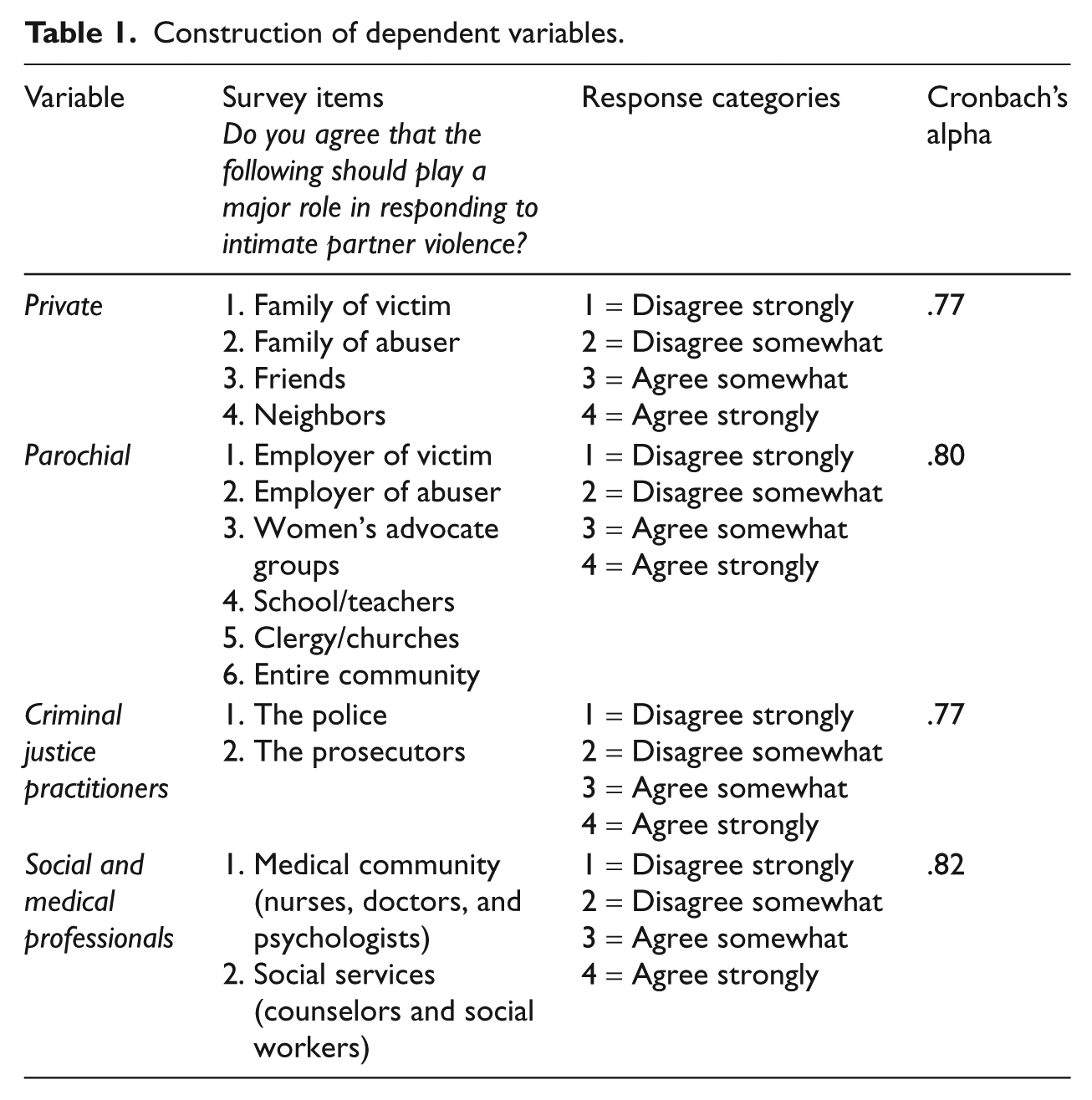
The dependent variables include four additive scales that indicate respondents’ attitudes toward the private, parochial, criminal justice, and social and health approaches to IPV, respectively. Table 1 displays a complete list of the items used to construct the scales. As shown by the Cronbach’s alpha, ranging from .77 to .82, all four scales have moderate to good internal reliability.
Construction of dependent variables.
The independent variables contain three groups: background characteristics, personal and vicarious experiences, and attitudes toward gender roles and violence. Background characteristics include country affiliation, sex, age, education, and growing up area. Country, sex, and growing up area were dummy variables with 1 representing Chinese, female, and urban area. Age was measured in years, and education was a five-category variable (1 = freshman; 2 = sophomore; 3 = junior; 4 = senior; 5 = graduate).
The second group, personal and various experiences, consists of four variables. The respondents were asked: ‘Have you ever had a romantic relationship that lasted more than two weeks?’, ‘Have you been a victim of a crime during the past two years?’, ‘Do you know anyone who has been a victim of intimate partner violence?’, and ‘Do you know anyone who has been arrested for intimate partner violence?’ (0 = no; 1 = yes).
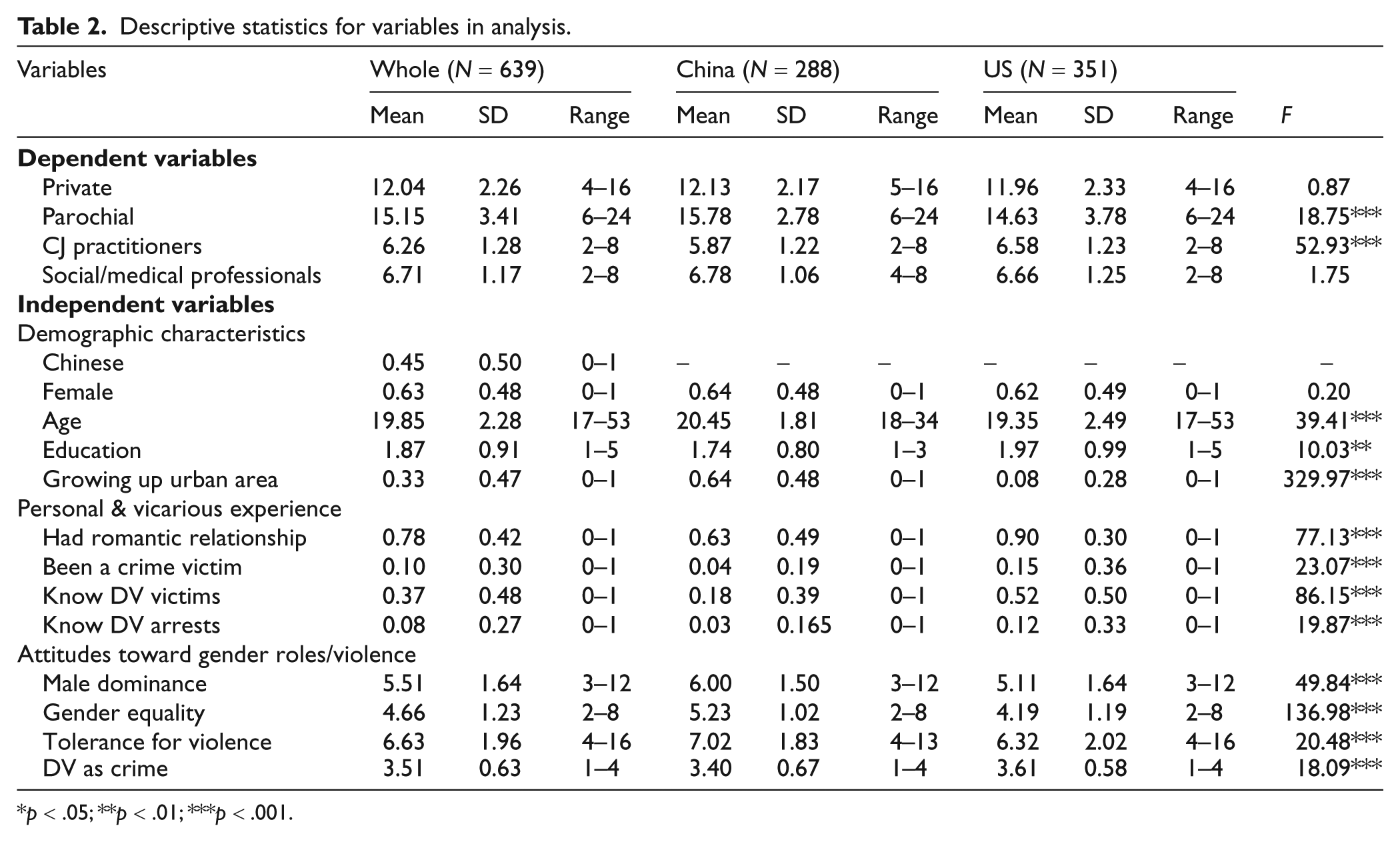
The final group comprises four attitudinal variables. The first variable, male dominance, was constructed by summing up three items asking the respondents if they agree that ‘Sons in a family should be encouraged more than daughters to go to college’, ‘There are many jobs in which men should be given preference over women’, and ‘A woman should not expect to go to the same places or have the same freedom as men’. The second variable, gender equality, was an additive scale derived from two items asking respondents if they agree that ‘Discrimination against women is no longer a problem in the US/ Hong Kong’, and ‘Society has reached the point where women and men have equal opportunities for achievement’. Both scales have a Cronbach’s alpha of .60, indicating acceptable reliability. The third variable, tolerance for violence, was measured by adding up four items: ‘Violence is justified if a partner insults’, ‘Violence is justified if partner cheats/commits adultery’, ‘Society should expect couples occasionally have minor physical fights’, and ‘A husband may beat his wife if she is unreasonable and starts the argument/fight’. The Cronbach’s alpha associated with the scale is .77. The last variable was obtained from a single item asking the respondents whether or not they agree that ‘Domestic violence should be viewed as a crime’. The responses to all above attitudinal questions include four categories: strongly disagree (1), disagree (2), agree (3), and strongly agree (4). Table 2 displays descriptive statistics for all variables used in this study.
Descriptive statistics for variables in analysis.
p < .05; **p < .01; ***p < .001.
Compared to American students, Chinese students were slightly older, lower in class status, and more likely to grow up in urban areas. Chinese students are less likely to have had a romantic relationship, be a crime victim, know an IPV victim, know an IPV arrestee, or view IPV as a crime, but more likely to agree with the notion of male dominance and be more tolerant of domestic violence.
Analysis
Frequency distribution, reliability test, mean comparison, and multivariate regression analysis were used in this study. Frequency distribution was employed to describe students’ responses to all the items that measured support for different responses to intimate violence. Reliability test was conducted to assess the internal consistency of all the items that were used to construct the private, parochial, criminal justice, and social/medial approaches to domestic violence. Mean comparison was utilized to compare Chinese and American students’ support for the different approaches to handling IPV as well as their demographic profiles, personal and vicarious experiences, and attitudes toward gender roles and violence. F-values were reported, indicating the ratio of the variance between groups to the variance within groups. Finally, ordinary least squares (OLS) regression was employed to examine the effects of all independent variables on students’ preference of different approaches to IPV. OLS was chosen because the dependent variables were continuous variables. Assumptions for OLS, including homoscedasticity and normality, had been checked and none were violated.
Results
Mean comparison of preference
As shown in Table 2, Chinese students were more likely than their American counterparts to support a parochial response and less inclined to favor criminal justice approach in handling domestic violence. Meanwhile, the differences in Chinese and Americans’ preferences for private intervention and interventions by social workers and medical professionals are not statistically significant.
Order of preference for intervention
Table 3 reports the order of preference for IPV intervention by Chinese and Americans. Medical community and social services are ranked top two among Chinese students. American students also gave high preferences for the same group, ranking them as the second and third choices, respectively. Family of victims is perceived by students from both countries as important for handling IPV, ranked first by American students and third by Chinese students. However, perceptions of the role of family of abusers and police officers in tackling IPV are distinguishable between the two samples. While Chinese students were more inclined to believe that family of abusers can take a major role (ranked fourth for Chinese and seventh for Americans), American students were more in favor of the police intervention (ranked fourth for Americans and eighth for Chinese).
Percentage distribution and rank of institutions preferred to handle IPV.

Factors influencing preference for intervention
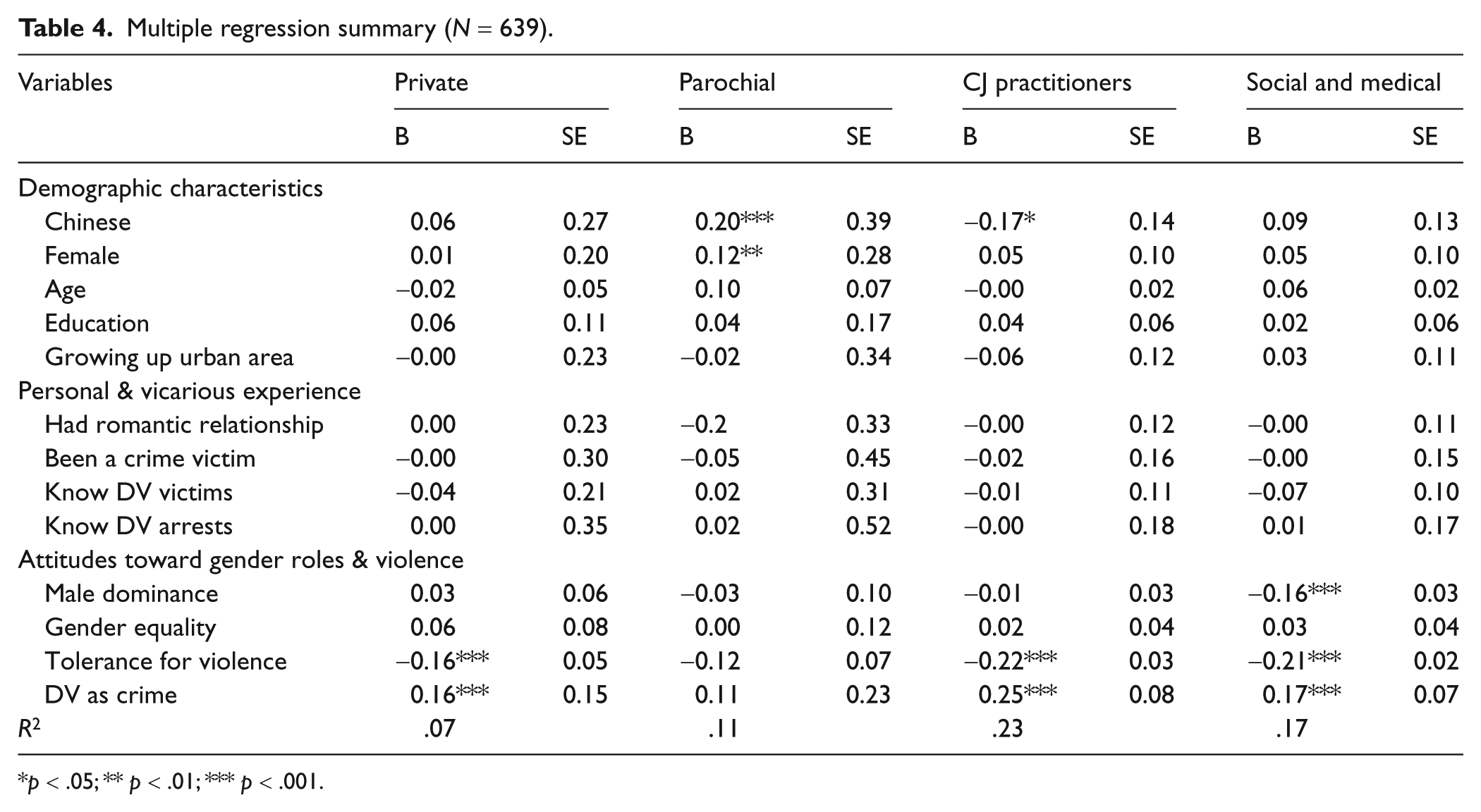
Table 4 reports on the results from our ordinary least squares (OLS) analyses in an effort to uncover the effects of the independent variables on public preference for different kinds of intervention. Results showed that students’ preferences for parochial and criminal justice responses to IPV were predicted by country affiliation. Consistent with the findings from mean comparison, Chinese students were more in favor of the parochial response but less supportive of the criminal justice response to IPV than their American counterparts.
Multiple regression summary (N = 639).
p < .05; ** p < .01; *** p < .001.
Only one background characteristic, sex, exerted a significant effect, with female students more likely than male students to favor the parochial response to IPV. None of the experiential variables predicted the preference of respondents.
Students’ attitudes toward gender roles and violence shaped their preferences for responses to IPV. Those who agreed that domestic violence is a criminal offense would prefer interventions by criminal justice professionals, social and medical practitioners, and family, friends, and neighbors. Conversely, students who had more tolerance of violence were less supportive of these responses. In addition, students who endorsed male dominance were less likely to believe that social and medical professionals should play a major role in responding to IPV.
Discussion
This study found that Chinese and American college students are distinguishable in their attitudes toward who should handle IPV incidents, with Chinese supporting neighborhood-based approaches while Americans favor legal interventions. Our findings echo recent arguments that individualist Western societies tend to handle domestic violence through legislation against offenders and various service programs to victims, whereas collectivist societies, especially those with patriarchal traditions and strong emphasis on informal social control, still view such incidents as personal and family problems rather than social or legal concerns (Haj-Yahia and Sadan, 2008). It should be borne in mind that collectivism, including collectively endorsed patriarchal ideology, also exists in individualist societies to a certain extent. Wife abuse, for example, was considered as a family concern until the women’s movement evocated protection through legal reform to safeguard battered wives’ individual rights and safety. Respondents’ sex, tolerance for violence, recognition of domestic violence as a crime, and male-dominance attitude were also found to affect their perceptions of who should play a major role in handling IPV.
While IPV has been widely recognized as a serious social problem throughout the world, policy-makers should be cautious about policy transfer from one country to another as policy ideas and practices, such as criminal justice intervention, may be perceived and received very differently by citizens in China, even though these policies and practices are supported by empirical evidence from the US. Bearing this caution in mind, these results offer several implications for IPV policy and practices in both China and the US.
First, results of this study suggest the need to increase the legitimacy of legal interventions in Chinese societies. Compared to their American counterparts, Chinese students were less supportive of a criminal justice response. Indeed, Chinese citizens tend to have a more skeptical view of the formal criminal justice system (Wu and Sun, 2009). Victimization surveys in Hong Kong revealed that only 35.5 percent of victimizations entailing physical injuries were reported to the police in 2005. The reasons for not reporting included the perceptions that the ‘police would not do anything’ and the ‘police could not do anything’ (Census and Statistics Department, 2007). Further investigation is needed to identify the incentives and obstacles for people to seek help from legal authorities to deal with domestic violence, making reference to the social contexts of both societies. For example, extending the scope of the Domestic Violence Ordinance to require police officers to make mandatory arrests in domestic violence cases could be considered in Hong Kong. Preparation in forms of training and operational manuals for police officers should be guaranteed before its enactment.
Second, results also suggest the importance of advocating individual rights of abused women and changing the male-dominance mentalities. Our findings indicate that respondents with male-dominance attitudes were less likely to perceive the necessity of seeking help and intervention from social and medical professionals. Hong Kong students were found to have a higher level of male-dominance thinking, reflecting a largely male-dominated tradition in China. Therefore, efforts to promote gender equality and to empower women are of particular importance in Chinese societies, although the collectivist (Haj-Yahia and Sadan, 2008) and ‘face-saving’ cultures (Chan, 2006) constitute the potential barriers to such an endeavor. Nevertheless, social workers should treat abused women as independent identities instead of just ‘wives’ or ‘mothers’ of someone else, and attend to their rights and needs. Meanwhile, male batterers should receive some help to release themselves from masculine gender role stress (Chan, 2006). On the other side of the coin, the helping professionals can make good use of the ‘face-saving’ culture – reminding the male batterers not to initiate domestic violence as that may be likely to bring them a poor reputation in the community. This issue may be particularly salient in a community with high collective efficacy, including strong natural surveillance.
Third, our findings also suggest the promotion of parochial support in the US communities. This study found that Americans were less likely than Chinese to favor the parochial response to IPV. Promoting collective efficacy through enhanced social ties among kin, friends, and neighbors in the community is fundamental in preventing IPV (Chan et al., 2009). Specifically, developing a sense of community, cultivating local residents’ commitment to tackle community problems, formulating an action plan for solving the problems, and improving access to resources for actualizing the plan are the fundamental steps for building collective efficacy in a community (Chaskin, 2001). To achieve these steps, collective effort by the NGOs, legal authorities and local grassroots organizations should be available.
Finally, social workers in Chinese societies need to focus on developing the neighborhood-based approach to handling IPV, such as promoting gender equality through community education and mobilizing social resources and supportive networks to take care of vulnerable population. Social workers in the US may have to work closely with legal authorities in delivering more corresponsive criminal justice intervention, such as victim support programs and community policing strategies. In addition, gender-specific intervention is of great importance to social workers in both societies. Nevertheless, as a result of globalization, a single society has become more diverse in terms of its culture, race, and ideology, and social workers also need to remain critical and reflective of their practices (Fook, 2002). Truly, there is no silver bullet for the problem.
Limitations associated with this study, along with their implications for future research, should be acknowledged. First, while Hong Kong has been a part of China since 1997, its legal system, official policy, and police response regarding IPV are not entirely identical to those in Mainland China. Thus, findings of this study may not be generalized to residents of other parts of China. Future studies can examine whether residents from different parts of Mainland China differ in their attitudes toward various responses to IPV. Second, while college students have been widely used in research on public opinions of social and political issues, findings based on convenience, student samples may not be generalized to the general population. More research using randomized, non-student samples should be conducted to explore attitudes toward IPV intervention across countries.
Third, the cross-sectional data used by this study means that the results only uncover the association, rather than the causation, between the independent and dependent variables. Finally, the theoretical model that this study employed to explain college students’ attitudes toward IPV intervention has a weak to moderate explanatory power. Future research should continue to explore predictors of public preference for responses to IPV that are both theoretically meaningful and statistically strong.
Footnotes
Acknowledgements
The authors gratefully acknowledge the three anonymous reviewers for their valuable comments on an earlier version of this article.
Funding
This research received no specific grant from any funding agency in the public, commercial, or not-for-profit sectors.