




Abstract
This study aimed to uncover the influential factors of community participation in a rural poverty alleviation programme in Malaysia. A quantitative approach was used, and data were collected through a self-administered survey questionnaire from 260 respondents of the Iban community in Malaysia. The study considered 22 influential factors (18 as independent variables and 4 as dependent variables) to measure the level of community participation in decision-making, implementation, benefits sharing and evaluation. The study explored how these influential factors interacted with participation in a rural poverty alleviation programme. The results found a diversity of interacting factors within the forms of participation at the implementation level. The article contributes a dynamic and multi-dimensional understanding of how influential factors shape community participation processes. The findings are an important indicator to policy-makers and development practitioners.
Introduction
The concept ‘community participation’ has been considered as an important aspect in rural poverty alleviation. The main objective of this participation is to empower the people in the community. Participation is a complex issue, and this is particularly true in rural poverty alleviation programmes, where a number of multiple factors interact within the entire participation procedure. Malaysia has made a notable progress in a number of areas of economic and social development. The country enjoys a relatively high standard of living and atmosphere of social harmony in a multi-racial society. Nevertheless, there remain many economic and social problems and there is much work to be done (Economic Planning Unit, Malaysia, 2014). Malaysia achieved real progress from its Sixth Plan (1990–1995). The incidence of overall poverty in Malaysia was reduced from 17.1 percent in 1990 to 9.6 percent in 1995, surpassing the Sixth Plan target of 11.1 percent. During the Sixth Plan, the focus of anti-poverty programmes was directed at the hard-core poor. The efforts to eradicate hard-core poverty were spearheaded by a special programme known as the ‘Development Programme for the Poorest’. As a result, the incidence of hard-core poverty in Malaysia decreased from 4 percent in 1990 to 2.2 percent in 1995. According to the Tenth Malaysia Plan (2011–2015), the poverty rate further declined to 3.8 percent. Out of 6.2 million households in Malaysia, 228,400 are the poor households and their average monthly income is RM800 (equivalent to US$258) (Tenth Malaysia Plan, 2011–2015).
The efforts in poverty alleviation continue to mitigate the number of poverty cases to 2 percent in 2015 so as to realise the intention to make Malaysia a developed and a high-income country by the year 2020. The government utilised this poverty line in assessments of the minimum consumption and requirements of an average-sized household for food, shelter, clothing and other non-food needs (Haque et al., 2014; Hatta and Ali, 2013). The government implemented various programmes and projects towards poverty alleviation among rural and agricultural households. The poor people participated and benefitted from projects such as the Integrated Agricultural Development Project, the provision of agriculture infrastructure, replanting schemes, land consolidation and rehabilitation, and support services. In addition, greater employment opportunities from off-farm and non-farm activities are helping to increase the income of poor households (United Nations, Malaysia, n.d.).
Despite the fact that the statistics has shown a steady decline from one year to another, incidences of poverty continue to plague the Bumiputera (sons of the soil). Compared to other ethnic populations in Malaysia (e.g. the Chinese and the Indians), the poverty rate among the Bumiputera, especially the Malays, is still the highest recorded. The poverty incidence is more severe among the minority Bumiputera, especially those of the minority in Sarawak (e.g. the Iban, Bidayuh, Melanau and Orang Ulu) (Madeline, 2003). According to Madeline et al. (2006), 36 percent of the Iban community were living under the poverty line as compared to the Malays at 16.5% and the Chinese at 4.3%. The process of poverty alleviation in Malaysia has been a multi-tiered one, involving village leaders at the bottom, and the federal, state and Cabinet (Parliament) at the top. The government, non-governmental organisations (NGOs) and state-based Poverty Eradication Foundation have voluntarily been involved in helping to reduce poverty in Malaysia (Economic Planning Unit, Malaysia, 2014). The objective of this study was to measure the level of community participation among the Iban community in Sarawak, Malaysia, in a poverty alleviation programme named the People’s Welfare Development Scheme (PWDS). The study investigates the influential factors of community participation in decision-making, implementation and benefits sharing.
Literature review
This article uses two main concepts, namely, community participation and rural poverty. The discourse of participation has become the common denominator of action for development agencies in a global world (Islam, 2014a, 2014b; Islam and Morgan, 2012; Islam et al., 2013; Tembo, 2004: 1025). Participation is considered an important component for securing community people’s decision-making and equitable opportunities (Islam, 2014a, 2015; Islam et al., 2013). It must not be seen as a short-term or casual involvement of people; rather, it is a ‘social experience shared by individuals and groups, who live in economic and social relations to each other in a society’ (Malki, 2006: 54). It is a pre-requisite to collective action (Mondal, 2000: 463) and an integral element of economic improvement and social change efforts. The community workers should work on assessing community feelings through their active participation and then transform these into constructive community action plans (Islam and Morgan, 2012; Islam et al., 2013; Malki, 2006: 52). In community participation, the participatory plan of the NGOs is most useful to improve local people’s confidence, traditional attitude, experience and skills (Islam et al., 2013). It is helpful to justify and verify their thinking within institutional arrangement. More participation within an institutional arrangement decreases individual fears, apprehensions and limitations on the one hand, and increases ‘social mobility’ towards social empowerment on the other (Islam, 2014a, 2014b; Islam and Morgan, 2012). Lyons et al. (2001: 1233) mentioned that participation has a significant effect on development, which Friedmann (1996) calls ‘socially sustainable conditions’.
Poverty is a multi-dimensional social phenomenon. Definitions of poverty and its causes vary by gender, age, culture and other social and economic contexts. The World Bank (n.d.) mentioned that poverty never results from the lack of one thing, but from many interlocking factors that cluster in poor people’s experiences. Poverty is a deeply embedded wound that permeates every dimension of culture and society. It includes the sustained low levels of income for members of a community. It also includes the lack of access to services like education, markets and health care; lack of decision-making ability; and lack of communal facilities like water, sanitation, roads, transportation and communications (United Nations, Malaysia, n.d.). Furthermore, despair, homelessness, apathy and timidity are pervasive among members of a community affected by poverty (Bartle, 2007). Malaysia’s Poverty Line Income (PLI) is based on the minimum requirements of a household for three major components, such as food, clothing and footwear, and other non-food items, for example rent, fuel and power; furniture and household equipment; medical care and health expenses; transport and communications; and recreation, education and cultural services (United Nations, Malaysia, n.d.). For the food component, currently the minimum expenditure is based on a daily requirement of 9910 calories for a family of five persons, while the minimum requirements for clothing and footwear are based on standards set by the Department of Social Welfare for welfare homes. The other non-food items are based on the level of expenditure of the lower-income households, as reported in the Malaysian Household Expenditure Survey (HES). The PLI is calculated to reflect differences in prices and household size in Peninsular Malaysia, Sabah and Sarawak. Poverty rates, as measured using Malaysia’s PLI, differ from those implied by the 1 US$ a day (purchasing power parity) poverty line used by international organisations (United Nations, Malaysia, n.d.).
There is a wide range of literature which analysed mainly four types of community participation, namely participation in decision-making, implementation, benefits sharing and evaluation. The study considered a number of independent variables to justify the level of community participation in those four factors. These variables are socio-demography, socio-economy, knowledge, assumption, political support and local government support, power decentralisation, interactions with programme officer, physical environment, past experiences related to programme intervention and the satisfaction with the programme. The researchers did not find any published literature that included these four types of participation; rather, most of the literature partly covered some variables. A number of studies included the demographic and socio-economic backgrounds (e.g. Anyoha, 2011; Augustine and Paul, 2012; Awortwi, 2013; Tahmeena et al., 2010), knowledge (e.g. Bahaman, 1992; Haris, 2007) and assumptions (e.g. Alhaji et al., 2012; Haris, 2007) that have formed during the programme. Tahmeena et al. (2010) mentioned that socio-economic factors like occupations, income and educational level are directly linked with public participation in the development programme. This finding is also consistent with the study of Augustine and Paul (2012), who find farmers with larger farms, higher education level and higher income are more likely to take part in social organisations, as compared to those who have lower criteria in these socio-economic attributes (e.g. farm size, education level and income). Anyoha (2011) unravels a positive relationship between membership in local organisations and level of participation in development programmes. People actively engage with local organisations, and many of their members hold top-rank positions in the development organisations involved in decision-making at the implementation and evaluation stages.
A number of studies have investigated the administrative factor in community participation in development activities (e.g. political and the local government support, power decentralisation, interactions with programme officers). For example, Cohen and Uphoff (1977) and Cornwall (2002) argued that public participation in development programmes is not only influenced by the environment, but also decided by the institutional framework involved in the programme implementation. The degree of support from the political entities and local government (Haris, 2007), power decentralisation (Johnston, 1982) and interactions with programme officers (Allahdadi, 2011) have been identified as the primary elements influencing public participation in the development programme.
Power decentralisation is another influential factor in determining community participation in poverty eradication and development agenda. Decentralisation and participation are often assumed to relate positively to one another in development programmes (Asiyati, 2005). The implementation of power decentralisation permits locals to have their say in planning, decision-making, implementing and assessing the activities carried out on their home grounds. Allahdadi (2011) examined members’ participation in rural cooperatives’ activities. He found that the locals became involved more effectively in the scheme by interacting with administrative agencies and forming good and active relationships with local organisations. He reveals that among the reasons for low levels of participation of the members is the incapability of the members to interact with other members in their areas. Allahdadi and Aref (2011) argued that effective poverty eradication requires participation among the target group in order to ensure that they attend the programme and interact face-to-face with the local government agencies.
Other than the individual and administrative factors, the readiness of locals to get involved in the poverty eradication programme is also marked by influential factors. In the context of this study, the influential factors are divided into two elements, namely, one’s past experiences of anti-poverty programmes implemented by the government and one’s satisfaction with the delivery and receiving of the programmes. Cummings (1997) finds that past experiences that are related to one’s participation in a programme can impede the recipients from being involved in the programme. In considering the aforementioned literature, the main objective of this study was to analyse different influential factors of community participation in decision-making, implementation, benefits sharing and evaluation and explore how these influential factors interacted with the rural poverty alleviation programme.
The Iban community in Malaysia
The Iban community is part of the Sarawakian community of Bumiputera, which comprises the vast majority in the state of Sarawak. According to the last census, the total population in Sarawak was 579,900, and the Iban comprises the largest percentage (almost 34%) of this population (Department of Statistics, Malaysia, 2010). The majority of the residents still reside in the Rumah Panjai (or the longhouses) in some remote areas in this state, especially along the Rajang River. The riverbank areas have struck as the main choice for settlements and Iban’s longhouse constructions because the river has become the main medium for communication and transportation in the rural areas. At the Song District level, the Iban community’s settlement areas are divided into six main areas, namely, (1) Batang Rejang Hilir, (2) Batang Rejang Hulu, (3) Katibas Hilir and Musah River, (4) Tekalit, (5) Central Katibas and Bangkit and (6) Katibas Hulu (Figure 1). In terms of leadership, the community leader of the Iban community is always associated with the elderly. This older generation has the authority to make decisions on all aspects related to their community life. At the longhouse level, the community is led by the Tuai Rumah (head of the longhouse). The Tuai Rumah position is not confined to the men alone, as both men and women can be appointed as the Tuai Rumah (Komanyi, 1973). Despite this, it is rather difficult to come across a female Tuai Rumah among the Iban community. Every longhouse area in the Song district is led by a community leader known as the Penghulu (Chief). These chiefs, in turn, are headed by another Head known as Pemanca. At the time of this study, the position of Pemanca in Song was held by Pemanca Ak Geramong. A body that is formed at the longhouse level which assumes the role as a mediator in the community structure, to close the gap between the government and the people, is the Village Development and Committee Security (Jawatankuasa Kemajuan dan Keselamatan Kampung or JKKK). According to Maimunah (1990), JKKK is a channel through which information and government policy are relayed to the people. JKKK also promotes people’s participation in the development programmes. Every longhouse in the Song district has its own JKKK that is held accountable for safeguarding the residents’ affairs in their respective houses. The longhouse JKKK is often chaired by the Tuai Rumah and under whom Bureaus like the Education Bureau, Village Security Bureau, Cleanliness Bureau, Women Bureau, Financial Bureau, Sports Bureau, Recreation Bureau and Entertainment Bureau carry the responsibility of taking care of matters and affairs related to longhouses.
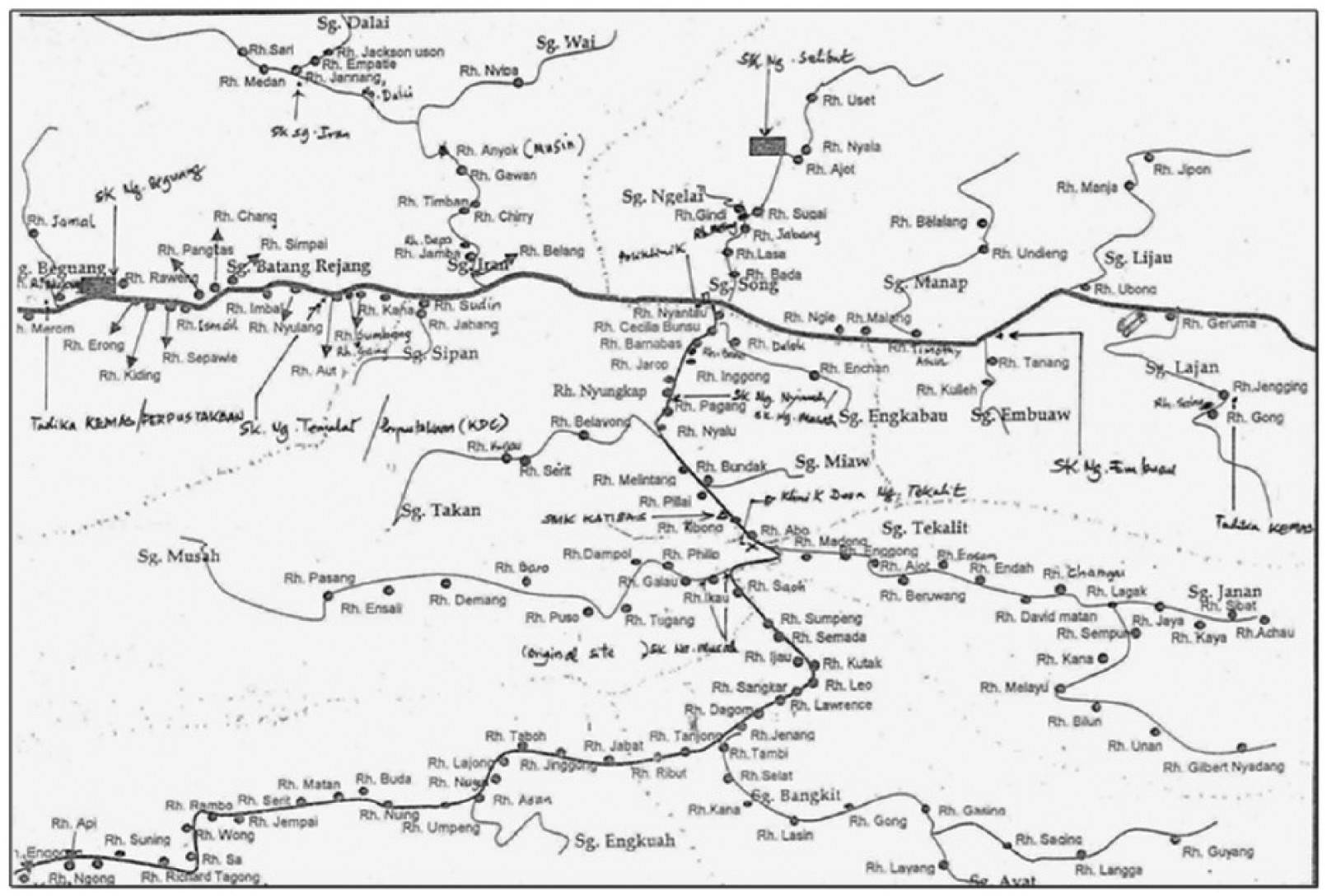
Longhouse locality in the study area.
This study was conducted in the Song district under the Kapit Division in Sarawak. Sarawak is the largest among the 13 states in Malaysia, and it is divided into 11 administrative divisions, namely, Kuching, Kota Samarahan, Sri Aman, Betong, Sarikei, Sibu, Kapit, Bintulu, Mukah, Miri and Limbang (Figure 2). Kapit has three administrative districts, namely, Song, Kapit and Belaga, which form the biggest part of Sarawak with a width of 38,934 km2. The Song district located in the Central Territory of Sarawak, which borders the Southern Kalimantan spanning 3935.20 km2, has become a joint district with Kapit, which was declared another administrative part of Sarawak on 2 April 1973 (Song District Office, 2009). Most of the area is hilly plateau that is still covered by the primary forests. Other than that, this district is also graced by the Rajang River, the longest river in Malaysia. There is the branching of the main rivers forming smaller ones like Batang Katibas, Song River, Iran River, Manap River, Lajan River and Lijau River that become the major connectors to most of the community settlement areas in Kapit. Its hilly nature explains the district’s non-existent land connection with other districts or divisions in the state. Several road construction projects are underway to enhance the communication network between this district and others in the state. However, this district is still connected via a waterway (Rajang River) using the express boat services that frequently travel from Sibu town to Kapit town. Travelling using an engine-boat from Sibu town to Song district takes 2 hours and another 1 hour from Song town to Kapit town. The flat hill-laden contour of the Song district has brought about many negative implications to the development in this district. Its geographical condition also seems to stall the development process initiated by the government. The government agencies, at either the central or state level, have to confront various obstacles so as to make the area prosper. Its scattered population pattern also contributes to the difficulty. Such a situation is synonymous with the backwardness and/or ignorance of the longhouse residents, especially in terms of benefitting from the facilities like the roads, public transport and communication services.
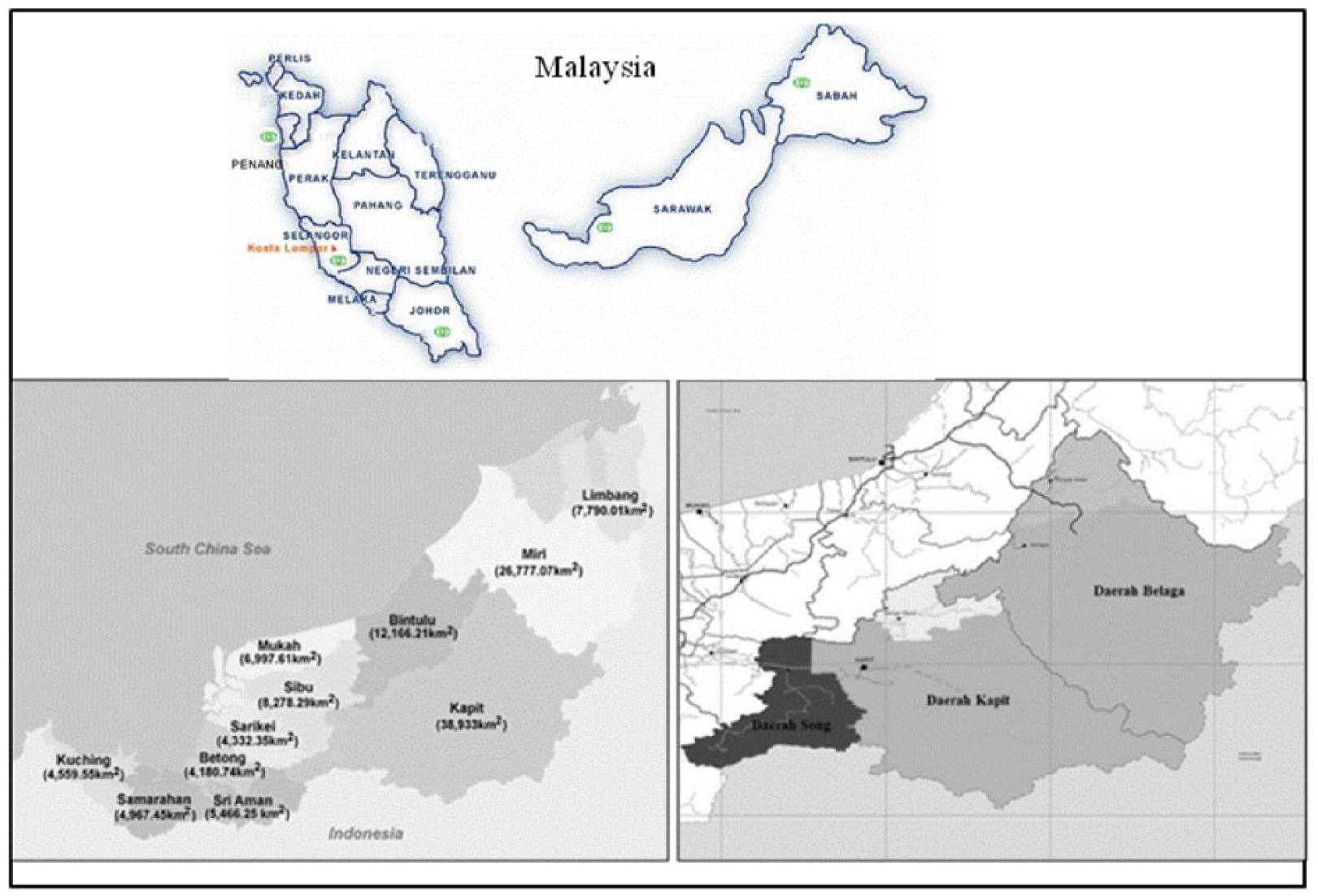
Maps of Kapit division and Sarawak state in Malaysia.
Study design and data
Main research approach
This study used a quantitative approach consisting of a self-administered survey questionnaire. A similar research approach was used by a number of researchers in their studies, such as Toros and Lasala (2015), Osei-Kufuor and Koomson (2014), Hoddinott et al. (2001), Rifkin et al. (2007), Siti Hajar et al. (2015) and Wahab et al. (2016). A self-report survey (Cantor and Lynch, 2000) was conducted to gather data on the three domains, namely, individual-self factors, factors related to administrative institutions and influential factors. This survey design was chosen because our study involved a large number of homogeneous respondents. It is an appropriate technique to determine individual opinions, attitudes, behaviours or experiences about social issues/social phenomena (Creswell, 2008). In addition, this is a proper means to get ‘honest’ feedback from the respondents (McLaughlin and Muncie, 2001).
Sampling and respondents’ profiles
The study was conducted in the district of Song, Kapit, Sarawak in Malaysia. In all, 260 respondents who served as the Tuai Bilik (heads of the family in the longhouse) were chosen using a simple random sampling technique. Three procedures were properly administered. In the first procedure, the researchers selected the longhouse area based on the geographical map provided by the district office. Generally, the longhouse areas in Song are divided into six divisions, namely, the Batang Rejang Hilir, Batang Rejang Hulu, Katibas Hilir and Sungai Musah, Tekalit, Katibas Tengah, and Bangkit and Katibas Hulu areas. Only three out of the six areas were chosen to participate in the study. They were randomly selected using the ‘lucky draw’ method. Consequently, three longhouses, namely the Batang Rejang Hilir, Batang Rejang Hulu and Katibas Hilir and Sungai Musah were chosen. The second procedure was to select the households from the representative longhouses in the areas of the Batang Rejang Hilir, Batang Rejang Hulu, Katibas Hilir and Sungai Musah. There were 82 longhouses in all three areas (30 in the Batang Rejang Hilir area, 24 in the Batang Rejang Hulu and 28 in the Katibas Hilir and Sungai Musah). The longhouse selection was determined by 10 percent on all three areas. The selection procedure was done randomly to make sure that every longhouse in the area had an equal chance to be selected as the subject of the study. A checklist of longhouses from the three areas was obtained and later placed into three special boxes, and the lucky draw exercise was performed. As the outcome, three longhouses were selected from each area. As Batang Rejang Hulu comprised 24 longhouses, only two longhouses were chosen to represent the longhouse. Having selected the longhouses, the third step entailed the selection of respondents from eight longhouses identified from the second stage of the sampling procedure. The Tuai Bilik, or heads of the family in the longhouse, were selected based on the list of the accommodation ‘rooms’ within the selected longhouses. In total, 260 heads were registered in the list. All of them were selected to participate in the study. Among the selected respondents, the highest age group was 51–60 years (39 percent), 86 percent were men and 89 percent were married. In household size, the highest 48 percent of the respondents were from four- to six-family-member households, 59 percent were illiterate and 59 percent had farmer as their occupation. Most of the respondents (70 percent) came from very poor families whose income was RM101–RM300 (US$25.25–US$50), and 57 percent of the respondents had no membership in any organisation. The profile of respondents’ details is presented in Table 1.
Respondents’ profile.
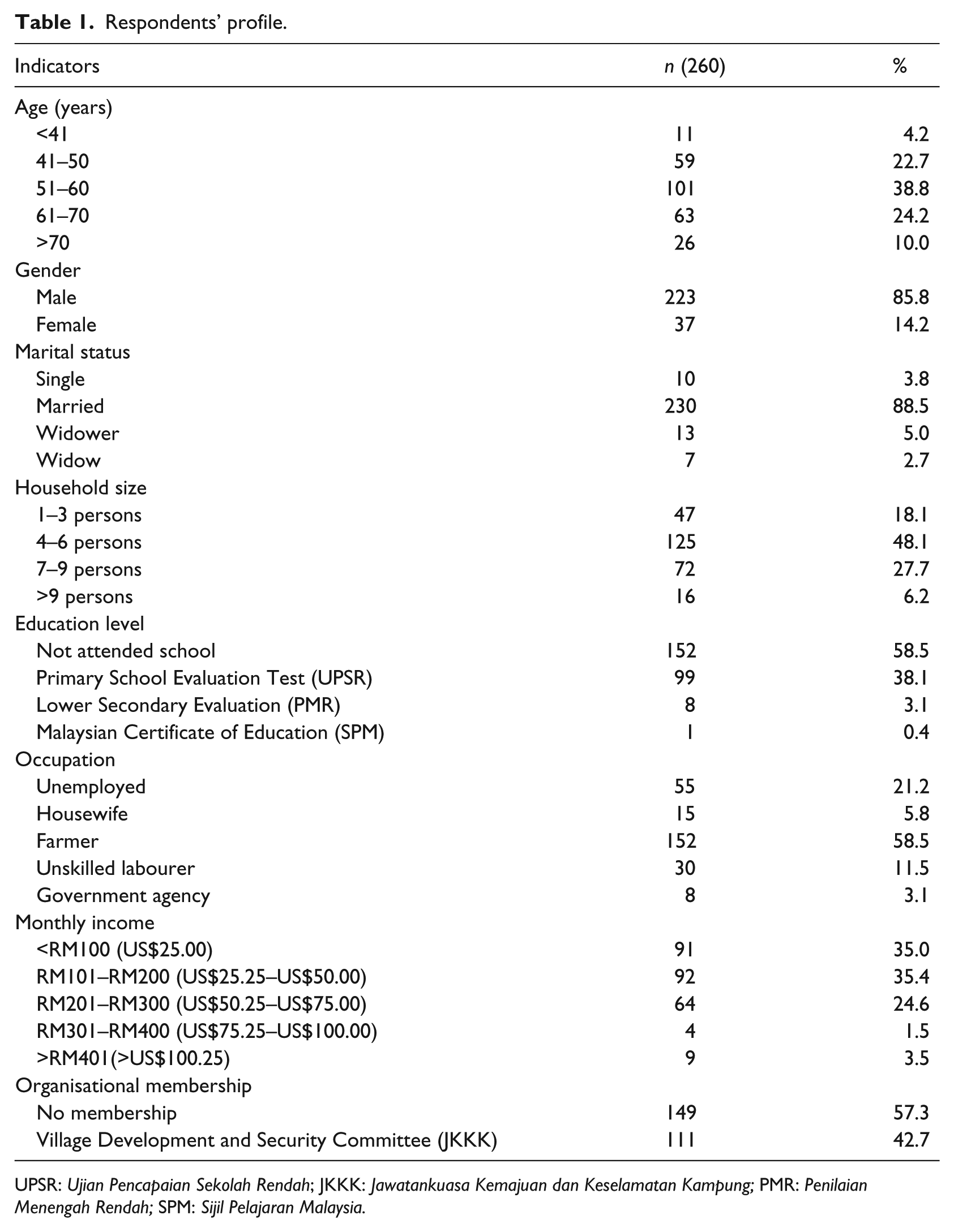
UPSR: Ujian Pencapaian Sekolah Rendah; JKKK: Jawatankuasa Kemajuan dan Keselamatan Kampung; PMR: Penilaian Menengah Rendah; SPM: Sijil Pelajaran Malaysia.
Data collection method and instruments
The researchers developed a self-administered structured questionnaire for this study consisting of 22 items (18 independent variables and 4 dependent variables) in addition to demographics. Toros and Lasala (2015) used similar items for their study. The questions were divided into two main sections. The questions in section A aimed to examine the participation of the Iban community in the PWDS. Indicators of their participation in the programme were carefully drafted based on four types of participation (proposed by Cohen and Uphoff, 1977), namely participation in decision-making, implementation, benefits sharing and programme evaluation. The questions in section B aimed to identify the independent variables (factors) that influence the participation of the Iban community in the PWDS programmes. These factors were divided into three, namely, individual-self factors (e.g. demographic backgrounds, knowledge and assumption), factors related to administrative institutions (e.g. political and local government support, power decentralisation and interactions with the programme officers) and influential factors (e.g. one’s experiences of involvement with anti-poverty programmes and one’s past experiences towards programme development). Data collection instruments were developed and modified based on the instruments used by Haris (2009) and Bahaman (1992) in their study. Apart from the five factors that were used by Haris (2009) or Bahaman (1992) (i.e. demographic and socio-economic background, knowledge, assumption about the programme, political support and power decentralisation), the researchers included three additional factors in order to ensure the justification of this instrument, namely interactions with programme officer, past experiences related to programme intervention and satisfaction towards programme. These three additional factors are significant in two ways. First, they are important to the stakeholders as well as the development practitioners in poverty alleviation. Second, they are significant indicators in community participation. A number of studies such as Islam (2014a), Islam (2014b), Islam (2015), Islam et al. (2013), Wahab et al. (2016) and Allahdadi (2011) showed that beneficiaries’ interaction with the staff members of the institution or NGOs, their past experiences related to programme interventions and their satisfaction towards poverty alleviation programmes are crucial for their effective participation.
Data measurement
The statements contained in the questionnaire form were measured based on the Likert scale. The questionnaire’s items consist of statements scored on a 5-point scale ranging from ‘strongly disagree’ (1) to ‘strongly agree’ (5). The questionnaire was constructed based on the three domains previously described, namely, individual self-factors, factors related to administrative institutions and influential factors. The researchers had broader experiences and understanding towards the surroundings, culture, customs and the tradition of the locales, especially involving the Iban community in the longhouses. Their skills in communicating in the Iban language made it convenient to approach and interview the respondents to obtain required data. The researchers provided a clear understanding about the study objective and explained the significance of the study to the participants. Among the respondents, those who were able to read and write (108) were required to complete a questionnaire that was distributed to them. The researchers did not influence the participants while they assisted respondents to complete the study questionnaire. Meanwhile, for the illiterate respondents (152), the researchers helped them read out the questionnaire to these respondents and allowed them to complete the questionnaires. There was no issue of bias in the data collection process.
Data analysis techniques: Reliability and validity
The researchers used a number of techniques to ensure the reliability and validity of the study findings. These included the following: (1) use of SPSS 16.0 for data analysis; (2) descriptive statistics of the sample (demographic items: participants’ age, gender and the length of work experience); (3) descriptive statistics (means and standard deviations [SDs]) for all items and domains; (4) reliability analyses of the data for each identified influential factors sub-construct (Cronbach’s alphas, reliability coefficient values obtained for each factor are the index between the ranges of 0.693 and 0.965); (5) a pilot test to ensure the reliability of the instrument; and (6) use of two statistical tools, namely the chi-square test and the multiple regressions for data analysis.
Research ethics
The researchers used the research ethics provided by the University of Malaya Research Ethics Committee (UMREC). The committee undertakes ethics review of all research involving human participants, including funded and unfunded research which is non-medical. The researchers submitted an application in a prescribed form with the research proposal and other relevant documents to the UMREC on 13 July 2014. Then, the UMREC examined the ethics components of this research, such as sound methodology, possible risks to the subjects, recruitment of subjects, consent from the subjects, confidentiality or anonymity for the subjects, the way in which the data were handled and how feedback could be provided for the subjects. The committee approved this on 27 July 2014. Prior to data collection process a consent form was sent, and the researchers obtained written permission from the Song District Office and Tuai Rumah (the head of the house). In the case of illiterate respondents, their verbal consents were taken before data collection.
Results
The chi-square analysis of the level of participation on independent variables
The study used 18 independent variables and four dependent variables related to participation, namely decision-making, implementation, benefits sharing and programme evaluation of the PWDS. Table 2 provides the results of the chi-square test. This analysis was utilised in order to determine the independent variables that come out as the strongest predictors of the types of participation of the Iban community in the PWDS. Based on the analysis of the chi-square test, it was found that in decision-making there were significant differences in the level of participation according to gender, marital status, household size, education level, occupation, income, land width, organisational membership, level of knowledge, level of assumptions about the programme, level of assumptions about the officer, political support, interaction with programme officers, past experiences related to programme intervention and the level of satisfaction with the programme (p < 0.05), but no significant differences with the age, land ownership and power decentralisation. In implementation, the significance differences were found in gender, marital status, household size, occupation, income, land width, organisational membership, level of knowledge, level of assumption about the programme, level of response towards programme officer, political support, power decentralisation, interaction with programme officer and the level of satisfaction with the programme (p < 0.05), but no significant differences with the age, level of education, land ownership and past experience. In benefits sharing, the significant differences were found in age, gender, household size, occupation, level of knowledge, level of assumption about the programme, political support, interaction with programme officer and satisfaction with a different programme, but no significant differences in marital status, education level, income, land ownership, land width, organisational membership, level of assumption about the officer, power decentralisation and past experiences related to programme intervention. In programme evaluation, the significant differences were found in most of the independent variables except land ownership, land width and past experiences related to programme intervention.
The chi-square test of the independent variables with level of participation
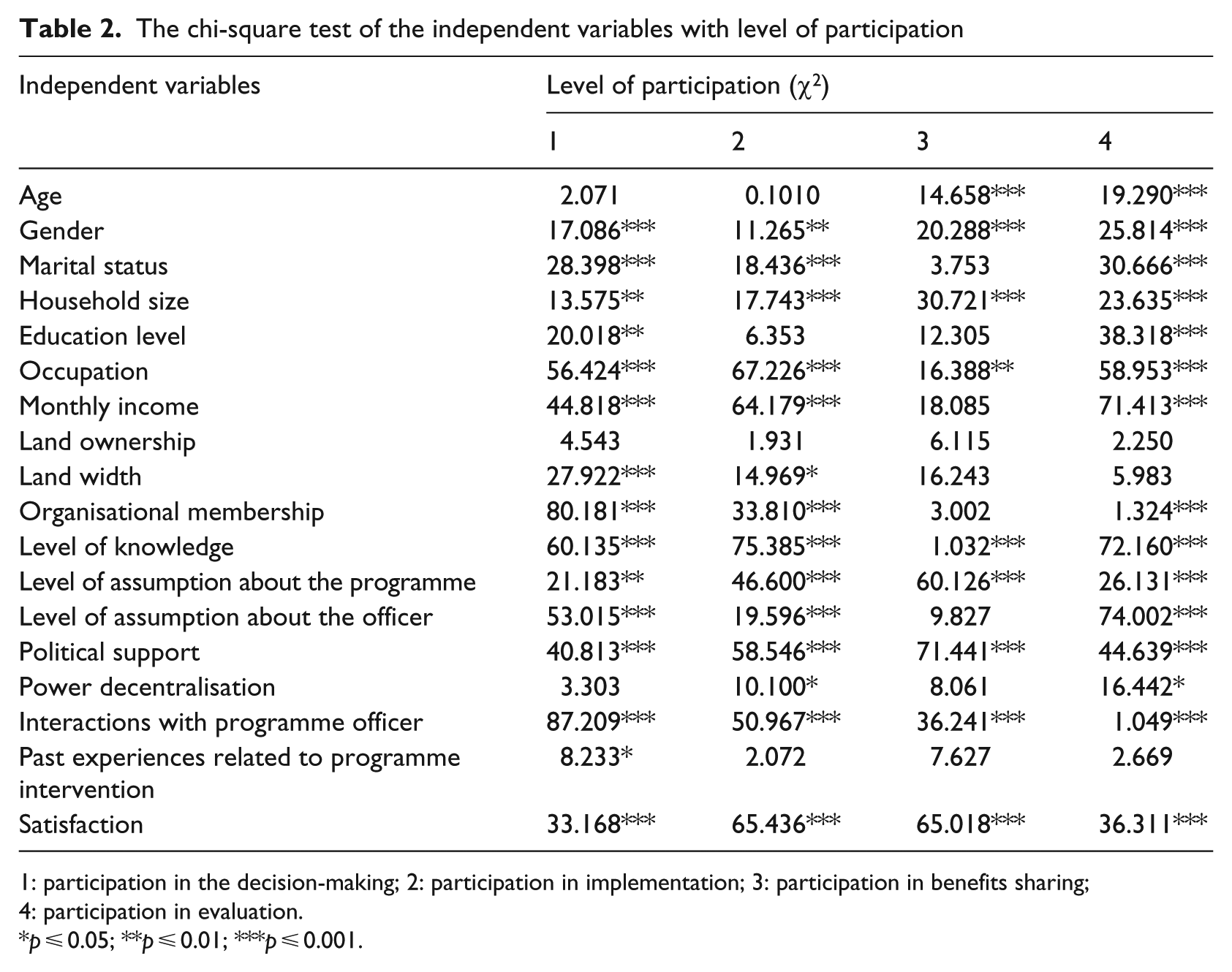
1: participation in the decision-making; 2: participation in implementation; 3: participation in benefits sharing; 4: participation in evaluation.
p ⩽ 0.05; **p ⩽ 0.01; ***p ⩽ 0.001.
The multiple regression analysis on the level of participation on independent variables
Table 3 presents the results of the multiple regressions which determined the relationship between the level of participation and independent variables. The result of the participation in decision-making shows the value of R = .773. There is a high correlation between the independent variables and the dependent variables. The adjusted value of R2 = .579 shows that 58 percent of the variance in the participation was jointly explained by the set of 12 independent variables used in the regression equation. Only seven variables, namely organisational membership (p = .000), interactions with programme officer (p = .000), income (p = .002), assumption about the programme (p = .006), land width (p = 0.021), assumption about the officer (p = .048) and past experiences related to programme intervention (p = .050), have been found to contribute significantly to their participation in the decision-making of the programme. The result of the participation in implementation showed the adjusted value of R2 = .463. This demonstrates that 46 percent of the variance in the participation was jointly explained by 11 independent variables used in the regression equation. The value of R = .697 shows a significant relationship between the independent variables and the dependent variables. The result shows that only two selected variables, which are the participants’ knowledge about the programme (p = .000) and their organisational memberships (p = .019), have been found to contribute significantly to their participation in the implementation of the programme. Meanwhile, nine selected variables, namely household size, income, land width, assumption about the programme, assumption about the officer, political and local government support, power decentralisation, interactions with programme officer and satisfaction towards programme, have been found to contribute insignificantly to the respondents’ participation in the implementation stage.
Multiple regression on the level of participation on independent variables

1: Participation in the decision-making R = .773, adjusted R2 = .579, F = 30.632, Sig. F = .000; 2: participation in implementation R = .697, adjusted R2 = .463, F = 21.296, Sig. F = .000; 3: participation in benefits sharing R = .635, adjusted R2 = .387, F = 24.358, Sig. F = .000; 4: participation in evaluation R = .844, adjusted R2 = .699, F = 51.102, Sig. F = .000.
The result of the participation in benefits sharing shows the adjusted value of R2 = .387. This means that 39 percent of the variance in participation is jointly contributed by seven independent variables employed in the regression equation. The symbol of R = .635 shows a significant relationship between the independent variables with the respondents’ participation in the benefits sharing of the programme. Out of seven independent variables, only four variables – knowledge (p = .000), assumption about the programme (p = .001), satisfaction towards programme (p = .027) and household size (p = .031) – have been significantly contributed to the participation in benefits sharing. Meanwhile, another three variables, namely respondents’ age, political and local government support and interactions with programme officer – have not contributed significantly to the participation in benefits sharing. On the other hand, the result of participation in the evaluation shows the value of R = .844. This demonstrates an imperative relationship between the independent variables and the respondents’ participation in the evaluation stage. The adjusted value of R2 = .699 implies that 70 percent of the variance in participation has been jointly contributed by 12 independent variables used in the regression equation. Only six variables, namely respondents’ age (p = .000), interactions with programme officer (p = .000), organisational membership (p = .000), knowledge about the programme (p = .000), level of income (p = .009) and level of education (p = .032), have a significant contribution to the respondents’ participation in the evaluation of the programme. Other variables, namely household size, assumption about the programme, assumption about the programme officer, political and local government support, power decentralisation and satisfaction towards programme, have not contributed significantly to participation in the assessment of the programme.
Discussion
The objective of this study was to uncover the influential factors on community participation in decision-making, implementation, benefits sharing and evaluation in a rural poverty alleviation programme. Based on a quantitative analysis, the study found a diversity of interacting factors within the forms of participation at the implementation level. The article contributed a dynamic and multi-dimensional understanding of how the influential factors were shaping within the community participation processes in the Iban community in Malaysia. This study presented some valuable aspects of community participation in rural poverty alleviation. The results showed that respondents’ interaction with the officers, respondents’ knowledge about the programme and their membership of the organisation were the main predictors that influence their participation in the anti-poverty programme. This finding is consistent with Allahdadi (2011). He found that the readiness of community members to cooperate and participate in the micro-credit schemes rested on how frequently they attended the interaction sessions conducted by the administrative agencies of the scheme, and the community effort in forming a productive and conducive relationship with their local organisations. This finding is also comparable to Allahdadi and Aref (2011). They showed that the face-to-face meetings that were held between the programme administrators and participants helped in determining the efficiency of poverty eradication initiatives among the stakeholders. During fieldwork, the researchers observed that the programme implementation agencies under the PWDS had a greater role as compared to the Iban communities at the longhouses. In this situation, it was observed that the implementing agency officers frequently visited the longhouses to obtain some feedback from the longhouse residents in order to develop the poverty alleviation programme. By contrast, the Iban community at the longhouses has been perceived as being more passive, withdrawing themselves from participating and merely depending more on the initiatives from the agencies.
Bahaman (1992) found that respondents’ participation in the project was in linear relationship with their level of knowledge in Malaysia. In this regard, Haris (2007) found that one’s level of knowledge concerning his or her participation is crucial in any anti-poverty programme. Here, the higher the level of knowledge of the programmes held by the participants, the more they were involved in the programme activities and/or agendas. Rahim and Asnarulkhadi (2010) proved that individuals who have certain knowledge on certain issues tend to have better awareness and understanding of a particular condition or issue related to their lives, and this subsequently influences their belief or faith in the issues or agenda. If the local community knows how to get involved or participate, they will then be inclined to choose to participate in the development activities at their free will and without any form of coercion from the implementing bodies.
Membership of the organisation was found to be the main factor of evaluation towards participation in the poverty alleviation programme in the Iban community. From this result, we can conclude that participation in the evaluation process tends to be higher when the Iban community sits more with the local organisations to converse the implementation of the development activities. Therefore, this study suggests that the efforts to increase participation of the Iban community in the programme evaluation encourage people in the longhouses to join more organisations directly or indirectly with the implementation of development programmes.
The researchers had some limitations in the study. The aim of this study was to explore the influential factors of community participation in a rural poverty alleviation programme in the Iban community in Malaysia. However, this finding is particularly true for this community, and it would be difficult to generalise that this would be equally true to all of the ethnic communities in Malaysia. Another limitation was that the researchers had very little ability to find out more detailed information on the level of participation on the selected independent variables. However, the researchers recognise that there were some other social aspects of the level of participation in the poverty alleviation programme that may have been missed due to the use of the quantitative method. The factors affecting community participation in most development programmes, especially the anti-poverty programmes, are numerous; however, this study only managed to look into some of these factors. Nonetheless, there are also other factors that may have a significant relationship with participation. For further study, researchers who intend to instigate the issue of participation in the Iban or any other community need to incorporate factors that have not been addressed in this study. One such factor that needs to be studied in an in-depth manner is leadership. For instance, the relationship between leadership style and the role played by the heads of the longhouse community (Tuai Rumah) and the heads of the society (Penghulu) with the degree of participation in the community development agenda needs to be explored in detail. In the same manner, an in-depth study should be conducted in order to evaluate the effectiveness of the Village Development and Committee Security (JKKK) at the longhouse level in supporting the implementation of the planned development programmes for the Iban community.
Study implications, recommendations and conclusion
As a whole, the analysis shows that the variables organisational membership, interactions with the programme officer, monthly income, assumption about the programme, land width, assumption about the officer and one’s past experience related to a programme have become the leading predictors of community participation in anti-poverty programmes among the Iban community. Therefore, it can be concluded that the level of participation of the Iban community in the anti-poverty programmes is high in situations where (1) the participants are members of local organisations which were appointed to manage and implement the anti-poverty programmes, (2) the participants meet constantly and communicate frequently with the personnel and the implementing agencies responsible for the programmes and (3) the participants with a higher monthly income participate actively in evaluation of the programmes, compared to participants with a low monthly income. The findings of the study also demonstrated that participants’ knowledge about the programme and their membership in local organisations contributed significantly to their participation in the implementation phase of the anti-poverty programme. The regression analysis highlighted that the level of participation of the Iban community in the programmes increased when (1) the participants understood and/or at least had general knowledge about the programmes and (2) the longhouse residents participated or joined more organisations directly or indirectly with the implementation of development programmes in the longhouse. The outcome of the analysis also shows that participants’ knowledge about the programmes, their assumptions about the programme, their level of satisfaction towards the programme and their household size contributed significantly to their participation in the aspect of benefits sharing.
The findings of this study have significant contributions to the policy-makers, development practitioners and international readers. The findings can be considered as important indicators of the researchers to investigate community participation in poverty alleviation in areas with similar socio-economic and political conditions. However, the researchers could argue that although this study has explored the level of participation in a particular poverty alleviation programme with a particular community, it might have some implications for other communities where the socio-economic and community conditions are similar. The findings may also give new input to the Malaysian government, the Ministry of Women, Family and Community Development, Malaysia and the NGOs. The Tenth Malaysian Plan (2011–2015) targeted five strategic thrusts. The third thrust, ‘moving towards inclusive socio-economic development’, and the fifth thrust, ‘building an environment that enhances quality of life’, have a direct association with community participation and poverty alleviation. The Vision 2020 in Malaysia identified nine challenges, 1 and all of these are more or less related to poverty alleviation and development (Islam, 2011). At the policy level, the government acknowledges that national unity would not be possible without a greater equity and balance among Malaysia’s social and ethnic groups. The most important task is to secure people’s participation in the development of activities through accelerating and reconciling economic and social reformations. Thus, a turning point ought to be defined in terms of per capita gross domestic product, poverty incidence, as well as poverty inequality.
From the social work perspective, the researchers claim that this study includes an important aspect of community development. Poverty alleviation through community participation and community empowerment is one of the important interventions in social work. As the International Federation of Social Workers (IFSW) mentions, its recent global social work definition is that social work is a practice-based profession and an academic discipline that promotes social change and development, social cohesion and the empowerment and liberation of people. The principles of social justice, human rights, collective responsibility and respect for diversities are fundamental to social work. The aim of social work intervention is to address life challenges and enhance human wellbeing (IFSW, 2014). In general, many aspects of these interventions, such as promoting social change and development, social cohesion, empowerment and liberation of people, collective responsibility, humanities and indigenous knowledge, respect of diversity, and life challenges and human wellbeing, are closely related to these findings. This research explored a number of important factors of community participation in decision-making, implementation, benefits sharing and programme evaluation. The results clearly show that the increase in interaction between staff members and beneficiary groups, the increase in knowledge among beneficiaries, their leadership capacity and their level of satisfaction with the programmes are important in order to increase community participation. All these can be valuable indicators to the social workers who are involved in community development field.
To sum up, the researchers have a number of specific recommendations for the study implications. First, the study has shown that the Iban community in Sarawak is still behind compared to the other ethnic communities in Malaysia. The study presented some important aspects on the level of community participation among the Iban community in Malaysia. However, these findings will give some input to national policy, particularly towards the aim of greater equity and balance among Malaysia’s social and ethnic groups. Second, this study has clearly highlighted some influential factors that contributed to the increase in the level of participation of the Iban community. In addition, the study has explored some challenges and advantages of community participation. However, this study has some further policy implications; the government will consider these to implement poverty alleviation for the Iban community in future. Third, the findings can offer some new ideas to social workers at both government and NGO levels in order to promote social change and development, empowerment and human wellbeing. This is particularly important to the Ministry of Women, Family and Community Development, Malaysia. Finally, the study has illustrated some areas for further studies that will give some new insights to the researchers to assist in conducting further research in the field of community participation and poverty alleviation.
Footnotes
Acknowledgements
The researchers acknowledge the Song District Office and Tuai Rumah (the head of the longhouse) for their permission to conduct this study.
Funding
The author(s) received no financial support for the research, authorship and/or publication of this article.