




Abstract
This study aims to develop a scale for measuring professional social work values with particular relevance to the Chinese context. The Chinese social work values scale consists of five dimensions, including basic rights, social responsibility and justice, self-determination, mutual care, and potential for change. The findings of this study indicate that the Chinese social work value system has minor differences in specific constructs and in the ranking order of value dimensions from Western models. Empirical evidence further demonstrates that fair recognition is given to each dimension by Chinese social workers, though generally with less commitment to social work values.
Keywords
Introduction
Social work ethics refers to a set of belief systems that social workers have about the essence of humanity, human society, and the human environment, which are closely related to social work missions and goals (Reamer, 1998). Scholars believe that social work values are the source of social work skills, and this essential value base is credited with laying the foundations for the profession and allowing for technological advancement (Goldstein, 1973; Nimmagadda and Cowger, 1999). Social work ethics is the soul and lifeline of social work (Pi, 2009; Xu, 2002), exerting an immediate influence on the theoretical and conceptual concerns of the subject, as well as on the development of social work practice (Reamer and Abramson, 1982; Wei and Li, 2007; Zhao, 2012).
Reamer (1999) stated that the development of the social work profession is affected by social work ethics in four aspects: first, social work industry types and professional missions; second, relationships of social workers with clients, colleagues, and members of society; third, social work intervention models; and finally, solutions to ethical dilemmas in social work practice.
The debate on social work values in China has been taking place for a long time. Some scholars and social work practitioners have questioned whether the core values of social work are consistent with Chinese culture and socialist core values. If they are not, is it suitable for China to develop social work that is rooted in Western Christian culture and values? Social work was abolished as a study major in China in 1957 due to college adjustment and was not reinstated until the late 1980s. Despite social work in China being reconstructed 30 years ago, the question of whether it has built its own professional value system still remains. What are the similarities and differences between this system and the Western version? The aim of this study is to investigate this knowledge gap with an empirical study.
Literature review
Despite differences in their definitions of social work values, researchers have generally agreed upon some aspects of the core values which constitute the foundation of the social work profession. These aspects encompass dignity, self-determination, personal development, and human potential on the individual level, as well as broader social values including service, responsibility, justice, and so forth. The core values prescribed in the US National Association of Social Workers (NASW) code of ethics comprise service, social justice, dignity and worth of the person, importance of human relationships, and integrity and competence (NASW, 1996). Meanwhile, the core values in the British social work ethics code consist of human rights, social justice, and professional integrity (British Association of Social Workers [BASW], 2012). Furthermore, the core values of Hong Kong’s ethics code, as developed by the Social Work Registration Administration, include helping others, respect, self-realization, human rights and welfare, well-being of citizens, personal and social progress, and interpersonal relationships (Li and Jingshu, 2014). Likewise, the China Association of Social Workers has pronounced service, social justice, dignity and worth of the person, importance of human relationships, integrity, and competence as core values of the social work profession (Zhao, 2016). It is thus suggested that all of these organizations have approached the profession from an intrinsically identical perspective.
Several attempts have been made to develop instruments to assess social work values. Varley’s (1963) four-dimension scale and McLeod and Meyer’s (1967) 10-dimension scale were largely based on conceptual identification, though without a solid empirical basis. A methodologically more complex attempt was made by Howard and Flaitz (1982), who developed the Social Humanistic Ideology Scale; however, they identified several drawbacks, including the small size and limited representativeness of the sample, and made suggestions for further improvement in terms of factor analysis and structural validity. Aiming to address the methodological concerns of previous research, the Professional Opinion Scale (POS) (Abbott, 1988) was developed and modified several times in empirical validation tests (Abbott, 1988, 1995, 1999). The four-dimension scale has been acknowledged as a methodologically sound and reliable instrument for measuring degrees of commitment to social work values and has been widely adopted in social work research in China. In close relevance to this study, a six-dimension scale was constructed by Kam et al. (1997) and was empirically validated as a reflection of the social work value system in Hong Kong.
Although there have been various attempts at revealing the essential elements of social work practice, most have been made by researchers in the West or in Hong Kong. Researchers in mainland China seem to be more interested in general theoretical discussions of social work values, with a special focus on contextualizing Western models in the Chinese setting. As a result, there is a paucity of quantitative research that aims to operationalize and consolidate the theoretical findings.
Methodology
This study was conducted in two stages. First, we modified and improved the draft scale on the basis of the empirical validation test results. The revised scale was then used to measure the value commitment of social work students and practitioners from higher education institutions and social work organizations in Shanghai, China. Descriptive and explanatory data analyses were conducted to establish a general picture of the professional value system of social work practice in mainland China.
Constructing a Chinese social work values scale
With reference to existing social work values developed by different countries, experienced academics in the social work profession were consulted to judge the validity and relevance of the dimensions and the constructed items, and a new social work ethics scale was developed. Items inconsistent with Chinese culture, such as issues of euthanasia, abortion, and the death penalty, were deleted. A preliminary version of the scale comprised 80 items within six dimensions: basic human rights, mutual care, social responsibility, social participation, potential for change, and freedom of choice. Items were rated on a 5-point Likert-type scale ranging from Strongly disagree (1) to Strongly agree (5).
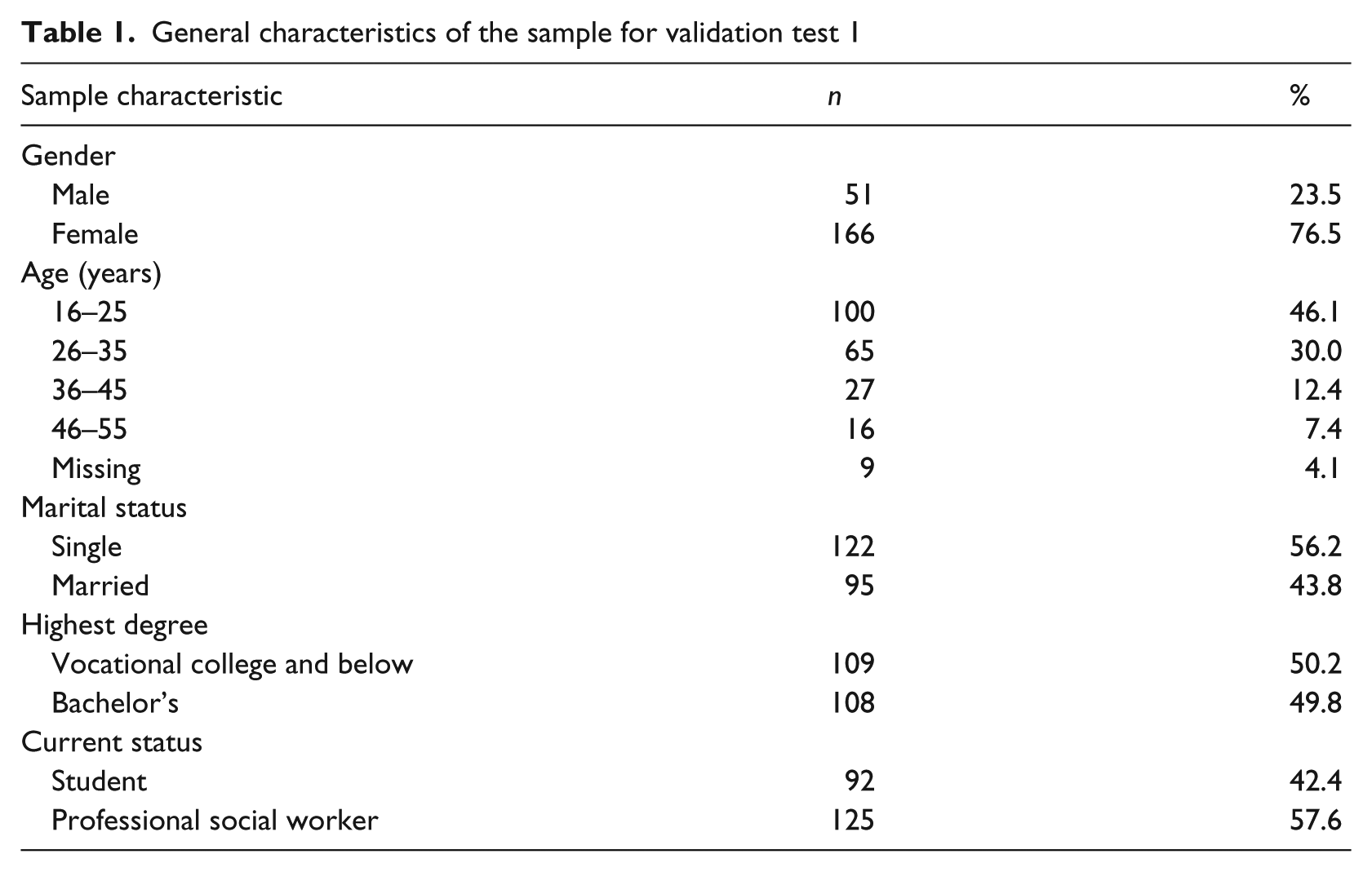
Two rounds of pilot tests were administered to validate the internal consistency and factorial structure of the scale. Categorical sampling was conducted in three different kinds of universities and social work institutions in Shanghai. Invitation to participate in the project, consent form, and questionnaires were sent to them by researchers in person. Students in social work departments of National 985 Project universities, National Project 211 universities, and general universities were invited to participate in the study. 1 Meanwhile, front-line social work practitioners from private non-enterprise social work institutions, hospitals, and communities were also asked to fill in the questionnaires. The first validation test was based on data from social work undergraduate students and social work practitioners in Shanghai. The sample size for the first reliability test and factor analysis was 217 (see Table 1). However, in the absence of a stable item structure, the result of the factor analysis was not satisfactory, suggesting that revision was needed. First, factors with low item–total correlation were deleted and then items with low factor loadings (less than 0.3), using principal components factor analysis with oblique rotation, were also deleted. In addition, participants were interviewed for feedback and for suggestions on the possible deletion or revision of unclear or ambiguous items. The resulting revised scale was composed of 67 items sorted into five dimensions.
General characteristics of the sample for validation test 1
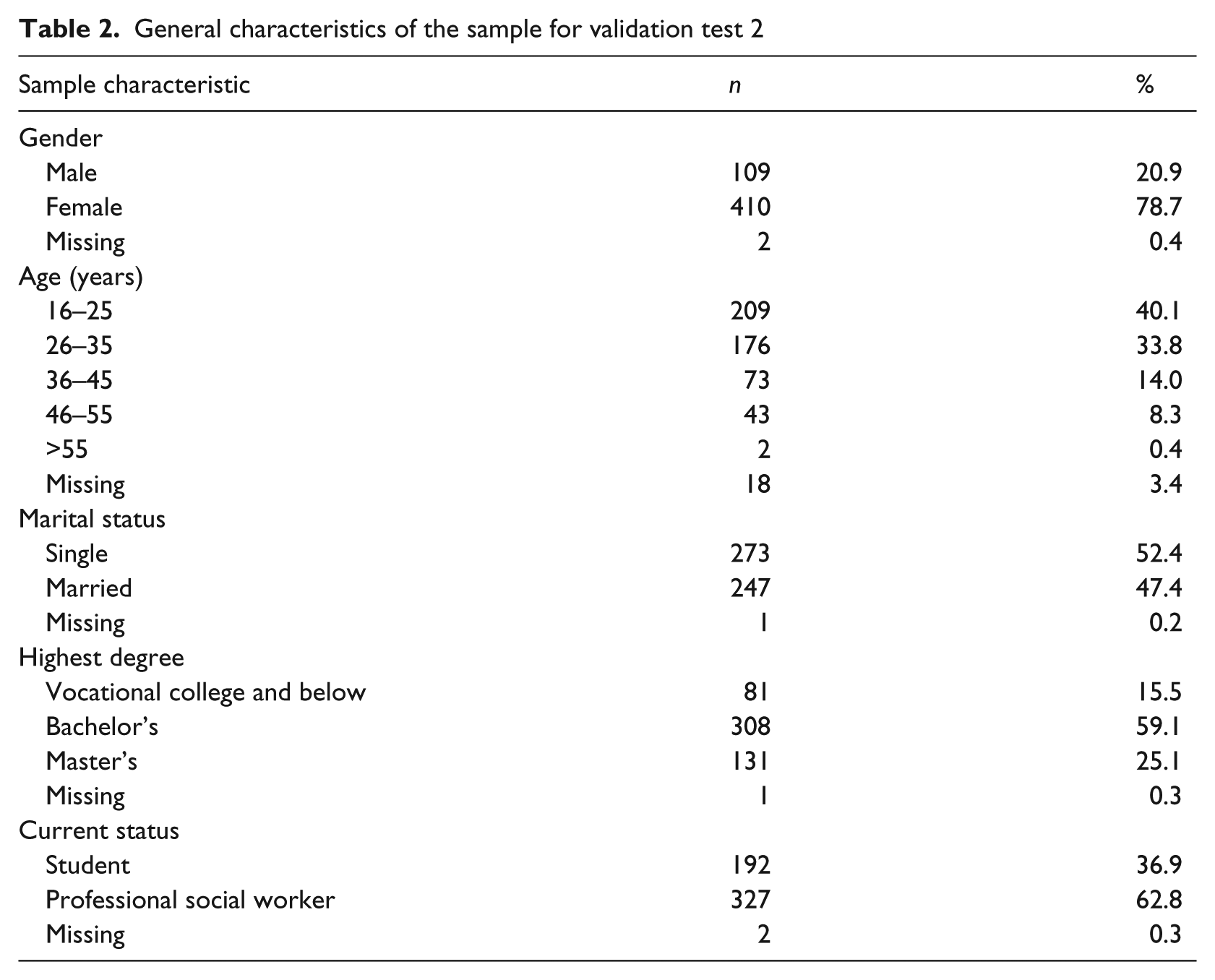
The second round of validation testing was conducted with social work students and social work practitioners in Shanghai, with a sample size of 521 (see Table 2). For better stability of the factor structures, identical factor analysis procedures were carried out to further reduce the number of items to 40.
General characteristics of the sample for validation test 2
In order to confirm structural validity of the scale, the criterion of the Kaiser–Meyer–Olkin (KMO) measure of sampling adequacy was adopted to examine sampling adequacy (Kaiser, 1974), and the Bartlett test of sphericity was employed to check the inter-independency of the identified dimensions (Bartlett et al., 1937). The sample sufficiency KMO index was 0.816, indicating that the scale was suitable for factor analysis. In addition, the supposition test of sphericity using the Bartlett test was rejected due to level of statistical significance, with a chi-square of 2137.255 with 780 degrees of freedom. This suggested that the factor analysis was satisfactory; hence, acceptance for conducting factor analysis of the scale was ascertained.
Therefore, after examining the validity and reliability of the initial scale, a five-dimension model was created. Principal components factor analysis with oblique rotation showed that the cumulative probabilities were 35.2 percent, with uniformly high factor loadings on the items in each dimension.
The overall reliability analysis of the scale was Cronbach’s alpha = 0.815, suggesting that the reliability of the overall scale was quite satisfactory, with acceptable levels of internal consistency for further research.
Measuring value commitment of social work students and practitioners
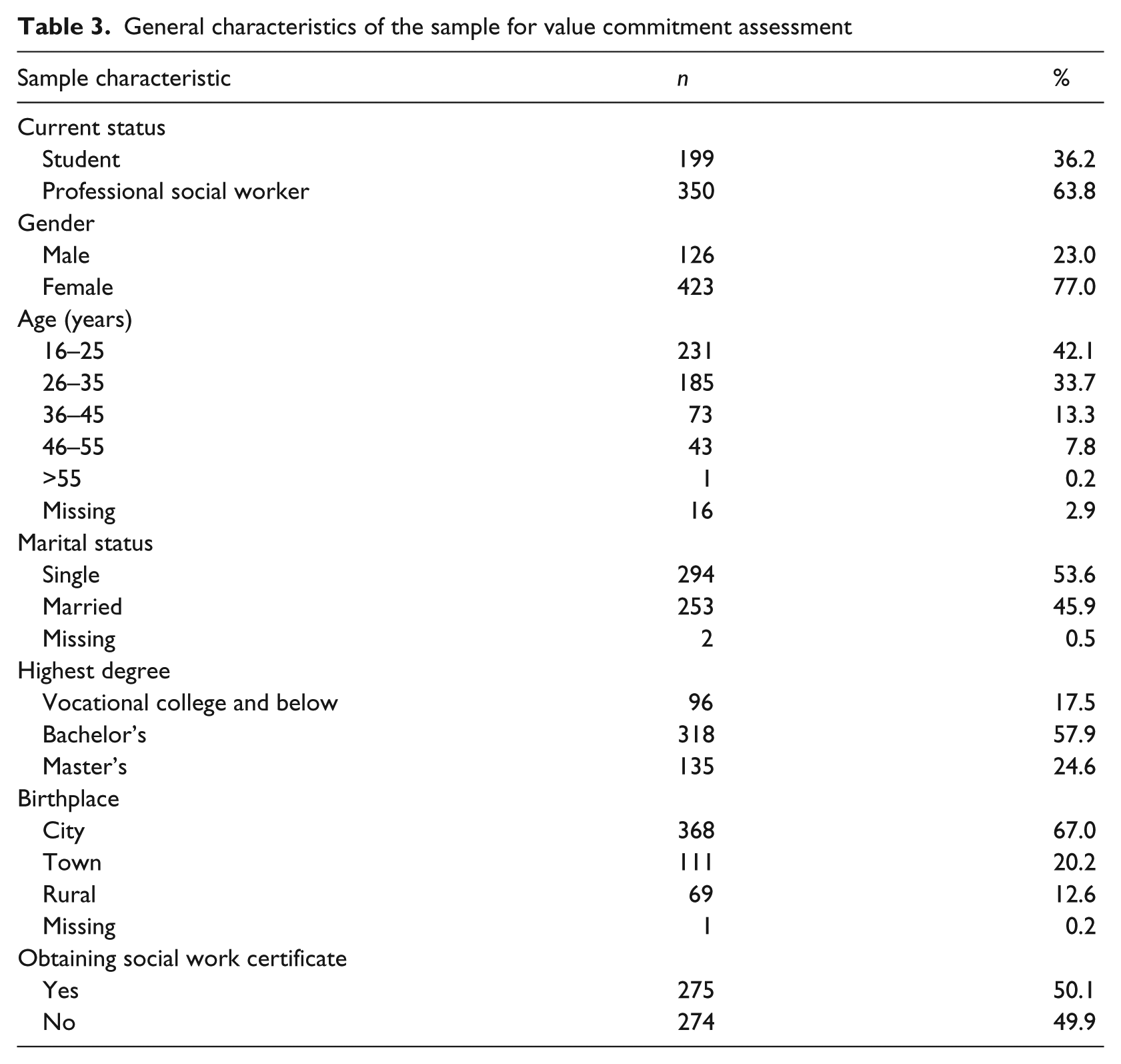
To further test the relevance of the values assessment scale, categorical sampling was also conducted within three kinds of social work organizations and institutions in Shanghai to measure acceptance of the conceptualized values among social work practitioners and students. The sample included four social work organizations and two higher education institutions that offer diploma and degree social work programs. Invitations to participate in the survey, along with consent forms and questionnaires, were sent to all the employed practitioners and registered students. Among the 634 questionnaires distributed, 553 were returned, yielding a response rate of 87.2 percent. The number of valid questionnaires after screening was 549 (see Table 3).
General characteristics of the sample for value commitment assessment
Findings and discussion
To sum up, three rounds of data collection were conducted, and 1287 students and social work practitioners participated in the study. Specifically speaking, 483 participants were college students and 802 were front-line social work practitioners. Moreover, 286 were male and 999 were female with ages ranging from 16 to 60 years. In total, 689 participants were single and 595 were married. As for their educational level, most participants who responded to the survey had a Bachelor’s degree (N = 734), and 286 participants had a vocational college degree and below.
Dimensions of professional social work values in mainland China
In various cultural contexts, attempts to specify components of social work value systems have been made using detailed descriptions of value orientations. Targeting the underlying professional social work values written in the NASW Public Social Policy Statements, the POS (Abbott, 1988) identified four distinctive factors, which were ‘respect for basic rights, sense of social responsibility, commitment to individual freedom (social justice) and support of self-determination’ (Abbott, 1999). Another study (Kam et al., 1997), in examining the perceived social work values of Chinese students in Hong Kong, indicated six dimensions involved in a social work values scale, comprising human worth, potential for change, mutual care, societal responsibility, social participation, and freedom of choice. To more accurately describe the value orientation of mainland Chinese social workers, this study adapted a scale to fit the Chinese context and tested it with two separate samples. It should be noted, however, that in constructing a scale relevant to the Chinese mainland context, some culturally loaded items of Western social work value scales, such as those concerning the death penalty, abortion, and elderly care, were removed due to low relevance.
Five dimensions were identified in the factor analysis and, based on previous literature on the conceptualization of social work values, were labeled as follows: respect for basic rights, social responsibility and justice, self-determination, mutual care, and potential for change (see Table 4). From a comparative perspective, the construct of a mainland Chinese social work value system coincides largely with Western models, but resembles the Hong Kong value system more closely.
Factor loadings for items making up the five value dimensions

Negatively worded items were reversely coded in the data analysis.
Commitment to social work values
The study shows that fair recognition was given to the conceptualized social work values by social work students and professionals, with a mean score of 3.74 (on a 5-point Likert scale). This result lends support to the optimistic view held by some Chinese researchers (Huang, 2007, 2013; Jiang, 2010; Liu, 2004; Liu and Zhou, 2006; Wang, 2010a; Wei and Li, 2007; Xu, 2002) that social work values are largely compatible with both Chinese traditional culture and contemporary social value system and thus can be naturally assimilated in the Chinese context. It further confirms the assumption that social work values transcend cultures, as indicated in Abbott’s (1999) study on social work practitioners from 26 countries that revealed shared value orientations in four aspects, comprising respect for basic rights, sense of social responsibility, social justice, and self-determination.
The average score obtained in the current study was 3.75 (Table 5). These findings may suggest that, on average, the commitment of social work students and professionals to acknowledge social work values in mainland China is not high. Such a paucity of recognition may be attributed to the degree of professionalization in social work practice in mainland China. Compared with the century-long history of social work practice in the United States, this study is circumscribed at a time when social work was only introduced to mainland China three decades ago. With a considerably longer history, the social work profession in the United States probably receives better recognition from its practitioners than it does in mainland China, where social work practice is still in its infancy. In a similar vein, Abbott’s (1999) cross-cultural survey revealed that Asian social work practitioners show a significantly lower degree of commitment to social work values than their US, European, and Australian colleagues.
Mean scores of the overall scale and sub-scales by social work students and practitioners

M: mean; SD: standard deviation.
From an ideological perspective, social work value orientation is viewed as truthful reflection of historical, political, social, economic, and cultural aspects of society (Nimmagadda and Cowger, 1999; Pincus and Minahan, 1973; Rokeach, 1973; Segal, 1993). In a cross-cultural study on professional values of US and Turkish social work practitioners, Feldman (1971) found that while US social workers attached more significance to individual value, freedom, and diversity, Turkish practitioners tended to view social control and homogeneity as prominent professional values. The existence of cross-cultural difference received more empirical evidence from a study conducted in Korea (Canda et al., 1993), which showed that the deeply-seated influence of the traditional philosophies of Confucianism, Buddhism, and Shamanism contributed to an ideological inclination toward collectivism, resulting in a lower degree of regard for social welfare and service than in Western societies. In the case of mainland China, such differences can also be spotted in social work value orientation, in that collectivist culture, the subsumed individual identity, worth and status in relation to the family and society, as well as interpersonal relationships, all contribute, in varying degrees, to the specificity of the social work value system (Huang, 2007; Tian and Liu, 2008; Wang, 2010a). The current research reveals that, among the five dimensions of social work values, mutual care and respect for basic rights have the highest degree of recognition, followed by self-determination, social responsibility and justice, and potential for change. Differences are detected in the ranking order of the sub-scales when compared with research findings in the United States (Abbott, 1988, 1999) and Hong Kong (Kam et al., 1997). 2 These differences can be reasonably explained if factors such as inheritance from traditional culture, social structure, development of the social work profession, and the social welfare system are taken into consideration.
The sub-scale of mutual care received the highest ranking among the five dimensions, with an overall mean score of 4.0. Items under the mutual care scale mainly concern issues like neighborly care and assistance provision to the impoverished and the vulnerable. In contrast to the prevailing ideology in Western societies, which highlights individualism and independence, individuals in the Chinese context are inter-dependent and connected, which is consistent with the Confucian belief that one shall always find him/herself in the midst of connections (Sun, 2009). As such, traditional cultural values continue to exert influence on the mainland and beyond, and it is not surprising that this tendency was also found in the Hong Kong study (Kam et al., 1997), where social work students were found to be most receptive to the value of mutual care.
The second-ranking sub-scale, slightly lower than the mutual care sub-scale, was basic rights, which had an overall mean score of 3.97. Considering that previous research conducted in Western contexts has ascertained that respect for basic human rights ranks highly – mostly in first or second place – among the dimensions of social work values (Abbott, 1998, 1999), this finding is probably indicative of the fact that respect for human life and acts of dignity are cross-cultural common foundations of social work values (Jiang, 2010; Liu, 2004; Xu, 2002).
Self-determination ranked third among the five sub-scales, with an overall mean score of 3.75. This ranking is compatible with the results from the US survey, while it diverges from the findings of the Hong Kong study. While the US social work practitioners in Abbott’s (1999) survey showed the highest degree of commitment to self-determination, the Hong Kong student participants in Kam et al.’s (1997) study attached the lowest significance to freedom of choice. Many Chinese scholars have suggested that self-determination ought to be the least recognized value dimension and is also the one most likely to give rise to ethical conflicts (Dai and Liu, 2009; Fei, 2002; Luo, 2003; Shen, 2012; Wang, 2010b). Recognition of self-determination by social work students and professionals may be affected by such impediments as negligence of individual rights, collectivism, paternalism, and uncritical reliance on authority. However, self-determination was given a middle ranking among the five value dimensions in this research, suggesting that the students and professionals involved generally acknowledge individuals’ freedom of choice.
The fourth-ranking sub-scale, as the findings indicate, was sense of social responsibility and social justice, with an overall mean score of 3.60. This value aspect highlights government accountability and social service and social welfare, the elements of which are markedly inconsistent with the realities of Chinese society. The reason for such discrepancies can be traced to differences in the prevalent societal ideologies nourished by distinctive traditional cultures. In traditional Chinese culture, the obligations and responsibilities of the individual are placed ahead of those of the society, thus an overt emphasis is placed on the instrumentality and self-sacrifice of the individual (Chen, 2004). Instead of enjoying the benefits of services and rights, individuals are expected to fulfill their obligations and responsibilities. Typical Chinese society relies on the skeleton of ‘individual-family-society’, in which the family serves as the nucleus, and the close tie between the individual and his/her family provides the foundation of society. The individual is basically empowered by his/her connection with their family. Even with a weakening role in modern Chinese society, family still acts as the major provider of social welfare. The role and accountability of the government are thus undermined with social welfare and social service being overlooked, while family becomes the place where one can seek power and assistance. This prevalent ideology is revealingly evidenced by wide acceptance of the statement ‘It is the responsibility of the family rather than the government to take care of the aged’ (Item 36) in the constructed scale. The impact of collectivist culture has also been substantiated in Korea, where a significantly lower degree of acceptance of social welfare and social service was reported than that of Western cultures (Canda et al., 1993). Another reason for the under-recognition of social welfare and service in mainland China is the common misunderstanding of the reciprocal nature and cooperative role of these practices, worsened by the sluggish development of the welfare system and its gloomy prospects of positively benefiting the nation’s economic growth. With lukewarm enthusiasm for endorsing social justice and responsibility, it is assumed the general public will consequently attach less significance to these values. This runs contrary to the findings of the study with Hong Kong students, who gave a higher ranking to the sub-scale of social responsibility and justice (Kam et al., 1997).
With a mean score of 3.32, the sub-scale of potential for change ranks the lowest among the five dimensions. Apart from the lack of recognition of individual rights and power in traditional Chinese culture, the development of social work practice in mainland China may also have contributed to this aspect being underrated. Dissimilar to Western models, social work practice in mainland China takes a unique path, with government playing a dominant advocating force. This results in a number of clients involuntarily receiving help from assistance providers, who would normally assume a central role in the service. This practitioner-oriented practice often results in social workers being negligent of the initiative and potential of their clients, approaching clients and conducting service in accordance with his/her personal value system. Moreover, the social welfare service in mainland China is mostly realized in the unitary form of social assistance, which has, to some extent, misguided general public opinion and attitude toward vulnerable members of society, thus rendering the potential for development and change virtually non-existent.
It should be noted, however, that the ranking of the self-determination sub-scale is reported to be higher than that of the potential for change sub-scale; this finding is contradictory to the tenet of self-determination. That is, self-determination holds the client to be in possession of the capability and right to make choices in accordance with his/her needs and their reality; hence, it should be closely intertwined with the aspects highlighted in the potential for change dimension, with the latter functioning as an indispensable prerequisite for belief in the freedom of choice. In this study, while the participants did not highly regard the potential for change dimension in the value system, they showed a generally better acceptance of the self-determination dimension. This seemingly confusing result is reflective of social work students’ and practitioners’ perceptions of the significance of individuals’ potential for change, that is, freedom of choice would be less well recognized if general acknowledgment of individuals’ potential for change was not high. Conversely, belief in clients’ abilities and their potential for self-development is only available when their freedom to make life choices is recognized.
Conclusion
As it has been widely acknowledged that social work values lay the foundation for sustainable development of the profession, research efforts to unveil the nature and features of social work values in the Chinese context are of significant pertinence to the professionalization of social work practice in China.
The study first attempted to explore the constructs of the Chinese social work value system, and in a comparative analysis, with reference to Western models, revealed the similarities and differences between Chinese and Western social work value orientations. It was found that the social work values identified by students and practitioners in mainland China primarily consist of five dimensions: basic human rights, social responsibility and justice, freedom of choice, mutual care, and potential for change. This value system is intrinsically congruent with Western models and is also in accordance with research findings in the Hong Kong context. Nevertheless, minor differences are found to exist in terms of specific constructs and in the order the value dimensions are ranked. For instance, particular attention has been attached to mutual care in the Chinese context.
Based on a five-dimension social work value scale validated to fit the Chinese context, a further attempt was made to evaluate the degree to which mainland social work students and practitioners commit to conceptualized values. Despite persistent efforts to examine the potential influence of culture on social work values, there remains a lack of consensus on the issue. Scholars with a relatively conservative and suspicious attitude toward the contextualization of social work in China tend to believe that social work values are embedded in the Christian culture and value system and are thus incompatible with the Chinese cultural tradition. Others, with a more positive stand, however, argue that there is an underlying common core of social work values that transcend cultural boundaries. In this study, the humanitarian beliefs of traditional Chinese culture are found to accord with the universally relevant elements of social work values. Empirical evidence of this study further demonstrates that Chinese social work students and practitioners give fair recognition to each dimension, though with a comparatively lower degree of commitment than their Western counterparts.
This study is limited in some aspects, including insufficient representativeness of the sample, poor validation of the scale, and potential influencing factors involved in the regression model. Before more generalized conclusions can be drawn, larger and more varied samples from different social work training institutions and organizations should be procured, allowing for a more comprehensive picture of social work values in mainland China. Further validation of the scale should include drawing more empirical evidence from reliability testing and confirmatory factor analysis to further modify and refine the items in each sub-dimension. To account for other potential factors that may exert influence on social work value orientation, and to improve the current model, future research may also include variables in stepwise regressions that are different from those selected here (demographic data, identity, education, professional education, and practice).
Footnotes
Declaration of conflicting interests
The author(s) declared no potential conflicts of interest with respect to the research, authorship, and/or publication of this article.
Funding
This work was supported by the research fund of the School of Social Development and Public Policy at Fudan University.