



Abstract
A considerable empirical research has been conducted on sexual exploitation of children and adolescents; however, limited information is available in developing countries. This study describes and discusses the prevalence, nature and characteristics of sexual exploitation of adolescents using data collected from 1116 secondary school students in Tanzania. Results indicate that 21 percent of the surveyed adolescent students had had at least one experience of sexual exploitation. Being a female, living in rural areas and being aged above 15 years were associated with high risk of sexual exploitation. This study underscores gender- and locality-specific social work interventional requirements, with emphasis on interdisciplinary collaborative efforts.
Introduction
Sexual exploitation of children and adolescents has emerged as a global concern for decades and has drawn the attention of the international community. The first World Congress Against the Commercial Sexual Exploitation of Children was held in 1996 in Stockholm, Sweden; the second Congress was in 2001 in Yokohama, Japan; and the third Congress was in 2008 in Rio de Janeiro, Brazil. They all addressed concerns about sexual exploitation of minors. The first Congress clearly defined that commercial sex with minors and similar phenomena are child abuse. Sexual exploitation of children and adolescents is a serious crime that violates the rights of the victims. It infringes on the social well-being and health of the victims. Children and adolescents in Tanzania are no exception. Cases of sexual exploitation of children and adolescents in Tanzania have appeared in several studies (e.g. Andersson et al., 2012; International Labour Organisation [ILO] and International Programme for the Elimination of Child Labour [IPEC], 2001; Kisanga et al., 2013; Lalor, 2004; McCleary-Sills et al., 2013; McCranna et al., 2006; Silberschmidt and Rasch, 2001; United Nations Children’s Fund [UNICEF], 1999, 2003). Research has shown that approximately one out of three females and one out of five males have been victims of child sexual abuse (UNICEF, 2003).
Children and adolescents are not meant to satisfy the sexual needs of adults. Using them for the sexual satisfaction of adults is rape, a crime of power and an abuse (Densen-Gerber and Hutchinson, 1979), and sexual exploitation is one of the most destructive forms of abuse (Barnitz, 2001). Children and adolescents have continued to experience this kind of abuse from adults for decades (Tyler and Stone, 1985). In short, sexual exploitation has remained a critical social, human rights and health problem at local and international levels. While research has indicated that efforts are required to address and mitigate the plights of sexually exploited children and adolescents (e.g. Andersson et al., 2012; Barnitz, 2001; Li, 2015; Mabala, 2006), the Institute of Medicine (IOM) and National Research Council (NRC) (2013) have noted that the sexual exploitation of minors is a commonly overlooked, misunderstood and unaddressed form of abuse. This is due to the reasons that sexual exploitation of minors occurs at the margins of society and behind closed doors; in some countries such as Tanzania, there is an absence of specific policies for dealing with sexual exploitation of children and adolescents, and in most cases, there are no specialised trainings for addressing all forms of sexual exploitation of children and adolescents.
Furthermore, Barnitz (2001) points out that the efforts exerted to address sexual exploitation of minors are insufficient. For example, the current efforts in Tanzania involve the punitive measures as stated in section 138b of the Sexual Offences Special Provisions Act (1998). The act penalises convicted offenders with imprisonment for a term of not less than 5 years and not exceeding 20 years (United Republic of Tanzania [URT], 1998). However, this has not solved the problems, and there is a great number of victims or survivors of sexual abuse and/or exploitation who continue to suffer the plights of this crime.
This study, therefore, was designed to provide knowledge and practice implications. First, although considerable empirical research has been conducted to determine the pattern and factors contributing to sexual exploitation of young people in Tanzania, little is known about its prevalence and nature – coercive or non-coercive. Second, few analyses are available on the association of abuse with gender and age of victims or comparing urban and rural areas. Third, identifying a culturally appropriate intervention is necessary. This study addresses these concerns based on responses collected from adolescent students in Tanzania.
Definitions, nature and categories
In this study, the term sexual exploitation is used to refer to a variety of coercive and non-coercive sexual encounters, such as transactional sex, sexual abuse, coerced sex or sexual violence. Specifically, we have adopted the definition of sexual exploitation as ‘any abuse of a position of vulnerability, differential power or trust for sexual purposes’ (Inter-Agency Standing Committee, 2002) that may involve remuneration in cash or kind given to the victim or to a third person or persons in exchange for sexual activity (ECPAT International, 2007; Stockholm Declaration, 1996). This is referred to as transactional sex (Kuate-Defo, 2004; Williams et al., 2012). However, sexual exploitation of children and adolescents in most cases does not involve commercial transactions and/or negotiations. In this sense, sexual exploitation is likely to manifest as sexual abuse, coercion and/or sexual violence.
Causes
In Tanzania, sexual exploitation of children and adolescents is prevalent. Studies that have explored the prevalence of sexual exploitation and perceived factors of its existence and consequences, especially health risks, have indicated that it is a common phenomenon (McCleary-Sills et al., 2013; Matasha et al., 1998; Mgalla et al., 1998; Silberschmidt and Rasch, 2001; Wamoyi et al., 2010). Children and adolescents, especially girls, are involved in sexual partnerships and/or transactional sex with adults in which they are sexually exploited (Luke and Kurz, 2002; Mlyakado, 2013; Silberschmidt and Rasch, 2001). They fall prey to sexual predators because of economic and power differentials (Kaufman et al., 2014; Kuate-Defo, 2004; Williams et al., 2012). While these are some of the socio-cultural and economic factors associated with sexual exploitation of children and adolescents, McCranna et al. (2006) identified three broad explanations for child sexual abuse in Tanzania: (1) poverty – older sexual predators offering payment or financial support to worse-off youth, (2) superstition – belief in the cleansing nature of the virgin labia, and (3) lack of education, or ignorance – victims’ unawareness of their rights or where to get help in the case of sexual exploitation or abuse. In addition, the breakdown of the traditional communal childcare system is viewed as a contributing force to this phenomenon in Tanzania (Lalor, 2004): the communal system involved taking on the role of childcare and protection as a community, whereas currently this is left to the individual parent or family.
Effects and consequences
Sexual exploitation exposes children and adolescents to negative consequences ranging from physical through psychological, cognitive and social to lifetime development (Hodge, 2008). Children and adolescents involved in sexual activity across a generational continuum in the form of transactional sex or cross-generational sex are exposed to personal, social, academic and health problems, such as unintended pregnancy, abortion, sexual violence or abuse, poor academic performance, truancy, dropping out of school and/or sexually transmitted infections (STIs) including HIV/AIDS (Li, 2015; McCleary-Sills et al., 2013; Mlyakado and Timothy, 2014; Silberschmidt and Rasch, 2001; Wamoyi et al., 2010). The consequences of sexual exploitation may not manifest instantly, but in most cases ‘progress to serious manifestations including depression, ulcers, colitis, chronic low self-esteem, problems with bonding and forming relationships, developmental delays, migraines, self-abuse, acting-out behaviour, attempted suicide and in some cases suicide’ (Shoop, 2004: 35–36). In Tanzania, children and adolescent girls involved in sexual exploitation are at high risk of unintended pregnancy, contracting STIs or facing multiple health risks, loss of educational opportunities due to truancy and/or dropping out of school, and poor academic performance due to depression, shame, stress and/or psychological pressures (McCleary-Sills et al., 2013; Mlyakado, 2013; Mlyakado and Timothy, 2014; Silberschmidt and Rasch, 2001).
Moreover, research has emphasised that sexual exploitation or sexual violence destroys the psychological development and social maturation of children and adolescents, which increases the vulnerability of victims to addictions or substance abuse, prostitution and engagement in criminal activities (Densen-Gerber and Hutchinson, 1979). Victims of sexual exploitation are more likely to experience depression, shame, self-abuse and low self-esteem (Hodge, 2008). For example, a study in 10 Southern African countries, such as Botswana, Malawi, Namibia, Tanzania and South Africa, indicated that adolescent students who were reported to have perpetrated forced or coerced sex were more likely to have been victims of forced or coerced sex (Andersson et al., 2012). While all these problems happen to a great number of sexual exploitation victims, Hodge (2008) has emphasised that the negative psychological consequences of sexual exploitation are more pervasive.
Social and legal responses
In Tanzania, sexual exploitation of children is a punishable act. Specifically, Section 138b of the Sexual Offences Special Provisions Act (1998) penalises convicted offenders with imprisonment for a term of not less than 5 years and not exceeding 20 years (URT, 1998). In addition, previous studies have suggested a number of interventions to address and/or mitigate sexual offences, such as strengthening medico-legal linkages and legislative responses to help attain easy access to social, legal and medical services for victims (Densen-Gerber and Hutchinson, 1979; Kilonzo et al., 2009); seeking help and support from formal and/or informal service providers (Abeid et al., 2014; McCleary-Sills et al., 2016; Muganyizi et al., 2011; Sayem et al., 2013); and handling preferences among stakeholders such as parents, police officers, community leaders and social workers (Li et al., 2016). However, most case studies in Tanzania have concentrated on examining the barriers that victims encounter when trying to access support, help or services from service providers such as police and health facilities (Abeid et al., 2014; Kisanga et al., 2013). Nevertheless, efforts to implement interventional programmes have been less effective in developing countries such as Tanzania. Therefore, novel efforts are required to address the plights of sexually exploited children and adolescents.
This study explores the sexual exploitation of adolescent students in secondary schools in rural and urban areas of Tanzania. Based on these data, the study presents a brief description of the patterns of sexual exploitation of adolescent students and the implications for social services in addressing and/or mitigating the plights of sexually exploited victims, particularly children and adolescents.
Methods
Research location
This research was conducted in Tanzania, a country located in East Africa. Tanzania has a total area of 945,087 km2 with a population of approximately 50 million. According to Tanzania’s 2012 Census (National Bureau of Statistics, 2013b), the majority of the people lived in rural areas and only one-quarter of them lived in urban areas. By 2014, among the total population, 5,792,587 (1,490,658 in urban and 4,301,929 in rural areas) were young people aged 10–14 years (National Bureau of Statistics, 2014). These young people were aged 13–17 years during data collection for this study in 2015. Although the Ministry of Education and Vocational Training revealed that approximately 1.88 million students were enrolled in secondary schools (URT, 2012), the 2012 Census recorded 3.8 million secondary school-aged individuals (National Bureau of Statistics, 2013b).
Tanzania has 30 regions comprising 169 districts (National Bureau of Statistics, 2013b), and is culturally diverse: its population includes ethnic groups that speak more than 120 local languages (Swilla, 2009). Kiswahili is spoken by almost everyone in the country, and it has been elevated to the national language. Tanzanians are involved in several economic activities. However, most residents, especially those in rural areas, depend heavily on agriculture. Agriculture employs approximately three-quarters (74%) of the population in mainland Tanzania. About 89 percent of the rural population and 44 percent of the urban population depend on agriculture (National Bureau of Statistics, 2013a).
Data for the study were collected from the Dar es Salaam and Mwanza regions in the east and northwest of Tanzania, respectively. These two regions have heterogeneous characteristics typical of other regions in Tanzania (Creswell, 2012). Dar es Salaam and Mwanza were suitable to represent other regions because they represented the urban and rural features in the study sample; Dar es Salaam represented the urban areas and Mwanza the rural areas. These regions were chosen based on three reasons: (1) the regions could provide the respondents with data to answer the research questions, (2) the researchers could conveniently connect with the schools in these regions, and (3) one of the researchers was familiar with these locations. These reasons were crucial in facilitating data collection given the time limitation.
Participants
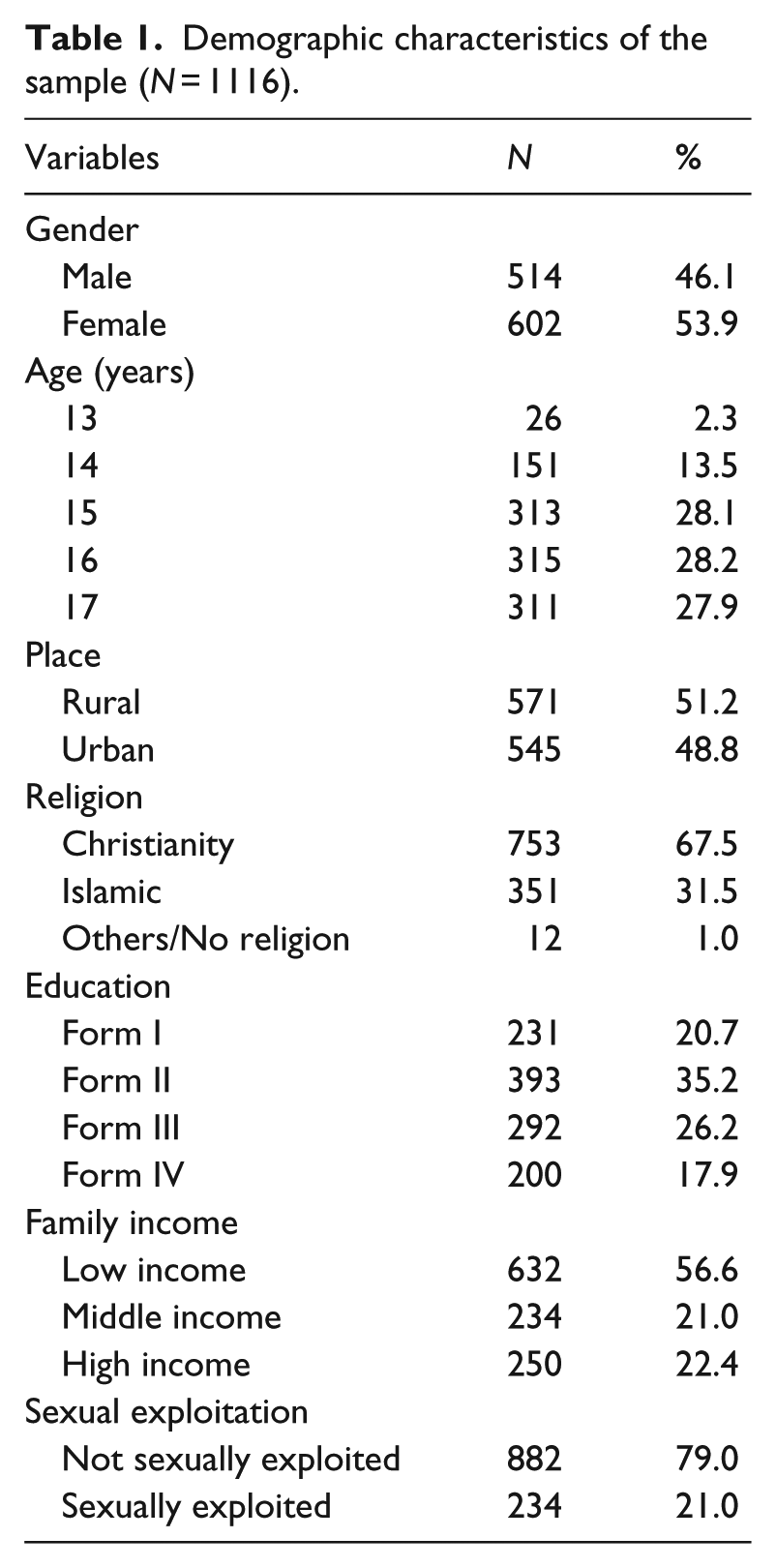
We used data from a stratified random sample of adolescent students from 10 secondary schools in two regions in Tanzania. We recruited adolescent students aged 13–17 years with a mean age of 15.66 years (standard deviation [SD] = 1.09). A total of 1151 secondary school adolescent students participated in the survey and returned the filled-in questionnaires. However, after careful checking, only 1116 (514 males and 602 females) questionnaires were retained, and they were used as the sample for analyses. Our sample comprised 53.9 percent female students, and more than half (51.2%) of the total sample was recruited from rural areas. Most (67.5%) of the respondents were Christians, 31.5 percent were Muslims, and 1 percent indicated other religions or no religion. The majority (56.6%) came from low-income families. A total of 21 percent of surveyed students indicated that, from the age of 12, they had experienced at least one encounter of sexual exploitation. Table 1 summarises the demographic features of the sample.
Demographic characteristics of the sample (N = 1116).
Design and procedures
This is a cross-sectional survey that involved school students selected from a stratified random sample in terms of area (urban and rural), gender (male and female), age of student participants (13–17 years) and years of study in secondary school (Forms I–IV). Data were collected using self-administered questionnaires with a variety of scales comprising about 70 items, including demographics during a 3-month period from March to June 2015. A pilot test of the questionnaire was conducted in February 2015. For the purpose of this article, only one scale of seven items for sexual exploitation (the Sexual Coercion Scale [SCS]) and items for demographic features were analysed and reported here. Analyses for other scales are reported elsewhere.
The study obtained approval from the research committee of a Hong Kong university and then permits from the Ministry of Education and Vocational Training in Tanzania through the Regional Administrative Secretaries, District Executive Directors, District Educational Officers and heads of schools who authorised data collection from the chosen regions, districts and schools. Respondents’ parents or guardians signed parental consent letters to allow their children to participate in the study. In addition, all recruited adolescent students, whose parents had consented to their participation in the study, signed a consent form.
The data collection activity took place in the classrooms or laboratories at the schools. Adolescent students could ask for clarification from the researcher, who was physically present in Tanzania during data collection. At the same time, any participant could withdraw from the study at any time if they felt uncomfortable participating. To ensure anonymity, no identifiable information was requested in any part of the questionnaire and confidentiality was assured. An average of 1 hour was required to complete the questionnaire. All consenting students completed the Kiswahili version of the questionnaire, which was translated from English.
Measurement
We modified the SCS to measure the prevalence and patterns of sexual exploitation of adolescent students. The original SCS was designed to measure the experience of sexual behaviours regarded as coercive and unwanted in the adolescent and adult population (Aalsma et al., 2002). We added three new items to the scale to determine whether student victims encountered sexual exploitation due to a perpetrator’s position in terms of power, economic status and/or trust. Sample items of the modified SCS are as follows: ‘How often has someone used force (like punching you or holding you down) to make you have sex?’ and ‘How often has someone you trusted (e.g. relative, teacher, religious leader) used “your trust” to make you have sex with them?’ The responses ranged from 0 (never) to 2 (twice or more), and we summed the scores of the seven items without reversing to compute the experience of sexual exploitation of adolescent students. The composite scores ranged from 0 to 14; higher scores indicated more encounters of sexual exploitation. Cronbach’s alpha was .77, indicating that the reliability of this modified SCS was acceptable.
Analysis
We entered all the data into the IBM SPSS software version 22. We discarded 35 questionnaires with incomplete information, such as those in which the participants did not indicate their age, did not respond to any sexual exploitation item or gave biased responses, that is, they rated all the items the same. The study analysed 1116 valid questionnaires. Descriptive statistics such as the mean and SD were performed to describe the scores (see Table 2). The analyses aimed at determining the main and interaction effects of the three independent variables on the dependent variables: prevalence and nature of sexual exploitation. The groups were compared in terms of sexual exploitation based on gender (male or female), locality (rural or urban) and age category (15 years and below or 16 years and above) using independent samples t-test and a two-way analysis of variance (ANOVA). Because these three independent variables have two levels, the two-way ANOVA involving a 2 ×2 factorial design was used.
Mean and SD of variables.

SD: standard deviation.
Results
Prevalence
Generally, the prevalence of sexual exploitation of adolescent students in the surveyed secondary schools was 21 percent (based on 234/1116). This involved at least one experience of sexual exploitation of an adolescent student in his or her life from when he or she was 12 years of age to the current age. Specifically, sexual exploitation occurred in female students at 26.2 percent (based on 158/602) and in male students at 14.8 percent (based on 76/514). The majority (67.5%) of the sexually exploited students were females. More than half (62.4%) of sexually exploited students were from rural schools, and the majority (68.8%) of sexually exploited adolescent students were aged 16 years or above.
Nature
Among the 21 percent of victims of sexual exploitation, several adolescent students experienced multiple victimisations. The victims indicated that the sexual exploitation encounters occurred because the perpetrator used their economic status (46.2%), the victims had non-consensual sex (42.3%), the perpetrator misused the position of trust (40.6%), the perpetrator forced the victim (34.6%), the victim was afraid of the perpetrator (20.9%), the perpetrator misused their position of power (20.9%) and the perpetrator threatened the victim (15%). In most of these patterns of sexual exploitation, female adolescent students, especially those aged above 15 years, had a higher number of sexual exploitation encounters. These results indicated that the sexual exploitation of adolescent students was due to coercion, misuse of power and trust, and economic asymmetries.
Characteristics of victims and risks
Further analyses indicated significant differences in the sexual exploitation of adolescent students based on demographic groups. Independent samples t-test results showed a statistically significant difference (t(1079) = 4.722, p < .001) in sexual exploitation between female (M = 0.80, SD = 1.77) and male (M = 0.38, SD = 1.25) adolescent students. A statistically significant difference (t(1105) = –2.874, p < .01) was observed between urban (M = 0.47, SD = 1.45) and rural (M = 0.74, SD = 1.66) adolescent students. Similarly, a statistically significant difference (t(1077) = –5. 212, p < .001) was observed between adolescent students aged 15 and below (M = 0.35, SD = 1.16) and those aged 16 years and above (M = 0.81, SD = 1.80). Equal variances for these results were not assumed. Other demographic variables such as family income and religion did not demonstrate statistically significant differences in the sexual exploitation of adolescent students.
Furthermore, we performed a 2 × 2 ANOVA to examine whether age could influence the differences in sexual exploitation with gender and locality of adolescent students. The results for a 2 × 2 ANOVA indicated statistically significant interaction effects between age and gender (F(1, 1112) = 23.766, p < .001,
Discussion
Sexual exploitation of children and adolescents is a common but hidden phenomenon. This study investigated the prevalence of sexual exploitation of adolescent students in secondary schools in Tanzania. The results revealed that sexual exploitation of secondary school adolescent students was prevalent for both males and females, but female students suffered the most. In total, 21 percent of the surveyed adolescent students had had at least one experience of sexual exploitation, with rates of 26.2 and 14.8 percent for females and males, respectively. In general, the majority of those sexually exploited were female students, who had a significantly greater experience of sexual exploitation than male students. These findings suggested a gender asymmetry in sexual exploitation encounters in Tanzania. Previous studies, especially in sub-Saharan Africa (SSA), revealed similar findings, indicating that females were sexually exploited more than males (e.g. McCranna et al., 2006; Maganja et al., 2007; Silberschmidt and Rasch, 2001; Stoebenau et al., 2013; Swidler and Watkins, 2007). For example, using a sample of university students in Tanzania, McCranna et al. (2006) determined that the rates of sexual abuse were 31 percent for females and 25 percent for males; the 2009 National Survey on Violence against Children in Tanzania revealed that nearly 3 out of 10 females and 1 out of 7 males reported at least one experience of sexual violence prior to age 18 years (UNICEF-Tanzania, Centers for Disease Control and Prevention [CDC] and Muhimbili University of Health and Allied Sciences [MUHAS], 2011). In the Tanzanian context, social norms such as normalised gender violence and patriarchal dominance dictate the differences in sexual exploitation, which in most cases disadvantage females (e.g. McCleary-Sills et al., 2013, 2016; Wamoyi et al., 2011). McCleary-Sills et al. (2016) found that sexual violence against women and girls, such as marital rape in Tanzania, is socially normalised and rationalised to uphold the ideal of masculinity that emphasises male dominance and control over women. This situation is likely to explain the study’s findings of higher sexual exploitation of female than male adolescent students.
A great number of sexually exploited adolescent students, females in particular, indicated that their exposure to sexual exploitation was due to the perpetrator’s economic status. In a study conducted in Tanzania, 11 percent of males and 9 percent of females reported partaking in the early sexual incidents because of bribes or enticements (McCranna et al., 2006). The perpetrator’s economic status was a factor highlighted by victims in this study; this means that victims were more likely to have been lured into transactional sex for economic reasons. Transactional sex has emerged as a means of survival for young women and girls in many parts of SSA as they use their bodies to secure basic needs such as food, shelter and money (Kuate-Defo, 2004; Luke and Kurz, 2002; Maganja et al., 2007; Stoebenau et al., 2013; Williams et al., 2012). The poverty status is likely to be associated with this finding, although family income was not a statistically significant factor of sexual exploitation of adolescent students in this study. In addition, we observed greater exposure to sexual exploitation among rural than among urban adolescent students. McCleary-Sills et al. (2013) and Wamoyi et al. (2011) have pointed out that in Tanzania, rural adolescents, specifically girls, became involved in transactional sex with adults as an easy way to earn money. This finding can also be associated with the poverty level in rural areas.
Although there is evidence of sexual exploitation of children and adolescents due to economic transactions and negotiations, further observations in this study have indicated that some victims had sex forcibly, with the perpetrators misusing positions of power and trust. Adolescent students were likely to have been forced into sexual activities with the perpetrators. In this sense, coercion, threat and misuse of positions of power and trust played a large role in sexual victimisation of children and adolescents in this study. Other studies have indicated similar observations. For example, Andersson et al. (2012) pointed out that sexual violence among schoolchildren was common in African countries; McCleary-Sills et al. (2013: 101) found that ‘girls frequently cited the persistent pressure from boys and men to have sex as, ultimately, a decision between giving in or being raped’; and UNICEF-Tanzania, CDC and MUHAS (2011) pointed out that adolescents had unwanted sexual intercourse because they felt overwhelmed by continual arguments and pressure from the perpetrators.
Furthermore, our findings have revealed significant information on the sexual exploitation of secondary school adolescent students in Tanzania. The findings have extended knowledge on sexual exploitation of adolescent students. This knowledge can be useful for interventions to address and/or mitigate the plights of sexually exploited children and adolescents in Tanzania. This study found evidence that sexual exploitation of adolescent students varies based on gender, locality and age. Gender asymmetry in sexual exploitation of adolescents requires gender-specific interventions to challenge the gender social norms and socialisation of children and adolescents, which are likely to support the sexual exploitation of girls in Tanzania. In addition, the greater sexual exploitation observed among rural adolescent students requires awareness programmes.
Implications for social work
Three social work implications can be generated from this study on sexual exploitation of adolescent students in Tanzania. First, the study shows that adolescent students in rural areas encountered higher risk than their counterparts in urban areas. Therefore, more resources should be directed to rural areas for community education. For instance, a community-based intervention, ‘SASA’, implemented in rural Tanzania aimed at improving health-seeking behaviour among sexual violence survivors is an example of good practice (Abeid et al., 2015). Findings generated from a quasi-experimental design demonstrated that interventions through strategies such as radio programmes, educational materials and advocacy meetings with local leaders, affected rural citizens’ awareness of sexual violence, as with reports of rape, improving knowledge of and attitudes towards sexual violence. The community care model is more practical and desirable than individualised and deficit-oriented interventions to handle the child sexual abuse problem (Schmid, 2007). Community intervention covers a wide range of strategies and requires the combined efforts of the interested parties. Social workers may need to seek support from local government to mobilise resources.
Second, this study confirmed that girls are more vulnerable than boys in encountering sexual exploitation. It has been recognised that gender inequalities increase the risk of violence against women by men and inhibit the ability of those affected to seek protection (World Health Organization [WHO], 2009). Therefore, interventions that promote gender equality, anti-gender discrimination and gender-specific assertiveness or help-seeking need to be strengthened in Tanzania. Interventions can be implemented in the school, community and media (WHO, 2009). Examples regarded as effective by the WHO include school programmes targeting male and female students and addressing how gender inequality fosters violence, challenging attitudes towards violence as a means of conflict resolution and developing non-violent communication skills. This kind of intervention should benefit the schoolgirls in Tanzania. One key finding was that schoolgirls became involved in transactional sex owing to the economic status of the perpetrator. Eliminating the reliance of females on males for economic support is worth considering. Microfinance initiatives that increase women’s economic and social status are alternatives, as with South Africa’s Intervention with Microfinance for AIDS and Gender Equity (IMAGE) (WHO, 2009). This seems applicable in Tanzania, whereby girls could generate income through these projects without reliance on males.
Third, study data indicate that sexual exploitation involves both genders, although girls were more willing to report their victimisation. Therefore, prevention programmes can address the safety needs for both genders. In this respect, informal help from social network members plays an important role in preventing and handling issues related to adolescent sexual exploitation. An individual is less resistant to seeking professional help if he or she is supported by family members and friends (Wong and Li, 2014). Enhancing child sexual abuse literacy among family members is necessary. In a study conducted by UNICEF, 61 percent of rapists of children were either a relative or a person well known to the victims, such as a co-tenant or neighbour (UNICEF, 1999). Therefore, parents must educate their children about protecting themselves from sexual harassment or exploitation from both strangers and acquaintances. Social workers can play a role in strengthening the coping capacities of families. In addition, practitioners in the formal helping network are critical in protecting minors from sexual exploitation and assisting them in recovering from victimisation experiences. Social workers must first establish their own personal and professional attitudes and address their own complex emotions and prejudices, given that sexual exploitation of children and adolescents is a complex and controversial phenomenon (Li et al., 2016; Peled and Lugasi, 2015). The next step for social workers is to equip themselves with relevant knowledge and skills. Social workers can help sexually exploited adolescents to redefine their experiences, and they can also encourage survivors to break their silence to eliminate isolation (Mennen, 1990) and the self-blame and internalisation of negative self-evaluation (Leung, 2015). The police can contribute to facilitating reporting and detecting child and adolescent sexual exploitation and/or abuse cases. A social problem can hardly be managed completely by a single bullet; therefore, interdisciplinary collaboration can be an option. A team approach among social workers, police officers and medical workers is a desirable means to manage sexual exploitation (Campbell et al., 2001).
Limitations and future research
Despite these potential contributions, this study had four limitations and suggestions for improvement to offer. First, the representativeness of the sample was limited. As the study collected data from secondary school adolescent students, the findings could not be generalised to all adolescents in Tanzania. Future studies may diversify the sample to include out-of-school adolescents. Second, the study focused on the contribution of demographics and localities to explain the prevalence of sexual exploitation; future writing could incorporate theoretically relevant explanatory variables. Third, the study was a cross-sectional survey, which could not guarantee causality. Future researchers may try a longitudinal design to test for temporal and causal relationships. Finally, a parallel exercise of collecting qualitative accounts of child sexual exploitation in the form of interviews, case studies and focus groups would complement the survey data to generate a comprehensive understanding of this phenomenon.
Conclusion
The study explored the sexual exploitation of adolescent students in Tanzania. The results provide evidence that sexual exploitation is prevalent and that a majority of sexually exploited adolescent students are females, adolescents living in rural areas and those aged above 15 years. These findings address sexual exploitation of children and adolescents, proposing community-based interventions in rural areas, initiatives to promote gender equality and economic autonomy, and multidisciplinary collaborations for preventing sexual exploitation of both genders.
Footnotes
Declaration of conflicting interests
The author(s) declared no potential conflicts of interest with respect to the research, authorship and/or publication of this article.
Funding
The author(s) received no financial support for the research, authorship and/or publication of this article.