



Abstract
Despite the growing emphasis on evidence-based practice (EBP), Chinese social workers’ adoption of EBP has been slow and limited, due partly to the fact that they often hold negative attitudes toward EBP. This study examined factors that account for these negative attitudes, using data collected from social workers in Hong Kong. Regression revealed that females, those less experienced, and social workers in non-governmental organizations endorsed more positive attitudes toward EBP, while those providing youth services had less favorable attitudes. Recent initiatives to promote Chinese social workers’ adoption of EBP will be more successful if they target those groups having less favorable attitudes.
Introduction
In recent decades, there has been a growing movement to establish more scientific knowledge bases for decision making in the provision of social services (Barth et al., 2012; Thyer and Myers, 2011). Central to this movement is the idea of evidence-based practice (EBP), often defined as a decision-making process in which professionals integrate the best available research evidence with clients’ value and professional expertise (Gambrill, 2011; Sackett et al., 2000). This definition, which conceptualizes EBP as a process to guide practice, indicates that EBP is a comprehensive concept, inclusive of, but not limited to, the use of empirically supported interventions (ESIs) (Drisko and Grady, 2015). EBP, a concept that was originally applied in the field of medicine (Sackett et al., 2000), has been increasingly adopted in other helping disciplines, including social work, on the premise that EBP will lead to the development and delivery of effective social services, and thereby improve clients’ wellbeing (Gray et al., 2013). In addition, growing funding mandates and policies requiring the implementation of ESIs have also encouraged social workers to embrace the idea of EBP as a new paradigm. This paradigm shift, although it has been the subject of vigorous debate (Gambrill, 2019; Khoury, 2019), has often been viewed as a way of validating the status of social work as an accountable and knowledge-informed profession (Gambrill, 2019).
While the uptake of EBP is influenced by various factors (Bellamy et al., 2006; Garcia et al., 2016a; Glisson and Schoenwald, 2005), professionals’ attitudes toward EBP have been found to play a key role (Aarons, 2004; Aarons et al., 2010; Reding et al., 2014). Individuals’ attitudes toward a specific behavior, as posited by the theory of planned behavior (Ajzen, 1985, 1991), can shape their intentions and behavior, suggesting that understanding attitudes toward EBP may provide important information about professionals’ intention and/or readiness to adopt EBP. In his seminal study of attitudes toward EBP, Aarons (2004) pointed out that professionals’ attitudes toward EBP, including their views on the value of innovation, research, and research-informed interventions, can influence their decision to try out an innovative practice. Furthermore, even if professionals decide to adopt a new intervention, the affective and emotional elements of their attitudes can also influence the way in which they implement innovative practices in real-world service settings (Aarons et al., 2010). The roles that attitudes play in EBP adoption, coupled with research showing that social workers often hold negative attitudes toward EBP (Bellamy et al., 2008; Murphy and McDonald, 2004), point to the need to understand factors influencing social workers’ attitudes toward EBP. This may in turn identify the possible scope for interventions to change social workers’ attitudes and thereby encourage them to adopt EBP.
Understanding social workers’ attitudes toward EBP and related factors is particularly important in Chinese social work contexts. In Hong Kong, for example, social workers are normally employees of the government or of non-governmental organizations (NGOs). They are on the frontline of providing social services to needy individuals, families and communities. Hong Kong has social work education systems where students receive structured curricula from tertiary institutions, whose curricula are periodically reviewed and accredited by the Social Workers Registration Board. There are also professional bodies, such as the Hong Kong Council of Social Service (an umbrella organization of social service organizations) and the Hong Kong Social Workers Association, which have promoted the professional development of social workers. The existence of such bodies may suggest that social work in Hong Kong is a well-developed profession (Chui et al., 2010). Nevertheless, many social workers in Hong Kong are wary of EBP, considering it to be a relatively new concept imported from the West (Macgowan and Vakharia, 2016). In a thought-provoking study of the status of EBP in Hong Kong, Shek et al. (2004) found that EBP is rarely practiced in social work settings, suggesting that Chinese social workers often develop and implement services that are not based on evidence of efficacy or effectiveness. A more recent study (Kim, 2019) also found that Hong Kong social workers had more negative attitudes toward EBP than their counterparts in Western countries. These findings underscore the need to identify the factors that account for Chinese social workers’ negative attitudes toward EBP. The present study therefore examined potential predictors associated with social workers’ attitudes toward EBP, based on data gathered from registered social workers (RSWs) in Hong Kong.
Potential predictors of social workers’ attitudes toward EBP
Studies have indicated that attitudes toward adopting EBP potentially differ in accordance with practitioners’ demographic characteristics (e.g. gender, education levels, age, and years of experience). However, the studies to date have produced mixed findings. Regarding gender, for example, some studies (Aarons et al., 2010; Egeland et al., 2016; Van Sonsbeek et al., 2015) found that women had more favorable attitudes toward EBP than men, whereas other studies (Aarons, 2004; Gray et al., 2007; Nakamura et al., 2011; Patterson et al., 2018; Stroobants et al., 2016) reported no gender difference in attitudes toward EBP. Mixed results were also found between education levels and attitudes. In some studies, for example, higher educational attainment was associated with more favorable opinions of EBP (Aarons, 2004; Gray et al., 2007; Nakamura et al., 2011; Van Sonsbeek et al., 2015). By contrast, other studies reported either a negative association between education and attitudes (Jensen-Doss et al., 2009) or no association at all (Egeland et al., 2016; Nelson and Steele, 2007; Patterson et al., 2018; Stroobants et al., 2016).
The findings in respect of age and experience have also been mixed. Three studies (Brookman-Frazee et al., 2009; Nakamura et al., 2011; Nelson and Steele, 2008) found that attitudes were not related to age and years of experience. On the other hand, Gray et al. (2007) found that age was negatively associated with attitudes toward EBP. Another study found that both age and years of experience were negatively correlated with attitudes toward EBP, indicating that older professionals and those with more years of experience held less favorable attitudes toward EBP (Melas et al., 2012). In complete contrast, another study (Stroobants et al., 2016) found that both age and years of experience had a positive association with attitudes toward EBP. Some other studies found that age and years of experience had differential effects on attitudes toward EBP. For instance, Aarons et al. (2010) found that age was positively associated with attitudes toward EBP, whereas years of experience was negatively related. Patterson et al. (2018) and Egeland et al. (2016) also reported that years of experience increased the likelihood of having negative attitudes toward EBP, but age had no such associations. This suggests that age and years of experience, although they might naturally be expected to be positively correlated, may be conceptually distinct (Melas et al., 2012). It is therefore necessary to include both age and years of experience in the same analytic model, despite concerns about potential multi-collinearity.
Practitioners’ service specialties or fields of service may also influence attitudes toward EBP. Despite the long-standing debate on generalist versus specialist social work practice, there has been an increasing trend of service specialization within social work (Blom, 2004), and social workers now often specialize in serving a specific population or working in a particular setting. Fueled in part by demands for efficiency and aspirations for professionalization (Blom, 2004), service specialization has also occurred in social work settings in Hong Kong. Based on target populations and fields (or settings) of work, Hong Kong social workers typically specialize in one of the following service areas: (1) family/child welfare services, (2) medical social services, (3) rehabilitation services for persons with disabilities, (4) services for the elderly, (5) services for young people, (6) services for offenders, and (7) community development (Social Welfare Department, 2019). However, it is possible that the available evidence base (i.e. ESIs and research evidence) and resources for EBP, which are necessary for EBP adoption and thus shapes professionals’ attitudes toward EBP, may differ by service specialties (Satterfield et al., 2009; Shek et al., 2004). Depending on the service specialties, moreover, social workers are more (or less) likely to work with other professionals (e.g. clinical psychologists and medical professionals), whose disciplines may have a longer and stronger tradition of EBP. Given that adopting EBP is often facilitated by interpersonal contacts within and between organizations (Palinkas et al., 2011) as well as across disciplines (Satterfield et al., 2009), social workers’ attitudes toward EBP could possibly be influenced in various ways by their service specialties and the extent to which these expose them to inter-professional collaboration.
In addition to individual characteristics, social workers’ organizational characteristics may also affect their attitudes toward EBP. Aarons et al. (2009) pointed out that public sector agencies tend to be more bureaucratic, and have more formalized rules/regulations and more hierarchical decision-making processes than private and non-profit sector agencies. In public sector agencies, therefore, adopting a new intervention is likely to require more red tape to be cut, discouraging its advocates from trying to surmount the various bureaucratic obstacles in their way. Such organizational differences may explain why previous studies found that mental health providers in NGOs and private agencies had more favorable attitudes toward EBP (Aarons, 2004; Aarons et al., 2009), and that EBP had been adopted earlier and more widely in private substance abuse treatment organizations than in their public counterparts (Knudsen et al., 2006). The private sector in Hong Kong has played a marginal role in the provision of social services, and it is probable that government agencies and NGOs, Hong Kong’s main social service providers, may have different levels of bureaucracy and organizational support for EBP, suggesting that social workers’ attitudes toward EBP may differ by organization type (i.e. NGOs vs government organizations)
Current study
Taken together, previous research suggests that social workers’ individual characteristics (e.g. gender, education levels, age, years of experience, and service specialties) and organizational characteristics (e.g. organization type) are potentially associated with their attitudes toward EBP. As noted earlier, however, the results of previous studies have been ambiguous. They were also all conducted in Western contexts, and it is not clear how far their findings can be generalized to a Chinese setting. The current study therefore examined the associations of the predictors with attitudes toward EBP in an exploratory manner, without making specific predictions about the directionality of the associations.
Methods
Participants and data collection
An online survey was conducted of RSWs who graduated from one of the five universities in Hong Kong which offer both undergraduate- and postgraduate-level social work programs. Prior approval for the survey was obtained from the relevant institutional review board. Based on the contact information (i.e. email) of the social work alumni (i.e. graduates of the Department of Social Work at the university), an invitation email was sent to recruit potential participants of the online survey. However, the email list includes an unknown proportion of the social work alumni who are not RSWs, and those who are RSWs but work in non-social work areas. Therefore, the invitation email, together with a link to the online survey, were sent to all of the social work alumni, indicating that only those currently working as RSWs are eligible. Although the lack of information about RSW status in the list made it impossible to determine the response rate, the online survey produced a sample of 181 RSWs, after non-eligible participants were weeded out (e.g. respondents who completed the questionnaire but were not RSWs). The data, which are arguably sufficient for regression models used in the current investigation, were collected in April–May 2017. All of the participants gave their informed consent to the survey, voluntarily completed the questionnaires, and were remunerated for their time with a supermarket coupon (worth HK$50 or US$6.4) after the completion of the survey.
Measures
Attitudes toward EBP
Social workers’ attitudes toward EBP were assessed via the Chinese version of the Evidence-Based Practice Attitude Scale (EBPAS). The EBPAS, which is a brief 15-item measure, assesses health and social service providers’ attitudes toward adopting EBP (Aarons, 2004). The EBPAS items, rated on a five-point Likert-type scale (0 = not at all, 4 = to a very great extent), are designed to measure four dimensions, namely (1) intuitive appeal to EBP (the Appeal subscale, 4 items), (2) likelihood of adopting EBP given requirements to do so (the Requirement subscale, 3items), (3) openness to new practices (the Openness subscale, 4 items), and (4) perceived divergence between research and current practice (the Divergence subscale, 4 items). The subscale scores were computed as mean scores, with higher scores indicating more positive attitudes toward EBP, except for the Divergence subscale. With reverse coding for the Divergence subscale items, the EBPAS also provides a total scale score, calculated as the average of all the 15 items, reflecting global attitudes toward EBP. The validity and reliability of the EBPAS have been tested in several studies (Aarons et al., 2010; Egeland et al., 2016; Melas et al., 2012; Van Sonsbeek et al., 2015) for use in health, mental health, and social service settings. With back-translation, the Chinese version of the EBPAS has also been validated in a sample of Chinese social workers in Hong Kong (Kim, 2019). The current study used the EBPAS total scale (Cronbach’s alpha = .75), as well as the four subscales, with Cronbach’s alpha ranging from .90 (the Requirement subscale,) to .61 (the Divergence subscale).
Organization types
Both the government and NGOs play a role in the provision of social services in Hong Kong. NGOs are the major providers of social services in Hong Kong, but the government also provides, via its Social Welfare Department (SWD), certain statutory services, including family/child welfare services, services for older people, medical social work services, and services for offenders. Many NGOs operating in Hong Kong receive subventions (i.e. subsidies) from the government, and NGOs can therefore be classified into ‘subvented NGOs’ (those financially dependent on the government) and ‘non-subvented NGOs’ (those which operate without government funding). The study therefore divided social service providers into three organizational types: (1) government organizations, (2) subvented NGOs, and (3) non-subvented NGOs.
Service specialties
The Hong Kong Special Administrative Region (HKSAR) Government’s SWD normally categorizes social services into eight separate specialties: (1) family/child welfare services, (2) medical social services, (3) rehabilitation services for persons with disabilities, (4) services for the elderly, (5) services for young people, (6) services for offenders, (7) community development, and (8) others. In this study, the proportion of participants who reported ‘services for offenders’ and ‘community development’ as their major services were so small (2.2% and 3.9% respectively) that we decided to group these two categories under ‘others’, so that each cell in our matrix was large enough to generate a reliable estimate.
Demographic characteristics
Demographic predictors include age, years of work experience (in the field of social work), gender (male vs female), and education levels (Bachelor’s degree vs Master’s degree or higher).
Analysis plan
Using SAS 9.4, linear regression was conducted to examine the association of the predictors with attitudes toward EBP. Specifically, five regression models were conducted, using the total EBPAS scale and its four subscales as dependent variables, respectively. Both age and years of experience were included in the regression models, given the evidence from previous studies that, while generally positively correlated, they are conceptually distinct. The Variance Inflation Factors (VIFs) for age and years of experience were around 4 and 3, respectively, across the regression models, indicating that they were sufficiently smaller than the most commonly used rule of thumb (i.e. VIF 10; O’Brien, 2007). Our study also tested regression models in which age and years of experience were sequentially included along with the other predictors, but we found little difference in the regression coefficients across models, suggesting that multi-collinearity was not a serious problem. In terms of missing data, although 181 RSWs completed the survey, 4 participants failed to provide data on organization type. As the missing rate was not sizable (2%), complete data analysis was conducted for regression analyses, excluding those with missing data on organization type.
Results
Descriptive statistics
Table 1 presents descriptive statistics of study variables (N = 181). The sample consisted of 64.6 % female respondents, with a mean age of 33.1 years (SD = 7.0). They had, on average, 9 years of work experience in the field of social work (SD = 6.7). The vast majority of the sample obtained a Master’s or higher degree (80.1%), and worked for NGOs (91.6%; 63% for subvented NGOs; 28.3% for non-subvented NGOs). In terms of field of practice, 24.9% provided services for young people, followed by 19.9% in family and children welfare, 18.8% in rehabilitation services, 13.3% services for the elderly, 8.8% in medical social services, and 14.4 % in other areas.
Descriptive statistics of study variables (N = 181).
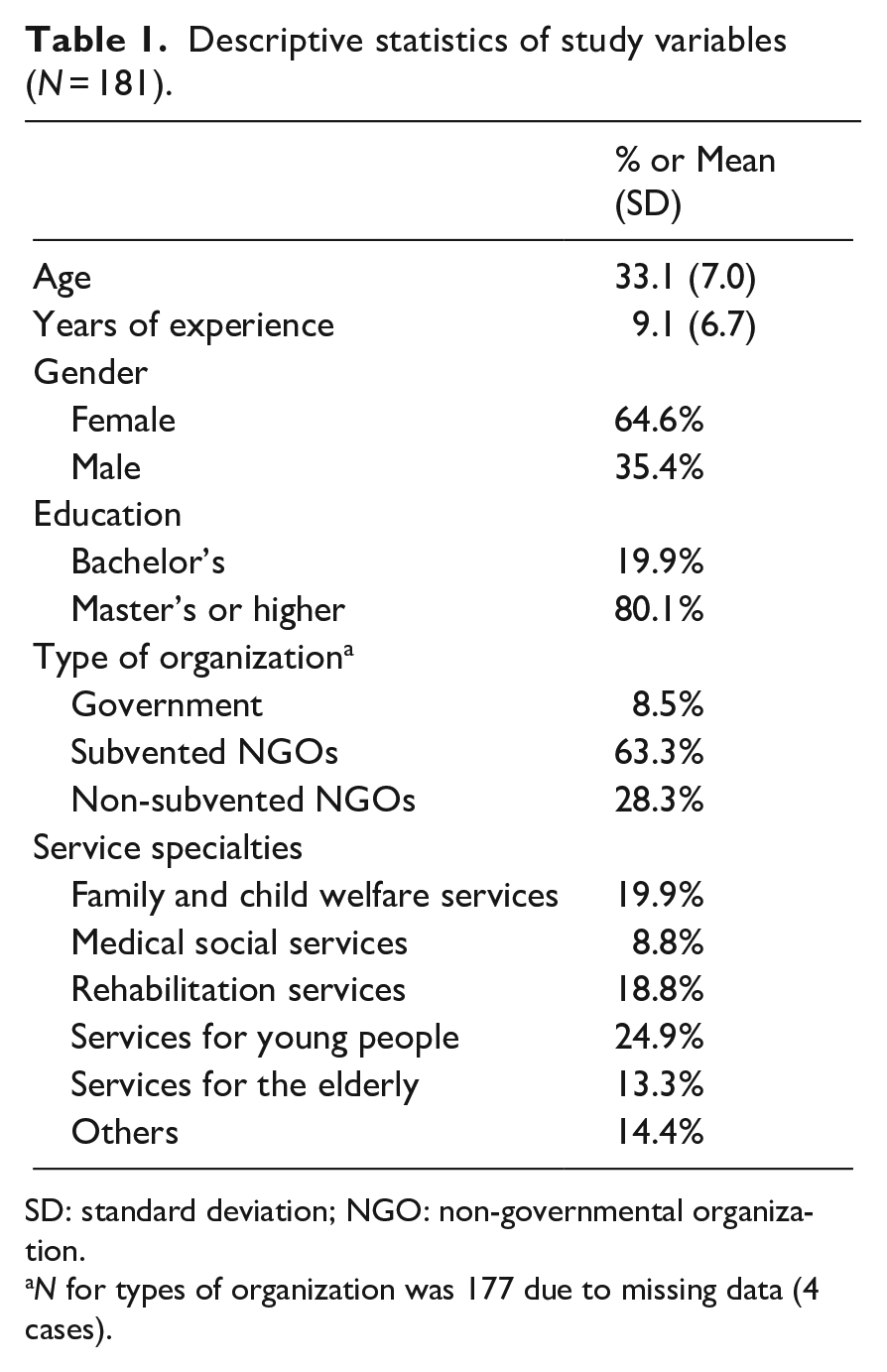
SD: standard deviation; NGO: non-governmental organization.
N for types of organization was 177 due to missing data (4 cases).
Regression results
Tables 2 and 3 present findings from the regression models using the four EBPAS subscales and the total EBPAS scales as dependent variables, respectively. Being female was negatively associated with the Divergence subscale (b = −.445, p < .001), indicating that men perceived more divergence between EBP and current practice than did women. As a result, women had more positive global attitudes toward EBP, as reflected in the association of gender and the total EBPAS scale (b = .155, p < .05). Years of experience was negatively associated with the Openness subscale (b = .029, p < .05), while age had non-significant associations with any of the EBPAS scales. This indicates that social workers with more experience were less open to new interventions. Social workers in the field of rehabilitation services (b = −.366, p < .05) and youth services (b = −.329, p < .05) were also less open to new interventions than those who specialized in family/child welfare services (i.e. the reference group). Moreover, social workers in the sector of youth services had global attitudes toward EBP, which were less positive than the attitudes of those who specialized in family/child welfare services (b = −.252, p < .01). Social workers in NGOs were found to have more positive attitudes toward EBP than their counterparts in government agencies. Those in subvented NGOs had greater willingness to adopt EBP given the requirements to do so (b = .726, p < .05), and had more positive global attitudes toward EBP (b = .291, p < .05). Social workers in non-subvented NGOs also had more positive global attitudes toward EBP than their counterparts working for governmental agencies (b = .267, p < .05). Finally, education levels were found to have a non-significant association with the four subscales as well as the total EBPAS scale, indicating no difference in attitudes toward EBP between social workers with Bachelor’s degrees and those with Master’s degrees (or higher).
Regression with the four EBPAS subscales (N = 177).
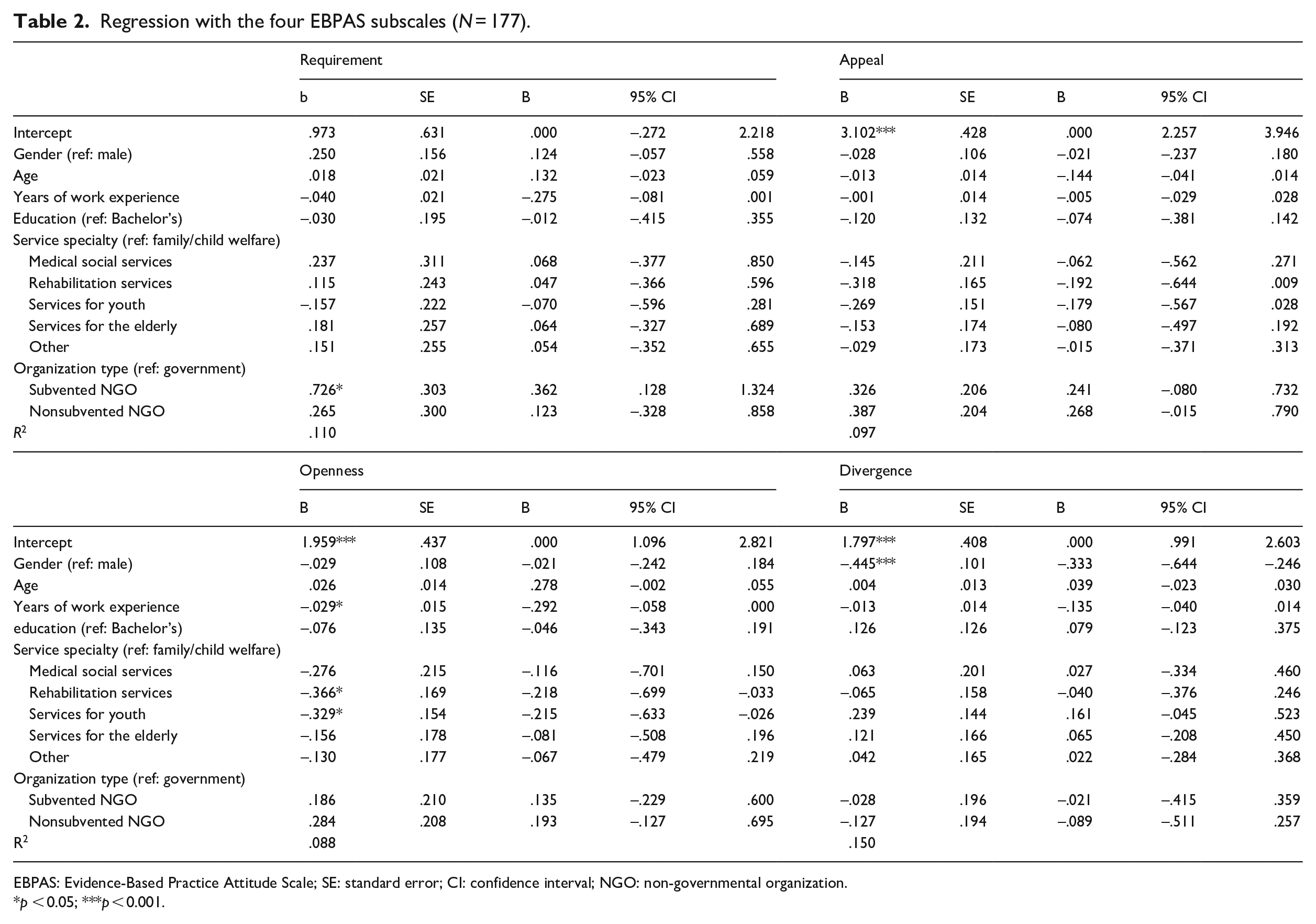
EBPAS: Evidence-Based Practice Attitude Scale; SE: standard error; CI: confidence interval; NGO: non-governmental organization.
p < 0.05; ***p < 0.001.
Regression with the total EBPAS scale (N = 177).

EBPAS: Evidence-Based Practice Attitude Scale; SE: standard error; CI: confidence interval; NGO: non-governmental organization.
p < 0.05; **p < 0.01; ***p < 0.001.
Discussion and conclusion
Recognizing that professionals’ attitudes toward EBP play a central role in adopting EBP, this study investigated whether social workers’ individual and organizational characteristics were associated with their attitudes toward EBP. Based on data from RSWs in Hong Kong, this study demonstrated that some demographic characteristics (i.e. gender and years of experience), service specialties, and organization type predicted attitudes toward EBP. On the other hand, no significant association was identified for age and education. These findings suggest that, although Chinese social workers have relatively negative attitudes toward EBP (Kim, 2019), there may be considerable variation within the social work profession. These results shed valuable light on the attitudes of social workers in general and of Chinese social workers in particular.
As far as demographic factors are concerned, this study found that female social workers had more favorable global attitudes toward EBP than their male counterparts, consistent with the findings of previous studies that documented similar gender differences (Aarons et al., 2010; Egeland et al., 2016; Van Sonsbeek et al., 2015). As reflected in the Divergence subscale scores, moreover, female social workers had less perceived divergence of usual practice with research and research-informed interventions, suggesting that male social workers were more skeptical than female social workers of the potential benefit of research and research-informed interventions. Little work has been done so far on gender differences of this kind, and it is not entirely clear why attitudes differ so markedly between the two sexes (Stroobants et al., 2016). At the same time, this is a potentially promising finding, as the social work workforce of Hong Kong is predominantly female (69.7%, Social Workers Registration Board, 2019). Given that there are still a sizable number of male social workers in Hong Kong, however, policymakers and academics should attempt to understand why this gender difference exists, and consider how best to encourage social workers of both genders to adopt EBP. Of the other demographic variables, years of experience was negatively associated with the Openness subscale, whereas age was not. In fact, both years of experience and age have been commonly used as an indicator of job-related knowledge and experiences (Sturman, 2003). Consistent with findings from Egeland et al. (2016) and Patterson et al. (2018), however, the differential effects of years of experience and age indicate that years of experience reflects the accumulation of job-related knowledge and experiences derived from practice, while age should be considered a proxy for workers’ aspirations and motivation (Melas et al., 2012), particularly when both variables are included in the same analytic model. In this respect, the finding that more experienced social workers were less open to EBP suggests that those with more on-the-job experience are more likely to trust the practical and/or experiential knowledge they have accumulated during their long service over research-informed alternatives (Baker and Ritchey, 2009; Patterson et al., 2018), and are more assertive or pragmatic in making decisions about new interventions (Aarons et al., 2010; Bellamy et al., 2008).
This study also found that social workers’ attitudes toward EBP differed by service specialties. Notably, social workers providing youth services (known as youth workers in Hong Kong) had lower scores on the total EBPAS scale and the Openness, Appeal, and Requirement subscales, but higher scores on the Divergence subscale, than their counterparts in the field of family/child welfare services. Although some of the effects did not reach statistical significance, the findings indicate that, across the various attitude domains, youth workers tended to have less favorable attitudes toward EBP. Shek and Yu (2011) contended that youth workers in Hong Kong are largely unaware of the importance of EBP, based on a review of positive youth development programs in Chinese contexts. Our findings bear out this contention, which might be explained by the lack of EBP-related information and research in the local context (Shek et al., 2004). As suggested earlier, moreover, the reason might be because EBP adoption is often stimulated by interactions with other professionals (Palinkas et al., 2011). Youth workers in Hong Kong are likely to work in a silo, namely a setting where they have little opportunity for inter-professional interactions. For instance, youth workers often provide a range of services (e.g. guidance and counseling, and supportive and developmental programs) at Integrated Children and Youth Services Centers (ICYSCs), which is one of the major modes for youth service delivery in Hong Kong (Cheung, 2018; Lee, 2003). The word ‘integrated’ sounds promising, but should not mislead. All it means is that a range of youth services are provided within a single center. The professional staff at these centers often consist entirely of youth workers, who rarely get the opportunity to form inter-disciplinary teams or collaborate with professionals from other agencies or other disciplines where EBP is more established. Another possible explanation, though speculative, is that many Hong Kong social workers, particularly youth workers (Cheung, 2018), are supporters of a reformist agenda, and their determination to make Hong Kong a more caring society has often been coupled with an activist political stance (Lam and Blyth, 2014). Although this kind of ideological orientation is no longer as powerful a force as it was before, it still exists, and some youth workers may perceive the stress laid by EBP on ‘effectiveness’ and ‘evaluation’ as heralding an indirect attempt to implement new managerial methods and/or to restrain their autonomy (Duffy et al., 2017). This may make them suspicious of the motives of those who advocate the adoption of EBP. Further research is needed to test these hypotheses and discover exactly why youth workers and social workers in other fields (e.g. those providing rehabilitation services) had somewhat negative attitudes toward EBP.
Finally, organization type (i.e. government agencies vs NGOs) was also found to influence attitudes toward EBP. Specifically, social workers in NGOs (whether subvented or not) endorsed more positive global attitudes toward adopting EBP than their counterparts working in government agencies, and this disparity is reflected in the total EBPAS scale. While social services in Hong Kong have been delivered by a mixture of government and non-governmental agencies, the finding suggests that government agencies are more likely to rely on mechanisms that entail formal (and informal) regulations with bureaucratic structures (Boyne, 2002), which may diminish social workers’ interest in innovation and the potential changes resulting from EBP adoption (Panzano and Roth, 2006). Given that the finding is consistent with findings from Western studies (e.g. Aarons et al., 2009), it could be argued that, as in Western societies, institutional differences still remain in Hong Kong, in spite of the recent public reforms or new management policies designed to make public sectors more efficient and responsive to evolving societal needs. Characterized as a statist-corporatist regime or government–NGO partnership (Chui et al., 2010; Lee and Haque, 2008), however, the NGO sector in Hong Kong, which provides over 90% of its welfare services (Lam and Blyth, 2014), is largely supported by government funding, through the subvention system by which the government provides subsidies to NGOs but also defines eligible costs, cost ceilings, and staffing standards. As a matter of fact, therefore, the recent ‘new management’ measures, such as the Service Performance Monitoring System (NGOs’ service performance is assessed based on Funding and Service Agreements [FSAs] specifying the objectives of social services as well as performance standards with measurable outputs) and the Lump Sum Grant Subvention System (a flexible funding model), were introduced by the government to reform the NGO sector. This might well help to explain why the NGOs display more positive attitudes toward adopting EBP than government agencies. The finding that being in the subvented NGOs was positively associated with the Requirement subscale, indicating more willingness to adopt EBP if it were required by an agency, supervisor, or the government, also provides evidence regarding the potential contribution of the new management measures, offering incentives for the government to further enhance the positive attitudes of social workers toward EBP. For instance, FSAs, which currently focus mainly on the ‘output’ of the services, may need to incorporate indicators assessing the ‘outcome’ or ‘effectiveness’ of the services, with a focus on making services provided by both government agencies and NGOs more efficient and effective.
Limitations
Some limitations of the present study should be noted, which may guide future research in this field. First, findings from this study relied on data from the alumni list of a single university in Hong Kong, and therefore may not be generalizable to the overall social work population in Hong Kong. As the study relied on online survey methods, moreover, it is possible that young social workers, who are more likely to be comfortable with such methods and remain in contact with their former departments, might be over-represented. In addition, the sample of the study did not include social workers graduating from sub-degree programs. Therefore, this study should be viewed as a starting point in the effort to understand Chinese social workers’ attitudes toward EBP and related factors. More research is needed, using large representative samples of social workers in Hong Kong, to validate the findings of this study. Second, although multiple variables were considered, there may be other predictors associated with attitudes toward EBP. Previous studies of attitudes toward EBP have shown that professionals’ knowledge about EBP (Nakamura et al., 2011) and their abilities to access and understand research evidence (Garcia et al., 2016a) can shape the process of EBP adoption and implementation. In addition, a growing body of research has highlighted the important effects that organizational contexts, such as organizational culture and climate (Glisson and Schoenwald, 2005), and socio-political factors, such as levels of poverty and social service expenditures (Garcia et al., 2016b, 2016b; Kim et al., 2018), may have on professionals’ adoption of EBP. To further advance our understanding of EBP adoption, it is necessary to collect data on whether and how individual, organizational, and socio-political factors interact with social workers’ adoption of EBP. Third, social workers’ attitudes were assessed using a self-reporting method. Though the scale used to measure attitudes toward EBP (i.e. EBPAS) is valid and reliable (Kim, 2019), the measure might have been subject to a social desirability bias. Due to the increasing pressure placed on social workers to endorse EBP, for example, some participants may have felt obliged to report positive attitudes. Although the anonymous aspect of the online survey is likely to minimize the potential bias, more research is warranted to replicate this study’s findings, using various scales. Finally, while attitudes toward EBP are multi-dimensional concepts, the four subscales of the EBPAS may not capture other dimensions of attitudes toward EBP. To this end, Aarons et al. (2012) recently developed the EBPAS-50 (with 50 items) to expand the domains of the original EBPAS. Though the original EBPAS, as a short instrument, has practical advantages (Kim, 2019), additional research is needed to validate and utilize the broader EBPAS scale in order to gain more comprehensive understanding of social workers’ attitudes toward EBP.
Implications
Despite these limitations, the present study is, to the best of our knowledge, the first study to investigate the factors associated with attitudes toward EBP among Chinese social workers. Its findings clearly show a degree of variation in social workers’ attitudes toward EBP, and suggest a possible approach for better promoting the use of scientific information and effective interventions in social work. In fact, social work academics in Hong Kong have long been aware of the limited use of EBP in the social work profession (Shek et al., 2004; Shek and Yu, 2011), but the development and implementation of programs or policies to promote EBP in social work is only now beginning to emerge in local contexts. In this respect, recent initiatives, such as ‘Evidence-based Practice Social Work Research Salons’ organized by the Hong Kong Council of Social Service to share the latest social work studies with practitioners, and the Monitoring, Evaluation, and Learning (MEL) project organized by the Chinese University of Hong Kong to train local social service providers to enhance their understanding, capacity, and expertise for utilizing EBP, are particularly promising developments. They reflect effective strategies known for EBP implementation (Mullen et al., 2008), such as building interaction that creates links between researchers and practitioners (Walter et al., 2005), and providing staff training to support the introduction and utilization of EBP (Johnson and Austin, 2006) based on agency–university partnerships (Bellamy et al., 2008). These nascent interventions would be more effective in addressing the persistent gap between research and practice (Mullen et al., 2008) if they targeted those found to have less favorable perspectives of EBP in this study: namely males, those with greater professional experience, those working in government agencies, and youth workers.
Concluding remarks
Guided by the theory of planned behavior, which posits that individuals’ attitudes play an important role in shaping behaviors, the present study investigated social workers’ attitudes toward EBP. A unique, theoretical contribution of the study is that it extends the theory of planned behavior in the context of Chinese social work, by illuminating factors associated with attitudes toward EBP among Hong Kong social workers. Such an understanding will guide future research that may further advance our knowledge on the linkage between attitudes toward EBP and EBP-related behaviors. For example, attitudes toward EBP may determine the degree to which Chinese social workers (1) make use of research evidence for daily practice, (2) receive training in EBP, and (3) conduct scientific evaluations (Aarons et al., 2010).
Another contribution of the study is that it potentially paves the way for comparing factors associated with attitudes toward EBP between Chinese social workers and their Western counterparts. For example, this study’s findings regarding gender, years of experience, and organization types, which are consistent with several Western studies (e.g. Aarons et al., 2010; Egeland et al., 2016), may suggest that such factors affect attitudes toward EBP in a similar fashion. As noted earlier, however, Western studies have produced mixed findings with regard to how such factors influence attitudes toward EBP, and thus there are some studies (e.g. Stroobants et al., 2016) whose findings are in contrast to this study. Additional studies are indeed warranted to arrive at a conclusion regarding similarities and/or differences between Chinese and Western social workers in terms of attitudes toward EBP and related factors. Moreover, this study has the potential to provide a beginning point for illuminating similarities and differences within Chinese social work communities, including mainland China, where social work, despite its relatively short history as a profession, has paid increasing attention to EBP (Zhang et al., 2018). Such efforts will inform the development of effective EBP promotion strategies tailored to the needs of social workers in the local and/or global contexts.
Footnotes
Declaration of conflicting interests
The author(s) declared no potential conflicts of interest with respect to the research, authorship and/or publication of this article.
Funding
The author(s) disclosed receipt of the following financial support for the research, authorship, and/or publication of this article: This research was supported by a Direct Grant (No. 3132658) from the Chinese University of Hong Kong.
