




Abstract
In 1524, Petrus Apianus published two closely related works—one the Latin Cosmographicus liber, aimed at an educated audience of international readers, and the other, Ein kunstlich Instrument, a shorter, more practical book for those who could read German but had no Latin. Both books nevertheless make use of most of the same instruments, including Apianus’ early volvelles. Most of these instruments also reappear in subsequent editions of Cosmographicus liber (or Cosmographia, a frequent alternative title). While the Cosmographicus liber has received much scholarly attention, Ein kunstlich Instrument has received very little. In this paper we (1) set the instruments of Ein kunstlich Instrument in the context of Apianus’ earlier work, especially his lost Mappa mundi and the extant booklets (Declaratio and Isagoge) that explained it, (2) compare the German- and Latin-language books of 1524, (3) explain in detail those instruments that have not heretofore been adequately discussed, and (4) explore their later history. We also make available, in the on-line edition of the Journal, working virtual copies of Apianus’ instruments from Ein kunstlich Instrument.
Keywords
Apian’s first publications as sources for his two books of 1524
Petrus Apianus (1495–1552) was born in Leisnig, Saxony, and named Peter by his parents, Martin and Gertrud Bienewitz (or Bennewitz). 1 Documents from the universities of Leipzig and Vienna also carry the spellings Pennewitz, Benebitz, and Wenewitz. 2 In the introduction to the first edition of Cosmographicus liber, he is identified as “Petrus Apianus (called Benewitz),” so we may assume that was the spelling he preferred, at least in 1524. After studies at the universities of Leipzig and Vienna, he lived for a while in Regensburg and Landshut before moving on to Ingolstadt, where he established a printing shop with his brother Georg, and issued an edition of the Sphere of Sacrobosco in 1526. 3 From 1527 he was professor of mathematics in the Hochschule there (later, university). 4 Like any good Renaissance humanist, he had Latinized his name by the time of his first publications (Latin apis = German Biene, a bee). In modern scholarly writing, both in German and in English, he is often called Peter Apian. We shall use this convenient short form.
World map of 1520
Apian’s oldest extant publication is a world map, 5 printed in 1520 and titled “Image of the whole globe according to the tradition of Ptolemy the cosmographer and the voyages of Amerigo Vespucci and others, elaborated by Petrus Apianus of Leisnig.” 6 This first map was heavily derivative of Martin Waldseemüller’s map of 1507, which it followed in labeling a new southern continent “America.” But Apian’s was much more compact, being printed on a single sheet of paper, while Waldseemüller’s filled 12 sheets. 7
Although Apian’s map was probably issued as a feuille volante, copies of it were also inserted into books by others printed in Vienna and Basel in 1520 and 1521. In this map we can already see Apian’s interest in cosmography. This is the art that encompassed elements of geography, astronomy, and applied geometry, to elucidate the relationship of the Earth and the celestial realm. 8 Thus, Apian’s modified cordiform 9 (heart-shaped) projection emphasizes the curvature of the Earth. The personified winds are shown blowing from the various quarters, and the circles of constant latitude are accompanied by a scale indicating the classical climata and another scale indicating the distance in Italian miles associated with a degree of longitude. All these features Apian borrowed from Waldseemüller. Decorative devices on Apian’s map include an armillary sphere and a globe with its meridians and parallels. Apian’s world map of 1520 was printed with north at the top, the common choice for European maps of the time. 10
Isagoge, Declaratio, and Mappa mundi
In the early 1520s Apian published Isagoge in typum cosmographicum seu mappam mundi (Introduction to the cosmographical image or map of the world), a booklet of eight pages. 11 The Isagoge bears no date, and we will discuss the dating problem below. The heart of the booklet consists of 12 “propositions” describing features of the world map and explaining their use. The title-page illustration, shown in Figure 1, suggests that the accompanying Mappa mundi was printed with south at the top. The woodcut used for the title page was re-used for Apian’s diagram of the 12 winds in the 1524 Cosmographicus liber (on page 53), which provides our first of many examples of Apian’s re-use of woodcuts and engravings.
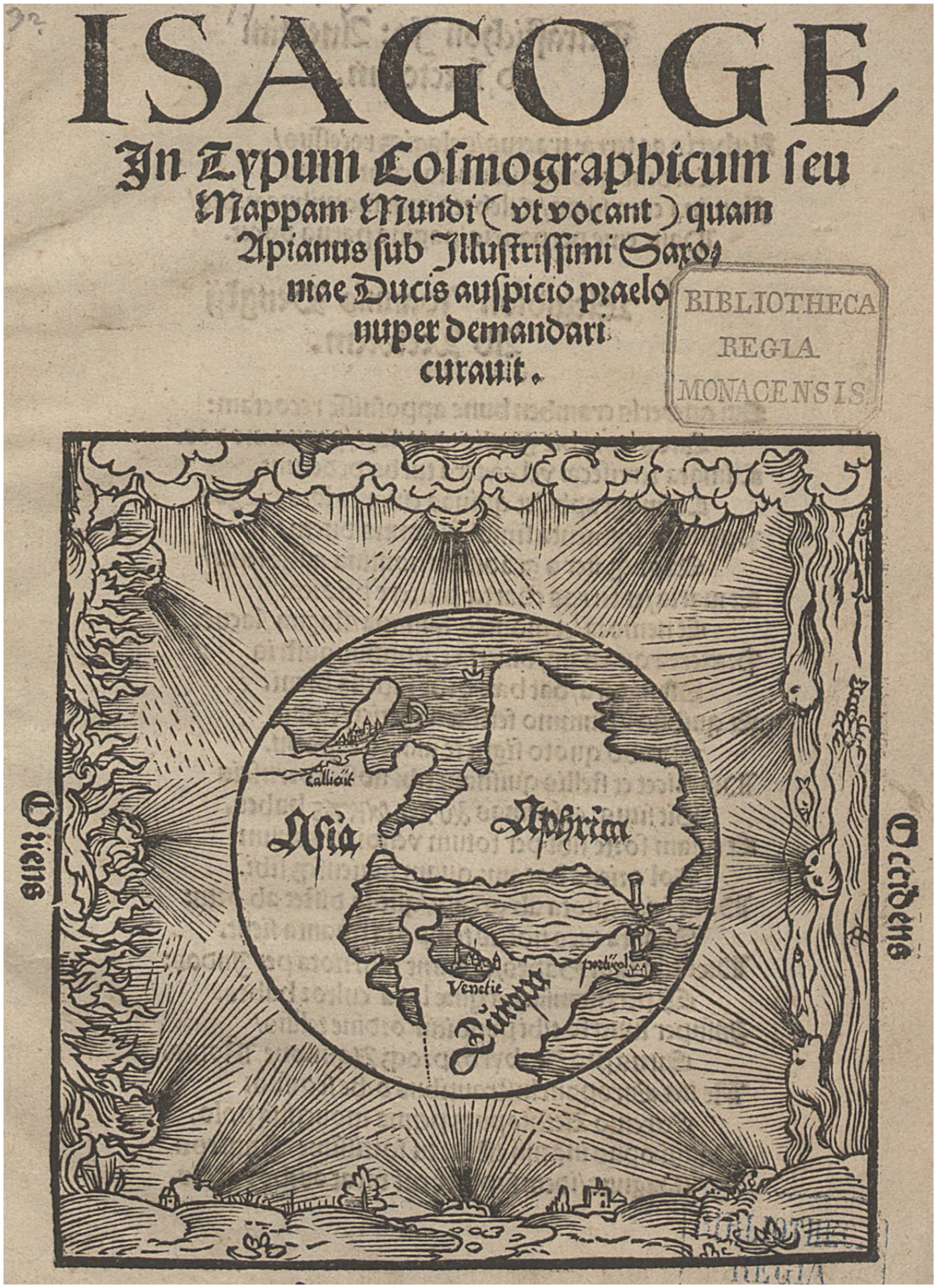
Title page of Apian’s Isagoge, showing a world map with south at the top. The four elements are represented around the edges of the square.
Apian also published a slightly longer description of what was most likely the same map, under the title Declaratio et usus typi cosmographici. Mappa mundi. 12 (Explanation and use of the cosmographical image. Map of the world.) See Figure 2, which, as we shall see, more faithfully represents the actual form of the lost Mappa mundi. In one of the two printings of the Declaratio, in the introductory notice to the reader, the author identifies himself as Petrus Apianus of Leisnig, Liberalium artium baccalaureus et mathematicus (bachelor of liberal arts and mathematician). In the Declaratio, there are 16 pages; and there are 17 propositions, though in this booklet they are called “problems.” Waldseemüller had published his Cosmographiae introductio 13 (Introduction to cosmography) to accompany his own world map of 1507, so Apian was following a well-known example in pairing a map with an explanatory pamphlet.
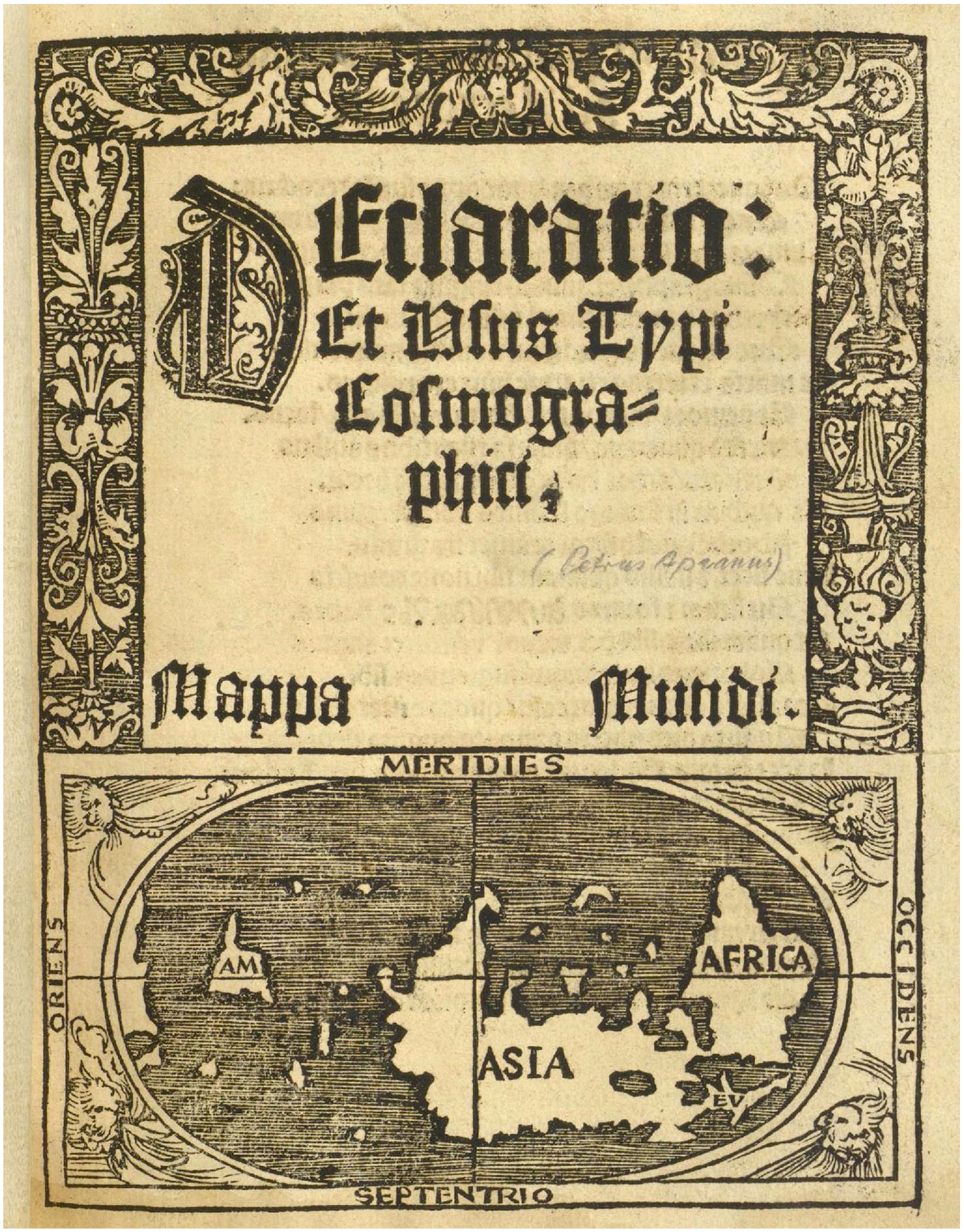
Title page of Apian’s Declaratio of 1522. The world map is oval in form and the continent of America appears along with Asia, Africa, and Europe. Zentralbibliothek Zürich.
In the front matter of the Isagoge, Apian printed two bits of poetry by two of his Bavarian friends which were headed “to the reader.” The first is a tetrastichon (a poem of four lines), by the historian and philologist Johannes Aventinus (Johann Georg Turmair, or Thurmayr), which ends with the line, “Buy this for very little / a small page teaches.”
The second is an elegidion (a short poem in elegiac couplets) in 26 lines by the schoolmaster, editor, and heterodox theologian Johannes Dengkius (Hans Denck). It is likely that Apian became acquainted with Denck when they overlapped in Regensburg. In the first couplet of his introductory poem, Denck notes that some readers may “complain that this cabbage has been served up re-heated.” But he offers the reassurance that the new map and booklet offer more than previous maps—here we have the Sun’s rising and setting times through the whole year, the forms of the constellations, etc. And near the end is the pronouncement, “This is a work of great talent.” 14
Apian also printed Denck’s elegidion in his Declaratio of 1522 and Aventinus’ tetrastichon in his Cosmographicus liber of 1524. Why did Apian not also include the elegidion in Cosmographicus liber? One might at first suspect that this was because Denck’s theological views were starting to make him controversial. However, the public theological dispute involving Denck in Nuremberg did not begin until later in 1524 and it led to Denck’s banishment from the city in January of 1525. 15 For an alternative explanation, we point out that the elegidion which appeared in the Isagoge and Declaratio made references to details of the world map and to the contents of the booklets. Thus, Apian simply may simply have judged the poem not to be appropriate for Cosmographicus liber.
Near the end of his elegidion, Denck remarked that “the order of the Earth is spread out for you inverted,” with the winds switched around, “Eurus in place of Zephyrus and, in place of Aquila, Notus,” as if Europe were observed from the Ethiopian (i.e., southern) pole. Apian reacted to Denck’s complaint at the end of the first proposition of the Isagoge, saying that he had also issued an inverted version of the map, in the arrangement usually adopted in the maps of the ancients, “because this image seemed to be more suitable for our habitation.” This could imply a second version of the Mappa mundi, with north at the top; but, so far as we know, no copy exists (in either version). It is more likely that Apian was referring to his world map of 1520, mentioned above, which did have north at the top. But, of course, this map did not have all the features of the Mappa mundi.
In Cosmographicus liber, Apian is still torn between the northern and southern orientations. The illustrations of globes and armillary spheres (e.g., on the title page and pages 9 and 47) have the north at the top; but the diagrams explaining the zones, parallels, and climata (p. 10, 12, 14, 16) have south at the top. It is possible that these southerly diagrams for CL had already been made when Denck suggested that a northern orientation would be preferable to most readers. We shall see below that the production of the Isagoge and Cosmographicus liber may well have overlapped.
Features of the Mappa mundi
Some scholars have treated the two booklets (Isagoge and Declaratio) as if they were intended as commentaries on Apian’s world map of 1520. 16 The advantage of this position is that it avoids the need to postulate a map by Apian that is completely lost. However, Fiorini 17 and Van Ortroy 18 pointed out long ago that these booklets referred to a different map that had different characteristics and that was probably titled Mappa mundi. In particular, as the title-page illustrations suggest, the missing map was printed with south at the top (opposite to the map of 1520). Moreover, the first proposition of the Isagoge, in which the general features of the map are introduced, informs us that there are “two poles, one in the upper part which is said to be southern (austrinus), the other in the lower part, which is called northern (aquilonarius).”
There are other passages in the text that support this. For example, the ninth proposition of the Isagoge reads: Given the altitude of the pole, [it is required] to show in which climate and parallel we are. Look for the degree of elevation of your habitation on the eastern limb (in limbo exortivo): from the given latitude of your habitation, also immediately on the left side the climate in which you are appears; but on the right side, the zone (segmentum) of said habitation.
From these directions, we understand that the degrees of latitude were printed along the eastern limb of the map; according to the directions, by looking there (i.e. the left side) we see, along with the latitudes, an indication of the climata. On the right side of the map the geographical zones were indicated. Having east on the left does indeed imply that the map was printed with south at the top. On the map of 1520, Apian had also numbered the degrees of latitude and the climata (Climates 1, 2, etc., up to 8) along the left-hand border. So this aspect of design was retained for the Mappa mundi, even though the map was inverted. The zones were not indicated on the map of 1520.
The texts of the booklets describe other features of the Mappa mundi that prefigure illustrations that would later appear in Ein kunstlich Instrument or Cosmographicus liber. For example, in the Isagoge, the eighth proposition tells the reader how to find the Pole Star by using the two pointer stars in the Great Bear (alternatively regarded as wheels if the constellation is thought of as a wagon). And we are told that this is illustrated in “the Atlantic sphere of this chart,” in which the direction of the Pole Star is indicated by a white broken line. So we should imagine an inset circle in the empty space provided by the ocean. This device nowhere appears on the map of 1520. However, a similar device appears in Ein kunstlich Instrument (see Figure 3). So we should imagine that something resembling this figure (or perhaps only one of its circles) appeared in the Atlantic on the Mappa mundi.
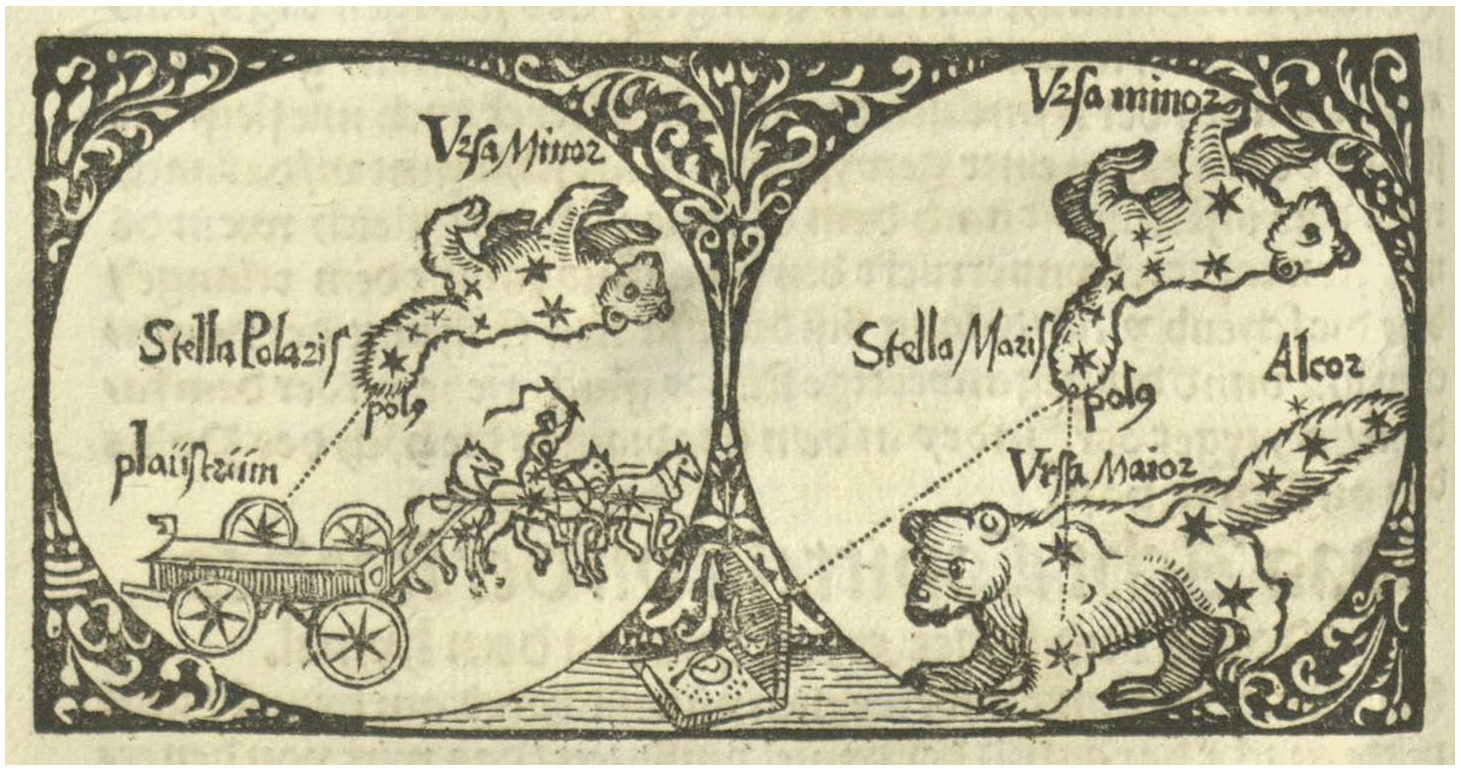
Diagram from Ein kunstlich Instrument showing how to find the Pole Star, also known as the Star of the Sea (Stella Maris). The same figure appears in Cosmographicus liber, providing another example of Apian’s reuse of material. Beinecke Rare Book and Manuscript Library, Yale University.
The first proposition of the Isagoge informs the reader, “We have sinuously drawn the circle of the zodiac across the face of the map, following the course of the Sun, with just the characters of the signs added.” So we should imagine the ecliptic as a sideways S between the tropics.
The fourth proposition of the Isagoge informs us that in a narrow ribbon at the eastern limb of the Mappa mundi, some dozen and a half constellations were shown. This seems to have been similar to the mode of display adopted by Gemma Frisius in his cordiform world map of 1540, and inserted into the 1544 and later editions of Apian’s Cosmographia. 19 Thus, there is not a complete celestial chart—but one can at least read off a constellation that would pass straight overhead at any particular latitude. On the later cordiform maps, this feature must be judged to be merely suggestive and hardly quantitative. But on the Mappa mundi, the little constellation drawings were apparently placed accurately enough to allow one to read off the declination of the constellation or star. In the ninth problem of the Declaratio, Apian tells us how to do it. Place the point of a compass (circinus) on the equator, and open the compass to the star (or to the Sun’s position on a given day). Transfer the compass to the central straight meridian and read off the declination of the star or Sun (its angular distance from the equator). Thus we see that the central meridian (Figure 2) was divided into degrees of declination.
The seventh proposition of the Isagoge tells us how to find the regions and islands at which the Sun is straight overhead on a given day and hour. Knowing the longitude of the Sun, we are directed to go into either the eastern or the western zodiac (in zodiaco orientali vel occidentali). And there, “make a mark from which a line or string parallel to or equidistant from the equinoctial is extended. Therefore, the Sun moves overhead on a given day for those who remain under that line or string.” So we should imagine that an oval or other figure representing the zodiac (divided into signs and degrees) was printed at both the left- and right-hand sides of the map. (These might remind us of the analemmas sometimes printed on modern globes.) These zodiacs on the left and right sides of the map do not appear on the map of 1520.
Also, these same directions imply that on the Mappa mundi the parallels of constant latitude are straight lines. Matteo Fiorini suggested that Apian used the Bordone projection (of which this would be true). 20 The oval form of the map shown on the title page of the Declaratio (Figure 2) would be consistent with the Bordone projection. Straight parallels were required by Apian’s desire to have the reader stretch a string horizontally across the map to visualize all the places that have the noon Sun directly overhead on the same day. And this is why there are two zodiacs—so that one may line the string up at the correct declination on both sides of the map, to guarantee that the string will be perfectly horizontal. That Apian really intended his readers to stretch a string across the Mappa mundi is nicely supported by an illustration in Cosmographicus liber (see Figure 4), in which he shows his readers how to use stretched strings to read off the latitude and longitude of a city. This stretching of strings is a harbinger of Apian’s interest in having his readers engage in an active way with his texts, not only by pulling strings but also by turning things about.
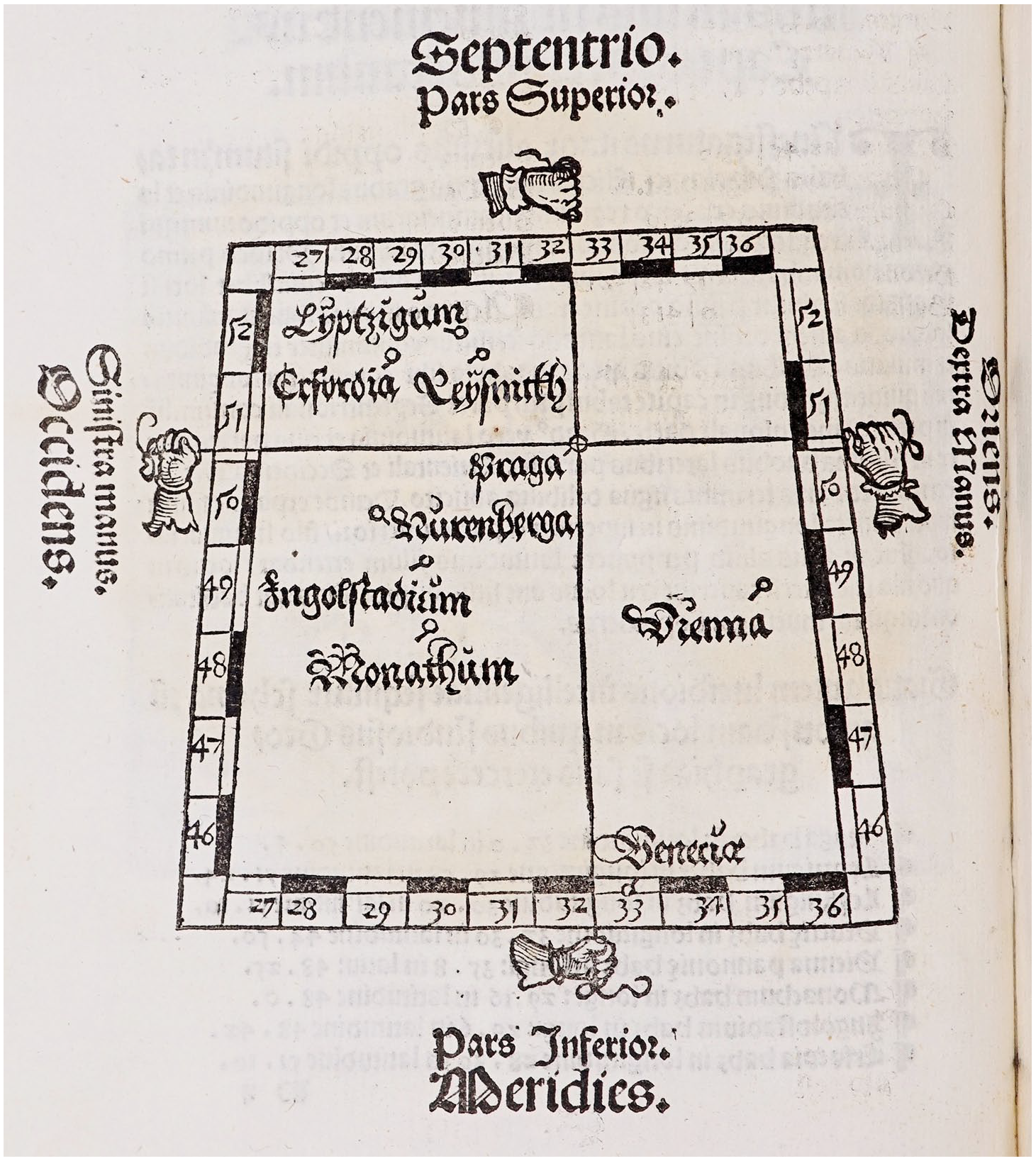
Using stretched strings to read off the longitude and latitude of Prague. Cosmographicus liber (1524). Something similar could be done with the Mappa mundi to find the cities at which the Sun is straight overhead on the same day. Universitätsbibliothek Graz.
Indeed, in the second proposition of the Isagoge, Apian informs his reader how to orient the map. Lay it on a horizontal plane and “place upon the depicted dial (super horarium depictum) a traveler’s instrument that is commonly called a compass.” The user is directed to turn the map until the compass points coincide. Thus we should visualize a compass rose (or something similar) printed on the map. The user is to place a compass on the rose and turn the map underneath the compass until it is properly oriented.
There is an even more striking example of hands-on activities. As we have seen, proposition seven of the Isagoge requires us to go to the left- or right-hand zodiac with the knowledge of the Sun’s longitude. But where are we to get this knowledge? The Sixth Proposition reads
21
: Gradum solis quolibet die ex theorica solis investigare, pone filum ex centro theoricae super diem mensis : habito respectu ad primas mensium litteras (nomina enim mensium perperam sunt posita) filum itaque extensum super extremum orbem indicat signum et signi gradum in quo sol movetur dato die: quod fuit investigandum. To find out the degree of the Sun on any day from the theorica of the Sun, place the thread from the center of the theorica over the day of the month: having regard to the first letters of the months (for the names of the months are wrongly set out), then the thread extended over the extremity of the orb indicates the sign and the degree of the sign in which the Sun moves on a given day: which was to be investigated.
It is clear that Apian is describing an ordinary solar equatorium based on the eccentric-circle solar theory of Hipparchus and Ptolemy. (Theorica is a medieval term for a model for the motion of a celestial body such as the Sun or a planet.) Shortly afterward, this same instrument would appear in both Ein kunstlich Instrument and Cosmographicus liber, and we will discuss it in more detail below. Thus we see that Apian had already combined a solar equatorium with his lost Mappa mundi. It is likely that the theorica solis was printed on the Mappa mundi itself. Alternatively, it could have been bound in at the beginning or end of both the booklets (the Isagoge and the Declaratio), though we have not seen it in any copy that is available to us. Apian’s remark about using the initial letters of the month names probably refers to the fact that for many months the space available did not allow printing the entire name—as was also the case with the solar equatoria printed in Ein kunstlich Instrument and Cosmographicus liber.
Apian tinkered repeatedly with some of his instrument designs, so it is not surprising that one of the instruments on the Mappa mundi differed considerably from the instrument that performed a similar function in Ein kunstlich Instrument and Cosmographicus liber. This is the device for finding the time of sunrise and sunset (and thus also the length of the day), at a given latitude and time of year. The beautiful instrument in these two later works has moving parts and is closely related to the theory of the armillary sphere. We will discuss it below. But for an instrument printed on a map, it was necessary to avoid moving parts.
In Declaratio and Isagoge, Apian describes a diagram printed on the Mappa mundi as resembling a horn (cornu) and a harp or lyre (cythara). This device, as described in proposition ten of the Isagoge, seems to have been related to the “straight line quadrants” that Apian presented in his Instrument Buch of 1533. 22 Another closely related instrument, which Apian describes in the fourth part of Instrument Buch, is his horometrum, shown in Figure 5.

Apian’s horometrum from Instrument Buch. A related device was probably printed on the Mappa mundi. The horizontal parallel lines in the “horn” are for particular latitudes or habitations. The “harp” for the hours of day or night is seen below. www.digitale-sammlungen.de / Bayerische Staatsbibliothek, München.
We can see an inverted animal horn with its tip at A. Each of the parallel lines that make up the horn is for a particular latitude (or altitude of the pole). The latitudes are labeled at 5-degree intervals along the right side of the horn. In Declaratio/Isagoge each of these parallel lines is termed the “zodiac” of a particular habitation.
The boundaries between the zodiac signs are the slanted bold lines that make up the horn. The lighter-weight slanted lines mark 10-degee celestial longitude intervals. The beginnings of the zodiacal signs are indicated along the horizontal line labeled ECLIPTICA above the horn. 23
The lower part of the diagram (with its parallel vertical lines) can be said to resemble a harp. This is one reason for thinking that the instrument for obtaining sunrise and sunset times printed on the Mappa mundi resembled the device of Figure 5, from Instrument Buch.
One enters the diagram with the geographical latitude of the observer and the longitude of the Sun. The intersection between a horizontal horn line (for a particular latitude) and a slanted line (for a particular time of year) gives us the solution. The x-coordinate of the point of intersection gives the time of sunset (upper line of numerals) and the time of sunrise (lower line of numerals). For example, suppose that we are at latitude 50°, and that the Sun is at the beginning of Aquarius . The slanted line for the beginning of Aquarius is the second bold line from the left. Find the intersection of this slanted line with the horizontal line for 50° latitude. Drop straight down from the point of intersection to find that the Sun rises at 7:45
There are some other differences, as well. In Declaratio/Isagoge, Apian speaks of making use of some curved lines. Apian tells us (Declaratio, sixth and fifteenth problems) that in the “horn” the zodiacs of the individual habitations are parallel lines. And these lines are divided into signs (for telling the time of year) by the curved arcs making up the horn. Thus, he probably had not yet adopted a method of making all the important parts of the device from straight lines, which is the considerable simplification offered in his publications of the early 1530s (Horoscopion, Quadrans Apiani astronomicus, and Instrument Buch). And Apian also mentions that there are two harps, placed above the horn (Declaratio, sixth problem). So it seems there were separate harps for the rising and setting times. The whole construction cannot be reconstructed with full confidence, as the descriptions are not detailed enough. But we can at least be sure of the general function of this drawing on the Mappa mundi. In Ein kunstlich Instrument, this figure was replaced by an orthographic projection of the celestial sphere with moveable parts.
The figure printed on Mappa mundi and described in Declaratio/Isagoge owed a debt to the quadrant printed by Regiomontanus (Johann Müller of Königsberg) in his Calendarium (c. 1474), in both the Latin and German editions. 24 Regiomontanus’s instrument is a (quasi-universal) sundial, good for any latitude between 39° and 54°, in which the hour lines are straight, and for which the suspension point of the plumb line is moveable. Thus it is sometimes called a rectilinear dial or a straight-line dial. Regiomontanus called it the “general horary quadrant” (quadratum horarium generale). And Regiomontanus’s straight-line quadrant itself has a prehistory in a number of 15th-century manuscripts dealing with such instruments as the navicula and one of the various instruments called organum Ptolomei or Ptolemei. 25 Apian may also owe a debt to a broadside of 1512 by Johannes Stabius (Johann Stab), whose device shares some features with the construction described by Apian in Declaratio/Isagoge. 26 However, neither Regiomontanus nor Stabius used curved arcs in the “horn.” Thus, although Apian has probably drawn from them, his instrument on the Mappa mundi was not the same as theirs.
We should also mention that in Apian’s straight-line quadrants (in Instrument Buch as well as Horoscopion and Quadrans Apiani astronomicus), the roles of the geographical latitude and the solar longitude generally are reversed from the case of the diagram printed on Mappa mundi. That is, in these other works, the lines for the habitations are slanted and the lines for the sign boundaries are horizontal straight lines. This is why the horometrum more closely resembles the diagram that was printed on Mappa mundi than do Apian’s quadrants.
In the fifth part of Instrument Buch, Apian takes full credit for the invention of a particular straight-line quadrant, without mentioning that the basic ideas were already used by others. But again it is not a case of simple appropriation, since, in Apian’s quadrant the roles of geographical latitude and solar longitude are reversed from the arrangement in the instruments of Regiomontanus and Stabius. Thus Apian tended to claim originality when only relatively minor changes had been made.
Dating the Isagoge
Scholars have generally placed the undated Isagoge between 1521 and 1524. Rejecting the then-common dating of 1524, Van Ortroy followed Fiorini in putting the Isagoge in 1521 or 1522. Röttel and Kaunzner make it “1521/22 or 1524.” For the Declaratio, the situation is simpler, as Apian printed a date at the end of the introductory address to the reader: duodecimo Kalendas Maij Anno SERVATORIS vicesimosecundo supra Sesquimillesimum Phebe Martis domicilium occupante (12 days before the Kalends of May, 1522, with Phebe [or Phoebe = the Moon] occupying the house of Mars). So there is no doubt that this pamphlet was published in 1522, but there is a mystery about the date.
Twelve days before the Kalends of May, counting inclusively, is April 20. On April 20, 1522 (at Greenwich noon), the geocentric longitude of the Moon was about 325.6°, which puts it in Aquarius, the lunar house of Saturn. 27 The houses for Mars are Scorpius (solar house) and Aries (lunar house). As we will see below, Apian made a mistake in 1524 for the date of Cosmographicus liber, which was corrected by hand in some copies. (He mistakenly named a date 1 month too early.) Perhaps he was not used to using the Roman way of reckoning dates. So it is possible that here he has made a similar mistake. For 12 days before the Kalends of June (May 21), a modern calculation of the geocentric longitude of Moon gives 13.1°—in Aries, a house of Mars, as is required. And tools available in Apians’s time similarly put the Moon near the middle of Aries. A calculation from the Parisian Alfonsine Tables for May 21, 1522, at noon in Toledo, gives 14°39′. (This is about an hour-long procedure.) Using Regiomontanus’ lunar instrument in his widely available Calendarium, we get 14°. (This is about a 2-minute procedure.) Thus, Apian seems to have accidentally named the current month, forgetting that one counts backwards to the Kalends of the following month—the same error he is known to have made 2 years later with the dating of Cosmographicus liber. The introduction to the Declaratio seems actually to have been finished on May 21, 1522.
Van Ortroy argued that it is more likely that Apian expanded the Isagoge to produce the Declaratio than that he cut the Declaratio to produce the Isagoge. Many passages are identical in the two texts. The additional material in Declaratio (none of which appears in Isagoge) consists largely of the following: In Prob. 1, description of the four parts of the world, Asia, Europe, Africa, America In Prob. 2, discussion of the isthmuses, peninsulas and islands of the world In Prob. 3, discussion of the perioechi, antoechi and antipodes In Prob. 4, the naming of all twelve winds Prob. 9, how to find the declination of the sun or a star from the Mappa mundi (which was mentioned above) Prob. 11, how to find the pole by using a compass sundial Prob. 12, how to measure the altitude of the pole by using an astrolabe or quadrant to observe the sun’s altitude Prob. 13, finding the altitude of the pole at night by observing the altitude of a star
If one accepts Van Ortroy’s view, a reasonable sequence would be Mappa mundi and Isagoge, followed by Declaratio (1522), followed by Ein kunstlich Instrument and Cosmographicus liber (both 1524). In this view, the additional material was added to Isagoge almost right away to make a richer Declaratio.
But we must point out that Cosmographicus liber is cited in the Isagoge! In the first proposition of the Isagoge, after mentioning that one may inscribe a globe of wood or bronze with meridians and parallels so that it is divided into convex surfaces like the Earth, Apian goes on to say: “Perhaps you will understand this more clearly from our Cosmographical book (ex nostro Cosmographico libro), in which these things are contained.” And again in proposition three of the Isagoge, concerning the 12 winds, and how to find the name of the wind that is blowing, by tracing the wind’s direction on the properly oriented map, Apian says, “These things are explained more extensively in the Cosmographical book.” These references to the CL are the strongest evidence in favor of placing the Isagoge in 1524. In this view, the geographical material of Problems 1, 2, 3, and 4 was removed because it duplicated the recently published CL. Perhaps the more technical material of Problems 9, 11, 12, 13 (some of which required a quadrant or astrolabe to supplement the Mappa mundi) was removed as overly complex. If one wishes to maintain a date of 1521 or 1522 for the Isagoge, one must suppose that Apian had already written parts of Cosmographicus liber or had at least projected what was to be treated in it.
The order of publication of Declaratio and Isagoge is not crucial for our study: it is enough that Apian was working by 1522 on this material, which formed an important source for his Ein kunstlich Instrument and Cosmographicus liber of 1524. However, it seems more likely to us that Isagoge followed Declaratio, and that it was published no earlier than 1524. Besides the fact that (1) CL is cited in Isagoge, we observe the following. (2) In Isagoge, as in CL, Apian speaks of “propositions,” while in Declaratio he used “problems.” (3) In CL, Apian warmly mentions Ioannes Aventinus in the introduction and prints his tetrasticon after the table of contents (the tetrasticon that also appears in Isagoge). Neither the tetrasticon nor the name of Aventinus appears in Declaratio. This would seem odd if the order of publication were Isagoge, Declaratio, Cosmographicus liber. The natural solution is that the order is Declaratio, Cosmographicus liber, Isagoge and that Apian became friendly with Aventinus sometime after the publication of Declaratio in 1522. Finally (4), both Isagoge and CL were printed in Landshut by Johann Weyssenburger, while Declaratio was printed in Regensburg by Paul Kohl (or Khol). 28
In any case, we can see that the Mappa mundi and its explanatory pamphlet, Declaratio, helped prepare Apian for his more ambitious projects of 1524, Ein kunstlich Instrument and Cosmographicus liber. In the early works, Apian developed his approach to providing his readers with hands-on activities that involved orienting maps and pulling out strings. He included a polar diagram, a theorica solis, as well as an instrument for finding day lengths, which would turn up in one or the other of his later works. And from the last proposition of both Isagoge and Declaratio, we see that the Mappa mundi allowed one “to convert an hour counted from noon or midnight into an hour estimated from sunrise or sunset.” This likely refers to converting from equinoctial hours into seasonal or planetary hours. (However, it is conceivable that it refers not to seasonal hours but instead to the so-called Italian hours—equinoctial hours measured from sunset.) As we shall see, Ein kunstlich Instrument included a cleverly designed instrument for going back and forth between equinoctial and seasonal hours.
Audiences for German and Latin
As a boy, Apian had attended Latin schools, which served as preparation for his university education, which was, of course, mostly conducted in Latin. Not surprisingly, many of his own publications were in Latin. These obviously were intended for an educated audience, which could even be international. But he also showed a deep interest in another audience with no Latin and little mathematics and a commitment to providing for these readers. His most famous work, the magnificent Astronomicum Caesareum, was published in 1540 at his private printing shop in Ingoldstadt and supported by and dedicated to the emperor Charles V. The directions for using the planetary volvelles are all densely printed in Latin. But, in the same year, Apian also published a German-language pamphlet, with more concise directions for using the instruments. It was titled Astronomicum Caesareum. A thorough exposition of the book Astronomicum Caesareum and its instruments, in which the course of the whole heaven can be found, to eternal times, without any calculation or brain-racking, together with all the eclipses, composed as concisely as possible in the German language.
29
At the beginning of this German pamphlet, Apian wrote, in his address to the reader: I have, good Reader, quite often had the experience that laity, much more than learned scholars, in our time are to be found in artistic and other subtle areas, especially in the art of astronomy and geometry. Thus, in order that these people will not be deprived of such a noble art, I have been motivated to explain the instruments in German.
And he explained the brevity of the German directions in this way: No one should complain that he has not used as many words in the German booklet as in the Latin version. If the Latin version had not had so many words, the form and layout of the book would have forced him to add them, or else the explanatory pages opposite the instruments would have been more than half empty, which would have spoiled the book. “I have had to fill them with many extra words (although they are not useless).” He went on to say that he had hoped to produce a complete German-language edition of Astronomicum Caesareum, but had been prevented by the press of other work.
Apian’s keen interest in astrology motivated his most frequent publications in German—his series Practica teutsch (later, simply Practica) of astrological almanacs with prognostications for the coming year, the first of which probably appeared for the year 1523. 30 Copies survive for at least 9 years between 1524 and 1544. Probably there was one for every year; such a long run suggests that they sold well. Apian used his Practica for 1532 to announce his discovery that the tails of comets point away from the Sun. 31 This German-language account was almost immediately reprinted with slight modifications as a stand-alone work. 32 Apian’s best-known account of the direction of comet tails is the Latin study included 8 years later in Astronomicum Caesareum. German-language publication in the existing series of Practica allowed for the most rapid announcement of his discovery, which he also believed would be of interest to the general public.
Another notable German-language publication is Apian’s Instrument Buch (1533), mentioned above, which gave four printed quadrants for different latitudes (intended to be glued to wood), along with other instruments and directions for making and using them, as well as quite a number of practical tips for using the hand for making various measurements. These instruments were re-uses of those presented in Latin in his Astronomical Quadrant of Apianus (1532) 33 and Horoscopion (1533). 34 In the German-language Instrument Buch, he included a statement that he had improved the instruments in many places (an vil ortten gebessert) over those that had appeared in Latin. 35 For his textbook of mercantile arithmetic, 36 intended for an audience of tradesmen, Apian naturally chose the German language, while his work on trigonometry was in Latin. Apian had a notable predecessor in catering to two different audiences, for Regiomontanus had issued both Latin and German editions of his Calendarium in 1474.
Ein kunstlich Instrument
The book analyzed here was published in 1524 under the title: “An artful instrument or Sun clock / from which many useful things are found / such as the ruling planets for all hours / and the nature or character of persons born under the rising of the twelve signs / also included herein is an instrument by which one may find the hour at night from any sundial or wall clock by means of moonlight / and the same from the course of the stars in the Big Dipper. Compiled and explained by Petrus Apianus, Mathematicus.” 37 See Figure 6.
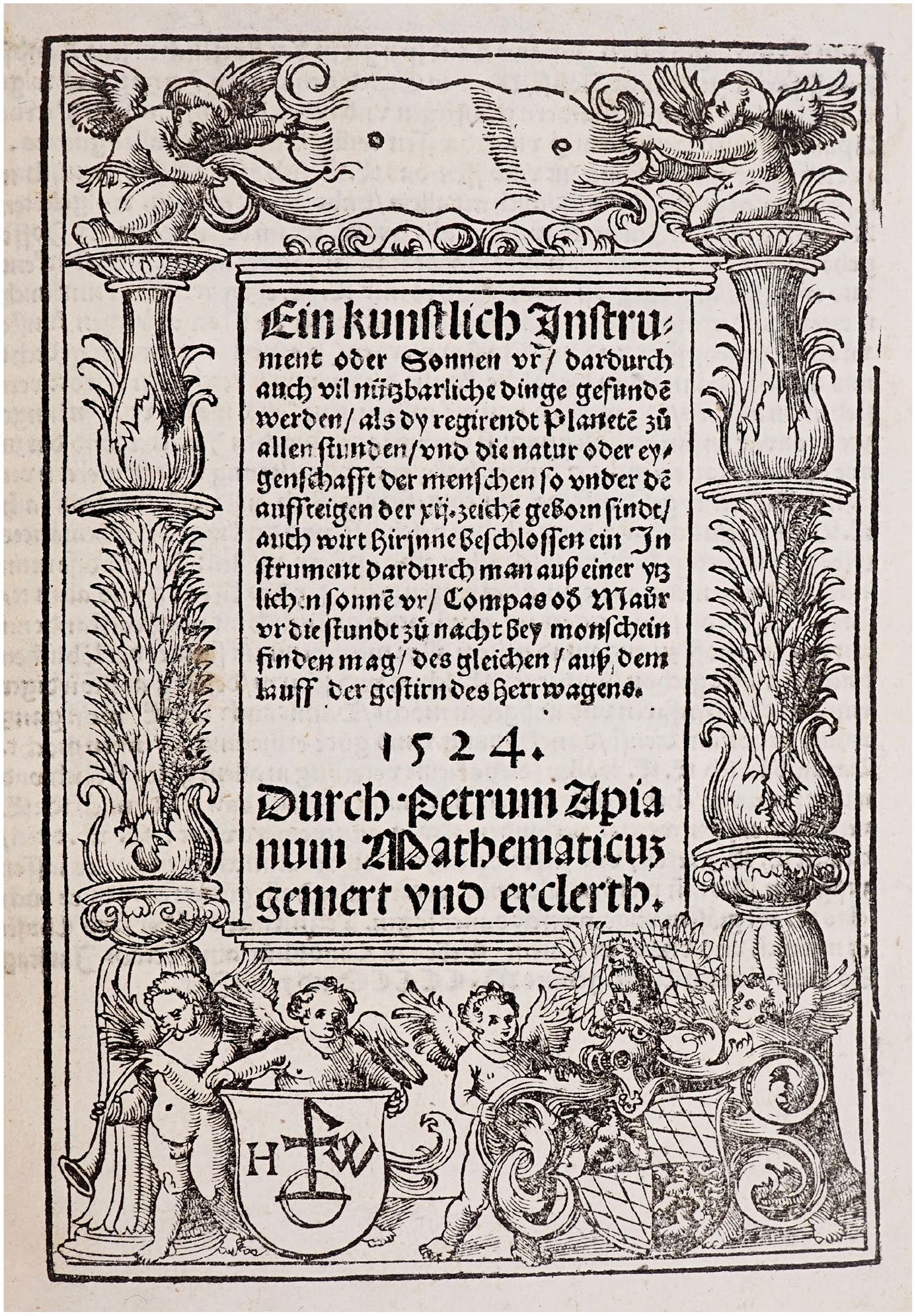
Title page of Ein kunstlich Instrument. The printer’s device is in the shield at lower left. The grid on the shield in the lower right seems to reflect Apian’s instrument for planetary hours, found later in the book. The two apparent holes depicted in the scroll held by the putti at the top may allude to similar holes for a movable support for a plumb line on a quadrant described already by Regiomontanus in his Calendarium and also used by Apian in his later Instrument Buch and Horoscopion. Universitätsbibliothek Graz.
In modern German, künstlich often means artificial, not natural, or imitative. However, a now outdated usage made it a synonym of künstlerisch (artistic, ingenious) or kunstvoll (artful). 38 These early usages, in our view, illustrate Apian’s meaning. English artful similarly carries a double sense—either the rather negative crafty or cunning (as with Dickens’ Artful Dodger), or the more positive artistic or skillful. (And once it also meant artificial.) Finally, which instrument in his little book did Apian consider to be ingenious? In our view, he meant the whole book—the book itself is the ingenious instrument. 39
Relation of Ein kunstlich Instrument to Cosmographicus liber
From the title alone, the contrast with Cosmographicus liber 40 is striking. We see that Ein kunstlich Instrument is devoted to practical time-telling and some applications of astrology. The cosmographical book contained a celebrated distinction among cosmography, geography, and chorography, 41 a lengthy proof that the Earth is a sphere, an account of the nested spheres of the cosmos, an introduction to the circles of the celestial sphere, definitions of terrestrial longitude and latitude, an account of the climata and geographical zones, elements of surveying, a list of the upcoming eclipses for 1523–1570, a brief catalog of zodiacal stars, and instructions on the use of various instruments. 42 The long second part of Cosmographicus liber gave a detailed geography of Europe, Asia, Africa, and America. In short, Cosmographicus liber was just the sort of work from which a university professor could crib his lectures for a course in cosmography.
The dedicatory letter on the back of the title page of Ein kunstlich Instrument is dated New Year’s Day, 1524. The dedicatory letter that begins Cosmographicus liber bears a printed date “septimo Kalendas Januarias.” But in all four copies of the first edition of the CL that we have examined, “Januarias” has been corrected by hand in ink to “Februarias,” and by the same hand in all four. 43 Thus, we take the correction to have been made with Apian’s knowledge and approval and the intended date to be 7 days before the Kalends of February, that is, January 26, 1524. So we see that the two books were in the works at about the same time but that Ein kunstlich Instrument was ready for the printer somewhat before the much longer Cosmographicus liber. Both were printed in Landshut by Johann Weyssenburger. The colophon in Cosmographicus liber informs us that the book was printed “at the expense of Petrus Apianus,” in 1524, “In the month of January with Phoebus [= the Sun] in the house of Saturn” (Mense Janu: Phebo Saturni domicilium possidente). Now, Capricornus is Saturn’s solar house, and Aquarius its lunar house. 44 The Sun was in Capricornus approximately December 12–January 11 and in Aquarius approximately January 11–February 9. So the printing of CL was probably completed in the last part of January (with the Sun in Aquarius), in all likelihood after Ein kunstlich Instrument had been printed.
Cosmographicus liber was addressed and dedicated to Matthäus Lang, the Prince-Archbishop of Salzburg, whose coat of arms appears on the verso of the title page. Ein kunstlich Instrument was addressed to a less prestigious personage, one Johann Landsperger (or Landtsperger), pastor of St. Jobst 45 in Landshut (who is also acknowledged in Cosmographicus liber).
Cosmographicus liber had a model in an earlier book by Johann Schöner, Luculentissima quaedam terrae totius descriptio (A most lucid description of the whole Earth), published at Nuremberg in 1515. 46 Schöner’s book (like Apian’s) is divided into two parts—a short cosmographical introduction, followed by a longer geography with an extensive gazetteer. Schöner’s book, probably intended to accompany his globe of 1515, 47 bears on its title page the threatening notice that the book is printed with the privilege of Maximilian, the Emperor of the Romans, for 8 years, and that “no one should print or try to print these codices: with the Cosmographical globe: subject to a fine of fifty Rhenish florins, and the loss of all copies.” If Apian did make some use of Schöner’s book, he did not violate the privilege, as the 8 years had (just) elapsed. 48 In any case, many writers were borrowing one another’s geographical data; moreover, the cosmographical contents of all these books came from a common storehouse of knowledge and tradition. Also, it must be said that the cosmographical part of Apian’s book was twice as long as the corresponding part of Schöner’s Descriptio, was more reader-friendly, covered some topics not treated by Schöner, was generously illustrated (while Schöner’s had only two illustrations—of a terrestrial globe and an armillary sphere), and was also accompanied by the spectacular working instruments that had no counterpart in Schöner’s book. (Schöner was, however, also a creative designer and printer of planetary volvelles, as shown by his Aequatorium astronomicum of 1521, reprinted in 1534. 49 ) Finally Apian’s Cosmographicus liber was more handsomely printed than Schöner’s Descriptio.
While Ein kunstlich Instrument seems to have had but a single edition, Apian’s Cosmographicus liber became extraordinarily popular. After the 1524 publication in Landshut, it was reissued in Antwerp in 1524 and 1527. 50 And then in 1529 Gemma Frisius or Phrysius (Jemme Reinerszoon) published a new edition with his own corrections, under the title The Cosmographical book of Peter Apian the mathematician, diligently corrected, and freed of errors by Gemma Frisius. 51 We shall see some examples of Gemma’s corrections below. But here we may mention an obvious minor change: Gemma re-did the image of the polar region shown in Figure 3 with each constellation mirror-reversed. 52 This was to show the constellations as they are seen in the sky, rather than as they are seen on a globe. Apian’s original figure was not a mistake, but it was less convenient for beginning users than was Gemma’s.
In 1533, Gemma published a new edition, 53 adding at the end of the 1529 text his own short treatise on triangulation. 54 There were many reprintings to follow, with translations into French, Spanish, and Flemish. Röttel and Kaunzner list some 50 editions up to 1609, with some dozen and a half different publishers. Sometimes extra material was added by a new publisher. Usually the original material by Apian was carefully distinguished from the additions by Gemma Frisius and others. And yet, the 1524 Cosmographicus liber and Ein kunstlich Instrument do have some overlap, most obviously in sharing some of the instruments and illustrations, even with the use of the same figures. And, as Van Ortroy points out, some passages of Cosmographicus liber were translated word for word from the German original. 55
Outline of the work
Ein kunstlich Instrument is divided into an introduction and 15 chapters, with supplementary material (such as tables and working instruments) included. Here we translate all the chapter titles and the most important section titles. We also note all the instruments and tables, as well as those figures that are not merely decorative.
56
An instrument, table or figure which also appears in the editio princeps of Cosmographicus liber is in italic type. An instrument, table or figure that does not appear in the cosmographical work is in
•Title page, with dedicatory introduction on verso
• “ [Working orthographic projection of celestial sphere on verso]
•Chapter 1, “On the course of the Sun”
[Theorica solis on verso]
•Ch. 2, “On the common hours of the day”
•Ch. 3, “On sunrise and sunset”
•Ch. 4, “On the day length and night length”
•Ch. 5, “On the dawn / and separation of day and night”
•Ch. 6, “On the altitude of the pole”
•Ch. 7, “Also on the altitude of the pole / how one finds it / at all hours in the day by means of sunlight”
•Ch. 8, “On the location of the pole and finding it in the sky” -“Another way of finding the pole using the compass” [Figure of polar constellations and folding compass sundial (Figure 3 above)]
•Ch. 9, “On the altitude of the Sun from the sunlight”
•Ch. 10, “On the planetary hours / how / where / and why they were invented” -“The way to find for all times the planetary or Jewish hour” -“How to find the planetary hour in the night” -“Here follows the instrument for the planetary or Jewish hour” [
•Ch. 11, “On the ruling planets” -The order of the planets and their symbols [ [
•Ch. 12, “On the nature of the planets and the properties of their hours / also what is good to do in them and what to avoid” -“Saturn and its hour” -“For those born in Jupiter” -“Mars” -“Sun” -“Venus” -“Mercury” -“Moon”
•Ch. 13, “On the rising of the twelve signs / and their nature / also on the characteristics of people / who are born under them” -“Here follows the instrument of the rising sign” [ -“The nature of the twelve signs and the people born thereunder”
•Ch. 14, “Gives a brief and good instruction / how one should conduct oneself in bloodletting”
[
•Ch. 15, “On the night clock / how one shall use a compass [sundial] at night by moonlight” -“Here follows the night clock” [Night clock instrument] -“How to find the hour at night by means of the stars of the Wagon” -“The use of this instrument” [Figure of a man using a nocturnal] [The nocturnal to be assembled]
As we can see, the German-language book is aimed primarily at practical matters: finding the pole, telling time at night or in the day, knowing which zodiac sign is rising, and so on, with a good dose of astrological lore, including advice on when it is best to do a bit of bloodletting. Almost entirely absent are the grand cosmographical treatment of the place of the Earth in the universe, the celestial circles, the climata, geographical zones and winds, and world geography. Apian’s perceived audience for Ein kunstlich Instrument had no patience for or interest in this sort of material from the liberal arts curriculum. And even the astrology is treated in a cursory way. That is, the reader receives no instruction on the details of casting a horoscope. Rather, the focus is on what is good or bad to do at each hour of the day, and the general characteristics of people born when the various zodiac signs are rising. Propitious times for bloodletting are prescribed according to the zodiac sign in which the Moon is located and which sign is rising. The astrological chapters will be discussed in more detail below.
The instruments, tables and figures of Ein kunstlich Instrument
Table of latitudes
Apian starts with a table of geographical latitudes (in degrees and minutes). See Figure 7. Most of the tabulated sites are in central Europe, but a few are included from the Iberian peninsula, France, and Italy, and a few more have historical or religious significance, such as Constantinople, Carthage, Alexandria, Ephesus, Sidon, Jerusalem, Babylon, and Mecca. All the listed latitudes are between 22° (Mecca) and 54°36′ (Rostock), except for the more exotic “Callikut” (Calicut, India), said to be at 5°. Here Apian’s dependence on Schöner is likely, as the latitudes for the distant places tend to be identical with those in Schöner’s vastly greater list in his Most Lucid Description. By “distant” we mean not only such places as Tyre, Jerusalem, and Mecca, but even Granada, Lisbon, Rome, and Paris—for all these, as for many more, Apian’s latitudes agree with Schöner’s. But for a number of places in southern Germany and in Austria, Apian’s latitudes depart from Schöner’s, sometimes by 1 or 2 minutes, but in some cases even by 6′ (Salzburg), 12′ (Passau), or 19′ (Landshut). Thus, Apian may have relied on other sources for areas closer to home. Alternatively, as he later made maps of some of these regions, he may have used his own estimates to correct Schöner. 57

Table of geographical latitudes (height of the pole) from Ein kunstlich Instrument. Beinecke Rare Book and Manuscript Library, Yale University.
Theorica solis
In a logical progression, the first instrument to be introduced would be the one labeled Der Sonnen instrument genandt Theorica (The solar instrument called Theorica). See Figure 8. This instrument is found on the verso of Chapter 1. And thus it is actually the second instrument in the book—for the first is the working orthographic projection of the celestial sphere, for finding the length of the day (among other things), which, for many applications, cannot logically be used unless one already knows the longitude of the Sun. Theorica is a medieval Latin term for a geometrical model or mechanical instrument for deducing solar or planetary positions. This particular instrument was very common in medieval Arabic and Latin astronomy, occurring, for example, in manuscripts of the Theorica planetarum of Companus of Novara (13th century). 58 It is a literal representation of the eccentric-circle solar theory of Hipparchus and Ptolemy. The oldest known description of such a device occurs in the Hypotyposis of Proclus (fifth century CE). 59 It was a common feature on the backs of European astrolabes. 60 And, as we have seen, Apian had already printed one on his Mappa mundi.

The theorica solis in Ein kunstlich Instrument, with too large an eccentricity. The theorica that appears in the 1524 Cosmographicus liber was printed with the same block. Österreichisches Nationalbibliothek.
This instrument is used to find the longitude of the Sun, given the date in the (Julian) calendar. The outer circle is the zodiac. The central point, from which a string should extend, represents the Earth. The inner circle, divided into months and days, represents the annual path of the Sun. The thread from the center of the central circle is missing in this copy, as in many of the originals. Using the added line in the figure we see that 10 May corresponds to a solar longitude of Taurus 28°, which is the example that Apian mentions in Ein kunstlich Instrument (Chapter 1).
The personified Sun is shown bestriding a lion, because Leo is the astrological house of the Sun. The Moon and the five planets are on leashes held by the Sun, a reference to the fact that each of these bodies is partly controlled in some way by the Sun. Mercury and Venus are always close companions of the Sun. And Mars, Jupiter, and Saturn move around their epicycles in Ptolemaic astronomy in lock step with the motion of the Sun on its eccentric circle. 61 In this allegorical figure, the leash for Saturn is longer than those for Mars and Jupiter—so Apian was able to slip in a subtle cosmological message, after all. In the same way, Mercury is on a tighter leash than Venus. The Moon’s leash is thinner and lighter than those of the planets, perhaps reflecting that it has almost free rein moving around the zodiac. Its motion was affected by the Sun only though the evection, or second lunar anomaly (with an amplitude of about 1.3°), described by Ptolemy.
The instruments that appear in Ein kunstlich Instrument but not in Cosmographicus liber were naturally labeled in German. These include the instrument for planetary hours and the horizons instrument (for finding the zodiac sign that is rising at a given latitude). But instruments that appear in both works were generally printed in Latin. This is the case with the theorica solis and the working orthographic projection of the sphere, even though this resulted in some minor conflicts between the instrument labels and the textual description of the instruments.
Unfortunately, in the theorica solis of Ein kunstlich Instrument, either Apian or his engraver made a mistake, for the eccentricity of the Sun is too large by approximately a factor of 2. By the eccentricity, we mean the distance between the centers of the two circles (zodiac and calendar circles) divided by the radius of the calendar circle. This should be equal to the eccentricity of the Sun’s eccentric circle in standard solar theory. Measurement in Figure 8 yields an eccentricity of 0.075—about twice what it should be. The value given by Ptolemy in the Almagest was 2½ sixtieths (0.04167) and the value common in Alfonsine astronomy was 0.0378. 62 Obviously, something is amiss in Apian’s theorica. We conjecture that Apian made the common error of taking the dimensionless eccentricity times the diameter of the calendar circle (rather than the radius).
Figure 9 is the theorica solis that Gemma Frisius printed in the corrected Antwerp edition of Cosmographicus liber (1529). We find that the eccentricity is the much more appropriate 0.038. This was perhaps one of the corrected errors that Gemma had in mind when he titled his edition. Much of the overall design of the theorica has been retained, although Gemma has made the instrument more resemble the back of an astrolabe by adding a shadow box and a set of curved lines for telling time in seasonal hours. Also, by making the inner circular disk carrying the solar image concentric with the zodiac, he has made the whole figure resemble a standard cosmological diagram of the sort found in Georg Peurbach’s Theoricae novae planetarum. 63 Finally, Gemma seems not to have noticed the subtle point about the Sun’s influence on the Moon’s motion that Apian had made in making the Moon’s leash lighter than those of the planets; for in Gemma’s allegorical figure the Moon’s leash is just as heavy as those of the planets. Gemma’s version of the theorica solis appears in later editions of Cosmographia, sometimes with minor changes.

The theorica solis from Gemma Frisius’s 1529 edition of Cosmographicus liber, with an appropriate eccentricity. Edward E. Ayer Digital Collection (Newberry Library).
In Apian’s Astronomicum Caesareum of 1540, the solar instrument gives a maximum equation of center of roughly 2°, corresponding to an eccentricity of 0.035, which is close to the Alfonsine value. So Apian did not make this mistake again.
Orthographic projection of the celestial sphere
Apian has no special name for the device shown in Figure 10, just referring to it as the “instrument” (das Instrument oder Organum). Greek ὄργανον = Latin organum = a tool, an instrument. It is a working orthographic projection of the celestial sphere and can be used to solve a host of problems, such as finding the length of the day or the time of sunrise. It can also function as a universal sundial (good for all latitudes) that tells time in equinoctial hours. One uses the movable TRIGONUS to measure the altitude of the Sun. Then an appropriate reading of the instrument gives the time. The projection is basically a side view of an armillary sphere, with some moving parts. In at least some copies of Ein kunstlich Instrument, as we see in Figure 10, the organum was printed on a page that (probably mistakenly) carried the same heading as was used for the page carrying the theorica solis. That this instrument was not intended to be labeled a theorica is plain from Apian’s 1524 Cosmographicus liber, where this mistake was eliminated.
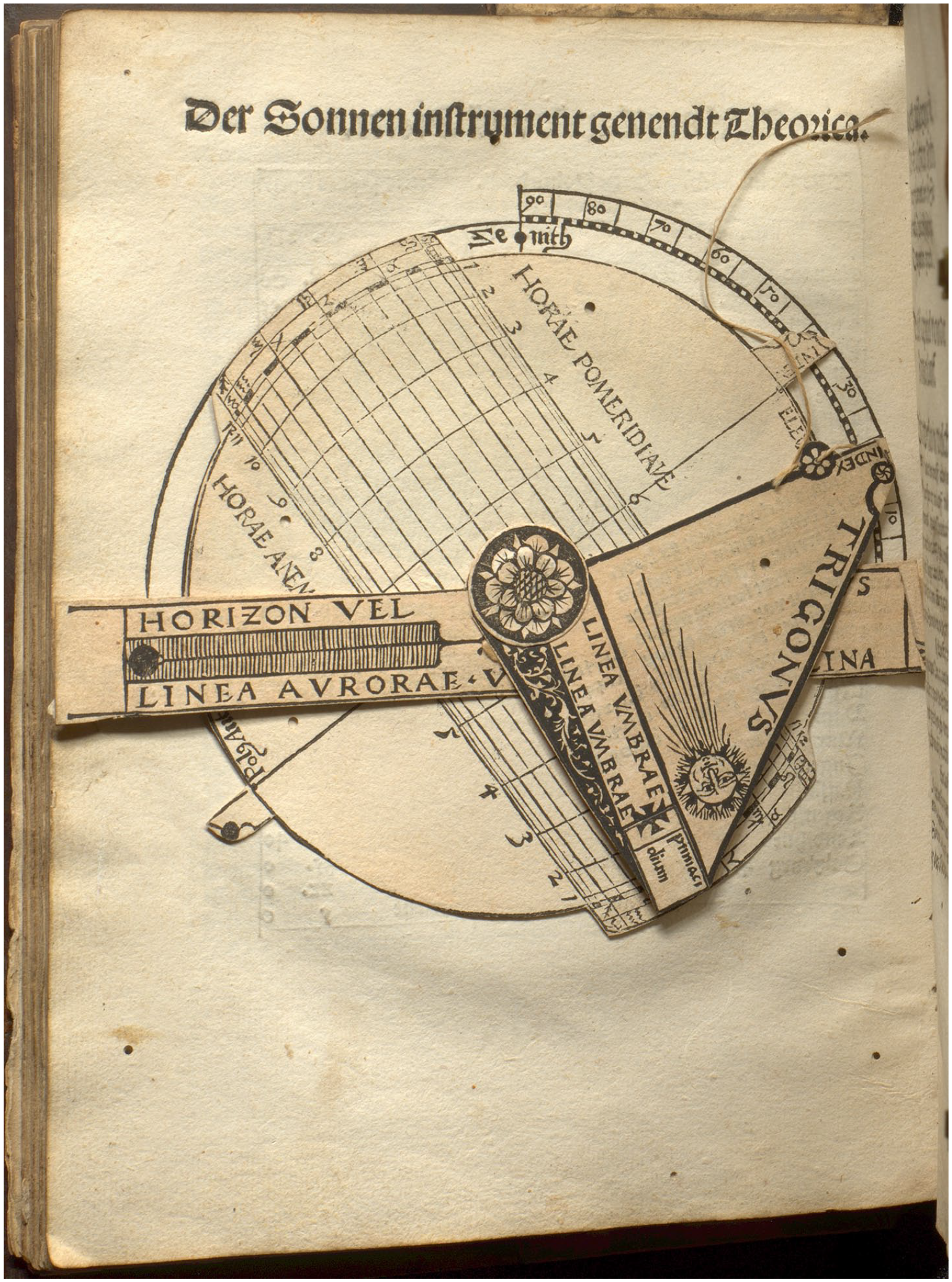
The orthographic projection of the celestial sphere in Ein kunstlich Instrument. By Courtesy of the University of Liverpool Library. Ref. no. SPEC EP.Ryl.B28(02).
The underlying orthographic projection was the basis of what is sometimes called the “de Rojas astrolabe,” as it appeared in Juan de Rojas’ Commentariorum in astrolabium (1551). 64 De Rojas may well have been influenced indirectly by Apian, for he was a student of Gemma Frisius 65 and so would have known the Cosmographicus liber. Moreover, he makes much use of Gemma in his own book. But orthographic projection was certainly not original with either de Rojas or Apian. Indeed, several late 15th-century instruments based on the orthographic projection of the celestial sphere are extant. 66
One of these instruments, with a standard stereographic astrolabe on one side and a “Rojas-type astrolabe” on the other, was presented to Cardinal Bessarion by a certain Ioannes in 1462. This instrument has been discussed in detail by Turner and King, who make the compelling case that the presenter was none other than Regiomontanus. 67 The characteristic feature of instruments of this sort is the grid (visible in Figure 10 or 14) consisting of straight-line parallels of declination and curved lines for the equinoctial hours. These curves should in principle be segments of ellipses, but were often represented by arcs of circles. Following Dekker, 68 we shall refer to this as the orthographic grid. The grid is rotatable to give the correct orientation with respect to the horizon for a given latitude. (The angle between the north celestial pole and the horizon is the latitude.)
Another relevant instrument is a celestial globe surmounted by an astrolabe, which was made for the astrologer Martin Bylica in 1480 and is now in the Jagiellonian University Museum, Cracow. On the reverse of the astrolabe is a fixed (non-rotatable) orthographic grid, which has a ribbon-like engraving carrying instructions for its use. 69 This device is commonly attributed to the instrument maker Hans Dorn, who studied in Vienna under Georg Peurbach and Regiomontanus. 70 According to Turner and King, 71 if the orthographic grid is rotatable the device can serve as an instrument of observation; but if the orthographic grid is fixed (as on this instrument), it is merely a calculating device. While there is an element of truth in this, the distinction is actually not so clear-cut. Bylica’s device bears instructions for using it to tell time, but there are extra steps involved, in that one must first use the instrument to measure the altitude of the Sun before processing the datum with the orthographic gird. On a complex instrument, the boundary between taking data and calculating with it can be fuzzy.
Several mid- and late-15th-century manuscripts discuss the projection leading to a universal sundial that was later called organum Ptolemei—Ptolemy’s instrument. 72 Thus, Apian’s name for his instrument, organum, is probably a shortened version of this. (Unfortunately, and rather confusingly, in late-medieval and early-Renaissance astronomy, two different classes of instrument were called organum Ptolemei, or Ptolomei. 73 One is the instrument we are discussing here, which uses an orthographic projection of the sphere. The other is a group of quasi-universal sundials in which the hour lines are straight, mentioned above.) Around 1456 in Vienna, Regiomontanus copied a number of manuscripts dealing with various astronomical instruments. These included a text titled Instrumentum universale ad inveniendum horas in quocunque climate fueris fabricare (To construct a universal instrument for finding the hours in whatever climate you may be). The author’s name is not given and not all of the figures were copied. Zinner records several later copies of this treatise in German and Austrian libraries. And, as he points out, the text of one of them gives, near the end, a name that could possibly be intended for G. Peurerbach. 74
Moreover, in the Yale Medical Historical Library is a copy of Regiomontanus’s Calendarium that is bound together with some 34 fifteenth-century Viennese astronomical manuscripts from the 1480s. This was formerly owned by the Bibliothek des Stiftes (Melk, Austria). One of the manuscripts in the volume is a text with same title (Instrumentum universale . . . fabricare) that includes a drawing of the orthographic grid. See Figure 11. 75 The same manuscript has a sketch of the part of the apparatus that became Apian’s trigonus, including its plumb line. See Figure 12. The non-radial leg of the triangle is here a circular arc.
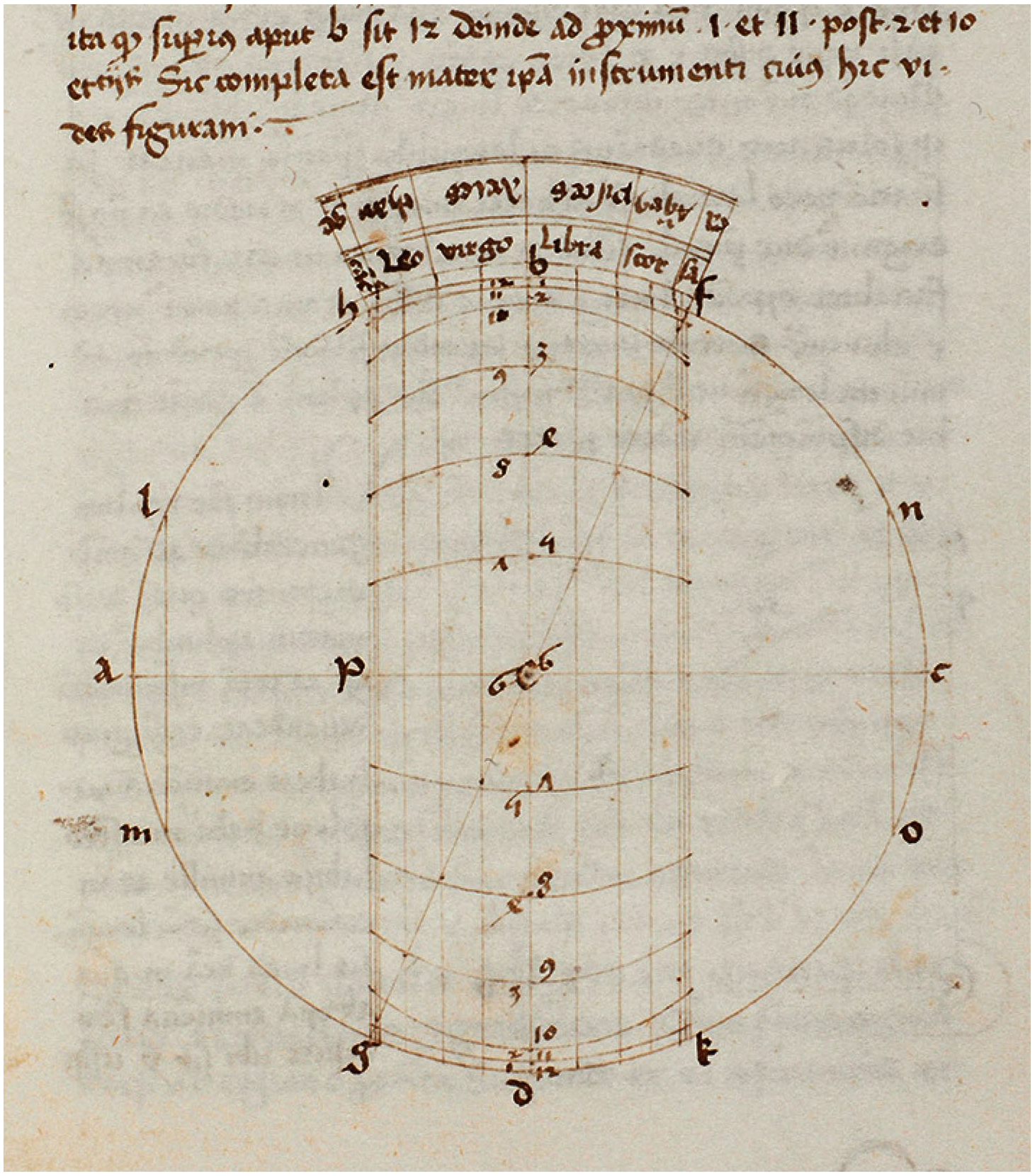
The orthographic projection of the belt between the tropics in Instrumentum universale ad inveniendum horas in quocunque climate fueris fabricare. Medical Historical Library, Harvey Cushing/John Hay Whitney Medical Library, Yale University, Codex Mellicensis 367, p. 441 (detail).
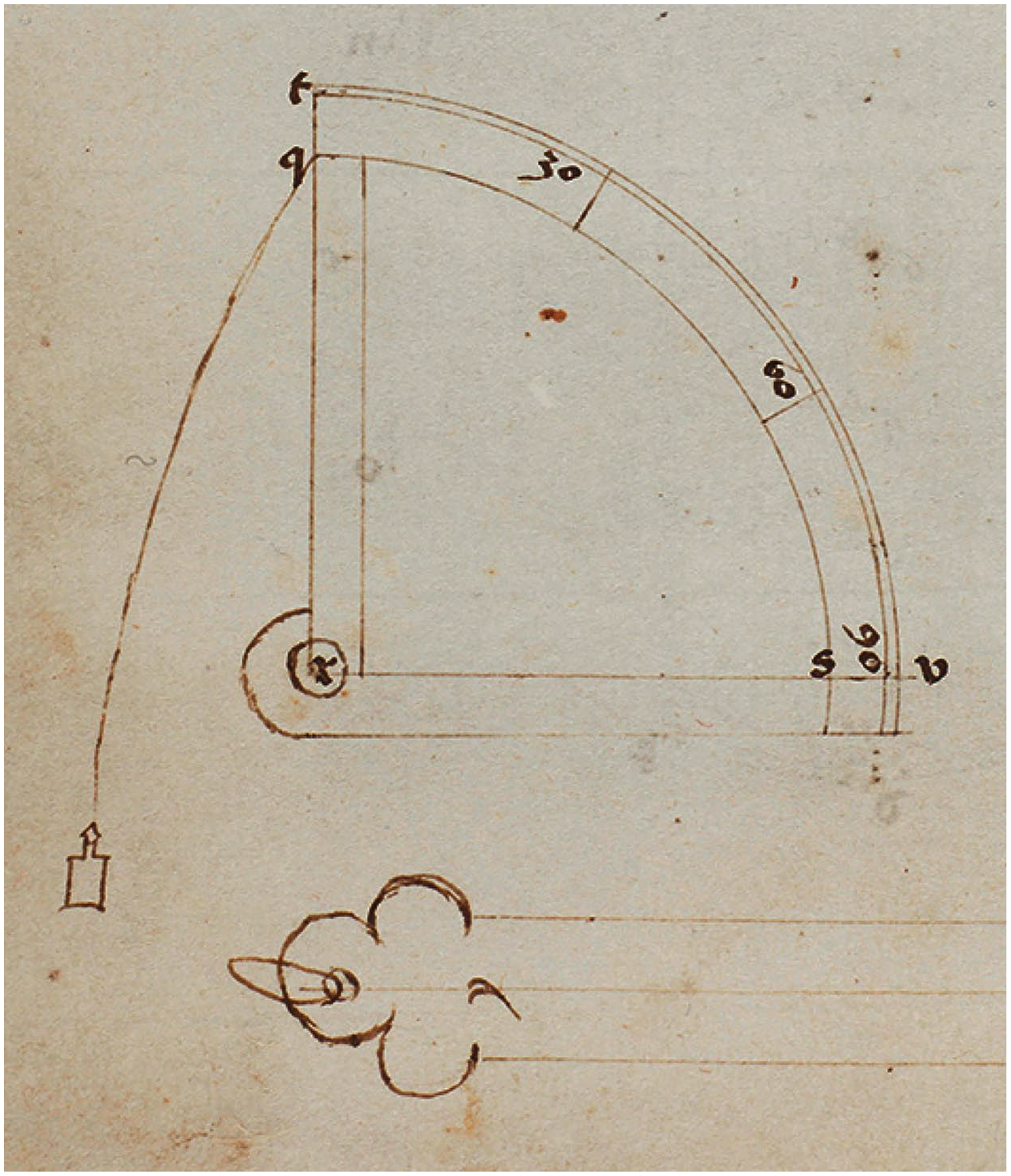
The rotatable quadrant with plumb line (the precursor of Apian’s trigonus). Instrumentum universale ad inveniendum horas. . . . Medical Historical Library, Harvey Cushing/John Hay Whitney Medical Library, Yale University, Codex Mellicensis 367, p. 442 (detail).
An even better likeness of the trigonus is found in a Vienna manuscript, as it includes the sights required on one side of the device. See Figure 13.

Detail of the rotatable quadrant with plumb line, equipped with sights. Instrumentum universale. . ., Österreichische Nationalbibliothek, Cod. 5296, f. 151 (detail).
Modern commentators have conjectured that the basic idea for these instruments based on orthographic projection goes back to Ptolemy’s On the Analemma, which was translated into Latin by William of Moerbeke in the 13th century. 76 It is true that Ptolemy shows how to construct arcs for the equinoctial hours, in order to determine, for example, how many equinoctial hours fit into the longest day at a given latitude. But Ptolemy’s work is much more general and, moreover, the actual instrument we are considering does not appear in the extant text. Moreover, the basic idea of orthographic projection is much older than Ptolemy. The earliest relevant text involving orthographic projection is found in Book 9 of Vitruvius’ On Architecture, which discusses the analemma. 77
This construction was, however, certainly not original with Vitruvius and it must go back to the early days of Greek sundial construction. Thus orthographic projection was a part of the ordinary toolbox of dialers and it would not have been necessary to have access to Ptolemy’s work to come up with what was sometimes called “Ptolemy’s instrument.” But there would have been little motivation to design an instrument for telling time in equinoctial hours until the later Middle Ages, when the introduction of mechanical clocks made the equinoctial hour common in everyday life. Deciding whether these 15th-century works really depend on Ptolemy’s On the Analemma would require a detailed comparison of the texts. In any case, as we have seen, the basic idea for Apian’s organum was in circulation a few generations before his time, including the rotatable “triangle” with sights, which permits a plumb line to be used to represent a horizontal line.
The page in Apian’s book (Figure 10) forms a base, printed with a quadrant scale for setting the geographical latitude and also for reading off the Sun’s altitude. Over this, there is a roughly circular, rotatable disk with tabs (labeled “Index”) at the celestial poles that can be used for setting the geographical latitude. This disk also has the grid (Figure 14) with straight-line parallels of declination and curves for the hours. The hour curves are labeled with times of day (
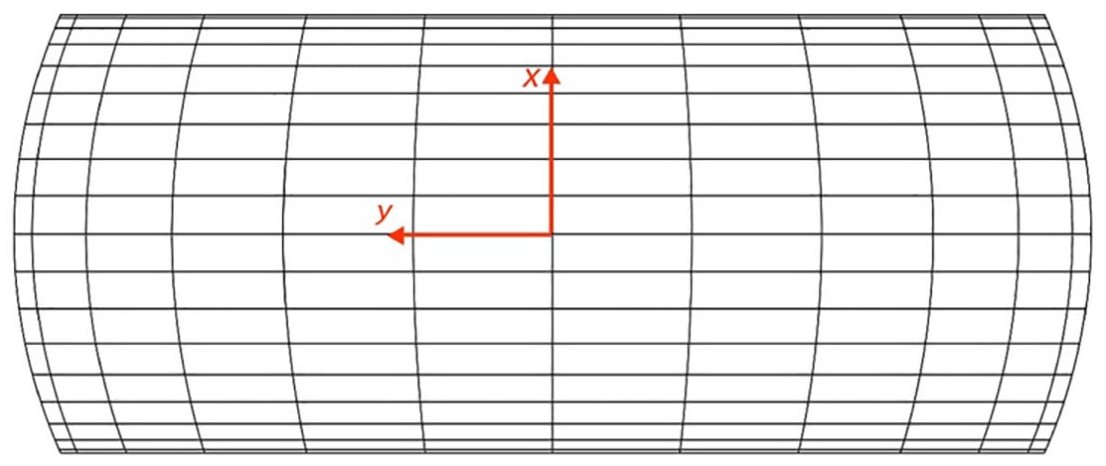
The grid coordinate system on the disk of the instrument. Drawing by L. Gislén.
The instructions for the use of the instrument in Ein kunstlich Instrument are not very clear. The procedures are described more clearly in Cosmographicus liber. We have not seen a detailed explanation of the use of this instrument in the modern historical literature. Therefore, let us see how to use the instrument as a quadrant for measuring the Sun’s altitude and then determining the time of day.
To do this, one first positions the booklet Ein kunstlich Instrument so that the page carrying the instrument is at right angles to the horizon plane, but rotated 90° counterclockwise, so that the graduated quadrant is up and to the left, as shown in Figures 15 and 16. The horizon band will therefore be vertical, as in Figure 16. Now identify the shadow projector, which is labeled PINNACIDIVM. This word was used in Renaissance astronomical texts for a fin-, feather-, or leaf-like part of a sighting apparatus. 79 In English it is often translated as “pinnule.” In Cosmographicus liber (fifth proposition), Apian refers to this folded-up tab as the proiector umbrae seu pinnacidium. In Ein kunstlich Instrument (Chapter 2), he simply refers to it as “the little four-sided plaque with the cross.” Cut along the dark line above the letters PINNA, then fold the shadow projector up along the cross, so that it stands at right angles to the page.

Finding the time of day from the altitude of the Sun. The horizon strip is omitted from this view for clarity, but would be vertical, with “Linea ortus” at the top. Drawing by L. Gislén.
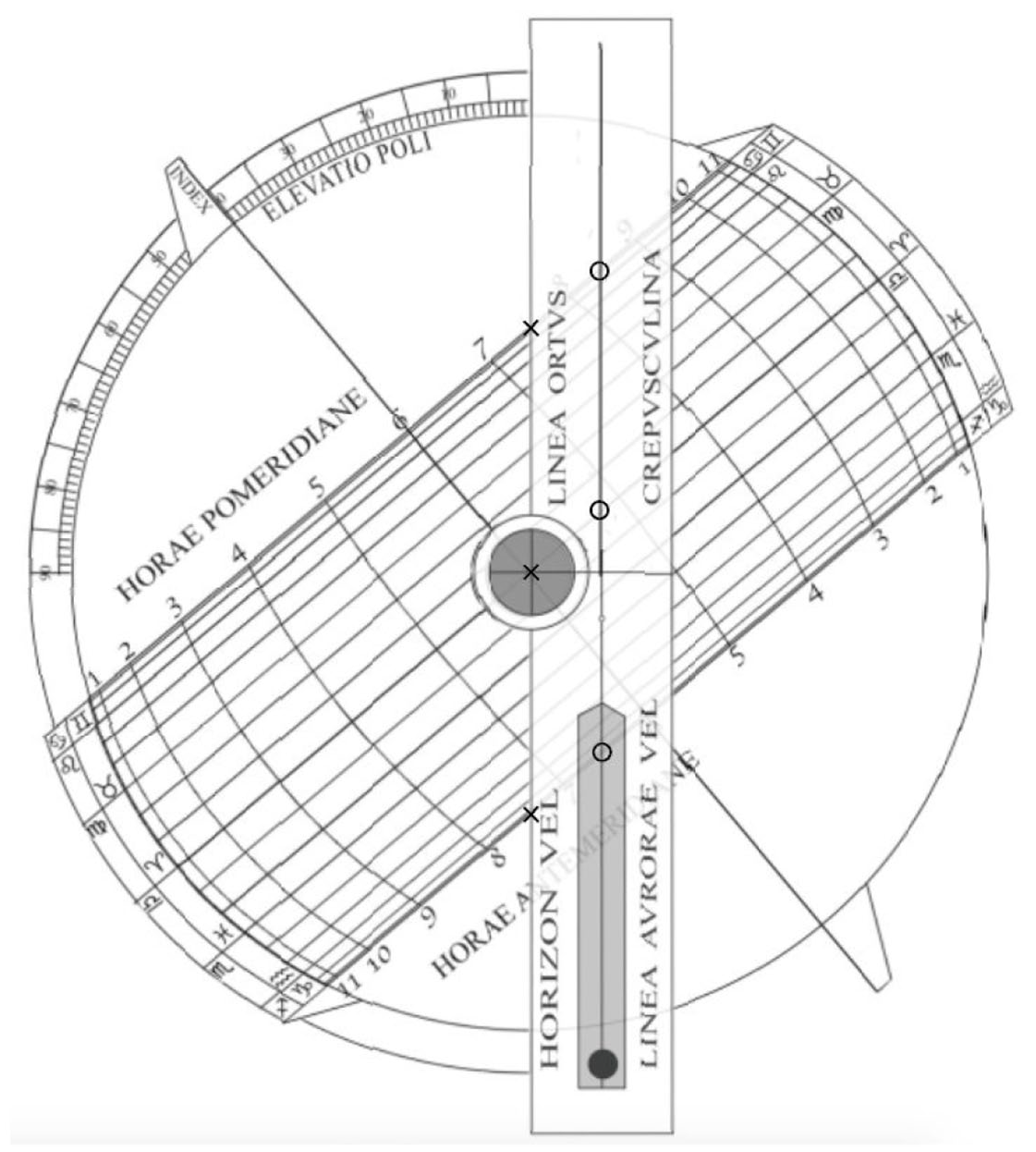
Sunrise, sunset, and twilight. Drawing by L. Gislén.
Now adjust the instrument for the geographical latitude by setting the “Index” labeled ELEVATIO POLI (elevation of the pole) along the scale of degrees printed on the page. See Figure 15. Note that zero degrees would be straight up, since the horizon line is vertical. In Figure 15, the instrument is set for latitude φ = 40°N.
With the book stood up and turned sideways (as described above), turn the instrument edgewise toward the Sun, with the PINNACIDIUM facing the Sun. Rotate the TRIGONUS until the edges of shadow of the PINNACIDIUM fall along the lines labeled LINEA UMBRAE. Then the instrument is set for the current altitude of the Sun and the altitude may be read off at the INDEX marked by the large asterisk on the TRIGONUS. In the example shown in Figure 15, the altitude of the Sun is h = 20°.
Finally, to read off the time of day, note where the plumb line crosses the declination lines of the grid, picking the correct time of year. Then follow the grid hour curve to either the
In our example (Figure 15) we seek the time of day for geographical latitude φ = 40° when the Sun’s altitude is h = 20°. If the Sun happens to be at the beginning of Aries or Libra this is about 7:45
Perhaps the cleverest part of the design is the rotation of the whole instrument through 90° so that a vertical plumb line can be used to represent a horizontal line. The plumb line picks out all the combinations of time of year and time of day for which the Sun is at the same altitude above the horizon. The right-angled TRIGONUS plays a key role in this.
Sunrise, sunset, and twilight are investigated using the rectangular strip on which there is a central twilight line, LINEA AURORAE, parallel to the horizon line, LINEA ORTVS (Figure 16). To find the time for the beginning of dawn, we first set the instrument for the geographical latitude. The TRIGONUS is not used here and can be positioned so that it does not obscure the twilight strip; it is therefore not shown in the figure. Thus the twilight strip has its HORIZON edge at 0° in the quadrant scale. Then the beginning of dawn twilight is read off from the crossings of the declination lines with the central line of the twilight strip and using the bottom
In the original instructions, a sharp object is to be used to make a mark through the twilight strip on the underlying grid. There is a thread fastened in the middle line near the central axis to assist making this marking. After making the pin-prick, one could rotate the disk so that the pinhole in the grid becomes visible, and thus observe the time. In a copy of a 1574 edition of Cosmographia in the Cornell University Library, someone has cut out a rectangle along part of the central line of the twilight strip in order to observe the crossings underneath more easily. 80
There are some niceties involving the orientation of the instrument on the printed page. As we have seen (Figure 10), in Ein kunstlich Instrument, the instrument is printed on a left-hand page with the horizon strip horizontal. In using the instrument to observe the Sun’s altitude, the booklet must be rotated counterclockwise by 90°. Sunlight can then hit the pinnacidium from the right (unless the Sun is very high, when the overhanging bundle of right-hand pages might interfere). But it must have been awkward to keep the right-hand pages up and out of the way. The instrument also appears with its horizon strip oriented in the same way in Cosmographicus liber of 1524 (Apian’s own).
Gemma Frisius changed this in his 1533 edition of Cosmographicus liber. (Gemma’s 1529 edition still followed Apian’s original 1524 CL. 81 ) In the edition of 1533 (Antwerp: Arnoldus Birckman), the graduated quadrant was rotated clockwise by 90° so that the zenith was to the right on the printed page, and the horizon strip was glued in vertically, with “Linea ortus” down. 82 The instrument was printed, as before, on a left-hand page. This was an ideal solution. Now a user could open the book up to the quadrant, and stand it upside down. 83 Then the instrument would be correctly oriented for use, and the right-hand pages would be harmlessly out of the way to the left. Figure 17 shows a 1553 edition (stood upside down) that follows this approach. Many later editions were printed this way, although there is some variety. And it must be said that many copies were assembled sloppily.
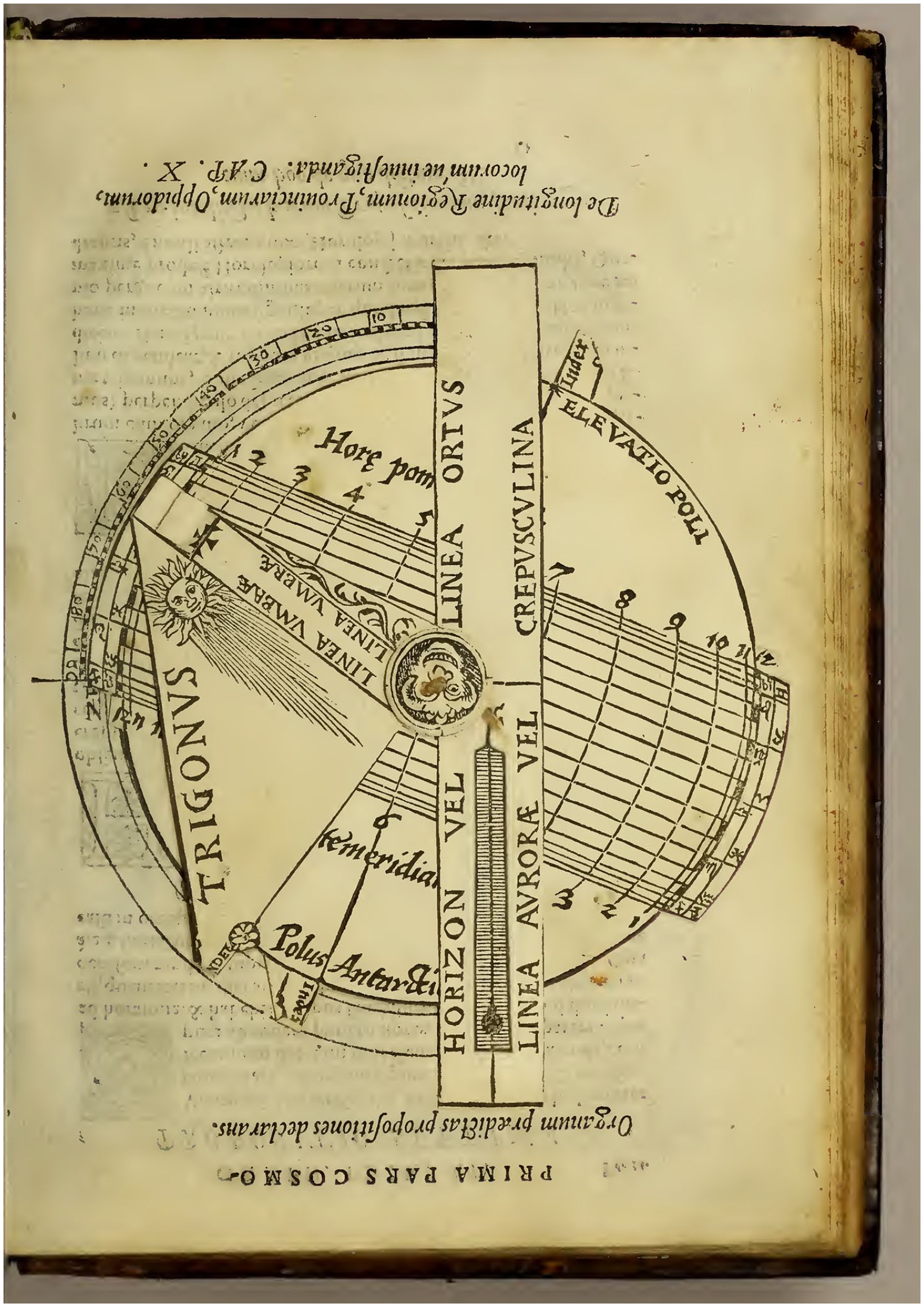
A copy of a 1553 Cosmographia edition, 86 turned upside down, in the orientation for use. archive.org/John Carter Brown Library.
It might be wondered whether Apian really intended readers of Ein kunstlich Instrument to fuss about with the bundle of overhanging pages: perhaps he meant the user to remove the page from the booklet and glue it to a board (a strategy he adopted for quadrants in some later publications). But the organum was printed on the back of the page with the table of latitudes, so he did indeed mean for the booklet to remain intact. Similarly, in Cosmographicus liber 1524, the organum is printed on the back of a page carrying one of the propositions and was not meant to be removed.
The instrument appears with cosmetic changes in all the editions of Cosmographia. The orthographic grid disk also appears in some other, later books such as Martín Cortés’ Breve compendio de la sphera y de la arte de navegar from 1551 84 and Michael Maestlin’s Epitome Astronomie from 1593. 85
In 1551, in Paris, Anthoine Mestrel made the instrument shown in Figure 18, which is now in the Collection of Historical Scientific Instruments at Harvard University. 87 One side of the instrument is a standard back of an astrolabe, with a theorica solis, which uses the two-gap style for handling the eccentricity, as in Gemma Frisius’s instrument in Figure 9. The top half of the interior is a scale for telling time in seasonal hours. And the bottom half of the interior has two shadow boxes for gnomons of 12 units. The front of the instrument of Figure 18 is an “organum” virtually identical to Apian’s in Ein kunstlich Instrument and Cosmographicus liber.
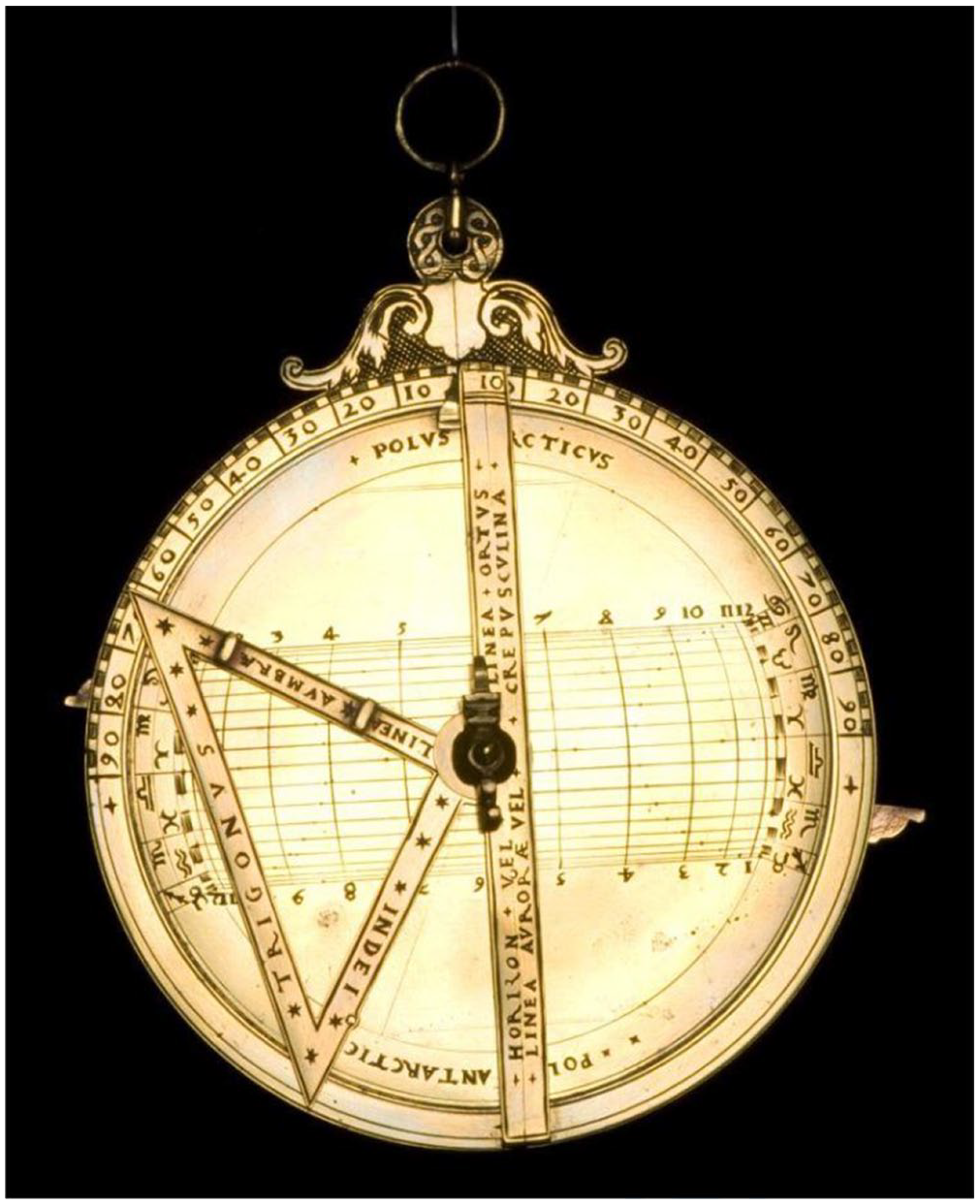
An organum Ptolemei made by Antoine Mestrel in 1551. Collection of Historical Scientific Instruments, Harvard University. Inv. DW0592.
This same Anthoine Mestrel was also the maker, in the same year 1551, of a signed astrolabe now in the History of Science Museum at the University of Oxford. 88 But this one was clearly based on de Rojas’ text and not on Apian’s. Mestrel thus appears to have been not only an excellent maker of astrolabes, but also a versatile one.
Also in the History of Science Museum at Oxford is a “geographical astrolabe” made at Antwerp by Gilles Coignet in 1560. One side of the instrument is a faithful copy of Apian’s or Gemma’s organum, including the rotatable orthographic grid, the trigonus, and horizon strip with engraved crepuscular line. 89 This gives us another example of Apian’s influence, whether directly or through Gemma, on instrument makers. The reverse of the instrument, rather remarkably, is a “cosmographical mirror,” also based on Apian or Gemma, and will be discussed below.
A Trigonometric Demonstration of the Function of the Instrument
A general expression for the altitude h of the Sun is 90

where the declination δ of the Sun is given in terms of the Sun’s longitude λ through the equation

where ε is the obliquity of the ecliptic (23.5° for Apian 91 ), φ is the geographical latitude, and H the hour angle of the Sun counted from solar noon and positive for times after noon. Times before and after noon are given by are tAM = H + 12h and tPM = H.
For the analysis of the working of the instrument, we define a coordinate system with the origin in the center of the grid, the x axis pointing to increasing declinations, and the y axis pointing toward noon, as in Figure 14. The radius of the grid disk is R. Then we have


We can rewrite (1) as

Multiplying by R and using (3) we get

This is a straight line with a negative slope in the grid system, parallel to the vertical and displaced by the distance R sin h/cos φ to the left of the origin for positive altitudes h. It coincides with the vertical plumb line (see Figure 15) in the actual instrument. The instrument graphically solves equation (1) for H, given the values h, λ, and φ.
It is important to note that one need not use trigonometry to design the instrument. This can be done by graphical construction and in the Appendix we explain a construction that is based on the treatment by Cortés. 92
Instrument for planetary hours
In Chapter 10, Apian introduces his readers to the so-called planetary hour, so important in astrology. The daylight period is divided into 12 equal parts. Thus in the summer, a day hour is long and in the winter a day hour is short—but there are always 12 of them. Similarly, the night is divided into 12 equal night hours. These are the seasonal (or temporal) hours of the ancient Greeks and Romans. The day and night hours are equal in length only at the time of the equinox. Hence the modern hour is also called the equinoctial hour—1/24 of a day and night together. Although the ancient astronomers did use the equinoctial hour for calculations when a uniform measure of time was required, in everyday life the seasonal hour was almost universal. Nearly all ancient Greek and Roman sundials are divided into seasonal hours, for example. The equinoctial hour did not displace the seasonal hour until the later Middle Ages, when the introduction of mechanical clocks made the equinoctial hour easily realizable. In Apian’s day, the equinoctial or clock hour was used in everyday life but the seasonal or planetary hour remained important for astrology.
Apian introduces the planetary hour by asserting on the authority of Hermes Trismegistus that the ancient Babylonian, Chaldean, and Jewish masters of the stars made every day 12 hours long, no matter whether the day was long or short. Moreover, Apian gives some examples from the Old as well as the New Testament, to illustrate the use of seasonal hours and to demonstrate that this really is the kind of hour used in the sacred text. As he informs us in the dedicatory introduction, he included these examples at the suggestion of pastor Johann Landsperger. For example: And on the sixth hour (that is precisely noon) there was a darkness of the whole earth and it lasted until the ninth hour (that is about 3 after noon by us) and on the ninth hour the Lord spoke with loud voice: Eli, Eli, etc.
93
Matthew says: A comparison with the heaven. A landowner went out early in the morning to hire workers for his vineyard. Then he went out again in the third and in the sixth hour and likewise in the ninth hour to hire more workers for his vineyard. Finally, he went out in the eleventh hour and said: “why are you standing there all day without work”, etc. But when the workers got their pay they mumbled and complained to the landowner because they didn’t get more than those who had only worked for one hour, etc. From these words it is clear that these hours [of the day] were twelve and were computed from morning to evening.
94
Apian refers to this sort of hour as the “planetary or Jewish hour.” For the later usage of course it is important that the Jewish day begins at sunset. Apian provides a clever instrument for finding the planetary or Jewish hour that corresponds to a given clock hour on a given day. See Figure 19a and b.
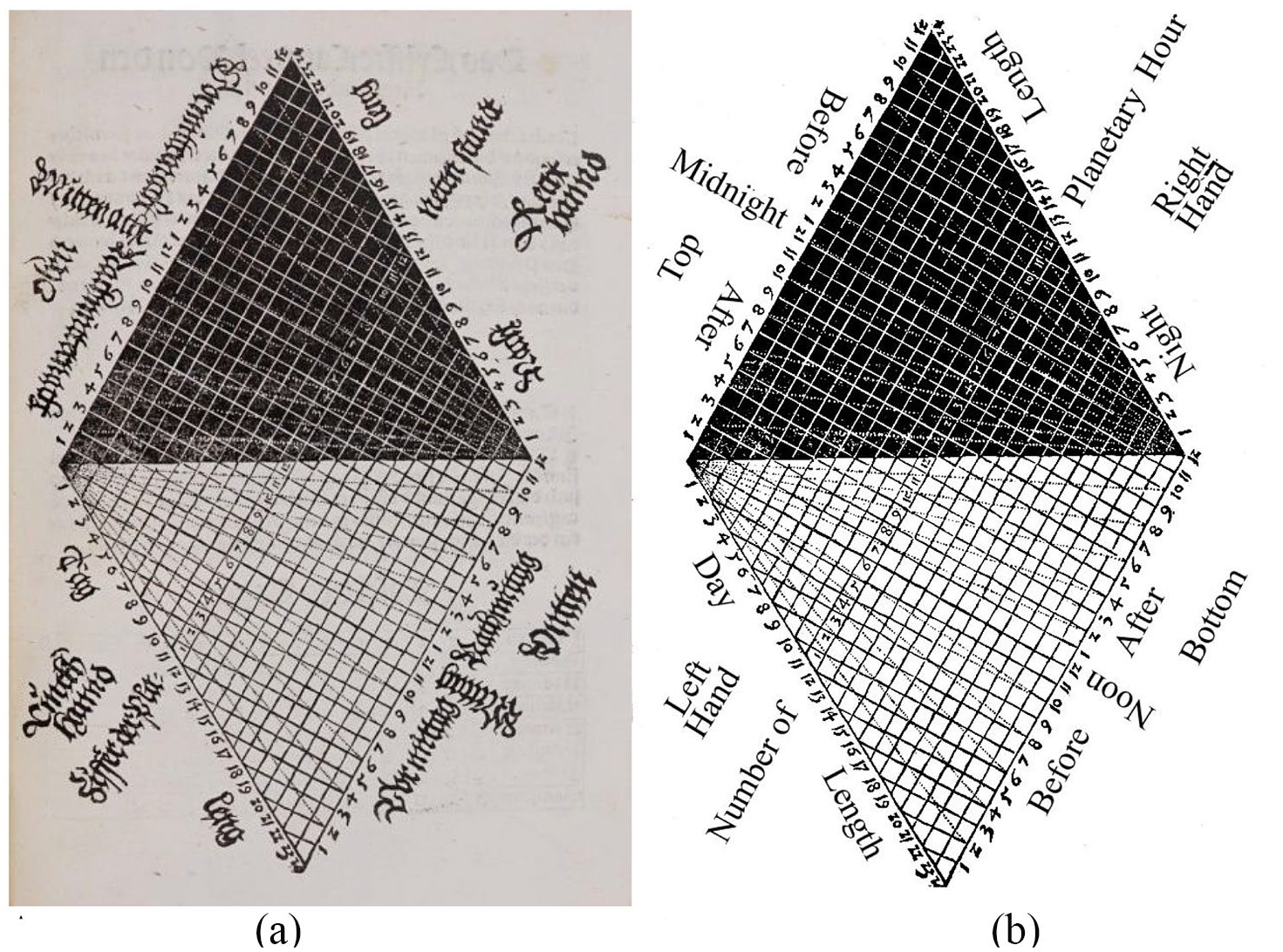
(a) The instrument for planetary hours in Ein kunstlich Instrument. Universitätsbibliothek Graz. (b) The instrument for planetary hours translated.
The instrument is a rhombic diagram in which you enter with the equinoctial hour and the length of day or night and find the corresponding seasonal hour by simple proportion. For daytime hours you enter with the equinoctial hour of the day in the lower right edge of the rhombic pattern and with the day length in the lower left edge and follow the grid lines to the planetary hour number in the middle of the white area. For night hours you enter in the same way with equinoctial night hours in the upper left edge and with night length in the upper right edge.
Example: Suppose that the day length is 16 hours and that the time of day (in equinoctial hours) is 8
The diagram is based on simple proportion. At this time of year, the 12 seasonal hours are equal to 16 equinoctial hours. Each equinoctial hour will thus be 12/16 of a seasonal hour. 8
Regiomontanus had included in his Kalendarium of c.1474 an instrument for converting in either direction between equinoctial and seasonal (or planetary) hours for a limited range of day lengths. See Figure 20, from the German edition. (The figure appears also in the Latin edition). A table in Regiomontanus’s text gives the length of the half-day as a function of geographical latitude and solar longitude. For the day in question, one pulls the string out to the proper half-day length on the outer, circular scale. One then fixes a knot or nodule of wax on the string so that it lies over the 12th hour line. One then can move the string to the desired clock time and can then note which planetary hour the knot or nodule indicates. Regiomontanus’s device (like Apian’s rhombic diagram) simply divides the length of the day into 12 equal parts. 95 Given the importance of planetary hours for “elections” (deciding when it is best to do something) and the example of a conversion instrument provided by Regiomontanus, it is easy to see why Apian had to include an instrument of some sort. Apian’s device is less complex to use, but would give somewhat less precise results than Regiomontanus’s.
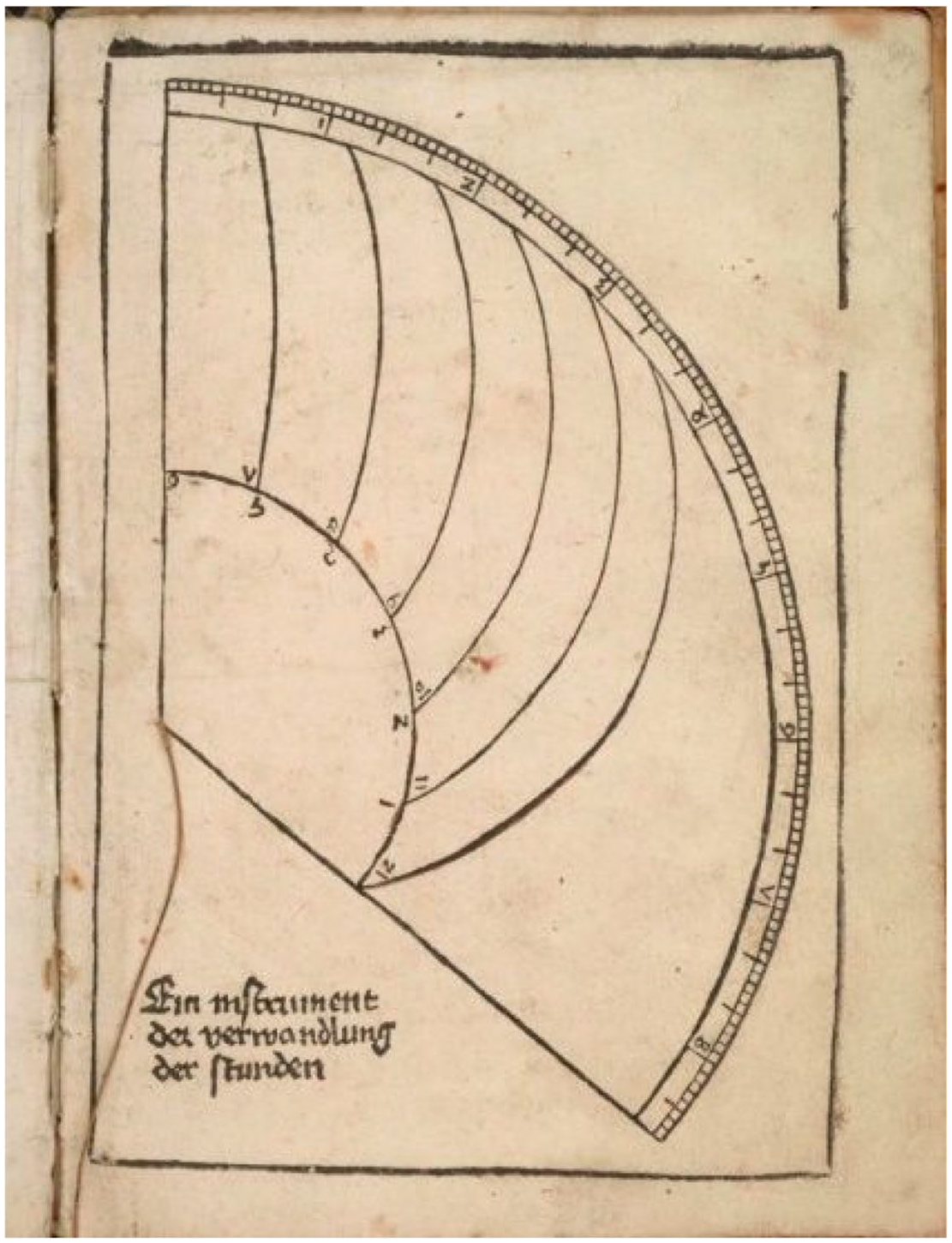
Regiomontanus’s “instrument for the conversion of hours,” in Kalendarium (Nuremberg, c. 1474). Library of Congress.
Apian re-used his instrument for converting between planetary and equinoctial hours, with some modification, in later works such as Horoscopion Apiani and Instrument Buch. Because of the non-uniform spacing of the hours on his horoscopion, the dotted lines of Figure 19a become curved. But it is recognizably the same stratagem. Apian’s curvilinear version of the hour converter owes a debt to a broadside of 1512 by Johannes Stabius (Johann Stab), which used a similar construction. 96
Tables for the ruling planet for each planetary hour
In standard Ptolemaic astronomy, here is the order of the planets, in decreasing distance from the Earth: Saturn, Jupiter, Mars, Sun, Venus, Mercury, Moon. Let us suppose that on a certain day Saturn rules the first hour of the day. (The whole day belongs to the planet that rules its first hour. Thus, we are starting with Saturday.) Then Jupiter will rule the second hour of that day, and Mars the third, and so on. After 21 places are used up (three cycles through the planets), we end with the Moon; and then there are three more hours to complete the 24 hours of the day and night, assigned to Saturn, Jupiter, and Mars. Thus, the first hour of the next day is assigned to the Sun. And this is why Sunday follows Saturday. The 7-day planetary week became widespread in the fourth century CE. In Chapter 11, Apian gives two tables, separating the night hours from the day hours and showing the ruling planet for each hour. See Figures 21 and 22.
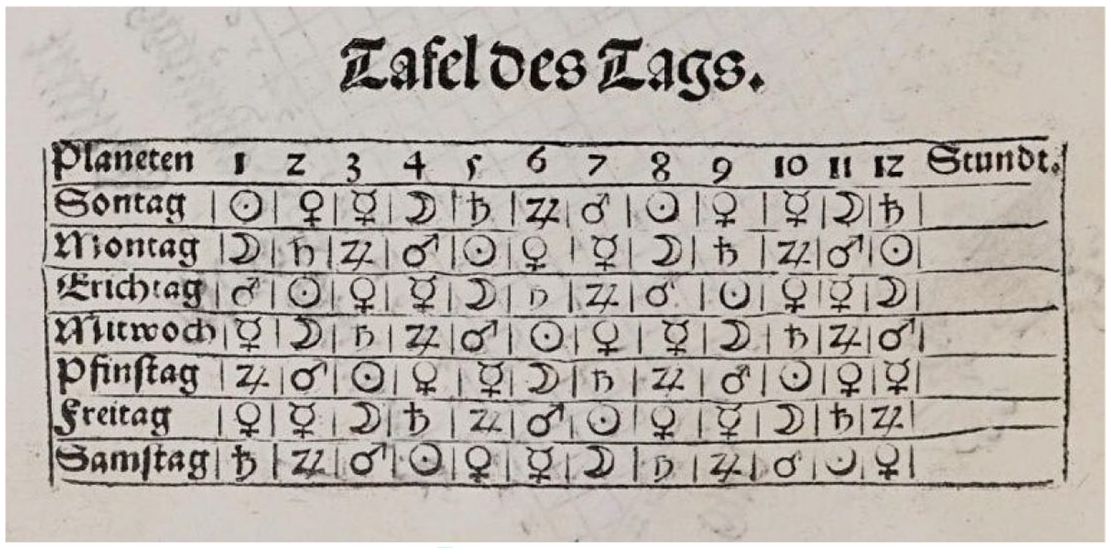
The “Table of the Day” in Ein kunstlich Instrument. The Sun rules the first hour of the day on Sunday. The 12th hour of the day on Sunday is ruled by Saturn. Universitätsbibliothek Graz.
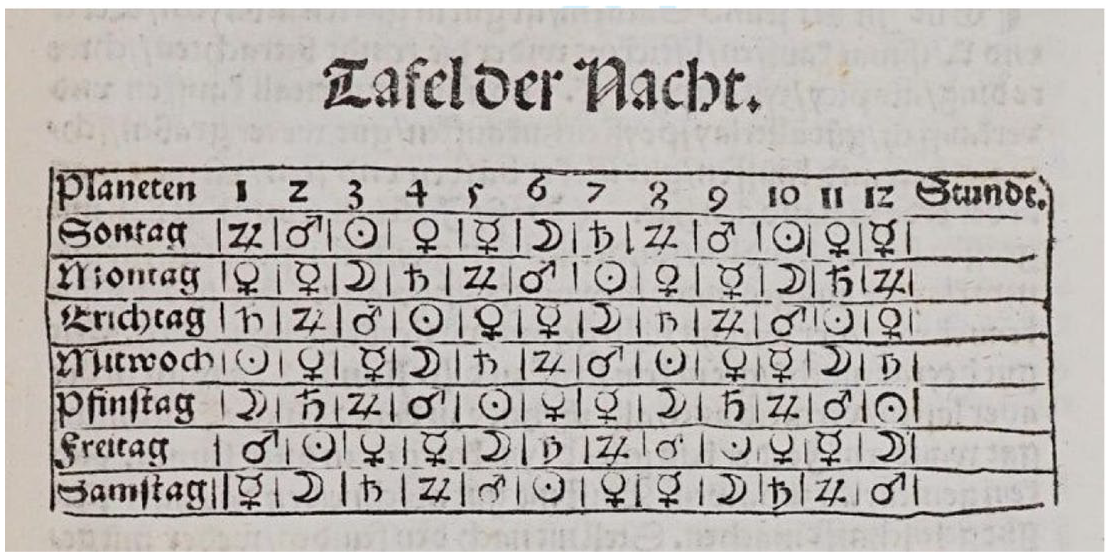
The “Table of the Night” in Ein kunstlich Instrument. As we saw in the day table, on Sunday, the last hour of the day is ruled by Saturn. And so the first night hour on Sunday is ruled by Jupiter. Universitätsbibliothek Graz.
Apian’s general discussion of planetary hours is followed by Chapter 12, in which he (1) explains the characteristics of people born in each planet’s hour, (2) lists the things that are good or bad to do in each planet’s hour, and (3) tells which situations make the planet’s hours more powerful and effective: the planet’s hours will be more effective if the planet is in its own house or, sometimes, if the Sun is in the planet’s house. Examples: A person born in the hour of Saturn will be proud and courageous, but slow and lazy with a deep mind and be melancholic and funny. Not pretty and with a body of a melancholic, will like black color, will be bearded and lean with deep-set eyes (die augen sthen im kopff ). . . . When Saturn or the Sun is in Capricorn or Aquarius and when the Sun enters there, then the above mentioned properties will have more and stronger force in Saturn’s hours because Aquarius and Capricorn are the houses of Saturn.
Mercury children are of medium size, have thin hearts, long fingers and are wise and pale. They are lovers of good art, have small eyes and small and delicate lips around the mouth, normally a large nose, have lean bodies and are diligent and clever with numbers and writing and often become astronomers. . . . In the hour of Mercury / It is good to deal with money. . . . good to travel on land and ride all animals. . . . good to write letters, do computations and send messengers. . . . When the Sun enters Virgo or Gemini, the hours of Mercury have more force and effect.
When Apian mentions that Mercury children are lovers of good art, we should recall that he considered geometry and astronomy to be noble arts. We note that Apian does not mention anything that is bad to do in Mercury’s hour.
Capricorn is the solar house and Aquarius is the lunar house of Saturn. Similarly, Virgo and Gemini are the solar and lunar houses of Mercury. Thus, Apian mentions (in the cases of Saturn, Jupiter, Mars, and the Sun) that the effect of a planet’s hour becomes stronger if the planet is in its own house. In some cases (for Saturn, Venus, Mercury, and the Moon), Apian mentions that if the Sun is in the planet’s house, the effect of that planet’s hours will be stronger. For Jupiter, Apian mentions that in Gemini, Virgo, and Capricorn the hours of Jupiter have less force. We note that Capricorn is Jupiter’s depression and that Gemini and Virgo are the signs in opposition to Jupiter’s two houses. Whether Apian’s differences in what he mentions about the individual planets represent real differences in the treatment, or just reflect the hurried and informal nature of Apian’s composition, is not so easy to say.
A reader could easily tell with the theorica solis which sign the Sun is in. But Apian in Ein kunstlich Instrument gives no way to find in which sign any of the five proper planets is located. In any case, these planetary influences only serve to strengthen the effect of a planet’s hour, without changing the essential nature of the effect.
Apian’s inclusion of tables for the planetary hours reflected a tradition of long standing in kalendaria texts. A typical medieval Latin kalendarium included calendar pages for each month, which were made useable for any year by means of golden numbers (for the new moons) and dominical letters (for the Sundays). Other frequently tabulated information included saints’ days, day lengths, tables for the moveable feasts, and tables for working out the zodiacal sign in which the moon is found. Moreover, there often were tables of the planetary hours, with a discussion of their application. A fine example is found in the Latin Kalendarium of John Somer, which was composed in Oxford in 1380, and which survives in some 33 more or less complete manuscripts. Immediately after the month-by-month calendar, we find the table for the planetary hours. 97 As these kalendaria circulated, they evolved: new material could be added or some old material might drop out. There was a tendency to add supplementary medical material.
Ernst Zinner identified a particularly significant class of German-language kalendaria that emerged by about the beginning of the 15th century (though there were of course German calendar texts before this). 98 This genre is usually known as the Volkskalender, although, as Brévart has pointed out, this is not an especially appropriate term. 99 For these calendars, with their technical terms, tables of numbers, and rules for applying them, were not aimed at a popular audience, in the sense of including a wide variety of social classes. Rather, they would have been understandable only for a fairly well-educated audience. One of the oldest texts of this type is a codex in the Universitätsbibliothek Augsburg (Cod. III.1.4°1), written in the first decade of the 15th century, with some material added in the second decade of the century. It includes an elementary introduction to cosmology, the month-by-month calendar, and various other matters. On folio 13v we find tables of the day and night hours completely equivalent to Apian’s (though with the planets’ names written out, rather than indicated by symbols). 100 We shall see other examples of Apian drawing on the Volkskalender tradition for supplementary material to accompany the instruments of Ein kunstlich Instrument.
Instrument for finding the ascendant
This instrument in Chapter 13 of Ein kunstlich Instrument (Figure 23) is used to find the ascendant (rising point of the ecliptic) and descendant (setting point of ecliptic), given the latitude of the observer, the time of day, and the longitude of the Sun. Apian calls it das Instrument der Aufsteygenden zaychen (the instrument of the rising signs.) The underlying pattern, printed on the page, has a stereographic projection of the horizon circle for every 5° of geographical latitude. This is overlaid with a rotatable wheel bearing a stereographic projection of the ecliptic. The intersections of the ecliptic circle and a given horizon circle are the ascendant and descendant. The instrument can also yield the time of day at which a given point of the ecliptic rises or sets, with the use of the hour scale at the rim of the instrument. In Ein kunstlich Instrument this hour scale was accidentally printed with the hours running in the wrong direction, something that is corrected by hand in both the Yale and Graz copies. 101
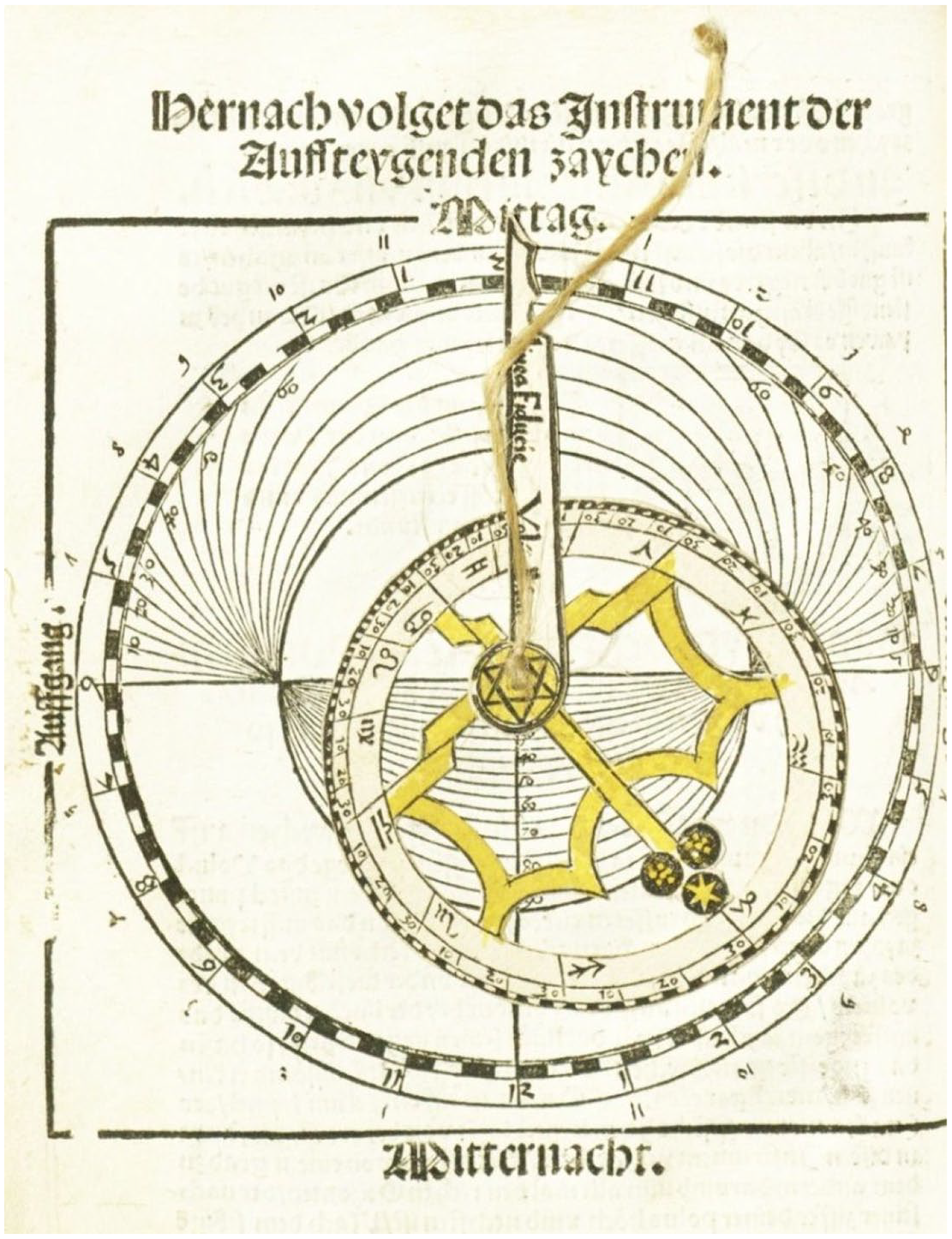
The instrument for finding the ascendant in Ein kunstlich Instrument. The printed hour numbers (just inside the outermost circle) run in the wrong direction. Someone has inked in by hand the correct hour labels (outside the outermost circle). Yale University Library.
The form of Apian’s rotatable zodiac wheel was modeled on the zodiac as it commonly appeared on the retes of astrolabes. Apian’s underlying pattern of many horizons on a single tablet was not a universal feature of astrolabes, but it was reasonably common as an auxiliary plate (a so-called horizons tablet). In the Islamic tradition, usually only half of each horizon is shown, and the multiple horizons are set in groups, rotated with respect to one another at 90° intervals. This is to allow for more horizons, without the need to crowd them too closely together. 102 Horizon tablets also appear on European astrolabes from before Apian’s time. Several examples may be seen in the collection of the History of Science Museum, Oxford. 103 Another notable example is provided by the astrolabe presented to Cardinal Bessarion, probably by Regiomontanus, in 1462. In this case, the multiple horizons are engraved, not on a separate plate, but in the womb of the mater. 104
In order to determine the ascendant you set the index pointer to the hour of the day. Then rotate the ecliptic until the current longitude of the Sun is directly underneath this pointer. This sets the position of the ecliptic for the current date and time of day. Then search for the horizon line that corresponds to your geographical latitude. The ecliptic longitude of the ascendant is then found where this horizon line crosses the outer edge of the ecliptic on the left side of the instrument. The descendant is found by the corresponding crossing on the right side. Finding the ascendant usually required a table of ascensions and a modest calculation. Apian’s instrument, instrument, which gives the result at a glance, would probably have been popular with laymen and astrologers, as suggested by the hand-made corrections in some copies. Moreover, the audience for whom Apian intended Ein kunstlich Instrument was unlikely to have astronomical tables.
Example with the setting shown in Figure 23: The time of day (indicated by the pointer) is 12
In the simple version of astrology that Apian taught in Ein kunstlich Instrument, the means of prediction are effectively reduced to two: (1) one must know the zodiac sign that is rising at the moment of interest (whether of a birth or a contemplated activity of everyday life) and (2) one must know in which planet’s hour this moment of interest lies. 105 In this little pamphlet Apian gave all the tools necessary for these two strategies of prognostication. The instrument for the ascendant was therefore an essential part of the pamphlet’s mission.
The later history of this instrument—in both Cosmographicus liber and Astronomicum Caesareum—is rather curious. It seems that Apian originally intended to include an instrument for the ascendant in Cosmographicus liber, then changed his mind and omitted it. Perhaps this was because there was so little practical astrology in the cosmographical book that an instrument for the ascendant would have been out of place. That is, there would have been no essential duty for this instrument to perform. The fact that the volvelle or rotatable index was inscribed in Latin is a clue that this instrument was originally intended for Cosmographicus liber as well as Ein kunstlich Instrument.
In any case, in Cosmographicus liber, the instrument for the ascendant was replaced by what Apian called the “cosmographical mirror” (speculum cosmographicum), a rotatable world map in stereographic projection, equipped with a rotatable zodiac ring, a rotatable index or alidade inscribed with latitudes, and a rotatable small circle inscribed with hours. See Figure 24. This instrument could be used to find the locations where the Sun is in the zenith at a particular time of year, to read off the longitudes and latitudes of places on the Earth, and also to determine differences of local time. Such an instrument fit naturally into a textbook of cosmography, and appealed to the interests of his readers in the age of exploration. After all, it was only 2 years since the return of the remnants of Magellan’s fleet after the circumnavigation of the globe. But, apparently, the base sheet bearing the multiple horizons had already been printed. The circular world map was then placed over it, obscuring the horizons plate (which no longer had any use at all). Only the hour scale at the periphery was still visible and useful.
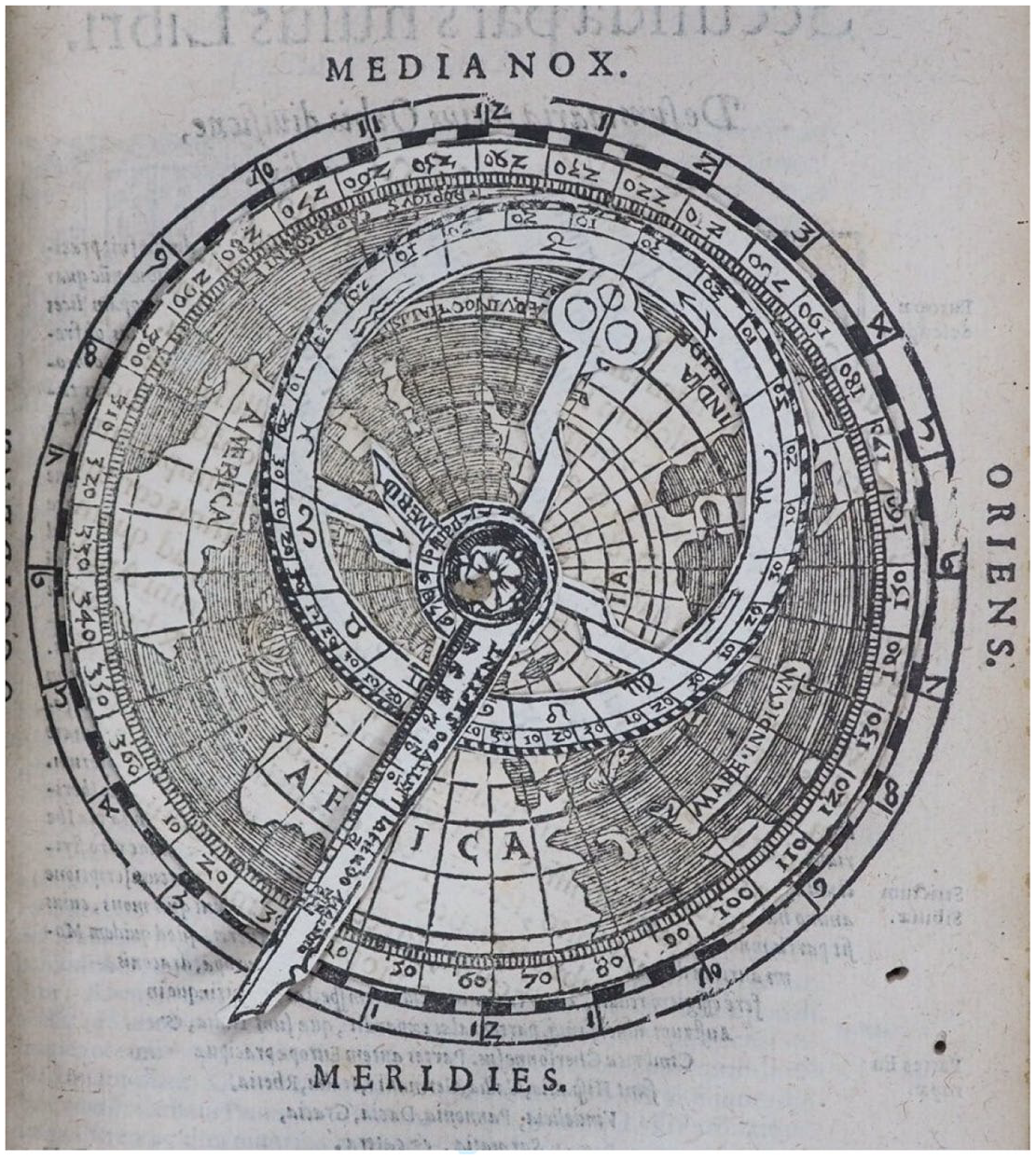
The cosmographical mirror in a 1584 Cosmographia (Antwerp: Withagius). Collins Library, University of Puget Sound. Photo by J. Evans.
Let us see how the instrument is used for time conversion by considering an example. Suppose we are located in the Nile valley in Africa. Therefore, turn the circular map until Egypt is directly over the noon line (MERIDIES), as shown in Figure 24. (The alidade can be used to help with this alignment.) Suppose the time is 2
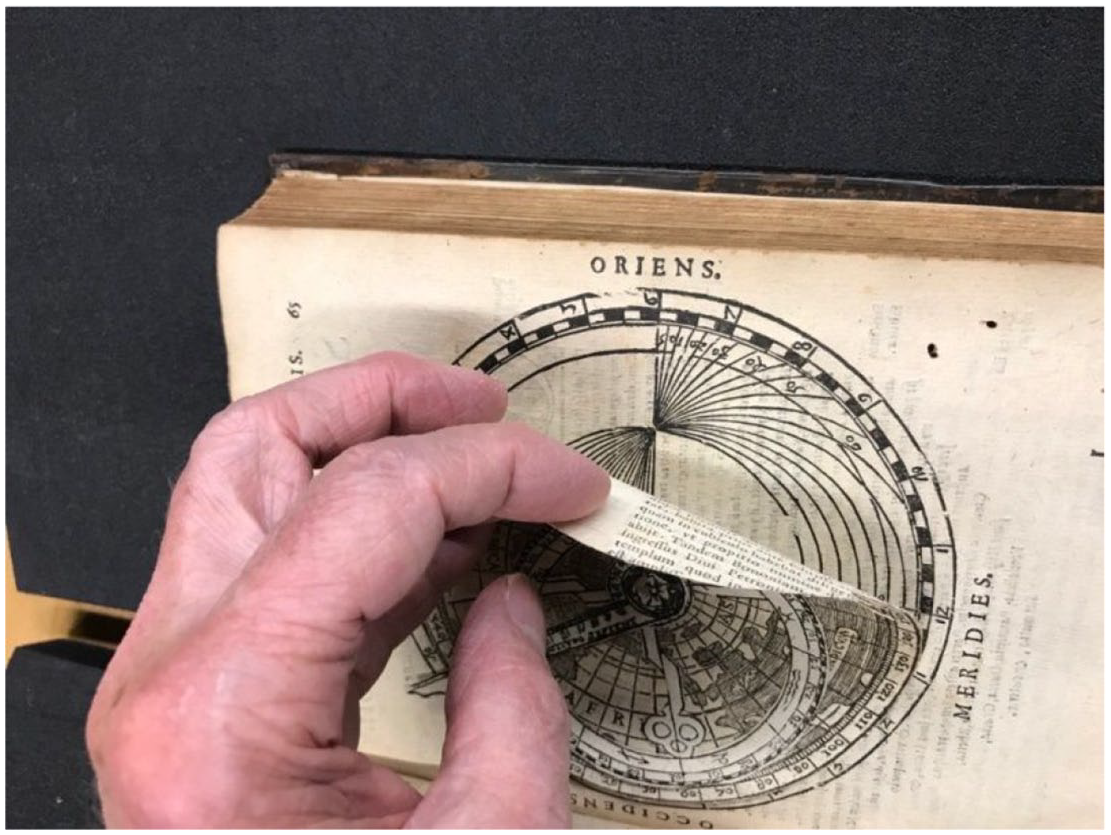
The hidden horizons-plate pattern in the 1584 Cosmographia. Collins Library, University of Puget Sound. Photo by J. Evans.
The cosmographical mirror appears in all the editions of Cosmographicus liber and Cosmographia known to us, with the bottom horizons-plate pattern always hidden beneath the covering disk of the stereographic world map, even though it has no use. See Figure 25. In the first edition of 1524, the printing block for the bottom pattern is identical with that in Ein kunstlich Instrument, including the wrongly graduated hour rim. In Gemma’s 1529 edition, the hour rim has been corrected. In the 1533 and all following editions printed in Antwerp, as well as the two last editions of 1598 and 1609 printed in Amsterdam, this same printing block for the bottom pattern was reused but rotated by 180°. The bottom horizons pattern is slavishly reprinted (but again hidden) in the Spanish, French, and Dutch editions of Cosmographia.
Curiously, some years later, when Apian was working on Astronomicum Caesareum, he apparently projected the inclusion of a horizons instrument, now with a horizon for every single degree of latitude between 0 and 65°. The sheets were printed. But again the horizons instrument was abandoned and the already-printed sheets were used as a base for a completely unrelated instrument. See Figure 26. Folio G 5 is an instrument that carries two volvelles for determining the times of new and full Moons, for investigating eclipses. But these rotating disks have been placed over the abandoned horizons tablet, which serves no purpose. Only the scale of hours at the periphery is used. 106
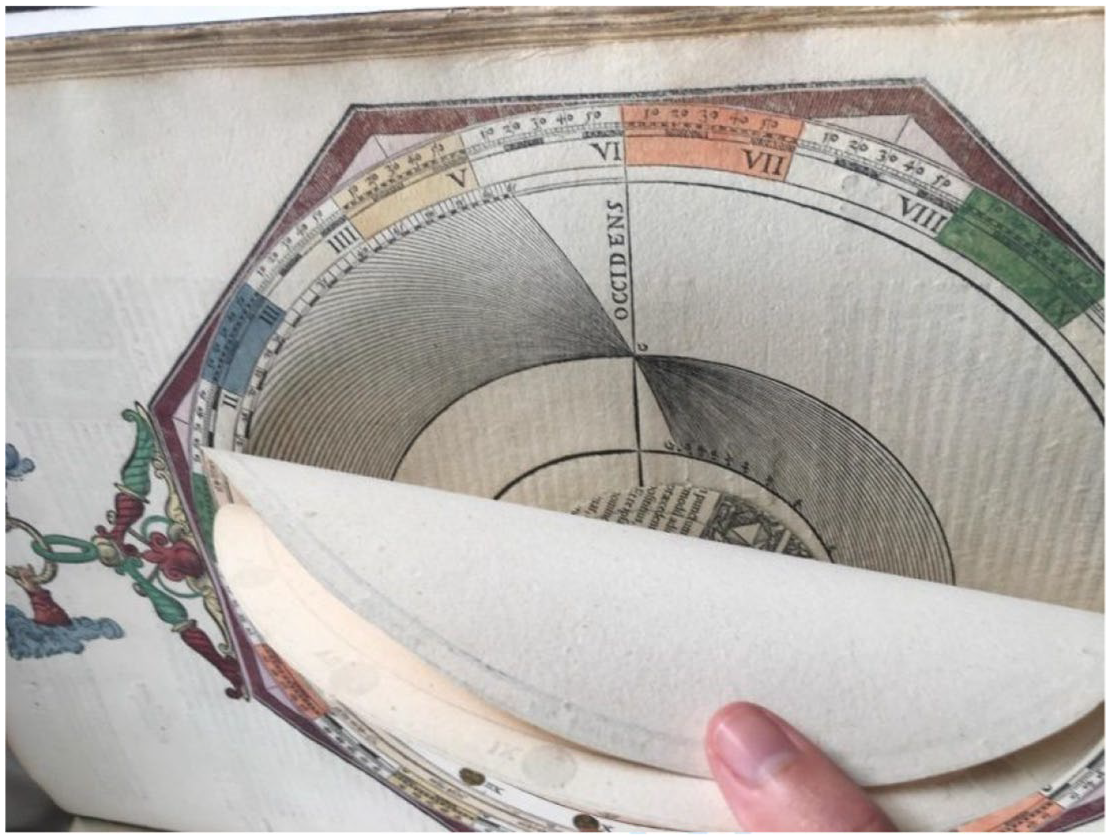
The hidden horizons-plate instrument in Astronomicum Caesareum, in the copy belonging to Leiden University Libraries (call number: Thysia 1625). Photo by N. Karskens.
Apian’s cosmographical mirror was produced in brass, by Gilles Coignet, at Antwerp in 1560, on the reverse of the organum Ptolemei that was mentioned above. 107 Coginet’s cosmographical mirror is complete with a rotatable world map in stereographic projection and an overlying rete. Oddly enough, this instrument includes a horizons plate or tympan, similar to that hidden beneath Apian’s world map. But, since in this case the world map can be removed, the horizons plate is actually useable. So Coignet improved on the instrument included in Cosmographicus liber by Apian and later also by Gemma. Coignet’s rete is furnished with a small number of star pointers, and so his instrument can also serve some of the functions of an astrolabe.
Having shown the readers of Ein kunstlich Instrument how to discover which zodiac sign is rising at a given moment, Apian also turns in Chapter 13 to the characteristics of the zodiac signs and the traits of people born when the various signs are rising. He also offers advice about what is good or bad to do when a particular sign is rising, with particular attention to bloodletting. The text goes through the 12 signs in order. The parts on bloodletting are quite detailed for the first signs and then become sparse. Examples: Aries, a house of Mars, is hot, dry and fiery, suitable for bloodletting, regards the head of people. Thus, someone born or conceived under the rising of Aries will have a beautiful and well-formed body, brown colors, be lean and not too fat, have desire and joy. . . . a choleric in his complexion. . . . In the time of the rising of Aries it is good to bleed the arm except for the main vein. . . .
Taurus, a house of Venus, is cold and dry, like earth. Wholly unsuitable for bleeding if the sign is rising or the Moon enters there. Whoever is born or conceived under this sign is by nature a melancholic. . . . In the time of the rising of Taurus it is not good to bleed, especially on the neck; also if the Moon is in the sign the neck vein should not be opened. . . .
Gemini is a house of Mercury. This sign, warm and wet, directs the arm and hand of people.
For each sign, Apian gives the associated element (earth, water, air, fire), as well as its standard qualities (cold or hot, wet or dry). These are sometimes called Aristotelian qualities, as Aristotle associated the two pairs of qualities with the elements in On the Heavens; but they pre-date Aristotle and appear in Greek medical theory, where they are associated with the four bodily humors (blood, phlegm, black and yellow bile). Thus Apian also gives the personality type (“complexion” or temperament) associated with each sign (sanguine, phlegmatic, melancholic, choleric). All this was standard physics/medicine/astrology in Apian’s day. Indeed, a text on the zodiac signs was a common feature in kalendaria. In the Augsburg Volkskalender text mentioned above 108 (Universitätsbibliothek Augsburg, Cod. III.1.4°1), we find a zodiac sign text, with a colored figure for each sign, on f. 15v-22v.
The zodiac man and some general principles of bloodletting
The correlation of the parts of the human body with the signs of the zodiac is a doctrine, “zodiacal melothesia,” that goes all the way back to Antiquity. It is mentioned, for example, by Manilius, Sextus Empiricus, and Firmicus Maternus (first, second, and fourth century CE, respectively). 109 The common rule for the correspondences is simple: we associate the first sign, Aries, with the head; the next sign, Taurus, goes with the neck, and so on, with the last sign, Pisces, assigned to the feet. Greek and Roman writers were divided in ascribing it to the Babylonians or the Egyptians. Quite recently, it has been discovered on a Babylonian tablet that is not securely datable but that probably does pre-date Manilius, the earliest extant classical source for the doctrine. 110 Diagrams illustrating zodiacal melothesia are common in medieval manuscripts, a classic example being the 15th-century Très riches heures of Jean, duc de Berry. 111 The zodiac man diagram was a common feature of kalendaria texts. There were two main types of diagram. A diagram might simply show the correspondences of body parts and zodiac signs. But a second type of diagram might identify particular veins for cutting. Such diagrams might appear, not only in kalendaria, but also in medical compilations.
Although the correspondences between body parts and zodiacal signs show only minor variations, the rules for deducing the consequences of these correspondences were more variable. According to Sextus Empiricus, if, at the moment of birth, a maleficent planet is in the sign corresponding to a particular body part, that part will be defective. In the Middle Ages, on the supposed authority of Ptolemy himself, it was widely held that one must avoid bleeding a part of the body when the Moon is in the zodiac sign corresponding to that part. The Centiloquium is a collection of 100 astrological aphorisms, spuriously attributed to Ptolemy, which circulated at least from the 10th century onward in Greek, Arabic, and Latin. The Greek title is Karpos (καρπός = fruit). 112 Whether this work really descends from an ancient text or is a medieval forgery is still debated. In any case, it circulated widely and was quite influential, being used for instruction in the universities of Bologna and Paris. 113 The 20th aphorism of the Centiloquium reads in the Greek version: “Touch not with iron a part [of the body] if the Moon occupies the sign that rules that part.”
Another common bit of advice, which could be supported with passages from Hippocrates, Galen, or Avicenna, was to avoid bloodletting in the summer or winter. But there were also shorter-term considerations for selecting the proper times, notably to bleed according to the Moon’s place in in the zodiac. As the Moon takes only about 2¼ days to traverse a zodiac sign, this might mean waiting a short time for a more appropriate day. Apian’s diagram of the Zodiac Man (Figure 27) belongs to this tradition and shows in which zodiac signs it is good, bad, or middling to bleed, and also shows which zodiac signs govern the various parts of the body. However, as we have seen in the passages quoted above, Apian modifies this by also assigning a role to the ascendant sign. A zodiac sign may take from 1 to 4 hours to rise (depending on the sign, as well as the observer’s latitude), so this introduces a more fine-grained consideration. For example, it can be good to let blood when Aries is rising, but certainly not when Taurus is rising. While the ascendant sign and the Moon’s place in the zodiac indicate times that are generally good or generally bad for bleeding, any good indications are, of course, overridden by the basic rule not to bleed a body part if the Moon is in the sign corresponding to that part. It is not so clear what Apian means by his diagram, as his discussion is not very complete for many of the signs. But we take him to intend the diagram to be valid for both the rising sign and the Moon’s place in the zodiac. That is, if a sign is labeled Böß, one should avoid bloodletting either if the Moon is in the sign, or if the sign is rising. Apian’s use of the rising sign is an unusual feature.
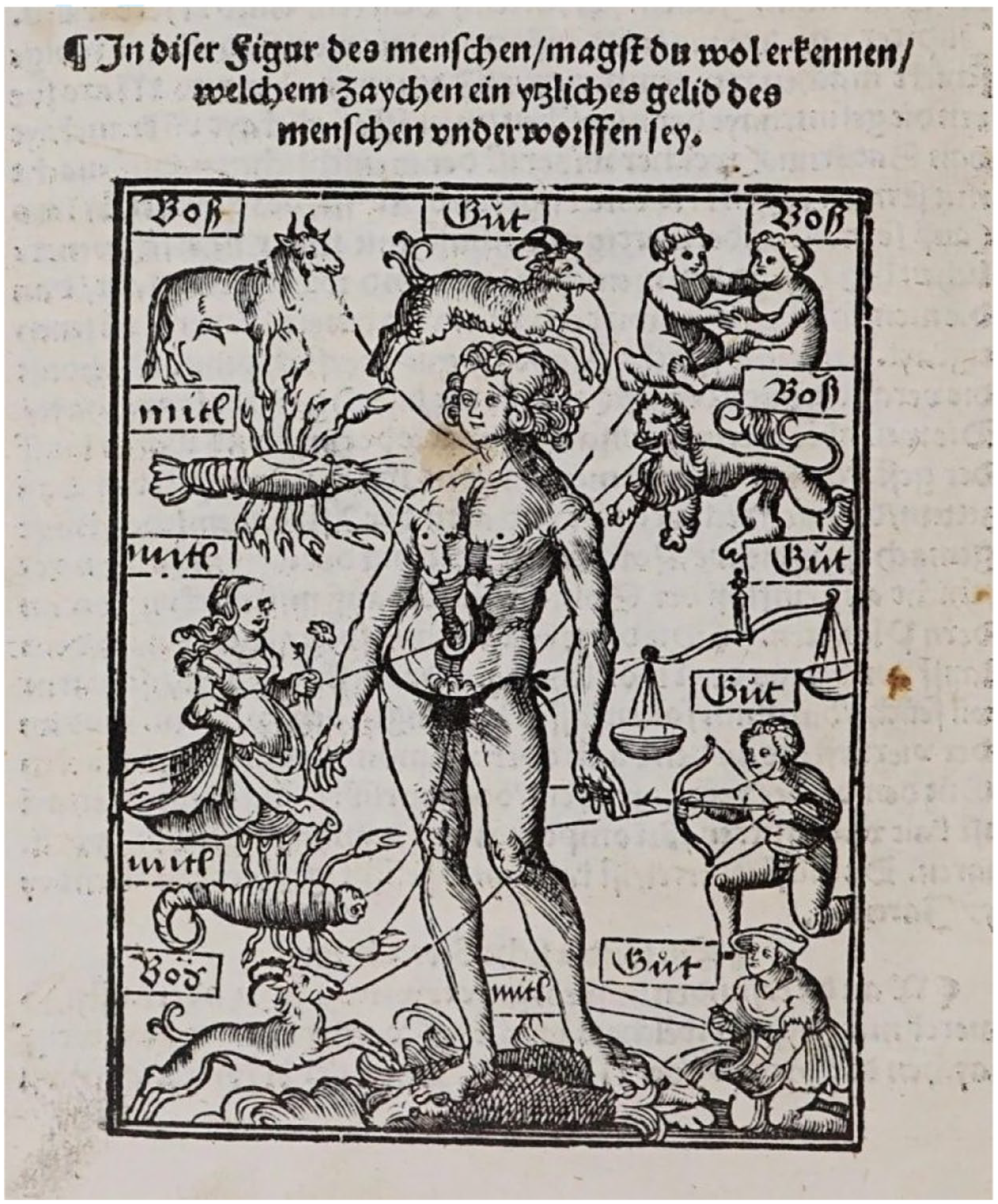
The zodiac man in Ein kunstlich Instrument. Universitätsbibliothek Graz.
Apian’s assignments of good, bad, and middling are virtually identical to those in the Latin edition of the Calendarium of Regiomontanus, printed at Nuremberg, c. 1474. 114 Regiomontanus’s book gives a calendar good for the 56 years between 1475 and 1530, including the upcoming eclipses. One single page of the Latin text is devoted to a brief discussion of the zodiac signs, together with advice about bloodletting. Regiomontanus begins, “Some seek suitable times for the cutting of veins: And the Moon has a great deal of power in that matter when harbored sometimes by these, sometimes by those signs.” Then Regiomontanus gives a couple of lines about each sign. For example, Aries is hot and dry and associated with the element fire. It governs the head. And it is a suitable sign in which to cut a vein. So Regiomontanus presents what is essentially a zodiac man—in words, with no diagram—quite similar to Apian’s. All the characterizations (good, bad, or indifferent for bloodletting) are the same as Apian’s, with one single exception: Regiomontanus labels Aquarius as indifferent for bleeding, while Apian it describes it as good. However, it does not necessarily follow that Regiomontanus was Apian’s source, since, as we have seen, advice for bloodletting by the zodiac signs was a common feature of the Volkskalender, as well as other sorts of cosmological, astrological, and medical compendia. In any case, we note that Regiomontanus gives no role to the rising sign (as Apian was later to do), but confines his attention to the Moon. Regiomontanus concludes his list of the signs with the admonition, “But it is not to be overlooked that if the Moon is in any sign chosen for the diminution of the blood, the part of the body attached to the same sign must not be touched.” 115
The German edition of Regiomontanus’s Kalender imitated the Latin version in describing in words the relation between zodiac signs and body parts, together with the mention of each sign’s suitability for bloodletting (but again with no diagram). 116 As this is the only bit of astrology in either edition of Regiomontanus’s book, it is not surprising that Apian decided that a bit of advice on when to bleed would be a good addition to his own booklet.
Pirated editions of Regiomontanus’s Kalender soon appeared, including one printed at Nuremberg almost immediately, in the form of a block book (also called a xylographic book). That is, moveable type was not used, but the text and figures were equally engraved on wood blocks. In this edition, a figure of the zodiac man was included—and this is often said to be the first zodiac man to appear in a printed book. 117 The production values of this xylographic edition are rather crude compared to Regiomontanus’s own handsomely printed typographic editions. Schreiber gave plausible reasons for attributing the production of this block book to Hans Spörer, a printer in Nuremberg. 118 Thus, it was probably the decision of Spörer to include a diagram of the zodiac man in this competitor to Regiomontanus’s German edition. In some copies of the block book, the zodiac man diagram is wanting, perhaps because it was a popular image for hanging on a wall for ready consultation.
So, while Regiomontanus certainly thought the readers of his Calendar would appreciate some advice about bloodletting and zodiac signs, he did not include a diagram. But by the time Apian composed Ein kunstlich Instrument, there were examples to follow in the pirated editions of Regiomontanus’s Calendar, as well as in many other compilations. And, although Apian found a zodiac man diagram a natural feature for Ein kunstlich Instrument, he did not put one in the less practical—and less astrological—Cosmographicus liber.
Apian gives his instrument for finding the ascendant in Chapter 13 of EkI, where he also lists the characteristics of the 12 signs and mentions which ones are favorable for bloodletting and other activities. The bloodletting specifics are then summarized by the zodiac man diagram that appears in the following chapter. And it is also in Chapter 14 where Apian makes some more general remarks about bloodletting. Here Apian takes a moderate approach, which was common in the literature of his day. According to Apian, in bloodletting there are two kinds of situations: one imposes necessity, and one allows for selection of the best time. “The time of necessity is when an illness requires bleeding, as with plague, stroke and other mortal illnesses, because if you should wait for the selected time great danger may be caused by that, because by such illnesses a man can soon die. Therefore, you should from two dangers choose the smaller one and not wait for the chosen time.”
For the selected times, there are three considerations. The first concerns the time of year. Spring is universally agreed to be best, and in support Apian cites Averroes and Galen as well as Hippocrates’ Aphorism 6.47. 119 Summer and winter are to be avoided. In any case, the bloodletting should be done in full daylight, when the food is well digested and the limb is well cleaned, in order that nothing unclean should enter the veins.
The second consideration involves the planets. Apian mentions that Venus and Jupiter are chosen because they make the air suitable and tempered. But Saturn and Mars bring illness and great danger. Here he is echoing the familiar division of the planets into beneficent and maleficent, which goes all the way back to Ptolemy’s Tetrabiblos, and even to Babylonian astrology. And, specifically, what Apian has in mind is to discourage bleeding in the hours of Saturn and Mars, and to permit it in the hours of Jupiter and Venus (as is clear in his discussion of the planetary hours of each planet).
The third consideration is the phase of the Moon. The first quarter is warm and moist and is suitable for the young up to 15 years old. From first quarter until full moon it is warm and dry—good for those of 23 years and over. The third quarter is cold and dry, good for men at 42 years. The last quarter is cold and moist and belongs to those older than 57 years. These were commonplaces.
Apian finishes with “a special consideration”: When you have chosen a good time for bloodletting then carefully note what sign the Moon is in, “Because the Moon has also great and special great power in bloodletting and likewise in medicine. As Ptolemy the all-famous master of the stars writes in the 20th saying of his text, when the Moon is in a sign (although it would be selected as good for bleeding) then you should not do it with the same limb that is subject to the same sign; that is dangerous because the Moon is increasing the moisture of the same limb.” Here Apian is, of course, citing aphorism 20 of the Centiloquium.
As we have seen, Apian’s concrete advice on when to open a vein comes down to applying his zodiac man diagram to the Moon’s place in the zodiac and to the sign that is rising. He gives an instrument perfectly adequate for determining the ascendant sign. But nowhere does he concretely say how to find the sign the Moon is in. However, this could actually be done with the instrument he describes next (his night clock) and knowledge of the Moon’s age (the days elapsed since new Moon).
The night clock and the sidereal instrument
These two instruments are used for telling time at night, either by the Moon or by the pointer stars in the Big Dipper. They play an important part in Ein kunstlich Instrument, since knowing the time in equinoctial hours is essential for finding the planetary hour as well as for determining which zodiac sign is rising. These instruments also appear in Cosmographicus liber, but there only as a sort of afterthought: they are placed in an Appendix.
Apian calls the instrument shown in Figure 28 die nacht ur, the night clock. The instrument consists of a circular hour scale printed on the page, surmounted by two rotatable disks. The base printed on the page has its periphery graduated counter-clockwise with the 12 hours from noon to midnight and the 12 hours from midnight to noon. The first overlaid movable disk has a tab that is marked with a picture of the Moon and the stars of the Big Dipper, with the two stars α and β Ursae Majoris printed along the fiducial edge of the tab to show that these are the stars to be used for time-telling. Just inside the periphery of this disk is a dodecagon divided into the months and days of the year. Next inside this is a scale for the age of the Moon, counted from new Moon. One side of the wheel is labeled CRESCENTE LUNA (Moon waxing) and the other LUNA DECRESCENTE (Moon waning). The top rotatable disk has a tab marked with the Sun and angles for aspects to the Moon: sextile, quartile, trine, and opposition. There is a circular hole where the Moon phases are displayed by a design on the underlying disk. The instrument can be used to tell time either by the Moon or by the two stars in Ursa Major.
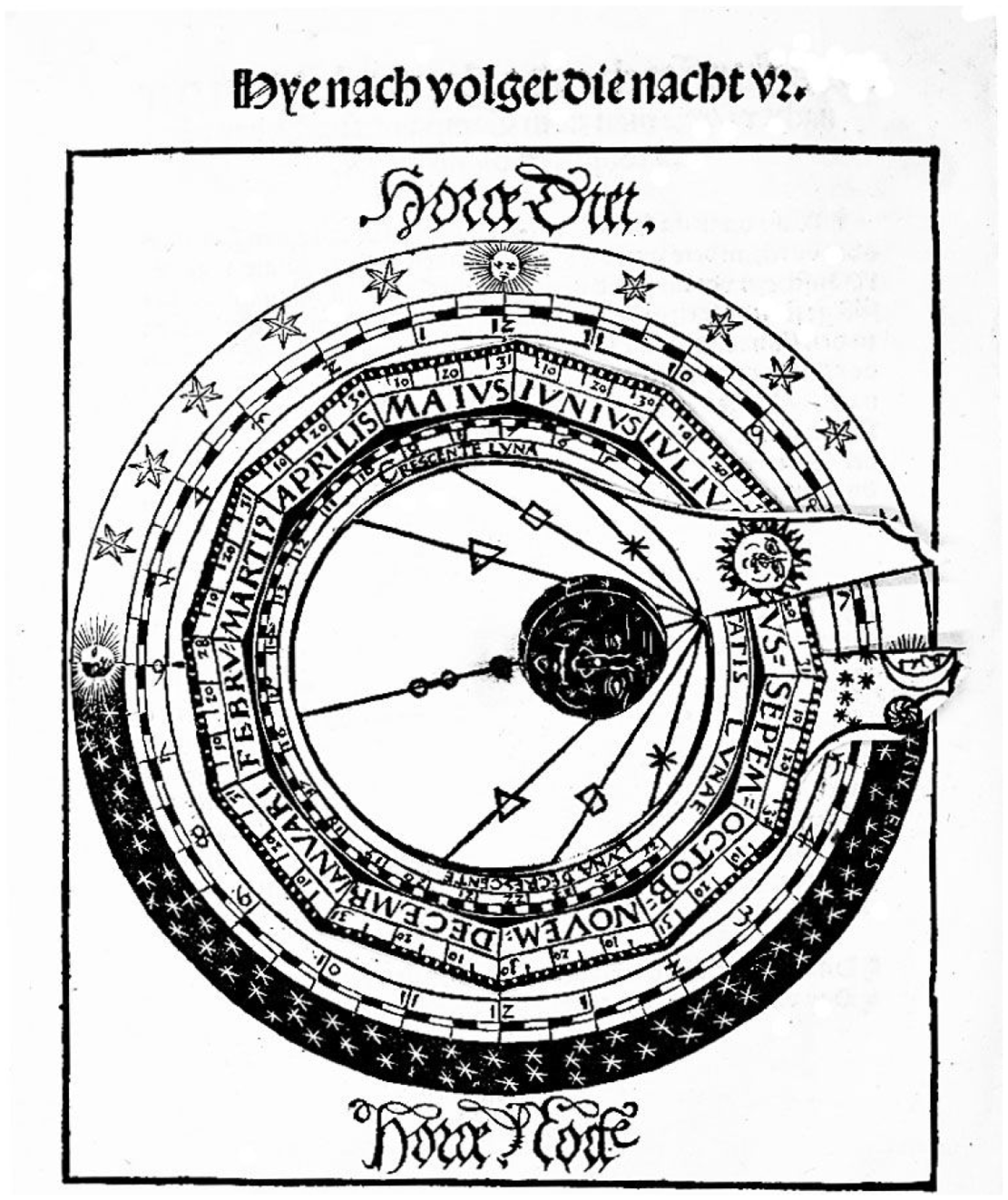
The night clock in Ein kunstlich Instrument. Universitätsbibliotek Graz.
To tell time at night, Apian tells us to begin by reading the time indicated by moonlight on a “compass” or wall dial. By the former, we understand a folding diptych dial that commonly included a compass for orienting the dial. We might call the resulting reading the “Moon time.” This Moon time is set by turning the Moon tab to the appropriate hour on the hour scale printed on the page. The Sun tab is then set to the age of the Moon. The hour of the day or night is read from the position of the Sun tab on the hour scale printed on the page. The idea is quite simple. At new Moon the Sun and Moon are synchronized. Then every day the Moon will be slow by about 12° or 50 minutes of time. The instrument will adjust for that.
When using the stars in Ursa Major to tell time, the process is more complicated and an extra instrument is needed, which is illustrated in Figure 29a and b. In Ein kunstlich Instrument, Apian has no special name for this device. But in Cosmographicus liber he calls it the instrumentum syderale. An instrument of this kind was described already in 1299 by Raymondus Lullus 120 (1235–1315). The general history of the instrument has been sketched by Oestmann. 121 In modern English writing it usually called a nocturnal or, sometimes, a nocturlabe. Follow a line in the night sky from the two stars α and β in Ursa Major, and you will end up very close to the pole star, as shown. This line will rotate 360° during a sidereal day, which is about 4 minutes shorter than the solar day, and the line will act as a clock hour hand indicating a sort of sidereal time. The angle of the clock hand is measured with the instrument, as shown in Figure 29b.
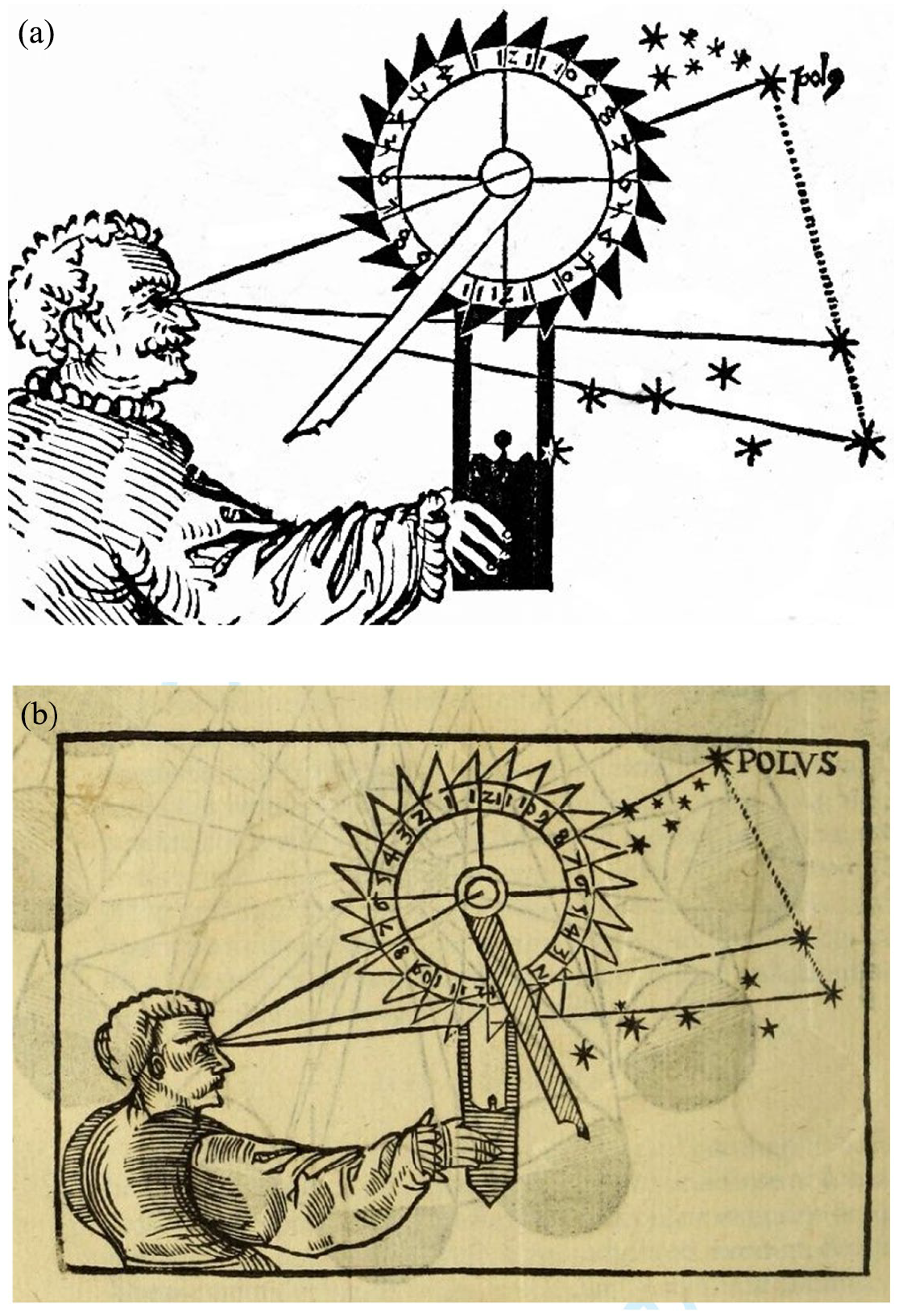
(a) The nocturnal in action in Ein kunstlich Instrument (1524). Universitätsbibliothek Graz. (b) The figure improved in Gemma’s 1529 edition of Cosmographicus liber. Edward E. Ayer Digital Collection (Newberry Library).
The centuries have not been kind to most copies of Ein kunstlich Instrument. The instruments with no moving parts naturally had the greatest chance of surviving. This means especially the instrument for planetary hours, and the theorica solis, which usually, however, lost its string. The instruments with the most moving parts (the orthographic projection of the sphere and the night clock) seem but rarely to have survived intact. In many copies, “repairs” or “restorations” have been made, often with a part wrongly placed, or even with a part borrowed from some other, unrelated publication wrongly inserted. The toughest situation of all applies to the nocturnal. For this instrument was never intended to stay in the book—its parts were meant to be glued to wood or heavier paper and assembled. We have yet to see a copy of Ein kunstlich Instrument in which the parts for this were preserved. However, the same instrument was included in Cosmographicus liber. And in several copies of this work, the parts of the nocturnal are found pasted onto the last of the pages devoted to these instruments, which allows us to see their form and small size (Figure 30). This was probably the way the parts of the nocturnal were supplied in CL.
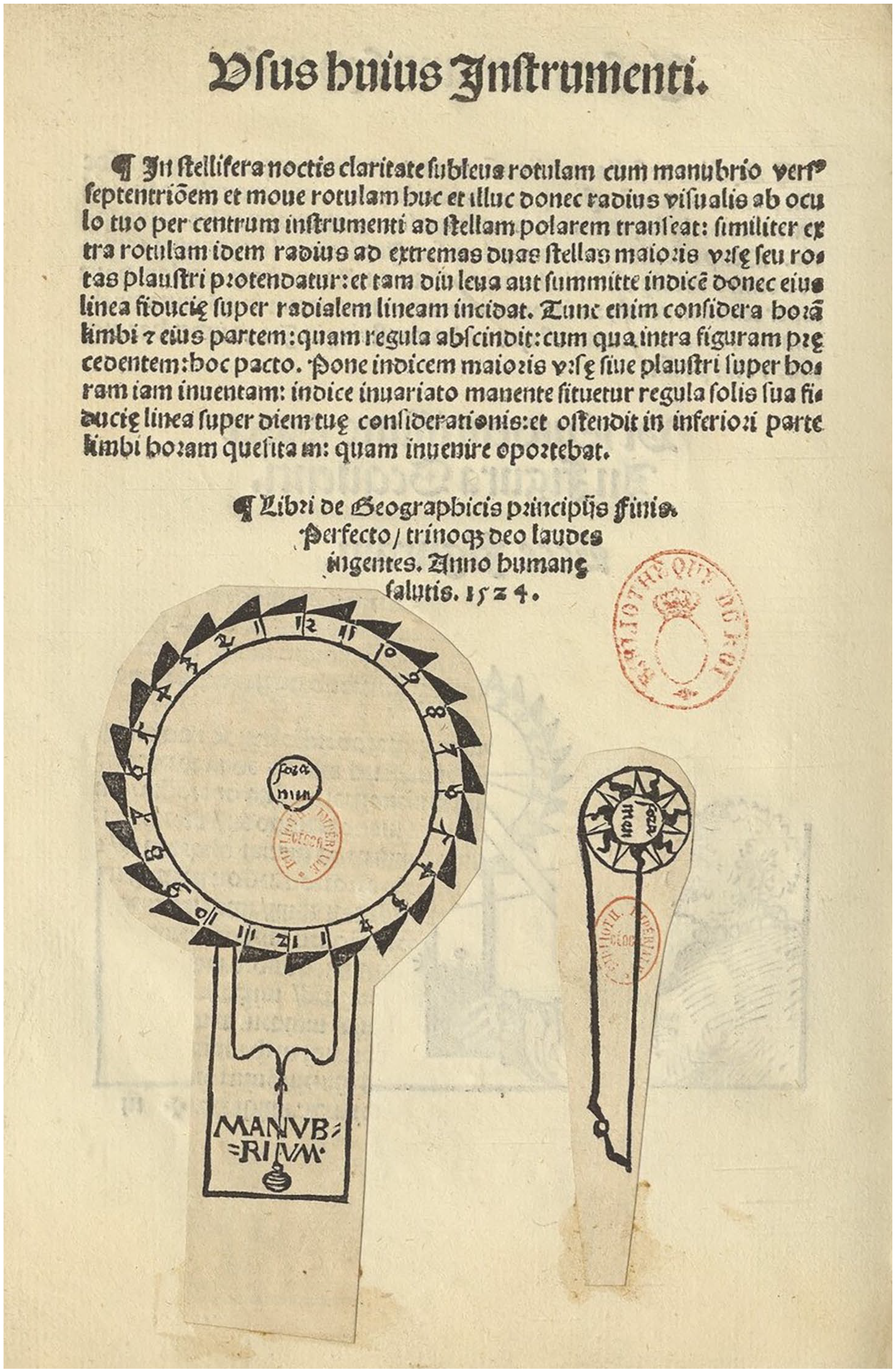
Parts of the nocturnal glued into a copy of the 1524 Cosmographicus liber. gallica.bnf.fr/Bibliothèque nationale de France.
To tell time by the stars, sight the pole star through the center hole in the disk of the nocturnal and keep the handle (manubrium) lined up with the celestial meridian. (A virtual plumb bob on the manubrium reminds us to keep the handle upright.) Align the pointer with the two stars in Ursa Major and read off the “star time’’ from the toothed wheel (not the same as modern sidereal time). Then set the star time on the night clock, using the tab with the stars of Ursa Major. Next, turn the Sun tab until it comes to the correct day of the year. Finally, read off the time by noting the position of the Sun among the hours printed on the page.
The star clock will be fast by about 4 minutes every day relative to a Sun clock and needs a date when it is synchronized with the Sun, something that will happen once a year. This date appears at the base of the Moon tab of the night clock. The synchronization moment chosen is when the star is vertically below the north celestial pole at midnight—when the two stars and the Sun have their lower culmination and the Sun and the stars will have the same right ascension. Around the middle of the 16th century this date was 20 August (Julian). See the midnight simulation of the northern sky on 20 August 1530, in Figure 31.
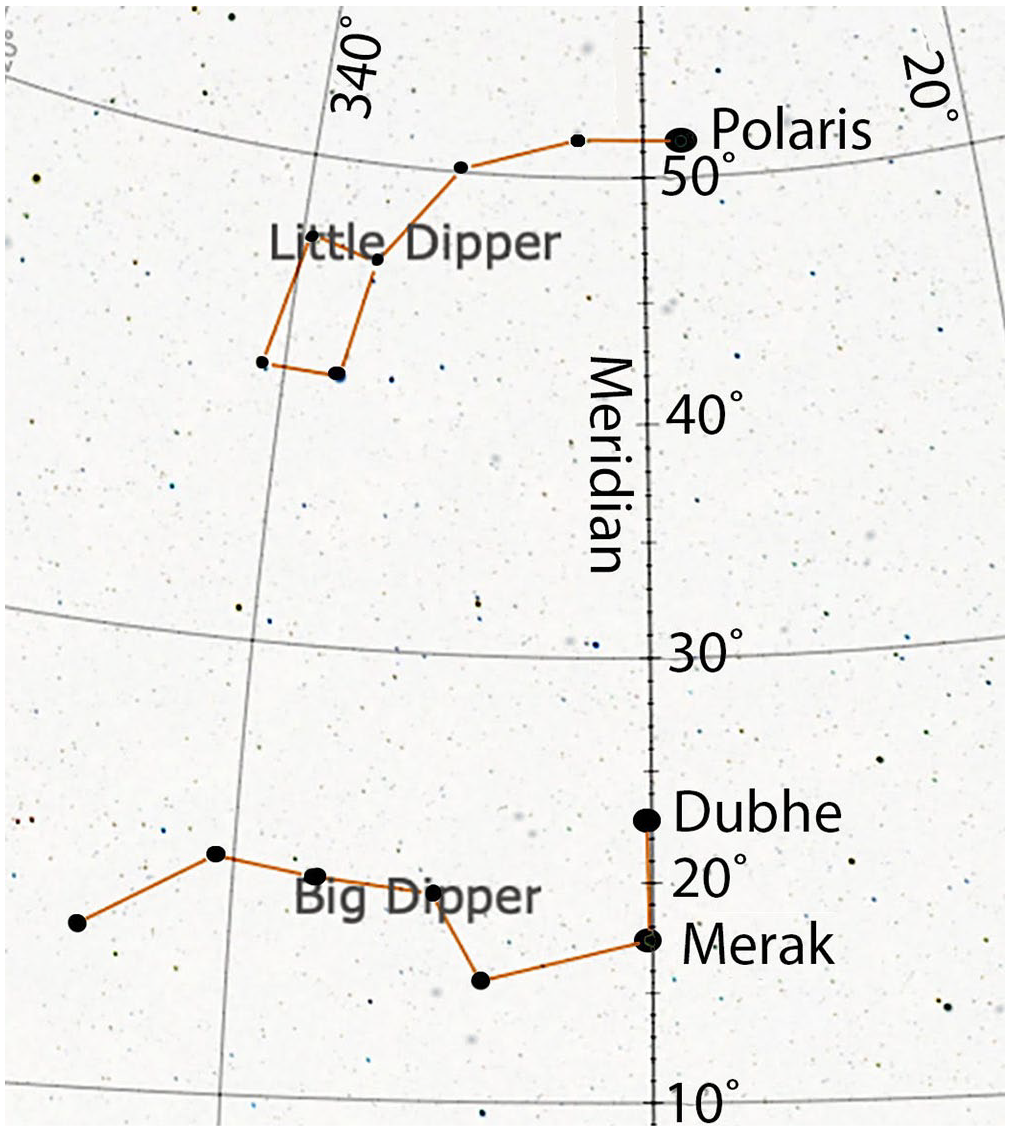
The northern sky at midnight on 20 August 1524 for Landshut. Altitudes and azimuths are numbered. Adapted by Lars Gislén from Starry Night.
In Ein kunstlich Instrument and Cosmographicus liber 1524, the synchronization date is the not very accurate 27 August (see Figure 32). A possible explanation is that about that date the two Ursa Major stars at midnight are just below the pole star, which in central Europe at midnight is about 2° offset in azimuth to the east from the celestial north pole, something that suggests that Apian’s synchronization date may have been determined by observation.
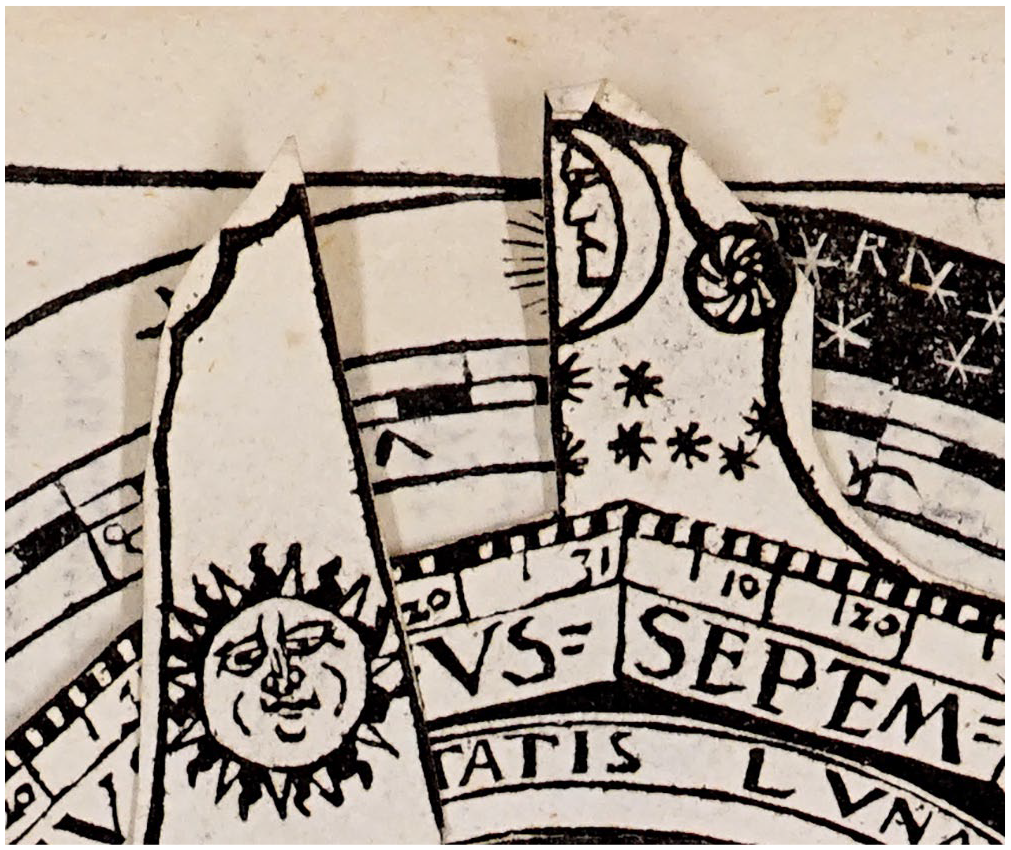
The synchronization date 27 August in Ein Kunstlich Instrument. Universitätsbibliothek Graz.
August 20 is the much more satisfactory synchronization date used in Gemma Frisius’s 1529 and 1533 editions of Cosmographicus liber (see Figure 33). This is another of Gemma’s corrections. August 20 is similarly used in the almost identical night clocks in Cosmographia, in all editions from 1537 onward. In Apian’s Instrument Buch, 2nd book, chapter 17, the synchronization date is also given as 20 August. But using the available astronomical tables at the time, for example the Alfonsine Tables, for the longitudes and latitudes of α and β Ursae Majoris does not result in this date; so it is conceivable that the date was simply determined by outdoor midnight observation using a plumb line.
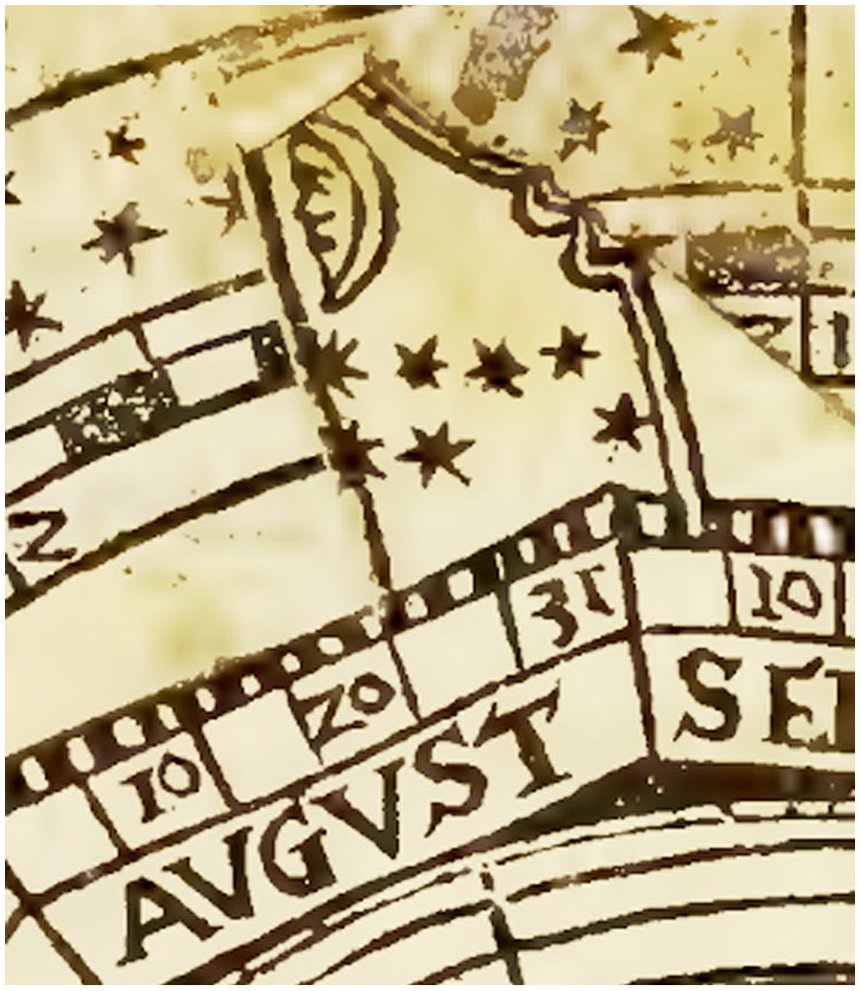
The synchronization date 20 August in Cosmographicus liber 1533 (Antwerp: Birckman). archive.org/John Carter Brown Library.
In the Julian calendar (used in Apian’s day), the synchronization date shifted later in the year at an average rate of about 0.66 day/century, due to the combined effects of precession (which makes the date move later) and the incorrect length of the Julian year (which makes the date move earlier). The combined effect is rather small. So we can see that the change in the synchronization date between the 1524 and the 1529 Cosmographicus liber was not due to a real astronomical shift, but rather represented Gemma’s effort to get a more accurate value for this parameter. In the Gregorian calendar, the synchronization date (due only to precession, as the error in the year length is practically nil) moves later in the year by at an average rate of about 1.4 days per century. Because the Sun does not move uniformly around the ecliptic, the rate of change of the synchronization date (in days per century), is slightly variable over the whole precession cycle, in either calendar. Also in either calendar, there is a small-scale, back-and-forth shift due to the leap-year cycle, superimposed on the continuous drift.
Concluding remarks
The instruments in Ein kunstlich Instrument have in general a long earlier history. The eccentric circle layout of the theorica solis goes back to the solar theory of Hipparchus and Ptolemy. The orthographic projection of the celestial sphere was also known in Antiquity and was revived in the 15th century. The stereographic projection of multiple horizons for the instrument for the ascendant comes out of the medieval astrolabe tradition. The night clock instrument derives from nocturnals that were used already in the 12th century. Apian’s originality is sometimes disparaged. John North, for example, wrote, concerning Apian’s treatment of a mathematical instrument called the meteoroscope, “like nearly everything Apian ever wrote, it is taken almost unaltered from the work of others.” 122 But this is going a bit too far. Although Apian made full use of the instrument traditions to which he was heir, he often adapted, as is clear from the multiple versions of his quadrants in Instrument Buch and associated texts. The instrument in Ein kustlich Instrument for converting from equinoctial time to planetary hours seems to be original with him.
In contrast to Cosmographia, Ein kunstlich Instrument, written in German instead of Latin, was intended to be used by ordinary, non-university people and Apian made an effort to explain the astronomical and chronological concepts in a pedagogical way. Perhaps he was thinking of readers from the merchant class, for whom he was soon to compose his mercantile arithmetic. Moreover, astrology plays a large role in Ein kunstlich Instrument but is essentially absent in Cosmographia. In filling out Ein kunstlich Instrument with material to provide astrological and medical applications for his instruments, he drew on the traditional contents of the kalendaria literature. But Apian’s instruments were far simpler to use than the technical tables often associated with the kalendaria. We may even see Ein kunstlich Instrument and Cosmographicus liber as dividing between them some of the traditional material of the kalendaria. The cosmological overview that began many Volkskalender texts went into Cosmographicus liber while the more practical advice about regulating one’s life went into Ein kunstlich Instrument. The overlap between the two texts is due to the fact that some of the same instruments are required for accomplishing the missions of the texts.
It is ironic that the book (Ein kunstlich Instrument) aimed at a popular audience had but a single edition, while the Cosmographia, aimed at an audience drilled in Latin, was a best seller that far outlived its author. One reason for this is the imperfect level of accomplishment of Ein kunstlich Instrument. While some basic concepts are carefully explained, the use of the more complicated instruments is not always made clear and, for the most part, there are no worked examples. We can glimpse the frustration of his audience in a hand-written note in Ein kunstlich Instrument, in the copy belonging to the Sydney Jones Library, Liverpool. On the rear end paper someone has written in an early hand, aber ich ien kan es nich: But I can’t [do] it. 123 For advice about bloodletting and the choice of safe times for various endeavors, many other resources, far simpler to use, were available to the popular audience.
Supplemental Material
sj-zip-1-jha-10.1177_00218286241241070 – Supplemental material for The artful early instruments of Peter Apian: Ein kunstlich Instrument of 1524, its precursors and its successors
Supplemental material, sj-zip-1-jha-10.1177_00218286241241070 for The artful early instruments of Peter Apian: Ein kunstlich Instrument of 1524, its precursors and its successors by Lars Gislén and James Evans in Journal for the History of Astronomy
Footnotes
Appendix: Construction of the grid disk of the orthographic projection
Acknowledgements
We are grateful to Elly Dekker, Michael Shank, David Juste, and Richard L. Kremer, as well as to an anonymous referee, for their lucid comments on our early draft, which led to significant improvements in the paper. Joachim Quack, David Tinsley, Francesca Schironi, and Philipp Nothaft responded helpfully to specific questions. The generous assistance of museum and library specialists made it possible to find and use illustrations important for the argument. We would like especially to thank Thomas Chisholm of Special Collections and Archives at the Sydney Jones Library, Liverpool; Sara Schechner of The Collection of Historical Scientific Instruments, Harvard University; Kate Carlin of the Division of Rare and Manuscript Collections, Cornell University Library; and Jane Connelly of Archives and Special Collections, Collins Library, University of Puget Sound.
Author’s note
One of the authors of this article is the editor of JHA. To avoid a conflict of interest, and in keeping with the policy of JHA and Sage, a different member of the editorial board handled this submission, making use of doubly-anonymous refereeing in the way usual for the Journal.
Notes on contributors
Supplemental material
Supplemental material for this article is available online. Working virtual copies of Apian’s instruments based on those in Ein kunstlich Instrument may be downloaded here. The download contains the working instruments as well as a short explanatory text. The user should have a Java Runtime Environment (JRE) installed. JRE can be downloaded free of charge from the Oracle site, < >.
>.
Notes
Supplementary Material
Please find the following supplemental material available below.
For Open Access articles published under a Creative Commons License, all supplemental material carries the same license as the article it is associated with.
For non-Open Access articles published, all supplemental material carries a non-exclusive license, and permission requests for re-use of supplemental material or any part of supplemental material shall be sent directly to the copyright owner as specified in the copyright notice associated with the article.
