




Abstract
This article combines theories of environmental virtue ethics and organizational virtuousness in proposing the idea of “organizational environmental virtuousness.” In doing so it draws attention to the fact that previous “green management” scholarship has emphasized reduction of harm and adherence to norms and overlooked the significance of positive deviance, virtue, and virtuousness. In common with organizational virtuousness, organizational environmental virtuousness is associated with moral goodness, human impact, and unconditional social betterment. Amplifying and buffering effects of organizational environmental virtuousness support positive deviance and environmentally supportive behaviors and constrain negative deviance and environmentally antagonistic behaviors, respectively. The article concludes with a consideration of the implications of organizational virtuousness for researchers who may wish to examine its antecedents and consequences, and for practitioners who may wish to leverage environmental virtuousness in their organizations.
In his best-selling book, The Ecology of Commerce first published in 1993, the environmentalist and author Paul Hawken argued persuasively that human nature—at least as it manifests in business behaviors—is such that the long-term well-being not only of the human species but of whole ecosystems is all-too-often subordinated to what in the end are small-scale, short-term gains. The necessary fundamental changes in the way companies do business are being effected at an “agonizingly slow rate” (Hawken, 2010, p. 2) and activities, such as “recycling aluminum” cans and “tree plantings”—so often the norm in efforts to “green business”—are the equivalent of “bailing out the Titanic with teacups” (p. 6). A corollary of Hawken’s bold assertion is that examples of organizations that deviate positively from the norm and exhibit elevated behavior are all-too-rare, but that failure of more organizations to do so may have potentially dire consequences for environmental, social, and economic sustainability. Organizational virtuousness embodies the requisite “elevated behavior” (Searle & Barbuto, 2011, p. 114), and its core qualities are moral goodness, human impact, and unconditional social betterment (Cameron, 2003; Cameron, Bright, & Caza, 2004). “Organizational environmental virtuousness” as proposed in this article is defined as a collective ethical disposition which habitually motivates, guides, and corrects moral behavior in organizations in positively deviant ways that contribute to sustaining the whole-Earth system’s integrity and stability. Ethical dispositions and moral behaviors that militate against the integrity and stability of the whole-Earth system are not possessed of organizational environmental virtuousness and therefore deemed undesirable. Compliance with norms represents a “lowest common denominator” for less unsustainable business, and moving toward more sustainable business requires an approach that voluntarily exceeds institutionalized normative expectations (Ehrenfeld, 2008; Walls & Hoffman, 2012). Organizational environmental virtuousness is less concerned with “moral mandate” or “ethical compliance” (see Hawken, 2010), rather it enables ethical self-organization and moral self-regulation.
From the classical virtue ethics’ perspective, human virtue is “rooted in character” and represents a mean between extremes e.g., “prudence” is between “rashness” and “cunning”; (Bright, Stansbury, Alzola, & Stavros, 2011). From the Positive Organizational Scholarship (POS) perspective, virtuousness is associated with behaviors that deviate positively from norms to the extent that they surpass “standards of adequacy” and “exceed expectations,” but not so much so that they are simply extreme, excessive, or obsessive (Bright et al., 2011). Organizational positive deviance is construed as “intentional behavior that departs from the norms of a referent group in honorable ways” and has evaluative (i.e., ought to occur), atypical (e.g., in relation to a referent group as represented by industry norms), and intentional (i.e., honorable intentions irrespective of outcomes) components (Spreitzer & Sonenshein, 2004, p. 828), 1 such as corporate environmental practices that exceed minimal norms, deviate from others with the field, and offer broad social benefits (Walls & Hoffman, 2012). Virtuous behavior is construed as being positively deviant to the extent that it militates against weaknesses, is counteractive to negative normative momenta (which tend to reinforce conformance to accepted norms), and enables “extraordinariness” that is pursuant of the “common good” (Bright, Fry, & Cooperrider, 2006, p. 26). Bright, Fry, et al.’s (2006) framework is adapted here for the domain of environmental virtuousness as shown in Figure 1 below. When organizations alleviate the impact of their activities on the natural environment “in ways that go beyond what is required by regulation, they are practicing positive organizational deviance;” moreover this may lead to the elevation of organizational and industry norms and associated broader scale changes (Walls & Hoffman, 2012, p. 2).

Conceptual framework for organizational environmental virtuousness (adapted from Bright, Fry, et al., 2006).
Organizational environmental virtuousness as proposed in this article arises from the integration of organizational virtuousness (Cameron, 2003) and environmental virtue ethics (see Sandler & Cafaro, 2005). It is relevant and timely for business because (a) humanity is confronted by multifarious biophysical impossibilities and associated moral dilemmas brought about as a result of increases in population, technological advancement, and economic growth (Intergovernmental Panel on Climate Change, 2007; The Royal Society, 2012); (b) humanity faces a pragmatic question that is not fundamentally an issue of economics, or even psychology, but is a moral philosophical question concerned with virtuousness, that is. “how should one live?”; (c) businesses through their actions impact in significant ways on the environment (Hawken, 2010), therefore employees, managers, and business leaders, far from being abstracted from any engagement with environmental issues, have a moral obligation to proactively question how their actions militate for or against the integrity and stability of the whole-Earth system (Giddens, 2008; King, 2004; United Nations Commission on Sustainable Development, 2011); (d) organizational environmental virtuousness is a positive means of self-organization and self-regulation by which members of organizations may informally and voluntarily engage in responsible, discretionary, and positively deviant proenvironmental behaviors thereby reducing or obviating reliance on formalized, costly, difficult-to-define, and difficult-to-enforce environmental codes of conduct that are concerned with preventing or remediating ethical breaches and reinforcing minimal-achievable norms.
Insofar as the responsibilities of various stakeholders are concerned, environmental scientists, managers, policy makers, and decision takers should work collaboratively to help ensure a future in which the whole-Earth system and its human populations are able to coexist sustainably (M. A. Palmer et al., 2005). Moreover, managers need to proactively seek dialogue with ecologists, biologists, glaciologists, and climatologists, and business schools need to place these issues center stage in their education of the next generation of managers. In so far as outcomes are concerned, organizational environmental virtuousness has the potential to enable environmental sustainability, whereas organizational environmental vice is a constraint on environmental sustainability, see Figure 1. This article offers practical theory for how organizational virtuousness can elevate management practice in positively deviant ways thereby contributing to environmentally supportive human systems for good business.
Background
In August 2012, NASA’s Goddard Space Flight Center released new data indicating that the extent of sea ice cover in the Arctic Ocean had shrunk to its smallest size since satellite observations of the polar ice cap began over 30 years ago. This provided the scientists, and the rest of us, with unequivocal evidence that both the nature and extent of Arctic sea-ice cover is changing fundamentally and for the worse. 2 Such changes in sea-ice affect not only the amount of water in the oceans and the dynamics of ocean currents, they also unlock frozen methane (a greenhouse gas) in Arctic ocean floor permafrost and lower the region’s surface reflectivity (its albedo) thereby accelerating global warming. 3 Sea-ice cover in the Arctic is an important “litmus test” of bigger and perhaps impending irreversible changes.
Global warming—the most pressing and potentially severe environmental challenge facing the human species for the habitability of the Earth—has already had undoubted affects on the stability of biological systems worldwide in terms of species’ distributions, life histories, and extinctions (Miller-Rushing & Primack, 2008). At continental, regional, and oceanic scales, numerous long-term changes in climate have been observed, including not only reductions in Arctic sea-ice cover but also widespread changes in ocean salinity levels, wind patterns, and instances of extreme weather events, including droughts, heavy precipitation, heat waves, and intense tropical cyclones (Intergovernmental Panel on Climate Change, 2007). But why should applied behavioral scientists, let alone management and leadership practitioners, be at all interested in such arcane details of environmental science and furthermore why should they care?
We should care because first, as carrying capacities are approached and exceeded, profound and immediate human effects are already beginning to be felt by some of the most vulnerable communities across the planet; second, more severe and widespread environmental, economic and social impacts are likely to follow, and few are likely to be exempt. The United National High Commission for Refugees (UNHCR) considers the “enormous” humanitarian consequences of climate change to be a major social challenge of the 21st century. 4 Large parts of Asia and Africa may become uninhabitable and by mid-century, people may be forced to move en masse to more habitable regions (Freidman, 2009). Families and communities already have left their homes to the extent that “climate change refugees” are now being created (e.g., climate-induced displacements of Torres Strait Islanders of Northern Australia, ethnic Somalis displaced from Ethiopia into Kenya, etc.). 5 People are being forced to move to new locations in search of clean drinking water and adequate food supplies (raising concerns about food security) and to seek shelter from the effects of extreme weather events, such as flooding (raising the specter of conflict as increased numbers of people compete for decreasing amounts of available space). Those of us fortunate enough to live in the developed world are far from immune: the consensus is that we too are feeling the effects, even though they may be less profound at the moment (e.g., in North America, global warming is thought to be behind heavier downpours, more intense storms, and heat waves, and altered river flow regimes; 6 changes in sea surface temperatures may be implicated in the migration southward of the jet stream, which has resulted recently in much wetter-than-average summers in the United Kingdom and negative consequences for domestic food production at a time when food prices on global markets are experiencing significant upward pressures). 7
The culprit is already known to us. The Intergovernmental Panel on Climate Change (IPCC) stated that, “most of the observed increase in global average temperatures since the mid-20th century is very likely due to the observed increase in anthropogenic greenhouse gas concentrations.” These increases have taken place since the mid-1700s and are due primarily to the burning of fossil fuels and land-use changes to support burgeoning human populations. By 2050, there will be between 8 billion and 11 billion human inhabitants on a planet, which has only a finite carrying capacity (Intergovernmental Panel on Climate Change, 2007; The Royal Society, 2012). The problem is unlikely to be ameliorated without immediate and concerted actions that tackle the root causes (including population growth).
Corporate social responsibility (CSR) is often mooted as part of the solution. CSR furthers social goods through actions that are beyond the requirements of the law or of the direct interests of the organization (McWilliams & Siegel, 2001). CSR extends firms’ responsibilities to stakeholders other than shareholders, including communities, society, and the environment, furthermore firms that adopt proactive CSR and environmental leadership strategies embrace a wider range of stakeholder groups than do firms that are reactive “pollution-preventers” (Buysse & Verbeke, 2003). CSR is becoming a mainstream issue for many organizations (Perrini, Russo, & Tencati, 2007) and CSR and economic performance, far from being mutually exclusive, can be “complementary” to the extent that it is argued that “firms can do well while doing good” (Doh & Guay, 2006, p. 47). However, adopting a purely economic stance toward environmental issues in exercising CSR becomes problematic because once firms have “picked the low-hanging fruit from the tree of eco-efficiency” (Tilley, 2000, p. 39), they are confronted by environmental issues that do not contribute to the bottom line. Norms become established, which may be “too little” and “too late.” Moreover, if normative momentum prevails and the status quo left unchallenged, the responsiveness of businesses to environmental crises is likely to be ponderously slow and locked-in to a reactive attitude (Hawken, 2010; Madsen & Ulhøi, 2001). Sooner or later, at least from the perspective of environmental virtuousness, a proactive attitude that seeks urgently to go beyond compliance and adherence to norms becomes inescapable in any endeavor to build sustainable human systems.
So, if the culprit is known and the need to act is acknowledged, the pragmatic question arises of what should organizations do? Business organizations are implicated heavily in both the causes of and the potential solutions to the practical and moral dilemmas associated with environmental degradation (Hawken, 2010); moreover, the seriousness of the situation is such that it demands leadership and organizational behaviors that foster positive deviance in relation to the environment (see Robertson & Barling, 2012). As one contribution to this debate, this article argues for extending the concept of “organizational virtuousness” to encompass “organizational environmental virtuousness.” Organizational environmental virtuousness is concerned with how the moral competences not only of leaders but of all organizational members might contribute to the ethical imperative for leveraging proenvironmental behaviors and “greening” business in self-organizing and self-regulating ways that ameliorate environmental degradation and promote environmental sustainability.
Ecology, Sustainability, and the “Greening” of Business
The term ecology is derived from a Greek word meaning “house” (oίκoς). The concept of community living and the relationships between living things and their environment is the fundamental principle of the science of ecology (Elton, 1927; Tansely, 1935). From the parallel perspective of virtue ethics, “it is in community that the virtues are developed and (partially) for whose [common] good they are exercised” (Beadle & Moore, 2006, p. 333, emphases added). However, the sustainability imperative demands a more holistic and systemic interpretation of “community” than instantiated in the traditional philosophical view or the CSR (Freeman, 1984) and organizational citizenship behavior (Borial, 2009) perspectives.
On the basis that human well-being and flourishing are embedded within that of the natural environment (Hoffman, 2000, 2006; Hoffman & Haigh, 2011; Hoffman & Ventresca, 2002), the ecological perspective is a useful frame in that it: (a) is systemic and places the human community within a much larger and grander biotic and biophysical context than do economic and anthropocentric perspectives (Adolphson, 2004); (b) recognizes that humankind has the vital role in determining the dynamics and trajectory of the whole-Earth system (King, 1995); (c) acknowledges that the disturbances that have occurred as a result of over 200 years of large-scale industrialization (brought about by scientific and technological advancements post-Enlightenment) and agricultural activity (to support burgeoning human populations) may lead to the system “surprising” us (King, 1995) by destabilizing and “turn[ing] lethal [for Homo sapiens]” (Wilson, 1994, p. 331). Humankind, therefore, disrupts the stability of the whole-Earth biophysical system at its own peril since “ecosystems and evolutionary processes would continue even if humans were to become extinct (C. Palmer, 2003, p. 17). Hence, it is incumbent on organizations and their members, if for no other purpose than ensuring the survival both of future generations of humankind, to engage positively in proenvironmental behaviors that are sustainability-enabling and avoid environmentally antagonistic behaviors that are sustainability-constraining (Figure 1).
From the perspective of “ecosystemic holism” (Scherer, 2003), organizations (i.e., organizational communities) may be conceptualized as part of the human community (i.e., human societies) that in turn is part of the larger biotic community (i.e., all living things) and ultimately the whole-Earth biophysical (i.e., living and nonliving) system. Moreover, these nested communities do not exist in isolation; they are intertwined dynamically over space and time (King, 1995), each affecting and affected by other parts of the system with consequent effects on its stability (Scheffer, Carpenter, Foley, Folke, & Walker, 2001) and munificence for particular species, for example, Homo sapiens. In extending the concept of organizational virtuousness to businesses’ relationships with the environment, sustainability may be coopted as a further indicator of “organizational genuineness” in addition to “stability, transparency and responsiveness” as suggested by Bright (2006, p. 752). Moreover, an ecosystemic analysis of sustainability entails recognizing goods other than economic or other goods concerned with human well-being, and that “value” is inextricably tied to “common wealth” and nonanthropocentric outcomes (Fineman, 1997, p. 37).
Managers of business organizations have an important societal responsibility for the sustainable use of the Earth’s resources, for the protection of its terrestrial, marine, and atmospheric environments (including the reduction of greenhouse gas emissions and the elimination of toxins), and for showing respect for the integrity, stability, and beauty of nature, that is, business managers are de facto natural resource managers (see Giddens, 2008; King, 2004). Indeed, Walls and Hoffman (2012) have gone so far as to claim that “solutions to contemporary environmental issues (e.g., climate change, water scarcity, species extinction, ecosystem destruction) can only be found and implemented through the actions of those within the corporate sector” (p. 13). If this is true, then the case for organizational environmental virtuousness is further emphasized.
In tackling these issues, traditional stakeholder analysis (Buysse & Verbeke, 2003; M. A. Palmer et al., 2005) is insufficient in a number of respects since (a) as far as environmental issues are concerned the number of stakeholders directly or indirectly affected as a result of business activities “is often much larger than expected” (Madsen & Ulhøi, 2001, p. 78) and (b) the fact that firms may deliberately limit the scope of who the stakeholders are renders such an analysis ill-equipped to deal with “broader social responsibilities” (L’Etang, 1995, p. 126), including responsibility toward the whole-Earth system. A stakeholder perspective on organizational environmental virtuousness should therefore be holistic involving the broadest possible range of partners, with diverse relationships and interactions nationally and internationally and including scientists, managers, practitioners, and decision makers as well as the consumers of the products and services businesses provide (M. A. Palmer et al., 2005).
A root problem is the classical economic model that aims to manipulate human behavior and reduce harm through the imposition and levying of financial costs, including taxes, regulation, and subsidy (Jamieson, 2003). Indeed, Ghoshal (2005) in a critical discussion of the influence of social scientific theory, and in particular economics, on business practice went as far as to argue that many of the worst excesses of management “have their roots in a set of ideas that have emerged from business schools and academics over the last 30 years” (p. 75). It is well-known among biologists, philosophers, psychologists, and others that human beings are motivated by a broad range of positive concerns over and above the self-interest and cost-minimization instantiated in the economic model (Jamieson, 2003). To the extent that virtuousness focuses on the ennobling and uplifting aspects of the human condition over-and-above effectiveness and profitability (Cameron, 2003), organizational environmental virtuousness is consistent with critiques of the economic model. Positive deviance requires a shift toward a system of values and beliefs in which “environmental values and ethical sensibilities dominate” rather than purely economic ones (Shrivastava, 1993, p. 30). The necessary changes in management practices and organizational behaviors will require a substantial reorientation of individuals’ dispositions toward the environment (Sandler, 2005), and in terms of the argument presented in this article, it will require higher levels of organizational environmental virtuousness.
Organizational “green” discourse has tended to be framed normatively in terms of, and favor the strategy of, environmental compliance in order to prevent harm (e.g., Fineman, 1997; King & Lenox, 2000; Newton & Harte, 1997). However, one of the dangers of placing too much reliance on compliance and compulsion is that it merely creates “incentives for and compliance with a minimum standard of behavior” (Neville, 2008, p. 556). Concomitantly, positive deviance may be overlooked or ignored since it represents a counter normative momentum, that is, if leaders feel that their organization is meeting what society and its institutions expect they may not feel compelled to excel the norm or may feel legitimized in resisting pressures to do so (see Figure 1). Even if it were possible to mandate efficiently against certain behaviors and ensure compliance and enforce compulsion in environmental matters and avoid harm (see Caza, Barker, & Cameron, 2004), it is not possible to mandate or legislate for those beliefs, values, and attitudes that are the cognitive, affective, and conative antecedents of individual virtuousness and on which extraordinary acts and human flourishing ultimately depend. Although mandate and compulsion do have vitally important legislative roles to play, if relied on too much, they may come to represent a “lowest common denominator.” It is employees’ knowledge, beliefs, attitudes, and values that ultimately hold sway over organizational members’ identification with and commitment to environmental matters and determine their consequential pro- or anti discretionary behaviors (Sandler, 2005; Walls & Hoffman, 2012, p. 13).
The choices that are made with respect to what businesses do and how they may adversely affect ecosystem stability are ultimately questions of virtue and virtuousness; moreover, how the necessary moral and ethical proenvironmental choices are exercised in businesses are questions of management and leadership. Positive deviance in environmental matters requires organizations to “engage in ethical behaviors above and beyond mere compliance with regulations” (Neville, 2008, p. 555). If one of the responsibilities of members of business organizations is to maintain the integrity and stability of the whole-Earth system, then specifying the dispositions and behaviors that are the basis of positive deviance requires a philosophical and psychological analysis that affords answers to the questions of “what sort of person should an environmentally virtuous employee be?” and “how should he or she voluntarily behave?” Virtue ethics’ and organizational virtuousness’ principal concerns are “the internal values that characterize an individual” and the condition or state that individuals aspire to “when they are at their best” (Caza et al., 2004, p. 173) and are important in this debate because they address root problems positively (Sandler, 2004).
Virtue, Environmental Ethics, and Environmental Virtue Ethics
Virtue
Virtues are dispositions of moral character that motivate, guide, and correct ethical behavior toward some end or purpose (telos; Whetstone, 2005). Moral virtues are qualities (“excellences,” in Greek aretē or agathos) that all human beings have the potential to develop, are cultivated through habit, and allow people to “excel” (Caza et al., 2004; Vardy & Grosch, 1994). The exercising of virtue is an end in itself, part of a “well-lived” life, instantiated in Aristotle’s concept of eudaimonia (usually translated as meaning “flourishing,” “doing well,” “living well,” Solomon, 2004). Aristotle’s moral philosophy distinguishes between “intellectual virtues” (dispositions of the mind that allow us to know the truth, that is, knowledge, comprehension/intuition, and wisdom) and “moral virtues” (dispositions of our emotions that help us to respond correctly in practical situations, for example, courage, temperance, patience). These two sides of human nature overlap in the intellectual virtue of “practical wisdom” (phronesis or “prudence”), the function of which “is to enable us to know the correct way to behave” and put into practice the “correct orientation of the values which the moral virtues provided” (Hutchinson, 1995, pp. 206-208).
In Aristotelian terms, becoming virtuous is a practical rather than an intellectual endeavor, that is, “it is from the repeated performance [habituation] of just and temperate [virtuous] acts that we acquire virtues [virtuousness] . . . nor is there the smallest likelihood of any man becoming good by not [italics added] doing them” (Nicomachean Ethics, 1105b). Furthermore, Aristotle’s moral philosophy is concerned with social betterment to the extent that it specifies the requirements for a life of virtue within the human community and for the good of that community (Beadle & Moore, 2006; Hutchinson, 1995). Bright et al. (2011) juxtaposed and reconciled the concept of the “mean” that is at the center of classical representations of virtuous character with the POS conception of excellence to underline the fact that “more is not always better.”
Environmental Ethics and Environmental Virtue Ethics
Environmental ethicists aim to understand and determine the norms and behaviors that govern the relationship between humans and the natural environment (Sandler, 2005). In his foundational Environmental Ethics, Rolston (1988) set out the fundamental precept of environmental ethics: humans must live in response to nature, accept a responsibility for nature, and optimize human fitness on Earth by seeking “practically urgent” answers to the question “what human behavior is morally appropriate?” Environmental ethics is a theory and a practice of appropriate concern for, values in, and duties regarding the natural world (Rolston, 2003). The intellectual project of environmental ethicists, such as Regan, Rolston and others was to situate the environment as the object of ethical discourse, not merely as the arena. 8
The origin of modern environmental virtue ethics is traceable to the work of forester, ecologist, and philosopher Aldo Leopold (1887-1948) and his collection of autobiographical and philosophical essays, A Sand County Almanac (1949). This work contains his most famous and enduring maxim: “A thing is right when it tends to preserve the integrity, stability, and beauty [italics added] of the biotic community. It is wrong when it tend to do otherwise” (Leopold, 1949/2003, p. 262). Leopold’s ethical conception is consistent with the precepts of the science of ecology in at least two ways: the flourishing of humankind depends on and is sustained by the flourishing of the community and communities of whom it is a part (Cafaro, 2005); communities as an interconnected matrix (i.e., whole-Earth system) should be the focus of attention (C. Palmer, 2003).
Environmental virtue ethicists define virtues as “the proper dispositions or character traits for human beings to have regarding their interactions and relationships with the environment” (Sandler, 2005, p. 3). Environmental virtue ethics privileges positive dispositions of human moral character (i.e., virtues) over mandate and legislation (i.e., enforcement of regulations and codes) as a means of preserving the integrity, stability, and beauty of the environment (Sandler, 2005) and aligns with the precepts of positive deviance and the shift from a concern with “deficit gaps” to a focus on “abundance gaps” (see Hoffman & Haigh, 2011). Given that it is not possible to take action against individuals for holding attitudes of indifference, insensitivity, and irresponsibility, the environmental virtue ethics’ view emphasizes nurturing individual moral goodness (i.e., ‘excelling’) to reduce harm.
The virtue discourse incorporates the view of environmental protection as being in our “enlightened self-interest” (Cafaro, 2005, p. 31, original emphasis) and rests on the fundamental axioms that (a) environmental virtues are good for humanity and for the Earth, and that environmental vices not only harm nature, but they harm individuals and the people around them (Cafaro, 2005); (b) being environmentally benevolent reaffirms our human nature, which is to “dwell in virtuous relations with the non-human environment as relational beings acting in specific moral, social, historical and ecological contexts” (Frasz, 2005, p. 133); and (c) it should promote human flourishing and justice, even if this requires short-term sacrifices for long-term gains, and invites a reappraisal of commonly accepted consumerist and materialistic values (Wenz, 2005) and what ‘prosperity’ means (Jackson, 2009).
Organizational Virtuousness
Paralleling the many and ongoing corporate scandals such as Enron, WorldCom, Lehman Brothers, and others that have damaged public trust in business (Neville, 2008), positive organizational scholarship extends the notion of virtue, moral character, and moral agency to the organizational level via the concept of “organizational virtuousness” (e.g., Bright, 2006; Bright, Fry, et al., 2006; Cameron, 2003; Cameron et al., 2004; Caza et al., 2004; Rego, Ribiero, & Cuhna, 2010; Searle & Barbuto, 2011). Organizational virtuousness in the formulation by Cameron et al. (2004) encompasses individual actions, collective activities, and cultural attributes. As noted earlier, organizational virtuousness has three definitional attributes: (a) moral goodness concerned with goods of first intent or “internal goods” (MacIntyre, 1984) chosen for their own sake, such as “love, wisdom, or fulfillment” as opposed to goods of second intent (“external goods”), such as “profit, prestige, or power” (Cameron et al., 2004, p. 769) which have an instrumental purpose (Bright, 2006); (b) individual flourishing and moral character, manifested in strength, self-control, and resilience and meaningful purpose and transcendent principles; and (c) unconditional social betterment concerned with creating benefit for others beyond self-interest without regard for reciprocity or reward, over-and-above mere participation in normatively prescribed volunteerism. Organizational virtuousness has at its heart discretionary and habituated moral behaviors that result in social betterment (i.e., of the community), “irrespective of personal or corporate benefit” (Cameron et al., 2004, p. 770). Virtuousness is positively deviant in that it strives to go beyond “doing no harm” (Bright, Fry, et al., 2006).
Empirical evidence for what constitutes organizational virtuousness was provided by Cameron et al. (2004), who used virtues selected from a number of extant models, theories, and instruments (e.g., forgiveness, integrity, trustworthiness, appreciation, humility, compassion, optimism, courage, generosity, honesty, benevolence, etc.) to circumscribe the domain and develop a 27-item self-report measure. On the basis of an exploratory factor analysis of 804 responses from 18 firms in the United States, they were able to identify five principal organizational virtues: “forgiveness,” “trust,” “integrity,” “optimism,” and “compassion.” Cameron et al. (2004) also demonstrated positive relationships between these organizational virtues and participants’ subjective assessments of firm performance (innovation, quality, and turnover). They concluded that “when virtuous behavior is displayed by organizational members and enabled by organizational systems and processes, the organization achieves higher levels of desired outcomes” (p. 783, emphasis added). In a later study, Rego et al. (2010) found that organizational virtuousness predicted a number of organizational citizenship behaviors both directly and via the mediating role of affective well-being.
The dimensions of organizational virtuousness identified by Cameron et al. (2004) support organizational resilience and performance through amplifying effects and buffering effects (Bright, Cameron, & Caza, 2006; Caza et al., 2004). Amplifying effects foster “escalating positive consequences” through positive emotions (e.g., zest, empathy, awe, see Fredrickson, 2001), social capital (e.g., by fostering communication, cooperation, and learning), and prosocial behaviors (e.g., through humans’ innate predisposition toward altruism; Cameron et al., 2004, pp. 770-772). Buffering effects protect against negative encroachments through enhancements of “resiliency, solidarity and a sense of efficacy” (Cameron et al., 2004, p. 773). Bright, Cameron, et al. (2006, p. 260) found “strong support” for amplifying effects and “mixed support” for buffering effects of virtuousness in organizations. Furthermore, individual virtuousness may become organizational virtuousness through the influence of leader behaviors (e.g., leaders may act as ethical role models) and other social effects (e.g., acts of virtuousness may trigger affiliative behaviors; Cameron et al., 2004). With regard to positive environmental behaviors, Wills and Hoffman (2012) observed that exceptional boards (i.e., those practicing positive organizational deviance) tended to be on the periphery of field-level networks (i.e., they were not constrained by normative practices) or have high levels of environmental experience (i.e., they possessed the virtue of specialized environmental knowledge that enabled innovations that deviated from norms).
The issue of virtuousness as conceptualized organizationally by Cameron et al. (2004) is pertinent to environmental ethics not only because of the importance it places on positive deviance, but also because it extends virtue beyond individual moral character to encompass the collective. In Aristotle’s Ethics, as well as its more recent interpretations (e.g., MacIntyre, 1984, 1999), the ends to which virtue is directed are linked to biology (Sadler-Smith, 2012), and more specifically the “biological interdependence of humans” (Weaver, 2006, p. 343) since the moral virtues are in essence ethical attributes for community living (Beadle & Moore, 2006; Whetstone, 2005). The importance of this “inclusivity” is underlined by the fact that Homo sapiens is unique among all the species of the biotic community in that it can alter the dynamics of the entire biophysical community in potentially irreversible ways. Hence, the ways in which humankind thinks and feels about and behaves toward the environment are impossible to ignore since they are having profound consequences for the whole-Earth system.
Organizational Environmental Virtuousness
Integrating organizational virtuousness and environmental virtue ethics and mainstreaming this amalgam into organizational scholarship and business practices offers a framework for the understanding and leveraging of organizational behaviors in positively deviant ways and toward the enabling of sustainability, see Figure 1. The question of what values, emotions, activities, and individual and social behaviors (Cameron, 2003) are likely to constitute organizational environmental virtuousness is a conceptual and practical problem for such a project. Organizational environmental virtuousness, like organizational virtuousness, manifests both individually and collectively. The virtuousness precepts articulated by Cameron et al. (2004, p. 768) offer guiding principles for the delineation of organizational environmental virtuousness, that is, “transcendent, elevating behavior of the organization’s members” and “features of the organization that engenders virtuousness on the parts of members.” Moreover, positive emotions, social capital, and prosocial behaviors escalate and amplify the positive consequences of organizational environmental virtuousness. Cameron et al. (2004) also draw attention to the fact that individuals and the organizations of which they are a part exist in a reciprocal relationship. Individual environmental virtuousness produces and reproduces organizational environmental virtuousness; organizational environmental virtuousness both enables and constrains individual environmental virtuousness. For example, transformational leadership behaviors that are focused on encouraging proenvironmental initiatives can positively affect employees’ proenvironmental passion and behaviors (Robertson & Barling, 2012).
In so far as the expression and acquisition of virtue is concerned, it was noted above that for Aristotle, “moral virtues, like crafts, are acquired by practice and habituation” (Nicomachean Ethics, 1003a). Similarly, the ways in which an organization routinely and habitually behaves toward the environment define its environmental ethic. As far as the development of the latter is concerned, it is those members of the organization who hold and wield power who ultimately “may be held responsible for the [moral] character of the institutions of which they are principal agents” (O’Neill, Holland, & Light, 2008, p. 215). In what follows, this article explores a number of environmental virtue literatures (e.g., van Wensveen, 2005a, 2005b) in order to capture the various moral attributes that offer a preliminary framework for organizational environmental virtuousness, see Table 1. 9 The environmental virtues delineated here encompass both moral and intellectual virtues (see: Section 4.1 above; Hutchinson, 1995) and are consistent with organizational virtuousness as articulated by Cameron et al. (2004; i.e., human impact, moral goodness, and social betterment, abundance rather than deficit, and the amplifying effects associated with positive emotions, social capital, and prosocial behaviors). A number of the virtues in Table 1 also resonate with Haidt’s and colleagues’ moral foundations theory and “intuitive ethics,” for example, reciprocity and position/hierarchy (Haidt & Joseph, 2004). The table also delineates the antithesis of environmental virtuousness, that is, environmental vice.
Environmental Virtues and Vices.
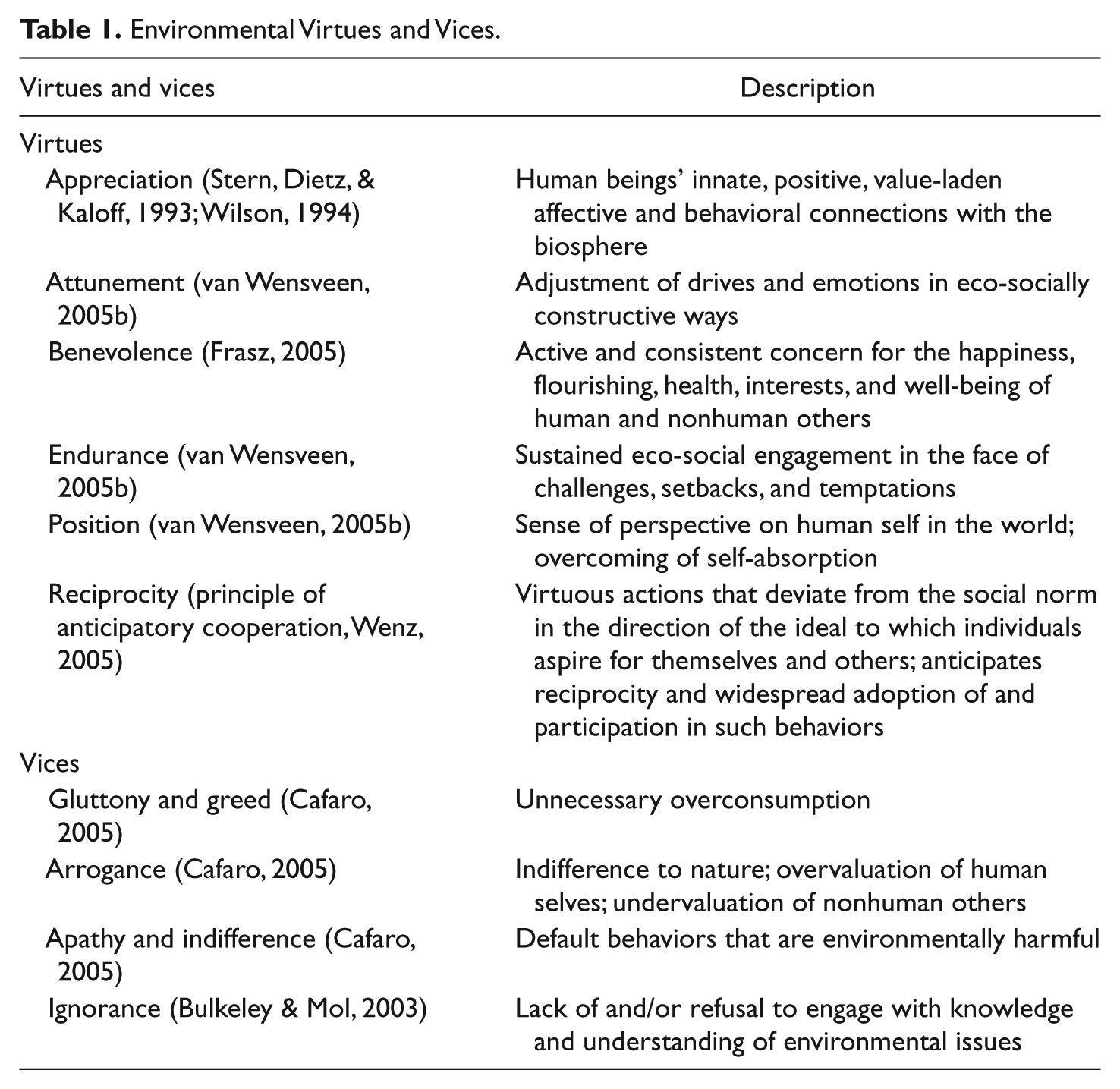
These virtues (and vices) translate into organizational-level effects when organizations enable rather than constrain the expression of environmental virtues by individuals and teams in workplace settings. High organizational environmental virtuousness arises when individuals are predisposed toward the relevant virtues and when organizations enable these predispositions to manifest in organizational systems, processes, and outcomes. Low organizational environmental virtuousness arises when organizational members are not predisposed toward relevant virtues and/or organizational systems, processes, and outcomes constrain their expression.
Organizational environmental virtues and organizational environmental vices lie on a continuum (Caza et al., 2004; see Figure 1 and Table 1) one end of which is characterized by environmentally antagonistic behaviors that are unsustainable, that is, environmental vices, which produce harm and which mandatory compliance militates against through positive normative momentum. The opposite end is characterized by environmentally supportive behaviors that enable sustainability and manifest the “best of the human condition” (Caza et al., 2004, p. 174) rather than the absence of negative outcomes (i.e., lack of harmful and environmentally antagonistic behaviors). It is proposed that the amplifying effects and buffering effects of organizational environmental virtuousness enable positive deviance toward environmentally supportive behaviors and sustainability and constrain negative deviance toward environmentally antagonistic behaviors and unsustainability (Figure 1). The relationships between organizational environmental virtuousness, amplifying and buffering effects and outcomes are discussed below. More specifically, based on an environmental virtue-oriented application of Cameron et al.’s (2004) theory of organizational virtuousness, it is proposed that organizational environmental virtuousness provides a number of effects (Caza et al, 2004; Rego et al., 2010). Hence,
Proposition 1: The amplifying effects of organizational environmental virtuousness lead to environmentally supportive behaviors.
Proposition 2: Organizational environmental virtuousness provides buffering effects against organizational environmental vice, suppresses environmentally antagonistic behaviors, and militates against harmful, negative environmental outcomes by enhancing resiliency, solidarity, and sense of efficacy.
In what follows this article outlines various specific effects of each of the organizational environmental virtues proposed in Table 1.
Benevolence
Frasz (2005) described benevolence in general as representing a family of virtues that involves direct concern for the happiness and well-being of others (e.g., compassion, friendliness, kindness, and generosity). Environmental benevolence is characterized by the “active and consistent concern for the happiness, flourishing, health, interests, and well-being of both human and nonhuman others” (Frasz, 2005, p. 125) and encompasses ecological as well as human impact. Benevolence is considered a “good of first intent” which gives rise to a feeling of goodwill among those performing benevolent acts; furthermore, benevolence can also help individuals to cultivate a more harmonious and inter-connected relationship with the nonhuman world (Frasz, 2005). Benevolence as a “self-transcendent value” has been found to be negatively related to anthropocentricism (Schultz & Zelezny, 1999). Benevolence is also germane to these discussions in that environmentally benevolent individuals provide ethical role models whose “sensitivity” and “attentive experience” not only offer moral prototypes of environmental leadership but also provides sources of environmental moral wisdom regarding the practical judgments required in exercising environmental virtues in particular contexts (Sandler, 2005, p. 217). Hence,
Proposition 3: Active and consistent concern for integrity and stability of the whole-Earth system creates attraction and attachment toward an environmentally benevolent virtuous actor, enhances trust, and triggers affiliative behaviors within the organization thereby building social capital.
Reciprocity
Wenz (2005) offered the principle of anticipatory cooperation (PAC) as a practical way to leverage virtuousness. Wenz’s PAC as originally formulated embodies the virtue of reciprocity and is based on a “spirit of compromise,” calling for virtuous actions by individuals that deviate from the social norm in the direction of the ideal to which they aspire for themselves and for others, but not to such an extent that they end up impairing, instead of fostering, human flourishing (consistent with Aristotle’s “doctrine of the mean” and Bright et al.’s juxtaposition of this with the POS view, that is, “more is not always better”). Wenz (2005) provided two examples by way of illustration: (a) car ownership: environmentally virtuous people may not need to abandon car ownership but instead they may, according to PAC, arrange their lives so that their car use and its adverse impacts are substantially less than is common in society at that time (e.g., by choosing to buy a more fuel-efficient car, driving more fuel efficiently, using public transportation or car pools more often, and so on, but without self-destructively “bending [ones’] life out of shape”, p. 211); (b) eating meat: environmentally virtuous people will try to reduce their consumption of meat below the common level thereby obviating unnecessary and inefficient use of crops for animal feedstuffs and overreliance on unethical factory farming methods.
PAC is optimistic in that it anticipates reciprocity leading to more widespread adoption of and participation in such behaviors, therefore helping to “nudge” society in a more environmentally virtuous direction. PAC also addresses the fact that one of the identified problems of the environmental threats faced currently is that they arise from the cumulative effects of vast numbers of seemingly insignificant decisions (e.g., whether to walk or drive to the supermarket) taken by enormous numbers of individuals (Sandler, 2004) who are temporally (i.e., there is a likely impact not only on current but also and future generations) and spatially distant (i.e., local sources of environmental degradation can have global impact). Consequently, environmental problems may be ameliorated by vast numbers of individuals deviating on what appear to be insignificant and inconsequential actions (e.g., not eating meat quite so often), which are both cooperative and anticipatory irrespective of reciprocity or immediate reward. Hence:
Proposition 4: Virtuous actions that deviate positively from organizational environmental norms in anticipation of reciprocal actions on the part of others create an urge to join and build on prosocial and proenvironmental contributions.
A potential downside of PAC and the additive effects of large numbers of seemingly insignificant and inconsequential actions “nudging” society in the right direction is that it may inadvertently provide a source of normative inertia, that is, encouraging compliance with a minimum, “lowest common denominator” standard (see Hawken, 2010; Wills & Hoffman, 2012). As the basis for positive deviance that leads to extraordinary behaviors, reciprocation in terms of adherence to the mean provides only a minimum standard. However, reciprocation framed in terms of elevating norms builds organizational environmental virtuousness and facilitates a shift toward the enablement of sustainability (an abundance gap) rather than the lessening of unsustainability (a deficit gap), see Figure 1.
Position
Position is framed by van Wensveen (2005b) as an environmental virtue that manifests as human beings’ sense of perspective on themselves in the world and nature’s hierarchy and an overcoming of self-absorption. Position embodies the intrinsic moral goodness of a humble self-acceptance of one’s own position in the natural world, and gratitude, appreciation, and respect for nature. As goods of first intent self-acceptance, gratitude, appreciation, and respect for nature are not goods for the sake of obtaining something else (e.g., the positive affect many people experience at seeing a spectacular natural phenomenon is intrinsically good, and may even be a transcendent experience, see Wilson, 1994), moreover, it is unlikely that people who possess these virtues of position are likely to tire easily of them. Hence,
Proposition 5a: Position gives an individual a sense of perspective regarding her/his position in the biophysical world, overcomes self-absorption, and produces prosocial/proenvironmental behaviors.
Proposition 5b: Position takes account of the needs of human and nonhuman others and triggers affiliative behaviors from others in the organization, thereby building social capital.
Attunement
Attunement (e.g., frugality, simplicity) is a predisposition for “handling temptations” that enables individuals to adjust their drives and emotions in eco-socially constructive ways (van Wensveen, 2005b). Attunement embodies a virtuousness that has both human and social betterment effects. More specifically, consuming with frugality and simplicity may be well within the means of the average European or North American citizen, and may also be in one’s material self-interests (i.e., overconsumption may result in self-harm), furthermore being frugal and simple in one’s tastes and consumption patterns (e.g., eating locally grown produce, not purchasing bottled mineral waters, etc.) may increase the availability and sustainability of natural resources, enable a fairer sharing of resources, and avoid needless utilization of scarce resources (e.g., unnecessary use of plastics in product packaging).
Proposition 6: The adjustment of drives in eco-socially constructive ways results in prosocial outcomes, that is, individuals make unconditional self-sacrifices (e.g., simplifying consumption patterns, being frugal not profligate in use of nonrenewable natural resources), irrespective of reciprocity or reward.
Endurance
Endurance (e.g., tenacity, loyalty) enables constructive eco-social engagement to be sustained in the face of challenges, setbacks, and temptations. Endurance is an attribute of moral goodness, which helps to sustain human impact over the longer term: “Life is full of obstacles, and if we do not have the character strength to face them, going instead with whichever wind blows the hardest, then we cannot be said to have an ethic at all” (van Wensveen, 2005b, p. 177). Hence,
Proposition 7: Sustained proenvironmental engagement in the face of challenges, setbacks, and temptations, is interpreted as a model behavior and creates positive emotions in self and others (e.g., respect of self and by others) and enhances social capital (e.g., trust and affiliation; attraction and followership).
Appreciation
The renowned sociobiologist Edward O. Wilson suggested that human beings have an innate “biophilia,” which he defined as “the connections that human beings subconsciously seek with the rest of life” based in the notion of “wilderness” as a good of first intent with transcendent qualities because it “settles peace on the soul because it needs no help; it is beyond human contrivance” (Wilson, 1994, p. 334). In support of these ideas, he noted that a favored living place for many people is a “prominence near water from which parkland can be viewed,” and that many people expend considerable time and resources backpacking, fishing, bird-watching, gardening, and visiting animal attractions; we populate our homes and workplaces with plants and many people keep animals as pets as expressions of our connectedness with and appreciation for the natural environment. Stern and colleagues (Stern, Dietz, & Kalof, 1993; Stern, Dietz, Kalof, & Guagnano, 1995) studied a “biospheric value orientation,” which encompassed beliefs about “unity with nature,” “protecting the environment,” “preventing pollution,” and “respecting the Earth” and observed that willingness to take environmental action is a function of dispositions, orientations, values, and beliefs. Hence,
Proposition 8: Positive, affect-laden behavioral connection with the biosphere and expression of “friendship” with the natural world in organizational settings triggers positive emotions and enhances personal well-being and performance.
Environmental Vices
Finally, Cafaro (2005) examined the antithesis of virtue and identified four “cardinal” environmental vices: (a) gluttony, for example, fuelling of environmentally harmful intensive agriculture by the overconsumption of food (especially meat) in parts of Europe and North America; (b) arrogance, for example, indifference to nature coupled with overvaluation of ourselves and undervaluation of others setting ourselves up as “tyrants over the rest of creation” (p. 147); (c) greed, which leads to the placing of profit above all other goals, undermining of democratic political purposes (Cafaro cites the case of U.S. energy policy under the Bush administration), driving widespread overconsumption and ultimately leading to self-harm; and (d) apathy and indifference are environmental vices since our default procedures are typically environmentally harmful without being deliberately so. Finally, decision makers may be ill-equipped to take actions and decisions that have an environmental component because of ignorance of the issues at hand (Bulkeley & Mol, 2003), that is, they may lack the necessary intellectual virtues.
Implications and Summary
This article builds on Cameron and colleagues’ foundational construct of “organizational virtuousness” and proposed “organizational environmental virtuousness” as a parallel theoretical resource and practical tool for understanding and leveraging environmentally supportive organizational behaviors. Becoming an environmentally virtuous organization is a major challenge, given the multiplicity of demands and stakeholder interests that converge within business. Nonetheless, previous research has shown that ethically good business, “greener” business, and performance can be mutually supportive. Researchers who may wish to operationalize and understand the role of virtuousness in the “greening of business” as well as organizations and their leaders wishing to follow a path of enhanced environmental virtuousness are faced with the practical question of “how?”
The delineation of the organizational environmental virtues and the development of propositions relating to these leads to some initial ideas for operationalizing the construct, specifically with regard to how these dispositions may be captured for research purposes. This is a critical step if the propositions are to be tested in organizational settings. Spreitzer and Sonenshein (2004) faced a similar challenge with regard to the general construct of positive deviance (i.e. intentional behaviors that depart from the norms of a reference group in honorable ways). Organizational environmental virtuousness was defined at the beginning of this article as a collective ethical disposition which habitually motivates, guides, and corrects moral behavior in organizations in positively deviant ways. The specific sets of behaviors that comprise this ethical disposition were subsequently delineated, albeit provisionally, on the basis of an analysis of environmental virtue ethics’ literatures. Hence, any measure of organizational environmental virtuousness might incorporate appreciation, attunement, benevolence, endurance, position, and reciprocity. For each of these environmental virtues, it would be possible to develop survey items using a Likert-type response format to produce an organization-wide “Organizational Environmental Virtuousness Index.” Previous research has demonstrated the feasibility of such an approach. For example, Schultz and Zelezny (1999) reported the use of a questionnaire to measure environmental attitudes, values, self-reported proenvironmental behaviors in a 14-country cross-national survey. 10 Robertson and Barling (2012) used a 15-item “harmonious environmental passion” scale in their study of the relationship between leadership and proenvironmental behaviors. As noted earlier, Cameron et al. (2004) used a survey-type instrument to capture perceptions of virtuousness from a sample of employees within organizations. As suggested by Spreitzer and Sonenshein (2004), to measure departures from organizational norms, it would be appropriate for raters to be individuals within the organization who understand the norms; for departures from industry norms, it would be important that raters understood the norms of the industry. Such an index could be validated by correlational analyses with dependent variables, such as the Kinder, Lydenberg, and Domini (KLD) standards for environmental and prosocial performance as used by Walls and Hoffman (2012). It would also be possible to employ other types of research designs, such as case study, to explore the ways in which organizational environmental virtuousness manifests in business. It would also be interesting to study whether or not companies that engage in positively deviant sustainability behavior without virtuous intent (e.g., enlightened self-interest) experience the same benefits as those predicted for companies that had a virtuous intent. 11
It was also noted above that in addition to the various “how” questions for researchers, the proposals offered in this article raise related questions for organizations aspiring toward a path of enhanced organizational environmental virtuousness. The evidence is that organizations that have chosen to deviate positively from ethical norms do not have to trade “doing good” for “doing well” (see Hoffman, 2000, 2006). For example, Green Mountain Coffee Roasting (GMCR) based in Waterbury, Vermont, is recognized widely as an innovative, high-growth, socially and environmentally responsible company. For example, GMCR was ranked “Best Corporate Citizen” by Corporate Responsibility magazine (measured in terms of environmental responsibility, corporate governance and ethics, fairness to employees, accountability to local communities, responsible products and services, and healthy rate of return for investors) for two years running in 2007-2008. It was the largest purchaser of Fair Trade Certified coffee in the world for 2010; it offsets 100% of its direct greenhouse gas emissions and allocates at least 5% of pretax profits to social and environmental projects. GMCR declares itself to be “focused on creating positive and sustainable change for people and ecosystems” and “committed to social and environmental responsibility” operating under the core belief that its business strength, support for employees, and a commitment to local and global communities are inseparable and synergistic. 12 . Neville (2008) argued that the positively deviant case of GMCR “creates an opportunity to study how good behavior begets more good behavior” (p. 573).
From the perspective of organizational environmental virtuousness, it would be interesting to analyze the specifics of the necessary behaviors using companies such as GMCR as “benchmark” cases in order to not only validate the construct but also identify precisely how the necessary moral and ethical proenvironmental choices can be exercised in businesses. GMCR also uses appreciative inquiry (AI) as a specific organizational development methodology to provide a forum for its plans for future growth in ways that are consistent with its ethic. In GMCR’s AI summits, “each GMCR employee, over time, has the chance to participate in the organization-wide AI Summits; add value to AI team-building events; use components of AI in their jobs; and create individual career development plans using AI questions.” 13 The philosophy and behaviors of companies, such as GMCR could provide much-needed exemplars in order that organizations that currently follow a path of compliance may be inspired and elevated. GMCR is only one of many such organizations across the globe evincing a collective ethical disposition that motivates, guides, and corrects moral behavior toward the environment in positively deviant ways; it is from such organizations that others may learn.
The environmental virtues and the practical suggestions offered in this article are preliminary; notwithstanding the tentative nature of these proposals, the urgency with which organizations and leaders need to engage with environmental virtuousness could not be greater given the environmental challenges currently faced. These challenges and the ethical dilemmas that accompany them can only be exacerbated further as new nations aspire to the levels of economic growth and material well-being that people in the West have grown accustomed to and which, in no small part, are responsible for the environmental degradations currently experienced. A more positive relationship between human beings, nonhuman life, and inanimate nature depends on the authentic engagement of individuals and organizations with the ethical challenges and moral dilemmas inherent in rational and responsible membership of the whole-Earth system. Organizational environmental virtuousness seeks to address these intellectual and pragmatic imperatives.
Footnotes
Declaration of Conflicting Interests
The author declared no potential conflicts of interest with respect to the research, authorship, and/or publication of this article.
Funding
The author received no financial support for the research, authorship, and/or publication of this article.