



Abstract
A growing literature explores the notion of constructive deviance conceptualized as behaviors that depart from the norms of the reference group such that they benefit the reference group and conform to hypernorms. We argue that constructive deviance is an umbrella term that encompasses several different behaviors, including taking charge, creative performance, expressing voice, whistle-blowing, extra-role behaviors, prosocial behaviors, prosocial rule breaking, counter-role behaviors, and issue selling. Using the three common mechanisms underlying constructive deviance to organize our review (intrinsic motivation, felt obligation, and psychological empowerment), we provide an emergent model that integrates extant empirical work on the antecedents of constructive deviance. We conclude by discussing issues for future research, such as examining obstacles, outcomes, and unexplored mechanism dynamics associated with constructive deviance.
As organizations have become more decentralized, flexible, performance oriented, and global (Crant, 2000; Parker & Collins, 2010), it has become necessary for employees to be more creative and innovative in how they perform their work (Madjar, Greenberg, & Chen, 2011; X. Zhang & Bartol, 2010). At times, it is possible that by doing so, employees will deviate from the norms and procedures of their organizations. Although a significant amount of research has argued that deviating from norms may be harmful (K. Lee & Allen, 2002; Mitchell & Ambrose, 2007; Robinson & Bennett, 1995), it can also be beneficial for the organization and can contribute significantly to organizational effectiveness (Galperin, 2003; Spreitzer & Sonenshein, 2004; Warren, 2003). Moreover, though it is important that employees follow corporate norms for smooth functioning and survival of the organization, strictly following all norms may inhibit employees from finding innovative ways of solving workplace problems (Galperin, 2003).
In this article, we review scholarly work on constructive deviance in organizations. Constructive deviance is an “umbrella term” that encompasses a wide range of behaviors (Warren, 2003), including principled organizational dissent (Graham, 1986), whistle-blowing (Near & Miceli, 1985), some types of prosocial behaviors (O’Reilly & Chatman, 1986; Puffer, 1987), and organizational citizenship behaviors (OCB; Van Dyne, Graham, & Dienesch, 1994). Although widespread research has been done on each of these constructively deviant behaviors and more, it has been done in isolation of each other. Therefore, while we know a substantial amount about the antecedents and mediators of these individual behaviors, our learning about the common causes and processes, if any, of constructive deviance is largely limited. Several scholars (e.g., Grant & Ashford, 2008; Petty, Wheeler, & Bizer, 1999) have expressed concern regarding construction and maintenance of several streams of literatures for related behaviors since it is likely to cause great inefficiencies for our field especially if these behaviors share similar features, antecedents, and processes. Therefore, we focus on “lumping” rather than “splitting” (Fiske, 2006) across literatures to gain a deeper understanding of the concept of constructive deviance. That is, we review across several literatures and integrate similar constructs that fall under the larger umbrella of “constructive deviance” in order to advance research in this area.
Our review is organized around a series of questions. We begin with “What is constructive deviance?” Once defined, we discuss which behaviors appear to fall within and which outside of this definition. We then turn our attention to well-researched areas on behaviors that fall under the umbrella of constructive deviance to ask, “What leads to constructive deviance and why?” Here, we review the various antecedents to different constructive deviance behaviors and induce three mechanisms that appear to explain why these antecedents lead to constructive deviance. The end result of this review is an integrative model of constructive deviance. We then ask, “What do we not know about constructive deviance?” In this section, we discuss some of the mixed findings. To conclude our article, we discuss a final question, “What central questions remain?” When possible, we provide options to address these unanswered questions.
What Is Constructive Deviance?
Constructive deviance has been defined in various, albeit similar, ways. For instance, Spreitzer and Sonenshein (2003) defined constructive deviance as “intentional behaviors that depart from the norms of a referent group in honorable ways” (p. 209). By “honorable,” these scholars referred to behaviors that would be labeled as such by a referent group. Galperin (2003) defined constructive deviance as “voluntary behavior that violates significant organizational norms and in doing so contributes to the well-being of an organization, its members, or both” (p. 158). Common to both conceptualizations is the belief that constructive deviance entails deviation from the norms of a reference group (which could be the organization, the department, or even the work group). One major difference between the two conceptualizations is that the former explicitly states that constructive deviance entails deviation in “honorable” ways that “improve the human condition” (Spreitzer & Sonenshein, 2003, p. 209), while the latter focuses solely on the benefits of constructive deviance within and for the organization—leaving unanswered (or at least implicit) the impact of these behaviors on society at large. Similarly, by raising issues of “the human condition,” the former taps into broader social norms that are at play (i.e., what is respectable, what is virtuous), whereas the latter’s focus on well-being tends to be specific to a group or organization. To synthesize and clarify these and other conceptualizations, Warren (2003) defined constructive deviance as “behavior that deviates from the reference group norms but conforms to hypernorms” (p. 628). Hypernorms are globally held beliefs and values (Donaldson & Dunfee, 1999). Warren also argued that embedded in the conceptualizations of constructive deviance is an assumed benefit to the reference group. Therefore, we slightly modify Warren’s definition to explicitly recognize these benefits and conceptualize constructive deviance as behaviors that deviate from the norms of the reference group such that they benefit the reference group and conform to hypernorms.
We should also point out that our definition, and the constructive deviance literature more broadly, is expansive enough to include deviations from productive as well as nonproductive group norms. While an often-discussed scenario is employee deviation from relatively benign group norms, it is also possible to be deviant from relatively toxic or harmful group ones, such as those where a lack of productivity or undercutting other members are normative. Unfortunately, the latter conditions were largely unexamined in the studies we reviewed.
Furthermore, Warren (2003) proposes that constructive deviance is an umbrella term that encompasses several different types of behaviors, such as principled organizational dissent (Graham, 1986), counter-role behavior (Staw & Boettger, 1990), tempered radicalism (Meyerson & Scully, 1995), whistle-blowing (Near & Miceli, 1985), exercising voice (Van Dyne & LePine, 1998), some types of prosocial behaviors (O’Reilly & Chatman, 1986; Puffer, 1987), some types of OCB (Van Dyne et al., 1994), and functional or creative disobedience (Brief, Buttram, & Dukerich, 2001).
In our review, we look at these behaviors as well as four more types of constructive deviance: creative performance (Amabile, 1996; Baer, Leenders, Oldham, & Vadera, 2010), issue selling (Dutton & Ashford, 1993), extra-role behaviors (Van Dyne, Cummings, & McLean Parks, 1995), and prosocial rule breaking (Morrison, 2006). We include these behaviors under the rubric of constructive deviance because, as we argue below, they can fulfill the three criteria of constructive deviance noted above. For example, creative performance refers to generation of novel and useful ideas or solutions to organizational problems (Amabile, 1996; Oldham & Cummings, 1996). The focus on “usefulness” suggests a benefit to the reference group, and while not explicitly discussed in the literature, these benefits often appear to conform to benevolent societal values and beliefs. Creativity, by its very nature, also entails a departure from the status quo regarding how organizations do things (Zhou & George, 2001) and, germane to our arguments, may also be performed by those whose work does not entail creative performance (Madjar, Oldham, & Pratt, 2002).
Issue selling is “voluntary behaviors which organizational members use to influence the organizational agenda by getting those above them to pay attention to an issue” (Dutton & Ashford, 1993: 398). We include issue selling in our review since it is considered as a subset of voice—a type of constructive deviance (Warren, 2003)—and is focused specifically on information about strategic issues or opportunities at the organization (Morrison, 2011). Finally, extra-role behavior is defined as “behavior which benefits the organization and/or is intended to benefit the organization, which is discretionary and which goes beyond existing role expectations” (Van Dyne et al., 1995: 218); and prosocial rule breaking is defined as “intentional violation of a formal organizational policy, regulation, or prohibition with the primary intention of promoting the welfare of the organization or one of its stakeholders” (Morrison, 2006: 6). These definitions explicitly state that (a) these behaviors entail some form of deviation from the informal or formal norms of the reference group and (b) they benefit the reference group. And most research on these behaviors assumes, even if not stated explicitly, that engagement in these behaviors is in conformity to hypernorms. For instance, while forwarding the notion of prosocial rule breaking, Morrison (2006) claims that “such behavior reflects a desire to do things better or to “do good” in the context of one’s organizational role” (p. 8). Table 1 provides the definitions of different types of constructive deviance and illustrates that the different types of constructive deviance (a) deviate from reference group norms, (b) benefit the reference group, and (c) conform to hypernorms.
Constructs That Capture Constructively Deviant Behaviors
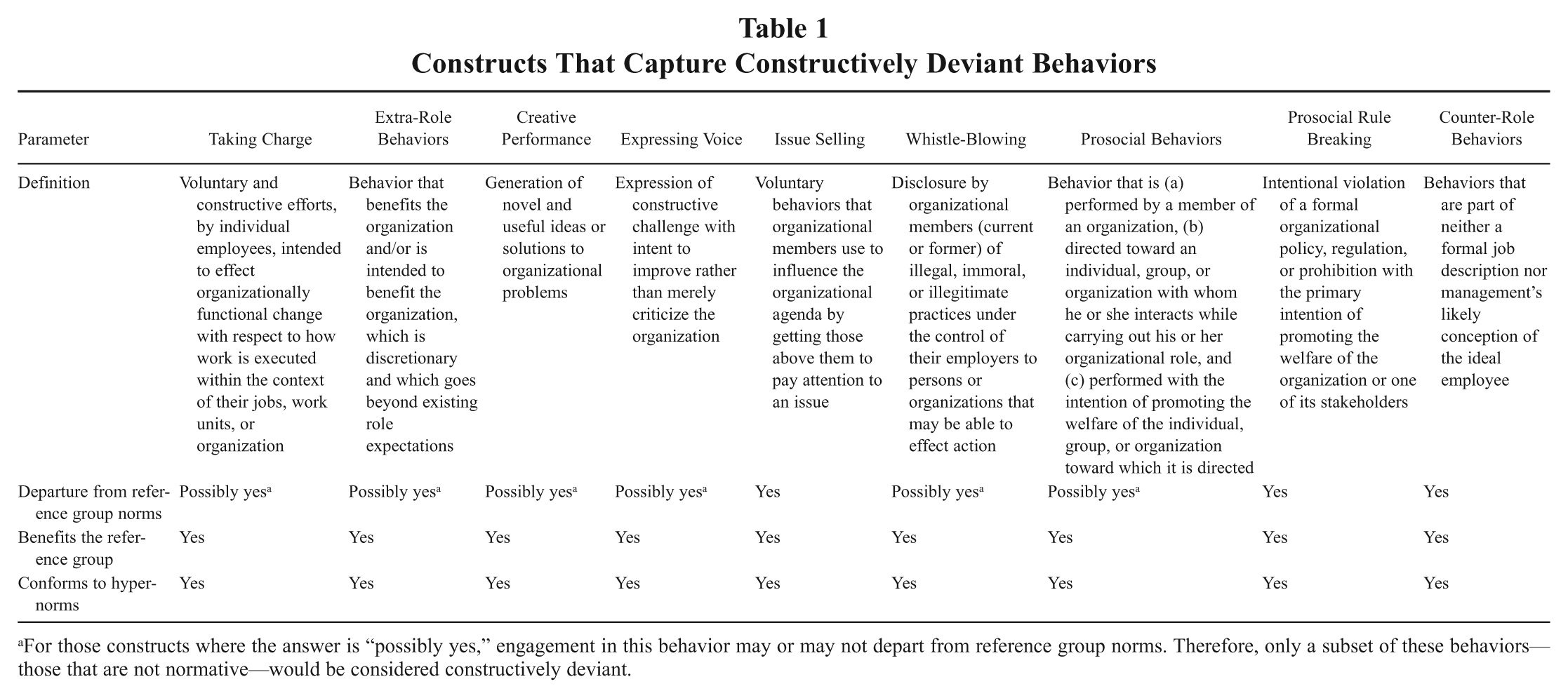
For those constructs where the answer is “possibly yes,” engagement in this behavior may or may not depart from reference group norms. Therefore, only a subset of these behaviors—those that are not normative—would be considered constructively deviant.
It is important to note, however, that some of these behaviors may not always be seen as constructively deviant behaviors. Some jobs require creative performance, taking charge, expressing voice, and so on. That is, they are part of the organizational/reference group norms. 1 These cases then do not fall under the rubric of constructive deviance and differ from the behaviors that our review focuses on behaviors that deviate from the reference group norms. Similarly, we also contend that constructive deviance is different from some forms of proactive behaviors and some forms of OCB. Crant (2000) defined proactive behavior as “taking initiative in improving current circumstances or creating new ones; it involves challenging the status quo rather than passively adapting to present conditions” (p. 436). Proactive behaviors thus refer to anticipatory actions that employees take to impact themselves and/or influence their environments (Grant & Ashford, 2008). They can be in-role or extra-role behaviors and may or may not necessarily conform to the organization’s or society’s values. In short, proactive behaviors entail anticipatory actions that may or may not deviate from the reference group norms and that may or may not conform to hypernorms. Similarly, while OCB has been defined in various ways (Borman & Motowidlo, 1993; Organ, 1988), central to all definitions is the notion that OCBs are employee behaviors that facilitate organizational functioning although they are not critical to the task or job. Examples of these behaviors include helping colleagues and supervisors, not taking excessive breaks, and attending functions that are not required (Organ, 1988). As with proactive behaviors, though, OCBs can also deviate or not from referent group norms and may or may not necessarily conform to the organization’s or society’s values. Only those that deviate from reference group norms but conform to hypernorms would be considered constructively deviant.
In our review of constructs in Table 1, we have therefore included only those articles in which the authors’ conceptualizations have implicitly or explicitly fulfilled the three criteria (e.g., deviation from referent norms) noted above. To do so, two authors individually rated all articles and coded them as 1 if the conceptualization of the behaviors in the articles fit our definition of constructive deviance and 0 otherwise. When there were disagreements between the authors that could not be resolved, articles (n = 3) were excluded from our review.
What Triggers Constructive Deviance and Why?
Having established the boundary conditions of the term, we turn our attention to summarize and integrate the results of the extant empirical work that falls within the criteria we noted for constructive deviance. The predominant focus of much of the empirical research in this area has been on identifying factors within and across multiple levels of analysis that influence the amount of constructively deviant behaviors in which an employee engages. To be comprehensive in our search, we used the terms taking charge, creative performance, voice, whistle-blow, extra role, prosocial behavior, prosocial rule breaking, counter-role behavior, and issue selling to search for articles in organizational behavior and related disciplines. 2 This search lead us to articles in 59 different journals, including Academy of Management Journal, Administrative Science Quarterly, Human Relations, Journal of Applied Psychology, Journal of Management, Organizational Behavior and Human Decision Processes, Organization Science, and Personnel Psychology. We have included approximately 152 empirical articles appearing on EBSCO, ABI Inform, and/or Google Scholar. Table 2 lists these articles and also highlights the research design, antecedents, mediators, and moderators as well as the theories adopted in these studies.
Review of Empirical Studies on Constructively Deviant Behaviors

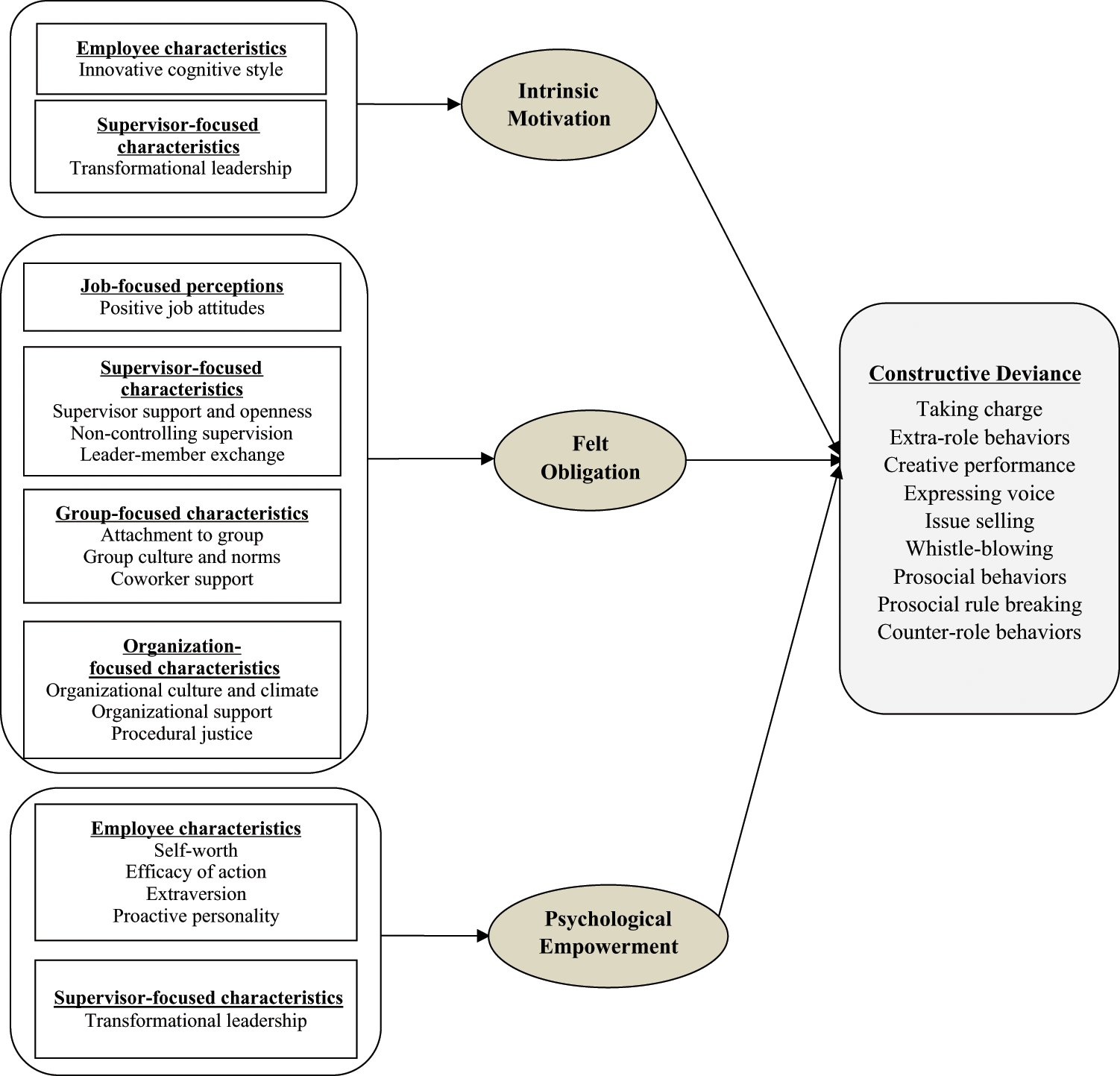
Figure 1 represents an emergent model that captures what is known about the likely predictors of these types of constructive deviance at the individual, dyadic/group, and organizational levels. Our rule for including an antecedent in this model is whether it has been empirically found to lead to multiple types of constructive deviance. In addition, we included only those variables for which there was significant and consistent positive relationship between the variables and different types of constructive deviance; we did not include variables that had contrasting effects on constructive deviance. We discuss these conflicting findings in the following section.
An Emergent Model of Constructive Deviance
From our review, we induce three mechanisms to explain why the various antecedents listed in Figure 1 lead to constructively deviant behaviors: intrinsic motivation, felt obligation, and psychological empowerment. We chose intrinsic motivation and felt obligation as organizing mechanisms because they have been explicitly or implicitly theorized to be, or have been explicitly examined and empirically supported as, mediating mechanisms for their corresponding antecedents in Figure 1. Psychological empowerment, in contrast, is a term we used to combine a variety of mechanisms that we feel work in a similar manner: each center on providing encouragement to, security for, or confidence in an individual.
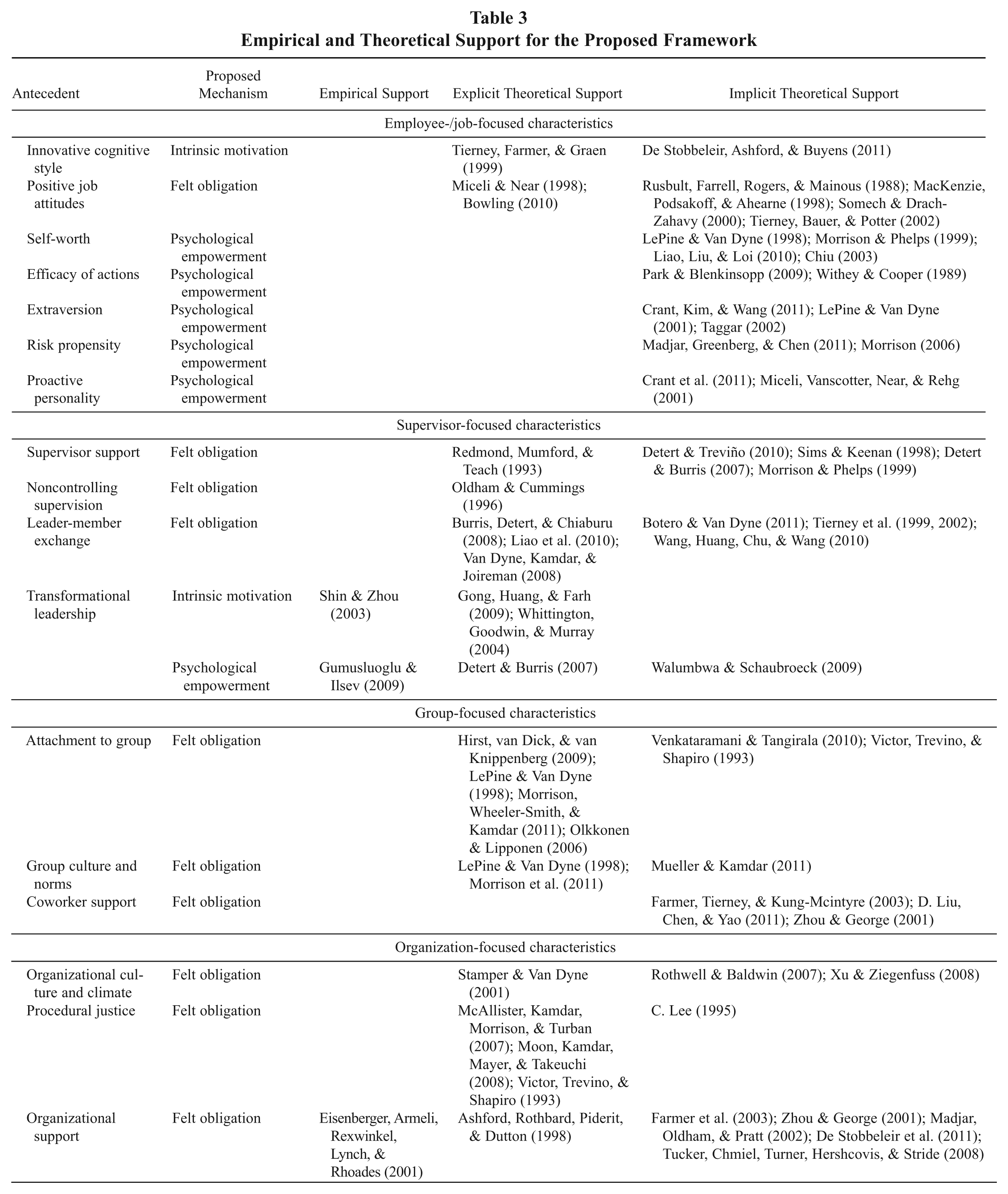
We organize our discussion around these three mechanisms, providing evidence across constructs and across levels of analysis for their existence. In most cases, the studies listed mention the mechanisms and related theories in question (or a related mechanism and theory, in the case of psychological empowerment). When a study does not posit any mechanism, we will argue why it should be subsumed under a specific mechanism. It is important to note, however, that different studies may posit similar antecedents (e.g., transformational leadership) but argue for different mechanisms. Please refer to Table 3, which lists studies wherein the relationships proposed in our organizing framework either (a) have been empirically supported in the extant literatures, (b) have been explicitly mentioned but not tested, or (c) have neither been explicitly mentioned nor tested but support a logic consistent with a mechanism we propose.
Empirical and Theoretical Support for the Proposed Framework
Intrinsic Motivation
Intrinsic motivation refers to a drive to engage in a particular task because it is inherently interesting or enjoyable (Ryan & Deci, 2000). Studies invoking an intrinsic motivation mechanism argue that individuals are likely to engage in constructive deviance as they take risks, explore new cognitive pathways, and are playful with ideas and materials (Oldham & Cummings, 1996). Situational features as well as individual characteristics increase constructive deviance via intrinsic motivation. We include two sets of antecedents as either directly or indirectly positing an intrinsic motivation mechanism: innovative cognitive style and transformational leadership.
Cognitive style is defined as a natural orientation or preferred means of problem solving that can range from innovative to adaptive (Kirton, 1976). Innovative cognitive style has been shown to relate to constructive deviance. An individual with innovative cognitive style tends to seek and integrate diverse information, redefine problems, and “generate ideas likely to deviate from the norm” (Tierney, Farmer, & Graen, 1999: 593). While not always explicitly mentioning intrinsic motivation in their arguments, studies linking innovative cognitive style with constructively deviant behavior often directly or indirectly (via the work of Tierney et al., 1999) draw upon Amabile’s (1988) work on intrinsic motivation to bolster their claims. Research has shown that individuals with innovative cognitive styles are more likely to engage in creative performance (Tierney et al., 1999) and report greater likelihood to express novel ideas when they are satisfied rather than dissatisfied with work (Janssen, Vries, & Cozijnsen, 1998).
Transformational leadership studies directly adopt Amabile’s (1988) intrinsic motivation theory to explain constructively deviant behaviors. Transformational leadership involves stimulating followers by questioning assumptions, challenging status quo, energizing them by articulating a compelling vision, and focusing on their development (Bass, 1985). Shin and Zhou (2003), in their study using a sample of 290 employees and their supervisors from 46 Korean companies, showed that transformational leadership was positively related to follower creative performance, and intrinsic motivation partially mediated this relationship. When leaders provide intellectual stimulation, subordinates are motivated to perform the task at hand by challenging the status quo. They are also encouraged to reformulate issues and problems, to use their imagination, and to be playful with ideas and solutions. That is, transformational leadership is argued to encourage constructive deviance by highlighting intrinsically motivating characteristics of their work (Shin & Zhou, 2003). Using similar rationale, Whittington, Goodwin, and Murray (2004) collected data from 209 leader-follower dyads from 12 different organizations and found that transformational leadership had a positive effect on extra-role behaviors.
Felt Obligation
Beyond the intrinsic motivation arguments, extant research has also suggested that felt obligation may be a key mechanism underlying constructive deviance (e.g., Morrison & Phelps, 1999). Positive job attitudes, supervisor characteristics (supervisor support, noncontrolling supervisor, leader-member exchange [LMX]), group characteristics (attachment to group, group culture and norms, coworker support), and organizational characteristics (organizational culture and climate, procedural justice at the organizational level, organizational support) have all been linked to constructive deviance through felt obligation as a mediating mechanism. The logic behind a felt obligation mechanism can be found in social exchange theory (Blau, 1964). This theory suggests that a reciprocal obligation is likely to develop between two (or more) parties through a series of mutual, although not necessarily simultaneous, exchanges. One party makes some form of contribution to the other party, and in doing so, develops an expectation of a return at a future time. The other party, having received something, develops a sense of obligation to reciprocate. Drawing from these arguments, scholars have proposed that when individuals are in a context that is perceived to be positive, friendly, and productive due to their relationship to either the job, their supervisors, their groups, and/or the organization, they may feel obligated to positively contribute back to the group—what is termed as felt obligation—by engaging in behaviors that are beneficial for the reference group and its members even if the actions deviate from the norms of the reference group. Therefore, they are more likely to engage in constructively deviant behaviors.
With regard to positive job attitudes, Miceli and Near (1988) analyzed survey data from individuals who observed wrongdoing in 22 organizations and found that those observers who were more favorably inclined to their jobs were more likely to engage in whistle-blowing behaviors. Rusbult, Farrell, Rogers, and Mainous (1988) similarly found that high satisfaction and investment in job, by themselves and jointly, affected voice behaviors in a laboratory setting. In a similar vein, Bowling (2010) found that job satisfaction was positively related to extra-role behaviors (also see MacKenzie, Podsakoff, & Ahearne, 1998; Somech & Drach-Zahavy, 2000; Tierney, Bauer, & Potter, 2002).
Studies have argued that supervisor support is also related to constructive deviance. This research suggests that supervisor support and openness, wherein supervisors listen to their subordinates, are interested in their ideas, give fair consideration to the ideas, and take action to address the matter raised (Detert & Burris, 2007), lead to different types of constructively deviant behaviors. For example, Detert and Trevino (2010) conducted 89 interviews in a high-tech multinational corporation with employees at multiple levels in two manufacturing and two research and development units that differed significantly on “speak up”–related items on a companywide employee survey. Among other findings, the authors’ analysis suggested that immediate supervisors’ support strongly influenced employee voice perceptions. Similarly, supervisor support has been shown to be positively related to whistle-blowing (Sims & Keenan, 1998), while management openness is positively associated with voice (Detert & Burris, 2007) and taking charge (Morrison & Phelps, 1999). Also, Redmond, Mumford, and Teach (1993) manipulated leader behaviors as subordinates performed a task requiring creation of a marketing campaign and demonstrated that supportive leader behavior led to higher subordinate creativity.
Similar to the notion of supervisor support is the concept of noncontrolling supervision, which is also positively related to constructive deviance. Oldham and Cummings (1996) examined the characteristics of organizational context on three indicators of employees’ creative performance. They found that participants (171 employees from two manufacturing facilities) produced the most creative work when, among other factors, they were supervised in a supportive, noncontrolling fashion. By contrast, when supervisors were controlling, they closely monitored employee behavior, made decisions without employee involvement, and pressured employees to think, to feel, and to behave in a certain manner (Deci, Connell, & Ryan, 1989). That is, they did not provide employees with the freedom to perform their tasks. Controlling supervision thus reduced creative performance (also see George & Zhou, 2001).
LMX, another supervisor-focused antecedent, has also been shown to be related to constructive deviance. LMX theory looks at the quality of dyadic relationships formed between a supervisor and each subordinate. It is based on the perceptions of resource exchanges and level of support beyond formal expectations (Sparrowe, Liden, Wayne, & Kraimer, 2001). When individuals feel that their managers understand their needs and help solve their problems, then they are said to enjoy high-quality exchange relationships with their leaders. And this high-quality LMX develops a sense of obligation for the subordinates, who may reciprocate by engaging in constructive deviance. High LMX has been found to be positively related to expression of voice, creative performance, and whistle-blowing. For instance, Burris and colleagues (Burris, Detert, & Chiaburu, 2008) surveyed 499 managers in the restaurant industry and showed that high LMX was significantly related to voice (also see Botero & Van Dyne, 2011; Van Dyne, Kamdar, & Joireman, 2008). On similar lines, Liao, Liu, and Loi (2010) demonstrated that high LMX quality had a significant effect on creative performance (also see Tierney et al., 1999). And Bhal and Dadhich (2011) found that high levels of LMX were related to whistle-blowing in India.
As noted in Figure 1, some studies move the focus of their research from leaders to the group in which an employee works. Amongst this stream of research is the work on attachment to the group (i.e., satisfaction or identification with group). For example, the study by LePine and Van Dyne (1998), who conducted a field study of 441 full-time employees in 95 work groups in the Midwest, and the research by Morrison and colleagues (Morrison, Wheeler-Smith, & Kamdar, 2011), who collected cross-level data from 42 groups of engineers from a large chemical plant in India, concluded that there exists a positive association between satisfaction with work group and voice behaviors. But Morrison and colleagues went one step farther and showed that voice behaviors were also positively related to identification with the group (also see Hirst, van Dick, & van Knippenberg, 2009). In a related vein, Olkkonen and Lipponen (2006) demonstrated a positive relationship between work unit identification and extra-role performance. Each of these studies adopt social exchange theory and suggest that those employees who are attached to their work groups may feel obligated to reciprocate this positive feeling and thus are likely to engage in behaviors that are beneficial for the work group or the organization and its members, even if those behaviors deviate from the norms of the reference group (also see Venkataramani & Tangirala, 2010; Victor, Trevino, & Shapiro, 1993).
An important recent development within group-focused constructive deviance research has been the emergence of group-level as well as multilevel theorizing (see Morrison, 2011). In contrast to prior scholarly work, which has primarily been at the individual level of analysis, the recent work considers both individual and group-level effects. The above-mentioned studies on attachment to the group, for example, have also shown that group culture and norms (i.e., group voice climate, self-management vs. traditionally managed groups, etc.) are related to expression of voice (LePine & Van Dyne, 1998; Morrison et al., 2011). Specifically, LePine and Van Dyne (1998) concluded that there exists a significant Person × Situation interaction between satisfaction with group and situational factors, such as group size and group management style, such that individuals with high satisfaction with their groups were more responsive to the situational factors than were those with low satisfaction. On similar lines, Morrison et al. (2011) demonstrated that group voice climate was highly predictive of voice and explained variance beyond the effects of individual-level identification and satisfaction.
Other investigations have also tested this relationship between group culture or climate and constructive deviance. For example, Mueller and Kamdar (2011) explored the extent to which the culture of helping in a team was positively related to a person’s own creativity. Results from 291 employees in a single division of a large multinational organization revealed that seeking help predicted creativity, but giving help was negatively related to creativity. In this study, the theoretical arguments regarding felt obligation are more implicit, but they hint at the idea that group culture—such as a culture of helping—can signal to employees whether the principles of reciprocity are followed in the group, thereby suggesting that felt obligation (or a lack thereof) among group members is likely to influence constructively deviant behaviors.
Still another set of group-focused characteristics mirrors work on supervisory support and LMX to show how collective-level support from coworkers and related notions, such as positive feedback from coworkers and group acceptance, are also associated with engagement in constructively deviant behaviors (Farmer, Tierney, & Kung-Mcintyre, 2003; Madjar et al., 2011). For example, D. Liu, Chen, and Yao (2011) theorized and demonstrated, using data from 856 members in 111 teams within 23 work units of a porous metal company and from 525 employees in 98 teams of 11 branches of a large commercial bank, that team autonomy support and team member autonomy orientation as well as unit/branch autonomy support and team autonomy support jointly affected individual creativity. In a sample of 149 employees, as hypothesized, Zhou and George (2001) illustrated that employees with high job dissatisfaction exhibited highest creativity when continuance commitment was high and when (a) useful feedback from coworkers and (b) coworker helping and support were high.
In addition to those focused on the individual and group, three organization-focused characteristics, namely, organizational climate and culture, perceptions of procedural justice, and organizational support, have also been related to constructive deviance. Rothwell and Baldwin (2007) reported findings from a study that investigated the relationship between organizational climate and police whistle-blowing on five forms of misconduct in the state of Georgia. These scholars discovered that friendship climate in the organization was positively related to willingness to blow the whistle. Other studies have similarly pointed to the importance of organizational climate and culture. For example, Xu and Ziegenfuss (2008) conducted an experiment to find that internal auditors were more likely to report wrongdoing to higher authorities when organizations had reward systems for doing so. Although these studies did not adopt social exchange theory to explain their predictions, they indicated that climate in the organization may foster a sense of obligation in the individuals, due to which they may engage in whistle-blowing. Stamper and Van Dyne (2001), however, did adopt social exchange theory and demonstrated that whereas part-time employees displayed relatively little voice regardless of organizational culture, full-time employees who were more vested in the future of the organization exhibited higher levels of voice when the culture was less bureaucratic. Therefore, organizational climate and culture have been shown to affect constructive deviance.
A second organization-focused variable, procedural justice, has also been linked to constructive deviance. Although not explicitly positing felt obligation, these studies do draw upon social exchange perspectives that underlie this mechanism. For example, McAllister, Kamdar, Morrison, and Turban (2007) adopted social exchange theory and demonstrated a positive relationship between procedural justice and taking charge using data from 225 employees in India and their direct supervisors. Also adopting an exchange perspective, Moon, Kamdar, Mayer, and Takeuchi (2008) collected data from two diverse samples containing both coworkers and supervisors and found that procedural justice at the organizational level was positively related to taking charge when evaluated by a coworker. Finally, Victor and colleagues (1993), in their study of 159 employees from corporate-owned fast-food restaurants, illustrated that perception of procedural justice influenced whistle-blowing behaviors. They suggest that when organizations are fair, employees feel obligated to reciprocate by acting in ways that benefit the organization.
Finally, organizational support may also signal to employees that the organization and its members are not going to react negatively to constructive deviance. For example, Eisenberger, Armeli, Rexwinkel, Lynch, and Rhoades (2001), in their study using data from 413 postal employees and their supervisors, found that perceived organizational support (POS) was related to employees’ felt obligation to care about the organization’s welfare and to help the organization reach its objectives and that felt obligation mediated the associations of POS with extra-role behaviors. Using a sample of Taiwanese employees, Farmer et al. (2003) showed that creativity was highest when employees perceived that the employing organization supported creative work. Zhou and George (2001) made similar conclusions about the positive relation between organizational support and creative performance in their study with data from 149 pairs of employees and their supervisors (also see De Stobbeleir, Ashford, & Buyens, 2011; Madjar et al., 2002). Tucker, Chmiel, Turner, Hershcovis, and Stride (2008), using a cross-sectional survey of 213 urban bus drivers in the United Kingdom, found that organizational support for worker safety was positively related to voice. In a related vein, Chen, Eisenberger, Johnson, Sucharski, and Aselage (2009) assessed POS and extra-role performance two times, separated by a 3-year interval, among 199 employees of an electronic and appliance sales organization and found that support was positively associated with a temporal change in extra-role performance. Finally, Ashford, Rothbard, Piderit, and Dutton (1998) showed that perceptions of a high degree of organizational support were related to individuals’ willingness to raise and promote gender equity issues in their organizations.
Psychological Empowerment
We organize the following as factors that are related to constructive deviance through the mechanism of psychological empowerment: employee characteristics, such as self-worth (and related concepts), extraversion, risk propensity, and proactive personality; and supervisor characteristics, such as transformational leadership. We follow Spreitzer (1995) and use the term psychological empowerment to represent a myriad of variables that work to fortify or strengthen the individual in some way, allowing her or him the capacity to engage in constructive deviance. According to Spreitzer, empowerment is manifested in a set of four cognitions reflecting an individual’s orientation to his or her work: meaning, competence (analogous to agency beliefs, personal mastery, or effort-performance expectancy), self-determination (i.e., individual’s sense of freedom or autonomy), and impact. We argue that empowerment serves as fortification, which provides individuals the resources to engage in constructive deviance; and that this fortification may be accomplished through competency and self-determination, that is, through a sense of being confident in one’s abilities, having the freedom to do one’s own thing, and/or protection that stems from psychological security and safety. By inducing the mechanism of psychological empowerment, it becomes clearer how seemingly contradictory variables, such as transformational leadership and noncontrolling supervision, can affect constructive deviance: by fortifying the individual.
Self-worth is the degree to which individuals believe that they are capable, significant, and successful (Coopersmith, 1981) and is related to self-efficacy, self-confidence, self-esteem, and generalized self-competence. Because they are more confident and comfortable with who they are, high-self-worth individuals tend to conform less and exhibit more initiative and assertiveness than those with low self-worth. They are also more likely to set and adhere to a challenging goal of changing the status quo and to exert more effort in pursuit of this chosen goal (Bandura, 1986). They are thus more likely to engage in constructively deviant behaviors. Following these arguments, LePine and Van Dyne (1998), in their field study noted above, found that individuals with high levels of global self-esteem engaged in more voice than did individuals with low levels of global self-esteem. In a similar vein, Morrison and Phelps (1999) obtained self-report and coworker data for 275 white-collar employees from different organizations and found that taking charge was positively related to generalized self-efficacy. Using longitudinal, multisource data for 828 employees on 116 teams, Liao et al. (2010) also demonstrated that high levels of self-efficacy were positively related to creative performance (also see Tierney & Farmer, 2011). Also, Chiu (2003) collected data from 306 Chinese managers and professionals using vignettes to show that an individual’s internal locus of control was positively related to whistle-blowing. These scholars argue that individuals who were confident that their actions make a difference were most likely to choose actions that bring about change and alter the source of discontent. Therefore, they are more likely to deviate from the norms of a reference group in ways that benefit the group and its members (also see Somech & Drach-Zahavy, 2000).
Related to the notions of self-worth and self-efficacy is the idea of efficacy of actions, which is the optimistic belief about the potential outcomes for engaging in behaviors. These beliefs have been linked to different types of constructively deviant behaviors. For example, Park and Blenkinsopp (2009) demonstrated that a belief that actions will be efficacious was positively related to internal whistle-blowing intentions. And Withey and Cooper (1989) conducted two longitudinal studies and illustrated that when people were confident that improvement was possible through their actions, they were likely to engage in expressing voice.
Of the Big Five personality traits, extraversion is the only trait that is consistently related to, and has in fact a positive relationship with, constructive deviance. Extraverts are sociable, enthusiastic, and energetic. They are also open to expressing their thoughts and can stimulate discussion and have high performance expectations (Barry & Stewart, 1997). LePine and Van Dyne (2001) argued and found extraversion to be positively related to voice behavior. Following similar logic, Crant, Kim, and Wang (2011) conducted a survey to measure personality of 224 MBA and undergraduate students and also kept track of all incidents of student voice behavior in the classroom. They also found that extraversion was associated with expression of voice. Last, Taggar (2002) found a positive association between an individual’s extraversion and individual creativity. Rationales for why extraversion leads to constructive deviance evoke competence/empowerment-related arguments. LePine and Van Dyne (2001: 328) argue in their study of constructive deviance and voice:
It seems reasonable to expect that extraverts are more comfortable and skilled in communicating their thoughts. Voice behavior involves an element of risk taking because it can be viewed as an attempted change in status quo. As such, it requires a willingness to speak up and be counted. We argue that extraverts will be less inhibited by conformity pressure and will be more willing to express change-oriented opinions.
The above quote also suggests that risk propensity, or the willingness to take risks, may also be related to constructive deviance. It is therefore not surprising that Madjar et al. (2011), in a study of 157 employees and 12 supervisors, found that willingness to take risks was associated primarily with radical creativity. In a similar vein, Morrison (2006) showed that high risk-taking propensity was positively related to the likelihood of deciding to engage in prosocial rule breaking.
Our review suggests that proactive personality is also related to constructive deviance. Proactive personality describes the differences in the extent to which people effect environmental change by identifying opportunities and acting on them (Bateman & Crant, 1993). Proactive people are likely to believe that they can initiate changes successfully and are not likely to be dissuaded from acting by a retaliatory environment. Put differently, proactive individuals are likely to feel competent and be self-determined, two dimensions of psychological empowerment, and thus likely to engage in constructively deviant behaviors. Although extant research has not explicitly looked at psychological empowerment as a potential mechanism, several studies have adopted the above reasoning and shown that proactive individuals are more likely to engage in constructive deviance. For example, Miceli, Vanscotter, Near, and Rehg (2001), in a sample of over 300 military and civilian air force employees, found that whistle-blowers had higher levels of proactive personality than did inactive observers. Similarly, the study by Crant et al. (2011), described above, demonstrated that proactive personality was positively related to voice behaviors.
Just as it is instrumental in intrinsically motivating individuals, transformational leadership also signals a sense of safety and support to employees. Detert and Burris (2007) analyzed data from 3,149 employees and 223 managers in a restaurant chain and showed that transformational leadership was positively related to expressing voice. The arguments made by the scholars was that when managers display transformational leadership, that is, routinely demonstrate a personal interest, listen carefully, and take action, they demonstrate to subordinates that there is little risk in honest communication (Edmondson, 1999). Such experiences will fortify the individual by providing psychological safety, which in turn would motivate employees to express voice (also see Walumbwa & Schaubroeck, 2009).
What Do We Not Know About Constructive Deviance?
There are two ways of discussing what is not known: (a) focusing on where literature has yet to focus (i.e., gaps) and (b) focusing on inconsistencies. Our summary tables, especially Table 3, and our organizing Figure 1 illustrate the former. For example, we know from Table 3 that there is a paucity of empirical support linking employee and job-focused characteristics with our various mechanisms. Moreover, we organized Figure 1 around those articles that justify their arguments using a particular mediating logic (e.g., felt obligation). Future research can be done to explore the potential, but not illustrated, linkages in this figure. For example, can transformational leadership lead to issue selling via felt obligation? Alternatively, research can focus on mapping out more explicitly each of the employee-, job-, supervisor-, group-, and organization-focused antecedents, if any, that link to the three mechanisms we proposed.
A second means of assessing what we do not know is to focus on inconsistencies in the literature. Beyond the above-outlined characteristics, a variety of other individual and organizational factors have been investigated in relation to constructive deviance. Yet research findings in these areas are inconsistent in that they suggest some combination of positive, negative, or no statistically significant relationships between these factors and constructive deviance. Inconsistency is most pronounced at the individual or employee level, where most of the research on constructive deviance has been done. As research on group and organizational characteristics grows, inconsistencies with these types of variables may become apparent.
At the employee level, it is unclear how personality traits, such as conscientiousness and agreeableness, as well as other individual differences variables (e.g., demographics) affect constructive deviance. Conscientiousness refers to individual differences in impulse control, conformity, and determination (Costa & McCrae, 1992; Hogan & Ones, 1997). Individuals who are high on conscientiousness are likely to be dependable, reliable, and self-controlled; tend to obey rules and conform to norms; and are likely to be responsible and scrupulous (Costa & McCrae, 1992; Goldberg, 1992). Studies examining the effects of conscientiousness on voice, creative performance, extra-role behaviors, and prosocial rule-breaking behaviors have found either a positive (e.g., Bowling, 2010; Crant et al., 2011; Demerouti, 2006; LePine & Van Dyne, 2001; Taggar, 2002), negative (e.g., Dahling, Chau, Mayer, & Gregory, 2012) or no (e.g., George & Zhou, 2001; Tucker et al., 2008) significant relationship. Another Big Five personality trait whose relation to constructive deviance is unclear is agreeableness. Agreeable individuals tend to be trustworthy, straightforward, altruistic, and modest (Costa & McCrae, 1992). They also tend to engage in more teamwork, are more cooperative, and have higher-quality interpersonal interactions. These characteristics of agreeable individuals tend to help them with information seeking and conflict resolution (Taggar, 2002). LePine and Van Dyne (2001), in contrast to their prediction, found that agreeableness was negatively related to expression of voice, while Taggar (2002) demonstrated a positive relationship between agreeableness and creative performance.
Our review further indicates that formal predictions have not always been made for the effects of some of the individual differences variables, such as demographics, on constructive deviance; nonetheless, most of these variables have been used as controls in various studies. Gender, age, education, tenure, and hierarchical positions are amongst the most commonly used control variables, and their effects on constructive deviance are largely mixed. For example, some studies have shown a positive association between being male and whistle-blowing (Miceli & Near, 1988), expression of voice (e.g., Detert & Burris, 2007; Gao, Janssen, & Shi, 2011; LePine & Van Dyne, 1998), creative performance (X. Zhang & Bartol, 2010; Zhou, 1998), extra-role behaviors (e.g., Bowling, 2010), prosocial behaviors (e.g., C. Lee, 1995), and prosocial rule breaking (e.g., Morrison, 2006, for Study 1), while others have found no (e.g., Moon et al., 2008; Morrison, 2011; Van Dyne et al., 2008) or a negative relationship (e.g., Dahling et al., 2012; Hall & Ferris, 2011) between gender and any of the constructively deviant behaviors.
Similarly, age and education have been found to be positively related to voice (e.g., LePine & Van Dyne, 1998; Tucker et al., 2008), creative performance (e.g., De Stobbeleir et al., 2011; Farmer et al., 2003), extra-role behaviors (e.g., Bowling, 2010), and prosocial behaviors (e.g., Balliet & Ferris, in press; C. Lee, 1995) and negatively related to whistle-blowing (e.g., Chiu, 2003; J.Zhang, Chiu, & Wei, 2009a) and creative performance (e.g., George & Zhou, 2007; Madjar et al., 2011) or to have no relation to different types of constructive deviance (e.g., Amabile, Barsade, Mueller, & Staw, 2005; Dahling et al., 2012; Mueller & Kamdar, 2011; Perry-smith, 2006; Tierney & Farmer, 2011; van Dick, van Knippenberg, Kerschreiter, Hertel, & Wieseke, 2008).
Regarding tenure, some scholars argue that newcomers generally (a) tend to be less familiar with the rationales or intricacies associated with the norms of the organization or job, (b) tend to be less identified with formal and informal goals and culture of the organization, and (c) may perceive themselves to be organizationally powerless. They are thus less likely to feel psychologically empowered or intrinsically motivated to deviate from the norms of the organization such that it benefits the organization and its members. Therefore, they would be less likely to engage in constructive deviance (also see Vadera, Aguilera, & Caza, 2009). But the data do not always support these arguments. We find that tenure has a positive (e.g., Liao et al., 2010; Mellahi, Budhwar, & Li, 2010), a negative (e.g., Stansbury & Victor, 2009), or no relation (e.g., George & Zhou, 2007; Madjar et al., 2011; Moon et al., 2008) to different types of constructive deviance.
The arguments for the relation between hierarchical position and constructive deviance are similar to those put forth for the effects of tenure. Individuals at lower levels of the organization may have relatively simple and rigid views of group norms and may perceive themselves as being relatively vulnerable to those in power. Therefore, they are less likely to engage in any behaviors that deviate from the norms in fear of sanctions and punishments. Hierarchical position should thus be positively related to constructive deviance. However, past research suggests that there exists a positive (e.g., LePine & Van Dyne, 1998; Venkataramani & Tangirala, 2010) or no (e.g., D. Liu et al., 2011; Morrison & Phelps, 1999; Taylor & Curtis, 2010) relationship between position and taking charge, creative performance, voice, whistle-blowing, extra-role behaviors, prosocial behaviors, and prosocial rule breaking.
Finally, attachment to the organization (in terms of organizational identification, organizational commitment, and psychological attachment) is another variable whose relationship to constructive deviance is still ambiguous. Studies have shown either a positive (e.g., Mellahi et al., 2010; Olkkonen & Lipponen, 2006; Taylor & Curtis, 2010), a negative (e.g., Zhou & George, 2001), or no (e.g., Burris et al., 2008; Sims & Keenan, 1998) relationship between the different forms of attachment and different types of constructive deviance. For example, Withey and Cooper (1989) have demonstrated a positive relationship between organizational commitment and voice using a graduate student sample but found no such relationship for an accounting firm sample. On similar lines, Madjar and colleagues (2011) proposed and found a positive relationship between organizational identification and incremental creativity but not between organizational identification and radical creativity. Also, Taylor and Curtis (2010) uncovered a positive relationship between commitment and whistle-blowing, while Zhou and George (2001) hypothesized and showed a negative relationship between continuous commitment and creative performance.
What Central Questions Remain?
To summarize the main points of our review, we have found consensus around the mechanisms that mediate common antecedents for constructive deviance: intrinsic motivation, felt obligation, and psychological empowerment. While these mechanisms account for a large number of antecedents, there remain some proposed antecedents whose relationship to constructive deviance remains inconsistent. The latter raises the question, What are the contingencies explaining mixed findings regarding constructive deviance? But implicit in our review are other unanswered questions as well. For example, extant research has focused most exclusively on what motivates employees to engage in constructive deviance. However, what are the obstacles or deterrents of constructive deviance? More generally, our review shows that research has mostly examined the antecedents of constructive deviance, but what are the potential consequences of constructive deviance? We have also argued that there are three primary mechanisms that exist in extant research that explain why certain antecedents lead to constructive deviance. But are there more mechanisms, and might different mechanisms interact in explaining why employees engage in constructive deviance? Finally, in reexamining the antecedents and mechanisms, we wonder what separates engagement in constructive deviance from destructive deviance? In the following sections, we shift from review to areas for future research that address these various questions.
What Explains the Mixed Findings?
Our review revealed that the relationship between personality traits, such as conscientiousness and agreeableness; individual differences variables, such as demographics; and attachment to the organization and constructive deviance is still unclear. One potential reason we may have found these ambiguous results may involve the fact that not all constructive deviance behaviors are exactly alike. For example, creative performance aims to generate novel and useful solutions to organizational problems, while expressing voice seeks to improve dissatisfactory working conditions. Therefore, it is possible that some variables that facilitate the generation of new and useful ideas may actually deter expression of concerns to supervisors or others in authority. Consider the case of agreeableness. As noted above, agreeable individuals tend to engage in more teamwork and in more information seeking and conflict resolution. These characteristics are ideal for accessing varied information from different sources that may eventually help with idea generation. However, these same characteristics may hinder the expression of unacceptable working conditions or policies and procedures of an organization because of the tendency of agreeable individuals to be more cooperative and to minimize conflicts. Therefore, it is not surprising that Taggar (2002) illustrated a positive relationship between agreeableness and creative performance, while LePine and Van Dyne (2001) found that agreeableness was negatively related to expression of voice.
Research even suggests that different facets of the same construct may sometimes have different effects. Moon and colleagues (2008), for example, predicted and found different effects when examining the two facets of conscientiousness, duty and achievement striving, on taking charge. Duty was positively related, but achievement striving was negatively associated, with taking charge. To the degree that achievement striving is self-focused and duty is other-focused, it may be that individuals who are other-focused may be more willing to engage in deviance behaviors that involve sacrifice (e.g., whistle-blowing, taking charge) than those who are not. By contrast, more self-oriented individuals may engage in deviant behaviors that come with less social cost and more immediate upside potential, such as engaging in extra-role behaviors. In short, while all constructively deviant behaviors have some elements in common, it may be that differences in the types of behavior (e.g., improve a relatively satisfactory status quo versus challenge unsatisfactory conditions; whether the behaviors will involve a high degree of personal risk or sacrifice) or individual differences (e.g., self- versus other-oriented) may help to explain inconsistent results in current research on constructive deviance.
What Are the Obstacles to Constructive Deviance?
We propose that the field of constructive deviance needs to move beyond exploring the facilitators of constructive deviance to investigating the obstacles to, or inhibitors of, these behaviors. These inhibitors could be across multiple levels of analysis. A good place to start would be to examine those variables that are negatively related to the mechanisms we have identified. At the individual level, for example, apathy, narcissism, and negative affect and mood may undermine intrinsic motivation, felt obligation, and psychological empowerment, respectively (see Ashforth, 1997; Madjar et al., 2002; Spector, 1975), and thus may be obstacles to constructive deviance. Moreover, the effects of personality traits, such as neuroticism, need to be investigated more systematically in the literatures. Individuals who are high in neuroticism are emotionally unstable. They tend to be anxious, depressed, angry, worried, and insecure (Barrick & Mount, 1991). They also tend to express negative attitudes toward their coworkers and are likely to have lower-quality interactions with others at work. As such, they are not likely to be as internally “fortified” as someone who feels psychologically empowered and therefore are not likely to engage in any behaviors that are beneficial for the reference group and its members. There is limited evidence in the literatures that neuroticism is negatively related to constructive deviance. For instance, while investigating the relationship between personality traits and contextual performance, LePine and Van Dyne (2001) found that neuroticism was negatively related to voice behaviors. However, this relationship has yet not been systematically investigated for other forms of constructively deviant behaviors.
At the supervisor level, abusive supervision is likely to impede constructive deviance. Abusive supervision is defined as “subordinates’ perceptions of the extent to which their supervisors engage in the sustained display of hostile verbal and nonverbal behaviors, excluding physical contact” (Tepper, 2000: 178). Abused subordinates often experience frustration along with a diminished sense of personal control and competence (Ashforth, 1997). They therefore tend to choose to enact (or not) certain behaviors over which they have discretion. Since abused subordinates are likely to blame their employers for the supervisor’s behaviors (Tepper, 2000), they are not likely to channel felt obligation in productive ways; rather, they may “pay back” the supervisor by intentionally withholding actions that benefit the reference group. They are thus less likely to engage in constructive deviance.
Regarding organizational characteristics, some types of organizational cultures, such as those uncomfortable with uncertainty and ambiguity, may be negatively related to constructive deviance because they may be too rigid to allow any deviance, constructive or destructive. One example of such organizations are family firms, which tend to be conservative and may be unwilling to accept risky behaviors due to high risks of failure as well as the risk of destruction of family wealth (Sharma, Chrisman, & Chua, 1997). These and similar organizations are likely to initiate efforts to eliminate uncertainty through greater centralization and coordination (Pfeffer & Salancik, 1978), which in turn could lead to an increase in rigidity and control. Therefore, in such organizations, individuals are less likely to feel empowered to engage in constructive deviance.
What Are the Consequences of Constructive Deviance?
Constructive deviance, by definition, entails actions that benefit the reference group. But to our knowledge, no study has systematically examined whether engagement in constructive deviance influences the organization as a whole or the constructively deviant actor. In the organization, what benefits one referent group may positively impact the entire organization through greater productivity and retention. However, there may be negative, unintended effects of constructive deviance, such as when constructive deviance at one level of the organization is seen quite differently at another. Someone may, for instance, be motivated to engage in unsanctioned creative behavior to improve some core departmental practices. However, changing these practices may have an adverse effect on other areas of the organization that are interdependent with this department, especially as they relate to the newly reconstituted practices. Consider the scenario when one department may decide to employ novel ways of tracking inventory using iPads. But this new system may not be compatible with organizational procedures for gathering these metrics. The net result is a negative outcome of constructive deviance for some aspects of the organization. Thus, one factor that may influence whether organizations will benefit from constructive deviance of a given referent group might be the type of interdependence this group has with others in the organization (e.g., sequential vs. pooled).
We further believe that future research needs to systematically investigate when and how constructive deviance will have a positive or a negative effect on the actor (see Morrison, 2011, for a similar call). Our review suggests that research on one type of constructively deviant behavior, whistle-blowing, has mainly focused on retaliation from colleagues, supervisors, or top management as a negative consequence for whistle-blowing. That is, reporting misconduct can lead to a damaged public image (e.g., being seen as a troublemaker or snitch) or to formal sanctions, such as a lower performance evaluation or a bad job assignment (Miceli, Near, & Dworkin, 2008). By contrast, research on another form of constructive deviance, voice, has by and large focused on the positive outcomes for the individual expressing voice. For example, in an experimental study, Whiting, Podsakoff, and Pierce (2008) asked participants to rate the performance of a “paper person” on the basis of written descriptions of 24 critical incidents. Some incidents described high levels of voice, while others described low levels. The scholars found a positive effect of voice on performance appraisals, above and beyond the effects of task behavior and helping (also see Vakola & Bourades, 2005; Van Dyne & LePine, 1998).
One factor that may influence whether an actor’s constructive deviance is viewed positively or negatively by others is skill related to networking ability. Networking ability is defined as the extent to which people are skilled in developing and using social networks to effect change at work (Ferris et al., 2005). Individuals who are high on networking abilities are likely to involve others and build coalitions before engaging in constructive deviance. They may therefore be less likely to be seen as troublemakers and more likely to be evaluated positively because of the support they may have garnered for their ideas. Supporting this claim, research on issue selling and creative performance suggests that building coalitions and an alliance of potential supporters is likely to allow individuals to better attract the attention of top management (see Baer, 2012). Thus, the manner in which an individual engages in constructive deviance (by networking, building coalitions, seeking alliances, etc.) is likely to influence the consequence of engagement in these behaviors for the individual. While both networking skill for individuals and referent group interdependence are promising avenues, more systematic research in this area is needed.
Do Mechanisms Work Together and Are There Others?
As we noted above, our review reveals that individuals engage in constructively deviant behaviors via three mechanisms: intrinsic motivation, felt obligation, and psychological empowerment. Intrinsic motivation basically hints at the impetus to act, felt obligation focuses on the impetus to act such that the reference group is benefited, and finally, psychological empowerment indicates that the employees will feel fortified to engage in these behaviors. Therefore, the three mechanisms discussed above focus on (a) the drive to act such that the (b) reference group is benefited and the (c) deviants feel empowered to act. Viewed in this way, at least two major questions remain.
First, do these mechanisms work together or is each sufficient on its own? For example, is intrinsic motivation sufficient without some force directing it in service of the referent group? To illustrate, research has argued that organizational identification serves as an intrinsic motivator for employees but that this motivation is otherwise unfocused (van Knippenberg, 2000). This may explain competing arguments in the literature. On one hand, research suggests that when employees identify with the organization, they are intrinsically motivated to engage in behaviors that benefit the organization. They are thus motivated to “bend the rules” or deviate from the formal and informal norms of the organization as far as it helps the organization (Vadera et al., 2009). On the other hand, research finds that when individuals feel attached to the organization, they are likely to adhere to and behave in ways that are consistent with organizational norms and values (Pratt, 2000). Taken together, individuals can help the organization by either following the rules or by deviating from them. Similarly, intrinsic motivation may be expressed via either norm following or norm deviating.
In a related vein, will organizational members be able to act upon their motivations to help the organization without sufficient psychological resources? To illustrate, without some sort of psychological fortification, will employees be willing to “pay back” the organization for supportive leadership and the like through constructive deviance rather than through normative means? And if the mechanisms interact in some way, will antecedents, such as transformational leadership—which appears to touch upon multiple mechanisms (intrinsic motivation and psychological empowerment)—be more successful at promoting constructive deviance than those that appear to tap into only one?
Second, and perhaps more critically, none of the mechanisms we have induced from the literature appears to explain why a given individual will engage in constructively deviant rather than constructively normative behavior. More specifically, the mechanisms may help explain why employees act constructively (e.g., to reciprocate support) but not in a deviant manner. Intrinsic motivation, as we have noted, may not be focused toward norm following or norm breaking. Similar arguments could be made for felt obligation and psychological empowerment: employees could repay their group or be fortified to act in either normative or non-normative ways. What then might explain the push toward deviance while still remaining constructive?
Research on “destructive deviance,” such as research on workplace deviance, is broad and vast and includes research on interpersonal and organizational deviance (see C. Berry, Ones, & Sackett, 2007, for review) and counterproductive work behavior (see Dalal, 2005; Lau, Au, & Ho, 2003, for review). This research tends to argue that engaging in deviance is a product of both situational factors and individual differences that result in attributions of some sort of unsatisfying state (e.g., an unjust state) or “disequilibria” (see Martinko, Gundlach, & Douglas, 2002: 43). Thus, one place to start would be to look at various situational and individual factors that might lead to deviant behavior but not necessarily destructively deviant behavior. Two possibilities appear to be promising starting places. Regarding the situation, one may extrapolate that perceived insufficiency of organizational policies and practices, broadly defined, may be a key mechanism in explaining constructive deviance, given the role of inflexible policies (Martinko et al., 2002) or perceptions of various forms of justice (C. Berry et al., 2007) in explaining other forms of deviance. The logic here is that to arouse deviant behavior, whether positive or negative, employees feel that existing conditions are not sufficient for creating the type of changes they want to make. For constructive deviance, such insufficiencies need not mean that the organization is acting unjustly (although this may be the case with whistle-blowing). Rather, it may be acting inefficiently (e.g., in the case of creative behavior) or may have overly narrow roles or rules (e.g., in the case of extra-role behavior or prosocial rule breaking).
Regarding individual differences, we suggest that identity security, potentially a special type of psychological empowerment, may also be a promising avenue to pursue. Identity security refers to the type of attachment one has with their referent group. It differs from identity strength, which is the more commonly studied in organizational identification, in that the strength refers to the degree that one sees one’s group as self-defining, ranging from strong to weak. Identity security, by contrast, occurs when individuals not only see their group as self-defining but feel comfortable and safe in their group as well as validated by others (J. Berry, 1991; Huo & Molina, 2006; Mummendey & Wenzel, 1999). Pratt, Fiol, O’Connor, and Panico (2011) argued that identity security acts quite differently from identity strength, such that those with identity security are not as apt to rigidly follow and defend referent group norms but will be open to a broader and more diverse way of thinking. Thus, identity security appears to have elements we have discussed as essential for constructive deviance. Attachment to the group will be motivating and will direct helping behavior toward helping the group. Moreover, the willingness and ability of individuals with identity security to look beyond their “in-group” norms to adopt new ones would suggest at least a propensity for deviation.
In sum, there is a paucity of research that has examined mechanisms that explain constructive deviance—and not simply constructive organizational behaviors. We suggest that perceived insufficiency of organizational policies and practices and identity security may be good starting places, but research should examine not only these but other mechanisms as well.
What Separates Constructive From Destructive Deviance?
In addition to distinguishing constructive deviance from constructive normative behavior, we also think additional work should be done distinguishing the antecedents and mechanisms underlying constructive versus destructive deviance. What, for example, distinguishes an employee experiencing disequilibrium from a crisis from taking charge versus taking advantage of the situation for his or her own gain (see exit, voice, loyalty, and neglect models for similar discussions, e.g., Rusbult et al., 1988). At present, while some similar types of antecedents, especially Big Five personality measures and perceptions of justice, have been examined for both constructive deviance (see Table 2) and counterproductive work behaviors (C. Berry et al., 2007; Dalal, 2005; Martinko et al., 2002), these antecedents have more consistently been linked with the latter, suggesting that there may be unique dynamics underlying each; that is, that they are not simply the inverse of each other. By contrast, mechanisms, particularly, social exchange/reciprocity, have been argued to underlie both constructive and destructive deviance (see also Dalal, 2005, for review). Taken together, additional work is needed comparing these responses, particularly in the same organization (see Galperin & Burke, 2006, for an example). One potential distinguishing mechanism relates to the quality of the relationship between the individual and his or her organization or referent group (see Rusbult et al., 1988, for a similar line of arguments). For example, Vadera and Pratt (2013) link different qualities of organizational identification—over-identification, over-disidentification, apathetic identification, and ambivalent identification (see also Dukerich, Kramer, & Parks, 1998; Kreiner & Ashforth, 2004)—to different types of organizational crime, a type of destructive deviance. In one set of arguments they make, they link a high degree of organizational disidentification, a relationship that occurs when someone views himself or herself strongly in opposition to his or her organization, to anti-organizational crimes or crimes against an organization. 3 Extending this work, there may be forms of organizational identification—likely involving some positive identification—that predispose someone toward constructive deviance. At first blush, positive organizational identification would appear promising; however, it is important to note that even positive identifications can be harmful if they are too strong (Dukerich et al., 1998). If the overlap between oneself and one’s organization is too complete (i.e., over-identification), employees may overconform to group norms and may even engage in unethical behavior to protect group interests. Thus, there may be an optimal level of positive organizational (or referent group) identification that may be required. Alternatively, recent work has suggested a connection between ambivalence and wise decision making. For example, Weick (2002) suggests that holding an ambivalent attitude may allow people to break out of entrenched ways of thinking. Extrapolating from this, there may be some forms of ambivalent identifications, whereby employees are simultaneously attracted and repulsed by their organization, that may be key to constructive deviance. Indeed, ambivalence is at the heart of Meyerson and Scully’s (1995) notion of tempered radicalism.
Conclusion
We have argued that due to pressures for decentralization, flexibility, and a stronger performance orientation, employees are expected to be more creative, more productive, and more involved in the performance and survival of the organization. To be able to do so, they may need to deviate from the norms or informal rules of the organization in ways that benefit the reference group and its members, that is, they need to engage in constructive deviance. However, research in the subfields falling under the umbrella term constructive deviance (see Table 1) has suffered from a lack of integration. Thus, insight into constructive deviance is limited.
We have attempted to integrate and extend extant work in this area. To begin, we not only identify a variety of antecedents that have been found to predict multiple types of constructive deviance but also induce three mechanisms that have been proposed across different literatures that explain their effects: intrinsic motivation, felt obligation, and psychological empowerment (see Figure 1). While these mechanisms serve to integrate consistent findings in the literature, additional work needs to help better reveal those findings that are inconsistent across subfields of constructive deviance. Moreover, we argue that additional work is needed to better understand obstacles to and consequences of constructive deviance. Future research also needs to fully investigate whether and how the mechanisms underlying constructive deviance overlap, whether or not there are missing mechanisms, and what antecedents and mechanisms differentially predict constructive and destructive deviance.
In closing, given that deviance has such negative connotations, it may seem odd to focus so much attention on behavior that violates reference group norms. However, competitive demands would argue that it is just this type of “out-of-the-box” thinking that we now need.
Footnotes
Acknowledgements
We wish to thank Karl Aquino and the two anonymous reviewers for their insightful comments. We would also like to acknowledge the Centre for Leadership, Innovation, and Change (CLIC) as well as the Centre for Emerging Markets Solutions (CEMS) at the Indian School of Business for providing partial funding.