



Abstract
The development and enactment of leadership involves paradoxical tensions. Cultural and organizational forces increasingly reflect an awareness of paradox. Leadership is correspondingly understood as having paradoxical aspects. I address the relationship between leadership and paradox and explore the utility of the competing values framework as a means to develop leadership skill from a paradox perspective. The competing values framework can support the development of a more paradoxical view of leadership that encourages greater leader behavioral and cognitive complexity as well as increased leader flexibility. Furthermore, the capacities of awareness, exploration, and interpretation are identified as possible resources to advance paradoxical conceptualizations of leadership.
Introduction
A paradox perspective involves “contradictory yet interrelated elements that exist simultaneously and persist over time” (Smith & Lewis, 2011, p. 382). The development of leadership skill often involves paradoxical tensions. Therefore, a paradox perspective may be especially useful in addressing leadership development dilemmas. A core challenge for leaders, for example, is the need to project consistency in order to earn trust and the simultaneous and seemingly opposing need to adapt to changing circumstance. Dennison, Hooijberg, and Quinn (1995) capture this tension by extending the F. Scott Fitzgerald line that “the test of a first-rate intelligence is the ability to hold two opposed ideas in the mind at the same time and still retain the ability to function:”
The test of the first-rate leader may be the ability to exhibit contrary or opposing behaviors (as appropriate and necessary) while still retaining some measure of integrity, credibility, and direction. (p. 526)
The aim of this article is to bring a paradox perspective to bear on the subject of leadership to develop a more paradoxical vision of leadership. Combining insights from paradox with leadership responds to the above-mentioned quote as it represents an attempt to consider how leaders navigate paradoxical challenges. Therefore this article aids scholars and practitioners to more skillfully cultivate leadership potential by more deeply incorporating a paradox perspective.
To generate insights about the interplay of paradox and leadership development, I explore the competing values framework (CVF), a well-known means of characterizing individual and organizational leadership (Cameron, Quinn, DeGraff, & Thakor, 2007). I explore how the CVF might aid leadership development informed by a paradox perspective. The framework, its workings, and its theoretical underpinnings are described later in this article.
Leadership development is the focus of this article because of its importance to organizational change (Higgs & Rowland, 2011). Human potential is a critical factor in any sustained organizational or social change. The development of leadership capability and the cultivation of individual competency are fundamental to such change efforts.
The paper is organized as follows: I briefly identify cultural and organizational forces that heighten awareness of paradox. I subsequently address the related scholarly topics of ambidexerity and complexity and the linkage between paradox and leadership. Then I explore the relationship between the leadership development, paradox, and the competing values framework. I specify how the CVF can support a more paradoxical perspective of leadership. Finally, I end by considering the roll that awareness, exploration and interpretation may play in future exploration of paradoxical leadership.
Leadership in an Era of Increasing Ambiguity, Complexity, and Paradox
Numerous scholars have asserted that during the transition from the 20th to 21st century complexity, ambiguity and paradox would be the defining managerial themes of the era (Cameron & Quinn,1988; Handy, 1994; Quinn et al., 2010, Vaill, 1996). This is echoed in the world of practice where, for example, research conducted in Asia by the Center for Creative Leadership and the Human Capital Leadership Institute (2012) suggests that paradox is fundamental to global work contexts and should be understood as a perspective to cultivate when promoting leadership development. The same forces influencing the world and workplace shape demands for management scholars (Lewis, 2000). Noting trends of globalization, technological change, and increased competition, Lewis acknowledges, “indeed, the rising intricacy, ambiguity, and diversity of organizations place a premium on researchers abilities to think paradoxically” (p. 760). Therefore a paradox perspective allows for theory development “more in tune with organizational complexity and ambiguity” (p.760).
Theorizing that acknowledges or incorporates paradox represents a shift and corrective within organizational theory. Poole and Van De Ven (1989) note that “tensions, oppositions, and contradictions” (p. 562) are downplayed and parsimony and internal consistency are most prized. This leaves us with theories that are “essentially incomplete” (p. 562). Echoing this sentiment, Eisenhardt (2000) states that “simplicity is elegant but often untrue” (p. 704). Poole and Van De Ven (1989) conclude that “significant advances in theory require ways to address paradoxes inherent in people and their social organizations” (p. 562). By cultivating a paradox perspective, Lewis (2000) begins to articulate how it would ideally not just be seen as a resource for developing theories that are more faithful to organizational reality but also more actionable and useful to practicing managers. Paradox can be construed not simply as social fact but also as a resource:
Yet, in today’s complex organizations, models based on linear and rational problem- solving do managers a tremendous disservice. Managers need to recognize, become comfortable with, and even profit from tensions and the anxieties they provoke, for the contribution of paradox to management thinking is the recognition of its power to generate creative insight and change. (Lewis, 2000, p. 764)
This points the way for conceptualizing about leadership and approaching leadership development in a manner that acknowledges paradox and makes use of it. This is not just timely but necessary because tensions from competing demands often elicit strong, defensive, reactions among organizational leaders that can lead to potentially detrimental responses (Lewis, 2000). Leaders who can embrace inconsistencies, and seek to support contradictory elements simultaneously, can foster creative, beneficial alternatives (Cameron & Quinn, 1988; Poole & Van De Ven, 1989; Smith & Lewis, 2011). Lewis (2000) invokes Argyris exhorting us to “work toward tensions and the anxieties they provoke in search of insightful interconnections” (p. 774).
Toward a Paradoxical View of Leadership
Although Dennison et al. (1995) note that many early leadership theories acknowledge dynamic tensions (Bass, 1960; Blake & Mouton, 1964; Burns, 1978; P. R. Lawrence & Lorsch, 1967), several recent ideas contribute to a more paradoxical perspective on leadership. I will examine them here before addressing how the CVF can aid in leadership development from a paradox perspective.
Ambidexterity
Ambidexterity can be understood as a form of managerial and organizational flexibility. Ambidexterity has been a topic of ongoing attention (Good & Sharma, 2010; Kaiser, Lindberg, & Craig, 2007; Zaccaro, Foti, & Kenny, 1991; Zaccaro, Gilbert, Thor, & Mumford, 1991). Birkinshaw and Gupta (2013) define ambidexterity as “an organization’s capacity to address two organizationally incompatible objectives equally well” (p. 291). Thus, paradox and ambidexterity share the need to address competing, seemingly paradoxically crucial yet incompatible objectives. Yet Birkinshaw and Gupta align organizational considerations with managerial action when they note:
Essentially ambidexterity provides a normative perspective about on how organizations function. It says that managers are making choices and trade-offs among competing objectives, and when they do their job well they override the organization’s tendency to go down the path of least resistance (p. 293).
Research on ambidexterity by Tushman, Smith, and Binns (2011) suggests that the ability of senior leadership teams to embrace tension between old states and activities and new ones is a key predictor of firm success. They note that firms “thrive” when senior teams can contend with this duality and they must “embrace inconsistency by maintaining multiple and often conflicting strategic demands”(p. 76). O’Reilly and Tushman (2011) also note that ambidexterity is behaviorally enacted and strongly influenced by leadership style. They hold that a key leadership quality is “the ability of the senior leadership to tolerate and resolve the tensions arising from separate alignments” (p. 76). Meta-analytic work by Junni, Sarala, Taras, and Tarba (2013) finds that, broadly speaking, ambidexterity seems to positively affect performance.
Yet ambidexterity connotes more decidedly single-loop aims (Argyris & Schon, 1978, 1996) than paradox. Ambidexterity primarily treats dual or binary options as given and assumes that attending to both objectives equally well, ought to be the goal. Thus ambidexterity is a response to largely binary tensions with the aim of more skillfully addressing competing dualities by attending to both sides of a competing tension in a balanced not differential manner. A paradox perspective allows for a broader range of possible responses. Although both perspectives recognize competing tensions and dualism, a paradoxical approach may identify an even broader range of dilemmatic tensions and provide varied, changing, differential, or attenuated responses.
Complexity
Uhl-Bien, Marion, and McKelvey (2007) identify the need for leadership to account for and contend with complexity given the increasingly interdependent, knowledge-based, world. Invoking McKelvey and Boisot’s (2003) “law of requisite complexity,” they assert, “It takes complexity to defeat complexity.” (Uhl-Bien et al., p. 301). This builds on a long-standing call for increased cognitive and behavioral complexity in the conceptualization and study of leadership (Dennison et al., 1995; Hooijberg, Bullis, & Hunt, 1999; K. A. Lawrence, Lenk, & Quinn, 2009; Quinn, 1988). Dennison et al. (1995) note that increased cognitive complexity is surely necessary to address increasing social and organizational complexity but cognitive advances alone are insufficient because leadership is performative. Thus behavioral complexity is needed because “we must conceive and perform” (p. 524). This perspective posits that effective leaders are those who have the cognitive as well as the behavioral capacity to recognize and react to paradox, contradiction, and complexity in their environments. This premise has garnered empirical support (Dennison, Hooijberg, & Quinn, 1995; K. A. Lawrence et al., 2009; Spreitzer & Quinn, 1996).
Paradox
More overtly paradoxical conceptualizations of leadership have begun to come into view. Smith and Lewis (2012) suggest that a paradoxical view of leadership is needed. They assert that “managing paradoxical tensions also helps individuals, groups, and firms to be flexible and resilient, fostering more dynamic decision-making” (2011, p. 394). Initial empirical studies employing a paradox perspective support this view (Luscher & Lewis, 2008; Miron-Spektor, Gino, & Argote, 2011; Kan & Parry, 2004).
Smith, Besharov, Wessels, and Chertok (2012) begin to develop a paradoxical model of leadership as it relates to social enterprise. Social ventures contend with the tension of juggling financial and social demands. Smith et al. assert that social entrepreneurs would do well to develop the “meta-skills of acceptance, differentiation, and integration” (p. 466) in order to move beyond formal rationalist mental models, see synergies and possibilities beyond dichotomous tensions, and explore generative potential in paradox. Although Smith et al. constrain their focus to social enterprise, they acknowledge that a range of organizations “embody multiple, conflicting values, identities, norms, routines, and structures” (p. 476) including health care organizations, higher education organizations, and arts organizations.
Ambidexterity, flexibility, and complexity including cognitive and behavioral complexity all paint a picture of leadership that acknowledges and capitalizes on paradox. As a more decidedly paradoxical conception of leadership comes to light, I look to the CVF as a resource for leadership development from a paradoxical perspective.
Paradoxical Leadership and the CVF
Smith et al. (2011) and Lewis (2000) note that current interest in the study of paradox was, in many respects, galvanized by Cameron and Quinn (1988). Their edited volume Paradox and Transformation brought the topic to the fore and built on their respective efforts (Cameron, 1986; Quinn, 1988). Thus it stands to reason that a leadership development tool developed by these scholars would incorporate a paradox perspective.
The CVF was first articulated by Quinn (1984) and informed by Quinn and Rohrbaugh (1983) and Quinn and Cameron (1983). The framework was further refined in Quinn (1988) and further tested by Dennison et al. (1995). It is perhaps most widely known through Cameron and Quinn’s Diagnosing and Changing Organizational Culture: Based on the Competing Values Framework (2005, 2011). More than 100,000 have taken assessments using the CVF resources in that text (Cameron & Quinn, 2011). Because the CVF has been subject to extensive psychometric testing and validation (Cameron & Quinn, 2011, includes extensive appendices delineating this process), I do not repeat this description here. Instead, see citations above. I draw on two additional books about the CVF in this article: Quinn et al.’s 2010 Becoming a Master Manager (5th ed.) and Cameron et al.’s (2007) Competing Values Leadership. Additional useful description of the CVF in use can be found in Cameron and Lavine (2006), Lavine and Cameron (2012), and Giek and Lees (1993).
I first briefly describe the CVF in somewhat mechanistic terms with the intent of familiarizing the reader with its function and interpretation. I then identify specific means by which the CVF serves as a source for a paradoxical view of leadership and leadership development.
The CVF highlights the trade-offs, tensions, contradictions, and paradoxes inherent in organizations and their leaders (Cameron et al., 2007; Cameron & Quinn, 2005, 2011; Quinn, 1988; Quinn & Cameron, 1983; Quinn & Rohrbaugh, 1983). The framework comprises two dimensions that express the tensions or competing values that characterize all organizations. One axis represents the continuum between flexibility or adaptability juxtaposed by stability or control. The other axis articulates the continuum between efficient internal processes, such as human resources practices or internal control systems, versus external positioning related to stakeholders such as competitors, customers and clients. Each continuum highlights performance criteria that are opposite from that of the other end of the continuum, such as internal versus external orientation (horizontal axis) or flexibility versus stability (vertical axis).
Each of the four quadrants has been given a label to describe its most notable characteristic. The original formulation of the CVF used terms derived from the scholarly literature in organizational studies to define each quadrant—Clan (upper left), referring to team, group, esprit de corps among collaborators; Adhocracy (upper right), referring to the ability of people to nimbly collaborate in new, creative, and innovative ways; Market (lower right), the ability to focus on results, achievement and attention to the competitive landscape and external positioning; and Hierarchy (lower left), the ability to create and maintain structures and systems that support organizational control and learning (Cameron & Quinn, 2011). Because the academic labels in each quadrant are often misunderstood, it has proven useful to substitute more accessible and commonly used verbs to describe the dominant activities that relate to each quadrant—Collaborate, Create, Compete, and Control.
As depicted in Figure 1, the Collaborate quadrant is at the upper left of the framework, the Create quadrant is at the upper right, the Compete quadrant is at the lower right, and the Control quadrant is at the lower left. The two upper quadrants share an emphasis on dynamism and flexibility. The two bottom quadrants emphasize control and stability. The two left-hand quadrants are both focused on internal capabilities whereas the two right-hand quadrants are externally focused.

Core dimensions of the competing values framework (from Cameron et al., 2007).
Thus competing or paradoxical elements are found through comparison of the diagonally, or diametrically, opposite quadrants. For example, the upper left quadrant in Figure 1 emphasizes organizational performance with an internal focus, whereas the lower right quadrant is externally focused. The competing or opposing nature of the elements in each diagonally opposed quadrant captures the presence and necessity of paradox.
One premise of the CVF is that the most effective organizations, and the most effective leaders, have competency and capability in each of the four quadrants. They manage to act soft and hard, flexibly and with stability, creatively and under control, quickly and methodically. They are relational and independent, precise and groundbreaking. They are, in a word, paradoxical. This is not simply an indicator of ambidexterity however in that skillful leaders may, for example, be primarily flexible and only minimal stability focused in a given circumstance and quite the opposite in another. Thus leadership effectiveness is not achieved simply by attempting to approach both sides of an opposing force with equal skill. Rather, leadership skill seems to best be evidenced by more movement throughout the framework, indicating a complex adaptation to changing circumstances (Dennison et al., 1995). In the following sections I identify three essential ways that the CVF can aid in leadership development from a paradox perspective.
The CVF Encourages Greater Cognitive and Behavioral Complexity
The management skills assessment that accompanies the CVF (Cameron et al., 2011) provides a profile that identifies management and leadership skills that respondents have developed to differing degrees. The CVF expands cognitive complexity and encourages behavioral complexity by identifying management skills and corresponding leadership roles and behaviors. Therefore, the CVF provides a developmental and perceptual roadmap that provides a reasonably concrete description of behavior and skill that a respondent could develop to improve their leadership skills.
Furthermore, the CVF enables respondents to recognize that they may underperceive areas of skill that they do not strongly exhibit. It thereby provides developmentally adapted feedback to respondents about areas of skill and behavior to which they may be comparatively blind outside of their dominant areas of strength. Table 1 provides an illustration.
Competing Values Framework, Management Skills/Model, Leadership Roles/Behaviors.
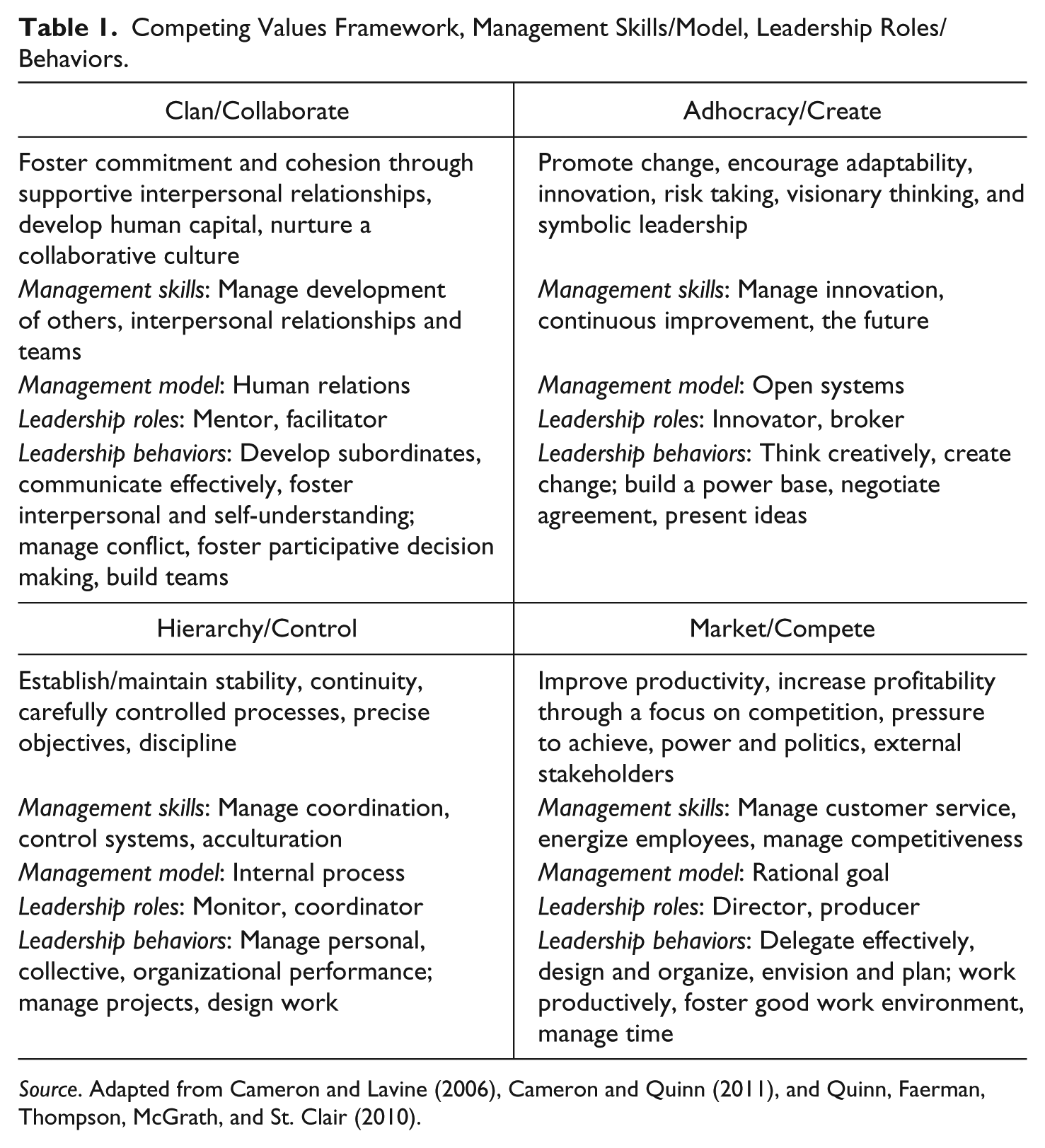
Source. Adapted from Cameron and Lavine (2006), Cameron and Quinn (2011), and Quinn, Faerman, Thompson, McGrath, and St. Clair (2010).
The developmental assessment that the CVF can provide enables respondents to see behaviors they may enact and roles they may fulfill with varying degrees of skill. The CVF provides a description of roles and behavior such that those using the framework may gain a provisional sense of behavior and accompanying roles that may be unfamiliar to them. This is consonant with findings from developmental stage models of leadership that a sufficiently specific articulation of leadership behaviors, roles, and states accelerates leadership development as it provides scaffolding to support new leader behaviors (Kegan, 1983, Kegan & Lahey, 2002; Rooke & Torbert, 2005; Torbert, 2004).
The CVF Heightens Awareness of Dynamic Tensions Within Key Managerial and Leadership Skills
Quinn et al. (2010) describe paradoxical assumptions that are basic to the CVF. The first such assumption is a both/and rather than either/or logic (Bartunek, 1988; Luscher et al., 2008). The CVF is influenced by and represents an integration of aspects of widely used models: human relations, internal process, open system, and rational goal (see Table 1; Quinn, 1988; Quinn & Rohrbaugh 1983). Yet it differs from and transcends models that assume a predominant or best organizational action or managerial approach. Quinn et al. (2010) note:
Complex situations require complex responses. Sometimes organizations benefit from stability, and sometimes they benefit from change. Often organizations need both stability and change at the same time. In contrast to earlier approaches, the development of the competing values framework did not assume that stability and change were mutually exclusive, an either/or decision. (p.12)
Thus the CVF is based on a core assumption of dynamic tension (Cameron et al., 2011). It represents an integration of ideas that attend to opposing concerns. It treats the friction, trade-off, and simultaneity of demands represented by these concerns as the core value of the model (Quinn, Kahn, & Mandl, 1994). Effectiveness is increased by employing aspects of the four integrated yet opposing models simultaneously (Quinn et al., 2010).
The CVF uses the term competing values because the quadrants can appear in conflict. Organizations and their leaders want to be adaptable and flexible but also stable and controlled. They want innovation and change but also efficient internal processes. The quadrants diagonally across from one another represent the greatest opposing differences. Therefore, focusing on internal cultural (see Figure 1) in the upper left quadrant (Clan/Collaborate) is in greatest opposition to external competition and market focused result on the lower right (Market/Compete). Similarly, the quadrant focused on organizational control (Hierarchy/Control) is in most opposition its diametric opposite (Adhocracy/Create). Therefore the CVF allows leaders to see that strong action in one domain carries a particular and specific risk of comparatively less action in the diametrically opposing quadrant.
For example, focusing on in-house culture carries a risk of neglecting the competitive landscape. Creating assiduous control systems often stifles the room for bold, creative action. The CVF can help leaders see that strengths often carry accompanying risks of deficit or inattention to conceptual opposites and deficits can help explain why the value of some strengths may be blunted if areas of deficit are profound.
If areas of weakness are substantial they can hinder the success of strengths. An important caveat to the CVF is that focusing on strengths when corresponding weaknesses are developed to a minimal or average level can often be adaptable. Yet neglecting areas of deficit altogether is often problematic. Certainly no single individual can possess across-the-board strengths, but average or adequate performance represents a baseline condition fundamentally different from deficit or weakness. Even if strengths are profound they are often not enough to overcome areas of significant weakness. Remedial attention to any significant area of weakness is essential to building leadership strength.
Working to overcome areas of relative weakness such that they can be converted into average or adequate performance can help leaders see more possibilities for action when core areas of strength fail to produce desired outcomes. This is one illustration of the comparative behavioral complexity that the CVF promotes. Areas of weakness are akin to a conceptual floor whereas areas of strength may be thought of as a ceiling. Although strengths may, in large measure, determine potential, that only holds true if the floor is stable or the distance from the floor makes the ceiling easier to reach. Some of this logic is manifest in Herzberg’s (1964) well known two-factor motivation–hygiene theory. This work showed that a host of positive factors contribute to motivation and satisfaction at work (the ceiling), but the floor is also determined by potential sources of dissatisfaction. The CVF surfaces an analogous set of tensions pertaining to strengths and weaknesses related to leadership and managerial skill development.
Paradox Is Made More Manageable Through the CVF
Lewis (2000) and Luscher and Lewis (2008) note that self- or social- reflection is needed for paradoxes to become apparent. The CVF provides a framework to encourage self-reflection and a comparative dimension that supports broader social- reflection. Furthermore, the deliberately opposing nature of the managerial models that influenced the development of the CVF ensure that a series of organizational and leadership dilemmas are likely to become apparent (see Table 2).
Competing Values Framework, Leadership, and Managerial Paradoxes.
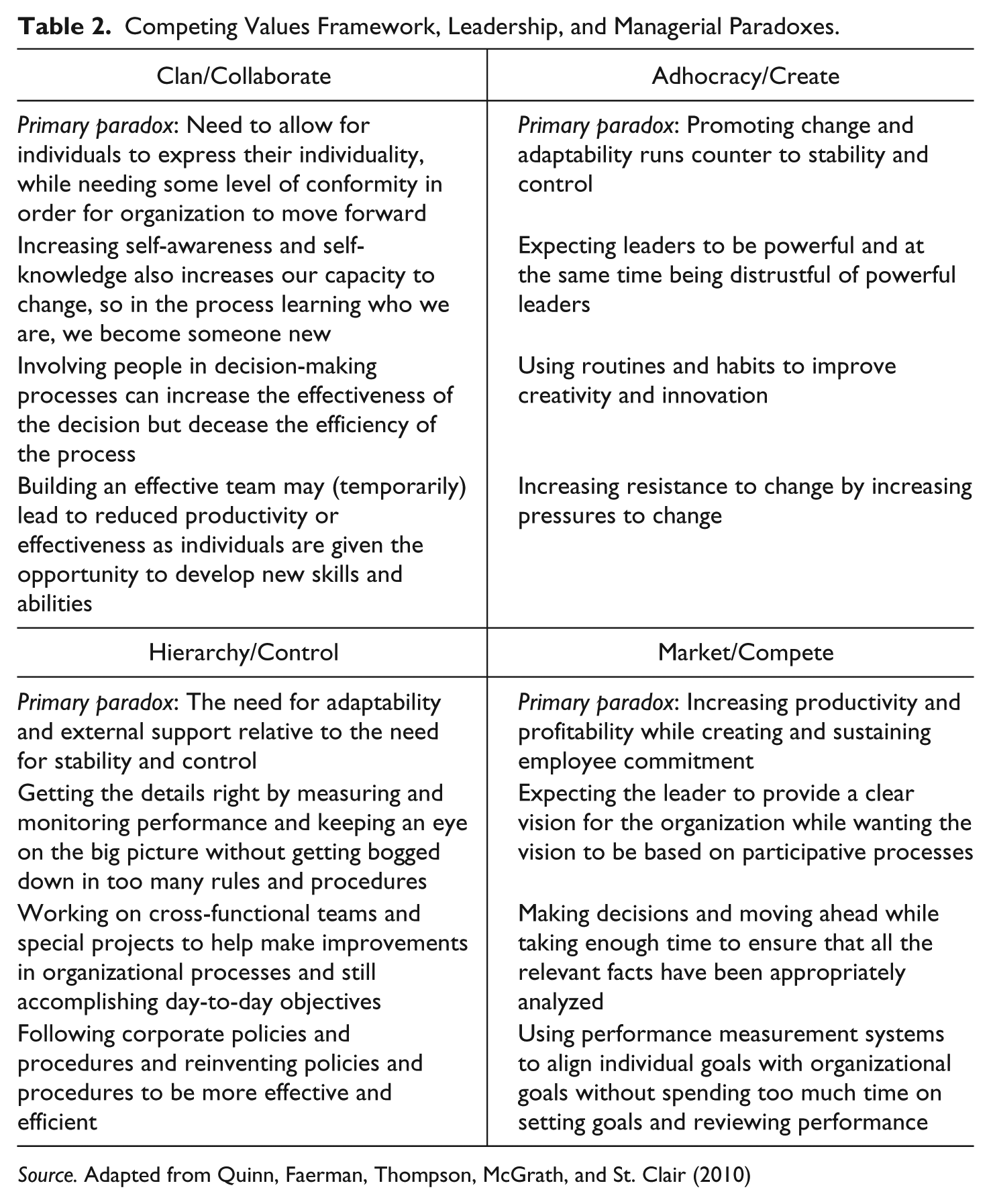
Source. Adapted from Quinn, Faerman, Thompson, McGrath, and St. Clair (2010)
This may seem like a simple “figure-ground” distinction where a degree of demarcation is needed for a phenomenon to be made visible. Yet Lewis (2000), citing Hatch and Ehrlich (1993), notes that “a key challenge when exploring paradox is locating and bracketing the phenomena” (p. 771). Therefore “building constructs that accommodate contradictions” (p. 773) is essential to conceptualizing paradox, and there has been a specific call for tools to aid in the management of paradox (Marsh & Macalpine, 1999). Quinn et al. (2010) acknowledge that a key strength of the CVF is that it is “flexible enough to accommodate change and still provides enough structure to help guide behavior (p. 15).” Similarly, Lewis (2000) posits that the CVF “expands understandings of distinct and mutually exclusive leadership styles, enabling examination of whether highly effective leaders behave more paradoxically than those who are less effective” (p. 773). This suggests that the CVF has the potential to support leadership development and further inquiry into paradoxical leadership
To date, there is mounting empirical evidence that supports the benefits of a paradoxical approach to leadership. Paradoxical frames consistently prime respondents to respond with greater creativity (Miron-Spektor et al., 2011). Paradoxical frames enhance complex thinking and enable people to see more complementary possibilities between opposing sources of tension (Kan & Parry, 2004; Miron-Spektor et al., 2011).
Dennison et al. (1995) contend that the complexity of the CVF allows leaders to “reframe underlying polar opposites such as stability and flexibility” (p. 527) and see leadership role and action as occurring along a much more nuanced continuum. Indeed, the authors empirically establish that “effective managerial leaders exhibit a behavioral structure with greater differentiation and complexity than their less effective counterparts” (p. 535). They use effectiveness evaluation data gathered from subject’s subordinates and supervisors to show that those deemed more effective behaved in accordance with more aspects and dimensions of the CVF. This holds promise that the range of actions, skills, and behaviors described by the CVF enable a broader repertoire of action that is, in fact, more skillful.
Conclusions
In the preceding pages, a vision of paradoxical leadership is developed that draws from increased scholarly attention to leader flexibility and various forms of complexity. The CVF provides a means to foster leadership development from a paradoxical perspective. The CVF encourages and enables behavioral and cognitive complexity and heightens awareness of dynamic tensions as they relate to leadership and managerial skill. The CVF also provides a means to make paradox more visible and manageable. Although the relationship between the CVF and paradox has always been evident, this article deepens exploration of the role that the CVF can play in fostering paradoxical leadership.
Implications for Practice
Each of the central points in this article are intended to guide practice. They strengthen a vision of paradoxical leadership and then provide a means via the CVF to deepen leadership practice that is more informed by paradox. Leadership practice can become even more effective were it to cultivate greater awareness of paradox and dynamic tension, and promote greater cognitive and behavioral complexity. The CVF provides a context to carry them out. Even those who have prior familiarity with the CVF should gain an enhanced sense through this article of how the CVF promotes not just leadership development generally but a more paradox-informed approach specifically.
Further Directions
I offer two sets of thoughts about further directions here. First, I offer a brief consideration of how the CVF might aid the further study and dissemination of a paradoxical perspective on leadership. Second, I offer consideration of dynamics of paradoxical leadership that could inform future exploration.
The CVF is widely used to guide practice and as a teaching tool. So it represents one concrete means to transmit and work with the concept of paradox. Thus the framework can be a useful tool for further the study and dissemination of a paradox perspective. Wisdom about how to attend to such tensions simultaneously and skillfully is an important leadership capacity. The ability to apply paradox can be developed through the CVF and then transferred to all manner of paradoxical realities. Furthermore, the CVF affords a useful source of empirical data to advance thinking about paradox especially given its wide use. The CVF isolates, and therefore sharpens, views of paradox to a relatively specific, recurring set of paradoxical tensions enshrined in the CVF (Lewis, 2000). The CVF and the paradoxical, competing tensions around which it is built have the potential to strengthen the scholarship and practice of leadership development, organizational change, and the role of paradox in organizational life. Ideally, this article aids in that effort.
Additionally, multiple scholarly explorations of paradox offer tripartite distinctions involving the management of paradox. I build on these by suggesting that the dynamics of awareness, exploration, and interpretation may aid the exploration of paradoxical leadership.
Lewis (2000) writes about acceptance, confrontation, and transcendence as it relates to paradox. During acceptance, parties acknowledge and learn to live with paradoxical tension. Confrontation represents an effort to mitigate paradoxical tensions by using reflection, critique, and even humor to reduce a sense of paralysis that can accompany paradoxical tension. Transcendence occurs with deeper second-order thinking (Argyris & Schon, 1978, 1996) where greater possibilities and perhaps complementary options can be seen within paradoxical tensions. In mild contrast, Smith et al. (2012) write of accepting, differentiating, and integrating. Accepting matches the approach of Lewis (2000). Smith et al. (2012) note that acceptance involves seeing both sides of a paradoxical dilemma as possible (Bartunek, 1988; Lewis, 2000; Luscher et al., 2008) and identifying expanded possibilities using a technique known as an abundance approach (Cameron et al., 2006). Differentiation involves trying to see both value and distinction between both sides of a paradoxical dilemma or tension. Integration involves trying to identify synergy or a learning stance based on trust, openness, and cultural sensitivity.
Inspired by these examples, I offer a tripartite distinction intended as a further direction that may hold particular use for viewing leadership and leadership development from a paradoxical perspective. Future exploration of paradoxical leadership may do well to consider the dynamics of awareness, exploration, and interpretation.
Awareness is inspired by Eisenhardt (2000), who notes that “paradox is neither a compromise nor a split between competing tensions but is, rather, an awareness of both (p. 704).”Awareness connotes a sense of equanimity or neutrality toward paradoxical tensions. It follows the observation by Kan and Parry (2004) that identifying paradoxes may not comprehensively satisfy organizational change but often has a significant impact. It is essential to identify or become aware of paradox. Although awareness may lead to acceptance, it allows that a broad range of possible responses may ensue including resistance and reframing.
Exploration builds on the distinction offered by Lewis (2000) that “paradox management involves exploring rather than suppressing tensions” (p. 764). Exploration implies that a range of possibilities, approaches, and stances may be explored relative to any given tension. This expansive quality also implies efforts to move beyond seeing dilemmas and tensions in purely binary terms and use exploration to consider more expansive reframing of dilemmas.
Interpretation, acknowledges that a key aspect of leadership is providing narration, or sense-making and sense-giving (Foldy, Goldman, & Ospina, 2008; Maitlis & Lawrence, 2007; Sharma & Good, 2013; Weick, Sutcliffe, & Obstfeld, 2005) by offering interpretative possibilities to followers. Interpretation bears likeness to political leadership (Ammeter, Douglas, Gardner, Hochwarter, & Ferris., 2002; Smircich & Morgan, 1982) where the core task of leaders is construed as the constructive management of shared meaning.
Although merely provisional, awareness, exploration, and interpretation seem to characterize key tasks of leaders operating from a paradoxical perspective. Thus they may represent ideas on which to build.
In The Age of Paradox, Handy (1994) writes, “Paradoxes are like the weather, something to be lived with, not solved, the worst aspects mitigated, the best enjoyed and used as clues to the way forward” (p. 13). Ideally the insights contained herein contribute to favorable conditions that support leaders to navigate and learn from paradox.
Footnotes
Acknowledgements
The very insightful comments of Kim Cameron are gratefully acknowledged as are those of the editors and two anonymous reviewers.
Declaration of Conflicting Interests
The author declared no potential conflicts of interest with respect to the research, authorship, and/or publication of this article.
Funding
The author received no financial support for the research, authorship, and/or publication of this article.