



Abstract
Despite the increasing interest in emotions at work, there is still a need for more research that focus on the antecedents of emotions in organizational change contexts. Moreover, literature on the subject considers leadership and trust to be fundamental when dealing with change processes. Taking into account both ideas, it is proposed here that authentic leadership (AL) perception can influence followers’ trust and emotions during change. To test these hypotheses, we gathered and analyzed the experience of 102 Spanish human resource managers using structural equation modeling based on partial least squares. Findings show that AL is directly and positively related to followers’ trust in the leader and the experience of positive emotions. Furthermore, we found that trust mediates the relation between AL perception and the experience of negative emotions. Based on these findings, some practical implications are proposed, such as the implementation of training initiatives in order to provide human resource managers with a better understanding of the AL concept and facilitate different actions that could be carried out by them so as to contribute to trust building.
Introduction
Change has become an increasingly common context in organizations (Kiefer, 2005). Acknowledging this managerial concern, researchers have long tried to find the key success factors in change processes. One overarching conclusion has been that the reactions of change recipients are an important determinant of success and failure in implementing change. Much of this research has, until recently, taken on a cognitive and/or behavioral perspective in which emotions have been considered an obstruction (Kiefer, 2002). However, new integrative alternatives are arising to fill the gaps left by cognitive theories. It is now thought that emotions guide people in adapting to new environments; they are thus a vital part of change and do not always have negative consequences as used to be thought (Kiefer, 2002). Several proposals, such as affective events theory (Weiss & Cropanzano, 1996) or informational theories (Forgas, 1995, 2002), posit that people not only engage in behavior rooted in conscious thinking and deliberation but also in more spontaneous, emotion-based behavior, especially in uncertain and ambiguous contexts (e.g., organizational changes) or when they lack sufficient interest, motivation, or resources to create a more elaborate response (Bartunek, Balogun, & Do, 2011; Forgas, 1995, 2002; Weiss & Cropanzano, 1996).
Interest in emotions in the organizational context has been intense and increasingly popular. However, many theoretical and methodological opportunities remain (Brief & Weiss, 2002). In particular, research has focused more on the consequences of emotions than on explaining how and why they occur and how they can be explained (Giæver, 2009b). Thus, it is proposed that more research is needed on antecedents of emotions during organizational change to understand better the factors underlying successful change implementation (Lines, Sáenz, & Aramburu, 2010). And this is exactly what this investigation attempts to do.
In addition to emotions, leadership style and level of trust in the leader are considered fundamental elements for the success of change processes, and have also been thought to influence emotions. On the one hand, few articles have tried to demonstrate the general belief that leaders’ behavior is a fundamental source of employees’ emotions at work. In terms of our interest in a relatively new leadership style, there has been a smaller amount of research in the form of authentic leadership (AL). And there are even fewer studies if we focus on organizational change contexts. On the other hand, trust is considered an important element in the effectiveness of leadership; however, the role of trust and emotions in leading and following is still underresearched. Therefore, questions concerning whether and how authentic leaders may influence followers’ emotions, how they can build trust in the leader, or whether trust plays any role in the relationship between leaders’ behavior and followers’ emotions remain unanswered.
Regarding the role of human resource managers (HRMs) in organizational changes, this has also been examined from different perspectives giving rise to multiple proposals (e.g., Alfes, Truss, & Gill, 2010; Caldwell, 2001; Ulrich, 1997). But there is still a lack of research into the role of HRMs’ emotions in change processes. Moreover, there are no studies that focus on an analysis of the influence of the leadership style (in particular, AL) on HRMs’ emotions.
The present study addresses the aforementioned gaps in literature on leadership and emotions (i.e., lack of studies about the antecedents of emotions during organizational change, and about whether and how authentic leaders may influence followers’ emotions, how they can build trust in the leader, or whether trust plays any role in the relationship between leaders’ behavior and followers’ emotions), by examining why AL behavior matters, and how it may influence followers’ level of trust in the leader and emotions during organizational change processes. In concrete terms, this empirical study will be centered on HRMs and the AL behavior of their direct leaders. Direct leaders’ leadership attributes will be considered that trigger events of HRMs’ emotional reactions, based mainly on an appraisal theories of emotions. In particular, their perceptions of their direct leaders’ AL behavior and level of trust in their leaders will be analyzed as antecedents of HRMs’ positive and negative emotions during organizational change processes. To the best of our knowledge, this is the first attempt to explore the relation between followers’ AL perception, trust, and emotions in organizational change contexts.
Theoretical Background and Hypotheses
Emotions During Organizational Change
No definitive definition of emotion has yet been achieved, although emotions are intuitively well understood (Weiss & Cropanzano, 1996). Emotions are usually classified as positive or negative according to their valence. Positive emotions are the result of a favorable appraisal of an event related to the achievement of one’s own goals (e.g., happiness, pride, relief, hope). Conversely, negative emotions result from the negative appraisal of an event related to the realization of goals (e.g., anger, disappointment, frustration, rage; Bisquerra, 2009).
Emotions are expected to surface more frequently and more intensely during change processes than in nonchange situations (Kiefer, 2002). Organizational changes, defined for the purpose of this investigation as the process by which organizations move from their present state to some desired future state in order to foster the achievement of one or more organizational objectives, are laden with emotions because of the increased likelihood of experiencing challenging and potentially threatening issues (Kiefer, 2005) due to the uncertainty inherent in change contexts. Organizational changes are a context of uncertainty for all involved, especially in the beginning, mainly because of the lack of reliable information about the situation, and the difficulty in predicting every outcome of each change-related decision. This often makes employees feel vulnerable and insecure. Hence, organizational change seems to be an appropriate context for understanding emotions at work.
The number of articles that study emotions in organizational change contexts has increased in the past few years. Using different goals, methodologies, and theories, these articles aim to contribute to a better understanding of the field. Some authors narrow their research down to negative emotions (e.g., Fugate, Kinicki, & Scheck, 2002; Giæver & Hellesø, 2010; Kiefer, 2005), while others prefer to take a positive perspective (e.g., Avey, Wernsing, & Luthans, 2008). Qualitative techniques, mostly case studies, have been popular (e.g., Balogun, Bartunek, & Do, 2010; Bartunek et al., 2011; Bartunek, Rousseau, Rudolph, & Depalma, 2006; Giæver, 2009a; Giæver & Hellesø, 2010; Huy, 2002,2005; Kiefer, 2002; Smollan & Sayers, 2009; Smollan, Sayers, & Matheny, 2010; Stam & Stanton, 2010; Turnbull, 2002; Vince, 2006). However, quantitative studies are also present in literature (e.g., Avey et al., 2008; Lines et al., 2010; Lines, Sáenz, Aramburu, & Rivera, 2009; Seo, Taylor, & Hill, 2007). Some articles are mainly interested in managers’ emotions (e.g., Balogun et al., 2010; Huy, 2002; Kiefer, 2002; Mossholder, Settoon, Armenakis, & Harris, 2000; Vince, 2006) and others in the relation between emotion and time (e.g., Fugate et al., 2002; Giæver, 2009a; Smollan et al., 2010). Finally, some authors aim to build new theories by integrating different perspectives, such as psychodynamics (e.g., Carr, 2001) or psychoanalytics (e.g., Antonacopoulou & Gabriel, 2001), offering new approaches (e.g., Balogun et al., 2010; Kiefer, 2002; Liu & Perrewé, 2005), creating new concepts such as emotional balancing (Huy, 2002), or new theories such as the multilevel theory of emotion and change (Huy, 1999).
What many of these investigations have in common is that they are grounded on appraisal theories of emotions (e.g., Fugate, Kinicki, & Prussia, 2008; Giæver, 2009a; Giæver & Hellesø, 2010; Huy, 2005; Kiefer, 2005; Liu & Perrewé, 2005), especially those that analyze the antecedents and consequences of emotions (e.g., Avey et al., 2008; Bartunek et al., 2006; Fugate et al., 2008; Huy, 2005; Kiefer, 2005; Lines et al., 2009; Lines et al., 2010; Seo et al., 2007; Smollan, 2006; Stam & Stanton, 2010; Szabla, 2007). Affective events theory has emerged as the main theoretical focus for these studies (Weiss & Cropanzano, 1996).
Affective events have been described in the work context as incidents, the consequences of the interaction between employees and their working environment that stimulates the individual assessment processes, triggering an emotional experience (Basch & Fisher, 2000; Bisquerra, 2009). For example, when a person is excited about a recent promotion, the promotion would be the work event that triggers the emotion of excitement.
Research into work events as elicitors of emotions during change is not very common in the literature. Three categories of events can trigger negative emotions during change: issues relating to working conditions, issues relating to personal status, and organizational issues (e.g., acts of management and the values and fairness of the organization; Kiefer, 2005). The present research would fall into Kiefer’s “organizational issues” category, as HRMs report their leaders’ behavior during a change process. In the same category, change agents’ actions and managers’ transformational leadership behavior have been demonstrated to be antecedents of emotions during change in Huy’s (2005) and Seo et al.’s (2007) research, respectively.
We decided to focus on the direct leader because, as the closest manager this is the one with whom workers spend more time; hence, this is the manager who most frequently and most intensely influences them.
The Influence of Authentic Leadership Perception on Emotions
Luthans and Avolio (2003) introduced the idea of AL development to offer a more positive way of conceptualizing leadership development (Avolio, Walumbwa, & Weber, 2009). Later, Avolio, Gardner, Walumbwa, Luthans, and May (2004) provided some of the initial foundations for a broader theoretical framework of how authentic leaders influence follower’s attitudes, behavior, and performance. This article, together with a special issue of the Leadership Quarterly, published in June 2005, and the book Authentic Leadership Theory and Practice: Origins, Effects and Development (Gardner, Avolio, & Walumbwa, 2005), became the foundation for exploring AL and related concepts (Avolio, 2010).
Walumbwa, Avolio, Gardner, Wernsing, and Peterson (2008) defined AL as follows: A pattern of leader behavior that draws upon and promotes both positive psychological capacities and a positive ethical climate, to foster greater self-awareness, an internalized moral perspective, balanced processing of information, and relational transparency on the part of leaders working with followers, fostering positive self-development. (p. 94)
This definition reflects the four underlying dimensions of the construct of AL (i.e., balanced processing, internalized moral perspective, relational transparency, and self-awareness) that have been generally accepted following its empirical validation (Walumbwa et al., 2008).
According to Gooty, Connelly, Griffith, and Gupta’s (2010) literature review on leadership, affects and emotions are deeply intertwined with the process of leading, leader′s outcomes, and follower′s outcomes. In fact, Avolio et al. (2004) presented a framework in which they suggested that emotions could be a key variable in explaining the process by which authentic leaders influence followers’ outcomes.
When trying to understand how and why emotions arise, most researchers base their proposals on Lazarus’s (1991) appraisal theory of emotions, as did Weiss and Cropanzano (1996) in developing affective events theory, a theory of emotions at work. The appraisal theory of emotions considers these to be specific reactions to events, indicating the importance of the episode to the individual. However, the stimulus that activates the appraisal process does not need literally to be an event; it can also be a stable feature that is salient (Elfenbein, 2007). As previously mentioned, events related to interactions with coworkers, customers, and supervisors are among those that have the greatest emotional impact on workers, with leaders’ behavior looming particularly large (Elfenbein, 2007). Therefore, leaders’ behavior can be the event that activates the appraisal process, giving rise to emotional experiences.
AL is a complex leadership style that involves the enactment of several distinct types of behavior that together constitute an internally consistent gestalt. At the basic level, however, it can be contrasted with an autocratic, command-and-control style by which leaders solicit little input from their followers and show little concern for followers’ well-being, focusing exclusively on organizational-level objectives without regard for how decisions affect those working in the organization. Autocratic leadership based on control-and-command has been related to negative feelings of uncertainty, anxiety, vulnerability, and general discomfort, because followers, when faced with such leadership behaviors, perceive such high levels of risk that the leader can exploit the power dependence asymmetry in ways that are harmful to followers (Konovsky, 2000; Lind, Kulik, Ambrose, & De Vera Park, 1993). The behavior of authentic leaders, in contrast, may eliminate some of the processes underlying these negative emotions. By soliciting information from a wide variety of sources, prior to making a decision, followers might perceive that their interests are being considered more fully and are being partly used as criteria for making change-relevant decisions regarding the content of change, as well as the timing and attributes of the change process itself. This should elicit perceptions of decision control (Thibaut & Walker, 1975), which in turn would be less colored by negative emotions than processes where followers experience little or no control over the decision process. Research on procedural fairness suggests that this effect might be present even in situations where followers’ interests do not have an impact on final decisions (Konovsky, 2000). The mere experience that one’s views and interests are being considered might elicit positive emotions and lower the likelihood of negative emotions being experienced. The authentic leaders’ internalized moral perspective, when observed by followers, might also affect emotions felt during the change process. Research into behavioral integrity shows that followers routinely observe and assess the consistency of leaders’ behavior over time, and the correspondence between what leaders say and what they do. Leaders with an internal moral perspective are more likely to be perceived as honest and trustworthy because, regardless of external pressures, they will attempt to behave in accordance with their internal moral principles and values. In cases where external pressures are too strong, they might exhibit relational transparency and justify their decisions openly to followers by explaining why they have to behave in a seemingly inconsistent way due to these pressures. The provision of well-grounded and convincing justification for behavior has previously been shown to alleviate negative reactions, even when the consequences of decisions are harmful to the recipients (Brockner et al., 1994). By extension, we expect leaders who exhibit an internalized moral perspective underlying their behavior to elicit more positive and less negative emotions in their followers.
Considering the aforementioned, we propose the following hypotheses:
The Influence of Trust on Emotions
Rousseau, Sitkin, Burt, and Camerer (1998) defined trust broadly as “a psychological state comprising the intention to accept vulnerability based upon positive expectations of the intentions or behavior of another” (p. 395). This definition has been adopted by many authors, such as Dirks and Ferrin (2001, 2002), Gillespie (2003), Lines, Selart, Espedal, and Johansen (2005), Søresen and Hasle (2009), Kelloway, Turner, Barling, and Loughlin (2013), and Zhu, Newman, Miao, and Hooke (2013). It will be used in this study.
Trust in the leader is considered a relevant factor for the successful implementation of organizational changes (Oreg, 2006; Søresen & Hasle, 2009; Zhu, May, & Avolio, 2004) because it is considered crucial for getting individuals to work toward a common goal (Dirks, 2000), especially under high levels of perceived uncertainty. Moreover, trust in the leader is also considered a fundamental element in the effectiveness of leadership (Bass, 1990). This idea is supported by Dirks and Ferrin’s (2001, 2002) meta-analysis, in which they found that leadership style can increase trust in the leader, which is in turn associated with attitudes, perceptions, and important organizational outcomes such as organizational citizenship behavior, job performance, job satisfaction, organizational commitment, or intention to quit. Based also on past research into trust, Schoorman, Mayer, and Davis (2007) considered the study of the relationship between trust and emotions, a very interesting area of research. In response to this call, Ballinger, Schoorman, and Lehman (2009) demonstrated that work group members’ affective reactions to the departure of a leader were partly based on the quality of the relationship they had with the leader. These affective reactions influenced group members’ trust judgments of the new leader, unless they had access to previously formed judgments about the leader’s ability. Yet the role of trust and emotions in leading and following is underresearched (Gooty et al., 2010).
A leader’s trustworthiness is based on followers’ expectations about the leader’s future behavior, more specifically that the leader will not behave in ways that threaten followers’ interests (Rousseau et al., 1998). These expectations, in turn, are based on information from past experiences regarding the leader’s fundamental attributes of ability, integrity, and benevolence. The trust construct, however, is also forward looking in the sense that highly trusted leaders are expected to behave competently, with integrity, and in ways that do not harm followers’ interests in future situations. In a change context that is characterized by high levels of outcome uncertainty and ambiguity, trust is likely to be at the forefront of followers’ concerns, and may act as a core determinant of how change recipients react emotionally. Because highly trusted leaders are considered to be follower oriented and expected to take into account how followers are affected by change(s), they are unlikely to make decisions that threaten important values held by followers. As value relevance is a core determinant of the appraisal process underlying emotional reactions (Lazarus, 1991), we expect that this perceived benevolence of trusted leaders makes them better able to avoid producing negative emotions and to foster the experience of positive emotions during change. The expectation of leader integrity inherent in trust will further reduce the likelihood of experiencing negative emotions and foster the experience of positive emotions.
Moreover, mere interaction with a trusted leader can engender positive emotions unmediated by cognitive considerations like those outlined above. In the presence of trusted individuals, people tend to experience feelings of interpersonal warmth, calm, and hope (Jones & George, 1998). Most likely, these emotional reactions are mediated by the low levels of threat experienced when a person is in contact with highly trusted individuals. The experience of threat and the absence of threat are fundamental for our understanding of emotional processes and the ecological function of human emotions (Lazarus, 1991). In contrast, in the presence of distrusted persons, feelings of anxiety are likely to emerge, especially when individuals are highly dependent on the person being distrusted, as is often the case in leader–follower relationships. Hence, we propose:
The Mediating Role of Trust
Leaders can gain or lose followers’ trust depending on their behavior during change. Leaders who do not show consistency between words and actions, or who frequently lie, will hardly be trusted by their employees. On the contrary, authentic leaders are expected to build trust in their followers via their supporting behavior. Transparency is a main characteristic of authentic leaders and it is also considered central for building trust. That is why it is proposed that AL relational transparency can build followers’ trust in the leader (Avolio & Wernsing, 2008; Clapp-Smith, Vogelgesang, & Avey, 2009; Norman, Avolio, & Luthans, 2010; Walumbwa et al., 2008; Wong & Cummings, 2009; Wong, Laschinger, & Cummings, 2010). Leaders who are self-aware, whose values are based on high moral principles, and who act on their values, have less reason for not openly sharing information and expressing their true thoughts and feelings to followers (Avolio & Wernsing, 2008). Authentic leaders are transparent and congruent in their beliefs, words, and actions; they are honest and show concern for employees; they have high ethical standards, integrity, and credibility; and are willing to give and receive feedback. All these characteristics are proposed to help authentic leaders build followers’ trust in them. In fact, it has previously been empirically found that AL influences trust directly at the individual level (Hassan & Ahmed, 2011; Wong & Cummings, 2009; Wong et al., 2010; Zamahani, Ghorbani, & Rezaei, 2011) as well as at the group level (Clapp-Smith et al., 2009), and indirectly at the individual level through personal identification (Wong et al., 2010). Hence, it is proposed:
In their proposed framework, Avolio et al. (2004) posited that identification, trust, and emotions could be the processes by which authentic leaders exert their influence on followers’ attitudes and behavior. Since then, the relationship between AL, trust in the leader, and various followers’ attitudes and behavior has been successfully researched (Peus, Wesche, Streicher, Braun, & Frey, 2012). It has been empirically confirmed, for example, that trust mediates the relationship between AL and performance (Clapp-Smith et al., 2009), voice behavior (Wong & Cummings, 2009), and work engagement (Hassan & Ahmed, 2011; Wong et al., 2010). These results imply that trust might also mediate the relation between AL and followers’ emotions. In fact, Avolio et al. (2004) suggested there could also be a relation between AL, trust, and positive emotions, although they did not present an explicit hypothesis. According to Clapp-Smith et al. (2009) “followers may be more willing to place trust in the leader’s future actions because they can use past experiences to predict future responses” (p. 232). In other words, authentic leaders make employees feel more comfortable and secure about the leader’s future behavior. Positive past behavior provides behavior predictability, which “seems to be a particularly relevant facet of trust in the examination of its relation with authentic leadership” (Peus et al., 2012, p. 335). Moreover, trust enables followers to perceive the leader’s actions as genuine (Zhu et al., 2013). In this way, trust helps followers judge the leader in a favorable light, favoring in turn the experience of more positive emotions and less negative emotions. As authentic leaders are expected to behave in a manner perceived as trustworthy, followers are expected to demonstrate more positive emotions and less negative emotions. Therefore, we propose:
Figure 1 represents the conceptual model being tested.

Representation of the conceptual model.
Research Method
Sample Framing and Data Collection
A multiorganizational approach for data gathering was chosen because we decided to focus our attention on various HRMs’ experience during organizational changes. The research focused on Spanish companies with more than 50 employees, and to identify these companies, the database SABI was used. 1
The information-gathering process went on from February to December 2012. HRMs were first contacted by telephone, and afterward further information and access to the questionnaire was sent by e-mail. In this call, the purpose of the research was explained, participation in the study solicited and a report with the results offered as a compensation for their effort. Afterward, further information about the research and access to the questionnaire was sent by e-mail. This process resulted in 146 answers (which means a response rate of 4.3%) but only 102 (70%) of these were usable. The reason for most of the rejections was that the change implementation process was not finished at the time the questionnaire was filled in, although it was emphasized several times that it was essential to respond concerning a recent but already finished organizational change.
Regarding the response rate, this is quite low. The main reason for this is that many companies were reluctant to participate in the survey due to the difficult times they were experiencing. The survey was done in the middle of the “storm” for many Spanish firms due to the dramatic impact of the economic crisis in Spain. As a consequence of the major survival challenges many companies had to envisage at that moment, they adopted a very conservative position and did not want to participate in any type of survey. The research was done in a very difficult context. Nevertheless, and in spite of the difficulties, it was ultimately possible to obtain a sufficient sample of firms.
According to the nature of the change in which the answers were based, 38.2% of the respondents referred to departmental reorganizations, 24.5% to a change in the strategic orientation of the organization, 12.8% to company mergers, 9.8% to important modifications of processes, 4.9% to the introduction in new markets, 3.9% to the introduction of a new business line, 1% to technological changes, and 4.9% to other kinds of changes such as the management team.
Constructs and Measures
AL perception is the exogenous construct of the model. It is a second-order construct as it comprises four first-order constructs (i.e., balanced processing, internalized moral perspective, relational transparency, and self-awareness). The specific measures used have been obtained from the Authentic Leadership Questionnaire developed by Avolio, Gardner, & Walumbwa (2007). This questionnaire captures a person’s degree of AL behavior, which in our case is the HRMs’ perception of their direct leader’s AL behavior. HRMs were asked how frequently each of the statements provided fitted their direct leaders’ leadership style during the change process.
Trust in the leader is the first endogenous construct of the model. It refers to the extent to which the HRM is willing to be vulnerable (i.e., voluntarily take risk) at the hands of his or her direct leader. Trust was measured by six items based on Schoorman and Ballinger’s (2006) proposal, which was possibly the most promising measure of trust to date, according to Schoorman et al. (2007).
Finally, positive and negative emotions are the second group of endogenous constructs in this research. Fiebig and Kramer’s (1998) research presented a list of positive and negative emotions that respondents reported feeling as a reaction to organizational incidents. Based primarily on this research, the positive emotions construct was measured by 7 items, whereas negative emotions were measured by 10 items.
The concrete constructs, codes, and measures used in this research can be found in Appendix A. All the indicators were measured using a 5-point Likert-type scale and the nature of all the constructs in the model is reflective. In a construct with reflective indicators, these reflect the construct, which is the origin or cause of the indicators. In other words, the construct precedes the indicators in a causal sense. Reflective indicators are determined by the construct; therefore, if the level of the construct changes, the indicators covary at the same level and in the same direction (Chin, 1998; Chin & Gopal, 1995).
Multivariate Analysis
Structural equation modeling (SEM) based on partial least squares (PLS) is used to test the hypotheses of the research due to the characteristics of the model and sample. In comparison with the covariance-based approach (an alternative SEM approach), PLS avoids two important problems: those related to nonunique or otherwise improper solutions (Fornell & Bookstein, 1982) and those related to the use of small data samples (Fornell, 1982). Thus, PLS can be a powerful analysis method due to its minimum requirements in terms of variable measurement scales, sample size, and residual distribution (Chin, Marcolin, & Newsted, 2003).
The sample size obtained is large enough to perform a statistical study based on a PLS approach to SEM by means of PLS-Graph software (Chin et al., 2003; Chin & Frye, 2003). Since all the constructs of the model are reflective in nature, the largest number of antecedent constructs leading to an endogenous construct in the structural model will determine the minimum sample size required—in our case, 50 responses for the first-order model and 20 for the second-order model.
PLS analysis consists of two consecutive stages, although measurement and structural parameters are concomitantly estimated (Barclay, Higgins, & Thompson, 1995). First, the measurement model must be evaluated to assess its validity (i.e., that it really measures what we want to measure) and reliability (i.e., that it does so in a stable, consistent way). This will guarantee that the theoretical concepts are properly measured by the variables observed. Afterward, structural model evaluation can take place in order to analyze the weight and extent of relations between constructs and to test the research hypotheses.
Results
Measurement Model Evaluation
Since AL perception is a second-order construct, it is necessary to create a first-order model and make all the basic checks (in the case of reflective constructs, individual item reliability, construct reliability, convergent validity, and discriminant validity have to be tested). In all cases, the results of the first-order model are satisfactory (results of the first-order measurement model evaluation in Appendix B).
As far as individual item reliability is concerned, a rule of thumb is to accept items with loadings of 0.707 or more, which implies more shared variance between the construct and its measures than error variance (Barclay et al., 1995; Carmines & Zeller, 1979). As can be seen in Appendix B, Part I, indicator loadings are greater than 0.707, with three exceptions: TRUST6 (loading: 0.6815), POSEMO1 (positive emotions; loading: 0.6690), and NEGEMO3 (negative emotions; loading: 0.6256). According to Barclay et al. (1995), loadings above 0.5 and 0.6 are also acceptable in early stages of scale development as is the case for this construct. Thus, all the indicators proposed have been retained in the research.
Construct reliability or internal consistency refers to the extent to which all the indicators of a specific construct measure the same latent variable. If this were to be true, all the indicators making up the construct should be highly correlated. For this to be tested, composite reliability (ρc) has been calculated. According to Nunnally (1978), a value of 0.70 constitutes a benchmark for modest reliability in early stages of research, whereas later on, values higher than 0.80 would be preferable. As can be observed in Appendix B, Part I, all constructs of the research have a composite reliability over 0.8. Hence, internal consistency is adequate.
Convergent validity is assessed by means of the so-called average variance extracted (AVE). This measure was created by Fornell and Larcker in 1981, and it provides the amount of variance that a latent variable captures from its indicators, relative to the amount due to measurement error. It is recommended that AVE should be greater than 0.50, this meaning that 50% or more of the variance of the construct is due to its own indicators. As can be seen in Appendix B, Part I, this is the case in all constructs of the research.
Finally, discriminant validity indicates the extent to which a given construct is different from other constructs (i.e., the extent to which the constructs making up the research model really measure different things). For this to be true, a construct should share more variance with its measures than it shares with other constructs of the model (Fornell & Larcker, 1981). In other words, AVE should be greater than the variance shared between the construct and other constructs (i.e., the squared correlation between two constructs). Once the correlation matrix is obtained, it is easier to calculate the root value of AVE for each construct (this would be the diagonal of the correlation matrix) and to compare it with the correlations obtained. For adequate discriminant validity, the diagonal elements (i.e., the root values of AVE) should be greater than the off-diagonal elements in the corresponding rows and columns. This is exactly the case in our research (see Appendix B, Part II).
Once the first-order measurement model has been checked, the same has to be done for the second-order model. Therefore, the second-order model was created and the measurement model evaluated. Following the same criteria as before, we satisfactorily checked individual item reliability, construct reliability, convergent validity, and discriminant validity (results of the second-order measurement model evaluation in Appendix C).
In particular, and as far as item reliability is concerned, loadings are higher than 0.707 in all cases, with the exception of three indicators: TRUST6 (loading: 0.6803), POSEMO1 (loading: 0.6548), and NEGEMO3 (loading: 0.6189; see Appendix C, Part I). As stated earlier, and according to Barclay et al. (1995), loadings above 0.5 and 0.6 are also acceptable in early stages of scale development as is the case for this construct. Thus, all the indicators proposed have been retained.
With regard to construct reliability, composite reliability (ρc) is above 0.8 in all cases. And for convergent validity, AVE is higher than 0.5 in all cases. Therefore, both tests are satisfactory (see Appendix C, Part I). Finally, and regarding discriminant validity, this test is also acceptable (i.e., diagonal elements in the correlation matrix are larger than off-diagonal elements in the corresponding rows and columns; see Appendix C, Part II).
Structural Model Evaluation
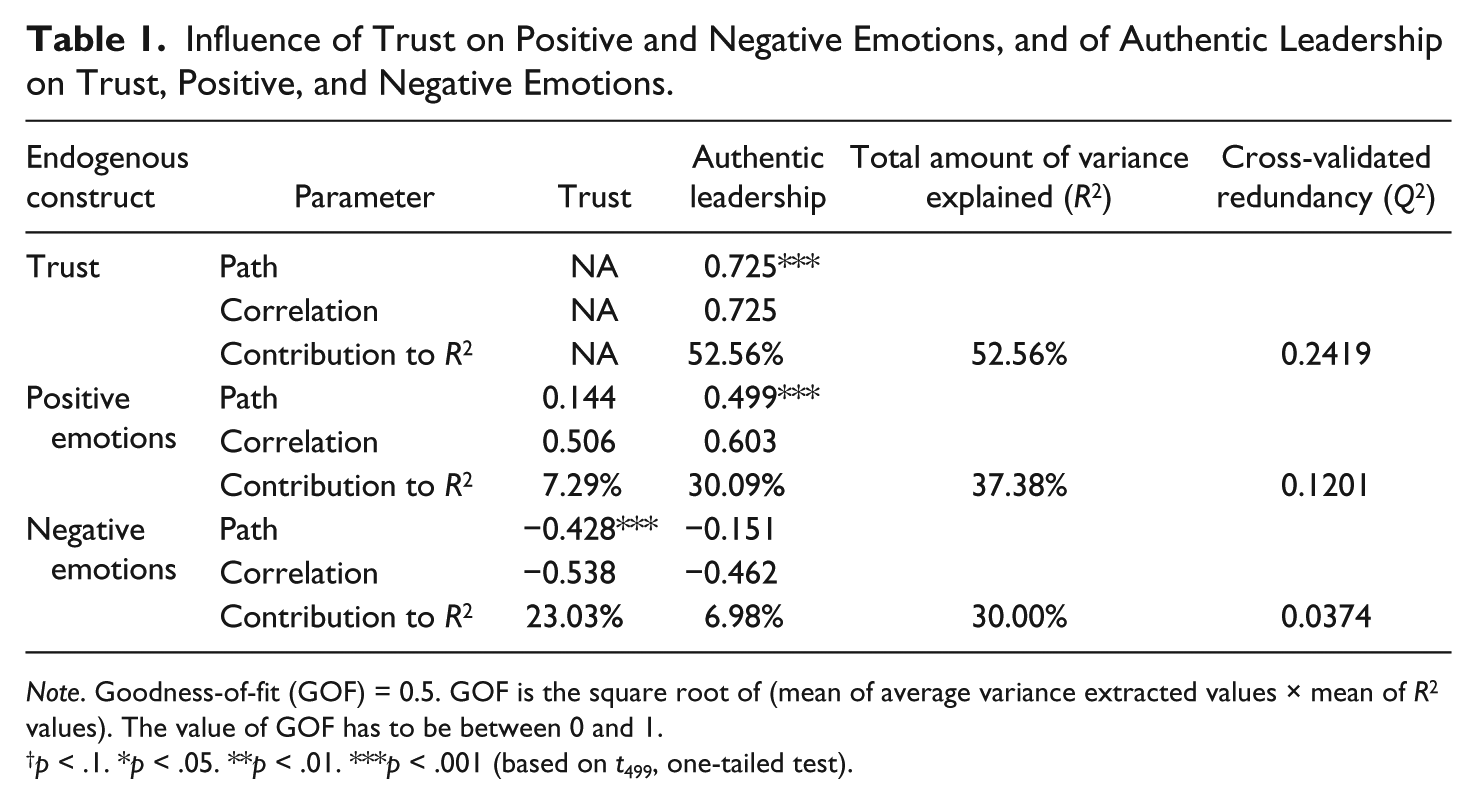
Table 1 shows the results obtained of the evaluation of the structural model, analyzing the strength of the research hypotheses and the predictive capacity of the model.
Influence of Trust on Positive and Negative Emotions, and of Authentic Leadership on Trust, Positive, and Negative Emotions.
Note. Goodness-of-fit (GOF) = 0.5. GOF is the square root of (mean of average variance extracted values × mean of R2 values). The value of GOF has to be between 0 and 1.
p < .1. *p < .05. **p < .01. ***p < .001 (based on t499, one-tailed test).
As predicted, the positive relationship suggested between AL and trust is statistically significant and so, therefore, Hypothesis 3 is accepted. As can be seen, the path coefficient between AL and trust is 0.725 at a confidence level of 99.9% and it explains 52.6% of the variance in trust.
AL is also positively related to positive emotions but not to negative emotions. Therefore, Hypothesis 1a is accepted, while Hypothesis 1b is not. The contribution of AL to the amount of variance in positive emotions explained is slightly above 30% and the path coefficient is 0.499 at a confidence level of 99.9%.
Finally, trust is negatively related to negative emotions, but it does not have any significant impact on positive emotions. Thus, Hypothesis 2b is accepted, while Hypothesis 2a is not. The path coefficient between trust and negative emotions is −0.428 at a confidence level of 99.9% and it explains 23% of the amount of variance in negative emotions.
As can be seen, the predictive capacity of the model is doubly checked. On the one hand, the total amount of variance explained of all three endogenous constructs is above the 10% quality threshold advocated by Falk and Miller (1992) and, on the other hand, cross-validated redundancy measures (calculated by means of a blindfolding process with an omission distance of 7) are above zero, as suggested by the Stone–Geisser test (Geisser, 1975; Stone, 1974).
Summarizing this section, Figure 2 visually represents the results obtained.
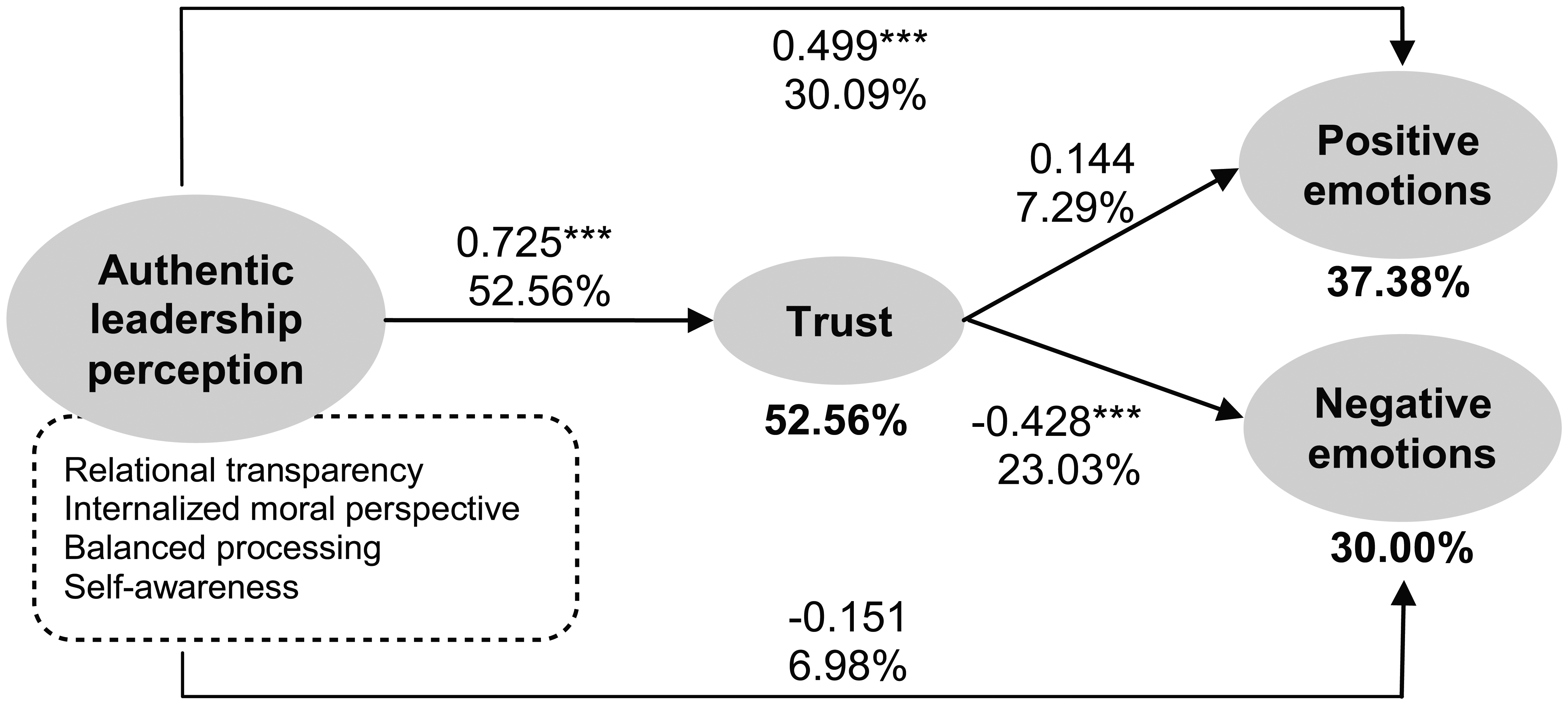
Representation of the results.
Mediation Test
Two different approaches can be used for mediation testing: the traditional approach and the Sobel test. Following the traditional approach, two models have to be run for mediation to be tested. In the first model, the mediator variable should be excluded (trust) and the independent (AL) and dependent (positive and negative emotions) variables should be linked to check that the relations between the exogenous variable and the endogenous variables are significant.
As shown in Table 2, the first condition for mediation to exist is fully satisfied as AL exerts a significant impact on emotions.
Mediation Test—Influence of Authentic Leadership on Positive and Negative Emotions.

p < .1. *p < .05. **p < .01. ***p < .001 (based on t499, one-tailed test).
The second is a model in which all the variables are included. In fact, this is the model analyzed in the previous section (see Table 1). This model is intended to check that the relation between the mediator variable (trust) and the endogenous variable (positive and negative emotions) is significant. The relationship between trust and positive emotions is not statistically significant. Therefore, trust does not mediate the relation between AL and positive emotions, and so Hypothesis 4a cannot be accepted. However, the relation between trust and negative emotions is statistically significant, satisfying the second condition established for mediation to exist.
The third condition for mediation is that the path value (β) of the relation between the exogenous variable (AL) and the endogenous variable (negative emotions) in the complete model should be lower than that in the model without mediators (see Table 2). The association between AL and negative emotions increases from −0.151 in the complete model to −0.464 in the model without mediators. And since the relation between these two constructs in the complete model is nonsignificant, trust fully mediates the relation between AL and negative emotions. Therefore, Hypothesis 4b is accepted.
These mediation results have also been confirmed by means of the Sobel test. As a result of this test, the values of the “z” parameter were compared with a standard normal distribution 2 (Preacher & Hayes, 2004) to establish statistical significance.
In the case of negative emotions, the “z” value is significant. Hence, mediation exists, but it is not significant with regard to positive emotions, and so trust does not mediate the relation between AL perception and positive emotions (zAL-TRUST-POSEMO = 1.169; and zAL-TRUST-NEGEMO = 3.426).
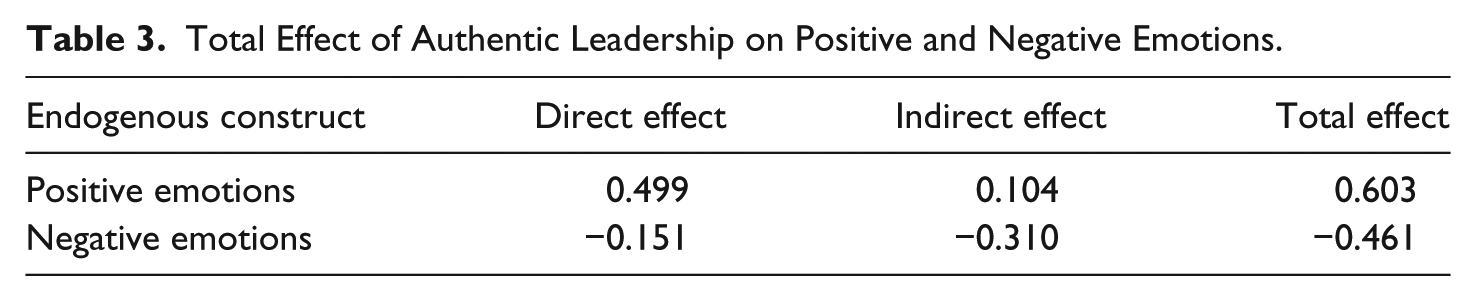
For the final mediation, Table 3 shows the total effect of AL on emotions as a sum of the direct and indirect effects. As can be seen, the effect of AL on positive and negative emotions is quite different. AL has a positive and mainly direct effect on positive emotions, while it has a negative and mainly indirect effect on negative emotions through trust.
Total Effect of Authentic Leadership on Positive and Negative Emotions.
Conclusions, Discussion, and Managerial Implications
This article is a first attempt to explore the relation between AL perception, trust, and followers’ emotions during organizational change. The influence of different leadership styles on trust and emotions has been studied earlier, but to the best of our knowledge no studies have linked followers’ AL perception, trust, and emotions in contexts of organizational change. We proposed, and found, that HRMs’ perception of their direct leaders’ AL behavior is related to the level of trust in the leader and the emotions experienced during organizational change processes.
More specifically, we found that AL perception is tightly linked to HRMs’ trust in their leader. The results indicate that AL behavior is related to followers’ trust in their leader, which is in line with previous results, as indicated by Gardner, Cogliser, Davis, and Dickens (2011). These authors published a literature review on AL on December 31, 2010, in which they indicated that the three articles in the review that empirically studied this relationship supported the positive influence of AL on trust in the leader. Since then, more articles supporting this relation have been published (e.g., Hassan & Ahmed, 2011; Zamahani et al., 2011). However, there is still more theoretical than empirical support for this relation.
Followers’ trust in their organizational leaders has become an important issue (Norman et al., 2010), and managers should be aware of the important consequences their behavior has on employees’ level of trust. If managers lie, if they act unfairly, if they do not keep their word, if their decisions are biased by their own interests or pressures from others and employees know it, they will expect managers to act the same way in the future. This behavior is expected to destroy trust: Employees will not be willing to accept further vulnerability based on positive expectations of the managers’ behavior because they will have no positive expectations. Conversely, since trust is fundamental for the effectiveness of leadership (Bass & Avolio, 1990; Dirks & Ferrin, 2001, 2002) and AL builds trust, managers should be sincere and honest, maintain high moral values, and act objectively when making decisions if they want employees to trust them.
Moreover, we found that AL perception was also significantly and positively related to the experience of positive emotions. Following Lazarus’s (1991) appraisal theory of emotions, the existence of a direct relationship between leaders’ AL behavior and positive emotions reveal the importance that AL behavior has for HRMs. However, it seems that not all AL dimensions have the same influence on positive emotions. Although it was not our primary intention, further analyses showed that internalized moral perspective is the only AL dimension that is significantly related to positive emotions. Therefore, this study reveals that direct boss’ behavior based on his or her core values and congruency with his or her thoughts especially matters to employees, triggering positive emotional reactions. Curiously, it was the lack of ethical conduct of today’s leaders that called for a new, genuine, values-based leadership (Gardner et al., 2011), giving rise to AL. Considering the results, it seems that it is precisely this moral perspective that most influences HRMs’ positive emotions. This fact makes us think that AL could be more tightly linked to followers’ positive emotions than other leadership styles such as charismatic, transformational, or transactional types. Independent research has found positive results relating transactional, transformational, and charismatic leadership to followers’ emotions, especially to positive emotions. However, it would be interesting to compare these relations in a single research to determine if there is any leadership style that can better explain followers’ positive and/or negative emotions.
Additionally, it was found that trust mediates the relation between AL perception and negative emotions. AL behavior seems to be positively related to trust in the leader, which in turn is negatively related to the experience of negative emotions. Conversely, and contrary to predictions, trust does not seem to contribute to an explanation of positive emotions, nor does it mediate the relation between AL and positive emotions. These results point out that the relation between AL, trust, positive emotions, and negative emotions is quite complex and needs further research. An explanation for the results obtained might lie in the consideration of trust as dynamic (Rousseau et al., 1998), which is developed over time, mainly as a response to leaders’ behavior. In addition, as suggested by Gooty et al. (2010), besides cognitive influences, emotions could also influence the level of trust. As the affect-as-information theory (Forgas, 1995, 2002) proposes, positive emotions might be used as information, and therefore help build trust, while negative emotions might destroy it. However, given a concrete time and specific situation (as in the case of the present study), the level of trust that a follower has in the leader might act as a filter to interpret the leader’s behavior, affecting in turn the follower’s emotions. Trust in the leader might help interpret the leader’s behavior in a positive way, even giving the leader the benefit of the doubt when negative behavior (such as injustice or unfairness) are perceived. On the other hand, lack of trust might have negative consequences through a negative interpretation of the leader’s behavior due to suspicion and skepticism. In order to confirm this proposal, new longitudinal research is needed that makes it possible to capture the evolution of trust and the experience of positive and negative emotions as responses to leadership behavior.
The results obtained in this article contribute to theory in different ways. For instance, it helps explain why emotions occur during organizational change processes by reinforcing the affective events theory and enriching the literature on emotions. Moreover, the article shows that leaders’ behavior is a relevant variable to understand employees’ emotions at work and trust building, contributing to the literature on leadership, emotions, and trust. And it also contributes to the literature on trust by demonstrating that trust can be a relevant mediating variable.
Additionally, in light of the results obtained and the discussion presented above, we would like to offer some managerial advice.
First, we consider that, given the benefits of AL, it would be advisable to develop some specific actions promoted by management and addressed to HRMs with the purpose of explaining them the foundations of this leadership style, its importance and benefits, and to help them engage in AL behavior. Among these actions, training programs could be delivered. For instance, a workshop on AL could be organized with the participation of HRMs belonging to different companies.
A very important issue to be taken into account is that internalized moral perspective is the only AL dimension that is significantly related to positive emotions. It means that, in the case of HRMs, their behavior has to be congruent with their own core values and thoughts. Therefore, it would be interesting to focus the training workshop on the exchange of personal experiences of HRMs about different situations where they have acted according to their own values looking for consistency (e.g., a change situation where the HRM said prior to change that he or she would not fire anyone and he or she did not indeed; or a situation where he or she said he or she would listen to people and he or she spoke with everyone). The beneficial outcome of this exchange of consistent behavior evidences the fact that HRMs could understand better what AL means in practice, and also what the implications of looking for consistency for followers are (e.g., increasing their sense of security and confidence that is very positive for the company and the change process).
Furthermore, another practical implication for managers could be related to the construction of trust in the companies they run. As has been demonstrated in this research, trust mediates the relation between AL perception and negative emotions. Therefore, the construction of a culture of trust in the firm arises as a relevant issue. A culture based on trust could help mitigate the emergence of negative emotions, and in this sense, managers should work on trust building. In particular, HRMs could play an important role in this trust construction process, since they occupy a middle position in the hierarchy, acting as “bridges” between top management and the organization’s bottom line, helping to transmit the main corporate values to bottom-line workers. Therefore, HRMs could become the main trust construction agents in the company.
The key question that arises is how to build trust. In this sense, HRMs could undertake different actions: They could provide people in the company with a better understanding of top management thoughts about the change. To do so, they could meet personally with people in order to explain the goals of the change, the reasons for change, and the specific consequences of the change for the person, in particular, the implications of the change for his or her job (e.g., new task requirements, new skills to be acquired for the development of the new tasks, etc.). This conversation would help reduce the fear of change, increasing the sense of confidence of employees and, therefore, contributing to building trust.
Another action that could be carried out by HRMs would be to recognize publicly their own mistakes and take measures addressed to solve the consequences of such errors. This gesture of humility could help increase the sense of confidence of followers who would feel that things could get better, thanks to their bosses. Hence, they could trust them.
Limitations and Future Research Directions
This research makes an interesting contribution, but it is not without important limitations that should be kept in mind when interpreting the results and conclusions. First of all, while the variables used in this study are logically and theoretically ordered with respect to time, it remains a cross-sectional study. This raises important concerns regarding the direction of causality (Lazarus, 2003). Memory bias may inflate the results and the reported relationships may be contaminated by reverse causality, since the answers are a recollection of past events, thoughts, and feelings. Longitudinal research could help address this limitation. Second, the list of positive and negative emotions included in the research is not exhaustive, as other emotions could be experienced during change processes. Therefore, new discrete emotions could be included in future research and the effects of each analyzed. Furthermore, the generalizability of the results is limited due to the characteristics of the sample. This study gathered together the experience of Spanish HRMs during organizational changes, and so therefore, differences in culture, context or organizational position may result in different conclusions. Future research might focus on different targets, cultures, and organizational contexts in order to determine if the results are similar to those obtained here.
Regarding culture and considering that organizations are embedded in societies, the surrounding societal or national culture is an important external influence on organizational culture (Dickson, Aditya, & Chokar, 2000; Hofstede & Peterson, 2000; Sagiv & Schwartz, 2000, 2007; Trice & Beyer, 1993). As a result, organizational cultures tend to develop and evolve in ways that are compatible with the societal culture in which they are embedded (Sagiv & Schwartz, 2007).
According to data gathered by Hofstede, Hofstede, and Minkov (2010), Spain shows important cultural differences regarding other countries. For instance, the differences are noteworthy in some particular cultural features like power distance (i.e., the extent to which the less powerful members of organizations and institutions within a country expect and accept that power is distributed unequally), individualism (i.e., the preference for a loosely knit social framework in which individuals are expected to take care of only themselves and their immediate families), and masculinity (i.e., the preference in society for achievement, heroism, assertiveness, and material rewards for success).
All of these national cultural features could influence the organizational cultures of companies and also people’s emotions. Therefore, it could be interesting to consider culture (national and organizational) as a contextual factor that could moderate the relation between AL, trust, and emotions. Along these lines, comparative studies between companies from different countries could also be carried out in the future, with the aim of discovering whether there are significant differences in the aforementioned relation due to the influence of national cultural features.
A final limitation of this research has to do with the low response rate of the study (4.3%), which could lead to a response bias. On the one hand, perhaps the results could change if more HRMs had participated in the survey, considering their personal traits (i.e., age, gender, years of experience in their job, level of education). As we only have information about the traits of the HRMs who answered the questionnaire, it is not possible to check if they are different with respect to nonrespondents’ traits and if the potential differences affect the results. On the other hand, maybe the results could change due to differences in characteristics of the firms (e.g., size). In particular, size could affect to the relationship between HRMs and their direct boss in the sense that physical and emotional distance could differ depending of the company’s size (i.e., the distance would be shorter in a small company than in a big one). In the case of this research, as stated before, all companies have more than 50 employees. The distribution of medium-sized (50 to 150 employees) versus big companies (more than 150 employees) is different in the whole population (55% medium-sized firms; 45% big companies) with respect to the sample considered (35.3% medium-sized firms—36 out of 102; 64.7% big companies—66 out of 102). The response rate is higher among big firms than among medium-sized ones. Moreover, it would be interesting to test if there are significant differences in results between medium-sized and big firms in the sample. For this, a multigroup analysis should be carried in PLS comparing both groups of companies. The important limitation for doing it is the sample size. As stated in the “Research Method” section, the minimum sample size required for the first-order model is 50 responses and 20 for the second-order model. According to this, each group of firms should accomplish this minimum and this is not the case with regard to medium-sized companies. Therefore, we cannot conclude if size is a determinant variable regarding the results of this study and if it could explain a possible response bias.
Footnotes
Appendix A
Appendix B
Appendix C
Declaration of Conflicting Interests
The author(s) declared no potential conflicts of interest with respect to the research, authorship, and/or publication of this article.
Funding
The author(s) received no financial support for the research, authorship, and/or publication of this article.