



Abstract
This research examines the link between intrinsic motivation and creativity using inductive theory building to explore the intrinsic motivation of creative people. Data were gathered at six case study sites in France using semidirective interviews to explore how creative people experience their creativity and motivation in various contexts. Data analysis suggested a 2 × 2 model of the types of intrinsic motivation for creativity composed of two creativity dimensions based on the relationship to the setting (independent vs. dependent) and the focus of the creative behavior (egocentric vs. other-centered). The model suggests promising avenues for further research, and the development of theory about the complex relationships between intrinsic motivation and creativity. Furthermore, the model suggests possible insights into ways to encourage and support intrinsic motivation, and hence creativity, in organizations.
Keywords
Theoretical Basis and Research Objectives
The conventional wisdom, for both organizational scientists and managers, is that organizations must find innovative solutions if they hope to overcome the economic constraints that limit them, and build new products for new markets to stay ahead of their rivals. Thus creativity often appears as a key strategic objective for organizations. Furthermore, there are many important potential linkages between creative behavior and organizational change that are seriously underexplored in the extant literature (Woodman, 2008, 2014).
According to Amabile’s (1988) influential componential model, creative behavior consists of three main components: expertise, creative personality, and intrinsic motivation. Expertise refers to the degree of knowledge and specialization people possess (Nystrom, 1995). Creative personalities are defined by a set of personality traits, such as
a high affinity for esthetic qualities, an attraction to complexity, high energy, independence of judgment, autonomy, intuition, self-confidence, ability to bring people together, to accommodate apparently opposite or conflicting facts or notions in the same concept, and a firm awareness of oneself as creative. (Barron & Harrington, 1981, p. 453)
Finally, “individuals are intrinsically motivated when they seek enjoyment, interest, satisfaction of curiosity, selFexpression, or personal challenge in the work".” (Amabile, 1997a, p. 21 ). Research regularly reaffirms the influence of these factors. For example, expertise has been confirmed as important by Simonton (1995), Csikszentmihalyi (1996), Weisberg (1995), Tiwana and McLean (2005), and Hemlin and Olsson (2011), and authors highlighting the influence of creative personalities include Gardner (1993), Ford (1995a), Feist (1999), Puccio and Grivas (2009), and Raja and Johns (2010). Intrinsic motivation also has been developed further by Basadur (1992), Csikszentmihalyi and Sawyer (1995), Woodman, Sawyer, and Griffin (1993), Glynn (1996), Shin and Zhou (2003), and Eisenberger and Aselage (2009).
In addition, researchers have lamented the lack of pooled knowledge about the creative phenomenon and the difficulties in encouraging creativity in organizations. “Despite decades of empirical research and theoretical development, researchers still know surprisingly little about how the creative process works especially within the context of formal organizations” (Woodman et al., 1993, p. 316). Feldman (1999) goes a step further and criticizes experimental research for its tendency to study creativity in a controlled way: “The effort to implement variables and the desire to control them has led authors to take the sense out of the concept of creativity, reducing it to a set of individual or collective capacities” (p. 169). Certainly some progress has been made since the above words were written (cf. Zhou & Shalley, 2008). However, George (2007) pointed out, “Rather than assume that intrinsic motivation underlies creativity, researchers need to tackle this theorized linkage more directly and in more depth” (p. 445). Today, the empirical evidence linking intrinsic motivation to creativity is still equivocal (Grant & Berry, 2011, p. 73).
For example, the ability to encourage intrinsic motivation is a crucial but difficult task for organizations wishing to achieve creativity. Managers might gear their recruitment processes toward people with creative personalities and invest in further training to support their expertise, but it is very difficult to “act” on intrinsic motivation, for several reasons. First, the intrinsic motivation of creative people entails substantial social complexity. For example, in his general model of creative action in organizations, Ford (1995a, 1995b) acknowledges that creativity might not be tied to an individual, process, place, or product but rather might be the result of complex social constructions that mark each of the contexts for action. Creativity is linked to a field or domain. It corresponds to the subjective recognition of what is new and the usefulness of an action in any particular situation. Its evaluation can vary from one group, organization, or culture to another. Feldman (1999) also argued for an overall understanding of creativity that incorporated the variety of creative situations. In general, the situation or context for creativity appears critical for understanding and managing creativity in a complex social setting such as a work organization (e.g., Woodman, 1995, 2013). Intrinsic motivation is related to openness to experience, self-efficacy, and perseverance (Prabhu, Sutton, & Sauser, 2008), and thus intrinsically motivated employees are more likely to engage in the creative process. As demonstrated by Zhang and Bartol (2010),
If an individual pays little attention to a problem and chooses to minimally engage in its resolution, solutions may not be creative and useful. On the other hand, creative solutions may be generated when an individual devotes substantial attention to a problem and chooses to fully engage in the creative process and to persist in carrying out the creative process. (p. 113)
Second, intrinsic motivation has a strong cognitive dimension, linked to the perception that people have of their ability to act in their surroundings (Deci, 1971). If people have an “internal causality chain,” they give themselves credit for the results of their actions and are intrinsically motivated. If the causality chain instead is external (i.e., controlled by or dependent on external factors), intrinsic motivation is weak. Many studies also show that the cognitive characteristics of creative personalities have an influence; for example, Barron and Harrington (1981) and Martindale (1999) demonstrate that creativity improves with greater access to primitive modes of cognition rooted in memory. Shalley, Zhou, and Oldham (2004) show that intrinsic motivation enhances creativity by increasing positive affect, cognitive flexibility, risk taking, and persistence. Mumford, Hunter, and Byrne (2009) confirm this fundamental role of cognition in the capacity to develop creative ideas. In this context, it is crucial to better understand the link between creativity and intrinsic motivation because “employee creativity requires various cognitive skills that only intrinsically motivated people are likely to achieve” (Hon, 2012, p. 53).
Third, organizations have difficulty acting on intrinsic motivation because of their general tendency to prefer extrinsic motivation tools. According to Amabile (1988, 1997a, 1997b), resorting to extrinsic motivation tools, such as attribution, the promise of rewards, or sanctions, damages the intrinsic motivation of creative individuals. Even if they originally are fully engaged in an activity and intrinsically motivated toward its outcome, people’s attention shifts suddenly to the attainment of social, managerial, and financial gain or to the desire to avoid threats or sanctions, when extrinsic motivations become salient. Intrinsic motivation thus gives way to extrinsic motivation, which may harm creative performance unless the organization’s reward system is carefully designed (Amabile, 1997a, 1997b). In contrast,intrinsically motivated people are deeply engaged in their activity because they are free of external and irrelevant considerations concerning the extrinsic aims of the activity. Their freedom in taking risks, their capacity to analyze new cognitive patterns, to pursue directions not strictly linked to finding solutions allows them to experiment with ideas and materials. (Amabile, 1988).
According to Ambrose and Kulik (1999), research should investigate the nature of intrinsic motivation and its interaction with creativity more closely, because the “existing links between intrinsic motivation and creativity have neither been explored nor demonstrated to date” (p. 268). A better understanding of the links between intrinsic motivation and creativity also would help identify more effective management practices and advance the development of theory. However, to the best of our knowledge, no researchers have responded directly to Ambrose and Kulik’s (1999) appeal. “Intrinsic motivation is often mentioned in research related to creativity or R&D or new product development as an important theoretical consideration, but it is rarely empirically assessed” (Dewett, 2007, p. 198). More recently Grant and Berry (2011) confirmed that “research has yielded mixed and often confusing results about whether intrinsic motivation enhances creativity” (p. 73).
In this context, many organizational scholars ask for the development of new theoretical perspectives and empirical investigations to deepen knowledge of the motivational processes that drive creativity (e.g., Shalley et al., 2004). Grant, & Berry, (2011) called for building and testing theory about the psychological processes that explain the intrinsic motivation/creativity interaction. For Chalofsky and Krishna (2009), “One of the possible reasons for this lack of a clear understanding of the motivational processes is because of the separation of the intrinsic aspects of motivation from the organizational and contextual factors that affect its development”(p. 190). Indeed, “most of the research (on creativity and intrinsic motivation) has involved laboratory experiments with children and college students developing artistic products, in which it is possible to manipulate intrinsic motivation and obtain independent expert ratings of creative outcomes” (Grant & Berry, 2011, p. 74). As a socially grounded phenomenon, organizational creation could be best examined in context (Alvarez & Barney, 2010; Walsh & Bartunek, 2011).
Contributions of This Research
While the notion that there is a strong relationship between intrinsic motivation and creativity has become, to a certain extent, “accepted wisdom,” as we discussed above many scholars have questioned the nature of these linkages and the field’s actual understanding of them, suggesting that more research is needed (e.g., George, 2007; Grant & Berry, 2011; Shalley et al., 2004). The purpose of our research was to take the first steps toward developing a theory that describes how creativity and intrinsic motivation are linked. We draw from the extant research on creativity and intrinsic motivation showing that there are extensive linkages between them but seek to develop a richer understanding of these linkages (cf. Ambrose & Kulik, 1999).
We use the generally accepted definitions of creativity and intrinsic motivation: Individual creativity in an organization is a process allowing new and useful products, services, ideas, or procedures to be developed (Woodman et al., 1993), and intrinsic motivation is a motivation to undertake an activity for one’s own pleasure and interest.
Our choice to select different cases and context (economic, artistic, and humanitarian) in which creative people engage in creative process is a response to Shalley et al. (2004) who noted, “In the extant literature, the concept of creativity is generally discussed as if it were a unitary construct” (p. 949). It follows the work of Perry-Smith and Shalley (2003), for whom “creativity does not have to exist only on specific types of projects; it can occur while an individual performs in various work situations” (p. 90). It also follows the work of Unsworth (2001) who has identified several types of creativity that might emerge, given different types of problems, as demonstrated by Grant and Berry (2011), who identify social perspective as a key mechanism that strengthens the impact of intrinsic motivation on creativity.
We propose a theoretical model based on empirical data that highlights the relationships between creativity and intrinsic motivation. Our presentation uses the following plan: In the preceding paragraphs, we presented the theoretical basis, need for, and objectives of our research. Next, we will describe how we collected and analyzed our study data and then detail the results of our study and propose a model that links various types of intrinsic motivation with creative behavior. Finally, we address some implications for research and practice.
Method
The purpose of our study is to advance theory by developing a model that suggests how intrinsic motivation and creativity are linked. As the link between creativity and intrinsic motivation is a grounded phenomenon from which we want to generate theory, we decided to use an inductive-driven research design (Walsh & Bartunek, 2011). This inductive approach, based on rich qualitative data, is well suited to understand the subtle and complex links that exist between creativity and intrinsic motivation (Eisenhardt & Graebner, 2007). Furthermore, to enhance the robustness of this theory-building process, we decided to use a multiple–case study approach (Yin, 2003). “Multiple cases enable broader exploration of research questions and theoretical exploration and typically yields more robust, generalizable and testable theory” (Eisenhardt & Graebner, 2007, p. 27). We next discuss the selection of cases (i.e., the research locations), the sources of data, the procedures of analyses, and the model that emerged from the data.
Theoretical Sampling of Cases
We chose six case study locations on the basis of the actual work experience of students enrolled in an organizational creativity class. Since 2004, the first author has taught “Managing Creativity” to master’s-level students. Each year, teams of students analyze instances of organizational creativity in a broad range of organizations. These assignments produced approximately 160 case descriptions of organizations between 2004 and 2011. From this set of 160 organizational settings, we chose six case study locations in which creativity and intrinsic motivation play fundamental roles.
These cases are particularly well suited for revealing how intrinsic motivation and creativity are linked, and their comparison offers potential theoretical insight from which a new model could emerge that describes their possible relationships. We used several criteria for case selection: a range of settings (artistic, social, and economic) and an affiliation with a profession identified with or characterized by “passion” and intensity such that intrinsic motivation features prominently and typically includes the production of creative outputs. To verify the presence of strong intrinsic motivation and the importance of creativity, we carried out several preliminary interviews for each case study.
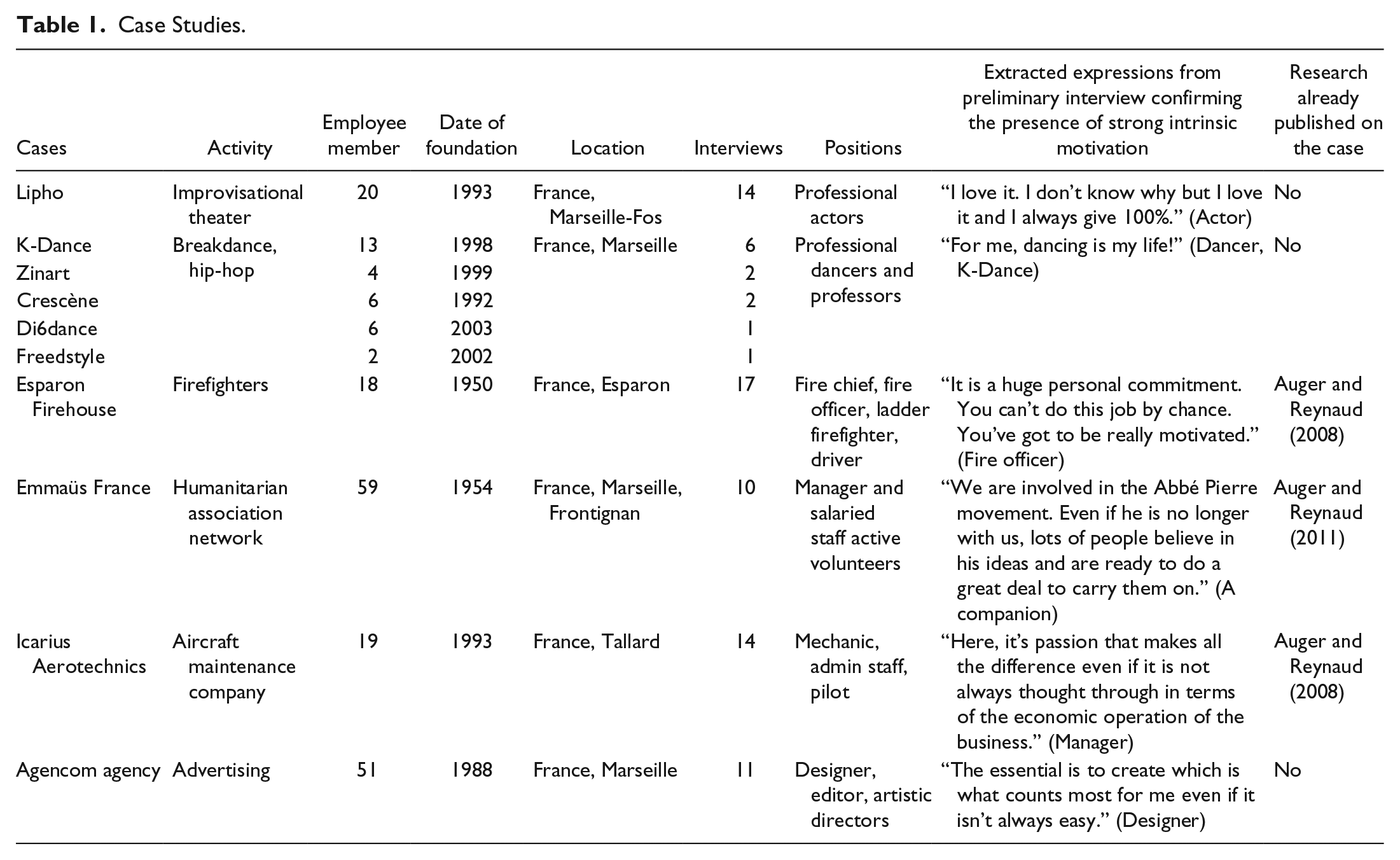
Table 1 summarizes these criteria, as well as the number and nature of the interviews. We conducted a total of 86 interviews across these six settings. Below we describe each case study. All of these organizations are located in France.
Case Studies.
Case Study 1: Improvisational Theater
The improvisational theater pits two teams of actors against each other and assesses their ability to improvise 1- to 5-minute sketches on a theme chosen at random. The actors have 30 seconds to prepare and allocate roles, identify a situation, and come up with a beginning and an end. There are three types of improvisation: compared (comparison of improvisations delivered by two teams on the same theme), mixed (actors from the two teams take part in the same sketch), and chase (sketch begun by one team and completed by another). Lots are drawn to set certain limitations, such as the number of players, the presence of accessories, and the style (narrative, song, mime, etc.). For each improvisation, the actors’ performances are assessed by professional juries during official competitions, which then grant recognition to the actors’ creative performance. For the research, we interviewed 14 out of the 30 members of the LIPHO, a troupe of actors located in Marseille-Fos who specialize in improvisational theater.
Case Study 2: Breakdance
Breakdance is a dance style that emerged in New York in the 1970s. Each dancer dances in turn in the middle of a circle formed by the audience. The choreography comprises acrobatic moves assessed on their level of creativity, speed, and style of delivery. The winner is chosen either by the audience or by dance judges during official competitions. The biggest annual competition, called “The Battle of the Year,” rewards dancers who show the highest levels of creativity and technique. For our research, we collected data from 12 professional dancers from five dance associations that specialize in breakdance. These dance associations, located in Marseille, are mainly composed of professional dancers, artistic directors, and students.
While we are treating these five dance associations as a single case study “location,” it was necessary to interview individuals from different associations because many dance associations are quite small, and the dancers involved were not as readily available as was typical in the other sites. Using five associations allowed us to gather enough interviews and to ascertain that the participants shared common experiences and attitudes.
Case Study 3: Firefighters
The mission of firefighters generally includes the protection of people, goods, resources for economic output, and the environment (fighting disasters, life-saving, first aid, tackling pollution). They participate directly in rescues and provide urgent medical assistance. As part of a vital emergency service, firefighters are used to delivering first aid. Studies of their operations in the management of fire risks have shown that firefighters often show a high level of creativity to manage unexpected and explosive situations in major fire incidents (Auger & Reynaud, 2008; Weick, 1993). For this research, we concentrated on a specific firehouse located in Esparon, France. We interviewed 17 of the 18 firemen and an administrative member of the firehouse.
Case Study 4: Emmaüs
Initially run as a homeless shelter, “The capacity today of Emmaüs to develop social innovation in the most varied of sectors is unquestionable” (Auger & Reynaud, 2011, p. 53, translated from the original French). Its mission includes accommodations for the homeless and the most disadvantaged, sustainable development, codevelopment, and integration into society of all types of “excluded” groups (e.g., released prisoners, illegal immigrants, the elderly, single parents). Emmaüs helps these groups find jobs, housing, medical services, and education; however, its creativity arises in its requirement that “people receiving assistance also have to help the organization. Its main principle is that dignity must be won by work and solidarity among members and financial independence” (Emmaüs, 2009, p. 3). In its February 2009 newsletter, Emmaüs published a special feature titled, “Emmaüs—Socially Responsible Innovations,” in which it highlighted the latest examples of its social innovation: the transformation of old clothes into an efficient insulating material for house construction, the creation of a second-hand clothing cooperative in Africa, and the development of housing for people suffering from psychiatric illnesses. For this research, we concentrated on two sites located in Marseille Saint-Marcel and Montpellier Frontignan where we interviewed a total of 18 volunteers and salaried employees.
Case Study 5: Icarius Aerotechnics
Icarius Aerotechnics is an aircraft maintenance company employing 20 people. It specializes in jet and turbo-prop aircraft maintenance and, in particular, the Pilatus Porter PC6. This type of aircraft is mainly used for leisure parachute jumps. Pilatus Porter PC6s are manufactured in Switzerland by the Pilatus Company. Despite multiple administrative, technical, and regulatory barriers, Icarius designs and regularly delivers new innovative techniques. As early as 2003, it committed to a project to design a new engine for the aircraft. This was not part of its normal operations, but it secured for the company a worldwide monopoly for the fitting of new turbo-prop engines used in Pilatus aircraft. We conducted interviews with 14 of this firm’s employees.
Case Study 6: Agencom
This advertising agency offers promotional tools (money-off vouchers, special offers, games) and communication campaigns (annual promos, summer season deals, “sudden deals”). The agency employs 52 staff and is part of one of the biggest advertising groups in France. Agencom provides its services to a select portfolio of companies, including Sara Lee Meats, United, Nestlé Pet Foods, Pernod Ricard, Cadbury, Schweppes, San Pellegrino, Monsavon, Fluocaril, Energizer, Sanex, and Williams. The organization’s staff is split into two main groups, each with sales staff (commercial department, group leader, assistants, and development managers) and creative staff (creative department, artistic directors, creative artists, graphic designers, and copywriters-designers). It has an annual turnover of 10 million euros, and since 2004, management has deliberately encouraged creativity. We interviewed 11 individuals at Agencom, which included employees in several different roles as shown in Table 1.
Data Collection
The first contacts were arranged either by telephone or face-to-face with potential informants, whose names and contacts we found on websites (Cases 1-4); from existing relationships (Case 5); or from public directories (Case 6) . During this first contact, we identified preliminary data about the organization and matched the characteristics of the case with our sample criteria. We also identified potential interviewees involved in the creative process, and we planned the dates and locations of first face-to-face interviews. To reinforce the representativeness of concepts (Strauss & Corbin, 1990) we aimed to meet members of the organization with varied and pertinent profiles, in particular in terms of which sector they belonged to, the role they performed, their age, their length of employment, and their status. Moreover, we gave special consideration to the restrictions on people’s availability, preferring to reschedule meetings even at the last minute to conduct interviews at a time that was most convenient for the participant. We also gave strict guarantees of anonymity to anyone taking part.
The interviews were conducted in either the candidate’s place of work or a leisure environment. In all cases, they were held in a quiet and undisturbed location. The length of interviews varied from 1¼ to 2½ hours. The interviews were systematically transcribed and validated (in terms of our mutual understanding of their content) through a process of rephrasing the statements made during interviews. All were conducted as semistructured interviews driven by open-ended and follow-up questions, which are included in the appendix. As suggested by Evrard, Pras, and Roux (1993, p. 91), we adopted an approach based on “unconditional positive regard in which the subject can freely express their opinions and each element of their response has a particular value since it refers either directly or indirectly to the analytical elements of the subject for research.” These interviews were complemented by secondary sources such as archival documents (internal reports, websites, and published articles) about the organization and observation of employees in their work settings. During the time we spent in each organization, we participated in brainstorming sessions, training sessions, and other meetings, events, and informal conversations.
Data Analysis
The analysis of data was carried out in an iterative fashion between the data and the emerging structure of theoretical arguments (Locke, 2001; Miles & Huberman, 2003; Strauss & Corbin, 1990). To accommodate the vast amount of data to process (approximately 500 pages of interviews and notes), we used NVivo software, suited to dividing and categorizing text. The Nud*ist software allows researchers to develop and endlessly redefine codes, which makes it particularly well suited to content analysis through emergent coding (Lincoln & Denzin, 2000), because it does not limit the number of codes or their analogical merging (Crang, Hudsom, Reimer, & Hinchliffe, 1997, p. 779). The analysis consisted of three main steps. First, we created first-order codes. Each interview or sources had to be read again and divided into first-order codes. We named the codes with words expressed by the interviewee to remain as close as possible to the content of the interview. “Names could come from the words of the interviewees themselves” (Strauss & Corbin, 1998, p. 20) or from “the words or generic themes contained in the interview” (Miles & Huberman, 2003, p. 108). After the first-order codes were named, we created categories and checked again that the first codes fit into the categories.
Second, we created theoretical categories. When we consolidated the categories they became more abstract, so we moved from open codification to axial codification (Locke, 2001; Strauss & Corbin, 1998). Recurrent themes emerged that could be identified as theoretical categories. At this step we had to check again that each code was consistent within its category and through all categories to prevent codes from becoming part of two different categories.
Third, we developed a theoretical model. Once theoretical categories are defined, the next step is to understand what links them, what underlies them, and what might offer a better conceptual framework. For example, some categories were linked to collective dimensions, others to individual dimensions, some dependent on or related to their domain, and others independent of their domain. We tried to find alternative frameworks that describe how the theoretical arguments are related. And eventually we found a model that was consistent when we checked again for fit with the initial codes and categories. The model we developed is the result of this emergent theoretical understanding (Becker, 1970; Glaser & Strauss, 1967; Locke, 2001).
Table 2 illustrates the process of analysis and lists the first-order categories and theoretical categories that lead to cross aggregate theoretical dimensions. We found 34 first-order categories in the interview data as can be seen from the table.
Overview of Data, First-Order Codes, and Theoretical Categories.
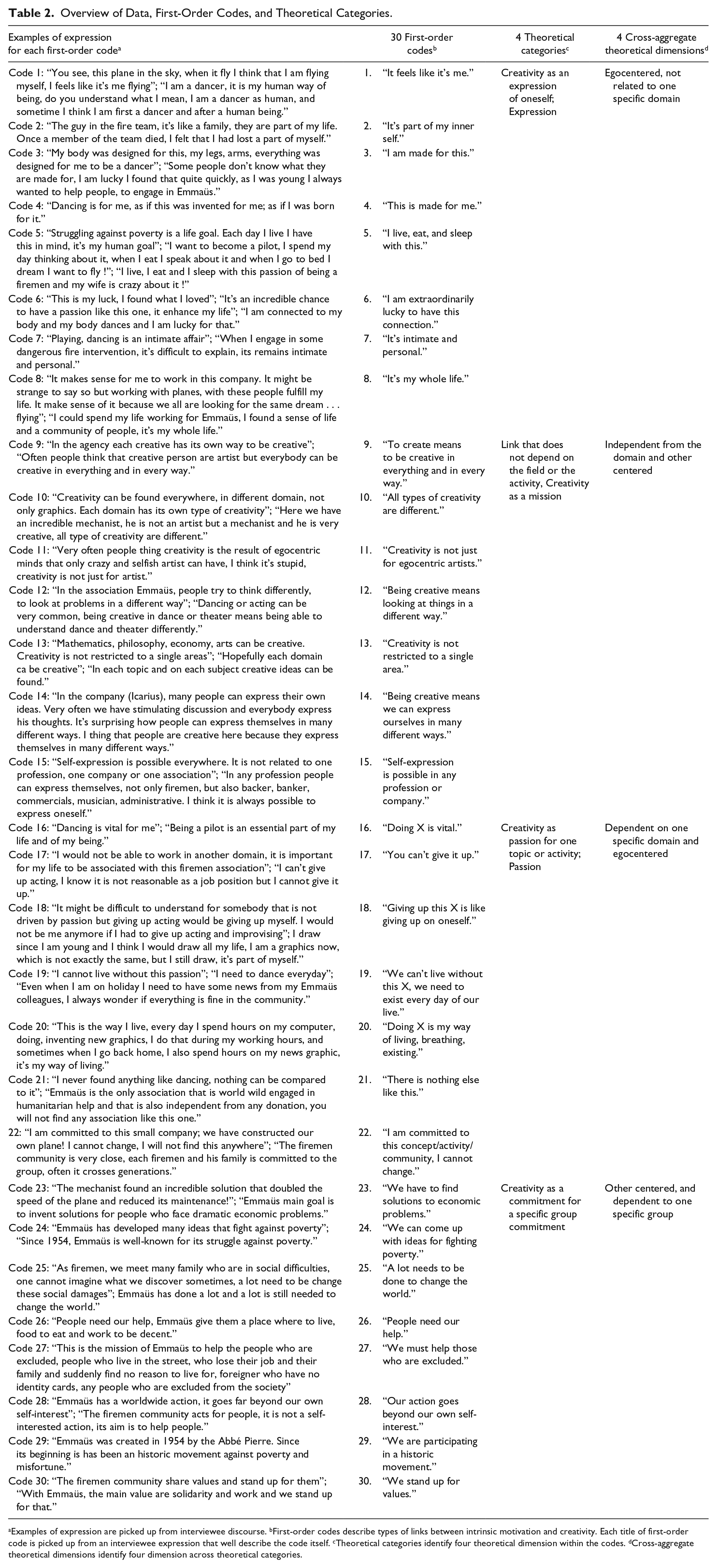
Examples of expression are picked up from interviewee discourse. bFirst-order codes describe types of links between intrinsic motivation and creativity. Each title of first-order code is picked up from an interviewee expression that well describe the code itself. cTheoretical categories identify four theoretical dimension within the codes. dCross-aggregate theoretical dimensions identify four dimension across theoretical categories.
Results
Our analysis revealed a model of the types of intrinsic motivation for creativity. Two dimensions linked to creativity and intrinsic motivation—(1) egocentric versus other-centered and (2) dependence versus independence—enabled us to propose a model of the links between creativity and intrinsic motivation.
Creativity can be action oriented, toward the creative person or others. In the case of egocentric creativity, the creative person is intrinsically motivated by the sensation of freedom, expression, and fulfillment that the object or idea being created provides. In the case of an other-centered creativity, the person is intrinsically motivated by a service that he or she accomplishes for someone else, which offers a feeling of being useful or feelings of commitment, based on moral values.
Creativity also can depend on or be independent of the activity. In the case of dependent creativity, the motivation is focused on the specific action, a specialty, an organization, or a value. For independent creativity, intrinsic motivation is attached to the pleasure of creating regardless of context. Motivation is part of the process, and creativity can be expressed in different settings. That is, the individual’s creativity is not specific to the setting; the individual loves being creative and is likely to be creative in various activities. Whatever task the individual undertakes, it is done creatively. In contrast, the motivation for dependent creativity depends on the situation, such that the person likely is creative only in a particular setting or activity.
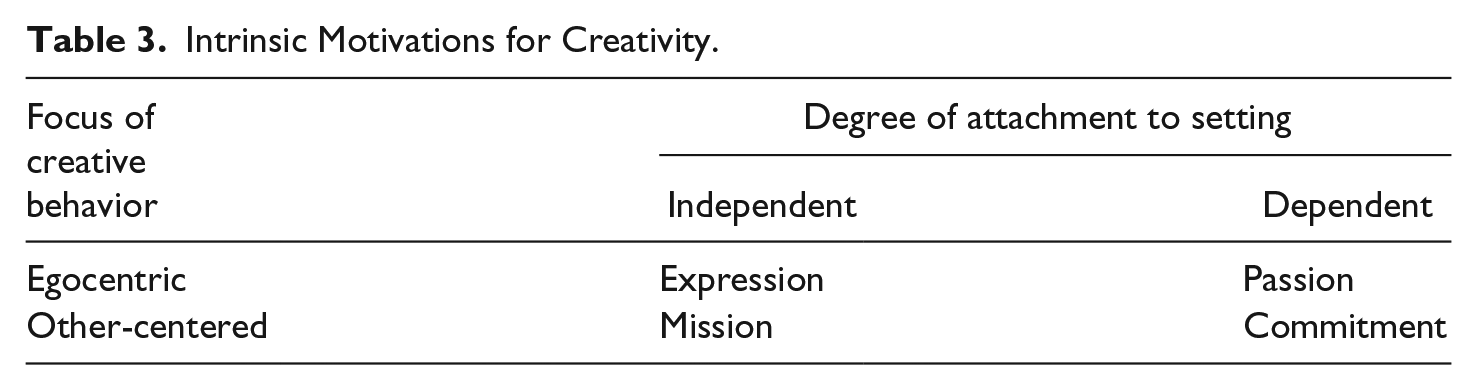
Combining these two dimensions suggests four types of intrinsic motivation for creativity, summarized in Table 3. Each type of intrinsic motivation is described next.
Intrinsic Motivations for Creativity.
Expression
The “expression” form of intrinsic motivation is egocentric and independent of the setting. Most common among creative people in the advertising agency, expression allows for a broad field of application for capacities and creative skills, because “the proportion represented by creativity in our profession never stops growing and we all do it whatever our subject area,” and “Creativity helps to innovate and offer new approaches for merchandising to stand out from the competition. You have to be very responsive in this business and sector and therefore always come up with new ideas” (Director, Agencom). The creative person can therefore work in a communication agency, events company, or architectural firm, moving easily from one project to the next. If an organization does not allow it, he or she can achieve this need for expression outside work, because “whatever the project or product, you have to find new ideas every day” (copywriter-designer, Agencom). Creative people express their satisfaction by working in their chosen profession:
What gets me out of bed each morning is the thrill of doing a job that makes me happy. I love repeating this phrase: Your talent lies in your tastes. . . Researching an idea, the special excitement which comes from original ways of approaching something on ever-changing subjects. (Graphic designer, Agencom)
They also could change professions or employers to express their creative skills.
Mission
We use the “mission” label for intrinsic motivation that is other-centered and independent of the setting. The mission, as expressed by our respondents, indicates their feeling that they are the bearer of an ideal, a value, or a role that they view as of central importance for guiding their behavior. We find this form of motivation primarily in the humanitarian and social organizations, among creative people who express their attachment to the mission that they have taken on, albeit not necessarily for the organization they work for: “Yes, for me, if I’m here, it’s because I think that the economy should be a human science. Today, the economy is anything but that. . . . Today, it’s simple; everything is driven by ‘profits and losses.’” All the values of Emmaüs, the solidarity and the fraternity, and so on are values that today have been massacred by the economy. “Me, I believe that we can do things differently” (volunteer, Emmaüs). Their descriptions reveal that they are sometimes involved in several humanitarian organizations, such as when a paid staff member in one organization volunteered in another or when people became involved in one organization after the other, noting, “I have always done it. Before coming to Emmaüs, I was with the Restos du cœur, but I found the spirit of Coluche was no longer there and so I moved” (volunteer, Emmaüs). This mission included paid staff members too “I have always worked for this type of organization. Today, I’m responsible for an Emmaüs community. It’s true, I don’t see myself doing anything else, in any case, I would need to find some sense to my responsibilities” (community manager, Emmaüs).
Passion
Our “passion” category represents intrinsic motivation that is egocentric and dependent on the setting. Passion was expressed in relation to a particular activity, such as when a dancer noted,
I don’t think I could ever stop doing this. You see, there such a strong link with your inner-self, that to give it up would be giving up on myself. It’s part of my basic needs now. It’s vital, vital . . . It’s like breathing.
Passion marks not only the dancers and actors (“I know that I was made for this and that’s amazing; to do something that you were born to do”) but also the mechanics and technicians in the aeronautics maintenance company:
It’s M’s passion that makes all the difference. Yes, because it’s completely insane [to take on a project of designing a new engine] when you look at the company’s business operation and yet, it happens and everyone is committed to it. (Manager, Icarius)
These creative people cannot engage in an activity without including what they consider to be their essence, their life, and their personality in it. For example, “You see a plane in the sky and it was you who did the maintenance checks on it. You are that plane . . .” (mechanic, Icarius). The creative process also is intimately linked to an activity and very specific area of expression, which creates a considerable degree of motivation, such that “I can’t do without it” (dancer, Kdance).
Commitment
The “commitment” form of intrinsic motivation is other-centered and dependent on the setting. With commitment, the creative person associates his or her life with an organization or project, especially among firefighters, who assert, “Here, we are firefighters from father to son” and
I am a firefighter; that means I am a firefighter and that I respect the rules, that I am committed to firefighting call-outs and that I belong to this community. To be a firefighter is not just about doing the day job, or at least in my case, that’s the way I feel.
Motivation is directly linked to the reference group and the collective project it is delivering. Such commitment also is prevalent among the Emmaüs respondents, who describe how the
movement has always supported large projects such as building housing, communities, and social inclusion projects. You only have to look at the latest project about Métisse insulation. It’s great! The Abbé Pierre had this force and these ideas and we carry them on. (Manager, Emmaüs).
The organization to which they belong “embodies” their creative identity and the mission to which they decided to commit, so “When the current managers come here, they come because they have heard of the Abbé Pierre. They are doing it for a social purpose. They are there for Emmaüs and for nothing else” (member, Emmaüs).
Discussion
For decades, research has shown that intrinsic motivation is an essential factor in the development of creativity (Amabile, 1997a, 1997b, 1988; Csikszentmihalyi & Getzels, 1973; Elsbach & Hargadon, 2006; Glynn, 1996; Woodman et al., 1993), though researchers also have questioned the nature and substance of these links (Grant & Berry, 2011). According to George (2007), “rather than assume that intrinsic motivation underlines creativity, researchers need to tackle this theorized link more directly and in greater detail” (p. 445). Shalley et al., (2004) assert it is equally necessary to develop new empirical research to gain more in-depth and up-to-date knowledge about what really governs the things that motivate creativity. The model we propose offers some theoretical and practical responses to these issues.
The model shown in Table 3 can be described by a series of propositions that could be useful in terms of developing lines of inquiry into the complex intrinsic motivation–creativity relationship. These propositions further explain and summarize the model developed from our analyses.
Research Implications
The main contribution of this research consists of proposals for a model to gain a better understanding of intrinsic motivation and its links with creativity. This result has many implications for research and creativity theory. As intrinsic motivation is a fundamental concept that appears regularly in research on creativity, a model that identifies and distinguishes among different types of intrinsic motivation could have several theoretical impacts on research based on intrinsic motivation. First, our results advance Amabile’s componential model by adding different types of specific intrinsic motivation. According to Amabile (1988), creativity is essentially determined by the existence of a creative personality, a high level of expertise, and strong intrinsic motivation. Additional research could analyze the impact of these types of motivation on expertise and its relationship to personality. For example, the “Passion” and “Commitment” types imply high, specialized expertise, whether in a specific activity or a particular organization. In contrast, the “Expression” and “Mission” types are independent of the setting and organization, so creativity is very flexible and adaptable to different settings. Does this mean that the balance between creative personality and expertise differs? In some cases, might creative personality have a more significant influence, whereas in other cases, expertise is more crucial? The model we propose offers new opportunities for understanding these relationships.
Second, our proposed model could have impacts on the definition of creative personality. Most definitions rely on a set of personality traits and a cognition that highlights their high levels of intrinsic motivation. Puccio and Grivas (2009) demonstrate that personality traits influence the preference expressed by the individual for different stages during the creative process, such that
clarifying problems is associated with tendencies to be cautious, careful, analytical, accurate and tactful. In contrast, those who express strong preferences for the idea generation stage of the creative process are likely to show such traits as willingness to challenge prevailing thought, need for change and an attraction to variety. (p. 247)
The model we propose suggests that a creative person also can be differentiated by types of intrinsic motivation. It would be interesting to analyze the influence of personality traits on the type of motivation in a similar manner.
Third, our model integrates different types of literature that distinguish between creativity for oneself and creativity for others. In this sense it reconciles the results put forward by Grant and Berry (2011) and Chalofsky & Krishna (2009). According to Grant and Berry (2011), existing links between creativity and intrinsic motivation are more complex than they appear and may be relayed by attention to others. Thus they define a form of “social motivation” that enables, on one hand, the promotion of intrinsic motivation and, on the other, high levels of creativity that drive people to look for ideas that are particularly important to relevant others. Therefore, when they take a “pro-social motivation to take on others’ perspectives, employees will channel their intrinsic motivation toward producing ideas that are not only novel but also useful, thereby achieving higher creativity” (Grant & Berry, 2011, p. 74). This output relates to other-centric categories of intrinsic motivation in our model, such as attention to others by carrying out an action for a relevant other or for another person in a more abstract sense, such as for humanity overall. Because our model also highlights egocentric forms of intrinsic motivation, it enables us to consider work by Chalofsky (2003) for whom the usefulness sought through creativity was directed not just at others but also toward achieving some level of personal satisfaction. Thus high levels of intrinsic motivation link to perceptions of personal accomplishment, defined according to three main themes: a sense of self, a sense of the activity, and a sense of harmony. In turn, our model extends a recent trend in analyses of intrinsic motivation by taking into consideration both spiritual and personal dimensions and commitment to personal achievement.
Practical Implications
In terms of managerial implications, the results from our research suggest different forms of encouragement and ways to promote intrinsic motivation. First, it is useful to differentiate the use of mobility and versatility for each type of intrinsic motivation. These two criteria are often valued by organizations but could be counterproductive when applied to certain types of intrinsic motivation. For Expression intrinsic motivation for creativity for example, the company could offer professional mobility and regular changes of activity without harming creativity. But for the Passionate profile, it would be better to let the creative person become thoroughly involved in a single activity and use creativity to develop expertise with the company. For a creative person motivated by Mission, the meaning of activities will encourage and maintain motivation. Finally, Committed intrinsic motivation for creativity is directly linked to the company. Whereas real-world practice often uses motivational tools regardless of the person’s type of intrinsic motivation, we would argue that such a generalization might be counterproductive and that differentiation would be more appropriate.
Second, our findings related to commitment offer several key insights. Nakamura and Csikszentmihalyi (2002) show that intrinsic motivation helps people attain higher levels of concentration and lucidity, such that they lose all sense of time while engaging in an activity. These people are committed because they feel in control of the situation. Similarly, Deci (1971) describes a sense of control and commitment in cognitive evaluation theory. That is, people attribute the cause of their behavior to internal factors and perceive that they have the capacity to act on the situation. The more competent they feel about the situation, the more committed they are. However, a change in this perception reduces their intrinsic motivation and commitment. In our interviews, among the four types of intrinsic motivation, we found a high level of commitment, and the definition of these different types of intrinsic motivation enhance the notion that commitment can occur in varying settings. The model of intrinsic motivation distinguishes a commitment to Expression of oneself from activities that people are Passionate about, and commitment to a Mission goes far beyond the self. The organization and activity are not necessarily the primary drivers of individual commitment. But in other cases, commitment arises only in very specific settings, and people likely would not commit themselves to contexts that they did not believe they would be able to influence. In this sense, the model of intrinsic motivation gives useful information that could help organizations create environments that encourage commitment among individuals with each type of intrinsic motivation. It also helps explain why people are committed in some contexts and not in others, even though they seem similar.
Third, the proposed model suggests new ways to define tasks and jobs. According to research dealing with the influence of job positions on creativity, the nature of a task has a direct influence on intrinsic motivation. To encourage creativity, managers must develop job positions that offer autonomy and ambitious goals. When organizations create jobs filled with simple tasks and problems, people are less committed to their jobs and less likely to develop creativity. The different types of intrinsic motivation reveal that tasks should be not only autonomous but also adapted to the intrinsic motivation type. Social action tasks with a high level of autonomy cannot ensure the commitment of a creative person with a Passion motivation if he or she is not also passionate about social action. However, tasks with a high level of autonomy will be sufficient to promote Expression intrinsic motivation, which is independent of the setting.
Limitations
This research suffers from several limitations that could be addressed in further research. We conducted the study among so-called passion professions, for which a strong intrinsic motivation is a typically distinctive feature of the creative personalities who work in them. As social science lore recommends, the phenomenon being investigated needs to be given every opportunity to manifest itself. Considering the limited state of our knowledge about intrinsic motivation–creativity linkages, it makes sense to begin this line of inquiry in such settings or professions. However, to refine and supplement the typology we developed, it would be helpful to study more “classic” or traditional businesses and settings, for which passion is not necessarily part of the culture. Although we base our research on six case studies, all of the case study organizations are located only in France. It would be useful to explore the utility of the model in other countries and cultures. Inductive theory building can help develop new concepts and theories, but it cannot be used to generalize the models it proposes. Therefore, our model must be tested on a larger scale, using, when applicable, more quantitative research methodologies.
Conclusion
The aim of this research was to discover how intrinsic motivation and creativity are linked. A better understanding of existing links between intrinsic motivation and creativity suggests more relevant and effective management practices, rather than simply associating the management of creativity with intrinsic motivation. To establish this model on an empirical basis, even without prior research focused specifically on intrinsic motivation–creativity linkages, we opted to conduct a guided empirical exploration using an inductive theory approach. The results enabled us to propose a two-dimensional model: The egocentric/other-centered dimension describes the focal object of creativity, whereas the dependent/independent dimension describes the degree to which creativity is attached to a particular activity or setting. The combination of these dimensions identifies four different forms of intrinsic motivation. Therefore, the managerial practices capable of encouraging creativity likely vary, depending on the nature of the intrinsic motivation that exists in a particular work setting and among the employees. These new insights may help organizations promote commitment and creative performance. They also open new avenues for research on creativity in organizations by providing further insights into one of its main factors, intrinsic motivation.
In the field of change and development, managers, change agents, and organizational scholars often think about building the capacity to change into organizations. Seldom is there much focus on building creative capacity into the system. However, the capacity to create is also essential for most complex organizations. The field has not done enough to link theory and research on organizational change with theory and research on organizational creativity.
Footnotes
Appendix
During the first part of each interview (Question 1: Can you describe your activity?), we established contact with the candidates by asking for details about the aspects of their job that require them to be creative. Then, the second part (Question 2: Can you tell us about your motivation for performing your activity?) aimed at examining more closely the links between their motivation and their commitment to being creative. In each section, candidates responded to various questions designed to examine in greater detail, define, or specify aspects of their responses. These questions were specifically adapted to the individual context inherent to each interview. According to Stake (2000), such a candidate-specific approach ensures the spontaneity and authenticity of responses. We took the view that each candidate would have specific stories to tell about his or her personal experience, so we modified in-depth questions to reflect the experiences candidates could best describe. Overall then, the interviews were carried out as follows:
Declaration of Conflicting Interests
The author(s) declared no potential conflicts of interest with respect to the research, authorship, and/or publication of this article.
Funding
The author(s) received no financial support for the research, authorship, and/or publication of this article.