



Abstract
This essay discusses how views of organizational change and innovation have traditionally focused on planned episodic change that focuses on rational, strategic, top-down and consensus-directed interventions following teleological or regulatory process models. Future scholarship seems to be focusing more on unplanned continuous organizational changes that emphasize experiential, emergent, bottom-up, pluralistic social movements following dialectical and evolutionary models of change. While planned-episodic and unplanned-continuous change may appear to be opposing views of organizational change, they are entangled in one-another, and provide a rich agenda of future scholarship on processes of organizational change and innovation.
Projecting forward into the future of scholarship on organizational change and innovation requires projecting backward to build upon the past. As the philosopher Santayana (2006) stated, “To know your future you must know your past.” This essay does so by discussing how views of organizational change and innovation have traditionally focused on planned episodic change that focuses on rational, strategic, top-down and consensus-directed interventions following teleological or regulatory process models. Future scholarship seems to be focusing more on unplanned continuous organizational changes that emphasize experiential, emergent, bottom-up, pluralistic social movements following dialectical and evolutionary models of change. While planned-episodic and unplanned-continuous change may appear to be opposing views of organizational change, they are entangled in one-another, and provide a rich agenda of future scholarship on processes of organizational change and innovation.
These contrasting views are based on findings from co-editing (with Marshall Scott Poole) the Oxford Handbook of Organizational Change and Innovation, 2nd Edition (Poole & Van de Ven, 2021). It presents 36 chapters by 60 leading authors from 47 universities in 20 countries who examine cutting-edge extensions on process models of organizational change introduced by Van de Ven and Poole (1995).
Since the Handbook's first edition in 2004, dramatic shifts have occurred in population demographics, technology, competitive survival, and social, economic, and environmental health and sustainability concerns. These shifts are influencing how scholars are studying how organizations change and develop. Although understanding why and what organizations change is generally well known with variance studies of its causes or consequences, the process of how organizations change over time has received less attention and is the central focus of the Handbook and this essay.
Processes of Organizational Change
The process of organizational change is an observed and/or experienced difference over time in some organizational characteristic, activity or idea. Organizations are changing all the time in many ways and directions. These changes vary greatly in frequency, size, novelty, and temporal duration.
Most changes are well known, recurrent and follow routine standard operating procedures (such as personnel recruitment and promotions, yearly planning and budgeting cycles, maintenance repairs and replacements). As they are repeated, people sometimes change the steps in their prescribed sequence, which leads to dynamic patterning processes in organizational routines (Pentland & Feldman, 2007; Pentland & Goh, 2021).
Some changes are larger planned initiatives (such as organizational mergers and acquisitions, structural reorganizations and strategic reorientations). While they are not new and may have occurred before in an organization's history, they entail extensive resources and vicarious learning from others since they occur relatively infrequently to the people involved (Burke, 2021).
Finally, some changes are new, not experienced before, and require novel constructions by the people involved. They are innovations, which are commonly defined as the creation and implementation of new ideas. The new idea may pertain to a technological innovation (new technical artifacts, devices, or products), a process innovation (new services, programs, or production procedures), or an administrative innovation (new institutional policies, structures, or systems). The idea may be a novel recombination of old ideas, a scheme that challenges the present order or an unprecedented formula or approach (Zaltman et al., 1973). As long as the idea is perceived as new and entails a novel change for the actors involved, it is an innovation (Van de Ven, 1986).
The process in which these changes unfold might begin with a dissatisfying experience that “shocks” an attentive manager or employee to launch an episodic change venture by generating support, resources, and a change team. The process might also emerge during an ongoing flow of everyday work activities as organizational participants change or fix routines to maintain stability in their operations. However, the change process unfolds, participants typically find that their plans or expectations often go awry, setbacks and mistakes occur, stakeholders conflict, new goals and plans emerge as different developmental paths are pursued. These experiences may provide opportunities for learning how to complete the change process or incorporate it in a never-ending flow of organizational changes (Van de Ven et al., 1999; 2008)
Having clarified our definitions, we can now proceed to examine how organizational scholars have studied organizational change over time. Traditionally, scholars have viewed the pattern of organizational change as being planned and episodic. This traditional view emphasizes rational, strategic, top-down and consensus-directed interventions following teleological or regulatory process models. Projecting forward the Handbook chapter authors seem to be focusing more on unplanned and continuous change (Van de Ven & Poole, 2021). This view emphasizes experiential, emergent, bottom-up, pluralistic social movements following dialectical and evolutionary models of change (see Table 1). I will discuss these contrasting views for the purposes of projecting future scholarship. I will explore how these contrasting views are entangled and instantiated in each other, and discuss when they apply on various topics, questions, and contexts for understanding and managing organizational change and innovation. In doing so I hope to build upon the past to create a broader and richer appreciation of organizational change and innovation processes.
Contrasting Views of Traditional and Emerging Views of Organization Change.

Planned and Unplanned Change
Planned change is consciously conceived and implemented by knowledgeable actors. Burke (2021) points out that scholarship on organization change emerged during the 1950's with the founding of the field of Organizational Development (OD). It was based on an action research model developed initially by Lewin (1948) that involved groups of participants working with consultants or organizational researchers ‘to solve immediate, practical problems and also to make a scholarly contribution based on the outcome. OD scholars advanced a number of process models of planned change, including Lewin (1948), Weisbord (1976), Nadler and Tushman (1977), Tichy (1983), Beer et al. (1990), Burke and Litwin, (1992), and Kotter (1996). These models commonly consist of a prescribed set of stages (e.g., Lewin's unfreeze, change, and refreeze), and steps for undertaking a planned change process. These models became popular and widely used by practitioners even to today.
There is a prescriptive managerial orientation to these models of planned change. “They attempt to improve an organizational situation through use of behavioral science technologies, research and theory,” (Burke, 2021). Adopting rational, logical analysis with data that is assumed to be valid and objective, these planned change models are typically driven by top-level managers often with external consultants. Steps in these models include developing a need and vision for an organizational change, communicating and advocating it to organizational participants, and providing them training and incentives that support implementing and institutionalizing the change and overcoming resistance. A teleological model typically applies to goal-directed efforts of developing an envisioned end state by the change planners, followed by a life cycle model of prescribed and regulated implementation by the change doers.
A major challenge often experience with these planned change models has been resistance to change (Ford & Ford, 2020; Piderit, 2000; Zorn & Scott, 2021). Resistance is encountered and implementation often fails when planners are separated from the doers, or when events are caused and consequences are felt by different people. As Pressman and Wildavsky (1973) concluded from their now-classic study of the design and implementation of the Oakland Rehabilitation Project,
Implementation and evaluation must not be conceived of as processes that take place after, and independently of, the design of a program. Learning requires that design, implementation, and evaluation become fused in the change process and that interaction occur among the people principally concerned with design, implementation, and evaluation. (Pressman & Wildavsky, 1973, p. 135)
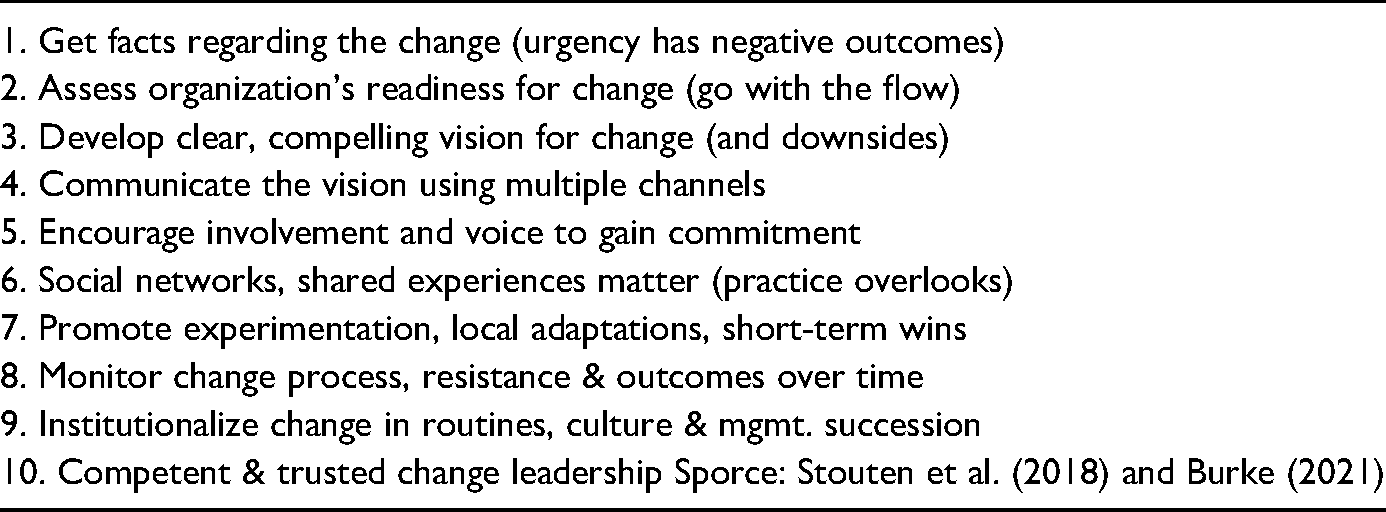
A second challenge is that popular planned change models often rely on expert opinion as their foundation rather that scientific evidence. Burke (2021) and Stouten et al. (2018) addressed this challenge by reviewing the literature for research evidence for key tenets in practitioner-oriented planned change models. Overall they found good news that there is research evidence for many (but not all) of the tenets. They concluded by identifying the ten evidence-based steps in managing planned organizational change outlined in Table 2.
Evidence-Based Principles for Planned Change Management.
Episodic and Continuous Changes
Going beyond these traditional practitioner-oriented models of planned change, more recently, scholars are taking a more social constructionist and emergent view of unplanned changes unfolding all the time in organizations. In part, this emerging view reflects dramatic shifts in new information technologies, social media platforms, flatter organizational hierarchies, generational shifts to Millennials, and demands for organizations contributing to societal welfare (Rheinhardt & Gioia, 2021). These shifts are leading to bottom-up, employee-emergent change initiatives that often produce pluralistic, divergent and conflicting views that are seldom planned in any unified way.
Hernes et al. (2021) and Tsoukas (2021) expand on Weick and Quinn’s (1999) initial discussion of episodic change as “infrequent, discontinuous and intentional” (such as in Lewin’s (1948) model of unfreeze-change-and refreeze), and continuous change as “ongoing, evolving and cumulative” (such as the bottom –up sensemaking process discussed by Rheinhardt & Gioia, 2021). The two forms of change are associated with different metaphors of the organization, analytical frameworks, theories of intervention and roles attributed to change agents, as shown in Table 1. The distinction between episodic and continuous change is similar to the distinction Feldman (2021) makes between exogenous (external) and endogenous (internal) organizational change. This distinction also fits with the new type of dialogic OD intervention that focuses on meaning making rather than problem solving (Bartunek et al., 2021).
As Table 1 outlines, this emerging view argues that organizational change is a dynamic, unpredictable, and evolving process, rather than occurring at preconceived planned intervals or certain life stages. It assumes that reality is socially constructed, involve conflicts and contradictions among many partisan change agents of unequal power and who get emotionally (as well as rationally) involved in dialectical change (Hargrave, 2021) and social movements (Davis & Kim, 2021). Purpose and directions of change emerge in the process through sensemaking, interactions, and shared experiences in social networks. Unlike the “change maker” role in the traditional view of episodic change, the change agent in this emerging view is a “meaning maker,” or a sense maker and giver who reframes how participants think of changing (Bartunek et al., 2021; Rheinhardt & Gioia, 2021).
Particularly noteworthy in this emerging view is the role of human agency, time, and a growing concern with governance of change processes. Traditionally, the literature focused on change agents as individuals who take control, create, and remake organizations such as Steve Jobs with Apple. These “great individuals” –executives, entrepreneurs, transformational leaders, strategic decision-makers, change agents –represent a potent expression of the human will as maker of the organization. However, this “great leader” concept of agency is subject to several qualifications. For one thing, external conditions limit the agent's power and capacity to control events and manage organizational change. Second, agency is more complex when multiple interacting agents are involved. For example, a less powerful agent may take the crucial action that determines the success or failure of a change. Multiple agency is difficult to deal with, because it is difficult to know whose intentions count in such cases. Unequal balance of power among multiple agents is triggering increasing attention to dialectical processes of managing contradictions, partisan mutual adjustment (Hargrave, 2021) and social movements (Davis & Kim, 2021).
Unequal power balance among stakeholders in organizational change processes is also leading scholars to call for governance structures of decision rights and roles for all parties affected by organizational changes. Traditional models of top-down change are largely silent on this and assume that that top management determines a governance structure by fiat (Alvarez et al., 2020). While power has been a core driver in traditional models of organizational change, some new institutional scholars have moved away from the focus on power and are directing their attention to institutional mechanisms that enable self-organized governance and coordination of common-pool resources (Ostrom, 2005). They include formal and informal working rules, norms, and shared strategies that liberate, enable and constrain the human rights of all stakeholders affected by an organizational change process (Commons, 1950; Ostrom, 2009). Participation and transparency in the formulation of change initiatives can improve success prospects for change. Better local knowledge in the formulation of change initiatives, and greater motivation through voice and self-determination can be advantages of such governance among diverse stakeholders in complex organizational changes (Pant et al., 2018). “Leadership must create a structure—a container—that ensures the psychological and career safety required for truth to speak to power” (Beer, 2020).
Entangling Past and Present Views of Organizational Change
In conclusion, it is important to note that while planned-episodic and unplanned-continuous change may be viewed as opposite ends of a continuum, it is also useful to consider them together, as done in a growing number of hybrid models of organization change. Viewing change as a continuous unfolding process enables us to look for emergence even in the most episodic and planned types of change (Tsoukas, 2021). Episodic change acquires emergent qualities as change projects are implemented in open-ended contexts. And vice versa, even emergent change can have an ongoing episodic character, as Garud and Turunen (2021) show in their discussion of Usher's cumulative synthesis theory.
Episodic and continuous changes often represent different micro and macro levels of analyzing a change process up close or from afar. From a macro-outsider's perspective, a structural reorganization or a technological innovation may be viewed as single major episodic event. However, up close from the perspective of insiders, the episodic event often entails a continuous flow of numerous every-day change events often occurring over an extended time. The closer we look into the process the more we see agency. The farther away we are removed from agency, the more we see continuities punctuated by episodic moments of disruption (Pettigrew, 1997). Since organizational members are both observers of, and contributors to, many changes going on in various levels and units of organization, they alternate between episodic and continuous change views, thus generating a more refined understanding of action: practitioners can view action from both within (i.e. experience its continuous flow of ongoing tasks and activities) and from outside (i.e. punctuate and reconstruct their experiences as episodic events in retrospect.
Most studies of organizational change find them to be highly complex and uncertain processes, where episodic change initiatives typically morph into continuous change patterns as plans go awry, and alternative goals and directions emerge during the process, as discussed by Sarasvathy and Venkataraman (2021) and Garud and Turunen (2021). All planned change occurs in the context of the ambient change processes that occur naturally in organizations. For example, Gaba and Meyer (2021) report of strategic planning processes in healthcare organizations that are going through their own life cycle and also adapting to hyper turbulent environmental jolts. The intersection of these change processes, one planned and the other two unplanned, shapes the organization. Knowledge of the ambient change processes can enable managers to conduct strategic planning more effectively. Conversely, unplanned change processes can be “domesticated” through interventions and driven in useful directions. For example, Maurer et al. (2021) discuss how a VSR (variation-selection-retention) theory of unplanned population evolution can be transformed into a planned model of organizational evolution and innovation. In order to do this, the planner takes a virtue of necessity. Drawing on his or her knowledge of how natural change processes unfold, the planner uses the processes’ momentum to push through needed measures. Jing (2021) advances this idea by discussing three strategies for seizing, entraining, and creating change momentum based on Eastern yin-yang philosophy.
Episodic and continuous views of change are entwined in time as reflections on significant experiences in an ongoing flow of continuous change. By viewing events as episodic breaks in actors’ experiences, they represent potentialities or affordances that actors may evoke from the past or project upon the future as they move through time. The potentiality is created as agents redefine events by relating them to other events over time. Hernes et al. (2021) illustrate this process through their study of how past and envisioned changes during an initially mundane meeting at a shipbuilding company led to the adoption of a new bow design. Similarly, Schultz and Hernes (2013) observed the managers of LEGO, to emerge with a new identity by evoking and reconstructing selective past events in light of anticipated futures.
Conclusion
Scholarship on organizational change and innovation has traditionally focused on planned episodic change that featured rational, strategic, top-down and consensus-directed interventions following teleological or regulatory process models. Projecting forward scholarship seems to be focusing more on unplanned continuous organizational changes that emphasizes experiential, emergent, bottom-up, pluralistic social movements following dialectical and evolutionary models of change. Future scholarship can build usefully on the past by exploring how these contrasting views are entangled and can be used for understanding different topics, questions, and contexts of organizational change and innovation. In particular, the entangled nature of episodic planned change and continuous unplanned change provides a richer and deeper understanding of processes of organization change from the perspectives of micro and macro levels, how they are entwined in time as reflections on significant experiences in an ongoing flow of continuous change, and how they broaden our appreciation of the complexity and uncertainty of observed organizational change processes. Finally from a managerial perspective, an episodic view of change is useful for launching planned change initiatives periodically required in organizations, while continuous change is necessary for repairing and maintaining organizational stability.
Footnotes
Declaration of Conflicting Interests
The author(s) declared no potential conflicts of interest with respect to the research, authorship, and/or publication of this article.
Funding
The author(s) received no financial support for the research, authorship and/or publication of this article.