



Abstract
This paper examines the conceptual contradiction between a nationally uniform local government system as constitutionally provided in Nigeria, and, the principles of governance model that is presently believed to advance the course of service delivery in government. The paper argues that the straitjacketed constitutional provisions that require every state government to establish a patterned, uniform local government system, is conflict-generating, opposed to effective management and harnessing of local differences in a highly differentiated country like Nigeria, and averse to the multi-jurisdictional principle advocated by the proponents of the governance model. The focus of the paper therefore, is to investigate the extent the prescribed uniform system of local government hinders the application of the governance model that could advance the course of service delivery at the local level. The author suggests that contrary to the constitutional provisions on the nature of local government, which autonomy is not strongly protected by the constitution, the state governments should be allowed to determine the nature and structure of local governments in their domain to reduce the abuse of the local government system and entrench competitive local government practice. This will advance the greater use of local networks in local governance.
Keywords
Introduction
The primary purpose of local government is to bring government close to the local people. This generally entails two things for the structuring of local government: (1) to ensure local democracy or civic participation (Sharpe, 1970); and (2) to apply the locality principle in extending effective service delivery to the people (Mackenzie, 1961; Stoker, 1988). Scholars often contend which of these objectives are more important, albeit no scholar in effect denies the importance of the other. In most countries, local governments are either assigned the constitutional responsibility of providing basic services or are used by higher level governments as a medium to provide them. The governance model which has become the bench mark for government organization and operations since the 1980s and 1990s is supportive of the localness of service provisioning by advocating the use of partnerships and multi-organizational networks in carrying out the functions of government (Sinclair, 2011). The model reflects a shifting pattern in styles of governing in which the boundaries within and between public and private sectors have become blurred (Stoker, 1998). Its operating mechanism does not rest on the recourse to bureaucracy, sanctions and authority and suggests that the institutional/constitutional governing perspective is limited and misleading (Peters and Pierre, 1998). Rather it suggests partnerships involving collaboration between governments, the voluntary, community and private sectors. The governance model apparently contrasts with uniformity in local government since differences could exist in the kind of community organizations and available voluntary sectors that could be engaged.
Nigeria is believed to operate a three tier federal structure comprising the federal, state and local governments. The main objective of this three tier structure is to ensure a freestanding local government system that is capable of doing what government actually does – governing at the local level (Federal Republic of Nigeria, 1976: 1), including the capability to embark on governance application. The 1976 reform that revolutionalized the Nigerian local government system was aimed at creating a common national local government system (Asaju, 2010; Ogunna, 1996), and more importantly sought to sever the extra strong controlling hands of the state governments on the local governments (Adamolekun, 1979). It is this objective, that is, “the formal and unequivocal recognition of local government as constituting a distinct level of government with defined boundaries, clearly stated functions and provisions for ensuring adequate human and financial resources” (Adamolekun (1979: 3) that is the main feature of the Nigerian Local government system to the present. The key points of this third tier status as noted by Asaju (2010: 102) are:
local government should become a legal entity distinct from the state and federal government;
local government should be administered by democratically elected officials;
local government should have specific powers to perform a range of functions assigned it by law;
local government should enjoy substantial autonomy to perform an array of functions, plan, formulate and execute its own policies, programmes and projects, and its own rules and regulations as deemed for its local needs. This autonomy includes power to control its finance, and to recruit and discipline its staff.
Unfortunately, this cherished model of the reformist military architects of the Nigerian federation has not materialized in practice. Even though various institutional structures have been put in place to concretize it, an amalgam of bottlenecks has been put in the ways of an emergent autonomous local government (Adeyemo, 2005). In practice, most state governments deviate from establishing local governments in their domain in accordance with the constitutional provisions and the third tier of government has not truly evolved in Nigeria (Ighodalo, 2008).
Many studies have examined the reasons for the situation, which ultimately leads to poor performance of the local governments in the country (Adeyemo, 2005; Asaju, 2010; Ighodalo, 2008; Ikeanyibe, 2008; Oviasuyi et al., 2010). Adeyemo (2005) points to the challenge of conflicting constitutional provisions, political instability and financial/fiscal problems; Ikeanyibe (2008) observes that the constitutional recognition or the third tier status leads to inflexibility that constrains dynamism and adaptability necessary for effective local government; and Ojo (2009) points to the problem of poor management and corruption. Most of these studies also underscore constant whittling down of the local government powers by the state governments (Odo, 2014). Invariably, close to four decades (that is, since the 1976 local government reforms) of seeking “to sever the extra strong controlling hands of the state governments on local governments” (Adamolekun, 1979: 3) has not yielded much progress for the Nigerian local government system.
In the Fourth Republic which has been in existence since 1999, many states have sought different ways to deliver local services. States such as Lagos, Akwa Ibom, Bayelsa, Enugu, Ebonyi and Kastina have created development centres; others like Anambra State have cooperated with churches and communities to provide the wide range of services expected of local government. While there are few extant studies evaluating the benefits and successes/failures of these recent practices in local governance in the country, it must be remarked that these models were operated at the expense of the prescribed constitutional provisions on local government. For instance, many states have not bothered to establish democratically elected councils as stipulated in section 7 of the 1999 constitution (Federal Republic of Nigeria, 1999). In some that pretend to conduct elections for their local governments, the governors merely select and inaugurate loyalists that succumb to their wishes and caprices as local government officials. Others appoint management or caretaker committees in open disregard of the constitutional provisions. Above all, most states refuse to transfer financial allocations meant for the local governments to them, and even exploit their sources of internal revenue (Usman and Esidene, 2006).
The concern of this paper is not to investigate these lapses in the practice of local government, some of which have been highly discussed in the literature, but to explore how the constitutional provision of a uniform local government practice contrasts with the locality principle in local government which is necessary in a highly differentiated federal democracy, and constrains the application of the governance approach, either by the local governments themselves or the state governments in local governance.
Conceptualizing the local government: Uniformity versus locality
A number of theories have been offered to explain the essence and purpose of the local government. Ezeani (2012) lists some of the major theories to include the democratic- participatory theory, the efficiency–services theory, the developmental theory and the locality theory. These theories do not fundamentally present contradictory perspectives but underscore key aspects of what the local government should fulfil. The democratic participatory theory contends that local government exists primarily to provide opportunity for democracy and political participation and education of the citizens at this level. Sharpe (1970) for instance, remarks that the roles of the local government include political education, civilizing men through the medium of self-government, and serving as a training ground for democracy for higher levels of government. The efficiency theory justifies the existence of local government as an agent for provision of services that are local in nature. Thus higher order government should use the local governments for such services. This role for Mackenzie (1961) should be the basis for judging the local government. The developmental theorists (e.g. Ola, 1984) see local government as an instrument of development especially in developing countries. Thus local governments can be used for the implementation of socio-economic programmes that attempt to restructure the infrastructure necessary for an improved way of life (Ezeani, 2012; Ola, 1984). Finally the locality theory justifies the existence of local government on the need to recognize that needs and resources vary from locality to locality and should therefore be addressed and exploited in the best local manner (Stoker, 1988). This theory advocates for any local government model that suites the local area and apparently contrasts with a uniform system.
It is necessary to remark that all the other theories relatively express the locality principle, especially in an environment where local differences exist substantially. The democratic theory advocates for local representation and participation, the efficiency theory the need to provide local services through the mobilization of local resources, and the developmental theory the importance of local areas in the overall development of a nation. As the level of government nearest to the people, local government is the only government most citizens can reach. Hence, it is usually the level of government that is best positioned to provide the most basic and essential services to the people.
Despite the obvious recognition of the locality principle by most local government theories, there is the fundamental paradox about whether local government should be an instrument of maintaining national uniformity in the localities or of ensuring local differences. The argument is usually based on which is preeminent – the nation or the community (local government) – dealt with by such classic philosophers as Aristotle, Alexis de Tocqueville and others (see Okoli, 1998). Holding the nation as prior would usually tilt the argument in favour of maintaining uniformity in national standard, while holding the community as prior would favour the locality principle. While scholars like Alexis de Tocqueville (see Okoli, 1998) would argue that the community is natural and superior to the state or national government, the overriding argument about the possession of sovereignty by the nation state had rather tilted this contention in favour of the national government. Chandler (2008; 2010) has argued that the justification for local government
Despite admitting the primacy and superiority of the national government over the local government, maintaining a uniform standard in local government still leaves one with the problem of the degree of uniformity and the level of government that should determine it in a federal arrangement where the federal and provincial or state levels share power. While Nigeria has been savouring the idea of a three tier federal structure, some scholars (e.g. Gamper, 2005), believe that local governments cannot generally become equal third partners within the federal system despite the fact that they are very much affected by the federal operative system such as the impetus for fiscal distribution. Similarly, Ayeni (1994) observes that three-tier federalism is impossible to define in a consistent manner. This is because local governments usually do not partake in legislative power-sharing which is essential to the policy-making power of the constituent units of a federal system (Gamper, 2005).
In most federal states therefore, the power over local governments usually belongs to the federating units. This is in spite of the fact that “many countries today including both federal and unitary ones make constitutional provisions regarding the nature, functions and finance of local governments as a ploy to provide guaranteed autonomy and local power devolution that goes beyond the wishes or laws of higher level governments” (Ikeanyibe, 2016: 386). The fact is that this has not worked in Nigeria. Hence, despite constitutional provisions to protect local government autonomy by creating a kind of constitutional checks by the federal institutions such as in financial allocations and creating of new local governments, states obviously are given the power to establish local governments (section 7 (1) of 1999 Constitution). Invariably national uniformity that constrains the right of the state governments to perform this role with some degree of discretion translates to devolution without authority, undermines innovation, and is prone to generate political and administrative conflicts in local governance.
The governance model and the locality principle
The new governance paradigm is a spillover from the neoliberal trend that most Western countries embraced in the late 1970s and early 1980s, though some analysts (e.g. Archer, 1994) believe that the governance approach marks an important break with neoliberalism. For Archer (1994), whereas neoliberalism recognizes that markets are the whole answer, the governance approach does not; this approach recognizes the importance of collaboration of government and other sectors including the private and civil society or the third sector in service provisioning.
Governance is a term that is pervasively used and has numerous academic backgrounds (Bevir, 2010). Scholars do not agree on its meaning because it finds application to various issues of social coordination such as in good governance principles being advocated for developing countries as lending conditions by International Financial Institutions, global governance, collaborative governance, partnerships, policy networks and contemporary governance (Ansell and Gash, 2008; Gibson, 2011; Leftwich, 1994; Magnette, 2003; Weiss, 2000). In all these usages, Bevir remarks that too little attention is given to ways of making sense of the whole literature on governance. He however notes that “at the most general level, governance refers to theories and issues of social coordination and the nature of all patterns of rule” and “more specifically… to various new theories and practices of governing and the dilemmas to which they give rise” (Bevir, 2010: 1) By new theories, Bevir (2010) particularly underscores such practices and dilemmas that place less emphasis on hierarchy and the state, and more on markets and networks. Ansell and Gash prefer to use collaborative governance to empahsize the collective management approach implied in the model. They aver, "we opt for a combined approach to conceptualize governance…. governance applies to laws and rules that pertain to the provision of public goods…. governance is also about collective decision making—and specifically about collective decision making that includes both public and private actors. Collaborative governance is therefore a type of governance in which public and private actors work collectively in distinctive ways, using particular processes, to establish laws and rules for the provision of public goods" (Ansell and Gash, 2008: 545).
The term governance is, therefore, employed to describe some fundamental processes of modern government that are distinct from the way ‘governments’ traditionally operate. It consists of broad political processes where citizen and group participation in government policy and programmes is vital. Thus, the key to understanding the concept is the involvement of parties that are not recognized as part of the formal government organs in carrying out the traditionally acclaimed role of government. It reflects a shifting pattern in styles of governing in which the boundaries within and between public and private sectors have become blurred (Peter and Pierre, 1998). Stoker (1998) observes that the Anglo-American theory uses the term government to refer to the formal institutions of the state and their monopoly of legitimate coercive power; governance reflects a shifting pattern in styles of governing in which the boundaries within and between public and private sectors have become blurred. Its operating mechanism does not rest on the recourse to sanctions and authority and suggests that the institutional/constitutional governing perspective is limited and misleading. Archer (1994) believes that the governance approach tries to rehabilitate or reinvent the state after the assumption by neoliberalism that the market provides all the answers.
In as much as it can be agreed that the governance approach is a rescue of the state from the excesses of neoliberalism, it must be remarked that this rehabilitation is not to the status of what the state was in the era of the welfare state, when the government and its bureaucracy made great inroads into the economy and dominated the service sector. The governance model remains a market-driven, competitive model. The core ideas are a competitive market economy, well-managed state, and a democratic civil society (Archer, 1994). It focuses on the “multi-layered structural context of rule-governed understandings, along with the role of multiple social actors in arrays of negotiation, implementation, and service delivery. Addressing governance requires attending to social partners and ideas about how to concert action among them” (O’Toole, 2000: 276). It entails a devolved mode of service delivery, the unit of analysis of which is a network of nonprofit organizations, private firms and governments (Ewalt, 2001).
Stoker (1998:18) identifies five critical though dilemmatic propositions and distinguishing characteristics that should frame our understanding of governance.
i. A network of institutions and actors from within and beyond government.
ii. The blurring of boundaries and responsibilities for tackling social and economic issues. This shift in responsibility goes beyond the public–private dimension to include notions of communitarianism and social capital.
iii. Power dependence among institutions involved in collective action. Organizations are dependent upon each other for the achievement of collective action, and thus must exchange resources and negotiate shared understandings of ultimate program goals.
iv. The autonomous self-governing networks of actors.
v. The capacity to get things done which does not rest on the power of government to command or use its authority.
Essentially, governance involves partnership in carrying out of governmental functions. Such partnerships include local residents, community/regional-serving organizations, the public sector, and the private sector (Gibson, 2011: 4).
The implication of the model for the local government administration seems to contrast with a constitutional provision that encourages the establishment of a patterned, uniform local government system, despite local differences. While an established, autonomous local government system could operate the governance model like other tiers of government by engaging the non-profit sector, communities and other voluntary organizations in pursuing its goals, this is more problematic for local governments that are mere appendages of the state government. Furthermore, Ibietan (2011) has shown that the constitutional third tier status that legally prescribes a uniform local government system challenges the locality principle in a highly differentiated federal democracy like Nigeria. Ikeanyibe (2008) reveals that the third tier local government status in Nigeria mars flexibility and dynamism in local governance. In the midst of this dilemma, it is needful to examine how the uniform provision on the nature of local government in Nigeria allows the practice of collaborative governance both for the local governments themselves and the state governments that possess the constitutional right to establish local governments.
Brief on the Nigerian local government system
The new era of local government in Nigeria is traced to the 1976 local government reforms masterminded by the military government. The reform created a single-tier all-purpose local government. The guidelines stated that “all the statutory and public service functions of local government in Nigeria should be concentrated in multi-purpose single tier institutions called local governments with complete and self-contained budgets, so that the whole system of local government within any area can be identified and coordinated” (Federal Republic of Nigeria, 1976: 3). Ogunna (1996: 150) posits that the two main characteristics of the local government structure in the reform were largeness and uniformity of local government areas throughout the federation. The intent of the 1976 local government reforms had been reflected in various decrees of subsequent military governments and the constitutions of the country since 1979.
The current 1999 constitution as amended in 2011 provides in section 7 (1) that “the system of local government by democratically elected local government councils is under this Constitution guaranteed; and accordingly, the Government of every State shall, subject to section 8 of this Constitution, ensure their existence under a law which provides for the establishment, structure, composition, finance and functions of such councils.” Despite this provision, section 3 (6) of the Constitution avers that “there shall be seven hundred and sixty-eight local government areas in Nigeria as shown in the second column of Part I of the First Schedule to this Constitution and six area councils as shown in Part II of that Schedule". There are other provisions (see Asaju, 2010; Awotokun, 2005; Ikeanyibe, 2016) that indicate that the 1999 constitution and its predecessors have already created and recognized a stipulated number of local governments including their names, their respective States, and also stipulated their functions and funding in the Fourth Schedule and under public revenue in section 162 respectively. The provision of section 7 (1) about the power of States to create local government is apparently a formality. The conditional section 8 of the constitution to which the State law must be subject to in creating local governments is therefore only relevant in relation to “creating a new local government area” (section 3) aside the ones constitutionally recognized. Even at this, section 8 contains some rigid and intricate processes that make this exercise a near impossibility (Ikeanyibe, 2016). Ultimately, creating new local governments by States requires constitutional amendment with its rigid procedures as specified in section 8. Section 9 (3) avers that “an Act of the National Assembly for the purpose of altering the provisions of this section, section 8 or Chapter IV of the constitution shall not be passed by either House of the National Assembly unless the proposal is approved by the votes of not less than four-fifths majority of all the members of each House, and also approved by resolution of the Houses of Assembly of not less than two-thirds of all the States". By all the members of each House is meant that “the number of members of each House of the National Assembly shall, notwithstanding any vacancy, be deemed to be the number of members specified in sections 48 and 49 of this constitution" [section 9 (4)]. This implies that the four-fifths majority would be decided based on full membership of the two Houses and not just those present and voting.
Clearly, attempts by various State governments to create new local governments that would be constitutionally recognized had been conflictual and unsuccessful. The case of Lagos State that had its allocation to local governments seized by the federal government under Obasanjo’s Administration in 2006 for creating new local governments not approved by the National Assembly is a celebrated example. However, conflict and refusal of the National Assembly to recognize new local governments created by States had not deterred the State governments from creating new local governments, including refusing to establish democratically elected councils. Apart from the celebrated Lagos State case, other States like Kogi, Oyo,Yobe, Ebonyi, Katsina, Nasarawa and Niger created new local governments (Agboola, 2016; Asaju, 2010; Danjuma and Muhammad, 2013), using the terms ‘Development Centres’ or ‘Areas’ to identify these. However, the so called Development Centres or Areas are operated on the same platform with the constitutional local governments through the same personnel system and sharing of allocations. The most important issue to note about creating these Development Centres is the fact that the State officials considered them necessary to extend development nearer to the localities in ways that could not properly be covered by the fairly large, uniform, single tier local governments provided in the constitution.
Apparently, a key feature of the local government system in Nigeria is that the constitutionally prescribed model is hardly maintained in practice by the State governments during democratic rule. Akinsanya (2005) observes that the State governments since the 1979 constitution, not only exercised their powers under section 7 (1) to dissolve “elected” local government councils and replace them with sole administrators or caretaker committees, but also created new local government areas, without ensuring national recognition. The abuse of the local government system is more glaring on issues of finance. Although the constitution enjoined States to pay 10 per cent of the statutory revenues to the local governments in their jurisdiction, very few States honoured the provision (Akinsanya, 2005). Statutory allocations from the Federation Account to local governments paid into the States-Joint Local Government Account were often diverted by some State governments (Usman and Esidene, 2006). The State governors either misappropriate the funds of local governments or reduce them to perform other functions meant for the State government. In November 2009 for instance, a total of N1.7 billion was allocated to 20 local governments in Ogun State but only N700 million was released to them by the State governor (Obamwonyi and Aibieyi, 2015). More concrete arbitrary actions by some states against their local governments as documented by Obamwonyi and Aibieyi (2015) include:
Abia State: in June, 2006, the governor dissolved the elected local government officials. This matter had been in court since then, ending in the Supreme Court judgement of Friday, 11 July 2014;
Rivers State: in 2012, the governor suspended 11 local council chairmen indefinitely for failing to attend a meeting called by the governor;
Delta State: the governor sacked the chairman of Burutu local government of Delta State, five months before the end of his first tenure in office;
Ondo State: in 2008, the governor of the state, on assumption of office sacked the local government chairmen and councilors;
Ekiti State: in October, 2010, 16 local government chairmen were sacked by the governor as a result of the court ruling of Justice Cornelius Akintayo of Ado Ekiti High Court that the State Independent Electoral Commission, which organized the election was not properly constituted;
Bayelsa State: in 2013, five local government chairmen were sacked from office by the connivance of the state governor and the state House of Assembly on the alleged crime of gross misconduct;
Imo State: the governor dissolved the Local Government Councils in 2011 just to eliminate members of the People’s Democratic Party that has been in power in the state since 1999. The governor who was elected in May 2011 was a member of the All Progressives Grand Alliance (APGA);
Edo State: in late October 2012, the state House of Assembly connived with the governor to sack the 18 local government executives of council transition committees;
Anambra State: the state governor Mr Peter Obi refused to hold local government elections while in office. The only local government election he held from 2006 to 2014 was the one held a few weeks before the end of his tenure in December 2013.
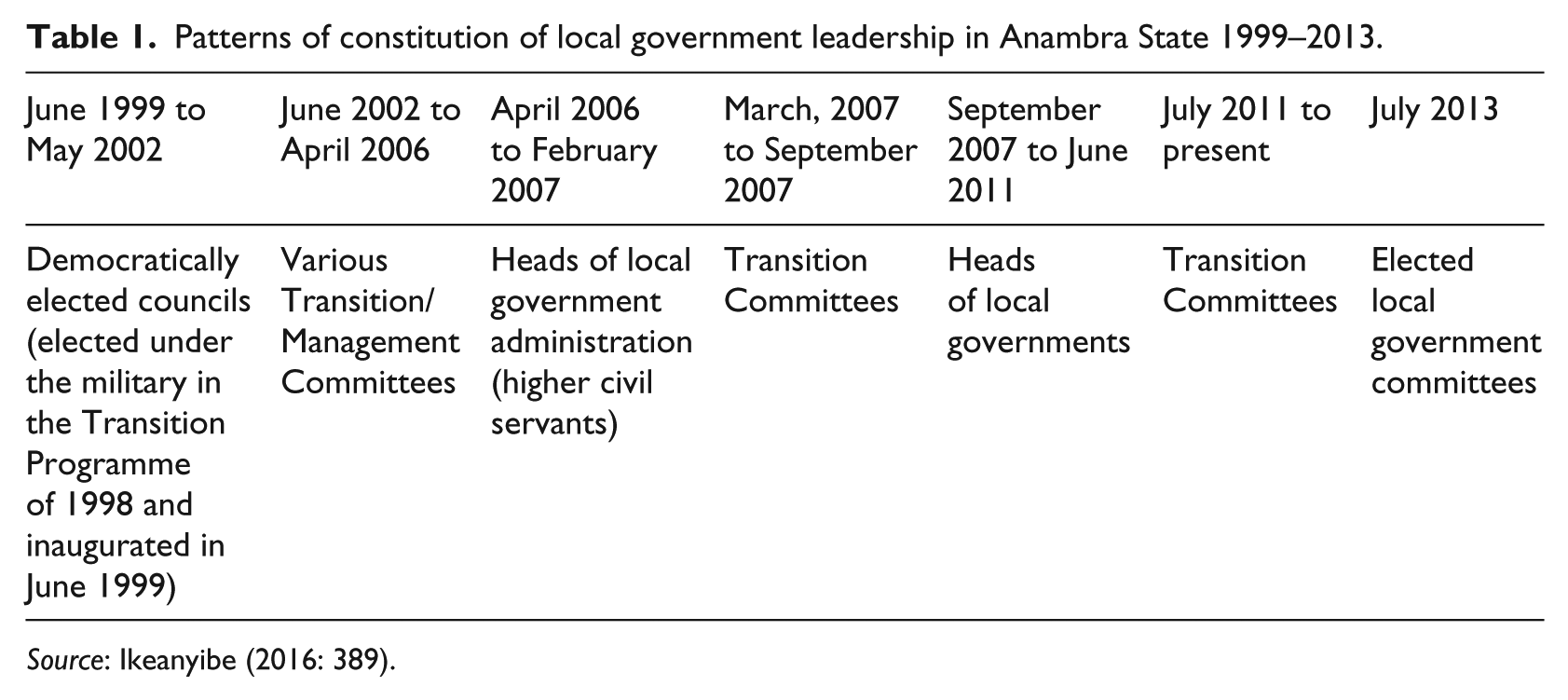
The case of Anambra state has been among the most well-known examples of a state government’s tendency to establish local governments as it suits them in total disregard to legal provisions. In a recent study, Ikeanyibe (2016) showed that from the inception of the Fourth Republic in 1999 to 2013, Anambra State operated various forms of local government as shown in Table 1.
Patterns of constitution of local government leadership in Anambra State 1999–2013.
Source: Ikeanyibe (2016: 389).
As shown below, local governments in the state were constituted by elected officials from 1999 to 2002 arising from the transition elections conducted by the federal military government in 1998. It is necessary to mention here that while the federal military government conducted the elections that ushered in local government officials in 1998, it has not been able to assume such powers in the democratic period because of the asserted rights of States. Successive Transition Committees were appointed between 2002 to April 2006. The Heads of Local Government Administration (the most senior civil servants) took over from the Transition Committees set up by the State administration of Dr Chris Ngige as Peter Obi assumed office as governor in March 2006. There was a brief attempt to use Transition Committees by the Obi Administration from March 2007 to September 2007. The Administration eventually settled for the use of senior civil servants (Heads of Local Government Administration) from September 2007 till July 2011 when Obi reverted to the appointment of Transition Committees; he only conducted local government elections which were more of a selection than an election as his political party, APGA won all the seats and chairmanship of the 21 local governments in the State. The State had been under three different governors at this period and each of them had given preference to a different kind of local government administration in line with the prevailing situation. By and large, local governments are emasculated through acts of omission or commission by most state governments, who operate various kinds of structures as local governments. Yet, we need to assert that evaluation of local governments must shift from evaluating the degree of compliance to constitutional provisions to evaluating the level of local services provided, and the feasibility of practising the constitutionally provided local government model in those circumstances where the various states have sought for other options.
Uniformity in local government system and the application of governance model
The difficulty to apply the governance model in the Nigerian local government system is argued from two angles: (1) from the position of the local governments, which can on their own use various networks in pursuing their goals; and (2) from the position of the States, which could be at leisure to establish appropriate types of local governance approach that admit the involvement of communities, the voluntary sector and other networks. In both angles, however, it is argued that uniform local government system in a federal democracy with enormous diversity like Nigeria is antithetical to the locality principle, as well as the discretion to collaborate with other institutions through a multi-tier level approach to local governance. In a country of over 300 ethnic nationalities, entrenched natural community organizations, and various kinds of emerging voluntary sector including faith-based organizations, localities are definitely bound to be different in terms of resources, social and political organization of the people, geography, and economic endowment. Incorporating the diverse communities and groups effectively in governance require more concrete and specialized decentralization that could contrast with a uniform, patterned, single tier hierarchically organized local government institution as prescribed.
In the first angle about the capability of the Nigerian local governments to use the governance approach to improve their services, it is argued that the Nigerian local government system as described above lacks the appropriate structure, autonomy and finance that can help them to be at liberty to engage networks. As revealed in the last section, the uniform, multi-purpose, single tier local government system is not operational in Nigeria since its adoption in 1976. It is difficult to clearly identify the type of local government practised in various States of the federation despite the legal provisions that clearly specify the system. It is more correct to say that the Nigerian system of local government depends solely on the caprices and wishes of the political officials in power at various state levels at a particular point in time. This often arises from various challenges the State officials face concerning peculiar locality issues.
As shown above, most often local government officials are political stoodges of the State political actors. Many States operated the Caretaker, Management or Transitional Committees system that are appointed by the governors and thus “owe total allegiance to their godfather-governors rather than the people at the local areas and grassroots” (Obamwonyi and Aibieyi, 2015: 153). States that manage to conduct elections tactfully make selections to ensure that the ruling party in the State wins all the seats in the local governments. Also those that win the party ticket to stand for elections were those favoured by governors. In their bid to eliminate political conflicts that could possibly arise from the presence of different political parties in the local governments, the governors block electoral competition to ensure they control all their local governments.
In most States therefore, local governments are not firmly established, they lack stability and discretion to make decisions or even to employ their funds. Local government officials whether appointed or selected through the so-called elections are not sure of their tenure and have very little discretion to act. In the case of Anambra State mentioned above, the average tenure of local government officials in the period 1999 to 2013 was far less than two years in office. This does not make way for effective planning, execution of programmes and possible involvement and coordination of networks.
On the part of the State governments, it is observed that many of them prefer and do engage other actors in local governance, create smaller Development Centres, and use appointed officials when it is inexpedient to organize elections. Yet, most often they pretend to comply with constitutional provisions on local government establishment. Anambra State also provides a typical scenario. During the administration of Peter Obi (2006–2014), the State has partnered with networks such as natural communities and faith-based organizations in local governance. The administration engaged faith-based institutions, especially the Catholic Church and the Anglican Communion, and the Community Development Associations (CDAs) of 177 natural communities in the State to pursue various local services including education, health, roads and security. On yearly basis, the governor (Peter Obi) presented monies to CDAs for security concerns and maintenance of communal roads. He presented a security van to each of the 177 communities and various market associations in the state and encouraged and paid salaries of local vigilante groups in these communities (Osuji, 2012; The Tide, 2013). This helped in no small measure in the maintenance of security and rural roads in the State. Various community school projects were carried out through the community leadership bodies.
Furthermore, he partnered the two orthodox Christian churches that dominate the State (Catholic and Anglican Churches) in education and health services. He returned back schools taken over from the churches in the 1970s and provided money directly to them to build infrastructure and run the schools and engaged them in the provision of health infrastructure (Nigerian Masterweb Citizens News, 2011). In one instance in 2011, he presented cheques totaling N733 million to the churches to rehabilitate primary schools in their management. He also presented cheques for the rehabilitation of secondary schools managed by the churches and donated buses to them.
It is important to underscore that these schools are financed and managed by the churches themselves. Hence the State government was merely assisting them rather than entirely financing and managing these schools if they were fully owned and managed by the local government – the public schools. Anambra State also funded several health institutions owned and managed by the churches such as Saint Joseph’s Hospital Adazi Nnukwu, Regina Caeli Hospital Awka and Iyienu Hospital Awka (Gabriel’s Report.com, nd) under the administration of Obi (News Express, 2014).
The use of faith-based organizations and communities in local governance is not peculiar to Anambra state. Other states have created Development Centres to collaborate with the single tier local governments. While these practices have in most instances devalued the local government system as enshrined in the constitution, it cannot be said that local governance has been neglected since the governors devise other ways to ensure the development of their localities. Indeed, there is no extant research that has investigated if localities in Nigeria are better off than they would have ordinarily been with effective practice of the constitutional local government system. What is rather over researched is the issue of local autonomy as if autonomy is tantamount to effective service delivery.
Notwithstanding the reality of moderate application of the governance approach by some State governors over the years, it must be stated that they are highly constrained to freely explore the governance options as a result of the constitutional provisions on local government. No matter how the State governments abuse the constitutional system in preference to creation of Development Centres or use of communities and other bodies for local services, they still have to pretend that they have established constitutionally recognized local governments. Often this leads to nominal existence of these local governments, with salaries paid to the employees while allowing no justifiable roles to them. In some cases, the issue of functional duplication between networks engaged by the state and the local government is obvious. This situation surely duplicates roles and drains scarce resources.
Again, some State governments’ actions in relation to the constitutional local governments such as dissolution of local government councils, engineer court cases that divert attention and resources. In most cases, court proceedings have been delayed for many years thereby stalling activities in local government management, and the application of resources of the local government or State to prosecute cases. In most instances, the relief sought by the parties concerned become irrelevant and time-barred as the judgements, when they eventually come, have been overtaken by events. In some of the cases mentioned in the last section (Obamwonyi and Aibieyi, 2015), subsequent appeals and counter-appeals finally ended with the Supreme Court judgments, thus taking so much time and exposing judicial inconsistencies; for example, the case of dissolution of the Council by the Governor of Abia State in 2006, only ended with the Supreme Court judgment of 2014, when all the concerned parties had all left government. The court in the case of Imo State of 2011 ruled a re-instatement of the officials, which the governor appealed to. In the case of Ekiti State, the Court of Appeal held that Justice Akintayo who ruled on the lack of a proper constitution of the State Independent Electoral Commission erred as the case before the court was about the constitutionality of the sack carried out by the governor, or lack of it. The Appeal Court judgement, which ruled that the governor lacked the power to sack the elected local government chairmen (Obamwonyi and Aibieyi, 2015) failed to reinstate the sacked officials, thus, leading generally to poor resolution of issues. The Nigerian court system through its contradictory rulings has not helped matters in maintaining the constitutional provisions. It rather provides opportunity for prolonging cases to the point where the final ruling becomes time-barred or unhelpful to entrench sanity in the local government system.
Obviously, the conflictual nature of local government operations in the country in the Fourth Republic is believed to be as a result of the contradictory provisions of the 1999 constitution (Asaju 2010; Awotokun, 2005; Ikeanyibe, 2016). Awotokun (2005) in fact avers that the constitution somehow has overridden the gains and aspirations of the local government with the exclusion of local government from the constitution, despite the provisions. One then wonders about the value of these efforts towards constitutionalism.
Proponents of a separate tier of local government (Asaju, 2010; Enejo and Isa, 2014) have continued to advocate for constitutional amendment to probably ensure federal dominance in the centripetal–centrifugal power struggle between the federation and the federating units. But could federal dominance eliminate the yearnings of States’ political actors for more legislative powers and could amending the constitutional provisions come easily? In this author’s view, the problem with the Nigerian local government is not just the issue of constitution; it is a fundamental issue about power definition between the federal government and federating units (see Ikeanyibe, 2016: 390). Ikeanyibe avers that "the two democratic eras following the constitutionalisation, the second and the fourth republics, show greater determination of state political office holders to control their local governments….This attitude of the state power brokers clearly conflicted with the enshrined local government protective provisions masterminded under the centralising military command structure" (Ikeanyibe, 2016: 390) is evident in the two constitutions of 1979 and 1999 which, they (the military) assisted in.
In the final analysis, this paper submits that most state actors in Nigeria desire to control and establish local government systems that serve their aspirations and that of their states. While some of these aspirations may be self-serving, it is important to consider the issue more from proper definition of powers in a federal democracy that is highly differentiated. It is in this way that the value of local governance in terms of engagement of multi-level organizations, including local communities could better be appreciated.
Conclusion
Uniformity in local governance, while essential and preeminent among the reasons for the existence of local government, is contrary to the locality principle in a highly diverse and politicized country like Nigeria with over three hundred ethnic nationalities and uncompromising party politics. For Langrod (1953), local government is antithetical to a social whole, a community which is uniform, a majoritarian democracy and a unitarian system since it is a phenomenon of differentiation. Ostensibly, the architects of the Nigerian federation believe that a constitutionally determined uniform system of local government would better advance the course of national unity, democracy and development. However, promoting the locality principle in local government is more likely to produce valued and sustainable outcomes than trying to impose general prescriptions (Sinclair, 2011).
In the Nigerian case examined in this study, uniformity or general constitutional prescriptions in principle reduces the discretion of State governments to establish local government system considered suitable for the existing differences in the polity, which may include exploring the collaboration with local organizations like faith-based and community associations. In practice however, it has led to non-compliance and manipulation of legal provisions by the State governments. The constitutionally prescribed uniform system of local government has not led to consistency, stability and the desired freestanding local government system. It has generated conflicts more or less among the tiers of government and denigrated the autonomy of local governments. At worse, it leaves the local governments politically and financially spineless and thus incapable of engaging networks for proper local governance.
The example from Anambra State has shown that the state government could enjoy fruitful partnership with the community and faith-based organizations in providing local essential services. Other States have created Development Centres as local governance options. Operating through bureaucratic, single tier, uniformly patterned local government system in a federation where power definition between the federal and federating units is seriously contested, is to reduce the local government system to a battlefield, denying them the relevant stability, autonomy and financial self-sufficiency necessary for the engagement of networks.
In the final analysis, it is recommended that Nigeria and similar emerging federations that experience power division challenges should discard the idea of a third tier local government system. This is because it could subject the local government system to untoward interferences, some of which have been exposed in this paper. In such a scenario, engaging multi-organizational bodies in local governance by either the local government or states becomes hampered.
For recommendation, it could be suggested that two options are possible: (1) to strengthen federal control such as establishing a ministry to oversee local governments and organizing local government elections centrally; or (2) allowing states clear control and establishment of their preferred local government system. In the first option, sticking to a freestanding third tier local government system should receive full protection through insitutionalized national bodies recognized by the constitution itself. In Brazil for instance, local government elections, functions and funding are not only enshrined in the constitution; they are protected by national institutions. In Nigeria, this option will surely go against the incessant calls for restructuring the nation in favour of the federating units that are recurrent in the country. For the second option, the States should be allowed to establish local governments that in their thinking could best advance the welfare of the local people. This could reduce excessive conflicts, party politicization that induces States to manipulate their local governments, and steer States to compete in the quality of local governance provided to the people. This competitiveness could be more amenable to collaborative governance with various geographically-specific local organizations and communities, the voluntary and the private sectors than to the prescribed single tier, uniform system.
Footnotes
Funding
This research received no specific grant from any funding agency in the public, commercial, or not-for-profit sectors.