




Abstract
This paper explores the ongoing presence of the 1972 expulsion of the racialized Asian population by former president Idi Amin in contemporary Uganda. The expulsion was a “critical event” and thus the paper uses an “anthropology of the event” approach to focus on the architecture of silence and historical consciousness of the event in urban Kampala. The four arenas of focus are: (1) official state narratives; (2) community mobilization and public forums on urban African-Asian relations; (3) memories, adventure tales, and narratives expressed by Ugandan Asian men; and (4) the infrastructure and material culture of 1970s Asian property expropriation.
Introduction
For multi-racial and ethnic Ugandans, the 1970s is very much an unresolved historical era; it is also very much an uncertain lived reality. During my field research, many different interlocutors expressed their vernacular understandings of time in Kampala: that events were chronological and occurred in a linear progression but that they were also inevitably cyclical, or that the era of the 1970s was distorted such that it was a “long decade.” In the context of state’s passing of a number of undemocratic bills in 2014, I often heard people tell me that the “1970s was back,” that Uganda was “stuck in the 1970s,” or that not much had changed since the 1970s. 1
Perhaps this is not so surprising, given the fact that the 1970s is part of the recent historical past, and given the neoliberal developmental authoritarianism of the Ugandan (National Resistance Movement) state. Despite the lack of consensus on what the Ugandan national community is or should be, despite ongoing processes of nation-building and exclusion—and despite ethical concerns surrounding conducting research on violence during this sensitive decade—historians and historical anthropologists have begun to chart new ground in the study of the 1970s in recent years. 2 A special issue on “1970s Uganda” in the Journal of Eastern African Studies, which emerged from a conference on “Rethinking the State in Idi Amin’s Uganda” at the University of Michigan in 2012, has helped provide a framework for thinking beyond the Amin regime (1971–1979) as an era of “institutional collapse and economic chaos” (Peterson and Taylor, 2013). Indeed, scholarly and insider accounts that emphasized the culture, personality, and the psychology of the dictator (Kyemba, 1977; Mazrui, 1975), ethnicity and “tribalism,” and modernization and dependency theory—in conjunction with international journalism on the Amin regime—all seemed to co-produce the 1970s as an era of Afro-pessimism. In Uganda, Afro-pessimism signaled the failure of African economic nationalism; decay, decline, and socio-political chaos after an initial period of post-colonial promise. Idi Amin himself was mediated through larger global tropes about the post-colonial failings of a “Conradian Africa”—its turn to ethnic and sectarian violence, military coups, economic crisis, its so-called barbaric violence, and its failure to modernize. Indeed, as a symbolic and distorting/distorted figure, Amin has become synonymous with Africa as the Heart of Darkness in a global imaginary about the 1970s, and vice versa.
Thus, Amin, as a historical subject and discursive site, and the field of scholarship that was produced around him, tended to overpower the “truths” and social realities of this era of military dictatorship in Uganda. Earlier work sought to rectify this distorted character of the 1970s through critical political economic analyses and studies of postcolonial political governance (Kasozi, 1999 [1994]; Mamdani, 1976, 1984), including trenchant critiques of Western representations of Afro-pessimism (see Mamdani, 1996). Recently, scholarship has focused on projects of historical reconstruction or revisionist histories of the 1970s, with a focus on examining the Amin era as a field of dynamic social action (Peterson and Taylor, 2013). The imperatives of these scholars have been to recover social histories of this era through the study of politics and culture that detract attention away from the dictator and personality of Idi Amin, the tropes of African primitive violence that circulate around the Amin regime, and from high politics in Kampala. They have focused, for example, on the media infrastructure of governance in the regime (Peterson and Taylor, 2013), the study of Uganda’s illicit coffee trade and smugglers during the 1970s (Asiimwe, 2013), or on the local experience of governance and violence among subaltern groups such as women and “Asians” (Decker, 2013, 2014; Hundle, 2013a). 3 In doing so, the new wave of Ugandan historiography is beginning to rework the epistemological frames of 1970s African failure that characterized scholarship in political, historical, political-economic, and cultural studies.
Despite this excellent work on the part of historians, there have been no recent attempts to inscribe the 1970s within a framework of anthropological knowledge and in the context of ongoing everyday urban life in Uganda. In this paper, I argue that attention to the political and cultural work of the 1970s in contemporary Uganda helps us to make sense of the ways in which the epistemologies grounded in 1970s-era scholarship and in popular apprehensions of this decade continue to be mobilized in everyday lived practice—thus making our study of 1970s Uganda politically urgent in both national and global contexts. I set out to examine how the 1970s emerges materially, discursively, and semiotically—tracking the ways in which the past, present, and future are constructed, mobilized, and reworked in the ethnographic present. Thus, official state narratives, public and individual memory, and ongoing popular constructions about the 1970s do not merely inform us about the “truths” of the past, but also constitute contested archives of the past, ongoing nation-building practices, and critical political imaginaries about the future. 4
Questions about the role of the past in the present became crucial in the context of fieldwork research on the aftermath of the 1972 expulsion of the Asian population in Uganda. 5 This project traces the processes and practices of citizenship-making, exclusion, and transnational belonging among African Asians (or Ugandan Asians) and “newcomer” South Asian migrants alongside race, security, and nation-building practices in urban Uganda. In the context of this larger project, I became interested in the significance of historical consciousness and racialization among long-time residents and newcomers, constructions of identity and difference, and ongoing speculations about, narratives of, and interpretations of the expulsion event among African Asians and South Asians in Kampala and the larger Buganda region. Linking this historical awareness of post-independence Africanization and intense racial consciousness among those who had been expelled (including “newcomer” South Asian migrants) provided a framework for analyzing citizenship and subjectivity beyond the more rigid constructs of “indigene” or “autochthone” versus “settler colonial” or “migrant foreigner.”
Although there are many ways to assess the 1970s in the ongoing present, in this paper I focus specifically on the climax of post-independence Africanization, expressed most violently in the expulsion of South Asians from Uganda in 1972 and its aftermath (see Hundle, 2013a for more detailed discussion of the expulsion and scholarship on the expulsion). Briefly, on the spectrum of African post-independence nationalist projects, which involved ideologies and practices of Pan-Africanism, African socialism, and other “racial projects” (Pierre, 2012) such as nativism, indigenization, and Africanization, Uganda’s postcolonial governance and state apparatus was exemplary in its attempt to completely “deracialize” the urban population through the racialized exclusion and forced expulsion of the South Asian minority. In fact, there is little scholarship exploring “Africanization” itself as a political, ideological, and racial project in East Africa (Brizuela-Garcia, 2006), although new works on the impacts of nativism in Southern and Eastern Africa are beginning to emerge (Lee, 2014). The study of “deracialization” and “Africanization” as concepts, ideologies, and practices are an important avenue of future research in East Africa, particularly in relation to the emerging politics of plural societies.
There were numerous ways, both quotidian and surprising, that Africanization, in the form of the 1972 Asian expulsion, made its way into the contours of field research. This paper maps out four key arenas in which the expulsion “event” continues to emerge in contemporary Ugandan political and social life. Specifically, I discuss the ways that official state narratives about the 1970s establish an apparatus of neoliberal governmentality that effectively prevents urban “counter-memory” practices (Foucault, 1980[1977]). On the other hand, social memory expressed in a public forum on the expulsion, individual memories and urban practices of belonging rooted in 1970s political culture, and urban aesthetics (landscapes, built infrastructure, and architecture) provide alternative routes for thinking about the legacy of colonial racial and class inequality and exclusion. I argue that expressions of counter-memory and the ongoing habitation of city-space are critical avenues for opening democratic discussions of contested and uncomfortable discussions of race and class relations, African-Asian relations, and more radical imaginaries of the possibilities of inclusive “future citizenship” and political community. Thus, I contend that this analysis is politically urgent in the context of urban state repression and global and state productions of neoliberal and consumer-oriented citizenship in the city.
Critical events and colonial repetitions
In the 1960s and 1970s, scholarship produced in the general context of Africanization, indigenization, and nationalist projects in East Africa, and on the Asian expulsion specifically, tended to use historical and Marxist analysis to detract attention away from the expulsion as an unexpected and aberrant “event”—indeed, this was partly a reactive stance to popular tropes of the exceptional, erratic, and primitive violence of Idi Amin (Mamdani, 1976; Tandon, 1973). Significant works by East African-Asian intellectuals, specifically, understood colonial and racialized capitalist and class formation as the cause of post-independence Black-Brown racial and economic inequality in the non-settler British colonial protectorate of Uganda. Indeed, the focus of this scholarship was historical process and structure, rather than the event of the expulsion itself, which was more or less understood as an outcome or consequence of the visibility of South Asian class mobility, wealth accumulation, and consumption that characterized Kampala and other urban areas of Uganda in the 1950s, 1960s, and early 1970s. As Mahmood Mamdani observes in Politics and Class Formation in Uganda (1976), “the point about the commercial bourgeoisie in Uganda was that it was an Indian commercial bourgeoisie. In fact, from the very outset, the colonial state directed its administrative machinery towards the repression of African traders, at the same time encouraging Indian traders. For this, the state had excellent reasons, both economic and political” (1976: 33). In Uganda, Indians were the dominant and visible “territorially based class” and thus, intellectuals stressed that what seemed to be a “racial” or “ethnic” problem was, in fact “class.” As a non-settler colony, Uganda was exceptional in the sense that race and class had coincided to produce the need for a resolution to the Asian question in post-colonial Uganda (indeed, scholars seem to recognize the importance of Mamdani’s original political-economic analysis of the postcolonial plural society, although revisionist intersectional analyses of the categories of “race” and “class” in Uganda are still lacking). 6 The resolution to the “Asian question” would begin in the 1960s through the “Move to the Left” policies aimed at the Indian capitalist class by President Milton Obote; it would culminate in the Immigration (Amendment) Decree on 5 October 1972, which followed Idi Amin’s publicized announcement on 9 August 1972 to cancel the permits, residency, and visas of Uganda’s Asian population. They would have to leave the country by the end of a three-month time frame; the official deadline to leave was 9 November 1972.
In contrast to the political-economic analysis of Asian class formation at the time of independence, Mamdani’s (1996) Citizen and Subject: Contemporary Africa and the Legacy of Late Colonialism exemplified a shift from the “labor question” to the “native question.” Here, the approach was to highlight the impact of British indirect rule colonization in the formation of a bifurcated colonial state. The bifurcated state would entail partial rights for non-native “foreigners” in urban civil society, as opposed to local state customary rule for natives in the rural context. The bifurcated colonial state was characterized by a “decentralized despotism” that continued to inform the character of the post-colonial state. Here, deracialization as a partial reform of the postcolonial central state, without the detribalization of the local state, is highlighted. In Uganda, non-natives in the non-settler colony of Uganda were primarily the Asian “middleman” minority, and political reform and redistribution would entail the excision of Asians in order to open the boundaries of urban civil society to Black Africans. Mamdani concludes that although deracialization was a successful project in the East African context, democratization after colonialism has not been realized.
In addition to the emphasis on historical political and economic structures to help explain the expulsion event, my approach is to highlight the ongoing presence of the event in everyday life—noting the ways in which the event is made to appear or disappear, or strung together with other events and imaginaries and imbued with political and cultural meaning by various actors and institutions. These are not new methodologies or epistemologies of the postcolonial intellectual, but rather an application of tools that have been worked out through other studies in the South Asian (specifically, Indian) context, see below. I hope that they will allow us to continue to debate the politics of postcolonial reform and help open up new space kinds of intellectual projects and imaginaries relevant to the politics of contemporary East African society—including questions about what freedom from violence and justice after colonialism could look like.
There are other reasons why this event is so important and why it merits its own analysis in this essay. The expulsion was a critical moment for East Africa, Africa, and the global/international community because of the ways in which it signaled (1) the failure of European modernization and civilizational projects, including the application of universal liberal citizenship in plural postcolonial societies, (2) the limits of the incorporation of settler populations into post-independence nation-states, and (3) the symbolization of powerful ideas of postcolonial “decline” and Afro-pessimism with little scholarly attention to the creative ways in which South Asians continued to reside, make space, and make claims for East African identity and belonging (discussed above).
Recent scholarship on the “ethnography of events” have questioned the dichotomy of “structure” and “event,” arguing for the need “for studies which explore the dynamic relationship between moments of disruption and moments of calm” (Tarlo, 2003: 6). Indeed, a whole body of scholarship has studied events “not as aberrations of the normal state of affairs but elements of the everyday,” suggesting that “social structure is a dynamic form shaped and re-made through events” (Tarlo, 2003: 6; see also Das, 2007; Kleinman, 2000). Here, I am indebted to Veena Das’s notion of the “critical event” in contemporary Indian society, borrowing this notion for understanding the import and significance of the 1972 expulsion of East African Asians from Uganda. But, as Das argues in the context of the Partition, the 1984 anti-Sikh pogroms, and the Bhopal Union Carbide incident, critical events institute “new modalities of historical action” and “new modes of action [come] into being which redefine[e] traditional categories such as codes of purity and honour, the meaning of martyrdom, and the construction of the heroic life … new forms were acquired by a variety of political actors, such as caste groups, religious communities, women’s groups, and the nation as a whole” (Das, 1995: 5–6). These events “are also located across many terrains and institutions”: in the case of the 1972 Asian expulsion, I argue that these new terrains of social and political action include the family, community, bureaucracies, the state, the nation and multiple transnational contexts.
Initially, I naively struggled to work past the official narratives and scholarly explanations of 1972 in order to access deeper meanings and “hidden transcripts” (Scott, 1992) about the expulsion. This was much more challenging than I expected. I was confronted by an “architecture of silence” and repression around the event, and because an inclusionary and democratic project of multi-racial citizenship has still not been clearly articulated by the contemporary NRM regime and central state or in the Ugandan constitution (see more below). At other times, however, the expulsion event would quite literally re-appear in ordinary life. In 2009, one encounter seemed to perfectly illustrate this repetition of the colonial event—the ongoing experience of colonial violence. A Punjabi (Ramgarhia caste) Sikh youth from a working-class background, Amar, had invited me to have dinner with his family at their home on the outskirts of Mengo, the center of Buganda royalty. During our dinner, the conversation turned to the family’s part in playing the roles of the “expelled Indians” in the Hollywood film The Last King of Scotland. I had of course heard about the several months in 2005 when Hollywood came to Kampala to film crucial scenes in town. Stories and rumors abounded about the Ugandans who feared the imposing presence of Forest Whitaker because of his resemblance to Idi Amin. For example, friends told me that many urban youth—born after the 1970s and during the Museveni and NRM-era—imagined that the ghost of Amin was “being made to return to Kampala, and that his appearance on Kampala Road was an inauspicious omen.” Thus, for Hollywood, bringing Amin to life in Kampala might have been about art, history, and film production, but for urban dwellers, Whitaker’s presence spoke to their spiritual insecurities and disrupted their sense of social order. Ultimately, new cultural production on Idi Amin is creating new knowledge on the Amin era. The film has become a “historical truth” that has helped to shape public understandings of the 1970s for younger generations.
To return to my ethnographic vignette, Amar’s neighbor, a Bengali Hindu who lived in the family’s compound, told me that he had gone to the film set one day in between his work duties (he was a trader and the proprietor of an internet café in the city). An American crewmember approached him and told him they needed some “extras” of South Asian descent—both men and women—who could wear traditional clothes, carry luggage and other personal belongings, and act as if they were climbing onto buses and railcars to leave the country. I was astonished, especially when Amar’s neighbor explained that he took the crewmember to the family’s compound to explain the situation, and that Amar and his entire extended family piled into a van to return to the film set with the crewmember. They laughed as they encouraged me to re-screen the film and look carefully at the expulsion scenes so I could recognize them; they also laughed about how they actually got paid for hanging around the entire day in costumes. Amar complained loudly that the “Angrez” (“English man”) had made them wear a “weird, white cotton, Gandhi-style lungi.” “Did we really dress like that back then?” he asked his father. What was most compelling about this moment was that Amar’s family were the original expellees—Amar’s father was expelled in August 1972, but he was able to negotiate his stay in Uganda with Amin after the November 1972 deadline for all South Asians to leave the country (see Hundle, 2013a for further discussion of the “exemption passes” provided to South Asian men employed by Amin’s regime or for traders and merchants who supplied Amin’s army). Amar’s father was a crucial community organizer who helped others to leave during the exodus; he exemplified the complicated subjectivity of men who were able to remain or return to Uganda in the 1970s and 1980s, and he was also an important living repository of memory surrounding the expulsion for his son. This incident reveals how the expulsion of Indians, as represented in the short scene in such films as The Last King of Scotland (Macdonald, 2008) and Mississippi Masala (Nair, 1991), reveals the resonance of the expulsion as a critical event, and not a historical process, in popular and diasporic consciousness and in a global imaginary. The incident also reveals the rather ordinary, mundane nature of the event as it continues to operate in the day-to-day life of individuals, families, and communities who experienced violence in the post-independence era.
How does the critical event continue to inform Uganda? How is it related to structures of violence, subjectivity, and the collective political identity of communities? How is it both remembered and forgotten by institutions, communities, and individuals? The lenses on the 1972 expulsion below are not exhaustive, but simply the arenas that provide meaningful, everyday ways to reflect on the past—rather than turning to the available historical scholarship. The discussion below also informs a critique of standard ethnographies on Uganda, which tend to adopt, wholesale, and without critical interrogation, narratives of 1970s national regression, decline, and political and economic chaos in a historical background chapter that is detached from ethnographic work on the present. By subjecting these arenas of political, economic, and cultural life to critical analysis, we might consider the ways in which popular apprehensions of the 1970s informs deeper reflections on history and historical consciousness among different communities in national and regional contexts in the ethnographic present, as well as the ways that the 1970s continues to shape pressing political questions about local contexts, the continent, and its relationship to the global.
Urban historical consciousness and the architecture of silence
Recently, Richard Reid has noted that, “History in Uganda has proven to be an intrinsically contradictory project, in the sense that it has been essential both to ruling elites at the expansionist center and to others on a range of peripheries seeking to challenge the center and bring about a redistribution of power” (2014: 351). Exploring the mobilization of historical narratives in “colonial and post-colonial Uganda, a territory made up of a number of clearly defined and distinct political and cultural systems rooted in the precolonial past,” Reid observes that “history in the modern era is a profoundly problematic intellectual and political exercise” (2014: 352). Indeed, in the context of the National Resistance Movement (NRM), which has been in power since 1986, the production of historical scholarship at Makerere University and the production of alternative historical narratives are under particular threat. The NRM combines forms of illiberal and neoliberal governance to propagate an aggressive form of authoritarian developmentalism that tends to be reproduced in the popular consciousness of urban Ugandans. This is particularly the case as global and state governance in urban areas seeks to “avoid tribalism” in the name of development and transform urban dwellers into modern, neoliberal, consumer-oriented citizens (Hundle, 2013b). Reid notes that in the current regime, “history is regarded with, at best, deep suspicion, and at worst as actively inimical and antagonistic to development. The prevailing view is that there is little in the deeper past that can contribute much of substance to Uganda’s onward march to economic modernity. A second factor is that history is associated with sectarianism and “tribalism,” and here the past is viewed as divisive, with enormous destructive potential. Third, over the past 30 years or more, precolonial history has been gradually marginalized from Ugandan scholarly research and the public mainstream—even when precolonial studies might provide important alternatives to exclusionary nativist and nationalist projects.
Returning to the expulsion event, I have noted that the emigration of East African Asians to India, Britain, and other destinations in response to nationalization policies in the 1960s, and the eventual exile and expulsion of South Asians from Uganda in the 1970s, resulted in the dissolution of an already small South Asian political elite class (which had begun to rely more extensively on clientelistic political alliances for community security anyway) (Hundle, 2013b). Indeed, the Amin regime (1971–1979), the short and unstable governments that followed (1979–1980), and Milton Obote’s second regime (1980–1985) were fashioned out of ethnic constituencies and the extermination of ethnic enemies (Branch, 2013; Hansen, 1977). Among African Asians connected to Uganda, strategies to remain hidden and invisible during successive regimes resulted in a deeply parochialized African-Asian social and community life. Ugandan Indian men who remained in the country during the 1970s, in particular, developed depoliticized subjectivities and clientelist relations with the state. They kept out of political affairs, aligning themselves with the economic, cultural, and gender roles to which they had been assigned by the state (Hundle, 2013a). In 2008, when I began to work seriously on understanding the ties of Ugandan Indian returnees to the country (and the emergence of new South Asian communities in East Africa), these issues impacted my ability to build rapport with interlocutors and to conduct interviews with individuals and families who had experienced the violence of past regimes and who were assessing their futures in Uganda with the NRM in power.
While I grappled with how to move past the architecture of silence that characterized Ugandan Asian communities and their relative ability or inability to speak about their pasts and their individual and collective practices of remembering and forgetting the past, I also turned my attention to racialized state projects, governance, and the contexts in which historical and racial consciousness surrounding the expulsion event did emerge. Here, I focused on “bottom-up” practices and performances of citizenship among Ugandan Asian and South Asian communities, the ways in which they sought to make claims and shore up political security in a repressive environment of racialized state violence. I also centered “the architecture of silence” in my ethnographic research by paying attention to the “loudness” of discomfort in fieldwork encounters, by analyzing refusals to be interviewed or engage in conversations surrounding the past, by studying denial and complicity with anti-Black racism and other power hierarchies, and by recording the ways in which Uganda’s post-colonial histories were flattened, both by the state and in popular discussions and interviews with indigenous Ugandans and South Asians. Below, I will explore the “canned” nature of narratives and their circulation in various urban publics below. I provide brief analyses of four arenas of public, community and social life in Kampala that demonstrate the living history of the expulsion and the possibilities of radical and political imaginaries of future belonging and citizenship in plural East Africa. 7
The NRM state and the expulsion: The origins of underdevelopment and imagined futures
In central Uganda, nationalist development projects are not only rooted in colonial ideologies of African “backwardness” and the desire to modernize. They also originate in Afro-pessimist ideologies of the post-independence era—specifically, through the so-called “backwardness” of Idi Amin and key events in the 1970s that led to Uganda’s decline and ongoing economic crises. These narratives have become further entrenched through the political ideologies of President Yoweri Museveni and other allied constituencies and bureaucrats in the National Resistance Movement (NRM)-led state, which tends to characterize itself as a millenarian, civilizing and modernizing social and political movement that brought peace to the country after the coups that ousted Idi Amin in 1979 and Milton Obote at the end of his second regime (1980–1984). 8 While conducting research on the economic inclusion of South Asian migrants who are discursively produced as “foreigners” and/or “foreign investors” in the nation, I studied state narratives on the role of so-called foreigners in national development. Generally, Museveni and the NRM mobilize declension narratives of the Amin years in order to marshal popular support for their leadership and encourage tolerance of the South Asian racialized minority in the nation—but as foreign investors, rather than as legal or formal citizens (Hundle, 2013b). In one of the dominant economic narratives of the NRM, Ugandan underdevelopment originates in the misguided policies of Idi Amin—most specifically, his decision to launch the “Economic War” against the Asian “middle-man” bourgeoisie and to expel them in August 1972. Accompanied by ethnic-based violence, patronage, and the expansion of the illegal economy (magendo in Kiswahili), this Ugandan “underdevelopment” is also characterized by a generalized breakdown of the moral character of the Ugandan citizenry, their deviant behavior, and a looting or “getting things for free” mentality among political elites and their patronage networks (particularly those who benefitted by receiving Asian property, more below). Thus, in contemporary nationalist narratives, the expulsion was “the beginning of the end.” It precipitated further state and social violence and the destruction of a Ugandan national moral character under the Amin regime.
Indeed, the excision of Asian skilled professionals and the trading classes did help lead to economic decline and political and social violence in Uganda (Hansen and Twaddle, 1988; Hansen and Twaddle, 1991; Mamdani, 1976). Empirical research on the 1970s by social scientists supports the dominant state narratives of the origins of Ugandan regression, decay, and decline in relation to the 1972 Asian expulsion. Yet it is also true that most analysts have marginalized and neglected the economic activities of Ugandan African traders, entrepreneurs, and businessmen in the years both before and after the expulsion; they have also largely ignored the production of other forms of value in the domestic arena, the explosion of the informal economy (Goodfellow and Titeca, 2012), and the subsistence farming of Ugandans in rural and urban areas. In doing so, South Asians continue to be cast as model economic entrepreneurs, businessmen, and “drivers” for the national economy (and therefore politically ineffectual citizens), while indigenous Africans’ capacity for contributing to national development is consistently devalued and marginalized.
In contemporary Uganda, therefore, the 1972 expulsion is mobilized to govern Ugandans through neoliberal development ideologies. The state, international monetary institutions, development aid banks, and components of the civil society are aligned in a concerted vision to “develop” rural and indigenous African subsistence farming forms of production (including horticulture and pastoral modes of production) into a fully modern agricultural sector. This development vision is based on the possibility of a second “post-expulsion” industrial revolution in Kampala and other urban areas of the nation, which will serve as industrial and manufacturing bases (Museveni, 1997, 2000). The hypothetical second industrial revolution, according to the national development vision of the NRM, will depend upon the putatively private-sector led economy that is open to racial and ethnic foreigners and based on a foreign direct investment model—but also based on indigenous participation in the development project. According to this vision, the nation will then be able to “catch up” to become the economically viable, modernized, and globally competitive society that it would have been—had it not been for the expulsion.
During fieldwork, I found that interlocutors of a variety of racial, ethnic, and religious class and caste backgrounds reinforced developmental state narratives (this research was primarily carried out in central Uganda, in Buganda. In popular narratives, African and South Asian elites often supported neoliberal development narratives that served their interests, while the poor and excluded urban “underclass” often celebrated Idi Amin in populist narratives. These narratives supported Amin for critiquing neocolonialism, being a “true nationalist” and creating economic opportunities for indigenous Africans. I do wonder what the narratives of the expulsion might look like from the vantage point of Northern Uganda, which has been excluded from colonial and national development initiatives. Many South Asian elites, and at times even middle-class or informal South Asian migrants and traders, supported national development projects because it helped them to legitimize their presence and economic activities in the country and under a precarious regime.) Most elite interviewees and other upwardly aspirational indigenous Ugandans and Ugandan Asians felt that the expulsion of Asians was a grave mistake that had set Uganda “backwards” in their imaginary of linear, teleological, and progressive national economic development (Ferguson, 2006). Here, most did not consider the legacy of historical and colonial racialized class formation as an impediment to contemporary economic development; neither did they want to consider Uganda’s economic crisis in the context of colonialism and global structures of economic inequality. Their focus, instead, was on Amin’s expulsion decrees, the expulsion as a “critical event,” and ensuing economic decline. In fact, the neoliberal development ideology of the state was so deeply embedded in the popular consciousness of individuals, many even suggested that if the expulsion had not happened, Uganda would be “as developed as Malaysia or Singapore today.” Indeed, the government often described the development trajectory of Uganda as utilizing the model of Asian “tiger countries”; this is part of the new rhetoric of “Africa Rising” and South–South neoliberal economic development.
Indeed, the expulsion is a powerful reminder and symbol of Uganda’s economic decline and regression among urban Ugandans. In official state narratives, it is significant because it provides the basis for contemporary political work—the making of an alternative past and a possible future. Political elites have established a vision of Uganda’s developed and modernized future as a counter to the economic chaos of the Amin regime, and citizens are asked to imagine what might have been if the expulsion of Asians had not occurred. In doing so, the state and its political elites are able to maintain their legitimacy through an imagined past and an imagined future that may or may not emerge.
The “Lessons of the 1972 Asian Expulsion” public forum: Collective social memory, and popular discourses
In the context of the architecture of silence surrounding the 1970s in contemporary Uganda, it was difficult to locate and isolate alternative historical narratives that sought to interpret the expulsion in ways different than narratives of crisis and decline in scholarship, that reinforced ideas of Amin’s irrationality and backwardness, or that tended to legitimize official state narrative’s of the expulsion’s role in the underdevelopment of Ugandan society. Almost everyone in Buganda, whether Muganda, Munyankole, Gujarati, or Punjabi, explained the expulsion to me in curt and perfunctory statements by placing agency and responsibility on Amin himself. They described the time when the “Asians went away” (abahindi abagenze in Luganda), or when “Idi Amin chased us away” (Amin ne sanu pajatha si in Punjabi; Usne hamme bhagaya tha in Hindi). These scripted-like phrases were usually accompanied by a set genre of rumors about Idi Amin (his dream that compelled him to expel the Indian population; that a wealthy Ugandan Asian “tycoon’s” daughter had refused to marry him—which incited his anger and the expulsion of Asians). Many interlocutors racialized indigenous Ugandans in their everyday conversation and confided to me that “Africans” did not like them, and that Ugandans were still resentful of them. At times, these discussions reproduced stereotypical narratives of South Asian immigrants and communities, or even devolved into racist stereotypes or racist diatribes about indigenous Ugandans (see Hundle, 2013b, for further reflections and analysis on racial projects and racial narratives in contemporary urban Uganda). The flattening of longue durée histories, process and structures, in favor of truncated narratives and stereotyping, were entrenched discursive practices in urban space and social settings. In fact, the exact same statements and rumors that were expressed by Ugandan Asians were often repeated and circulated among newcomer South Asian migrants who had arrived in Kampala since the late 1990s, early 2000s, or even more recently. In contrast to these statements that express collective social memory and hegemonic urban scripts of the past, some of my other research has allowed me to access more nuanced individual apprehensions of the expulsion, always rather indirectly than through direct enunciative statements (see Hundle, 2013a, 2013b). I could not help thinking, “What did individuals really think and feel about the racialized state violence of the past, ongoing exclusion, and its relation to their subjectivity and everyday life, their ethno-racial consciousness, and feelings of political and social insecurity?” “In contrast to state narratives of collective cross-racial national development, had reconciliation with colonial racialized inequality, South Asian sources of anti-Black racism, and South Asian exclusion actually been achieved?” “What were the possibilities and limitations of racial and class-based justice in the current context of authoritarian neoliberal and developmental nation-state building?”
In 2013, the Asian African Association, under the guidance and leadership of Professor Mahmood Mamdani of the Makerere Institute of Social Research (MISR) at Makerere University, launched a public forum called “Lessons of the 1972 Asian Expulsion” that was advertised in the major Ugandan English language press. The purpose of the event was to establish a safe space, initiated by the self-identified “Asian African” community, where Ugandans of plural racial and ethnic backgrounds, citizens, newcomer migrants, long-time residents, expatriates, scholars, and community leaders could openly discuss the expulsion and consider it in the context of more recent racial and class tensions in Kampala. 9 A panel of five academics, professionals, and government figures presented their views on three core questions: (1) “If the objective of the expulsion was justice—the Africanization of the economy from which colonial power had excluded Africans on racial grounds—has that objective been achieved? Why or why not?”; (2) “If the objective of the return of properties and opening of the door to South Asian immigrants was reconciliation, and if the point of reconciliation was development, to what extent has that objective been achieved?”; (3) “To what extent have we not yet learnt the lessons of the expulsion? To what extent is a second expulsion in the cards? And if it is, what should we do about it?” After the panelists responded to these questions, individuals in the audience were invited to make comments and ask questions in front of open microphones set up in the front of the panelists.
Significantly, panelists countered the dominant political ideologies of the day that suggested that the “Asian community” was safe from future expulsion and possessed political security under the NRM regime. Rather, the panelists suggested that an expulsion of new migrants can and would be possible if lessons from 1972 were not incorporated into present political, social, economic, and personal interactions and exchanges between Ugandans of Asian and African descent (as well as new South Asian migrants, who now constituted the majority of the South Asian population in Uganda, eclipsing the minority of Ugandan Asians who had remained in East Africa or returned). Here, “History” was presented as cyclical unless immediate reform took place. Reforms, according to panelists, required a reworking of community parochialisms among South Asians, the abandonment of patronage practices with political elites to ensure individual, family, and community security, the reform of business and labor practices, and concerted efforts at social de-segregation and integration. 10 One panelist, Professor Joseph Oloka-Onyango of the Makerere Law School, spoke extensively about the reform of the Departed Asian Properties Custodial Board (DAPCB), an institution set up by the Amin government in 1973 to possess, nationalize, maintain, and re-distribute Asian private property under auspices of the state. Under Obote and Museveni-era governance, the DAPCB was transformed into an agency to allow expelled Ugandan Asians in the diaspora to repossess their properties, which is often interpreted as an invitation for Ugandan Asians to return to the country to help develop the nation. This has occurred without a formal national committee convened to investigate the expulsion itself and in the context of controversial graft and corruption that flourished among individuals involved in the DAPCB under successive regimes (see more below).
Despite being held during hot late afternoon hours on a business day, around 200 individuals attended the forum. It was also televised and discussed in articles in the local press for several days afterward (in particular, discussions on the DAPCB). Each panelist spoke for 10–15 minutes only. The bulk of the time was allotted for audience members to make comments from the floor, which ranged from insightful suggestions for progressive social change, to the airing out of racial grievances that were expressed in uncomfortable, tense, and vitriolic racist attacks from African Asians, more recently-arrived South Asians, and indigenous Ugandans toward each other, to individuals relating their own experiences of the expulsion or their experiences in Uganda since the 1970s and afterwards. Comments were not censored, but were moderated. Organizers and panelists agreed that the forum was significant in that it would allow the architecture of silence and underlying resentment around the expulsion and its aftermath to begin to fold. Certainly, the forum compelled attendees to consider the implications of emerging racial and class inequality and stratification in neoliberal Uganda; it also compelled audience members to consider the possibilities of racial, ethnic, and cultural pluralism and belonging in Uganda beyond formal legal-juridical citizenship or nativist identity politics and racial projects. The forum, and others that would follow, are beginning to establish spaces for alternative narratives on the expulsion and the beginning of a social transformation in urban African–Asian relations beyond informal racialized segregation in the city. This transformation, no doubt, is indebted to new South Asian migration to East Africa and new kinds of cross-racial interactions among African and South Asian youth as they attend mixed-race schools and socialize and consume in urban public spaces.
Upon further reflection after the forum, I emphasize that, to my knowledge, no comparative state-led commission or public forum has ever been convened in Kampala since the expulsion occurred (a similar forum was hosted by the African Asian Association several months prior to this one, but it was internal to association members). As a panelist, I was nervous about discussing my opinions on race relations in Kampala at the time, especially since I had not grown up in the city and am distantly related to East African-Asian family in Kenya who had had businesses in Uganda and were also forced to divest and leave in the 1970s. Upon writing this analysis now, it strikes me, what if President Museveni and the NRM had convened an official commission into the expulsion, something akin to the Truth and Reconciliation Committee (TRC) during the 1994 transition from the apartheid government to the democratic ANC-led government in South Africa? What kinds of possibilities for inclusionary citizenship would have been possible? But what other past atrocities—traumatic events and tragedies of the Ugandan postcolonial period, which include the violence of the transition to NRM governance —would need to be addressed in order for that to happen? Indeed, in a context of ongoing state violence and repression, the significance of bottom-up leadership and organizing by local urban communities themselves cannot be underestimated.
Ugandan Asian men and the expulsion: Afro-Asian modes of belonging in the 1970s
Life story interviews and fieldwork conversations with Ugandan Asian men provided an important lens from which to think through the ongoing significance of the 1970s—especially in the context of both formal and informal debates over the possibilities and limits of South Asian citizenship and belonging in the contemporary period. I focused on the experiences of Ugandan Asian men (Gujarati, Punjabi, Muslim, Sikh, and Hindu) because, as discussed elsewhere, a small community of men were allowed to stay after the expulsion deadline in the Amin regime with exemption passes and identity cards (Hundle, 2013a, 2013b). Many of these men were employed through contracts as suppliers and construction contractors for the Amin government, or were traders and merchants who provided luxury commodities, working in the informal economy. Most of them lost their shops, businesses, and homes in the expulsion—but through personal ties and connections, they negotiated strategies to remain engaged in business or maintain communal properties in Kampala. These individuals also maintained connections with Uganda throughout the unstable regimes of the 1980s and the transition to NRM governance. They display the complex subjectivities of men who managed to fit themselves within successive regimes without overtly politicizing themselves—thus they were both victims of 1970s racialized state violence and complicit collaborators in authoritarian state regimes.
In the process of collecting their life story narratives and interpretations of contemporary migrants’ South Asian community-building processes, it became clear to me that the 1970s was an era of the practice, performance, and expression of a shared African-Asian, or “Afro-Asian”, patriarchal masculinity between Ugandan Asian men who remained in the country after the expulsion deadline and the indigenous Ugandan political elites, bureaucrats, and soldiers with whom they had crafted careful connections in order to survive (Hundle, 2013a).
My interview with Hari Singh, a Punjabi (Jat) Sikh transnational with a construction contracting business in a repossessed property in the Industrial Area of Kampala, exemplified this 1970s Afro-Asian patriarchal masculinity. We began the conversation with Hari gruffly complaining about new migrant sensibilities in Uganda—particularly the idea that many of them had no vested interests or attachments to the country. He explained that they would leave the “second they got immigration [to the West]” and that they were not real “investors” or developers of the nation. Because I had come by his office to discuss the 1970s in particular, he launched into a nostalgic discussion of the tight-knit community bonds between Ugandan Asian men who interacted with powerful indigenous Ugandan men in Kampala at that time. In particular he discussed the wealth that individual entrepreneurs made at the time through informal trade, as well as late nights of cooking food, drinking, socializing, and visiting the homes of ministers (see Hundle, 2013a). Several other interviewees expressed nostalgia as they discussed their love of dancing, drinking, feasting, socializing, dating women, and making business deals during this difficult time. In particular, I was struck by the ways in which they enjoyed both hierarchical and seemingly equitable friendships with Ugandan men more powerful than them after the expulsion. They seemed to enjoy the social recognition by men empowered in the “deracialized” Amin regime—and even despite the fact that although they had some protections, Ugandan Asian men could also face unexpected and extreme violence during this time.
Shared cross-racial Afro-Asian patriarchal masculinity of the 1970s era was developed in urban space: patron–client relations, exchange relations, and masculine sociality developed in places like social clubs, homes, hotels, and discos. Ugandan Asian men’s narratives of risk-taking entrepreneurship and mercantilism—which crisscrossed the legal and illegal economy—helped to inform a sense of shared community and collective sense of honor among those who remained in East Africa during an acute period of racial exclusion and heightened racial consciousness. Indeed, it ushered in new ideologies of morality and heroic masculinity, born through the destruction of Ugandan Asian families, kinship-networks and communities in 1972.
Significantly, I argue that this nostalgia for adventurous risk-taking, mercantilism, and social recognition by Amin and his political allies informs patriarchal Afro-Asian subjectivities and claims for Afro-Asian masculine belonging that are very different than and oppositional to the neoliberal and consumer-oriented citizenship that is being fostered today among urban Ugandan youth, South Asian youth, and new South Asian migrants in Kampala. 11 At the same time, Afro-Asian belonging cultivated in the 1970s among Ugandan Asian men naturalizes “illiberal” and informalized South Asian business practices that rely on crafting patron–client relations, personality-based political connections, community security practices, and community/ethnic/religious/caste-based parochialisms.
Finally, research on this decade speaks to the making of social and community life in the 1970s that defies hegemonic narratives of political and economic chaos. Although African-Asian men receded from overt politicization associated that is usually associated with the realm of liberal-democratic political participation in civil society and formal citizenship rights, they did develop alternative urban political subjectivities, racialized community and political identities, and political alliances through their relations with bureaucrats, soldiers, and other friends and allies in the Amin era.
“Walking in the city”: On the materiality of 1970s Africanization
When alternative narratives of the expulsion and of the 1970s are not readily available, are mediated by global and historical tropes of the dictator par excellence Idi Amin, and are carefully controlled by official narratives emanating from the central state, where else might one look to understand the relationships between the past, the present, and the future? In recent years, the developmentalist vision of the state has been accompanied by the reorganization of the physical landscape in Kampala and central Buganda (Hundle, 2013b). Places of urban sociopolitical significance associated with the 1970s are being razed, redeveloped, and rebranded in keeping with an urban-neoliberal economic ethos and the progressive, modernizing temporality of the current regime.
The built infrastructure of Kampala and other urban areas are symbols of the ongoing significance of the 1970s. The private property (homes and commercial properties) of Ugandan Asians who were expelled in 1972, in particular, are material and semiotic sites that represent post-independence Africanization, and indigenization. As discussed above, Idi Amin sought to redress colonial racialized inequality through the creation of a state bureaucracy called the “Departed Asian Property Custodial Board,” which was engaged in the expropriation and nationalization of Ugandan Asian properties (homes, shops, factories, schools, community enters, religious sites) after the expulsion. They were eventually re-distributed among clientelist networks—generally of Alur, Lugbara and Madi descent from the West Nile region, the Nubians and the Kakwa, and those who practiced Islam. Properties changed hands many times over successive regimes after the coup that ousted Amin in 1979.
Significantly, as a form of “post-expulsion” reconciliation, President Museveni oversaw the process of transferring ownership of properties back to their original Ugandan Asian owners in 1992 and 1993. In the context of property repossession, Museveni invited expelled Ugandan Asians to return to the country as “economic investors” in the country, laying the groundwork for neoliberal and economic forms of citizenship for Ugandan Asians. Others have suggested that another rationale for the property repossession process was that Ugandan Asians would help stem the tide of graft between bureaucrats and renters associated with DAPCB properties, particularly if wealthy Ugandan Asian diasporans re-invested in the properties and rented them for profit. The property repossession process, of course, was not without flaws. It was dependent upon the dispossession and displacement of indigenous Ugandan tenants and squatters and accompanied by the flourishing of political and patronage networks in order to transfer ownership back to Ugandan Asians from government bureaucrats. There have also been controversial claims and discussion of the exploitation of resettled Ugandan Asians in the diaspora by community leaders and elites who resided in Kampala and became the next generation of powerful elite property owners in the city. 12
The presence and visibility of expropriated Ugandan Asian private and communal properties in Kampala today allows Ugandan Asians and newcomer South Asian migrants to make claims about their role in helping to build and develop the country during the colonial and post-independence years prior to the 1972 expulsion. On numerous occasions, for example, interlocutors expressed that “Asians had built the country,” but were not recognized today for their important role in developing the country. While it is true that Asians, particularly Punjabi laborers and carpenters, built the Uganda Railway and other infrastructure in colonial towns, these statements and claims were often constructed without deeper reflection on the racially and ethnically segmented nature of the colonial economy, the role of African peasant labor in subsidizing Asian labor in urban areas, or the significance of African/Black labor in colonial urban towns. Nonetheless, urban built infrastructure, its use of Asian architectural styles, provided symbolic markers for Ugandan Asian legitimacy in East Africa and strong claims for belonging among both old and new migrant communities. From the point of view of the state, and especially the Kampala City Capital Authority (KCCA), the semi-privatized organization empowered by the central state to be in charge of urban development and renewal policy in Kampala, properties that have been re-developed and invested in by returning Ugandan Asians add to the success story of a cosmopolitan Kampala; properties that remained derelict and were inhabited by squatters or managed by corrupt government bureaucrats were reminders of “Amin-era anti-development.” Seemingly abandoned Ugandan Asian homes that are homes for squatters and other landless people (Figures 1 and 2) are often viewed as symbolic sites of the “grabbing” and “getting things for free” mentality of the 1970s, rather than the neoliberal cultures of hard work and entrepreneurship that the state was trying to inculcate in its citizens.

Derelict and un-repossessed “Asian” property in Jinja town. Un-repossessed properties are under the de facto management of the Departed Asian Properties Custodial Board that was established in 1973. This department is currently located in the Ministry of Finance.
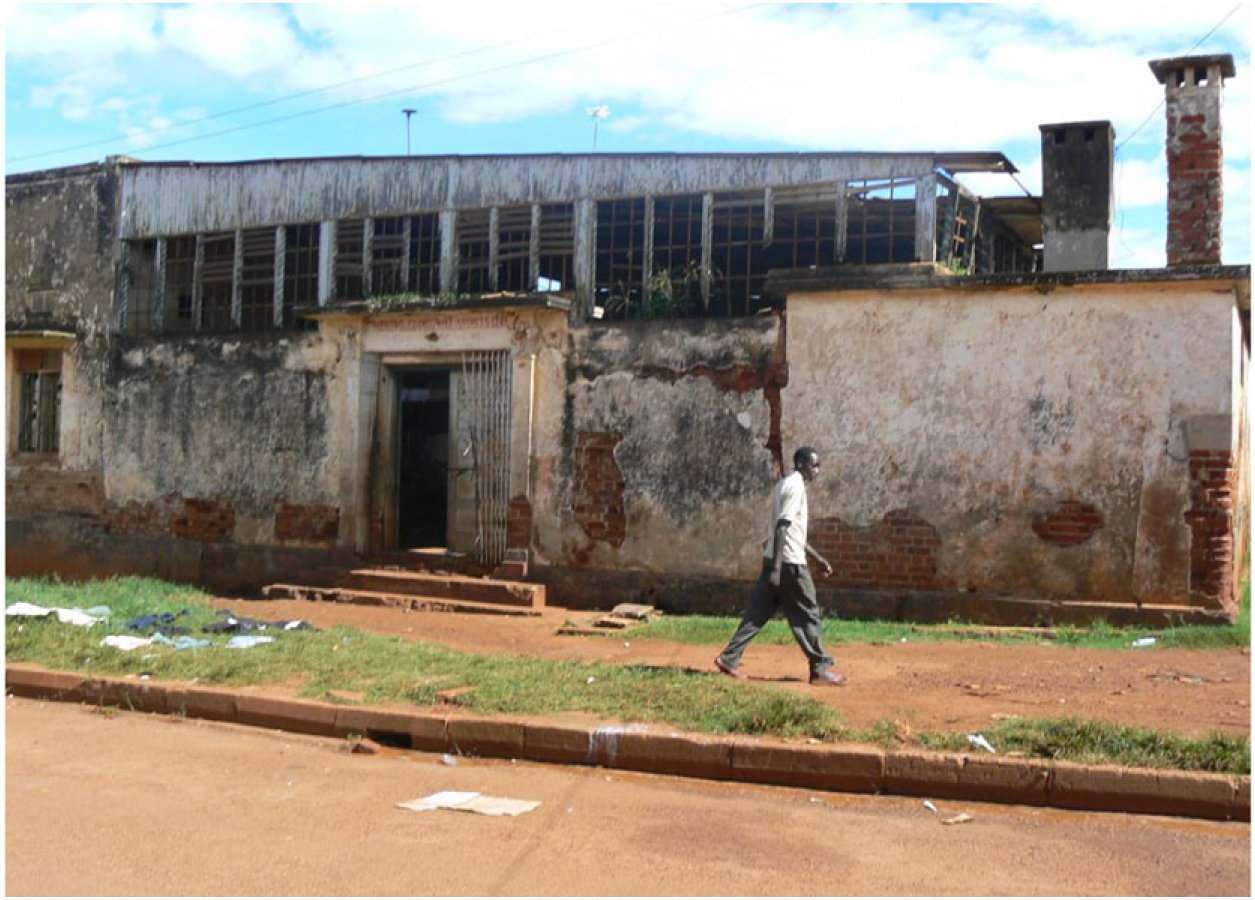
Un-repossessed Asian property that serves as an evening church fellowship and sports club for individuals from the Basoga community in Jinja town.
Indeed, by simply walking the city in Kampala or in any other historic trading center in Uganda, one finds it possible to read the legacy of 1970s Africanization policies in the built environment and on the urban landscape. These landscapes are loud, rather than silent. Many of my interviewees, when at a loss for words about the past, could show me their family homes and compounds, take me on a driving or walking tour of the city, and point out to me the places where they worked, went to school, prayed, played sports, went dancing, watched films, and socialized. These walking practices, which included profound moments of stillness and quiet, followed by observations and commentary, was central to conceptualizing the embedded nature of violence in everyday lived practices of habitation in urban space. Indeed, to borrow from Michel de Certeau, “the act of walking is to the urban system what the speech act is to language or to the statements uttered.” Walking, in Kampala, served a certain enunciative function in relation to the limit of language and articulation of violence itself (de Certeau, 1984: 97; Das, 2007).
In my conversations with them, several interlocutors explained the pragmatic aspects of property expropriation and repossession, detailing the complex and nuanced “afterlives” or “multiple lives” of properties. For example, old Indian dukan (wholesale shops) were usually transformed into something else after they were appropriated in 1973—larger shops with more warehouse space were partitioned into four or five smaller units that were rented by Africans who became the next generation of small-scale traders (Figure 3). Large commercial properties in Old Kampala often bore the names of Muslim entrepreneurial families who had allied themselves with the regime, benefited from the expulsion, and received property allocations (Figure 4). Formerly racially segregated schools were now mixed-race and multi-national schools, where Indian, Pakistani, and Baganda children studied with children from Ethiopia, Sudan, and Somalia. Some Ugandan Asian communal properties had become institutions that were rented by community organizations and served indigenous African communities, other Ugandan Asian communal and religious properties continued to serve new South Asian migrant communities, and some Ugandan Asian elites who had profited from the repossession process were tearing down old properties and constructing modernist commercial and rental properties for expatriates and corporates (that other nostalgic Ugandan Asians, who enjoyed the older Asian aesthetic styles, complained about!). The KCCA has most recently issued local government ordinances that any “left-over” properties in the current possession of the government will be torn down and slated for redevelopment in keeping with the larger development vision of the city. In response, community organizations like the Asian African Association are increasingly interested in initiatives surrounding the historical preservation of colonial-era Asian properties in Uganda before they are completely gone.
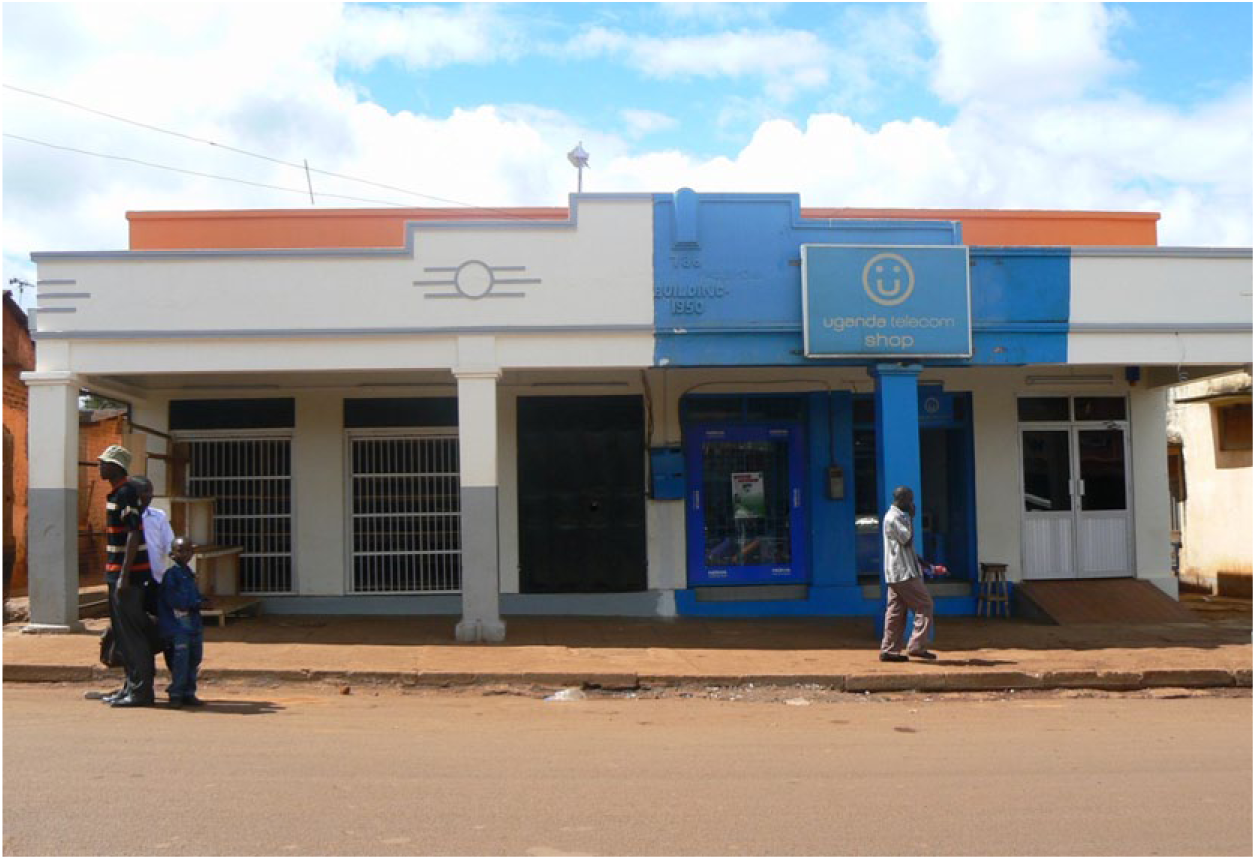
Former Indian wholesale shop (dukan) that has been partitioned into several commercial spaces for rent in Jinja. The property has likely been repossessed and maintained by the original Asian owners or has been transferred to new ownership.
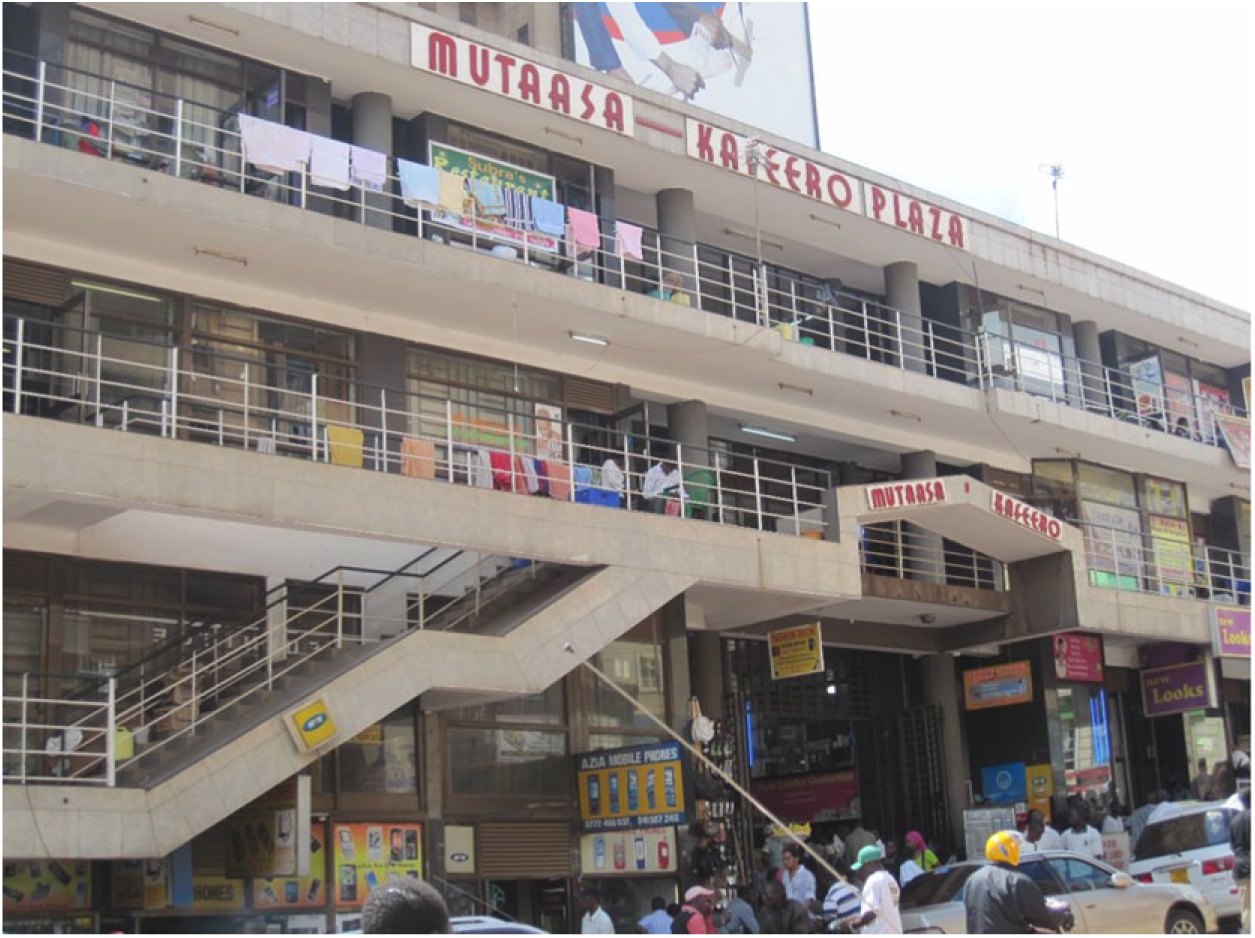
The Mutaasa-Kafeero commercial mall complex in Kampala. The Kafeero family is an important Ugandan Muslim entrepreneurial family that specializes in property development and that benefitted from the Amin regime.
Conclusion: The past, present and future of 1970s Africanization
The material discussed above—the construction and mobilization of official state narratives of Amin’s Economic War and his attendant project of Africanization and Asian de-racialization of the nation, the populist and collective social memory practices surrounding the expulsion in contemporary urban Ugandan publics, the 2013 public forum on “Lessons of the Asian Expulsion,” expressions of patriarchal masculinity among Ugandan Asian men who continue to inhabit and claim “de-racialized” landscapes and urban space, in the both past and present, and the histories of Asian property expropriation and repossession that haunt urban landscapes—all of this evidence provides complex and heterogeneous evidence for thinking about the 1972 expulsion as a “critical event” and an ongoing “living history” in Uganda, East Africa, and Africa. In addition, using anthropologist George E. Marcus’s call for a “multi-sited ethnography” both “in and out of the world system” (1995: 95), I suggest that assembling evidence from multiple urban sites, events, and moments provided the lenses from which I could study the ongoing politics and legacy of the expulsion and attend to subaltern voices, subjectivities, practices and positionalities during field research. Indeed, multi-sited urban ethnography is an effective methodology in the context of ongoing state violence and state repression surrounding past atrocities, the intense mobility and transnational character of Ugandan Asian returnee and new South Asian informal migrant communities, and cross-racial community anxiety surrounding the past and present of urban race relations and economic inequality. In fact, to understand the affective quality and texture of 1970s state violence in Kampala today, I suggest that nuanced multi-sited urban ethnography is the most effective methodology for the anthropologist.
In addition to providing an effective multi-sited urban ethnographic method, this paper suggests that the 1970s is an unresolved historical era and continues to be the basis of political work, political anxiety, and political claims about the possibility of multi-racial and plural Ugandan futures. Ideologies of “1970s decline” and the “anti-developmental” nature of the expulsion are mobilized by the central state to impose neoliberal economic urban governance on citizens and residents of Kampala, often inculcating a consumer-oriented urban citizenship among indigenous Ugandans, foreign investors, returnee Ugandan Asians, expatriates and new informal migrants, traders and merchants. 1970s decline, then, is inextricably related to futurist and modernist imaginaries of an economically productive, developed, and cosmopolitan Uganda that is borne out of both an illiberal and neoliberal governance ethos, rather than through the state’s formal political inclusion of racialized “Others” through democratic, liberal citizenship. Some further questions to consider: to what extent is the Uganda case generative? Does the unresolved status of the 1970s (including its baggage of Afro-pessimism, decay and decline), and its urban re-signification with new kinds of political meanings in relation to neoliberal economic globalization speak to broader contexts across the continent? To other postcolonial contexts? This will require further comparative work from other scholars of postcolonial Africa working on this period.
It is also clear that epistemologies of 1970s Ugandan decline, decay, and crisis have overshadowed alternative cultural and social formations that were shaped in this decade and that continue to inform contemporary claims for belonging, as the case of Ugandan Asian men who lived under the Amin regime illustrates. The decade is also subject to debate and contestation through the formation of emerging urban counter-publics. The public forum on the possibility of an impending “second expulsion,” in addition to debates about the histories and futures of expropriated and/or re-possessed Asian property illuminate the spaces and places in which counter-narratives and counter-memory may inform a critique of the violence of the national development project. Other urban counter-publics in Kampala, of course, include the realm of arts, aesthetics, and other kinds of cultural production—which I have not addressed in this analysis.
While this paper has been limited to the study of the political mobilization and popular reflection on the 1972 Asian expulsion in Uganda today, it is clear that new venues for debating the past via social media and internet blogs are becoming increasingly relevant outside of Uganda. These forums serve the indigenous Ugandan African and Ugandan Asian diaspora that fled Uganda during the 1960s–1980s (Ugandan exiles and their children, as well as East Africans in general). Moving beyond the nation-state paradigm adopted in this paper, which entails working through the rather authoritative and repressive environment within which individuals continue to forge claims for belonging and residence in Uganda (and outside of the legal-juridical structures of formal, liberal citizenship), I plan next to consider the claims that are articulated by the larger diasporic and global community of individuals engaged in conversations about 1970s Uganda. In doing so, I hope to expand our imaginations of political citizenship, community and belonging beyond nation-state boundaries. Instead, it will be important to consider the ways in which the African/African-Asian diasporic community continues to inform ideas of Ugandan political community (and vice versa), and to examine the world in Africa and Africa in the world.
Footnotes
Declaration of Conflicting Interests
The author(s) declared no potential conflicts of interest with respect to the research, authorship, and/or publication of this article.
Funding
The author(s) disclosed receipt of the following financial support for the research, authorship, and/or publication of this article: The National Science Foundation SBE Doctoral Dissertation Improvement Grant (2008-2010) and the Wenner-Gren Dissertation Fieldwork Grant (2008-2010) funded portions of this research.