



Abstract
Since Ghana’s independence in 1957, political corruption has been a significant problem impeding the development of the country. Based on primary and secondary data, this article argues that grand corruption such as Ghanaian political corruption mainly stems from a complex interplay of greed, opportunities grounded in monopoly power, and weak deterrent systems. Hence, uncontrolled political corruption is primarily a product of consistent political leadership failure to aggressively regulate greed, reasonably limit political power, and effectively strengthen the public-sector accountability structures. To help address political corruption, major stakeholders, particularly the political leadership, should critically analyze the legal regime, power structures, and deterrent mechanisms to remove opportunities for political corruption through effective checks and balances, surveillance, and sanctions. This paper makes theoretical and empirical contributions to understanding and tackling political corruption generally.
Introduction
As grand corruption such as political corruption tends to undermine democracy, inclusive development, environmental security, and human rights and freedoms, many countries and inter-governmental organizations, including the United Nations, have committed to addressing this problem (African Union, 2004; Ki-Moon, 2009; Klitgaard, 1988; UN, 2003). Inter-governmental conventions against corruption that member states have ratified demonstrate this general commitment to fighting political corruption (African Union, 2004; United Nations, 2003). Despite these national and international efforts at curbing corruption, as the Transparency International (2018) reports indicate, little or no progress has been made, particularly in developing countries such as Ghana.
Several explanations for the failure of some developing countries to make any progress in tackling political corruption have been advanced (De Graaf, 2007). While scholars argue that cultural practices and orientations promote political corruption (Barr and Serra, 2010; Sankoh, 1999), other researchers dispute such culturally based explanations (Pellegrini and Gerlagh, 2008; Rothstein, 2011). Because political corruption pervades every society (Klitgaard, 1988; Mbaku, 1999; Rose-Ackerman, 1999; Stapenhurst and O’Brien, 2000; Transparency International, 2018), cultural orientations cannot be an important explanatory factor if checks and balances are strictly enforced or implemented.
Other scholars also argue that colonialism and ongoing forms of imperialism are responsible for political corruption in postcolonial countries (Ezeanya, 2012a, 2012b; Lanre and Olabisi, 2013; Khapoya, 2012). Some postcolonial perspectives suggest that colonialism and new forms of imperialism, such as the forces of neoliberal global governance emphasizing individualism, have significantly continued to erode the African indigenous crime control mechanisms grounded in communal spirit (Gyekye, 1997, 2010; Ochieni and Nwankwo, 2012). Postcolonial perspectives do not, however, rationalize the continued failures of previously colonized sub-Saharan African countries to fight political corruption. Instead, postcolonial perspectives require postcolonial African leaders to assert their responsibility in addressing political corruption rather than perpetuating it.
In addition to cultural and external factors, governance-based explanation of political corruption holds that the monopolization of political power and the exercise of discretionary powers in the wake of weak deterrence produce opportunities for political corruption (Klitgaard, 1988; Mungiu-Pippidi, 2013a). Governance explanations thus focus on weaknesses in established systems, laws, policies or procedures intended to achieve specific objectives, such as accountability. This explanation, however, fails to elucidate situations in which people with opportunities for committing corruption without the possibility of being punished if caught may not end up indulging in political corruption.
Another important explanation for political corruption that is often ignored is greed. This greed-based explanation suggests that most postcolonial African politicians come to power with a primary motive of obtaining illicit capital accumulation via diverting national resources for private use at the expense of the masses (Mafukata, 2015; Wrong, 2009). Unlike petty corruption, which may be driven by need, grand corruption is mostly motivated by greed (Mafukata, 2015; Transparency International, 2015). This grand corruption encompasses all “acts committed at a high level of government that distort policies or the central functioning of the state, enabling leaders to benefit at the expense of the public good” (Transparency International, 2015: 3). Political corruption is a typical form of grand corruption. As intended in this article, political corruption involves “a manipulation of policies, institutions and rules of procedure in the allocation of resources and financing by political decision-makers, who abuse their position to sustain their power, status and wealth” (Transparency International, 2015: 3). Although greed is a critical explanation for this political corruption, it is not sufficient in itself to explain the weak structures of governance that permit top government officials and their allies to execute their selfish agenda without typically facing the full rigors of the law.
Given the limitations of using a single explanatory perspective for political corruption, as the current study confirms, an integrated approach can provide a nuanced and in-depth explanation for grand corruption such as political corruption. Integrating and expanding on theoretical insights, particularly by Klitgaard (1988) and Mungiu-Pippidi (2013a), this article, therefore, proposes an integrated approach, granturation, for explaining grand corruption such as persistent Ghanaian political corruption. This proposed granturation holds that grand corruption such as persistent political corruption primarily stems from the interaction and the extent of three main critical factors: (a) greed; (b) opportunities embedded in monopoly and discretionary (political) powers; and (c) a weak deterrent system. Although explanations for grand corruption by Klitgaard (1988) and Mungiu-Pippidi (2013a) cover corruption opportunities embedded in monopoly and discretionary powers and weak deterrence, they fail to include (the political leadership) greed. As incorporated into the granturational framework, this article argues that the magnitude of political leadership greed is another critical factor that explains the level of motivation or political will for fighting political corruption, particularly in developing countries such as Ghana. Based on this proposed framework, this article addresses one research question: “What accounts for the persistent political corruption in Ghana’s fourth republic?”
The focus on Ghana is driven by several factors. First, no recent in-depth study has examined political corruption based on the proposed three-pronged approach. Second, as an exemplary microcosm of democracy in sub-Saharan Africa (Kpodo, 2012; Woodward, 2009), understanding the significant drivers of political corruption in Ghana is likely to provide some useful insights into the relationship between grand corruption and democracy. Finally, given the growing anti-corruption civil society groups (Global Integrity Report, 2016) that are considered critical to the anti-corruption efforts (Mungiu-Pippidi, 2006, 2013b), Ghana provides an insightful case for explaining the country’s high-profile political corruption scandals.
In examining the explanatory factors of persistent political corruption, this article provides background information about Ghana and discusses the proposed granturation and methods. Finally, it critically analyzes how greed, opportunities, and weak deterrence fuel the persistent Ghanaian political corruption and also presents conclusions. By investigating factors driving political corruption, this article makes theoretical and empirical contributions to understanding and effectively fighting political corruption, particularly in the case of Ghana.
Background
South of the Sahara, Ghana became the first African country to gain independence from the United Kingdom on 6 March 1957. The country shares land borders with Togo, Burkina Faso, and Ivory Coast. The country’s current population is estimated to be 29,375,668 (World Population Review, 2018). Agriculture, which is the backbone of the country’s economy, employs approximately 60% of the population and contributes 40% to the GDP (Ghana Statistical Services, 2012). Ghana’s major exports include gold (US$9.7b), cocoa beans (US$2.4b), crude petroleum (US$1.15b), and coconuts, Brazil nuts, and cashews (US$1b) (Observatory of Economic Complexity, 2016: 1).
Since independence, Ghana has had a chequered political history because of military takeovers. Corruption has been one of the major catalysts for these military takeovers. In 1979, for example, the Armed Forces Revolutionary Council, led by Flight Lieutenant Jerry Rawlings, successfully organized a coup d’état. This military council then executed on corruption charges three former heads of state—Fred William Kwasi Akuffo, Ignatius Kutu Acheampong, and Akwasi Amankwa Afrifa—and five top military officers (Asah-Asante and Brako, 2014). Political corruption, however, has characterized almost every form of political arrangement—whether democratic or military rule—which Ghana has witnessed since independence in 1957 (Government of Ghana, 2017). Ghana has struggled to tackle corruption because the country loses an estimated amount of US$4b to corruption annually (Ofori-Atta, 2017). The 2014 Afrobarometer survey report also shows that 76% of respondents argue that political corruption has increased while 71% indicate that the government has performed poorly in fighting political corruption in the country (Armah-Attoh, 2014). As discussed, this article argues that persistent political corruption is attributable to the intersection of three main factors: greed, opportunities, and weak deterrence.
Theoretical framework
As discussed, the proposed granturation emphasizes the interaction of three principal factors—greed, opportunities, and weak accountability—in explaining grand corruption such as persistent political corruption in Ghana. As Figure 1 shows, the intersection of these factors gives rise to a lack of strong political will needed to institutionalize and implement concrete measures to tackle political corruption.
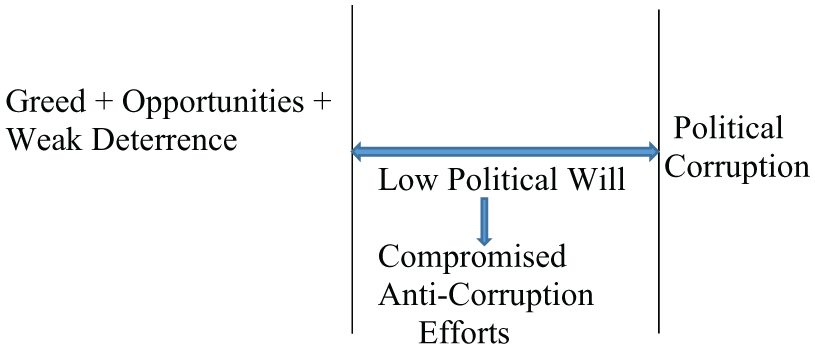
Granturational framework.
As used in this paper, greed emphasizes the principal motive for the pursuit of political power or office by some top government officials—that is, accumulating illicit wealth, securing political power, and building prestige and status at the expense of the public good. In sub-Saharan Africa, research evidence indicates that political elites typically seek power to promote opportunities for themselves and their allies, such as securing illicit enrichment rather than deepening democracy and fostering an inclusive socio-economic development (Mafukata 2015; Otusanya, 2011; Owoye and Bissessar, 2014; Wilson, 2014; Wrong, 2009). In Kenya, Wrong (2009), for example, offers a classic analysis of how political elites’ intent to plunder national resources propels them into politics. Under the pretext of being politicians or party financiers, some criminal networks have infiltrated postcolonial African party politics (Mafukata, 2015; Mashele and Quobo, 2014). Thus, greed is one of the critical pre-conditions for the continuous occurrences of political corruption.
In addition to greed, opportunities and weak accountability emphasize institutional and regulatory weaknesses, which create incentives for political corruption because of the compromised deterrent system to regulate greed (Klitgaard, 1988; Mungiu-Pippidi, 2013a: 28). Klitgaard (1988) rightly argues that corruption mostly thrives in situations where officials or entities enjoy monopoly or discretionary powers over the distribution of scarce resources without an accountability system to keep them in check. This theoretical insight calls attention to the opportunities for corruption via the exercise of monopoly and discretionary political powers and lack of properly functioning accountability structures. Similarly, Mungiu-Pippidi (2013a) argues that the level of prevailing corruption depends on the degree of opportunities available and the nature of deterrents (both legal and normative) in place. Mungiu-Pippidi (2013a) adds that opportunities typically stem from the availability of material resources to misappropriate, poor regulations that create the monopoly and discretionary powers, and “any other resources which can be used and abused, turned into spoils or generate rents” (Mungiu-Pippidi, 2013a: 28).
Like Klitgaard and Mungiu-Pippidi’s theories of corruption, the crime opportunity theory points to the critical role of opportunity in the commission of a crime (Clarke, 2012; Clarke and Cornish, 1985). This crime opportunity theory holds that crimes, such as corruption offenses, cannot occur unless the potential offenders have the chance to indulge in such illegal acts. Another example of the sources of opportunities for political corruption is the politicians’ and top-level government officials’ privileged access to information that potentially erodes timely chances of detecting their acts of corruption (Klitgaard, 1988).
Aside from the opportunities for political corruption, a weak deterrent system emboldens actors interested in engaging in corruption to do so without any fear of being held to account. The mechanisms of deterrence have both legal and normative dimensions (Mungiu-Pippidi, 2013a). The legal deterrents comprise “an autonomous, accountable and effective judiciary able to enforce legislation, as well as a body of effective and comprehensive laws covering conflict of interest and enforcing a clear public-private separation” (Mungiu-Pippidi, 2013a: 28). Normative deterrents, in contrast, encompass general societal norms supporting “public integrity and government impartiality, and permanently and effectively monitoring deviations from that norm through public opinion, media, civil society, and a critical electorate” (Mungiu-Pippidi, 2013a: 28).
The formal deterrents depend on the appropriateness of anti-corruption laws and the credibility of the judiciary system and the law enforcement to investigate, prosecute, convict, and impose the right sanctions fairly and equally to all manner of persons without fear or favor. This formal legal deterrence, however, can be weakened by political interference, slowness of court proceedings, lack of enforcement of court decisions, failure to prosecute and sanction corruption offenses appropriately, and corruption in the law enforcement agencies (García-Quesada et al., 2015; Hope, 2013; Klitgaard, 1988; Mungiu-Pippidi, 2013a). Mungiu-Pippidi, (2013a) argues that the societal deterrence, on the other hand, encompasses the public shaming of individuals and entities linked to corruption offenses, and the existence of a strong coalition that consistently demands political accountability and the rule of law. This societal deterrence also includes the ability of the citizenry to impose electoral discipline on corrupt governing political elites and their parties. In summary, the interplay of greed and opportunities activates and perpetuates the commission of political corruption in contexts where the chances of detection and the odds of imposing severe sanctions in the event of exposure are unusually limited.
Methods
As previously indicated, this paper sets out to critically examine the factors responsible for the continued political corruption in the Ghanaian context and to propose measures needed to address this social canker. In explaining the three main discussed conditions fueling persistent Ghanaian political corruption, this article uses both primary data from in-depth interviews and relevant secondary data, particularly media reports on political corruption, to provide a comprehensive and nuanced analysis. Following ethics approval for this study by the University of Saskatchewan Behavioral Ethics Committee, 25 semi-structured, in-depth interviews were conducted in Accra (Ghana) between 29 September and 12 December 2017. The participants 1 in this study included renowned academics (N = 5), anti-corruption activists (N = 2), politicians from both governing and opposition parties (N = 4), and journalists (N = 10), as well as ordinary students (N = 4) who met the inclusion criteria. These categories of participants were chosen because of their roles, expertise, and experience in the subject matter of this research.
The semi-structured interview was chosen since it affords participants the freedom to articulate their views and experiences about the research topic while allowing the researcher the opportunity to further probe relevant emerging issues (Creswell, 2013; Merriam, 2009). Aside from the primary data, relevant secondary data obtained from several sources, particularly Ghanaian private media reports, provided further information to assess the relevance of the proposed theoretical framework in explaining uncontrolled Ghanaian political corruption.
As informed by the proposed granturation, the NVivo 11 Pro software was used to code both the secondary and primary data into three themes, namely political leadership greed, opportunities for political corruption, and weak deterrence, all of which are discussed in turn.
Political leadership greed
The intent of politicians to win and consolidate political power as a strategy to improve their social standing and to acquire wealth manifests itself typically in the way they misappropriate public resources and control the provision of public services to their advantage. Participants in this study confirmed this political leadership greed. One interviewee, a leading member of the ruling New Patriotic Party, put it this way: The executives are family and friends and they are sharing. They are seriously sharing national resources. They will go, and another one will come. And unfortunately, we have only two main parties always positioned for power, and it is always family and friends, as a cartel, always come together, steal and go, and another will come. (Kwame, 31 October 2017)
Similarly, another academic in this study provided the following insights: Winner-takes-all politics is the practice of state capture and the partisan monopolization of resources, power, and opportunities by the ruling party and its cronies to the exclusion of all other Ghanaians who do not belong to the ruling party. And it [winner-takes-all politics] creates in the mind of people it is our government that has come, and it is our time to chop [or to enjoy]. That is the problem. (Fosu, 6 November 2017)
These interview extracts provide evidence of the leadership greed that has characterized successive Ghanaian government regimes.
The greed among the political leadership is most evident in the diversion and stealing of funds released for state projects and programs. Classic examples include (a) the Savannah Accelerated Development Authority (SADA), which the Government of Ghana established in 2010 to narrow the poverty gap between the three main northern regions; and (b) the Ghana Youth Employment and Entrepreneurial Development Agency (GYEEDA) created in 2006 to help address the teeming Ghanaian youth unemployment. These programs became channels for political elites overseeing the projects to siphon public money unlawfully for private use (Awuni, 2016). In the case of GYEEDA, for example, it was estimated that US$317m was lost through this scandal (Asiamah, 2014). These two cases exemplify the successive Ghanaian political leadership greed undermining their commitment to anti-corruption efforts in the country.
Another dimension of the political leadership greed can be seen in cases in which the state pays monies for non-existing contracts to companies belonging to people connected to the corridors of political power. A classic case involved one Alfred Agbesie Woyome, a financier of the then ruling National Democratic Congress, who received an illegal payment of approximately US$12m for a non-existent contract between 2009 and 2010 (Gadugah, 2014). Although the Supreme Court of Ghana in 2014 had ruled that the payment was unlawful and ordered Alfred Agbesie Woyome to refund the money, records show that the state has failed to recover the money since powerful political actors allegedly benefited from this deal (Class FM, 2017).
Greed also manifests itself in how state contracts are deliberately inflated. The recent Social Security and National Insurance Trust (SSNIT) scandal involving the overpriced US$66m software contract is a classic example. This contract awarded to Perfect Business Solutions Limited to automate the operations of this state agency demonstrates the regular occurrences of inflated state contracts awarded under suspicious circumstances (Aseidu, 2017). Furthermore, district hospitals were being constructed at the inflated value of US$25m during the erstwhile National Democratic Congress administration. In contrast, a comparative analysis 2 of the same or similar projects carried out by other entities, such as the African Development Bank, cost less than US$6m (Nunoo, 2018).
Additionally, greed is the primary reason political functionaries mostly ignore measures that are likely to protect the public purse. In Ghana, many unwarranted and overly inflated sole-sourced contracts have been signed when competitive bidding would have helped reduce the wastage of state funds (GhanaWeb, 2018a). Ghana’s district assemblies’ waste bin contracts are typical examples of unjustified sole-sourced contracts since these contracts failed to meet the criteria for sole-sourcing (Joy FM, 2017). In addition, government officials have consistently outsourced inflated contracts for projects that state agencies can properly execute. An investigative journalist explained it this way: Projects which can be handled by a state department are outsourced. They call it a private-public partnership. But I call it a private-public plundering. They create, loot and share what belongs to all of us. And the impunity with which they do this is frightening. (Awuni, 2014: 1)
This narrative suggests that the motive behind this unwarranted outsourcing is the private gains that the awardees obtain in return for signing these contracts.
Apart from these inflated and unwarranted sole-source contracts, the failure of successive governments to pass the right to information bill into law in nearly two decades supports the claim that they use their privileged access to information as one strategy for protecting their vested interests. Being a signatory to both the African and United Nations’ conventions against corruption (African Union, 2004; UN, 2003), Ghana is required to have passed this bill as part of the preventive measures to fight political corruption. Despite the persistent pressures from the citizenry and civil societies (Institute of Economic Affairs, 2018), Ghana’s failure to legislate and implement the right to information law demonstrates that the political leadership is not committed to fighting corruption because of one reason: greed.
These findings are consistent with previous studies (Gray, 2015; Jarso, 2010; Mafukata, 2015; Otusanya, 2011; Wrong, 2009). Government officials and their collaborators were the masterminds behind the infamous Golden Affair scandal in which Goldenberg International was deliberately paid for a non-existent gold and diamond jewelry export contract. This contact cost Kenya about US$850m (Jarso, 2010: 60). In Tanzania, state officials and a business firm were involved in a political corruption scandal amounting to US$122m (Gray, 2015). Gray (2015) thus provides another typical example of the role of political leadership greed in perpetuating political corruption. In Kenya, Wrong (2009) emphasizes the greedy mindset of most politicians who seek power to serve their interests. According to Wrong (2009), these politicians consider access to political power the fastest route for illegal wealth accumulation at the expense of the general public. As manifested in the misappropriation of public resources and control of services, this political leadership greed partly explains the low political commitment to fighting political corruption.
Opportunities—monopoly and discretionary powers
The opportunities for political corruption depend on the extent to which the laws and regulations create the monopoly and discretionary powers exercised by political functionaries in allocating scarce national resources to advance their parochial interests. In this study, research participants confirmed the excessive concentration of power in the executive arm of government, creating problems for addressing political corruption, because of limited checks and balances. One participant, a renowned media practitioner, expressed his frustrations with the constitution: The constitution has given the executive president every power to do whatever he/she wants, and I believe that it is a bigger problem. For instance, any political party that comes into power sacks almost everybody who heads a public institution and replaces almost everybody. So our laws must be amended to suit societal interests because without doing that, I think we will be fighting a lost battle. (Osei, 9 November 2017)
If implicated in political corruption, the executive arm of government is so powerful and partisan that they would not usually prosecute their party members, relatives, and cronies.
The executive’s monopoly over the state prosecutorial powers has culminated in the politicization of the state security and law enforcement sectors, including state anti-corruption agencies, because the president appoints party loyalists to head almost every public institution. In Ghana, the state Attorney General’s Department is part of the Ministry of Justice, which is under the direct control of the executive arm of government. A female academic explained it this way: We need to have a Minister of Justice, which is part of the executive, separate from the state Attorney General that should be somebody who should spring up from the legal system. If not, we may have problems because it is the same person [a member of the executive], and he will be hesitant. (Agyeiwaa, 10 November 2017)
This lack of independence of the Attorney General’s Department has impeded the fight against political corruption in the country.
The secondary data also confirm the executive body’s manipulation of the law enforcement agencies to shield politicians involved in political corruption scandals from prosecutions and sanctions. As a result, many people and civil society organizations have expressed concerns about the extensive powers that the 1992 Constitution grants to the executive arm of government, weakening the state accountability system (GhanaWeb, 2016). One former Minister of State for economic planning and regional integration, Dr Paa Kwasi Nduom, for example, has argued that the executive president wields so much power that he can do anything he so desires (GhanaWeb, 2016). As the literature shows, the exercise of monopoly and discretionary political powers typically creates opportunities for political corruption to flourish by undermining effective accountability in tackling corruption offenses because of imbalances in political powers (Klitgaard, 1988; Mungiu-Pippidi, 2013a; Mutebi 2008; Rose-Ackerman, 1999; Wrong, 2009).
The legislature is also ineffective in performing its constitutionally mandated oversight functions over the president, whom members of parliament lobby for ministerial appointments (GhanaWeb, 2016; Prempeh, 2016). Since most ministers of state are the same people sitting in parliament approving typically everything coming from the executive body, the legislature has become an appendage of the executive body. As the legislature tends to serve party interests at the expense of public good, this partisanship limits the legislature’s power in performing its oversight responsibilities. Given that the majority of members of parliament often come from the same political party that is in power, they tend to vote based on party lines to protect their political party interests. Because of this symbiotic, partisan relationship between any ruling party and its majority of parliamentarians, the president of the ruling party exercises enormous political and discretionary powers, providing opportunities for Ghanaian political corruption to blossom because of weak accountability. This finding supports previous studies (Adebanwi and Obadare, 2011; Mafukata, 2015; Stapenhurst and O’Brien, 2000; Wrong, 2009). Mafukata (2015) and Stapenhurst and O’Brien (2000) demonstrate that the over-concentration of power in the executive arm of government weakens adequate checks and balances, resulting in the unlawful personalization of national resources by top government officials.
Deterrence—responses to political corruption
As previously discussed, the deterrence system has both formal and informal components (Mungiu-Pippidi, 2013a). Based on the nature of laws and regulations, institutional procedures, and sanctions, and the extent to which these are enforced to ensure deterrence, the formal legal deterrent mechanisms can be analyzed. Ghanaian corruption offenses are classified as misdemeanors. Because misdemeanors carry less punishment than felonies, their deterrence effect is negligible. Section 239 of the Criminal Offences Act confirms that corruption offenses are considered to be misdemeanors, not felonies: 1) A public officer or juror who commits corruption, or willful oppression, or extortion, in respect of the duties of the office, commits a misdemeanor. 2) A person who corrupts any other person in respect of duty as a public officer or juror commits a misdemeanor. (Government of Ghana, 1960: 86)
Reclassifying corruption offenses as felonies might help address corruption in Ghana. Although Ghana categorizes corruption as a misdemeanor that is subject to a maximum imprisonment term of 25 years (Section 296(5) of the Criminal and Other Offences Act 30 3 ), anti-corruption analysts argue that corruption should be categorized as a felony (Duodu, 2017). Re-categorizing corruption as a felony rather than a misdemeanor may, however, have little deterrent effect if the government fails to implement other anti-corruption measures. These measures may include reducing monopoly and discretionary powers and creating a capable surveillance system to detect acts of corruption (Clarke, 2012; Klitgaard, 1988; Mungiu-Pippidi, 2013a).
Aside from classifying corruption offenses as misdemeanors with little deterrence, Ghanaian political corruption is a low-risk venture because anti-corruption laws are typically not implemented. One male academic said the following: Because we have made it [corruption] a low-risk thing, until such time that we will make it a high-risk enterprise that when you are caught, the law will deal with you, I think corruption will be very difficult to fight. (Takyi, 21 November 2017)
One female student participant explained it this way: The government in power often do not deal with government officials whose alleged corrupt practices have been exposed. The government often attempts to shield its corrupt officials. The government will say that they are investigating the issue and they will later come out to say that there is not enough evidence to prosecute the alleged corrupt officials. (Ama, 2 November 2017)
Participants confirmed that political operatives implicated in acts of political corruption are typically not prosecuted, resulting in perpetuating the political corruption.
Although retrieving stolen public resources is significant, the practice of asking corruption offenders to refund stolen monies without also facing custodial sentences has turned political corruption into a low-risk crime. One female academic provided the following insights: The problem is enforcing the law—that is, prosecuting people for wrongdoing. If you do that if a few people spend time in jail…but what happens is that you let them pay when they’ve stolen. When you let them pay when they have stolen, there is every incentive to steal because the chances that they would be caught are slim and if they are caught is worth the risk, because you know all they have to do is to pay back. (Dzifa, 26 October 2017)
Corruption offenses can be made a high-risk crime by making offenders face the full rigors of the law without any considerations or favors.
The findings show that successive Ghanaian governments have failed to properly investigate and prosecute political operatives who have allegedly committed acts of corruption. These findings support past research that indicates that the big fishes involved in political corruption are mostly exonerated from prosecutions and appropriate sanctions because of their access to the corridors of political power (Gray, 2015; Hope, 2013; Mafukata, 2015; Wrong, 2009). As the literature indicates, without prosecutions and sanctions—the enforcement component of the anti-corruption framework—to serve as deterrence, the fight against corruption will continue to be a mirage (African Union, 2004; Klitgaard, 1988; Mungiu-Pippidi, 2013a; United Nations, 2003; Wrong, 2009). Rational-choice theory (Clarke and Cornish, 1985; Clarke, 2012) rightly suggests that the decision to be corrupt is based on whether potential benefits outweigh the potential costs. As a result, making the potential cost exceed the likely benefits from engaging in acts of political corruption by increasing the detection rate through surveillance, prosecutions, and severe sanctions is critical in fighting political corruption.
Aside from the formal accountability system, the normative forms of deterrence can be seen in the public display of tolerance or disapproval of political corruption and citizens’ pressures for government accountability (Mungiu-Pippidi, 2013a). In this sense, the Ghanaian society has contributed to both (a) political corruption and (b) anti-political-corruption efforts to address the problem. The apparent breakdown of the Ghanaian moral fiber as manifested in the common acceptance of unethical and illegal behaviors and practices, including corruption, has partly contributed to political corruption by weakening deterrence at both individual and society levels (Aboagye, 2005; Ayee, 2016). As Ayee (2016: 65) argues, “Unethical practices have become a way of life in Ghana and are tolerated by the communities.” By extension, this high tolerance of unethically and illegally unacceptable practices such as corruption is seen in virtually all aspects of the contemporary Ghanaian society, such as traditional, religious, government, and non-governmental fields of social life. This situation has partly fostered Ghanaian political corruption.
There have also been instances where powerful traditional and religious leaders who are supposed to know better plead with relevant state authorities to stop investigating and prosecuting corrupt political elites (GhanaWeb, 2018b). This apparent support for and idolization of allegedly or convicted corrupt political elites by respected individuals and groups (ethnic, tribal, religious, geographic, political, educational, etc.) to which these elites belong encourage illegal practices, including political corruption. Ghanaians’ limited sense of national patriotism is partly blamed for the high political corruption in the country (Aboagye, 2005; GhanaWeb, 2017; Noonoo, 2018). Because of their wealth and power, at public functions in and outside churches, corrupt political elites are mostly appointed chairpersons, and they are also highly revered in Ghanaian communities (Anomah, 2018; GhanaWeb, 2018c; Noonoo, 2018). Hence, today, corruption has predominantly permeated every segment of Ghanaian society, such as traditional chieftaincy institutions and particularly religious bodies, which are supposed to provide a moral, ethical or religious training and guidance for the social collectivity. Without discouraging such tolerance of political corruption by a large section of Ghanaian society such as ordinary people and especially influential political, religious, and traditional leaders, the fight against corruption is likely to remain a mirage.
While sections of the Ghanaian society have contributed to political corruption, others have also helped in tackling it. Some Ghanaians have protested against uncontrolled political corruption (Citi FM, 2017; Laary, 2014). They have also imposed electoral discipline by voting out of power any governing political party perceived to be doing little to tackle political corruption. Despite the inducement of the electorates in the form of cash or kind by the sitting government to win national elections, Ghanaians have increasingly exercised their voting power to remove corrupt political elites and parties from power (Transparency International, 2018). Ghanaians have increasingly become critical of successive governments by demanding political accountability.
In addition to protests and electoral discipline, several influential individual citizens have fought against Ghanaian political corruption. One Mr Martin Amidu, a former Attorney General and Minister for Justice from 2011 to 2012, for example, has used his resources to pursue cases of political corruption involving business firms and government officials (Asomah, 2015). In 2014, Mr Amidu won some landmark cases for the state. In one of these cases, for example, the Supreme Court of Ghana asked Alfred Woyome, a financier of the National Democratic Congress, to pay back approximately US$12m wrongly paid to him by the state. To date, the state, however, has failed to retrieve this money (Asomah, 2015; Class FM, 2017; Gadugah, 2014).
The independent and free Ghanaian private mass media have also contributed to exposing political corruption with hardcore evidence, pressurizing governing political elites to take swift action in tackling the problem (Awuni, 2014, 2016). Responses from the successive governments, however, have been very discouraging. In this study, in most cases, participants confirmed that the government ignores the compelling evidence from such investigations and attacks the private media whose investigative work has exposed Ghanaian political corruption scandals. One male academic had this to say: In many cases, governments have mounted vigorous rebuttal and response against such reports and have used the party machinery and media that is favorable to the party or government to fight back. But in many times, many of the exposures have been ignored. (Gyan, 5 November 2017)
The state’s failure to act on evidence-based exposures of political corruption has primarily compromised deterrence among political operatives contemplating engaging in political corruption.
Like the independent private media pressing for political accountability by exposing political corruption, many civil society organizations have equally sprung up demanding that the government takes proactive measures in addressing political corruption by implementing the laws. Several non-governmental anti-corruption organizations, including the Ghana Anti-Corruption Coalition, Ghana Integrity Initiative, and the Occupy Ghana Movement, have pressurized recent governments to fight Ghanaian political corruption (Atitsogbi, 2015; Awuni, 2014). Although some anti-corruption organizations, such as the Committee for Joint Action, are politically affiliated, making them ineffective if their preferred political party is in power (Awuni, 2014), the above evidence still corroborates the presence of some normative Ghanaian accountability.
In summary, despite the increasing activities of the independent media, citizens, and civil society organizations intended to check political corruption, little success has been achieved because the problem continues to fester. One significant obstacle is that the main political parties that have alternated political power since 1992 are not committed to addressing the problem. Instead, they tend to do the same or even worse in committing acts of political corruption than their predecessors did. As observed in several African countries, including Kenya, Uganda, and Nigeria, because the political leadership fails to ensure adequate implementation of anti-corruption laws and strengthen deterrence, the fight against political corruption has mostly been unsuccessful (Abdulai, 2009; Hope, 2013; Sadiq and Abdullahi, 2013; Mbaku, 1999). Although the contributions of citizens and civil society organizations to anti-corruption reforms are crucial (Aderonmu, 2011; Mungiu-Pippidi, 2006, 2013b), this study shows that such efforts are less likely to yield significant results without strong leadership commitment to tackling political corruption. Although some Ghanaians have contributed to addressing political corruption, other individuals and Ghanaian group affiliations have also encouraged political corruption through their unquestioned celebration and acceptance (recognition) of political elites whose sources of wealth can be traced to political corruption (Anomah, 2018; Ayee, 2016).
Conclusions
This paper has argued that the interaction of greed, weak deterrence, and opportunities account for grand corruption such as the persistent Ghanaian political corruption. Although the establishment of the Office of the Special Prosecutor by the current New Patriotic Party administration is laudable, this office is facing a similar challenge confronting prior state anti-corruption bodies: weak political commitment to strengthening and resourcing these bodies in performing their constitutional mandate (Amidu, 2018). Based on this paper, several key arguments can be made. First, as previously discussed, uncontrolled political corruption mainly stems from a complex interplay of the magnitude of the political leadership greed, the nature of the deterrent system, and available opportunities grounded in monopoly and discretionary powers. The extensive powers of the president, the winner-takes-all orientation that political power is intended to serve the private interests of the governing party, and the weak structures to hold the political leadership accountable have culminated in perpetuating Ghanaian political corruption. The findings also indicate that successive Ghanaian governments have used their sweeping appointing powers to put their party cadres, friends, and family members loyal to them in important, strategic public positions, such as the state Attorney General’s Department. This constitutional arrangement cripples the public accountability system by strengthening the executive monopoly and discretionary political powers in creating opportunities for controlling public services and diverting national resources to serve private interests.
This monopoly political power combined with greed has significantly weakened the required political will to enact and implement proper anti-corruption laws to arrest Ghanaian political corruption. This paper highlights the inability of the state to properly regulate greed by institutionalizing and enforcing appropriate deterrent systems, thereby creating incentives for political corruption to thrive. This paper indicates the need to review the legal framework and seal the loopholes for political corruption by limiting monopoly and discretionary political powers and re-categorizing corruption offenses as felonies to help check political corruption. The non-partisan enforcement of the relevant laws via prosecutions and sanctions that follow due processes should be a critical component of serious anti-corruption efforts.
Second, although retrieving stolen resources is critical in anti-corruption efforts, this strategy should be combined with the imposition of long-term custodial sentences on people duly prosecuted and convicted of political corruption. This study shows that politicians found to have evidently engaged in acts of political corruption have typically escaped prosecution if they refund stolen resources or monies to the state. Because the chances of detection are slim, asking caught offenders to merely refund stolen monies may motivate most top government officials to indulge in political corruption since the potential benefits exceed the costs. The retrieval of all stolen resources from political corruption offenders should go hand in hand with deserving jail terms to serve as a meaningful deterrence to others contemplating committing acts of political corruption.
Third, although anti-corruption pressures from the civil society and the imposition of electoral discipline on successive governments are crucial, these pressures provide inadequate controls for political corruption if political parties vying for power are equally corrupt. This study demonstrates that, in the last two decades, anti-corruption efforts of citizens, civil society organizations, and free and independent private mass media have increased to check political corruption. There have also been media exposures of political corruption, demonstrations against political corruption, and the citizens’ resolve to advance electoral accountability by voting out of office corrupt political parties and politicians. Despite these developments, political corruption continues to fester because of the successive governments’ failures to back their anti-corruption campaign rhetoric with concrete actions. This finding re-echoes the criticality of leadership commitment to the success of anti-corruption efforts (Lowenstein, 2013; Mafukata, 2015; Wrong, 2009). The study also supports the argument that although normative accountability is significant (Mungiu-Pippidi, 2013a), it is an insufficient safeguard for controlling political corruption without a firm political commitment to impartially implementing anti-corruption laws.
The current study generally supports a similar work on grand corruption, such as political corruption (Klitgaard, 1988; Mafukata, 2015; Mungiu-Pippidi, 2013a). In particular, Mafukata (2015) provides a typical example of how the interaction of greed, opportunities for corruption arising from monopolization of political power, and a compromised accountability system has continued to fuel political corruption in sub-Saharan Africa.
Fourth, while sections of the Ghanaian society are positively contributing to efforts to fight political corruption, others are also worsening the problem (i.e. political corruption) via supporting, celebrating or recognizing corrupt political elites. This study suggests that the unquestioned respect and support that corrupt political elites receive from their admirers and particularly groups (ethnic, tribal, religious, geographic, political, educational, etc.) to which they belong have partly worsened Ghanaian political corruption. This finding reflects previous Ghanaian studies, suggesting that this unquestioned idolization of corrupt political elites is attributable to the general breakdown of the Ghanaian moral fiber as evidenced in limited patriotism and dishonesty or lack of strong integrity in public life (Aboagye, 2005; Agbodohu and Churchill, 2014; Ayee, 2016; Werlin, 1972). The current finding indicates the need for Ghanaians to stop celebrating, recognizing, respecting or idolizing politicians whose sources of wealth are (allegedly) traceable to political corruption.
This informal accountability can be strengthened by uncompromised formal deterrence, including giving duly convicted political elites community sentencing requiring them to perform services such as garbage collection in their political strongholds. Such “demeaning” community work can potentially neutralize the respect and recognition accorded to these corrupt politicians at both local and national levels. This approach may also deter future political corruption. For this measure to work, individuals, civil society organizations, the government, and all influential groups (ethnic, religious, political, geographic, etc.) should collectively desist from politicizing the fight against political corruption. In addressing political corruption, Ayee (2016) rightly emphasizes that education on ethics and ethical behavior in all institutions of learning, from primary to university level, should be vigorously pursued.
In summary, this paper indicates that persistent political corruption primarily stems from the consistent political leadership failure to aggressively regulate greed, limit power, and strengthen the accountability system. As a result, significant stakeholders, particularly the political leadership, should critically analyze the legal regime, power structures, and the institutions of accountability to remove or prevent opportunities for political corruption through proper checks and balances and the imposition of appropriate sanctions. It is a time that postcolonial African leaders and the people stopped attributing all our African woes to foreign forces, such as colonialism or more broadly imperialism, and find pragmatic ways of addressing our problems, not worsening them by, for example, perpetuating political corruption. In explaining and addressing grand corruption such as political corruption in Ghana and elsewhere, particularly in sub-Saharan Africa, future research is recommended to assess the generalizability or suitability of the proposed granturational framework.
Footnotes
Acknowledgements
I sincerely thank the editor and the anonymous reviewers for their time in reviewing this manuscript. I also thank my interviewees for their insights.
Funding
The author received no financial support for the research, authorship, and/or publication of this article.
Ethics approval
This paper used part of the data collected during my doctoral field research, which was approved by the Behavioral Research Ethics, University of Saskatchewan.
