



Abstract
In June 2012 the government of Ghana added 42 new districts to the country’s system of local governance. This paper measures the impact of one new district in terms of private wealth accumulation, access to public services and political engagement. Data analysed comes from a panel survey of residents of the new district capital and two similarly sized villages, one in the new district and one just outside. Proponents of government fragmentation promise personal, public and political gains when government is brought closer to the people. Evidence weighed here suggests that these gains are largely realized by residents.
Introduction
When the Talensi-Nabdam District was carved out of Bolgatanga District’s southern and eastern flanks there was tension. Talensi and Nabdam have been separate electoral constituencies since 1954 when the Gold Coast government allowed the North to vote for the first time. Nabdams grumbled that Talensi’s name came before theirs in the moniker and the district capital was placed in Tongo, a town within Talensi boundaries. Although the Nabdam (Nabt) and Talensi (Talni) languages are mutually intelligible, the pace and style of life in the two communities is indistinguishable to an outsider, and the two populations have little history of conflict and quite a bit of cooperation, prominent figures within Nabdam began agitating for a new arrangement. When President Mahama announced the creation of a new district situated in Nabdam in early 2012, it seemed the community’s prayers were answered. 1
Most Nabdams who argued in favour of a district to call their own had two justifications. There were cultural reasons – ‘we Nabdams are different from our Talensi brothers and sisters’ – although the stated substance of these differences varied tremendously from person to person. In asserting a need for political autonomy for a community with its own paramount chief, Nabdams were arguing for an intrinsic good with a great deal of historical precedent. ‘The desire to belong to culturally similar units’, notes Bening (1999: 311), is a mainstay of Ghanaian calls for new regions and greater local autonomy from colonial times through the present.
Whereas the cultural justification explains why a new district’s boundaries should be drawn here and not there, the development justification explains what problem a new district solves in the first place. 2 This latter justification presupposes a positive relationship between increased fragmentation of government and economic development. It is this second, more instrumental justification on which this paper focuses. The developmental justification has a long and illustrious history in Ghanaian politics. In his capacity as Minister of Local Government and Rural Development, WH Yeboah (1988) provided an example of this justification by contending at the dawn of Ghana’s contemporary district system that more districts would ‘facilitate economic programmes and . . . ensure equitable development throughout the country’ (Ayee, 2013: 630). The fruits of development, the argument goes, were somehow being blocked by the local governance arrangement that paired Nabdam’s destiny with its Talensi neighbours. To put this reasoning in more zero-sum terms, whatever benefits the area got from separating from the larger Bolgatanga District in 2003 went disproportionately to the Talensi. Nabdams desirous of development coveted a new district as the alteration to the status quo that would make this development more likely for them. Developmental justifications not dissimilar to those uttered by many residents of Nabdam undergird much of the decentralization orthodoxy (World Bank, 2008).
Nabdam District is a small rural area deep in the Ghanaian hinterlands that most Ghanaians will never visit. But the creation of a new district, even one off the beaten path, presents an opportunity to test some of these familiar ‘developmental’ justifications in a straightforward manner. Proponents of government fragmentation promise personal, public and political gains when governance is brought closer to the people. Are these claims defensible empirically? Does getting a new unit of local government make residents richer, improve infrastructure and make leadership more accountable? In the following pages we test these claims by using the creation of a new Nabdam District as our test case. We report results of a panel survey that compares citizens’ wealth, access to infrastructure and ability to hold leadership accountable before and after the separation of the Talensi-Nabdam District. Respondents are drawn from the new district’s capital, a neighbouring village in the new district and a neighbouring village outside of the new district. Based on data from this survey, we come to the conclusion that, although this study is but one small brick in a foundation, the Nabdam case supports the hypotheses that the creation of new districts in particular, and more localized government in general, is a net benefit to communities. Being assigned capital status compounds a community’s benefits.
Literature review: Government fragmentation in Ghana, Africa and the developing world
Some of the earliest calls for decentralization of government power in an independent Ghana began before the Union Jack was replaced by the Black Star. Leaders of political factions in the Gold Coast Colony’s North, Ashanti-speaking areas, and the British protectorate of Togoland worried about losing autonomy under a centralized Nkrumah government in Accra (Select Committee of the Legislative Council, 1955). Although he spoke on behalf of the National Liberation Movement (NLM), Busia (1956) sums up well the anxieties of these disparate groups:
The strength of national feeling in Ashanti is well known. It was given historic expression during the last century in seven battles against the British. National sentiment in Ashanti is based on a history of which the Ashantis are proud, and on loyalty to the Golden Stool, the symbol of the nation’s identity. Any constitution which fails to recognize the identity of the Ashanti nation will arouse violent feelings against it.
In Ghana, as in most of Africa, these calls for greater autonomy along cultural lines were soon relegated to the historical record. In only Nigeria (1960), Ethiopia (1995) and South Africa (1994) were regional appeals made by identity groups strong enough to push newly independent – or, in the latter two cases, newly reconsidered – states into formal federal arrangements (Dickovick, 2014). These exceptions are, in Stepan’s (1999: 22–23) vernacular, classic examples of ‘holding-together’ federalism where leaders of the central government negotiated away some control in order to maintain unity.
Towards the NLM and their fellow champions of federalism, Nkrumah and the Convention People’s Party (CPP) government laid charges that they were out to do none other than ‘destroy national unity’ (Select Committee of the Legislative Council, 1955: 378). In this regard, Nkrumah was far from unique on the continent. Independence-era governments were in near unanimity, their leaders arguing that regional demands would tear apart fledgling states before they had a fighting chance at indoctrinating the citizenry on the finer points of being a nation (Adamolekun and Kincaid, 1991; Rothchild, 1966). Wallerstein (1967) provides the justification for this thinking, arguing that proto-party systems in Africa focused on the conflict pitting the colonized against the colonizer. Without a robust class consciousness to divide society along negotiable lines, scholars of Wallerstein’s generation were worried that ‘tribal’ groupings would be the fall-back option (e.g. Apter, 1965; Coleman and Rosberg, 1964; Hodgkin, 1961; Morgenthau, 1964; Zolberg, 1966). Occasional post-independence flare-ups of ethnically tinged violence across the continent, especially the onset of the Nigerian Civil War in 1967, were cautionary tales for unitary governments to continue fighting calls to push power from the centre to the regions (Horowitz, 1985: 229–288).
Although leaders in most African countries clung to the idea that a unified state is superior to a devolved state as long as they could, the international community began to change course in the late 1970s and early 1980s. Political scientists and economists sang the praises of economic decentralization and government fragmentation on the continent as a panacea to everything from low levels of political participation, ill-fitting and ineffective development projects, to corruption (e.g. Adamolekun et al., 1990; Chambers, 1986; Mawhood, 1983; Owens and Shaw, 1972). 3 As the 1990s approached, conversations on decentralization were propelled increasingly by Bretton Woods structural adjustment programmes and ‘third wave’ democratizations (Dickovick and Wunsch, 2014; Mkandawire and Soludo, 1999; Olowu and Wunsch, 2003). Bit by bit, and with more than a little nudging from international lenders, most African states continued to reject the ideas associated with federalism but eventually decentralized some of their governance functions and created more local governance units to perform these functions (Manor, 1999). Ghana is no exception to this trend. The pinnacle of this sometimes ad hoc, often painful, and not fully realized formal process of government fragmentation was the advent of Ghana’s district assembly system via the PNDC Local Government Law in 1988 (Ayee, 2013; Dafflon and Madiès, 2013).
Cynics would argue that the rapidly expanding universe of local layers of government that began in the 1990s and continues through the present were spurred by a desire for more public positions with titles and paychecks to be bequeathed on would-be clients. Studies have shown that the more potential veto players a politician can bring into his or her governing coalition, the more stable a regime will be (Arriola, 2009). In Ghana’s district assembly system where the chief executive officer and 30% of assembly members are appointed by the president, this political patronage argument is rather unavoidable (e.g. Abdul-Rahaman and Adusah-Karikari, 2019; Ayee, 2013; Mohammed, 2016; Yeboah-Assiamah, 2016). Ghanaian scholars and activists have consistently argued in favour of more democratization at the local level as a corrective to this institutionally encouraged clientelism (e.g. Agomor et al., 2019; Crawford, 2009; Nyendu, 2012; Obeng-Odoom, 2013).
Supporters of government fragmentation focus on the additional capabilities decentralized arrangements give regional or local communities to meet unique parochial demands in a more accountable way (Crook and Manor, 1998: 1). Too often these potential benefits are oversold by politicians and communicated in such an abstract way that it is difficult to imagine how to measure the impact of government fragmentation. Wantchekon (2003: 9) notes that all political projects in the region must be sold as solutions to ‘national unity and peace, eradicating corruption, alleviating poverty, developing agriculture and industry, protecting the rights of women and children, developing rural credit, providing access to the judicial system, protecting the environment, and/or fostering educational reforms’. The creation of new units of local governance is no exception to this rule. If one digs into the scholarly literature, however, there are more concrete hypotheses to test. The advertised tangible benefits of these localized arrangements can take many forms, which we will, for the sake of brevity, lump into three overlapping categories: personal, public and political. Hypotheses contained in these categories are summarized in Table 1.
Hypotheses.
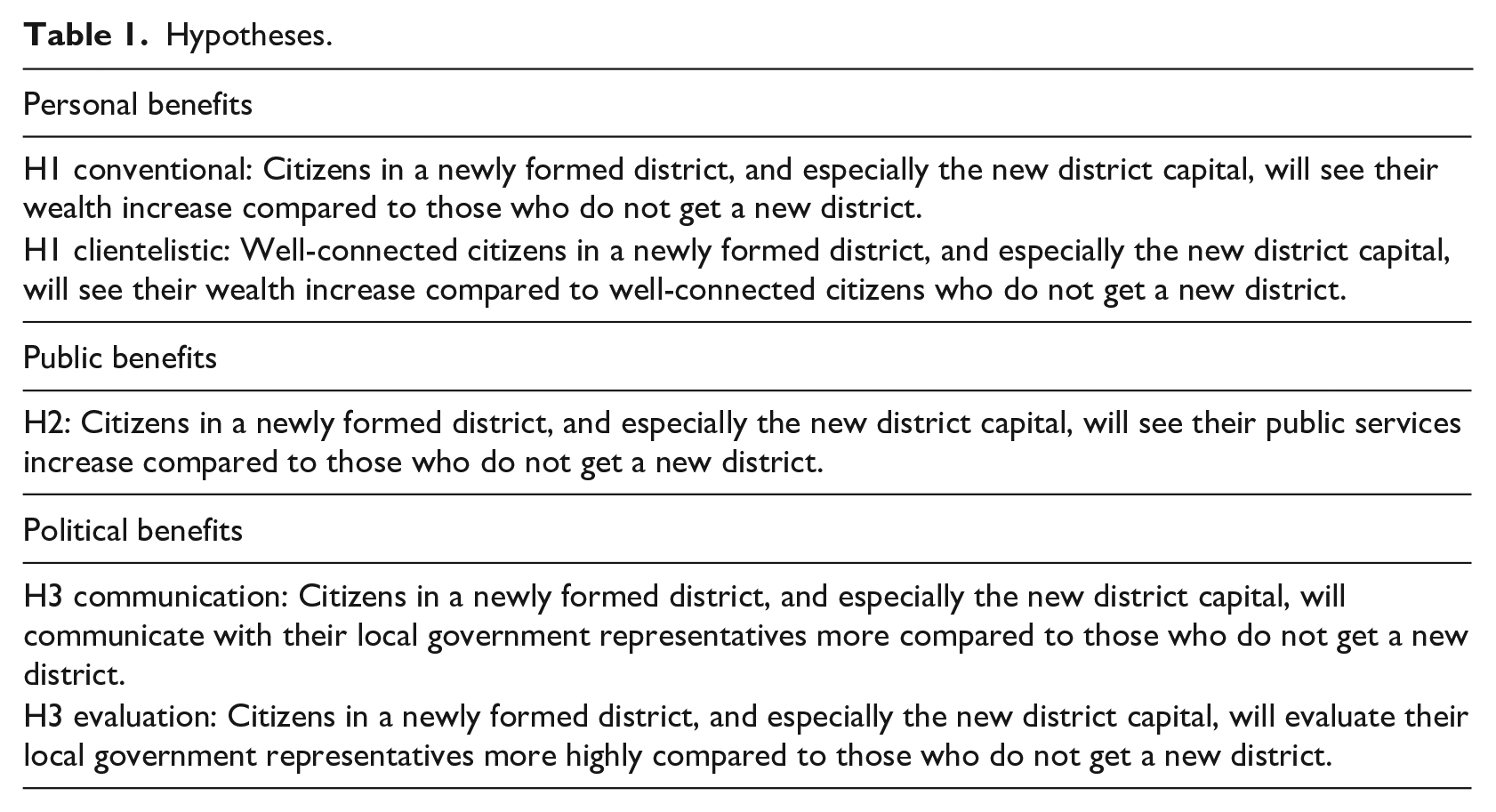
Personal material benefits of government fragmentation may be focused, dispersed, and/or a bit of both. Clientelism was a central topic in African politics before the impact of Bretton Woods’ prompted decentralizations (Lemarchand, 1977). Although some scholars anticipated decentralization and political fragmentation would profoundly reshape this focus (Herbst, 1990), clientelism has proven itself extremely adaptable (Driscoll, 2018; van de Walle, 2007; Wantchekon, 2003). Outside of Africa, the ability of regional ‘big men’ to extract resources from the centre post-decentralization is documented in the Brazilian case. For cabinet positions, government contracts, and sometimes just spending money, party members in the various federal states and their political factions must be taken into consideration (Ames, 2002; Nichter, 2014; Samuels, 2003). Sinologists tend to look at the link between political fragmentation and personal material benefits as a less concentrated affair. In the late 1970s China underwent a series of massive social, political and economic changes. Although it is difficult to tease out the impact of all of these changes individually, decentralization to the regions and government fragmentation is often attributed causally to the massive economic growth and improvement of living standards China has seen over the last several decades (Dollar, 2016; Fitzgerald, 2002; Morgan, 2000). In other words, money to the regions improved lives unevenly but far more broadly than the clientelist hypothesis would predict.
Public benefits, as they are characterized here, are programmes and infrastructure which are non-excludable assuming citizens meet well-defined and reasonable criteria. We are no longer talking about cash in one’s pocket, such as with personal benefits, but rather things understood in terms of community development. In justifying Ghana’s new district assembly system, the PNDC government highlighted this type of benefit, arguing that local government is for the peasantry about ‘how to improve their mud-houses, their drinking water, their capacity to bring their farm produce to the market-place, have their health needs attended to and have schools for their children’ (Herbst, 1993: 91). The theory linking the proximity of government and provision of public works rests on two related assumptions (Grossman et al., 2017; Sutiyo, 2013). First, people from an area know what their neighbours want and need better than those residing elsewhere (Ebdon and Franklin, 2006; Vasstrøm and Normann, 2019; von Braun and Groat, 2009). In developing areas, citizens have a great many needs. What politicians in the capital or NGOs with executives abroad prioritize might not align with local desires. Second, in relying on more localized knowledge, governments can target even conventional projects more efficiently (Oates, 1999). Knowing the terrain a project will be constructed upon can lead to more appropriate contractors, materials and designs. Citizens who have local governments that know what they want and are capable deliverers of these goods and services are more likely to have access to basic public works.
Political gains from local governance are best understood as bidirectional. On one side of the relationship, citizens see leaders who resemble themselves and are emboldened to become more engaged in the process of governance. In their work on decentralization, Fung and Wright (2001) explain that empowered deliberative democracy is how nearly all local governance projects are sold to the public. Government fragmentation ‘aspire(s) to deepen the ways in which ordinary people can effectively participate in and influence policies that directly affect their lives’ (2001: 7). The People’s Plan Campaign in the Indian state of Kerala became the posterchild for this objective when leaders at the state level decided to funnel more than a third of the state development budget to localities so ordinary Keralan men and women have more direct input on how the monies are spent (Heller, 2001; Heller and Harilal, 2007; Isaac and Franke, 2002). On the other side of the equation, local officials respond to their constituents’ empowerment by holding bureaucrats accountable to them and holding themselves accountable to the public (Blair, 2000). This target has been elusive historically on the African continent and elsewhere, which could contribute to the appeal of accountability as a dependent variable (see Acemoglu and Robinson, 2012; Mamdani, 1996). More and better engagement with local officials would be the expectation if government fragmentation delivers on its political promise.
Methods: Formulating a hypothesis test in an opportune case
In Ghana, districts are the smallest unit of government. Created in the 1988 via PNDC Law 2017 in the lead-up to the Fourth Republic, districts are officially meant to be local replications of the national ministries that are both shaped by the policy preferences emanating from the capital in Accra and responsive to local conditions (Ayee, 1996). Originally, there were 110 districts in Ghana. At the beginning of 2012 there were 170, but in late June that year the number of districts was increased by an additional 42. One of the new districts would be called Nabdam District. It was separated from the Talensi-Nabdam District and had its capital scheduled for Nangodi. The old district assembly building in Tongo continues to serve as the seat of local government for the residual Talensi District.
This fortuitous intervention by the national government allows an excellent opportunity to find out how the introduction of a new district impacts people’s lives. In order to capitalize on this dispensation, we studied three villages that are very similar save for one important difference: Nangodi is the new district capital, Pelungu is in the new district but not the capital, and Duusi is just outside of the new district (see Figure 1). The centre of Nangodi is approximately four miles north-northeast of Pelungu and Pelungu is another two miles north-northeast of Duusi. All are connected via a dirt road linking the Zebilla-Bolgatanga Road at Nangodi to Talensi’s capital of Tongo via Shiega. Population numbers are difficult to come by with any certainty since borders are imprecise and head counts difficult, but Ghana Statistical Services (2014a, b) estimated Duusi’s to be approximately 6100, Pelungu’s to be 2300, and Nangodi’s to be 3600 at the time of the 2010 housing census. Economically these three villages are representative of other rural settlements in Ghana’s Upper East. Millet is the predominant crop during the farming season (Meyer, 1992) and illegal gold mining (Jonathan and Isaac, 2014) and trips to the South to labour are how ends get met in the dry season (Agyei et al., 2016). Table 2 displays socio-economic similarities in our sample from these three villages. Answers from 2012 are given from respondents who participated in both the 2012 and 2014 studies, and although there is variance, there are no remarkable dissimilarities.
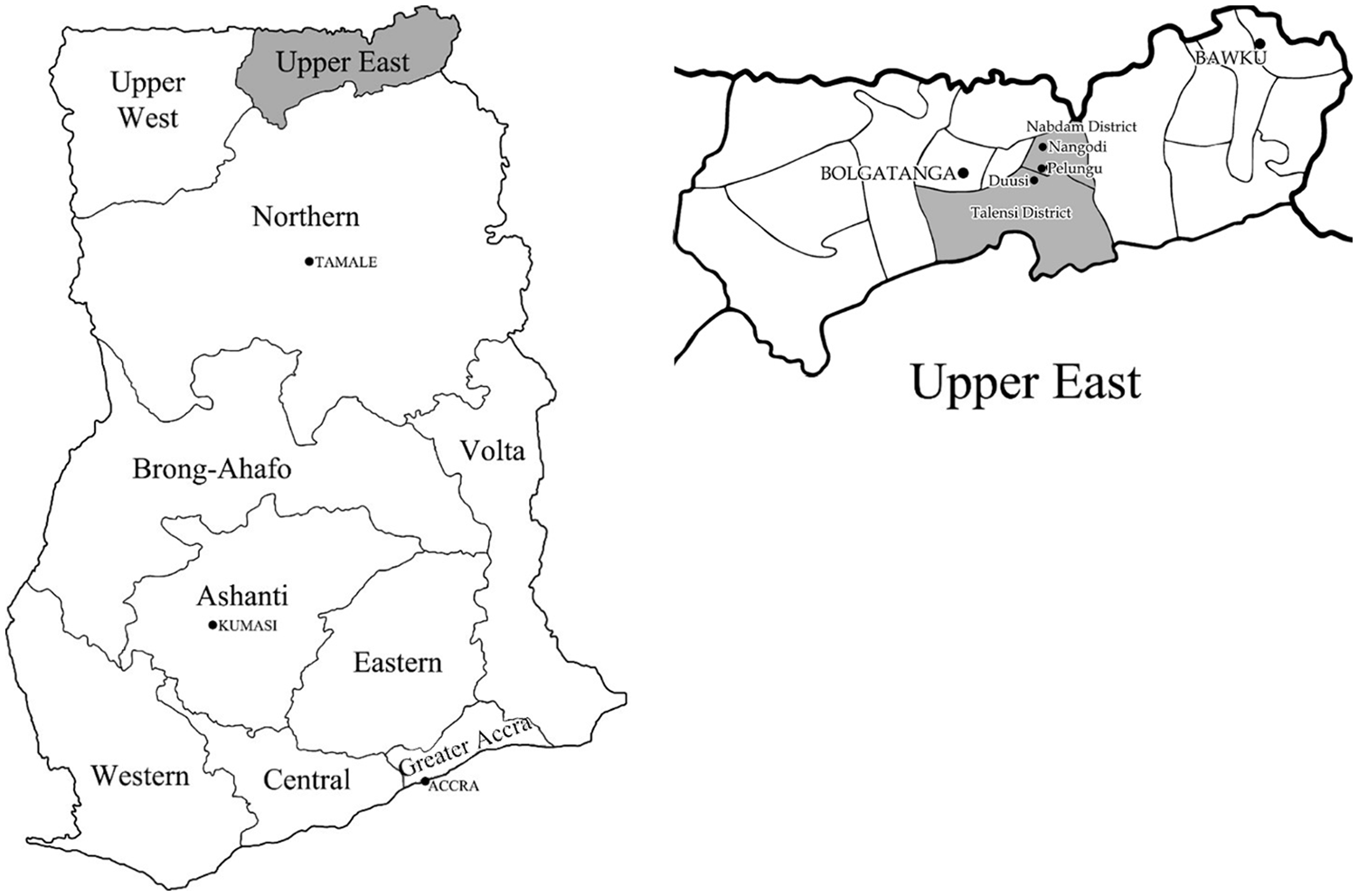
Research sites situated in Upper East (Duusi, Nangodi and Pelungu) Region.
Descriptives of the villages (2012).

The average age of respondents is significantly higher than the average age of residents. No one under the age of 18 was interviewed, meaning nearly half the population of these young villages is excluded from the sample.
In May and June 2012, 100 residents in each of these villages were asked a battery of questions about their demographic characteristics, living conditions, and political perceptions and activities. We use a systematic random sampling technique stratified by gender (half male/half female) and age (18–35, 36–50, 51+). 4 As rural areas of Ghana’s Upper East are poor and migratory (Adaawen and Owusu, 2013), 16% of respondents reported personally travelling south in search of work during the previous dry season and 58% reported a member of their household making the journey. Given this transience, we anticipated a considerable amount of attrition, but designed the project as a panel. Respondents were asked for their name, residential location, and their contact number or the contact number of someone who knows them. In summer 2014, we returned to these three villages to track down the 300 residents we interviewed two years prior. In Duusi we successfully re-interviewed 76 participants, in Nangodi 72, and in Pelungu 49. Participants were given an identical survey to the one they received in 2012.
The independent variable in our study, proximity to the new district, is operationalized via case selection. Assuming a new district brings benefits to an area, Nangodi and Pelungu will do better over the period 2012–2014 in relation to their neighbours in Duusi. If the benefits of a new district are best viewed as concentric circles of diminishing returns, Nangodi will experience more benefit from the new district, since it is the capital, than Pelungu. Dependent variables are constructed with survey questions that operationalize the three aforementioned hypotheses.
Hypothesis 1 (Personal benefits) uses animal units as the dependent variable. The Talensi-Nabdam area is rural and agricultural. Cereals such as millet, sorghum and maize provide most of the residents’ calories, with groundnuts, peas and beans serving as supplemental sources of protein and crops including tomato, pepper, okra and sweet potato providing flavour notes in popular local dishes (Talensi Nabdam District Agriculture Development Unit, 2010). Animals supplement this diet but are also good measures of wealth. Although economists disagree on just how important livestock is as a buffer against down years on the farm (Fafchamps et al., 1998; Lange and Reimers, 2015), residents in Ghana’s Upper East keep significant portions of their savings in livestock for cultural (Bawa, 2015) and practical reasons (Whitehead, 2006). Given high levels of subsistence, communal savings and irregular wages, animal units in the household are a more valid and reliable measurement of wealth in the region than cash on hand (Alkire and Santos, 2014). Survey respondents were asked in 2012 and again in 2014 how many fowl, goats and cows their household owns. With this information we can index livestock using rough USDA animal unit equivalency tables (a cow is worth one unit, 10 goats are worth one unit, and 100 fowl are worth one unit) and see how much people’s savings changed over the two years in question. 5
Hypothesis 2 (Public benefits) uses access to electricity as the dependent variable. Although previous research reveals a great many things these communities desire by way of general development (Fridy and Myers, 2019; Myers and Fridy, 2017), electricity is very close to the top of this list. Electricity also proves to be a very good measure of an area’s general level of economic development (Elvidge et al., 2007). If electric lines are close by, home electrification requires a small amount of personal income to set up the meter (approximately US$100), but Ghana’s pay-as-you-go electrical system means once users are hooked up to the grid, usage can be throttled up or down to match available resources. If electric lines are not close by, each pole put in the ground to bring wires to one’s home adds approximately US$500 to the bill (Electricity Company of Ghana Limited, 2020). In other words, access to electricity is less a function of cash on hand and more a function of availability. Unlike other utilities (for instance, piped water and roads), electricity is also relatively low-hanging fruit. It is already in the two districts under study, so it can go up reasonably quickly for relatively little money if the electric company and officials who influence them deem an area important (Briggs, 2012). 6 Respondents were asked if their home is connected to the electric grid and we compare the answers from 2012 to 2014.
Hypothesis 3 (Political benefits) uses respondents’ engagement with their local political officials and perceptions of said officials as the dependent variable. To operationalize engagement, respondents are asked ‘have you ever spoken to a district assemblyperson about a problem?’ Responses include Yes and No. To operationalize perceptions, the query is ‘how well do you think your district assemblyperson is doing their job?’ Responses range along a five-point scale from Poor (1) to Excellent (5). Assuming political grievances are similarly pronounced in the three villages, those who answer the contact question in the affirmative are exhibiting greater political agency (Marien et al., 2010). Their local leaders are convenient geographically and accessible personally. If local officials are accountable to the demands of their citizenries, one would expect more positive responses to the evaluation question (Gronke and Newman, 2003). Citizens, the argument goes, like government officials more if they perceive their concerns being addressed and their needs met.
Findings: Evaluating the impact of the new Nabdam district assembly
When this study began in 2012, median residents of Duusi were about half as poor as residents in Pelungu or Nangodi in terms of livestock. In animal units, respondents from Duusi reported about 2.5 goats whereas Nangodians and Pelunguans reported nearly five each. Table 3 demonstrates that Duusians did not experience any economic windfall over the two years of our study. Both the median and average Duusian treaded water with no statistical difference between their 2014 and 2012 possessions. For hypothesis 1 (Personal benefits) to be supported, one would expect better results in Pelungu and especially Nangodi. In terms of descriptive statistics, these two villages line up exactly as hypothesized. In terms of statistical significance, however, only the Nangodians are statistically better than zero in terms of increased animal units. Whereas a typical Duusian and Pelunguan did not better their savings over these two years, a typical Nangodian made gains. The average Nangodian gained the equivalent of eight goats and five chickens. The median Nangodian gained the equivalent of two goats and one chicken. This positively skewed mean for Nangodi supports the more sceptical (i.e. clientelistic) readings of hypothesis 1, with benefits of the new district going disproportionately to a relative few. Given that Nangodi began the study between Duusi on the low end and Pelungu on the high end in terms of animal units, it is unlikely that these gains are the result of the rich getting richer via compounding interest. 7
Change in animal units (2012–2014).
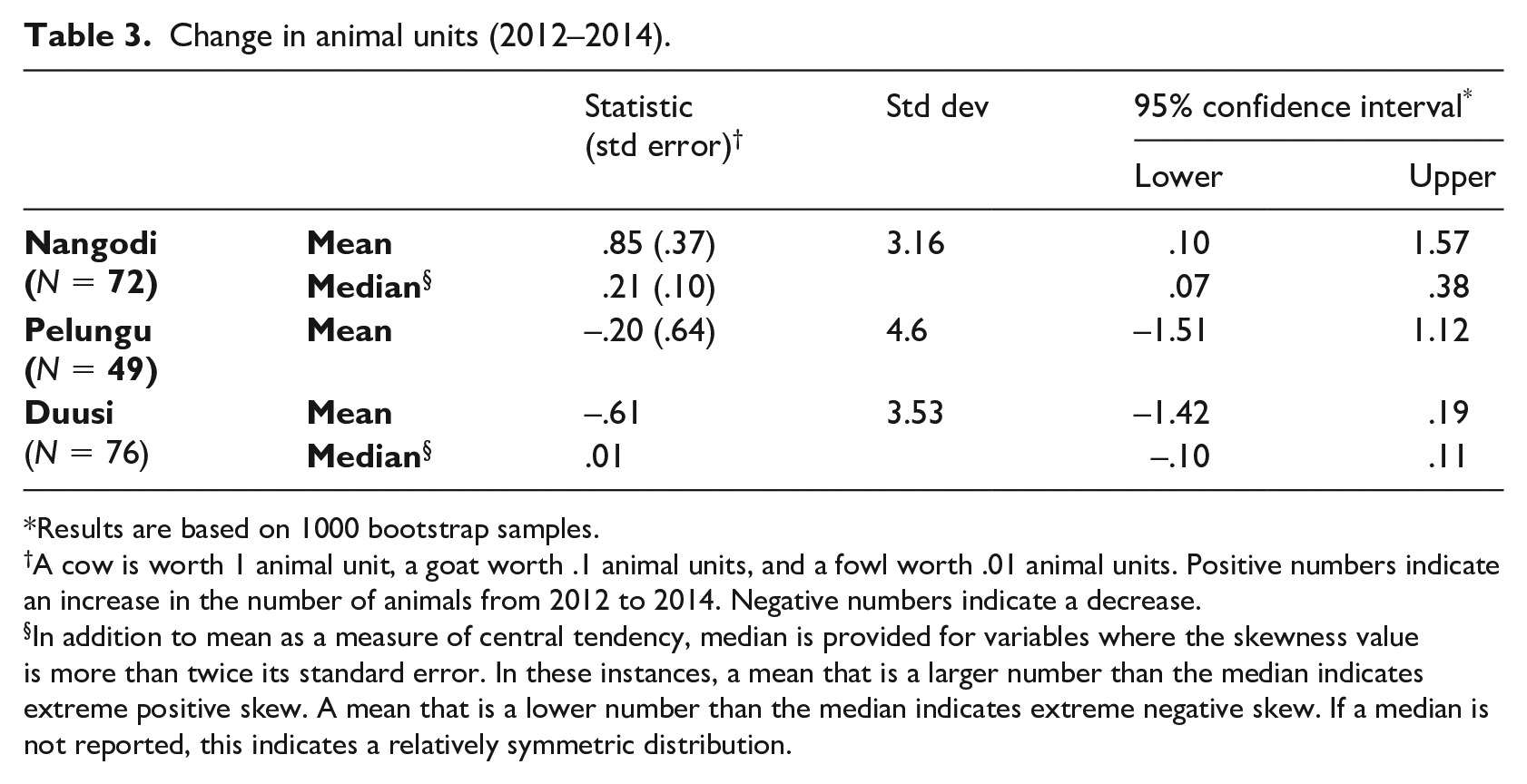
Results are based on 1000 bootstrap samples.
A cow is worth 1 animal unit, a goat worth .1 animal units, and a fowl worth .01 animal units. Positive numbers indicate an increase in the number of animals from 2012 to 2014. Negative numbers indicate a decrease.
In addition to mean as a measure of central tendency, median is provided for variables where the skewness value is more than twice its standard error. In these instances, a mean that is a larger number than the median indicates extreme positive skew. A mean that is a lower number than the median indicates extreme negative skew. If a median is not reported, this indicates a relatively symmetric distribution.
Our test of hypothesis 2 (Public benefits) is displayed in Table 4. As with hypothesis 1, the data here is supportive of the hypothesis. We know from census figures that fewer than one in ten Talensi-Nabdam residents were connected to the electric grid in 2010. By the time we asked the question in 2012, our sample hovered between one in six and one in seven in the three villages under consideration. In the two years after the creation of the new Nabdam District, fortunes changed dramatically for Nangodians and Pelunguans. In Pelungu more than half of the sample gained electricity over the 2012–2014 period. In Nabdam nearly three-quarters of the sample saw the same improvement. Duusians too saw an increase in electrifications, but one that was relatively small in comparison; fewer than one in ten of the Duusi respondents saw their home electrified over this period. These results are not only descriptively substantial, but inferentially significant. Looking at the 95% confidence interval, the most generous estimate of Dussi electrification is 13%; the least generous estimate of Pelungu is 41% and Nangodi 62%. Given that all three villages started the decade off in similar straits, these differences are remarkable.
Change in electrification (2012–2014).

Results are based on 1000 bootstrap samples.
1 = change from no electricity to electricity; 0 = no change; –1 = change from electricity to no electricity.
In addition to mean as a measure of central tendency, median is provided for variables where the skewness value is more than twice its standard error. In these instances, a mean that is a larger number than the median indicates extreme positive skew. A mean that is a lower number than the median indicates extreme negative skew. If a median is not reported, this indicates a relatively symmetric distribution.
Hypothesis 3 (Political benefits) is divided into two tests: one that looks at volume of contact between citizens and their local representative, and the other that looks at citizens’ evaluation of these representatives. Does having a new district assembly building closer to home increase contact with representatives? Table 5 suggests the answer to this question is No. Although Pelungu and Duusi respondents both on average report contacting their assemblyperson less in 2014 than in 2012, Nangodians were even more disinclined to make contact with their representatives. Interpretation of these results is muddled by a potential intervening variable. As the question asked of respondents is temporally subjective – ‘Have you ever personally spoken with your district assemblyperson about a problem?’ – and elections for the district assembly came in 2011, just before the 2012 survey round, it is likely that first-round respondents remembered the contact they had with their local representative during the campaign more readily than they did two years later. But this reading does not explain why Nangodians are outliers here, as one would expect their memories to be impacted similarly to the memories of their neighbours.
Change in contacting district assembly (2012–2014).
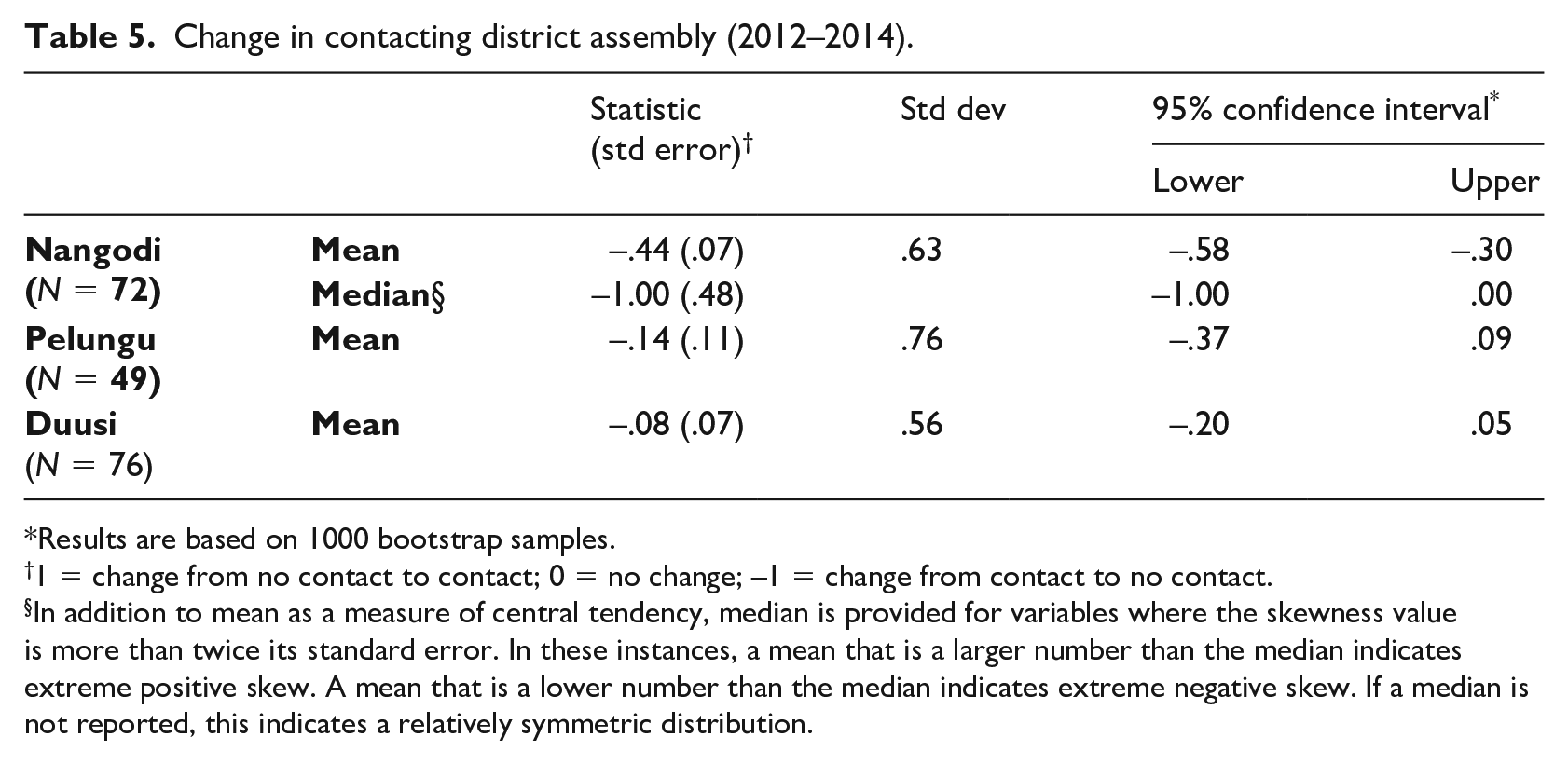
Results are based on 1000 bootstrap samples.
1 = change from no contact to contact; 0 = no change; –1 = change from contact to no contact.
In addition to mean as a measure of central tendency, median is provided for variables where the skewness value is more than twice its standard error. In these instances, a mean that is a larger number than the median indicates extreme positive skew. A mean that is a lower number than the median indicates extreme negative skew. If a median is not reported, this indicates a relatively symmetric distribution.
Does having a new district assembly building closer to home increase the evaluations of representatives? Table 6 suggest the answer to this question is Yes. Residents of Duusi showed no statistical difference in their evaluations of their district assemblyperson from 2012 to 2014. In both Pelungu and Nangodi respondents moved in a favourable direction towards their assemblyperson. In Pelungu this movement was less than half a point on a five-point scale, but in Nangodi this movement was nearly two points. These results point to a new reading of the results in Table 5. Contacting a local representative and evaluation of a local representative might work in opposite directions. This seems to be the case for national politicians and there is little reason to believe the relationship works differently for local politicians (Schulz, 2017). In other words, constituents seek out their representatives to complain in greater numbers than to compliment.
Change in evaluation of district assembly (2012–2014).
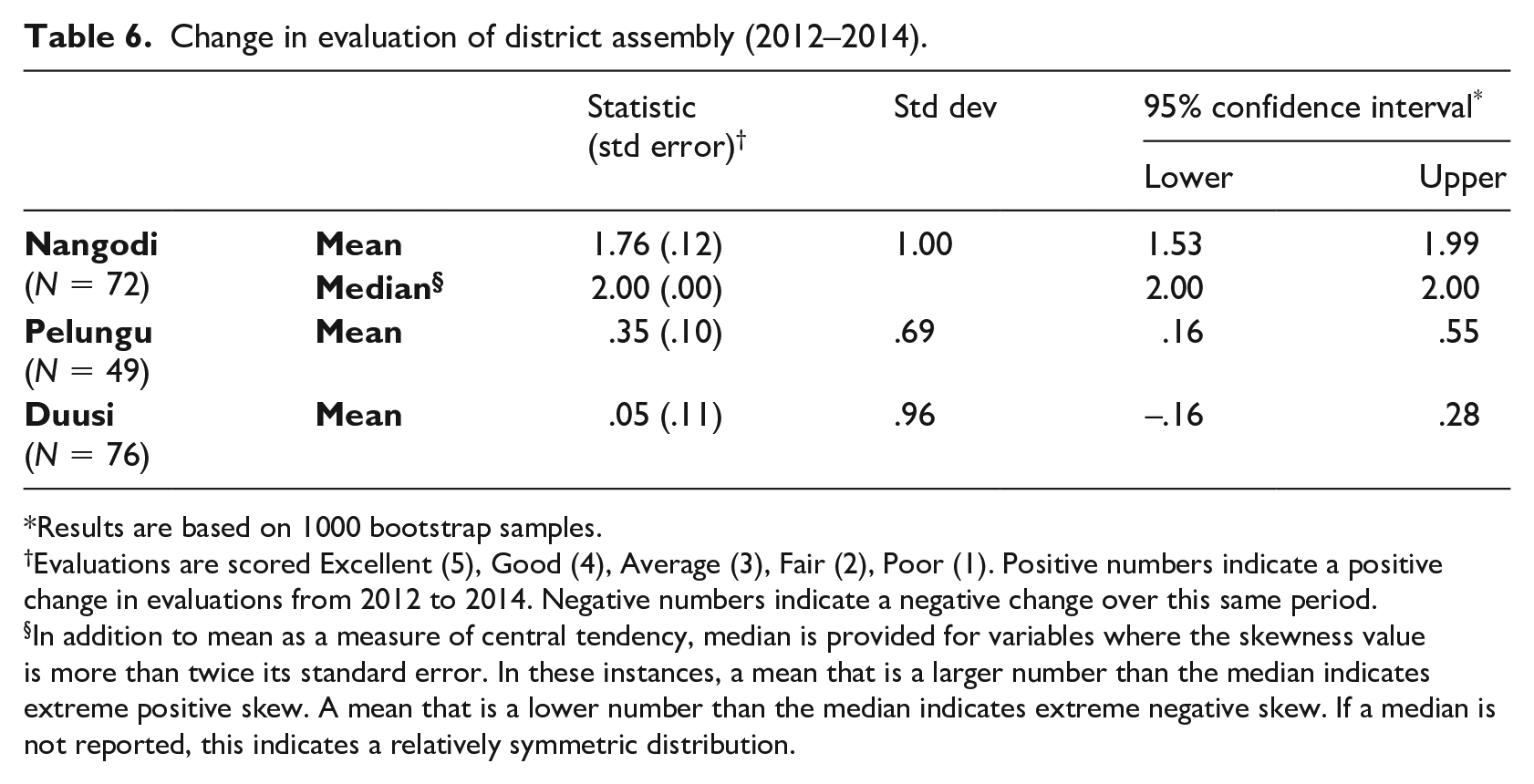
Results are based on 1000 bootstrap samples.
Evaluations are scored Excellent (5), Good (4), Average (3), Fair (2), Poor (1). Positive numbers indicate a positive change in evaluations from 2012 to 2014. Negative numbers indicate a negative change over this same period.
In addition to mean as a measure of central tendency, median is provided for variables where the skewness value is more than twice its standard error. In these instances, a mean that is a larger number than the median indicates extreme positive skew. A mean that is a lower number than the median indicates extreme negative skew. If a median is not reported, this indicates a relatively symmetric distribution.
None of these results should be oversold. For instance, we can be confident based on Table 3 that Nangodians have improved their lot in terms of animal units and we cannot be confident at all that Pelunguans and Duusians have benefited. At the 95% confidence interval, however, the three communities’ means overlap between .10 and .19 animal units. That is between one and two goats per person, which is a sizable portion of the wealth residents identified in the 2012 survey. This overlap disappears at a 90% confidence interval where there is at least a .23 difference between the communities of Nangodi and Duusi. At the 95% confidence interval, the only results that are significantly different are: (a) Nangodi and Pelungu have benefited more from electrification than Duusi; (b) Duusi residents contacted their district assemblyperson more in 2014 compared to 2012 than their neighbours in Nangodi; and (c) Nangodians began evaluating their assemblyperson much better in 2014 compared to 2012 than either Pelunguans or Duusians.
The distinctions between Nangodi, the new district capital, and Pelungu, a nearby village in the Nabdam District, should also not be overlooked. The primary physical infrastructure of a new district is the district assembly building. At first Nangodi made do by converting the Nkrumah-era area council office into a makeshift district headquarters, but eventually a large administrative and legislative structure was constructed nearby. It is there that most highly paid public postings in the district report. Looking at the numbers, there is reason to believe that the capital effect outweighs the district effect. Pelungu looks to have benefited from electrification, like Nangodi, but it lags slightly behind. In terms of animal units, Nangodians benefited over the two years under study whereas Pelunguans saw an increase that is statistically no different from zero. Pelunguans like the job their district representatives are doing better in 2014 than in 2012, but by a very small margin compared to Nangodians.
Conclusions
As with all panel studies, it is possible that those participants lost through attrition are significantly different from those maintained in some important way, creating a biased sample. Although attrition rates in Nangodi and Duusi were similar, Pulunguans proved significantly more difficult to track down for the second round of surveying. Our study also has a small N with not quite 200 participants after attrition. More participants would be better, but panel surveys are difficult and expensive even under optimal conditions (Hsiao, 2007). The Nabdam and Talensi areas also have particular attributes – they are extremely rural and poor, located in the Guinea savannah, ethnically homogenous, and in Ghana’s far North – that may make our results generalizable to only a select set of locations with similar characteristics. Caution should be used in applying our findings to policy decisions impacting areas that are very different environmentally, politically, economically or culturally from those studied here.
Ghana too has its peculiarities. Ayee (2013: 634) documents the rapid creation of districts between the year 1988 and 2012. Over that time the number of districts in Ghana more than tripled. When the Nabdam District was lopped off the Talensi-Nabdam District in 2012, there were 212 districts in Ghana, ranging in size from Banda (a district with a population estimated to be around 25,000 in what is now Bono Region) to Kumasi Metropolitan (Ashanti Region’s capital with a population around two million) (Ghana Statistical Service, 2019). Given the rapidly changing number of districts and their diversity in size, it is possible we have reached the point of diminishing returns from government fragmentation in some areas (Grossman et al., 2017).
None of these warnings, however, negate the strong agreement in the results. In terms of private wealth accumulation, public services and political engagement, the new Nabdam District with its capital in Nangodi appears to have benefited Nabdams, and particularly Nangodians, in relation to their neighbours in Duusi. In other words, all three of the hypotheses tested here are largely supported by the data. Political pundits often look on sceptically as Ghanaian government after government seeks to add ministers and parliamentarians and regions and districts to the country. It is a crass attempt to reward cronies, they contend, when in a developing country in great need of many things resources can be better applied elsewhere. In the case of the new district assemblies, however, this scepticism should be tamped down a bit. As little work as might get done at the Nabdam district assembly, as far behind as the central government might be in payments to the districts, and as many people as get rewarded for political loyalty instead of work, there do seem to be measurable and positive externalities associated with having a new local government to call one’s own, especially if one lives in the new capital. As with any policy decision, these benefits should be weighed against programmes that go underfunded and unfunded, but the results of this study suggest it would be improper to simply ignore the positives of government fragmentation outright.
Footnotes
Acknowledgements
The authors would like to thank the anonymous reviewers at JAAS for their helpful feedback. For paper inquiries please contact
Funding
The authors disclosed receipt of the following financial support for the research, authorship, and/or publication of this article: This work was supported by internal grants from the University of Tampa’s Faculty Development Funds.
