



Abstract
This article interrogates street traders’ encounters with the bribery and extortion by task force officials in Lagos State, Nigeria, using a mixed method of social research survey, in-depth interview and observation. The study found that poverty (p = 0.000), gender (p = 0.001), location (p = 0.009), employment status (p = 0.003), family pressure (p = 0.008) and payment of remittance (p = 0.000) are significant predictors of willingness to bribe task force officials (p < 0.001). It also established that traders, who perceived the street trading law of Lagos as a deterrent law, tended to bribe task force officials in order to escape justice.
Introduction
Hawking of goods for survival is one of the major features of modern African cities and the informal economy in the developing world (Asiedu and Agyei-Menseh, 2008; Brown and Mackie, 2018; Brown and McGranahan, 2015). It represents, in the global South, the response of the urban marginalised to the crushing economic conditions that leave millions of people out of the formal sector, and in the global North, it is a means of livelihoods for many immigrants who want to work but are unable to get a gainful employment in the formal sector (Recchi, 2020). Research into the dynamics of the informal economy indicates that street trading is not new to the developing world. It is an economic system that dates back to the colonial era but has increased rapidly since the end of the Cold War when the number of the poor people increased due to the widening gap of income disparities between the rich and the poor occasioned by corruption and poor governance systems. Unfortunately, a combination of global economic crisis and internal mismanagement of African economies has made it impossible for many to be employed by the formal sector (Adama, 2020a; Brown and Mackie, 2018; UN-Habitat and United Nations, 2017).
This development apparently creates a huge gap between those who want to work and the available employment in the formal sector, thereby pushing many women and children into street vending. It is, therefore, not uncommon to find women and young people occupy the major roads of most West African cities such as Lagos, Accra, Johannesburg and Dakar selling their goods. They move from one location to another trying to take advantage of the cities and the chaos created by urbanisation and traffic congestions. This is happening in spite of the existence of repressive urban regulations banning street trading in many of these countries (Adama, 2020a; Igudia, 2020; Roever and Skinner, 2016).
Roever (2016) noted that although street trading is often declared an illegal business in most developing societies, it has currently contributed over 70% informal employment in Asia and 66% in Sub-Saharan Africa. In India, estimate by the country’s Ministry of Housing and Urban Poverty Alleviation shows that 10 million people engage in street trading, and in Kolkata, there are about 150,000 street traders (Ghatak and Chatterjee, 2018). Estimates of such traders are difficult to reach in the West African sub-region because government officials who collect revenues are generally hostile to street vending (Adama, 2020a; Benjamin et al., 2012; Ghatak & Chatterjee, 2018; Ibeh, 2013; Roever, 2014).
In Asia, Latin America, the Caribbean and Africa, studies have consistently shown that millions of people engage in street vending for the purpose of earning a meagre income in order to enable them provide food for their families. This is in response to the unfriendly economic environment which enriches the elites and impoverishes the poor (Brown and Mackie, 2018; Kusakabe, 2006). Burdened by the increasing number of street vendors in the cities, urban regulators and the police have increased their crackdowns on street traders by confiscating their goods, subjecting them to physical assault, extortion and sexual abuse. This trend, though varies across countries, is particularly challenging in the West, East and Southern African countries such as Ghana, Kenya, Uganda, Nigeria, Benin Republic, Burkina Faso, Zimbabwe and Ivory Coast where street traders suffer from both the problems of extortion and assault by governments’ officials (Brown and Mackie, 2018).
In Nigeria, there is not yet a national law outlawing street trading, but there are numerous legislations forbidding loitering on the roads and activities relating to street trading. Colonial laws also exist in the nation’s history, which forbid abusive use of children for street hawking. The Children and Young Persons Ordinance (CYPO) promulgated in Nigeria in 1943 outlawed street trading and loitering on the streets by children (Aderinto, 2012; George, 2011). This has again been reinforced in the Child Rights Act, 2003, but not many states in Nigeria have domesticated the national legislation.
The current study is specifically informed by the event of Wednesday 29 June 2016 when hoodlums at the Maryland axis of Lagos Metropolis unleashed assault on the Lagos Bus Rapid Transit (BRT) System because a street trader was reported to have been knocked down by the BRT bus while the trader was hawking her goods on the expressway. The event, which later generated public outcry, exposed two issues about the street trading business in the state. The first is that prior to 2016, it was clear that despite having knowledge of the existence and enforcement of the street trading law, some street traders still defied the law to remain on the streets. The second issue was that the Lagos State Government has never been so passionate about assessing the applicability of the law until the event of 29 June 2016. The matter arising from that event, which subsequently informed this research, was that there has never been a comprehensive attempt to study the phenomenon of street trading business in Lagos State.
Literature review
Street vending as a growing informal economy in modern African cities
Street trading is rapidly becoming a major feature of the economies of many African cities including that of Lagos in the 21st century. This is taking place at a time when the city of Lagos remains one of the fastest growing African cities with 3.4% annual growth rate. Lagos is also projected to have over 21 million people, and it is believed to be the capital commercial city of Nigeria, although the Federal Capital Territory had since been moved to Abuja, the seat of Nigerian government. Lagos is also said to be the highest income-generating State in Nigeria with Value added Tax contribution of over 400 billion to the Federal Government’s treasury (Akon et al., 2021). With this status, Lagos remains a major attraction for many national and international investors who want to invest in the Nigerian economy (Lawanson, 2018). It now generates about 25% of the gross domestic product of Nigerian state, thereby making it the hub of investment in the country (World Population Review, 2021).
Although Lagos has continued to witness rapid increase in its population growth and expansion of its urban infrastructure since the end of the Second World War, events after the Cold War between the United States of America and the defunct USSR (Russia) have changed both the dynamics of migration in Nigeria and Lagos economy. First, it has been argued that urbanisation in Africa has responded to the challenges thrown up by the changes in the global political economy, one of which is the alteration of the world system from dual system (capitalism and communism) to the one where only the United States’ and West’s capitalist agenda ruled the world (Acemoglu and Robinson, 2013; Ake, 2000; Meredith, 2005). This change in the global political economy is said to have led to a rapid shift from statist-communist economic system of developing nations to a neoliberal economy which demands that nations open up their economies, improved the conditions of their citizenry and open up the city for trade and investment (O’Brien & William, 2010; Padayachee, 2010).
The second factor that provoked a dramatic increase in the street trading business in Nigeria and in most West African countries is the fact that the local economies, ran by the military and corrupt politicians for decades, have crumbled and are unable to provide jobs for many people who are desirous of working in the formal sector. Faced with the problem of acute poverty, pressure at home, high cost of living and pressing demands for personal needs, young men and women, especially people who are still vibrant to work in urban centre, went into street trading. They move from one part of the city to another exploiting the chaotic situation created by Lagos traffic (Kumolu and Adelaja, 2016).
The consequence of this was serious on Lagos as more people migrated to the city in search of gainful employment. Disappointedly, the formal sector, which should have provided employment for workers, had shrunk further due to a combination of global economic shock of the 1990s and those of the early 2000s (2008), which made the informal sector the only alternative for survival. The informal sector is believed to offer over 70% of employment in Nigerian economy, and it is a source of employment for many young people in Lagos State. Notwithstanding the contributions of the informal sector to the Nigerian economy, government’s approach to the management of street trading has largely been undemocratic, repressive and a violation of the rights of street traders (Adama, 2020a; Lindell, 2019).For instance, the Lagos State Government enacted its Street Trading and Illegal Market (Prohibition) Law (2003) and amended it in 2015 in order to curb the challenge of street trading in the state and imposed sanctions on the violators of the law. The law is a follow-up to the 1984 Lagos State Street Trading and Illegal Market Edict made under the military (Omoegun, 2015).
The composition of street traders in Lagos and West African cities
Studies on street trading in West African cities indicate that street trading is largely an informal economic activity that takes place in the city or urban centre of African cities. It is usually targeted at exploiting the chaos created by urbanisation and the traffic congestion which usually makes it impossible for formal urban workers to buy their goods in the main markets. Lindell (2019) established that most of the people who go into street trading in Lagos and in majority of West African cities are people motivated by high level of poverty in the region but are increasingly seeking vending of goods as an alternative source of income.
Adama (2010), Lindell (2019), Mitullah (2005) and Roever and Skinner (2016) stated that the ages of participants in street trading vary from young people who are largely unemployed in the formal sector to women and migrants who go into vending as a survival strategy. Lindell specifically noted that age matters in street vending because vendors need to be active and be able to navigate the urban space especially in societies where urban regulators are hostile to street vendors or averse to the activities of street vendors. Adama (2020) noted that street vendors in Abuja vary from those selling foods and consumables in unauthorised public spaces such as under bridges, government’s gardens to walkways. There are also vendors who move from one part of the city to another location exploiting traffic congestions and targeting the busy traffic that is characteristic of many African cities.
The governance of urban space, urban planning and vendors’ encounters with the extortion and bribery of the police and task force officials
The governance of the urban space has always rested in the hands of the State Government as prescribed by the 1999 Constitution of the Federal Republic of Nigeria and the 1978 Land Use Act which vests power to allocate lands in an Urban Area to the Governor of a State (Adisa, 2018). This position has also been maintained in the Street Trading and Illegal Market Prohibition Law (2015) as amended, which states that The Governor may by Order apply this Law to any town in the State. (See Section 9 (i) of the Lagos State Street Trading Law)
Apart from the Governor who is deemed to enjoy statutory right to govern the urban space, the local governments in the State are also empowered by Law to supervise the affairs of the markets in their respectful local government councils while they report to the Governor and ensure compliance with appropriate laws. For instance, local governments are empowered to collect levies from markets under their jurisdiction as a form of revenue generation. However, such levies imposed on traders must comply with the appropriate laws of the State Government. It is, however, important to note that some local government officials have extended their levies to street vendors, whose presence in the urban space, in the first instance, is illegal (Omoegun, 2015).
The Section 1 of the Lagos State Street Trading and Illegal Market (Prohibition) Law, which is advancement on the 1984 Street Trading and Illegal Market Edict, prohibits street trading thus: A person must not sell or hawk or expose for sale any goods, wares, articles or things or offer services whether or not from a stationary position in any street specified in the First Schedule to this Law or within the vicinity of any public building in the State.
Section 2 states who is authorised to designate a market for trade in the state: A person other than the State or a local government or statutory corporation must not establish or maintain any market in any place in the State.
On the offences for selling on the streets, the Section 10 (1) of the Law states unequivocally that A person who contravenes the provisions of this Law is guilty of an offence and is liable on conviction; (a) as a first offender to a fine of ninety Thousand Naira (#90, 000.00) or to Six (6) months imprisonment; (b) a second offender to a fine of One Hundred and Thirty-Five Thousand Naira (#135,000.00) and nine months imprisonment. (c) as a third offender to a fine of One Hundred and Eighty Thousand (#180,000.00) and one (1) year imprisonment.
From the various Sections of the Lagos State Street Trading and Illegal Market Prohibition Law 2015, it is obvious that first, street trading is an illegal business in Lagos State. Second, it is a punishable offence in the State with either fine or imprisonment, and in some instances, both fine and punishment. Thus, vendors who are adamant to remain in the urban space risk the probability of going to jail. This situation apparently puts the vendors in dilemma and at the mercy of government officials, the police, the task force officials and local government officials who are saddled with the responsibility of enforcing the law (Okon, 2020; Omoegun, 2015).
Bribery and extortion as grease to the wheel of a rigid system
Extortion of money from innocent citizens is one of the major characteristics of the police in developing countries (Hope, 2016; Mbaku, 2016). This is because policing in most of these societies is characterised by arbitrariness, widespread use of discretion and lack of democracy in the management of the relationship between the police and the public. Democratisation of the police implies that the police will see themselves as part of a system that is put in place to protect the citizenry. When the people see the police as part of their society, they are more likely to obey the law and respect the authority of police authorities (Tyler, 1990).
The use of bribery to navigate the space of a rigid bureaucracy has been well researched in the literature of police corruption and corruption of government’s bureaucracy in developing world (Harden, 2011; Ibeh, 2013; Ogunbiyi, 2020; Okon, 2020; Premium Times, 2013). Adisa (2014), Ake (2000) and Mbaku (2016) noted that though corruption is inimical to the development of African societies, payment of bribe usually serves as a lubricant that enables the subaltern class penetrate and navigate the rigid bureaucracy that has constrained equitable access to national resources.
Since the opportunity to make it is continually narrowed by the increased inequality between the rich and the poor, payment of bribes is often seen by people as an alternative to gain access to the economy. Given the fact that the formal sector of the Nigerian economy is faced with multiple economic crises, vendors see both bribery and extortion as a part of a systemic system that survives on opportunism (Lindell, 2019). It is, therefore, not uncommon to find a governance system in Africa’s urban centres that is characterised by arbitrariness, excessive use of discretion, and corruption on a large scale which symbolises the thriving business of transnational organised crime in the West African sub-region.
Theoretical framework
The article adopts meta-theoretical perspectives for the study of street trading in Lagos, Nigeria, namely: the peripheral political economy and the agency theory of street trading.
The political economy of bribery and extortion of street traders in Nigeria
This article locates the problem of bribery and extortion of street traders in Lagos State, Nigeria, within the peripheral political economy approach. The article argues that though different theories have been offered to explain the causes of corruption and bribery in the management of street vending in urban space, the majority of these theories have failed to explain the historical context of the African informal economy. The informal economy, this paper argues, is an integral aspect of the political economy of Africa, and events in it cannot be sufficiently explained outside the crises of the African political economy. The political economy of postcolonial Africa is a peripheral political economy which exists not on its capacity but on its overall interaction with the global political economy (Ake, 2000; Meredith, 2005).
As a dependent economy, the political economy approach argues that Africa is unable to take an independent decision on how to improve its natural resources and economic infrastructure except those imposed on it by the neoliberal and imperialist world system. The theory argues that the resurgence of the street trading business in Lagos and in majority of West African countries is a response of the peripheral African economy to neoliberal agenda, which advocates increased participation in the global economy and at the same time stifles the processes of liberating the poor in developing countries from their shackles of poverty (Ake, 1996).
Faced with this dilemma, the African economy is beset with an economy that is controlled from outside even though managers of the economy claimed expertise at home (Meredith, 2005; Padayachee, 2010). Government’s policy and decisions on the management of the city are both a product of globalisation and the global capitalist agenda, which emphasised the establishment of mega city with modern infrastructures. In this instance, the city, either in Lagos, Nigeria or Accra, Ghana, is a representation of what the West wants it to represent in the governance of affairs of Africa. It is in this wise that the Lagos Mega City was designed to eliminate urban slums and transform slum areas of the city into high income class city thereby widening the gaps between the rich and the poor (Lawanson and Omoegun, 2018).
While some have consistently held that the new agenda of postmodernism in non-Western societies is the protection of the informal economy and street workers in West African cities, such agenda is yet to be prioritised in the management of the political economy of African countries. This is because rarely has the International Community sanctioned African governments that brutalised urban residents under the guise of creating a cleaner city.
The second leg of this theory is the one that explains why bribe persists in the governance and politics of urban space in Africa. Unlike the modernists who hinged the analysis of the challenge of bribery to the persistence of particularistic cultures in cities of developing societies, this theory opines that the problem of corruption in postcolonial African societies is inevitable given its colonial and postcolonial legacies of the postcolonial African state. The state, in most of African countries, is believed to be a product of arbitrariness, opportunism and dictatorship. Instead of representing the mass of the people, the state is a mere representation of the political elites who are constantly at war with one other. This is partly because the state was a product of statism (Agbiboa, 2012).
Statism is an economic system where the state takes over the control of the economy. Instead of allowing the private sector to drive the economy, the state manages virtually all the facets of the economy. In Nigeria, and in most of African countries, statism was hijacked by corrupt politicians who seized the state and converted its property into private use. In order to survive and ensure that most citizens did not have access to the economy, it created a police force that was brutal and arbitrary. It was this legacy that Nigeria inherited after over 30 years of military rule, and it is this approach that has governed the regulation of urban space in Lagos where the Lagos State Government utilises the Lagos State Environmental Sanitation Corps (LSESC) and the task force to apply maximum force to keep street workers out of the urban space (Kumolu and Adelaja, 2016; Okon, 2020; Omoegun, 2015). The hostility towards the vendors is not only because the officers are trained to apply force, but because they see the use of force as a legitimate means of ensuring compliance since the city itself is occupied by elites who are constantly at war with each other. This is evidenced in land racketeering and land grabbing that characterise most Nigerian cities, especially Lagos, Nigeria, where the commercial value of land has been elevated because the 1978 Land Use Act gives exclusive powers to the Governor of a State in the allocation of lands (Williams, 1992).
The agency theory of street trading, bribing of task force officials and police extortion
The agency theory of street trading is a postmodernist and contemporary theoretical analysis of street trading which believes that the survival of street vendors is dependent on their ability to use their individual and collective agencies to navigate the urban space. The theory, which is derived from James Scott’s (1985) research on agency, asserts that the assumption of the neoliberalists and modernists that street vendors are not rational thinkers who make reasonable choices between obeying the law and disobeying urban authorities is false. It states that, in the real situations of most African cities, the chaotic nature of urban life and non-tolerance of street vending have made vendors use their individual agency to negotiate access to the urban space. This negotiation involves paying urban regulators who are already corrupt by the system, bypassing the police by paying regular incentives, and paying market associations who provide them with the collective networks that enable them to remain in urban space (Lindell, 2008, 2010).
Unlike the political economy approach which associates the immediate and long-term causes of street vending in Africa to structural factors such as the nature and character of the African state, the agency theory provides theoretical nuances that help to understand why vendors who are bent on remaining in urban space resort to bribery and allow themselves to be exploited by the police. It explores the vendors’ individuals’ ingenuity as actors in the urban space to use their initiative even when they face stiff opposition from the state (Lindell, 2010; McCann, 2002).
The theory holds that street vending has increasingly become a part of everyday life in urban African cities. This implies that it can no longer be dismissed because it is informal, anti-modernisation and against neoliberalist agenda in the Global South. The theory strongly opposes and contradicts the neoliberalist assumption that street trading is informal and contributes little to the development of formal economy. It does this by demonstrating that urban informal economy in most African economies is a significant contributor to economic development as it helps millions of people to remain employed outside the state-regulated formal sector.
Beyond this, urban vending creates regular incomes for millions of households that are already battered by economic crisis evidenced in the postcolonial economies of African societies. The agency theory holds that experiences in post-Cold War Africa have now shown that the management of urban governance goes beyond the restriction of vendors from trading in highbrow areas of the city, it consists and is influenced by a lot of informal politics which helps the participants to exert informal rules and agree on mutual understanding and collaboration (Adama, 2020a; Lindell, 2019). It enables them penetrate the once difficult urban terrain where obedience to formal and modernist rules is cast in the marble. The agency theory sees the use of bribery as a significant weapon to break a rigid public service that indiscriminately allocates urban space and makes it impossible for majority of poor people to have a space for survival (Lindell, 2019). The theory sums up the crisis of access to urban space as that of competition for economic survival where individuals use their various individual potentials to navigate the rigid public urban administration.
Methods
Study design, location and population
The study adopted cross-sectional survey design and mixed methods of data collection. The adoption of mixed methods was motivated by the need to have firsthand experience of how traders operate and their interactions with government officials. Although the quantitative method was sufficient to test the hypotheses, a deeper understanding of why street traders operate despite their awareness of the street trading law and how government officials react to this phenomenon requires the interpretivist approach.
The study was conducted in Lagos State. Lagos State was deemed most appropriate for this study for a few reasons: (1) Lagos State has the largest economy in Nigeria, and its internally generated revenue (IGR) is higher than that of five other states combined. Besides, Lagos State is the commercial nerve centre of the nation, and its economy can be taken as a microcosm or subset of the Nigerian economy. Consequently, the state has attracted migrants from other states in Nigeria and neighbouring countries like Benin Republic and Niger Republic. Hence, buying and selling of consumer goods at different levels is rampant in the state. (2) Lagos State had the second largest population according to the 2006 population census, but it is arguably currently the most populated state in Nigeria considering the influx of people from other states. However, Lagos State is the smallest in terms of land mass and consequently has the highest population density in the country. By implication, cost of living (especially accommodation) is expensive in Lagos, and residents engage in all kinds of activities to survive. Roadsides in many parts of Lagos are usually occupied by traders who shed their goods, and in some places, they cause traffic gridlock. Hence, the government has always been in constant struggles with the street traders who are desperate for survival. The study covers the three senatorial districts (Lagos West, Lagos East and Lagos Central) in Lagos State. Two local government areas (LGAs) were selected from each senatorial district. Ojo and Oshodi-Isolo (Lagos West), Ikorodu and Somolu (Lagos East) and Eti-Osa and Lagos Island (Lagos Central) were the selected LGAs.
The six LGAs selected for the study, namely Lagos Island, Eti-Osa, Oshodi, Ojo, Ikorodu and Somolu, were chosen based on two major criteria. The first criterion was based on the administrative representation of the State as recognised by the 1999 Constitution. The 1999 Constitution of the Federal Republic of Nigeria has divided Lagos State into three senatorial districts; Lagos East, Lagos Central and Lagos West. Each senatorial district represents a political and administrative section of the state, and is a key factor in determining the impact of government on the people. This factor was adopted because the researchers felt that it would help predict comparative experiences of government’s presence across the state. For instance, previous studies on street trading in Lagos State such as Lawanson (2018) and Omoegun (2015) had concentrated on certain sections of the state that were known for street trading. In order to depart from this approach, the researchers felt that it would be good to tap into the experiences of street vendors across Lagos State.
With reference to the population of street traders, the researcher resorted to the selection of the six local governments based on rural and urban population distribution of the state rather than that of street trading. The reason for choosing this approach was because there was no comprehensive list of street traders in Lagos State possibly because street trading is still largely an illegal activity in the State (Adama, 2020a; Lindell, 2019). It is an illegal activity because the street trading law bans every activity of street traders and outlaws them from the street.
However, in order to ensure that the activities of the vendors who worked in different parts of the State are captured, the researchers resorted to the use of rural-urban distribution. Although Lagos State is almost 65% urban, there are certain areas that still have some rural communities which still are regarded as sub-urban areas/rural areas. It was this criterion that helped to choose some as urban and other LGAs rural/sub-urban. For the purpose of this research, urban LGAs are Lagos Island, Somolu and Oshodi. None of these LGAs has elements of rural cohabitation as at the time of the study. The rural/sub-urban LGAs are Eti-Osa, Ojo and Ikorodu. All of these local governments have a mixture of urban and rural communities. In fact, Eti-Osa is regarded as one of the fastest growing LGAs in Nigeria because the rural communities are increasingly being transformed into world-class residential estates.
The population comprised street traders of different age grades who trade their goods on the streets and highways across Lagos. This is the first category of respondents that participated in the quantitative and qualitative parts of the study. The second category of respondents were officials of the Ministry of Environment and task force officials who have the mandate to formulate policies and arrest defaulters. This category only participated in the qualitative study.
Sampling
For the quantitative aspect, 300 respondents were selected from each senatorial district, putting the sample size at 900. Of this number, information provided by 894 respondents was deemed eligible for final data analysis. The study adopted a two-stage sampling techniques to select the street traders. The first stage in the sampling process for the survey was the stratification of the street traders into consumables and non-consumables. This was followed by accidental sampling of 300 street traders from each of the senatorial districts. The second phase of the study was an interaction with street traders through interview. A total of 50 interviews were conducted for the street traders and 30 for government officials.
The 30 government officials are officials of LSESC. In each LGA, five officials of LSESC were interviewed based on the approval of the State Government, making it six officials per local government and a total of 30 LSESC for the entire state. The reason for interviewing them was to assess their views and tap into their experiences in the enforcement of the Lagos State Street Trading and Illegal Market Law. Since these officers are critical stakeholders to the enforcement of the law through their regular encounters with the law and the street traders, the researchers felt that it was important to include informed individuals who understand the law and are constantly involved in its enforcement in the State.
It was on the basis of this that, the research team wrote to the Permanent Secretary of the Ministry of Environment, Lagos State, for an ethical approval of the study in the state and also to help provide informed Ministry officials that would interact with the researchers on the street trading law enforcement project in the state.
Consequently, on 17 December 2018, the Permanent Secretary of the Ministry of Environment replied to the team, approving that the study should be conducted in the state and a stakeholder’s meeting should be held with senior officials of the Ministry on Friday 21 December 2018. A copy of the letter is hereby attached.
This is in addition to the Lagos State Government Ministry of Environment’s Environmental Sanitation Corps designated to monitor the activities of street traders across the state and ensure effective enforcement of the Lagos State Street Trading Law.
The use of in-depth interview in the study was informed by review of literature. Based on available literature, street vending in Nigeria is still an unorganised business unlike in South Africa and a few other African countries where street traders have associations. It was thought that the most suitable approach to adopt in this type of study was to explore the experiences of street vendors generally since we could not really identify their leaders unlike market men and women that have associations.
Key informant interview is usually suitable when a researcher is certain about the leadership structure of a group and has a preliminary understanding of the locus of power in the group.
It should, however, be noted that based on the advice of the reviewer, the researcher decided to conduct six focus group discussions (FGDs), one in each of the six LGAs. The results are quite instructive on the findings of the research on street trading.
The third phase of the study was the adoption of participant observation method (as buyers), in order to avoid suspicion among the traders. This gave the researchers enough time to examine the characteristics of the traders as well as their coping mechanisms with the law.
Research instruments
Informed by the mixed methods design, structured question and in-depth interview guide were used for data collection. The questionnaire contained five sections and a total of 76 questions. The section on the socio-demographic characteristics contained basic questions on age, gender, migration status, education, religion and so on of the respondents. There was a section on motivations for partaking in street trading and another on barriers respondents encounter in the course of their business. Similarly, the interview guide (for the qualitative study) was developed in line with the issues raised in the questionnaire. The interview was in a way that allows the interviewees to express themselves beyond what they have been asked.
Measures
There were two dependent variables, namely: bribery to evade arrest and extortion. For bribery, we asked ‘have you bribed the task force officials as a strategy to escape being arrested or caught by the law in the last 6 months’. For extortion, the question was ‘have you ever made any unofficial payment to a law enforcement agent?’ There were a few independent variables which we categorised into two. The first was socio-demographic characteristics which include gender, age, religion, ethnicity, education, location, migration status and category of goods sold. The second was perception of the rationale street trade law. The question was ‘why was the law put in place? (Multiple answers are allowed)’ with 13 options including to ‘safeguard trading on the streets’, ‘discourage illegal markets’, ‘encourage traders to rent shops’ and so on.
Data analysis
The data were analysed at univariate, bivariate and multivariate levels. At the univariate level, the socio-demographic characteristics were analysed using simple frequencies and percentages, but no table was presented to avoid too many. Later, we used the Pearson’s chi-square to test for the crude association between the two groups of the independent variables and each of the dependent variables, and presented the results in Tables 1 to 4. All the independent variables were tested, and only the significant ones at 95% level of significance were presented in the table to avoid cumbersomeness. In Table 5, we ran two logistic models (one for each dependent variable) showing the influence of socio-demographic factors on bribery and extortion. We did not do the same for the second group of independent variable (perception of the rationale for the street trade law) as the model was not fit – Hosmer and Lemeshow test had significant value less than 0.05. Only variables that were significant in the chi-square analyses were presented in the regression models.
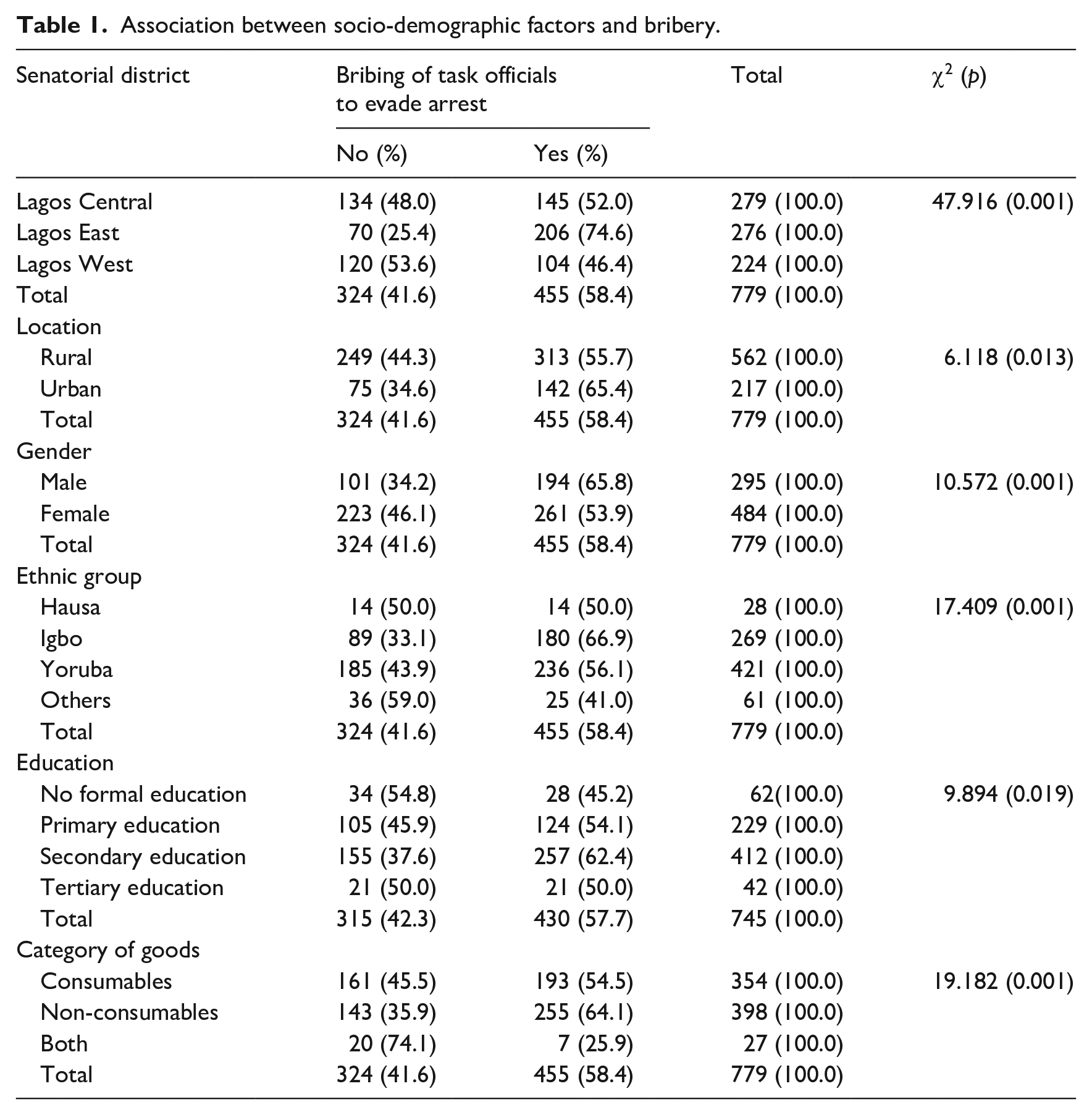
Association between socio-demographic factors and bribery.
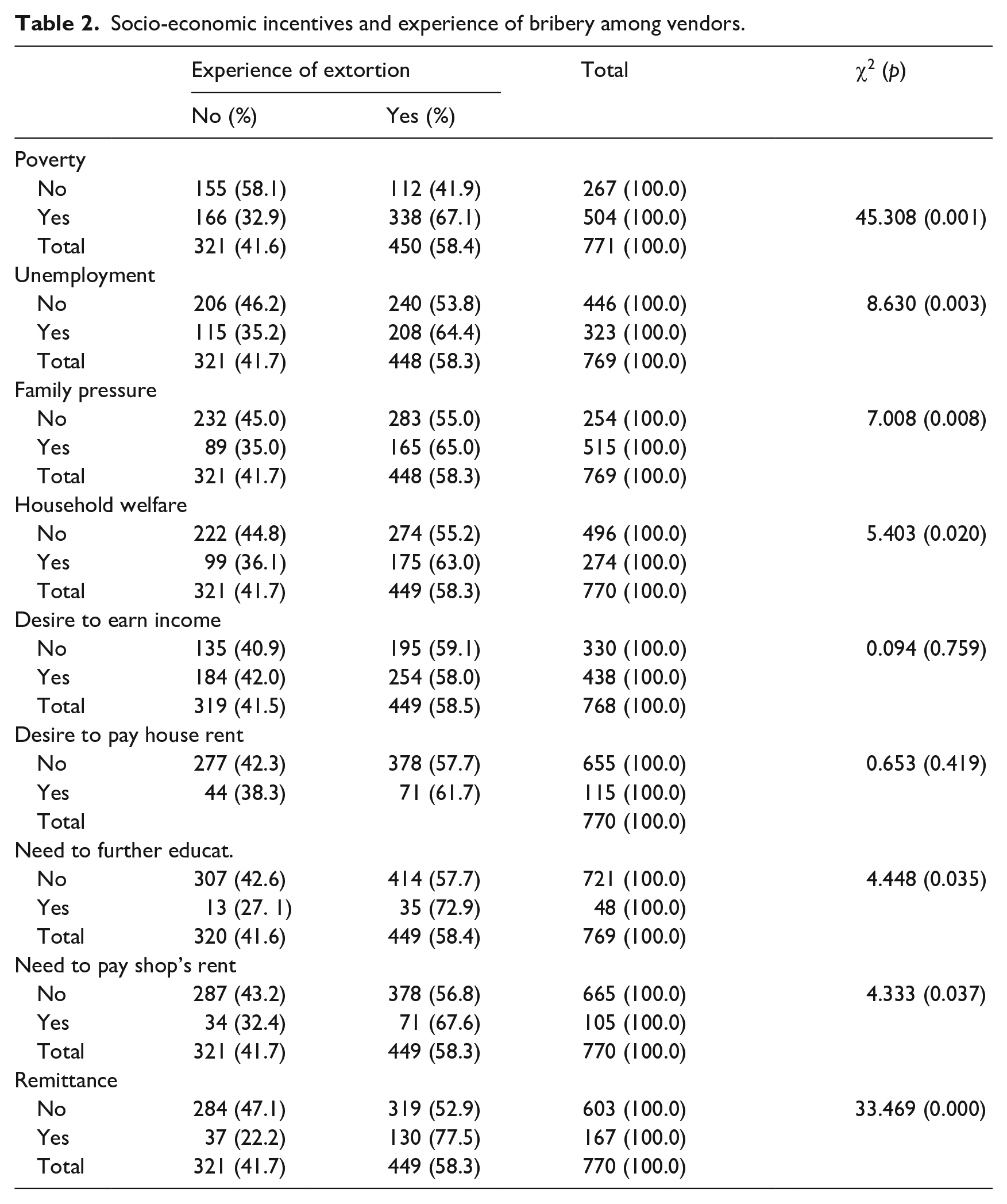
Socio-economic incentives and experience of bribery among vendors.
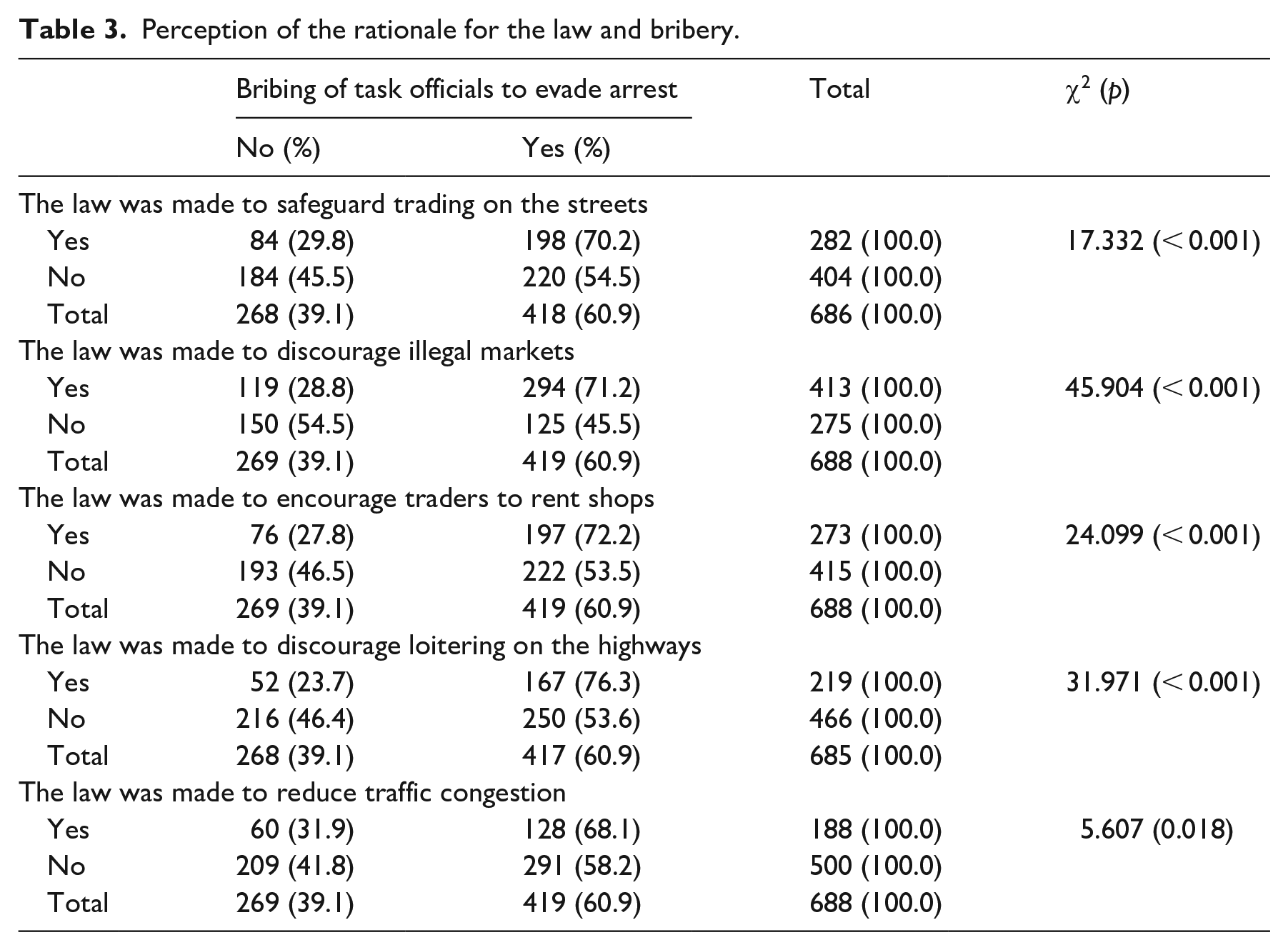
Perception of the rationale for the law and bribery.
Socio-demographic factors and experience of extortion.

Logistic regression models showing the influence of socio-demographic on bribery and extortion.

AOR: adjusted odds ratio.
Reference category: Lagos central; urban; male; Hausa; Christians; None; Migrant; Consumables.
Bribery: Model χ2 (p) 100.556 (0.000); H & L Test (p) 14.289 (0.075); Nagelkerke R2: 0.170.
Extortion: Model χ2 (p) 120.385 (0.000); H & L Test (p) 14.485 (0.070); Nagelkerke R2: 0.205.
Ethical issues
The research underwent ethical review before it was finally approved for continuation. Each respondent was asked if they consented to proceed on the study before they were interviewed and included in the sampled population. The first page of the questionnaire contained a brief note introducing potential respondents to the study’s overall objectives and seeking their consent to participate in the study. The last sentence asked if potential respondents are happy to participate in the study. Only those who answered in the affirmative eventually took part in the study.
Results
Socio-demographic characteristics of the respondents
The results show that 63.2% of the respondents were women, while the remaining 37.8% were men, indicating that a higher percentage of street traders in Lagos are women. The mean age was 36.1 with a standard deviation of 10.82, showing that the majority of traders were within the ages of 25 and 47. The result also indicates that more than half of the street traders were Yorubas – the dominant group in south-western part of the country – while the Igbo and Hausa-Fulani constituted 34.3% and 3.4%, respectively. Concerning the level of education of the street traders, more than half (56.6%) of them had acquired secondary school education before entry into the street trading business, while only 8% never attended a formal school. More than two-thirds (67.5%) were immigrants from other states. More than half (59.7%) of the respondents were Christians and 38% were Muslims.
Bivariate analysis: research questions
RQ 1: What are the socio-demographic characteristics influencing bribery as a strategy of evading arrest in the last 6 months?
In Table 1, the basic demographic variables are related to bribing of task force officials to evade arrest. The table shows that street traders in Lagos East senatorial district (about three-quarters of them) are more likely to pay bribe compared to those in Lagos Central (52%) and Lagos West (46.6%) (p < 0.001). Street traders in urban areas are likely to pay bribe than those in the rural areas (65.4% vs 55.7%, p = 0.013), and male street traders are more likely than females to do the same (65.8% vs 53.9%, p = 0.001). Similarly, ethnicity was significantly related to bribing of task officials, and Igbo traders are more likely to pay bribe (66.9%) than their Yoruba (56.1%) and Hausa counterparts (50%, p = 0.001). Regarding education, street traders with no formal education (45.2%) and those with tertiary education (50%) are least likely to pay bribes compared to those with primary education (54.1%) and secondary education (62.4%). Street traders who specialise in the sales of non-consumable goods are more likely to pay bribe than those selling consumable goods (64.1% vs 54.5%, p < 0.001).
RQ 2: What are the socio-economic incentives influencing experience of bribery among vendors?
Table 2 is a bivariate analysis of the relationship between socio-economic incentives motivating individuals into street trading and experience of bribery among the vendors. The table indicates that there is a significant relationship between people whose involvement in street trading is as a result of poverty (0.000), unemployment (0.003), family pressure (0.008), household welfare (0.020), need to further education (0.035), need to pay shop rent (0.037), remittance (0.000) and bribing of task force officials in Lagos State.
The inference that can be drawn from this finding is that majority of those who take part in the street trading business in Lagos are motivated into the trade by the high level of poverty and lack of gainful employment in the country. The result also indicates that a good number of these people wanted to fulfil family responsibilities such as caring for the welfare of their family members and sending remittances to them on a regular basis. This is evidenced in the result which showed that increased family pressure is related to street traders’ willingness to bribe task force officials in order to remain in urban space as a strategy for surviving the harsh economic conditions in the country.
The results from the FGD conducted for the street traders across the state indicated that several factors are responsible for the problems of street trading in the State. These include: high level of poverty in the country, high cost of living, lack of jobs in the formal sector, high cost of renting shops especially in the urban centres where government places high premium on the cost of shops. For instance, the traders in Lagos State unanimously agreed that shops are very expensive to rent in the local government council and are not readily available for those who need them. They stated that even when you are ready to rent the shop, a trader could be dealing with multiple landlords.
The vendors blamed the government partly for the high cost of renting the shop in Lagos State because shop owners are also mandated to pay heavy taxes to the State Government while the local government officials also collect their regular levies (FGD 1, Street Traders, Lagos Island Local Government).
The street traders in Oshodi and Ikorodu LGAs unanimously decried the brutal treatment of street traders by Lagos State Government officials. They stated that this is against government’s promise that government will support the poor and help them seek alternative means of livelihoods to the limited jobs in the formal sector (FGD 3 and FGD 6, Oshodi and Ikorodu LGAs).
RQ 3: Is there an association between the perception of the rationale for the law and paying of bribe as a strategy of evading arrest in the last 6 months?
Table 3 shows the association between perception of the rationale for street trading law and involvement in bribery in order to evade arrest. The table shows that respondents who held the affirmative opinions are more likely to bribe task officials. In other words, respondents who thought that the law was created to safeguard trading on the streets (70.2% vs 54.5%, p < 0.001), to discourage illegal markets (71.2% vs 45.5%, p < 0.001), to encourage traders to rent shops (72.2% vs 53.5%, p < 0.001), to discourage loitering on the highways (76.3% vs 53.6%, p < 0.001), to reduce traffic congestion (68.1% vs 58.2%, p = 0.018) paid bribes than those who thought otherwise.
The result of the qualitative study also indicated that vendors paid bribes to task force officials in order to survive in the urban space. According to a KAI official: The law provides for the arrest of violators by KAI or task force officials. No street trader have ever subjected herself to arrest, they always find a means of escaping like running away, leaving their goods when they sight of task force officials. They may even threaten officials with jazz [juju] while some bribe top officials with both money and in kinds. Every street trader knows how to evade arrest. (Female member of LASEC, 43, IDI, Eti-Osa)
A male street trader also stated that the street trading business is irresistible despite the fact that it is illegal and has been outlawed by the government: Yes, I am aware of the street trading law. The law was enacted 9–10 years now. Though, a lot of people want to react against the law, but nobody has the power to do so. It should be known that we also do not deliberately want to engage ourselves by putting ourselves under this condition if not for survival. And on top of that, we get harassed everyday trying to make ends meet. This is not good, at all. (Male, 25 years IDI)
RQ 4: What are the socio-demographic characteristics influencing experience of extortion among vendors?
Like in Table 1, Table 4 also shows that street traders in Lagos East senatorial district experienced extortion by task officials (80.1%) than those in Lagos Central (67.4%) and Lagos West (54.8%, p < 0.001). Similarly, those who traded in urban areas got extorted more than their counterparts in the rural areas (73.3% vs 65.3%, p = 0.013), and male traders experienced incidence of extortion more than their female counterparts (80% vs 59.9%, p < 0.001). Contrary to the findings on bribery, Hausa traders experienced extortion (85.7%) the most, followed by Igbo (81.1%), Yoruba (59.4%) and traders from other ethnic groups (54.1%, p < 0.001). Traders who practised Christianity have experienced extortion by task officials than their Muslim counterparts (70% vs 63.1%, p = 0.036). Those trading in non-consumable goods have experienced extortion than those who specialise in consumable products (74.2% vs 62.8%, p < 0.001). Migrant traders have experienced extortion more than non-migrant traders (69.7% vs 57.9%, p < 0.001).
The result of the qualitative study seems to support the assertion that street traders in the city are extorted more than those in the outskirts of the city. This finding corroborates the position of a male street trader in Oshodi market, Lagos, when he stated as follows: We face a lot of challenges here in Oshodi. One has to sort out the area boys around this place. Secondly, you will be paying dues everyday to the same ‘Area Boys’. Then thirdly, this place is a very big place, because if you are a new person here and you don’t recognize those LAGSEC and Taskforce and you don’t know how they operate or arrange yourself when they are coming, the person will be caught by them. Though, most times, they don’t come in their uniforms. They do their work as they please, I mean the LAGSEC people. (Male Vendor, 25 years IDI)
A trader noted that harassment for money is higher for vendors on the roads/streets than those in the shops. This finding is completely different from the result of the quantitative data which says that there is no significant relationship between selling on the street and in a make-shift shop: A major problem we face is KAI; they disturb us. They say they don’t want people selling on the road for this reason or that, but when there is no alternative place to go to, we tip them. We bribe them like this frequently. And there are some places where the government has completely sent away street traders. But wherever we are managing, we don’t have peace of mind. It is preferable to sell in a shop, even if there is no much sales, you will have peace of mind. It is the condition of things that has brought us here. Since the shops are not affordable, some will prefer to get one canopy to manage for a while. If shops are made available at affordable prices, people will go there. (Female Trader, 43 years, IDI)
Although, everyone seems to be vulnerable to extortion by task force officials, women are more likely to be harassed sexually by men. This position is maintained by a female trader when she stated that Sex is the last option for you when the officer insists that he does not want money and you want to remain on the road, you sell your body. (Female 26 years, IDI Lagos Island)
Multivariate analyses
Table 5 shows the logistic regression model for factors associated with payment of bribery to evade arrest and experience of extortion from the task force officials. Overall, the models are significant (χ2 = 100.556, p < 0.001 for bribery, and χ2 = 120.385, p < 0.001 for extortion). The first model explains 17% of variations in bribery cases, while the second model explains 20.5% of variations in extortion cases. The table shows that senatorial district is a significant predictor in both models. Street traders in Lagos East senatorial district were three times more likely to pay bribe (p < 0.001) and 2.3 times more likely to be extorted by taskforce officials (p = 0.001) than those in Lagos Central district. When other factors are considered, location (whether rural or urban) did not significantly predict any of the two dependent variables. Ethnic group did not predict bribery but predicted extortion – respondents who belong to the minority groups ‘others’ had lower likelihood of being extorted compared to Hausa respondents (adjusted odds ratio (AOR) = 0.262, p = 0.042). Religion and migration status did not significantly predict extortion, and education did not predict bribery. However, the category of goods specialised in significantly predicted the two dependent variables–those who specialised in both consumable and non-consumable goods had lower likelihood of paying bribes (AOR = 0.252, p < 0.001) and being extorted (AOR = 0.177; p < 0.001) compared to those who sell only consumable goods.
Discussion
The street trading law of Lagos State and reactions of street traders in Lagos State
This study was undertaken to review the impact of the Lagos State Street Trading and Illegal Market Law, 2015, on the regulation of street trading in Lagos State using street traders’ characteristics and perception of the law as predictors of their willingness to pay a bribe to task force officials. The main objective of this study is to understand if social and economic factors contributed to street traders’ deviance to the law of Lagos State on street trading. The study was also informed by the fact that previous researches on street trading in the state did not significantly pay attention to the coping strategies of the traders, which limited critical understanding of the politics and governance of the informal sector in Lagos and Nigeria as a whole. This study is, therefore, a significant step in government’s efforts at reforming the street trading business in Lagos State, Nigeria.
The study found that most of the street traders were women, urban-based, migrants and adults. The existence of more adolescent and adult populations among the street traders is not unconnected with the enforcement of the Child Rights Act, 2003 and the Lagos State Law, which forbid street hawking by children or child labour perpetrated by parents. Whether in Lagos State or elsewhere in Nigeria, the Child Rights Act prohibits any form of exploitation of the Nigerian Child that results in the physical or psychological abuse of the child. The awareness of the law is very high in the Southern parts of the country than in the (Magashashi, 2015; Okoli and Cree, 2012).
The study revealed that most of the women who partake in street trading in Lagos, and have spent longer years in the business tended to develop some passion for the business than the first-time vendors. The fear of being vulnerable to arrest, however, cuts across the street traders since enforcement of the law is usually executed without procedural justice by the task force officials and officials of government at local government levels. The lack of procedural justice in the execution of the law by taskforce officials is a reflection of the country’s political economy and character of the political state. The character of the state is anti-poor and their policies are usually geared towards widening the gaps between the rich and poor. Law enforcement agencies are usually used by the state to suppress the poor and any entities perceived to be a threat to the realisation of the state’s political goals. This finding aligns with Adama (2020b) research about the criminalisation of street trading in the city of Abuja and Oladeji et al.’s (2018) research that most of the urban laws and policies of Lagos State Government are anti-poor especially those concerning street trading. It also aligns with Mitullah (2005) and Benjamin’s et al. (2012) studies of the abuse and criminalisation of the street trading business in Africa.
Some other findings that may be addressed by the theory of political economy include the fact that (1) more than two-thirds (67.3%) of the traders have experienced extortion; (2) in the qualitative study, respondents narrate giving money to area boys so that they can allow them to trade; (3) traders bribe government officials not only with money but also with sex in order to avoid being arrested and prosecuted. All these are reflections of the behaviour of the political class and the political economy of the country. In the first instance, street trading is a consequence of unemployment which is as a result of mis-governance by the political class. In addition, poor salary structure of the police force may make bribe attractive to police officials. The maltreatment of the traders by governments and area boys in Lagos State is a reflection of the government’s quest for statism. In Lagos, the government is known for using coercive law enforcement agents and area boys to suppress any perceived opposition. By implication, just like the political class is concerned about their own economic and political interests, the government officials are also not necessarily concerned about putting an end to street trading or executing the law therein, they are interested in enriching themselves by extorting the vulnerable street traders.
Socio-economic factors and vulnerability to bribery of task force officials
The result of the test of hypothesis showed that gender, location, education, employment status before entry into the street trading business and family pressure exact more influence on street traders’ willingness to bribe task force officials. The results of the observations and the in-depth interview tend to support the fact that more people reported that they paid bribes to officials of government while the test suggests that bribing of task force officials tended to take place in the satellite areas of the city than urban centres.
Although some of the street traders whom we interacted with confessed to have deliberately paid a bribe to the task force officials to enable them escape arrest, what most of the traders experienced was extortion of money by the task force officials using all sorts of tactics such as indiscriminate arrests, illegal searching of pockets of vendors and confiscations of the goods of the traders in order to force them to pay bribes. Whereas the task force officials saw the enforcement of the law as a call to duty and an attempt to create a safer environment for Lagos, the majority of vendors bemoaned the hostile, brutal and abusive ways the officials carried out their responsibilities. This finding aligns with research work of Ayee (2016), Mitullah (2005) and Roever (2016) which revealed that corruption, extortion of money and bribery are rampant among local government officials in a good number of African countries.
The combined influence of the harsh economic environment and a mismanaged political economy can be explained using the political economy approach and the agency theory. While the political economy approach attributes the influence of family pressure and gender to increased poor economic conditions in Nigeria, the agency theory is able to account for the role of education in the street trading business. Vendors who engage in the street trading business know very well that they require minimal level of education in order to survive in the street trading business (Mitullah, 2005). Education therefore becomes a tool to navigate the street vending business in an urban centre where government is hostile to street work.
Perception of the street traders about the street trading law and willingness to pay a bribe
The study reveals that perception of the direct functions of the Lagos State Street Trading Law has more influence on the street traders’ decision either to bribe the task force officials or not to bribe them. Some of the direct roles of the law perceived by the traders include the fact that the law is designed to protect street traders, discourage illegal markets, discourage loitering on the roads and reduce traffic congestions. Where a street trader perceived that he would be arrested for obstructing traffic, he or she is 1.5 times more likely to bribe the task force officials than his or her counterparts, but where a street trader perceived that the law is meant to protect street traders from the road, he or she is 3.0 times more likely to pay a bribe than his or her counterparts. This finding supports the result of the qualitative study which indicated that willingness to bribe the officials of the government is hinged on the fact that, such payment would guarantee them freedom from arrest and non-prosecution from the provisions of the law, which is illegal sale on the roads (Adama, 2020b; Brown and Mackie, 2018; Lindell, 2019; Mitullah, 2005).
One interesting finding about this study is the attitude of the street traders to the continuation of the street vending in spite of the arrest, intimidation, oppression and harassment by local government officials, area boys and officials of the Lagos State task force.
A cursory look at the law and reactions of the street vendors in Lagos State indicates that the level of awareness of the implications of the law for the business they do is very high among all the categories of the traders captured in the study including those who are into street trading because of lack of jobs and those whose involvement is driven by urban poverty. This is also demonstrated during the FGD in the six LGAs selected for the study when the traders acknowledged that they knew about the law but are forced to remain on the job because it is their source of income of feeding themselves and their family members. Evidently, street trading is thriving in Nigeria and in majority of developing countries because of high level of poverty and inability of the traders to be gainfully employed by the formal sector (Adama, 2020a; Asiedu and Agyei-Menseh, 2008; Brown and Mackie, 2018; Roever, 2016). The challenges, poverty and lack of jobs in the formal sector, have been further articulated in the peripheral political economy when it was noted that Africa is in its present development crisis because the state, in most parts of the continent, is a dependent economy that lacks sufficient capital to create jobs for its teeming youths and is also battered by massive corruption in the public service (Mbaku, 2000).
Specifically, Ake (2000) noted that there is no way the state in postcolonial Africa can be committed to development because at independence in the 1960s and 1970s, it was caught between embarking on popular projects that could reduce the high level of poverty and economic sufferings inherited from over 100 years of colonial rule and providing primitive capital accumulation for the political elites who were determined to use ethnic cleavages to amass wealth for themselves and their cronies. At the end, the state in Nigeria and in most African countries chose the latter by creating enormous opportunities for corruption in government. Eventually, it turned out to be an instrument of plunder extracting the meagre resources that should have been used to improve the standard of living of the citizenry. This scenario, Acemoglu and Robinson (2013) and Meredith (2005) noted, led to the emergence of extractive societies where leaders are only interested in what they can get from the state, and not what they can do to improve the economy.
Although the informal economy is reputed to be a major feature of the economies of the global South, it was the nature and character of the state after independence and throughout the era of the military that pushed many young men and women into informal trading as an alternative to formal income generations. This condition of a failed state and a rapidly growing informal sector has increasingly reinforced the role of the law in the control of street vending in many African cities. Today, street vendors are not in doubt of the fact that the Street Law and Illegal Market Law are meant to brutally get them out of the street.
Extortion of money from the street traders
Extortion of money is one of the major problems that street traders in developing countries face in their day to day encounters with urban regulators (Roever, 2016). Because the street trading business is often criminalised and categorised as illegal, street traders tend to be desperate and fall victims of extortion and deception of government officials. This study again found that sex, education, marital status, migrant status and employment status at the entry into the street trading business are significant predictors of street traders vulnerability to the extortion of the task force officials (Amoo et al., 2016; Dragsted-Mutengwa, 2018).
Although vendors often pay bribes in the satellite areas of the State, people who vend their goods in the urban areas of Lagos are more likely to be extorted than those living in the rural areas. This again confirms the fact that the urban centre is the epicentre of corruption in the street trading regulations in Africa as previously established by Adama (2020b), Brown and Mackie (2018) and Roever (2016). Bribery and extortion of street traders have been classified as a way of surviving the harsh economic system in most of the African countries (Harden, 2011; Ibeh, 2013; Ogunbiyi, 2020; Okon, 2020; Okon & Cree, 2012; Premium Times, 2013). This finding also corroborated the assertion by the peripheral political economy that urban Africa has been the centres of corruption evidenced in restrictive urban policies that criminalises street trading but allocates most urban lands to political and commercial elites who are able to bribe government’s officials (Adama, 2020a). For instance, in Nigeria, research has shown that the governance of urban space is characterised by corruption and mismanagement of the Land Use Act, 1978, as civil servants use the discretionary powers given to the Governor to extort the public who seek to have access to the public space (Agbiboa, 2012).
This study found that street traders are ready to risk everything it takes to remaining on the streets despite the persistence of the task force officials on the roads. For instance, in Bariga, Palmgrove and Oshodi, it is not uncommon to find street traders adopt the ‘ready-to-run’ approach. Although this tactic enables the traders to escape arrest, it does not guarantee them freedom of trading on the street. The only strategy that can guarantee a trader’s temporary stay on the road is his or her willingness to pay a bribe to the task force officials. This experience was shared by one of the street traders in the course of the study. The trader lamented that street trading is a good business but exposes an individual to multiple risks such as accidents and massive corruption on the streets. This includes extortion by area boys who survive on the money they are able to extort from the vendors and individuals with illegal structures. Innocently, people pay the area boys without asking if they are authorised to collect such illegal levies.
The second major corruption mentioned by the trader in the course of the study was the extortion of money from the vendors by some officers of the LSESC and the task force officials. While it was easy to negotiate with the area boys, the trader said that it was often difficult to negotiate with the officers. This was because as stated by her ‘you are caught up between the death and deep sea’. The death is survival in the face of poverty, and the deep sea is social stigma associated with celebrated arrest and prosecution that are often given to street offenders in Lagos.
The study found that despite the combination of socio-economic challenges faced by many of the street traders, they still prefer to sell their goods on the roads in as much as the trade would guarantee a means of livelihood. This again reinforces the persistence of the problem of poverty as the main cause of street trading in West Africa (Adama, 2020a; Brown and Mackie, 2018; Mitullah, 2003). This is why street trading, apart from providing people with alternative jobs, guarantees their continued existence in the city (Adama, 2020b). This study found that urban migrants with no jobs and social networks still regarded the street trading business as the opportunity offered by rapid urbanisation in Africa. This development indicates that migration will continue to play a key role in expansion of street work in Africa.
Although the modernists view about migration and urban development of African cities have remained valid, given changes in urban population of African cities, experiences in modern African societies have shown that the agency factor mentioned in the agency theory of street trading will remain a key determinant of who participates in the informal economy in the continent in the face of the restrictive, oppressive and undemocratic urban policies (Lindell, 2019). For instance, vendors who paid bribes to navigate the urban space did this based on their experiences of the urban centre. This clearly shows in the case of Lagos that, despite the existence of the socio-economic obstacles and legal bottlenecks, vendors still find their ways to evade the political system and remain in the urban space.
The agency theory has further shown that street vendors will continue to exploit the loopholes in the system and use the opportunities to create access to the urban space, even though it requires confrontation with urban regulators or compromising them such as bribing task officials in the city. It can, therefore, be said that the political economy approach and the agency theory of street vending will play complementary roles in the understanding of bribery, extortion and resistance in the management of urban space of Lagos.
Conclusion
Street trading regulation and the politics associated with the use of the urban space have remained one of the most contested issues globally. While some believe that street trading is an anti-modernization and an obstacle to the establishment of sustainable and habitable cities, others hold that it is the right of the traders to trade in the City (Roever, 2016; Roever and Skinner, 2016; Smit, 2018). The Right to the City approach has become part of the advocacy being used to fight for the rights of street workers and to deepen the reform of the informal economy in the South.
This study was initiated to contribute to the ongoing theoretical and empirical debates on why street vendors trade on the street. It, however, differs from many studies as it focused on the socio-economic and demographic factors predicting the use of bribery and extortion to escape the arrest of task force officials. Concurrently, this study found that street trading is a major means of livelihood for many Nigerians in the urban centres. The study found that vending on the street is both a means of livelihoods and an opportunity to cater for one’s family members.
The study reveals that gender, poverty, unemployment, family pressure and positive perception of the functions of the Lagos State Street Trading Law predicted willingness to pay a bribe to the officials of government in order to remain in the urban space. The study reveals specifically that men vendors in urban centres and those who perceived the law as a means of curbing street trading paid bribes to task force officials than their counterparts.
This is also confirmed in the responses of the law enforcement officers during the survey that despite the efforts of government to curb the menace of street trading in the state, women, young people and migrants from different parts of the country have continued to remain in the urban space. They stated further during the stakeholders’ engagement that the non-effectiveness of the law could also be attributed to politics which often hinder the extent to which the law could be enforced.
The implications of this research is that there are other factors which determine who complies with the Lagos State Street Trading and Illegal Market Prohibition Law other than the repressive approach that government officials use to confiscate the goods of arrested vendors and also detain them for some periods. The study, therefore, suggests a comprehensive review of the Law to recognise the right of the vendors to the urban space as the current law contradicts the provisions of the 1999 Constitution on dignity of the human person.
Supplemental Material
sj-docx-1-jas-10.1177_00219096221081764 – Supplemental material for Street Traders and the Law: A Test of Vendors’ Encounters With Bribery and Extortion of Task Force Officials in Lagos State, Nigeria
Supplemental material, sj-docx-1-jas-10.1177_00219096221081764 for Street Traders and the Law: A Test of Vendors’ Encounters With Bribery and Extortion of Task Force Officials in Lagos State, Nigeria by Waziri B. Adisa, Adebowale Ayobade and Ayodele Shittu in Journal of Asian and African Studies
Supplemental Material
sj-jpg-2-jas-10.1177_00219096221081764 – Supplemental material for Street Traders and the Law: A Test of Vendors’ Encounters With Bribery and Extortion of Task Force Officials in Lagos State, Nigeria
Supplemental material, sj-jpg-2-jas-10.1177_00219096221081764 for Street Traders and the Law: A Test of Vendors’ Encounters With Bribery and Extortion of Task Force Officials in Lagos State, Nigeria by Waziri B. Adisa, Adebowale Ayobade and Ayodele Shittu in Journal of Asian and African Studies
Footnotes
Funding
The author(s) disclosed receipt of the following financial support for the research, authorship, and/or publication of this article: University of Lagos Central Research Committee CRC/2018/19.

Supplemental material
Supplemental material for this article is available online.
Author biographies
References
Supplementary Material
Please find the following supplemental material available below.
For Open Access articles published under a Creative Commons License, all supplemental material carries the same license as the article it is associated with.
For non-Open Access articles published, all supplemental material carries a non-exclusive license, and permission requests for re-use of supplemental material or any part of supplemental material shall be sent directly to the copyright owner as specified in the copyright notice associated with the article.

