




Abstract
This paper assesses the performance of democratic leadership in the Nigerian state in sub-Saharan Africa to determine if democracy dividends accrue to the citizens. The study suggests that in the fight against corruption, the government must guarantee the independence of the anticorruption institutions and fix the socioeconomic factors plaguing the nation. Evidence from the descriptive statistical outputs of the moderator factors such as corruption, inflation, infrastructure and insecurity suggests a deleterious moderation in the relationship between ‘democratic leadership performance’ and ‘democracy dividends’. Thus, the diminutive influence of the former on the latter potentially leaves the citizens vulnerable.
Introduction
After 20 years of unbroken democratic rule in Nigeria, have Nigerians reaped the gains of being in a democracy? Nigeria had her independence in 1960 after decades of colonial rule under the British government’s amalgamation in 1914 (Akinola, 1988). Meanwhile, Lagos was already a British colony since 1862. After the first republic (1963), democracy was re-adopted in 1999, the fourth republic (Dode, 2010; Omotola, 2010) after it had failed in the second (1979) and third republic (1993) due to military coup d’état. Between the first republic (1963) and the fourth republic (1999–date), nine coup d’état took place in Nigeria and three failed (Joseph, 2014; Toyin, 2015).
Democracy, analogous to the political leadership, was re-adopted in 1999 in Nigeria after years of the military regime. It was then referred to as ‘nascent democracy’ by scholars and journalists (Ukiwo, 2003). However, after two decades of democracy, the same can no longer be said of Nigerian democratic rule. Economic development occurs between the medium and long term. For a proper and fair assessment to be justified by any standards, the 5- to 10-year benchmark is deemed appropriate.
Therefore, the Nigerian democratic rule is overdue for an assessment. Two years into the fourth republic (1999), Akinyele (2001) noted that Nigerians were yet to witness the dividends of democracy. Five years later, Olukoju (2004) concluded that Nigerians were yet to reap the gains of democratic rule. Dode (2010) qualitatively assessed Nigerian political parties’ contribution to the nation’s democracy after 7 years of democratic governance beginning from the fourth republic but reported a low score relative to nations of similar democratic governance age.
Even if earlier assessments appeared premature, after 20 years of democratic rule, the democratic system of government in Nigeria warrants an appraisal as scant studies exist in this regard despite poor economic indices that have endured in the economy. This is the problem of this study. For instance, with the food inflation rate (22.28%), inflation rate (18.17%) and unemployment rate (33.3%), 1 the country is currently enmeshed in gloom worse than the second republic’s democracy that was described as fraught with system decay, ‘austerity, insecurity and corruption’ (Joseph, 2014: 3; Osoba, 1996). Great economies were not built on socioeconomic-political rot. Financial Times reportedly announced that Nigeria was on the verge of becoming a failed state. 2 Amid the mixed reactions it provoked, technocrats and journalists admitted that the information had long been apparent.
In terms of data source, being that political leadership studies are ever-changing each day, to keep up with the most updated information, the author made recourse to archival data such as the news from the media archived on YouTube and other social media sites (Tleubayev and Kozhakhmet, 2022). Mostly, information from such pieces of news is yet to be documented in the literature. Thus, employing archival data, fairness, depth and context are accorded to the study. Moreover, data on socioeconomic factors were collected from scholarly websites (see Table 2). The study contributes to the literature by providing an updated assessment of the discussion using archival and descriptive statistical evidence (Eze and Ndubisi, 2013; Gidwani, 2002; Tleubayev and Kozhakhmet, 2022) on Nigeria’s political economy as to whether the Nigerian government has delivered to its citizenry the dividends of democracy (Joseph, 2014) in the last two decades of uninterrupted democratic rule or not.
Hitherto, only scant empirical evidence exists in the literature on the Nigerian political economy relative to a preponderance of qualitative narratives. The author incorporated socioeconomic perspectives to study political leadership’s performance following the Leadership Quarterly Journal that argued that the field of economics could advance leadership research if adopted (Garretsen et al., 2020). Eze and Ndubisi (2013) in the Journal of Asian and African Studies employed conceptual and descriptive statistical analysis in their study. Moreover, socioeconomic indices are pragmatically adopted to judge the impact and performance of political leadership. This study complements earlier narratives. Meanwhile, the rest of the paper shall proceed as follows: a review of literature, methodology, analysis, discussion and conclusion.
The Presidents of Nigeria from 1999 to date.
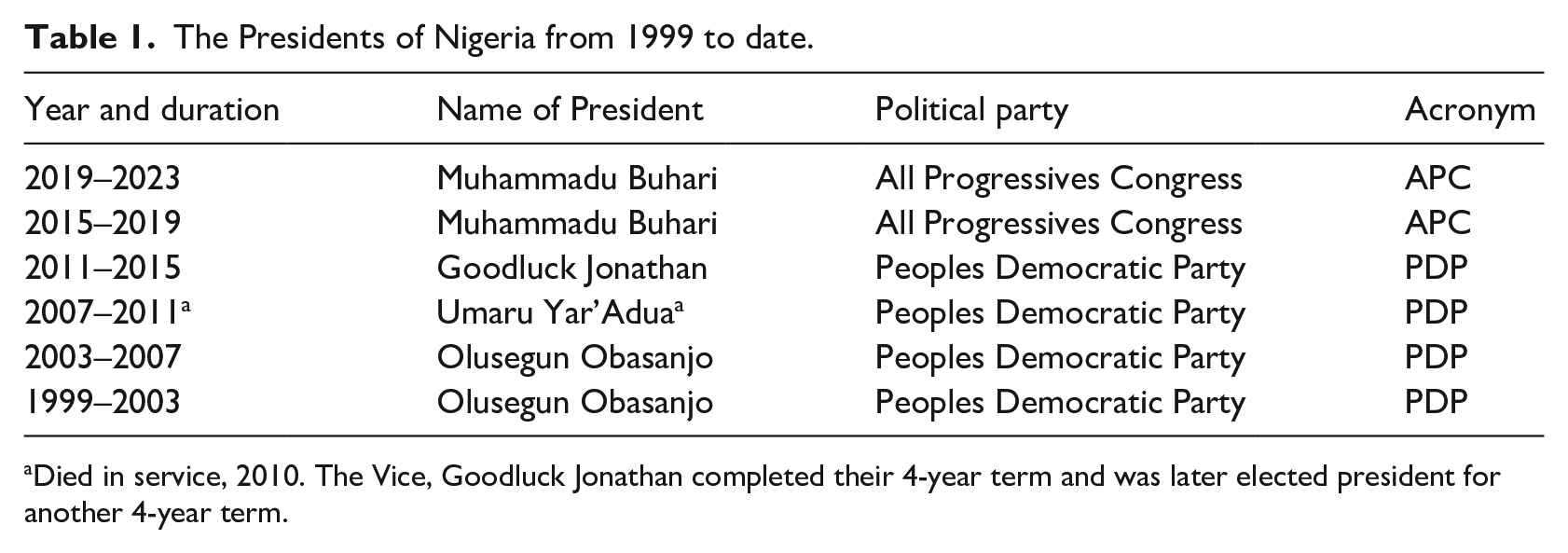
Died in service, 2010. The Vice, Goodluck Jonathan completed their 4-year term and was later elected president for another 4-year term.
Theoretical background
The literature on theories of democracy as a system of government is mixed (Andreev, 2005; Bettschneider, 2006; Buchanan and Tullock, 1965; Diamond, 2002; Downs, 1957; Huntington, 1991; Lijphart, 1999; Pinto et al., 2012; Przeworski et al., 1995; Sartori, 1987). Therefore, this study explores the public choice theory, primarily. ‘Public choice theory is the use of economic analysis to scrutinize the political process’ (Larkin Jr., 2013: 9). Democracy derives from two Greek words, demos, meaning people and kratos meaning rule by the people (Sartori, 1987). The Lincoln cliché ‘government of the people, by the people and for the people’ appears to have derived its root from this common concept (Blaug, 2016: 90). Some scholars have theorized democracy from a ‘procedural minimum’ dimension to capture many forms and processes of democracy, while a few other scholars theorized democracy from a ‘substantive’ perspective that emphasizes the validity of democracy (Andreev, 2005; Brettschneider, 2006; Collier and Levitsky, 1997). The former states that democracy should embody free and fair elections devoid of enormous malpractices (Collier and Levitsky, 1997; Przeworski et al., 1995), and the latter emphasizes the rule of law and free speech (Bettschneider, 2006; Collier and Levitsky, 1997). Public choice theory (Buchanan & Tullock, 1965; Downs, 1957; Shaw, 2002) is adopted to ground this study theoretically.
Taxation and public spending gave rise to the theory of public choice (Shaw, 2002). James Buchanan, the 1986 Nobel prize winner in Economics, propounded the public choice theory that assumes the similarity of principles in the way people behave in the marketplace and in collective bargaining. Public choice Economists posit that self-interest is the driver of people’s behaviour in the public space. Therefore, this theory submits that beyond the sympathy expressed by market participants for others in the marketplace is a concern for themselves. The public choice theory has been extrapolated to the political marketplace to demonstrate that self-interest is the motivation for the politician’s canvassing for votes and the promises captured in manifestoes. The politicians highlight various upheavals in society such as poverty, inequality and infrastructural decay that will be fixed if they become successful in the elections. However, beyond what looks like a concern for society and the masses is the politician’s self-interest (Buchanan & Tullock, 1965). This plays out in most developing nations more than in developed nations.
The proponents of public choice believe that there has indeed been a lot of romanticization of political leadership that results in illusion and government failure (Samuelson and Nordhaus, 1985; Shaw, 2002). Government intervention usually fails to realize its goal. Public choice theory observed that voters do not have the motivation and mechanism to supervise the government. Even when they do, a voter’s vote may not hinder the politician from carrying the day after the electoral activities are over. Thus, the incentive for an individual to spend time tracking political events is usually absent (Downs, 1957). The public choice theory also delves into the actions of the parliamentary members who make laws that guide the nation’s resource allocation. Aggregated resources are products of fines from those who violated regulations and compliant taxpayers. However, the theory argues that as much as the politicians may want to allocate the taxpayer’s money judiciously to favour all, the poor incentive for the politician whereby he neither gains from the wealth conserved nor saves wealth for himself potentially jeopardizes the whole effort (Shaw, 2002).
Thus, the weak incentive for politicians to demonstrate unbiased public resource management constitutes a deterrent to selfless service (Buchanan & Tullock, 1965; Shaw, 2002). The result is that the politician subsequently pursues self-interest that gradually precipitates corruption. At this point, the promises to serve the interest of the public become partially or wholly defeated, leaving the masses disgruntled. The view of public choice theory is that a decision in the interest of the public would be voted for unanimously by all voters (Buchanan & Tullock, 1965). Although unanimity of voting by all voters may never happen in real life, and even if it does happen, unanimity of voting by all voters may not mean that the majority’s decision is always the best (Buchanan & Tullock, 1965; Shaw, 2002). This is premised on the grounds that voters lack the mechanism to keep abreast of the activities of the politicians and, therefore, may not always have accurate information for an informed decision. This ignorance is excusable since they have no incentive for such a task (Downs, 1957). Therefore, public choice theory uncovers the self-centeredness enshrouded in the actions of both politicians and the masses but usually disguised as civic or benevolent acts.
Brettschneider (2006) proposed the ‘value theory of democracy’ that an authentic democracy theory must reflect the basic tenets of democracy like the ‘rule of law and freedom of speech’. Andreev (2005: 8) outlined four broad perspectives by which the quality of democracy can be, assessed: ‘socioeconomic, administrative-bureaucratic, political-constitutional and societal’. The socioeconomic perspective that captures the GDP per capita, corruption reduction, infrastructural satisfaction, etc., is of interest in this study. Since the adoption of a democratic system of government in Nigeria to date, Nigeria’s economic development has been unsatisfactory, making the consolidation of democratic values elusive (Sahle, 2017). By far, the direct impact of socioeconomic default by the leadership in a democracy creates more hardship for the majority than defaults bordering on free speech and the rule of law that often affect just a minority.
Operationalizing democracy as a value-adding form of governance in Nigeria has become very problematic, leading to a gap between democracy and development. Although extant literature argued that being in a democracy may not guarantee a rapid, annual and complete development of a state economically (Edgell et al., 2020; Gerring et al., 2012; Przeworski and Limongi, 1993; Timmons, 2010), there was a consensus that democracy should foster economic development even more than authoritarian regimes (Ake, 1990; Safaei, 2006; Sahle, 2017). Miller (2015) argues, however, that electoral autocracy has a stronger influence on human development than democracies. Thus, the initial enthusiasm with which democracy was welcomed by the masses is turning to apathy. Part of the reason for this is that Nigeria has not been truly liberated from authoritarian regimes (Diamond, 2002; Diamond and Plattner, 2012).
The Economic Intelligence Unit (EIU) in its ‘democracy index’ classified Nigeria as a hybrid democratic nation: a mix of authoritarian and democratic regimes (Diamond, 2002; Diamond and Plattner, 2012). Nigeria, therefore, falls short of an ideal democratic regime. For instance, almost all the democratically elected presidents since the beginning of the fourth republic (1999) till date were retired military personnel who only dressed up in civilian attires to contest for presidential office. Upon assumption of office, pursuits of personal interests and manifestations of dictatorial tendencies discredited their leadership and betrayed the trust vested in them through the votes of the electorates. The dominance of dictatorial tendencies reflects military-dominated democracy or authoritarian democracy (Collier and Levitsky, 1997; Mechkova et al., 2017). The hope that African economic development lies in democratic governance (Ake, 1990) and the despair from the pursuit of self-interest by the politicians in the practice of democracy (Buchanan & Tullock, 1965) is the reason for economic underdevelopment in African states (Nyong’o, 1992). This aptly reflects the Nigerian democracy experience.
Democratic leadership and contingency theories
The environment from which political leadership derives its authority could be democratic through contested free and fair elections (Hartley and Benington, 2013; Przeworski et al., 2000) empowered by sovereignty, institutions and legal procedures within a defined constituency (Hartley and Benington, 2013; Knutsen, 2010). Political leadership must pay attention to its followership and work toward the essence of power conferment. Political leadership, thus, is elected rather than appointed. As a result, continued support for political leadership lies in continuous support from the followers and stakeholders.
The riskiness of holding political power or office is that sudden or unpacified displeasure of a central stakeholder could overturn power leaving the political leader stripped of authority and leadership status (Hartley and Benington, 2013). It calls for regular attention to the development and sustenance of alliances to gain support to ratify their actions. The political leadership calls for daily self-improvement to remain up to date in performance. Its use of state coercive power necessitates a display of fairness with it. The political terrain is dynamic and demands change on the part of the political power holder for relevancy (Hartley and Benington, 2013).
Under the contingency model of leadership, depending on the leader’s characteristics, situational factors such as uncertainty can moderate outcomes of performance meaning there is ‘no one best way to lead’ (Fiedler, 1993:15; Grint, 2013). Some leaders are yet to recognize the peculiar contingency factors that moderate the impact of the outcomes of their leadership. A moderator could be a contingency factor that weakens or strengthens the relationship between two or more relationships (Figure 1).
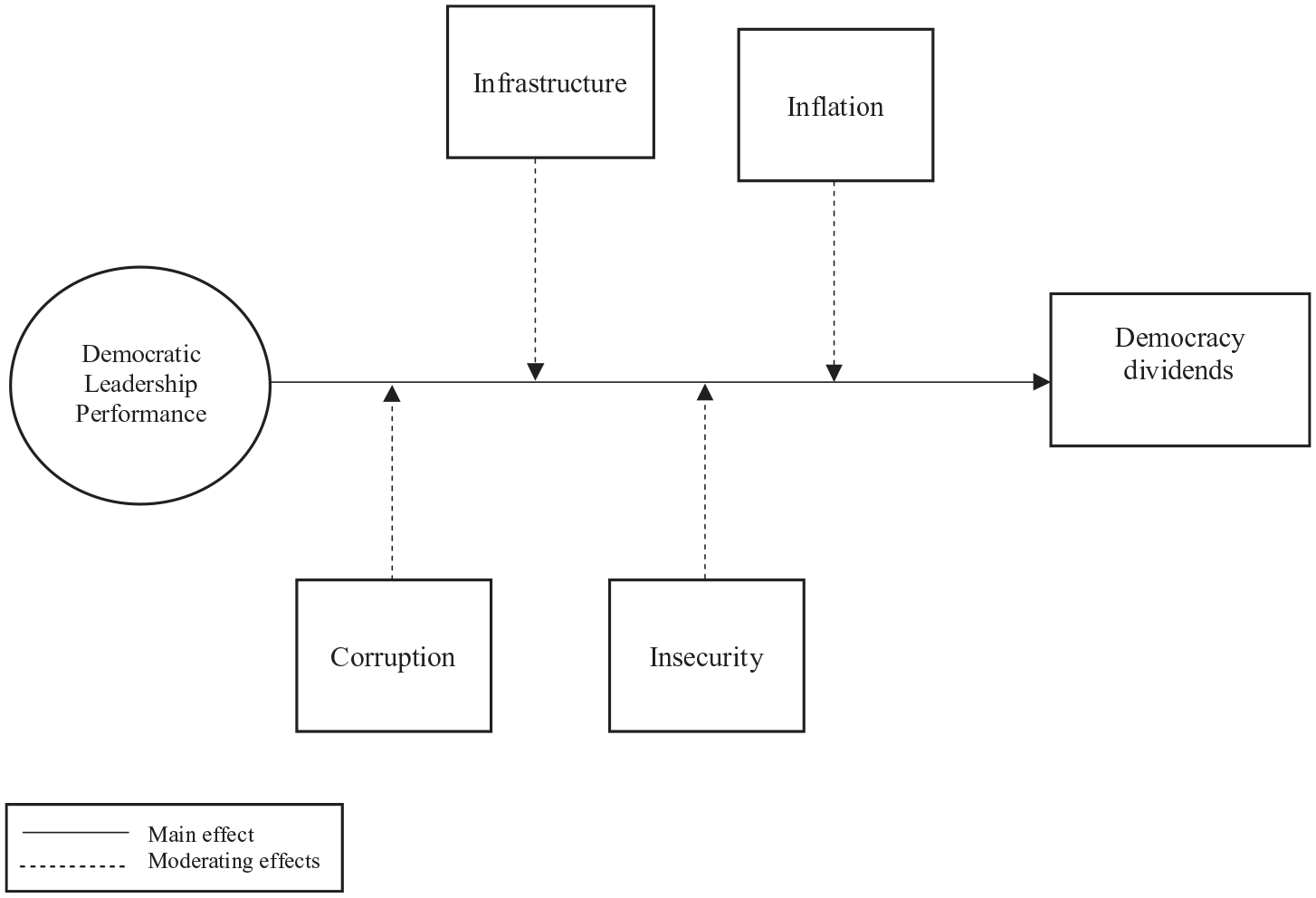
Conceptual model of the Nigerian democratic leadership performance, its dividends and the moderating factors.
Democracy in Nigeria
The Nigerian democracy commenced its fourth republic in 1999 but not without its setbacks. The Nigerian elites occupy positions of privilege and influence, unlike the average citizens. The result is a wide disparity between the rich and the poor. With the growing gap between the elites and the masses, an unprecedented level of corruption and prebendalism (Joseph, 2014) had been witnessed in almost all facets of government institutions in the Nigerian state (Danfulani and Fwatshak, 2002; Olivier de Sardan, 1999; Olukoju, 2004) as the elites and politicians struggle to stay ahead of the masses (Osoba, 1996; Smith, 2014).
The strong presence of civil rights groups and societies that run social media commentaries on the situation in Nigeria among other causes is a testimonial against the Nigerian democracy. Recently, following the controversial ‘End SARS’ 3 (Special Anti-Robbery Squad) protest, which was amplified to the world through social media, the legislative arm of the government dismissed a bill requesting a ban on the freedom of use of social media by the populace (Olukolu et al., 2019). Under controversial circumstances, reports had it that unarmed protesters were shot by Nigerian security operatives.
The ‘End SARS’ protest was a peaceful demonstration against police brutality and poor governance in Nigeria. Reports became controversial when the government denied deploying military personnel to the protest site to shoot indiscriminately at the unarmed protesters. After a lot of back and forth, the panel handed in a report describing the ‘Lekki Toll Gate’ incident, in context, as a massacre. Despite the report, extrajudicial killings by the Nigerian police have not ceased to make headlines on the news and social media.
Fundamentals of the Nigerian democracy
Democracy propagates ‘freedom of speech and self-determination’ (Akinyele, 2001: 623), the rule of law, the right to vote and free and fair elections (Andreev, 2005; Bettschneider, 2006; Collier and Levitsky, 1997; Przeworski et al., 1995). They are captured in the 1999 Nigerian constitution 4 as fundamentals, ‘while the economic, social, and cultural rights are listed as fundamental objectives and directive principles of state policy’ (Igwe et al., 2019: 4), making the former appear mandatory and the latter obligatory. Lamentations of citizens over the violation of their fundamental rights and political segregation are preponderant. 5
Elections arguably have not been free and fair. The present government in Nigeria was supposedly elected to power by the people. However, most journalists and independent observers could not attest to the integrity of the electoral process and procedures by which the leader assumed office (Diamond and Plattner, 2012). Usually, after elections, the opposition party candidate takes to the court to challenge the election results (Omotola, 2010) citing ballot box snatching by political thugs, intimidation of electoral officers and voters by the thugs of the most powerful political party under the watch of the armed security personnel deployed to maintain order, bribery of senior and junior electoral officials, multiple votes by one person, and casting of votes in some parts of the states of the country by minors (Ijim-Agbor, 2007).
In the last two decades of democracy, extant literature documents that the citizens have been marginalized, impoverished, denied true freedom of expression and displaced internally leading to agitations for self-determination, political turmoil, religious crisis, ethnic clashes (Ake, 2000; Akinyele, 2001; Ukiwo, 2003), alarming insecurity, incessant killing, kidnapping for ransom, endemic corruption, unabated inflation, unprecedented rise in the unemployment rate, to least a few. 6
Methodology
Data
A country-level data of macro-economic indices of the Nigerian state between 1999 and 2021 were collected from the sources listed in Table 2 (except for the poverty headcount ratio that was from 1985, for meaning-making). The data analyses reflect the descriptive statistics of the socioeconomic factors (Eze and Ndubisi, 2013; Thinda et al., 2021; Tleubayev and Kozhakhmet, 2022). The data were analyzed and presented as descriptive statistics (Eze and Ndubisi, 2013; Thinda et al., 2021; Tleubayev and Kozhakhmet, 2022). Missing data occurred from sources, mostly in poverty headcount ratio, the human development index, infrastructure (electricity) and corruption perception index since their data were either not previously reported annually or a year-to-year reporting began long after the millennium. However, data of some variables have not been updated in the last 2 or 3 years leaving an option to be utilized based on the last update. Inflation was captured only from 2020 to 2021 since it is reported quarterly. Archival data were collected from the electronic media: journalism and social media (Gidwani, 2002; Tleubayev and Kozhakhmet, 2022).
Factors (variables), measurements and sources of data.

Source: Author’s compilation.
GDP: gross domestic product; PPP: purchasing power parity.
An assessment of the main and moderating factors
Andreev (2005) identified several factors under four broad categories by which the quality of democracy can be assessed. To assess Nigerian democracy, we select Quality of Life (QoL) components such as ‘high GDP per capita, low levels of corruption, high purchasing power parity (PPP), rich-to-poor ratio, high security, low torture, high-quality infrastructure, good education and health care facilities’ (Andreev, 2005: 10) that all fit under the socioeconomic category (Figure 2).
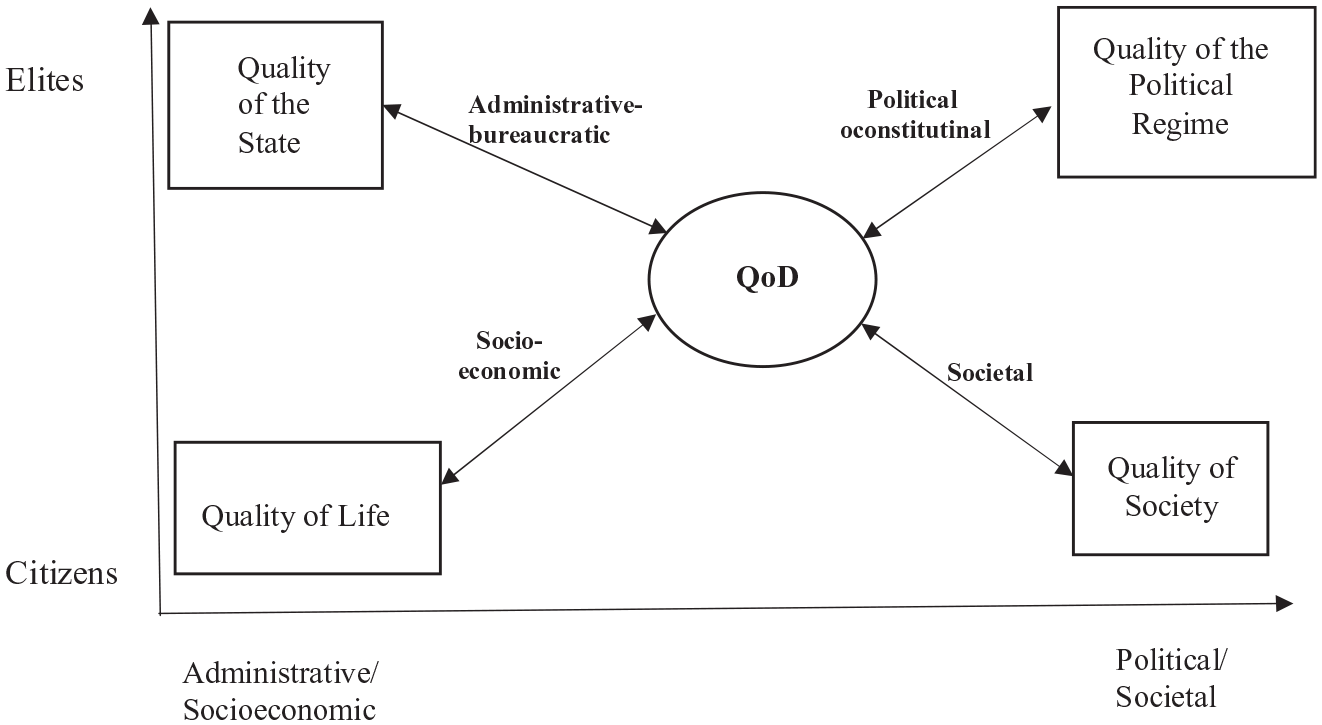
The Quality of Democracy (QoD) and its various dimensions (Andreev, 2005).
Democracy dividends
The gains accruable to Nigerian citizens for being in a democracy are ‘democracy dividends’ (Akinyele, 2001; Olukoju, 2004). Although extant literature measured human development by infant mortality rate (Gerring et al., 2012), we explore it by the United Nations Human Development Index (HDI). ‘HDI is a powerful predictor of both infant and maternal mortality rates’ (Lee et al., 1997: 430). The increase in HDI (Todaro, 1992) and reduction in the poverty headcount ratio (World Bank, 2022) are standard measures of gains derivable for being in democracy from a socioeconomic view (Andreev, 2005) as they are more encompassing and central to every citizen. Alternatively, the HDI could be unbundled for more specific effects (Lee et al., 1997) and to mitigate possible endogeneity concerns in pure quantitative research. Other measures of democracy gains include the security of lives and properties, adequate infrastructure, transparency in governance and spending and relative stability in general price levels (Andreev, 2005).
Human Development Index
The HDI (gross national income, literacy, and life expectancy) captures the economic development of the humans in a country. The HDI has gained general acceptance worldwide as an index for the comparison of wealth and well-being of people across countries of the world (Baumann, 2021; Bonaiuto et al., 2015; Piazza, 2006). The ‘Human development index remains the most reliable and informative composite social indicator of development performance’ (Todaro, 1992: 362). The HDI is a straightforward measure that relates directly to the lives of the people in each country capturing the progress of human life premised on unfettered access to the good life the people of a country had always desired to live (Baumann, 2021). Researchers have used the HDI to measure a country’s quality of life (QoL). GDP, growth in the economy, security and infrastructure are indicators of QoL in developing nations (Bonaiuto et al., 2015). Based on available data, since 2015, there has been no significant growth in the country’s HDI (Figure 3).
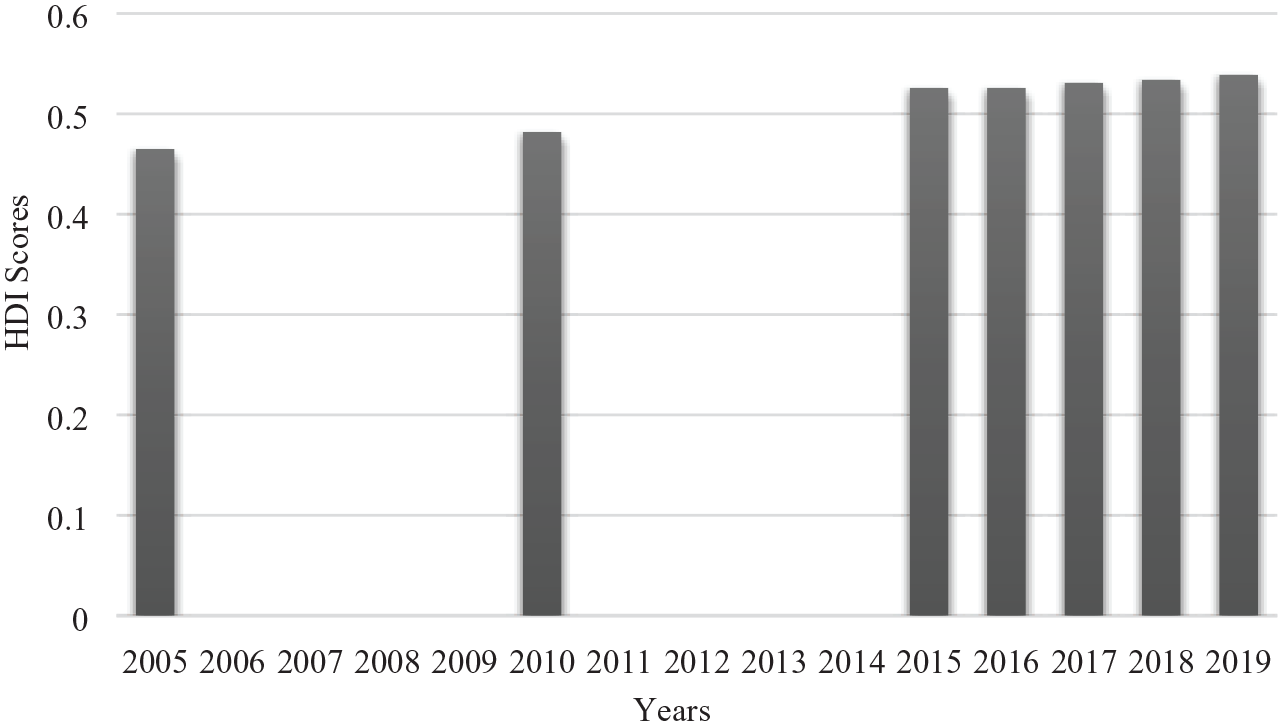
Nigeria’s Human Development Index (2005–2019).
But employing infant mortality rates as a proxy for HDI, Gerring et al. (2012) argued that yearly democracy assessment weakly influences HDI, but democracy measure over a century (democracy stock) strongly influences HDI, suggesting it could take as much as a generation for democracy’s influence to be noticeable (also see Fredriksson and Neumayer, 2013). So, in order not to make political scientists lose relevance, or for democracy not to become undesirable, political scientists suggest that the impact of democracy should be thought of in terms of political outcomes rather than in any other terms (Brettschneider, 2006; Edgell et al., 2020; Gerring et al., 2012; Przeworski and Limongi, 1993). Some might regard this as advancing a handicap for political science and democracy.
Poverty headcount ratio
The poverty headcount ratio is an indicator of the financial and social well-being of the people of a geographical territory measured as a percentage of the population who live under US$1.90 per day. 7 The author also used the poverty headcount ratio as a second proxy for democracy dividends. If the citizens are reaping the dividends of democracy, leadership performance (GDP per capita) will vary inversely with the poverty headcount ratio. So, the higher the GDP per capita, the lower the poverty headcount ratio. But ‘Nigeria is ranked among the poorest countries in the world’ (Ibitoye and Adenikinju, 2007: 492; World Bank, 2022).
Given the first point of the millennium development goals (MDGs)― ‘poverty eradication with a target to cut down by half, the number of poor people by the year 2015, 8 Nigeria’s poverty reduction status is doubtful. More than half of the Nigerian population lives below the poverty line as they cannot afford between one and two US dollars to feed themselves daily. 9 The average Nigerian suffers deprivation of the first two basic needs of man: food and safety (Maslow, 1943). Leadership that impoverishes its people (Asogwa, 2013; Danfulani and Fwatshak, 2002) rather than alleviating poverty is failed leadership.
Thus, in Nigeria, as of 2021, with a population estimated above 211 million people (World Bank, 2022), over half of the people are living in squalor and extreme poverty. 10 Poverty in Nigeria has its history before the fourth republic (Danfulani and Fwatshak, 2002; Meagher, 2006). Infant and perinatal mortality are on the increase due to poor health care, starvation and malnutrition during the gestation period (Fawole et al., 2011). Ironically, basic needs appear to be a ‘luxury’ for the average Nigerian. On average, to eke out the most basic needs is challenging for over 65% of the Nigerian populace, implicating the leadership (Figure 4).
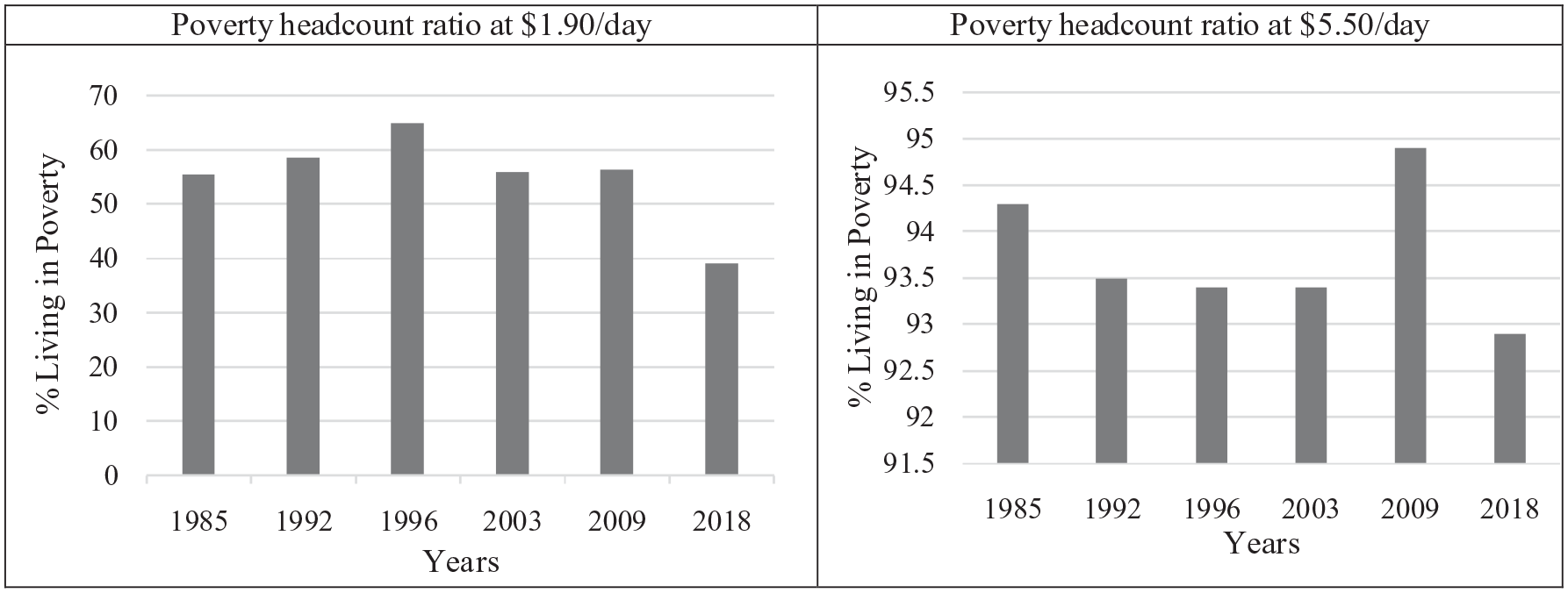
Nigeria’s poverty headcount ratio (1985–2018).
Democratic leadership performance
GDP per capita, a measure of economic growth, reveals partly the state’s economic welfare (Ghazalian and Hammoud, 2021; Mansoob Murshed and Mamoon, 2010). The economic gains derived from a democracy are reflected in the economic development fostered by those who occupy positions of leadership. Economic development can promote national peace levels (Ghazalian and Hammoud, 2021). Some studies have measured the quality of democracy by GDP per capita (Andreev, 2005; Huntington, 1991; Przeworski, et al., 1995). Sociopolitical gains include greater income inequality reduction, gender equality, inclusiveness by the ruling class, secularism, free speech, rule of law and human rights propagation (Andreev, 2005; Lijphart, 1999). However, the socioeconomic impact is the focus of this study. Hence, the interest in GDP per capita. Nigeria’s GDP per capita had grown since 2010 and plunged beginning from 2015 to 2020. With reference to a persistent decline in the country’s GDP per capita, democratic leadership performance goes farther away from the mark of improving the population’s QoL (Figure 5).

Nigeria’s GDP in billions of dollars (2010–2020).
The ‘per capita GDP, a measure of total wealth produced and consumed in a country divided by population’ (Piazza, 2006: 160) has been used to measure wealth generated under the leadership of a country that impacts the population. Boozer et al. (2003) found an indirect relationship between the poverty headcount ratio and GDP per capita, albeit reported a chain-like relationship between GDP per capita and the HDI. GDP per capita is distinct from the HDI in that, the former focuses on a country’s production and income generation capacity while the latter is concerned with the QoL of the citizens. Roemer and Gugerty (1997: 4) reported ‘strong support to the proposition that growth in per capita GDP can be and usually is a powerful force in reducing poverty’. GDP per capita had been used to measure economic growth and development (Boozer et al., 2003; Lindstedt and Naurin, 2010; Suri et al., 2011). Economic growth is attributable to leadership’s performance, hence, GDP per capita is used as its proxy.
Infrastructure
The percentage of the population with access to electricity is a proxy for infrastructure. This piece of infrastructure refers to the power by which household equipment, appliances, industrialization and development are driven. The inadequacy of power supply is a serious infrastructural problem in Nigeria. 11 The Nigerian ‘electricity consumers have yet to reap the dividends of democratic rule’ (Olukoju, 2004: 67). Many countries in emerging economies suffer set back due to the limited availability of infrastructure (Sheth, 2011). ‘The electricity situation in Nigeria is grossly inadequate, which is largely responsible for the slow development of the country’ (Ohimain, 2015: 298). Domestic appliances would seldom serve the purpose for which they were purchased. Entrepreneurs, small and medium-sized enterprises (SMEs) and multinationals have been adversely impacted by irregular power supply leading to recourse to power generators.
Experts and leading captains of industries reported that Nigeria requires 100,000 MW 12 (megawatts) to meet the country’s power needs. With the current world energy transition from fossil fuel to renewable energy (Gallo et al., 2016) such as wind and solar power, Nigeria will grapple with an immense infrastructural setback. However, in the wake of the current instability threatening the country’s unity (Akinyele, 2001), regrettably, infrastructure is unlikely to be the government’s priority. The country’s infrastructure is in deplorable condition due to inadequate maintenance and abandonment, causing the QoL to elude the citizens. ‘A country that will allow a federal government asset to decay is not a normal country’. 13
Many multinationals thus had evacuated their assets and plants from Nigeria to other neighbouring countries while most SMEs are shutting down due to poor electricity supply. Attempts to use industrial power generators had proved unsustainable following increased operational costs that had made it difficult for businesses to be competitive in the markets. The resultant deindustrialization heightens unemployment and has implications for the exchange rate. ‘Corruption, inefficiency and wastefulness’ were cited as responsible for the colossal failure of the Nigerian power sector for which Nigerians hitherto have struggled to reap the dividends of democracy (Olukoju, 2004: 67). The growth of the percentage of electricity users in Nigeria had been on a rising-and-falling trajectory for two decades with no significant growth (Figure 6).
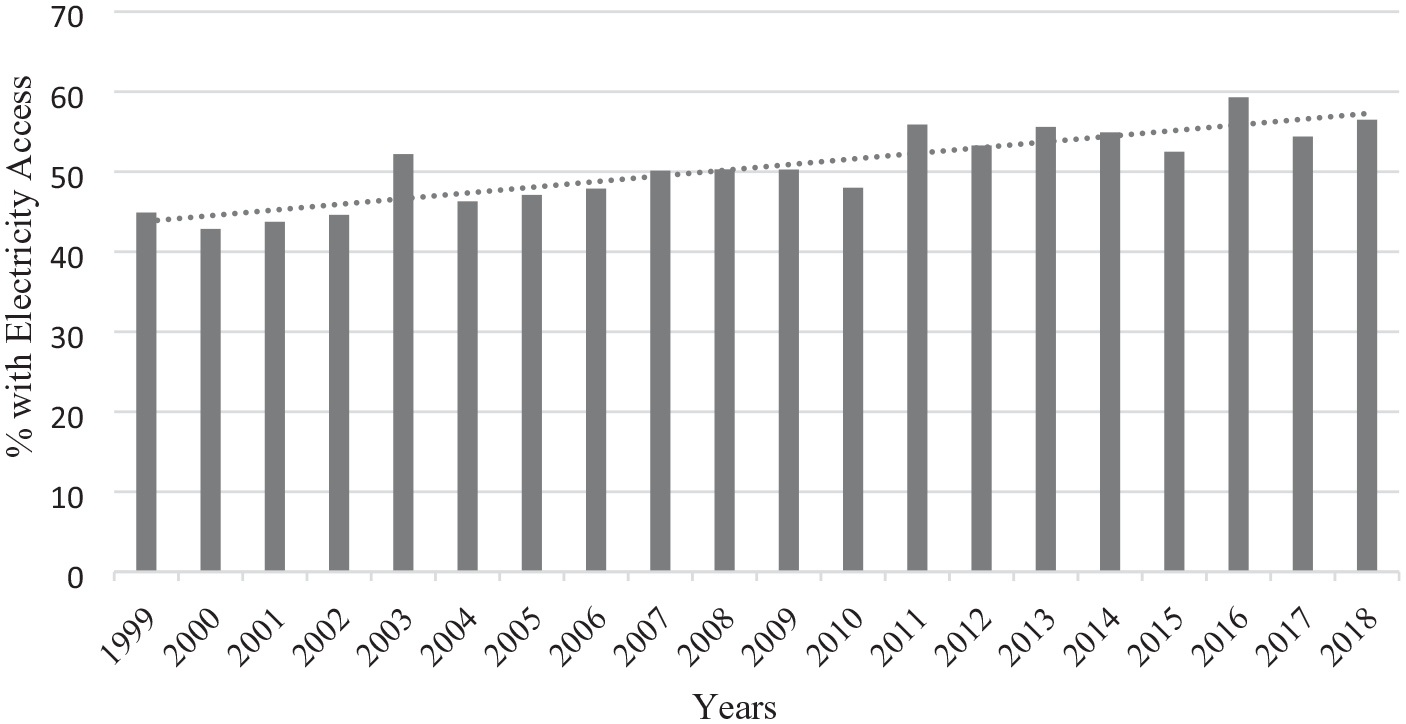
Percentage of Nigerians with access to electricity (1999–2018).
Inflation
An unabated rise in price over a long time usually due to deficit balance of payment (BOP) outcomes and unfavourable comparisons of baskets of currencies (foreign) of different countries (foreign) relative to a focal country’s (local) currency (Levi, 2009) leading to a devaluation of the local currency. Inflationary pressure has endured beyond a single digit in Nigeria for years. 14 A prolonged increase in the inflationary trajectory in any economy gradually destroys such an economy through a general rise in the prices of goods, thereby leading to a reduction in the purchasing power of the citizenry. Continuous rise in the inflationary trend and exchange rate volatility make importation a bit expensive for the affected country, and the population suffers an inevitable cost pass-through (Alsamara et al., 2020) that increases the chance of the country recording an unfavourable BOP.
In Nigeria, the inflation rate in 2021 stands at 21.03% with a ripple effect resulting in unprecedented food price inflation (22.28%) and a rise in the unemployment rate (33.3%) (Figure 7). 15
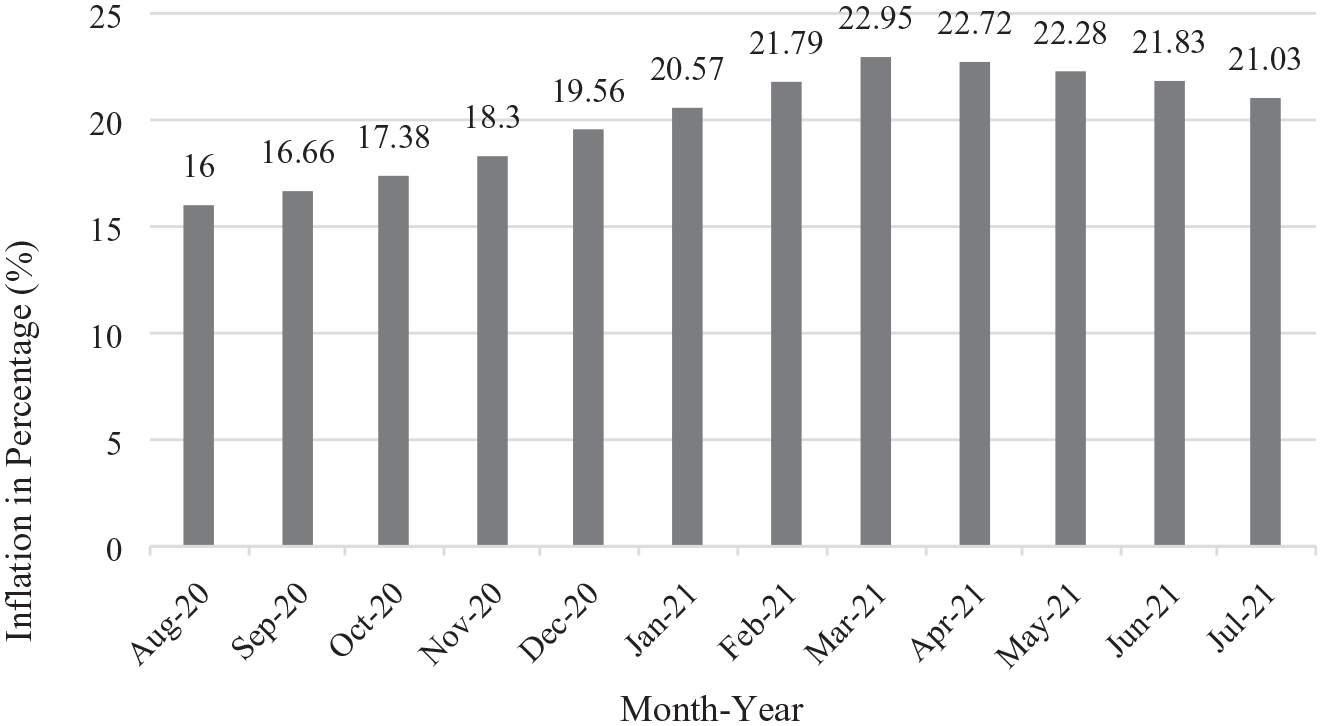
Nigeria’s food price inflation in percentage (August 2020–July 2021).
The food price spike is impacting the vast population adversely as purchasing power declines. This has a potential for political instability (Abbs, 2020). The effect of this has been that the elites and politicians who have managed to amass wealth legitimately or by some other means (Osoba, 1996) are covered; they possess purchasing power commensurate to the inflationary effects in the economy, but the uncovered masses, languish in poverty, aside the gap between the rich and the poor that continues to widen. Evidence exists that hyper-inflation can provoke political instability (Piazza, 2006).
Corruption
The Transparency International’s corruption perception index (CPI) 16 is a proxy for corruption in this study (Chizema and Pogrebna, 2019; DiRienzo, 2019). ‘Corruption is everywhere’ manifesting either pervasively or arbitrarily (Rodriguez et al., 2005: 384). ‘Corruption is a global phenomenon’ (Osoba, 1996: 373) characterized by the misuse of a vested position of authority for personal gains (Rodriguez et al., 2005). Corruption confers rewards inequitably to the advantage of the undeserving, leaving the legitimate worker at a disadvantage (Rodriguez et al., 2005).
Extant literature extensively documents corruption in the Nigerian state and politics (Akinyele, 2001; Danfulani and Fwatshak, 2002; Osoba, 1996; Joseph, 2014; Meagher, 2006; Olukoju, 2004). Corruption is an antisocial behaviour entrenched by a group or a person to achieve an unfair advantage (Osoba, 1996). It entails violating subsisting legal procedures and moral norms to beat the system. ‘Corruption is a big cankerworm in Nigeria’. 17 Although corruption led to the impoverishment of Nigerians, upholding ‘democracy, transparency and the rule of law’ could become the panacea to the corruption evident in almost all government parastatals (Danfulani and Fwatshak, 2002; Olukoju, 2004).
Corruption in Nigeria dates back to independence from British rule. The Nigerian government has scarcely lived up to the transparency expectations of the populace (Albert et al., 2021). Osoba (1996) asserted that immediately after the second republic, from the military regime to the civilian rule, an unprecedented level of corruption that was kleptocratic bedevilled the country. Rodriguez et al. (2005) found that corruption impairs economic growth and development. In 2019 and 2020, Transparency International ranked Nigeria 146th and 149th of 180 countries and scored it 0.26 and 0.25, respectively. By 2021, Nigeria’s corruption score had further deteriorated to 0.24 and the corruption ranking had gone up to 154. Low corruption scores and high corruption ranking signify poor performances (Figure 8).
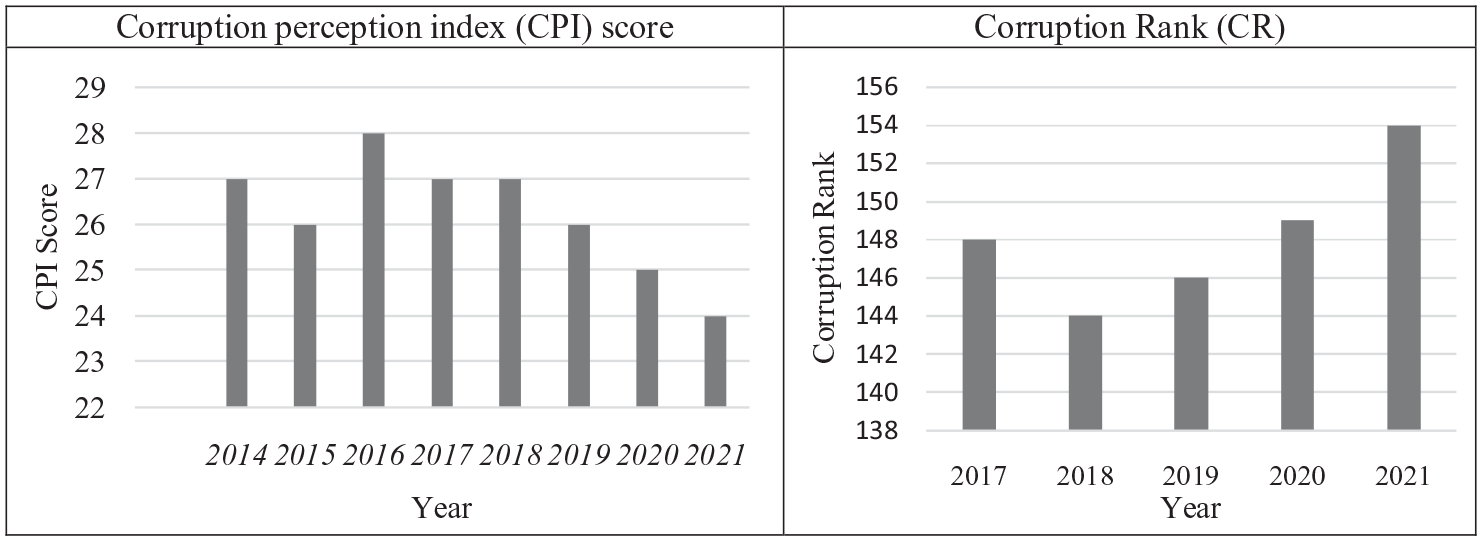
Nigeria’s corruption perception index (CPI) score (2014–2021) and corruption rank (CR) (2017–2021)
Insecurity
The Global Peace Index (GPI) and Global Terrorism Index (GTI) are proxies for insecurity. GPI is a composite index that measures how peaceful a sovereign state is or negative peace (Das and DiRienzo, 2012). It embodies numerical and non-numerical indicators on a weighted scale of 1–5. Countries with lower scores are more peaceful than those with higher scores. ‘The GPI is available for 153 independent states and is based on 23 indicators from three broad categories: ongoing domestic and international conflict, societal safety and security and the level of country militarisation’ (Das and DiRienzo, 2012: 272). Boko Haram has terrorized the Nigerian state for over a decade with unparalleled ferocity (Hansen, 2017). Aghedo and Osumah (2015) blamed the existence of Boko Haram on poor governance.
Part of the manifesto of the current government was fighting and putting an end to the insurgency of Boko Haram upon assumption of office, but to date, all is to no avail. The Indigenous People of Biafra (IPOB) has constantly been dubbed a ‘proscribed group’ by the Nigerian government, but extant literature is not quite in tandem with this assertion which has been termed ‘divisive’ (Adangor, 2018) and the method by which the government arrives at the group to be proscribed is devoid of parliamentary debates as in developed countries (Ejeh et al., 2020). The western Nigerians represented by the Oodua People’s Congress (OPC) (Akinyele, 2001) that once gravitated towards a restructuring of the system of government in Nigeria have recently identified with the agitation of the Indigenous People of Biafra (IPOB) of eastern Nigeria for self-determination. 18
Meanwhile, Boko Haram killed more than 35000 people in Nigeria between 2010 and 2016 (Adelaja and George, 2019). In 2016, Nigeria ranked third most terrorized in the world after Iraq and Afghanistan; ‘only the Taliban has killed more persons than Boko Haram’. 19 Nigeria ranked sixth most terrorized nation in 2021. In the last 10 years, the terrorism scores of Nigeria witnessed no significant drop. It could best be described as near constant (Figures 9 and 10).
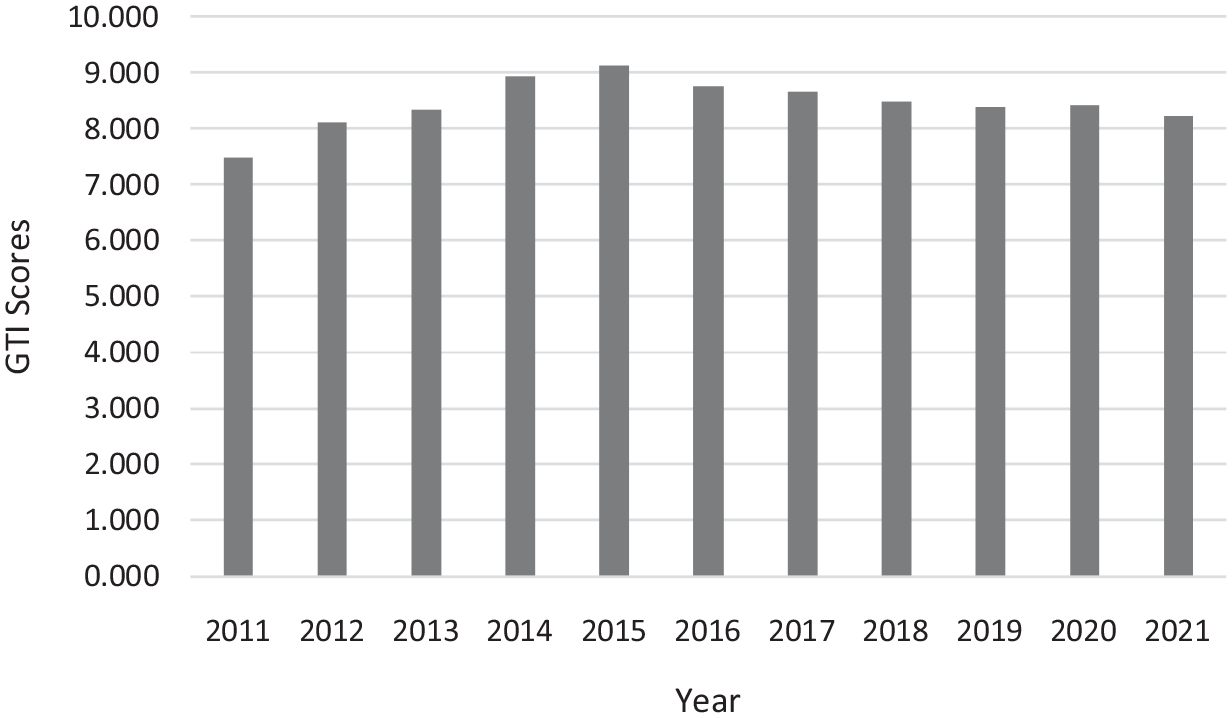
Level of terrorism in Nigeria by the GTI (2011–2021).
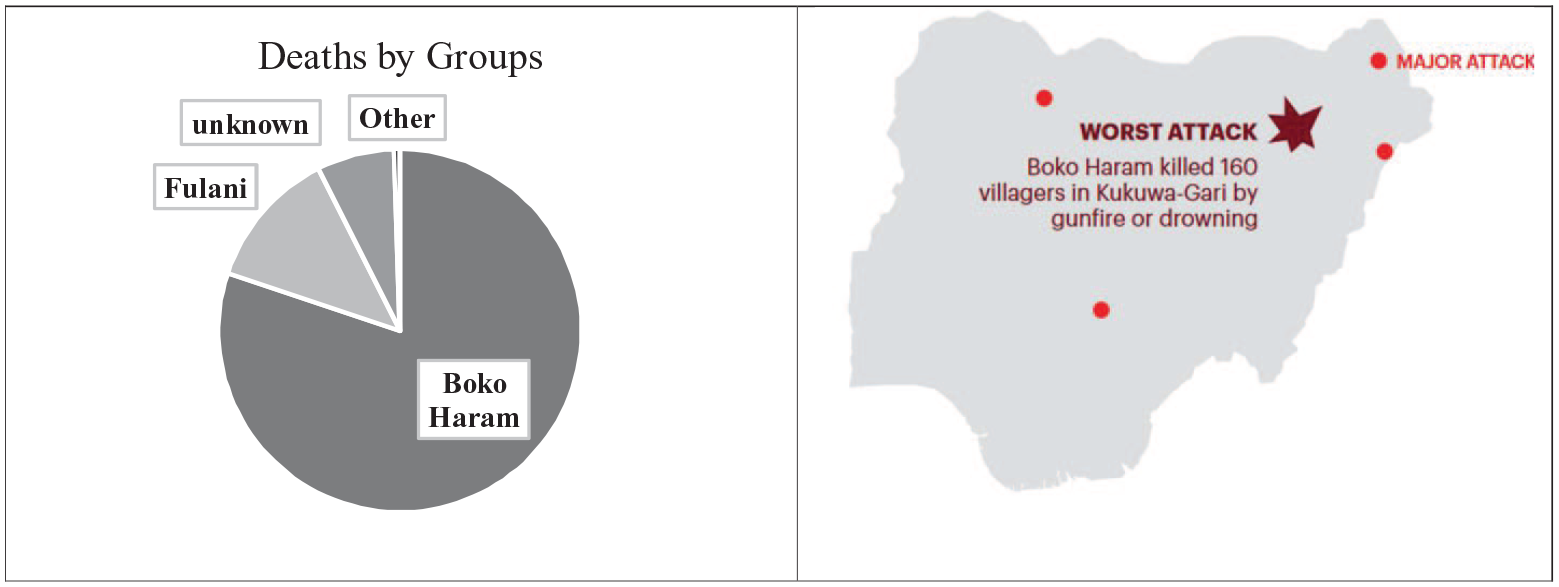
Distribution of deaths by groups and major Boko Haram attacks in Nigeria.
Tella (2018) and Ugwueze and Onuoha (2020) argued that the Boko Haram insurgency could be defeated through national and institutional diplomacy called ‘soft approach’ premised on the 2008 ‘United Nations General Assembly (UNGA) Resolution’ adopted by the Nigerian government as ‘National Terrorism-Counter Strategy (NACTEST)’ in 2014 as against the subsisting ‘hard approach’ by the government involving military combatants.
Despite the UN report that almost 350,000 persons have died due to insurgency in Nigeria, 20 the Nigerian government has irresponsibly relinquished its constitutional duty of ‘protecting lives and property of its citizens’ to the citizens. For instance, The Nigerian Army pleaded with Boko Haram to ‘turn a new leaf’ 21 and the Minister of Defence publicly announced that Nigerians should defend themselves against banditry and insurgency. 22 The presidency neither issued a counterstatement to debunk any of those cowardice proclamations unworthy of the army of a sovereign state nor a statement to reinstate its commitment towards the protection of lives and properties of its people.
Currently, the state of insecurity in Nigeria is alarming despite the US government’s plea to the Nigerian government to protect civilians. 23 It seems to have worsened as bandits 24 and the killer pastoralist Fulani Herdsmen 25 from the northern region of Nigeria have become a menace to both elites and peasants. Old and young vulnerable female farmers have fled their farms to avoid being raped 26 by the Ak-47-bearing killer Fulani Herdsmen (Ajala, 2020), who sometimes end up killing their victims while those who escape remain traumatized (see note 26). ‘The government refused to take any action against the group, claiming that it is a sociocultural group representing the interests of Fulanis’ (Ajala, 2020: 2058). A regime that deploys ‘ethno-exclusive policies as a means to maintain political power is not immune from nonviolent action’ (Abbs, 2020: 13) Nigeria’s GPI scores escalated from 2012 to date, indicating that a high level of insecurity has prevailed for a decade (Figure 11).
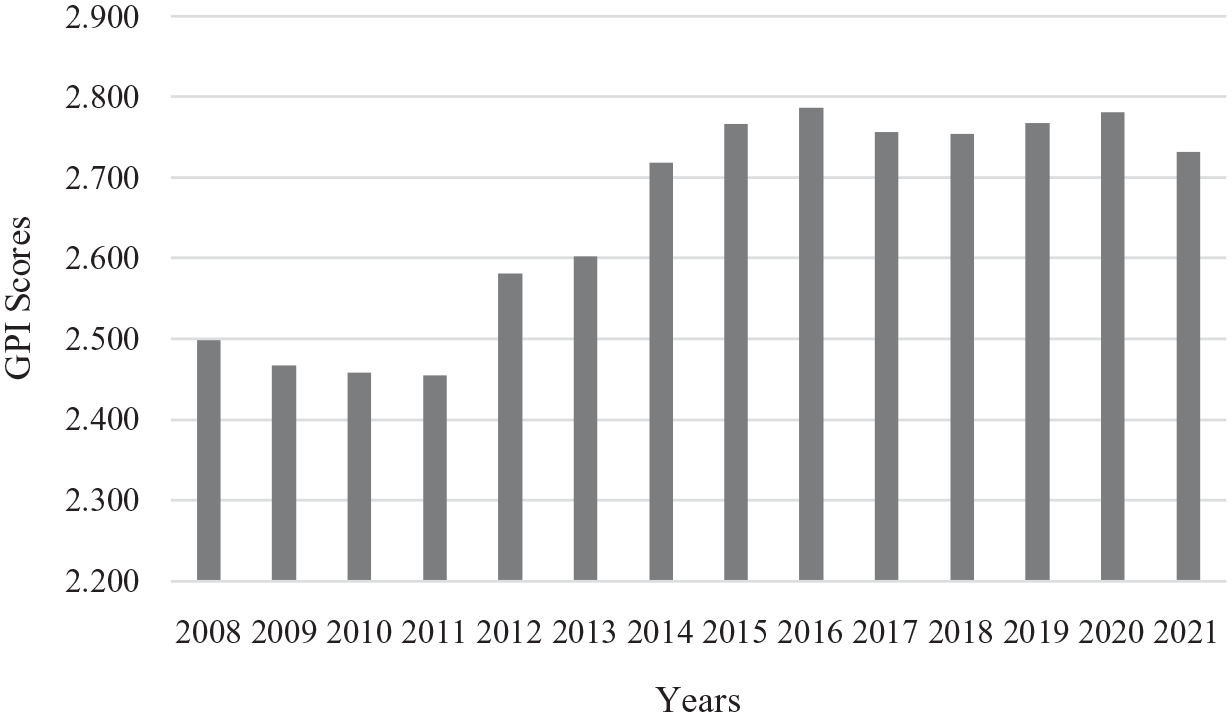
Level of peacefulness in Nigeria by the GPI (2008–2021).
Discussion
The political economy of the Nigerian state has been assessed to determine whether Nigerians have reaped the gains of being in a democracy or not. The government needs to pay attention to infrastructural development and maintenance. Economic strategies to curb the double-digit inflationary trend that has plagued the economy are critical rather than the priority the Central Bank has placed on money supply implementation under the guise of printing new currency notes. 27 Insecurity must not be left to sway in the country. Unscrupulous elements in the country usually stir up insecurity to rely on the gains thereof as an alternative to closing the poverty gap. However, when the politicians are involved, they may have a different motive, such as closing the power distance between them and a higher power level.
Therefore, the argument against rooted-in-poverty as the rationale for terrorism may hold relative to politicians (Piazza, 2006) but not to the masses. Furthermore, these unscrupulous fellows in the society create destabilization and leverage the resultant insecurity for personal gains like huge ransom collection or forcefully obtaining valuables from the vulnerable as a panacea for poverty. This counter-productive means of poverty reduction is unacceptable by any standards as it widens the inequality gap and gradually destroys the country socially and economically. It will prove unsustainable in the long run with a reversion effect on the poverty headcount ratio.
Furthermore, insecurity is a menace in Nigeria capable of making the daily freedom of movement of well-meaning citizens to their means of livelihood a risky venture. Insecurity manifests as insurgency, kidnapping, banditry, robbery, raping and extrajudicial killing. The Nigerian government must pay attention to these unfavourable factors to fix them so that the democracy dividends accruable to the people will be uneroded. And if unchecked, these factors can make the government’s efforts go down the drain despite sincere efforts and optimum input to demonstrate good governance.
However, the Nigerian government seems to make the fight against corruption its primary goal while treating critical socioeconomic factors like inflation, insecurity and infrastructure, among others, as secondary. The fight against corruption, though sacrosanct, should be left primarily for the relevant anti-corruption institutions (Hopkin and Rodríguez-Pose, 2007) to enable the government to focus on positive economic growth indices. These institutions and their personnel are not irreplaceable for unsatisfactory performance. Besides, punitive measures must be meted-out on corrupt persons, whether government officials or not, to constitute a deterrent to potential offenders. But disregard for the rule of law and selective enforcement is rampant.
Unfortunately, the independence of most of the institutions is compromised as the government and its officials are usually shielded from corruption charges under the presumptions of immunity, unlike other countries of advanced democracy. They are only chargeable upon the expiry of their tenure, by which time they have perfected looting the nation’s treasury only to hand-pick their cronies as successors to cover up their gross misconduct. Even when arrested for interrogation by anti-corruption institutions, they usually end up crafting their way to freedom. The parliamentary members who ought to open such a counter-productive phenomenon to debate on the floor of the house of parliament are themselves desperate for a similar privilege. 28 Therefore, the leaders often conveniently use the institutions as machinery for a witch-hunt. The government and its officials are not exempt from being charged for corrupt practices.
For instance, the present-day Nigerian government is allegedly guilty of corruption but quick at fighting corruption if the perpetrator belongs to the opposition party (Ocheje, 2018). Considering the double standard, the government will lack requisite legitimacy in its anti-corruption drive, while attempts to charge or name-and-shame corrupt persons will be perceived as sheer political partisanship. Political romance of corruption has kept Nigeria retarded and almost bankrupt. Corrupt governments persistently default on international borrowings (Wei and Wu, 2002). Nigeria owed the World Bank US$9.81billion as of 2019. 29
The present-day government borrows based on unrealistic oil revenue projections and expectations to augment an annual budget 30 that comprises mostly recurrent expenditure 31 with little attention to investments in reproducible capital for intergenerational equity equalization (Solow, 1974), thus, gradually mortgaging the future of its unborn generation and putting the prosperity of the present citizens in jeopardy. Despite glaring poor indices suggesting leadership failure in Nigeria, leadership has unapologetically clung to power.
Limitations and future research
Other value dimensions of democratic leadership performances such as equality, inclusiveness, secularism, free speech, the rule of law and human rights could not be dealt with in detail. They are recommended for future research. Second, although this study is exploratory, it forms a foundation for empirical analysis.
Conclusion
Corruption was the common denominator unveiled in a body of literature reviewed on the Nigerian state as a striking factor causing the woes of Nigerians, claiming it has festered across all parastatals of the government and the nation, leaving the country poor and void. The country is a shadow of its better days. The impact of leadership on the Nigerian state is abysmally poor. Unfortunately, the moderators suggest a deleterious influence on the diminutive positive effects of democratic leadership performance on the human development index and poverty headcount ratio.
To escape economic hardship, mass exodus will be commonplace in Nigeria. But those who are conditionally attached to the country for their sustenance might resort to protests and violence towards emancipation from a life of extreme poverty and suffering occasioned mainly by the government’s ineptitude and tyranny. It might, therefore, be unsavoury to condone democratic governance for a century (democracy stock) before deeming it appropriate to assess its developmental influence within the jurisdiction of its application, much less to think of democracy only in terms of political outcomes. Therefore, democratic leadership cannot be extricated from systemic failure and a life of hardship experienced by Nigerians.
Meanwhile, since the government has subjected the people to a life of unprecedented hardship with neither apology to make amends nor willingness to voluntarily resign office, constant voicing must be on the rise through social media and any other formal or informal legitimate avenues at the disposal of the citizens, notwithstanding the ongoing divisive social media regulatory stance of the government. Hopefully, members of the international community who do not have a vested interest in the ‘One Nigeria’ slogan 32 will intervene in response to the voicing of the agonizing masses. Democratic leadership cannot escape responsibility for poor development in geographical enclaves and exclaves where it is operational.
Footnotes
Acknowledgements
I thank the Editor-in-Chief and Associate Editor for their support. I appreciate the anonymous reviewers for their useful comments, suggestions and valuable inputs. Regards to my professors and colleagues at Texas A&M International University. All errors remain the author’s.
Declaration of conflicting interests
The author(s) declared no potential conflicts of interest with respect to the research, authorship and/or publication of this article.
Funding
The author(s) received no financial support for the research, authorship and/or publication of this article.
