




Abstract
Restorative justice was reborn in the 1970s with a promise to provide a better sense and experience of justice, especially for those who are let down the most by the criminal justice system. And yet, despite well-evidenced disproportionality and race inequality issues within criminal justice institutions, restorative justice research and practice within the context of race are almost nonexistent. This article aims to unravel this paradox while looking at the scant extant literature to explore the alternative and more personalized restorative justice vision of “the other” and cultural differences. An expansive conceptual model that is aligned with the integrative nature of restorative justice is then posited for further pilots and research. The article warns that if restorative justice continues to ignore the challenges raised within a race equality context, the power structures inherent within our current structural framework of criminal justice will lead to its demise.
The Paradox of Restorative Justice
Over the past 30 years, restorative justice spread fast across the world occupying scholarly and policy debates principally within the criminal justice arena. Its proponents see it as a “reincarnation” of an old justice notion that puts conflicts into the hands of their parties (Gavrielides, 2011b). In its modern version, restorative justice appears principally in the form of (direct or indirect) mediation, family group conferencing, circles, and restorative boards (Bazemore & Walgrave, 1998; Crawford & Newburn, 2003; Gavrielides, 2007; Johnstone & van Ness, 2011).
In 2005, van Ness recorded approximately 100 countries that utilize restorative justice (van Ness, 2005), while in 2011, Gavrielides identified 23 prison-based restorative justice programs in at least 84 countries (Gavrielides, 2011a). Umbreit (2008) estimated that there are over 300 victim-offender mediation programs in the United States and over 700 in Europe. The Council of Europe and the European Union have shown their keen interest by issuing Recommendations and Directives encouraging member states to promote and implement restorative justice. 1 At the international level, as early as 2002, the United Nations (UN) issued UN Resolution E/CN.15/2002/L.2/Rev.1 “Basic Principles on the Use of Restorative Justice Programmes in Criminal Matters.”
Since the first articles on restorative justice appeared in the 1970s (Barnett, 1977; Christie, 1977), the writings on its potential have been impressive (Gavrielides, 2007; Zehr, 1990). However, similarly to other disciplines, restorative justice is faced with a number of disagreements relating both to its normative and empirical promises (Gavrielides, 2008b; Johnstone & van Ness, 2011). Nevertheless, occasional confusion should be expected with relatively untested concepts that are trying to find their place within our complex, modern societies (Gavrielides, 2007; Gavrielides & Artinopoulou, 2013).
The intention here is to bring to the restorative justice debate a new dimension that is yet to be explored in its own right by Western scholars. This refers to issues surrounding race and intercultural relations. Although there have been some studies on issues surrounding diversity (Albrecht, 2010), hate incidents (Gavrielides, 2012a; Walters, 2012), power dynamics among participants and facilitators (Charkoudian & Wayne, 2010; Gavrielides, 2008; Schiff, 2013), and mediators’ adequate cultural training (Davidheiser, 2008), the relationship between restorative justice and race remains largely unexplored both normatively and empirically (Hamer, Jenkins, & Moore, 2013).
Some argue that one of the reasons that restorative justice was brought back into the modern world of policy and practice is the growing disappointment of our criminal justice systems (Pavlich, 2005). These writings tend to quote the increasing incarceration rates, recidivism statistics, the rising costs of justice, and the inability to protect the public from current and new forms of criminality. Therefore, it is surprising why race hasn’t featured more prominently in the restorative justice discourse. I will call this the “paradox of restorative justice” (also see Pavlich, 2005).
We now have enough evidence to safely claim that one of the groups that are let down the most by our criminal justice systems is Black and other racially underrepresented groups (Dorling, 2011; Kang, 2005). The international literature on disproportionality (e.g., prison population, stop and search, arrests and sentencing patterns), race relations between offenders and criminal justice agents (police, judges, prison and probation staff), the appropriateness of interventions, and issues around explicit and implicit racism is rich. Since restorative justice is brought back as a reaction to a failing criminal justice system, a newcomer to restorative justice would expect that its first normative promises and aspirations should have been for those who are let down the most. But as this article will show, the criminal justice system and the policies, laws, institutions and structures that support it do not exist in a vacuum. They are informed by our subconscious and sometimes overt bias against various social categories. It is also not surprising that those who have been named as fathers, mothers, and grandfathers of restorative justice are mostly White. This should not be read as an attack against the impressive work that has been carried out by passionate researchers, practitioners, and campaigners. In fact, it is their own gradual recognition of this gap that inspired this article.
For instance, in the first Liz Elliot memorial lecture, 2 Howard Zehr, known as “the grandfather of restorative justice,” pointed out that despite the successes of restorative justice, the continues obvious racial disparities in court and prison systems as well as the bureaucratization of restorative programs are now the key challenges that researchers need to face if the restorative justice movement is to continue. Social change, he suggests, will come from providing an alternative vision of a more caring and safe society as exhibited by creativity and artistry of compassionate people. This “alternative vision” that Zehr speaks about that could lead to the much-needed change could be provided through the implementation of the restorative justice vision and principles. This article aims to unravel not only the opportunities that restorative justice offers but also the challenges that are associated with it.
Bringing race into the restorative justice debate for research, policy and practice is a much-needed and belated task with many challenges. This is for at least three reasons, which may indeed provide an explanation and context for the aforementioned paradox of restorative justice.
First, governments are faced with increasing financial pressures to deliver more for less. Priorities are being shifted with an emphasis on costs and efficiency. Issues of equality, including race, do not feature prominently in the many waves of institutional and legislative reforms (Gavrielides & Blake, 2013). Equality and race equality are yet to be seen as drivers of reducing costs, increasing productivity, or achieving financial success (Gavrielides & Blake, 2013).
Second, proposing to treat race as the starting point of our research investigation assumes an attitudinal challenge for many readers and writers. It requires a shift in thinking as race-related matters within the context of restorative justice have never been explored in their own right. Traditionally, they have been treated as side issues of various problematic areas of implementation.
Third, to have a debate on race for restorative justice, first there needs to be an acknowledgement that such a debate is needed. Many have argued that the “Trojan horses of race” (Kang, 2005) make it difficult for the White decision maker and researcher to overcome the implicit bias that is ingrained against racial minorities notwithstanding sincere self-reports to the contrary. This subconscious resistance is also experienced from non-White groups. For example, this article assumes an acceptance of the term race within a sociological understanding. This might indeed be a challenge for certain countries that seem to be focused on a “Black” interpretation of the term. In my view, focusing exclusively on Black communities does not fully reflect the impact of power structures that affect us all, and indeed on how society uses the term race to refer to all those affected by such dynamics. Let me be clear that specialist services, and focused research and programs must continue in order for practices and policies to be effective.
The restorative process demands power-sharing that is based on the premise that all parties in conflict are equal in the identification of harm, and in reaching an agreement for restitution. Relinquishing power within the current philosophy of adversarial justice and economics is in itself a challenge. Relinquishing power within a system that is challenged by the implicit biases and “Trojan horses of race” is an even more complex matter. 3
The article will first start with some key definitions. It will then try to understand the promises of restorative justice for race. Is restorative justice able to offer this “alternative vision” that Zehr speaks about? What are the potential benefits that are to be gained if we are to invest in restorative justice for racially underrepresented groups? What are the structural and practical caveats that need to be considered when applying restorative justice for race?
The article will conclude by applying Gavrielides and Artinopoulou’s reconstructed philosophical model of restorative justice in the hope that next steps are identified for researchers and scholars. These further studies might help us bridge the current gaps in the knowledge of restorative justice and race. Therefore, it should not be expected that this think piece will provide “handbook solutions.” Here, I only aim to lay the conceptual framework within which race and restorative justice can be further developed both normatively and empirically. I also acknowledge that restorative justice research is underdeveloped in other equality areas including disability, mental health, gender, sexual orientation, and transgender issues. These, however, fall outside of this article’s remit.
I also acknowledge two key limitations. First, the article develops some critical thinking using secondary analysis of data. Up to date, there hasn’t been a research project with an exclusive focus the collection of primary data on race and restorative justice. The arguments and issues raised here are triangulated through relevant studies that looked at specific issues where race was touched upon as a side matter in the investigation of restorative justice. Second, the extant studies that were used to provide a check for our arguments are scarce. Again, this goes back to our original claim that the debate on race and restorative justice is still in its infancy. 4
Conceptual Agreements
Understanding Restorative Justice
Definitions can be artificial and run the risk of becoming obsolete very quickly, particularly if they refer to continuously evolving concepts such as restorative justice. While bearing this in mind, a glance at the extant literature will render a number of definitions for restorative justice as if it has always been a unified concept (see, for example, Braithwaite, 2002; Gavrielides, 2008; Johnstone & van Ness, 2011; Marshall, 1999). Morrison (2006) argues that restorative justice has been conceived in two broad ways. One is a process conception; the other is a values conception. The process conception is characterized by a process that brings together all parties affected by harm or wrongdoing. The values conception, on the other hand, is characterized by a set of values, or principles, that distinguish restorative justice from traditional punitive state justice.
For the purposes of this article, we accept that restorative justice is “an ethos with practical goals, among which is to restore harm by including affected parties in a (direct or indirect) encounter and a process of understanding through voluntary and honest dialogue” (Gavrielides, 2007, p. 139). Gavrielides (2007) argues that restorative justice “adopts a fresh approach to conflicts and their control, retaining at the same time certain rehabilitative goals” (p. 139). For Braithwaite (2002) and McCold (1999), the principles underlying this “ethos” are victim reparation, offender responsibility, and communities of care. McCold argues that if attention is not paid to all three concerns, then the result will only be partially restorative.
Braithwaite (2002) spoke about three groups of restorative justice standards: constraining, maximizing, and emergent. Constraining standards specify precise rights and limits, maximizing standards pursue restoration and justify the constraining standards, and emergent standards are gifts that are given in the process of restorative justice and may include apology and remorse. Christie (1977) argued that restorative justice returns conflicts as property to individuals and communities, taking them away from the state and lawyers. He argued that the state has stolen the conflict between citizens, and that this has deprived society of the opportunities for norm classification.
Let’s Talk About Race When We Talk About Race
The term race has long been contested, and thus it is important that we agree what we mean by it here. However, it must be pointed out that the understanding that we aim to develop is not meant to serve as a universal truth for race but simply to serve the purposes of our research investigation.
A biologist would probably say that race refers to a person’s physical appearance such as skin color, hair, eye color, bone structure, and so forth. It is said that these are characteristics that are passed from generation to generation and are part of a fixed biological category. For instance, in 1885, Meyers Konversations-Lexikon outlined ethnographic division into three principal races: Caucasian, Mongolian, and Negroid. In 1962, Carleton S. Coon presented four major races: White/Caucasian, Mongoloid/Asian, Negroid/Black, and Australoid. However, in 1950, the UN opted to drop the term race altogether and speak of “ethnicity.” Consequently, a number of scholars have asked for the replacement of race with ethnicity (Patel & Tyler, 2011). They believe that ethnicity can be tracked down depending on where one’s ancestors came from. Ethnicity also relates to cultural factors such as language, beliefs, nationality, and religion.
However, the term culture is not without its own challenges. In 1963, anthropologists Kroeber and Kluckhojn identified 163 definitions for the term, and more have appeared since. Again, there have been views that the term is abandoned all together (e.g., Abu-Lughod, 1991). This is principally because the term is no longer used within a specialized anthropological context. The effects of culture may also vary at an individual level (Davidson, 2001). Individuals also have “multiple cultures linked to social groups memberships and experiences” (Charkoudian & Wayne, 2010, p. 30).
From a sociological perspective, race is seen as the trigger for understanding society’s reaction to diversity and cultural difference (see, for instance, Lindhorst Everhardt, 2010). Functionalists would say that race differences exist because they serve important functions for society including the creation of “scapegoats” and the justification for things that tend to go wrong (Crenshaw, Gotanda, Peller, & Thomas, 1995). The conflict perspective argues that those in power use race and cultural difference to create conflict that will work to their advantage. This strand is very much influenced by economics and goes as back as the time of slavery and the labor disputes during the industrial revolution (Zuberi, 2011). For instance, it has been argued that race divisions were used as a managerial strategy to prevent a unitary labor force against those in control of power structures. Finally, interactionism looks at issues such as labeling and stereotypes. So, when people define themselves using racial terms, it is because of their difference with other racial groups. It has been argued that if we all experienced the world in the same way, and if we all were given the same choices and opportunities in society, then no group could claim that they are more oppressed than others, and racial differences and racism would be terms of the past.
Therefore, let me be clear that I reject the biological discourse and thus when I talk about race in this article, I use it in its analytical, sociological context to refer to the process of power that “racializes” groups and identities. I am not interested in its biological interpretation but in the power structures that the term is infused with as well as the interactionism meaning it gains through the existence of “the other.”
What is also important to agree here is that despite the fluidity and subjectivity of definitions for “race,” when putting it within the context of restorative justice, racial and cultural differences are not treated as matters of esoteric ivory tower conversations but are observed for what they are. Indeed, the subject of race for restorative justice offers an excellent opportunity for attaining the unrealized ideal of theory informing practice and vice versa. This article aspires to start a debate that will allow empirical testing. In the context of conflict resolution and restorative justice, the significance of race and cultural differences extends far beyond the interpersonal level. I agree with Zehr that understanding better the significance of race for restorative practices will help us develop a stronger restorative justice movement. Ultimately, this will bring a positive impact on restorative processes and outcomes, and indeed the future development and direction of the restorative justice notion. Charkoudian and Wayne (2010) argue, “Culture affects both how conflict is pursued and how it can be addressed. It influences people’s values, beliefs and understandings and frames the context in which conflict occurs” (p. 30). Avruch (2003) also argues, “Culture creates the mental and emotional structures through which people understand their actions and those of others in conflict” (p. 143).
The Restorative Justice Vision: An Alternative Consciousness for Race
The scarce extant literature on the interaction of restorative justice with race argues that one factor that makes restorative practices appealing is their potential to create an understanding of the perspective of “the other” (Charkoudian & Wayne, 2010; Gavrielides, 2012a; Walters, 2012). Unlike with what takes place in a courtroom, restorative practices require communication processes between the conflict parties. According to Albrecht (2010), “This process can be expected to be exacerbated when participants from different language groups and cultures, with their distinct sets of behaviour, rituals, and values meet in mediation” (p. 4).
A number of restorative justice advocates would agree with this claim. For instance, Johnstone and van Ness argue, “The ultimate goal of restorative justice should be to transform the way in which we understand ourselves and relate to others in our daily lives” (quoted in Vlaemynck, 2008, p. 3). Vlaemynck (2008) would add that this way, restorative justice has the potential to enhance social integration, understood as the ability of different groups in society to live together in productive and cooperative harmony built on mutual trust. 5
Similarly, Zehr (1990) spoke about the transformative potential of restorative justice and its changing lenses of how we view crime. He saw crime as a wound in human relationships and as an action that “creates an obligation to restore and repair” (Zehr, 1990, p. 187). He contrasted restorative justice with the retributive way of defining crime. He argued that retributive justice understands crime as “a violation of the state, defined by law-breaking and guilt. Justice determines blame and administers pain in a contest between the offender and the state directed by systematic rules” (Zehr, 1990, p. 181). According to Zehr, restorative justice sees crime as a conflict not between the individual and the state but between individuals. Accordingly, this understanding encourages the victim and the offender to see one another as persons. In a similar vein, Gavrielides (2005, 2013) argues that the focus of the restorative justice process is on the restoration of human bonds and the reunion of the two individuals who have been affected by harm or of the individual with their community. Zehr agrees as he points out that our current understanding of crime “creates an obligation to make things right,” and while “retributive justice focuses on the violation of statelaw . . . restorative justice focuses on the violation of people and relationships” (Zehr, 1999, p. 199).
Restorative justice assumes the existence of what Gavrielides calls a “social liaison” that bonds individuals into a relationship of respect for each other’s rights and freedoms (Gavrielides, 2005). This also includes their race and cultural differences. Restorative justice assumes that this liaison has always been with us independently of our ethnic background, because it is innate in our nature as human beings. We cannot see it, but we can feel it in moments of danger, or of extreme happiness. Individuals are not really strangers, and that is why victim and offender are not enemies (Gavrielides, 2013).
Interestingly, critical race theorists agree with Gavrielides’ justification of what a restorative justice process aims to restore. Jenkins (2006) argues that restorative justice is based on the Afrocentric understanding of justice. This is very much dependant on the existence of others putting an emphasis on community and values as opposed to individualism and control. The latter, he argues, are the central features of the Eurocentric understanding of justice. Schoeman (2013) reminds us of the African concept of Ubuntu, which she claims to be the foundation of restorative justice. “Modern restorative justice and indigenous justice practices share many similarities". The same values and principles that underpin the African philosophy of ubuntu are also embodied in restorative justice. This intersection of restorative justice and ubuntu philosophies is of broader relevance as it demonstrates how global and African philosophies have the potential to contribute to restoration and conflict resolution in diverse societies (Schoeman, 2013).
Barriers and Limitations for Restorative Justice
As a voluntary and complementary practice, restorative justice often struggles to find its space within the criminal justice system. Implemented mainly by and through the community (Gavrielides, 2012b; Pavlich, 2009), restorative practices often have to compete with entrenched practices and the dominant punitive mind-set of criminal justice agents (e.g., police officers, probation staff, judges, prosecutors, and prison staff). This raises some concerns as to how realistic our expectations can be in relation to its role for race equality.
According to Pavlich (2009), restorative justice is inherently limited by its implementation through “programmes that complement, are located within, or even carried out under the auspices of, state justice agencies” (p. 24). For the United States, Schiff (2013) has asked,
Is it possible for restorative justice to survive and transform such systems to produce socially just results, or is restorative justice more likely to get compromised and co-opted by the overwhelming dominant cultural ethos (and corresponding power structures) of the organizations it seeks to transform? Ultimately, is restorative justice strong enough to co-opt the co-opters? (p. 163)
Hudson (2006), Maruna (2011), and Simson (2012) all argue that restorative justice stands the best chance of resolving power imbalances within society including race-related tensions. However, none of them offer a systematic, operational mechanism by which to do so. In fact, Schiff (2013), Yiallourides and Anastasiadou (2013), and Gavrielides and Artinopoulou (2013) argue that it is impossible to divorce the successful implementation and exercise of restorative justice from the political, social, economic, and cultural context within which it is designed, operated, and implemented. Therefore, without addressing the balance of power inherent in and necessary to sustain Western sociopolitical and legal institutions, the open, flexible, inclusive approach proffered by restorative justice may be false promises. How can then this balance be achieved?
And there are additional and more practical pitfalls when implementing restorative justice for racially related tensions. For instance, the theory of restorative justice assumes that every practitioner, independently of his or her racial or cultural background, should be able to facilitate every case. However, Albrecht’s (2010) research in Finland and Norway concluded that although “to apply one’s generic model of mediation but try to be sensitive to cultural issues was unproblematic and exercised in both countries” of her fieldwork, “there was no consensus about the question of adapting one’s model to better meet the needs of minority parties” (p. 15). She then asks, “How far restorative justice practices are in reality beneficial for minorities?” (p. 15).
Albrecht then moves on to identify further practical dangers in the application of restorative justice with cases involving migrant and refugee groups. One such problem refers to what she consider the financial disadvantage that these groups have and which puts them in a vulnerable position to accept a monetary payment through the restorative justice process that does not really allow meaningful restoration. In addition to the financial benefits that this might have for this group, she also points outs that refugee and migrant victims and offenders “live under the notion that legal proceedings can have a negative impact on their right of legal residence” (Albrecht, 2010, p. 15). She concludes with fears that the key restorative justice principle of voluntariness may in fact be compromised for this particular group as she sees them twice as vulnerable being subjected to both criminal law and residence law.
Davidheiser’s research raises further practical problems. These relate principally to what he calls an “appropriate communicative framework” (Davidheiser, 2008, p. 71). This may refer to the communication styles, language barriers, ethnic matching of disputants and facilitators, cultural competencies, and self-awareness. Myers and Filner (1997) believe that adjustments in the negotiation process of restorative justice may be beneficial and that the general principles of problem-solving mediation are applicable cross-culturally. They do point out though that mediators and by extension any restorative justice facilitator must be sensitive to different styles of communication and values. Davidheiser (2008) agrees with this conclusion but argues that cognitive structures “influence mediation in a profound way that goes far beyond shared norms, values, or behavioural standards” (p. 71).
Another issue relating to cultural diversity is whether there is a need to ethnically match the facilitators with the participants. Charkoudian and Wayne looked at this issue alongside gender matching in a 2010 study. They looked at mediation cases from Maryland, Pennsylvania, Delaware, New York, Washington, D.C., New York, and Northern Virginia. Overall, 70 cases were researched including both the mediators and the parties. The cases stretched from neighborhood disputes and nonpunishable disagreements to some instances of interpersonal conflict. The researchers concluded, “Mediator-participant matches based on race or ethnicity had less effect on mediation experience than matches based on gender. They still had some effect, however, particularly when the mediator’s race/ethnicity matched only that of the other participant” (Charkoudian & Wayne, 2010, p. 43). Interestingly, they point out that issues relating to effective communication, participants’ satisfaction, and perception/bias had nothing to do with the fact that the mediators did not match the participants’ race. In going forward, they warn not to match the mediator with only one of the participants. These create tensions and imbalances. However, they do point out that although it is preferable to avoid ethnic matching,
it is essential to have a diverse mediator pool in part to make it possible to avoid isolating any participant. In particular, it is critical to realise that an overwhelming white mediator pool will repeatedly increase the possibility of isolating minority participants. (Charkoudian & Wayne, 2010, p. 47)
6
Fisher and Long’s research in 1991 with 257 mediations conducted in Australian Community Justice centers found lower rates of agreement in cases where the participants were matched with mediators of similar ethnographic backgrounds. Viswanathan and Ptak’s (1999) study in Canada raises further concerns. They claim that matching participants with mediators can in fact have divisive results as the matched mediators are often expected to act as cultural interpreters and mitigate misunderstanding. For example, in one of the cases they investigated, a Chinese woman specifically requested not to be matched with a Chinese mediator, as she feared being subjected to patriarchal attitudes and stigmatization as a bad woman and wife.
The theory of transformative mediation attempts to propose a solution to the aforementioned problem described by Fisher and Long (1991). Bush and Folger (1994) claim that when disputants are given a voice in both the content of discussions and the shaping of the mediation process, then the dangers associated with cultural biases and awareness are minimized. However, Davidheiser (2008) argues, “To date, no entirely satisfactory method has been found for addressing sociocultural pluralism in mediation and by extension in restorative justice" (p. 77). In fact, he warns us that conscious attempts to recognize diversity may harm more than hinder. “Broad generalisations of culture may work in some cases, but they may be counterproductive in others” (p. 77). Indeed, shared identities and worldviews are continually contested and renegotiated through discursive processes.
Restorative justice makes one more assumption. It takes individuals to be dependent on their communities; their lives gain meaning from the aggregation, and their happiness is linked to the existence of the aggregation that witness it. But how realistic is this assumption in today’s society? It appears that when translating this into action, restorative justice assumes a kind of relationship between people, which is difficult to accept, or even comprehend in modern Western societies. Sullivan, Tifft, and Cordella (1998) argued that restorative justice promotes a social ethic “that differs radically from that prevalent in our current political economy” (p. 16). Accordingly, many restorativists suggest that we should try to understand this relationship, not by comparing it with what we live today in our societies (where the “social liaison” is less visible) but with what communities such as the Navajo Nation experience. Yantzi (1998) explains how their spiritual approach to life and human relationships leads them to define the Navajo sense of justice as peace making. But again, isn’t this a bit far-fetched? How can we expect our modern societies to transform themselves into indigenous and aboriginal models of community living?
Looking at the Evidence
Turning now our focus on what little empirical evidence exists on the intersection between restorative justice and race, Albrecht (2010), in a research project that she carried out in Norway and Finland looking at restorative justice with cases that involved migrant minorities, concluded, “Restorative justice is an appropriate tool of conflict resolution for migrant minorities” (p. 14). She gives two reasons for this. First, she claims that restorative justice offers a less complex justice system that is easier to grasp by migrants and refugees who lack the knowledge and often the language skills to engage with the formal criminal justice system. The restorative justice system is also more flexible, she argues, and has the potential to respond to the needs of the participants. Second, restorative justice offers an alternative that is free of costs as opposed to the expensive criminal justice procedures, which entail paying for a legal representative and various associate court fees. While financial aspects can create power imbalances in court procedures, concerning, for example, the quality of the juridical representation or possibility to appeal against a judgment, differences in social status do not affect mediation processes. Albrecht’s (2010) arguments are backed up with findings from a small qualitative study that she carried out through observation of four cases where restorative justice was used with migrant and refugee people. These were followed up with 31 qualitative interviews with mediators, administrative mediation staff, and project leaders in Finland and Norway.
The very concept of punishment entails social exclusion from the community, whereas as a socially integrative approach to conflicts, restorative justice can contribute to a peaceful cohabitation of ethnically diverse groups (Gavrielides, 2013). Bazemore (2001), among others, argues that although restorative justice may indeed have demonstrated a positive effect at the individual level, “a greater community-building potential has yet to be realised” (p. 199). However, as Hebermas would argue, “which bonds socialise individuals to each other and ensure the integration of society is a network of communicative gestures” (quoted in Mannozzi, 2002, p. 233). Albrecht (2010) also sees restorative justice as one communicative gesture of many.
In Finnish intercultural neighbourhood mediation, it was noted that mediation often is the first step for people to start greeting each other or to talk to each other . . . it was reported that people learned about each other’s cultures, which enhanced tolerance of cultural diversity. (Albrecht, 2010, p. 20)
Condon’s (2010) domestic violence research with African American women and restorative justice also seems to agree with some of Albrecht’s statements. She claims “restorative justice provides a better avenue to justice for minority victims of domestic violence than participation in the traditional legal system” (Condon, 2010, p. 489). Condon starts from the premise that “the law better serves white women than minority women” (p. 491). Issues of reporting, stereotyping, persecution, and marginalization by the racially underrepresented victims’ community as well as lack of confidence in the system are some of the challenges that Condon mentions for pursuing justice through the traditional system. She also goes on to give examples of where the criminal justice system fails racially underrepresented victims of domestic violence including police’s responsiveness rate, prosecution, victim support services, and other remedies that are available to White women but not to those from Black and racially underrepresented groups (Condon, 2010).
Condon’s arguments are drawn from critical race theory (Zuberi, 2011) with an underlying argument that since White scholars and White legal theorists shape the discourse, it will always be White-centric, and hence minorities will always be disadvantaged (Crenshaw et al., 1995). She goes on to ask whether the restorative justice discourse is also racialized as White. Although she does not give definite conclusion, she argues that since restorative justice originates from indigenous populations, it does not share the same White history as the current criminal justice system. Therefore, she remains hopeful that since “restorative justice is so based in the community it has a greater flexibility built in, and it will be able to reflect the community standards no matter how the discourse is framed” (Condon, 2010, p. 499). Focusing on the African American community, Condon claims that restorative justice offers additional and specific protections. For example, she claims that it can overcome the obstacle of disclosing that domestic violence took place. By definition, restorative justice takes places behind closed doors, and hence it can give the reassurances to Black abused women not only that they will not have to share their suffering with the White world but also that they will avoid being stereotyped by their own community. Furthermore, the fact that the state is not involved in the dispute gives further reassurances to Black women that even when their Black men are brought to restorative justice, they will not have to face jail or the institutionalized racism of the criminal justice system. Coker would largely agree with Condon’s findings. In her study of Navajo Peacemaking cases involving domestic violence, Coker (1999) found that restorative justice “at its best is a healing ceremony; it seeks to remake the world—the batter’s world, creating the possibility of a different life” (p. 56).
Jenkins’s (2006) research with the Black communities of the Gullah Island also agrees with Condon. Using the method of folknography (Jarett & Lucas, 2002) and through interviews with key informants and focus groups, he concludes that on the Gullah Islands, Black communities have two forms of justice: “just law” and “unjust law.” “The just law is an approach that is restorative in nature” (Jenkins, 2006, p. 309). “Unjust law is the formal law of the state that is grounded in Eurocentric principles” (Jenkins, 2006, p. 310). He claims that the Eurocentric approach to justice has caused mistrust of the criminal justice system by many Blacks and that “the use of a restorative process, grounded in Afrocentric principles, could reduce not only crime and delinquency but also the apprehension many Blacks have about the political and legal systems” (Jenkins, 2006, p. 304).
Simson’s (2012) U.S.-based research in restorative justice and its effect on racially disparate punitive school practices seem to agree with the above arguments. He presents data to claim that the punitive practices in American schools (e.g., out-of-school suspension) “not only has racial disproportionality in school discipline been consistent, it also seems to have increased in severity over time” (Simson, 2012, p. 7). 7 Schiff (2013) agrees with Simson. She claims, “In an adversarial legalistic power structure, winners and losers are too often dictated by skin colour, socioeconomic status and access to resources of power” (Schiff, 2013). Payne and Welch (2010) are also in agreement with this conclusion.
The system’s differentially unjust treatment of minorities is reflected in the concept of “disproportionate minority contact” (DMC), which documents the extent to which minorities, and especially African Americans, are disproportionately represented at all levels of the criminal and juvenile justice systems (Cabanis, Frabutt, Hendrick, & Arbuckle, 2006). For example, national data in the United States showed that in 2000, Black students represented only 17% of public school enrollment but accounted for 34% of suspensions (Advancement Project, 2005). Other data show that nearly 1 out of every 6 African American students is suspended, as compared to 1 out of 20 for White students (1 in 12 Native American and 1 in 14 for Latinos). The number increases to 1 in every 4 for African American students with learning disabilities—a full 16% points higher than for White students with comparable disabilities (Losen & Gillespie, 2012). Similarly, Platt (1977) argued that the juvenile justice system is primarily a middle-class mechanism invented for the purpose of controlling lower class immigrant youths. Bortner (1988) later contended that the juvenile justice system was created to imbue youths with middle-class societal values and behaviors that essentially extended state control and oppression by those with power and privilege.
Simson (2012) argues that restorative justice “might be an attractive alternative to zero tolerance policies because it is a practice that can provide a forum for the voice of minorities to show that systematic inequalities are still a reality in society” (p. 16). To test his hypothesis, he conducted quantitative research with 30 schools that used restorative justice in their disciplinary practices (2006-2010) compared against 113 schools that used nonrestorative justice. He agues that restorative justice can bridge the gap of understanding created in part by perceptual segregation. “Restorative justice helps in reducing school suspensions and allows schools to move away from being punitive in their resolution of disputes, keeping students in school instead” (Simson, 2012, p. 34). According to his research, the focus of restorative justice on dialogue and on giving everyone a chance to interact can lead to discovery of misunderstanding and different perceptions of the interactions between members of a school community. Restorative justice, he says, can bring to the surface the causes of instances of “behavior leakage” by encouraging both students and disciplinary decision makers to be honest about how they perceived the other person’s behavior in the interaction that might lead to a suspension.
The 13 restorative justice schools reduced their black suspension percentage disparity by 4.5% while non-restorative justice schools increased their disparity by slight less than 1% . . . Consequently, there is strong evidence that at least in the two school districts under investigation, restorative justice is helpful in addressing what has been a decade long problem of African American disproportionality in school discipline. (Simson, 2012, p. 35)
8
Lyubansky and Barter (2011) also agree that restorative practices “support individuals and communities during racial conflicts by creating conditions for mutual understanding and collaborative action rather than seeking to exclude or punish any of the parties in the conflict” (p. 38). They argue that when communities begin to see themselves and others through labels and structural power relationships, a quality of truth is lost without which dialogue declines. “Restorative practices create the space for this quality of truth, and the forms of expression privileged by truth to reassert their force and authority” (Lyubansky & Barter, 2011, p. 40). In their study of dealing with interracial conflicts in Brazilian society through restorative circles, Lyubansky and Barter found that dialogue helped make domination of the proceedings by one person or group difficult to achieve as it passes the discourse back and forth until mutual comprehension is reached. They note,
Seeing Brazilian court workers or others invested with conflict-resolution authority travelling to favelas to sit in spaces chosen and legitimised by members of those communities is to see a concrete shift in how justice is also racially done. To see US police officers responding hesitantly but sincerely to the codes and signs of a restorative system set up by First Nation peoples is to see both a more effective and inclusive approach to community healing and a symbolic recognition of the deeper complexities and interrelationships behind daily choices. (Lyubansky & Barter, 2011, p. 43)
A Reconstructed Restorative Justice Philosophy: Addressing the Paradox of Restorative Justice
The “Trojan horses of race,” the overt biases, and the White structural framework within which restorative justice is called to operate should provide some context for the aforementioned paradox of restorative justice as well as delays that we have experienced in the development of restorative justice theory and practice for race. This paradox must be addressed, and this article used what little evidence was available to weight the arguments for and against restorative justice for race. We are not yet in a position to give definite answers to the practical and theoretical questions that have been raised. Further research and pilots must be carried out in the hope that this gray area of knowledge catches up with other oversubscribed fields of restorative justice research.
However, in order to take the next steps in research and practice of restorative justice for race, we must first establish a conceptual framework for this development. I attempt to take such a step here. In the restorative justice spirit, I claim that this framework must be consensual. I also dare to claim that the era of abolitionists has served its purpose. As we moved away from the era of experimentation and entered the times of implementation and maturity, we realized that ideas of abolishing and replacing are out of date and naive. More importantly, conflict, nullifying, and replacing are not part of the restorative justice language or rhetoric, which emphasizes consensus and negotiation.
However, I am conscious that my middle-class, White background puts me in a space where some have argued forbids me from seeing the nuances of race. For instance, Kochman believes that my cultural background as a Caucasian is so different from Black people that despite my good intentions, I will never be able to reach my desired levels of communication with them. “Black and white cultural differences are generally ignored when attempts are made to understand how and why black and white communication fails . . . cultural differences play a covert role in the communication process . . . ” (Kochman, 1981, p. 7). I disagree with Kochman.
I admit that like many normative paradigms what I will propose here is founded in personal world readings. However, I do attempt to back up my proposal using schools of thoughts that others have created. I start from the premise that when we welcome differences, we allow ourselves to appreciate qualities and concerns that our own background tends to downgrade. In my case, being able to do this with racially underrepresented groups allowed me to appreciate the significance of self-expression, spiritual well-being, emotional expressiveness, spontaneity, individual self-assertion and distinctiveness, and, above all, community.
How does this personal account inform a normative framework for the application and research of restorative justice for race? It simply sets the foundation for a consensual model whereby the imbalances of power and control can be seen through the lenses of conciliation and the human rights values that we all share because of our humanity. I define these human rights values as dignity, respect, fairness, equality, and freedom.
The human rights project, which started with the Enlightenment, and continues until today, has evolved from protecting individuals from state brutality to establishing a set of ethical standards essential to creating a decent society (Beitz, 2009; Klug, 2000). These broad ethical standards have traditionally been associated with high-level human rights abuses such as torture, genocide, prisoners of war, or claims by celebrities and criminals (Ministry of Justice, 2008). Some have argued that these standards can, in fact, be used in our everyday lives to create a culture of respect for each other’s differences (Gavrielides, 2008a, 2012b; Harvey, 2005). As Klug (2000) puts it, human rights values “have the capacity to form the basis of a shared ethos without necessarily disturbing all other points of reference in people’s lives, whether these be political or religious or neither of these” (p. 148).
It has been argued that as a social justice reform initiative, restorative justice can only overcome the criminal justice barriers by implicitly acknowledging and confronting its threat to the status quo and the structural and real violence inherent in that order (Hudson, 2006). Schiff (2013) argues that "restorative justice needs to learn to speak and then subvert the language and practices inherent in such justice systems to a language of discursiveness, relationalism and reflection.”
To move restorative justice from the margins to the mainstream and indeed allow its use for race-related matters, we must pay attention not only to the lack of its empirical data and its movement’s conceptual and power interest battles (Gavrielides, 2008) but also to the sociocultural environment within which it is implemented. I also accept that the open, community-driven, and inclusive approach of restorative justice is not welcomed by many who retain and indeed control the power of our Western sociopolitical and legal institutions. However, I reject the argument that in order to implement “justice” in a racist and structurally violence society, restorative justice must adopt and adapt to such behaviors and beliefs. I also reject the argument that it is through conflict that restorative justice will prevail. I believe it is through consensus.
I also disagree with divisive approaches to justice such as that developed by Jenkins (2006) and Hamer et al. (2013). In order to justify the use of restorative justice for race-related conflict, they trace it in what they call the Afrocentric perspective of justice. They separate it from Eurocentric processes, which “differ in four fundamental principles” (control of others, individualistic/materialistic, humans are good or bad, and self-validation through scientific methods). This is the foundation of the current criminal justice system, they claim, which alienates Black people and does not serve any sense of justice for them. On the other hand, Afrocentric understandings are based on opposite four principles (all parties make decisions equally, communal orientation relationship with the community is primary, humans are naturally good, and spiritual source is primary). But the history of restorative justice (see, for example, Gavrielides, 2011b, 2012) and the multicultural roots and orientation of restorative justice challenge this dichotomy. In fact, many of its advocates claim that the bigger strength of restorative justice is that it cannot be traced in one culture but is to be found in aboriginal, African, indigenous, Greek, Roman, Eskimo, and many other traditions of the old. Restorative justice does not belong to anyone and is adaptable and malleable to culture and times (Gavrielides, 2011).
I use Gavrielides and Artinopoulou’s (2013) “Reconstructed Restorative Justice Philosophy” to propose that it does not have to be an “either or scenario” for White and Black people, for restorative justice and criminal justice. Similar to Gavrielides and Artinopoulou, my starting point is Aristotle’s interpretation of justice. Aristotle sees these encompassing two forms: the lawful and the fair. Both are desirable and can coexist. However, whereas the lawful requires a structure and a system of regulation, the fair is value-based and can be attained through loose and bottom-up practices. This integrative understanding of justice should also explain why I reject the divisive Afrocentric versus Eurocentric model of interpreting justice.
Gavrielides and Artinopoulou (2013) argue,
There is enough empirical evidence to show that restorative justice exists in both forms; the structured and unstructured—the lawful and the fair. There is no better or worse form. There is also no reason for comparing it with what isn’t. Our reconstructed vision of restorative justice philosophy has a dual dimension: the structured and unstructured restorative justice (p. 342)
This indeed may provide us with the balance that we sought above.
Gavrielides and Artinopoulou place their structured restorative justice within the legal machinery and organized subsystems of pursuing, delivering, and maintaining justice after a conflict has occurred. But they remind us that these institutions are not equal, and the agents delivering or representing justice share various positions of power depending on their roles and place in society. This creates the aforementioned power structures and imbalances, which are additional to those that may lead to conflict in the first place. These types of imbalances are to be found within the very machinery that is set up to address conflict and its underlying causes.
To counterbalance this distortion, we have introduced legal standards. We call these rights or human rights and are understood as justiciable standards that are implemented by the very system that they aim to correct. They are based on our common humanity, independent of our race or ethnicity, and informed by the living experiences of those they aim to protect. But they do not have any significance until they take the form, or have the protection, of the law. Thus, they must be introduced into the machinery of the structured and often racially biased systems and subsystems that have been set up to address injustice and conflict.
Figure 1 is taken from Gavrielides and Artinopoulou (2013), and it aims to illustrate how this structured way of delivering justice and restorative justice works. Conflict creates “crime,” “offenders,” and “victims.” All three are placed within a funnel. Emptying the funnel will bring “peace.” Peace is understood in terms of nondomination and the absence of conflict and harm. Exit from the funnel can be achieved through a legalized and structured justice system that is served by structured institutions. The power imbalance that this structure creates is meant to be contained by the outside layer of the funnel, which is made of human rights as these are materialized through the law. Structured restorative justice is one way of emptying the funnel and is part of many other structured forms of delivering and maintaining justice and bringing peace.

Structured restorative justice.
But there is another form of delivering justice and that is informal. This exists beyond the law and can be seen within the context of harm doing. This is how balance against the structured forms of justice and restorative justice can be achieved. In this scenario, conflict in the form of harm causes a “broken liaison” (see Gavrielides, 2005, 2013) between individuals, communities, the individual and the community, the individual and the state, or even between states. It also creates “harmed parties” (see Christie, 1977; Zehr, 1990) independently of whether these are labeled as victims or offenders. Under this model, what matters is that the conflict has caused harm and a broken liaison in the preexistent relationship of the harmed parties.
Going back to our funnel, this time it is filled with different ingredients, that is, “harm,” “broken social liaison,” and “harmed parties.” Again to achieve peace, in the way that we defined it above, we must empty the funnel. Only this time, the intervention of the law is not appropriate. The community must intervene, and various emotions must be employed. This intervention can take various shapes and forms. Restorative justice practice may offer one of such a form. Unlike the previous funnel, here loose and bottom-up mechanisms that aim to restore harm and the broken social liaison are used. These are not dependent on formalized subsystems. They use localized and informal projects of bringing peace.
A common feature of both funnels is the power structures that are created through the mechanisms of emptying them. Here, these powers are not observed within and between institutions. They are created among those community representatives delivering justice. They can also be created between the harmed parties themselves as their labels and roles are removed (see, for instance, domestic violence or hate crime cases).
Another shared denominator between the two funnels and forms of delivering justice is the role of human rights as restraining standards that make the outside layer of the funnels. In this case, human rights are not enforced as legal restrictions but as a value-based behavioral code. Here, whether they are justiciable or not is irrelevant to the bottom-up structures that are called to empty the funnel from harm, the broken social liaison, and the harmed parties. What these justice projects need is the manifestation of value-based guidelines.
Gavrielides and Artinopoulou are not the only ones professing for an integrative model. Gil (2008) contends that the successful operationalization of restorative justice can occur through conscious, systematic, and long-term integration within governmental organizations that may, over time, enable successful reform of socially unjust values and corresponding institutional practices. According to Gil, it is both possible and preferable to create structurally just societies through nonviolent and strategic means rather than radical and revolutionary ones, and such change requires
pos[ing] challenging questions and engag[ing] people in reflection and dialogue concerning the consequences of prevailing social, economic, political and cultural realities for the quality of their lives and their behaviours . . . One cannot help others to extricate themselves from the dominant ideology and culture unless one is no longer afraid to acknowledge one’s alternative perspective. (p. 509)
Beyond the Restorative Justice Paradox Through Synthesis and Consensus
Critical race theory teaches us that the structured means of delivering justice through the law are born with the intention of maintaining racial hierarchy (Zuberi, 2011). It also “offers an opportunity to imagine processes that challenge these systems of domination” (Zuberi, 2011, p. 1578). Some have also argued that the differences between Black and White people are so stark that attempts to reconcile differences through dialogue are bound to be hindered (Davidheiser, 2008; Kochman, 1981). When applying Kochman’s work to mediation, we can only conclude that restorative justice employed in institutional settings “imposes a communicative framework that emanates from the social milieu of upper-middle class White Americans. The sociocultural particularity of mainstream mediation can be inhibiting for Black Americans and parties for other different backgrounds” (Davidheiser, 2008, p. 64). In fact, Menkel-Meadow (1996) and Williams (1994) would argue that this conclusion extends far beyond the United States. Davidheiser (2008) argues that this raises inherent and entrenched issues of “power imbalances related to potential advantages conferred by mainstream mediation to disputants who are well versed in the values, symbols and conventions embedded in the mediation process” (p. 64).
Surely such concerns will be even more acute when restorative justice is linked to the judicial system. These are not theoretical concerns. They are timely and necessary. In fact, the recent global trend to put restorative justice on the statute and provide it as a “mainstream option” should put the questions posed here at the top of the research agenda internationally. For instance, in the United Kingdom, the 2012 strategy “Restorative Justice Action Plan for the Criminal Justice System” announced legislation (on restorative justice) offering it to all victims at all stages of the criminal justice process. In the United States and Canada, there are also strong pressures for standardization of restorative justice. This includes the need to be accredited and/or register to practice while certain jurisdictions prefer to also put restorative justice on the statute (see, for example, Uniform Mediation Act 9 ).
There can be no doubt that restorative justice is back on the agenda internationally. Governments are becoming interested in its propositions and are trying to find ways of using it more extensively and consistently. Interestingly, in the US the 2009 Restorative Justice in Schools Actintroduced restorative justice in the educational system at a federal level.
I argue that as this interest grows, pilots on restorative justice for race must work alongside the White-dominated structural legal framework. At the international level, we know that the effectiveness of conflict resolution methods may be lessened
if they do not resonate with the norms, values and behavioural patterns of other populations. The export of Alternative Dispute Resolution processes may implicate conflict resolution in the maintenance and reproduction of international power hierarchies and North Atlantic domination over the Global South. (Davidheiser, 2008, p. 65; also see Davidheiser, 1997)
In the hope of moving beyond the restorative justice paradox, I first acknowledged it and then proposed a consensual way of addressing it. In particular, I used Gavrielides and Artinopoulou’s reconstructed restorative justice philosophy to propose an integrative model for further pilots and research on the application of restorative justice for race. Clearly, the thin evidence base that was presented here for race and restorative justice cries for additional research. Some see this research leading to “more active participation of Blacks and other disenfranchised groups to the restorative justice movement” (Jenkins, 2006, p. 314). But the way forward is not one of separation but of consensus and negotiation.
Structured and unstructured restorative justice are not mutually exclusive. However, we must remember that if the structured system is applied, then restorative justice will be emptying the funnel from crime, victims, and offenders. If we wish to achieve peace by empting the funnel from harm, the broken social liaison, and harmed parties, then a top-down approach such as legislation will not be enough. A value-based system of community trust and care must be employed. But this does not mean that one is better than the other or that the two cannot coexist.
However, I do disagree that one is dependent on the other. For example, we do not need legislation in order for value-based, unstructured restorative justice to be implemented. The examples of the old where no legislation existed for restorative justice bear evidence to this claim. Likewise, the cold letter of the law does not need warm hearts and value-based localized systems to deliver structured restorative justice. This can still be applied by criminal justice agents such as the police, prosecution, probation, and prison staff.
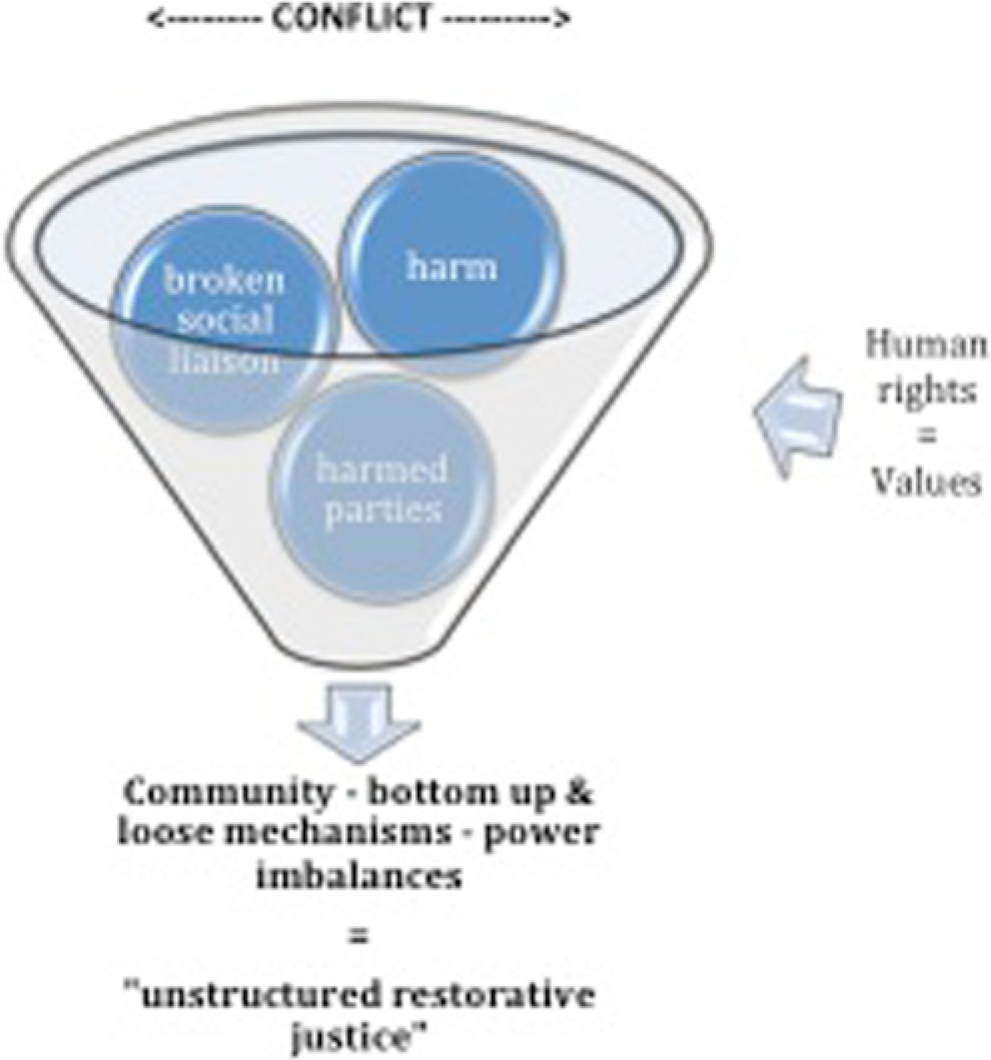
Unstructured restorative justice.
After all, much of the success of restorative justice is to be found in its diversity and living nature as a continuously evolving system of justice. Restorative justice is more than a set of values. What I argue here is that these values form the outside layer of the funnel. This layer aims to bring balance to the power battles that are to be found in the exit strategies of both of their funnels. They are not restorative justice but a part of it. The relationship between restorative justice and human rights must also be put right. I agree with Braithwaite (2002) that human rights act as the restraining values in the restorative practice. I make a distinction, however, between human rights as legal standards that exist within a structured system of justice and those that are value-based and are to be applied within a loose methodology. In this context, human rights are the values that each community embraces, and though certain similarities may be identified, these values gain meaning only through the localized codes of behavior and ethos. And yet again, value-based and justiciable human rights can work alongside each other (Gavrielides, 2012b).
If closely reexamined, what is proposed here is not in conflict with the critical race theory movement in law, as it reaffirms that a truly critical race theory requires theorists to participate in the modification of social reality. This is also the role of restorative justice and indeed its contribution to race equality. The proposed model also helps us see restorative justice as possibly an emergent different sort of power, which Foucault (2008) would refer to as “biopower.” According to Pavlich (2011), this biopower “targets living subjects, deploying pastoral, governmental and normalising power techniques that are different from, but operate in complex relations with sovereign model of criminal justice" (p. 25). Without abolishing structured restorative justice, its unstructured form can act as “counter-public” (Woolford & Ratner, 2008) fostering democratic ways for people to confront the subtle co-optations of a governmentalized, White state and its articulated visions of justice. It can provide the balance that we sought above.
It is easier to dismiss a failing criminal justice system than fix it while providing alternatives that complement it through a voluntary process. This article has pointed out a number of practical difficulties already identified in the scant extant literature on the application of restorative justice for race. What little evidence is available seems to suggest that our diversity, different communication styles, and the powers that limit us request an open and integrative approach underlining the value of process flexibly. This fluid approach increases the potential of inclusiveness and applicability of restorative justice. But Davidheiser (2008) warns, “Yet in terms of widespread, institutionalised use of mediation, leaving the process completely open could be impractical or problematic” (p. 77). He concludes, “To date, no entirely satisfactory method has been found for addressing sociocultural pluralism” (p. 77).
Remembering Kochman (1981), “A culturally pluralistic society must find ways to incorporate these differences into the system, so that they can also influence the formation of social policy, social intervention, and the social interpretation of behaviour and events” (p. 62). I conclude with Davidheiser’s (2008) recommendation for next steps:
The most promising direction may indeed be to focus our energies on crafting a replicable yet adaptive practice modality . . . The shortcomings of approaches of dos and don’ts for mediators suggests that rigid practice models should be de-emphasised in favour of an integrative focus on assessing what type of approach may be suitable for each particular case. (p. 79)
Footnotes
Acknowledgements
I am grateful to Professor Sharon Everhardt for her feedback as well as her support for presenting this article at the 4th U.S. National Restorative Justice Conference. Many thanks also go to the organizers of the conference, Professor Gina Paris and Jenkins Morris, as well as Professors Mara Schiff and Vasso Artinopoulou for inspiring me to write the article.
Declaration of Conflicting Interests
The author declared no potential conflicts of interest with respect to the research, authorship, and/or publication of this article.
Funding
The author received no financial support for the research, authorship, and/or publication of this article.