



Abstract
The present study was a correlation survey examination of self-esteem among African American college students. The constructs of racial socialization, parental involvement, social support, family structure, and self-esteem were examined among 98 African American college students residing in the central region of North Carolina. To examine these relationships, Pearson product correlation, multiple regressions, and ANOVA were run to analyze data. Conventional wisdom suggested that changes in family structure such as the dissolution of a two-parent family would have short-term and long-term effects on children and a wide range of psychosocial outcomes. However, the current study found no significant mean differences in self-esteem across family structures. By examining self-esteem in the sample population, this study identified that social support and parental involvement were significant factors that contributed to the development of self-esteem in African American adults.
Keywords
While several decades of research have been devoted to the investigation of adult depression, relatively little attention has been paid to the phenomenon of depression among adolescents. Adolescence has been viewed as a highly stressful, unstable period of the life cycle, and adolescent depression trivialized as being transitory (Chapman & Mullis, 2000). Contrary to similar contentions, depressive symptoms have been linked to adolescent suicide behavior (Tanner, 2006) and delinquency. Chapman and Mullis’s (2000) research study provides strong evidence which suggests that adolescent depression often is a precursor to major depressive disorders during adulthood.
Over the past 35 years, the proportion of U.S. children being raised in two-parent homes has dropped significantly—from about 85% in 1968 to 70% in 2003—while the number of children living in single-parent homes has nearly doubled (Durr & Hill, 2006). Scholars and researchers alike have given a significant amount of attention to family structure and its importance to self-esteem. To compound matters, family structure accompanied with socioeconomic status, can have an even more detrimental effect on self-esteem of African American children. One of the strongest predictors of poverty for adults, but particularly for children, is the number of adults in the household (Hattery & Smith, 2007). Of all Americans, only 58% of African Americans are likely to marry, while being significantly more likely to have nonmarital births. In 2005, 62% of African American babies were born to nonmarried women (Durr & Hill, 2006). Children and adults living in single-parent households are significantly more likely to live in poverty than those living in two-parent households (married or cohabitating; Durr & Hill, 2006). However, African American family structure is often extended and multigenerational and not limited to the membership of the nuclear family (father, mother, and children), to one household, or even to blood relatives (Wilson, 1989). The extended family often lives together or maintains a resilient system of social and economic support among family members.
The rising number of children who now live in single-mother households has led to considerable interest in the effects of family structure on adolescent development. In the recent past, the African American family has been depicted as a family in crisis. African American families are frequently regarded as poor, fatherless, dependent on governmental assistance, and involved in producing a multitude of children outside of wedlock (H. P. McAdoo, 1997). Since the 1970s, there have been few empirical studies linking family constellation and parental involvement with self-esteem issues in African American children. There is mounting evidence that parental support and involvement is a more suitable indicator of child behavior outcomes than actual family constellation (Jeynes, 2005). High levels of parental involvement continue to be positively associated with positive child outcomes. Moreover, this positive association is particularly evident in the academic success outcomes of African American youth (Jeynes, 2005; Mapp, Johnson, Strickland, & Meza, 2008). The ever increasing number of African American children and young adults suffering from suicide ideation, juvenile delinquency, and depression presents a new question: What other factors, paired with family structure, may be contributing to emotional and behavioral disturbances in African American youth? Consequently, a closer examination of the impact of parental involvement on family structure in African American children may be necessary when evaluating self-esteem in this population.
The purpose of the present study is to assess the impact of parental involvement, racial socialization, social support, and family structure on self-esteem in African American college students. The current study provided clarity on the state of the African American family and its effects on the development of self-image in African American children. The study also examined which family structure has consistently been related to healthy self-esteem in African American youth. In addition, the study defined family structure (or constellation) and discussed its relationship between racial socialization, parental involvement, social support, and self-esteem.
African Americans and Self-Esteem
Self-esteem is one’s affective reaction toward and feeling about oneself that is also evaluative. In order to understand African Americans, when evaluating outcomes of African American children, an examination of their self-concept and image is of great import. In addition, self-esteem must be evaluated as well. Demo and Hughes (1990) operationalized self-esteem as “the belief that most African American people possess positive characteristics and do not possess negative characteristics in a nationally representative sample of African Americans” (p.140). The correlation between support and its impact on self-esteem is of significant importance in evaluating positive outcomes of today’s youth. Crocker & Luhtanen (1990) emphasized the need to distinguish between the significance of race to an individual’s self-concept and the affective and evaluative feelings that the individual holds for his or her racial/ethnic group.
At the turn of the 19th century, the efforts of Cooley (1902) and Mead (1934) were instrumental in creating research on self-esteem. Mead suggested that people form a generalized self-image by experiences and social contact. More recent research identifies the construct of self-esteem as less inclusive than self-concept, which includes other self-processes (Gray-Little & Hafdahl, 2000). Self-esteem is central to health and happiness, and self-esteem enhancement is endorsed heartily by the popular culture. Self-esteem denotes feelings of self-acceptance, self-respect, and generally positive self-evaluation but not superiority or perfection (Oates, 2004).
A copious amount of research that surfaced in the late 1980s focused on parental behavior and adolescent self-esteem (Baldwin, 1984; Constantine, Donnelly, & Myers, 2002; Trumpeter, Watson, O’Leary, & Weathington, 2008). Family was determined to be integral in the development of a child’s self-concept (Gecas & Schwalbe, 1986). This school of thought made popular by Cooley’s (1902) idea of the “looking glass self” gave birth to Rosenberg’s (1979) “reflected appraisals.” Gecas and Schwalbe (1986) further expounded upon this by distinguishing base components of self-esteem to be a sense of personal worth and self-efficacy. Self-worth refers to the moral aspect of self-evaluation and self-efficacy refers to the sense of one’s competence or effectiveness in dealing with the social and physical environments. Gecas and Schwalbe completed a study on parental behavior and children’s self-esteem, which found that parental attitudes toward the child must be reflected in behavior in order to be perceived by the child and thereby affect his or her self-esteem. The primary outcome of this parental support and participation is that it has the possibility to deliver to the child information about his or her inherent worth (Trumpeter et al., 2008).
Prior to the 1960s, research on African Americans subscribed to the notion that African Americans suffered from low self-esteem (Constantine, Donnelly, & Myers, 2002). However, past initiatives such as the “Black is beautiful” movement were anchored in the belief that changing the values associated with characteristics of African Americans might enhance both individual and group esteem among African Americans (Kubrin, Wadsworth, & DiPietro, 2006). Although the efficacy of this type of program in raising self-esteem has not been demonstrated explicitly, the civil rights movement has often been credited with enhancing self-esteem among African American children and adults (Gray-Little & Hafdahl, 2000). The insulation hypothesis argues that because of racial segregation in the United States, the majority of African Americans compare themselves not with members of the broad society, but with other African Americans (Bryant & Zimmerman, 2003). This has resulted in African Americans being insulated from the broader society’s negative perceptions of their racial group, and their self-esteem is protected (Buckley & Carter, 2005).
Buckley and Carter (2005) submitted that though African American people often report high levels of self-esteem, racial group membership alone does not account for levels of self-esteem, specifically in African American girls. Wordlaw (2000) found that higher levels of racial socialization were related to higher self-esteem and social competence in African American female college students. In contrast to earlier models that were based on the negative impact of oppression on African Americans, models of resilience argue that identification with one’s race should result in more positive mental health outcomes such as high self-esteem (Baldwin, 1984). Thus, identification with one’s race is conceptualized as a protective factor for personal self-esteem in African Americans (Rowley, Sellers, Chavous, & Smith, 1998). This study examined factors that cultivated higher and lower levels of self-esteem in adulthood.
African Americans and Family Structure
Family structure includes the makeup of the household, specifically referring to who is the caregiver and/or guardian of the child. Family can also be defined as a group of people who feel they belong to each other although they may not live in the same house (Willis, 1999). In order to evaluate contemporary family structures, it is necessary to reflect on the historical structure of the African American family and factors that influenced its shape. As early as of 1939, E. Franklin Frazier emphasized slavery, with its dehumanizing effects on African American people, as a contributing factor to the devastating plight of African American families. Another common theory is that the new variation in African American family life was created by slavery and subsequent economic conditions such as poverty and prejudice (DeGenova, 1997). During slavery, marriage was not allowed, and children usually remained with the mother, while the father was transient and could be sold away. Following liberation, African Americans were presented with the task of forming their own family units and values of family cohesion, without the restrictive boundaries imposed by oppression (Belgrave & Allison, 2006; Johnson & Staples, 2005). Although slavery disrupted the traditions and family relationships that African Americans had grown up with, it did not eliminate the value of kinship (Willis, 1999).
From the time of Reconstruction to the Civil Rights era, two-parent households emerged and were prevalent (DeGenova, 1997). Study findings from various national surveys indicate that children raised in two-parent households do better in measures of educational achievement and adjustment than those raised in single-parent households (Preston, 2002). It has been asserted that children raised in two-parent households have an advantage due to an increased socioeconomic level and because single parents have less social support, poorer psychological well-being, and lower educational levels (Thomas, Krampe, & Newton, 2008).
The structure of African American families transformed during the 20th century to one of strength and resilience. During the Civil rights era, the African American family developed coping strategies to deal with discrimination, racial barriers, and employment (DeGenova, 1997). Families provided socialization, guidance, and inspiration. Prominent values for families included respect for elders, education and schooling, and religion (Willis, 1999). Despite the fact that more and more children are currently growing up in single-parent homes, the concept of the nuclear family, with reinforced kinship bonding, has lasted (Chapman & Mullis, 2000). This is significant to theories that hypothesize parents provide children with their initial sense of self-love and shape a child’s subsequent development (Trumpeter et al., 2008).
The structure of the family in which a child lives has strong implications for the well-being of the child. Forty-eight percent of African American children live in households with a single mother, whereas only 16% of White children live with a single mother (U.S. Census Bureau, 2002b). Although, a disproportionate number of African American families are headed by females, nonresidential African American fathers and extended family members play a role in nurturing and in the socialization of their children (Livingston & McAdoo, 2007). African American children are more likely to live in a household where a grandparent or extended family member is present (U.S. Census Bureau, 2002b). Extended family members, including distant relatives as well as social families, provide social and/or financial support (Lynch & Hanson, 2004).
There is also an ongoing battle for economic survival, which contributes to the absence of the African American parent at home and his or her continued search for self-worth. In an attempt to provide for the family, African American mothers and fathers are relegated to minimal salaried occupations and often must seek work away from their families (Fording & Berry, 2007). Removal from the home due to lack of job availability and unemployment concerns for African American parents, ultimately, has negative ramifications on their children, despite being positive initiatives (Fording, 2007). Recent research has steered focus away from the deficit model of African American families and begun to examine the constructive outcomes (Bryant & Zimmerman, 2003). The current research study investigated that while family structure forms a basis for self-esteem in adults, this is not the sole predictor.
African Americans and Racial Socialization
Past research has indicated that family structure and parental involvement alone are not the only determinants of positive mental health outcomes and self-esteem in African American youth (Blum et al., 2000; Bryant & Zimmerman, 2003). African American children growing up in the contemporary United States will likely experience unfair treatment and disenfranchisement because of their race (Brown, Brown, Caldwell, & Sellers, 2005). Historically, African American families have been and still are subject to conditions of prejudice and discrimination not experienced by other ethnic groups as American citizens (Danzinger & Lin, 2000; DeGenova, 1997; Willie & Reddick, 2003). Typically, the task to educate and condition African American children to deal with obstacles such as poverty, unemployment, and racism has been employed by parents (Hornby, 2000).
Studies and research by Livingston and McAdoo (2007) emphasize the importance of racial socialization in developing self-esteem and preparing children to cope with barriers and inequalities present in American society. Howard Stevenson (1994) defined racial socialization as the process of communicating messages and behaviors to children to bolster their sense of identity given the possibility and reality that their life experiences may include racially hostile encounters. The importance of race socialization in providing a protective barrier against prejudice and racial discrimination and its role in the development of African American racial identity have been acknowledged by many authors (Brown, Brown, Caldwell, & Sellers, 2005). Racial socialization is taught by caregivers to provide a foundation for healthy self-images at an early age. Caughy, Randolph, and O’Campo (2002) conducted a study that emphasized how Black children learn about race affected their cognitive and behavioral development. Nearly 90% of the 200 parents interviewed reported conveying racial or cultural pride messages in this study. Caughy and colleagues’ (2002) research findings indicated that children from homes rich in African American culture had greater factual knowledge and better problem-solving skills. Also, racial pride was associated with fewer behavior problems (Caughy et al., 2002). African Americans are firmly committed to developing the child’s knowledge of his or her kinship and of whom his or her people and family is (Willis, 2004). A critical function for African American families is to buffer the effects of racism and promote a sense of cultural pride and well-being within their children (Livingston & McAdoo, 2007).
Current evidence suggests that within African American families, the majority of parents (50%-89%) communicate race-related messages to their children (Caldwell et al., 2002). Stevenson (1994) developed an instrument called the Scale of Racial Socialization (SORS) that sought to address some of the measurement dilemmas in the area of racial socialization. In past research, racial socialization for adolescents has been studied by asking young adults what messages they have received from parents and grandparents (Livingston & McAdoo, 2007; McAdoo, 1997; Myers, 1998). The current study examined how racial socialization messages ultimately shape self-esteem.
African Americans and Parental Involvement
Parental involvement is operationally defined as the perceived level of parent-child interaction during childhood. Research has found substantial evidence that high levels of parental involvement significantly affect adolescent well-being and improve academic success outcomes (Jeynes, 2005). Hornby (2000) reported that parental presence often increases self-esteem, academic achievement, and stability in peer relations. The family is thought to be an important context for the development of long-term general well-being (Ackerman, D’Eramo, Umylny, Schultz, & Izard, 2001; Salem, Zimmerman, & Notaro, 1998; Willie & Reddick, 2003). The basis for mental well-being evolves in interaction with others, most notably in role-playing, the majority of, which occurs in childhood (Rosenberg, 1979). Thus, the involvement of parents with children has many implications for long-term well-being. Among adult children, positive relationships with parents reduce psychological distress and increase self-esteem levels (Wenk, Hardesty, Morgan, & Blair, 1994). Parents are a child’s first teacher and therefore play an integral role in developing the child’s orientation toward achievement and behavior.
Past research has indicated that parental involvement contributes significantly to more positive outcomes in children, specifically school-aged children (Trumpeter et al., 2008). In addition, Jeynes (2005) suggested that the positive outcomes of parental involvement also include (a) improved communication between parents and children, (b) a sense of accomplishment for parents, and (c) higher parental expectations of children. Mapp et al. (2008) conducted research to highlight that parental involvement can positively impact parent-child relationships through the parents’ participation in their child’s activities. Jeyne’s research has also overwhelmingly presented that child behavior and academic outcomes are positively affected when parents are involved. The correlation between parental involvement and child outcomes is particularly important for African American students who are more likely to be diagnosed with serious emotional disturbances than any other ethnic group (Trotman, 2002). This study hypothesized that with higher levels of interaction between parents and children, the African American community will provide a healthier self-esteem for its adults.
African Americans and Social Support
While family constellation and parental involvement are pivotal in the development of self-esteem, another contributing factor is social support. There is evidence to support positive self-esteem in African American children who may not have had a core parental presence in the home. However, in parental absence, there are typically other relatives or community members to provide guidance in the form of a social support network. Prior research has shown that social support is particularly effective at offsetting minor delinquency in areas of socioeconomic advantage, suggesting that mental health interventions promoting the development of support networks may be especially successful in these areas (Compton, Thompson, & Kaslow, 2004). Earlier research by Lynch and Hanson (2004) found that a network of social support by relatives and/or community members has a profound impact on outcomes of children who do not reside in dual-parent households or have frequent interaction with both of their parents. Social support has also been studied widely as a psychosocial resource that potentially mitigates or buffers the deleterious psychological effects of stress on mental health outcomes (Lincoln, Chatters, & Taylor, 2005).
Wight, Botticello, and Aneshensel (2006) found that African American adolescents who reported low support had higher instances of delinquency in their childhood. There was a clear association between levels of support and negative outcomes (e.g., poor academic achievement, school suspensions, and criminal behavior). The main effects model assumes that social support has a direct effect and serves a health-restorative role by meeting basic human needs for social contact, regardless of the level of stress present. This generalized beneficial effect of social support occurs because social networks provide positive interactions, support, and affirmation that lead to an overall sense of self-worth, self-esteem, and positive affect (Lincoln et al., 2005). The current study aspired to establish that higher reported social support scores translated to higher self-esteem levels.
Rationale
One of the newer demographic trends of recent years has been the increasing number of children growing up in single-parent families (Harris, 2002; Hattery & Smith, 2007; Willie & Reddick, 2003). Unlike so-called traditional families, the mother is the prevalent head of household. The rising number of children who now live in single-mother households has led to considerable interest in the effects of family structure on adolescent development. Living with a single mother has been associated with children’s delinquency, alcohol and substance abuse, lower self-esteem (Belgrave & Allison, 2006), psychiatric problems, earlier initiation of sexual intercourse, and leaving school before graduation (Jeynes, 2005). The numbers reflect high rates of both marital dissolution and children born to unwed mothers. The trend concerns analysts because single-parent status is associated with adjustment problems for children, including a variety of problem behaviors, scholastic difficulties, and psychiatric disturbances (Ackerman et al., 2001). Research questions were as follows:
Research Design
The present study was designed to assess the relationship between family structure, racial socialization, parental involvement, social support, and self-esteem in African Americans who were 18 years of age and older. Multiple regressions were employed to assess the direct and moderating relationships between racial socialization, family structure, parental involvement, social support, and self-esteem in a sample of 98 African Americans from an urban Southeastern community. Moreover, mean differences analyses were employed to assess significant differences between the constructs of racial socialization, parental involvement, social support, and self-esteem. Participants indicated family structure (which will interchangeably be referred to as family constellation) on the demographic questionnaire and were administered a battery of surveys to assess the viability of racial socialization, perceived parental involvement, social support, and family structure as predictor variables of self-esteem. A power analysis was conducted to ascertain the minimum detectable effect size given the fixed study parameters. The minimum detectable effect size is .26 when alphas and power are set at the conventional levels (.05 and .08, respectively), with the smallest group size being 200. Lipsey and Wilson (1993), in their classic meta-analysis, found that the average effect size in studies of psychological adjustment was .59, with a median of .53 and a mode of .25. In order to be conservative, a medium effect size with a power of .80 at alpha level .05 was chosen. According to Green’s (1991) formula, the minimum number of participants needed should include 8 times the number of independent variables plus 50. Utilizing this formula, a minimum sample size of 82 was needed to examine the relationship between the independent variables of family constellation, racial socialization, social support, and parental involvement on the dependent variable, self-esteem.
Participants
The data for this project was collected from a sample of African American college students residing in central North Carolina and currently enrolled at a historically African American university campus. Participants were 18 years of age or older. Exclusion criterion was that all participants must be at least 18 years of age and identify themselves as African American. Participants were asked to indicate family constellation (whether they were raised in a one- or two-parent household or by extended family). Of 98 participants in the study, 39.8% lived with single mother, 4.1% lived with single father, 38.8% dual-parent (biological parents), 8.2% dual-parent (bioparent/stepparent), 4.1% extended family, 3.1% guardian/foster parent, 2% single parent/cohabitating partner, 69% reported parental combined income less than US$60,000, 28% less than US$30,000, and 41% income between US$30,000 and US$60,000. The mean age of participants was 21.28. Of the 98 total participants, 71 were female and 27 male.
Consistent with the principles of community-based research, participants were recruited from general undergraduate courses in the psychology, history, and human sciences departments. Participants were assigned to a particular family structure on the basis of marital status and cohabitating partner. Families composed of married biological parent (termed intact families), married with stepfather (stepfamilies), single parent (no residential partner present during childhood), and cohabitating partner. For purposes of this study, cohabitating partners were not biologically related to the target adult. A consent form was obtained from all participants prior to test administration (see Table 1).
Descriptive Statistics for African American College Students (N = 98).

Procedure
Participants in the study were sampled from introductory general courses in the psychology, history, and human sciences departments. Ensuing calls and appointments occurred with professors within the departments to answer any questions regarding the study. In addition, times were arranged for data collection. On the date of collection, students were informed about the nature and purpose of the study and informed that all information provided would be confidential and that their participation was voluntary. Following explanation of the study and obtaining participants’ signature on informed consent documents, the surveys were administered. Completion of the surveys lasted approximately 20 to 45 minutes.
The participants initially completed the demographic questionnaire. Following this questionnaire, the examiner instructed participants to complete an assessment packet that contained the following instruments: Taylor and Tomasic’s Inventory of Self-Esteem (1991), followed by Causey and Livingston’s Perceived Parental Involvement Scale (2008), Interpersonal Support Evaluation List (ISEL; Cohen, Mermelstein, Kamarck, & Hoberman, 1985), and finally the Color-Blind Racial Attitudes Scale (Neville, Lilly, Duran, Lee, & Browne, 2000). Upon completion of the surveys, participants then placed materials in an unmarked envelope. Afterward, participants completed the surveys, placed them in a sealed envelope, and handed them to the examiner. Participants were debriefed, and all residual concerns were addressed. Students who completed the study were instructed to select a plain white envelope from an unmarked box in which the contents contained either a US$1, US$5, US$10, or US$20 bill as compensation for their participation.
Measures
Demographic Questionnaire
Demographic information surveys were secured from participants in the present study. Age, income, education level, gender, and family structure were assessed to obtain demographic information on each participant. In addition, family structure was assessed categorically; participants indicated the model of family organization that best depicted their family structure during adolescence.
Racial Socialization
The current study utilized the Color-Blind Racial Attitudes Scale (CoBRAS) created by Neville, Lilly, Duran, Lee, and Browne (2000); a six-item subscale taken from the Blatant Racial Issues scale is rated on a 5-point rating scale (1 = strongly disagree to 5 = strongly agree). Higher scores reflect a greater denial or unawareness of racism and discrimination in society (Neville et al., 2000). The combined parent CoBRAS had a mean item score of 1.96 (SD = 0.78) with an alpha coefficient of .77. Participants responded to items such as “Racial problems in the US are rare, isolated situations” and “Racism is a major problem in the US.” Of the original six items, four were used. Items 5 and 6 were removed because they did not correlate well with the rest of the items or the entire scale. Alpha reliability for the remaining four items was .66. Responses were rated from 1 to 5, with 1 = strongly disagree and 5 = strongly agree.
Perceived Parental Involvement
In an effort to evaluate students’ perceptions of parent involvement, a 10-item questionnaire was created. The 4-point Likert-type scale consists of items that will measure the perceived level of interaction between participants and their caregivers during childhood. Given that Causey and Livingston’s Parental Involvement Scale is a novice instrument, alpha levels and other psychometric tests were run following the pilot of 23. In an effort to assess the psychometric property of the parent involvement scale, the measure was piloted to 23 participants. Alpha reliability for the measure was .90. Factor analyses were run and 68% of variance was accounted for by three factors. Participants responded to items such as “When you were a child, did your caregiver talk to you about peer pressure?” and “When you were a child, did your caregiver attend school functions that you were involved in?” Item responses ranged from 1 to 4, with 1 = never and 4 = often.
Social Support
The ISEL was developed by Cohen et al. (1985) to measure perceived social support. Social support refers to the various types of support that people receive from others and is generally classified into two major categories: emotional and instrumental. Emotional support refers to the things that people do that make us feel loved and cared for, that bolster our sense of self-worth; by contrast, instrumental support refers to types of tangible help that others provide (e.g., provision of money, transportation, and child care). Cohen and colleagues reported retest reliability for the full measure as .87 and retest reliability ranges for the subscales between .71 and .87. Of the original 30 items of ISEL, only 10 were chosen. Of 10 items selected, only Items 2 to 10 were used. Item 1 was omitted as it did not correlate well with the other items on the scale. Participants responded to questions such as “I have a hard time keeping up with my friends” and “There is at least one person I know whose advice I really trust.” Alpha reliability for this scale was .70. The ISEL is a Likert-type scale with responses ranging from 1 to 4, with 1 = definitely true and 4 = definitely false.
Self-Esteem
For the purposes of this study, the Taylor’s Inventory of Self-Esteem will be the measure used to evaluate each participant’s self-image. The scale was developed in an effort to assess self-esteem in African Americans. Taylor’s Inventory of Self-Esteem is a 16-item Likert-type instrument created and revised from a random sample of 444 participants, of whom 84% were African American (J. Taylor & Tomasic, 1991). Of the 16 items of the scale, only 15 were used. Item Number 4 was removed because it did not correlate well with the other items on the scale. Alpha reliability was .85. The stability of Taylor’s Inventory of Self-Esteem was evaluated by Wilson (1989) who reported a 4-month test-retest reliability of .93. A Likert-type scale (0 = never to 8 = always) was used for rating each statement on the Self-Esteem scale. Participants responded to items such as “I am satisfied with the kind of person I am” and “I follow through on decisions that I make,” indicating lower score values on the scale denoted lower self-esteem and vice versa.
Results
In an effort to understand what factors predict self-esteem, SPSS 17.0 was used. Twenty percent of data will be reentered to assure accuracy. Frequency distributions were run to assure that data are within acceptable ranges. Pearson product correlations were run to assess the relationship between racial socialization and self-esteem, social support and self-esteem, and perceived parental involvement and self-esteem. Results indicated that there was no statistically significant relationship between racial socialization and self-esteem, r = .04, p = ns. Data also indicated parental involvement was significantly related to self-esteem; r = .38, p = .01. Thus, participants who indicated a high level of parental involvement reported a higher level of self-esteem. There was a statistically significant relationship between social support and self-esteem, r = .42, p ≤ .01 (see Table 2).
Correlation Table for Primary Variables.
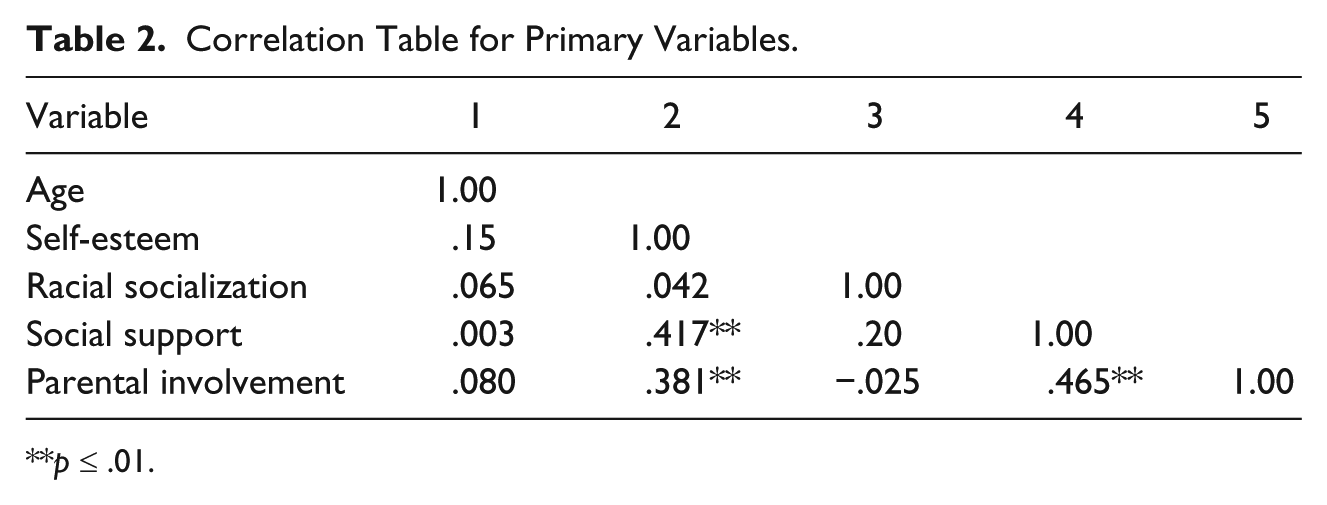
p ≤ .01.
Predicting Self-Esteem: Hypotheses 1 to 4
In an effort to assess those factors that predict self-esteem, a series of standard multiple regressions were run. Covarying out the influence of age, results of the study indicated that racial socialization does not significantly predict self-esteem among the participants in the study. (b = .03, p = ns). Covarying out the influence of age, results of the study indicated that parental involvement significantly predicted self-esteem (b = .37, p ≤ .01). Moreover, after covarying out age, social support significantly predicted self-esteem among African American college students (b = .42, p ≤ .01). To assess the combined influence of racial socialization and parental involvement, a regression controlling for the influence of age was run. The overall model explains 16% of the variance in self-esteem, F(3, 97) = 6.10, p ≤ .01. Thus, Hypothesis 4 is supported, and variables of racial socialization and parental involvement are better predictors of self-esteem than either variable alone (see Tables 3, 4, and 5).
Regression for Racial Socialization as Predictor of Self-Esteem.
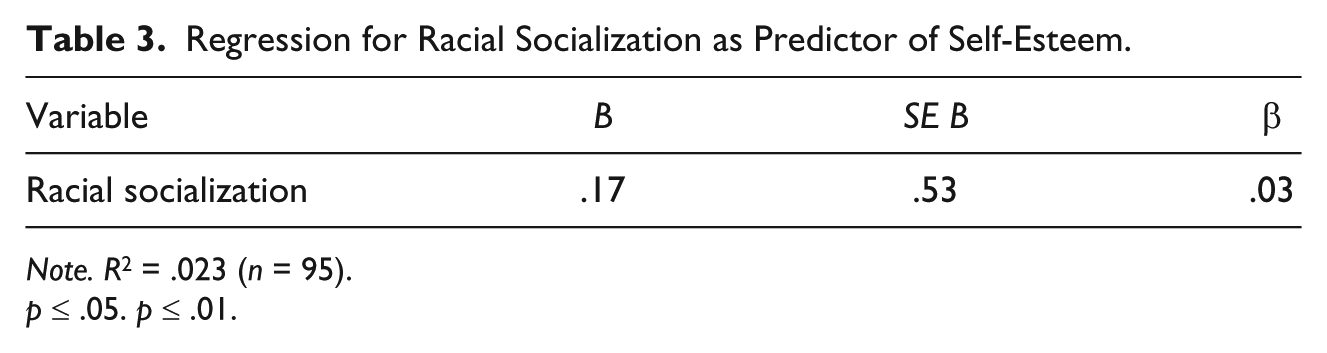
Note. R2 = .023 (n = 95).
p ≤ .05. p ≤ .01.
Regression for Parental Involvement as Predictor of Self-Esteem.

Note. R2 = .023 (n = 95).
p ≤ .05. p ≤ .01.
Regression for Social Support as Predictor of Self-Esteem.
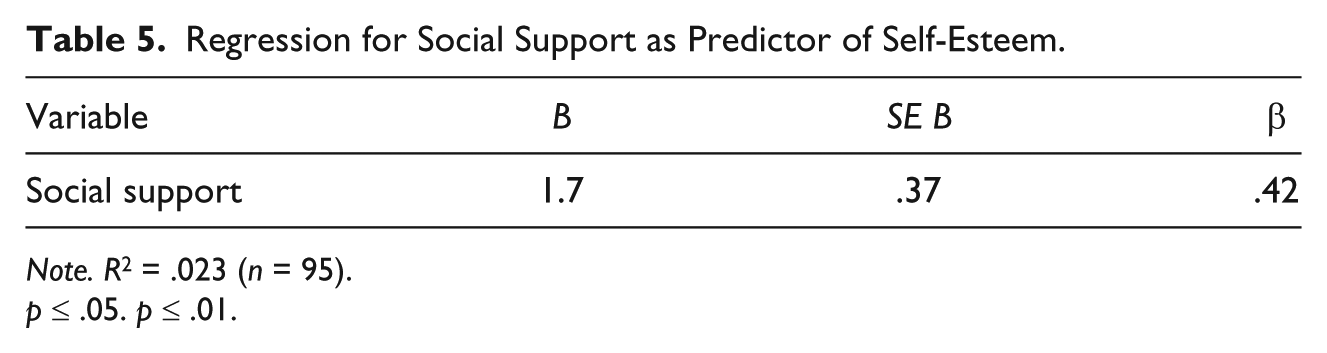
Note. R2 = .023 (n = 95).
p ≤ .05. p ≤ .01.
Familial Context: Hypothesis 5
ANOVA was run to assess mean differences in self-esteem across family structure. Results of the ANOVA show that there were no significant mean differences in regard to self-esteem across familial contexts, F(6, 97) = 5.24, p = ns (see Table 6).
Summary of a One-Way ANOVA for Self-Esteem Across Family Structures.
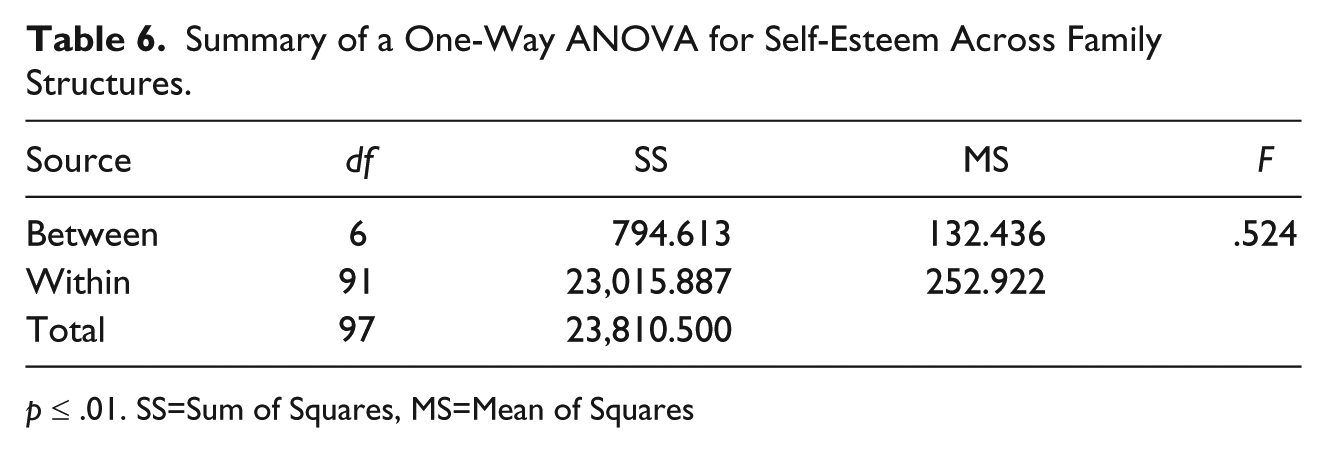
p ≤ .01. SS=Sum of Squares, MS=Mean of Squares
Post hoc analysis was run to assess where the exact mean differences were found across family structures.
Discussion
The present study attempted to elucidate the relationship between racial socialization, perceived parental involvement, social support, and self-esteem in African American college students. This study may bring clarity to our understanding of racial socialization, perceived parental involvement, social support, and self-esteem.
Although Research Question 1 asserted that racial socialization would be related to self-esteem, this assertion was not supported. To assess the relationship between racial socialization and self-esteem, a subscale that measured racial attitudes and issues in society was employed. This measure assessed the degree to which an individual reflected awareness of racism and discrimination in society. Results of the analysis indicated that racial socialization was not related to self-esteem. Thus, students who felt that racial issues were important did not report higher scores on self-esteem. This finding is inconsistent with contemporary studies, notably the work of Brown et al. (2005), which emphasized the importance of racial socialization in developing self-esteem and preparing African American children to cope with inequalities in American society. This suggests a possible need for a more adequate or thorough measure of the collegiate African American culture that took part in this study. Although past research has found that race attitudes and awareness are related to self-esteem in African Americans, it may be warranted to examine what other factors and/or variables negotiate this process.
Research Question 2 suggested there would be a significant relationship between parental involvement and self-esteem. This measure assessed the degree of perceived level of interaction between participants and their caregivers. Results in the current study, did in fact, reveal a relationship between parental involvement and self-esteem. Moreover, results of the current study indicated that parental involvement significantly predicted self-esteem.
These findings validate prior research that surmised parental presence and involvement increased self-esteem (Harris, 2002). Trumpeter et al. (2008) commented that parental involvement contributed significantly to more positive outcomes in school-aged children. Thus, the current study findings are consistent with prior research which suggests involvement of parents with children has many implications for long-term well-being. Moreover, this is substantiated by the sample of participants included in the study. Because the measure specifically called for participants to reflect in retrospect on levels of parental involvement, findings reinforced the long-term positive effects of parental involvement.
Research Question 3 asserted that there would be a significant relationship between social support and self-esteem. To assess this relationship, the selected scale measured availability and access to interpersonal support of individuals. Results in the current study found a high correlation between social support and self-esteem. Thus, participants who reported high levels of social support indicated high self-esteem scores.
These findings are consistent with prior research done by Wight, Botticello, & Aneshensel (2006), which found that social support is protective of both internalizing and externalizing problems among adolescents. Compton, Thompson, & Kaslow (2004) also found that social support serves as a protecting factor in the African American community. Findings of this study also affirm prior research done by Preston (2002) and Wordlaw (2000) that suggested social support leads to an overall sense of self-worth and more positive mental health outcomes. Therefore, the study successfully demonstrates that social support is an excellent predictor of self-esteem in African American adults.
Research Question 4 posited that racial socialization and parental involvement together would be a better predictor of self-esteem than each variable alone. However, a significant relationship was not found to exist between racial socialization and self-esteem; there was a clear relationship between parental involvement and self-esteem. Although racial socialization is thought to provide a foundation for positive self-esteem at an early age, findings of this study indicated that awareness of racial issues and discrimination may not be integral in developing self-esteem as previously surmised.
Moreover, one must take into consideration other factors that may contribute to the lack of emphasis on racial socialization as a catalyst for developing self-esteem. Vandiver and colleagues (2000) proposed the importance of accounting for levels of acculturation, due to race-neutral contexts in current society and the degree of integration within the African American community over time. Because parental figures are typically responsible for teaching racial socialization messages, one could surmise that participants with high levels of parental involvement and racial socialization have higher scores on the self-esteem scale.
Research Question 5 suggested that there would be differences in self-esteem across various family structures and, furthermore, that participants who reported rearing in dual-parent homes would report higher self-esteem scores than other participants in the study. Findings of the current study were incongruent with the original hypothesis and there was no significant disparity in self-esteem scores between family structures. This may be in part due to the buffering effects of social support regardless of family constellation. Thus, the significance of social support may prove more integral in predicting self-esteem than the factors of family structure and parental involvement.
Limitations
One of the limitations of the current study is the sample population used. All study participants attended a historically Black university. It would be interesting to examine if results were consistent if the population also included college students at predominantly White institutions, particularly the effect of racial socialization on self-esteem. Another limitation in the current study is the CoBRAS measure used to evaluate racial socialization. Only four of the six items were used in this scale due to the omitted items not correlating well. Because no significant relationship was indicated with self-esteem, the use of an alternative socialization scale may provide more reliability and, therefore, demonstrate that racial socialization is a good predictor of self-esteem. Sample size was an additional limitation of the study. A larger sample population that includes more than liberal arts majors, or perhaps a study inclusive of not only college students, would also serve to increase reliability and external validity of the study.
Implications
The current study confirms that familial and social support produces more positive outcomes in African American children. Racial socialization and parental involvement alone is not an indicator or predictor of self-esteem in African American children. The study proves there is no single variable that predicts self-esteem. Of all variables assessed, parental involvement and social support were better predictors of self-esteem than either family structure or racial socialization. The mental health of African American adolescents is shaped by the level of interaction from parents, social support, racial messages, and family members that youth are exposed to in their childhood.
Future Directions
An alternative option for future studies is to conduct a longitudinal study. Longitudinal studies should examine effective parental strategies for imparting socialization messages to children. Furthermore, it would be interesting to investigate social support and racial socialization as moderators of self-esteem in a similar sample population. Utilizing different assessment tools may influence future studies. To accomplish this, a racial socialization scale with higher interitem correlation would be beneficial as the current study found a third of the items in the CoBRAS scale to be not viable.
In addition, replication in other geographical areas and school settings may be beneficial to support the external validity of the current study. Broadening the study to include African Americans attending other types of institutions and in other regions across the country, would lend further credence to the theory that there is no singular variable that molds self-esteem. Simply varying the sample would provide insight and afford an opportunity to see if findings are consistent, regardless of location or school enrollment. It may also be of great import to inspect how African American children process racial socialization, and the various ways African American parents communicate socialization messages to their children. Consequently, a stronger relationship may be established between racial socialization and self-esteem.
Footnotes
Declaration of Conflicting Interests
The authors declared no potential conflicts of interest with respect to the research, authorship, and/or publication of this article.
Funding
The authors received no financial support for the research, authorship, and/or publication of this article.