




Abstract
The current study examines cyberbullying and victimization among African American college students who spend large amounts of time on the Internet and using their smartphones. In a survey of 321 African American college students, the most common venues for victimization occurred through text messages, phone calls, and social networking sites. Posting indiscreet images and sharing personal information with a large number of Facebook friends were positively associated with the victimization. Cyberbullying perpetration, as measured by Cyberbullying Questionnaire (CBQ), revealed a significant gender difference, with male students exhibiting higher prevalence. In a multiple regression analysis, the phenomenon of online disinhibition—a lessening of inhibitions during online interactions that would otherwise be present in face-to-face interactions—emerged as the strongest predictor of cyberbullying perpetration. Recommendations for future research include studying the negative impact of cyberbullying among African American adults, particularly in the workplace.
Introduction
This is the age of smartphones. In 2016, more than 80% of American adults own smartphones. Smartphone applications are becoming the primary access point for many digital activities (Nielsen, 2016). Young adults are leading this shift to a mobile world through their use of smartphones (comScore, 2016). College students, in particular, who are the highest users of the Internet and smartphones, spend a significant amount of time online and on social networking sites (SNSes), thus creating opportunities for cyberbullying and victimization.
Cyberbullying has been defined as aggression that is intentionally and repeatedly carried out in an electronic context (e.g., e-mail, blogs, instant messages, text messages, social networks, chat rooms, online games, or websites) against a person who cannot easily defend (Kowalski, Giumetti, Schroeder, & Lattanner, 2014). Most studies on cyberbullying have focused on children and adolescents, and less is known about the prevalence and impact of cyberbullying among young adults. However, in recent years, a growing body of research indicates that young adults commonly engage in hurtful online behavior as both perpetrators and victims (Ramos & Bennett, 2016) and that cyberbullying does not stop after high school.
Despite the fact that more African American young adults own smartphones (85%) than the general population, and accordingly engage in a high use of SNSes, the issue of cyberbullying in the African American young adult population has received little attention. The current study seeks to address that gap by exploring the experiences of cyberbullying and victimization among African American college students.
Literature Review
Theoretical Framework
Recent studies on the cyberbullying and victimization rely on the online disinhibition effect (Suler, 2004) which refers to a loosening of social/moral restrictions and inhibitions during online interaction that would otherwise be present in face-to-face interaction. Online disinhibition may lead individuals to behave in ways that are contrary to their moral code (Gini, Pozzoli, & Hymel, 2014). This online disinhibition effect, according to Baldasare and her colleagues, can be either benign (e.g., appropriate and meaningful self-disclosure) or toxic (e.g., destroying someone else’s reputation). These researchers suggested that this tendency to exhibit a more narcissistic, aggressive, and uncivil persona in the digital world can be explained as a function of moral disengagement (Baldasare, Bauman, Goldman, & Robie, 2012; Udris, 2014).
Bandura’s (1990, 1999, 2002) theory of moral agency also posits that moral disengagement develops over time as a result from behaving in contrast to internal moral values. Moral disengagement is the socio-cognitive process through which individuals able to harm others without having a bad conscience (Wachs, 2012). Some of the features that may contribute to cyberbullying include perceived anonymity, reproducibility, lack of emotional reactivity, and 24/7 accessibility (Francisco, Simao, & Ferreira, 2015; Kowalski et al., 2014).
Cyberbullying Among College Students
A number of recent reviews and meta-analysis (Bernie et al., 2013; Chen, Ho, & Lwin, 2016; Kowalski et al., 2014; Lund & Ross, 2016; Tokunaga, 2010) examined the cyberbullying behaviors among adolescents and college students. Estimates of prevalence among young adults, however, are not consistent because of lack of consensus on the definition of cyberbullying, reporting time frame being assessed, and locations of the sample (Bernie et al., 2013; Garaigordobil, 2015; Kowalski et al., 2014).
In one of the earliest studies before the debut of Facebook, Finn (2004) reported 11% of her college sample have been bullied through e-mails and instant messages. In 2010, MacDonald and Roberts-Pittman found 25% of the students were bullied through social media and 21% through text messages. More recent studies indicated that between 10% to 20% of college students reported that they were the victims of cyberbullying mainly through SNSes and text messages (Bauman & Baldasare, 2015; Kamali, 2015; Kraft & Wang, 2010; Molluzzo & Lawler, 2012; Peluchette, Karl, Wood, & Williams, 2015; Schenk & Fremouw, 2012; Smith, Grimm, Lombard, & Wolfe, 2012; Smith & Yoon, 2013; Walker, Sockman, & Koehn, 2011; Whittaker & Kowalski, 2015; Zalaquett & Chatters, 2014). Some studies conducted abroad reported higher prevalence among college students. For example, Dilmac (2009) and Aricak (2009) reported more than 55% victimization in a Turkish sample; Francisco et al. (2015) reported 28% victimization in a Portuguese sample; and Dredge, Gleeson, and Garcia (2014) reported 51% victimization in an Australian sample.
Several studies have examined the effects of race/ethnicity, sexual orientation, religion, and appearance on the cyberbullying victims (Bauman & Baldasare, 2015; MacDonald & Roberts-Pittman, 2010; Molluzzo & Lawler, 2012; Smith & Yoon, 2013; Washington, 2014; Zalaquett & Chatters, 2014). They found higher victimization among LGBT (lesbian, gay, bisexual, and transgender) students and racial minority students. Lund and Ross (2016) concluded that certain students in college may face biases and aggression online due to their minority status. Among college students, cyberbullying often involved romantic relationships, including break-ups and revenge (Crosslin & Goldman, 2014; Kota, Schoohs, Benson, & Moreno, 2014; Rafferty & Vander Ven, 2014). These studies noted that anonymity plays a large role in cyberbullying on college campuses.
Thus far, none of these studies have included a significant number of African American young adults in their sample. The proportion of African American college students in the samples ranged from 1.2% to less than 10%. The current study attempts to fill the gap in the research on this particular group of young adults, African American college students, regarding their cyberbullying and victimization experiences.
Cyberbullying Victimization and Major Predictors
Some major factors have been identified as possible predictors of cyberbullying victimization: the amount of time spent on the Internet, risky behaviors on SNSes, and demographic factors such as age and gender.
A number of studies demonstrated the link between the Internet time and use of information and communication technologies (ICTs) and increased risk of cyberbullying victimization, particularly by strangers (Hinduja and Patchin, 2008; Kamali, 2015; Kwan & Skoric, 2013; O’Dea & Campbell, 2012). In fact, O’Dea and Campbell found that befriending higher number of strangers brings higher frequencies of “phone calls in the middle of the night” (p. 215).
Other researchers noticed that not just amount of time online but the risky behaviors on SNSes. Dredge et al. (2014) found the positive association between the number of Facebook friends and higher incidents of cyberbullying victimization. Peluchette et al. (2015) explained that young adults tend to have wide social networks and a large number of Facebook friends which increases the number of individuals who have access to a person’s profile page. As a result, Peluchette and her team found that the strongest predictor of cyberbullying victimization was the posting of indiscreet/negative content on one’s Facebook profile. In addition to Facebook, which has the largest number of subscribers, other social media including Instagram, Twitter, and YouTube also have been used to harm others (Bauman & Baldasare, 2015; Whittaker & Kowalski, 2015; Wright, 2016).
Cyberbullying Perpetration and Major Predictors
Researchers investigating the major predictors of cyberbullying perpetration have focused on moral disengagement, different forms of aggression, and personality factors.
In their meta-analysis of 131 studies on cyberbullying, Kowalski et al. (2014) indicated that cyberbullying was strongly associated with normative beliefs about aggression and moral disengagement. Several studies (Baldasare et al., 2012; Bussey, Sally, & Amrutha, 2015; Gini et al., 2014; Hymel & Bonanno, 2014; Wright & Li, 2013) pointed out the correlation between moral disengagement and cyberbullying. Online aggression, according to Pornari and Wood (2010), may not demand the same level of rationalization and justification as traditional bullying because young people consider it as less serious due to anonymity and lack of face-to-face contact. Similarly, a number of studies carried out in Europe (Perren & Gutzwiller-Helfenfinger, 2012; Renati, Berrone, & Zanetti, 2012; Wachs, 2012) found the moral disengagement as a strong predictor of cyberbullying.
The association between cyberbullying and specific forms of aggression has also been explored (Calvete, Orue, Estevez, Villardon, & Padilla, 2010; Gibb & Devereux, 2014; Schenk, Fremouw, & Keelan, 2013). Wright and Li (2013) found that young adults who are verbally aggressive in face-to-face situations exhibited similar behaviors using ICTs.
Other studies (Ak, Ozdemir, & Kuzucu, 2015; Aricak & Ozbay, 2016; Garaigordobil, 2015; Lonigrao et al., 2015) found positive relationship between anger as a personality trait and cyberbullying. They indicated that outward, explosive expression of anger appears to be common among cyberbullies.
The Present Study
We know very little about the experiences of cyberbullying and victimization among African American young adults. The paucity of research focused on this group leads to the following research questions for the current investigation.
Method
Participants
A total of 321 African American college students at one of the largest Historically Black Colleges and Universities (HBCUs) in Texas participated in the survey in November 2015. The average age of the sample was 21.52 (SD = 4.88). The sample consisted of 49% males and 51% females. Forty-three percent of the participants were freshmen, 31% sophomores, 16% juniors, 9% seniors, and the remainder were graduate or professional school students.
Measures
Cyberbullying victimization
In addition to demographic information, the questionnaire asked about the frequency and intensity of social media use including Facebook, Instagram, Twitter, and YouTube. In line with previous studies, the current survey asked participants about their profile contents, including whether the individual engaged in risky behaviors such as posting seminude photos, sexually provocative photos, partying photos, and the number of Facebook friends. Other questions on the use of ICTs included daily Internet time and number of text messages sent and received.
To examine the cyberbullying victimization experiences of the sample, the questionnaire first included the definition of cyberbullying: “When we say cyberbullying, we mean bullied through e-mail, instant messaging, social media, in a chat room, on a website, in an online game, or through text messages sent to your cell phone” (Whittaker & Kowalski, 2015, p. 14).
Participants then indicated the specific media through which cyberbullying victimization has occurred in the past 2 months. Students have yes/no answers to five major venues: text messaging, social media, e-mail, chat room, and phone calls. Students who were the victims of cyberbullying were asked about their relationship with their perpetrator, as in the study of Smith et al. (2012), including an anonymous or unidentified source, an identified source but someone hardly known to the student, friend or family member, or an identified source considered to be a significant other (boyfriend/girlfriend).
Cyberbullying perpetration
Cyberbullying experiences were determined by using the 16-item Cyberbullying Questionnaire (CBQ) developed by Calvete et al. (2010). These items included a wide variety of bullying behaviors such as sending threatening or intimidating messages to someone, impersonating someone, sending humiliating or ridiculous images/video clips, hanging jokes, rumors, gossip, or embarrassing comments about a classmate on the Internet. Students responded on a 3-point scale of never (1), sometimes (2), and often (3). Cronbach’s alpha for CBQ was .92.
Online toxic disinhibition
Based on the findings from previous studies, three potential predictors of cyberbullying were selected for the current study: toxic disinhibition, verbal aggression, and anger. Four parts of the toxic disinhibition subscale developed by Udris (2014) specifically measure the online disinhibition behavior: (a) I don’t mind writing insulting things about others online, because it is anonymous; (b) it is easy to write insulting things online because there are no repercussions; (c) there are no rules online therefore you can do whatever you want; and (d) writing insulting things online is not bullying. Cronbach’s alpha was .87.
Verbal aggression and anger
A modified version of the Buss and Perry’s (1992) Aggression Questionnaire (BPAQ) was used to measure verbal aggression (five-item subscale) and anger (seven-item subscale). BPAQ focuses on four different dimensions of aggression: physical aggression, verbal aggression, anger, and hostility. For brevity, this study utilized only the verbal aggression and anger subscales. An example of verbal aggression was the statement, “When people annoy me, I may tell them what I think of them.” Examples of explosive expression of anger were the statements, “I flare up quickly but get over quickly,” and “I have trouble controlling temper.” These three predictor variables were measured on a 5-point Likert-type scale of strongly disagree (1) to strongly agree (5). Cronbach’s alpha for the verbal aggression scale was .68 and for anger was .76.
Procedures for data collection and analysis
The researcher collected the survey forms with the cooperation of instructors in different areas of the university. The survey instruction promised confidentiality and provided the option of not completing the questionnaire. Statistical analyses were performed using IBM SPSS 23.0.
Results
The main purpose of the current study was to explore the experiences of cyberbullying and victimization among African American college students. Findings from the survey are presented as major research questions.
Of the 321 participants, 82.2% had Facebook account; 77.8%, Twitter; 87.5%, Instagram, and 95.0%, YouTube account. In terms of the intensity of Facebook use, 45.4% of the participants checked Facebook once a day; 18.6%, 2 to 3 times; 18.6%, 4 to 6 times; 8.2%, 7 to 10 times; and 9%, more than 10 times a day. In terms of Internet use, 2.6% said they used Internet less than an hour; 16.0%, 1 to 2 hours; 32.1%, 3 to 4 hours; 16.0%, 5 to 7 hours; 14.7%, 7 to 9 hours; and 18%, more than 9 hours.
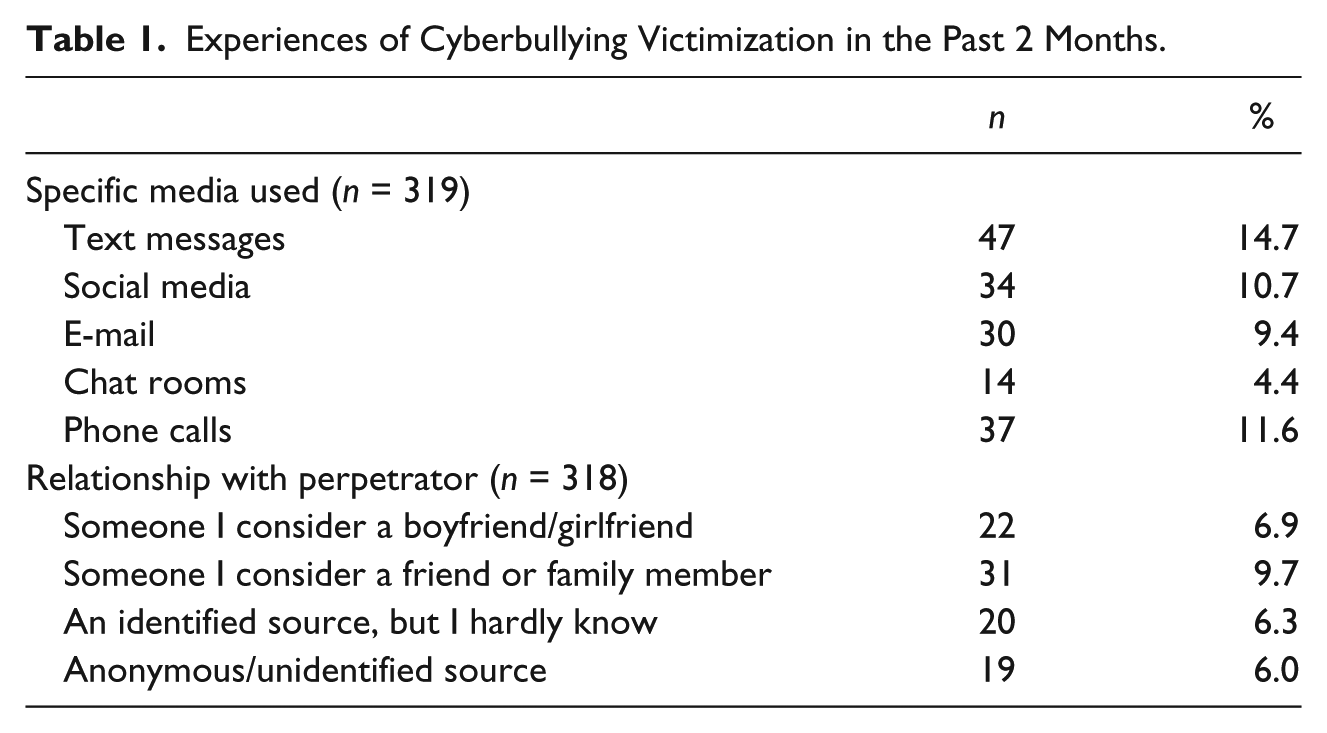
In the past 2 months, 14.7% of the sample reported that they were bullied through text messages and 11.6% by phone calls. Nearly 10.7% of the sample experienced cyberbullying through SNSes, while about 9% by e-mail and 4% by chat room platforms.
When asked about the relationship with the perpetrator, 6.9% of the respondents were bullied by significant other (boyfriend/girlfriend), 9.7% by a friend or family member, and 6.3% by distant acquaintance. Nearly 6% of the perpetrators were anonymous or someone unknown, as shown in Table 1.
Experiences of Cyberbullying Victimization in the Past 2 Months.
To determine the effect of risky postings on the victimization, specific items on Facebook posting were analyzed. Almost 8.3% of the students included semi-nude photos, 7.0% sexually provocative photos, while 31.5% partying photos in their profile. Table 2 illustrates the relationship between indiscreet postings and cyberbullying victimization. Posting semi-nude photos, sexually provocative photos, and partying photos were strongly associated with victimization across different media. The relationship between the number of Facebook friends was positively related to the victimization through text messages and e-mail, but not on SNSes or in chat rooms.
Risky Behaviors on Facebook and Cyberbullying Victimization.

Note. Number of Facebook friends was coded as follows: fewer than 100 = 1, 100 to fewer than 300 = 2, 300 to fewer than 500 = 3, 500 to fewer than 1,000 = 4, 1,000-2,000 = 5, more than 2,000 = 6.
Of the 16 items on the CBQ, the most frequent bullying behaviors were sending threatening or insulting messages by e-mail (13.5%) and by cell phone (12.6%). Other frequent bullying included sending links of humiliating images to other people (12.3%) and recoding a video or taking pictures by cell phone while a group laughs and forces another person do something humiliating or ridiculous (11.3%). Responses to CBQ items are summarized in Table 3.
CBQ Responses of the Participants (n = 321).
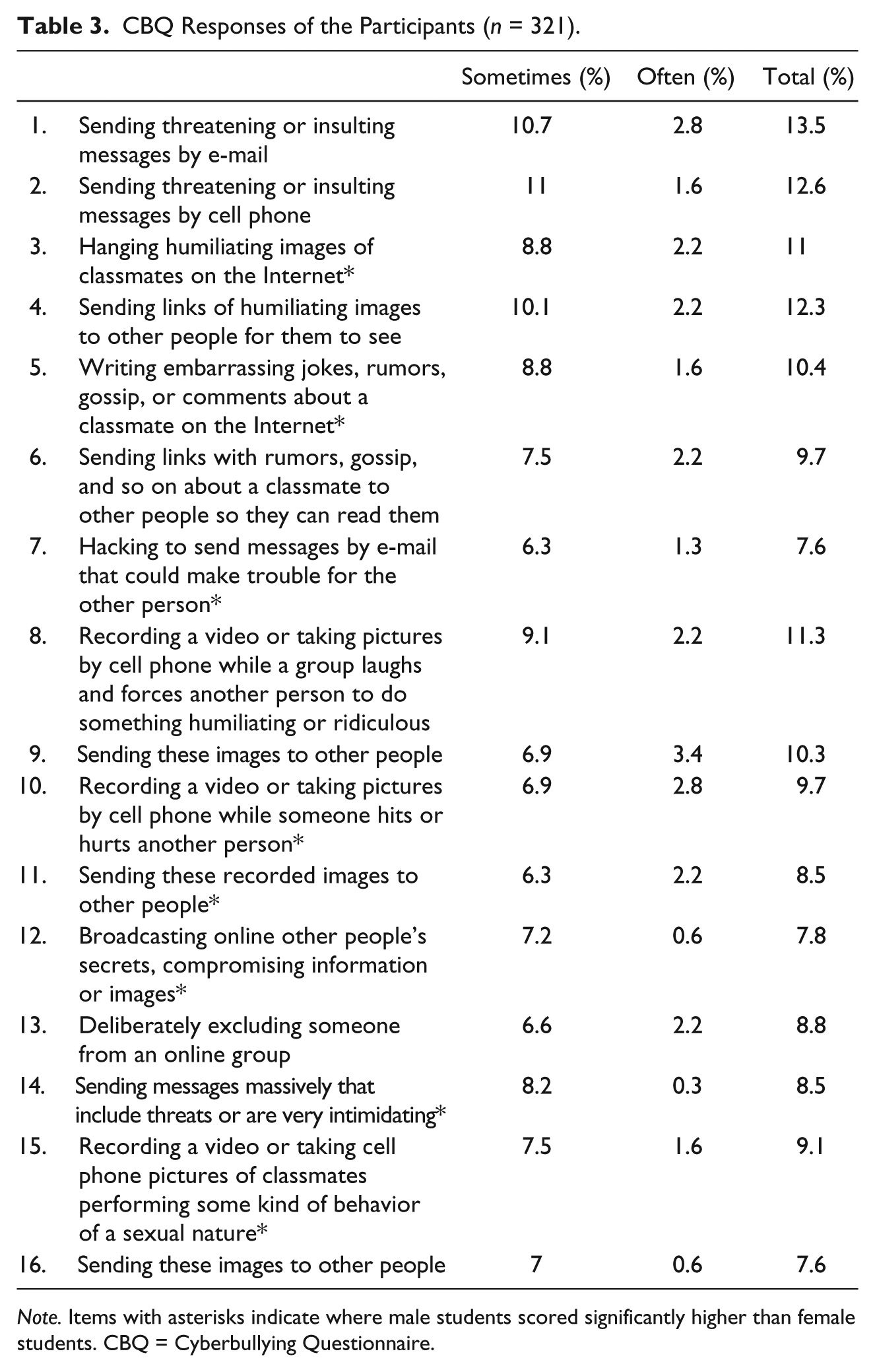
Note. Items with asterisks indicate where male students scored significantly higher than female students. CBQ = Cyberbullying Questionnaire.
The total cyberbullying score was calculated by adding the responses on the 16 items with a range of 16 to 48. Mean score for the sample was 17.47 (SD = 3.60), with mean for male students being 18.19 (SD = 4.66) and females being 16.79 (SD = 1.95). Male students scored significantly higher than female students (t = 3.41, p < .01). Table 3 shows that on half of the 16 items, male students scored significantly higher than female students. However, it is important to point out that the prevalence rate of each type of cyberbullying behavior as well as the combined CBQ score were relatively low. There was no significant relationship between age and CBQ scores.
Inter-correlations of eight predictor variables and CBQ are presented in Table 4. The eight predictor variables included age, gender, intensity of Facebook use, number of Facebook friends, Internet time, verbal aggression, anger, and online toxic disinhibition. The average of five-item subscale of verbal aggression was 16.19 (SD = 4.07). The average of seven-item anger subscale was 18.73 (SD = 5.99) with range of 7 to 35. The four-item toxic disinhibition subscale had an average of 7.63 (SD = 4.56) with a range of 4 to 20. There were statistically significant gender differences on anger (F = 4.03, p < .05) and toxic disinhibition (F = 26.91, p < .01), but not on the verbal aggression subscale.
Correlations Among Predictor Variables of the Cyberbullying Behaviors.

Note. Gender was coded Male = 1, Female = 2. CBQ = Cyberbullying Questionnaire.
p < .05.**p < .01.
A multiple regression was performed to assess the effects of eight predictor variables on the CBQ. Taken together, about 14.8% of the variance in the cyberbullying behavior was explained, R2 = .148, F(8, 165) = 3.596, p < .01. The cyberbullying perpetration was positively and significantly related to the online toxic disinhibition, but negatively related to the intensity of Facebook use, as shown in Table 5.
Multiple Regression Analysis for Predictors of the Cyberbullying Behaviors (n = 270).
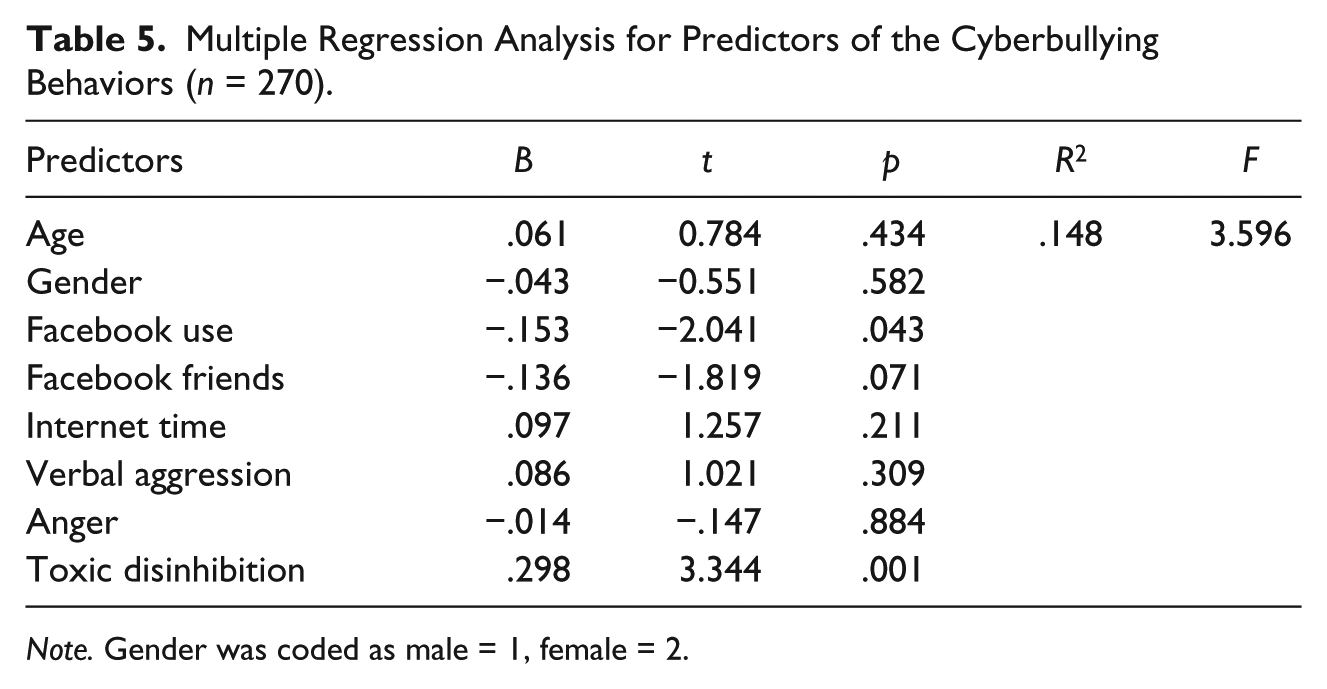
Note. Gender was coded as male = 1, female = 2.
The survey included questions on toxic disinhibition. With respect to the statement, “I don’t mind writing insulting things about others online, because it is anonymous,” 66.5% of the sample strongly agreed, 9.4% agreed, 8.8% no opinion, 6.0% disagreed, and 9.4% strongly disagreed. With respect to the statement, “It is easy to write insulting things online because there are no repercussions,” 58.9% strongly agreed. 9.7% agreed, while 8.5% disagreed and 10% strongly disagreed. With respect to the statement, “There are no rules online therefore you can do whatever you want,” 55.6% strongly agreed and 10.2% agreed, 14.6% no opinion, and 23% disagreed or strongly disagreed. With respect to the statement, “Writing insulting things online is not bullying,” 66.8% strongly agreed and 9.1% agreed while 24.1% disagreed or strongly disagreed. These responses highlight the general perception of cyberbullying behaviors among our participants.
Discussion
Few studies of cyberbullying have focused on the African American young adults. The current study examined experiences of cyberbullying and victimization among African American college students.
Our findings suggest that the most common venues of victimization occur through text messages, phone calls, and SNSes. Victimization was positively related to the posting of indiscreet images and sharing personal information online. These findings are consistent with previous studies of mostly non-African American college students (Kamali, 2015; Molluzzo & Lawler, 2012; Peluchette et al., 2015; Smith & Yoon, 2013; Whittaker & Kowalski, 2015; Wright, 2016). Currently, SNSes with visually oriented features and communication through smartphones are common venues for cyberbullying and victimization. But as Whittaker and Kowalski (2015) discussed, technology changes rapidly, and as new modes of technology emerge, so too will new means of cyberbullying.
The prevalence rate of cyberbullying perpetration, measured by CBQ, was relatively low. Nevertheless, there was a significant gender difference with male students exhibiting higher involvement in the bullying behaviors. This finding corresponds with previous research (Boulton, Lloyd, Down, & Marx, 2012; Calvete et al., 2010; Francisco et al., 2015; Gibb & Devereux, 2014). The CBQ measured the wide variety of cyberbullying behaviors adequately and showed a high internal consistency in our survey. But the lack of consensus about the definition of cyberbullying and measurement of the concept among researchers still remains as a major issue.
Online disinhibition emerged as the strongest predictor of cyberbullying perpetration among eight predictor variables tested in our survey. These findings support other studies in the past (Bussey et al., 2015; Gini et al., 2014; Hymel & Bonanno, 2014; Udris, 2014). In addition, our findings clearly suggest that our participants exhibited more accepting attitude toward cyberbullying and perhaps underrated the potential harm to others.
Limitations and Implications for Future Research
This study attempted to understand the negative impact of cyberbullying among African American young adults. Although this exploratory study examined an important topic and added new information to the growing body of research, it was carried out with some limitations.
First, our data came from self-report measures of cyberbullying and victimization behaviors. The lack of previous research on the African American subjects makes the comparison and generalization of the findings to other campuses difficult. Even previous studies that examined African American children and adolescents, according to Hinduja and Patchin (2015), yielded very inconclusive results so far.
Second, the current study did not examine the negative impact of cyberbullying on the social, emotional, and physical heath of the victims. College students who are victims of cyberbullying suffer not only emotional distress but also anxiety, phobias, and even paranoia (Feinstein, Bhatia, & Davila, 2014; Ramos & Bennett, 2016; Wright, 2016). Future study should assess such consequences.
Finally, future study should address cyberbullying and victimization among African American subjects across life span. Little is known about the impact of cyberbullying on the African American adults in the workplace. There are no available research and data on such environment.
Footnotes
Declaration of Conflicting Interests
The author declared no potential conflicts of interest with respect to the research, authorship, and/or publication of this article.
Funding
The author received no financial support for the research, authorship, and/or publication of this article.