



Abstract
This article is a case study assessing transformation in one faculty of education at a South African university. This article explores aspects of transformation: equity, ideology, and practices. Of particular relevance is the experiences of Black academics in their struggle for social justice. Critical race theory is used as an analytical tool to make sense of the paradox of Black experiences of discrimination at the hands of Black faculty leadership and the concomitant entrenchment of Whiteness as dominant in the institutional culture. “Interest convergence” and institutionalized racism are plausible reasons for the racial paradox and reluctance of Black leadership to address discriminatory practices. To answer the research question, “What is the state of the transformation discourse in a merged faculty of education?” data were extracted from primary sources, reflective reports, and staff experiences. Findings point toward an underdeveloped, suppressed, and restrained transformation discourse based on outdated values and practices. Recommendations are made to embark on a “vigorous transformation indaba” to promote academic citizenship and social cohesion in the faculty.
Introduction
At a recently held colloquium arranged by the University of South Africa—Mail & Guardian Critical Thinking Forum, a distressing observation was made that South African higher education institutions are headed, to a large extent, by Black academics but that is an outside appearance of change. The point was made that after more than two decades of democracy, institutional culture, which refers to “the way we do things here,” failed to lead to substantive transformation in universities. The colloquium claims that institutional policies and practices have a profound impact on individual and institutional attitudes and behavior, much of which become tangible points of reference to describe the real state of transformation at many institutions of higher education (Naicker, 2016). The paradox of Black experiences of discriminatory practices under Black leadership is seldom theorized. While students successfully sustained the struggle for social justice and transformation, the struggle of academics is less visible. Academics are often afraid to be at loggerheads with university leadership due to its potential negative effect on their future careers. Using critical race theory’s notion of “interest convergence” and “counter narrative story-telling” as analytical and methodological framework, this article investigates the state of transformation in one faculty of education from the perspective of equity, ideology, and practice. While critical race theory is primarily associated with legal studies (Delgado & Stefancic, 2001), its methodology is increasingly gaining popularity in educational studies especially where race, class, and ethnicity form an integral part of the social context (Lynn & Dixson, 2013).
South African university students protested in 2015/2016 against an alienating university curriculum which arguably added little value to their education. While student demands for free, quality, and decolonized education cannot be ignored, progressive academics who have challenged discriminatory practices and the lack of transformation at universities are less successful. The now famous Mamdani, Shell, and Magoba “affairs” (1997, 2001 and 1995, respectively), are examples of what could be the consequences of “rocking the boat” in higher education spaces (Taylor &Taylor, 2010, p. 897). All three scholars mentioned above criticized their universities in good faith, for their paternalistic nature and practices, their racially mediocre and nepotistic practices (Taylor & Taylor, 2010, p. 902). Their actions led to their ultimate departure from their institutions. These are documented instances of how systemic racism in predominantly White institutional cultures resisted transformational ideas. Institutions of higher education were at a time not responsive to change and resisted all efforts deemed as undermining to the existing culture. The three cases were the exception to the dominant “interest convergence” (Milner et al., 2013, p. 339) tendency in higher education, which explains the slow pace of transformation and academic passivism. This article draws on staff member experiences who mobilized for transformation and against discriminatory practices. Unlike Mamdani, Shell, and Magoba who are all internationally acclaimed academics, this article concerns experiences of ordinary academics who were largely marginalized by their university management but whose agency for social justice is equally significant in transforming a system that was molded by colonial-apartheid ideology and practices.
The poor state of transformation in higher education received much public attention and critique. However, its complexity remains challenging to even the country’s progressive leadership. Transformation of South African universities goes beyond mere attention to “structure” and “ideology” (Soudien, DoE, 2008). The predominance of White academic staff, the remnants of the legacy of apartheid and Bantu education, and their concomitant epistemological disposition, set the standard for curriculum content and practices, which became normalized over decades of higher education institutionalization. Transformation requires “living the future now” which includes engaging with issues that would unmake race, nation, and culture (Erasmus, 2006). Arguably, the history of universities in South Africa sustained patterns of structural racial inequality, institutional cultural reproduction, and resistance to change outdated practices. The central argument made in this article is that the transformation project is often compromised by the interest of Black leadership that converges with the interests of Whites, believing that equality and equity for people of color will be best advanced when it converges with White interests. In the South African context, interest convergence has been an integral part of the political settlement to achieve democracy after apartheid. At the time of adopting the sunset clauses, it was envisaged that White capital would contribute in the efforts to liberate Blacks from economic bondages (Ntlemeza, 2012). The vast economic inequalities, high rate of unemployment, and poverty among Blacks are indicative that White businesses do not appear to have assisted historically disadvantaged people to take ownership and control of the means of production (Ntlemeza, 2012). In the context of this study, members of the Black academic elite tend to believe erroneously that their success is dependent on an economy of privileges and practices embedded in an institutional culture of Whiteness in which lies their salvation. Unlike Mamdani, Shell, and Magoba, Black academic leadership adopts a soft option approach, which is brewing opposition at the bottom.
The Council on Higher Education (CHE) noted that the Ministerial Report on Transformation and Social Cohesion (Soudien, 2008) reduced transformation to three critical elements: policy and regulatory compliance, epistemological change (curriculum), and institutional culture (Soudien, 2008, p. 37). The CHE claims that, while institutions are well on their way to effect transformation in the sense of compliance and putting policies in place, there remains a concern about poor implementation and the larger question of transformatory curricula and institutional culture (CHE, 2009, p. 5).
While a case study approach is adopted to investigate the state of transformation in one faculty, this study focuses on textually based discourses and experiences that are contextually bound within one faculty (Bertram & Christiansen, 2014, p. 44). The intention is to provide rich descriptions of lived experiences rather than to generate generalizable findings (in)capable of explaining the complexities of universities’ transformational contours. The epistemological value of this study lies in its contribution to a limited literature pool, which is in need of enrichment through future research of a similar kind.
Theoretically and methodologically, this article focuses on discursive practices and critical race theory to construct counter-narratives of real-life experiences of a group of academics at one university faculty. The article unfolds as follows: background and rationale for the study, extant literature on transformation at South African universities, analytical and conceptual framework, methodological note, data presentation and discussion, and conclusions and recommendations.
Background and Rationale for the Study
Early in the academic year of 2014, three new staff members shared their negative experiences in the faculty staff meeting in spite of the leadership’s tacit disapproval. The statement delivered by the new staff members provoked reactions from some staff members, inconsistent with the norms of scholarly debate. That moment was marred with a raucous call from the back of the room: “Are they calling us racists?” was one comment. After the statement was made, a senior staff member, embarrassed by what was said, apologized to the new staff members.
Subsequent to this incident, many accounts surfaced about previous negative experiences, including racism in the faculty. These range from personal anecdotes to litigation. Scholarly publications (Robinson & Rousseau, 2011; Sosibo, 2013) provided scientific background to an analysis and interpretation of current exchanges in the faculty. One of the “recalcitrant” academics was placed on “extended probation” and faced other punitive action for opposing the authoritarian management style in the faculty. A Black administrator openly accused his White line manager of racism. In a staff meeting, a member of the faculty executive noted that “a lot of anger and frustration was expressed from staff, frustration and strained race relations between individuals, race groups at different levels. Healing needs to take place in the faculty. There is a need for workshops on diversity and transformation. Staff proposed intervention from outside, culture on change management . . . ” (Staff circular, April 2015).
Following the exposure of racism and discrimination through the release of the video “Luister” (Listen) by Stellenbosch university students, an aggrieved group of staff members who strongly identified with the Stellenbosch video came together and formed “Mamela” which became the mouth piece to communicate their collective grievances. It became clear that these experiences at universities are symptomatic of a broader problem of transformation, which requires special lenses to understand and interpret. The situation became unbearable for some who saw it fit to look for posts elsewhere. After the “Mamela” group presented their grievances to the management, members started to complain about victimization, discrimination, and in one case, disciplinary action resulting in a 9-month period of restraint and premature transfer out of the faculty. After the dust has settled and the faculty leadership felt that the “Mamela” group has been dismembered, the need to reflect and theorize the state of transformation as a case study in higher education becomes an academic imperative. In an attempt to answer the research question, “What is the current state of transformation in a merged faculty at a higher education institution?” the article unfolds with reference to some landmark studies on transformation in South African universities, followed by a conceptual lens and methodology adopted in this study.
Transformation Studies on South African Universities
The “Rhodes must fall movement” heightened the urgency and political nature of the transformation debate at universities. Transformation refers to changes that correct the imbalances of the apartheid era. According to Jansen, “social justice is about correcting the wrongs of the past, while transformation is about shaping the future” (Cape Peninsula University of Technology [CPUT], 2014b, p. 2). Because South African universities underwent major restructuring since 1994, much of the transformation debate centered on racial transformation and pressures of efficiency (Ntshoe, 2004). Merged institutions were expected to develop new identities and cultures that transcend their histories (Jansen, 2002, pp. 9-10). Hemson and Singh (2010, p. 938) assert that research undertaken on mergers addressed issues of leadership, management, and staff satisfaction or dissatisfaction, with little attention to issues of racial, gender, or class inclusion or exclusion. On the contrary, claims are made that transformation tended to focus on race and sex, at the expense of research into homophobia, which should be an integral part of the transformation agenda (Msibi, 2013, p. 65). Critical incidents such as the 2007 UFS Reitz incident (when some White students made a video showing Black cleaners subjected to forms of degradation (Pattman, 2010, p. 953), and the Makgoba, Mamdani, and Shell “affairs” (Taylor & Taylor, 2010, p. 897), have contributed to a limited but rich critical literature on obstacles to transformation at South African universities.
Studies by Hemson and Singh (2010) and Msibi (2013) demonstrate congruence with the findings of the Ministerial Report (Soudien, 2008) on problems of transformation of race and gender. The MRTHE report states that racism and sexism are pervasive in all South African universities (Department of Education [DoE], 2008, p. 13). Following Soudien’s (2010) view, institutional leadership has to recognize and eradicate structural and ideological manifestations of racism. Nieman (2010, p. 1005) claims that a strong institutional culture has to be purposefully and patiently cultivated by management. A university cannot be treated as culturally homogeneous nor is it possible to generalize about a single culture at an institution. Van Wyk (2009, p. 335) refers to the fact that various faculties within a broader university could nurture their own subculture. The current study, which resonates with Van Wyk (2009), focuses on a “sub-culture” in one faculty that persisted unabated: a suppression and subversion of the transformation discourse in the post-1994 era. While there is widespread agreement that universities have developed transformational charters and guidelines, there is apprehension that not enough is being done to implement these plans. The Ministerial Report (2008) sums up the situation as follows:
It seems that there are mainly two reasons for the disjunction between policy and practice. The first appears to be the result of poor dissemination of information pertaining to policy, . . . a lack of awareness of the roles and responsibilities pertaining to implementation that flow from the policies, and the lack of institutional will . . . in many institutions there exists a disjunction between institutional culture and transformation policies. (p. 14)
Transformation literature covers social justice, equity, culture, and racism, which emerged as common themes. Verhoef (2016) argues that the wrong research questions are being asked around university transformation. He claims that while transformation has been analyzed through curriculum, structures, redressing equity, and access, they fall short by not giving attention to internationalization, interdisciplinary contributions, and embracing transformation’s inherent complexity (Verhoef, 2016). Interestingly, Verhoef (2016) does not identify discriminatory practices and real-life experiences as significant fields of analysis currently lacking in transformation studies. I therefore deduce that Verhoef (2016), through omission, provides further evidence that discriminatory practices have been ignored as significant to the transformation debate. This study contributes toward that gap in the literature, which should inspire more research of its kind to promote transformation.
After clarifying the gap in literature, the article unfolds with an explanation of the analytical and conceptual framework used to interpret three data sets: “structure,” (in light of equity) in the faculty, “ideology” (in light of curriculum practices, for example, Teaching Practice), and third, “discursive practices” (in light of paradoxes and experiences of discrimination), followed by a brief note on critical race theory methodology as applied in this study.
Conceptual and Analytical Framework: Discursive Practices and Critical Race Theory
The Ministerial Committee (MCTHE; DoE, 2008) was appointed after a racist incident at the University of the Free State (UFS), where, under the disguise of an initiation ceremony, a group of White students forced Black workers to eat food which had been urinated upon (“Racist Video Surfaces at the University of the Free State,” 2008). The MCTHE concluded that transformation is a central issue in higher education and widespread compliance was found to be evident at higher education institutions (DoE, 2008). The MCTHE report provided a framework to approach sensitive issues around the lack of transformation (Soudien, 2010, p. 881). In his approach to analyze transformation of higher education institutions, Soudien (2010) amalgamates Higgins’s (2010, pp. 1-2) “empirical” and “objective” approach and Raditlhalo’s (2007, p. 5) “ideological” approach. Raditlhalo (2007, p. 5) asserts that most “previously white universities” are engaging in a barely disguised battle to maintain the status quo.
In an attempt to deepen the transformation debate at higher education institutions, Soudien’s (2010, p. 883) approach to the transformation puzzle is twofold: structural and ideological. “Structural” refers to the sociological ordering of the system, particularly relations between (human) subjects and “ideological” foundations: the beliefs and assumptions, which define and articulate problems and solutions in institutions (Soudien, 2010, p. 883). The ideological nature of South African education was historically based on notions of racial superiority and discrimination against Blacks. Social structure and race became interwoven elements that shaped social inequalities—hence the pervasiveness of racism in South African society. While the “structural” and “ideological” may provide an external descriptive frame of analysis, Soudien’s approach does not sufficiently provide an approach to address the lived experiences of subjects involved in transformational processes. For “subjectivities” to become part of an analytical framework, an additional category of data is necessary: real-life experiences. In this study, “discursive practices” is used as an analytical concept to provide empirical evidence to elaborate on the state of transformation based on lived experiences of staff.
To explicate the subjective experiences of individuals, Foucault’s notion of discursive practices is useful. Discursive practices encompass structural, social, and subjective sources of discourse, which are riven with power (Dreyfus & Rabinow, 1982). In this study, “discursive practices” are used as statements which relate to structure, ideology, and actions. Statements are not autonomous units, but part of a whole (Dreyfus & Rabinow, 1982, p. 53). In our attempt to examine and understand transformation by using discursive practices, we regard practices as discourse, which forms the objects of which they speak and which give meaning to human interaction (Parker & Bolton Discourse Network, 1999, p. 3). As previously noted, this article uses three categories of data for transformational analysis: structure, ideology, and discursive practices. Discursive practices bring to the study subjective—textual material in the form of reflective reports and experiences to compliment a broader understanding of transformation in terms of structure and ideology.
The notion of “interest convergence” (Delgado & Stefancic, 2001; Milner, Pearman, & McGee, 2001) is appropriate to explain the continued inequality and discrimination in South African society. Arguably, civil rights advances for Blacks always coincide with changing economic conditions and the self-interest of elite Whites (Delgado & Stefancic, 2001, p. 18). Presumably, the Supreme Court of America’s unexpected judgment in the Brown v. Board of Education (1954) case, which declared segregated schools for Black and Whites unconstitutional was not based on morality but rather intended to get the loyalties of African American servicemen who served in the Second World War and to improve the image of the United States in the eyes of the Third World (Milner, Pearman, & McGee, 2013, p. 339). Similarly, the South African political solution was not inspired by anti-racism and human rights activism of White South Africans, but rather the preservation of their economic privileges (Ntlemeza, 2012). What follows is a methodological note of the use of Critical race theory methodology.
Methodological Note
A case study approach is used to gain in-depth understanding of a situation and meaning for those involved (Henning, 2004, p. 41). In a case study design, the case is of importance and the interaction between the context and the case becomes the unit of analysis (Henning, et al., p. 410). In this study, the phenomenon is “transformation” and the case is the discursive practices as manifested in the structure, curriculum, and experiences of a group of activist academics in one faculty. This study uses qualitative data, and to explicate structure and equity data, quantitative sources in the literature. Given the transformation focus of this study, the researcher aims to capture the reality of lived experiences and thoughts about a particular situation (Cohen, Manion, & Morrison, 2001, p. 182).
Data collection techniques used in this study comprises statistical data reports, reflective and self-reflective accounts, documents, email correspondence, and counter-storytelling narratives. To analyze incidents of discrimination, critical race methodology as propounded by Matsuda (1995) and Delgado and Stefancic (2001) was used. Delgado and Stefancic (2001, p. 144) define counter-storytelling which is a central element of critical race theory as a method of telling a story that “aims to cast doubt on the validity of accepted premises or myths, especially those held by the majority” which in this study refers to the faculty leadership. This article uses tenets of critical race theory such as counter-storytelling, social justice, and experiential knowledge as sources of data to argue that racism and power abuse are rife in higher education institutions (Solorzano, 1998, p. 123). Following the example of Milner et al. (2013), I locate this study in the field of teacher education referencing various sites where interest convergence intersects on structural level (staff equity), curriculum and instructional practices (Teaching practice), and discriminatory experiences of academics (racism, abuse of power). What follows is a presentation of data regarded as a reflection of the internal dynamics and institutional state of transformation in one faculty. The faculty under discussion consists of two campuses: Table Mountain campus and Winelands campus (pseudonyms). Application for ethical clearance was applied for, and certificate number EFEC 13-5/2014 was issued as permission to conduct the research.
Data Presentation and Discussion
Following the three analytical categories defined above—structure, curriculum, and discursive practices—this section presents and discusses data using critical race theory as conceptual lens. Institutional documents provided data for analysis of staff structure and equity in the faculty.
Structure and Equity
The faculty spans two campuses: Table Mountain and Winelands. The leadership structure consists of a faculty dean who is located at the Table Mountain campus and two assistant deans located at each campus. The following table provides data on the faculty (CPUT, 2014a). These figures are inclusive of the two campuses and include administrative and academic staff.
In Table 1, the collective staff percentages are as follows: White: 41.78%; Colored: 40.2%; Indian: 3.98%; and African: 13.9%.
Equity Profile of All Staff as at March 31, 2014.

Racial and Gender Profile of the Winelands Campus.
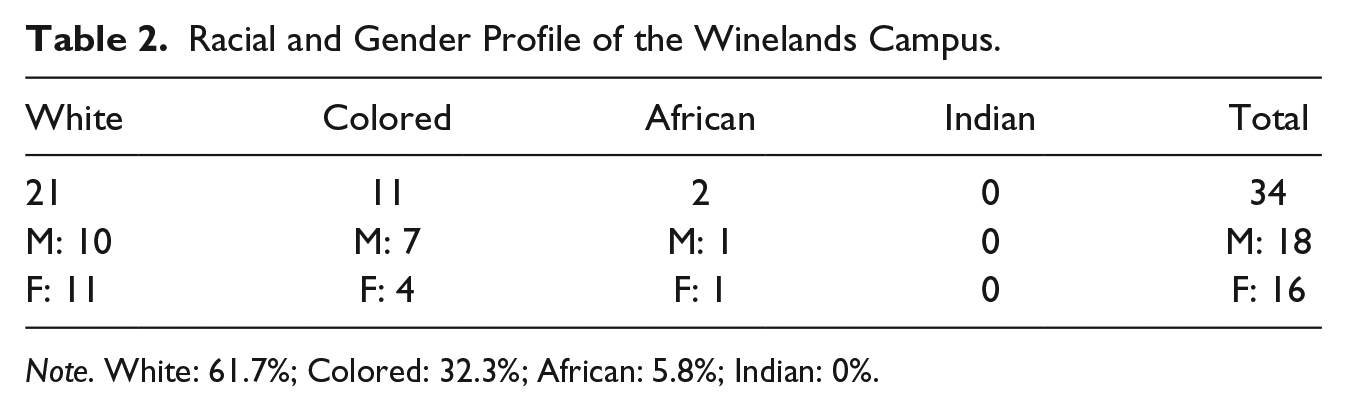
Note. White: 61.7%; Colored: 32.3%; African: 5.8%; Indian: 0%.
Equity Profile of Permanent Academic Staff as at March 31, 2014.
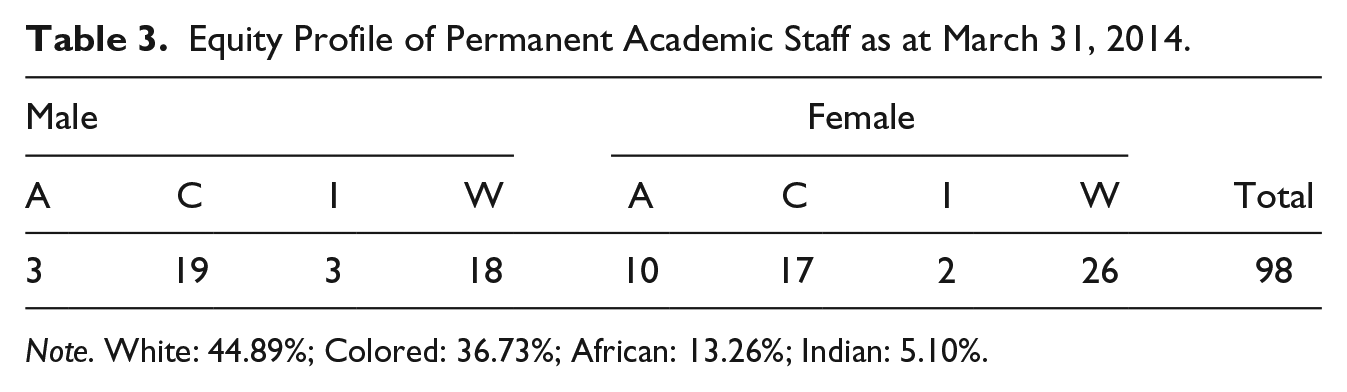
Note. White: 44.89%; Colored: 36.73%; African: 13.26%; Indian: 5.10%.
The White majority of 41.78% is indicative of the faculty’s slow racial transformation since inception 10 years ago. There has clearly not been a will to ensure a faster pace equity in the faculty. Special attention is required to bring about a new trend that will show visible transformation at structural level.
The Winelands Campus
The Winelands College of Education merged with the Table Mountain campus in 2001 to become the education faculty of this newly merged university. The Winelands campus was previously White and shows signs of slow transformation.
The Winelands campus constitutes approximately 30% of the faculty. As a historically White institution, staff transformation is inconsistent with institutional requirements. Raditlhalo’s (2007) assertion may be relevant: Only with a strong anti-racist agenda will previously White institutions transform without alienating Black talent. The internal transformation debate does not engage the disproportionate nature of the staff structure. Officially, Afrikaans, the language of instruction has not changed since the inception of the merger: This fact might have played a role in limiting staff appointments and student enrollment.
The White group dominates the academic staff profile employed on a permanent basis (44.89%), followed by the Colored group (36.73%), the African group (13.26%), and the Indian group (5.10%).
Considering the three tables above, the White group dominates academic positions. African and Indian categories are under-represented. It would be in the interest of the faculty to attend to these imbalances. The author agrees that issues of staff equity are seldom addressed. A document drafted by a faculty member highlighted the anomaly of White staff in senior lectureships without PhDs compared with Black academics in ordinary lecturer positions with PhDs. Senior positions and leadership in the faculty were vested in White appointments despite their lower qualifications. Using the 2014 faculty handbook as data source, the following interpretive analysis emerged from the document:
. . . Four out of five individuals are classified as white hold university lectureships without a university degree. . . . All white staff members with a PhD are Senior lecturers . . . white lecturers with Master degrees were granted automatic senior lectureship . . . Currently out of twenty-one (21) senior lecturers, fourteen (14) are white (66.6%) . . . Since 2012 to 2014, six (6) out of eight (8) appointment to senior lectureship were white (75%). (Internal document)
Structurally, the faculty remains predominantly White and the trend in the latest appointments at senior level indicates its continuation. The domination of White male leadership and White academic staff may relate to the entrenchment of White academic staff in the faculty. In the following section, the focus is on curriculum and its intersection with ideology. For practical purposes, Teaching Practice which is a core module in all teacher training institutions has been selected.
Curriculum and Instruction Practices: Teaching Practice
Structurally, evidence presented above shows the domination of White academic staff at both campuses in the faculty. The question that arises is whether there is a correlation between the academic staff structure and prevailing ideology in the faculty. In explaining issues of social justice (Solorzano, 1998, p. 123), critical race theory recognizes the intersectionality of race, gender, and ideology. Raditlhalo’s (2007, p. 5) assertion that most previously White universities are engaging in a disguised attempt to maintain the status quo resonates with the empirical evidence in this study. The history of the staff is that most college lecturers were trained during the period of Christian National Education (CNE) and Fundamental Pedagogics, which provides some background knowledge and explanation for the dominant educational ideology and curriculum practice. For the purpose of this article, CNE and Fundamental Pedagogics can be summed up as “the ideological state apparatus that reproduces the ideology of apartheid” (Enslin, 1984, p. 145).
In the context of post-apartheid higher education, there is agreement that transformation needs to take place from apartheid to democracy. There is unanimity that a strong institutional culture does not just happen (Niemann, 2010, p. 1005). An inclusive culture has to be cultivated consciously and conscientiously by management, which is arguably absent in this faculty. Given that Teaching Practice is a core issue of concern in any teacher education institution, a closer view of the policies and practices of this curriculum topic is analyzed from a transformational perspective.
Teaching Practice
Curriculum instruction is informed by ideology, which will be illustrated with reference to Teaching Practice at the Table Mountain campus. Extracts from documents and communications provided data. The ideological nature of Fundamental Pedagogics is embedded in the curriculum practices as will be illustrated below.
Maintaining Teacher-Centeredness
The post-apartheid education policy shifted from “teacher-centeredness” to “learner-centeredness.” The role of the pre-1994 teacher/lecturer was that of “bearer of authority and the learner as ‘demander of authority’” (Landman, 1981, pp. 8-9). The following extract demonstrates how lecturers, oblivious of new CHE assessment policy of transparency, consistency, and fairness (2011), assume authority to finalize student’s Teaching Practice marks. According to the Teaching Practice Manual, evaluation of students takes place at a special meeting:
. . . At this meeting the performance of each student is reviewed, the evaluation of the tutor-teacher is taken into consideration and the final mark is decided upon. This mark is not a mathematical average based on the marks received [even if it is 50% or more] but is a mark which takes the total situation into consideration and is an attempt at giving a more accurate reflection of the student’s performance in respect of the university’s criteria for what is considered outstanding, acceptable or below par. (Teaching Practice Manual)
According to the evaluation procedure, once the Teaching Practice sessions have been completed and the assessment results are submitted, evaluators meet to determine students’ results. The outcome of student performance is the result of a subjective systemic process (Sosibo, 2013, p. 150). At these meetings, student performance is discussed and decided as a “pass” or “fail”: even if it is 50% or more, 50% being the institutional criterion for a pass mark. These Teaching Practice evaluation procedures centralize power in the hands of the lecturers as they go about exercising quality assurance as professional practice. At these meetings, students’ academic performance is the outcome of subjective narrative understandings of lecturers (McMillan, 2001, p. 294). Sosibo (2013) recommends that a teaching practice rubric, which minimizes subjectivity and extraneous expectations, should guide the supervision and assessment of students. During the establishment of the merged faculty, concerns were expressed that curriculum practices have their origins in ideological histories rather than academic or professional principles of curriculum design (Robinson & Rousseau, 2011). These practices are entrenched in the faculty and in need of revision.
Teacher-centeredness and control of students are regarded as an integral part of apartheid CNE philosophy. Evidence of these two aspects of CNE characterizes the hierarchical student-lecturer relations in the faculty. In the context of the Teaching Practice module, these practices are maintained and particularly during Teaching Practice assessments, the students are subjected to outdated CNE practices. Contrary to the principles of assessment as espoused in the CHE policy on assessment (2011), the Teaching Practice manual states, for instance, that “it is the right of the evaluator to stipulate which subject he/she will evaluate,” which violates the principle of fairness in assessment (CHE, 2011). Students are subjected to a system of quality assurance and control that placed them under pressure. The following quotation attests:
The last week of the Teaching Practice session, the fourth-year students have “to teach all day every day.” It is during this week that they receive their final evaluations and these evaluations are unannounced walk-in visits. (Staff correspondence, June 27, 2014)
These regulations and practices are seemingly intended to ensure that students perform optimally and that the quality of student who graduates has been ensured. Many of these practices survived from the faculty’s apartheid past as a training college. Transformative approaches to Teaching Practice assessment need to be introduced to shift the practicum to a learner-centered approach: consonant with the post-apartheid higher education sector.
Resistance to Change
Lack of transformation is caused by resistance to change and maintenance of the status quo (Raditlhalo, 2007). Teaching Practice assessment is a major concern in higher education and, according to the CHE (2011, p. 94), Teaching Practice is an uneven area which represents a significant challenge to quality in the sector. After a request for uniformity in Teaching Practice was mooted in the department, an evaluators’ workshop was proposed to promote a common approach to Teaching Practice assessment and quality assurance. The following response to the idea of a Teaching Practice workshop to address current practices is presented as evidence to retain the status quo and resisting change:
I am extremely concerned that the TP programmes are being labelled fragmented. By whom was this decided? Was this discussed in the FP and ISP and is this the feeling of the academic staff? Where is the minutes of such a meeting where this matter was discussed and when this conclusion reached? Do the new TP members know how the current programmes were developed over the years to come to what it is currently? TP is not just a technicist exercise and should be grounded in theory and well thought-out academic principles as the current programmes are. These programmes were circulated a number of years ago by the academic staff members as TP cannot be separated from the academic programme.
This quotation defends the current system of Teaching Practice operating in the faculty and argues for its preservation. Teaching Practice emerged as the bastion of the college system: It is supported by the ideological tenets of control by experts who apparently know what best practice is. The response to this initiative is indicative of the resistance to change and the trend to maintain the status quo (Raditlhalo, 2007).
Data presented in this section highlighted a continuation of practices reminiscent of the apartheid era. Despite all the policy changes that were promulgated with regard to organizational culture, managerial practices, and curriculum transformation, resistance to change and preservation of existing practices are strong. Open skepticism and negativity toward the development of software programs and digitalization to go “paperless” have been recorded. Needless to say, CNE ideological principles and values are still vibrantly implemented and defended.
Practices of Racial Discrimination
Structure and ideology are analytically interrelated categories in the higher education domain (Soudien, 2010). Critical race theory challenges dominant discourses on race and racism as they relate to education by examining how theory, policy, and practice are used to subordinate certain racial and ethnic groups (Solorzano, 1998, p. 122). In this section, I will present counter-storytelling instances based on experiential knowledge and a commitment to social justice (Matsuda, 1995). Extracts are taken from reflective reports.
White on Black Racism
This counter-story is a reflective narrative of an ex-faculty member. The story speaks of territorialism, exclusivism, and control in the context of curriculum and teaching:
I worked as a full-time, permanent lecturer in the faculty. I was part of a group of 5-6 “core group” lecturers. The head of the programme named the group and established a very strong sense of ownership of everything related to the programme . . . The core group consisted of white females who had worked together for many years in the previous college of education era . . . None of them were as academically qualified as I was . . . At least two of them did not have any degree. They owned the programme with distasteful territoriality. While they were hard-working and productive in many ways, they conducted the culture in the group meetings with an entitlement to maintain “their” ways of doing and knowing—a white, dominant, history-preserving disposition which left me feeling perturbed. (Extract from reflective report)
In the above extract, frequent mention is made of the White racial composition of the “core group.” What is significant is the superior academic qualification of the lecturer, yet she was not in a leadership position. Critical race theory challenges the dominant ideology that informs educational practices. In the context of this study, the ideology refers to those educational values, beliefs, and practices that were inculcated during the apartheid period: racial superiority, control, authority, teacher-centeredness, and reproductive pedagogical practices. In the above quotation, the curriculum is “owned” by the group. It may portray a sense of superiority because the assumption is made that the “core group” knows better. A sense of knowing better and territorial control is continuously asserted. Lamenting a lack of transformation in the faculty, the lecturer decided to resign.
For the faculty to transform, voices of the “oppressed and marginalised” need to be heard before the ideal of inclusivity can be set as a strategic objective of the transformational agenda.
Whites Treating Blacks Badly
The first narrative refers to the early days of new staff members in the faculty. Three newly appointed Black staff members joined the faculty in 2014 and registered common discriminatory experiences with racial connotations. They were surprised when the leadership whom they expected to support their call, discouraged them from reading the statement. This notwithstanding, they opted to present their statement as a matter of principle. The following is an edited extract of their statement:
We find that some staff members often speak to us in ways unbecoming at an institution of higher education. One of us had to face the indignity of taking instructions from a fellow staff member who spoke rudely to him. The staff member (white), refused to work closely with him (black). The incident, which is just one of many, brought undue suffering and impacted negatively on his performance. A formal grievance was lodged with the university authorities. He was also accused of being lazy. Another lecturer asked him in public to see his job description when he refused to carry out her (white) instructions. One of us stated that she is often spoken to crudely and has been ordered by a colleague in the following way: “I want you to come to my office” or “I need you to do . . .” And, “sorry if I come across hard but that is the way I am, I don’t mean it personally. . .” . . (Abridged statement)
After the statement was made, a staff member apologized for the unfortunate experiences which new faculty members had to endure. It was reported to the author that an awkward mood prevailed in the meeting room while the statement was read. A significant comment was made: “Are they calling us racists?” an indication that reference was made predominantly to Whites who were treating Blacks badly. The following is a response from a staff member who felt insulted because Black staff subjected her to listen to them, against her will:
. . . I also do not believe that I am worthy of your veiled insinuations that there is racism on our campus. This allegation has never before been directed towards me, no matter that it was in a generalised comment. I am a part of the general staff. I was offended and insulted. I am aware of others who have also tried to welcome you.
The above quotation is evidence of an outrage toward the counter-narrative which is both a source and critique of oppressive practices and domination. The statement came as a “shock and surprise.” The response resonates with the description of Rozena Maart’s lecture: “When Black consciousness meets White consciousness,” by a White American lecturer, as “unstabilizing,” “disturbing,” and “upsetting” (Maart, 2014, pp. 2-5). According to a staff member, racism was never discussed in an open forum. After this incident, however, many lecturers regularly expressed their open disgust with the racism and disrespect displayed in the faculty. These utterances were made at departmental and faculty meeting level.
Unfair Labor Practices: White Preference Over Black
A third counter-narrative of abuse of power concerns the inconsistencies with advertising of posts, shortlisting, and appointments in the faculty. In one instance, the position of assistant dean was advertised in the faculty and the advert was written with a particular candidate (White) in mind. Noteworthy was the absence of publication requirements normally associated with a senior academic position. Despite the superior qualifications, list of publications and supervision record of a Black associate professor, the post was filled by the White candidate with inferior qualifications. No objective institutional policy guided the process, and the Black academic had to endure humiliation at the hand of a Black leadership that viewed the action in the best interest of the faculty. The Black applicant referred the matter to the Conciliation and Arbitration Commission (CCMA) as a case of “unfair labour practice.” The Black academic was awarded compensation of R284,106.00 minus statutory deductions by no later than January 31, 2017 (Commission for Conciliation, Mediation & Arbitration, 2016).
In another instance, a Black female academic applied for ad hominem promotion but was denied while a White colleague who also applied was granted promotion despite having the same research shortcomings: no publication output in accredited journals. The case was presented to the CCMA as “unfair labour practice” based on “race,” which seems to be the only difference between the two lecturers. This narrative portrays another experience of Whiteness being privileged and an unsuccessful attempt at exposing racism in disguise. The narratives presented above are instances of staff seeking recourse to justice, speaking truth to power (Matsuda, 1995).
Conclusion
Responding to the research question that informed this study, findings indicate that structurally, the faculty is dominated by a White “race” group. Ideologically, curriculum practices and life experience counter-narratives confirm subtle and overt instances of racism. Instances of power abuse, punitive action for not conforming, and unfair labor practices provide evidence of a faculty that struggles to transform. Interest convergence and critical race theory methodology of counter-narratives provide analytical and conceptual tools to understand the slow pace of transformation and lack of institutional “will” that exacerbates the pervasiveness of retrograde culture climate (The Ministerial Report, 2008, p. 14). Interest convergence of Black leadership with Whiteness and institutionalized racism based on the historical Whiteness of the faculty offer some explanation for the paradoxical support of Black leadership against Black academics’ struggle for social justice.
Higher education institutions’ transformation agenda requires that those in leadership position understand the debate and take a position on it (Soudien, 2010, p. 882). Realizing the need for assistance at institutional level, the Ministerial Report (2008) suggested that higher education institutions incorporate an approach that includes diverse academic culture, an engaging approach, and substantive representation of different population groups in governance and administration (DoE, 2008). Based on evidence in this study, it is recommended that a bottom-up approach instead of a top-down approach informs transformation. In this regard, the faculty needs to embark on a process that will build a cohesive, academic culture presently lacking but not out of reach. I suggest incorporating Homo Bhabha’s notion of hybridity as part of a new transformation approach when a transformation agenda is conceptualized (Thavers, 2006).
Erasmus (2006) argues that transformation requires “living the future now” and moving away from conflating sameness with equality, and difference with inequality (p. 60). Thavers (2006) suggests the adoption of Homi Bhabha’s notion of hybridity and the third space to conceptualize and change institutional cultures instead of opting for essentialized identities. For Bhabha (1996), hybridity is the process by which the colonial governing authority undertakes to translate the identity of the “other” within a single framework but then fails because something new is produced. For Bhabha, indeterminate spaces in-between subject positions are lauded as the locale of the disruption and displacement of hegemonic colonial narratives of cultural structures and practices (Bhabha, 1996). Instances referenced in this article are of dominant structures and practices being challenged. For Bhabha, the third space is a mode of articulation, a way of describing a productive and reflective space that engenders new possibilities. The third space is an ambivalent site where cultural meaning and representation have no “primordial unity or fixity” (Bhabha, 1996).
The faculty needs to embark on a productive participation process to construct a program from the bottom up. This process should include a “cultural audit” to identify the expectations, values, and commitment of staff (Niemann, 2010, p. 1007). In a similar initiative, UFS used various models to develop an “Appreciative Inquiry” approach to transformation (Niemann, 2010, p. 1007). Given the urgency of the transformation process and its centrality in fulfilling the function of the university, the merged faculty needs to hold an urgent “transformation indaba.” With the support of and experiences from other faculties and universities, transformation of the structural, ideological, and pedagogical practices should be intensified to close the transformation theory-practice gap that characterizes the lack of academic citizenship and social cohesion in the faculty.
Footnotes
Author’s Note
The article is based on personal experiences and other data sources. It was initiated while in the employment of the higher education institution.
Declaration of Conflicting Interests
The author declared the following potential conflicts of interest with respect to the research, authorship, and/or publication of this article: Ethical clearance certificate EFEC 13-5/2014 was granted by the institution where this study was conducted. The author was a member of staff at the time of writing but took up employment at another institution.
Funding
The author received no financial support for the research, authorship, and/or publication of this article.
