



Abstract
Racial inequity in postsecondary education is a significant social problem. Black students’ academic success is often hindered by feelings of isolation, particularly at predominantly White institutions (PWIs). Educators should ensure that their teaching strategies promote a sense of belonging. Team-based learning (TBL) is a small-group pedagogy that is being used at an increasing rate. The extant literature has not yet examined the impact of TBL on Black students. The current study compared the academic outcomes of White and Black students enrolled in TBL courses. In this study of 148 social work students, academic outcomes were operationalized as grade point average (GPA), course grade, and peer evaluation score. Findings indicate that although Black students had comparable GPAs and course grades, they scored significantly lower on peer evaluations. Implications are discussed.
Racial inequity in postsecondary education is a significant social problem. This inequity has been documented at various stages throughout the educational pipeline, including the transition from high school to college, college enrollment, the 6-year graduation rates, as well as the ethnic breakdown in conferred degrees nationwide (Snyder, de Brey, & Dillow, 2018). A 2018 U.S. Department of Education study found that, among White high school graduates, 71.3% transitioned directly from high school to college. In contrast, only 56.6% of Black students made this immediate transition (Snyder et al., 2018). In terms of enrollment, 42% of White 18- to 24-year-olds were enrolled in either college or graduate school, while only 35% of Black 18- to 24-year-olds were enrolled in postsecondary education (Snyder et al., 2018). The chasm between the ethnic groups becomes even more noticeable when examining the graduation rates. The Department of Education reports that 63.3% of White college students graduate with a bachelor’s degree within 6 years, as compared with only 39.5% of Black students (Snyder et al., 2018). Furthermore, when looking at all bachelor degrees conferred in the United States, 66.5% are awarded to White individuals even though only 54% of all 18- to 24-year-olds in this country are White; and, 10.6% of bachelor degrees are awarded to Black students even though 15% of all 18- to 24-year-olds in this country identify as Black (Snyder et al., 2018).
The educational outcomes for Black students are particularly daunting for those attending predominantly White institutions (PWIs). Research suggests that Black students attending historically Black colleges and universities (HBCUs) tend to have higher graduation rates than those attending PWIs (Davis et al., 2004; Nichols & Evans-Bell, 2017). When comparing graduation rates for institutions with similar levels of low-income students (40%-65% low-income students), HBCUs have a 41.8% graduation rate for Black students and non-HBCUs have a 32.1% graduation rate for Black students. An extensive body of literature has examined why there is such a disparity in the success rate of Black students at PWIs and HBCUs. Findings suggest that a key factor to Black students’ success is a sense of belonging. Black students enrolled at PWIs lack this sense of belonging, and instead, feel isolated, alienated, and invisible (Ancis, Sedlacek, & Mohr, 2000; Hurtado et al., 2007; Nichols & Evans-Bell, 2017).
The statistics above show evidence of significant racial inequity in postsecondary education. It is imperative to the social and economic well-being of our country to close this achievement gap, and ensure that all people have an equal chance for academic success. Closing this achievement gap will certainly require a multipronged approach, including, for instance, the changing of enrollment patterns (Nichols & Evans-Bell, 2017). However, solving this nationwide problem cannot solely be placed on the shoulders of university and college administrators; rather, faculty must take an active role in promoting positive outcomes for Black students. In an effort to enhance Black students’ sense of belonging and ensuing academic success, it is critical to examine the impact and effectiveness of specific pedagogies for this population. An innovative pedagogy that is being used at an increasing rate is team-based learning (TBL). Although the overall effectiveness of TBL has been well documented, extant literature has not examined the impact or outcomes of this pedagogy for Black students enrolled at PWIs. The purpose of this study is to compare the academic outcomes of Black students with their White counterparts who are enrolled in TBL courses. First, however, an overview will be provided of TBL, including a discussion of its purpose, structure, benefits, and limitations.
Literature Review
TBL: What Is It?
TBL is a highly structured small-group pedagogy that focuses on knowledge application rather than regurgitation. When using TBL, the instructor divides course content into five or six main units and subsequently follows a six-step instructional sequence for each of the main units (Michaelsen, Bauman Knight, & Fink, 2004). The six steps are as follows (Michaelsen, 1994; Michaelsen et al., 2004; Michaelsen & Sweet, 2011): First, students engage in individual study of the assigned reading. Second, students take an individual test regarding the assigned readings in class. Third, students sit in small groups and take the exact same quiz as a group. Group quizzes are graded immediately following completion of the quiz. Fourth, groups have the opportunity to prepare a written appeal if they feel that one or more of their responses on the quiz were erroneously marked as incorrect. Fifth, after the individual and group quizzes are completed, the instructor can briefly lecture or provide input where necessary. Note that this is the first time in the sequence that the faculty engages in any lecturing. These first five steps should take up approximately 20% of in-class time. The remaining 80% of class time is devoted to Step 6, which consists of application-oriented activities/projects. As is evident from this six-step sequence, TBL is highly student driven. Students are responsible for acquiring the content/knowledge, while instructors are responsible for facilitating the application of knowledge.
The grading system in TBL is based on individual work, group work, and peer evaluations (Michaelsen et al., 2004). The individual grades result from the individual quizzes. The group grades result from the group quizzes and group projects. Finally, the peer evaluation grades result from the peer evaluation forms completed by all students. Specifically, at the end of the semester, students must complete a peer evaluation for each member of their group. This evaluation assesses how prepared peers were for the group work, as well as their ability to work effectively within a group (i.e., respect for team members, openness to team members’ input). The scores from all team members are combined to come up with one comprehensive peer evaluation score for each student. The purpose of the peer evaluation score is to ensure all group members’ active participation within the group.
TBL also prescribes a very specific way of composing student groups (Michaelsen et al., 2004). At the onset of the semester, the instructor creates the groups in an intentional way. Groups should be as heterogeneous as possible, with all forms of diversity (including ethnic diversity) distributed evenly across groups. Groups should consist of approximately four to seven students and the groups should remain together for the duration of the semester. The use of such permanent groups is said to result in an increased likelihood of intellectual growth, increased commitment and immersion in the course content, and improved social interactions/relationships between group members (Michaelsen & Sweet, 2011).
Benefits of TBL
TBL has been used quite extensively in disciplines such as business (Michaelsen, Peterson, & Sweet, 2009), medicine (Haidet, O’Malley, & Richards, 2002; Koles, Stolfi, Borges, Nelson, & Parmelee, 2010; Michaelsen, Parmelee, McMahon, & Levine, 2008; Searle et al., 2003; Seidel & Richards, 2001), industrial organization psychology (Haberyan, 2007), science (Dinan, 2004; Herreid, 2004), and social work (Macke & Tapp, 2012; Gillespie, 2013). More recently, research with psychology students in Italy using a modified team-based learning (MTBL) pedagogy reflected that the MTBL pedagogy enhanced the academic performance of participants (Rania, Rebora, & Migliorini, 2015). A qualitative study using MTBL reflected that student perception and experience with MTBL was that this pedagogy allowed them to develop important life skills, such as critical thinking (Rania, Migliorini, & Rebora, 2016). These authors also used Photovoice through an MTBL pedagogy to teach qualitative methods, perhaps the first time this has occurred (Rania, Migliorini, & Rebora, 2017).
Evaluation studies in all these disciplines have found TBL to be highly effective in a variety of ways. First, TBL has been found to be effective in transferring knowledge about basic and complex terminology (Koles et al., 2010; Michaelsen, Watson, & Black, 1989). It has also been found to allow for better knowledge retention and understanding (Shankar, 2009), as well as an increased level of self-efficacy (Macke & Tapp, 2012). Besides educating students about the content area, TBL also promotes higher order learning. Specifically, the use of TBL has been associated with improved critical thinking, problem solving, analytical skills, interpersonal and leadership skills, and conflict resolution skills (Anwar, Shaikh, Dash, & Khurshid, 2012; Michaelsen, Cragin, & Watson, 1981; Rania, Migliorini, & Rebora, 2016; Rania, Rebora, & Migliorini, 2015; Watson, Michaelsen, & Sharp, 1991). Finally, TBL can help stave off a sense of burnout among instructors who repeatedly teach introductory courses (Michaelsen et al., 1981; Watson et al., 1991).
Limitations of TBL
Although the reported benefits of TBL are extensive, one area that remains unexplored is the impact of TBL on Black students and their sense of belonging within the classroom. The potential shortcoming/problem of TBL concerning Black students pertains to the prescribed method of group formation. As was previously noted, in the TBL protocol, instructors are directed to distribute all forms of diversity across groups. In PWIs, where ethnic diversity is limited, this procedure for group formation often results in having only one student of color in each group. To the authors’ knowledge, there is currently no literature available on the impact of this type of isolation on the academic outcomes of Black students. Although no empirical data currently exist specifically on this topic, the literature related to critical race theory (CRT), culturally relevant pedagogy, and group dynamics and race can provide us with a deeper understanding of Black students’ experiences and educators’ role in promoting positive outcomes among Black students.
CRT, Culturally Relevant Pedagogy, Group Dynamics and Race, and Culturally Relevant Educators
An in-depth study of CRT, culturally relevant pedagogy, group dynamics and race, and culturally relevant educators is beyond the scope of this article; however, each area warrants singular attention due to its collective importance in examining the outcomes of Black students in TBL courses.
Scholars advocate that CRT should be used as a means to examine educational inequality in our society (Ladson-Billings, 1998; Ladson-Billings & Tate, 2006). The fundamental views of CRT are that
racism is pervasive in the United States;
the intersectionality of race, class, gender, and sexuality should be fundamental in analyzing inequality;
the life experiences of Blacks enduring racism represent counterstories and a source of legitimate knowledge; and
Whiteness represents a form of property, historically and presently, in our society as a mechanism that perpetuates inequality (Delgado & Stefancic, 2000; Lac, 2017).
Thus, a solid understanding of CRT is necessary for educators using TBL to develop genuine conversations in the classroom to hear and address the lived experiences of minorities. The CRT framework provides a more robust and dynamic framework for educators to use in the classroom. Race is a social construct with substantial consequences. This must be part of the conversation for racial consciousness to appear and evolve in the classroom (Griffin, Brown, & Warren, 2012; Lac, 2017).
Researchers and educators desiring to examine the effects of institutional racism within the academy should invite voices from minority populations concerning experiential realities and contradictions. In initiating such conversations, scholars and educators would find CRT a useful lens for analysis (Harper, 2012; Lac, 2017).
These fundamental components of CRT support a culturally relevant pedagogy. In providing a culturally relevant pedagogy, Ladson-Billings’ seminal work is instructive. First, the academic success of students should be the primary focus of educators (Ladson-Billings, 1995), and educators must take ownership of implementing practices that support student achievement. Second, Ladson-Billings clarifies that culturally relevant pedagogy helps students to accept and affirm their cultural identity. Third, educators using a critical lens must be aware of and reject social inequalities, while teaching and inspiring students to do the same (Ladson-Billings, 1995). Educators must understand the meaning of culturally relevant pedagogy to avoid oversimplification of the concept and have a significant, positive impact on student outcomes (Lac, 2017; Milner, 2012). For instance, some may focus on cultural celebrations and believe that a culturally relevant pedagogy has been provided. Such oversimplifications are uninformed and can trivialize, and even reinforce inaccurate racial perspectives (Sleeter, 2012). Sleeter (2012) suggests analyzing topics through a political lens to combat uninformed perspectives, searching outcomes experienced by marginalized and vulnerable populations, and critically examining the unequal distribution of power and resources. In seeking outcomes experienced by Blacks in TBL group work, CRT becomes a critically important lens for dialogue, assessment, and learning. Lac (2017) articulates the reality that discussions on race, which lack sufficient attention to the underlying causes of racism and White supremacy, create barriers and limit how students conceptualize and understand issues about race and racism.
The authors found no literature on group dynamics and race relative to TBL groups. However, as evidenced above, there is significant research on how race affects the classroom and our society. In integrating these concepts of CRT and culturally relevant pedagogy, culturally responsive educators (CREs) possess dispositions and characteristics that are . . . validating, comprehensive, multidimensional, empowering, transformative, and emancipatory. Each faculty member with a culturally relevant disposition has a unique approach to these desired outcomes. Cultural responsiveness is a skill that is developed to respond to students’ needs as they arise, similar to the way a baseball player fields a ball that is hit; no one can predict the exact bounce the ball will take, but keen awareness and finesse are needed for a productive response with favorable outcomes. CREs use multiple approaches to make students feel visible, valued, and essential in the classroom learning environment. Culturally responsive faculty also take a comprehensive approach to teaching in which they seek to develop students’ intellectual, social, emotional, and political learning so that students will experience growth and increase preparedness for all aspects of their personal lives, professional opportunities, and civic engagement (Gay, 2010). They are also aware of the many dimensions that can support learning. Their multidimensional teaching addresses many aspects of the learning context, classroom environment, student and teacher relationships, classroom management styles, and assessments (Gay, 2010). These culturally responsive educators have their own styles, but each faculty member works towards developing relationships with the students and providing clear expectations as well as a deep level of support. (Flynn, Mathien, Mitchell, & Whalen, 2017, pp. 74-75, as cited in Whalen, 2016)
Thus, CRT, culturally relevant pedagogy, group dynamics and race, and culturally relevant educators are critical components of TBL group work, and yet, currently, they are not a central part of the TBL literature. These limitations and gaps in the literature are the impetus for the current study, which seeks to examine the differences in outcomes for White students and Black students who are enrolled in TBL courses. For this study, academic outcomes have been operationalized as peer evaluation scores, course grade, and overall grade point average (GPA). It is hypothesized that Black students will have lower peer evaluation scores as compared with their White counterparts, despite having similar overall academic outcomes.
Method
Data Set
Institutional review board (IRB) approval was obtained to create a data set derived from the school records/transcripts of social work students enrolled in either the master of social work (MSW) or the bachelor of social work (BSW) program at a Midwestern public university. The data set includes 148 mutually exclusive cases with three different “grading scores” for each. It is important to note that students who identified as an ethnicity other than White or Black were excluded from this data set. In total, four students were excluded from the data set for this reason. This was strictly done to allow for the direct comparison of Black and White students.
The data set included demographic information (e.g., race/ethnicity) that the social work program routinely gathers about its students, and scores reported from instructors in six different courses that used the TBL pedagogy. Each of these courses was designed in its entirety using the TBL pedagogy. That is to say, TBL was not simply used to cover one topic or unit of the course; rather, this pedagogy was used for the duration of the course.
As part of the TBL pedagogy, all six of the courses from which data were drawn for this study utilized semipermanent small groups. The TBL pedagogy recommends the creation of heterogeneous groups that stay together for the entire course (e.g., 16-week semester), with all forms of diversity (including ethnic diversity) distributed evenly across groups. As prescribed by TBL, faculty placed their students, who were subsequently included in this data set, into groups of four to seven students with all forms of diversity distributed across groups. For instance, students with professional social work experience were distributed across groups, nontraditional students (older than 25 years) were distributed across groups, and students who identified as an ethnicity other than White were distributed across groups. With an average of only three Black students in each class, this meant that there was, at most, one Black student in each group. It is also important to note, that although some students may have known each other prior to the beginning of the course, they were not allowed to choose their own group members.
Measures
Race/ethnicity and gender were gathered through the demographic information routinely collected as part of the record-keeping protocol for the social work program. Three “grade scores” were utilized in this study. First, GPA was collected from each student’s transcript. GPA is calculated on a 4-point scale, with higher scores indicating better grades. To standardize GPA scores, the current GPA was used for BSW students, while undergraduate GPAs were utilized for MSW students. Course grades were reported by the individual instructor and were on a 0 to 100 scale, with higher scores indicating a higher grade. The course grade is the overall score a student received in the course, and consists of all assignments, quizzes, and/or exams that were included in the course. Peer evaluation scores were also on a 0 to 100 scale, with higher scores indicating a better evaluation. The instructors provided peer evaluation scores to the researcher. These evaluations are a standard component of the TBL pedagogy and require students to evaluate their group members’ contributions to the group. These evaluations include questions regarding the students’ preparedness for group work, participation in group work, openness to group members’ input, and respect for group members.
Data Analysis
Several analytical techniques were utilized for this study. First, the study utilized case-wise deletion to handle missing data. Depending on whether assumptions of statistical tests were met, either an independent samples t test or a Mann-Whitney U test was conducted to determine differences across racial status. A Pearson’s r was calculated to assess the relationship between the three grade scores. Next, a cluster analysis of GPA scores was conducted to determine groupings of students. GPA was chosen because of its distribution and the notion that it is a global predictor of student achievement. Several analyses were conducted to determine any differences across cluster membership and the other grade scores.
Results
Demographics
Table 1 reports the demographic statistics of this study. Of the 148 student records used in this study, 113 were from Bachelor of Social Work (BSW) students while 35 were from Master of Social Work (MSW) students. Participants came from one of six social work (SWK) classes: SWK 308: undergraduate research (29.1%), SWK 105: undergraduate intro to social work (19.6%), SWK 630: graduate human behavior (14.9%), SWK 310: families and groups (14.2%), SWK 307: undergraduate human behavior II (13.5%), and SWK 640: graduate research (8.8%). The students were predominantly female (91.2%) and White (86.5%), followed by African American (13.5%).
Demographics (N = 148).

Note. BSW = bachelor of social work; MSW = master of social work.
Descriptive Statistics
On average, students scored 95.85 (SD = 9.822) on their peer evaluation with scores ranging from 36 to 100. The sample had an average course grade of 92.26 (SD = 6.675) and GPA of 3.206 (SD = 0.417). Scores for course grade ranged from 44 to 100 while GPA scores ranged from 1.88 to 4. All three scores were assessed for normalcy using histograms and skewness and kurtosis statistics. Only GPA scores were considered normal; peer evaluation scores and course grade were considered not normal visually through the histograms and for having skewness and kurtosis scores over the recommended cut points of ±2 and ±1, respectively (Rubin, 2010).
Relationships Between Variables
Because peer evaluation scores and course grade did not have a normal distribution, a Mann-Whitney U test was conducted to determine any differences between White and Black students. An independent samples t test was run to determine differences in the normally distributed GPA scores. The results in Table 2 indicate that Black students scored significantly lower in peer evaluation scores (U = 700.5, p < .05), but there were no differences between course grade (U = 875, p > .05) and overall GPA, t(125) = 1.284, p > .05. Next, a correlational analysis was conducted indicating significant relationships (p < .05) between peer evaluation scores and both course grade (r = .566) and GPA (r = .177). Course grade was also found to be related to GPA (r = .256, p < .05).
Differences Between Black and White Students.
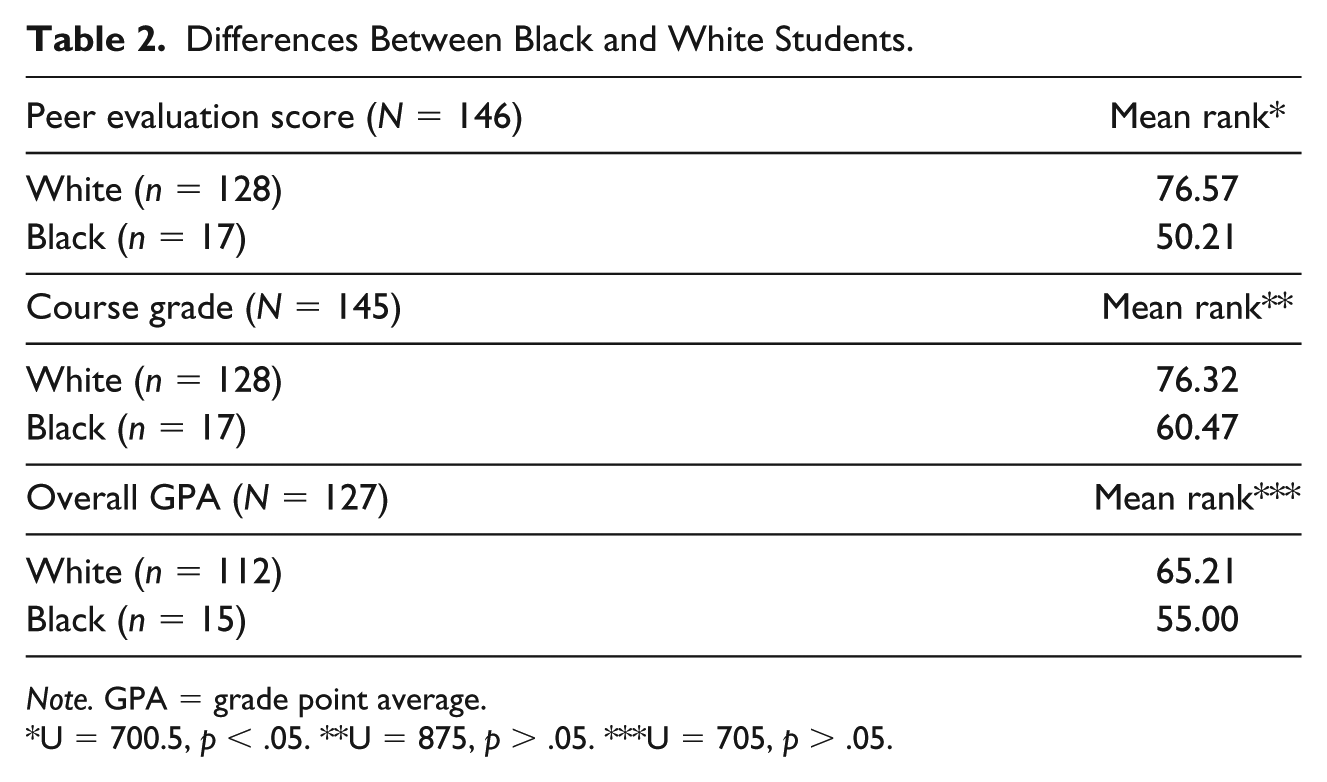
Note. GPA = grade point average.
U = 700.5, p < .05. **U = 875, p > .05. ***U = 705, p > .05.
Cluster Analysis
A k-means cluster analysis was conducted to determine different groupings of participants by GPA; k-means cluster analysis requires researchers to determine the number of clusters, k, before analysis, and then conduct the analysis iteratively to best determine the number of clusters (Norusis, 2011). Several k-means cluster analyses were conducted with the research team deciding that two clusters best fit the data, one with high GPAs and one with low GPAs. Figure 1 displays a scatterplot of the distance between cluster centers for both groupings, with tighter groupings desired, used to make this determination. Because of the density of each cluster, we determined that a two-cluster solution was appropriate.
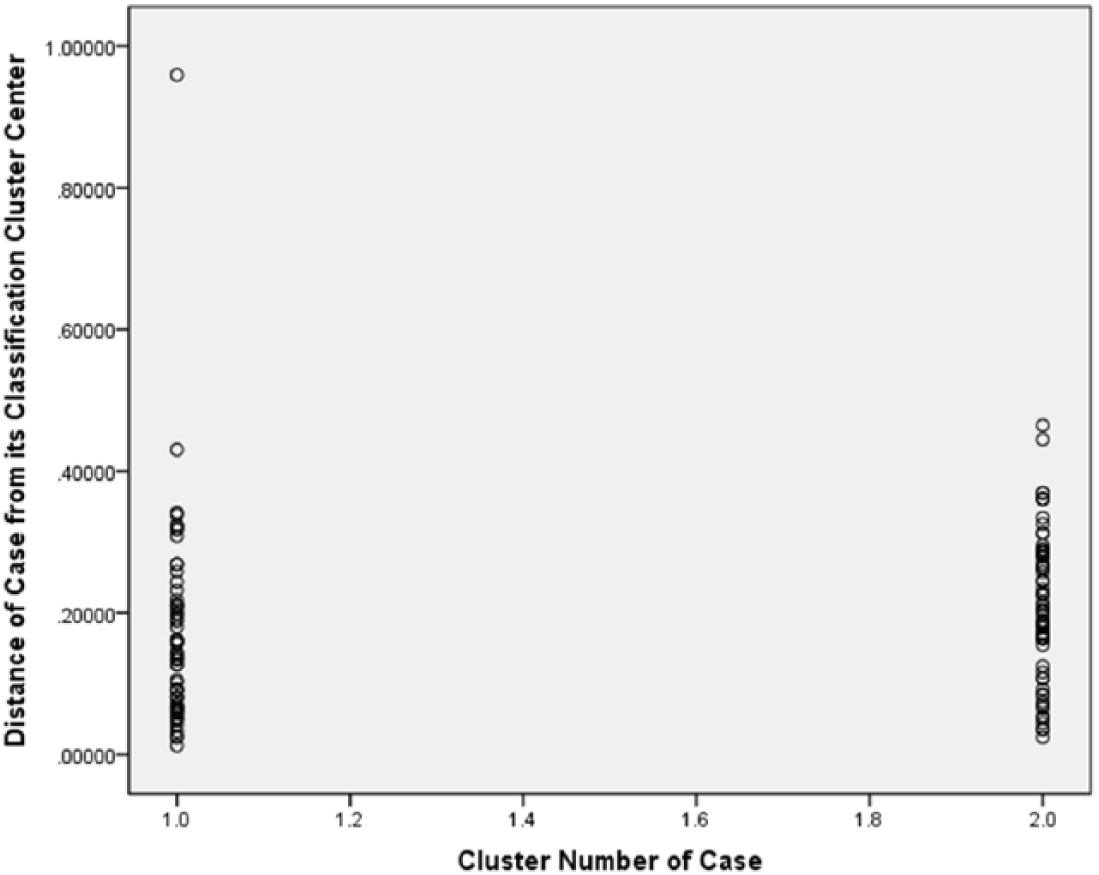
GPA cluster centers.
The high GPA cluster had an average GPA of 3.525 (SD = 0.234; see Table 3) while the low GPA cluster had a mean GPA of 2.838 (SD = 0.223). Two more analyses were conducted to determine any differences in course grade and peer evaluation scores across the two clusters. Course grades were significantly different between the two clusters, t(125) = −2.49, p < .05, while no significant difference was found for peer evaluation scores, t(76.862) = −1.525, p > .05; see Table 3. Finally, a crosstab of the GPA clusters by racial status (see Table 4) was run. Although this was found to be statistically insignificant, it still provides information on the dispersion of status across GPA clusters, χ2(1) = 0.259, p > .05.
Cluster Groupings and Scores.

Note. GPA = grade point average.
t(125) = −17.131, p < .05. **t(125) = −2.49, p < .05. ***t(76.862) = −1.525, p > .05.
Crosstab of Cluster and Ethnicity.
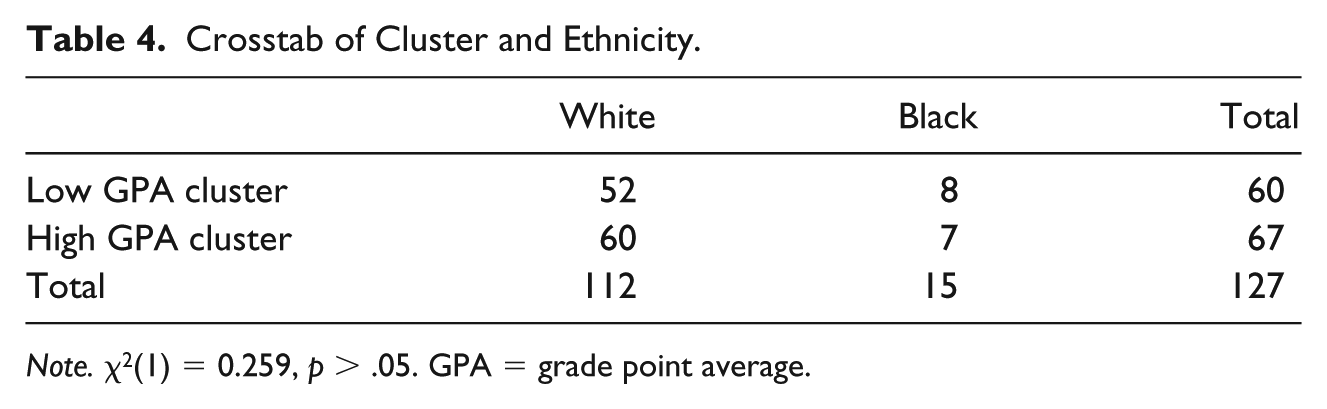
Note. χ2(1) = 0.259, p > .05. GPA = grade point average.
Discussion and Implications for Educators
The findings from this study indicate that Black students scored lower on their peer evaluations, despite the fact that their overall course grades and GPAs were statistically comparable with those of White students. This suggests that even though the Black students in this sample are academically as capable and as achieved as their White counterparts, they are being perceived less favorably by their peers during group work. Although this study suggests that the lower peer evaluation scores are not affecting the overall grade received in the TBL course, it strongly suggests that the group experience is negatively affecting the overall academic experience and success of the Black students. Specifically, the lower peer evaluation scores indicate that the Black students had a less than optimal group experience. The compromised group experience may cause or reinforce the feelings of isolation, invisibility, and alienation often experienced by Black students (Ancis et al., 2000; Hurtado et al., 2007). In turn, the lacking sense of belonging may result in a reduced chance for academic success.
There are several plausible explanations for this study’s findings. First, the Black students in this sample may have been disengaged during the group work due to their feelings of isolation. Given the limited ethnic diversity within the sample, it is very likely that Black students were singled out within the groups. If disengagement occurred, then this would have likely affected their peer evaluation scores.
A second explanation for the findings pertains to differing cultural/social expectations. The literature provides evidence of a cultural/social expectation among Black students that encourages Black students to defer to “authority” (Alvarez, Cervantes, Blume, & Thomas, 2009; Johnson, 2000; Steele, 1997; Thomason, 1999). Although Black students may not perceive their White group members as having “authority,” they do perceive their professor as having authority over the groups. As a result, Black students may not feel comfortable speaking up in their group, because such actions may be perceived by the professor as uncooperative. This suggests that Black students may feel obligated due to their cultural expectations to take on a silent, passive role within the group. Although this deference to authority is a cultural phenomenon, the White students may perceive it as laziness or unpreparedness, thus, resulting in lower peer evaluation scores.
A final, and most likely explanation for the findings in this study would be that Black students are just as engaged as White students, but are being rated lower as a result of institutional racism, racial stereotypes (Cherry, 1993), and implicit racial bias (Holroyd, 2015).
Institutional racism involves forms of direct discrimination as well as unequal treatment that unwittingly results from “neutral” regulations (Hormel, 2007).
Institutional racism includes differential access to the opportunities of society (such as education) and places Black individuals at a disadvantage (Carmichael & Hamilton, 1967). Implicit racial bias is a component of institutional racism, and explains how well-meaning faculty and students in higher education can act in good faith with an empirically based pedagogical model while being unaware of the racial inequities perpetrated with its application and outcomes (and that the model developers did not intend or foresee). Thus, institutional racism occurs within a pedagogical model if it appears to be neutral on its face, but is discriminatory in its application and/or effects (Holroyd, 2015). This implicit racial bias can include adverse peer evaluation scores of Black students by White students in the TBL model. Such peer evaluation decisions by White students can be based on unconscious stereotypes and attitudes toward students of color (Holroyd, 2015). This “unwitting prejudice” (Macpherson Report, as cited in Holroyd, 2015) or implicit racial bias occurs even in people who report they are not racist and are committed to nondiscriminatory treatment (Holroyd, 2015).
Implicit bias can persist in individuals who reject any explicitly racist sentiments; and can be found in Black and Black ethnicity individuals as well as Whites. Implicit racial bias isn’t just a matter of “a few bad apples” but rather a matter of widespread automatic and implicit associations that can affect the way even fair minded policies are implemented. (Holroyd, 2015, p. 31)
Although there are no additional studies in TBL and selection of groups as related to Black student outcomes in peer assessments at this time, findings from empirical psychology in implicit racial bias assist in a better understanding. Devine’s (1989) study demonstrated that stereotypes and prejudicial emotions can occur automatically, counter to one’s stated beliefs.
Although most people shun racial bias, racial discrimination remains prevalent because prejudice can influence our judgments and behaviors in subtle, unexamined ways. Most biases can operate outside of conscious awareness and control, nevertheless distorting our judgments and making discriminating all the more difficult to avoid. (Greenwald & Banaji, 1995, as cited by Glaser, Spencer, & Charbonneau, 2014, p. 89)
TBL has been demonstrated to be a robust and effective pedagogy for acquisition of knowledge and development of higher level skills. The TBL model does not intend racial discrimination; however, such discrimination may be occurring because of institutional racism and implicit bias. White students enrolled in TBL courses may be inadvertently grading their Black peers more harshly on their peer evaluations due to implicit bias.
Racial stereotypes and implicit racial bias faced by Black students at PWIs may erode their academic perception of self and lower academic performance (Fries-Britt & Turner, 2001). “Predominantly White campuses can dramatically undermine Black students’ chances of success and degrade their academic performance” (Harper & Hurtado, 2007, as cited in Karkouti, 2016, p. 66). This study provides one example of TBL’s impact related to group formation and peer evaluation. At a systemic level, this is only one unanticipated consequence of one pedagogical model. However, the discussion and literature review serve to show that implicit racial bias is a likely explanation for the findings of this study.
Regardless of the reasons for the findings, this study has significant implications for educators. First and foremost, the use of heterogeneous groups as prescribed by TBL may have negative academic implications for Black students, particularly at PWIs. As a result, faculty using TBL are encouraged to ensure that Black students are not singled out within a group. The authors of this study recommend that instructors refrain from distributing Black students evenly across groups when this distribution results in a single Black group member. It must be clearly stated that this does not suggest that Black students should be segregated within one group. Rather, the authors argue that ethnicity should not be used at all as a determining factor during group formation when there are an insufficient number of Black students to populate each group. Ideally, Black students would have the opportunity to work in a group with at least one other Black student in an effort to enhance a sense of belonging and potential for academic success.
Another manner in which TBL instructors can enhance sense of belonging is by including curricular themes within the group projects that are relevant to the Black experience (Hunn, 2014). Black students may feel a greater sense of purpose and belonging to the group if they feel that they can make unique and specific contributions. In addition, White students may perceive the Black students as more valuable if the content of the group projects pertains to Black issues.
Instructors may also want to consider using Learning Communities during the first semester/year and then adding the TBL component the following semester/year (Hunn, 2014). Learning communities are similar to TBL, in that, they involve group activities; however, they are different from TBL because the grading in learning communities is entirely individually based. This suggests that students are not dependent on one another for their grades. Learning communities then allow group members to get to know and trust one another, without the stress that comes from group grades. Once a good group dynamic has been established (i.e., after being in the same learning community for one semester), TBL can be incorporated in the classroom. This sequence of learning communities followed by TBL may give Black students an opportunity to acclimate to their predominantly White group, thereby allowing them to feel less isolated. In turn, this could reduce the likelihood that the Black students will disengage from the group. In addition, it may allow White students to resolve any racial stereotypes that they may have.
Limitations
There are several limitations to this study. First, no actual classroom observations were made. Actual observations may have provided a clearer picture of how peer interactions occur within the TBL pedagogy. Next, the low number of Black students in this study may have influenced the statistical tests. Only large effect sizes could be detected (Cohen, 1992), and the risk of making a Type II error is inflated. Next, there was no control for interactions outside of class. Peer evaluation scores may have been influenced by interactions outside the classroom environment. Finally, we assume that the instructors were all utilizing proper TBL techniques. There may be pedagogical fidelity issues resulting from instructors interpreting and using TBL differently. In response to these limitations, future research should include larger, more ethnically and geographically diverse samples. In addition, future studies should collect data that attempt to explain the findings from this study. These studies could involve either survey research or qualitative interviews or focus groups. One such future study may consider using TBL groups that consist predominantly of Black students to examine whether the trend in peer evaluation scores remains the same. This would help shed light on whether the lower peer evaluation scores are a result of being in the minority or the result of racial stereotyping.
Despite these limitations, this study makes several important contributions to the literature. This study is, to authors’ knowledge, the first to examine the impact of TBL on Black students. As was hypothesized, the findings from this study suggest that Black students in TBL courses have less positive outcomes as compared with White students. Specifically, findings indicate that Black students scored lower on their peer evaluations, despite the fact that their overall course grades and GPAs were statistically comparable with those of White students. This suggests that Black students were perceived less favorably by their group members as compared with White students. In light of these findings, instructors at PWIs who are implementing TBL are urged to be mindful of such factors as disengagement of Black students in TBL group work due to feelings of isolation, differing cultural/social expectations, and institutional racism, racial stereotyping, and implicit racial bias. Mindfulness of these factors by faculty should then culminate in the adaptation of the group formation process when using TBL in PWIs.
Footnotes
Declaration of Conflicting Interests
The authors declared no potential conflicts of interest with respect to the research, authorship, and/or publication of this article.
Funding
The authors received no financial support for the research, authorship, and/or publication of this article.