



Abstract
This article gives a canonical sequential analysis of openings and closings based on a corpus of department meetings. The first section of the article shows how opening a meeting constitutes a shift in turn-taking system. The second section identifies five techniques used in opening meetings. The third section identifies six techniques used in closing meetings. The final section of the article concludes how openings and closings mirror each other, with similar “stepping stones” to be “traveled”; and discusses the potential of this being a canonical and cross-cultural model. The study has implications for the community of conversation analysts, for business communication studies, and for practitioners.
Keywords
This article explores the business meeting format as an interactional achievement requiring intense collaboration and contributes to a deeper understanding of the passing of the informal into the formal and the formal into the informal. It shows which social actions are relevant for a chair to take (and to monitor) in order to open or close a meeting; and how not talking is a primary technique for participants in meetings to transition into a closing track. Meetings in general, and opening and closing meetings in particular, are to be seen as collaborative achievements, not just a concern for the chair of the meeting. The participants need to work through a distinctive procedure by drawing on local resources. This article identifies five techniques used in opening meetings, three chairman’s techniques (“boundary marker,” “reference to procedure,” and “start declaration”) and two participant’s techniques (“showing readiness to open the meeting” and “passing opportunity to talk”). The article also identifies six techniques used in closing meetings, four chairman’s techniques (“topic bounding and preclosing,” “concluding remark/moral/lesson,” “last call for new mentionables,” and “declaring closure”) and two participant’s techniques (“showing readiness to close the meeting” and “passing opportunity to speak”).
As an example of institutional interaction, a business meeting is goal oriented with embedded activities, routines and procedures aiming at furthering such goal orientation and leading to particular results, and it is characterized by asymmetry in distribution of participant rights, obligations, knowledge, and experience with and understanding of organizational routines (Drew & Heritage, 1992).
Institutional interaction has been studied for decades, but not much attention has been given to business meeting interaction (Asmuss & Svennevig, 2009; Boden, 1994; Chan, 2008; Fairhurst, 2007; Jarzabkowski & Seidl, 2006; Mirivel & Tracy, 2005; Schwartzman, 1989). Central are early works on formality (Atkinson, 1982), meetings as an organization cultural phenomenon (Schwartzman, 1989), and meeting interaction (Atkinson, Cuff, & Lee, 1978; Boden, 1994). Lately, however, a number of studies of business meeting data have been done within conversation analysis and linguistics, focusing on turn taking (Ford, 2008; Larrue & Trognon, 1993); thematic continuity and development (Bargiela-Chiappini & Harris, 1997); alignment and teaming up (Asmuss, 2008; Kangasharju, 1996, 1998, 2002); laughter (Clifton, 2008; Kangasharju & Nikko, 2009); the embodied orientation to physical objects (Nielsen, 2012; Streeck, 1996); leadership (Clifton, 2006; Holmes, 2005; Holmes & Marra, 2004; Marra & Holmes, 2005; Nielsen 2010b; Samra-Fredericks, 2000a, 2000b); decision making (Clifton, 2008; Huisman, 2001; Svennevig, 2008); sense making, socialization, and community building (Nielsen, 2009, 2010a; Tracy & Dimock, 2004); and multicultural participation or cross-cultural comparison (Bargiela-Chiappini & Harris, 1996, 1997; Bilbow, 2002; Poncini, 2002, 2007; Yamada, 1990).
The study of openings and closings in general was triggered by a large study of telephone calls that constituted groundbreaking work, laying the foundation for studying sequencing (Schegloff, 1968; Schegloff & Sacks, 1973). The analysis in this article builds on these and other classic studies on conversational data (e.g., Button, 1987) and will be referred to throughout the article.
Not much attention has been given in the literature to the opening and closing of meetings. However, Atkinson et al. (1978) discuss the use of summons. Boden (1994) describes openings as structured sequences embodying a variety of critical organizational issues, bracketing out of the busy workday while bracketing in the local meeting membership. Boden found that assessments of attendance, proposals to “get started,” or announcements and general information items frequently mark the opening (Boden, 1994, pp. 96, 97) and describe closings as “coordinated exits from the enclosed boundary of the meeting” and as mutually coordinated suspension of talk and activity (Boden, 1994, p. 102). There is always a spate of multiparty interaction before the “togetherness” transforms into a meeting, which begins when mutual surveillance occurs and ends when the second-to-last person has left (Goffman, 1967). Bargiela-Chiappini and Harris (1997) suggest a generic structure of corporate meetings consisting of an opening phase, a debating phase, and a closing phase with “transitional moves” between them (p. 209). The opening phase may consist of initiation exchanges (elicitation and compliance moves) and expansion exchanges (further elicitation, acknowledgment, challenge and transitional moves; Bargiela-Chiappini and Harris, p. 214). Compare how opening a meeting, that is, shifting to a new activity, may occur with the use of an opening move designed as an interrogative but with global falling intonation (Richards, 2006, p. 31). A study of formal business meetings in a Hong Kong company, which I will return to in this study, has shown a pattern of opening and closing meetings in Cantonese (Chan, 2008).
Meetings are not prediscursive phenomena, which govern the actions of the participants, but locally produced by the participants’ orientation to allowable contributions (Clifton, 2008). The key to understanding the dynamics of openings is found in the organization of turn taking (Sacks, Schegloff, & Jefferson, 1974). Turn-taking organization is a fundamental and generic aspect of the organization of interaction, and participants in an institutional setting pervasively organize their turn taking in a way that is distinctive from ordinary conversation, organize their conduct so as to display and realize its “institutional” character over its course, and they do so recurrently and pervasively (Atkinson, 1982; Drew & Heritage, 1992; Heritage, 1997). Meetings may shift on a turn-by-turn basis from orientation to strict chairing to a turn-taking format associated with conversation (Bargiela-Chiappini & Harris, 1997; Boden, 1994). A meeting can be said to begin when the participants move from one interaction format (multiparty talk) to another (meeting talk; Schwartzman, 1989, p. 125ff).
Meetings take many forms. In the literature, such diverse meetings as trade commission negotiations (Bilmes, 1994), faculty meetings (Ford, 2008), business meetings (Streeck, 1996), and team meetings (Clifton, 2008) are studied. Therefore, they may be very different with respect to turn taking. It may be a chaired meeting in a communist party, with designation of next speaker in accordance with a list of potential speakers, formed by participants raising their hand to get on the list (Larrue & Trognon, 1993), or it may be a meeting between nurses during a work shift in a hospital setting, with the nurse going off duty informing and instructing the nurse going on duty how the patients are doing and how they have been medicated; a meeting closer to conversational turn taking (Grosjean, 2004). Though meetings take many forms, they have an orientation to forms of turn taking that vary from the conversational norms as explicated by Sacks et al. (1974).
Moreover, different kinds of premeeting talk have been identified: small talk, work talk, meeting preparatory talk, and shop talk (Mirivel & Tracy, 2005). “Small talk” is about personal matters, such as health, leisure activities, and so on; “work talk” is doing organizational work, attending to work commitments or making visible/audible the doing of solitary, institutional work; “meeting preparatory talk” is related to readying activities tied to the upcoming meeting; and “shop talk” is updating people about issues, actions, events, or routine problems of being in a particular industry or profession, sometimes of a gossipy quality. All kinds of talk may serve multiple organizational purposes, but are conversationally organized talk, with work roles and organizational positions and statuses more or less backgrounded.
Opening a meeting entails shifting from multiparty interaction with local negotiation of turn taking and potentially several people competing for the floor to meeting interaction with an implicit rule of one speaker at a time. Local sequence organization with turns-at-talk organized in adjacency pairs are essential for the understanding of openings and closings (Schegloff, 1990; Schegloff & Sacks, 1973) and the interactive negotiation of the local understandings in a conversation. Taking an initiative to open a new activity does not automatically entail success of the endeavor. It takes collaboration from the interlocutors. By their response they may, first of all, show which kind of endeavor they recognize the initiative to be, and second of all, they may accept it or block it. By initiating talk, a speaker takes a risk of having to compete for the turn, resulting in talk in overlap. By initiating talk on a topic, the speaker may not have the topic ratified; the interlocutors could talk about something else. By initiating a sequence, the speaker takes the risk of not getting relevant uptake. So, openings are in the hands of all the participants. They may be ignored, blocked, or competed with. Therefore, aligning with initiatives of opening is a matter of cooperation. The interlocutors show each other their local understandings, and in this way they also show the analyst, as an overhearer of the talk, their local negotiations of their mutual understandings, cf. “next-turn proof procedure” (Drew, 1992).
The aim of the current study is to explore how the transition from multiparty interaction to meeting talk is achieved step by step, and how the transition from meeting talk to multiparty interaction is achieved step by step; what interactional strategies meeting participants perform in order to move in and out of formality. Because of restrictions in article length, the focus in this article is not on how to define meetings, or how to achieve a meeting, but in how openings and closings are achieved as transitions in already arranged meetings with the potential participants present in a designated meeting room.
Data and Method
Data have been collected from four Danish companies (medical, petrochemical, consumer products, service industry) and a national trade union, from departments of research, human resource, communication, or public affairs. Names of companies and persons have been rendered anonymous.
In each department, between one and nine meetings were recorded (17 in total). The meetings last from 30 minutes to 2 hours. All meetings are in Danish and chaired by the department head. All meetings were video and audio recorded (using two cameras with wide-angle lens and a tape recorder), except for two meetings that were only audio recorded. In order to capture all premeeting and postmeeting talk, all recorders were set up and switched on before the first participant entered the meeting room and only turned off after all participants had left the room. Therefore, the data show participants gradually arriving at the meeting room, talking together—often with parallel conversations, preparing food, 1 and so on. The researcher left the room once taping began, except in one meeting, the first recording made. All recordings were analog and later digitized.
The micro level is relevant to study since it is the locus of participants’ rhetorical strategies, regardless of the greater context. In order to make out conduct, attention to detail is necessary, calling for a conversation analytic approach. Conversation analysis (CA) is an inductive method aiming at disclosing the interactional order (“why that now”), which the interlocutors orient to in their local negotiation of identity and intersubjectivity. Each interactional move is shaped by the global and local context and is renewing/shaping the context for the next action. Participants show each other, and the analyst, their shared understanding (next turn proof procedure).
To show the gradually progressing interactional work at participant level, data extracts have been analyzed with analytic sensitivity toward participants’ strategic options as the interaction unfolds step by step. Working with transcripts of authentic, recorded data, lifts the analysis from conjecturing interlocutor motives (“how they do it before why they do it”). Since all details are not equally important in such analysis, attention is paid to show how little details, such as turn design, prosody, posture, and sequential order are co-creating meaning (“show it in the data”).
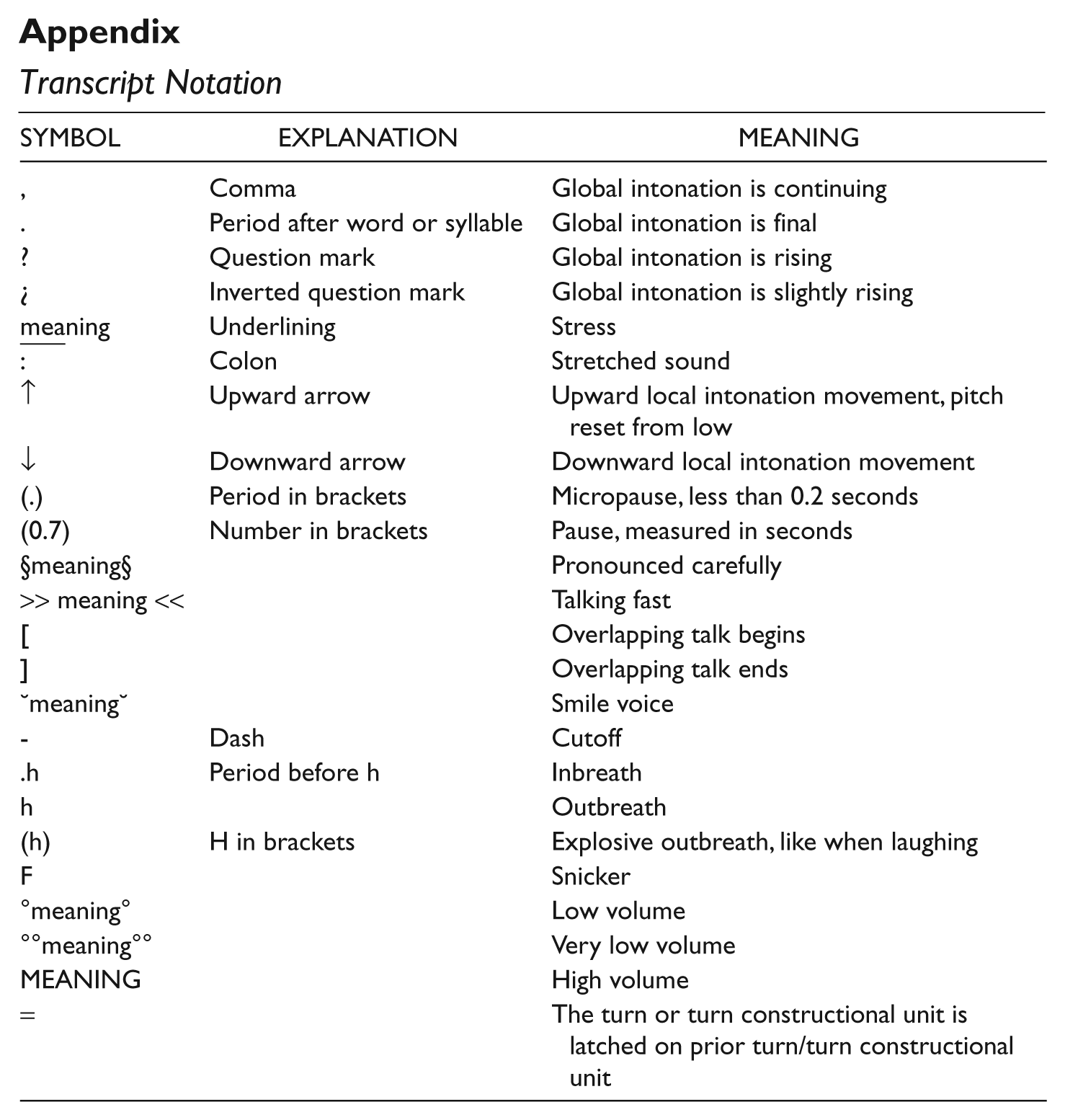
Laying out the transcription is a methodically central part of CA’s approach to verbal interaction. Not letting the transcript show details, even those not given closer examination in the analysis, deprives the reader the opportunity to falsify the analysis. The meetings have been transcribed according to an adaptation of the Gail Jefferson transcript notation system (see the appendix). In the data extracts, the speaker initials of the department heads are marked with bold. The data have been translated into English for the purpose of this article. The analysis was done on the original data. Both languages are shown for each transcript line.
Results From Studying Openings: Marked Shift in Turn-Taking System
Before discussing the techniques of opening and closing meetings, I will show how opening a meeting represents making a fundamental shift in turn-taking system. The participants move in and out of formality when opening and closing meetings. Formality is serving the purpose of furthering distinct and goal-oriented interaction while saving time, and this may be solved via preallocation of participant roles, topics, turn types, and placement of turns, preformatted utterance design and turn production, and participants may be made visible and audible by special garments, boundary signals, turn mediation, speaker identification, and allocated spot for speaking (Atkinson, 1982), which is probably most evident in courtroom interaction and church ceremonies. This article will show how distinct and goal-oriented interaction is achieved in business meetings by shifting to a special turn-taking system.
Below is shown an extract from a research department meeting in a medical company. Some of the participants (Kevin, Pia, and Tina) have been joking about dressing during the morning, getting ready for the meeting, which they knew in advance was to be recorded (it is the second meeting being recorded in this department). Kevin is asked about having a new tie, which he responds to by saying that he was too busy this morning (it does not appear from the data whether he usually wears nicer ties or no tie at all but that he has dressed this day with the prospect of being video recorded in mind), when the chair (John) makes an attempt to open the meeting:
John cuts through the participants’ initial jokes on dressing up and being busy with the incomplete request “should we::” (l. 3), but is ignored. They continue their talk, and Kevin is preoccupied with the cameras (l. 8-15). In l. 12-13, John responds to Tina’s comment in l. 11 or Karen’s in l. 10, which could be heard as an assessment of Kevin’s behavior. At least three different activities/conversations seem to be going on in parallel, all “meeting preparatory talk” (Mirivel & Tracy, 2005). Again in l. 20, the chair cuts through the conversations, and this time he succeeds in opening the meeting.
There is a distinct before-and-after the “[§I wa:n:ted§ to sug]gest thateh:” in l. 20. Before l. 20, the participants take turns at talk, they self-select as speakers and they seem to decide themselves when to talk, whom to talk to, what to talk about and how to design their talk. There is a local negotiation of turn taking; they use the turn-taking rules of ordinary conversation (Sacks et al., 1974). Any topic choice is possible at this point in the interaction. Before l. 20 it is absolutely doable to talk about clothes and being busy, after l. 20 it is not, and it would take some interactional work, for instance by misplacement marking, to make it relevant or to insist on continuing to talk on that topic. After l. 20, only John speaks for quite some time. He opens a completely different topic, is doing non-next to the prior utterance, not relating to the prior speaker’s immediate talk. Kevin speaks in overlap but drops out (l. 19). The participants are treating his turn as anything else but the relevant thing to do here in this particular sequential position. After l. 20, John controls the floor and all talk is produced with the meeting as a frame. The participants have made a transition from one turn-taking system to another, from multiparty talk to meeting talk. During these few seconds, John takes the floor, secures a multiunit-turn and shifts to another turn-taking pattern that gives him the fundamental right to speak and select the next speaker and topic.
Results From Studying Openings: Five Opening Techniques
There are several kinds of openings: of informal conversations, of turns-at-talk, sequences, topics, stories, of business meetings, rounds of speakers, and so on. The challenge of achieving an opening is taking the initiative to begin something new and having it ratified and accepted as such by the interlocutors. Openings may be more or less formal (Atkinson, 1982), longer or shorter, successful at first attempt or needing several attempts in order to be accomplished.
In the following, we will explore three chairman’s techniques used to open a meeting: “boundary marker,” “reference to procedure,” and “start declaration”; and two participant’s techniques used to open a meeting: “showing readiness to open the meeting,” and “passing opportunity to talk.”
Participant’s Opening Technique 1: Showing Readiness to Open Meeting
Before a meeting is opened, the participants are collaborating in accomplishing opening by showing that they are ready for the meeting to begin. They orient to being in a premeeting phase. The length of this phase is variable. It begins when the first participant arrives at the venue where the meeting is going to be held. The anticipation of the meeting is the reason for showing up. All the participants have been summoned at a certain time in a certain room, with the stated purpose of attending a meeting, and are now seated around a meeting table in that particular room. This “waiting” is not passive—it represents an active collaboration from the participants to open the meeting.
Meetings cannot begin without “a perceived critical mass of members present” (Boden, 1994, p. 88), achieving a quorum (Turner, 1972), an essential difference between meetings and ordinary conversations. Therefore, meeting participants may be waiting for and reminding each other of the meeting.
Common in premeeting talk are exchanges such as the following between Erik, research project leader, and John, research department head in a medical company:
Here, Erik brings to John’s attention that a prerequisite for opening the meeting has been met, namely, that they are all present. By doing so he demonstrates that he is ready to have the meeting opened.
Informal business meetings tend to begin as key persons show up (Boden, 1994, p. 102). But since this is a department meeting about to begin, everybody in the department at work that day being present in the meeting room is a prerequisite for beginning the meeting. All employees in the department are relevant and obligatory meeting participants, unless they have been excused by informing the chair in advance of significant reasons for not being present. Compare how “We seem to be all here” serves to initiate a kind of activity in which a full complement of persons is required, such as committee meetings (Levinson, 1992, p. 73).
Chairman’s Opening Technique 1: Opening via Boundary Marker
One strategy used by meeting chairs for opening meetings is boundary markers such as “well”/“right” and “good.” For instance, see the extract below from the same meeting as in Extract 2, where John, Erik, and Pia are talking about a category of employees in the company and about a solar eclipse the day before:
A first glance at the data suggests that such a shift may be taking place rather abruptly, with the chair suddenly cutting in to open the meeting. Compare also, how Richards (2006) found that opening moves may emerge unilaterally with the chair making no concession to the topic currently under discussion, plunging straight into business (p. 31). This is, however, an achievement, building on the two participants’ strategies for opening meetings and the use of a boundary marker.
The technique in Extract 3 is to use the Danish “nå,” a change-of-state marker (Heritage, 1984; Nielsen, 2002) to be translated “oh,” ”well,” or “right,” depending on the local sequential environment. In Extract 3, it could be translated with “well.” The “
Compare what Boden says about the opening of a meeting in her data: “Lana’s long “U:::hm” (l. 1, with exhaled breath) marks a kind of transition or topic boundary, separating premeeting conversation from what is observably the opening of the meeting” (Boden, 1994, p. 93). Meeting openings were typically prefaced by a standard topic transition marker such as: “so,” “okay,” “uh,” or “ehm,” and items such as “uhm” or “ehm” frequently marked the introduction of first topic (Boden, 1994, pp. 96-97). Compare how people in conversations change topic by using high pitch (Couper-Kuhlen, 2004).
Although l. 5-7 is a topic opener built to get a response, it gets no uptake by the others, is not continued by the speaker herself, is not returned to later in the meeting, and the fact that this topic is abandoned is not given special treatment. John starts to talk on a completely different matter, is “doing non-next” to the prior utterance, not at all relating to the prior speaker’s immediate talk. Also, he is not using “misplacement marking” (Schegloff & Sacks, 1973, p. 319f), that is, components such as: “by the way” or “now I’d like to talk about something completely different.” And nobody is treating his turn as anything else but the relevant thing to do here in this particular sequential position, that is, the participants are not initiating repair, pursuing response or questioning his turn in any way, and not treating his move as accountable (Heritage, 1988).
The conversational strategy in l. 8 accomplishes more than just changing topic and activity; it changes the whole turn-taking system. How can a small particle accomplish that? A study of the transition from coffee break to meeting at an American radio station has shown that it is important to distinguish between “summons” and “summons-to-meeting” (Atkinson et al., 1978, p. 137). The first can be a range of utterances or movements, such as bursts of anger, bursts of pain, sudden or forceful movements, and so on. The latter is an utterance intended to direct the participants’ attention toward an impending meeting. To determine whether or not the summons is motivated, the participants must, according to Atkinson et al. (1978) make sense of the prior turn as indicating intentionality and having interactional consequences for them.
When the participants in Extract 3 hear John utter a “WELL,” they have no reason not to include themselves in the category of the possible recipients of the utterance, contrasted with how an utterance such as “
Participant’s Opening Technique 2: Passing Opportunity to Talk
Another strategy used by meeting participants for opening meetings is to pass the opportunity to talk.
See for instance Extract 3 (§4.2). After John’s use of the boundary marker “
Compare also Extract 1 (§3), where the meeting participants are collaborating in not speaking after l. 20 when John opens the meeting. Only Pia begins talking (l. 36 and 52), and only because she has been addressed by the chair and selected as speaker.
THE SMARTEST THING (Mikro-2) 2
Chairman’s Opening Technique 2: Opening Via Reference to Procedure
Another strategy used by meeting chairs for opening meetings is reference to procedure, in the sense of explicit reference to how they as participants are going to go about things (cf. Nielsen et al. 2012).
We may see how this is done in Extract 1 (§3). John simply cuts through the participants’ multiparty talk with the incomplete request “should we::” (l. 3), but is ignored. The potential meeting participants continue multiparty talk. Again in l. 20, John cuts through, designed as a suggestion for procedure, just like his first attempt in l. 3 seemed to be. He makes five moves, which change the footing and secure a particular outcome. First, he turns his bodily attention to his own documents (l. 16, 20), then he takes a turn (l. 20), selects a speaker (Pia, l. 21) and a topic (safety related problems, l. 22-27), and finally he accounts for bringing up this topic: A safety board meeting has recently been held and an issue was identified that needs attention (l. 28-34). Pia produces a counter suggestion for procedure (l. 36-42), but the chair talks her into starting (l. 44-46), again by reference to procedure. Interestingly, Pia does not seem to doubt that the meeting has been opened now or that the chair’s request is a relevant part of the meeting. She ends up doing the requested report (l. 47f), and nobody else is speaking after l. 20.
They negotiate the first thing to do by means of references to procedure. John is opening the meeting by setting a local agenda for who is doing what and when. The relevance of the reason for bringing up the topic and the topic itself could be questioned, which Pia attempts to do by questioning the timing of the topic. However, she does not question the link between her, the reason, and the topic; and she does not question John’s right to ask her to take the floor. She withdraws from discussing the timing of the topic when the chair pursues the matter (l. 44-46). Even though she resists the agenda, the discussion of timing is part of the meeting, not postponing the opening of the meeting. The meeting is in progress while they consider what to talk about during the meeting and this fact is not questioned.
This extract also shows that the practice “reference to procedure” need not be successful immediately. When John accomplishes opening the meeting, he takes three steps, and the participants collaborate in passing the opportunity to talk. First, he self-selects and takes the floor in order to produce a reference to procedure, which works as a boundary remark, creating a shift from one turn-taking format to another. Then he selects a first speaker (Pia), allocating her an extended turn at talk. Linked to this is a selection of topic for her to talk about. When Pia begins to talk about the selected topic, she shows him to be successful with both turn allocation and topic selection.
Chairman’s Opening Technique 3: Start Declaration
Another technique for the chair is to produce proposals to “get started,” or let announcements and general information items mark the opening (Boden, 1994, pp. 96, 97).
In Extract 3 (§4.2), the techniques described above; showing to be ready to open the meeting, boundary marker, passing opportunities to talk (see §4.1-4.3) have already been used, when John after the pause in l. 9 says, “It’s not that I have that many things” (l. 10). Such an item is an important preface for securing the beginning of an extended turn-at-talk as it leads the listeners to observe a multiplicity of conversational objects (Boden, 1994, p. 98).
John notes that he does not have much to present, which at the same time holds the presuppositions that he does have something to present, that he is the one to present it, and that him having something to present is the primary reason for the meeting. Therefore, his remark not only informs them about what is going to happen, it also constitutes an implicit start declaration.
It is also implied that they have been summoned because of the few things he does have, or that they are going to have the meeting in spite of him not having much to tell since the meeting has been scheduled. Because this meeting is a standard weekly meeting, and since he designs the unit negatively, rather than stating it explicitly as “the reason for the meeting,” he is projecting (Lerner, 1991) that this meeting will not be long.
This technique for opening meetings may seem unnecessary since the meeting clearly is opened at this point, but the start declaration is still part of the transition process. It works as a response to the participants’ collaboration in showing to be ready and passing the opportunity to talk, and it makes the transition visible and “on record.”
Category Work in Meeting Openings
In this corpus of department meetings, opening a meeting is a category bound activity (Sacks, 1972a, 1972b), each meeting chaired by the department head. Typically, the arrival of the chair of the meeting/the department manager is an indication that the meeting is about to begin. Often, the chair of the meeting arrives as the last person, with everyone else already there and ready. The department chair is the “pivotal person” (Levinson, 1992, p. 73) for the activity of opening a department meeting. For other kinds of meetings (e.g., leader group meetings), this membership category would not be crucial, and therefore opening the meeting not a designated task.
Opening meetings entails identity work, building on turn type preallocation and turn-type mediation (Atkinson, 1982). Utterances like “
The fact that the participants have experienced a certain person in the role of a chair before cannot be separated from the analysis of using a particle to do boundary marking. If that person uses a language item that can function as summons, they might be prone to take it as a summons-to-meeting, which is different from just any one of the employees tapping a teaspoon on a cup, and so on.
Unequal distribution of knowledge and differences in professional status give participants different access to the floor in shifts between participation frameworks (Grosjean, 2004). If someone not belonging to the category “chair of the meeting” performs an action like this, it may be understood as a joke since some activities are seen as “category bound activities” (Sacks, 1972b). Compare Extract 1 with Kevin preoccupied with the cameras (l. 8-15) staring into them and “playing at checking the equipment” as if he was working on a film crew. If a person not belonging to the category “chair of the meeting” performs the relevant actions of a chair, the participants will not immediately see this person become the meeting chair; rather, they might see the person as acting improperly, being pushy, ambitious, or witty. In order to determine whether or not the potential opening is intended as one and has relevance to them, the participants present will look for several signs simultaneously:
When people at a meeting make such findings as “chairman” for speaker, “summons-to-a-meeting” for utterance, and “co-member of meeting” for hearer, they do not make each finding separately; they do not latch on to just one of these findings as the “crucial” one. By saying that such findings are mutually constitutive, we mean that these categories and actions are co-selected; ( . . . ) The use of category-boundedness to produce such findings facilitates the ability to read off, to make co-selections of appropriate category pairings. (Atkinson et al., 1978, p. 139)
This raises the question of how the identity “chair” is achieved in talk. The social actions employed at local turn level shape local discourse identities (e.g., “telling a story” creates the local discourse identity “storytelller”; cf. Zimmerman, 1998). Situated identities
come into play within the precincts of particular types of situation ( . . . ) brought into being and sustained by participants engaging in activities and respecting agendas that display an orientation to, and an alignment of, particular identity sets ( . . . ) [resting] on the underlying alignment of discourse identities. (Zimmerman, 1998, p. 90)
The speaker category “chair” is a situated identity shaped by local actions as opening a meeting. The category evokes reciprocal categories for the rest of the participants as “meeting participants” or “employees in the department,” building on the omni-relevant identities 3 in the premeeting phase: “meeting participant” and “meeting chair” (cf. Sacks, 1972b).
Social categories are organized in collections or families of categories, (e.g., Buddhist/Jew/Catholic), making certain activities and norms relevant. Categories have obligations and rights relative to each other; a “mother” is for instance expected to care for her “baby,” so that a woman picking up a crying baby usually will be seen as the mother of the baby picking it up because it cries and not because she is bored (Sacks, 1972a). In meetings, omni-relevant identities make participants orient to allowable contributions (Levinson, 1992), such as different strategies in opening and closing a meetings:
persons present have to be, and have to be seen to be, occupying their appropriate roles (and that includes listening and talking properly), so that those present can see the meeting to have been properly and seriously constituted, so that business may be seen to have been done in a proper and legitimate manner. (Atkinson et al., 1978, p. 146)
By aligning with a chair’s local actions shifting to meeting talk, the participants may confirm her “discourse identity of “authorized starter,” which invokes her situated identity of chairperson and allows her to accountably perform the act of opening the meeting, which is “category-bound to chairperson” (Clifton, 2008, p. 89).
This collaboration begins already when the participants are in a premeeting phase, showing to be ready to begin the meeting (§4.1). When the chair gives a “contextualization cue” (Auer & di Luzio, 1991; Gumperz, 1982) using strategies like “boundary marking” (§4.2) or “reference to procedure” (§4.4) to open the meeting, all other talk ceases, and the participants further collaborate by passing the opportunity to talk (§4.3). The chair now has the floor until he takes the initiative to pass it on. On the video, the participants are seen monitoring the chair (e.g., Extract 3b).
In Extract 2, someone other than the department head is taking the first initiative to make the transition. But note how he does not himself open the meeting, but draws attention to the fact that one condition for opening it is fulfilled: They are all present. He orients to the department head’s omni-relevant identity as chair. The activity of opening the meeting is category bound to the chair and though the activity itself has no fixed slot in the interaction when it is done, the “doer” invokes his or her omni-relevant identity (Sacks, 1992, pp. 313-314). In this instance, the participant displays an orientation to the identity “chair” and thus an orientation to the projected action of opening the meeting. And note that it is the chair responding to this utterance with a confirmation. This way, he shows that he sees himself as the most relevant recipient of this utterance, and the most relevant to respond. He confirms the projected identity by responding at this point. So, even when someone other than the chair sets the stage to open the meeting, it involves the chair. The employee in question shows the chair that an opening would be relevant, an implicit way to motivate the chair to do open the meeting, and a way to potentially speed up the transition.
I GUESS WE’RE ALL HERE NOW (Mikro-6)
NOT THAT MANY THINGS (Mikro-6)
Results From Studying Closings: Six Closing Techniques
There are several kinds of closings. There are closings of: turns-at-talk, topics, extended turns as a part of a super format of the speaker taking turns around the table to talk, rounds of speakers, business meetings, informal conversations, and so on. The challenge of achieving a closing in the latter is to organize the participants’ simultaneous arrival at a point when one person’s completion of a turn does not lead to another person speaking and when the lack of continuation is not heard as silence from one of the participants (Schegloff & Sacks, 1973, pp. 294-295). It is not merely a question of ceasing to speak, as silence does not equal closing. Even though informal business meetings tend to be closed as key persons leave (Boden, 1994, p. 102), closings in general should be understood as achievements.
In the following, we will explore four chairman’s techniques used to close a meeting: topic bounding and preclosing, concluding remark/moral/lesson, last call for new mentionables, and declaring closure by thanking; and two participant’s techniques used to close a meeting: showing readiness to close the meeting and passing opportunity to speak.
Participant’s Closing Technique 1: Showing Readiness to Close
Just as the participants before a meeting is opened are orienting to opening it at some point, they are in a “pre-meeting opening phase,” the participants in closing sections are in a “meeting preclosing phase.”
Some business meetings are held at the same time every week and a maximum time slot is decided. Other business meetings are accompanied with a meeting convener stating location, participants, meeting time, and duration. Such meetings may end earlier than stated, but if the end time is exceeded, the participants may leave or otherwise appear eager to attend other planned activities, for instance other meetings.
The prerequisite to closing a meeting is that the meeting’s activities are closed down. The participants may make visible their readiness to close the meeting by means of physical actions like imperceptibly moving around in their chairs; sitting at the very edge of the chair to be ready to leave; moving their chairs backward away from the table; checking their watches; collecting their pens and papers; collecting and ordering papers by tapping them on the table; cleaning up after coffee drinking, for instance by emptying mugs, collecting cups, and putting them on trays, or putting lids back on jam jars. These are all signals that mark a closing to be relevant.
The often many practical arrangements surrounding the meeting 4 offer the participants many possibilities to mark readiness for closing. In a phone conversation, the participants may be bounding the topic, making arrangements, and changing their tone of voice in order to show their readiness to close (Button, 1987; Schegloff & Sacks, 1973), whereas at meetings, this can be marked by opening a winding up of the practical activities and arrangements. Part of this is tidying up and making the room ready for the next meeting and getting ready to leave.
The participants are showing alertness, making available their readiness to make a transition from meeting interaction to multiparty interaction. Even though the chair, formally, is the only one who can close the meetings, these practical arrangements offer the rest of the participants some closing-invoking strategies. They can show the chair that the conditions for closing the meeting are present, just like they, before the meeting, could show that the conditions for opening it were present.
Chairman’s Closing Technique 1: Topic Bounding and Preclosing
Closings are local achievements. The key to understanding the dynamics of closings is also found in the organization of the talk in adjacency pairs (Schegloff & Sacks, 1973). Closings are organized as a series of pairs that are organized in a separate “closing section” (Schegloff & Sacks, 1973, p. 304) or “closing sequence” (Schegloff, 2007). A closing section may be initiated by a “preclosing” or “possible preclosing,” as it may lead to something else (Schegloff & Sacks, 1973, pp. 303-304). This adjacency pair occupies the floor without continuing the topic or coming up with a new one, which is why the utterances constitute the speakers’ possibilities to take a turn, which they do not exploit to bring in new items. Such “topic bounding” (Schegloff & Sacks, 1973, p. 306ff) works as possible preclosings.
In Extract 4, which is from a department meeting in a petrochemical company, the chair, Kim, is using an “okay” + pause to do topic bounding and possible preclosing:
WHISK BACK (Makro-1)
Utterances such as “okay” are possible closings when placed after a point, which the participants can interpret at the end of a topic (Button, 1987; Schegloff & Sacks, 1973, p. 305).
In Extract 5, which is from a department meeting in a consumer products company, the chair, Hans, is using an assessment + pause to do topic bounding and possible preclosing (l. 14-15):
THAT’S ALL FROM HERE (Multi-1)
At this point in the two meetings, it is still possible to insert something. The consequence of this would be the “closing track” (Button, 1991) being abandoned. This may for instance be done via misplacement marking (Schegloff & Sacks, 1973, p. 319f).
Chairman’s Closing Technique 2: Concluding Remark, “Moral” or “Lesson”
After topic bounding, a central closing technique for the chair is to “conclude.”
In the following extract from a medical company, the participants (Bo, Tina, Kevin, Pia, Erik, Karen, and John) are talking about a visit Monday-Tuesday next week from a quality control unit, and they are talking about being busy at the moment preparing for the visit:
The participants treat the visit and the preparation for it, going through the files, as an unattractive activity, teasing Bo because he will have the responsibility for it (l. 5-15), and he acknowledges the responsibility (l. 6, 11, 13, and 17). Bo concludes on his report (l. 17), and after a pause (l. 18), John produces a concluding remark (l. 19), bounding up the topic. After another pause, Karen acknowledges the conclusion (l. 21), and after yet another pause (l. 22), John produces an assessment, which may function as topic bounding from the manager (l. 23), and another concluding remark (l. 24). John’s utterance “°that’s good° °°then we must hope that - - -°°” (l. 23-24) is not fully comprehensible but constitutes an invitation to the others to produce a coassessment or confirmation (Pomerantz, 1984). It resembles a “moral” or “lesson,” frequently appearing in closing environments (Schegloff & Sacks, 1973, p. 306). A central practice for closing topics are candidate preclosing formulations (Barnes, 2007). The fact that such remarks frequently appear in closing environments makes them in itself closings implicative, showing participants that they are now on a closing track, moving toward possible closing of the interaction.
Chairman’s Closing Technique 3: Last Call for New Mentionables
Inviting participants to bring in new items and marking such an invitation as a last chance to do so is an important closing technique for the chair.
In Extract 5 (§6.2), the chair, Hans, explicitly makes it possible to further meeting talk and make it visible as such, which simultaneously shows the participants that they are heading toward the closing of the meeting. After topic bounding (l. 14) and a pause (l. 15), Hans continues by declaring that he “didn’t have anything else” (l. 16-18). Jón comes in in overlap with a late appreciation (l. 17) of Klaus’ work, which was the previous topic, and is supported by Jonna (l. 19). Hanging in the air is Hans’ statement of not having anything else. This remark works as a premeeting closer and as well an implicit invitation to come forward if anyone “has something.” A long pause follows (l. 20) in which nobody responds. Then Hans moves on to declare the meeting closed (l. 21). 5
The technique is that the chair explicitly invites people to take the floor with a new item and at the same time clearly marks this invitation as the last chance to say something. They use very similar lexical material: “anything else,” “else,” “are there other things,” “other things,” “have something,” “nothing else,” “something more,” “have any other things like that”. New topics are invited, and at the same time it is marked that these new topics will be something “else.” There is still time for “other things,” and simultaneously the previous talk is retrospectively marked as the “essential” part of the meeting. Thereby, all the new things that may be brought up from now on are marked as not as central as the previous topics but as additional lesser topics. This framing may in itself discourage the bringing up of something new at this stage. Central issues that are placed in exactly these sequential surroundings will need to be strongly marked as essential if they are not to be treated as peripheral.
The remark therefore works as a precloser. One manager makes this visible by producing the opportunity as an if-then construction, saying, “if we don’t have any more things like this then I think we should (0.7) whisk back” 6 (Extract 4, §6.2), with the invitation made implicit as the first part of the construction, still making it possible to abort the closing by producing talk that counters the if-condition and eliminates the then-implication of closing the meeting.
The lexical material is similar to the lexical material found in preclosing sequences in American meetings: “anybody e:lse? got anything else?,” “Do we have any (.) other business? any new business?” and “any other? (0.7) new business?” (Boden, 1994, pp. 104-105), and in Hong Kong meetings: “So anything else to be added on to this item?” or “do you have any other business?” or “Does anyone have any other business?” (Chan, 2008).
It does not, however, seem to make a difference in a meeting closing track about which particular wording is used; compare how it does make a positive difference in bringing in additional concerns if doctors say, “Is there something else you want to address in the visit today?” compared with “Is there anything else you want to address in the visit today?” in doctor-patient consultation closings (Heritage, Robinson, Elliott, Beckett, & Wilkes, 2007).
Participant’s Closing Technique 2: Passing Opportunity To Speak
Passing the opportunity to speak, to continue topical talk, to bring up new “mentionables” (Schegloff & Sacks, 1973, p. 300) is a crucial closing technique, and one that is in the hands of all participants. Pauses are typical of topic transitions and closings in all conversations (Barnes, 2007; Boden, 1994, pp. 105-106).
Extract 6 (§6.3) shows how all participants collaborate in closing a meeting by using the technique of passing the opportunity to talk. After Bo’s conclusion (l. 17), there is a 2.8 second pause (l. 18). Nobody takes the floor. Compare how Tina uses the pause in l. 4 to come in (l. 5), and how that results in a new exchange, prolonging the meeting a bit (l. 6-17). But now, everybody passes the opportunity, and John produces a concluding remark (l. 19), bounding up the topic. Then there is another long pause, this time of 1.3 seconds (l. 20), marking the floor to be available. Nobody takes the floor, until Karen acknowledges the conclusion (l. 21), then another pause (l. 22). John produces an assessment (l. 23) and another conclusion, this time in very low volume (l. 24). Karen snickers (l. 25), and John moves on to last call for new mentionables (l. 26). The participants have closed down the topic being talked about and may use the slot as a starting point for beginning a new topic. However, nobody takes the floor, which creates a pause as long as 4.7 seconds (l. 27). At that point, after allowing plenty of time to respond, John declares the meeting closed (l. 28).
THEN LET’S SAY THANKS FOR NOW (Mikro-2)
At each step, the meeting participants collaborate moving further down the closing track by not talking, by consistently passing every opportunity to talk, even if this opportunity is made very explicit as an opportunity (l. 26-27).
Chairman’s Closing Technique 4: Declaring Closure by Thanking
Studies show that meetings in New Zealand and Sweden tend to be closed with a “thank you” using rising intonation (Chan, 2008). Talk occurring after the closing marker is no longer (achieved as) part of the meeting (cf. Boden, 1994, p. 102).
In my data, this technique appears in the last stages of the closing process, and it is used more as a declaration of the process being brought to an end than to promote closing. This is evident in Extract 6 (§6.3). After the long pause of 4.7 seconds (l. 27), the chair declares the meeting closed (l. 28) by producing not just a “thank you.” The form is “thanks for now,” frequently used in Danish as a closing remark (Nielsen, 2000). Interestingly, it is prefaced with “we’ll say,” letting the “thanks” be packaged as a formula: “we’ll say thanks for now,” turning it into a procedural step. Furthermore, it is designed as a consequence: “then we’ll say thanks for now,” probably a consequence of nobody having “other things” to say (l. 26-27). The “then” introduces an if-then construction, making the “then” part of the construction explicit and letting the “if” part be an implicit reference to the passing of opportunity in l. 27 to bring in new mentionables. This way, the “thanks” works as a declaration of closure. This turn is followed by yet another long pause (l. 29) before people start mumbling (l. 30), probably about switching off the recording equipment, since this is what the chair responds to (l. 31).
Category Work in Meeting Closings
Parallel to opening meetings, closing meetings entails identity work, building on turn-type preallocation and turn-type mediation (Atkinson, 1982). The categories “chair” and “meeting participants” are already in play. Going from meeting talk to multiparty talk, they are shifting to another collection of categories: “colleague,” “employee,” “chair of the department,” and so on. By aligning with the chair’s local actions shifting from meeting talk to multiparty talk, participants may confirm the chair’s discourse identity of “authorized meeting closer.” This confirms and reinvokes his situated identity of chairperson, allowing him to accountably perform the act of closing the meeting, category-bound to chairpersons (cf. Clifton, 2008, p. 89). This collaboration begins already when participants are in a meeting preclosing phase, showing to be ready to close the meeting (§6.1). While the chair uses strategies such as “topic bounding and preclosing” (§6.2), participants collaborate in closing down topical talk, and when the chair produces a “concluding remark/moral/lesson” (§6.3) and a “last call for new mentionables” (§6.4), participants further collaborate by passing the opportunity to talk (§6.5). The chair still has the fundamental right to the floor (Nielsen, 2010b) until he “declares the meeting closed” (§6.6).
Conclusion: Openings and Closings Mirroring Each Other
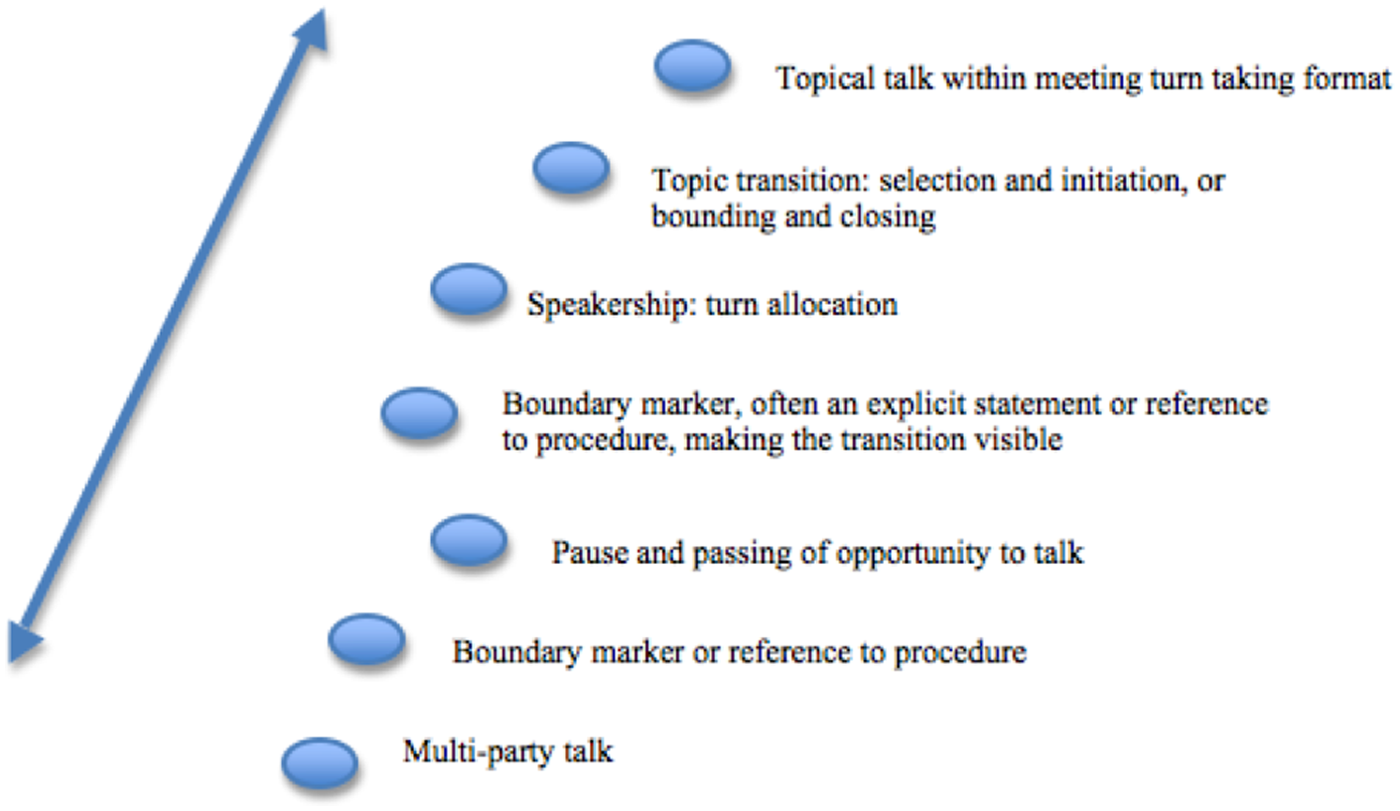
Meeting openings in my data have a stable pattern; using “stepping stones” to accomplish openings and to perform the transition from multiparty talk to meeting talk:
Multiparty talk with the possibility of parallel conversations.
At this stage, participants may display being ready to open the meeting and may verbalize that the conditions for initiating an opening are met (e.g., “don’t you think we’re all here now”).
One of two chairman’s techniques: The chair uses one among several possible particles as “boundary marker” and/or “summons” (e.g., “well”/”right,” “good,” “so/then”). These tokens may be prosodically marked to stand out from the surrounding talk, making it possible for them to function as summons and boundary markers. And/or the chair produces a reference to procedure or statement of the situation (e.g., “we won’t be many today”).
Pause: A significant pause, in which the floor is open. The opportunity to take the floor is passed by everyone. And/or an item like “eh” or “e:h:m” is produced by the chair.
One possible chairman’s technique: The chair may produce an explicit “meeting opener” or “start declaration,” often designed as a reference to procedure (e.g., “let’s begin” or “yes, we’ll begin”).
First speaker: The chair takes the floor by securing a multiunit turn by use of a preface or a preliminary designed as a reference to procedure (e.g., “it’s not that I have that many things” or “initially I would like to say”). Or the chair selects the first speaker (e.g., “I wa:n:te.d to suggest thateh: Pia just went ahead” or “and I won’t be looking at Karen Inger but I will look at Jonna”) and allocate the turn to this speaker by this very explicit reference to procedure. Or, the chair swiftly allocates the turn to a person present, already prepared to present something.
First topic: Topic selection, often by the chair, or the prepared participant begins presenting something, which may be arranged beforehand with the chair. The first topic may appear on a written agenda but usually does not in these data.
Topical talk proceeds within meeting turn-taking format.
Openings occur at different paces, and it differs how long it takes to open a meeting. It takes a mutual effort to accomplish the transition. Each move by the chair creates a slot that gives other meeting participants the opportunity to derail the process. Not exploiting that opportunity is a display of collaboration. Not talking and displaying readiness to open the meeting play a crucial role. If a meeting participant does not collaborate in suspending multiparty talk, then the chair of the meeting will have to make more than one attempt at employing the “stepping stones” in order to accomplish opening the meeting. It is only possible for the chair to succeed with an opening if the rest of the participants collaborate in letting it happen.
Similarly, meeting closings also have a stable pattern, using “stepping stones” to accomplish closings; transitioning from meeting talk to multiparty talk:
Topical talk within meeting turn-taking format.
Participants may display readiness to close the meeting by tidying up and getting ready to leave.
Last topic: Topic bounding and topic closing, often produced by the chair (e.g., “okay”).
The chair may produce a concluding remark, “moral,” “assessment,” or “lesson” of the last topic.
Last turn/speaker: Closing of turn at talk. If the meeting format is a table-round, the round is closed.
Call for last mentionable: The chair produces a premeeting closer, often designed as a reference to procedure, making the floor explicitly available, designed as a last call for new mentionables to be introduced.
Pause, in which the floor is open. The opportunity to take the floor is passed by everyone.
The chair may produce a boundary marker, a formal declaration of the meeting being closed (e.g., “then we’ll say thanks for now”).
Multiparty talk with the possibility of parallel conversations.
Closings occur at different paces, and in the data it differs how many chances the chairs give to reopen the meeting and how many closing markers the chairs utter. At each of the “stepping stones,” the meeting may be derailed from the closing track if the participants continue topical talk, reopen topics, continue turns, self-select, and so on. When the chair demonstrates last call to bring up something new, any participant may bring up a new topic. If a closing is derailed, then the closing track must be begun anew. Therefore, a meeting closing is something the meeting participants accomplish when they collaborate in moving the meeting further down the closing track. Not to speak is a participants’ primary technique in moving a meeting toward a closing track and once it has been established, maintaining that closing track.
Closings and openings of Danish department meetings are structured very orderly. The “stepping stones” of moving from multiparty talk into meeting talk and the “stepping stones” of moving from meeting talk into multiparty talk mirror each other.
Stepping along these stones, meeting participants accomplish opening and closing of turns at talk, topics, rounds, and meetings (see Figure 1).
Stepping stones in moving in and out of meetings 7
A Canonical and Cross-Cultural Model?
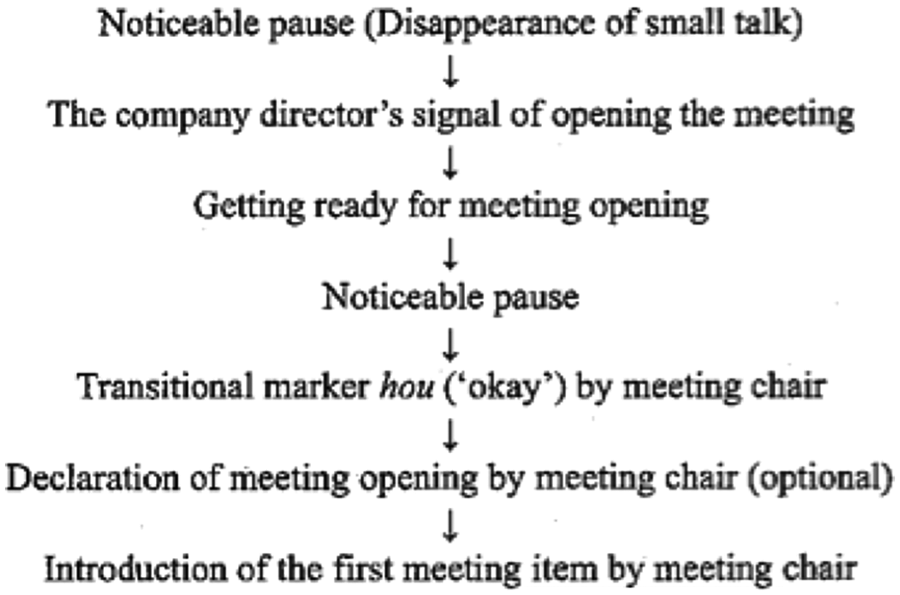
This study of openings and closings in Danish department meetings was originally part of an unpublished doctoral dissertation (Nielsen, 1998), but the fundamental elements have since been found by a study 8 of three formal business meetings in a Hong Kong company, documented in an unpublished doctoral dissertation (Chan, 2005). Chan (2008) found that opening sequences included noticeable pauses, explicit signals, transitional markers, and formal meeting opening declarations (see Figure 2).
Chan (2008, p. 206): Proposed sequential structure of meeting openings at Rainbow
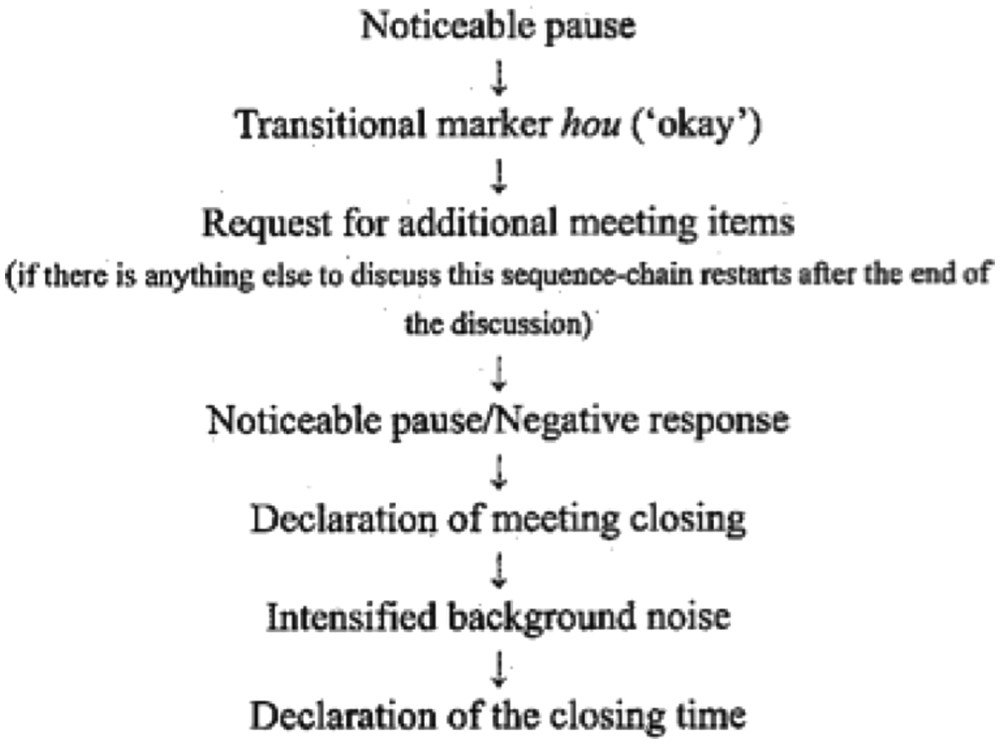
Chan (2008) found that closings included noticeable pauses, transitional markers, requests for additional meeting items, and formal meeting closing declarations (see Figure 3).
Chan (2008, p. 217): Proposed sequential structure of meeting closing at Rainbow
In the Hong Kong meetings opening/closing were “achieved through the following steps:
the participants stop talking or a gap in talk occurs
the chair (or the company director in the case of Rainbow) exploits the gap and uses a transitional marker to indicate his/her intention to open/close
if no one else self-selects to speak at this point, the chair can proceed to open/close the meeting” (Chan, 2008).
Finding the pattern in both meetings in Scandinavia in Danish and meetings in Hong Kong in Cantonese suggests that this model might be canonical and cross-cultural. Moreover, it seems to be backed by studies of formal business meetings in New Zealand business organizations (Marra, 1998, an unpublished MA paper mentioned in Chan, 2008). It is still too early to say if the model is indeed global. More studies will be needed on international meeting data.
Interestingly, a study of virtual meetings in chat forums shows that participants in meeting opening sequences adopt a two-stage process for opening their meetings, consisting first of a so-prefaced turn that usually references previous communication by the team and second of an agenda-setting turn that offers a specific candidate for the current meeting’s discussion (Markman, 2007); and participants in closing sequences of these meetings similarly use a two-stage process employing so-prefaced turns in the first stage and a second turn that projects future action of some sort. Both meeting openings and closings could be delayed, or even derailed completely, by competing turns posted in the chat.
Even though these data are very different from the data of face-to-face interaction used in this study, it is interesting that the participants go through a two-step procedure in order to move in/out of their meetings and that implicit reference to procedure seems to be a crucial step. The fact that such a two-step procedure exists in opening and closing virtual meetings in chat forums is another indication of the possibility of a model of wider application.
Lessons and Implications
This study has implications in three rather different arenas. For the CA community, one fundamental insight produced in this article is a canonical sequential analysis of openings and closings based on a corpus of Danish department meetings. Three chairman’s techniques (“boundary marker,” “reference to procedure,” and “start declaration”) and two participant’s techniques (“showing readiness to open the meeting” and “passing opportunity to talk”) were used to open a meeting. Four chairman’s techniques (“topic bounding and preclosing,” “concluding remark/moral/lesson,” “last call for new mentionables,” and “declaring closure by thanking”) and two participant’s techniques (“showing readiness to close the meeting” and “passing opportunity to speak”) were used to close a meeting.
For business communication studies, one fundamental interest in openings and closings concerns formality (Atkinson, 1982), the passing of the “informal into the formal” (as is the case with openings) and the “formal into the informal” (as is the case with closings). These are spaces where new auspices for interaction are constructed. Some crucial points have been made about how formal and informal flow into one another in practice: collaboration between all participants is necessary, category work is entailed, with certain strategies for opening or closing available for participants, and “stepping stones” are used. Furthermore, the special turn-taking organization of meetings should not just be seen as present in certain formal environments but as products of the conversational strategies of the interlocutors, as an achievement for the participants aiming at achieving these particular environments for particular purposes. Moving in and out of formality is a joint undertaking, requiring collaboration and using interactional strategies from ordinary conversation. The ordinary is a point of departure and a resource for producing formality.
For practitioners, the implications of this research are threefold. First of all, the article explores the business meeting format as an interactional achievement, which requires intense collaboration. The article shows just how such collaboration takes place, and which social actions are relevant for a chair to take (and to monitor) in order to open or close a meeting. Second, the article shows how not talking is a primary technique for participants in moving a meeting down the closing track. For a chair, silence may be taken as an indication of unwillingness to share ideas and knowledge, but it may represent a desire to close the meeting and move on to other tasks. Therefore, scheduling meeting end points or being explicit about how much time is allotted for each meeting item might help participants navigate. Third, the article contributes to a deeper understanding of the benefits of formality and informality. Formality is an achievement and performs particular institutional tasks, not to be considered old fashioned and rigid.
Footnotes
Appendix
Transcript Notation
| SYMBOL | EXPLANATION | MEANING |
|---|---|---|
| , | Comma | Global intonation is continuing |
| . | Period after word or syllable | Global intonation is final |
| ? | Question mark | Global intonation is rising |
| ¿ | Inverted question mark | Global intonation is slightly rising |
| Underlining | Stress | |
| : | Colon | Stretched sound |
| ↑ | Upward arrow | Upward local intonation movement, pitch reset from low |
| ↓ | Downward arrow | Downward local intonation movement |
| (.) | Period in brackets | Micropause, less than 0.2 seconds |
| (0.7) | Number in brackets | Pause, measured in seconds |
| §meaning§ | Pronounced carefully | |
| >> meaning << | Talking fast | |
| [ | Overlapping talk begins | |
| ] | Overlapping talk ends | |
| ˘meaning˘ | Smile voice | |
| - | Dash | Cutoff |
| .h | Period before h | Inbreath |
| h | Outbreath | |
| (h) | H in brackets | Explosive outbreath, like when laughing |
| F | Snicker | |
| °meaning° | Low volume | |
| °°meaning°° | Very low volume | |
| MEANING | High volume | |
| = | The turn or turn constructional unit is latched on prior turn/turn constructional unit |
Acknowledgements
Special thanks are due to the anonymous reviewers for very constructive advice.
Declaration of Conflicting Interests
The author declared no potential conflicts of interest with respect to the research, authorship, and/or publication of this article.
Funding
The author received no financial support for the research, authorship, and/or publication of this article.