




Abstract
How, if at all, do nondemocratic elections affect credible signaling in international crises? While the literature on credible signaling emphasizes the importance of electoral competition, it does not specify the minimal conditions that elections must satisfy in order to enhance the credibility of threats. We address this oversight by focusing on two fundamental properties of electoral institutions: (1) the degree of proincumbent bias and (2) the vulnerability of the incumbent to a de facto loss of power following an opposition victory. Our theory argues that both decreases in electoral bias and increases in incumbent vulnerability introduce greater accountability into the electoral process and thus enhance the credibility of public threats, even when elections fail to meet basic democratic standards. We apply these insights to the case of electoral authoritarianism, that is, regimes in which some form of electoral competition exists but basic principles of democratic governance are commonly violated. Using data on reciprocation rates in militarized crises, We show that, so long as electoral biases are sufficiently low and incumbent vulnerability is sufficiently high, even electoral authoritarian regimes are able to credibly signal resolve.
Keywords
An enduring question in the study of international crises is whether democratic institutions increase a leader’s ability to credibly signal resolve (Fearon 1994a, 1997; Schultz 1999, 2001a, 2001b; Slantchev 2006; Tomz 2007). One view, emphasizing audience costs, argues that when democratic leaders handle crises poorly—for example, by issuing threats on which they do not follow through—they face punishment from domestic audiences. Due to their potential costs, threats from democratic leaders should therefore be especially credible (Fearon 1994b). A second view, focusing on party competition, argues that opposition parties in democracies have strong incentives to oppose the policies of incumbent leaders. When, despite these incentives, oppositions nonetheless publicly support an incumbent’s policies, they effectively confirm domestic support for those policies, thereby increasing the credibility of the incumbent’s threats (Schultz 1998, 2001a).
Both mechanisms rely upon the incentives and constraints generated by democratic elections and thus apply most readily to procedural democracies. Yet, neither approach explains how variations within electoral institutions affect credible signaling. While scholars have recently begun exploring audience costs in authoritarian regimes (e.g., Weeks 2008), these analyses focus exclusively on nonelectoral mechanisms. They therefore do not broach the question of whether flawed or otherwise nondemocratic elections also enhance credible signaling. This omission is particularly salient in light of the growing prevalence of “electoral authoritarian” regimes: states in which electoral competition exists but the regime otherwise fails to meet basic principles of democratic governance—such as ensuring a level-playing field for the opposition, counting votes correctly, or always abiding by the result of the popular vote. Electoral authoritarianism is on the rise (Brownlee 2009). Fewer than a dozen of the nearly two hundred countries in the world have not recently held direct elections for national office. 1 While the popularity of elections has, of course, partly swelled the ranks of democracy, a substantial number of these newly minted electoral systems fall instead into “the wide and foggy zone between liberal democracy and closed authoritarianism” (Schedler 2002, 37). 2
This article explores the relationship between nondemocratic elections and credible signaling. We focus on two dominant theories of credible signaling: the costly signaling argument, rooted in audience costs (Fearon 1994a), and the confirmatory signaling argument, rooted in legislative opposition (Schultz 1998, 2001a). While Fearon allows that nondemocracies may develop unique sources of audience costs, his discussion of these sources is limited to nonelectoral mechanisms (1994a, 582). His model does not specify, for example, whether electoral fraud—a hallmark of nondemocratic elections—completely undermines the constraints imposed by audience costs or merely dilutes their effects. Similarly, Schultz notes that confirmatory signaling does not require a “strict adherence to some ideal definition of democracy” (1998, 832). Yet, what is required is unclear. A seemingly necessary condition is that some form of opposition must contest elections for public office. But is this condition also sufficient, or, rather, do certain nondemocratic political constraints—such as restrictions on dissent—effectively abrogate the confirmatory effect of political contests? 3
To gauge the effects of elections on credible signaling, we develop a simple framework of electoral institutions, focusing on (1) the extent of proincumbent bias in electoral contests and (2) the vulnerability of incumbents to transfers of de facto political power. The first criterion indicates how well incumbents are likely to perform in elections, and the second indicates, once an election has occurred, whether a victorious opposition will actually assume power. We develop propositions describing how variations in these criteria impact both costly and confirmatory signaling. To ground these propositions in empirical observation and develop testable hypotheses, we distinguish between two distinct subtypes of electoral authoritarianism: (1) competitive authoritarianism, where elections may be flawed and competition unfair, but leaders nonetheless submit to contested elections and thus give oppositions a chance to win executive power (Levitsky and Way 2002, 2010); and (2) hegemonic authoritarianism, where the opposition can and does win representation, but the incumbent’s grip on power never wavers (Sartori 1976).
While both regime types hold elections, variations in electoral institutions ensure that only competitive authoritarianism enables credible signaling. Confirmatory signals are likely to be more credible when sent by competitive authoritarian regimes, where oppositions do not depend as heavily on the leader’s favor. As well, the link between domestic audiences and leader performance should be a more considerable source of constraint under competitive authoritarianism, where incumbents actually face electoral consequences for failed foreign policies.
Our method of analysis examines whether, in the event of an interstate crisis, a targeted state resists or concedes to a challenger’s threat or use of militarized force (cf. Schultz 2001a; Weeks 2008). The analysis shows that, in general, hegemonic authoritarian regimes meet resistance to their challenges at virtually the same rate as closed autocracies, suggesting an inability to credibly signal resolve. Competitive authoritarian regimes, on the other hand, meet resistance nearly as infrequently as democracies, which indicates a strong capacity for credible signaling. Overall, these findings suggest that credible signaling is not merely a luxury afforded to procedural democracies, but is instead made possible by a more encompassing class of electoral institutions. Even flawed elections are an important source of credible signaling in international crises.
Crisis Bargaining and Electoral Institutions
Conflict is always ex post inefficient; states would do better to find mutually acceptable ex ante bargaining arrangements than pay the costs of war (Fearon 1995). Yet, war endures. Recent efforts at addressing this efficiency puzzle have drawn attention to asymmetric information and strategic uncertainty (e.g., Fearon 1994b, 1995). Militarized contests are plagued by uncertainty about the capabilities and resolve of opponents, and states have incentives to use strategic misrepresentation or “bluffing” to increase their share of a bargained outcome—for example, by dissembling a willingness to use force if their demands are not met. The danger of such misrepresentations is that they also increase the probability of war. For both challengers and targets, then, the ability to credibly signal resolve should reduce information asymmetries and increase the probability of locating mutually acceptable ex ante bargains. 4
One way of conveying credibility is costly signaling, where a state deliberately adopts costly policies and thus distinguishes itself from less resolved or capable states, who are unwilling to absorb such costs (Fearon 1997). Elections are one particular mechanism for exacting these costs (Fearon 1994a). When a leader faces an international crisis, her foreign policy competence is subject to evaluation by a domestic audience, such as voters. Incompetence occurs when a leader escalates a crisis and subsequently backs down in the face of resistance, thus suffering “diplomatic humiliation.” 5 This threat of negative electoral consequences means that democratically elected leaders incur higher potential costs when escalating a crisis; thus, such leaders are able to communicate their intentions with greater credibility. Beyond the requirement that elections pose a realistic threat to incumbents, the logic of audience costs is unclear on precisely “how democratic” elections must be in order for them to enable costly signaling. Fearon’s seminal article only discusses ideal types—for example, it contrasts fully democratic states, such as the United States and the United Kingdom, with fully closed authoritarian regimes, such as pre-2003 Iraq—and thus provides little guidance on the foggy zone between these poles (Fearon 1994a, 582).
A second means of conveying credibility is confirmatory signaling. In the context of international crises, confirmatory signaling hinges on the possibility that domestic competition between incumbents and oppositions can reveal important information about a country’s resolve for fighting (Schultz 1998, 2001a). A conflict of interest exists between oppositions and incumbents in that the former has a strong incentive to distinguish itself to voters by publicly opposing the latter’s foreign policies. In a crisis, the incumbent leader or party may be willing to gamble and employ bluffing or “cheap talk.” The opposition, however, can score political points by exposing bluffs; indeed, oppositions may even oppose genuine threats by incumbents, so long as the expected payoff from war is sufficiently low. In short, an opposition party only supports the incumbent when nonsupport is politically costly, such as when public opinion strongly favors the incumbent’s policy. Aware of these various incentives, foreign leaders, in turn, interpret opposition support as a credible signal of resolve.
According to Schultz (1998, 831-32), three conditions must be met in order for electoral institutions to send credible information: (1) political parties should value and seek office, (2) oppositions should have access to crisis-relevant information, and (3) competition should be public and unrestricted. While Schultz notes that these criteria emphasize competition and do not require “strict adherence to some ideal definition of democracy” (1998, 832), his subsequent theoretical developments and empirical analyses make clear that “competitive polities” are substantially similar to what others have called procedural democracies. For example, he argues that political competition should be “unfettered by restrictions on dissent” (Schultz 1998, 832, 838) and the empirical measures used to test his argument effectively eliminate rigged elections or government harassment (Schultz 2001a, 129). 6
While both theoretical frameworks draw upon electoral mechanisms, neither explains how variations in electoral institutions affect credible signaling. Exactly how democratic must elections be in order to make signals credible? This need for greater attention to electoral mechanisms is nontrivial. Electoral institutions have proliferated across the globe without necessarily producing democratic polities. Instead, a particular brand of authoritarianism or partial democracy has gained momentum. There are at least as many names for this phenomenon as there are debates about its nature and trajectory. 7 In 2002, Journal of Democracy published a special issue on “Elections without Democracy,” which included Diamond’s discussion of hybrid regimes (2002), Levitsky and Way’s research on the rise of competitive authoritarianism (2002), and Schedler’s theory of the electoral authoritarian “menu of manipulation” (2002). These scholars provide essential tools for conceptualizing varieties of authoritarianism.
We follow Schedler and others in adopting the term electoral authoritarianism to refer to the broadest category of nondemocratic countries that feature at least a semblance of democratic competition—the form, if not the substance. This category includes regimes that have the following core attributes: elections [that are] are broadly inclusive (they are held under universal suffrage), as well as minimally pluralistic (opposition parties are allowed to run), minimally competitive (opposition parties, while denied victory, are allowed to win votes and seats), and minimally open (opposition parties are not subject to massive repression, although they may experience repressive treatment in selective and intermittent ways). (Schedler 2006, 3)
At present nearly 30 percent of regimes in the international system are electoral authoritarian—increased from about 20 percent during the height of the cold war. 8 These regimes can be further divided into mutually exclusive hegemonic and competitive subtypes. We follow Sartori’s work on hegemonic parties in conceptualizing hegemonic regimes as countries wherein the rule of a specific party or candidate is so entrenched as to eliminate the possibility of changes in power through the electoral process (Sartori 1976). While hegemonic regimes may brook competition, they typically feature one party that, through its control over state institutions, is able to effectively ensure dominance at the polls (Greene 2007; Magaloni 2006).
The competitive authoritarian subtype is, for our purposes, of relatively greater importance. Drawing on the work of Levitsky and Wau (2010)—who coined the term and identified the category—we define competitive authoritarianism as a regime wherein elections put the incumbent leader’s job at risk, but the playing field is skewed in favor of the incumbent and against the opposition. Levitsky and Way observe that, despite electoral bias, there exists some uncertainty surrounding elections in such regimes; this uncertainty is not as high as in democracies, but neither is it as low as in closed authoritarian regimes (2010, 13).
Credible Signaling with Imperfect Elections
In developing a theoretical connection between electoral institutions and credible signaling, we build on Hyde and Marinov (2012) and show how variations along two key characteristics of elections—the degree of proincumbent bias and the vulnerability of incumbents to opposition victories—affect credibility. Subsequently, we incorporate recent work on electoral authoritarianism to give these insights empirical grounding and generate testable hypotheses; we develop a simple typology of regimes and show why different regime types are more efficient at signaling.
Proincumbent Bias and Probability of Winning Office
Most (if not all) elections are at least somewhat biased contests (Gandhi and Przeworski 2009; Hyde and Marinov 2012). We conceptualize this bias as a continuum, with individual points defined by a parameter. Consider a hypothetical election in which the incumbent holds office and the opposition challenges. We assume that the party in office would receive some “true” vote-share if elections were entirely free and fair (and if voters were able to translate their preferences accurately into representation). Let

When
Some countries hold elections where parties compete for legislative seats but the office of the de facto leader is off limits. Jordan, for example, is ruled by a king. Parliament is elected and a government forms on the basis of seats gained, but the king can suspend parliament and call for fresh elections. Furthermore, the king is never on the ballot. The same applies to Morocco and, for a long period of its recent history, Egypt. Let
Credible signaling—whether costly or confirmatory—depends on both
Proposition 1: Threats made by regimes with contested elections but nonelected leaders (
Proposition 2: The credibility of threats made by regimes with contested elections increases as the degree of bias (
When
In practice, for both the confirmatory and costly signaling frameworks, Proposition 2 should only hold for relatively high values of
Electoral Authoritarianism and Credible Signaling
Both elections are contested; the office of the incumbent leader is decided by electoral competition; there is ex ante uncertainty on who will win; there is no doubt that the loser will yield power; elections recur at regular intervals.
In terms of our earlier propositions, cases where criteria (a) through (e) are satisfied—that is, those cases that ACLP defines as procedural democracies—correspond to regimes with no election bias and clear pathways for oppositions to win power: specifically, in our model of electoral accountability,
To examine subtypes of electoral authoritarianism, we use information from NELDA on whether the office of the de facto leader appears on the ballot. Hegemonic authoritarianism arises when (a) is met, (b) is not met, and (c) and (d) are possibly met.
14
In such regimes,
Competitive authoritarianism arises when both (a) and (b) are met, but one or more of the remaining conditions is violated. In such regimes,
The residual category, closed dictatorship, encompasses cases where there are no elections or where elections feature only a single candidate or party—that is, criterion (a) is not met. Because there are no data of this kind, we cannot explicitly measure (d) and (e). We assume that those criteria vary only infrequently—as a practical matter, elections in electoral authoritarian regimes are seldom suspended, and the loser seldom simply refuses to yield power.
Table 1 illustrates the mapping of electoral institutions, defined by variations in
Mapping of


Note. See text for ACLP regime criteria (a) through (e). Symbols
Testable Hypotheses
While hegemonic authoritarian regimes might, in theory, transmit information to opponents during crises, and while oppositions might value office enough to speak out against government, the unaccountable incumbent’s power over the political process undercuts credibility: by dissolving parliament at whim and excluding oppositions from the seat of power, these governments foster the dependence of oppositions on government.
Thus, when the leader of Morocco’s opposition Istiqlal party was asked about his party’s position in the “Sahara Affair” (a reference to the dispute between the Moroccan government and the Algeria-based Polisario front for control over Western Sahara), Boucetta stated, “You can rest assured that all Moroccans are unanimous in considering this question to be a national affair and that this part of our territory, the West Sahara, should be recovered by Morocco. There is opposition in other spheres, economic or cultural, but there is complete unanimity on the Sahara.” 16 Given that the party leader’s only chance at gaining power rested on the whims of the king, we cannot be confident that such assurances actually reflected the party’s true assessment of the crisis, as opposed to reflecting the position the king wanted to hear in the aftermath of a series of setbacks. 17
At the same time, our theory provides no ex ante reason to expect hegemonic authoritarian regimes to be any less successful in crisis bargaining than closed regimes. Ultimately, the two regime types are, for our purposes, indistinguishable. Combining our regime typology with Proposition 1, we derive the following testable hypothesis:
Hypothesis 1: In international crises, threats made by hegemonic authoritarian regimes are only as credible as threats made by closed authoritarian regimes.
Elections in competitive authoritarian regimes, on the other hand, share at least three important characteristics with their democratic counterparts. First, leaders face electoral accountability for their actions. Because elections are biased
Combining our regime typology with Proposition 2 thus yields the following testable hypothesis:
Hypothesis 2: In international crises, threats made by competitive authoritarian regimes are less credible than threats made by democratic regimes but more credible than threats made by hegemonic authoritarian regimes.
There are, of course, potential counterarguments to this hypothesis. One possible objection is that external actors may be unable to determine whether autocrats will lose elections. If this objection holds, then electoral competition may not generate sufficiently credible signals. However, while it may be true that, in authoritarianism, the probability that a diplomatic failure will cause electoral defeat is not fully known to opponents, such information is also lacking in democracies. Signals are always noisy, but they can still be informative.
18
A second possible objection is that, in regard to the strategic model developed by Schultz, the key requirements for confirmatory signaling may not be met. We might reasonably ask, for example, whether oppositions would risk jail and harassment in order to reveal truths to voters and outside observers, or whether the opposition has sufficient access to “good” information to make informative public statements about the crisis. We argue that these requirements are generally met in competitive authoritarian cases. The opposition’s movements and campaigns may not be entirely free from interference, but opposition politicians often develop independent sources of information and support. Oppositions are likely to have a sense of the electorate’s mood, and may have access to information by virtue of having previously held office, where allowed.
Consider the 1978 crisis between Bolivia and Chile. In mid-March, 1978, Bolivia broke relations with Chile because the latter had not kept its promise to negotiate a Bolivian outlet to the sea, reprising a grievance that went back to the War of the Pacific (1879–84). The Bolivian government sent five columns of troops to the Bolivia–Chile border. The gravity of the situation at one point prompted the Bolivian President to declare that “the clouds of war have descended” over South America. 19
At the time the dispute broke out, Bolivia was readying for elections to replace dictator Hugo Banzer with a civilian president. Due to a long history of heavy-handed tactics and military intervention in politics, the opposition had no assurance of winning. Still, the opposition came close after a fraudulent vote was thrown out by the independent electoral board. While the military ultimately installed their own candidate in office, the opposition posed a constant challenge and a source of criticism of government policy.
20
The opposition’s candidates were not deterred from voicing their disapproval of the government’s handling of the dispute. A few months before the election, in March of 1978, the Revolutionary Party of the Nationalist Left (PRIN) published an open letter accusing the existing government of not pushing hard enough on securing a sea outlet: The failure of the “charana embrace” [policy] has been acknowledged by the government itself through the severing of relations with Chile in order to shake off the dust of its incapability. What remains is the stagnation of the Bolivian position regarding our right to a sea outlet, which has been acknowledged by Chile for more than 90 years, without any territorial compensation. By admitting in its negotiations behind the backs of the people that conquests give rights, but not acknowledging the world principle that conquests endow no rights, the current government endangers national sovereignty.
21
Furthermore, the opposition’s actions highlighted broad-based support for standing firm against Chile. In October 1978, Siles Zuazo, leader of the Democratic and Popular Unity Front (FUDP) stated that negotiating with Chile “is a matter of national interest, irrespective of partisan ideologies and interests.” 22 Among the reasons Bolivia chose not press the issue militarily was a perception of military weakness, which counteracted the widely shared resolve to fight. 23
Research Design
We adopt the method employed by Weeks (2008) and Schultz (1999, 2001a), which is premised on the assumption that insofar as some states are better able to signal resolve, they should encounter less resistance to their threats and demands. This implication is measurable within the context of militarized disputes. When a challenger initiates a dispute, the target’s level of resistance provides an indication of the credibility of the challenger’s threat. Ceteris paribus, states with high audience costs or with strong incentives for opposition parties to disagree with incumbent policies should send more credible threats and, thus, should encounter less resistance when issuing threats.
We employ Correlates of War (COW) Militarized Interstate Disputes (MID) data to assess levels of resistance in conflicts (Ghosn, Palmer, and Bremer 2004). A MID occurs when a challenger initiates a threat, show, or use of force against a target. COW includes a dummy variable indicating whether the target reciprocated the challenger’s action—for example, by issuing a threat, show, or use of force itself. Reciprocation thus proxies for the target’s perception of the challenger’s credibility (Schultz 1999, 2001a; Weeks 2008).
We test our hypothesis using a directed-dyad data set similar to that used by Weeks (2008). Since our elections data begin in 1960, we examine disputes only for the 1960–2001 period. The data set contains one observation for every dyadic MID during this period, yielding a total of 1,408 dyad-year observations.
24
One state is coded as the challenger/initiator of the dispute, while the other is coded as the target. The dependent variable, R
Why Not Use Polity?
Scholars who employ large-
Because we wish to focus specifically on electoral competition in autocracies, we avoid the term anocracy, which may capture a wider or different array of regime features. Further, we do not rely on Polity IV because it does not satisfactorily categorize countries on the simple criterion of whether and what kind of elections they hold. Polity is best known for its composite Polity2 score, which ranges from −10 (most autocratic) to +10 (most democratic; Jaggers and Gurr 1995). Defining electoral competition with Polity leads to inaccurate categorizations of many events. For example, between 1960 and 2006, there were 124 elections held in regimes that score below −5 on Polity2 but nonetheless featured competition. The Polity IV subcomponent scores—the XRCOMP, XROPEN, and PARCOMP scores appear to be the most theoretically relevant to electoral conditions—are also inadequate. 25 For example, they each assign the same ranking to the 1980 Polish election and the 1996 Armenian elections: XRCOMP of 1 (chief executive determined through hereditary succession or rigged or unopposed elections); XROPEN of 4 (chief executive determined through elite designation or competitive election); PARCOMP of 2 (regime sharply limits political competition). The Polish elections were solidly authoritarian by any measure: the Communist party did not brook any official opposition. By comparison, the Armenian case was marked by fraud and other irregularities, but the opposition was nonetheless allowed to contest the poll.
Scholars have started to pay attention more broadly to the issue of authoritarian signaling in international crises. For example, a leader’s “winning coalition”—that portion of the selectorate responsible for putting the leader in power—may be able to punish autocratic leaders for diplomatic failures (Kinne 2005; Weeks 2008). Weeks (2008) identifies substantial variation in winning coalitions across autocracies. At one extreme are personalist regimes, ruled by a single charismatic individual with a small winning coalition. At the other extreme are single-party regimes, which may have relatively large winning coalitions. Weeks finds that personalist regimes face a much higher probability of resistance to their threats and challenges, which contrasts sharply with the lower probability of resistance faced by single-party regimes. 26
Weeks (2008) looks for credible signals in the audience costs generated by nonelectoral authoritarian political mechanisms. While we also address authoritarianism, we focus specifically on electoral mechanisms. Personalist regimes are almost entirely nonelectoral, and single-party regimes hold elections only rarely. In our analysis, most of these regimes would be considered closed authoritarian systems. In general, our categories do not coincide with—but instead cut across—the two main authoritarian categories in Weeks’s analysis. Thus, our approach emphasizes distinct causal mechanisms and is applicable to a distinct set of authoritarian cases.
Empirical Analysis
We first assess reciprocation rates of MID targets according to regime type of challengers. 27 Consider first the three aggregate categories: democratic, electoral authoritarian, and autocratic. Notably, autocratic regimes—in which no form of electoral competition occurs—are by far the most likely to see resistance to their threats; states targeted by such regimes reciprocate force 53 percent of the time. Democratic regimes, on the other hand, are least likely to see resistance, with a target reciprocation rate of 36 percent. Consistent with our expectations, electoral authoritarian regimes fall between democracies and autocracies, at about 40 percent. Next consider the competitive and hegemonic subtypes of electoral authoritarianism. The former category experiences target reciprocation nearly as infrequently as democracies, at about 37 percent. Target reciprocation against hegemonic authoritarian regimes, on the other hand, occurs much more frequently, at 44 percent. Leaders in such regimes, being largely invulnerable to electoral pressures, are less easily able to send credible signals. This pattern suggests that, even when regimes hold competitive elections, a strongly entrenched incumbent substantially diminishes credible signaling.
Main Results
We next test our hypotheses with multiple regression. Since the R
Major powers, which includes dichotomous controls for (1) major-power dyads, (2) major
Capabilities, defined as the challenger’s relative share of total dyadic capabilities, as measured by COW CINC scores (Singer 1987; Singer, Bremer, and Stuckey 1972).
Alliance portfolio similarity, which captures similarity in foreign policy preferences (Signorino and Ritter 1999).
Satisfaction with status quo, measured as each state’s degree of alignment with the system hegemon (Signorino and Ritter 1999).
Geographic contiguity, which includes directly contiguous states, as well states separated by less than 400 miles of water (Correlates of War Project 2006; Stinnett et al. 2002).
Revision type, or the issue at stake in the dispute, where such issues are defined as involving either (1) territory, (2) government or regime change, (3) policy changes, or (4) other issues (Ghosn, Palmer, and Bremer 2004).
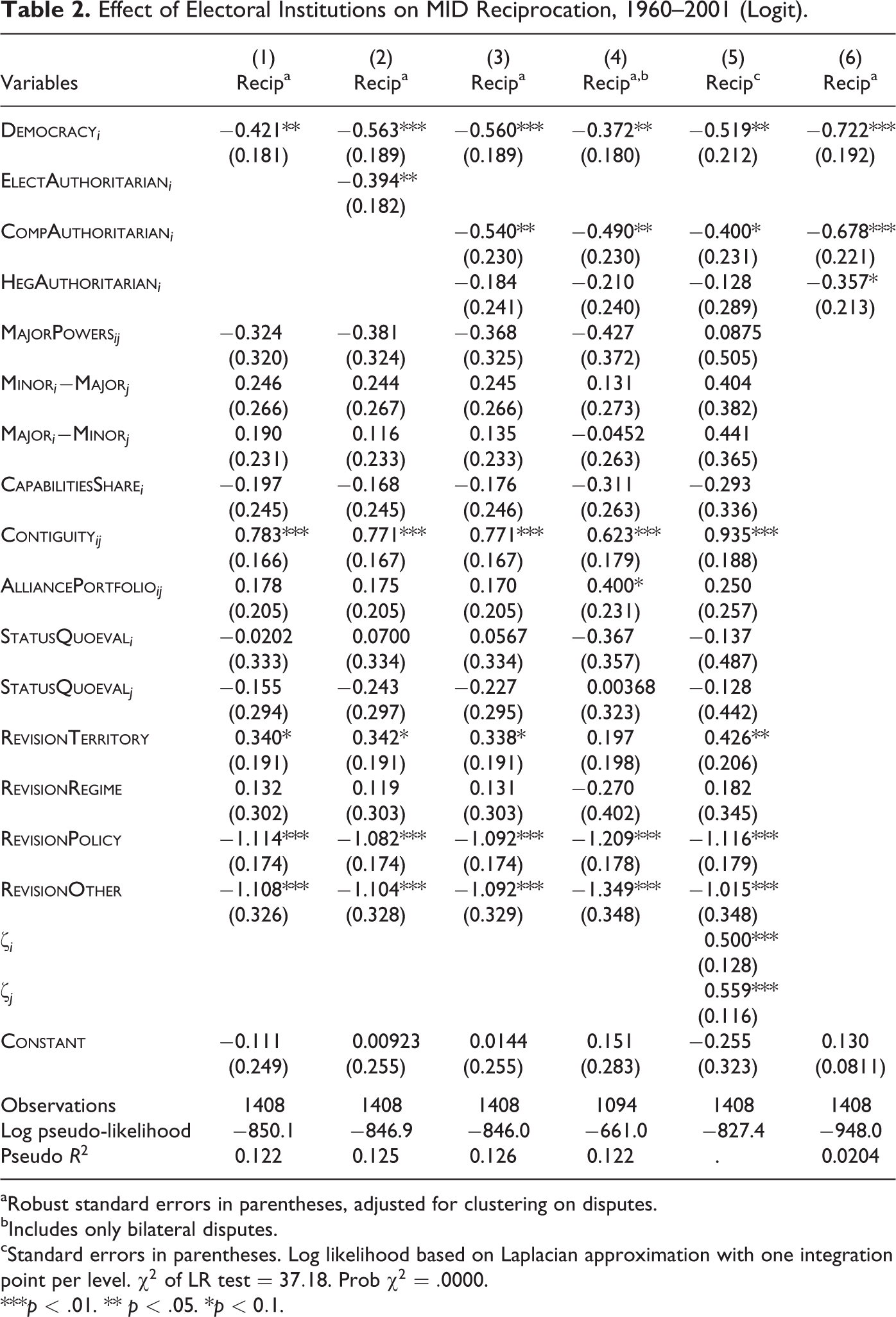
Table 2 shows the estimates from a logit model, with standard errors adjusted for clustering on disputes. Model 1 incorporates all of the relevant control variables, as well as a dichotomous measure of democracy. 28 The base category consists of all nondemocracies. The negative and significant coefficient for democracy is consistent with our theoretical expectations and with previous research.
Effect of Electoral Institutions on MID Reciprocation, 1960–2001 (Logit).
aRobust standard errors in parentheses, adjusted for clustering on disputes.
bIncludes only bilateral disputes.
cStandard errors in parentheses. Log likelihood based on Laplacian approximation with one integration point per level.
***p
Model 2 shows the results for adding an additional dummy for electoral authoritarianism, with (closed) autocracy as the base category. Recall that this coding is based simply on electoral competition, regardless of whether the incumbent leader participates in the election. As predicted, electoral authoritarian regimes are significantly less likely to face resistance in disputes than are autocratic regimes. Thus, even when controlling for multiple confounding influences, electoral competition increases signaling capacity. Disaggregating the electoral authoritarian category sheds further light on the influence of elections. In model 3, C
Dyadic data raise potential risks of nonindependence. In a multilateral dispute, for example, the probability of reciprocation by
To explore substantive effects, we use model 3 to generate predicted probabilities of target reciprocation, conditional on regime type of the challenger. 29 As illustrated in Figure 1, the predicted probabilities reveal a negative relationship between electoral competition and target reciprocation. Ceteris paribus, the probability of target reciprocation decreases as we move across the spectrum of electoral competition, with an especially wide gap between hegemonic authoritarian and competitive authoritarian regimes. For autocratic regimes, the probability of target reciprocation is over 50 percent, and nearly that high for hegemonic authoritarian regimes. This probability drops to about 37 percent for electoral authoritarian regimes and 36 percent for democratic regimes.

Predicted probability of target reciprocation by regime type. Dots are point estimates. Lines are 95 percent confidence intervals. Value of
Figure 1 reinforces Proposition 1: opportunities for credible signaling are high when
Legislative Opposition as a Measure of
Our Proposition 2 argues that a regime’s ability to send credible signals depends largely on the value of
We employ a data set that measures, from zero to one, the proportion of legislative seats held by the dominant (i.e., largest) party in a regime (Teorell, Holmberg, and Rothstein 2008). From this measure, we construct a dummy variable, O
To test the hypothesis, we split our sample into mutually exclusive regime subsamples. The first three subsamples contain only democratic and/or competitive authoritarian regimes, that is, regimes in which
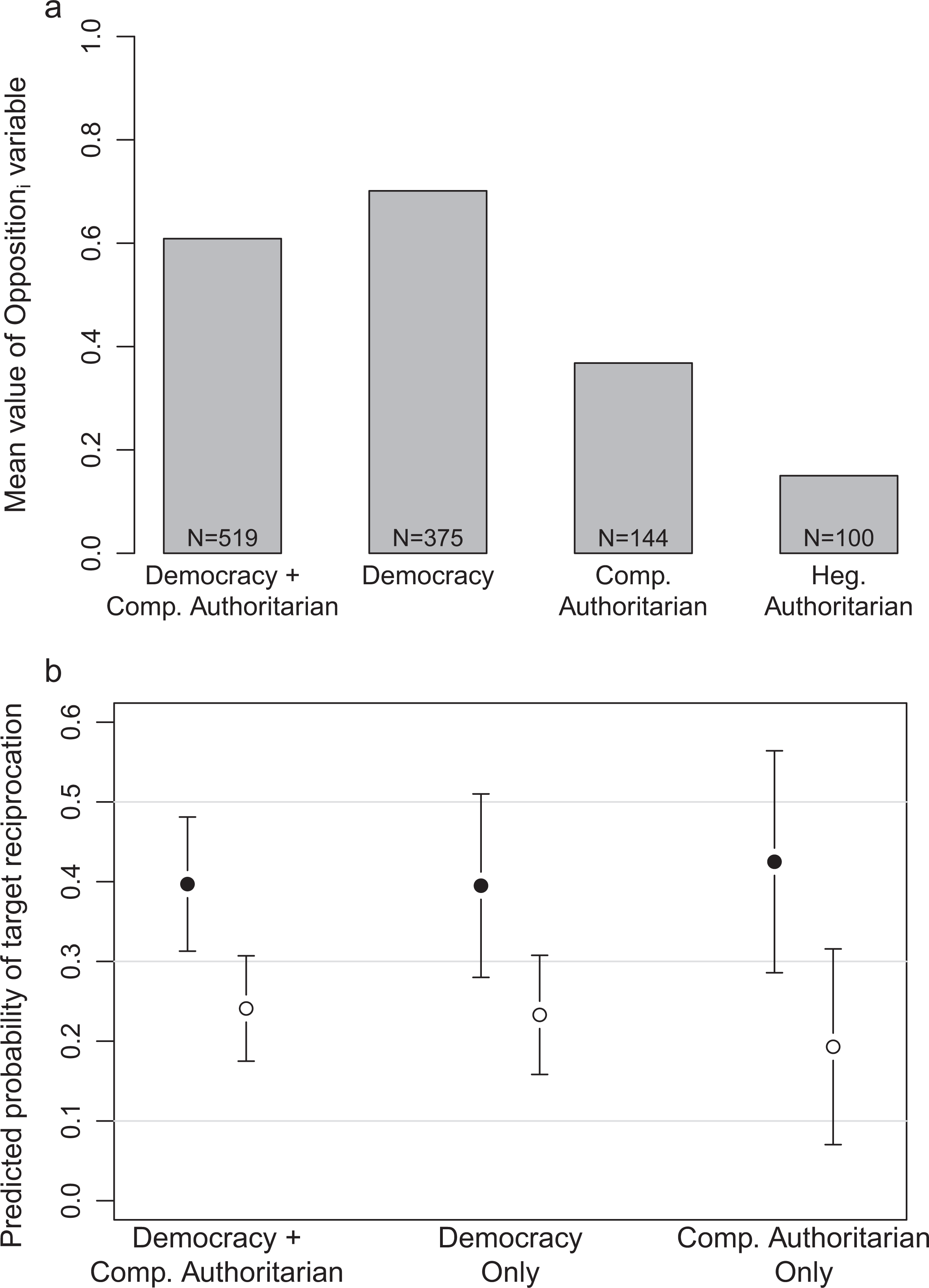
Panel (a) shows mean value of O
To assess substantive effects, Figure 2b plots predicted probabilities for those regime categories in which O
Overall, our results support two key conclusions. First, as shown by the wide gap in reciprocation rates between hegemonic and competitive authoritarian subtypes, the electoral vulnerability of incumbents (
Comparison to Other Approaches
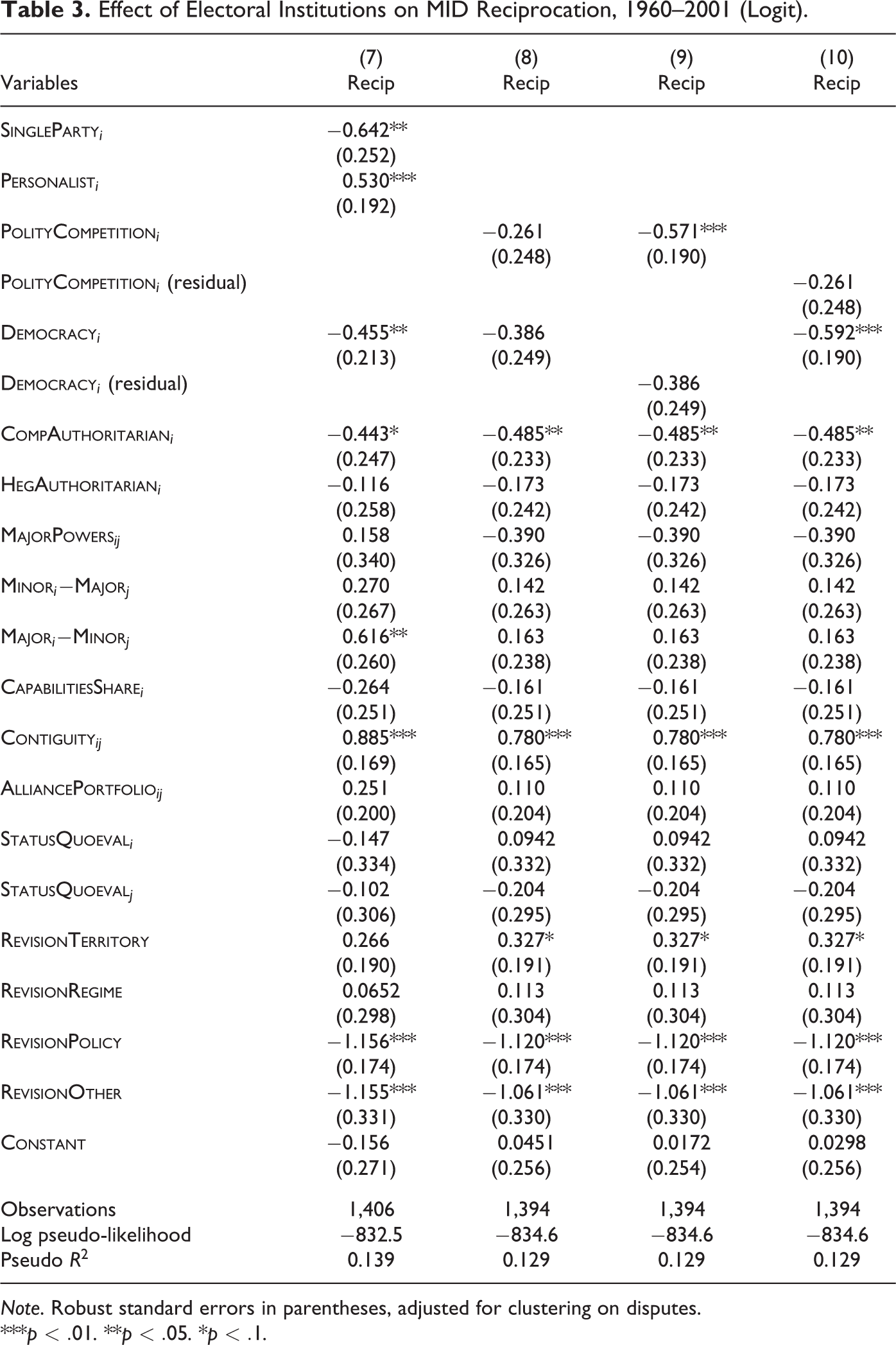
Finally, we compare our results to other quantitative studies of domestic politics and credible signaling. We first consider the approach of Weeks (2008), which focuses on nonelectoral sources of audience costs. In model 7 of Table 3, we introduce Weeks’ P
Effect of Electoral Institutions on MID Reciprocation, 1960–2001 (Logit).
Note. Robust standard errors in parentheses, adjusted for clustering on disputes.
***p
Schultz (2001a) argues that electoral competition enables confirmatory signaling; however, he uses Polity IV—or, more specifically, the subcomponents of Polity IV—to test this hypothesis. We used the Polity IV data to derive an index of competition identical to that employed by Schultz (2001a), denoted P
We first linearly regress D
These results suggest an important conclusion: the effect of P
Conclusion
Elections are not the only mechanism of credible signaling, but they are, arguably, the most salient and widely employed such mechanism. Scholarship by Schultz (1998, 2001a) and Fearon (1994a), among others, develops theories of audience costs and party competition in order to connect elections to signaling, but none of this work describes the minimal institutional requirements necessary for elections to enhance credible signaling. Given the proliferation of nondemocratic elections across the globe, this oversight is nontrivial. Our analysis focuses on two distinct properties of electoral institutions—the degree of proincumbent electoral bias, and the vulnerability of incumbents to losses of de facto power—and we argue that, ultimately, these two properties make possible both costly and confirmatory signaling. Importantly, these properties are not constrained to specific regime categories, but are instead fundamental institutional characteristics that vary in important ways across all regimes.
In extending our theoretical insights to the empirical level, we draw upon the growing literature on electoral authoritarianism. These regimes are becoming increasingly prevalent in world politics; they are not merely transitional polities or ad hoc governments. 34 We show that, while elections in such regimes often fall short of democratic standards, they nonetheless exhibit important variations in electoral bias and incumbent vulnerability. When proincumbent biases are sufficiently low, and the vulnerability of incumbents to opposition victories is sufficiently high, elections under authoritarianism effectively function as a source of credible signaling.
In short, even when elections are flawed, electoral pressures help communicate resolve and capabilities. The electoral mechanisms we emphasize can work even when oppositions are harassed, and there is vote fraud and repression. So long as elections introduce some amount of accountability into the political process, they work to constrain leaders. This finding carries practical importance, as it suggests that steps toward electoral institutions hold value even if they do not result in full-fledged democracy.
Footnotes
Acknowledgments
We thank the MacMillan Center and Jackson Institute at Yale University for generous financial support with building the original dataset used in this article; Alexandre Debs and Kenneth Schultz for informative discussions on the topic; Vinicius Lindoso and Baobao Zhang for capable research assistance; and Jessica Weeks for sharing her data. Replication materials and an online appendix are available at http://dvn.iq.harvard.edu/dvn/dv/bkinne and at http://jcr.sagepub.com.
Declaration of Conflicting Interests
The authors declared no potential conflicts of interest with respect to the research, authorship, and/or publication of this article.
Funding
The authors received no financial support for the research, authorship, and/or publication of this article.
Notes
References
Supplementary Material
Please find the following supplemental material available below.
For Open Access articles published under a Creative Commons License, all supplemental material carries the same license as the article it is associated with.
For non-Open Access articles published, all supplemental material carries a non-exclusive license, and permission requests for re-use of supplemental material or any part of supplemental material shall be sent directly to the copyright owner as specified in the copyright notice associated with the article.
