



Abstract
In a recent article in this journal, Chapman presents a formal model of the informational role played by international institutions. Unfortunately, the equilibria given in the article are incorrect. In this article, we identify the errors in the analysis of Chapman and solve for correct equilibria to the model. Our results show little support for the empirical implications derived in the original article. Contrary to these original findings, we find that there may be no relationship between an institution’s policy position and its effect on domestic public opinion or the likelihood that leaders will consult the institution.
The article “International Security Institutions, Domestic Politics, and Institutional Legitimacy” (Chapman 2007) presents a formal model of the informational role played by international institutions. In the model, a state leader chooses whether to consult an international institution before seeking domestic support for a foreign policy proposal. The leader and the institution have private information about the location of the proposal relative to the status quo, so their actions affect the domestic audience’s beliefs. Chapman (2007) uses this model to argue that leaders should be more likely to consult conservative institutions because the support of such institutions offers more convincing evidence to less informed domestic audiences. 1
Unfortunately, the analysis of the equilibria in Chapman (2007) is incorrect. We show that in this analysis, the domestic audience does not update its beliefs correctly, which in turn leads to a mischaracterization of the equilibria in the model. We demonstrate this by identifying some profitable deviations from the strategies given as equilibria in the original article. We then discuss the correct equilibria of the model. Although this model has many possible equilibria, we identify one in which the leader always proposes the policy unilaterally when the audience is revisionist and always consults with the institution when the audience is conservative.
Our findings are substantively important for the literature on institutional information transmission. In his discussion of the model’s empirical implications, Chapman (2007) focuses on the relative preferences of the leader and the institution’s pivotal member. He claims that as the pivotal actor’s ideal point moves closer to the status quo, institutional support is more credible and the leader becomes more likely to consult the organization. We find that this is not necessarily the case: there exist equilibria in which the institutional position has no effect on the leader’s choice of venue or the audience’s support for the proposal. Thus, the empirical implications derived in the original article lack support under our corrected equilibria.
Summary of the Model
In this section, we sketch the model presented in Chapman (2007). We closely follow the notation used there. Interested readers should consult the original article for more details.
There are three players in the model, the leader L, the pivotal member of the international organization V, and the domestic audience D. The sequence of moves in the model is given in figure 1 of Chapman (2007, 141-42). Nature chooses the outcome of a foreign policy
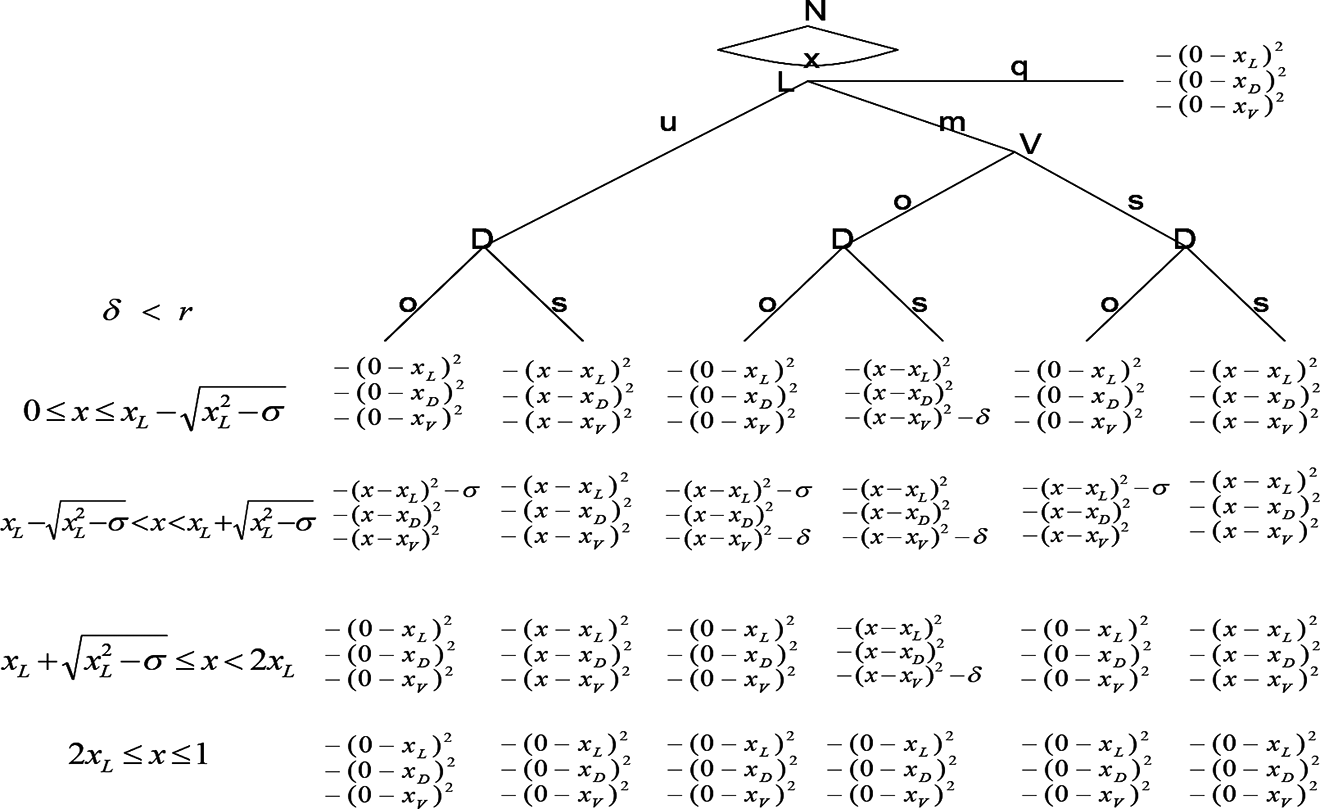
Reduced form game when
If the leader proposes x unilaterally, the domestic audience D chooses whether to support or oppose the proposal. After observing the choice of D, the leader decides whether to implement the proposal. If the proposal is implemented, the pivotal member V decides whether to accept or obstruct the proposal. If the leader proposes x multilaterally, the sequence of moves is similar. The only difference is that the pivotal member V initially signals support or opposition to the proposal. The domestic audience D observes this signal before choosing whether to support or oppose.
All players have a policy payoff given by
Chapman’s Equilibrium
Chapman presents his solution in his “Statement of Equilibrium Conditions” (p. 146), which we partially reproduce here for the case
Statement of Equilibrium Conditions
If
If
If
(a) If
(a) If
We summarize these conditions in Table 1. It gives four of the five regions that Chapman delineates in the parameter space of the model and describes the behavior of the players as a function of x in the region. 2 More details are available in the Online Appendix.
Regions in the Parameter Space.
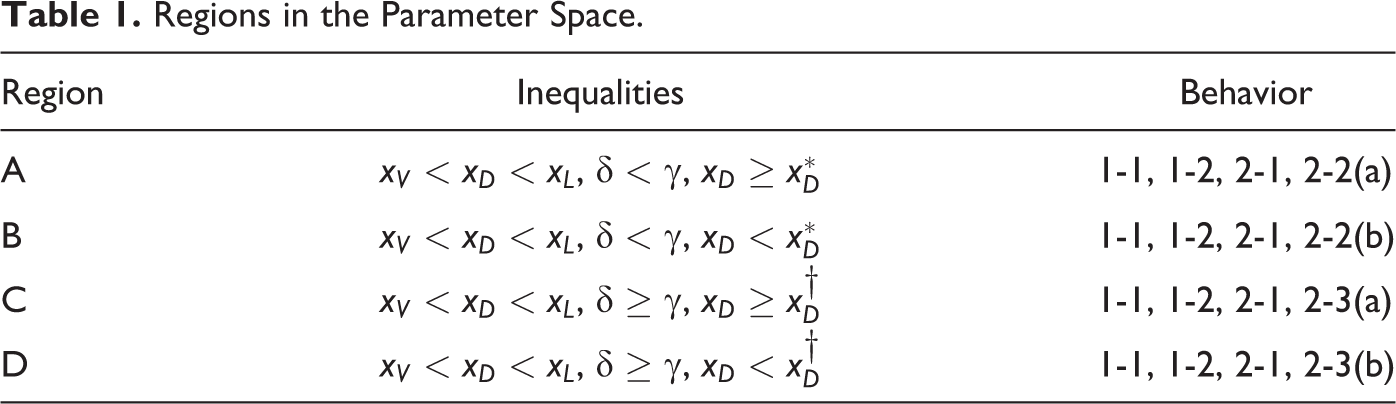
Unfortunately, this statement of equilibrium conditions is incorrect, for two reasons. First, in each of the regions identified in Table 1, there is at least one player who can increase his or her payoff by deviating from the proposed strategy. Second, the audience does not update its beliefs correctly.
As an example of a profitable deviation, consider region A in Table 1. The behavior of the players in this region is given by conditions 1-1, 1-2, 2-1, and 2-2(a). Specifically, in condition 2-2(a), when x satisfies
The article also fails to correctly analyze the updating of equilibrium beliefs. This is particularly unfortunate because a key feature of the model is how the audience uses the actions of the leader and institution to learn about the policy. An example of this problem is how the audience updates its beliefs in response to the leader’s initial choice. The appendix of Chapman (2007) states that “if L has proposed x, D knows that L prefers x to the status quo, or
Correct Equilibrium
Having identified the problems in the solution given by Chapman (2007), in this section, we analyze the correct equilibria of the model. The model is a signaling game with two signalers and continuous private information and therefore, as is usually the case with such games, there are a large number of perfect Bayesian equilibria. Focusing just on the action of the leader, we find a range of parameters such that it is an equilibrium for the leader to always propose x unilaterally, and another range in which it is an equilibrium for the leader to always propose x multilaterally. Importantly, in this solution, the international institution’s announcement of support or opposition does not depend on its own policy preferences, and the domestic audience’s actions in the multilateral subgame do not depend on the institution’s announcement.
In order to cut down on the parameter space, in what follows we assume that
in both the unilateral and multilateral subgames, if D supports x, then L implements
in both the unilateral and multilateral subgames, if D opposes x, then L implements
in the multilateral subgame, V accepts all
Given this lemma, we can reduce the game tree by replacing the actions covered by the lemma with their payoffs, as in Figure 1. As indicated in the figure, the payoffs depend on which region the value of x belongs to.
We now describe two kinds of equilibrium behavior in this game: one in which the leader never consults the institution and another in which he or she always consults it. We do not claim that these are the only equilibria. There are others with more complex behavior, where the leader sometimes accepts the status quo and sometimes proposes the policy. 5 We have chosen to focus on the two cases presented in the following because they most clearly illustrate our substantive points.
In our first proposition, we show that if the domestic audience is revisionist, then it is an equilibrium for the leader to always propose x unilaterally and receive domestic support. In the multilateral subgame, which is off the equilibrium path, the institution supports the proposal if and only if
L unilaterally proposes all
V signals support if
D supports a unilateral proposal. In the multilateral subgame, D opposes the proposal regardless of whether V signals support or opposition.
In the unilateral subgame, D’s belief about x is uniformly distributed on
By Lemma 1, the actions of L and V at the last two nodes of the game are sequentially rational. The remaining parts of the equilibrium strategies are examined in what follows.
For the leader, the equilibrium path of play gives L a payoff of
For the pivotal member, we check his action in each of the four regions
For the audience, we must show that its equilibrium action is optimal given its belief at each information set. If x is proposed unilaterally, then D’s belief about x is uniformly distributed on 
and the expected utility of opposing the proposal is
Evaluating these integrals and solving shows that
In the multilateral subgame, there are two cases to consider. If V signals support, then D’s belief about x is uniformly distributed on
Finally, we note that the belief of D in the unilateral subgame is given by Bayes’ Rule and the strategy of L. In the multilateral subgame, we assume that D’s updated belief about x before V makes its announcement—which is unrestricted because it is off the equilibrium path—is uniform on
In this equilibrium, the leader’s choice to propose the policy unilaterally is uninformative to the audience, since the leader does so for all
As is well known, perfect Bayesian equilibrium places no restrictions on the beliefs of players for actions that are off the equilibrium path. In this proposition, we have chosen the beliefs of the audience in order to make the proof as simple as possible. However, this same equilibrium path of play can be supported by other, more natural, beliefs at the expense of additional complication in the presentation.
In our second proposition, we show that if the domestic audience is conservative, then it is an equilibrium for the leader to always propose x multilaterally. The institution supports the proposal if
L proposes all
V signals support if
D opposes a unilateral proposal. In the multilateral subgame, D opposes the proposal regardless of whether V signals support or opposition.
In the unilateral subgame, D’s belief about x is uniformly distributed on
For the domestic audience, there are three cases to consider. First, in the multilateral subgame, if V supports the policy, then D’s belief about x is uniformly distributed on 
and the expected utility of opposing is
Evaluating these integrals and solving shows that
Finally, note that D’s beliefs in the multilateral subgame are given by Bayes’ Rule and the strategies of L and V. Its belief in the unilateral subgame is off the equilibrium path of play and is therefore unrestricted.
In this equilibrium, the condition on the audience’s ideal point means that it opposes a randomly chosen
It is worth emphasizing that no matter what the preferences of the audience are, the leader’s choice of venue does not depend on the policy position or whether the international institution is conservative or revisionist. In the next section, we consider the implications of these results for the substantive conclusions drawn in Chapman (2007).
Implications
In this section, we discuss how the corrected equilibria to this model call into question the empirical implications described in the original article. Chapman (2007, 149-50) summarizes the substantive importance of the original findings in a list of four observations. Each of these four claims fails to find support in the results described earlier. In particular, the players’ behavior in these equilibria does not depend at all on whether the institution’s pivotal member is conservative or revisionist.
The first two observations concern the effect of international institutions’ signals on domestic public opinion (p. 149):
Neither of these statements is consistent with the equilibrium behavior characterized in Propositions 1 and 2. In both cases, D always opposes the proposal in the multilateral subgame, even if V signals support. In fact, in Proposition 1, the domestic audience is more likely to support a unilateral proposal than a multilateral proposal that receives institutional support. These results do not depend on any particular assumptions about the institution’s conservatism or revisionism. If
The next observation is about the relationship between the pivotal member’s ideal point and the leader’s initial decision (p. 150):
The basis for the observation is that acquiring support from a conservative institution “guarantees public support” for the leader’s proposal—which, as we have already seen, is not true. Consequently, the observation does not hold.
The final observation concerns the conditions under which institutions can effectively constrain leaders’ policy choices.
Both statements rest on the implicit assumption that the pivotal member makes a sincere announcement of its preferences, which we have shown is not necessarily true in equilibrium. The first part of the observation is contradicted by Proposition 1, in which the leader is effectively unconstrained, regardless of whether V is conservative or revisionist. Even if the leader anticipates opposition from a revisionist institution to a policy he or she favors, in equilibrium he or she will propose it unilaterally and receive public support. The second part is contradicted by Proposition 2, in which the leader proposes all policies through the institution, again regardless of V’s ideal point. In this case, there is no need for the leader to be selective even if the institution is conservative, because he or she faces public opposition no matter how he or she makes the proposal or what the institution announces.
We have shown that none of the original article’s main substantive claims holds up under the equilibria we have found. To be clear, we do not claim that these observations are impossible to support as equilibrium behavior; the model has many more equilibria that we have not characterized here and we cannot rule out the existence of equilibria consistent with these claims. However, our results show that there are reasonable equilibria in this model that do not reflect the systematic relationship between institutional preferences, public opinion, and venue choices that are posited in the original article. This fact calls into question the originally claimed empirical implications of the model.
Conclusion
We have shown that Chapman’s (2007) statement of equilibrium conditions is erroneous and provided a corrected solution. Moreover, we have demonstrated that the empirical implications claimed in the original article are not supported by the equilibria in Propositions 1 and 2. In particular, the role of institutional conservatism or revisionism has been overstated: there is not necessarily any relationship between an institution’s ideal point, its ability to affect domestic support for a policy, and the likelihood that a leader will consult the institution in the first place. Our results suggest that a promising direction for future research would be to consider the informational role of other institutional features that have been left out of this model.
Footnotes
Declaration of Conflicting Interests
The author(s) declared no conflicts of interest with respect to the research, authorship, and/or publication of this article.
Funding
The author(s) received no financial support for the research, authorship, and/or publication of this article.
