



Abstract
When it comes to domestic terrorism (DT), state capacity matters in ‘the middle.’ Our article aims to bring together two apparently separate strands of terrorism research: one concerning the effects of regime type; and another concerning the effects of state capacity. We argue that state capacity can reduce DT in anocracies, but not so much in full dictatorships and democracies. Terrorists seek to maximize the reach of their attacks by exposing themselves to a larger audience. As a result, regimes with higher audience costs tend to be more vulnerable to domestic terror attacks. In anocracies, there is room for state capacity to influence the audience costs of a domestic terrorist attack. In full democracies and dictatorships, on the other hand, state capacity has little influence on the audience costs of DT. Consequently, if previous studies have purported linear, U-shaped, and inverted-U-shaped links between democracy and terrorism, we argue that the shape of the relationship is contingent on the level of state capacity. Theoretically, we substantiate our argument with a two-player simultaneous game between a terrorist group and a government. On the empirical side, we conduct a series of negative binomial panel regressions upon a time-series cross-sectional dataset of no less than 108 countries from 1970 to 2007.
Introduction
When it comes to domestic terrorism, state capacity matters in ‘the middle.’
Terrorism is ‘the premeditated use or threat to use violence by individuals or subnational groups against noncombatants to obtain a political objective through the intimidation of a large audience beyond that of the immediate victims’ (Enders & Sandler, 2006: 3). Since the primary goal of terrorism is to intimidate an audience beyond the physical vicinity of an attack, terrorists seek to maximize the reach of their attacks by exposing themselves to a larger audience (Hoffman & McCormick, 2004). What follows as a result is that regimes with larger audience costs (Weeks, 2008) tend to suffer more from domestic terrorist attacks (Conrad, Conrad & Young, 2014; Wilson & Piazza, 2013; Piazza, 2017). In contrast to full democracies, however, intermediary regimes can utilize state resources to suspend – or at least temporarily restrict – democratic practices. As a result, for those regimes, state capacity could substantially affect the audience costs of a terror attack. We dub this the ‘audience restriction’ (AR) effect, because state capacity is employed for restricting the audience of a domestic terror attack.
We focus on domestic as opposed to transnational terror since the key mechanism involved in our theoretical argument assumes that the terrorist is interested in affecting the host country’s political outcomes such that given alternative avenues to do so a potential terrorist may instead resort to methods other than terror. The scope of this article is also limited to domestic terrorist attacks with casualties, which tend to target soft as opposed to hard targets, because such attacks can generate substantially higher audience costs for the incumbent political leadership than attacks on hard targets. Finally, the article primarily concentrates on the military capacity of a state, operationalized with the Composite Index of National Capacity (CINC) (version 4.0) score (Singer, 1987; Singer, Bremer & Stuckey, 1972). Since terrorism is a national security threat, the security apparatus is crucial for successfully preventing and responding to the attacks (Bove, Rivera & Ruffa, 2020). Policies designed to counter terrorist attacks are ceteris paribus more likely to be successful when the state has stronger war-making capabilities.
We contend that the AR depends critically on both state capacity and the type of regime. In full dictatorships and full democracies, state capacity makes little difference to the AR. In full democracies, terrorists already have maximum access to democratic institutions and practices. For instance, the Black September Munich Olympics terrorist attack in 1972, after receiving widespread media coverage, ended up encouraging thousands of Palestinians to join the terrorist organization (Hoffman, 1998). Even if Germany’s military capability were higher, Black September would have received no less attention from the public. In full dictatorships too, state capacity has few implications for the AR. In 2017, as an example, Turkmenistan (a low capability authoritarian state) was reportedly at risk of being attacked by an extremist Islamist terror group (Pannier, 2017). To this day, it is impossible to know whether actual attacks took place, highlighting how terrorists could hope to inflict little audience cost to a full dictatorship, no matter how incapable it is.
By contrast, state capacity could tremendously affect the amount of AR exercised after a terrorist attack if the attack takes place in ‘the middle.’ In anocracies, where democratic and autocratic features coexist, the capacity of a state’s security apparatus critically affects the audience of a terror attack. First, sensitive information that concerns the nation’s security will not easily leak to the public when security forces are well-trained and highly disciplined, meaning that news about a terrorist incident will affect a smaller audience. Moreover, strong coercive institutions can effectively detect and deter democratic institutions (such as opposition parties, journalists and civil society) that seek to generate political momentum through a terrorist attack. Singapore, for example, introduced the ‘Public Order and Safety (Special Powers) Act’ in 2018, allowing the Ministry of Home Affairs to completely ban media coverage of terrorist events. Such a total ban on media coverage would not be possible without a strong and capable state apparatus.
Building upon this intuition, we present a formal argument as well as a thorough empirical evaluation of whether state capacity and regime type (RT) could jointly affect DT. This article’s contribution to the literature is twofold. First, it brings together the two apparently separate strands of terrorism research: one concerning the effects of regime type; and another concerning the effects of state capacity. On the one hand, a large body of research has focused on investigating democracy’s effect on terrorism. On the other hand, a relatively smaller group of researchers sought to examine whether terrorism is affected by varying levels of state capacity. Importantly, there is no evident bridge connecting the scholarship’s relatively recent interest in the state capacity variable with its more traditional focus on regime types and political institutions. Our analysis proposes to address this critical gap in the field. While studies of RT’s relation to terrorism often include state capacity as a control variable (and vice versa), to our knowledge ours is the first attempt to explore how the two variables may interact with each other in their effect on terrorism. Second, our article sheds a new perspective on the debate about democracy’s relationship with terrorism. If previous studies have purported linear, U-shaped, and inverted-U-shaped links between the two variables, our study finds that the shape of the relationship may be contingent on the level of state capacity.
Literature review
Regime type has been a central variable to many scholars of terrorism. From the early 1980s (Hamilton & Hamilton, 1983), scholars have sought to understand whether democracy renders terrorism more likely or less. On the one hand, proponents of ‘strategic influence’ posit that terrorism would thrive in the midst of the relative freedoms and many political constraints that characterize democracies. Civil liberties could lower the marginal costs of terrorism (Schmid, 1992; Eyerman, 1998), while a free press adds publicity to terrorist attacks (Wilkinson, 1986; Eubank & Weinberg, 1994). Indeed, the vast majority of empirical studies have found democracy to positively affect the frequency of terrorist events (Eubank & Weinberg, 1994, 2001; Weinberg & Eubank, 1994; Pape, 2003; Li & Schaub, 2004; Braithwaite & Li, 2007; Lai, 2007; Piazza, 2007, 2008; Chenoweth, 2010, 2013; Dreher & Fischer, 2010; San-Akca, 2014).
A different school of thought argues that democracy could deter terrorism by providing dissidents with ‘political access’ (Eyerman, 1998). As democracies are more inclusive than autocracies, they provide alternative, nonviolent avenues through which potential terrorists could foster the political change they desire (Hamilton & Hamilton, 1983; Ross, 1993). While this approach has been met with relatively limited empirical success, it illustrates how the relationship between regime type and terrorism could be more complex than the ‘strategic influence’ school may have it. Empirically, studies have pointed out how findings of the ‘strategic influence’ school may have been affected by underreporting and sampling bias. As Drakos & Gofas (2006a) reveal, studies of terrorism and regime type tend to suffer from underreporting, where the number of terrorist incidents are ‘scaled down’ in countries with restricted freedom of the press. Similarly, Gaibulloev, Piazza & Sandler (2017) point out that many of the studies use pre-2000 sample periods where democracies suffered heavily from leftist terrorists. Compared to more recent periods when religiously driven terrorism has become more prominent, the 1900s sample is bound to find a more positive association between democracy and terrorism. Perhaps such limitations of data can explain why some empirical studies have failed to find any relationship between regime type and terrorism at all (Wade & Reiter, 2007; Savun & Phillips, 2009; Gassebner & Luechinger, 2011; Kim & Sandler, 2021).
A number of studies have also suggested a quadratic relationship between terrorism and democracy. A small set of studies report a U-shaped relationship between terrorism and democracy. For example, in his study of 37 Muslim nations, Testas (2004) finds a U-shaped relationship between Freedom House (FH)’s democracy scores and terrorism. By contrast, a larger body of research found support for an inverted U-shaped relationship, where terrorism is most frequent in the middle (Abadie, 2006; Drakos & Gofas, 2006b; Kurrild-Klitgaard, Justesen & Klemmensen, 2006; Bandyopadhyay & Younas, 2011; Gaibulloev, Piazza & Sandler, 2017; Kim & Sandler, 2020). Notably, Gaibulloev, Piazza & Sandler (2017) provide a detailed formal model about how strategic interactions between the terrorists and the state ultimately result in an inverted U-shaped relationship between terrorism and democracy, and the authors test this theory upon a wide range of terrorism indicators. In addition to the ‘strategic influence’ and ‘political access’ theories, Gaibulloev, Piazza & Sandler (2017) posit that democracies could prevent terror by exerting more counterterrorism efforts.
Notwithstanding the prominence of regime types in the terrorism literature, scholars have long recognized that the effects of democracies and autocracies are quite heterogeneous. In other words, RT’s effects on terrorism are conditional upon various institutional factors. For instance, judiciaries (Findley & Young, 2011), electoral systems (Piazza, 2010; Aksoy & Carter, 2014), democratic participation (Li, 2005), and the number of veto players (Chenoweth, 2010; Young & Dugan, 2011) have been found to affect the number of terrorist events among democracies. In addition to the increasing pertinence of these democratic institutions for terrorism, there is a growing interest in whether authoritarian political institutions may also affect a regime’s exposure to terrorism. Aksoy, Carter & Wright (2012) argue that, in the absence of legislatures, active opposition parties resort to terrorism. Meanwhile, Wilson & Piazza (2013) find that single party dictatorships face less domestic and transnational terrorism compared to other types of dictatorships. Importantly, a group of scholars have found that regimes with higher audience costs were more likely to experience terrorist attacks (Wilson & Piazza, 2013; Conrad, Conrad & Young, 2014; Piazza, 2017).
Compared to regime types, state capacity has received relatively modest attention from scholars of terrorism. Research on regime types and terrorism often include state capacity as one of their controls (Li, 2005; Koch & Cranmer, 2007; Young & Findley, 2011; Findley, Piazza & Young, 2012; Gaibulloev, Piazza & Sandler, 2017). In these studies, state capacity is sometimes found to have a positive association with terrorism. In Li (2005) as well as in Koch & Cranmer (2007), the ‘government capability’ control variable (Li & Schaub, 2004) positively affects transnational terrorist incidents in most of the statistical models. Yet this relationship does not seem to be universal. In Young & Findley’s (2011) review, the government capability control (Li & Schaub, 2004) has no statistically meaningful effect on terrorism. Similarly, in Gaibulloev, Piazza & Sandler (2017), the CINC (Singer, 1987) had no significant effect on terrorism. Finally, Findley, Piazza & Young (2012) find ‘capability ratios’ (Bremer, 1992) to have an ambivalent effect on terrorism.
Considering the lack of consensus on the matter, it is surprisingly rare to find a study dedicated to investigating SC’s effect on terrorism. Blankenship (2018) finds that less capable states are more prone to fall into the provocation ‘trap,’ where the government overreacts to a terrorist attack, thereby encouraging more dissidents to use terrorism in the first place. Meanwhile, influenced by the literature on civil wars, Hendrix & Young (2014) propose a two-dimensional conceptualization of state capacity. The two dimensions are: ‘military capacity, or the ability to project conventional military force; and bureaucratic/administrative capacity, or the ability to collect and manage information.’ According to the authors’ empirical analysis, greater bureaucratic capacity reduces terrorism, but higher military capacity only serves to increase it. Because terrorism is a ‘weapon of the weak’ (Crenshaw, 1981), it is an attractive option for a political adversary facing a militarily capable government; to the contrary, when a government is equipped with bureaucratic capacity, it can effectively and credibly detect and deter terrorist intentions, making terrorism less appealing to a political opponent. The two dimensions’ implications for terrorism, however, are still a matter of debate. Larue & Danzell (2020) argue, for instance, that neither concept retains statistical significance once additional aspects of state capacity – ‘political fragmentation’ and ‘law and order’ – were added to the empirical analysis.
In short, the literature in its current state remains full of interesting yet underexplored questions. What is the relationship between terrorism and state capacity? Could the nature of this relationship depend on the type of regime? So far, a group of scholars explore terrorism’s relationship with regime types, whereas another – albeit smaller – group seeks to understand terrorism’s relationship with a state’s bureaucratic and military capacity. However, there is ample reason to believe that the effects of a state’s administrative and defensive capability may depend on the type of regime. If as Gaibulloev, Piazza & Sandler (2017) argue different regimes create different incentive structures for the state as well as for potential terrorists, could not the distinct strategic environments of dictatorships, anocracies and democracies affect the implications of state capacity for terrorism?
How does state capacity matter?
If previous studies have considered ‘strategic influence’ (Eyerman, 1998), ‘political access’ (Eyerman, 1998) and ‘democratic protection’ (Gaibulloev, Piazza & Sandler, 2017) as determinants of government and terrorist strategies, we contend that there exists another influential yet underexplored factor: AR.
Terrorists seek to bolster the effectiveness of their attack by obtaining a large audience (Wilkinson, 1997; Hoffman & McCormick, 2004; Pries-Shimshi, 2007; Rohner & Frey, 2007). Following the argument of Weeks (2008), we contend that authoritarian regimes differ in the extent to which their political institutions incur audience costs. And, as a number of recent studies have uncovered, we argue that regimes with higher audience costs will suffer from more terrorist attacks (Wilson & Piazza, 2013; Conrad, Conrad & Young, 2014; Piazza, 2017). In anocratic regimes where ordinary people have even limited rights to express their thoughts in public (for example, by engaging in civil society or elections), news about a terrorist attack can generate high audience costs against an incumbent regime. Our novel contribution to this existing insight, however, is that we incorporate state capacity into the theory. Among anocracies, we expect capable states to effectively contain the audience costs of terrorism by temporarily suspending – or at least restraining – their democratic institutions’ practices. We dub this the AR effect.
Importantly, we argue that the AR of a domestic terrorist plot jointly depends on a state’s capacity and the type of regime. Our focus here is on domestic rather than transnational terrorism, because our theoretical mechanisms assume that potential terrorists have domestic political motives: a premise that does not usually extend to transnational terrorists (Aksoy & Carter, 2014). The utility that results from each additional terror attack is referred to as the marginal utility of terrorism. Let us compare SC’s effects on marginal utility by the type of regime. As briefly outlined above, in intermediary regimes, the marginal utility of a terrorist attack rises quickly with decreases in state capacity, owing to the AR. Consider, for instance, a competitive authoritarian regime (Levitsky & Way, 2002), where elections are regularly held but the opposition has no serious chance of winning. In these states, elections serve to enhance the regime’s legitimacy while providing the ruling party with estimates about their performance. Terrorist attacks are often portrayed as a national security threat, with some nations even declaring ‘war’ against terrorism. Thus, with a disciplined and capable coercive apparatus at hand, the state could effectively control information about a terrorist attack under the pretext of securing the nation, by physically cordoning off locations of interest and sealing the lips of their personnel. A state that is capable of exerting physical force could also effectively detect and restrain – or threaten to restrain – opposition and civil society actions in the name of national security. It becomes difficult, therefore, for a domestic terrorist attack to obtain political attention. Information about the attack would be hardly available in the first place, but even with the information at hand political mobilization would be challenging under such heightened security. 1 By contrast, imagine that – due to some exogenous shock – the coercive capacity of this same state falls drastically overnight. The marginal gains from terrorism would rise steeply, as the anocratic state no longer has the means to suppress the political reactions that spark from a successful terrorist attack. News about each terrorist incident (which will quickly leak into the public in the absence of a disciplined and functioning security apparatus) can have far-reaching repercussions for the citizens who are accustomed to participating in pseudo-democratic activities: the leadership will need to take political responsibility in front of an audience that is greatly unsatisfied with the way the incumbents handled the security of the nation. Specifically, it could prompt the political opposition to voice concerns over the government’s stability, obtain international attention through foreign media, or spur a nationwide movement against the regime; at the very least, it can encourage voters to show support for the opposition in the next election.
In full autocracies and democracies, on the other hand, the marginal utility of terrorism does not rise as much with diminishing state capacity. First of all, because full dictatorships lack mechanisms to hold their leaders accountable for domestic terror attacks, their AR effect is more restricted. 2 Even without a very effective state apparatus, information about each terror attack would not spread as quickly or widely as in intermediary regimes, nor would the citizens have enough experience with democratic norms to hold their leader accountable for an attack. Turkmenistan’s response to an alleged terrorist ploy exemplifies how little state capacity affects the marginal utility of terrorism. In 2017, sources from inside the Turkmenistan regime leaked information to the foreign press that the regime could be under threat of extremist Islamist terror attacks. It is impossible, however, to know whether actual attacks took place, highlighting the low marginal utility that terrorists would gain from attempting an attack at even such a low-capacity state (Pannier, 2017). For political dissidents in full democracies too, a fall in the state’s capacity brings about no strong AR effect. In fully free countries, there are already no unwarranted restrictions on political participation, and leaders are held accountable for their actions. As a result, even when a fully democratic state becomes weaker, ceteris paribus, any additional gain that the terrorist reaps is minuscule in comparison with the anocratic context.
In the following section, we will provide a formal game-theoretic model about how all these strategic considerations combined affect the equilibrium level of terrorist attacks.
Game-theoretic model
Based on Gaibulloev, Piazza & Sandler (2017), we employ a simultaneous two-player game between a terrorist group and a government. 3 The two players simultaneously determine their actions: while the terrorist group chooses the number of attacks (a), the government determines the amount of counterterrorism effort (e). When the terrorist group decides on the number of attacks, it seeks to maximize its utility (u) given the cost (c):

where
For the terrorist to maximize its utility, the first-order condition (FOC) of equation (1) is as follows:

It indicates that the terrorist group chooses the level of attack so that the marginal cost equals the marginal utility. Using equation (2), we can derive the terrorist’s best response (

From now on, we focus on how the terrorist group’s strategy shifts as we change the level of state capacity. Applying the implicit function rule to equation (2), for each change in s, we get the following shift in the terrorist’s best response strategy:

The changes in equation (4) depend on the size of the numerator, which differs by the type of regime. In democracies and autocracies, as expounded in the previous section, the AR effect is barely affected by changes in the state’s capability. In other words, the marginal utility of an attack is not substantially affected by state capacity. In intermediary regimes with both democratic and authoritarian elements, however, state capacity dramatically affects the amount of AR. This means that, in anocracies, state capacity affects the marginal utility to a greater degree. Based on these observations, we could expect SC’s effect on the best response function to be largest in anocracies, compared to democracies and autocracies (see Figure 1).
Moving on to the government’s side of the game, a targeted government considers two factors: (a) the loss inflicted by terrorism (l); and (b) the costs of counterterrorism efforts (C). The government seeks to minimize the combination of the two:

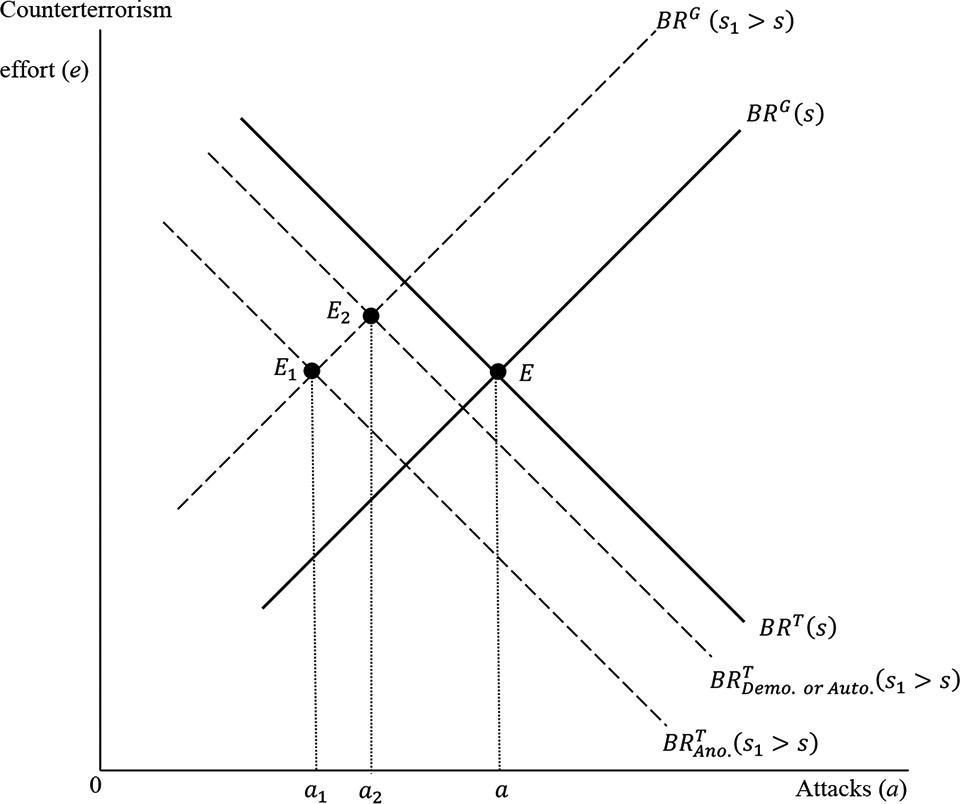
State capacity’s effect on the equilibrium number of attacks by regime type
Raising the counterterrorism effort decreases the loss at a diminishing rate of reduction (
The FOC of equation (5) is

From equation (6), we can derive the government’s BR strategy (

Equation ( 7) implies that the government will raise its counterterrorism effort as the number of attacks increases. We could also derive from equation (6) SC’s influence on the government’s BR strategy:

As capacity increases, the curve shifts upward and to the left. In other words, more capacity results in more counterterrorism effort, holding the level of attacks constant.
We can now simultaneously solve equations (2) and (6) to obtain the Nash equilibrium of attacks and counterterrorism efforts, represented by the intersection between the two players’ best-response paths. In our analysis, we are interested in how this intersection of the two players’ reaction paths move as we alter the level of state capacity. In particular, as with Gaibulloev, Piazza & Sandler (2017), we are interested in changes to the equilibrium level of terrorist attacks.
The effect of state capacity is clear-cut (Figure 1): the government suffers from fewer terrorist attacks as the state’s capacity increases, but the size of the effect depends on the regime type (
For better comparison with existing empirical work in the literature, this relationship could be also understood in terms of state capacity’s effect on the relationship between regime type and terrorism. For full dictatorships and democracies, the state’s capability has a small effect on the number of terror attacks; for anocracies, however, there are substantially more terrorist attacks in low-capacity states than in high-capacity states. As a result, among low capability states, the average number of terrorist attacks would be higher in the middle (worst of both worlds). Without sufficient capacity, an anocracy’s democratic institutions are unable to reduce grievance; meanwhile, its authoritarian institutions will also lack the despotic power to control the population. Among high capability states, by contrast, terrorism would be lower in the middle (best of both worlds). An anocracy’s democratic institutions can effectively address grievances; concurrently, its autocratic elements can selectively apply coercion in the name of national security. Combining these tendencies, we could therefore expect democracy to have an inverted-U-shaped effect on terrorism among low-capacity states and a U-shaped effect among high-capacity states.
Empirical analysis
We conduct a series of negative binomial panel regressions upon a time-series cross-sectional dataset of no fewer than 108 countries from 1971 to 2007. All the main models were run with country and year fixed-effects. All in all, our statistical analysis lends strong support to the hypothesis that state capacity and regime type jointly affect terrorism. Specifically, the models confirm the theoretical argument that state capacity affects DT in the ‘middle.’ Relatedly, the statistical analysis illustrates how democracy’s marginal effect on terrorism may also depend on state capacity. The relationship between terrorism and democracy follows an inverted-U-shaped pattern for states with low capacity, whereas the relationship gradually becomes a U shape as states become more capable.
Dependent variable
Our empirical models operationalize terrorism using the Global Terrorism Database (GTD) (National Consortium for the Study of Terrorism and Responses to Terrorism (START), 2019). Of all terrorist incidents reported by the GTD, we focus on domestic – as opposed to transnational – incidents that resulted in casualties (Enders, Sandler & Gaibulloev, 2011). We limit our attention to DT because, theoretically, we are analysing whether SC’s control over democratic institutions can reduce the domestic audience costs of terrorism. The proposed mechanism does not necessarily apply to transnational terrorism, because, as Aksoy & Carter (2014: 183) argue, democratic institutions may have no effect on terrorists’ marginal benefit when the terrorist groups could not obtain their goals through political representation in the first place.
Comparing the extent of underreporting across different measures of terrorism

Independent variables
The statistical analysis includes three independent variables: regime type, state capacity and their interaction terms. For state capacity, our models use four different measures. First, we mainly use the CINC (Singer, 1987; Singer, Bremer & Stuckey, 1972). The index holistically evaluates state capacity in terms of a nation’s military expenditure and personnel, population size, energy consumption levels and metals production. Because fighting terrorism requires a set of abilities akin to those required during war, the CINC is widely used in studies of terrorism. In this article, we argue that intermediate regimes can utilize their coercive capabilities to secure information and circumscribe democratic practices in times of a national security crisis, diminishing the audience costs that they suffer from domestic terror attacks. The CINC has been normalized to range between ‘0’ and ‘100’. As robustness checks, we also assess whether the two dimensions of state capacity proposed by Hendrix & Young (2014) (bureaucratic and military) affect terrorism differently. To do so, we borrow the two latent variables constructed by Hendrix & Young (2014). Bureaucratic capacity is constructed through a factor analysis of ‘bureaucratic quality’ and ‘law and order’ variables from the International Country Risk Guide; military capacity is created with measures of ‘military personnel,’ ‘military expenditure’ and ‘military expenditure per soldier’ in the National Military Capabilities dataset (Singer, Bremer & Stuckey, 1972; Singer, 1987). As another robustness check, we follow Anders, Fariss & Markowitz (2020) and use surplus domestic product (SDP) as an alternative proxy for the state’s power resources. The SDP is created by subtracting ‘subsistence income’ from the gross domestic product (GDP) (Anders, Fariss & Markowitz, 2020: 392). As a final robustness check, we also consider national military expenditure (logged) as a more direct estimate of military capacity (Singer Bremer & Stuckey, 1972; Singer, 1987). The results of the final two robustness checks are presented in Table A3 of the Online appendix. regime type is primarily operationalized using Polity IV’s composite score, which places the type of a country’s regime on a scale of ‘-10’ to ‘10’ (Marshall, Gurr & Jaggers, 2014). We normalized this measure to range between ‘0’ and ‘1.’ And since we expect the type of regime to non-linearly affect SC’s influence on terrorism, we also include a square term of this normalized value. As a robustness check, we also use a categorical regime type variable in one of our models. A country-year is considered ‘authoritarian’ if the Polity score (in its original scale) is below or equal to ‘-6,’ ‘anocratic’ if the Polity score is in between ‘-6’ and ‘6’ and ‘democratic’ only if the Polity score is equal to or greater than ‘6.’ We also employ FH’s measure of political rights as a proxy for democracy. FH’s political rights score ranges from ‘1’ to ‘7,’ with ‘7’ indicating worst political rights conditions and ‘1’ indicating the best guarantees of political rights.
Control variables
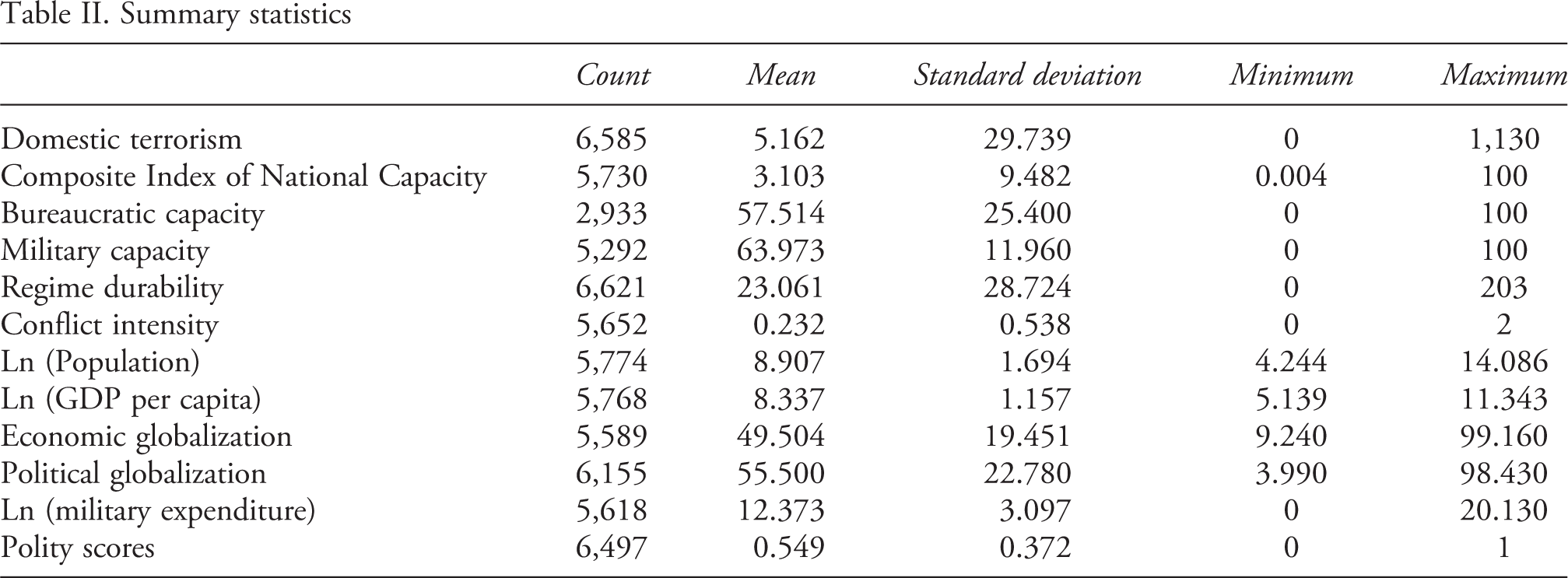
Summary statistics
The effects of state capacity (state capacity) on domestic terrorism (main models)
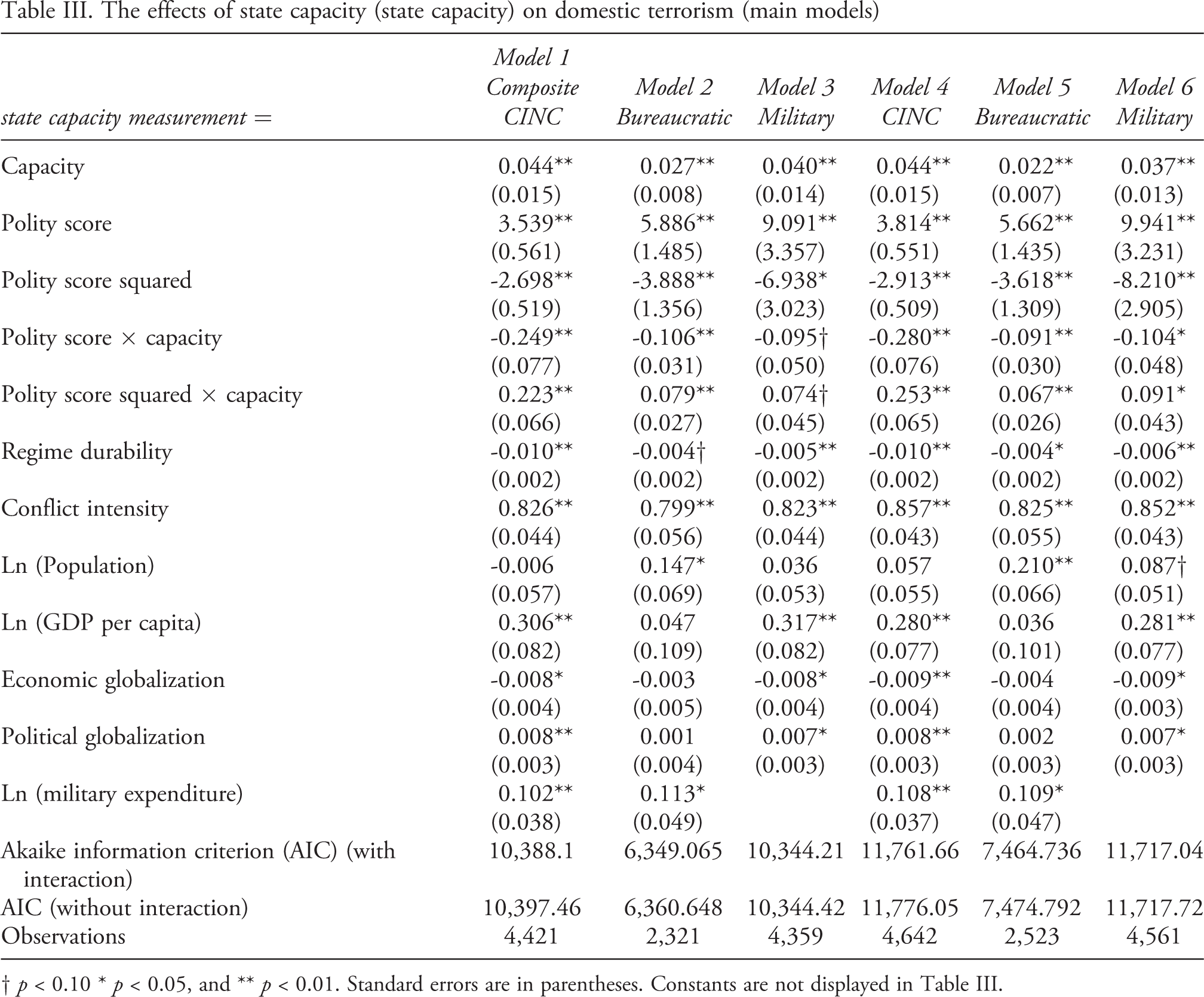
† p < 0.10 * p < 0.05, and ** p < 0.01. Standard errors are in parentheses. Constants are not displayed in Table III.
Results
Our main empirical analysis (Table III) conducts negative binomial panel regressions (Hausman, Hall & Griliches, 1984) upon a cross-sectional time-series dataset of domestic terrorist incidents. The main models (Models 1–3) include year-fixed and country-fixed effects. Model 1 uses the CINC as a measure of state capacity, whereas Models 2 and 3 use bureaucratic and military capabilities. The empirical models generally confirm our theoretical prediction that state capacity will reduce terrorism in the ‘middle’ but not so much in the extremes. Moreover, state capacity seems to mediate democracy’s effect on DT: democracy’s inverted-U-shaped relation with terrorism found among low-capacity states gradually transforms into a U-shaped curve as the states under concern become more capable. Using random-effects instead of the country-fixed effects (Models 4–6) leads to no substantial changes in the results.
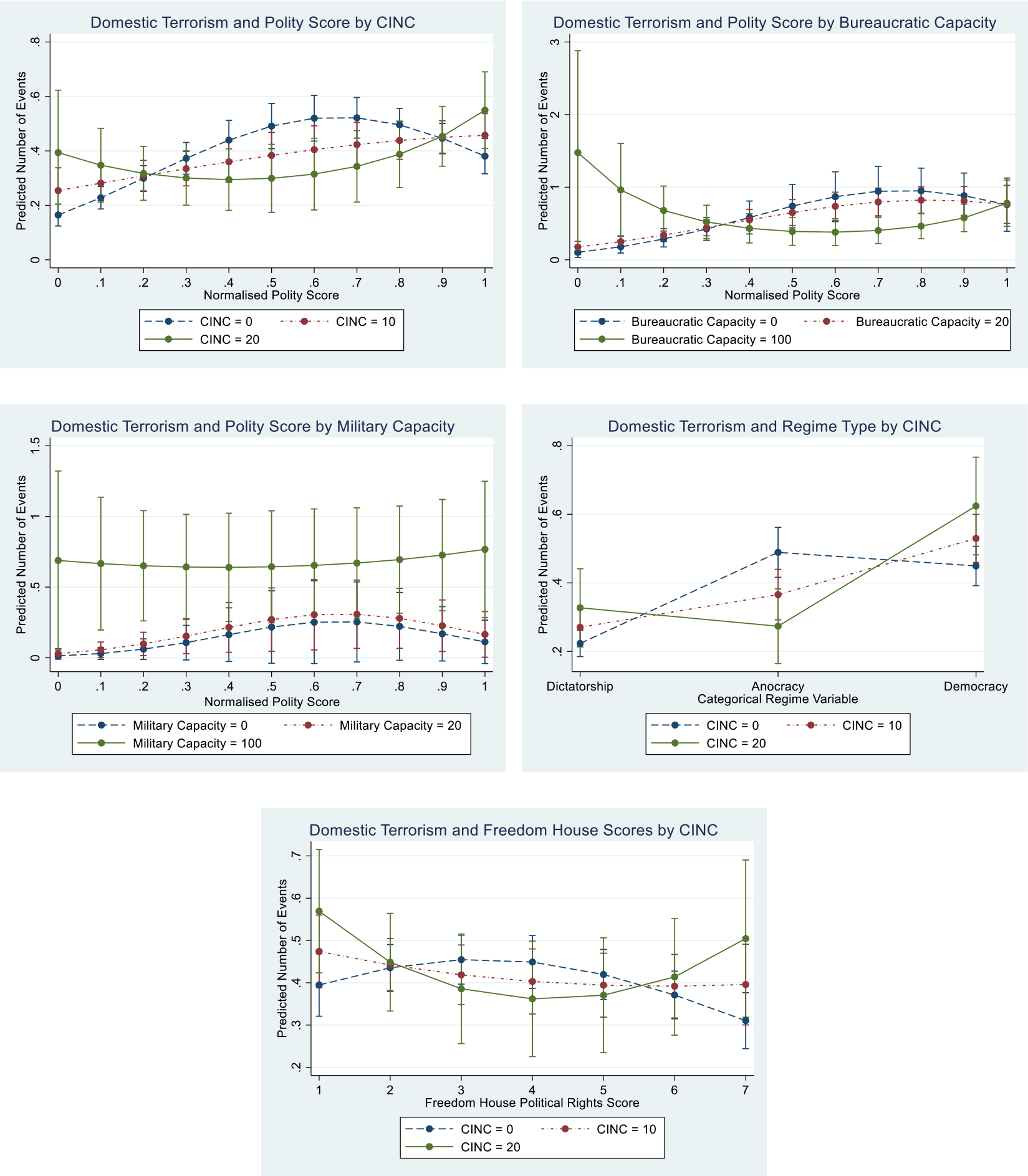
Because the coefficients of negative binomial regressions are not readily interpretable, we will use predicted margins to explain the implications of our statistical models. Model 1 uses the CINC as its measure of state capacity. As expected, state capacity reduces terrorism by a substantial amount in anocracies, but not in fully democratic or autocratic regimes. When the Polity score is ‘0.5,’ for instance, increasing the CINC from ‘0’ to ‘10’ reduces the expected number of domestic terror incidents by ‘0.108.’ For Polity scores ‘0.3’ and ‘0.8,’ however, the expected number of domestic terror events fell by only ‘0.038’ and ‘0.057,’ respectively. Relatedly, state capacity seems to condition the Polity score’s effect on domestic terror. Among low-capacity states (CINC = 0), the expected number of domestic terror events rise by ‘0.14’ as the Polity score increases from ‘0.2’ to ‘0.4’ but decreases by ‘0.08’ as the Polity score moves from ‘0.7’ to ‘0.9.’ Among high-capacity states, however, this pattern is reversed. For instance, if ‘CINC = 20,’ the expected number of terrorist events fall by ‘0.02’ as the Polity score moves from ‘0.2’ to ‘0.4’ but rises by ‘0.11’ when the Polity score changes from ‘0.7’ to ‘0.9.’
Models 2 and 3 use bureaucratic and military capabilities as alternative indicators of state capacity. Model 2 demonstrates that the relationship still stands when we use bureaucratic capacity in place of the CINC. Bureaucratic capacity reduces DT in the ‘middle,’ but not so much in the extremes. If the Polity score is ‘0.5,’ increasing the state’s administrative capacity from ‘20’ to ‘60’ reduces the expected number of domestic terror attacks by ‘0.147.’ For Polity scores further away from the centre, on the other hand, bureaucratic capacity either has a weaker or even positive effect on terrorism. The same increment in capacity, for example, reduces the expected number of attacks by ‘0.127’ if the Polity score is ‘0.9’ and increases the expected number by ‘0.038’ if the Polity score is ‘0.3.’ In contrast, Hendrix & Young’s (2014) military capacity variable in Model 3 increases the expected number of DT for all regime types, but this positive association is smallest in the ‘middle.’ Raising the military capability variable from ‘20’ to ‘60’ raises the expected number of attacks by ‘0.154’, ‘0.147’ and ‘0.179’ for Polity scores ‘0.3’, ‘0.5’ and ‘0.9,’ respectively. Terrorism indeed seems to be a ‘weapon of the weak;’ military capacity’s positive effect on terrorism, however, is smaller in anocracies, since more capable anocracies can also diminish the audience costs of terrorism. In other words, even Model 3 shows that state capacity’s effect on terror varies by the type of regime.
For both Models 2 and 3, state capacity again seems to shape democracy’s effect on terrorism. When capacity is low, democracy has an inverted-U-shaped relationship with DT; when capacity is high, this association turns into a U-shape. When the bureaucratic capability score is ‘0,’ for instance, the expected number of domestic terror incidents rise by ‘0.297’ as the Polity score moves from ‘0.2’ to ‘0.4’ but falls by ‘0.185’ as the Polity score changes from ‘0.7’ to ‘1.’ The p-values for the interaction term using military capability as an alternative measure are significant at the 10% level, but the direction of the coefficients indicate a similar pattern. When military capability is ‘20,’ the expected count of terror attacks climbs by ‘0.117’ as we increase the Polity score from ‘0.2’ to ‘0.4’ but falls by ‘0.082’ if the Polity score is brought up from ‘0.7’ to ‘0.9.’ By contrast, the pattern is reversed at higher levels of bureaucratic or military capacity. If bureaucratic capacity is ‘100,’ the expected number of domestic terror attacks falls by ‘0.247’ as the Polity score shifts from ‘0.2’ to ‘0.4’ but rises by ‘0.174’ as the score increases from ‘0.7’ to ‘0.9.’ Likewise, if military capacity is ‘100,’ the expected number falls by ‘0.011’ as the Polity score moves from ‘0.2’ to ‘0.4’ but increases by ‘0.097’ as the Polity score changes from ‘0.7’ to ‘1.’ Since the number of observations varied greatly across the three models, we also re-estimated the models State capacity reduces terrorism in ‘the middle’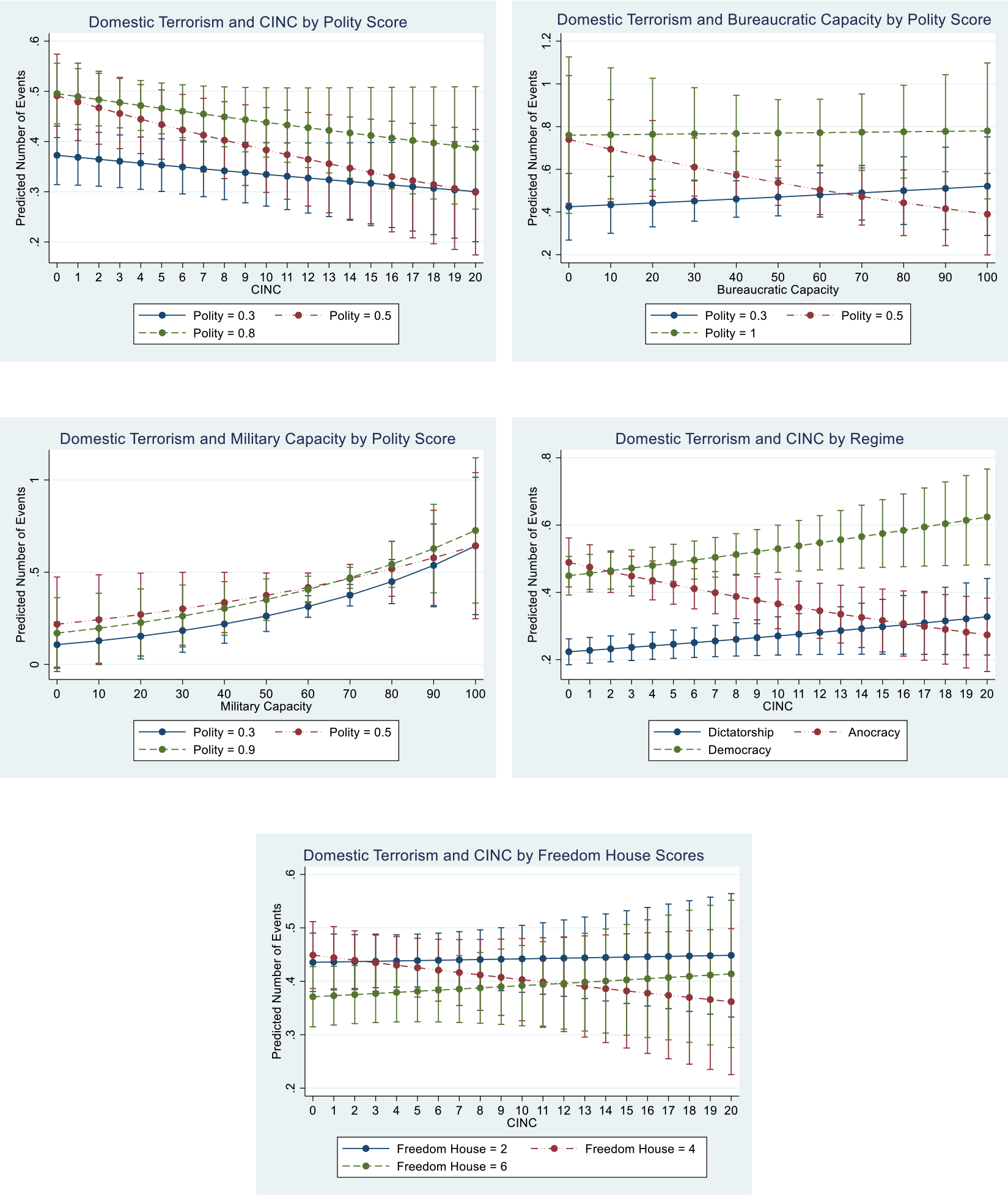
Figures 2 and 3 visually illustrate the above findings, assuming no fixed effects. The CINC and bureaucratic capacity have strong negative effects on the number of terror attacks in anocracies but not in fully autocratic or fully democratic regimes. By contrast, military capability positively affects terror attacks across all types of regimes (Figure 2). In addition, state capacity seems to condition democracy’s relationship with terrorism. For all indicators of state capacity, the Polity score has an inverted-U-shaped relationship with DT in low-capacity states only; as a state becomes more capable, democracy’s effect on domestic terror gradually turns into a U-shaped pattern (Figure 3). If existing works purported a U-shaped, linear, or inverted-U shaped pattern between terrorism and democracy, our empirical work demonstrates how the relationship may be contingent on an often-overlooked moderating variable: state capacity.
State capacity shapes democracy’s effect on terrorism
Robustness checks
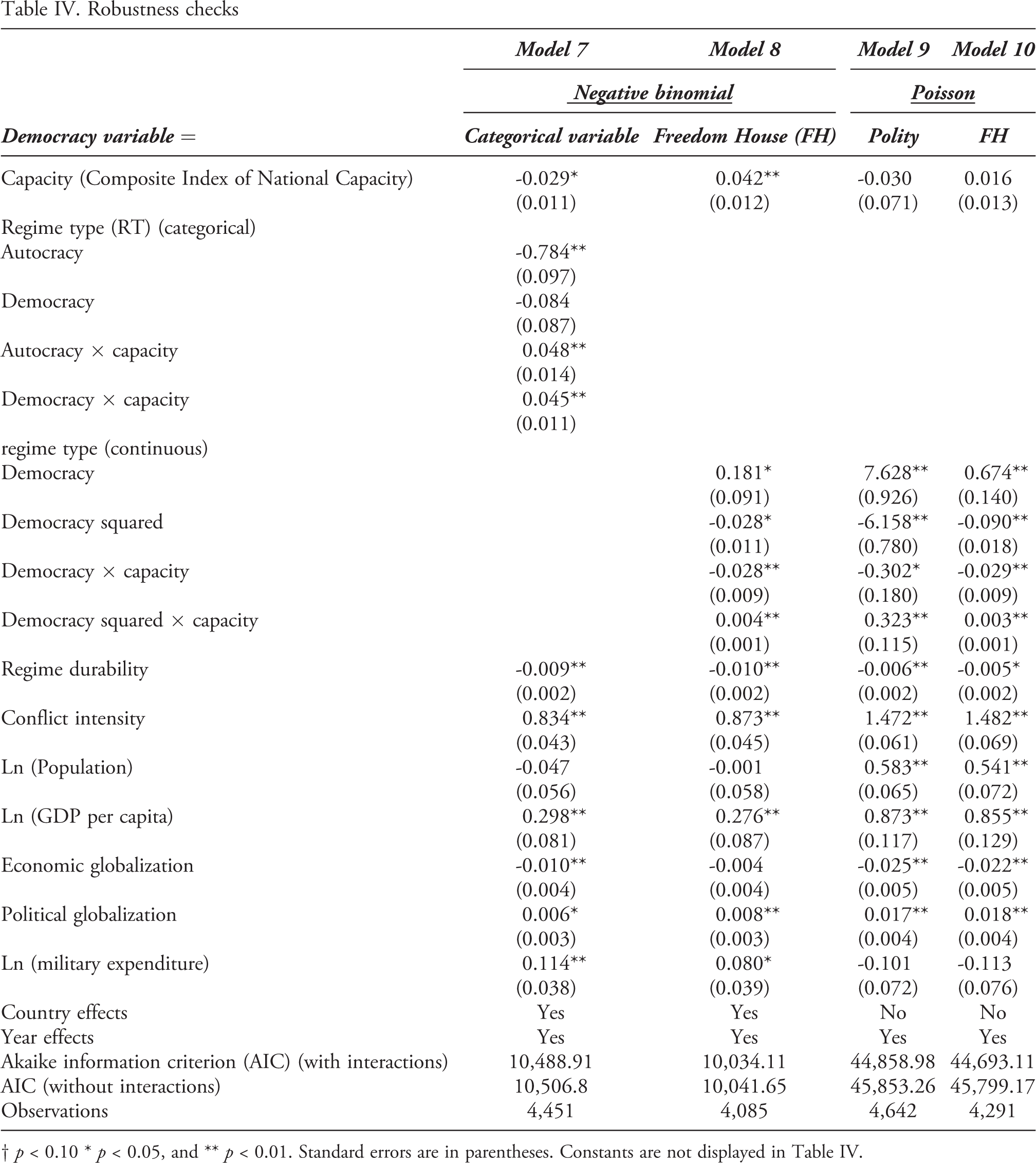
These results are replicated in eight different statistical models that are designed to assess the robustness of our main analysis (Table IV). Like Models 1–3, Models 7 and 8 are negative binomial regressions with year-fixed and country-fixed effects, but they use different indicators of democracy in their analysis. 8 Model 7 uses a categorical regime type variable, whereas Model 8 uses the FH political rights score. Models 9 and 10, on the other hand, are Poisson regressions. Due to overdispersion, negative binomial models are better suited for analysing the data than Poisson regressions. However, there have been concerns that negative binomial regressions could be problematic when combined with fixed-effects (Allison & Waterman, 2002). Acknowledging this potential limitation, Models 9 and 10 run pooled Poisson regressions with year dummies. 9
Robustness checks
† p < 0.10 * p < 0.05, and ** p < 0.01. Standard errors are in parentheses. Constants are not displayed in Table IV.
In Model 7, a categorical regime type variable is employed instead of a continuous one. Regimes are classified into autocracies, anocracies, or dictatorships. For states with low capacity, autocracies and democracies have lower levels of terrorism compared to anocracies, which is the base category. When ‘CINC = 0’, for example, the log of domestic terror incidents is ‘0.784’ lower in autocracies and ‘0.084’ lower (though not statistically significant) in democracies than they are in anocracies. By contrast, if ‘CINC = 30’, the pattern is reversed. The logged value is ‘0.66’ higher in autocracies and ‘1.266’ higher in democracies when compared with anocracies. Model 8 uses the FH political rights scores as yet another alternative measure of democracy. Again, democracy and state capacity jointly Predicted marginal effects of pooled Poisson regressions (Models 9 and 10)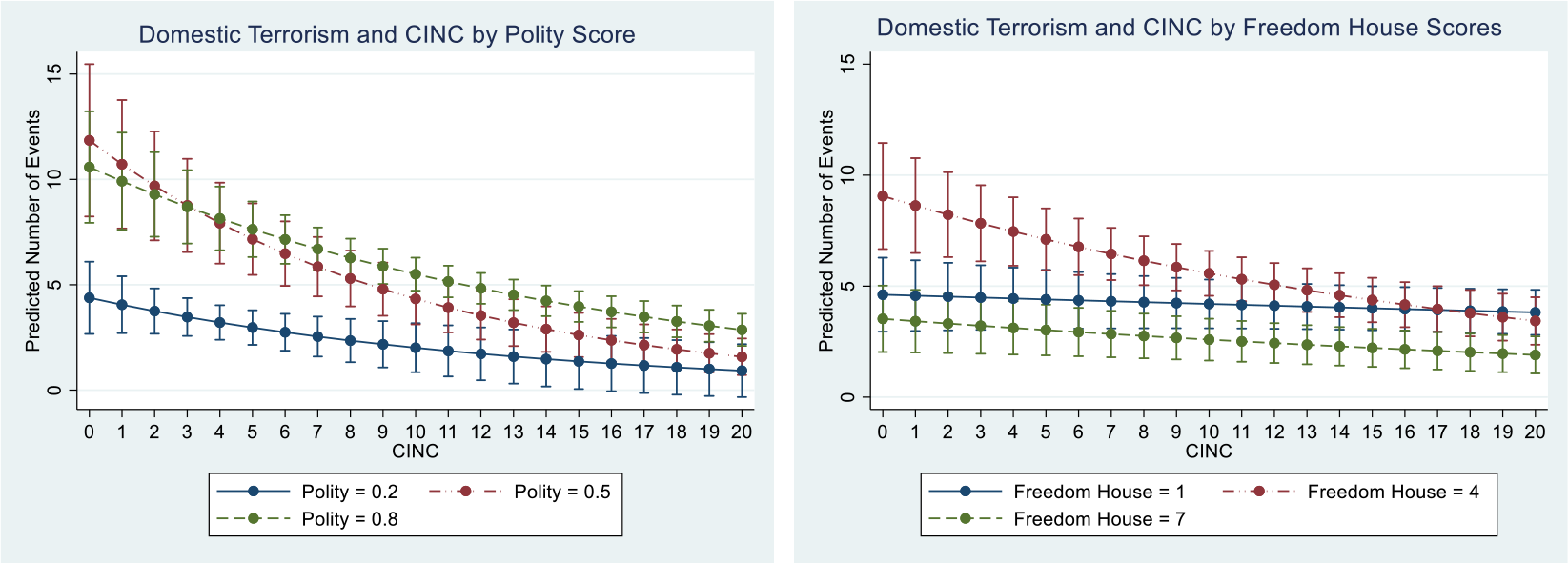
Pooled Poisson regressions also produce confirmatory evidence. Model 9 displays the coefficients of a Poisson regression that uses the Polity score as its measure of democracy. According to this Model, raising the CINC from ‘0’ to ‘20’ reduced the expected number of attacks by ‘10.271’ for ‘Polity = 0.5’, by ‘3.458’ for ‘Polity = 0.2’ and by ‘7.723’ for ‘Polity = 0.8.’ Model 10 uses the FH political rights score as an alternative indicator of democracy. Here again, the same pattern occurs. If the CINC increases from ‘0’ to ‘20,’ the expected number of attacks falls by ‘5.626’ for FH scores of ‘4,’ but only by ‘0.796’ and ‘1.626’ for FH scores of ‘1’ and ‘7.’ Figure 4 visually summarizes the results of the Poisson regressions. Finally, one could raise valid concerns about reverse causality. Notably, studies have argued that terrorist attacks could prompt the military’s involvement in politics (Aksoy, Carter & Wright, 2015; Bove, Rivera & Ruffa, 2020). If that is the case, terrorism could affect both of our independent variables (CINC and regime type) instead of the other way round. In an effort to address this concern, Models 1 and 2 in Table A1 of the Online Appendix lag the independent variables by one year. The results in Online Table A1 do not substantially vary from those of Tables III and IV.
Conclusion
‘Weak governments,’ argued the forty-third President of the United States, ‘are vulnerable to terrorist networks and drug cartels’ (Bush, 2002). The former United Nations Secretary-General Kofi Annan also argued that, because ‘terrorists exploit weaknesses,’ ‘building capacity in all States must therefore be the cornerstone of the global counter-terrorism effort’ (Annan, 2006: 15). Among policymakers, it is widely recognized that a state’s administrative and military capability to implement the government’s will critically affects the country’s vulnerability to terrorist threats. The literature on terrorism in its current state, however, mostly revolves around the issue of how regime types may affect terrorism. While acknowledging the relevance of regime type for the analysis of terrorist attacks, we sought to weave it together with the literature’s emerging academic interest in the state capacity variable. Specifically, our theoretical and empirical analyses demonstrate how state capacity determines RT’s relationship with DT.
In the theoretical section, we presented a formal game-theoretic model involving two players: a government; and a terrorist organization. At the intersection of the government’s best response functions and terrorist’s best response functions lies the equilibrium level of terrorist attacks. This equilibrium level of terrorist attacks, we argue, depends critically on both state capacity and regime type. In full democracies and full dictatorships, state capacity has little effect on the equilibrium number of terrorist incidents; in anocracies, state capacity has a strong negative effect on terrorism. Our theoretical argument was then empirically assessed using a series of negative binomial panel regressions upon a time-series cross-sectional dataset of no fewer than 108 countries from 1970 to 2007. According to the models, state capacity mattered most in ‘the middle:’ state capacity reduced the greatest number of expected terror attacks in anocracies compared to full dictatorships and democracies. While these empirical models do not directly test the AR mechanism, the findings lend consistent support to state capacitys theorized effect on terrorism. We encourage future studies to explore our proposed mechanism in greater detail.
Footnotes
Replication data

Acknowledgements
We thank Professor Andrea Ruggeri, Professor David Doyle, Professor Steffen Hertog, Professor Ben Ansell and Professor Nancy Bermeo for their feedback and advice.
Funding
The authors received the following financial support for the research, authorship, and/or publication of this article: This work was supported by the Ministry of Education of the Republic of Korea and the National Research Foundation of Korea (NRF-2021S1A5A2A0106994511).