




Abstract
Using a panel data set from Burundi where information on protection payments during the twelve-year civil war was collected, we test the relationship between payments, the nature of extraction by the rebels, and the welfare outcomes. We ask, “Does payment to rebels insure against future welfare loss and does the nature of payment matter? Specifically, does the level of institutionalization of extraction within the rebel governance structure provide a form of insurance for future welfare?” No less than 30 percent of the interviewees made at least one payment. Rebels extract these taxes through one of the following two routes: an “institutionalized” and regular cash-with-receipt method or an ad hoc and unpredictable labor extraction. Using matching methods, we find that payment through the institutionalized route increases household welfare between 16 and 25 percent. Ad hoc extraction has no effect. We situate our findings in the empirical literatures on contributions to mafia-type organizations and rebel governance.
In the context of war, weak states and civil unrest, payments to powerful groups—government forces, rebels, militia, and mafia—can be extorted or given over voluntarily in exchange for protection, or insurance, against a range of negative outcomes, including death. Furthermore, the nature of extraction of payments reflects structures and aspirations of territorial control of rebel governance, which can be ad hoc or institutionalized and sometimes accepted by civilians (Arjona 2008; Olson 2000). Whether effective protection is provided is a matter of debate, and a review of the literature on the subject suggests that payments can help for protection but are not a guarantee against negative livelihood outcomes.
Using a novel panel data set from Burundi where data on protection payments during the twelve-year civil war (1993–2005) were collected, we test the relationship between payments, the nature of extraction by the rebels, and welfare outcomes. In particular, we have two points of interest. First, does payment to rebels insure against future welfare loss? Second, does the nature of payment matter? That is, we are interested to see if the level of institutionalization of extraction within the rebel governance structure (proxied by predictability as opposed to unpredictability in extortion) provides a form of insurance for future welfare. While payment to rebels does not equate with the usual insurance market conditions, for an insurance market to function smoothly payments and risks need to be predictable in advance. In the same way, if rebels institutionalize a particular form of extraction, this is likely to have better welfare outcomes for the civilians than if the extraction is ad hoc. We are interested to test whether this relationship holds under conflict conditions. Olson’s (2000) work speaks to the other side of this coin; that is, does “mobility” of rebel governance structure (or rebel aspirations for taxation of population) determine the welfare outcomes for economies/societies at large? While intricately related, we are interested in the household-level welfare impacts. We provide a review of the rebel governance structure in Burundi as a way of contextualizing these outcomes. This is supplemented by qualitative evidence collected by the authors from key informants who had first-hand knowledge of the payment procedures during the civil war period. To the best of our knowledge, this is the first article to investigate, empirically, the linkages between the nature of rebel governance as reflected in type of extortion and household welfare outcomes during civil war.
We use standard ordinary least squares (OLS) models to investigate the relationship between extortion type and welfare. As a way to control for variation in the observable features of the households in our sample, we specify a model that predicts the determinants of extortion and then use this as part of an econometric matching design in order to establish the robustness of earlier findings. We find a strong and robust relationship between extortion and welfare, however, this relationship holds only for payments made in cash to rebels and not as extraction for forced labor. The reasons for this are likely to relate to several factors to do with rebel governance (or absence of): (1) the fact that cash payments were often given in advance before an act of violence, such as rebel attack, occurred; (2) such payments were often made regularly, in a predictable way whereby rebels would provide a receipt of payment; (3) labor was typically extracted in an ad hoc, unpredictable way and, usually at gunpoint; and (4) the socioeconomic characteristics of persons having cash extorted differ from those having labor extorted. In particular, persons owning an enterprise are more likely to make cash contributions to rebel groups. This means that rebels know whom to target, or in alternative wording, persons with this profile know that they have to contribute.
In this way, the institutionalized forms of tax (labor in this case) does not provide insurance for future welfare. These findings indicate that the nature of extortion and rebel governance within a conflict scenario is a critical determinant of welfare.
Our results resonate with Arjona’s (2008) theory of local orders within the context of civil war, highlighting that the greatest challenges and opportunities for peace, reconciliation, and reconstruction vary from place to place. Echoing the work of Olson, our work illustrates the codependence of the civilian population and the rebel movement, but fundamentally it shows how institutionalized forms of rebel governance (approximating Olson’s “stationary” bandits) have better outcomes for victims of extortion in terms of security and welfare than simple ad hoc punitive strategies (approximating Olson’s “roving” bandits).
Protection and Extortion: Literature Review
The literature concerned with protection payments is largely limited to the Italian (Sicilian) and Italian American Mafias, Russian Mafiya, and the Japanese Yakuza. There is also a small subliterature that discusses protection payments in developing countries. Noticeably, the effect that protection payments have on the welfare of the victims has received almost no attention. Instead, authors have concentrated on the history of protection payment organizations, the conditions that create a supply and demand for protection payments, and the operations of protection payment organizations. For purposes of this article, we review what the literature has to offer on (1) the nature of payment/extortion in terms of whether it is predictable or not and, relatedly, rebel governance and (2) the effects of payment and the nature of payment on welfare outcomes. Before this, a brief note of the distinction between extortion and protection payments is worth making.
A loose definition of how US Federal Law and Russian legal authorities define extortion is “the seizure of property with the knowledge and consent of the owner through the use of violence or the threat of violence” (Lotspeich 1997, 22). Theoretically protection payments differ from pure extortion in two ways. First, the definition for extortion omits the provision of protection to the owner. Second, although not clearly defined previously, there are cases in which payment is voluntary, for instance, in documented cases in West Darfur and Iraq (see Jaspars, O’Callaghan, and Stites 2007, 14; Williams 2009a, 160-61).
While the terms protection payment and extortion are often used to refer to the voluntary and involuntary nature of payment extraction, respectively, studies show that the two terms are often confused and ambiguous (see Gambetta [1993] for a case study of the Sicilian Mafia). The confusion between these activities means that distinction for purpose of analysis is difficult. For instance, Gambetta has shown that extortionists may be forced to provide protection or, as in numerous other cases, that the group receiving the payment may not be able to guarantee its customer’s safety. Here, we use the terms interchangeably.
The Nature of Extortion and Rebel Governance
While context specificity is critical, research shows that where institutions that exist to protect citizens (judicial system, police, military, etc.) are weak, there is an increased need for protection. In the context of war, protection often comes at a cost. The amount and the regularity with which the money or goods is extracted depend on the group extracting and the victim from whom they are withdrawing payment. Unlike many famous economists before him who believed that voluntary, mutually advantageous exchange ruled market relations, Olson (2000) recognizes the role that power, coercion, and force have in exchange relationships. In his famous book Power and Prosperity: Outgrowing Communist and Capitalist Dictatorships, Olson considers the role of power and the relation between governance and economic performance. Governance by a stationary bandit is more likely to support productive economic activity than governance by “roving bandits” because the former has an “encompassing interest” in maximizing output so that he or she can maximize his or her take from that output.
For instance, some evidence suggests that stationary bandits are able to institute protection systems, thereby cementing long-term regular revenue. In the case of migrant Chinese businessmen in New York City, the gang member demanding payment and the owner of a business negotiate the amount of money to be paid in order to prevent damage by the demanding gang or rival gangs. After the amount is negotiated, the business owner will pay regularly, whether it be on certain holidays, weekly, or monthly (Kelly, Chin, and Fagan 1993, 259, 261). In South Africa, members of the Mapogo a Mathamaga pay annually and their payment is based upon their status and the size of the business (von Schnitzler et al. 2001, 14). In Waro and Urdi in West Darfur, villagers paid the Janjaweed 5 Sudanese pound (US$1.5) per month for protection, while an Iraqi said that he paid US$13 per month to the local mahdi in order to avoid violence or kidnapping (Jaspars and O’Callaghan 2008, 11; Williams 2009a, 236). In Ottoman Gaza, protection payments to Bedouin tribes were legalized. The villagers benefited from the legal and regular payments, as the rules that were erected prevented contact with villagers, which could have resulted in the demand for further payments (Etkes 2007, 10).
There are a few cases, where victims are forced to pay what can be characterized as “user fees.” The military officers involved in coca trafficking require a US$5,000 protection payment for each planeload of Peruvian coca leaves or paste (Mason and Campany 1995, 162). In Somalia, West Darfur, and Iraq, people pay for safe passage on public roads (Vinci 2006, 9; Jaspars and O’Callaghan 2008, 14 and 11; Williams 2009a, 91; 2009b, 332). In West Darfur, pastoralists pay taxes as well as arbitrary payments of up to US$150 in order to access markets, while a person may be charged US$900 to take livestock to market with the protection provided by a military escort. Villagers in Abata were forced to pay for the use of camels if they wished to travel to Zalingei (Jaspars and O’Callaghan 2008, 14 and 11).
In some instances, businesses, rather than individuals or households, receive protection. In the Democratic Republic of Congo, Rally for Congolese Democracy—Movement for Liberation (RCD-ML) rebels “sold” insurances, technical notes, and discharge papers to businesses. In addition, by paying a fee to the rebels, businesses reduced or eliminated their taxes (Raeymaekers 2010, 9-10). A farm owner and other members of a cooperative in Beni-Lubero in the Democratic Republic of Congo pay the Mayi-Mayi one cow per month to pay for their protection (Raeymaekers 2010, 10). There are also cases where villagers pay through a combination of food and money in return for protection (Jaspars and O’Callaghan 2008).
All the examples mentioned earlier illustrate the various ways in which mafia or rebels establish and maintain governance structures that increase the probability of consistent and sustained extraction as well as citizen/civilian compliance. Sanín and Barón (2005) raise some pertinent issues in their analysis of the evolution of the Colombian, Puerto Boyaca’s paramilitary regime. Of relevance to this article is the question of how violence and repression constitute social order. Indeed, the Colombian paramilitary appeared as a punitive force, basically of the cattle ranchers and the narcotraffickers, but they soon discovered the need to govern, which entailed establishing new mechanisms to control the population. Similarly, Olson (1993) asks how criminality and the private provision of security are related? To Olson (1993) criminality was centrally important to rent extraction and the formation of the modern state whereby an elementary present value calculation shows that it is in the best interest of the bandit to limit his or her rent extraction, so as to give economic agents the opportunity to accumulate. Gradually, ad hoc extortions and rackets become taxes, the need to inspire fear is replaced by the need to control, and big organizational apparatuses appear. Stationary bandits were able to establish a monopoly on rackets and extortion, and at the same time offer them the opportunity of legitimizing through the provision of security.
Furthermore, Ana Arjona (2008) argues that in most contemporary civil wars the fight is about gaining territorial control rather than defeating a rival army in successive battles. This affects the ways in which armed groups relate to civilian populations: When the survival and success of armed groups depend on territorial control, civilian collaboration becomes crucial. Civilians can provide the armed groups with a wide range of valuable resources and endowments, including information, food, shelter, and labour force. Without these resources, armed groups can hardly survive, let alone maintain territorial control. Because civilian collaboration is so essential for armed groups, they have a clear incentive to behave in ways that render it. But collaboration is a complex matter. It may involve only a few occasional actions, or a long list of daily activities; and these behaviours can entail either mere obedience or endorsement. Given this heterogeneity, the effectiveness of violence is limited. If violence cannot bring about the different instances of collaboration that armed groups need from civilians, what is the alternative? Creating a new social order offers great advantages. By creating a new social order the group is able to influence civilians’ lives in ways that may, through different mechanisms, translate into obedience and endorsement. (Arjona 2008, 2-3)
So the nature of rebel governance, the degree in which it is institutionalized, and the collaboration between rebel and victim around the payment mechanism are all important in determining the welfare outcomes.
The Welfare Outcomes of Payment/Extortion
Noncompliance with the demands of the gang, rebels, militias, or mafia can lead to financial loss, property loss, injury, or death. Some groups inflict harm on the property owned by the person who is unwilling to comply (see Lynn [1993] for a review of welfare outcome associated with nonpayment in France under Louis XIV; Gragert [1997] for welfare outcomes in Japanese Yakuza protection racket; Williams [2009a] for description of injuries inflicted on unwilling “payers” in Iraq; and Mason and Campany [1995] for the punitive system of Sendero Luminoso in Peru).
In return for paying, businessmen, communities, and villages expect protection; however, only a few articles even mention the effectiveness of paying and the evidence appears to be entirely context specific. A US military officer, referring to the effectiveness of the militias, stated that “people count on the militias…. It’s like the mob—they keep people safe” (qtd. in Williams 2009a, 236). According to Reij Al Talata community leaders, who referenced the attack against the Katilingei village, the payment of protection money in Darfur is crucial to a village’s survival (Jaspars and O’Callaghan 2008, 14).
Even if protection is secured through payment, there are still consequences on the livelihoods to the individual or community paying protection. Although all victims experience a loss in money or goods, the impact on livelihoods is not widely discussed. Jaspars, O’Callaghan, and Stites (2007, 15) point to the short-term effects, such as loss of income, that paying protection money may have on individuals and communities, but they maintain that what is garnered in long-term benefits, such as retaining access to land or mobility, may be beneficial. In the case of migrant Chinese businessmen in New York City, the authors contend that money taken for protection was only mildly parasitic, while the cost for not paying was far greater (Kelly, Chin, and Fagan 1993, 263).
Moreover, paying a group money to protect against an attack does not necessarily ensure that other forms of violence will not be committed by the group against community members. Williams (2009a, 157) summarizes this predicament well in stating “protection and predation are two sides of the same coin.” In his discussion of protection in the Democratic Republic of Congo, Raeymaekers (2010, 10) notes that rebels proceeded in a reign of terror on the same villages they were being paid to protect. During the 2002 massacre in Kariobangi, people of the local community stated that although the Kenyan Taliban was charged with protecting them, they were “terrorising residents instead of protecting them” (qtd. in Anderson 2002, 532). In other words, payment does not guarantee protection, however, in many documented cases it does increase the likelihood that you will be spared from negative outcomes.
From the available literature, we see that there is much description on the nature of protection as set up through mafia and rebel governance structures, with references to predictability and regularity of payments, and some description on the linkages between extortion and protection. Absent is any analysis, in particular empirical work or evidence of how extortion, or the nature of rebel extortion, relates to outcomes for the victims. In the following analysis, we attempt to provide an empirical analysis of how institutionalized systems of extortion are able to insure against negative outcomes and even provide the basis for positive welfare returns, as compared to nonpayment or ad hoc extortion. We develop some testable hypotheses for protection/extortion and welfare. We first discuss the case of Burundi and identify the relevance of the literature to this case.
Conflict and Extortion in Burundi
A Short Political History of the Conflict
Burundi has, until recently, been involved in long and a brutal civil war that left hundreds of thousands of people dead, maimed, or displaced. Massive bloodshed took place in 1972, where the armed forces slaughtered between 80,000 and 200,000 (mostly wealthy and intellectual) Hutu. In 1988, responding to a similar uprising in the Ngozi and Kirundo provinces where several thousand Tutsi were killed, “peace” was restored by the government forces killing 20,000 Hutu (Human Rights Watch [HRW] 1998). Although no formal investigation into the 1988 massacres was allowed, President Buyoya sought for means to reconcile Hutu and Tutsi rather than controlling the Hutu majority by repression. Several Hutu were appointed to government positions.
Many Tutsi, however, viewed loss of ruling power and the resulting massacres in neighboring Rwanda as a warning sign for what would happen if they started sharing power with the Hutu. They therefore resisted Buyoya’s reforms with unsuccessful coups in 1989 and 1992. Despite internal opposition, elections were held in 1993 and on July 1, Melchior Ndadaye became Burundi’s first Hutu president. The newly installed president made important changes in the local administration and planned to reform the almost exclusively Tutsi army to increase ethnic and regional diversity (HRW 1998).
The attempts to reform, however, ended brutally with the killing of Ndadaye in October 1993. The eruption of Hutu-led violence following the killing of the president was retaliated by massive indiscriminate violence by the government forces. HRW (1998, 20) reports, “The army responded with clashes on Hutu making no distinction between communities involved in violence against Tutsi and those that were not. In a period of only a few weeks anywhere from 30,000 to 50,000 people were slain, roughly an equal number from each ethnic group.” Uvin (1999, 262) elaborates: “On October 21, 1993, low-level soldiers killed President Ndadaye and other dignitaries after only three months in office, with at least passive support from the highest levels of the army.”
In subsequent days and weeks, thousands of Tutsi were brutally killed, especially in the north and center in a campaign led by local Hutu politicians. The army moved in to restore order, killing thousands of Hutu in the process. In total, it is estimated that 50,000 to 100,000 persons were murdered in the three months after the coup, one million fled the country, and hundreds of thousands were internally displaced. The scope and intensity of the violence was unprecedented and resulted in a gruesome civil war that lasted sixteen years, leaving the country and its citizens in ruins.
Rebel Governance: Extortion without Service Provision
The civil war in Burundi was a low-tech war in which physical strength, rifles, and machetes were the most important assets of the warring parties. Civilians paid heavily for the war: many people were killed, kidnapped, or displaced. Women were raped, houses destroyed, cattle stolen, and trees burned. Importantly for the topic of this article, civilians were forced to contribute to the war effort, either by paying contributions, cotisations, in cash or by having support extracted in kind.
The cycle of violence followed a typical pattern: a warring faction would attack an army post or a symbol of government power in a specific locality after which the army would use disproportionate force to retaliate against the population of that locality. The army considered the population as supporters of the rebels wherever an attack was launched and the rebels considered the population as the base from which to operate. The army and rebels shunned open large-scale battles and preferred to rob and punish the civilian population instead.
Burundi’s hilly terrain and dispersed population make it almost impossible for the army to control the entire territory. It was relatively easy for the rebels to hide in, or retreat to, the forest or to move at night through the fields and swamps. Warring factions had their local support bases among the population, most fighters were the sons of Hutu peasants who joined the ranks of a rebel faction, whereas young Tutsi men would join the army. This does not mean, however, that all peasant families were ready to give even more support in terms of labor and cash. They had already “given” their sons and in some cases their daughters to the rebel group and were too poor to contribute more. The remaining male and female labor was needed on the farm as well as in the household together with the few livestock owned and the meager cash resources.
Since rebels have to eat, need money to buy weapons, and need labor to carry food and weapons, they would “extract” labor and demand cash contributions from civilians who did not volunteer this kind of support or did not want to give any kind of support at all. Our article focuses on this kind of forced contributions in cash as well as in kind. Different types of contributions were required. One typical pattern took the form of small groups of rebels that would stop buses passing through their territory and ask all passengers to get out of the vehicle and steal their valuables such as watches, earrings, rings, shoes, and money. From the point of view of the victim, this type of “extortion,” while always a possibility, was irregular and unpredictable in terms of timing and the actual resources extorted. Able-bodied men and women were not only robbed of their belongings, depending on the needs of the day but also forced to follow the rebel group and carry food, clothes, luggage, and ammunition. These men could be held in captivity to perform labor tasks as long as the rebels deemed necessary. In extreme cases, when tensions ran high, for example, because of recent political events, bus passengers could be executed on the spot. 1
Another form of extortion was in the form of “home” visits where the resident was asked to contribute money. This was a regular occurrence. One of the authors held in-depth discussions with well-informed persons upon several research visits to Burundi between 2011 and 2013 on rebel taxation and rebel governance during the civil war. It became clear from these discussions that the rebel movements systematically collected contributions from the population in the area under their control. Every month, each adult in the area was visited by a representative of the rebel movement to collect a tax. The level of the tax depended on the occupation and the perceived income of the resident. Persons with a salaried job had to pay more than ordinary farmers. Upon paying the contribution/tax, one received a receipt that proved that you paid your contribution. Next to the monetary payment, rebels would also ask for food, for example, a small animal like a goat or even a cow. They did not take all of your assets or belongings. If you had four goats, for example, they would request one. And a few months later, they would come back to ask another one. Asked by the researcher if the population received something in return for these contributions, the answer was always negative; that is, the rebel movement did not provide any services. When they would intervene in conflicts between neighbors, for example, on land issues, it could hardly be called justice, it was more about settling scores and denouncing other people. The researcher then asked if the “service” the rebels offered may have consisted of the absence of pillaging, in the sense that once you paid your contribution, you were left alone. This was confirmed by all the interviewees. One interviewee told the story of a large cement company in the capital whose owner approached the rebel leader to make a payment per truck of cement in a large road building project. After agreeing on the payment, the two sat together and shared a glass of beer, a sign of collaboration and friendly relations in Burundi.
The receipt which counted as proof of one’s contribution was particularly useful in the case of traders or entrepreneurs who have to transport goods across municipalities or provinces. When stopped at roadblocks by rebels, the trader was asked to show this receipt upon which he or she could carry on with his or her business. This was also the case for a passenger who was able to show such receipt when his or her bus was ambushed: he or she was left alone. The practice of writing receipts for contributions to the coffers of a rebel faction was also implemented on trucks transporting goods. A driver passing through a rebel-held territory had to show his or her receipt before being allowed to pass through. When he or she did not have it, he or she was asked to pay on the spot, receive a receipt, and was then allowed to continue with the journey.
This practice of collection of contributions shows the extent to which rebel factions implemented, and institutionalized, a tax administration in their territory. One could then ask what kind of protection (or services) was provided by a rebel faction in return for such tax collection? And did these payments really provide some insurance to civilians against future negative outcomes? Civilians may indeed be ready to contribute if they know that social or other services are provided by the collector. This is particularly the case for collective goods such as security, schools, hospitals, or roads. Rarely, however, did the rebel factions have complete control over an extended area for a prolonged period, say, several years. 2 As we described previously, these armed groups were mobile and moved the war theater from province to province. As a result, they did not invest much in taking over the role of the state in the provision of collective goods such as health centers and schools. One obvious exception, however, was the collection of taxes. In the areas where armed rebels were operating, the government of Burundi was unable to provide security to the civilians as the rebel faction had broken the monopoly of violence. The ability to extort or tax civilians was therefore in the hands of the rebel faction. As described in the work of Arjona (reviewed earlier), while services were not provided, the rebels relied on the civilians for medium-term provision of funds, food, and supplies. In return, the civilians were not robbed from all of their belongings and were not attacked until the next round of tax collection.
Before we develop our model, it is worth repeating our main research question, do contributions of civilians to the rebel faction provide protection/insurance against negative outcomes? In other words, when a civilian contributes in cash or in kind, does that mean that he or she and his or her family will not fall victim to attacks, assaults, property destruction, rape, torture, or theft? We can broaden this question to welfare effects in general, do civilian payments protect civilians from experiencing negative shocks on household welfare? Moreover, does the institutional arrangement of the extortion affect the outcome?
We end our description of the (absence of) rebel governance and taxation in Burundi with the formulation of several hypotheses that will be directly tested with the data we were able to collect.
Given the Burundi war context of high levels of violence, civil war, and extortion, we would expect people to pay the extortion money (a tax) and for these people to have better outcomes. In the Online Appendix, we develop a simple model of extortion from the viewpoint of a typical citizen confronted with a rebel faction. The model is based on the perception of the citizen with regard to the efficiency of the rebel movement. If the citizen believes his or her nonpayment is unlikely to be detected, he or she will not pay the tax. 3 We face a selection problem if many people who didn’t pay the bribe were killed in response to nonpayment. The attrition analysis in the Online Appendix shows that this is not a significant problem for our data analysis.
The Burundi Household Priority Survey 1998 to 2007
The data we use in this article consist of a panel with two data points over nine years, 1998 and 2007. 4 In 1998, the World Bank and the Burundi Institute of Statistics and Economic Studies (BISES) conducted a nationally representative general-purpose household survey to analyze living standards. For this survey, 3,908 rural households were interviewed (Household Priority Survey 1998). We designed the 2007 Priority Survey (henceforth PS07) as a follow-up to the 1998 Priority Survey (henceforth PS98). Due to budget limitations, it was impossible to try to track and resurvey all 3,908 rural households (391 survey sites) included in the PS98. Therefore, we decided to randomly draw 100 of the 391 baseline sites with the purpose to track and resurvey all 1,000 original (1998) rural households in these sites. 5 We trained sixty-five interviewers during a one-week training during which we improved the questionnaire. The questionnaire was pilot tested in an out of sample village and final corrections were made. The interviewers were instructed to track and reinterview, within each hill, the ten original households. Overall we managed to locate and reinterview 874 of the 1,000 selected households. The supervisor of each team of interviewers undertook a community-level survey in which he or she asked questions on infrastructure, history, population, attacks, and war-related violence.
In a module in the questionnaire on violence-related shocks and their consequences for households and individuals, we asked our interviewees if they had to perform forced labor for the rebel movement and if they were asked to pay contributions to the rebel movement. The latter is known in Burundi as cotisation and can be in cash, in kind, or by providing physical labor. If an interviewee told that he or she had to perform physical labor, we also asked him or her the number of times this occurred between the first round of the survey (1998) and the second round (2007). If the interviewee contributed in cash or in kind, we asked for the total value (in Burundese franc) of his or her contributions over the nine-year period. 6 One limitation of the data set is that we only have the number of times the person was extorted (as well as the amount in the case of cash), but we do not have the exact timing of each act of extortion.
Descriptive Results
In this section, we provide some data to illustrate the patterns of payment. As shown in Table 1, 70 percent of the sample did not incur any type of extortion over the nine-year period (1998-2007). 7 From the 30 percent who report having been extorted by paying contributions in cash or through forced labor, 23 percent of the sample had made regular payment of cash to the rebel groups and 14 percent had to provide labor; 6.6 percent had provided labor alone and around 16 percent had provided contributions in cash only. A substantially higher proportion of females reported no extortion (81 percent as opposed to 67 percent of males).
Type of Extortion by Gender of Household Head (Sample Size and Mean).
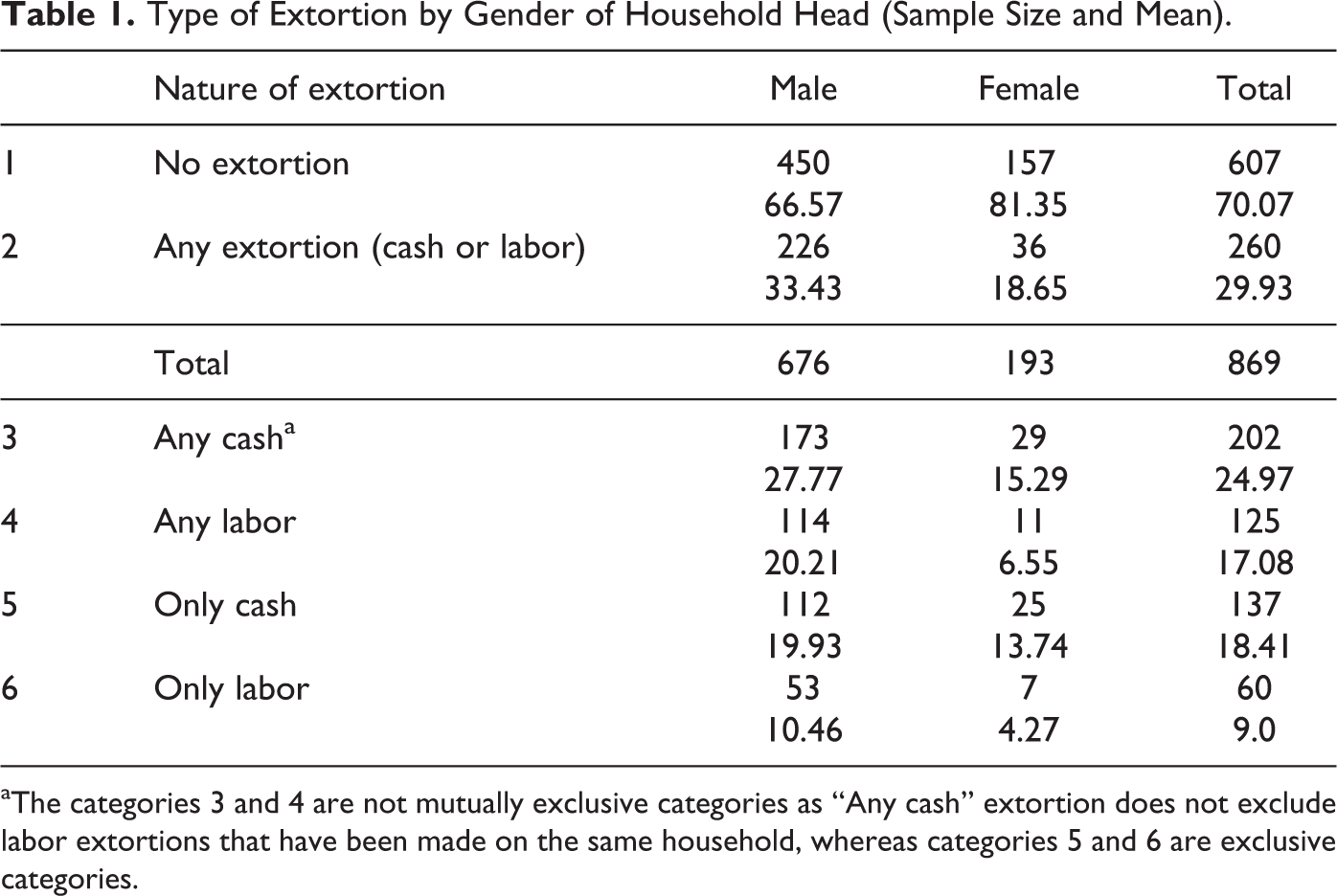
aThe categories 3 and 4 are not mutually exclusive categories as “Any cash” extortion does not exclude labor extortions that have been made on the same household, whereas categories 5 and 6 are exclusive categories.
For purposes of exposition and analysis, we are interested in understanding the insurance function of extortion, and in particular cash payments as opposed to nonpayment and forced labor extraction. We use cash payments to proxy for regular and institutionalized “insurance” extortion and forced labor to proxy for irregular and unpredictable extortion. First, we analyze whether extortion of any kind has a significant and positive effect on welfare, as compared to nonpayment. We then disaggregate this analysis by the nature of payment. Table 2 provides statistics that allow us to compare the different characteristics of the groups that are extorted in different ways.
Characteristics of Different Groups.

The data provided in Table 2 give insight into the profiles of households that paid some kind of extortion. In terms of the change in expenditures over the ten-year period (consumption_07 − consumption_98), the unconditional mean shows that the change has been positive for all categories except the labor-only payment (column 7). The change has been significantly larger for those being extorted (column 2) versus those not being extorted (column 1). This may point to evidence of an insurance function related to extortion. Disaggregated by extortion type, we see that the positive change is dominated by those households who have paid cash, not labor. In fact for those household who have had labor forcibly extracted, we see a negative change in welfare (column 7). This also suggests that our hypotheses on regular and “institutionalized” payments (Hypothesis 3) are more likely to perform an insurance function than random and unknown extraction of labor.
The data also suggest, as expected, that observable characteristics are likely to predict extortion type. For instance, elderly people are less likely to be extorted on both counts (cash and labor). Female-headed households are less likely to have extortion (81 percent vs. 67 percent of male-headed households). Education is not obviously related to extortion. Higher levels of land, assets, and enterprise ownership are also correlated with extortion, providing support for the link between socioeconomic profile and extortion (Hypothesis 4).
Welfare Results
In this section, we use econometric methods to test whether extortion has “welfare”/protection effects as opposed to no extortion. We also test whether the type of extortion matters for welfare outcomes (measured in terms of current consumption and changes in consumption over the nine-year period). We first use a simple OLS linear specification:
where C is the consumption in year 2007 or 1998 measured in adult equivalents for person i residing on province j, E is a dummy variable capturing whether or not the individual was extorted in the period between the two survey rounds (with different dummy variables for each type of extortion), α2 is our coefficient of interest, Z is a vector of individual-, household-, and community-level characteristics (age, sex, and education of the head of the household; three types of assets as well as the number of deaths and wounded from violence), δ is the province fixed effect, and ∊ is a random, idiosyncratic error term.
The results are presented in Table 3. We use changes in consumption per adult equivalent between 1998 and 2007 as our dependent variable. We include consumption at baseline, our extortion dummy variable, and a set of characteristics as in equation (1). Province-level fixed effects are included in the specification. We performed the same regression (results not shown) with consumption in 2007 as dependent variable and reached the same results (apart from the coefficient on consumption at baseline).
Ordinary Least Squares Estimation Results for the Effects of Different Extortion Types on Changes in Welfare, 1998–2007.
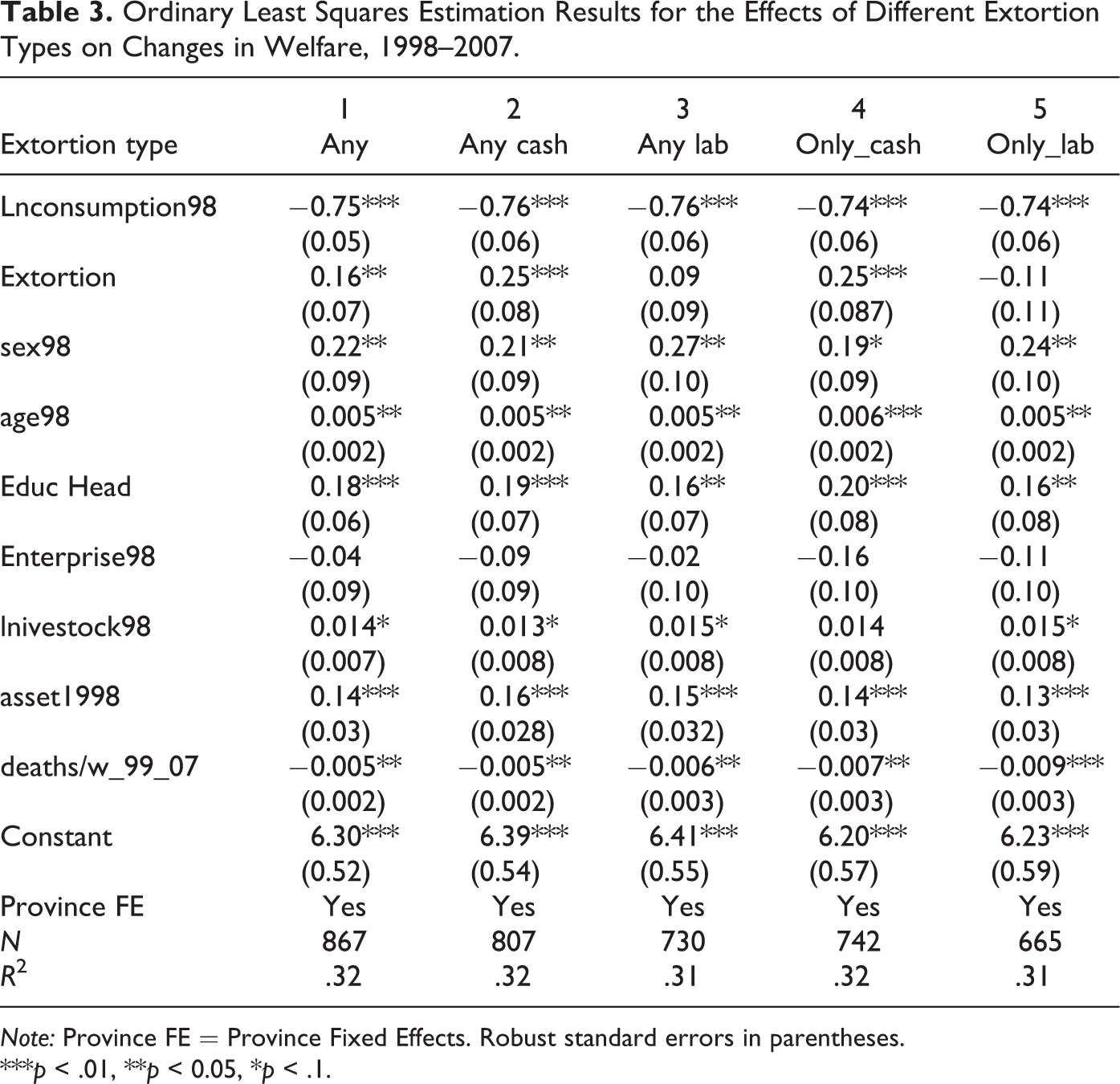
Note: Province FE = Province Fixed Effects. Robust standard errors in parentheses.
***p < .01, **p < 0.05, *p < .1.
The following three results from this regression, while not surprising by themselves, nevertheless, buttress the confidence we have in the quality of the data exactly because they confirm what other researchers have found: (1) the coefficient of consumption at baseline is negative and statistically significant at the 1 percent level, echoing the well-known convergence result in other panel data studies; (2) the effect of violence (measure as number deaths and wounded in the village) on consumption growth is negative and statistically significant at the 5 percent level and (3) the effect of education is positive and statistically significant at the 1 or 5 percent level depending on the specification. These established results may give some confidence to the other results obtained in table, most notable the coefficient of interest, α2, on the variable extortion, which is positive and statistically significant in three of the regressions, always involving cash payments. Also notice the positive effects of age at baseline and of having a female head of the household at baseline on changes in consumption over the conflict period. Higher initial asset holdings also predict positive and significant changes in welfare.
The welfare results derived from OLS estimation only make sense in the absence of a selection bias. It is, however, unlikely that the latter is absent. More specifically, the rebel groups may know whom they have to extort/tax because there may be some observable indicators of wealth, such as doing business of asset holdings. This means that it is necessary to deal with potential selection effects in our welfare estimation. We do that by first performing a probit analysis to explain the determinants of forced contributions, for cash as well as for labor, and subsequently employ matching methods to estimate the effect on welfare.
We use propensity score matching (PSM) and not instrumental variables (IVs) as in PSM the same observables are used in the selection equation as in the outcome equation. We believe this setup corresponds best to the reality on the ground. Those observables that determine whether or not a person is singled out for extortion are very much the same variables that determine your welfare. In fact, “observables” can be understood here not only from the perspective of the econometrician—as in current practice—but also from the perspective of the rebel movement. Rebels and their local aides indeed single out persons to pay tax, much in the same way as the government taxes people on the basis of their income/welfare. In an IV approach, on the other hand, we would face difficulties with the exclusion restriction. We would have to find a variable that is correlated with extortion but not with income/welfare, or in other words, a variable that only affects welfare through the extortion channel. We argue however that most (if not all) variables we can think of affect both. Hence, our preference for PSM is above IV.
The matching approach originated from the statistical literature and shows a close link to the experimental context. Its basic idea is to find in a large enough group of nonparticipants who are similar to the participants in all relevant pretreatment characteristics X. That being done, differences in outcomes between this control group and those of the participants can be attributed to the “treatment,” in our case the extortion (we refer to Caliendo and Kopeinig [2005] for full treatment of this method). Since conditioning on all relevant covariates is limited in the case of a high-dimensional vector X, Rosenbaum and Rubin (1983) suggest the use of balancing scores b(X), that is, functions of the relevant observed covariates X such that the conditional distribution of X, given b(X) is independent of assignment into treatment. One possible balancing score is the propensity score, that is, the probability of participating in a program given observed characteristics X, which we will use.
In our particular case, PSM involves estimating a binary treatment model (in out case a probit model) that predicts the probability of each household being targeted for one of the five types of extortion as a function of observed characteristics. The variables included in the analysis are those that influence simultaneously whether a household is involved in extortion and the outcome of interest, which is increased consumption/welfare. We use STATA command pscore to identify the matching in the subsequent results.
The results of a probit extortion model are shown in Table 4 (province fixed effects were used but for presentational purposes are not reported here). Younger people are significantly more likely to be extorted under any form than are older people. Males are significantly more likely than females to be extorted under all categories except for cash only. Education does not predict probability of extortion. In this way, observable characteristics of individuals and households predict extortion. Looking at the enterprise variable, we see that those households owning an enterprise in 1998, they were significantly likely to be targeted for cash extortion than those with no business enterprise. Enterprise ownership does not predict labor extortion (again supporting Hypothesis 4).
Probit Estimation of the Determinants of Extortion.
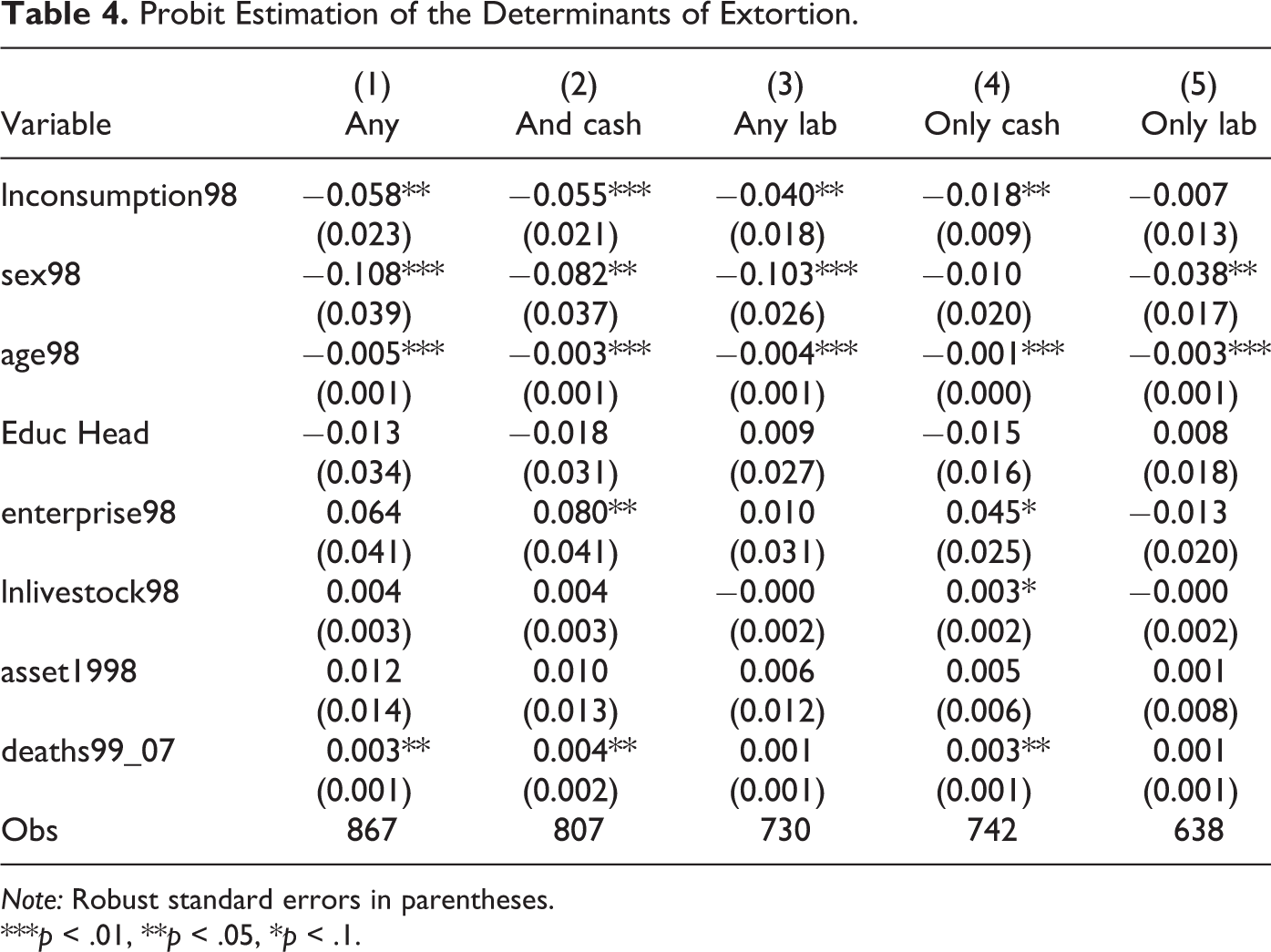
Note: Robust standard errors in parentheses.
***p < .01, **p < .05, *p < .1.
The negative effect of consumption on the probability of being extorted is surprising, even after controlling for enterprise ownership and other characteristics. We expected a positive sign here. It may be an indication that the rebels operate in a similar way as the Chicago mafia in taxing the production of pasta, to wit taxation not based on the consumption of the factory owner but on his or her production, production capacity, or his or her assets. It could also mean that poor people are targeted because they are easier to extort, with low levels of consumption signaling powerlessness.
The effect of violence varies depending on the type of extortion, that is, households residing in areas of high violence are significantly more likely to have cash extortion than households in less violent areas. Labor extortion is not related to the level of violence in the area, implying that households in any area are equally likely to have labor extorted. We are not able to distinguish the chronology of taxation and violence as we do not know which came first. Note, however, that most of the violence in our data set occurred in the first few years (1999, 2000, and 2001) of the period under study, making it unlikely that taxation preceded or indeed explains the occurrence of violence. Violence and taxation are consistently and positively correlated across the five regressions.
Moving to the results of the matching methods, we first need to test the probit model specification for equality of the mean and standard deviation of the observed characteristics across extorted and nonextorted households. The test is called the balancing propensity tests (Rosenbaum and Rubin 1983; Heckman, Ichimura, and Todd 1997; Dehejia and Wahba 2002). The next step in the PSM involves testing the “match.” This means using the propensity scores estimated in the first instance to identify the nonextorted that compares to the extorted (i.e., with the closest propensity score values) using the “nearest neighbor” algorithm. If a matched sample can be obtained then it is possible to estimate the impact of extortion/taxation on the household’s consumption (welfare).
Our results indicate that the balancing property is satisfied for all five model specifications for the extorted versus nonextorted. The number of households in each of the six blocks of the propensity score is shown in the Online Appendix. So, for instance, for the first model—any extortion versus nonextortion—we see that for the lower bound of the propensity score (0 probability of being selected into extortion) we have households that are comparable and whose characteristics satisfy the balancing property—207 nonextorted directly comparable to 21 extorted—and so on. This comparability is confirmed by looking at the distribution of the propensity score according to extorted and nonextorted households (see figures in the supplementary tables). Again, for the first model, for households who are extorted we can see that the propensity score distribution is more of a normal curve than for the nonextorted, however, there is substantial overlap implying that there is an adequate common support to enable us to predict the effect of extortion on welfare using matching methods.
Using matching methods, Table 5 presents the effect of extortion in the 1998–2007 period on welfare in 2007, taking account of the selection effect considered previously. As in the case of the OLS estimation, we find that extortion has a positive and statistically significant effect on welfare, suggesting an insurance or even welfare improving role of cash payments (supporting Hypotheses 1 and 2). Having cash extorted by the rebel group is associated with an increase of between 16 and 25 percent in adult equivalent consumption depending on specification. On the other hand, extortion under the form of forced labor contributions does not have an effect on future welfare.
ATT Results from Matching Methods.
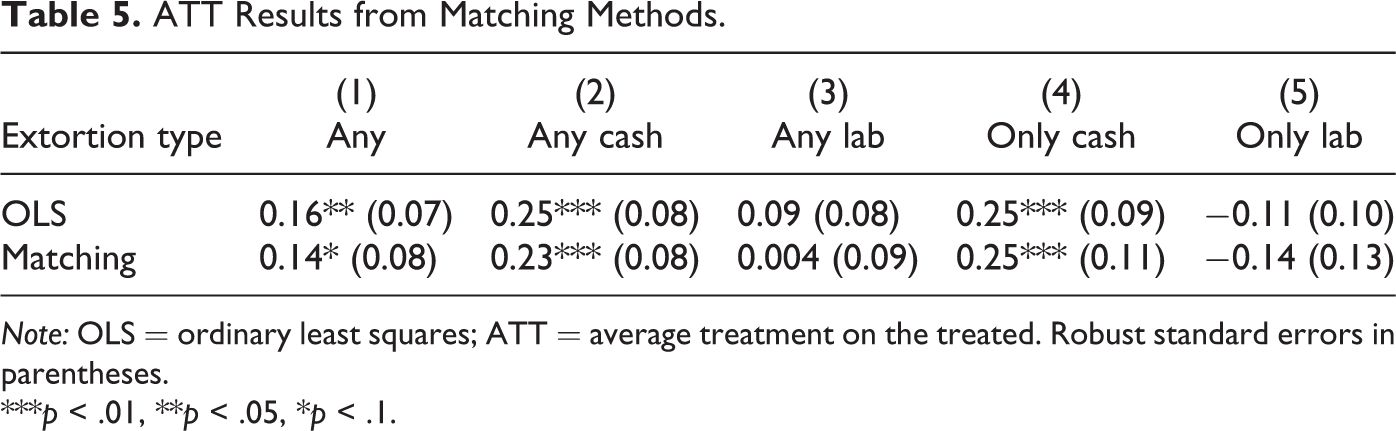
Note: OLS = ordinary least squares; ATT = average treatment on the treated. Robust standard errors in parentheses.
***p < .01, **p < .05, *p < .1.
Robustness Analysis
Unobservables
One may be concerned that selection into extortion is driven by unobservables. In that case, the extortion variable in the welfare analysis partly captures such effect. In order to address this concern, we apply a method proposed by E. Oster (2013; NBER and University of Chicago). She writes that we can learn something about the effect of unobservables on the coefficients of interest when looking at the inclusion of additional observables combined with the movement of the R 2. This is the case under the assumption that selection on observables is proportional to selection on unobservables.
Oster (2013) wrote a STATA command ‘psacalc’ (proportional selection assumption) to calculate delta (δ), the degree of proportionality between the observed and the unobserved variables. If δ = 1, this means that the observed and the unobserved have an equally important effect on the coefficient of interest. We compare the coefficient of our extortion variable in a model with and without observables and calculate the δ. With one more assumption to make, on the maximum value of R, we can compute β*, which is the value of our coefficient of interest corrected for bias attributable to the unobervables: In a regression without observables, β = .13 and R
2= .003. In a regression with observables, β = .16 and R
2= .32.
The psacalc command allows us to calculate delta in this instance, and we find δ = 0.4. This already indicates that the unobservables have less effect on our coefficient of interest than the observables. From this, we can calculate β* using the formula in Oster (2013, 9):
whereby β′ and R′ stand for the coefficient and the R
2 from the regression without observables and
Growth at the Province Level
One could be concerned that province-level growth trajectories may be responsible for the observed effect, rather than the extortion mechanism. We test this possibility by including province-level growth rather than province fixed effects in our analysis. We first remark that over our entire sample, growth of household-level consumption is negative, from 8.63 (in logarithms) to 8.52. This is the first indication that there has not been postconflict growth in Burundi at the time of the survey (2007). In effect, growth is negative in six of the twelve provinces in our sample.
When we include province-level growth as a regressor instead of province fixed effects, the coefficient of the extortion variable increases from 0.16 to 0.18 (for any extortion) and from 0.25 to 0.26 (any cash). The coefficient of household consumption at baseline increases from −0.75 to −0.63. This means that province-level growth trajectories cannot account for the effect we observe on extortion. Since they are much more specific in the effect they capture compared to the province fixed effect, these growth trajectories reduce the effect of household consumption at baseline somewhat, which is entirely plausible.
An additional concern may be that the extortion variable is picking up effects of economic recovery if regions with higher recovery coincide with regions with more extortion. Subsequently, we present a graph that plots the province-level growth 2007 to 1998 against the probability to be extorted (any extortion). It can be seen visually that there is no relationship. We also computed the Pearson correlation coefficient, which is .01 and which is not statistically significant using the usual thresholds. For completeness, we have performed the same analysis at the village level, and we found a correlation of −.09 which was not statistically significant either at the usual thresholds. Figures 1 and 2 show the scatter plot, and one can visually observe the absence of a relationship.
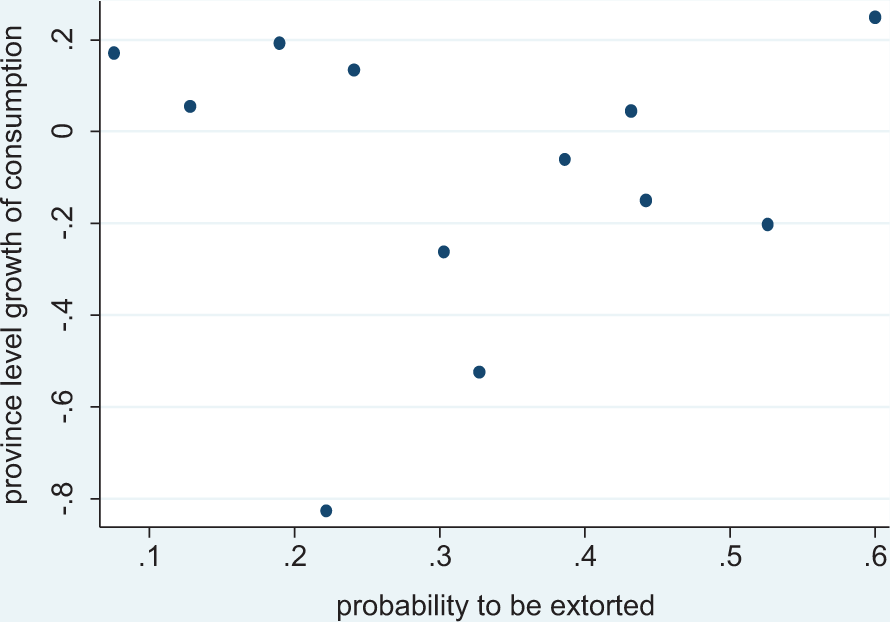
Consumption growth and probability of extortion—province level, 2007–1998.
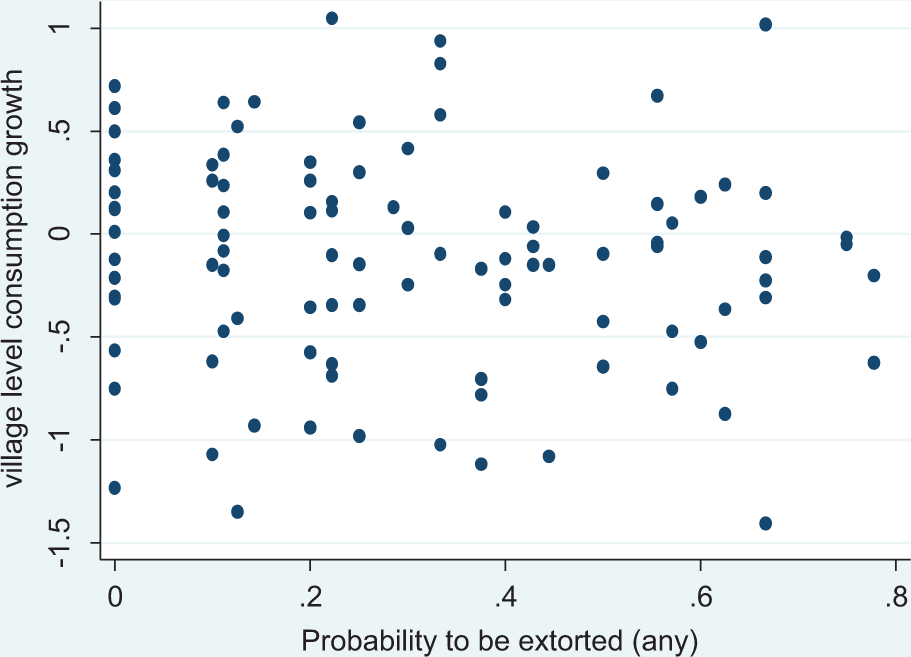
Consumption growth and probability to be extorted—village level, 2007–1998.
Extortion (for pay and for labor) occurs in all provinces, with on average one-third of the sample affected by at least one form of extortion. While certain provinces (such as Cankuzo, Cibitoke, and Kayanza) are particularly targeted for extortion, we do not find a correlation between the growth of welfare at the province or commune level and the probability to by extorted. Hence, we believe that the extortion variable is not picking up a local growth effect. The sum of these tests provides confidence that the extortion variable is picking up the intended effect and that its coefficient is statistically significant at the usual thresholds.
Pre-1998 Violence and Convergence
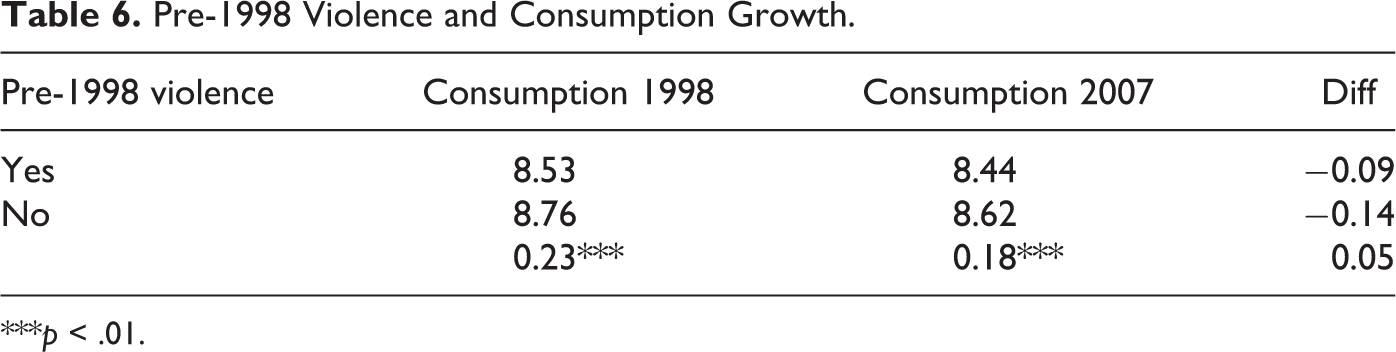
Households affected by pre-1998 violence (captured by the number of death and wounded in their village from 1993 to 1998) have lower consumption at baseline (1998) than nonaffected households (see Table 6). This could indicate that this lower consumption is the result of presurvey violence, after which a recovery to prewar levels could follow (convergence) that is not related with extortion. We notice that consumption at end line (2007) is also lower in the areas affected by pre-1998 violence. The reduction in consumption in 2007 in the pre-1998 affected areas is less than that in the nonaffected areas, hence the effect is less negative, but the difference between the two (difference in differences) is not statistically significant at the usual thresholds. Hence, this cannot account for the positive effects we observe from the extortion variable.
Pre-1998 Violence and Consumption Growth.
***p < .01.
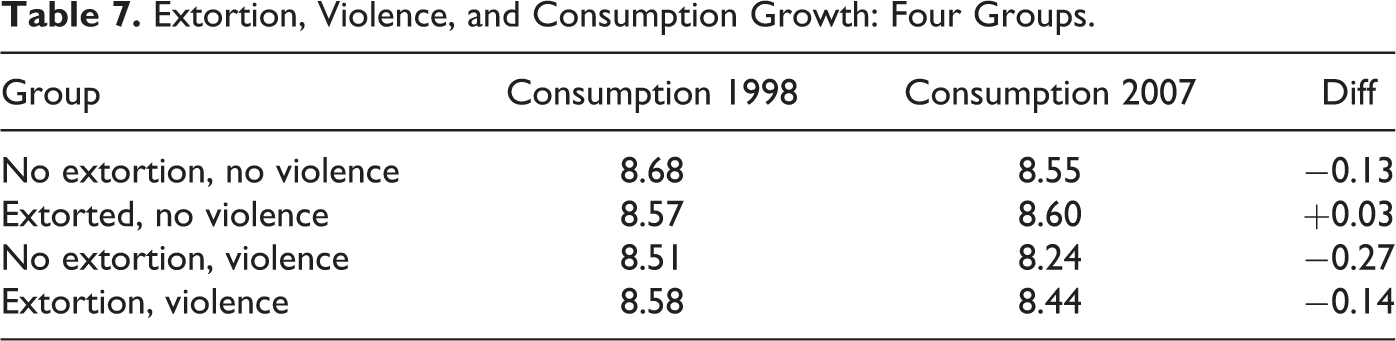
In order to verify if the result can be explained by postwar growth or convergence, we show an additional table with four groups of households: (1) those not affected by extortion (household level) or by civil war (village-level death and wounded 1993–1998), (2) affected by extortion (any type) but not by civil war violence, (3) not extorted but affected by village-level violence and (4) affected by both. Table 2 shows the welfare change in the four groups. Only group 2, the extorted group, has seen its welfare increase, while the three other groups saw their welfare decrease.
Peace/Stability
One may be concerned that is it stability rather than extortion in rebel held areas that explains our result. If we proxy stability by the absence of deaths and wounded from civil war (which is the violence variable in our article), then we already control for the effect of stability in our analysis. Stability indeed has a positive effect on consumption growth, but it does not capture or diminish the effect of extortion.
Conclusion
This is an empirical article that allows us to test for the linkage between taxation in the form of extortion payments in a war context and household welfare outcomes as well as the nature of the payments in relation to outcomes. We show that a person’s socioeconomic profile determines his or her likelihood to fall victim to one or another type of rebel taxation. We also find that payments in the form of cash (a regular, institutionalized form of payment that we use as a proxy for “stationary rebels”) increase household welfare by between 16 and 25 percent. Extortion in the form of labor (a proxy for ad hoc payments and “roving rebels”) does not have a welfare-enhancing effect. These findings tell a story about rebel governance in times of conflict, suggesting that where rebels have some legitimacy and rebel taxation is institutionalized within the governance structures, civilian populations may be provided with extra-legal security that can ultimately enhance their welfare. Whether their welfare would have improved in the absence of conflict is not something that we can test here. Conflict is not a randomized control trial (RCT)! Table 7, however, shows that conditions in Burundi deteriorated over time, even for those not affected by conflict or extortion. It is clear that relationships between extra-legal actors and civilians in times of war may actually be mutually beneficial, a result that supports Arjona’s conclusions. Our results suggest that the extent of institutionalization of the extortion appears to be critical in obtaining a positive result. Regular and predictable extortion is more likely to insure positive outcome than unpredictable extortion, which, on average, has a welfare-reducing outcome.
Extortion, Violence, and Consumption Growth: Four Groups.
The work by Sanin and Baron and Olson (as reviewed earlier in the article) resonates with what we see in the previously mentioned Burundi case, where rebels use cash-and-receipt taxation to securitize welfare of the citizens, however, ad hoc labor extraction remains punitive and coercive, with no welfare or security outcome. The findings presented here also speak to Arjona’s (2008) theory of local orders within the context of civil war. She highlights the multiple strategies that armed groups can opt in establishing social order during and after civil war. These are coercion (corresponding the exclusive use of violence and lack of rule), minimal (regulates violence and secure basic resources but stays out of civilian affairs), indirect (rules civilian affairs by proxy), and comprehensive (overtly regulates civilian affairs, such as public goods and religion). The cash-and-receipt security payment system used in Burundi corresponds largely to the minimal rebel strategy to promote social order, whereas the labor extraction corresponds to that of coercion. Within the Burundi civil war context, due to the fragmented and geographically dislocated nature of war, disparate rebel movements found it difficult to use indirect and comprehensive strategies to establish order. Our works illustrates the codependence of the civilian population and the rebel movement, but fundamentally it shows how institutionalized forms of criminality have better outcomes for victims of extortion in terms of security and welfare than simple punitive, ad hoc, strategies.
Footnotes
Acknowledgment
The data used in this study are collected through funding from the MICROCON consortium (EU 6th Framework), the University of Wageningen, and the United States Institute of Peace. The authors would like to thank seminar participants at IDS, Brighton, for insightful suggestions. All errors are the responsibility of the authors.
Declaration of Conflicting Interests
The author(s) declared no potential conflicts of interest with respect to the research, authorship, and/or publication of this article.
Funding
The author(s) disclosed receipt of the following financial support for the research, authorship, and/or publication of this article: The authors received financial support from the MICROCON consortium (EU 6th Framework) for support to the analysis of this data set and write up of the research results.
Notes

References
Supplementary Material
Please find the following supplemental material available below.
For Open Access articles published under a Creative Commons License, all supplemental material carries the same license as the article it is associated with.
For non-Open Access articles published, all supplemental material carries a non-exclusive license, and permission requests for re-use of supplemental material or any part of supplemental material shall be sent directly to the copyright owner as specified in the copyright notice associated with the article.
