




Abstract
Scholars often find that highlands and rural areas foster insurgencies. However, others have argued that cities can also be centers of insurgent activity and that nonterritorial insurgencies are different from territorial guerilla wars. We expect that in a nonterritorial insurgency, the high quality of local knowledge makes populated rural areas inhospitable to nonterritorial insurgent activity. Using data from a random sample of about 750 Médaille de la Résistance Française recipients, we find that departments with more residents in cities and large towns had more medal recipients than rural departments. Analyses of repression patterns (finding that insurgent arrests are less likely in cities than rural areas) and the historical record provide further evidence for the information mechanism.
Keywords
We argue that populated rural areas are less likely to see significant insurgent activity than cities and highlands. The usefulness of mountains has long been known (Mao 2000; Fearon and Laitin 2003). Urban areas like Baghdad, Falluja, Belfast, or Aleppo have also been hospitable to “urban guerrillas” (Marighella 1969). In populated rural areas, however, more information about peoples’ activities is readily available and, unless insurgents have the ability to coerce the population, their willingness to pass this information to authorities makes activities like participation in insurgency more dangerous.
We present evidence drawn from the World War II French Resistance to support these claims. France is a good case to test claims about the influences of topography and human geography; it has mountains and forests, a large urban population, and a large rural population. Like conflicts in Syria, Libya, and (in the wake of the US invasion) Iraq, the resistance was a complex and largely homegrown movement with dozens of large and small groups working against a powerful state or occupier. 1 Contemporary scholars have, accordingly, used detailed evidence from the French Resistance to test the theories of insurgency (see, for instance, Ferwerda and Miller 2014).
Literature
Mountainous regions are hospitable to insurgency because they are sparsely populated, and their irregular topography creates hard-to-monitor areas with few roads. This provides insurgents with sanctuaries from state agents or allies. Fearon and Laitin (2003) demonstrated a clear association between mountainous terrain and civil war outbreak. Hendrix (2011) confirms that the mechanism linking highland areas and insurgency is almost certainly state capacity to monitor and engage (see also Jimenez-Ayora and Ulubasoglu 2015). Likewise, McLauchlin (2014) shows that highlanders more readily desert from armies because they expect that hiding from the state will be easy.
In these sanctuaries, groups of insurgents can train, maintain supply depots, and hide. Other insurgent activities may be more difficult—there are few opportunities to engage in propaganda, intelligence gathering, recruitment, or offensive activity in the mountains. Consistent with these arguments, Carter and Veale (2013) found that coalition fatalities in Afghanistan were no higher in mountainous regions. Lacina (2006) likewise found no evidence that mountainous territory caused more casualties in civil wars. The lack of opportunities for activity may also be responsible for Rustad et al.’s (2008) finding that forests are not hospitable for insurgents.
Staniland (2010) has persuasively argued (contra Kalyvas 2006, 132-38) that urban areas can provide a powerful base for insurgency. Dense populations, powerful community structures and networks, and urban residents’ ability to “keep the state at bay” can make the city a hospitable terrain for insurgency. These characteristics facilitate mobilization and propaganda activities, provide opportunities to recruit new insurgents, and hide individual insurgents from state agents. The presence of the state means that insurgents can also gather intelligence on state activities, ambush police and army forces, and potentially assassinate political figures. Consistent with these arguments, LeBas (2013) shows that cities can provide a platform for enduring violent organizations.
Theory
The idea that rural areas and small towns might be more hostile to insurgency may seem counterintuitive. Many insurgencies seem to develop in rural areas (Kalyvas 2006, 132-38) and follow the Maoist strategy of assuming control of the countryside. Not all insurgencies emerge in these situations, however. As De la Calle and Sanchez-Cuenca (2012) argue, groups facing a strong state are more likely to use a nonterritorial strategy. Such a strategy generally means clandestine operations—attacks, sabotage, and other insurgent activities where the insurgents act without defending territory or revealing their identities. Mountains and cities are clearly useful for clandestine insurgents, since they provide opportunities to hide and to engage in insurgent activity. Populated rural areas—defined by small towns, villages, and crop-growing farmers living in close proximity to one another—however, may be hostile to clandestine insurgency.
One of the most valuable commodities in insurgency and counterinsurgency is information about what people in the area are doing (Kalyvas 2006; Lyall and Wilson 2009; Shapiro and Weidman 2015). This kind of information is particularly abundant in small towns and rural areas. The idea that small towns are hives of busybodies is an old trope in literature, but in rural areas, too, people are aware of each other’s movements and activities. One author recalls his grandparents commenting on the timing and purpose of almost everyone who drove down the dirt road that cut through their farm in Lewis County, West Virginia. Unfamiliar cars were often discussed with neighbors days later. Small farmers, moreover, know their land well and can often tell by small signs (gates left unlatched, strange footprints in soft ground, and disturbed fields) when someone has passed through it. 2
Accordingly, people in rural areas have high-quality information—what, when, and who—about activities in their area. Prospective insurgents will know this, and while personal ties (and intimidation) may inhibit some neighbors from revealing their information to state authorities, the easier it is to inform, the more likely it is that information will be given to the authorities (Shapiro and Weidman 2015). The fear that someone might talk can deter potential insurgents from regular participation in highly noticeable activities, like joining a guerrilla band or propaganda distribution. With fewer government forces, factories, or transportation routes, there will also be fewer opportunities for intelligence gathering or sabotage. Between the danger created by the availability of information about their activities and dearth of opportunities to engage in insurgent activities, there should be less insurgent activity in populated rural areas than in cities or highlands.
Research
We investigate our hypothesis in three ways. Our primary study is a regression analysis of departmental counts of Medaille de la Resistance Française (MRF) awards drawn from a random sample of 751 recipients; we find negative associations between MRF counts and rural areas. 3 Because this approach could be subject to ecological inference problems, we show that, consistent with our monitoring theory, arrests of MRF recipients are negatively associated with large urban areas. Last, we provide qualitative evidence supporting our account.
Primary Study: The Geography of MRF Recipients
The MRF was created by Charles De Gaulle in February 1943 to “recognize the remarkable acts of faith and courage which, in France, in the Empire, and abroad, contribute to the French people’s resistance against the enemy and against its accomplices from June 18, 1940.” Resistants in France itself would receive the medal for “taking an effective and exemplary part in the resistance against the invader and its accomplices on national territory” (Ordinance 42 of 9 February 1943). Among the 680 sampled recipients for whom an initial activity date is available, the average medalist began resistance in January 1942 and the median began in May 1942. 4
Less prestigious than the Ordre de la Libération, the MRF was awarded by the Commission National de la Medaille de la Resistance Française (CNMRF) between 1943 and 1947 to more than 60,000 individuals. 5 Their activities included distributing clandestine papers, intelligence work like monitoring harbors or military units, supply work like recovering parachuted goods, hiding fugitives from Vichy or the Gestapo, training and organizational work, sabotage, and attacks against occupation or Vichy forces.
Although De Gaulle was a conservative anticommunist, the CNMRF included independent resistance leaders, two socialist parliamentarians (one of whom supported communist leader Thorez for premier), and the former Parti communiste français (PCF) activist Yves Decheselles. 6 During the last year that the commission operated, De Gaulle was out of office and the Blum government—which PCF leader Thorez served in as deputy prime minister—oversaw awards. Casualty figures also suggest that the MRF was not politically biased against the left. Approximately 10 percent of pre-D-Day resistance fatalities are listed as FTPF members (Francs-Tireurs et Partisans Français, the principal communist resistance movement), and a similar proportion of MRF recipients in the sample were affiliated with the FTPF or its sister movement, the Front National (FN). 7 While MRFs may not be a perfect measure of resistance activity, they have the advantage of being administratively determined by a national committee after institutional nominations, rather than self-identification or decentralized administrative recognition.
Measures
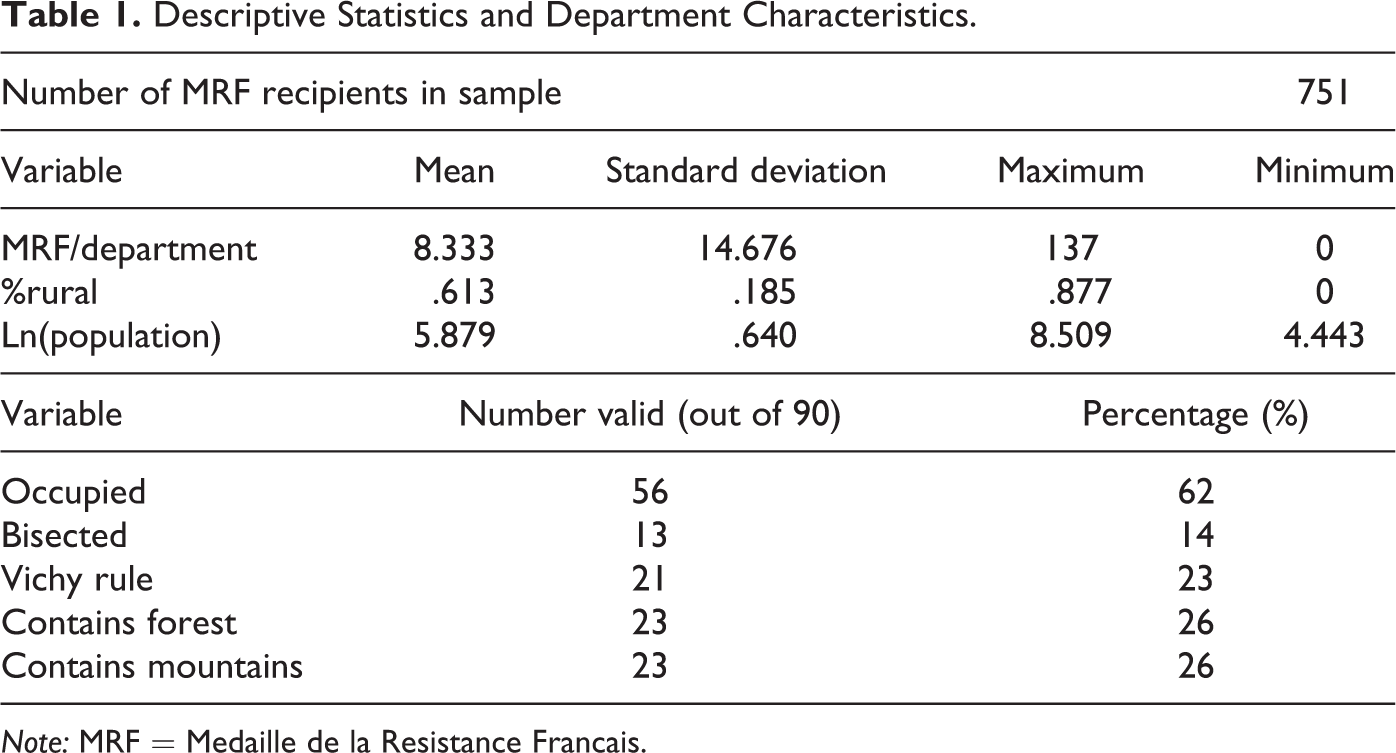
The dependent variable in this study is the number of sampled MRFs awarded in each department. 8 MRFs are placed in departments on the basis of a resistant’s initial resistance activity, which was assessed using the award files. Within the sample of 751 recipients, the most MRFs were awarded in Paris (137) and none were awarded in three departments (Basses Alpes, Cantal, and Haute Pyrenees). Descriptive statistics are provided in Table 1.
Descriptive Statistics and Department Characteristics.
Note: MRF = Medaille de la Resistance Francais.
Only a fraction of resistants met the MRF requirements. This is a methodological virtue: recipients made significant contributions to the resistance, as judged by local and national leaders with direct knowledge of their activities. These characteristics make the number of MRFs awarded within a department a sound measure of the level of regional insurgent activity, since meaningful activity requires committed, active insurgents. In addition, unlike casualty figures (Carter and Veale 2013) or violent acts (Condra and Shapiro 2012; Ferwerda and Miller 2014), the medalists reflect the wide range of activities necessary for developing and continuing an insurgency. Using only violence to measure insurgent activities means ignoring essential activities like supply, training, intelligence gathering, and propaganda (Parkinson 2013). Violent incident counts can also be biased by factors like weather (Carter and Veale 2013) and strategy (Kocher and Monteiro 2015, though see Ferwerda and Miller 2015), meaning that they may understate activity in some periods and places and perhaps overstate activity in others.
The most important independent variables address the extent to which an area was urban, rural, or mountainous. Our primary measure, rurality, is the percentage of the departmental population living in communes of fewer than 2000 people, as reported in the 1936 French census (Résultats Statistiques 1938, 32-3). It ranges between 87 percent in the Creuse department and 0 percent in the Seine department (essentially, Paris). While the measure comes directly from the French census, we believe that it is appropriate; as the number of people in a commune increases, the quality of local knowledge declines.
To ensure robust findings, we also used principal component analysis to create an orthogonal linear combination (rural factor) of the census rurality measure, population density, and the percentage of the departmental population in the agricultural workforce. 9 Population density (Ministère de l’Agriculture 1936, 30) is included since the more densely populated the department, the less rural it is. Agricultural workers are included because they are a core component of rural populations. All three measures loaded into a single factor and the factor scores are highly correlated with three components. 10
Because Paris might have special characteristics as both the largest city and the capital, a dummy dependent variable for the Seine department is also included in our analyses. Both forests and mountainous/rocky terrain were counted in the 1929 Agricultural Census (Ministère de l’Agriculture, 1936, 296-9, 300-3) and are measured in hectares (logged for our analysis).
Because departments with larger populations have more potential insurgents, we included the log of each department’s 1936 census population as a control variable. Given Ferwerda and Miller’s (2014) finding that areas occupied by the Germans had higher levels of insurgent activity than areas controlled by Vichy, we used their data on whether or not a department was occupied, ruled by Vichy, or bisected by the line. We control for German force presence using the number of Luftwaffe wings based in each department in fall 1940 (ranging between 0 and 22, in Pas de Calais). Between 1940 and 1944, the Luftwaffe wings perhaps the most important German assets for fighting the Allies and were both resistance targets (for intelligence gathering and sabotage) and objects of German force protection efforts. Garrison units, in contrast, were generally understrength and uninvolved in anti-resistance activities, leaving that to the Gestapo (whose records no longer exist) and French authorities.
Because Ferwerda and Miller (2014), Kocher, Lawrence, and Monteiro (2013), and Kocher and Monteiro (2015) found higher levels of resistance activity in departments with more left-wing populations, we control for the percentage of the vote won by the Front Populaire in the first round of the 1936 elections. 11 Finally, we control for industrialization using the per capita kilowatt hours of electricity consumed within the department in 1936 (Direction de la Statistique Générale et de la Documentation 1939, 115). Electricity consumption is a reasonable approximation of industrial activity since 1930’s era heavy industry required large amounts of electricity.
Analysis
Because our dependent variable is the number of medals awarded per department (MRF), and our data show signs of overdispersion, we use negative binomial regression to test our hypothesis. 12 We use different model specifications to address the population: in models 1 to 3, we include the natural log of population as a control variable; in model 4, we specify population as an exposure model, which treats medal counts as a rate dependent on the baseline population. To address potential heteroscedasticity, we use Huber–White heteroscedasticity-consistent (robust) standard errors.
Table 2 presents regression results for the MRF counts. Model 1 is our main theoretical specification, containing only the initial set of theoretically specified covariates. Model 2 also includes the additional controls for industrialization (electricity consumption), political attitudes (popular front vote), and German occupation (airbases). Model 3 uses the alternate, factor-based rurality measure. Model 4 specifies a population exposure model.
Explaining Medaille de la Resistance Francais Counts.

Note: Robust standard errors in parentheses.
Two-tailed test: *p < .1; **p < .05; ***p < .01.
All four models provide evidence for our core hypothesis. Each model shows an inverse relationship between a department’s rurality and the number of MRF medals rewarded. The percent rural measure is significant in models 1 and 2, and the rural-factor variable is significant in model 3. In model 4 (the exposure model), the rurality coefficient is in the expected direction but does not quite meet conventional significance thresholds (p = .118). The Paris variable is positive and significant in all models. Together, these results suggest that rural areas produced considerably fewer exemplary resistants than urban ones. German military infrastructure (Luftwaffe bases) is consistently significant and consistently negative. This type of military infrastructure seems to decrease the presence of resistance fighters. Variables accounting for topography, occupation status, political tendencies, and industrialization are not significant in any model. 13
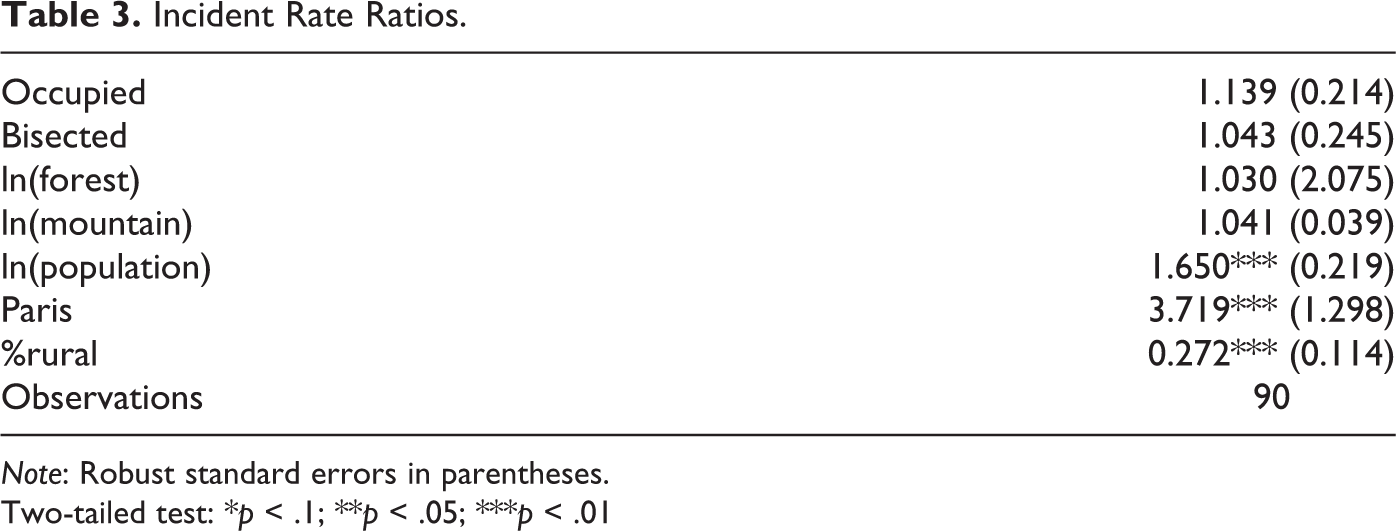
The effects of rurality and Paris are substantively meaningful. Table 3 provides the incident rate ratios (IRRs) calculated from model 1, 14 which identify how the independent variable values influence the expected departmental medal counts. The rurality IRR (0.272) indicates that a 1 percent increase in the rural inhabitants decreases the overall expected MRF count by roughly 1.3 percent. Moving from the least rural (Seine, 0 percent) to the most rural department (Creuse, 87 percent) decreases the expected departmental MRF count by 68 percent. 15 The Paris variable has a particularly large IRR (3.719), Paris corresponding to a roughly 272 percent increase (against non-Paris departments) in expected MRFs.
Incident Rate Ratios.
Note: Robust standard errors in parentheses.
Two-tailed test: *p < .1; **p < .05; ***p < .01
Finally, we conducted Monte Carlo simulations to further clarify the substantive influence of rurality and Paris on expected MRF counts. Figure 1 visualizes the simulated expected count values of MRF awards for percent rurality while holding all other covariates constant at their mean levels. 16 It shows a clear inverse relationship between rurality and MRF awards; in a 0 percent rural department, the simulation predicts expecting 14.73 MRFs, and in department that is 87 percent rural, the simulation predicts 4.57 medals. Figure 2 demonstrates the effect of Paris: the mean expected value count for a department containing Paris is 25.04 medals and 6.31 in all other departments.
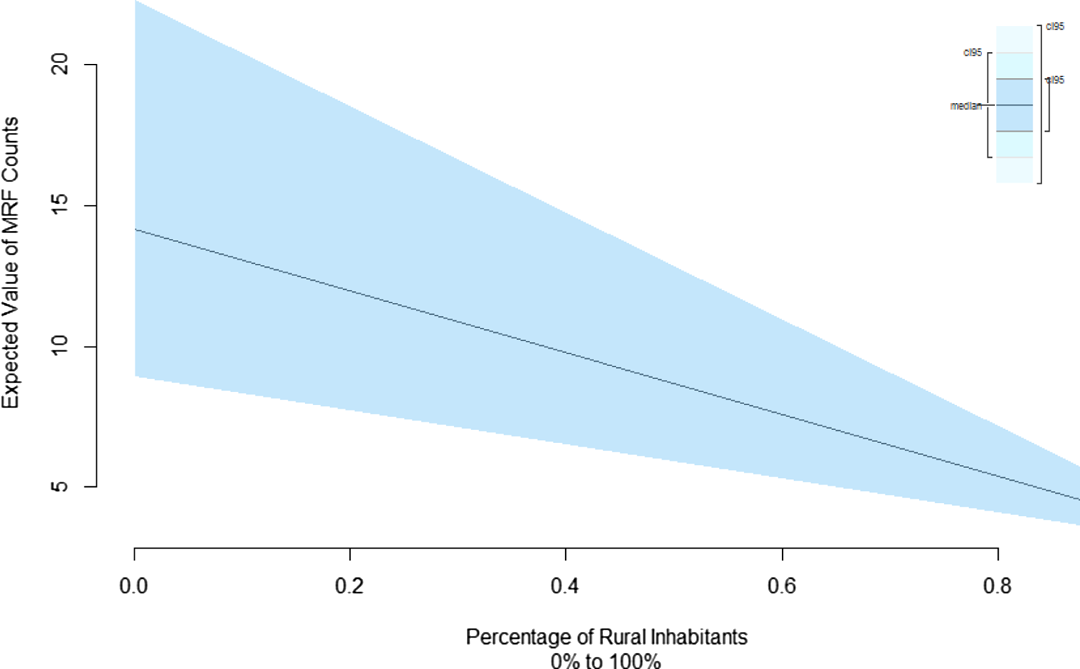
Simulated MRF counts showing the effect of percent rural.

Simulated MRF counts showing the effect of Paris.
Study 2: The Geography of Accurate Repression
In order to assess our most important mechanism—the information environments in rural and urban areas—we examine how rurality influenced accurate repression. Our theory suggests that the richer information available in rural areas should deter many prospective insurgents from participating, or participating as intensely, in resistance activities. However, the information environment should also influence the ability of the authorities to accurately repress insurgents. Repression—arrests, killings, or searches by the authorities—is accurate when it is targeted at actual insurgents. If our theory is correct, accurate repression should be more common in information-rich environments, like rural areas, and less common in areas like cities with greater anonymity. That is, rurality should be positively associated with accurate arrests and killings, and large cities should be negatively related with these kinds of repressive acts.
In order to test this hypothesis, we generated departmental counts of MRF recipients in our sample who were arrested, killed, or had to flee personal pursuit by Vichy or German authorities. References to repression were sometimes inconsistent—some files gave dates and description of the circumstances of repression, while others merely stated that an MRF recipient was arrested, killed, or had to flee French or German efforts to capture them. We assume that if there are no references to repression in a file, then the individual evaded capture, death, or personal pursuit. Because we are principally interested in events prior to D-Day, when data allowed us to do so, we excluded repression that occurred after June 6, 1944.
The independent variables in our analysis of repression are largely the same as those in the MRF analyses. There are two differences. First, to account for the fact that the presence of MRF recipients influences the possibility that they can be arrested, we include the departmental MRF counts as a control variable. Second, we include dummy variables for the departments containing the three largest cities, Paris (Seine), Marseille (Bouches-du-Rhône), and Lyon (Rhône). Marseille was a cradle of resistance movements (Mencherini 1994); Lyon was, for a time, the “capital” of the resistance (Gildea 2015, 74); but both later experienced intensive repression by German authorities (Meyer 1994; Jackson 2001, 475). Analyses are, again, negative binomial regression models with robust standard errors. As before, population is specified first as a control variable and then as an exposure variable.
The results of the accurate repression analyses are presented in Table 4. The results provide some evidence for our hypothesis. The coefficient for percent rural is positive in both models but only significant in the exposure model. This is suggestive evidence that resistants in more rural areas were more likely to be arrested, killed, or personally pursued by the authorities. The coefficients for all three city variables are negative and significant in both models. This is clear evidence that resistants in big cities were less likely to be repressed. The much larger effect observed in Paris may be due to the considerable size differences between the cities and the Germans’ targeted repression efforts in Marseille and Lyon. The positive effects for forests and mountains may be due to the fact that, during 1943 to 1944, occupation authorities pursued the developing Maquis groups in the forests and mountains with increasing intensity. 17
Explaining Resistant Arrests and Deaths.

Note: Robust standard errors in parentheses. MRF = Medaille de la Resistance Francais.
Two-tailed test: *p < .1; **p < .05; ***p < .01.
Study 3: Qualitative Evidence
Most historians conclude that the resistance was primarily an urban phenomenon that did not take root in the countryside until the arrival of the Maquis in late 1942 (Douzou 1997, 17; Guillon 1987, 59-60; Jackson 2001, 478, 487; Kedward 1993, 8). 18 They offer largely political and sociological explanations for the lack of early rural resistance. Politically, Vichy courted the countryside with “Petain, paysan, and patrie” propaganda (Marcot 1997, 24). Sociologically, most resistance pioneers were city-dwellers contemptuous of peasants (Douzou 1999, 5; Farmer 1985, 96; Kedward 1993, 9). 19
These arguments are consistent with the pattern of resistance development, but do not explain the dearth of early rural resistance. Politically, Petain was also extremely popular in the cities, and even in the cities pioneering resisters were very rare exceptions (Mencherini 1994, 442, 448; Reynaud and Guillon 1994, 430; Douzou 1997, 9-12; Bouet 1944, 1). Vichy’s efforts to court the paysans do not explain the absence of similarly “exceptional” men and women in the countryside, especially since rural residents decisively rejected Vichy’s overtures by 1942 (Douzou 1999, 6; Kedward 1993, 7; Jackson 2001, 475). Similarly, the contempt of middle-class Parisians, Marseillais, or Lyoniais for rural people does not explain the absence of a native resistance in the countryside.
We believe that the wealth of information about others’ activities characteristic of rural areas is an important but underplayed explanation for the dearth of early rural resistants. 20 There is clear evidence that high levels of information about resistance activity existed in rural France and that people sometimes used that information to denounce their neighbors between 1940 and 1943. 21 There is also clear evidence that the resulting risks made it harder to form resistance groups and, where they existed, suppressed their level of activity relative to urban resistants.
Abundant Information and the Threat of Denunciation in Rural Areas
French village society during the war was characterized by general acquaintanceship, which often hurt the resistance (Kedward 1996, 340; Douzou 1999, 9). Rougeyron, a resistant in Flers, claims that everyone on the list of forced labor conscription list drawn up by his local authorities was active in the resistance (Rougeyron 1996, 14-15). Michel (1963, 3) reports that in the early parts of the war, most Maquis units were quickly reported to the gendarmes. In Lozere, the nightly visits of a supply truck gave away the location of an early Maquis encampment (Cordesse 1999, 60-61). Guingoun, a sometimes communist in Limousin (Farmer 1985, 96), lost valuable propaganda production assets when people asked authorities about the newly built cabin near their village where he stored his supplies (Guingoun 1974, 37-40). Maquis in Saffre may have been found by German forces because locals “out for a walk” ran into them (Gildea 2002, 313).
This information was sometimes used to denounce neighbors. French civilians sent more than 3 million denunciation letters to Vichy authorities during the war (Halimi 1983, 7). It was so common that in the first years of the war, some rural people felt that the “gendarmes listened at the doors” (Grenadou and Prevost 1966, 178). Even a uniformed French army officer fleeing German captivity in 1940 was not safe (Frenay 1976, 7). Denunciation was sometimes motivated by ideological or communal commitments—hence the Cevenol pastors assisting Jews and other fugitives were more careful in villages with more Petainists (Poujol 2006, 143-44). In other cases, it was motivated by a fear of reprisal or anger at poorly executed resistance activities (Gildea 2003; Rougeyron 1996, 25). Last, some resisters were denounced after they lost residents’ trust: after a Maquis group in Haute-Saone turned to brigandage, residents quickly became informers and the group was eliminated (Jackson 2001, 489; Grandhay 1996, 281-5).
Effects of Abundant Information on Resistance Activity
This environment created a situation where only the most determined and risk-acceptant rural residents chose active engagement in the resistance. Decisions to resist usually began with an internal moral revolt against the events of 1940 (Douzou 1997, 9-12; Piketty 2009, xi-xx; Piketty 2011, 29), but action usually required connecting with other (prospective) resistants. This was difficult in the countryside (Douzou 1997, 17-18), where some (like Ephraim Grenadou’s eventual recruiter) were slow to tell even close friends about their activities (Grenadou and Prevost 1966, 178). Making contact outside of immediate social circles was hard because “the stranger is immediately spotted” in the countryside (Marcot 1997, 26). Even people with strong inclinations to resist were skittish. Between 1940 and 1942, Guignoun involved only the “surest” communists in his activities during 1940 to 1942 (Kedward 1993, 12), but even many of them refused (Guingoun 1974, 53-55). In 1940, a Lozère farmer allowed a group of resistance-oriented colonels to hide eighteen tons of weapons on his farm. In 1942, after a Vichy decree increased penalties for resistants, he demanded that they remove them. Within weeks of being moved to a different farm, the second farmer reported the cache to the authorities in exchange for amnesty (Cordesse 1999, 23-24).
The rural informational environment made the most common forms of early resistance activities difficult and dangerous. 22 Prior to 1943, hiding fugitives was challenging in rural areas (Lemaire 1946): finding lodging could be difficult as security concerns limited the range of options (Guingoun 1974; Cordesse 1999, 52), and moving fugitives required particular care (Rougeyron 1996, 28, 42). In cities, where everyday anonymity prevailed, hiding and moving fugitives was easier. Resistants in several networks report hosting airmen and other fugitives in Paris for months at a time (Ayle 1945; Bouet 1944, 3, 6, 9; Lascroux n.d., 1-4; Ryon n.d., 2; Bottin 1957, 4). They could be moved with considerable freedom, even using the Metro (Melot 1946). False ration and identity cards could be distributed in parks and from apartments (Degorces 1945; Richet 1947).
Propaganda activities played a central role in building resistance organizations. Clandestine tracts broke the sense of isolation among potential resistants (Piketty 2009, iii-xliv; Piketty 2011, 30; Douzou 2011, 134-36); distribution networks provided access points for new members and were often the precursors to broader resistance networks (Wieviorka 2013, 71-79). Accordingly, Vichy and German authorities tried to suppress the clandestine press by tightly regulating paper and printing supply purchases. They were more successful in villages and small towns, where sellers knew all of their regular customers and were sometimes suspicious of resistants trying to fake a rationale for buying printing supplies (Guingoun 1974, 27). While tracts could be put in mailboxes at night, doing so risked arrest; one would-be clandestine publisher lost his distribution network in France-Comté while distributing the first issue of his paper (Brantus 1947). Demonstrations were rare in rural areas; Guingoun judged that demonstrations would reveal the identities of his militants, allowing the police to arrest them (Guingoun 1974, 26).
In contrast, Georgette Girard was able to move to Lyon in 1940 and, despite knowing no one, start producing and distributing tracts immediately (Gerard 1950). In Paris, Defense de la France, under false pretenses, purchased a modern high-speed press and enough supplies to regularly print as many as 300,000 tracts (Bottin 1957). Activists in Paris could leave propaganda in the Metro undetected (Coquard 1957; Pastor 1946; Gildea 2015, 177) and even distribute tracts on busy street corners (Richet 1947). This was only possible because, in a large city, a resistant could expect that once he stopped distributing tracts no one would recognize him. Demonstrations were also easier and safer in cities because crowds of thousands gave protesters anonymity (Kedward 1993, 8; Gildea 2015, 176-77).
Discussion
These findings provide evidence that when guerrillas do not control territory, insurgents are more likely to be found in urban areas than rural ones. Controlling for population, there were fewer MRF recipients in rural departments than urban ones; Paris had a particularly large number of recipients. The analysis of repression and the historical evidence suggest that the richer information environment in rural areas is responsible for these findings.
In light of earlier scholarship (Ferwerda and Miller 2014; Kocher, Lawrence, and Muneiro 2013; Kocher and Monteiro 2015), the failure to find significant effects for left-wing areas is surprising. Two facts may explain this nonfinding. First, in the early years of the resistance, most resistance organizations were started by pioneering resistants new to politics (Michel 1950, 5-6; Wieviorka 2013, 106-7). Left-wing groups like the Section Française de l’Internationale Ouvrière were slow to join the resistance (Wieviorka 2013, 56-67); the PCF opposed resistance activity until the invasion of the Union of Soviet Socialist Republics 23 and its resistance organs, the FN and FTPF, did not become fully active until 1943 (Michel 1950, 10). People from the left, accordingly, had less time to engage in the kind of activities that might make them MRF recipients. Second, the measures used by Ferwerda and Miller (2014), Kocher and Monteiro (2015), and Kocher, Lawrence, and Monteiro (2013) may be particularly likely to detect left-wing resistance activity. Ferwerda and Miller (2014) and Kocher and Monteiro (2015) use sabotage as their key dependent variable. However, the communists were particularly likely to engage in sabotage and less likely to engage in activities like intelligence gathering (Michel 1970, 172; Michel 1950, 10) than groups like the Organisation Civile et Militaire (Wieviorka 2013, 81). 24 Kocher, Lawrence, and Monteiro (2013) measure resistance group activity using resistance veteran cards (Cartes de Combattant Volontaire de la Resistance (CCVR). However, historians believe that they are more reflective of postwar ex-resistant organizations’ activity than the resistance itself (Jackson 2001, 477). The PCF’s engagement in these organizations and their efforts to encourage their veterans to request CCVR’s are consistent with disproportionate numbers of CCVR recipients in left-wing areas. 25
These results are most easily generalizable to cases similar to the French Resistance: insurgencies in fairly developed states directed against occupiers. The 2004 to 2007 Sunni insurgency in Iraq, for instance, seems to reflect broadly similar tendencies (Hashim 2006, 125-213). Occupation may be a particularly important part of the story, since the question of collaborating with or resisting the occupiers may divide communities, making it harder to trust neighbors. 26 Still, the results may also be generalized fairly straightforwardly to other nonterritorial insurgencies.
The findings may not generalize as readily to insurgencies where guerrillas contest enduring control over territory. In territorial insurgencies, rural residents’ information can be of use to both sides, and despite strong incentives to avoid giving that information to the combatants, selective coercion can be used to extract it (Kalyvas 2006). When insurgencies develop in areas with strong allegiances and social networks (based, for instance, in religious or ethnic ties), information is perhaps less likely to be turned over to state actors. In this situation, different from what we have studied, rural areas may be more congenial to insurgent activity.
Conclusion
The findings in the article suggest that further research on the role of cities in insurgency is warranted. While territorial insurgencies may tend to arise in rural areas, urban areas may play a crucial role in nonterritorial insurgencies. The anonymity of cities allows insurgents more opportunities to organize, propagandize, and recruit new members than rural areas offer. The density of state (or occupier) assets in cities likewise provides more opportunities for gathering intelligence about state capabilities and intentions, and for sabotage or attacks against policemen, soldiers, and administrators.
Consistent with other recent research on the hidden aspects of insurgency (Parkinson 2013), these findings also suggest the importance of finding measures of insurgency besides violent action. The effective development and functioning of a sustained insurgency involves a wide range of tasks besides ambushes and sabotage—and many of these tasks are as dangerous as engaging in violence, if not more so. Focusing only on these variables will limit the ability of scholars to explain the resilience, potential capacity, and political influence of insurgent movements.
Supplemental Material
Supplemental Material, Appendix_for_Where_the_Insurgents_Aren't - Where the Insurgents Aren’t: Rurality, Information, and Nonterritorial Insurgency
Supplemental Material, Appendix_for_Where_the_Insurgents_Aren't for Where the Insurgents Aren’t: Rurality, Information, and Nonterritorial Insurgency by Thomas M. Dolan, Clayton Besaw, and Joseph Butler in Journal of Conflict Resolution
Supplemental Material
Supplemental Material, jcr_data_final - Where the Insurgents Aren’t: Rurality, Information, and Nonterritorial Insurgency
Supplemental Material, jcr_data_final for Where the Insurgents Aren’t: Rurality, Information, and Nonterritorial Insurgency by Thomas M. Dolan, Clayton Besaw, and Joseph Butler in Journal of Conflict Resolution
Supplemental Material
Supplemental Material, jcr_replication - Where the Insurgents Aren’t: Rurality, Information, and Nonterritorial Insurgency
Supplemental Material, jcr_replication for Where the Insurgents Aren’t: Rurality, Information, and Nonterritorial Insurgency by Thomas M. Dolan, Clayton Besaw, and Joseph Butler in Journal of Conflict Resolution
Footnotes
Authors' Note
Replication data are available via the journal website.
Acknowledgments
We are grateful to the Commission National de la Médaille de la Résistance Française, and its secretary, Lionel Boucher, for their welcome and access to medalists’ records. We are also grateful to Daniel Marien, Barbara Kinsey, Jonathan Powell, Andrew Boutton, Gunes Tezcur, Bruce Wilson, and Kerstin Hamann for practical assistance or comments on drafts.
Declaration of Conflicting Interests
The author(s) declared no potential conflicts of interest with respect to the research, authorship, and/or publication of this article.
Funding
The author(s) disclosed receipt of the following financial support for the research, authorship, and/or publication of this article: We received a small grant from the Department of Political Science, University of Central Florida, to pay for travel expenses.
Supplemental Material
Supplementary material is available for this article online.
Notes
References
Supplementary Material
Please find the following supplemental material available below.
For Open Access articles published under a Creative Commons License, all supplemental material carries the same license as the article it is associated with.
For non-Open Access articles published, all supplemental material carries a non-exclusive license, and permission requests for re-use of supplemental material or any part of supplemental material shall be sent directly to the copyright owner as specified in the copyright notice associated with the article.
