




Abstract
China’s provision of development finance to other countries is sizable but reliable information is scarce. We introduce a new open-source methodology for collecting project-level development finance information and create a database of Chinese official finance (OF) to Africa from 2000 to 2011. We find that China’s commitments amounted to approximately US$73 billion, of which US$15 billion are comparable to Official Development Assistance following Organization for Economic Cooperation and Development definitions. We provide details on 1,511 projects to fifty African countries. We use this database to extend previous research on aid and conflict, which suffers from omitted-variable bias due to the exclusion of Chinese development finance. Our results show that sudden withdrawals of “traditional” aid no longer induce conflict in the presence of sufficient alternative funding from China. Our findings highlight the importance of gathering more complete data on the development activities of “nontraditional donors” to better understand the link between aid and conflict.
Keywords
In 2007, Western aid donors substantially reduced their development assistance to Sri Lanka in response to the breakdown of a ceasefire between the government and the secessionist Liberation Tigers of Tamil Eelam (LTTE). By contrast, China substantially increased its aid to Sri Lanka over the 2007–2009 period, thereby helping the authorities to cope with the sudden negative “shock” caused by the withdrawal of “traditional” aid resources (Campbell et al. 2012). When asked to explain the government’s changing sources of aid, a senior official from Sri Lanka’s Ministry of Foreign Affairs indicated that “we had to succumb to acknowledge blackmail and compromise with terrorism, or look for other friends, which we did.… We shifted our focus from our traditional contacts towards the east, and we were very successful.… In fact, we hardly felt the pinch of the withdrawal of western development assistance.” 1 Sri Lanka’s ruling government eventually defeated the LTTE in 2009, ending three decades of internal strife. Chinese and Indian-funded infrastructure projects helped the government implement a strategy of winning over the North and East—previously controlled by the LTTE—through the promotion of economic development (Campbell et al. 2012).
The Sri Lankan case illustrates the growing role that non-Western donors play in shaping economic, political, and conflict outcomes in aid-recipient countries. Over the last decade, foreign assistance from non-Western donors has increased sharply—both in absolute terms and as a share of global development finance (Manning 2006; Woods 2008; Walz and Ramachandran 2011; Dreher, Nunnenkamp, and Thiele 2011; Dreher, Fuchs, and Nunnenkamp 2013; Fuchs and Vadlamannati 2013). This explosion of new funds and suppliers of development finance poses a challenge to the existing aid regime that is organized around the development assistance committee (DAC) of the Organization for Economic Cooperation and Development (OECD). Increasing donor competition provides developing countries the opportunity to “shop around” for the types of development finance that best suit their interests (Dreher, Fuchs, and Nunnenkamp 2013). The rapid increase in development finance from governments that do not report to the DAC also raises a set of vexing questions for scholars and policy makers. How much funding do these non-DAC donors provide, to whom, and on what terms? What impact do non-DAC sources of finance have on economic development, democratization, debt sustainability, environmental outcomes, conflict, and violence in developing countries? China, Russia, Venezuela, and India are thought to provide billions of dollars in assistance every year (Walz and Ramachandran 2011), but most of these “new” suppliers of development finance have chosen not to participate in existing reporting systems, such as the OECD’s Creditor Reporting System (CRS) or the International Aid Transparency Initiative (IATI). 2
China is a crucial case for researchers and policy makers because of the scale and opaqueness of its activities in developing countries. Western policy makers accuse China of expanding its presence, particularly in Africa, for self-interested reasons: securing access to natural resources, subsidizing Chinese firms and exports, cementing and expanding political alliances, and pursuing global economic hegemony. 3 China counters that its investment in Africa “[…] is based on respecting the will of Africa, listening to the voice of Africa and caring about the concerns of Africa, thus earning the trust of most African countries.” 4 With increasing development activities all over the African continent, China’s development finance has come under intense scrutiny over the past decade. African policy makers are divided on the issue of how Chinese development finance impacts social, economic, environmental, and government outcomes. 5 While some leaders perceive Chinese financing as better suited to Africa’s needs, others feel threatened by China’s growing presence in their countries. 6 Adjudicating between these competing claims has proven difficult because Beijing discloses very little official information about its development finance activities. In the absence of reliable and comprehensive data, much of the conventional wisdom about Chinese development finance rests on untested assumptions, individual case studies, and incomplete data sources. 7
As such, scholars cannot account for China’s development activities in quantitative studies of the allocation, effectiveness or side effects of aid. Since China is widely considered the most important non-Western source of development finance, this omission may bias research results. To understand the allocation pattern and consequences of development finance, scholarship must consider the activities of all major donors to give reliable answers to research questions involving aid and conflict, geopolitical competition, and connections between aid shocks and violence. Studies on the aid–conflict nexus could particularly benefit from inclusion of data on China and other non-Western donors, since development finance from these states might serve as a crucial backstop for recipient regimes experiencing sudden withdrawals of aid from so-called traditional donors.
As a first step toward addressing this critical information gap, we (a) systematize a web-based, open-source methodology for collecting project-level development finance information and (b) create a comprehensive database of Chinese development finance flows to Africa from 2000 to 2011. We find that China’s project commitments exceed US$73 billion over the 2000–2011 period, of which approximately US$15 billion is comparable to Official Development Assistance (ODA) according to the OECD definition. We use this database to replicate and extend the analysis of Nielsen et al. (2011) who show that aid shocks significantly increase the likelihood of conflict onset. By adding Chinese development finance to the analysis, our empirical results suggest that sudden withdrawals of traditional aid are only more likely to induce conflict in the absence of sufficient alternative funding from China. This is an important extension to the findings of Nielsen et al. (2011), as recent research demonstrates that “China increases faster its [financial] commitments towards fragile countries when traditional donors disengage” (Giovannetti and Sanfilippo 2011, 167).
This article is structured as follows. The second section provides an overview of previous attempts to measure Chinese development finance and identifies some of the key factors that have impeded the creation of accurate, detailed, and comprehensive data sets. In the third section, we introduce our new data collection methodology and present the resultant database of Chinese overseas development finance activities. The fourth section provides an overview of Chinese development finance to Africa as tracked by this new database. In the fifth section, we extend the findings of Nielsen et al. (2011) and show that the collection of Chinese aid data is crucial to understanding the aid–conflict nexus. Finally, we conclude and discuss the limitations and weaknesses imposed by this data collection approach, also suggesting avenues for future research.
Quantifying Chinese Development Finance
For a variety of domestic political and administrative reasons, the Chinese government does not release detailed, project-level financial information about its overseas development finance activities (Lancaster 2007; Strange et al. 2013). 8 Beijing’s resistance to aid transparency may also reflect a broader disinterest in complying with Western (OECD-DAC) standards (Grimm et al. 2011). The absence of detailed, comprehensive, and reliable information has fueled speculation and confusion about China’s aid to Africa. Scholars, policy analysts, and journalists routinely use inflated estimates to demonstrate the challenge that China poses to Western donors.
Conceptual differences further confound efforts to catalog and measure “Chinese aid.” Chinese development finance flows do not easily align with the well-defined OECD-DAC definitions of ODA and other official flows (OOF). The DAC defines ODA as “[g]rants or loans to [developing] countries and territories […] and to multilateral agencies which are: (a) undertaken by the official sector; (b) with promotion of economic development and welfare as the main objective; (c) at concessional financial terms (if a loan, having a grant element of at least 25 per cent). In addition to financial flows, technical co-operation is included in aid” (OECD-DAC glossary). 9 Members of the DAC have agreed that assistance to refugees, scholarships for developing country students, and funding relevant research are eligible to be included in ODA. Military aid and peacekeeping enforcement are excluded (OECD 2008). OOF is categorized as “[t]ransactions by the official sector with [developing] countries […] which do not meet the conditions for eligibility as Official Development Assistance, either because they are not primarily aimed at development, or because they have a grant element of less than 25 per cent” (OECD-DAC glossary).
China states that its foreign aid “[f]alls into the category of South-South cooperation” (State Council 2011); however, it does not provide precise definitions in the 2011 White Paper or other official publications. The White Papers provide five “basic features” of Chinese foreign aid, but these are more about principles for how to give aid. They do not explicitly address how China classifies different development finance flow types (State Council 2011, 2014). The initial White Paper states that Chinese financial aid flows include grants, interest-free loans, and concessional loans, and also lists eight forms of aid: “complete projects, goods and materials, technical cooperation, human resource development cooperation, medical teams sent abroad, emergency humanitarian aid, volunteer programs in foreign countries, and debt relief” (State Council 2011). What is more, there is no consensus as to how to classify many Chinese financial instruments that lack OECD-DAC counterparts such as natural resource-backed loans. So-called Chinese “package financing” means that development finance often consists of agreements that mix aid and investment, and/or concessional and non-concessional financing (Grimm et al. 2011). Chinese state-owned enterprises also blur the line between official government finance and private flows; foreign direct investment (FDI) or joint ventures can come from firms that are either private or state-owned. Finally, there may be substantial discrepancies between Western and Chinese calculations of the cost of aid for the donor country. Western aid budgets include administrative costs which might inflate statistics on aid flows since substantial chunks of aid budgets are used on donor administrative costs rather than directly on recipient development. 10
Aligning Chinese development finance with DAC categories is further complicated by the fact that many of Beijing’s transactions with African countries are “bundled together” in ways that challenge conventional flow type definitions. Bräutigam (2011b) argues that a relatively small amount of finance is given as ODA to Africa—only around US$1.4 billion in 2009, while the majority comes as OOF. A study by the Congressional Research Service (CRS) and NYU Wagner School adopted a broader definition, characterizing many more flow types, including state-owned companies investing abroad, as “aid and related activities.” As a result, they estimate US$18 billion in annual aid and related activities to Africa (Lum et al. 2009).
The wide-ranging estimates—US$0.58 to 18 billion in annual “aid” to Africa (see Online Appendix A1 in the supplementary material for details)—have significant implications for how China should be considered as a donor on the continent in comparison to DAC donors. If the upper estimate is to be believed, China gave three times more assistance to Africa in 2007 than the United States provided in ODA there (US$ 5.3 billion). DAC donors jointly disbursed US$27 billion in ODA to Africa in 2007 (DAC CRS database). Yet, high estimates of Chinese aid are likely inflated for several reasons discussed below.
There is a compelling need for a common vocabulary and categorization scheme for Chinese development finance. Bräutigam (2009, 2011a) demonstrates that many forms of Chinese development finance do not fit cleanly into OECD-DAC categorizations. However, neither the research community nor the policy community has coalesced around a single taxonomy for classifying and categorizing Chinese development finance that enables comparisons with development finance from OECD-DAC donors. Instead of combining diverse financial flows into one black box aggregation like the NYU Wagner School’s “aid and related activities” category, we have attempted to create more precise classifications and definitions that capture the diversity of Chinese development finance modalities. In particular, we have made a significant effort to allow researchers to differentiate between “ODA-like” activities, “OOF-like” activities, and other types of financing. 11 Our database also has a category called “Vague (Official Finance)” for loans and grants that are either ODA-like or OOF-like, but for which there is insufficient information to assign the flows to either the ODA-like or OOF-like category. While others may want to use our data set for different purposes, the focus of this article is on official finance from China to Africa, regardless of its developmental, commercial, or representational intent but excluding military aid and official investment. We use the term OF as shorthand for these ODA-like, OOF-like, and Vague Official Finance flows in the remainder of the article.
Our categorization scheme has several benefits. The introduction of the ODA-like, OOF-like, and Vague Official Finance categories provides a basis for analysts to make more accurate comparisons of OF provided by China and Western donors. Additionally, by introducing the Vague Official Finance category, we have made the imprecision of our data and the uncertainty of our flow-type designations explicit. We consider this last point to be particularly important. Many scholars who study Chinese aid and investment refuse to be transparent about their data and methods, which makes replication impossible. We believe that transparency is a necessary condition for scientific progress because it invites and permits scrutiny, which will uncover weaknesses in methods and errors in their application.
Tracking Underreported Financial Flows: An Open-source Approach to Development Finance Data Collection
Our methodology for tracking underreported financial flows (TUFF), which is documented at greater length in Strange et al. (2014), is designed to mitigate many of the risks associated with using media reports to collect data. 12 During the first stage, projects undertaken in a particular country and supported by a specific supplier of development finance—be it a sovereign government, multilateral institution, non-governmental organization, or private foundation—are identified through Factiva, a Dow Jones-owned media database. Factiva draws on approximately 28,000 media sources worldwide in twenty-three languages. Most of these sources are newspapers, and radio and television transcripts. In the second stage, researchers perform targeted online searches for each potential project identified in the first stage to corroborate project information and populate missing data fields. In this way, the media reports gathered in the first stage serve as a departure point for a set of follow-on data collection procedures that draw information from case studies and field reports completed by academics and non-governmental organizations, project inventories supplied through Chinese government websites, and grant and loan data published by recipient governments. 13
Our methodological approach is informed by previous attempts to use media reports to track Chinese official development financing, and expands on these previous methods by supplementing media reports with additional information sources (Bartke 1989; Foster et al. 2008; Lum et al. 2009; Gallagher, Irwin, and Koleski 2012; Scissors 2012; Export-Import Bank of the United States 2011; Wolf, Wang, and Warner 2013). Previous efforts to classify or collect Chinese development finance data encountered six primary challenges. First, although many Chinese projects are canceled, mothballed, or scaled back after the original announcement is made, previous data collection initiatives did not carefully “follow the money” from initial announcement to implementation, thus increasing the risk of overcounting (Bräutigam 2011b). Therefore, we conducted follow-up audits on all announced projects in order to mitigate the risk of mistaking project announcements for initiated or completed projects. Second, researchers have paid insufficient attention to double-counting of individual projects and activities reported by multiple media reports over multiple years (Grimm et al. 2011). To address this challenge, we employ a web-based data platform with filtering and keyword search functions that facilitates the identification and elimination of duplicate projects. Third, most scholars and analysts elide the issue of how to classify different forms of Chinese development finance. Rather than rolling diverse financial flow types into one omnibus category, we disaggregate by flow types and thus allow the users of the data to make their own decisions about what to include and how to analyze different forms of Chinese development finance.
Fourth, a lack of transparency in research methods has impeded efforts to improve knowledge about the distribution and impact of Chinese development finance. Documenting and disclosing research methods allow database users to identify potential errors and procedural flaws, and thus facilitate the improvement of methods and data quality. Fifth, unlike previous efforts that rely only on English-language sources to track Chinese aid, trained Chinese-language experts conducted Chinese-language search queries to fill data gaps and enhance data accuracy. Finally, wherever possible, we avoided a “sole-sourcing” data collection process, or relying on data from a single source to track Chinese development finance projects. Instead, we employed a triangulation system wherein multiple sources for the same project provided data about different project attributes. More broadly, source triangulation helped minimize data deficiencies resulting from uncertainty over whether certain projects were actually undertaken and completed following their announcement. Because this triangulation process pulled from multiple information repositories, it reduces a project record’s reliance on media reports.
New Evidence on Chinese Official Finance to Africa
Our database includes 1,751 Chinese OF projects in fifty African countries over the 2000–2011 period. 14 13.6 percent of the projects remain nonbinding pledges. 15 This does not necessarily mean that a project has not reached the next stage of completion; it only means that we did not find any information in open-source materials that one of the subsequent stages has been reached. Since we cannot be sure that these projects do indeed get formally committed, we exclude pledges from the analysis below (239 projects amounting to US$24.6 billion were omitted; this value and all following values are in constant 2009 US dollars). 16 By doing so, we intend to achieve comparability with aid commitments as defined by the OECD-DAC. Of the remaining 1,511 projects that have reached at least commitment stage, 63 percent of the projects provide information on the amount of OF committed, totaling US$73 billion. Note that this covers all financial flows that can be classified as either ODA-like or OOF-like (including Vague Official Finance projects that are identified as one of the two).
The majority of the projects included in our data are grants (52%), which correspond to only 10 percent of the total dollar amount tracked. Twenty-three percent of the projects are classified as loans, loan guarantees, or export credits, 8 percent as free-standing technical assistance, and 4 percent each as scholarships and other forms of training and debt forgiveness, respectively. 17 Within these flow types, the likelihood that the monetary value of a project is reported varies substantially. For example, 92 percent of loan projects have a reported monetary value, while only 9 percent of the (supposedly cheaper) projects of the category “Scholarships/training in the donor country” have a dollar amount. Classifying projects as ODA-like or OOF-like in Figure 1, the largest category in terms of project numbers is ODA-like grants (688 projects, amounting to US$5,100 million). This category includes, among many other things, donations of agricultural machinery and food aid. Concerning loans (including loan guarantees and export credits), we classify 108 projects as ODA-like (amounting to US$5,539 million), 49 as OOF-like (US$22,746 million), and 184 as Vague Official Finance (US$29,689 million). There are thus a significant number of loans for which we have no detailed financial information that prevents us from coding them as either ODA-like or OOF-like. Fifty-eight projects—fifty-seven of them coded as ODA-like—are classified as debt relief (debt rescheduling agreements and debt forgiveness). An additional 185 projects are classified as technical assistance and scholarships (151 of which receive the ODA-like designation).

Number of Chinese project commitments by flow type, 2000–2011.
Given the interest in China’s role in Africa vis-à-vis Western donors, we also compare annual official financing flows from China with those from the United States and the entire OECD-DAC. Over the entire 2000–2011 period, China committed US$73 billion in official flows to Africa, which is more than a fifth of the total OECD-DAC flows (US$361 billion) and almost as much as committed by the United States (US$83 billion). Panel (a) of Figure 2 demonstrates that in the early 2000s China was already providing almost the amount of OF commitments to Africa as the United States. At the peak in 2007, China was committing almost twice the amount of total US ODA and OOF, and almost half the amount of ODA and OOF to Africa from the entire OECD-DAC combined. Official Chinese financing commitments to Africa can vary dramatically from year to year, often due to “megadeals”: multimillion dollar financing packages for large infrastructure projects or other loans. The spike in 2007, for instance, is due to two large Chinese megadeals involving large loans to the Democratic Republic of Congo and Sudan. 18
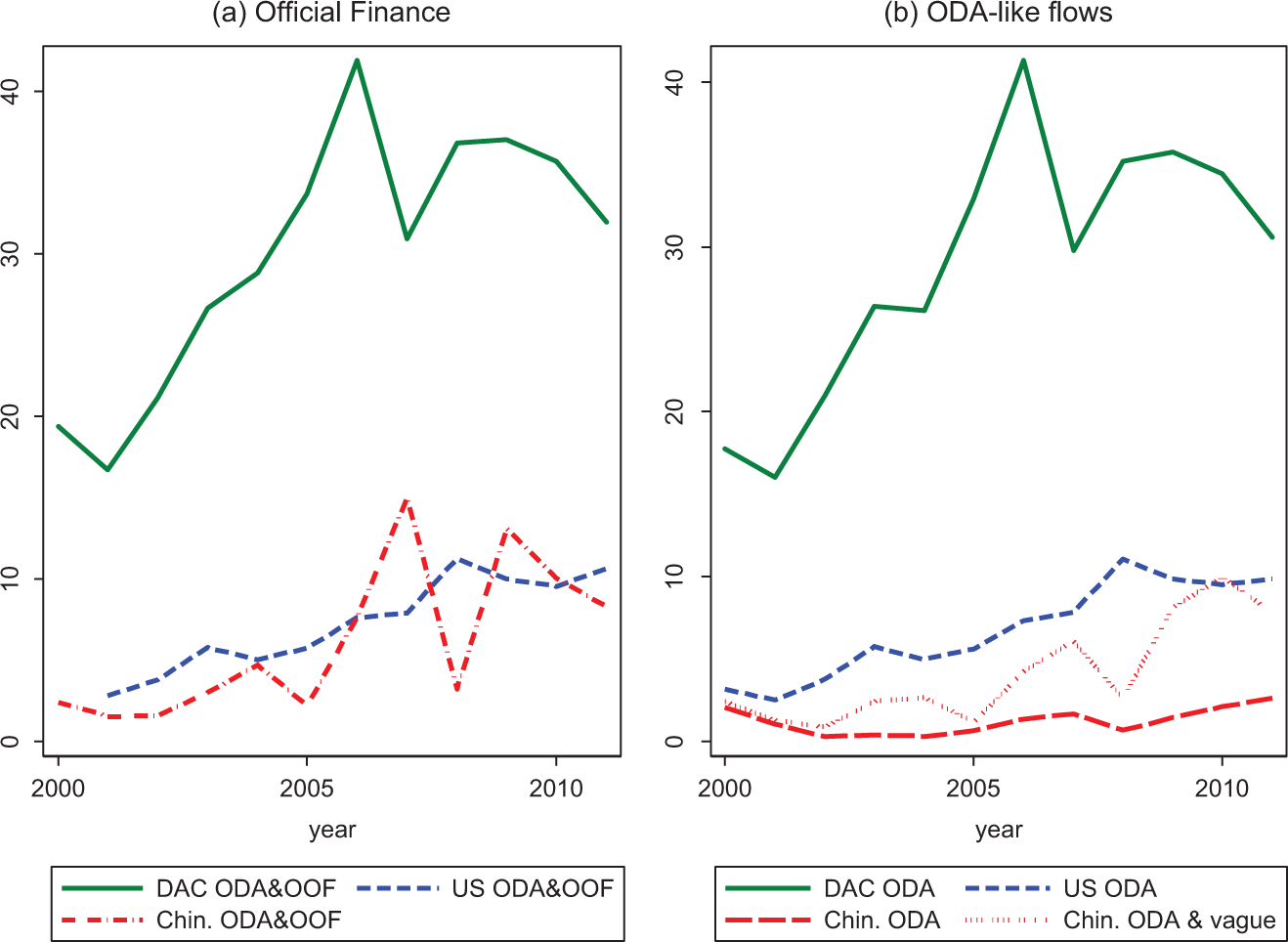
Chinese, Organization for Economic Cooperation and Development–Development Assistance Committee (OECD-DAC), and US official flows over time (in billions of constant 2009 US dollars). Panel (b) displays Chinese Official Development Assistance (ODA) both including vague flows (dotted line) and excluding those flows that cannot be identified as either ODA-like or other official flows (lower dashed line).
Panel (b) of Figure 2 restricts the analysis to Chinese and Western flows of ODA (or what we call ODA-like flows). Chinese flows to Africa identified as ODA have been much lower than those of Western donors. Over the entire decade, China committed US$15 billion in ODA to Africa, which is 4 percent of the total OECD-DAC ODA flows (US$347 billion) and 19 percent of those of the United States (US$81 billion). However, an important caveat here is that our estimates of Chinese ODA are likely significantly devalued since a substantial chunk of Chinese OF is labeled as “Vague Official Finance.” These projects are cases that we are able to classify as official Chinese finance, but do not have enough information to discern whether a project should be considered as OOF or ODA. The figure includes these flows as a separate item for comparison. Only in 2010, these combined flows exceed ODA by the United States. 19
Table 1 presents the sectoral allocation of China’s official financing projects in Africa. While we lack sufficient information to classify 214 projects, the most important sector according to DAC purpose codes is Government and Civil Society, with an overall number of 209 projects, amounting to US$1,718 million. While it might seem surprising at first that China is so active in this sector, most of Beijing’s activities differ much from Western donors. Whereas DAC activities in this sector include strengthening public financial management systems, supporting anticorruption institutions, and a wide variety of “good governance” initiatives, Chinese support to the sector includes, among other things, the construction of presidential estates and executive office suites. 20 Health (182 projects), Education (149), and Transport and Storage (107) are on the following places. In terms of monetary amounts, Transport and Storage projects dominate (US$17,230 million), followed by Other Multisector (US$16,937 million) and Energy Generation and Supply (US$13,301 million). 21
Sectoral Allocation of Official Finance to Africa (ODA-like and OOF-like), 2000–2011.

Note: The table shows the number of Chinese projects and amounts of official finance to Africa according to sector. Both number of projects and monetary amounts refer to projects that have at least reached the commitment stage. We provide a list of aid sectors in our Online Appendix B1. ODA = Official Development Assistance; OOF = other official flows; NGO = non-governmental organization.
Over the entire 2000–2011 period, Zimbabwe received the largest number of projects (101), followed by Ghana (67), and Ethiopia (63). The smallest number went to Libya (2), South Sudan (5), and Chad (6). 22 It is not surprising that we did not track any Chinese official project in Burkina Faso, Swaziland, the Gambia, and São Tomé and Príncipe between 2000 and 2011, as none of these countries maintained diplomatic relations with the People’s Republic of China and all of them recognized the Republic of China (Taiwan) instead.
Table 2 outlines the ten largest recipients of OF from China, the United States, and the OECD-DAC as a whole, aggregating monetary flows from 2000 to 2011. Four of the top-ten recipient countries are consistent across all three (groups of) donors: the Democratic Republic of Congo, Ethiopia, Nigeria, and Sudan. By contrast, Zimbabwe is a top recipient of Chinese OF but DAC flows are of low importance. Finally, Figure 3 shows China’s OF by recipient country as a share of the recipient’s gross national income (GNI). This measure is a commonly used indicator for aid dependency. In general, Chinese OF does not tend to be particularly high compared to African countries’ economic size. 23 Given the increasing trend of Chinese activities in Africa, this is likely to change in the foreseeable future.
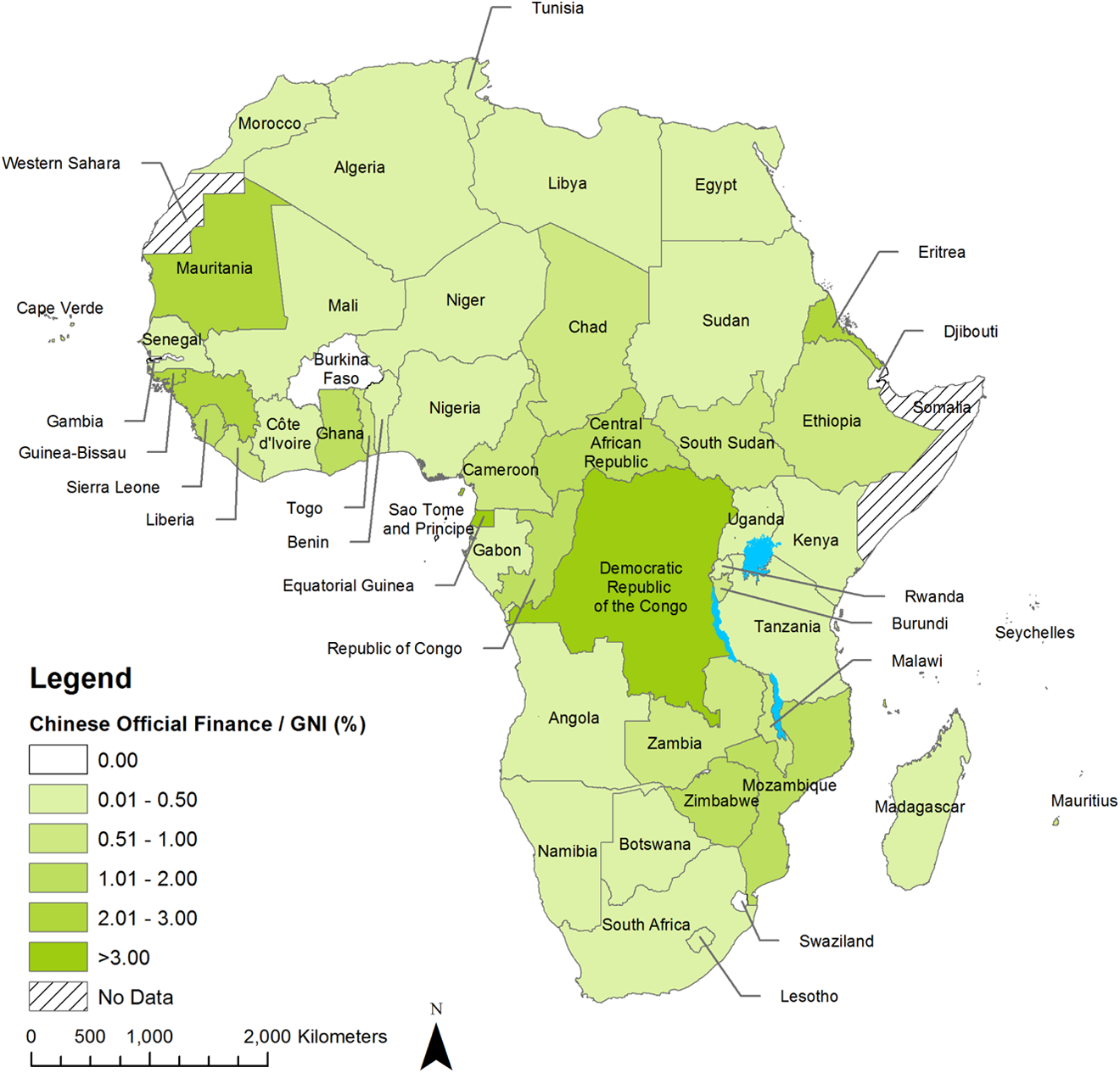
China’s official finance to Africa by recipient country as percentage of gross national income, 2000–2011 average.
Ten Largest Recipients of Official Finance to Africa (ODA-like and OOF-like), 2000–2011.

Note: Our calculations for China based on the TUFF methodology. OECD DAC creditor reporting system for the United States and DAC. Figures are reported in terms of commitments of Official Finance during the study period. ODA = Official Development Assistance; OOF = other official flows; DAC = development assistance committee; TUFF = tracking underreported financial flows.
Revisiting the Aid–Conflict Nexus
New data on China’s development finance allow for the reexamination of existing findings on the relationship between aid and other variables of interest. The impact of development finance on the incidence, duration, and severity of armed conflict in recipient countries has been extensively studied (e.g., Grossman 1992; Collier and Hoeffler 2002; Esman and Herring 2003; De Ree and Nillesen 2009; Savun and Tirone 2011, 2012; Nunn and Qian 2014; Crost, Felter, and Johnston 2014). Scholars continue to debate the precise impact of foreign aid flows on conflict in recipient states. For example, increases in aid might provide greater incentives for armed rebellion if the spoils of victory are perceived as larger, or may deter conflict by bolstering economic growth and state military capacity (Nielsen et al. 2011). While the contours of the aid–conflict nexus remain uncertain, scholars generally agree that volatility of incoming aid flows can have adverse effects in recipient states, whether through reductions in growth caused by greater uncertainty, increasing payoffs of war for rebels, or changes in the amount of resources governments can shift to deter violence or to buy off potential rebels (Lensink and Morrisey 2000; Arcand and Chauvet 2001; Bueno de Mesquita and Smith 2009). 24
The latter explanation, that aid volatility reduces the ability of governments to flexibly mobilize resources, is related to the fact that aid is sometimes fungible (Pack and Pack 1993). When aid is fungible, a recipient can effectively reroute incoming aid flows by reducing government spending in the sector receiving aid and spending more in other areas (Feyzioglu, Swaroop, and Zhu 1998; Nielsen et al. 2011). Fungible aid could deter intrastate conflict by increasing a state’s security capacity, or incite it by increasing the perceived rents for control of the state (Findley et al. 2011). Findley et al. (2011) argue that aid fungibility affects violence differently conditional on subnational location. It may deter conflict closer to state capitals where regimes enjoy substantial relative power advantages, but could catalyze local violence for aid rents further from the locus of state power. On the other hand, recipient regimes can leverage more fungible aid inflows by allocating them to “tenure extension activities” that promote leader survival (Licht 2010). In other words, aid fungibility can provide regimes with agency and flexibility to stabilize government spending in times of domestic vulnerability. A sudden aid shock, meanwhile, can jeopardize this flexibility.
The aid–conflict literature has been, however, largely dependent on development finance data from Western donors and multilateral institutions; published research ignores the possible impact of Chinese aid. Given the growing scale of Chinese aid, its inclusion in empirical research might affect the results of previous studies. To the extent that China gives aid where traditional donors are absent and increases aid where traditional donors retreat, ignoring Chinese aid could severely bias the results of existing studies. In other words, aid fungibility may be relevant not simply in the sense that recipients can partially or wholly direct the use of incoming aid flows, but can also substitute for aid flows among different donors. And, while we do not take it up in this article, if Chinese aid comes with fewer strings attached, recipient governments will have even more flexibility in allocating for tenure extension activities, so that one dollar of Chinese aid goes further in reducing conflict than one dollar of Western aid (Dreher et al. 2015).
To demonstrate the importance of including non-OECD donors, like China, when testing for relationships between aid and armed conflict, we replicate the analysis in Nielsen et al. (2011), including our data on Chinese aid. Nielsen et al. (2011) combine data on bilateral and multilateral aid (excluding China and other non-DAC donors) with data provided by the Peace Research Institute Oslo to demonstrate the adverse effects of sudden foreign aid withdrawals on recipient conflict. They run a rare-events logit analysis of time-series, cross-sectional data on 2,627 conflict events across 139 states over the 1981–2005 period. They find (among other results) that aid shocks significantly increase the probability of armed conflict onset. 25 We replicate this study, adding our new data on Chinese aid to their database. Importantly, the main result in Nielsen et al. (2011) holds when we restrict their sample to the post-2000 period and Africa. This is the reason why we have chosen their work to test our hypothesis, rather than relying on other studies that also investigate the aid–conflict nexus for which we could not replicate the main results in the post-2000 sample (e.g., Savun and Tirone 2011).
The inclusion of Chinese aid flows allows us to test our hypothesis: If traditional donors suddenly cut foreign aid flows, can recipient governments with close ties to other important donors, such as China, reduce the probability of violent conflict by offsetting aid shocks with alternative funding sources? In other words, does the presence of Chinese aid commitments increase the fungibility of aid that enables recipient governments to better withstand sudden outflows of traditional aid? We hypothesize that aid shocks do not translate into armed conflict onset if countries have access to sufficient funding from China to substitute for aid from traditional donors.
There are several possible explanations for this hypothesis. The availability of Chinese funds could enable governments to provide side-payments to (potential) rebels or make military investments that prevent (potential) rebels from challenging them. It could also be used by the recipient government to invest in economic development activities that make the local population less sympathetic to the concerns and aims of (potential) rebels. Additionally, in a similar way that aid flows from traditional donors are fungible and can free up resources for conflict deterrence purposes, Chinese aid flows could be used by some regimes to limit the risk of conflict during a negative aid shock. The conclusion of aid deals with Beijing could also serve as a signal to (potential) rebels that the recipient government can credibly commit to side-payments and thus prevent significant shifts in the distribution of power. This is particularly salient as China is said to be faster in delivering aid than other donors (e.g., Bräutigam 2009). In the remainder of this section, we test whether Chinese commitments to provide development finance in the aftermath of a shock in aid by other donors mitigates the effect of drastic changes in traditional aid flows on intrastate conflict.
We replicate Nielsen et al. (2011) as follows. We reproduce model (1) of their Table 1 (p. 226) with a sample that is restricted to Africa in the 2000–2005 period. As conflicts are more abundant in Africa than in the worldwide sample (5.3% of all post-2000 observations), we run our models using logit regressions rather than rare-events logit. 26 We consider the following logit equation

where conflictit is a binary indicator variable that takes the value of 1 if a country i experienced an internal or internationalized internal conflict between government and rebel forces with at least twenty-five battle-related deaths in year t (as coded in Gleditsch et al. 2002); xit represents a set of explanatory variables (including the aid shocks measure introduced above), while s(ti ) are cubic splines. 27 With the exception of data on China’s OF projects, we obtained these data from the replication data set provided by Nielsen et al. (2011).
In order to analyze the impact of a country’s access to Chinese funding on conflict onset, we add one of three measures of the intensity of Chinese development activities in a particular country at a time to the main regression. The first measure is the total number of China’s OF projects, the second is the total number of ODA-like projects, and the third is the US$ amount of China’s OF directed to a particular country as a share of the recipient’s GNI. The two measures based on project numbers have the advantage that they account for the entire universe of projects unveiled by the TUFF methodology. While the third measure based on monetary amounts excludes those projects for which we could not identify the monetary value of the project, it has the advantage that it accounts for the size of the project and the recipient’s economy.
In the working paper version of this article (Strange et al. 2015), we did not lag our measures of Chinese development activities even though Nielsen et al. (2011) lag the “aid shock” dummy in their estimations. This was because we assumed China and the recipient government would need time to react to a sudden drop in aid from other donors, so that we expected the availability of Chinese funding to matter at the time of the (potential) outbreak of a conflict rather than with a lag. However, an anonymous reviewer convinced us that the potential endogeneity that comes with the usage of contemporaneous aid more than outweighs the benefit of using aid with our preferred timing. While readers interested in our results with contemporaneous Chinese aid measures should refer to the working paper version of this article (Strange et al. 2015), we therefore present our regression results here with lagged aid to mitigate endogeneity concerns. 28 This approach has also been pursued by other scholars who study the relationship between aid and conflict as a (partial) solution to address potential endogeneity (Collier and Hoeffler 2002; Nielsen et al. 2011; Savun and Tirone 2011).
We present the results of our empirical analysis in Table 3. 29 The first column replicates model 1 from table 1 of Nielsen et al. (2011). The second column repeats the same regression, but employs logit rather than rare-events logit for the reason explained above. Our third and fourth columns demonstrate that the main results of Nielsen et al. (2011) hold if we first restrict the period of analysis to the 2000–2005 period and then further reduce the sample to cover African countries only.
Aid Shocks, Chinese Development Finance, and Conflict Onset (Regression Results).
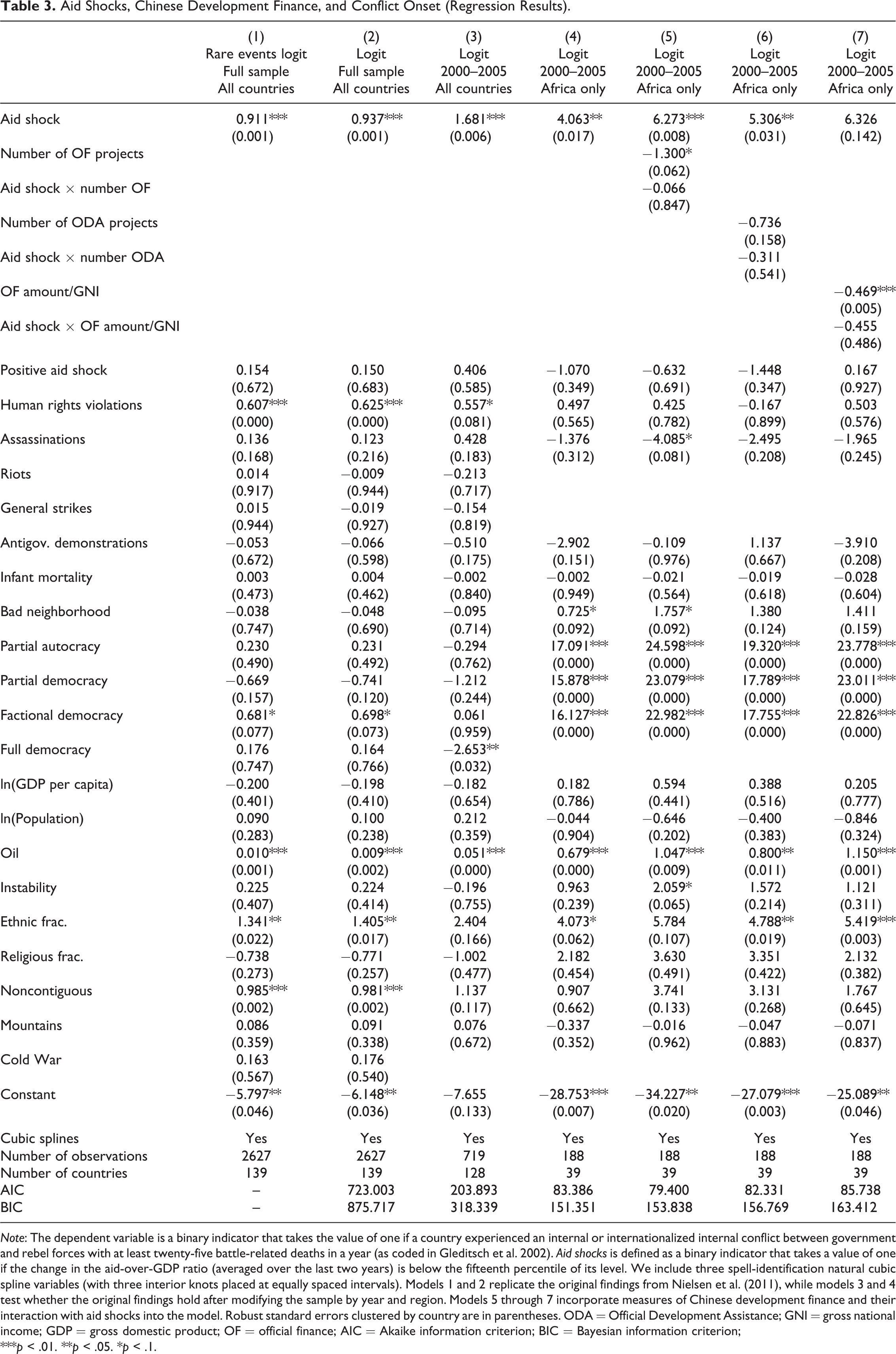
Note: The dependent variable is a binary indicator that takes the value of one if a country experienced an internal or internationalized internal conflict between government and rebel forces with at least twenty-five battle-related deaths in a year (as coded in Gleditsch et al. 2002). Aid shocks is defined as a binary indicator that takes a value of one if the change in the aid-over-GDP ratio (averaged over the last two years) is below the fifteenth percentile of its level. We include three spell-identification natural cubic spline variables (with three interior knots placed at equally spaced intervals). Models 1 and 2 replicate the original findings from Nielsen et al. (2011), while models 3 and 4 test whether the original findings hold after modifying the sample by year and region. Models 5 through 7 incorporate measures of Chinese development finance and their interaction with aid shocks into the model. Robust standard errors clustered by country are in parentheses. ODA = Official Development Assistance; GNI = gross national income; GDP = gross domestic product; OF = official finance; AIC = Akaike information criterion; BIC = Bayesian information criterion;
***p < .01. **p < .05. *p < .1.
As a next step, we introduce our three measures of Chinese development activities and their interaction with the aid shock dummy in columns 5–7 of Table 3. As Ai and Norton (2003, 123) note, “[t]he magnitude of the interaction effect in nonlinear models does not equal the marginal effect of the interaction term, can be of opposite sign, and its statistical significance is not calculated by standard software.” Figure 4 thus plots the average marginal effects of aid shocks on conflict onset at different levels of Chinese development finance (and the corresponding 90 percent confidence intervals). We find that aid shocks significantly increase the probability of armed conflict onset if no sufficient alternative funding from China is available. As can be seen in the figure, the effect of aid shocks on conflict remains statistically significant at conventional levels only at low levels of Chinese development activities. More precisely, we find that aid shocks do not significantly increase the likelihood of conflict onset if the number of Chinese projects exceeds roughly five (panel a) and three (panels b), respectively. Accounting for the monetary value of the development projects and the size of the economy, panel (c) of Figure 4 shows that aid shocks do not translate into conflict if the amount of Chinese OF as a share of recipient GNI amounts to 4.2 percent or more. 30 These findings suggest that the availability of funding from China mitigates the impact of aid shocks from traditional donors on conflict onset. More generally, incoming aid flows appear to be fungible in the sense that withdrawals of aid from one or more donors can be at least partially substituted for by aid commitments from other donors previously not considered in aid–conflict scholarship.
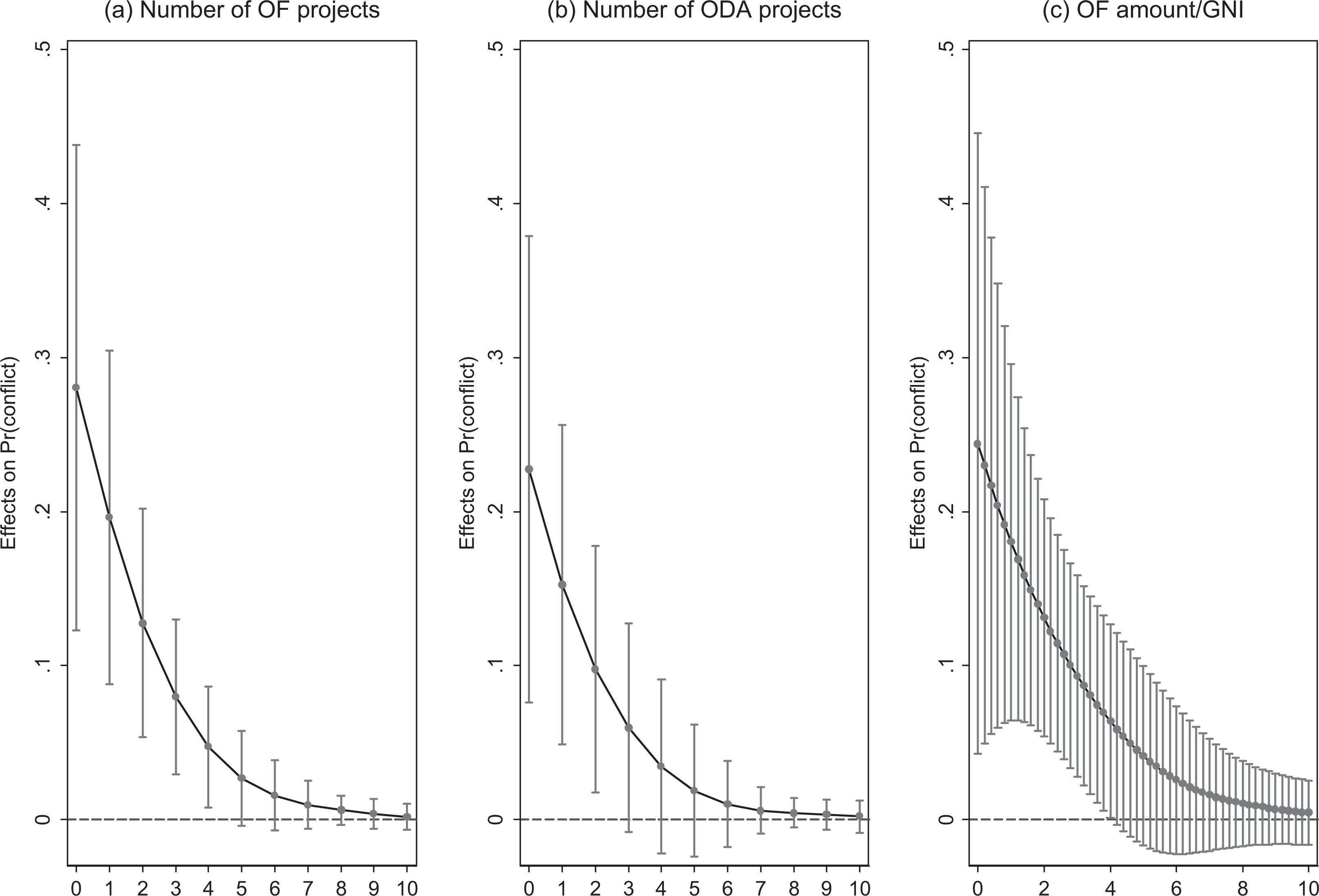
Aid shocks, Chinese development finance and conflict onset (average marginal effects). Note: The figure depicts the average marginal effect of an aid shock on the likelihood of conflict onset (and its 90 percent confidence interval), based on the regressions of Table 3. Panel (a) refers to the lagged number of Chinese official finance (OF) project commitments (column 5 of Table 3), (b) the lagged number of Chinese Official Development Assistance-like project commitments (column 6), and (c) the lagged monetary value of Chinese OF project commitments as a share of recipient gross national income (column 7).
As Nielsen et al. (2011) argue, incoming aid flows are often unstable despite the fact that many developing countries rely on them for a substantial portion of national expenditures. Instability resulting from sudden aid withdrawals is thus a major concern for developing states, making alternative sources of funding beyond traditional donors even more critical. Our results suggest that Chinese development finance may have a stabilizing effect in recipient states with weak governments. These findings also raise interesting questions about whether aid from China and other non-OECD donors, with arguably looser aid allocation and monitoring standards, is relatively more fungible or discretionary (Dreher et al. 2015; Bader 2015). Another possibility is that stabilizing aid from China—or other non-Western donors—in the aftermath of an aid shock reduces the ability of Western donors to intentionally weaken governments that have chosen to pursue policies which do not fall in line with Western policy preferences. More broadly, the findings highlight the importance of gathering better data on the development activities of China and other nontraditional donors to better understand the link between foreign aid and conflict. We discuss the robustness of these results in Online Appendix E.
Conclusions
As some Western governments scale back their development finance commitments, non-Western donors are rapidly expanding their overseas aid activities. The most important provider of OF to Africa among these non-DAC donors is China. Yet many non-DAC donors, including China, lack either the capacity or the political will to provide detailed information about their aid activities. Scholars are thus handicapped in their ability to study aid allocation and the impact of non-Western finance on development, political, and conflict outcomes.
Based on the insights from previous projects tracking conflicts, disasters, aid, investment, and other political and economic phenomena through open-source data collection techniques, we developed a systematic, transparent, and replicable methodology that triangulates and curates information from a wide range of sources that are largely independent from each other. Apart from contributing to the literature on development finance, we pursued this project as a proof of concept exercise to test the viability of a web-based, open-source data collection approach. This initial application has uncovered more than US$73 billion in commitments of official Chinese financing flows to Africa that were previously unrecorded—in a single location and with a single, consistent methodology—at the project level. About US$15 billion could be identified as being similar to ODA according to the OECD definition.
Several important observations can be made about twenty-first-century Chinese OF to Africa. First, with respect to the geographic distribution of China’s OF, we find that China’s activities are spread all over the African continent. Only countries recognizing Taiwan do not show up among China’s recipients of OF flows. According to the dollar amounts we tracked, the largest recipient appears to be Ghana followed by the Democratic Republic of Congo and Ethiopia. Second, with respect to the sectoral distribution of development projects, we find that China is active in almost all sectors, with “General environmental protection” being a notable exception. 31 While conventional wisdom that infrastructure plays an important role has been confirmed by the TUFF approach, the sector “Government and Civil Society” plays the most important role in terms of project numbers. Unsurprisingly in the Chinese case, projects in this sector are about “Government” and not “Civil Society.” Third, with respect to the trend over time, Chinese activities as a financier of development activities are increasing and are, at present, roughly comparable to the size of activities provided by the United States. When looking at ODA-like flows exclusively, however, China is still clearly behind the United States.
The results presented in this article suggest that Chinese development finance merits greater attention within the conflict studies literature. Extending the work of Nielsen et al. (2011), the empirical application of our data set has shown that aid shocks from traditional sources are more likely to induce conflict onset only if insufficient alternative funding is available from China. As such, traditional debates about aid fungibility and conflict should be expanded to consider not only the degree to which recipient regimes have agency to redirect incoming aid flows but also the extent to which they can mitigate the impact of negative aid shocks by substituting aid flows from different donors. This phenomenon is arguably most interesting when considering donors within a recipient country that are unlikely to increase and decrease aid commitments in concert with each other. As this article has demonstrated, including the development activities of China and other nontraditional donors is an essential step for generating more accurate conclusions about the relationship between foreign aid and armed conflict in developing countries. Future research could explore a variety of avenues, such as whether non-Western aid has a uniform stabilizing effect or depends on recipient institutions (see Bader 2015). All of this underscores the more general necessity of creating, improving and utilizing new sources of information to understand the development activities of China and other non-DAC donors.
Footnotes
Authors’ Note
This article is accompanied by the release of AidData’s Chinese Official Finance to Africa Dataset, Version 1.1, available for download at http://china.aiddata.org/datasets/1.1 and an interactive database platform (at http://china.aiddata.org). AidData’s Tracking Underreported Financial Flows (TUFF) methodology is also available for download at http://china.aiddata.org/TUFF_codebook. An earlier version of this article – entitled “China’s Development Finance to Africa: A Media-Based Approach to Data Collection,” co-authored with Vijaya Ramachandran—is available as working paper of the Center for Global Development (CGD Working Paper 323). This work would not have been possible without the invaluable support of reviewers, discussants and research assistants (see Online Appendix G for a full list). We provide our replication package for this article at  .
.
Declaration of Conflicting Interests
The authors declared no potential conflicts of interest with respect to the research, authorship, and/or publication of this article.
Funding
The authors disclosed receipt of the following financial support for the research, authorship, and/or publication of this article: This research was made possible in part by funding from the William and Flora Hewlett Foundation. Axel Dreher and Andreas Fuchs are grateful for generous support from the German Research Foundation (DFG) in the framework of the project “Foreign Aid of Emerging Donors and International Politics” at Heidelberg University (DR 640/4-1).
Notes
References
Supplementary Material
Please find the following supplemental material available below.
For Open Access articles published under a Creative Commons License, all supplemental material carries the same license as the article it is associated with.
For non-Open Access articles published, all supplemental material carries a non-exclusive license, and permission requests for re-use of supplemental material or any part of supplemental material shall be sent directly to the copyright owner as specified in the copyright notice associated with the article.
