



Abstract
Existing research has paid increasing attention to the role of political institutions such as legislatures and opposition parties in autocracies. So far, however, the relationship between nondemocratic institutions and state repression has remained largely unclear. This article argues that authoritarian institutions are related to divergent conflicting dynamics between incumbent regimes and opposition actors, which provide leaders with opposite incentives to repress. While authoritarian legislatures enhance leaders’ capacity to prevent conflict and reduce their need for repression, the presence of opposition parties helps opposition actors to overcome collective action barriers and mobilize against the incumbent regime, increasing the states’ need for repression. A panel data analysis of nondemocracies from 1976 to 2007 shows that authoritarian-elected legislatures reduce repression and the presence of opposition parties increases it. Moreover, the results indicate that autocracies with opposition parties and an elected legislature experience lower repression than autocracies with opposition parties but no elected legislature.
Introduction
The study of state repression in autocracies has received considerable attention in comparative politics and international relations over the last decade (see, e.g., Davenport 2007a; Vreeland 2008; Powell and Staton 2009; Conrad 2014; Frantz and Kendall-Taylor 2014; Hill 2016; Bove, Platteau, and Sekeris 2015). Prominent explanations emphasize differences between types of nondemocratic regimes to explain why some states are more repressive than others (Davenport 2007a). 1 Other explanations have turned their focus away from regime type to specific political institutions such as authoritarian legislatures and political parties. Leading theories of authoritarianism suggest that in contexts where the opposition is perceived as strong enough to threat regime stability, incumbent elites tend to create legislatures and allow the presence of autonomous opposition parties to co-opt rival forces within society. Partisan legislatures are seen as instruments of co-optation that help reduce conflict between governments and opposition, increasing the prospects for regime survival (Gandhi and Przeworski 2007; Gandhi 2008). Related research has shown that institutional co-optation through partisan legislatures decreases violations of empowerment rights, but it increases physical integrity rights violations (Frantz and Kendall-Taylor 2014).
Existing research has made significant progress in understanding how partisan legislatures influence the prospects of regime survival and state repression in nondemocratic regimes. Yet the category of partisan legislatures aggregates legislatures and opposition parties and does not allow us to examine the possibility that different authoritarian institutions affect repression in different ways. Moreover, related studies analyze the relationship between opposition parties and torture (Vreeland 2008), but do not consider whether and how authoritarian legislatures can affect torture and the overall amount of repression. Ultimately, it remains unclear whether legislatures and opposition parties affect repressive behavior in similar ways or whether these institutions provide leaders with divergent incentives to repress. Understanding the differences between legislatures and opposition parties is important since previous research shows that authoritarian institutions can have independent, even opposite effects on regime change and political violence (Wright and Escribà-Folch 2012; Aksoy, Carter, and Wright 2012).
This article disaggregates theoretically and empirically the effect of authoritarian institutions on state repression. It theorizes opposite effects of legislatures and opposition parties on personal integrity rights violations. I argue that authoritarian institutions shape government–opposition relations, their degree of conflict, and therefore the need for repression. Specifically, I contend that authoritarian institutions structure conflict between incumbent regimes and opposition actors in divergent ways and provide leaders with opposite incentives to repress. Authoritarian legislatures are co-optation devises that mitigate popular discontent and strengthen ruling elites’ capacity to prevent mobilization from below, reducing their need for repression. In contrast, opposition parties facilitate regime challengers to overcome collective action problems for mobilization, increasing the states’ incentives to repress. A panel data analysis of nondemocracies between 1976 and 2007 supports these claims. The results show that authoritarian legislatures decrease repression and the presence of opposition parties increases it, suggesting that authoritarian institutions affect violations of personal integrity rights differently. The analysis also shows that repression is lower in autocracies with opposition parties and legislatures, relative to autocracies with opposition parties but no legislature. This article suggests that authoritarian institutions do not constrain or provoke repression, but that they facilitate or mitigate dissent, which therefore instigates or decrease state violence.
State Repression in Authoritarian Regimes
One of the most robust findings in the quantitative literature on human rights points to a strong negative relationship between democracy and repression (e.g., Poe and Tate 1994; Bueno de Mesquita et al. 2005). Much research highlights the pacifying effect of democracy, stressing the role of political values and institutional constraints as the underlying factors explaining variation in personal integrity rights violations between democracies and nondemocracies. Some scholars claim that political values related to democracy provide peaceful mechanisms of conflict resolution and lead governments to avoid repression and use alternative nonviolent strategies (e.g., Henderson 1991). Other scholars postulate that democracies are less repression-prone than autocracies, mainly because democratically elected authorities face significant constraints coming from citizens’ participation in elections and veto players, which increase the costs of repression (e.g., Conrad and Moore 2010).
Following up earlier studies stressing that differences in autocracies are just as important as differences between democracies and nondemocracies (Geddes 2003), scholars started to examine why violations of physical integrity rights vary significantly among autocracies. Davenport (2007b) moves beyond the binary distinction between democracy and autocracy, suggesting that different types of autocracies resort to different levels of repression (see also Linz 1992). Davenport points out that pluralism and political engagement are likely to reduce repression and shows that single-party regimes are less repressive than other types of autocracies. A key conclusion is that single-party regimes share some features of democracies that help reduce repression, and hence there is a “tyrannical peace.” More recent research suggests that another fruitful way to study authoritarianism is by examining political institutions such as legislatures and opposition parties, instead of focusing on differences between types of autocracies. As noted below, this literature highlights the role of authoritarian institutions in shaping states’ repressive behavior.
There is robust evidence that social protest destabilizes authoritarian regimes and can lead to its breakdown (Ulfelder 2005), particularly nonviolent campaigns increasing the likelihood of transitions to democracy (Chenoweth and Stephan 2011; Rivera and Gleditsch 2013). In line with this, some scholars have paid increasing attention to the strategies that leaders use to dissuade or suppress dissent and survive in power. This literature emphasizes repression and co-optation as the main strategies that leaders have to hold onto power (e.g., Wintrobe 1990; Gandhi and Przeworski 2007; Bueno de Mesquita and Smith 2010). The use of repression can help to enhance regime survival by increasing the costs of collective action and eliminating opposition actors (Escribà-Folch 2013; however, see Bueno de Mesquita and Smith 2010). Nonetheless, it is well known that repression can be counterproductive as it may fuel dissent (e.g., Lichbach and Gurr 1981; Lichbach 1998).
Given the costs of repression, authoritarian leaders often employ co-optation strategies to ameliorate popular discontent and the threat of social protest. Autocrats can provide material rewards and distribute public goods to co-opt different segments of society; however, limited access to rents hinders their capacity to provide these benefits. Given the lack of resources, many leaders often find themselves on the need for alternative instruments of co-optation, and political institutions represent such alternative by providing dictators with the tools to make policy concessions and credible commitments. In particular, partisan legislatures “serve as a controlled institutionalized channel through which outside groups can make their demands and incumbents can make concessions without appearing to cave in into popular protest” (Gandhi 2008, 181). In line with this, scholars have shown that partisan legislatures increase regime survival (e.g., Gandhi and Przeworski 2007; Boix and Svolik 2013).
Related studies examine how autocratic institutions influence levels of repression. Frantz and Kendall-Taylor (2014) distinguish between empowerment rights and physical integrity rights and find evidence that co-optation through legislatures and political parties decreases violations of empowerment rights, but raise physical integrity rights violations. These results are consistent with previous work on political parties and torture in autocracies. Vreeland (2008, 69) highlights that “there is more torture where power is shared.” He argues that the presence of multiple parties increases opposition and acts of defection against the incumbent regime, making torture more likely as it is an instrument to obtain relevant information and intimidate opposition actors. Empirical analyses support the claim that opposition parties in autocracies are positively related to torture (Vreeland 2008; Conrad 2014).
While existing research has demonstrated that partisan legislatures in nondemocratic regimes influence the prospects of regime survival and most notably state repression, it remains unclear whether different political institutions affect states’ decisions to repress in similar ways. In my view, underlining differences between legislatures and political parties can bring new insights to understand repression in nondemocratic regimes, as there is evidence that these institutions influence actors’ incentives in distinct ways and affect regime change and political violence differently. For example, Wright and Escribà-Folch (2012) show that legislative assemblies strengthen autocratic stability and opposition parties instead destabilize authoritarianism and increase the likelihood of democratization. 2 Aksoy, Carter, and Wright (2012) find that autocratic regimes with opposition parties and no elected legislature experience more terrorism. In contrast, autocracies with opposition parties and an elected legislature are normally less likely to experience terrorism activity. Drawing on these insights, the remainder of the article examines theoretically and empirically the divergent effects of legislatures and opposition parties on personal integrity rights.
Authoritarian Institutions and State Repression
What specific authoritarian political institutions encourage/discourage leaders to deploy repression, and why? Building on existing research, I consider here legislatures and opposition parties as distinct institutions and develop an argument detailing why these institutions are expected to provide dictators with divergent incentives to repress. I expand on how legislatures and opposition parties can increase/decrease dissent and social protest, and hence increase/decrease the need for repression. Some scholars highlight the instrumental role of authoritarian institutions and understand them as arenas of co-optation and controlled bargain. From this perspective, “partisan legislatures incorporate potential opposition forces, investing them with a stake in the ruler’s survival. By broadening the basis of support for the ruler, these institutions lengthen his tenure” (Gandhi and Przeworski 2007, 1280). Other researchers instead see authoritarian institutions as arenas of contention through which opposition forces can challenge regime power and push for political change. Accordingly, the use of authoritarian institutions “creates space for political contestation that can be politically destabilizing” (Frantz and Kendall-Taylor 2014, 333).
I adopt a different stance and argue that political institutions in nondemocracies can be understood as arenas of co-optation and contention (see Schedler 2013). Yet, whether authoritarian institutions co-opt or provide opportunities for mobilization largely depends on the specific institution we look at. To anticipate, legislative assemblies provide an organized forum that helps autocrats to co-opt opposition actors and increase popular support. In contrast, although political parties can also be instrumental and facilitate co-optation, opposition parties constitute a source of conflict and domestic instability. The influence of authoritarian institutions on conflicting dynamics between ruling elites and opposition forces has important implications since there is a great deal of evidence indicating that governments resort to repression when leaders perceive threats to their survival or face manifest dissent (e.g., Gartner and Regan 1996; Moore 1998; Pierskalla 2010; Ritter 2014). Although not all forms of dissent lead to repression, there is a strong evidence that states resort to violence when they experience different forms of dissent and direct action such as riots, guerrilla warfare, terrorist attacks, and civil wars (e.g., Piazza and Walsh 2009; Carey 2010; DeMeritt and Young 2013).
The Rationale of Repression
Authoritarian governments deploy repression, but leaders make the critical decision whether to resort to violence or not. Repression in nondemocracies is not purely the result of what earlier scholarship saw as a regime pathology, where state-sponsored violence emerges from paranoid and unrestrained leaders. Rather than a direct outcome of irrational or sadistic leaders, most research today adopts a strategic approach in which repression largely depends on states’ need to appease dissent and institutional constraints shaping the costs of repressive behavior (e.g., Gartner and Regan 1996; Moore 1998; Poe 2004).
On the need side, a regime facing domestic threats has incentives to deploy repression in order to extract relevant information and enhance social control. The use of violence is a common response to challenges that threaten political stability and the integrity of the state, that is, governments resort to violence to dissuade, counter, and suppress opposition forces threatening state power. It is noteworthy that states not only repress manifest dissent but also deploy preemptive violence against perceived threatening actors. As Danneman and Ritter (2014, 257-58) put it, “if authorities expect a group to take an action that could undermine their power, they may try to preempt that action, repressing to undercut the group’s will or capacity to challenge them” (see also Poe 2004). The rationale of state repressive behavior is that the use of violence can ameliorate or suppress existing domestic challenges and intimidate other actors that otherwise may be willing to mobilize against the regime (Wantchekon and Healy 1999). Conversely, states have lower incentives to repress in contexts where they have broad support within society or in contexts where discontented people and organized opposition do not seriously challenge their power.
On the constraint side, leaders are less likely to repress in environments where political institutions raise the costs of violence. This feature is crucial to understand differences between democracies and nondemocracies since dictators face fewer constraints that make repression more likely when it is needed, as opposed to democracies where elections and veto players restraint leaders from using violence (e.g., Conrad and Moore 2010). Because authoritarian leaders face few institutional constraints to their repressive behavior, understanding why they engage in repression requires a focus on the factors affecting conflict relations between regimes and opposition. To quote Vreeland (2008, 74), “violence is employed strategically and violence is necessary only where there are likely subversives against the regime within society …. Where control is perfect, subversive behavior is likely to be detected and punished. Anticipating this, members of society choose to cooperate with the regime. So there is less violence.” I adopt this approach and bring new theory on how authoritarian legislatures and opposition parties influence subversive behavior in different ways, providing dictators with divergent incentives to repress.
Authoritarian Legislatures, Opposition Parties, and Repression
Legislative assemblies are co-optation tools that can strengthen the regime stability and mitigate the threat of civil unrest and social protest. Authoritarian legislatures allow dictators to encapsulate and neutralize potential opposition by incorporating them into an organized forum in which they can raise their voice and represent the preferences of broader actors in society. 3 In doing so, legislatures not only facilitate the making of policy concessions but also make the dictator’s promises more credible (Wright 2008; Gandhi 2008). Wright and Escribà-Folch (2012, 285) argue that “legislatures provide a credible guarantee that the regime will not renege on promises to forgo predation, permit policy concessions to the opposition, or redistribute away from the elite in the future.” From the regime’s perspective, the presence of opposition actors within the legislature enables the ruling elite to co-opt potential opposition forces and make policy concessions that benefit large segments of society, reducing the sources of popular discontent and social protest. From the opposition’s perspective, legislatures allow them to extract concessions from the incumbent coalition, without the risks associated with other contention strategies seeking to influence policy making.
A second way that authoritarian legislatures can reduce potential or manifest protest from below and thus enhance regime stability is via patronage. Another argument suggests that legislatures help co-opt key opposition actors by incorporating them into the legislative assembly and facilitate provision of particularistic rewards (Reuter and Robertson 2015). The presence of legislatures not only provides opposition actors the opportunity to influence policy and obtain concessions for larger groups but also gives them access to rents that otherwise they could not benefit from. Importantly, opposition elites who have institutionalized access to perks through the legislature have fewer incentives to lead other actors to mobilize and protest against the authoritarian regime. In this regard, Reuter and Robertson (2015, 236) claim that “legislatures help authoritarian leaders to diffuse social protests because they are a device that can be used to allocate spoils among would-be leaders of such protest.”
The prevailing role of nondemocratic legislatures is therefore one of processing and solving conflict between elite actors and between regimes and opposition forces. The existing research supports this claim by showing that legislatures are negatively related to social protest (Reuter and Robertson 2015). Moreover, leaders in autocracies with legislatures are significantly less likely to be removed from power than leaders in autocracies without legislatures (Boix and Svolik 2013). Either by increasing representation or personal co-optation of key opposition actors, legislatures offer an institutional forum of controlled bargaining that helps mitigate the emergence of challenging actors and potential or manifest protest. In consequence, repression is less needed. As legislative assemblies in autocracies prevent the emergence of threatening actors and decrease the risk of antiregime protest, we can expect that authoritarian legislatures are negatively associated with state repression.
Besides single-parties and legislatures, ruling elites frequently allow the presence of autonomous political parties to co-opt and contain potential opposition forces. When the opposition is perceived as strong enough to mobilize protest and threaten regime survival, political leaders make greater concessions and enable the formation of opposition parties that can compete in elections (Gandhi 2008). Furthermore, the adoption of political institutions such as opposition parties yields autocrats some democratic credibility in the international arena (Levitsky and Way 2010). Not surprisingly, examples of multiparty systems under authoritarianism are abundant in the contemporary world, most notably during the post–Cold War period.
To clarify, many autocratic regimes hold regular multiparty elections but electoral processes tend not to fulfill the minimal attributes of democratic elections, decreasing the chances of opposition parties to win the elections and take power. In unequal arenas of electoral competition, opposition parties thus have incentives to mobilize broad sectors of society in order to protest against the regime (see, e.g., Howard and Roessler 2006; Schedler 2013; Kinne and Marinov 2013). 4 Existing research has found a great deal of evidence consistent with this claim and shows that political parties constitute an important source of instability and conflicting interactions between regimes and opposition actors (Wright and Escribà-Folch 2012; Schedler 2013; Hafner-Burton, Hyde, and Jablonski 2014). Opposition parties often constitute the roots of political conflict and subversion since they can help actors overcome barriers to collective action (Aksoy, Carter, and Wight 2012). Much research on contentious politics emphasizes a number of obstacles for collective action, highlighting that common interests are not sufficient to motivate individuals to mobilize. Given that the benefits of collective action are not contingent on participation, rational actors have incentives to free ride and avoid the costs related to dissent activity (e.g., see Olson 1965; Lichbach 1995). Moreover, discontented people in nondemocratic regimes tend to lack information on the preferences of others and do not know the extent of popular discontent (e.g., see Kuran 1990; K. Gleditsch and Rivera 2017). Opposition parties are thus critical because of their ability to overcome problems of collective action. They often expose and disseminate relevant information on the nature of authoritarian politics and condemn government policy in sensitive areas, which can generate and intensify discontent among larger segments of society. Moreover, opposition parties are intermediaries that connect dissatisfied people and contribute to generate awareness of the extent of popular dissatisfaction with the regime. To put simply, opposition parties incubate and exacerbate the struggle for power and their presence makes social protest and direct action against autocratic regimes easier.
Opposition parties aggregate the views of discontented people and establish an organizational structure that facilitates mobilization against the regime. Thus, although authoritarian legislatures and opposition parties can facilitate power sharing and co-optation, they shape government–opposition relations in very different ways. As opposition parties coordinate popular discontent and make collective action easier, they incubate the threat of regime survival and hence it is reasonable to expect that party opposition will lead to higher repression levels. Take for instance the case of Mexico in the late 1980s, when opposition parties strengthened their organizational capacity for mobilization against the Institutional Revolutionary Party (PRI), leading to more repression, notably against opposition forces from the left-based Party of the Democratic Revolution (PRD). According to Eisenstadt (2003, 122), about 125 members of the PRD were killed at hands of state actors from 1989 to 1995. Another illustrative example is Chile under Pinochet, where several political parties created during the democratic era continued operating after the coup against president Allende. In a first stage, these organizations operated without access to a legislature and experienced systematic violations of personal integrity rights even in the period when they were not capable of mobilizing broader sectors of society and influence political change. The Chilean case illustrates how the mere presence of opposition parties tends to be perceived as a threat for regime survival and dictators deploy preemptive repression intended to hurt opposition parties’ capacity and dissuade other actors to join the opposition. In a second stage after 1983, opposition parties still had no access to a legislature but together with labor unions and student organizations were able to mobilize the masses and challenged Pinochet’s rule, leading to an escalation in repression (Garretón 1988). In the contemporary world, in many other instances, we see that states engage in repression, particularly when the opposition can defeat the incumbent government or when the opposition mobilize and contest election results (Schedler 2013; Hafner-Burton, Hyde, and Jablonski 2014).
From the preceding discussion, I derive two hypotheses about the divergent effects of legislatures and opposition parties on repression in nondemocratic regimes:
The preceding hypotheses summarize the expected divergent effects of authoritarian institutions on repression. As I detail later, however, an important proportion of nondemocracies have both legislatures and opposition parties, and thus leaders’ incentives to use repression may collide under this institutional setting. What behavior can we expect from regimes with both legislatures and opposition parties? Which effect predominates in polities where legislatures cohabit with opposition parties?
Given that legislatures incorporate opposition forces and facilitate negotiation between them and the ruling elite, it has been argued that organized party opposition bargains and processes conflict within the legislature. Nondemocratic legislatures allow the opposition to raise their demands and this flow of information facilitates compromise and responsiveness by authoritarian governments (Gandhi 2008). Moreover, legislatures reduce opposition’s incentives for resorting to dissent by influencing actors’ beliefs with regard to the effectiveness of negotiation and nonviolent methods to obtain government concessions. Party opposition with access to the legislature has incentives to advance regime openness through negotiation and gradual reforms, rather than pursuing liberalization and regime change through violent direct action (Bove and Rivera 2015).
5
In consequence, the presence of a legislature helps to mitigate dissent by opposition forces outside the regime front. I anticipate that the co-optative effect of legislatures will dominate over the subversive effect of opposition parties, and therefore repression will be lower when legislatures and opposition parties coexist. Conversely, regimes with opposition parties and no elected legislature are expected to repress at higher levels than regimes where opposition parties have access to the legislature. One reason for this is that in the absence of a legislative assembly party opposition has fewer chances to bargain over policy and has greater incentives to mobilize against the incumbent regime (Aksoy, Carter, and Wright 2012). The next hypothesis summarizes this reasoning:
Data
I employ a time-series cross-sectional research design to assess the hypotheses outlined above. The unit of observation is the state-year, and the spatiotemporal domain covers all autocracies between 1976 and 2007, as coded by Cheibub, Gandhi, and Vreeland (2010). A country is classified as democratic if the chief executive and the legislative body are elected trough free and fair elections, more than one party competes in elections, and there is alternation in power. A country is classified as nondemocratic if it does not meet one or more of these conditions.
Dependent Variable
To test the effect of authoritarian institutions on repression, I focus on the extent to which states engage in violations of physical integrity rights using data from the Political Terror Scale (PTS). This is the most commonly used measure of repression in the human rights literature. PTS covers the period 1976 to 2013, a larger period than the Cingranelli and Richards Human Rights Dataset, which is limited to 1981 to 2011. It focuses on state coercive behavior through a five-point ordinal scale that captures the severity of repression. Codification is as follows (Wood and Gibney 2010, 373):
Countries … under a secure rule of law, people are not imprisoned for their views, and torture is rare or exceptional.… Political murders are extremely rare.… There is a limited amount of imprisonment for nonviolent political activity. However, a few persons are affected; torture and beating are exceptional.… Political murder is rare.… There is extensive political imprisonment.… Execution or other political murders and brutality may be common. Unlimited detention, with or without trial, for political views is accepted. The practices of Level 3 are expanded to larger numbers. Murders, disappearances, and torture are part of life.… In spite of its generality, on this level terror affects primarily those who interest themselves in politics or ideas.… The terrors of Level 4 have been extended to the whole population.… The leaders of these societies place no limits on the means or thoroughness with which they pursue personal or ideological goals.
PTS provides two measures: one is based on country information from Amnesty International annual human rights reports and the other comes from the US State Department country reports on human rights. The core models in the analysis are estimated using the scale based on Amnesty International reports since there is evidence that the US State Department country reports are biased toward states allied with the United States. Poe, Carey, and Vazquez (2001) have noted that human rights reports from the US State Department reflect the interests of the United States to safeguard itself from the blame or condemnation against one of its allies. As a robustness check, I also provide estimates using the US State Department indicator.
Although violent repression is only one strategy in the state’s repertoire and governments can also use nonviolent strategies of control, I focus only on violent repression as commonly used measures of nonviolent repression such as restrictions of civil liberties take into account some aspects that are correlated with regime types. In fact, existing research on comparative politics employs the Freedom House index to classify “competitive” or “electoral” authoritarian regimes (Levitsky and Way 2010; Schedler 2013).
Independent Variables
So far, existing research has focused on how co-optation strategies under authoritarianism influence repression by using an aggregated measure of partisan legislatures. This is a three-point indicator, coded 2 if multiple legislative parties are allowed, 1 if only the regime party controls seats within the legislature, and 0 otherwise (e.g., see Gandhi 2008; Gandhi and Przeworski 2007). In this study, I adopt a different approach in which different authoritarian institutions like legislatures and opposition parties are expected to have opposite effects on repression. Rather than using an aggregated measure of authoritarian institutions, I employ two different indicators for elected authoritarian legislatures and opposition parties outside the regime front (for a similar approach, see Wright and Escriba-Folch 2012).
I use data from Cheibub, Gandhi, and Vreeland (2010) to capture the variables of interest. The first explanatory variable indicates whether a nondemocratic regime has an elected legislature in a given year. These authors provide a trichotomous measure reflecting the status of legislatures: 0 if the “legislature is closed,” 1 if the “legislature is appointed,” and 2 if the “legislature is elected.” I have recoded this variable to create a binary indicator of elected legislatures, which is coded 1 if the legislature is elected and 0 otherwise. In line with Aksoy, Carter, and Wight (2012), I only consider elected authoritarian legislatures since appointed legislatures are less effective to mitigate the risk of social protest. Appointed legislatures can be useful instruments to reduce intraelite conflict, but their lack of representativeness makes them less effective to co-opt large groups of society and reduce antiregime protest. As such, there should be no discernable differences between appointed and no legislatures on repression. 6 Within the sample, about 72 percent of the state-years observations have an elected legislature. Table 1 illustrates the distribution of elected legislatures and opposition parties by regime type. It shows that elected legislatures are most common in civilian autocracies (85 percent of state-years). We see elected legislatures in nearly 58 percent of state-years observations in military dictatorships, and 49 percent of state-years in royal dictatorships.
Elected Legislatures and Opposition Parties in Autocracies.

Source: Based on Cheibub, Gandhi, and Vreeland (2010).
The second explanatory variable captures the presence of opposition parties outside the regime front, based on the defacto2 variable from Cheibub, Gandhi, and Vreeland (2010). This variable codes 0 for “no parties,” 1 for “one party or multiple parties, but they belong to the regime front,” and 2 for “multiple parties.” 7 I have recoded this measure into a dichotomous indicator, which takes value 1 if there are multiple opposition parties outside the regime front and 0 otherwise. One reason for aggregating no parties and one party or multiple parties pertaining to the regime front is that this latter category can be useful to co-opt elite actors, but is unlikely to co-opt large groups and thus reduce the risk of dissent. From this view, the presence of multiple parties that pertain to the regime front is not expected to reduce repression levels. Within the sample, opposition parties outside the regime front are observed in about 53 percent of the state-year observations. Table 1 shows that opposition parties are frequent under both civilian (55.25 percent of state-years) and military regimes (56.78 percent of state-years), and are much less common in royal autocracies (29.15 percent of state-years).
The binary indicators for elected legislatures and opposition parties are helpful to assess the expected divergent effects of authoritarian institutions on repression. However, one potential shortcoming of these measures is that they lump together different institutional arrangements into one reference category. Following Aksoy, Carter, and Wright (2012), I employ an indicator capturing four exclusive categories that reflect different institutional arrangements in nondemocratic regimes. The numbers in parentheses specify the percentage of country-year observations in each category within the sample. Codification is as follows:
Opposition parties but no legislature (14 percent). It is coded 1 if at least one de facto party exists outside the regime front but there is no elected legislature, and 0 otherwise (e.g., Afghanistan [1992–2004], Chile [1983–1988], Congo DR [1992–1996 and 2000–2005], El Salvador [1979–1983], Rwanda [1992–2002], and Uruguay [1973–1984]). Opposition parties with legislature (39 percent). It is coded 1 if at least one de facto party exists outside of the regime front and there is an elected legislature, and 0 otherwise (e.g., Mexico under the PRI, Singapore under the People’s Action Party). Single-party regime (33 percent); it takes value 1 when there is only one party, and 0 otherwise. These figures show that nondemocratic elected legislatures and opposition parties do not always go together and there is significant variation that allows me to test the hypotheses outlined above (e.g., Algeria [1976–1989], Bulgaria [1976–1989], Cuba [1976–2007], and Tanzania [1976–1991]). No parties (14 percent). It takes value 1 when there are no political parties, and 0 otherwise (e.g., Burkina Faso [1980–1988], Ethiopia [1976–1983], Kuwait [1976–1990], Saudi Arabia [1976–2007], and Swaziland [1983–2007]).
The theoretical argument anticipates that personal integrity rights violations will be lower in autocracies with opposition parties and an elected legislature, relative to autocracies with opposition parties but no legislature. Therefore, I use opposition parties with no elected legislature as the reference category in the analysis. Based on Hypothesis 3, I expect a negative coefficient for regimes with opposition parties and an elected legislature (category 2). In a similar manner, the coefficient for single regime parties (category 3) and regimes with no parties (category 4) are expected to have a negative sign. One reason for this is that both single-party regimes and autocracies with no parties tend to face less opposition and thereby repression should be lower. This expectation is consistent with Vreeland’s argument that state-sponsored violence is necessary only where there are threats or manifest acts of subversion against the regime (Vreeland 2008).
Control Variables
The empirical analysis includes a series of controls plausibly associated with the use of repression and physical integrity rights violations: internal armed conflict, economic development, population size, oil wealth, judicial independence, repression at time t − 1, and regime type. I discuss each control variable below.
It is well established that violent threats to the state decrease the costs of government violence and thus repression is expected to be more likely under contexts of internal armed conflict (e.g., Poe and Tate 1994). In consequence, I incorporate a binary indicator for internal armed conflict, indicating whether a state experiences a civil war with at least 1,000 battle-related deaths in a given year, according to the Uppsala/The Peace Research Institute Oslo Armed Conflict Dataset from N. Gleditsch et al. (2002).
Existing research has found a negative relationship between economic development and state repression. One reason for this is that governments in wealthier countries are less likely to resort to violence, as they tend to experience less conflict and thus repression is less needed (e.g., Poe and Tate 1994). I thus include an indicator for development as measured by the natural log of gross domestic product (GDP) per capita. I also incorporate a variable, that is, the natural log of the total population, as there is plenty of evidence pointing to a positive relationship between population size and repression (e.g., Henderson 1993). Both indicators come from K. Gleditsch (2002).
The literature on natural resources and regime stability points out that states in oil-rich countries can invest in repression as a strategy to dissuade or appease domestic dissent. Empirical studies yield support for this argument by showing that oil wealth increases regime durability 8 (e.g., Bueno de Mesquita and Smith 2010). Related studies also find that oil wealth is positively associated with state repression (e.g., DeMeritt and Young 2013). I control for oil wealth, a binary variable coded 1 if oil exports exceed one-third of export revenues and 0 otherwise (from World Bank 2010).
Beyond structural factors influencing state coercive behavior and respect for human rights, other scholars have examined whether and how institutions such as domestic judiciaries affect repression in nondemocratic regimes. Conrad (2014) argues that effective domestic judiciaries raise the costs of state abuses of physical integrity rights. Consistent with this argument, empirical studies show that effective judiciaries measured by judicial independence are negatively related to repression in autocracies (Conrad 2014; see also Powell and Staton 2009; Conrad and Ritter 2013). To control for the impact of effective domestic judiciaries, I employ a latent measure for judicial independence developed by Linzer and Staton (2015). 9 Higher values indicate greater judicial independence and thus this variable should be related to lower levels of repression.
Finally, previous research provides robust evidence that past coercive behavior is a strong predictor of present levels of repression (e.g., Poe and Tate 1994). In line with this, all model specifications include the dependent variable lagged one year.
Findings
Given that the dependent variable is categorical and ordered, I estimate the effect of elected legislatures and opposition parties on state repression using an ordered probit model with robust standard errors clustered by country to address error correction within panels. In line with Nordås and Davenport (2013), I include year dummies to account for advances in coverage and detection of states’ violations of physical integrity rights across the world. All independent variables are lagged one year to mitigate potential problems of reverse causality between independent variables and the outcome.
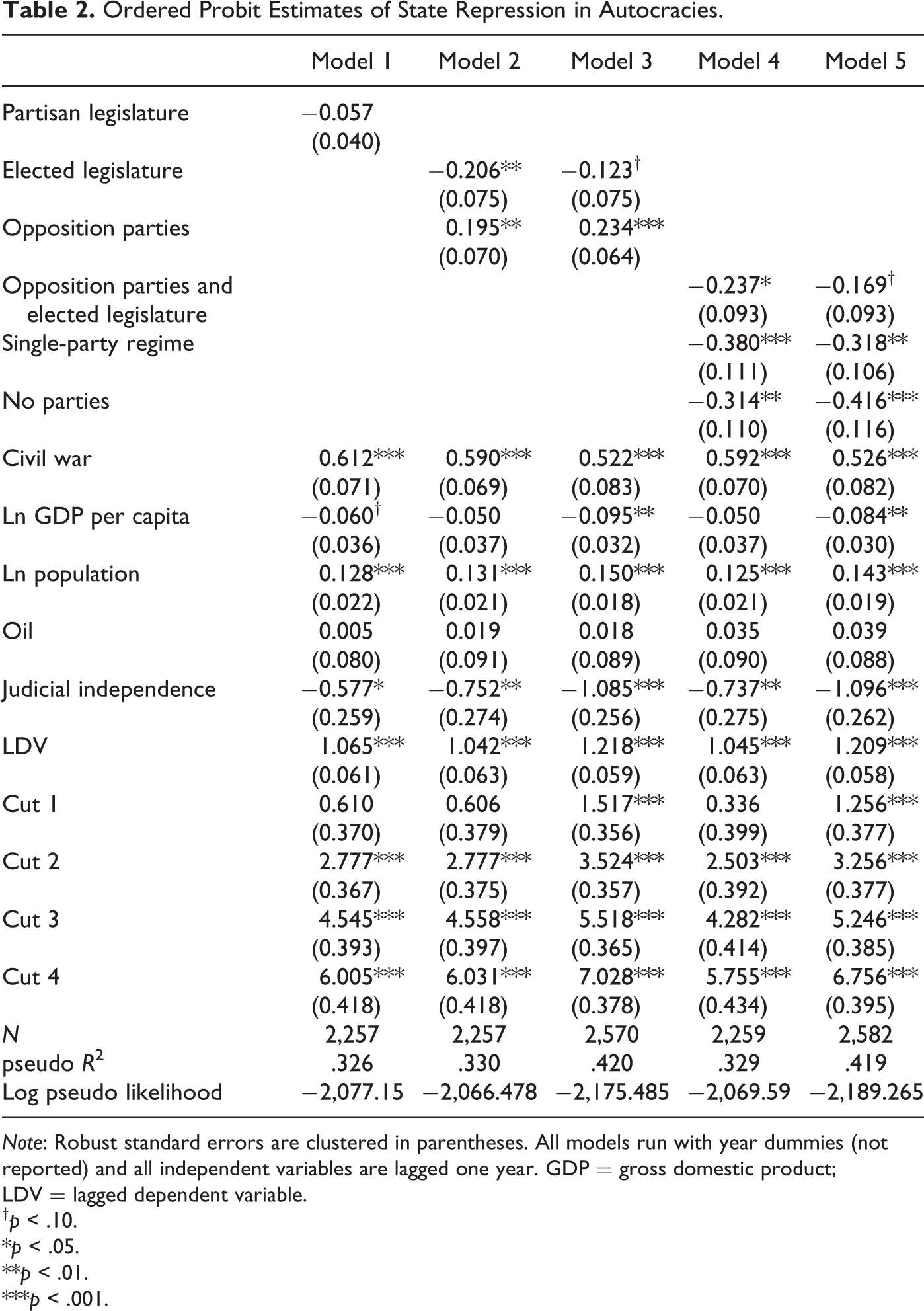
Table 2 displays ordered probit estimates of repression in autocracies. For purposes of comparison, in model 1, I begin by estimating the impact of partisan legislatures on the outcome. The indicator of partisan legislature is a trichotomous measure coded 0 when “either no legislature or all members of the legislature are nonpartisan,” 1 when there is a “legislature with only members from the regime,” and 2 when there is a “legislature with multiple parties” (from Cheibub, Gandhi, and Vreeland 2010). This is a common approach intended to capture co-optation strategies in autocracies (e.g., see Gandhi 2008). In model 1, the coefficient for partisan legislatures is negative, but it fails to obtain statistical significance. This result is compatible with an earlier study by Gandhi (2008), who operationalizes repression using military expenditures data and finds no relationship between partisan legislatures and military spending, once fixed-effects are taken into account.
Ordered Probit Estimates of State Repression in Autocracies.
Note: Robust standard errors are clustered in parentheses. All models run with year dummies (not reported) and all independent variables are lagged one year. GDP = gross domestic product; LDV = lagged dependent variable.
†p < .10.
*p < .05.
**p < .01.
***p < .001.
Model 2 excludes the measure for partisan legislatures and incorporates two indicators of elected legislatures and opposition parties. As detailed above, this strategy allows me to assess whether nondemocratic institutions have divergent effects on state repressive behavior. Model 2 suggests strong support for Hypotheses 1 and 2. While elected authoritarian legislatures are associated with lower levels of repression, opposition parties are positively and significantly related to repression. Model 3 replicates model 2 using the five-point PTS based on the US State Department as the dependent variable. These estimations did not alter the substance of the findings reported in model 2. In general, a comparison of models 1 and 2 illustrates the usefulness of theoretical and empirical disaggregation of authoritarian institutions. It shows that employing aggregated data can mask intriguing patterns regarding the effect that elected legislatures and opposition parties have on personal integrity rights violations under authoritarianism. Thus, considering legislatures and opposition parties as distinct institutions helps to understand how nondemocratic institutions influence state repressive behavior in opposite ways.
For a more substantive interpretation of the findings, I present a graphical description of the effects of elected legislatures and opposition parties on state repression. Given that statistical coefficients from ordered probit models are not straightforward to interpret, the top panel of Figure 1 displays the marginal effect of elected legislatures on each level of repression in the PTS. The panel shows how the likelihood of each level varies as the elected legislature variable ranges from either 0 to 1. Using this approach, it can be seen that nondemocratic regimes with an elected legislature are more likely to experience the lowest levels of state repression (PTS = 1 and 2). Error bars represent 95 percent confidence intervals and indicate these effects are statistically significant. The effect of elected legislatures is particularly strong for the second level, as we see that a change from 0 to 1 in the elected legislature variable is related to an increase of .065 in the probability that PTS = 2. Consistent with this pattern, the presence of an elected legislature decreases medium (PTS = 3) and highest levels of repression (PTS = 4 and PTS = 5). This effect is remarkable for the third and fourth categories of the scale, as the presence of an elected assembly reduces these categories by .023 and .040, respectively. Importantly, 28.60 percent of all observations of the dependent variable fall within the second category (PTS = 2) and 39.10 percent and 20.50 percent in the third and fourth categories (PTS = 3 and PTS = 4), indicating that the pacifying effect of elected legislatures is clearly nontrivial as it affects a significant proportion of nondemocratic regimes.
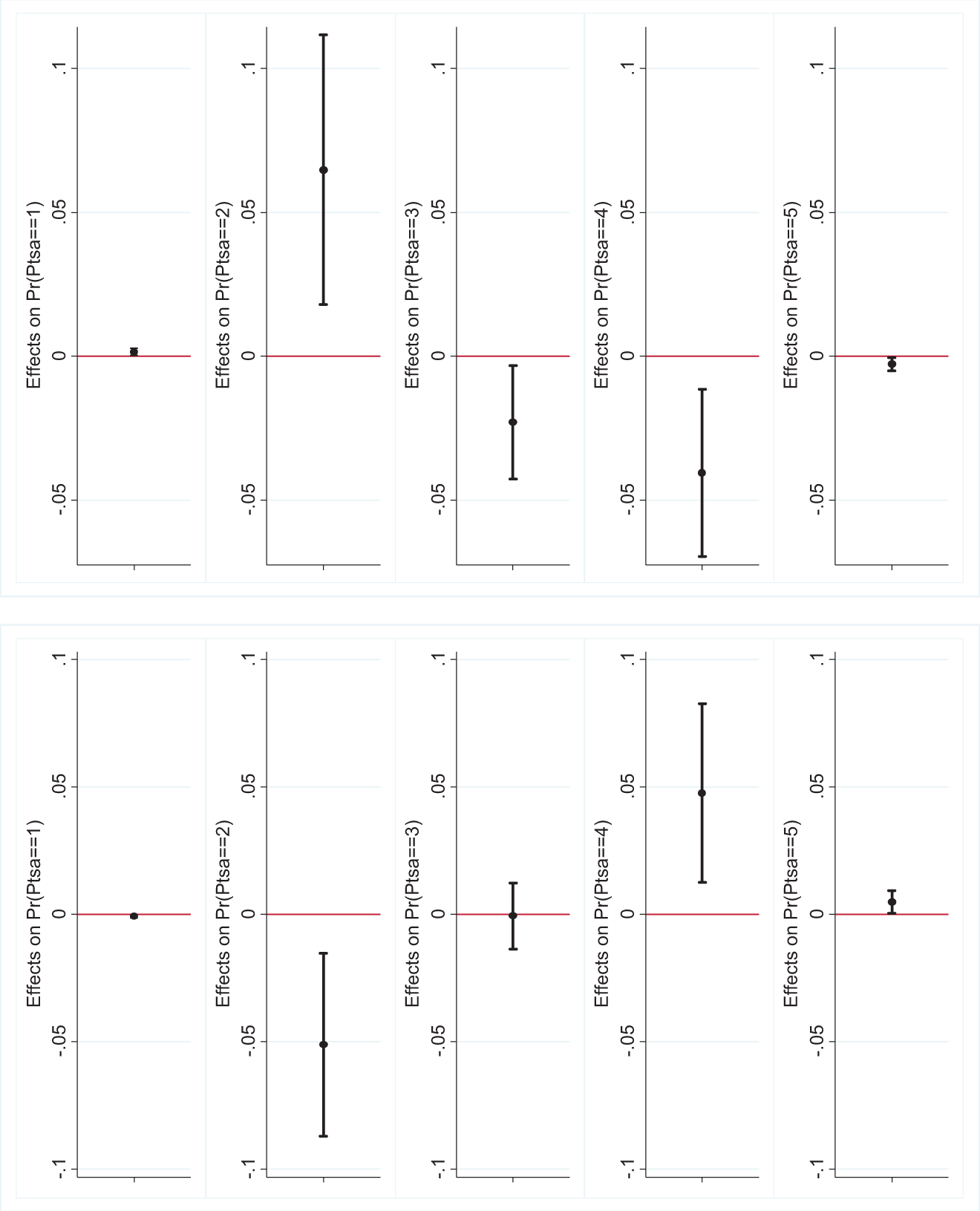
Marginal effects of elected legislatures and opposition parties on repression. Reported values are the marginal effects of each Political Terror Scale level, given a change from an autocracy without an elected legislature to an autocracy with an elected legislature (top panel), and a change from an autocracy without opposition parties to an autocracy with opposition parties (bottom panel). Based on model 2, continuous variables are held at their means and binary variables at 0.
The bottom panel of Figure 1 offers a closer look at the effect of multiple parties on state repressive behavior. It shows that autocracies with multiple opposition parties are less likely to experience the lowest levels of repression. In particular, the presence of opposition parties is associated with a decrease of .05 in the likelihood of PTS = 2. Whereas error bars indicate that the existence of opposition parties have no effect on the third level of repression, we see that autocracies become more likely to be coded PTS = 4 and PTS = 5. Most notably, opposition parties increase the probability that PTS = 4 by .05, which indicates a scenario where a state resort to violence against citizens systematically.
As discussed above, the dichotomous measures of elected authoritarian legislatures and opposition parties are helpful to assess the expected divergent effects of nondemocratic institutions on repression. Nevertheless, one shortcoming of these measures is that they collapse different institutional arrangements into the reference category. Following Aksoy, Carter, and Wright (2012), model 4 includes a measure reflecting four institutional scenarios: opposition parties with no legislature, opposition parties with legislature, single-party regimes, and no parties. The variable for opposition parties with no elected legislature is the reference category and thus the coefficient estimates for the other categories are interpreted compared to nondemocracies with opposition parties and no elected legislature. As the expectation is that regimes with opposition parties and no elected legislature are the most repressive, we should observe a negative coefficient for the other categories.
In model 4, the negative and statistically significant coefficient for opposition parties with an elected legislature provides support for the claim that repression levels are lower in nondemocratic regimes with opposition parties and legislatures, relative to countries with opposition parties but no legislature. Furthermore, the results indicate that single-party regimes and autocracies with no parties experience less repression compared to autocracies with opposition parties and no elected legislature. Model 5 shows that these estimates do not change substantively when the PTS based on the US State Department is employed.
Finally, the results for the control variables perform largely as expected and increase confidence in the main findings reported above. The positive and significant coefficient for civil war indicates that states experiencing an ongoing internal armed conflict resort to higher levels of repression. The natural log of the total population is also positive and significant, suggesting that larger populations are positively associated with personal integrity rights violations. As expected, repression at time t − 1 is a robust predictor of repressive behavior at time t. Whereas Conrad (2011) demonstrates that effective judicial institutions significantly reduce torture in autocratic regimes, the negative and significant coefficient for judicial independence indicates that effective domestic judiciaries not only affect torture but the overall levels of state repression. The coefficient for GDP per capita is negative, although it reaches statistical significance only in three models. The coefficient for oil wealth has the expected positive sign, although it does not reach statistical significance at conventional levels across estimates.
Sensitivity Analysis
I have performed additional estimates to ensure the robustness of the main findings. These results are available in the online supplementary appendix. First, the measure of nondemocratic legislatures captures whether there is or not an elected legislative assembly, treating appointed legislatures and no legislatures as the reference category. One potential concern is that this measure does not allow estimating whether there are relevant differences between autocracies with appointed legislatures and autocracies with no legislature. In sensitivity analyses, I tested models including elected legislatures, appointed legislatures, and no legislatures. These estimates did not change the main results and show that there are not significant differences between autocracies with appointed legislatures and autocracies with no legislature.
Second, someone may argue that there is a co-optative value of having multiple parties that belong to the regime front and the analysis does not allow to assess this possibility, as it uses a dichotomous variable indicating whether there are opposition parties or not. Therefore, I tested additional models using a disaggregated measure for political parties in autocracies, including three dummy variables for opposition parties outside the regime front, one party or multiple parties that belong to the regime front, and no parties. The results in the online supplementary appendix suggest that the presence of multiple parties belonging to the regime front does not necessarily increase co-optation. In fact, repression tends to be higher in autocracies with multiples parties that belong to the regime front when compared to autocracies with no parties.
Third, scholars have shown that differences between types of autocracies explain variation in relevant outcomes such as regime survival (e.g., Geddes 2003; Wright and Escribà-Folch 2012), terrorist activity (e.g., Aksoy, Carter, and Wright 2012; Conrad, Conrad, and Young 2014), and civil wars (e.g., Fjelde 2010), among others. Accordingly, I include three dummy variables for each type of autocracy, namely civilian, military, and royal (Cheibub, Gandhi, and Vreeland 2010). Controlling for regime type implies a more demanding test for the hypotheses outlined above, and helps to assure that the effect of elected legislatures and opposition parties on repression do not only reflect key institutional variation among different types of nondemocratic regimes.
Fourth, there is evidence that governments employed higher levels of repression in the Cold War context (Davenport 2007a). With the exception of monarchies, there is also evidence that legislatures in autocracies have been more common in the post–Cold War period, at least in part because increasing international pressure to liberalize nondemocratic regimes (Wright and Escribà-Folch 2012, 295). I ran additional estimates with a binary indicator for the Cold War period. Importantly, these estimations did not alter the substance of the main findings.
Conclusion
Existing research has paid increasing attention to how authoritarian institutions influence state repressive behavior. Despite significant progress, it is still unclear whether nondemocratic legislatures and opposition parties affect repression in similar ways or whether these institutions influence it differently. In this article, I argued that authoritarian institutions structure conflict between regimes and opposition in divergent ways, providing dictators with opposite incentives to repress. By enhancing the ruling elite’s capacity to co-opt, legislatures mitigate the emergence of challenging actors and the threat of dissent, reducing states’ necessity to engage in repression. In contrast, opposition parties help dissatisfied actors to overcome collective action barriers and thus states face greater incentives to repress. In line with these expectations, the results showed that elected legislatures decrease repression and opposition parties increase it. Moreover, regimes with opposition parties and an elected legislature experience lower levels of repression than regimes with opposition parties but no legislature.
The findings of this article speak to the different forms through which political institutions can affect violations of personal integrity rights in democracies and nondemocracies (see also Frantz and Kendall-Taylor 2014). Much research has shown that political institutions restrain democratic governments to use repression, motivating leaders to choose alternative strategies of control. This article has pointed out that political institutions in autocracies do not necessarily influence repression by limiting state power. Instead, authoritarian institutions do affect states’ necessity to engage in repression by increasing/decreasing conflict relations between regimes and opposition.
The findings of this study are of significant policy relevance and can inform human rights policy. International promoters of democracy and human rights have associated the presence of opposition parties with liberalization processes and favorable steps toward democracy. The findings here portrait a more complex picture where opposition parties are related to higher levels of repression, and in particular party opposition in the absence of elected legislatures is more likely to be repressed. This makes us better able to identify the actors and contexts where they experience the highest risk of suffering personal integrity rights violations. This knowledge can provide insights to international organizations seeking to promote democracy and human rights. For example, there is evidence that organized party opposition in regimes without an elected legislature often turns to terrorism as a strategy to accomplish its goals (Aksoy, Carter, and Wright 2012). However, encouraging the substitution of violent for nonviolent tactics can help advance change since transitions to democracy are more likely to occur in the aftermath of nonviolent mobilization (Rivera and Gleditsch 2013). Existing studies have also shown that Western press and international nongovernmental organizations naming and shaming can restrain state repressive behavior in autocracies (Hendrix and Wong 2013), suggesting that international condemnation can be an important strategy to decrease repression in regimes that are the most likely to resort to violence against party opposition.
Footnotes
Acknowledgments
I am grateful to Courtenay Conrad, Pat James, Rodrigo Salazar, Joe Wright, and Bárbara Zárate for their most insightful comments and suggestions on a previous draft, and to Han Dorussen and Kristian Skrede Gleditsch for their helpful discussions on an earlier stage of this article. I am also grateful to the editor Paul Huth and the anonymous reviewers for their very detailed and constructive comments, which substantially improved this article.
Declaration of Conflicting Interests
The authors declared no potential conflicts of interest with respect to the research, authorship, and/or publication of this article.
Funding
The authors received no financial support for the research, authorship, and/or publication of this article.
Supplementary Material
Supplementary material for this article is available online.
Notes
References
Supplementary Material
Please find the following supplemental material available below.
For Open Access articles published under a Creative Commons License, all supplemental material carries the same license as the article it is associated with.
For non-Open Access articles published, all supplemental material carries a non-exclusive license, and permission requests for re-use of supplemental material or any part of supplemental material shall be sent directly to the copyright owner as specified in the copyright notice associated with the article.
