



Abstract
Peacekeeping mitigates killing, but nonlethal violence also influences both positive peace and stability. We evaluate peacekeepers’ effect on one such type of abuse, sexual violence. We posit that peacekeepers raise the cost of abuses and foster institutional and cultural changes that curb violence. We find that missions both reduce the chance of any violence and limit its prevalence; larger deployments and multidimensional missions are more effective. Governments curtail violence more quickly than rebels do in response to military contingents; rebels are especially responsive when missions include large civilian components. These findings contribute to our understanding of peacekeeping in three primary ways: we expand the evaluation of peacekeeping to consider nonlethal violence; we draw attention to mission size, capacity to use force, and civilian-led programming as determinants of effectiveness; and we demonstrate how addressing nonlethal violence requires similar tools as lethal violence but is further enhanced by specific civilian-led initiatives.
Peacekeeping reduces death and destruction. But can peacekeepers also alleviate other suffering? In this article, we explore whether peacekeeping mitigates nonlethal violence. Better understanding how peacekeeping limits forms of violence other than killing illuminates its broader impact on the quality of life, clarifies its effects for individuals other than military-aged men, and informs evaluations of peacekeepers’ influence on long-term peace and reconciliation.
We focus on a particularly common form of abuse in this article: sexual violence (SV), and we demonstrate that United Nations (UN) peacekeeping missions significantly reduce combatant-perpetrated SV. We argue that they do so by raising the costs of violence and by supporting institutional and cultural shifts that deter violence. While SV, including rape, assault, forced marriage, and forced prostitution, declines sharply when peacekeepers deploy, missions do not equally improve the quality of life. More robust missions with larger deployments and military troops are especially effective, but small numbers of civilian peacekeepers also can control SV under many conditions. Perpetrators respond to security-focused and civilian initiatives differently. While peacekeeping troops and civilians attached to the mission effectively curb both rebel- and government-perpetrated SV, civilians have a larger effect on rebel behavior. The government, however, is more likely to respond to military deployments including troops, police, and observers. Because SV has particularly devastating short- and long-term effects on both individuals and societies, peacekeepers thus substantially improve the quality of life for millions of people and bolster the chances of long-term social reconstruction by curtailing abuses.
In the following sections, we delineate how literature on peacekeeping and killing affects our expectations regarding nonlethal violence. While we test our argument quantitatively, we employ evidence from Liberia in this section to explore mechanisms through which peacekeepers can affect SV. The Liberian conflict began in 1989 and was notorious for the extreme brutality all factions employed against civilians. A 1997 cease-fire collapsed two years later; by the time of the final peace accords in 2003, war had displaced about half the population and killed nearly 300,000. While precise estimates vary widely, there is no doubt that both government and rebel forces employed widespread SV (Bacon 2015; Bastick, Grimm, and Kunz 2007; Cohen and Green 2012). 1 The United Nations Mission in Liberia (UNMIL) deployed in October 2003 and rapidly grew to include 15,000 troops, 1,500 civilian personnel, and 1,115 civilian police. Liberia is a particularly rich case to explore mechanisms linking peacekeeping and nonlethal violence. On the one hand, the mission is unfortunately notable for the abuses perpetrated by international personnel. Thus, despite being a case in which international forces might not credibly impact combatant-perpetrated SV—and we do not claim that abuses ended entirely—the evidence suggests violence declined substantially. On the other hand, the large, multidimensional mission included multiple SV-related initiatives, which allows us to explore a range of pathways to reduce violence.
How Does Peacekeeping Work?
International conflict resolution often includes peacekeeping. Although the UN is the most widely recognized source of peacekeepers, institutions such as NATO (the North Atlantic Treaty Organization) and the African Union also play active roles. Peacekeeping has evolved since the Cold War: robust missions authorized to use weapons to enforce peace and protect civilians are more common, as is multidimensional peacekeeping, with nonmilitary personnel engaged in functions ranging from observing elections to consulting on institutional design and training security forces. As peacekeeping itself has evolved, so too has its evaluation. Early literature often judged peacekeeping missions as failures (Bratt 1996; Diehl, Reifschneider, and Hensel 1996; Greig and Diehl 2005); conversely, scholars who account for the difficulty of the mission’s task consistently find that peacekeeping works (Beardsley and Gleditsch 2015; Doyle and Sambanis 2000; Fortna 2003, 2004, 2008; Fortna and Howard 2008; Hultman, Kathman, and Shannon 2013, 2014, 2016; Quinn, Mason, and Gurses 2007; Walter 2002). In short, peacekeepers tend to deploy to the most intractable conflicts, and they mitigate violence even in these wars.
But if the consensus now concludes that peacekeeping is successful, defining success itself still varies quite widely. Diehl (2008) argues that reducing violence should be the baseline metric, consistent with what many scholars view as peacekeeping’s core function: keeping the peace (Diehl and Druckman 2010). In other words, does fighting end? Does peace last (Bratt 1996; Diehl, Reifschneider, and Hensel 1996; Fortna 2003, 2004; Hultman, Kathman, and Shannon 2016; Quinn, Mason, and Gurses 2007)? Others emphasize humanitarian outcomes such as limiting killing or protecting civilians (Hultman, Kathman, and Shannon 2013, 2014; Johansen 1997). Alternatively, while most missions are not explicitly tailored to long-term recovery and development, the more complex and long-term task of peacebuilding—reflected in outcomes such as democracy, intergroup trust, human rights, gender equality, infrastructure development, and economic growth—may be the best metric of success (Doyle and Sambanis 2000; Huber and Karim 2018; Mironova and Whitt 2017; Murdie and Davis 2010; Paris 2004).
While all of these are important outcomes to assess, they miss a central dynamic. Suffering and abuses short of killing are a pernicious feature of most civil wars, ranging from physical and psychological torture to kidnapping, rape, maiming, “cleansing,” destruction of infrastructure, and forced starvation. We argue that these nonlethal forms of violence bridge humanitarian and peacebuilding outcomes, offering a window into how peacekeepers can improve both human security and long-term social reconciliation and stability.
Evaluating how peacekeeping might impact nonlethal violence requires detailed data on specific abuses, because while forms of violence often coincide, we cannot simply conclude that nonlethal violence falls when the killing abates. The measures do not strongly correlate cross-nationally, and a glance at the data reveals numerous examples of conflict-related SV after killing subsides in conflict zones ranging from Haiti to Algeria, Chad, Georgia, the Central African Republic, and Rwanda. This is not surprising: unless armed groups completely disband, they may continue to operate in portions of the country, and government forces, while perhaps diminished or reorganized, can perpetrate violence long after war officially ends. Indeed, in some conflicts, perpetrators may intentionally substitute less easily detected methods of control and intimidation—such as rape, beatings, or torture—for killing (Cohen 2013; Cohen, Green, and Wood 2013; A. H. Green 2016; Samset 2012; E. J. Wood 2009). In each scenario, conflict would no longer be considered “war,” but continuing SV would still be conflict-related. More importantly for our evaluation of peacekeeping, we do not assume that killing has, in fact, ended when peacekeepers deploy. Thus, as we discuss below, we control for the effect of peacekeepers on the death toll, in addition to measuring the impact on SV.
We focus here on SV, which includes rape, nonpenetrating sexual assault, coerced undressing, and forms of violence such as forced prostitution, sexual mutilation, and forced abortion and sterilization (E. J. Wood 2006, 308). SV can be directed against men, but is most likely to target women, and produces a particularly wide range of destructive short- and long-term consequences, making it especially important to know whether peacekeepers can impact its occurrence. Physically, SV can spread disease, fuel displacement, create unwanted children, and cause debilitating conditions such as fistulas; psychologically, it causes long-lasting trauma and shame; and its strain on social structures complicates peace and reconciliation (Bastick, Grimm, and Kunz 2007; Mullins 2009; Nowrojee 1996; Plümper and Neumayer 2006; Rittner and Roth 2012; Sharlach 2000).
The international community has recently begun to address conflict-related SV, spurred by two devastating conflicts: Serbian forces may have raped 20,000 Bosnian women and girls, 2 and the International Criminal Tribunal for Rwanda (ICTR) found that rape was so widespread and deliberate in that conflict that it constituted a form of genocide in its own rite (Mezey 1994; Stiglmayer 1994). Security Council Resolution 1325 (2000) focuses on women and peace and security and urges special measures to control SV during conflicts. Subsequent documents, including Resolution 1888 mandating that peacekeeping forces protect women and children from SV, bolstered by prominent trials at the International Criminal Court, have reaffirmed and strengthened this commitment. 3
Despite publicity and a perception that rape is ubiquitous in civil wars, the rate of SV varies significantly. Indeed, individual factions often sharply diverge in their abuses, and a faction sometimes changes its practices over time (E. J. Wood 2006, 2009). Unlike in peacetime, potential perpetrators’ tools of coercion, the breakdown of social order, norms about violence by soldiers, and the incentives that can drive SV against civilians all potentially impact wartime SV. In other words, victims are often uniquely vulnerable and perpetrators unusually powerful in wartime. And certainly, some war-related SV is opportunistic (Goldstein 2001). But many scholars argue that combatants also use violence instrumentally, advancing demographic, social, or territorial control by influencing loyalties, spurring forced migration, or increasing ethnic purity (Benard 1994; Card 1996; Diken and Laustsen 2005; Kalyvas 2006; Leiby 2009; Mezey 1994; Mullins 2009; Samset 2012; Sharlach 2000; Weinstein 2007; E. J. Wood 2006; R. Wood 2010). As Cohen (2016) points out, however, arguments about instrumental violence often infer goals from effects. Social arguments, conversely, observe that gang rape is especially likely in wartime, particularly among groups that employ forcible recruitment methods or lack a clear ideology. This suggests SV serves to build solidarity or “reward” combatants, or as an often-tolerated mode of releasing tensions and anger (Baaz and Stern 2009; Benard 1994; Card 1996; Cohen 2013, 2016; Goldstein 2001; Humphreys and Weinstein 2006; Sanday 2007; E. J. Wood 2009).
In the following section, we weave together findings on violence and on peacekeeping to derive three primary mechanisms through which peacekeepers can affect SV. As is true for other forms of violence, peacekeepers change combatants’ incentives. SV is much more challenging to uncover and prevent than killing: the stigma often deters individuals from reporting abuses, and its aftermath is rarely as visible as dead bodies. Despite these difficulties, peacekeepers can make SV costlier by uncovering violence and reducing combatants’ ability to victimize the population. Peacekeepers’ role with respect to SV is broader, however. In particular, the civilian components of multidimensional missions can promote institutional and normative shifts to mitigate SV in postconflict societies. These processes tend to unfold over a longer time frame but may, in the long run, be more important for building positive peace.
How Does Peacekeeping Affect Sexual Violence?
At the most basic level, peacekeeping missions physically separate adversaries, making violence more challenging to commit and increasing the chance of detection—and therefore, punishment (Fortna 2008; Walter 2002). More observers are present, whether these are members of the peacekeeping mission itself or of nongovernmental organizations (NGOs) who deem it safe to work in the conflict zone when peacekeepers deploy (E. J. Wood 2006). We expect this well-established function of peacekeepers to impact nonlethal violence in similar ways as it reduces killing; indeed, under Security Council Resolution 1888, peacekeepers are now formally mandated to protect civilians from SV. Lamentably, some peacekeepers are themselves the perpetrators of sexual abuse and exploitation. In addition to the harm they inflict directly, civilians who cannot trust peacekeepers or view them as part of the problem are unlikely to report violence to mission personnel. In short, victims may still be reluctant to come forward; we simply assert that the declining power of armed factions and the presence of more neutral actors make violations more likely to be uncovered. 4
While numerous barriers hamper effective punishment for SV, reporting increases the chance of repercussions. These can be legal, but social opprobrium can also constitute a significant cost, particularly as former fighters demobilize and hope to reintegrate into the community, where they do not wish to forever be seen as rapists (Bangura 2018). 5 Social costs may be greater when the mission also supports institutional and cultural changes curtailing SV, as we delineate below. In other words, we expect that when potential perpetrators wonder if they can still rape with impunity, they are less likely to do so.
Peacekeepers observe, but they also reduce fighters’ capacity to coerce potential victims. Disarming, demobilizing, and separating combatants are central to many peacekeeping missions. While this process is often imperfect, weapons are collected, militias are disbanded, army units are demobilized, and soldiers return to their barracks where they are no longer in daily proximity to civilians. When former combatants reintegrate into communities, they are disarmed and, ideally, provided with training and resources to engage in nonviolent occupations. Of course, violence can still be committed with less sophisticated weapons; nonetheless, removing the deadliest tools of coercion is a significant step. Put differently, noncombatants become more vulnerable as violence mushrooms, but we expect the converse to also be true. And, as we explore further below, when social structures and norms restrain violence during peacetime, advancing peace opens space for actors and institutions in the postconflict period (Samset 2012; E. J. Wood 2006). 6
We turn now to Liberia to illustrate this first set of processes. Although instability remained high in many regions, citizens’ confidence in public safety and personal security grew steadily in many counties, and nighttime violence in rural areas declined as UNMIL patrols expanded. Liberian women, who often were forced to trade sex for food or protection during the war, no longer faced these choices as frequently—although the improvement was still only partial, unfortunately—and women were more comfortable venturing out to engage in commerce and other activities (United Nations Development Fund for Women 2004). As order was gradually reimposed, social institutions also began to curtail violence. Some were tangible: while vigilantism certainly has its drawbacks, community watch organizations supplemented UN patrols in many regions (Abramowitz 2014).
Liberian disarmament, demobilization, and reintegration (DDR) was flawed in important respects, but there were also notable successes (Omach 2012). 7 The change was particularly stark for the large number of women within the fighting forces, which may have ranged as high as 30 percent to 40 percent. Women who joined armed factions, either voluntarily or involuntarily, were often forced to “marry” fighters or were regularly raped by men in their units. While DDR unfortunately failed to formally demobilize many women, the 24,000 who did participate were no longer at the mercy of the men in their units. They were immediately separated and received independent transport, housing, and medical examination areas. Civilian personnel also worked to identify and treat survivors and to train both male and female participants on human rights and gender-based violence (Abramowitz 2014; Bastick, Grimm, and Kunz 2007).
Multidimensional missions can magnify military efforts by developing institutions and cultural norms that curb violence. Indeed, it is now rare to find a mission which solely deploys traditional coercive contingents—troops, police, and observers—without civilian components. These typically include international and local civilians, as well as UN volunteers. Common initiatives, both broad-based and targeted specifically to SV, range from establishing human rights offices to media campaigns, educational curricula, (re)training security personnel to respond to SV-related crimes, establishing a body of SV-related law, and strengthening the judiciary. Programs to retrain and resocialize fighters can play a particularly influential role in changing the culture of armed groups. 8 While missions do not primarily focus on long-term reconciliation, the international community clearly recognizes the importance of such efforts for mitigating violence in the short term and preventing conflict recurrence in the longer term. Some recent studies support this evaluation. For example, when peacekeepers focus on human rights, respect for physical integrity rights often improves (Murdie and Davis 2010), and peacekeepers increase the chance of gender reforms in the security sector (Huber and Karim 2018). Mvukiyehe (2018) finds that UNMIL positively impacted democratic outcomes and Liberians’ political participation. Thus, we find it reasonable to expect that initiatives to strengthen institutions that prevent or punish SV and to influence broader social norms about SV will affect the prevalence of conflict-related violence.
As we note above, UNMIL is an especially good case to explore these mechanisms, in particular. The mission had a strong anti-SV component and developed several programs that bolstered the interaction of stronger institutions and reinvigorated social norms. For example, Bacon (2015) notes that many Liberians did not know rape was a reportable crime; simply changing the terms of the conversation and providing information about how to report rape and preserve evidence proved a vital part of the mission. Other changes were more subtle. Female activists and women’s grassroots organizations played a particularly important role in Liberia’s peace process. They did a great deal of work long before peacekeepers arrived, but UNMIL helped to open further space for activists and groups in the postwar period (Fuest 2008; Mvukiyehe 2018). And while their efforts were not limited to SV, Jalalzai (2013) argues that the presence of high-ranking women in domestic institutions, coupled with broader social changes, enabled activists to address these topics: “You can talk about rape now and not be stigmatized” (p. 219). 9
UN personnel also supported government initiatives to increase female police officers and trained police recruits to respect human rights, investigate reported rape, and patrol in vital times and places (Bacon 2015; Bastick, Grimm, and Kunz 2007). 10 These efforts were accompanied by a well-funded, organized, and efficient campaign to both reinforce traditional norms and change the wartime culture surrounding SV. Abramowitz (2014, 119) notes that these programs were “active, mobile, well-documented, and bureaucratically transparent,” sending clear and consistent messages. They also coordinated remarkably effectively between agencies and between political, legal, and social programs. The Liberian Ministry of Gender was both powerful and efficient. International personnel worked closely with local staff, making many efforts self-sustaining, and provided material support for supplies like rape kits and training for medical professionals to recognize and treat SV (Abramowitz 2014; Ero 2012). The international community also funded radio stations, trained broadcasters, and sponsored media campaigns such as a radio ad reminding listeners that “Rape is Wrong…! Rape is a Crime!…If you force anybody and rape them…you will go to jail…” (quoted in Abramowitz 2014, 118).
While these efforts made considerable progress in addressing conflict-related violence—and had the potential to impact non-conflict-related SV—resources and training for police in remote rural areas lagged, and changing institutional cultures and habits often requires years. This was most obvious in the flawed prosecutions of rape cases: witnesses refused to testify, community leaders advocated “just moving on” as the best solution, reporting remained low, and popular discourse often insisted that rape was the woman’s fault (Abramowitz 2014; Bacon 2015; Jalalzai 2013; Karim and Beardsley 2017; Reno 2016). Liberia’s experience thus shows just how difficult the task of changing institutions and norms can be, even with massive international assistance.
In sum, peacekeeping increases the chance that SV will be detected and punished, reduces combatants’ capacity to coerce and threaten potential victims, strengthens domestic institutions, and can change norms and culture. Simply helping to end armed conflict may magnify the impact. In particular, the main schools of thought on SV imply that as peacekeepers control fighting, incentives for violence decline. If violence is used instrumentally, peacekeepers’ role in de-escalating conflict should mean the “instrument” is no longer as valuable; if its function is social, DDR disbands armed units that would be bound together by shared use of violence.
11
Thus, we expect that:
Yet not all peacekeeping missions wield the same capacity to influence violence. Both robustness and multidimensionality matter. Missions vary widely in size, from a few hundred personnel to tens of thousands. 12 We build on Hultman, Kathman, and Shannon’s (2014) findings, suggesting that just as mission size matters for limiting lethal violence, it also impacts nonlethal abuses; more personnel on the ground can detect and address violence across more territory. We conceptualize robustness as a function of both size and the ability to use force, which enables peacekeepers to threaten—and exact—greater costs for committing violence. 13 Thus, we expect troops to reduce SV more than other components of the missions. 14
Civilian contingents carry out many of the functions relating to institutional and normative change. We also expect the size of the civilian deployment to correlate directly to the prevalence of SV, since more staff means more capacity to implement programs and to reach a wider range of citizens. While the UN reports data disaggregated by international civilians, local civilians, and UN volunteers, the functions of these different groups of actors do not systematically vary, and thus, we do not have expectations about how their impact might differ.
Liberia allows us to explore the mechanisms through which both robustness and multidimensionality can influence SV. After the Economic Community of West African States Monitoring Group’s (ECOMOG) failure to secure peace during the 1997 cease-fire, the UN was determined to deploy a large force drawn from highly committed states, supported with sufficient resources and a mandate that addressed the major sources of the violence (Abramowitz 2014; Howe 1996). This enabled more than 120,000 combatants to be disarmed in the first three years, with UNMIL monitoring conditions countrywide. After the initial phase of DDR, an entirely new army was created, with extensive vetting for human rights abusers among potential recruits (Ansorge and Antwi-Ansorge 2011). Civilian UNMIL personnel supported social reforms and helped to reconstitute political and judicial institutions, as we discuss above (Bacon 2015; Jalalzai 2013, Liebling 2015). These tasks take time, of course. In Liberia, for example, implementing strong anti-rape legislation could not occur immediately, and the need to strengthen the judiciary undermined many efforts to reduce SV. The wide range of civilian-supported projects engaged thousands of personnel with expertise ranging from investigating human rights violations and moving them to trial as necessary, reforming the legal code, developing media campaigns to propagate information on the DDR process and on respect for rights, providing counseling and training for reintegrating ex-combatants, and training personnel from local NGOs.
In sum, variation between missions produces three main observable implications for SV:
Peacekeepers are not equally able to impose costs, but the combatants’ goals, incentives, and constraints also shape their sensitivity to costs. 15 Government-perpetrated SV is much more common than that by rebels (Cohen and Nordås 2014, 2015; J. L. Green 2006). 16 Several potential causes of this pattern may reveal how peacekeepers can affect SV. First, the government holds power and thus has more at stake, making government forces more willing to engage in abuses. Rebels, on the other hand, depend more on support from civilians and, thus, may be more likely to limit abuses. Of course, both sides may be more likely to abuse civilians from whom they do not draw support or anticipate needing future support from.
While government forces commit more violence, we suspect they are also more sensitive to the costs peacekeepers can impose. States are more susceptible than rebels to naming and shaming on human rights issues (Cohen, Green, and Wood 2013), perhaps because the government possesses an existing relationship with other states and international institutions, which rebels generally do not. This gives international actors diplomatic and economic leverage; while sanctions do not necessarily follow human rights abuses, Lebovic and Voeten (2009) suggest that international opprobrium provides an important cue for actors desiring to condition aid on abuses. While rebels may benefit more from recognition or sympathy from international actors—and thus might be more likely to comply with peacekeepers—it is harder to sanction rebel forces for abuses.
Thus, although rebels are sensitive to international pressure in some instances, we expect that government forces will be more likely to limit abuses when peacekeepers are present to observe and sanction violence:
Data and Methods
We evaluate peacekeepers’ impact on SV using cross-national data on the forty African civil wars from 1989 to 2009, identified from the Uppsala Conflict Data Program (Melander, Pettersson, and Themnér 2016). These represent a substantial proportion of both the wars and the peacekeeping missions deployed during this period. 17 Since SV is slightly more prevalent in sub-Saharan African civil wars, this analysis also represents a more stringent test of our argument (Cohen 2016). 18 If we observe a significant decline in violence when peacekeepers deploy in this sample, it thus suggests that missions might be even more effective in “easier” contexts. Since groups commit violence at different rates, even within individual conflicts, the unit of analysis is the conflict-dyad-year, yielding a total of 2,202 potential observations.
We measure SV using the Sexual Violence in Armed Conflict (SVAC) data, which record the average prevalence of seven types of conflict-related abuses: rape, sexual slavery, forced prostitution, forced pregnancy, forced sterilization/abortion, sexual mutilation, and sexual torture (Cohen and Nordås 2014). A score of three is defined as massive violence that is deliberately used to intimidate, control, or terrorize. A value of two represents “several” or “many” incidents; violence is reported as common, regular, routine, or frequent. “Some” violence—a score of one—reflects reports of incidents or victims that do not reach the level required for a score of two, and a zero indicates that the report did not mention SV. The data are coded using US State Department, Amnesty International, and Human Rights Watch reports, which are standard sources used by scholars evaluating human rights violations and agree for 86 percent of the African conflict observations (A. H. Green, Cohen, and Wood 2012). 19
Reporting on SV varies significantly, and we recognize the barriers to gathering data. Violence targeting men is even more underreported than that against women, although the stigma inhibiting reporting may be lower (for either men or women) when the perpetrators are outsiders brutalizing large numbers of people. In ongoing conflicts, violence may be harder to detect, and reprisals for its reporting more likely. But increased international presence and scrutiny also makes detection and documentation more likely, and health services may be more accessible, particularly in rural areas, when international actors arrive. Groups or individuals may selectively publicize or hide violence to influence support for specific factions, and aid organizations may publicize violence to garner attention and resources. Publicity, in turn, may increase scrutiny (Cohen 2016; Cohen and Green 2012; A. H. Green 2013; J. L. Green 2006; Peterman et al. 2011; Roth, Guberek, and Green 2011; Samset 2012; E. J. Wood 2006). Ordinal data mitigate these challenges, describing broad patterns and relative changes while allowing room for uncertainty. The extremely high correlation between the three sources used to code the SVAC data increases our confidence that the data capture real differences in the prevalence of violence. And we find it implausible that in most instances, underlying data are so deeply flawed that the relative magnitude of violations cannot be assessed. 20
We measure military peacekeepers, including troops, police, and observers, using figures from the UN Department of Peacekeeping Operations as reported in Hultman, Kathman, and Shannon (2014) and code our own data directly from UN documents on the civilian mission components, including international civilians, volunteers, and local civilians. Because these data capture shifts in deployments, we can assess the effects of not just the presence and peak mission size, but also intramission variation. We use the average annual composition; alternate approaches to aggregation, such as the maximum annual deployment, yield very similar results. Troops are by far the predominant type of peacekeeper, with a mean deployment of 1,847, as compared to 129 police and 65 observers, and accompanied by an average of 441 civilian members. We lag troop and observer deployments by one year and civilian deployments by three years, since peacekeepers do not impact violence the moment their boots hit the ground, and civilian contingents are particularly likely to be developing longer-term initiatives that may not yield immediate results. We lag police deployments by two years, since they are more likely than troops to carry out longer-term initiatives; their recruitment processes also tend to delay police contingents reaching full strength.
Several other factors might also affect SV. Using data from Cohen (2013), we control for the combatants’ recruitment techniques, since coercive approaches such as pressganging, conscription, and abduction exacerbate violence; this is a dichotomous measure. In addition, because behavior may change slowly and some actors may simply be more or less likely to employ violence for other reasons, we control for prior SV by the combatants in the previous year. 21
The difficulty of peacekeepers’ task affects their probability of success (Fortna 2004). Therefore, we control for the natural log of deaths, since increased fighting makes restoring peace more difficult. This also accounts for the possibility that we are simply capturing a general decline in violence; we also explicitly model time to further ensure that we are not measuring a decline in SV unrelated to peacekeeping as security increases. 22 Since peacekeeping is more difficult when strong rebels challenge the government, we also measure rebel strength (Fortna 2008). 23 Peacekeepers face a more difficult task in large countries with rugged terrain; we combine the natural log of territorial area with a metric of terrain to control for this possibility (Diehl 2008). 24 We account for peacekeepers’ focus on SV using a dummy variable for whether the mandate explicitly mentions SV. Finally, we code data from the authorization resolutions on the mission’s budget, in hundreds of thousands of dollars, to capture global commitment to end a war and peacekeepers’ resources for ending violence.
Results and Analysis
Peacekeepers deploy to conflicts which present particularly challenging circumstances (Fortna 2004). Given the recent attention to SV in civil wars, prevalent abuses thus could make peacekeeping more likely in conflicts with high SV (Karim and Beardsley 2017). The correlation between conflict-related SV and the deployment of peacekeepers to a conflict zone is only 29 percent, suggesting the relationship is relatively weak in our sample. However, those conflicts which receive peacekeepers do have slightly higher mean levels than do conflicts without missions: the prevalence levels are approximately 0.569 points greater on the four-point SVAC scale. It is also possible that peacekeepers only deploy when it is convenient for the host government. But this difference reflects a statistically significantly higher level of government-perpetrated violence: 0.34, compared to 0.14 perpetrated by rebels. In other words, the government is not strategically allowing peacekeeping forces only when it has nothing to hide or wishes to prompt condemnation of rebels.
But the relationship is certainly more complicated than a t-test can fully untangle. Thus, our next step was to use propensity matching to compare conflicts which received peacekeeping missions with similar wars which did not have missions. This allows us to estimate the effect of peacekeepers on SV in conflicts with interventions, relative to comparable conflicts in which the UN did not intervene. 25 Propensity matching thus allows us to explicitly account for the fact that missions themselves deploy nonrandomly, and these analyses clearly demonstrate that the presence of peacekeepers matters. A mission reduces the chance of any SV by about 20 percent; peacekeepers cut the chance of even low violence by almost 12 percent and moderate or high violence by 7.6 percent. In short, the simple fact of peacekeepers deploying significantly reduces the chance that combatants employ SV.
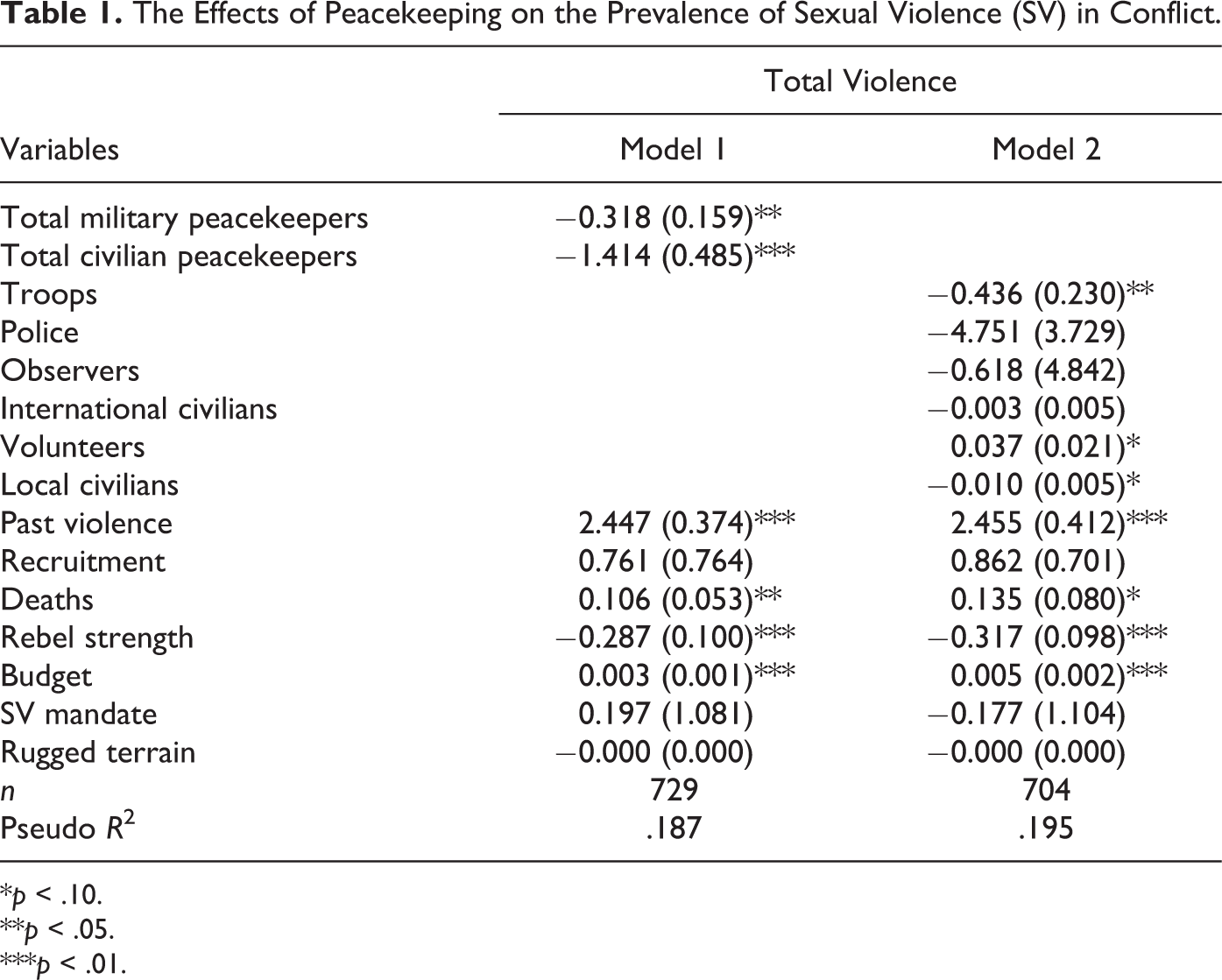
The Effects of Peacekeeping on the Prevalence of Sexual Violence (SV) in Conflict.
*p < .10.
**p < .05.
***p < .01.
Because propensity score matching evaluates the effectiveness of a dichotomous independent “treatment,” it is less well suited to evaluate how the size of a mission affects the prevalence of violence. Nonetheless, we did use four dummy variables to assess the broad effects of small, medium, medium-large, and large forces. The results clearly demonstrated that missions larger than a few hundred personnel effectively reduce violence under most conditions; other patterns were less consistent. 26 Thus, to more fully understand when and how peacekeepers might reduce SV, we now turn to analyses focusing on the effects only among those conflicts that did receive peacekeepers.
Using ordered logit tests with standard errors clustered by location, we find that missions significantly curtail SV, even when we account for other determinants of both violence and peacekeeping effectiveness. 27 Not surprisingly, the strongest predictor of SV among the control variables is prior usage: combatants who have used SV in the past tend to continue their abuses. Ongoing fighting also correlates with increased SV, and forcible recruitment techniques predict SV well in many cases, even accounting for prior usage. 28
SV falls substantially when peacekeepers deploy, as model 1 shows, even accounting for these other potential influences on peacekeeping success. We illustrate these trends graphically in Figure 1, which clearly shows that not only does violence fall, but peacekeepers also reduce the level of violence, even if they do not eliminate it entirely. And, as we hypothesized, more robust missions do so more effectively. In an “average” conflict (one in which all independent variables are set to their means), the probability of no violence is 26 percent when 1,000 troops, observers, and police deploy; 5,000 additional personnel increases this figure by 17 percent, and at the maximum deployment—just under 20,000—the chance of any SV at all falls to 12 percent. Civilian peacekeepers deploy in smaller numbers but can profoundly impact violence: the probability of no violence is 46 percent when just 1,000 civilians are part of a mission, and that rises by about 19 percent for every additional 1,000 civilians.

The effect of military and civilian peacekeepers on the probability of any sexual violence and of occasional violence in a conflict. All other variables are set to their mean values.
Even in conflicts where we expect peacekeepers to face the most difficult conditions, they limit abuses. While extreme SV only occurs in a limited number of cases—violence over a score of two is committed in just over 5 percent of the conflict-years in the sample—the chance of any abuses is halved at the maximum deployment. Given that these are the most challenging conflicts, peacekeepers’ significant progress is particularly important. The prevalence of abuses also consistently decreases, even if SV is not totally eliminated. For example, occasional SV falls by about 3 percent with every additional 1,000 military peacekeepers and by 5 percent with every 1,000 civilian peacekeepers.
Figures 2 and 3 graphically isolate the effects of civilian and military contingents, showing how these can reinforce each others’ efforts both to increase the chance of no violence at all and to substantially reduce the probability of even occasional abuses. Model 2 explores this initial evaluation more closely, examining the effect of specific mission components. We hypothesized that troops would most effectively curb violence, since they have the greatest ability to sanction abuses. Troops and local civilians are the only components of peacekeeping missions that consistently diminish SV, and troops exert a particularly strong effect. 29 For instance, increasing the number of troops by just one standard deviation—4,128 troops—increases the chance that no SV occurs by 37 percent, and the probability of even occasional violence falls by 15 percent.

The effect of troops, police, and military observers at different levels of civilian contingents, on the probability of no sexual violence and of occasional violence in a conflict. All other variables are held at mean values.

The effect of international and local civilian peacekeepers at different levels of military contingents, on the probability of no sexual violence and of occasional violence in a conflict. All other variables are held at mean values.
Many of the potential mechanisms through which peacekeepers can reduce violence imply that specific functions, such as disarmament or socialization, matter. We cannot fully disentangle these relationships here, but we explore two possibilities. First, since police are often integral in efforts to reintegrate former fighters and retrain security forces, as well as providing security, we expect their impact might further be delayed, as we note above. Moreover, police often volunteer individually, and thus, it may take even longer than we expected for police contingents to reach full strength. This appears to be the case: police deployments significantly reduced SV after four years in most specifications. Second, we also explored whether local institutions magnify civilian peacekeepers’ efforts, since civilians are most likely to focus on initiatives beyond the security sphere. When we interacted the Polity measure of democratic institutions with civilian contingents, the effects were significant and consistently reduced SV; the effect on government-perpetrated violence was greatest. This is consistent with Campbell’s (2018) argument that peacebuilding is most effective when international organizations are accountable to strong and empowered local stakeholders.
We also hypothesized that governments and rebels are not equally susceptible to the costs that peacekeepers can impose and that governments may be more sensitive to these costs.
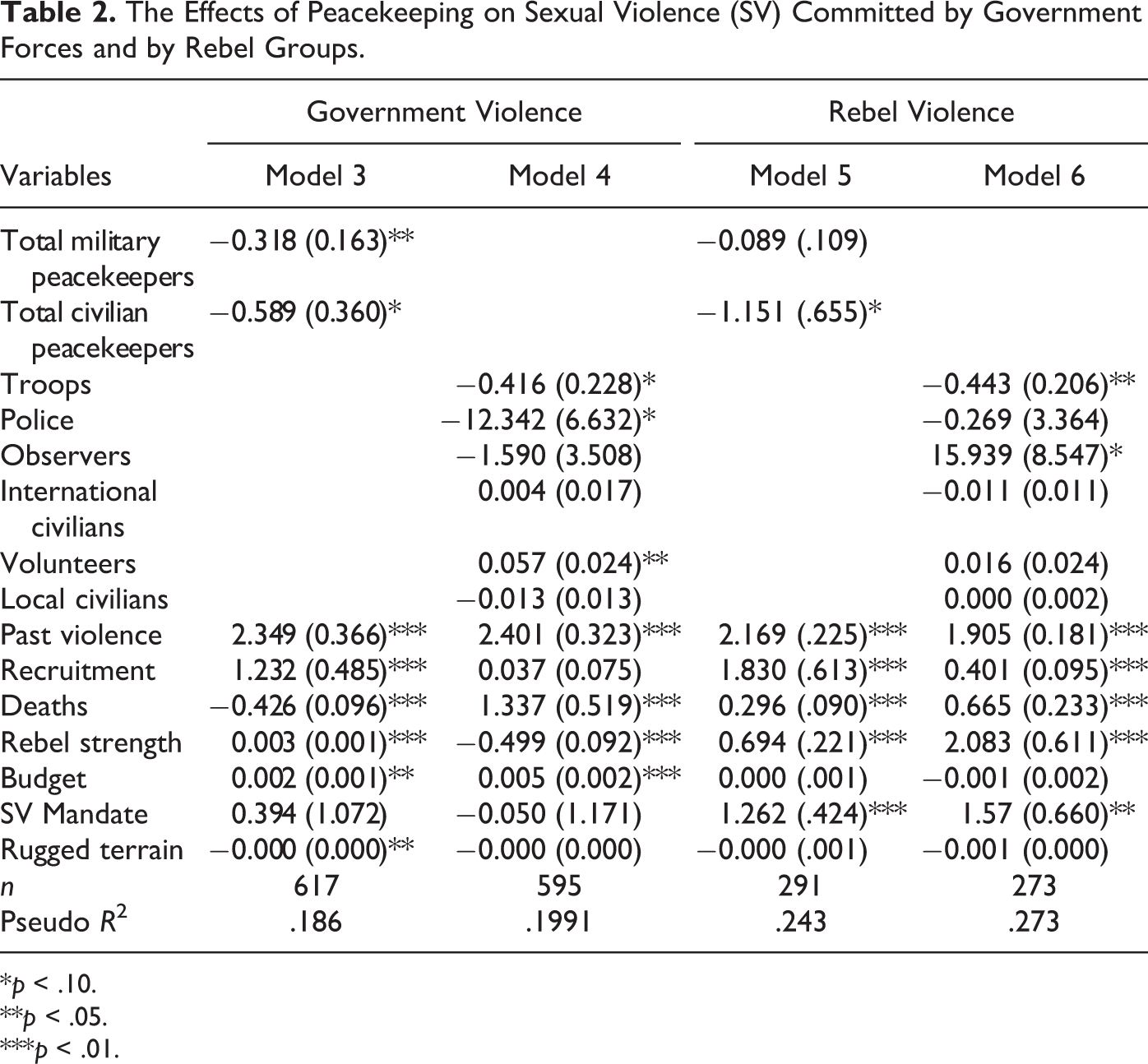
The Effects of Peacekeeping on Sexual Violence (SV) Committed by Government Forces and by Rebel Groups.
*p < .10.
**p < .05.
***p < .01.
Both government and rebel forces perpetrate less violence when peacekeepers deploy. Government forces (models 3 and 4) commit some violence about 72 percent of the time when all variables are at their mean levels. Increasing to 5,000 troops, observers, and police halves this amount; about 1,000 civilian peacekeepers have a comparable effect. The chances of moderate and high violence also decline, and even when some violence persists, its scope falls substantially as the number of peacekeepers rises. We illustrate this effect graphically in Figure 4, comparing the effect of civilian and military contingent sizes on low levels of government and rebel-perpetrated violence and on the elimination of SV. While the baseline levels of abuses are very different, moderate numbers of peacekeepers clearly reduce violence by all actors.

The effect of military and civilian peacekeeping contingents on government and rebel-perpetrated violence.
Even in especially intractable conflicts with prior violence, peacekeepers can limit government-perpetrated abuses. For example, a mission with just 5,000 troops halves the probability of moderate or very prevalent SV, compared to one without troops. Police also appear to reduce SV, although we note that the standard errors are very high and the coefficient in model 6 is not significant, although it is in the predicted direction. Adding 1,000 civilians to the mission further magnifies the effect: while violence is not totally eliminated, it only occurs occasionally. Since government forces commit the majority of SV (Cohen and Nordås 2014, 2015; J. L. Green 2006), peacekeepers’ ability to curtail government-perpetrated violence is particularly encouraging from a policy and normative standpoint.
At first glance, rebels appear to respond less consistently to peacekeepers: the coefficient on military contingents in model 5 is negative but is not significant; civilians attached to the mission do exert a substantial and significant negative effect. For instance, adding just 2,000 civilians to a peacekeeping mission reduces the chance of massive rebel-perpetrated violence by over 30 percent even under the most difficult conditions. And in an average conflict, adding 2,000 civilians increases the chance of no rebel-perpetrated violence at all from 78 percent to 91 percent. Model 6 adds more nuance and clarifies these findings, particularly on the effect of military contingents. Troops do reduce rebel-perpetrated violence, and the impact is even a bit larger than that on government forces. The first 1,000 troops reduce the chance of any rebel-perpetrated violence by about 9.6 percent under average conditions; 5,000 troops make any violence 26 percent less likely. Even in the most intractable conflicts, rebels are 22.5 percent less likely to commit moderate to high amounts of SV in the presence of 5,000 troops. And the probability of no rebel-perpetrated violence at all rises to over 50 percent by the maximum mission size of around 20,000 troops.
In short, peacekeepers reduce SV. Troops are equally effective against all perpetrators and can limit violence even under the most challenging circumstances. Civilians’ precise impact is more variable, but they consistently reduce the prevalence of SV, no matter the perpetrator.
Discussion
Peacekeepers control nonlethal violence, in addition to limiting killing. When peacekeepers deploy, conflict-related SV falls; indeed, because violence may be more frequently detected when peacekeepers are present, the true effects are probably much larger than those we observe here. In short, peacekeepers’ effect on SV not only improves the quality of life for individuals in conflict zones, it also bolsters long-term peace and reconciliation by curbing devastating nonlethal violence.
The international community can increase peacekeepers’ effectiveness by authorizing and supporting robust missions. Larger missions are better able to detect and control violations throughout the country, although it is striking how much influence even a few thousand personnel can exert. Troops play a particularly important role. While police do appear to reduce abuses, particularly after several years, observers do not significantly restrain this form of nonlethal violence. Multidimensional missions with large civilian components are now common and further reduce levels of SV, albeit over a longer time frame. They may be particularly likely to succeed in states with a legacy of democratic institutions, although this relationship bears further exploration.
The large role that troops play is not surprising: they tend to focus on immediate security, particularly in the early months of a mission; thus, violence often drops rapidly when they deploy. Other mission personnel often focus on longer-term outcomes. Training local police, reconstituting and reforming political and judicial institutions, purging armed forces of known abusers, and shaping societal norms are sustained efforts that take years to bear fruit. Police, observers, and civilians also carry out a diverse array of tasks. For instance, in Liberia, UN police actively developed programs combatting SV, but this is not always the case. When police provide security in refugee camps and have adequate resources to pursue perpetrators, they can quickly affect the quality of life, but they do not always have the requisite mandate or resources. And civilians often work on initiatives around human rights, violence against civilians, and trauma, but many also consult on institutional design, infrastructure, environmental protection, procurement, and human resources. In short, their mandate shapes their impact.
Mission personnel also may systematically deploy around the country in ways that influence their effect. For example, if police concentrate in urban areas, they will not reduce abuses in rural parts of the country. While we control for a number of conditions on the ground, our data cannot account for whether observers go to regions in which the amount of violence is already low, or where the combatants need only minimal assistance upholding a ceasefire.
Our results suggest that multidimensional peacekeeping is especially effective; future studies could delve more closely into other types of intramission variation that may shape peacekeepers’ ability to curb SV. 30 For example, we do not have detailed data on the progress of DDR within individual conflicts, but the Liberian case suggests this might matter. SV also is not prioritized equally. While the dichotomous control for whether the mandate included SV did not reduce violence in most models, SV and gender reforms are now standard in mandates; more significantly, this measure does not tell us much about how different missions—and even different national contingents within missions—emphasize this goal in carrying out their mandate. Additional data also could more closely parse how much of the effect is due to personnel attached to the mission itself, or whether we also are capturing an effect of other international actors, such as NGOs, simultaneously engaging in postconflict reconstruction. This may be particularly important if intimate partner violence rises in the postconflict environment, even as combatant-perpetrated violence declines. And while we include the overall mission budget in our analyses, we do not have data on how much of this budget is devoted to SV-related goals and how much is earmarked for other needs.
While both government and rebel forces respond to peacekeepers, if it is true that the international community can better impose costs on government actors, tools other than brute force could be especially salient. Regional patterns of rebel versus government-held territory or group hierarchies may also influence different actors’ responses. However, since government forces commit more conflict-related SV, their responsiveness to diverse peacekeeping contingents has especially important implications for the quality of life in war zones.
As the UN increasingly focuses on conflict-related SV, we hope that missions actively investigate and sanction reported abuses. As confidence grows that reports will be met with a robust response, victims will be more likely to come forward, and peacekeepers can impose greater costs on violators. Troublingly, UN peacekeepers, those sent to help, are sometimes themselves perpetrators of SV or other forms of sexual exploitation and abuse. Although this is not our primary analytical focus in this article, it is a serious problem with profound consequences for victims and may impact peacekeepers’ ability to credibly protect civilians. While the UN has begun to address this problem, there is still a long way to go (Bell, Flynn, and Machain 2018; Grady 2010; Nordås and Rustad 2013; Spencer 2005). From a normative standpoint, there is no question that the international community has a responsibility to address this misuse of power. While we set aside the empirical implications for another project, we strongly suspect that rebuilding peacekeepers’ credibility will enable them to more effectively protect civilians, while of course also avoiding further traumatizing them.
Previous research establishes that peacekeepers reduce lethal violence, and we demonstrate that they also reduce one prevalent form of nonlethal violence. But what about other types of violence, such as torture and kidnapping? Determining when and how peacekeepers might also alleviate these abuses is a crucial next step to improving the fortunes of civilians in postconflict zones. However, it is clear that UN peacekeeping does substantially reduce SV, a particularly vital outcome for improving the quality of life and supporting long-term stability.
Supplemental Material
Supplemental Material, JCRReplicDoFile - Does Peacekeeping Really Bring Peace? Peacekeepers and Combatant-perpetrated Sexual Violence in Civil Wars
Supplemental Material, JCRReplicDoFile for Does Peacekeeping Really Bring Peace? Peacekeepers and Combatant-perpetrated Sexual Violence in Civil Wars by Shanna Kirschner and Adam Miller in Journal of Conflict Resolution
Supplemental Material
Supplemental Material, JCR_PK_and_SV_Replication_Data - Does Peacekeeping Really Bring Peace? Peacekeepers and Combatant-perpetrated Sexual Violence in Civil Wars
Supplemental Material, JCR_PK_and_SV_Replication_Data for Does Peacekeeping Really Bring Peace? Peacekeepers and Combatant-perpetrated Sexual Violence in Civil Wars by Shanna Kirschner and Adam Miller in Journal of Conflict Resolution
Supplemental Material
Supplemental Material, Kirschner_and_Miller_Peacekeeping_and_Nonlethal_Violence_Appendix_Table_1 - Does Peacekeeping Really Bring Peace? Peacekeepers and Combatant-perpetrated Sexual Violence in Civil Wars
Supplemental Material, Kirschner_and_Miller_Peacekeeping_and_Nonlethal_Violence_Appendix_Table_1 for Does Peacekeeping Really Bring Peace? Peacekeepers and Combatant-perpetrated Sexual Violence in Civil Wars by Shanna Kirschner and Adam Miller in Journal of Conflict Resolution
Supplemental Material
Supplemental Material, Kirschner_and_Miller_Peacekeeping_and_Nonlethal_Violence_Appendix_Table_1 - Does Peacekeeping Really Bring Peace? Peacekeepers and Combatant-perpetrated Sexual Violence in Civil Wars
Supplemental Material, Kirschner_and_Miller_Peacekeeping_and_Nonlethal_Violence_Appendix_Table_1 for Does Peacekeeping Really Bring Peace? Peacekeepers and Combatant-perpetrated Sexual Violence in Civil Wars by Shanna Kirschner and Adam Miller in Journal of Conflict Resolution
Footnotes
Authors’ Note
Replication data are available at the journal website or by contacting the corresponding author at
Acknowledgments
We are grateful for feedback from Susanna Campbell, Michael Greig, Sabrina Karim, Emily Ritter, colleagues at the 2016 Peace Science and Political Methodology conferences, the editor, and two anonymous reviewers.
Declaration of Conflicting Interests
The author(s) declared no potential conflicts of interest with respect to the research, authorship, and/or publication of this article.
Funding
The author(s) disclosed receipt of the following financial support for the research, authorship, and/or publication of this article: We appreciate financial support from the Allegheny College Howard Hughes Medical Institute Global Health Grant and the NSF Advanced Empirical Research on Politics for Undergraduates Program.

Supplemental Material
Supplemental material for this article is available online.
Notes
References
Supplementary Material
Please find the following supplemental material available below.
For Open Access articles published under a Creative Commons License, all supplemental material carries the same license as the article it is associated with.
For non-Open Access articles published, all supplemental material carries a non-exclusive license, and permission requests for re-use of supplemental material or any part of supplemental material shall be sent directly to the copyright owner as specified in the copyright notice associated with the article.
