



Abstract
Moral dilemmas amid war on terrorism include repeated harsh moral choices, which often pose threats to one’s moral image. Given that people strive to view themselves as moral, how do they cope with such morally compromising decisions? We suggest and test two strategies to cope with morally threatening decision-making under in-group moral responsibility amid war on terrorism: (a) trivialization of the moral dilemma and (b) resentment toward the target. Four experimental studies measured (study 1) and manipulated (studies 2–4) these hypothesized mechanisms, presenting a similar collateral damage dilemma to Israeli Jews in the context of the 2014 Gaza conflict (studies 1 and 2) and to Americans in the context of the US campaign against Islamic State of Iraq and Syria (ISIS) (studies 3 and 4). Results demonstrate that both trivialization and resentment facilitate harsh moral choices under conditions of moral accountability. Studying the mechanism underlying moral decision-making in conflicts is key to understanding moral injury and the process of moral repair.
While people strive to view themselves as moral (e.g., Aronson 1992), in armed conflicts, they repeatedly encounter dilemmas that pose threats to their moral self-image. How do they cope with making morally compromising decisions? In particular, the war on terror, a form of asymmetrical warfare, poses moral dilemmas that require citizens to choose between conflicting rules of morality (Broeders et al. 2011; Lammers and Stapel 2009). This is because in asymmetrical warfare, terror organizations often hide among members of a civilian population (Schoenekase 2004). Under these circumstances, states can either opt for the moral rule of minimizing collateral damage, thus decreasing the risk of harm to out-group civilians, or they can follow the moral rule of ensuring the success of the military action, thus fortifying the safety of the in-group civilians (Kamm 2005; Kasher and Yadlin 2005). This moral dissonance leads individuals to struggle in making choices and, after making them, to find a way to calm the moral self. What coping strategies do they use?
Moral dilemmas in the context of war on terrorism, such as the Israeli–Palestinian conflict and the US offensive against Islamic State of Iraq and Syria (ISIS), may require unique coping mechanisms because of their particular characteristics including repeated moral choices, tangible physical threat, and intergroup dynamics. In this work, we suggest and test two strategies for coping with morally threatening dilemmas: trivialization of the dilemma and resentment toward the target, identified by Bandura’s (1990) moral disengagement theory (MDT) and by Monin’s (2007) application of social comparison theory.
The scenario we examine concerns collateral damage (i.e., physical harm to uninvolved out-group members) perpetuated by in-group members. When individuals use trivialization as a coping mechanism, they treat the dilemma as a technical, amoral decision. With resentment, hostility toward the target can help individuals to cope.
We tested our hypothesis in two contexts: the Israeli operation in Gaza against Hamas (studies 1 and 2) and the US operation in Syria against ISIS (studies 3 and 4). Both raised moral questions concerning civilian victimization similar to those often faced by decision makers in other asymmetrical conflicts. We presented a similar moral dilemma to Israeli Jews and to Americans: how many uninvolved civilians can justifiably be killed when bombing a house in which three of the most-wanted terrorists are meeting? We either measured (study 1) or induced (studies 2–4) the coping mechanisms and choices involved in the dilemma.
The examination of these mechanisms has important theoretical implications. It is often argued that the war on terrorism erodes the moral backbone of states. Asymmetrical warfare requires citizens to take sides in dilemmas involving collateral damage with clear moral implications. One can think of the psychological mechanisms that enable citizens to make difficult moral decisions repeatedly (i.e., reducing the importance of decisions that cause harm to others, emptying them of moral significance, and transferring responsibility to the other side) as the process through which society’s morality is eroded in armed conflicts (e.g., Bandura 2002; Bar-Tal 2012).
Moral Judgment in Asymmetric Conflict
We examine moral dilemmas in the war on terror. Moral judgment is the evaluation of an act as wrong or right (Ben-Nun Bloom 2014), and moral dilemmas require decisions in the context of conflicting moral rules (Broeders et al. 2011). The literature uses mental exercises that present life-and-death scenarios, such as the footbridge dilemma (e.g., Thomson 1985), which asks people whether they would push one person from a bridge to certain death to stop a train and save five others. Whereas most people are typically not required to solve life-and-death dilemmas in their daily lives, an armed conflict or ongoing war on terrorism requires military personnel and civilians to make consequential, morally intensive, and repeated moral decisions regarding real life-or-death issues.
Intergroup dynamics also distinguish dilemmas in warfare from other dilemmas. In-group moral responsibility for potential moral harm caused amid war on terrorism may induce frequent and strong moral threats (Noor et al. 2012) and moral injury (Litz et al. 2009; Maguen et al. 2011). Furthermore, ongoing violence amid war on terrorism can increase threat perceptions (Canetti et al. 2017; Ferguson and Crains 1996; Schmid and Muldoon 2015). In response, individuals tend to prioritize the security of their own in-group in making moral decisions. In addition, previous scholarship has found that the level of moral intensity, degree of personal involvement, and emotional arousal affect moral decision-making in the context of conflict (Bostyn, Sevenhant, and Roets 2018; Broeders et al. 2011; De Graaff 2016; Greene et al. 2001; Lincoln and Holmes 2010; Lucas et al. 2014; Seiler, Fischer, and Voegtli 2011).
We focus on a particular type of conflict, the war on terror (asymmetrical war), which involves a fight between armed forces and terrorist organizations hiding among civilians used as human shields (Schoenekase 2004). The integration of terrorists among civilians introduces a moral dilemma: refrain from killing out-group civilians (collateral damage) or prioritize military objectives, potentially protecting in-group civilians. Most armies try to minimize collateral damage because of public opinion and legality (Kamm 2005; Kasher and Yadlin 2005). However, such efforts might risk the safety of the country’s own civilians by limiting the military options to achieve its objectives. In these scenarios, there are no clear rules or right versus wrong, and each available option violates certain moral values (Lammers and Stapel 2009). There is a paucity of studies on repeated real-world moral dilemmas in cases of high personal involvement. By studying asymmetric warfare, the present work dovetails the moral dilemma literature with the conflict resolution literature to suggest strategies to cope with such morally threatening decisions.
Responsibility as a Threat to the Moral Self and a Factor in Harsh Moral Decisions
The contradicting moral rules of asymmetric warfare require individuals to engage in harm to others’ welfare which inherently violates their moral standards (Ben-Nun Bloom 2014). How can they justify harsh tactics? Bandura’s (1990) MDT, a well-accepted theoretical framework explaining how people bypass self-condemnation in such conditions, provides a theoretical basis for understanding the response. According to the MDT, self-sanction allows individuals to align their conduct with internal standards. When they are unable to resolve this gap between internal standards and conduct, they can resort to moral disengagement, which allows them to justify immoral acts using strategies such as nonresponsibility, dehumanization, and moral justification, especially in the context of armed conflict (Bandura et al. 2001; Castano and Ginger-Sorolla 2006; Haslam 2006; Hartmann and Vorderer 2010). For instance, with regard to counterterrorism decisions, McAlister, Bandura, and Owen (2006) found in their study on 9/11 that higher levels of moral disengagement correlated with higher support for retaliatory strikes against terrorists.
Nonresponsibility is a central disengagement mechanism in MDT, where moral control is weakened due to attribution to authorities (displacement of responsibility) or to other people (diffusion of responsibility). The moral dilemma literature also suggests nonresponsibility in distinguishing between action and omission and between harm as a means and harm as a side effect (Bartels 2008; Cushman, Young, and Hauser 2006).
To apply MDT to asymmetric warfare, nonresponsibility must be understood in the context of in-groups and out-groups. Previous empirical works on moral dilemmas have typically focused on the individual level (De Graaff 2016). Yet, according to social identity theory, the motivation to feel moral (e.g., Aronson 1992) extends to the group level (Tajfel and Turner 1979). Since people are motivated to derive positive self-esteem from their in-group membership, they are directly affected by the actions of their in-group (Turner et al. 1987). Accordingly, a threat to one’s sense of personal morality emerges when one’s in-group is perceived to be responsible for harm to others (Brambilla et al. 2013; Täuber and van Zomeren 2013).
Individual citizens have to decide whether counterterrorism action is moral to protect their moral in-group identity. Two hypotheses to explain this choice present themselves: as threats to the moral self increase, individuals will either make harsher (Hypothesis 1a) or less harsh (Hypothesis 1b) moral decisions. Another way to understand this choice is through the well-known footbridge dilemma. People have two modes of approaching moral dilemmas during conflict: the “save life” approach, which encourages the prevention of a terror attack even if attacks on terrorists kill innocent citizens (similar to Hypothesis 1a), and the “do not kill” approach, which suggests adherence to moral values such as international human rights, even if it allows for greater damage and casualties (similar to Hypothesis 1b; Broeders et al. 2011; Lucas et al. 2014). Both potentially contradictory possibilities can be derived from looking at the combination of MDT, moral dilemmas, and intergroup dynamics.
Individuals might make harsher choices because they calculate their strategy of action with respect to the security of their own in-group. In most armed conflicts, ongoing violence increases the credible perception of threat for the in-group (Canetti et al. 2017; Ferguson and Crains 1996; Schmid and Muldoon 2015). In turn, the threat due to in-group responsibility in a conflict may motivate defensiveness. Moral disengagement may be activated to allow for maximizing the security of one’s in-group at the cost of injurious conduct toward the out-group. Thus, people may blame the harmed group’s prior actions (Bandura 1990), denigrate the out-group (Bar-Tal 1998; Rudman and Fairchild 2004), downplay the immorality of transgressions committed by their in-group (Tarrant, Calitri, and Weston2012), or deny or rationalize immoral acts (Doosje et al. 1998; Iyer, Jetten, and Haslam 2012; Roccas, Klar, and Liviatan 2006). According to this perspective, as the threat to the moral self increases, people will be more inclined to make harsh moral choices (Hypothesis 1a).
On the other hand, a threat to the moral status of the group may result in a desire to decrease the moral shortcomings associated with the threatened moral identity by making less harsh choices. Current perspectives on group morality often focus on emotional micromechanisms, such as guilt, anger, and shame (De Hooge, Zeelenberg, and Breugelmans 2007; Gausel et al. 2012), whereby individuals respond differently to group moral responsibility for wrongdoing (e.g., Čehajić-Clancy et al. 2011; Täuber and van Zomeren 2013). Responses to emotional micromechanisms may lead individuals to support acknowledging the in-group’s responsibility, apologizing, or implementing reparation policies (e.g., Gillespie, Dietz, and Lockey 2014; Kramer and Lewicki 2010). In line with this view, as the threat to the moral self increases, individuals will be less inclined to make harsh moral choices (Hypothesis 1b).
Mechanisms of Coping with Moral Threat in the Context of War on Terror
The moral self not only determines an individual’s decision but also functions as a compass and a judge following the decision-making (Ben-Nun Bloom 2013; Jordan, Mullen, and Murnighan 2011; Monin and Jordan 2009). After engaging in morally threatening situations, people may use coping strategies 1 to calm the moral self and enable themselves to function properly, such as physical cleaning (Cramwinckel et al. 2013; Lee and Schwarz 2010; Zhong and Liljenquist 2006), impression management (O’Connor and Monin 2016), and self-punishment (Inbar et al. 2013). Still, moral distress due to recurrent harsh moral choices may require ongoing moral justification and a readily applicable set of coping tactics adjusted to the moral dilemma at hand.
To understand asymmetric conflict coping mechanisms, we combine MDT with ideas from the literature that specifically examines coping mechanisms. While Bandura’s moral disengagement strategies were originally viewed as mechanisms allowing individuals to conduct a harmful deed, the current literature recognizes that MDT strategies can also facilitate coping, the management of the aversive consequences of the moral transgression (Castano and Giner-Sorrola 2006; Čehajić and Brown 2010; Tillman et al. 2017). Another factor that might differentiate coping mechanisms in asymmetrical conflicts from other coping mechanisms is that countries may face unflattering comparison with the moral choices of others because, by definition, the other party is less powerful. As such, their victimhood may be emphasized after harsh moral decisions. Monin (2007) posits three main strategies that might help one cope with this type of threat to the moral self: trivialization, resentment, and suspicion. In our study, we focus on those strategies that enable coping with threat to the moral self due to in-group responsibility for moral harm. Specifically, we focus on those that allow for the MDT strategy of nonresponsibility: trivialization and resentment. We address how these two strategies may be employed to cope with asymmetric conflict.
In the context of coping with threat to the moral self due to in-group responsibility, trivialization means that individuals may deny or downplay the moral meaning and significance of the act. When coping with threat to the moral self in complex situations, including harsh moral decisions made during armed conflict and in-group responsibility for moral harm, the moral judgment itself can be trivialized. In other words, to cope with the threat posed by making a harsh moral decision, a person can negate the moral nature of that judgment and instead perceive it as a routine, conventional, technical, amoral procedure (Ben-Nun Bloom 2014; Nucci and Turiel 1993; Turiel 1983). A person can further belittle its importance, presenting the life-and-death moral dilemma as a “no-brainer,” thus cognitively separating the moral component of the act to rationalize engaging in it (Bandura 1999, 2015). Servicemen tend to use a procedural rule-based moral decision process (Williams 2010), and personnel included in execution teams manage their moral stress by describing the executions in terms of a professional “dutiful performance of a deterrence function” (Osofsky, Bandura, and Zimbardo 2005). In this manner, trivialization of the counterterrorism dilemma can lead to harsher moral choices (Hypothesis 2).
The second mechanism for coping with moral threat is resentment (Monin 2007), particularly toward the out-group. The social factor of morality has been found to be crucial in attempts to define one’s moral concept (e.g., Bandura 1999; Bar-Tal 2012; Ben-Nun Bloom and Levitan 2011). Drawing from social identity theory, Aquino and Reed (2002) found that both private and public dimensions of moral identity are part of the full picture of social identity. In situations in which the individual’s in-group is engaged in a conflict, the individual’s moral identity addresses the public, social dimension. In addition, individuals who would typically be part of the in-group but demand moral treatment of groups that pose a threat are met with hostility and kept at a distance from the rest of the in-group (Monin 2007). For example, the mainstream disregards political activists and organizations that demonstrate against their own government’s moral decisions, such as Americans protesting US policies in Iraq or Israelis protesting Israeli policies in the West Bank. They may also be considered moral rebels and, in extreme situations such as conflict or war, may even be labeled as heretics or traitors (Hornsey, Oppes, and Svensson 2002). Monin (2007) suggests that resentment can function as a tool to protect the moral self by distancing oneself from the threatening factor. This has also been suggested in Bandura’s MDT strategies directed at the recipient of the actions, that is, dehumanizing the other side, attributing blame, or viewing it as immoral (Bar-Tal 1998; Castano and Ginger-Sorolla 2006; Haslam 2006; Hartmann and Vorderer 2010). Therefore, we hypothesize that people who resent the target of the moral choice will be able to make harsher moral judgments in situations of in-group moral responsibility for moral harm (Hypothesis 3).
Studies
Four studies were completed between 2014 and 2016. They were designed to test the role of trivialization and resentment in a collateral damage dilemma. Study 1 was correlational and tested Hypothesis 1 to assess whether individuals faced with a counterterrorism decision are likely to make harsh decisions. Studies 2 to 4 were experimental, directly testing Hypotheses 2 and 3. Each experiment used a fictional news article presenting a moral dilemma in which the government needed to decide whether to authorize the bombing of a house in which a meeting of senior terrorist commanders was being held, given a risk of harm to innocent civilians including women, children, and elderly individuals. Studies 1 and 2 focused on the Israeli context, whereas studies 3 and 4 tested coping strategies in the American context.
Study 1
Study 1 was conducted about six months after the 2014 Gaza conflict. Participants were Jewish Israelis students recruited as a snowball sample (N = 902; see Data Collection in Online Appendix A).
Manipulation: Threat to Moral Self Due to In-group Moral Responsibility
Participants were randomly assigned to one of the three experimental conditions. We manipulated the level and source of the threat to their moral selves by varying the identity of the terror organization and the location of the event described in the article, thereby manipulating their level of moral responsibility for the potential harm. The different treatment scenarios were as follows (for more details, see Materials in Online Appendix A):
In-group responsibility (high threat): The terror organization was Hamas and the house to be bombed was in Gaza. This was the most relevant to the moral self, due to direct in-group moral responsibility, given that the scenario involved Israeli forces potentially harming innocent Palestinians.
Unassigned moral responsibility (lower threat): The terror organization and location were unidentified (“a foreign country” and “a terror organization”), thus decreasing threat to the moral self due to unassigned (ambiguous) responsibility (“unassigned moral responsibility” condition).
Other agent’s moral responsibility (lower threat): The terror organization was ISIS in Syria. This scenario presented a decreased threat to the moral self as somebody else would be responsible for any collateral damage (“other agent’s moral responsibility” condition).
Dependent Variable: Harsh Decisions in Moral Judgment
Upon reading the scenarios presenting the moral dilemma, participants were asked: “Based on the case presented above, here are some possible routes of action regarding the bombing of the house and the number of anticipated casualties among uninvolved civilians (including women, children, and elderly individuals). Please indicate the degree to which you agree or disagree with each of these decisions.”
Participants were asked “how justifiable” each of six decisions would be (1 = completely justified; 5 = completely unjustified, normalized to 0–1). They were asked whether they would bomb the house when the intelligence estimated that there would be varying levels of civilian casualties: none, 1 to 3, 4 to 6, 7 to 9, 10 to 20, or over 20. The reliability of the scale averaging the six items was α = .92. The moral decision score revealed a normal distribution with an average of .556 (Md = .542, SD = .271), with the exception of a high peak (10.8 percent of respondents) corresponding to the most harsh decision (over 20 casualties).
Coping Strategies: Trivialization and Resentment
Trivialization of the dilemma (viewing it as less of a moral struggle)
The level of moral struggle involved in the decision was measured by four items (each rated on a scale of 1 to 5; α = .89). Participants were asked: To what degree was it difficult/uncomfortable / frustrating/stressful to make the above moral decisions?”
Resentment of the target
This scale was based on Roseman (1984). Participants were asked to rate their degree of agreement (1 = fully object, 6 = fully support) with five statements regarding attitudes toward the Palestinians (α = .82)—for example, The real intention of the Palestinians is to harm and damage Israel as much as possible.
Controls and Variables for Robust Analysis
We measured hawkish ideology, religiosity, exposure to terrorism, democratic values, and political tolerance. To facilitate interpretation of the relative effects of the variables, we normalized all measurements to range between zero and one. Descriptive statistics are presented in Table A1 in Online Appendix A.
Results of Study 1
To examine the effect of in-group responsibility on moral judgment (Hypothesis 1) and the interaction between coping strategies and threat to the moral self due to in-group moral responsibility (Hypotheses 2 and 3), we regressed the preference for “harsh moral choices” over (1) the two experimental treatments: decreased threat to the moral self due to unassigned (ambiguous) responsibility (“unassigned moral responsibility”) and decreased threat to the moral self due to another agent being responsible (“other agent’s moral responsibility”), with the baseline defined as a high-level threat to the moral self due to direct in-group moral responsibility (see model I in Table 1), (2) each of the coping strategies, and (3) the interaction between manipulated threat and the respective coping strategy.
The Interactive Effects of Reduced Moral Responsibility and Coping Strategies on Harsher Moral Decisions—Study 1.

Note. Standard errors are given in parentheses.
†p < .1.
*p < .05.
**p < .01.
We started by examining the main effects of threat to the self (model I). We expected that an increased level of moral responsibility would affect harsher moral choices, either increasing (Hypothesis 1a) or decreasing (Hypothesis 1b) them. We found that a decreased level of moral responsibility due to unassigned blame did not affect an individual’s moral choice, as compared to the baseline of in-group moral responsibility. However, a decreased level of moral responsibility due to another agent committing the questionable act approached significance (p = .053): participants were more inclined to make harsh moral choices in the scenario in which their own in-group was responsible for the moral harm, as per Hypothesis 1a. Next, we examined Hypotheses 2 and 3, testing whether trivialization and resentment act as coping strategies that enable harsher moral decisions in general (main effect) and under conditions of in-group moral responsibility (specifying two-way interactions with the experimental conditions).
Trivialization
Hypothesis 2 states that as people trivialize moral dilemmas — they view them as less of a moral struggle — and are therefore more inclined to make harsh moral choices. First, as expected, the results of model IIa indicated that trivialization was associated with harsher moral choices. Second, and importantly, model IIb showed the expected significant two-way interactions between trivialization and each of the decreased-responsibility experimental treatments (unassigned moral responsibility: p = .040; other agent’s moral responsibility: p = .025). Figure 1 presents both interactions.
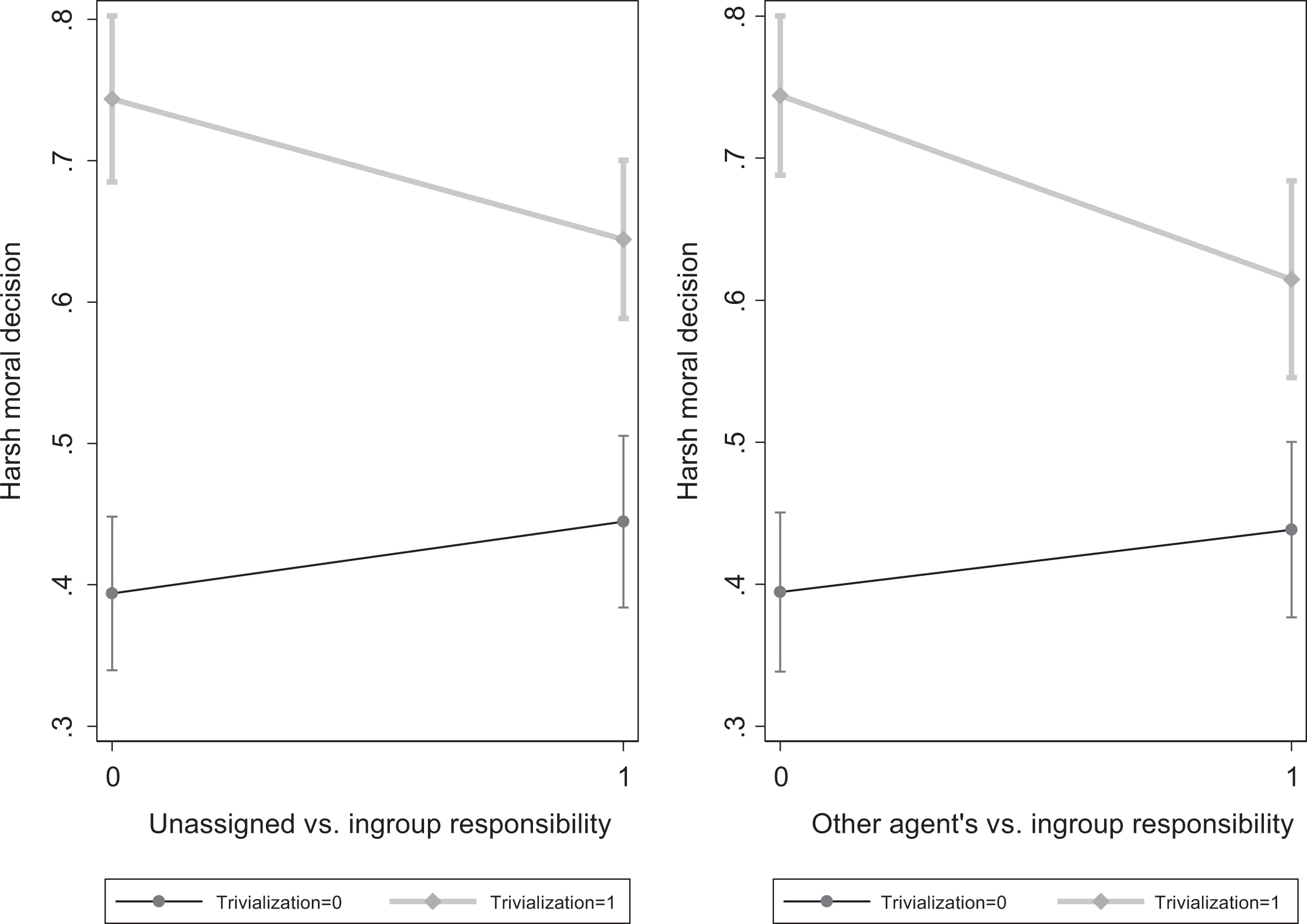
The interactive effects of moral responsibility and trivialization on harsher moral decisions—Study 1. Predictive margins with 95 percent confidence intervals.
Trivialization moderated the effect of reduced accountability due to both unassigned moral responsibility and another agent being morally responsible. Under conditions of minimal trivialization—that is, under conditions of severe moral struggle—decreased moral responsibility had a small positive and statistically insignificant effect (b = .051, p = .231 and b = .044, p = .303, see thin black lines in Figure 1). Conversely, when the moral dilemma was trivialized (maximal trivialization, see thick gray lines in Figure 1), the moral decision was 10 percent and 13 percent harsher in the high-responsibility, high-relevance scenario than in each of the two low-responsibility, low-relevance scenarios (b = −.099, p = .018; b = −.129, p = .005). 2 In other words, trivialization of the moral dilemma resulted in a harsher moral choice regarding potential harm to Palestinian civilians as compared to citizens of an unknown foreign country. This supports Hypothesis 2 and suggests that the availability of this coping mechanism will make it easier to make harsh moral choices in the context of high-relevance, high-responsibility dilemmas.
Resentment
Hypothesis 3 proposes that resentment toward the target serves as a coping strategy which enables harsh moral decisions under conditions of in-group moral responsibility. The results from model IIIa indicate that, as expected, resentment toward the target was strongly and positively associated with a harsher moral choice. Then, the two interactive terms of resentment and the experimental manipulations were specified in model IIIb. Whereas the interaction of resentment and unassigned responsibility approached significance in the expected direction (p = .075), we observed a null effect for the interaction of resentment and another agent being responsible (p = .610).
Resentment toward the target of the moral harm was found to condition the effect of unassigned versus in-group moral responsibility on moral decisions, replicating the effect of trivialization discussed above (see Figure 2). Under conditions of minimal resentment, decreased moral responsibility had a small positive effect: the moral decision was 5 percent harsher when the moral responsibility was unassigned than when it was assigned to one’s in-group. However, this effect was statistically insignificant (b = .046, p = .319; see the thin black line in Figure 2). Conversely, when there was strong animosity toward the target experiencing the moral harm (maximal resentment), the moral decision was 10 percent harsher in the high-responsibility, high-relevance scenario (Palestinians and Hamas) than in the low-responsibility, low-relevance scenario (Syrians and ISIS; b = −.103, p = .021; see the thick gray line in Figure 2). This supports Hypothesis 3 regarding the role of resentment in facilitating harsh moral choices under conditions of moral accountability. However, this finding was not replicated in the second experimental manipulation involving reduced accountability due to another agent being morally responsible.
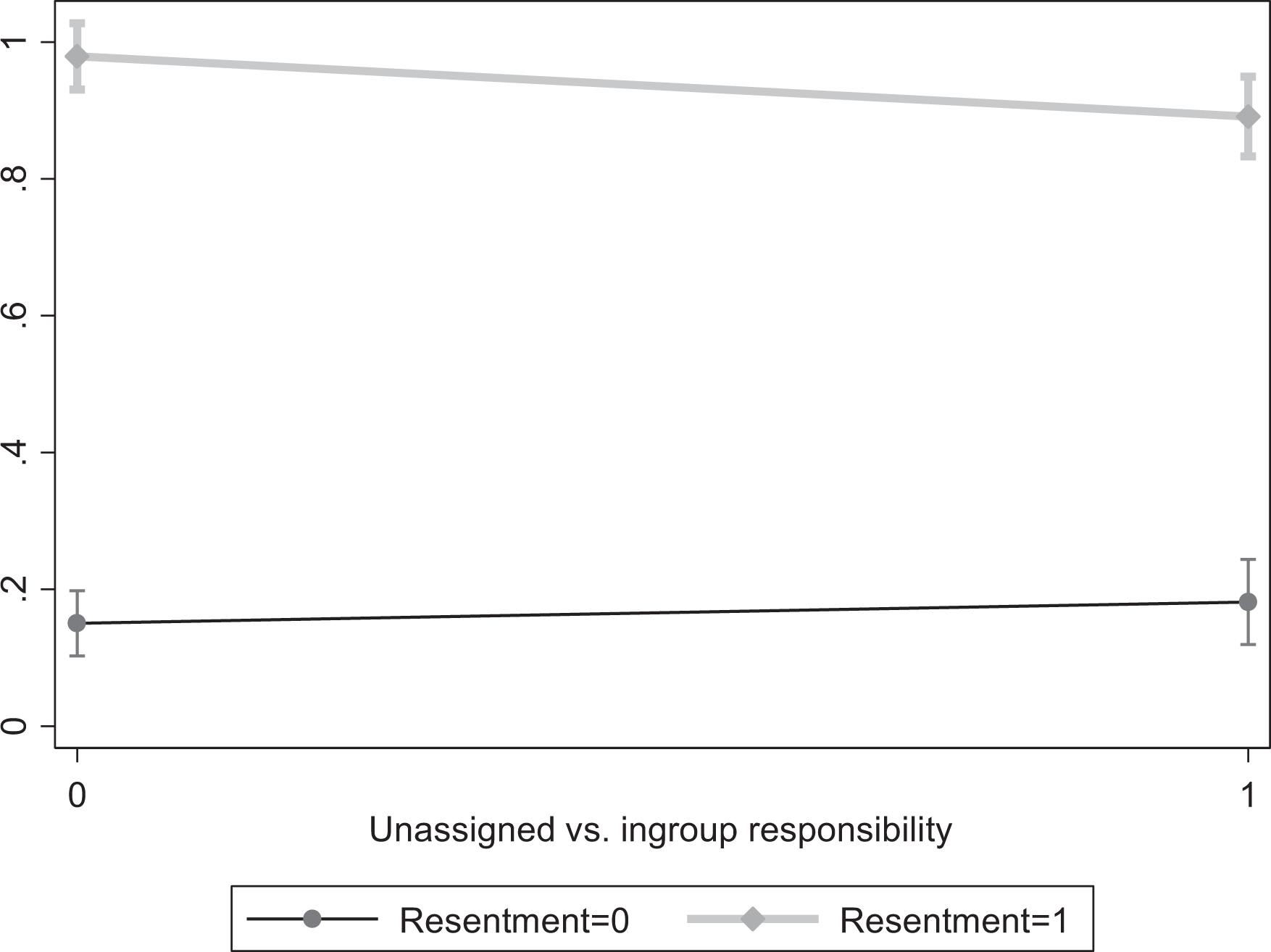
The interactive effects of unassigned versus in-group moral responsibility and resentment on harsher moral decisions—Study 1. Predictive margins with 95 percent confidence intervals.
The examined coping strategies could operate as a proxy for another underlying mechanism with which they are correlated: specifically, attitudes toward the Palestinians, religiosity, exposure to terrorism, democratic values, and/or political tolerance. We examined this possibility and affirmed the robustness of our results in Online Appendix A.
Discussion
Study 1 revealed that the examined coping mechanisms (i.e., resentment toward the target of the moral harm and trivialization of the moral dilemma) enabled harsher moral decisions under conditions of moral threat due to in-group responsibility for harm. However, study 1’s correlational design did not allow us to establish a causal relationship between those coping mechanisms and a harsher moral decision, as trivialization of the moral dilemma and resentment toward the target of the moral harm were measured rather than manipulated. We conducted study 2 to address this limitation by manipulating the two coping mechanisms supported by study 1 in a factorial design.
Study 2
Study 2 had a factorial 2 (trivialization: high vs. low 3 ) × 2 (resentment: high vs. low) design and was conducted during the fall of 2016. Participants were Jewish Israeli students recruited for class credit from a political science department and a psychology department of two Israeli academic institutions (N = 124).
Manipulation: Trivialization and Resentment
All participants received the scenario that cast direct in-group moral responsibility: specifically, the Israeli government deciding about bombing a house in Gaza. Whereas the basic text was identical in all four conditions, we varied the statements inducing the coping strategies of trivialization and resentment. Participants were randomly assigned to one of the four sets of experimental conditions with all possible combinations of high and low trivialization and resentment. The full materials and their English translations are presented in Online Appendix B.
Trivialization was primed in treatments 1 and 2 with wording such as “convened for a routine discussion,” “as in previous cases in the recent months,” “after the previous events, the cabinet developed a procedure for such decisions,” and “based on previous decisions and procedure.” Resentment was primed in treatments 1 and 3 by telling participants that the cabinet would make a decision after “a difficult year in which dozens of Israelis had been injured by armed Palestinians, who were not necessarily affiliated with any terrorist organizations.” Measurement of the dependent variable, harsh decisions in moral judgment, was the same as in Study 1.
Controls
Gender, age (seven categories), level of religiosity (1 = secular, 4 = ultraorthodox), political ideology (1 = left, 7 = right), and attitudes toward the Palestinians (a scale of four items, e.g., The Palestinians’ behavior toward Israel is unfair and unjust) were measured in study 2. All measures were normalized to 0 to 1. Descriptive statistics are presented in Table B1 of Online Appendix B.
Manipulation Check
To verify that the manipulation did not alter how realistic the dilemma was perceived to be, we asked participants at the end of the survey, To what extent was the dilemma in the article realistic in your view? We then ran an analysis of variance with the experimental condition as the independent variable. No significant effect was found for the experimental condition, F(3, 120) = .27, p = .85; means were 4.1, 4.2, 4.1, and 4.3 on a scale of 1–5.
Results of Study 2
Data were analyzed using linear regression. The decision in the moral dilemma was explained by (1) resentment toward the target of the moral harm and trivialization of the moral dilemma (model I in Table 2), (2) adding their cross-level interaction (model II), and (3) adding interactions with right-wing political ideology and with hawkish attitudes toward the Palestinians (models III and IV for the three-way interactions). Models were controlled for ideology, age, gender, and religiosity.
The Effects of Coping Strategies and Ideology on Harsher Moral Decisions—Study 2 and Study 3.

Note. Standard errors are given in parentheses.
† p < .1.
*p < .05.
**p < .01.
Confirming Hypothesis 3, model I showed that induced resentment toward the target led to harsher moral decisions (p = .043). Yet, regarding Hypothesis 2, induced trivialization had no significant effect on the harshness of the decision. Furthermore, there was no significant two-way interaction between the two factors (model II), but the findings suggest that the effect of trivialization was contingent on both resentment and one’s political leanings: a three-way interaction was seen among trivialization, resentment, and both measures of political leanings: (1) political ideology (p = .020, see model III and upper panel of Figure 3) and (2) hawkish attitudes toward the Palestinians (p = .009, model IV and lower panel of Figure 3).
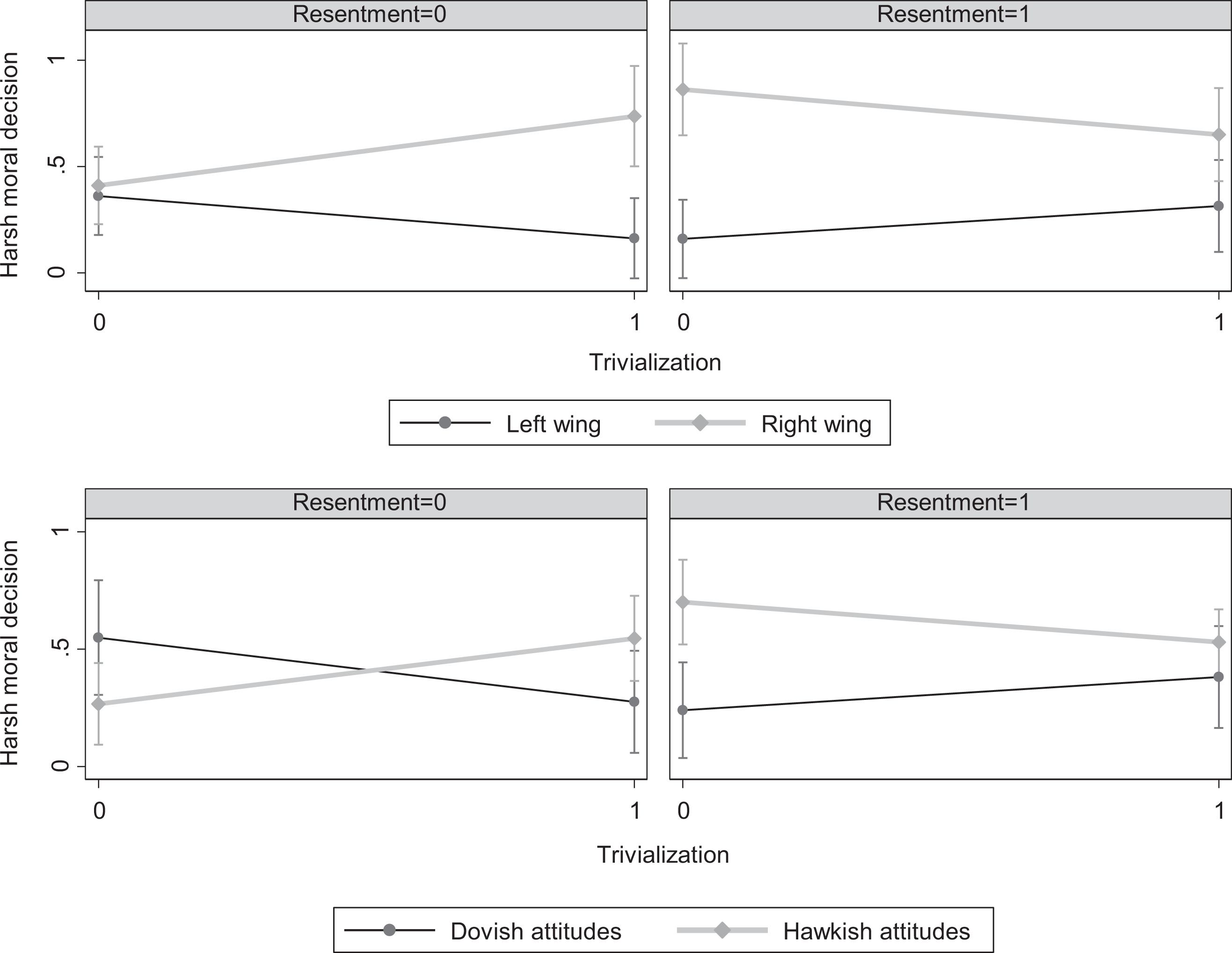
The interaction of trivialization and resentment with political ideology (upper panel) and attitudes toward the Palestinians (lower panel)—Study 2. Predictive margins with 95 percent confidence intervals.
Looking first at the three-way interaction with ideology, the left side of the upper panel of Figure 3 depicts the two-way interaction between induced trivialization and right-wing political ideology when resentment was not induced (p = .041). In that case, trivializing the moral dilemma led to harsher moral decisions, as stated in Hypothesis 2, among the right-leaning participants (b = .347, p = .031 when ideology was set to maximum). A boomerang effect emerged among the left-leaning participants but did not reach statistical significance (b = −.215, p = .120 when ideology was set to minimum). Finally, when resentment was induced, the two-way interaction between manipulated trivialization and ideology (presented in the right panel) was statistically insignificant. 4
Similarly, the two-way interaction between induced trivialization and hawkish attitudes toward Palestinians was statistically significant when resentment was not induced (p = .036, see bottom left panel). Trivializing the moral dilemma led to harsher moral decisions, as per Hypothesis 2, among the right-leaning participants (b = .275, p = .028). However, left-leaning participants showed a tendency toward more righteousness when the military act was presented as routine and trivial (b = −.267, p = .092). Again, when resentment was induced, the two-way interaction between manipulated trivialization and ideology (right panel) was statistically insignificant. 5
Discussion
To alleviate concerns regarding causality in study 1, study 2 manipulated the two coping mechanisms by presenting the same moral dilemma in a high-relevance, high-responsibility scenario. Whereas induced resentment unconditionally led to harsher moral decisions, the effect of trivialization was contingent on resentment and one’s political leanings; this is in line with findings regarding the role of ideology in motivated reasoning in general (Jost and Amodio 2012) and in dehumanization more particularly (DeLuca-McLean and Castano 2009; Maoz and McCauley 2008).
However, results should be read with caution due to the social context in which the study was conducted. As previously mentioned, various studies have found that social factors are crucial in defining one’s moral concept (Bandura 1999; Monin 2007; Ben-Nun Bloom and Levitan 2011; Bar-Tal 2012; Tauber and van Zomeren 2013). Studies 1 and 2 were conducted in the specific social and political context of the Israeli–Palestinian conflict. Israel’s long-standing conflict with the Palestinians and the need to deal with the threat to its security since its establishment as an independent state, in addition to the fact that all Israeli Jews serve in the army, might impact both the level of resentment toward those who are perceived as a security threat and the intensive use of coping strategies (e.g., trivialization) to justify various military activities.
Still, the hypothesized coping strategies serve motivational goals that are common to moral decision-making under in-group responsibility amid war on terrorism and are therefore expected to be replicated in other contexts. Study 3 was therefore set to strengthen external validity by examining the effect of the two suggested coping strategies outside the Israeli context. We sought to repeat the design of study 2 among American participants, in the context of the US conflict with ISIS in Syria, to test the effect of inducing resentment and trivialization on Americans’ tendency to make harsh moral decisions in the same collateral damage scenario. This context was arguably characterized by lower perceived in-group responsibility, given that army service is not mandatory and that the injurious consequences of war are less proximate.
Study 3
Study 3 applied the same factorial design (trivialization: high vs. low × resentment: high vs. low) and materials from study 2 to an American context, except that the fictional news article was applied to the context of ISIS in Syria. See Online Appendix for full materials. Participants were 273 Americans recruited through Amazon’s Mechanical Turk (MTurk) via TurkPrime in August 2018. To attenuate concerns about data reliability, we only utilized MTurk Masters with high approval rate who were born in the United States.
The dependent variable was measured the same way as in the previous studies. The average moral decision score was .382, lower than in the two Israeli samples, and its distribution was approximately normal (Md = .333, SD = .253). We used equivalent controls to those in study 2. As before, all measures were normalized to 0 to 1. Descriptive statistics are presented in Table C1 of Online Appendix C.
Manipulation Check
As in study 2, there was no difference between the experimental conditions in how realistic the dilemma was perceived to be, F(3, 272) = .99, p = .40; means were 4.1, 3.9, 4.0, and 3.9 on a scale of 1 to 5.
Results of Study 3
The analytical strategy was the same as in study 2 (see Table 2 for results). Looking first at the main effect of the treatments (model I), the results replicated those of study 2: induced resentment of the target led to harsher moral decisions (p = .004), whereas induced trivialization had no significant main effect on the harshness of the moral decision. Consistent with the results of study 2, there was no significant two-way interaction between the two factors (model II).
As in study 2, we next examined the moderating role of political leanings, measured as (1) political ideology and (2) attitudes toward ISIS. The results suggest that the effect of trivialization was contingent on the participants’ attitudes toward ISIS (two-way interaction: p = .020, model IV, right panel in Figure 4). Replicating the results of study 2 regarding the activation of trivialization among right-wing supporters in Israel, the trivialization manipulation increased harsh moral decision-making among hawkish participants (b = .175, p = .010 when attitudes toward ISIS were the harshest) and marginally decreased harsh decision-making among dovish participants (b = −.187, p = .053 when the attitudes were set to minimum). The two-way interaction with political ideology was statistically insignificant (see model III). Finally, a three-way interaction did not emerge between the two experimental treatments and political leanings.

The interaction of trivialization and attitudes toward ISIS—Study 3. Predictive margins with 95 percent confidence intervals.
Discussion
Replicating the results of study 2 presenting a dilemma about Hamas to Israelis, the results of study 3 show that Americans faced with a collateral damage dilemma involving ISIS in Syria were significantly more likely to support harsh acts when defensive coping strategies were activated, and particularly resentment (independent of political leaning, supporting Hypothesis 3) and trivialization (contingent on preexisting political attitudes, partly supporting Hypothesis 2). As indicated by the descriptive statistics, harsh moral judgment was lower in the American sample than in the two Israeli samples (despite the fact that college students are typically more liberal and left leaning than the general population and only the Israeli study was restricted to college students).
There was a difference between studies 2 and 3 in the moderating role of political leanings: particular attitudes toward the victims moderated the effect of trivialization in both studies, but political ideology only did so in study 2 (Israel). This difference may be a consequence of the between-settings difference in the alignment between political ideology in general and attitudes toward the examined conflict. Thus, political ideology in Israel is defined by attitudes toward the conflict with the Palestinians, with left being dovish and right hawkish, making the two variables strongly correlated (r = .698). However, this relationship was much weaker in the United States, with attitudes on foreign policy in general and the fight with ISIS in Syria more particularly being less correlated with ideology (r = .335).
In both studies 2 and 3, the two coping strategies were embedded in the scenarios such that the integrated primes slightly changed the description of the event. Thus, it could be that the difference in the event framing, rather than the activated resentment and trivialization, was responsible for the effects. Study 4 was therefore designed to separate the activation of resentment and trivialization from the scenario descriptions by using incidental manipulations of coping strategies.
Study 4
Participants were 165 Americans recruited through Amazon’s MTurk via TurkPrime in August 2018. We only utilized MTurk Masters with high approval rate who were born in the United States. The design was a three-group between Ss (induced resentment, induced trivialization, control). Participants were randomly assigned to read an essay describing (1) the state of human rights in territories controlled by ISIS, considered to be among the worst in modern history, as well as the results of a poll suggesting that a large share of Americans believe that ISIS has support among the majority of Muslims in Syria and that Bashar al-Assad is as bad as ISIS and that they worry about possible American support for ISIS (induced resentment), (2) the extensive use of predetermined conventional procedure in US Army field manuals, which contain “concrete authorized protocols for decision-making, detailed information on military techniques, and how-tos for procedures important to soldiers serving in the field” (induced trivialization), or (3) did not read an essay (control). The dependent variable was measured the same way as in studies 1 to 3. In line with the previous studies, the average moral decision score was .375 (Md = .333, SD = .245).
We used the same control measures as in study 3, adding two potential moderators: (1) familiarity with military service and (2) familiarity with the Middle East region. The trivialization prime applied military jargon and required participants to interpret field manuals as routines that reduce the degrees of freedom in the decision-making process (i.e., trivializing the moral dilemma). Furthermore, military service renders higher perceived responsibility, which differs between the Israeli and American context since army service in the Israeli context is mandatory. Therefore, we measured whether participants were exposed to military service by asking (1) “Have you ever served in the US military?” and (2) “Has someone close to you ever served in the US military?” (0 = no to both, i.e., no familiarity: n = 65, 1 = yes to either: n = 100). 6
Second, given that the hostility prime discussed the local politics and state of affairs of natives in Iraq and Syria, we measured familiarity with the region. The index was composed of three items: “How many of your friends and acquaintances are: (1) of Middle Eastern descent? (2) Muslim?” (1 = none of them, 6 = all of them) and (3) “Have you ever visited the Middle East (the trans-continental region centered on Western Asia, Turkey and Egypt)?” (1 = never, 4 = many times). 7 Again, all measures were normalized to 0 to 1. The descriptive statistics are presented in Table D1 of Online Appendix D.
Attention Check
To check for attention in reading the essays, we asked two multiple-choice questions after each essay (see Materials in Online Appendix D). Only one participant gave two wrong answers, which indicates the high quality of the sample. Note that removing this respondent from the sample had no substantial effect on the results.
Results of Study 4
Data were analyzed using linear regression. We predicted decisions in the moral dilemma based on: induced resentment and induced trivialization (model I in Table 3), their two-way interactions with ideology and with hawkish attitudes toward ISIS (see Table D2 in the Online Appendix), and the three-way interactions of familiarity with the military and familiarity with the region (models II and III in Table 3).
Tentatively supporting Hypotheses 2 and 3, both induced resentment and induced incidental trivialization showed a trend toward increasing harsher moral decisions compared to the control condition (resentment: 8.4 percent of the range of the moral decision, p = .065; trivialization: 7.5 percent of the range, p = .096, see model I in Table 3).
The Effects of Coping Strategies, Political Leanings (Ideology, Attitudes toward ISIS), and Familiarity with Military on Harsher Moral Decisions—Study 4.

Note. Standard errors are given in parentheses.
† p < .1.
*p < .05.
**p < .01.
Although both hypotheses about the effect of coping strategies were confirmed—namely, both manipulations had a marginal main effect—we further examined their interaction with political leanings to test whether previous results regarding the conditional effect of trivialization were replicated. Indeed, in accordance with the findings of studies 2 and 3, the effect of trivialization, but not resentment, interacted with political leanings; however, this interaction was moderated by familiarity with the military, as indicated by the marginally significant three-way interactions of trivialization and military familiarity with both ideology (p = .088) and attitudes toward ISIS (p = .087). 8 These three-way interactions are depicted in Figure 5.
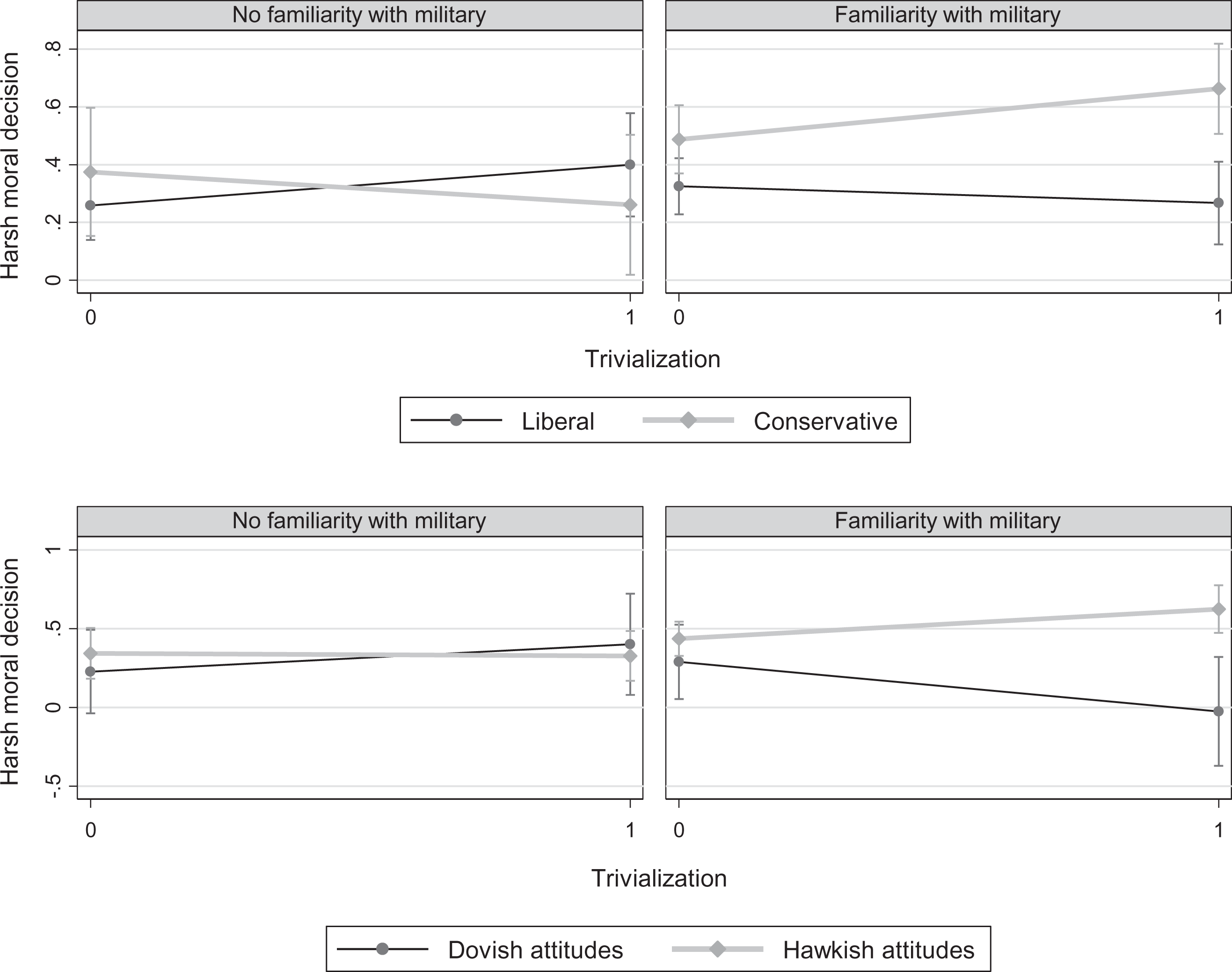
The interaction of trivialization, political leanings (ideology, attitudes toward ISIS), and familiarity with military—Study 4. Predictive margins with 95 percent confidence intervals.
In general, inducing trivialization using the army field manuals task was only effective for respondents familiar with the military. Among this subgroup (n = 100/165), the conditioning effect of political leanings demonstrated in studies 2 and 3 was replicated: induced trivialization led to harsher moral decisions as conservatism and hawkish attitudes increased.
The three-way interaction with ideology is depicted in the upper panel of Figure 5. For respondents familiar with the US army, shown in the right panel, trivialization led to harsher moral judgment among conservatives (p = .067 when ideology was set to maximum), but not among liberals (p = .633 when ideology was set to minimum). Looking at the upper left panel, trivialization had no significant effect among respondents not familiar with the military, regardless of their ideology (p = .308 when ideology was set to maximum, i.e., among conservatives, and p = .300 when ideology was set to minimum, i.e., among liberals).
Similarly, regarding the three-way interaction with attitudes toward ISIS, the induced trivialization led to harsher moral decisions among hawkish respondents familiar with the military (p = .042), as depicted in the bottom right panel of Figure 5, but not among dovish respondents familiar with the military (p = .180). Again, trivialization had no significant effect among respondents not familiar with the military, regardless of their hawkishness (p = .392 among the most dovish respondents and p = .288 among the most hawkish respondents). As in the previous studies, induced resentment had no two-way or three-way interactions with familiarity with religion, familiarity with the military, and political leanings (see Table D2 in the Online Appendix).
Discussion
Study 4 showed that both induced resentment and induced trivialization led to harsher moral decisions, independent of political leanings. These effects emerged when using extrinsic primes, that is, without reframing the moral dilemma. This provides important support for our coping mechanism hypotheses. Still, whereas the coping strategies showed a trend toward increasing harsher moral decisions compared to the control condition, their effect on moral decision was not significant in the .05 level (p < .1). This may be an artifact of the smaller sample size (N = 165 in study 4 vs. N = 273 in study 3) and the more subtle and indirect manipulations.
The moderating role of familiarity with the military in the effect of trivialization could be merely an artifact of the particular experimental task used in study 4. However, it could also be that trivialization of conflict-related moral dilemmas by means of military protocols is a more effective coping strategy for those accustomed to taking responsibility in military contexts. Future studies could test other trivialization strategies, such as framing decisions through crisis management protocols, through reference to less serious past events and through language of proportionality.
General Discussion
How do people respond to moral dilemmas amid war on terrorism? In this article, we demonstrated how even banal forms of coping have a considerable impact on moral judgment. Across four studies and two political contexts, we found that people faced with collateral damage dilemmas involving civilian victimization were significantly more likely to support harsh acts in the presence of defensive coping strategies such as resentment and trivialization. Our findings confirm, in both settings, that induced resentment results in harsher moral decisions. However, in studies 1 to 3, the effect of induced trivialization depended on political leanings. These mechanisms facilitate disengagement and reduce accountability through the presence of existing procedures (i.e., trivialization) and supply self-justification and out-group delegitimization through resentment of the victim. These results corroborate earlier studies’ findings that moral disengagement increases aggressive behavior (Bandura et al. 2001) and can inspire harsh decisions in moral dilemmas (Monin 2007; Tauber and van-Zomeren 2013; Kimhi and Kasher 2015).
Six potential limitations should be mentioned. First, all four studies were based on nonrepresentative samples. Still, we believe that replicating the main results in four studies, two settings, experimental and correlational designs, and different experimental tasks provide strong support for our findings. Second, like some other studies examining moral dilemmas, we did not examine actual behavior but rather respondents’ reactions to a stylized scenario, even if it was realistic. Third, further research should validate our measurement of coping strategies using a different research design. Fourth, future studies can follow up with the respondents a week or more after the manipulation to examine longer-term impacts of resentment and trivialization. Fifth, we leave for future studies to examine the prioritization of the moral self over the moral group in intergroup contexts. Finally, future studies can further examine the interrelations between disengagement mechanisms.
Notwithstanding its limitations, this study makes several important contributions. This work joins the current work extending Bandura’s moral disengagement strategies beyond the decision to engage in an unethical act, looking at moral disengagement as a multistage process, such that individuals need to cope with their moral choices both before and after they actually make them (Castano and Giner-Sorrola 2006; Tillman et al. 2017). Further, this research supplements the multistage outlook by viewing moral disengagement in intractable conflicts as a long-term process involving repeated rather than one-shot decisions. In this process, we view trivialization and resentment as vehicles of moral disengagement, serving both in retrospective thinking about past conduct and in attenuating self-condemnation in subsequent dilemmas, increasingly enabling harsher and less hesitant moral decisions. By mitigating threat to the moral self induced by subsequent decision-making and by facilitating harsher future moral decisions, such coping strategies form a spiral of moral disengagement, which gradually erodes the moral backbone of a fighting society.
Our findings further suggest political leaning as an important boundary condition for the effect of coping mechanisms in moral judgment under moral threat in conflict. This result converges with the literature on the moderating role of political leanings in dehumanization, by which supporters of the political right tend to dehumanize more than supporters of the political left (e.g., DeLuca-McLean and Castano 2009; Maoz and McCauley 2008). This important moderator stresses the need for an active and diverse political discussion in a society dealing with an intractable conflict.
More generally, we find that moral decisions are not reached based on a solid moral structure but are contingent on the type of threat, psychological motivations, and preexisting personal preferences. Hence, the context is key in understanding the role of coping strategies on moral decision-making. Settings may vary vastly in their collective histories, level of perceived in-group responsibility, and centrality of the conflict; armed conflicts vary in their length and intensity; and populations vary in their preexisting level of resentment toward the out-group and their hawkishness toward the victims. It is thus important to explore the types of coping strategies used in different conflicts and the relationships between the contextual characteristics and harsh moral decisions in those settings. Additional studies are needed to examine the types of moral decisions made in different situations during periods of conflict and of relative calm.
Finally, this article surpasses the study of one-time moral decision-making by examining the management of psychological distress in an ongoing process of moral disengagement, which is typical in counterterrorism. Thus, it contributes to the growing study of moral injury—that is, “the inability to contextualize or justify personal actions or the actions of others and the unsuccessful accommodation of these…experiences into pre-existing moral schemas” (Litz et al. 2009, 705). The literature acknowledges that even indirect and symbolic participation in acts of combat, such as harsh moral decision-making, require ongoing moral justification and can contribute to moral injury that brings about highly aversive emotional and cognitive responses and mental and behavioral health problems (Drescher et al. 2011; Maguen et al. 2011). Understanding the mechanism underlying moral judgment in conflicts can be an important asset in assessing the enduring impact of moral injury. Furthermore, insofar as moral repair can be achieved by acknowledging the processes of moral justification and by addressing the symptoms of moral distress (Litz et al. 2009), understanding coping mechanisms for harsh moral judgment in conflicts allows the symptoms of moral justification to be unraveled. Moreover, such understanding may translate into treatment options for a process of self-forgiveness and for rethreading a society’s collective moral fabric.
Supplemental Material
Supplemental Material, Online_Appendix - Coping with Moral Threat: Moral Judgment amid War on Terror
Supplemental Material, Online_Appendix for Coping with Moral Threat: Moral Judgment amid War on Terror by Pazit Ben-Nun Bloom, Shaul Kimhi, Shani Fachter, Michal Shamai and Daphna Canetti in Journal of Conflict Resolution
Supplemental Material
Supplemental Material, Replication_Files - Coping with Moral Threat: Moral Judgment amid War on Terror
Supplemental Material, Replication_Files for Coping with Moral Threat: Moral Judgment amid War on Terror by Pazit Ben-Nun Bloom, Shaul Kimhi, Shani Fachter, Michal Shamai and Daphna Canetti in Journal of Conflict Resolution
Footnotes
Declaration of Conflicting Interests
The author(s) declared no potential conflicts of interest with respect to the research, authorship, and/or publication of this article.
Funding
The author(s) disclosed receipt of the following financial support for the research, authorship, and/or publication of this article: This research was made possible, in part, by grants from the Leonard Davis Institute for International Relations (PBNB, DC and SF), the Israel Science Foundation (487/08) (DC), the United States–Israel Binational Science Foundation (2009460) (DC), and the Eilat Foundation for United States–Israel Studies (PBNB).

Supplemental Material
Supplemental material for this article is available online.
Notes
References
Supplementary Material
Please find the following supplemental material available below.
For Open Access articles published under a Creative Commons License, all supplemental material carries the same license as the article it is associated with.
For non-Open Access articles published, all supplemental material carries a non-exclusive license, and permission requests for re-use of supplemental material or any part of supplemental material shall be sent directly to the copyright owner as specified in the copyright notice associated with the article.
