



Abstract
The academic study of defense cooperation focuses heavily on formal military alliances. Yet, governments rarely sign new alliances, and the global alliance structure has remained relatively static for decades. By contrast, governments are increasingly active in defense cooperation agreements (DCAs). These bilateral framework treaties institutionalize their signatories’ day-to-day defense relations, facilitating such wide-ranging activities as defense policy coordination, joint research and development, weapons production and arms trade, joint military exercises, training and exchange programs, peacekeeping, and information exchange. Nearly 2,000 DCAs have been signed since 1980. Preliminary evidence suggests that DCAs impact numerous security, military, and defense outcomes and that governments increasingly incorporate DCAs as core elements of their security strategies. This article introduces the new DCA Dataset (DCAD). I provide a brief historical background on DCAs and compare them to other commonly studied forms of defense cooperation. I then explain coding standards and describe the data set in detail. Finally, I illustrate applications of DCAD to militarized interstate disputes and arms trade.
Keywords
Defense cooperation has long intrigued scholars of international relations. Thucydides’s History of the Peloponnesian War is, perhaps most of all, a treatise on alliance politics. Like Thucydides, contemporary scholars have focused heavily on formal military alliances and have produced a formidable literature. 1 Yet, governments rarely sign new alliances, and the global alliance structure has remained relatively static for decades. While alliance-making experienced a resurgence in the immediate aftermath of the Soviet Union’s collapse, only a dozen new alliances have emerged since 9/11—most of them ententes or nonaggression pacts rather than mutual defense pacts (Gibler 2009).
When governments pursue cooperation in defense, military, and security issues, they increasingly turn not to alliances but to a type of framework treaty known as a defense cooperation agreement (DCA). Nearly always bilateral, DCAs establish broad legal umbrellas for the range of cooperative defense activities in which states might engage, from coordinating defense policies to conducting joint exercises to jointly producing weapons and technology. In short, DCAs facilitate the routine interactions that comprise day-to-day defense cooperation. Taken as a whole, these agreements provide insight into the pragmatic tools that governments have developed to address the complex threats, both interstate and nontraditional, that define the contemporary global security environment.
The distinctions between DCAs and other agreement types are apparent in their institutional characteristics. While alliances focus primarily on contingencies surrounding conflict, DCAs exclusively address cooperation. They contain no mutual defense or nonaggression commitments. Indeed, most DCA partners lack a formal alliance altogether. DCAs also fundamentally differ from status of forces agreements, strategic partnerships, and other commonly studied defense agreements. And unlike these other agreement types, DCAs have proliferated rapidly. DCAs are often extensive and ambitious in scope, implementing institutional frameworks for the entirety of their signatories’ cooperative defense relations. They also tend to be relatively symmetric in the commitments they impose on signatories, and they endure for periods of five to ten years or longer.
Anecdotal evidence of DCAs’ significance abounds. After the loss of its Soviet sponsor in the early 1990s, Mongolia deployed a web of nearly three dozen DCAs to ensure access to defense-related training, education, matériel, weapons, and research (Growth of Mongolia’s Defense Cooperation 2017). A historic 2014 DCA between Russia and Pakistan led to arms transfers, counterterror drills, joint antidrug exercises in the Arabian Sea, and even the participation of a Pakistani warship in Russia’s Navy Day parade (Pakistan, Russia ink rare…2018). More generally, Kinne (2018) shows that DCAs increase the frequency of joint military exercises, contributions to peacekeeping missions and multilateral uses of force, arms trade, and overall cooperative bilateral events, while reducing the frequency of militarized disputes. In short, DCAs are now central to governments’ defense strategies.
In this article, I introduce the inaugural version of the Defense Cooperation Agreement Dataset (DCAD). DCAD relies exclusively on human coding methods, incorporating treaty data from (1) large repositories like the World Treaty Index (WTI) and United Nations Treaty Series (UNTS); (2) country-level sources including government-published treaty series, legislative gazettes, and personal contacts in foreign, defense, and internal ministries; and (3) global newspaper, newswire, and transcript archives. The full data set, which covers nearly 2,000 unique agreements, provides a comprehensive and exhaustive compendium of all known DCAs signed among all independent countries in the period 1980 to 2010. For many of these agreements, DCAD includes extensive information on institutional design features, such as duration, renewal conditions, issue scope, and asymmetry of obligations. DCAD thus provides hitherto unavailable insight into the institutionalization of routine defense interactions.
The article consists of five sections. First, I provide a brief historical background on DCAs. Second, I compare DCAs to other common forms of defense cooperation. Third, I explain in detail the data collection process and coding rules, and I describe the main features of the data set. Fourth, as a matter of illustration, I present results from simple analyses of DCAD data in two commonly studied topics in international security: militarized interstate disputes (MIDs) and bilateral arms trade. The fifth section concludes.
A Brief History of DCAs
Bilateral defense treaties are not new. In the late 1940s and early 1950s, the United States inked dozens of defense agreements with partners in Europe, South America, and Asia. Many of these agreements were created under the aegis of the Mutual Defense Assistance Act or its successor, the Mutual Security Act, and focused heavily on provision of military aid (Connery and David 1951; Kaplan 1980; Kolko and Kolko 1972; Scott 1951). Others focused on status of forces, establishment of US bases and/or troops, or airspace access for US military aircraft (Erickson 1994; Stambuk 1963). These agreements were highly asymmetric and designed to maintain or improve the preponderant military position of the United States. European powers established similar agreements with their former colonies (Martin 1995). Despite their asymmetries, these and related agreements bore skeletal similarities to present-day DCAs in that they established long-term, comprehensive defense frameworks.
Early explorations of mutuality in defense obligations took a limited form, such as agreements focused on protection of intellectual property rights for defense industries, which involved not only the US and its European partners but also European states themselves, including Sweden, France, Norway, and West Germany (Gapcynski 1972; Saragovitz and Dobkin 1968). Similar agreements emerged among Eastern Bloc states—particularly East Germany, Czechoslovakia, and Poland—and, to a limited extent, among governments in Southeast Asia and South America.
A basic template for framework bilateral defense agreements coalesced in the late 1980s and early 1990s. Kinne (2018) discusses in greater detail the historical motivations behind this trend, which included the waning of the Cold War, the decline of traditional interstate war, and the rise of nontraditional threats like terrorism, trafficking, transnational rebel groups, piracy, and nonstate weapons proliferation. Many governments publicly expressed a desire to redefine their defense relationships in light of new threats (New Era Forces US, Israel…1992). The first wave of DCAs emerged in the early 1990s, following closely on the heels of the Soviet Union’s collapse. Post–Soviet republics in particular faced multifaceted threats from a declining superpower and latent transnational movements, and they pursued bilateral security ties accordingly (Cottey 1995). This wave nonetheless extended far beyond Europe, involving regional powers like Brazil, South Africa, Argentina, Turkey, and numerous others.
Following Kinne (2018), I define DCAs simply as “formal bilateral agreements that establish institutional frameworks for routine defense cooperation.” Consider the following illustrative excerpt from a 2006 DCA between France and India: 1.1 The purpose of the Agreement is to promote cooperation between the Parties in the defence and military fields, defence industry, production, research and development, and procurement of defence materiel. 1.2 This Agreement shall establish a framework which aims to cover all cooperation activities conducted by the Parties in the field of defence.
2
A second criterion, implied by Article 1.1 above, is that DCAs do not endeavor grand mutual defense commitments but instead focus on routine forms of bilateral cooperation. Consider the following excerpt from a DCA between Sweden and South Korea: Paragraph 2 Scope and Areas of Cooperation 1. With regard to identified areas of mutual interest, the Participants may cooperate in the following areas: a. exchange of defence related experience and information, b. research and development, c. defence industry, d. logistics and maintenance, e. military technical cooperation, f. military education and training, g. government quality assurance, h. military medicine and health services, and i. other areas of cooperation, as jointly decided by the Participants.
5
Third, DCAs may be signed between any pairing of states and are not limited to specific events or to unique shared histories such as postcolonial ties or a recent conflict. Indeed, DCAD is full of seemingly improbable ties. Indonesia and Sweden signed a DCA in late 2016 despite both governments’ long-standing adherence to principles of neutrality and nonalignment (Sweden, Indonesia sign defense 2016). This feature distinguishes DCAs from myriad security agreements that are unique to the parties involved, such as US treaties with Ukraine on denuclearization, South Korean treaties with North Korea on the demilitarized zone, French treaties with Spain on ETA, and so on. Such context-specific agreements are meant to address problems unique to a given pair of countries and are not generalizable frameworks for defense cooperation.
Fourth, DCAs typically rely on decentralized institutional mechanisms to achieve implementation, with only minimal delegation (cf. Abbott and Snidal 2000; Hawkins, Lake, Nielson, and Tierney 2006), promulgated through a combination of commissions, working groups, task forces, and joint committees.
6
Consider the following excerpt from a 2005 DCA between Sweden and Saudi Arabia: Article 3 1. A committee shall be established under the name (The Joint Military Committee) which shall be responsible for the follow up and development of military cooperations between the two countries and in case any obstacles that may arise regarding this MoU, and each party shall appoint his representative at a later time; the committee will meet annually in each country respectively. The committee raise its recommendations to the higher authorities in both countries to obtain approval. 2. The committee can form specialized task forces from each party to serve the military cooperation fields.
7
Article 4 Planning and conduct 1. According to the provisions of this Agreement, the Parties shall work out and approve annually bilateral cooperation plans. The annual plan of cooperation for the next year shall be worked out by 1 December of the current year. 2. The annual plan of cooperation shall be elaborated on proposals submitted by the Parties.
8
Sixth, DCAs are signed for the long term. The shortest agreement in DCAD is two years. Nearly half of agreements are signed for ten years or longer. A substantial number of agreements are indefinite; they endure unless and until at least one signatory chooses to withdraw. While long-term agreements are certainly not unique in international law, this characteristic distinguishes DCAs from the numerous short-term security agreements, protocols, and contracts that fill treaty repositories.
Finally, a given pair of countries may sign more than one DCA. In some cases, countries simply replace expiring agreements. In other cases, governments have adopted a piecemeal approach to defense cooperation via sector agreements, and they sign a general DCA to pull their various issue area commitments into a single framework. Yet another possibility is that governments replace weak agreements with broader, more binding agreements (or vice versa).
DCAs versus Other Agreement Types
Browsing the “military matters” category of the UNTS reveals agreements on military cemeteries, radar stations, tobacco use by military personnel, and various other topics. Even seemingly trivial defense agreements are numerous. Accordingly, I distinguish DCAs from those defense agreements that have previously received scholarly attention, such as nonaggression pacts, mutual defense pacts, strategic partnerships, and status-of-forces agreements (SOFAs).
Defense pacts and nonaggression pacts have been heavily studied (e.g., Gibler 2009; Mattes and Vonnahme 2010; Walt 1987). Leeds et al. (2002) place both agreement types under the broader definition of a military alliance: Alliances are written agreements, signed by official representatives of at least two independent states, that include promises to aid a partner in the event of military conflict, to remain neutral in the event of conflict, to refrain from military conflict with one another, or to consult/cooperate in the event of international crises that create a potential for military conflict.
Even when alliances discuss cooperation more generally, they do not engender umbrella frameworks for the full range of states’ defense activities. Provisions on peacetime cooperation are in fact uncommon outside of ambitious alliances like NATO. Leeds et al. (2002) find that while about half of alliances involve mutual consultation, less than 15 percent mandate interpersonal contact during peacetime. And while many alliances encourage “economic cooperation, protection of minorities, scientific or cultural exchange, environmental protection, etc.,” these activities are overtly nonmilitary (Leeds 2005, 30). By contrast, routine activities like joint exercises, officer exchanges, procurement and acquisition, joint weapons collaborations, and defense industrial cooperation are the core purview of DCAs.
The distinction between alliances and DCAs is straightforward. The primary goal of an alliance is to specify obligations contingent on armed conflict. The primary goal of a DCA is to establish generic frameworks for routine cooperative defense activities. The two agreement types are mutually exclusive. Alliance and DCA obligations are also empirically distinct. At the dyad-year level, the correlation between DCAs and alliances is typically less than 0.2. The vast majority of DCA partners lack a direct alliance of any form.
Distinctions between DCAs and other agreement types are even sharper. While SOFAs have been frequently studied by political scientists and legal scholars (e.g., Sari 2008; Schwartz 1953), they focus largely on jurisdictional issues—especially regarding foreign-deployed troops—and do not establish broad legal umbrellas (Erickson 1994). Strategic partnerships are also common, but these agreements are substantively thin and vaguely defined (Kay 2000), often focusing on a wide variety of nonmilitary issues such as trade, finance, diplomatic relations, public health, or the environment. Neither agreement type bears a strong resemblance to DCAs.
Collecting and Coding the DCA Data
The author and a rotating team of coders assembled an exhaustive data set on DCAs for all countries in the world covering the period 1980 to 2010. We paid particular attention to five of the criteria elaborated by Salehyan (2015).
12
Specifically: We systematically and transparently assembled a large battery of primary sources. All coders consulted the same sources, and all sources were thoroughly documented. We collected data from numerous supplementary sources in order to address potential gaps or oversights in the primary sources. We utilized a diverse array of sources—from treaty repositories to country publications to global newspaper and newswire archives—in order to minimize any potential biases associated with specific sources. We implemented an extensive, unambiguous set of coding rules. All coders were debriefed on the coding system and met routinely with a supervisor to address challenges and verify accuracy of the data. We have arranged to provide free public access to the final data set via academic websites, Dataverse repositories, and the Correlates of War data portal.
The data collection involved three sweeps. First, we consulted the WTI and UNTS. The WTI, first assembled by Rohn (1984), is an expansive resource, but its post-1980 coverage overlaps substantially with the UNTS (Bommarito, Katz, and Poast 2012). The UNTS, in turn, is plagued by at least two problems. (1) Despite the requirements of Article 102 of the UN Charter, governments often fail to report their signed agreements. This underreporting appears to be especially prevalent with agreements on security, defense, and military issues. (2) Even when governments register their signed treaties as required, bureaucratic backlogs cause multiyear lags between registration and eventual publication in the series. Ultimately, the UNTS and WTI contribute only a small fraction of the observations in the final data set.
The second sweep focused on individual country sources, including official treaty series, publications of defense and foreign ministries, gazettes and other legislative records, online databases, and unofficial governmental records. In many cases, these documents were accessed via traditional print publications, fee-based online repositories, or publicly accessible ministry websites. We also directly contacted officials at foreign, defense, and legal affairs ministries, and we were often rewarded with data that, while not proprietary, would otherwise be publicly inaccessible. These country-level resources provided the vast majority of observations in the data set. This phase of the data collection was extremely labor intensive and covered a period of nearly five years.
The third sweep filled gaps left by the first two sweeps. Some countries lack the means or the motivation to make their treaty data publicly accessible. We thus used the Dow Jones Factiva database to access treaty information via global newspaper and newswire reports. 13 Coders were instructed to manually query Factiva using iterated combinations of relevant key words. To ensure careful attention to search results, these queries focused on one country at a time, employing for each country a moving search window of three to twelve months over the entire 1980 to 2010 period. This tertiary source provides approximately one-third of the observations in the final data set.
Coding Rules
DCAD categorizes agreements along multiple dimensions. At the most general level, DCAs can be distinguished by agreement type, which bifurcates into general agreements and sector agreements. The general category consists primarily of agreements designated as Full DCA, which, like the examples cited above, attempt to coordinate and institutionalize the entirety of their signatories’ current and prospective defense relations. The general heading also includes a specific subtype of DCAs known as defense industrial cooperation agreements. These Industry agreements are more strongly oriented toward military capacity than are full DCAs, but they are nonetheless far more extensive than the narrow weapons procurement agreements discussed further below. Industry agreements promote a wide range of defense industrial activities beyond a typical DCA, including joint research and development, joint production, sharing of classified weapons-related material, exchanges of scientific personnel, collaborations between universities and other research institutions, collaborations and partnerships between defense firms, transfer of components and finished weapons, and numerous other activities. This breadth leads to the classification of these agreements as general. Because DCAD clearly distinguishes Industry agreements from the Full DCA category, users are free to alter this categorization as desired.
The sector type of agreement consists of four main subtypes:
Procurement: These agreements establish frameworks for procurement and acquisition of weapons, equipment, spare parts, and possibly weapons-related training (Kinne 2016). Unlike Industry agreements, procurement deals typically do not involve industrial collaboration, joint research, information sharing, or similar activities. Rather, they facilitate weapons transactions. While some procurement agreements involve grants, loans, and/or offsets, those agreements that deal solely with military aid are uniquely asymmetric and, as such, are not included in DCAD.
Training and exchange (TrEx): These agreements create frameworks for officer exchanges, joint training and education, advanced coursework in foreign institutions, and other activities that involve movement of personnel for training and/or education purposes.
Research: These agreements promote defense-related research. Research agreements are narrower than industry agreements and focus more on basic research—often involving universities, national labs, and similar facilities—than on immediate weapons applications. They also do not address procurement, acquisition, or arms transfers.
Commission: These agreements establish recurring high-level consultation mechanisms such as bilateral committees, joint working groups, and military commissions, with a focus on general defense policy coordination. While full DCAs also establish such mechanisms, the Commission subtype of agreement typically involves only consultation and does not address the wide range of activities covered by full DCAs. Because the goals and motivations of these agreements are often vague, they are generally the weakest of the sector agreements.
DCAs thus fall into one of the two types (general or sector) and one of the six subtypes or categories (Full DCA, Industry, Procurement, TrEx, Research, or Commission). In most cases, a given agreement easily fits into one of these categories. In some cases, however, categorization is not straightforward. For example, an ambitious Research agreement may discuss procurement and acquisition, raising the possibility that it should be categorized as Industry. Coders thus assigned up to three separate categories for each agreement. Category1 indicates the most likely category, while category2 and category3, if used, indicate plausible alternative codings. Figure 1 illustrates the distribution of categories. Because full DCAs are readily identifiable, they are typically coded as category1. Industry agreements, while less common than full DCAs, are more numerous than any individual sector-level subtype. Agreements that fall into the Full DCA and Industry subtypes—that is, general agreements—clearly comprise the large majority of DCAs.

Defense cooperation agreements by category.
Figure 2 illustrates trends in DCA signature over time. Full DCAs comprise about half of agreements signed in a typical year. Industry agreements are slightly less numerous than all combined sector agreements but are nonetheless signed at nontrivial rates of fifteen to thirty per year. The last year of the data set, 2010, was the most prolific year thus far, with nearly 120 separate agreements signed. Preliminary data collection beyond 2010 suggests that DCA creation continues apace.
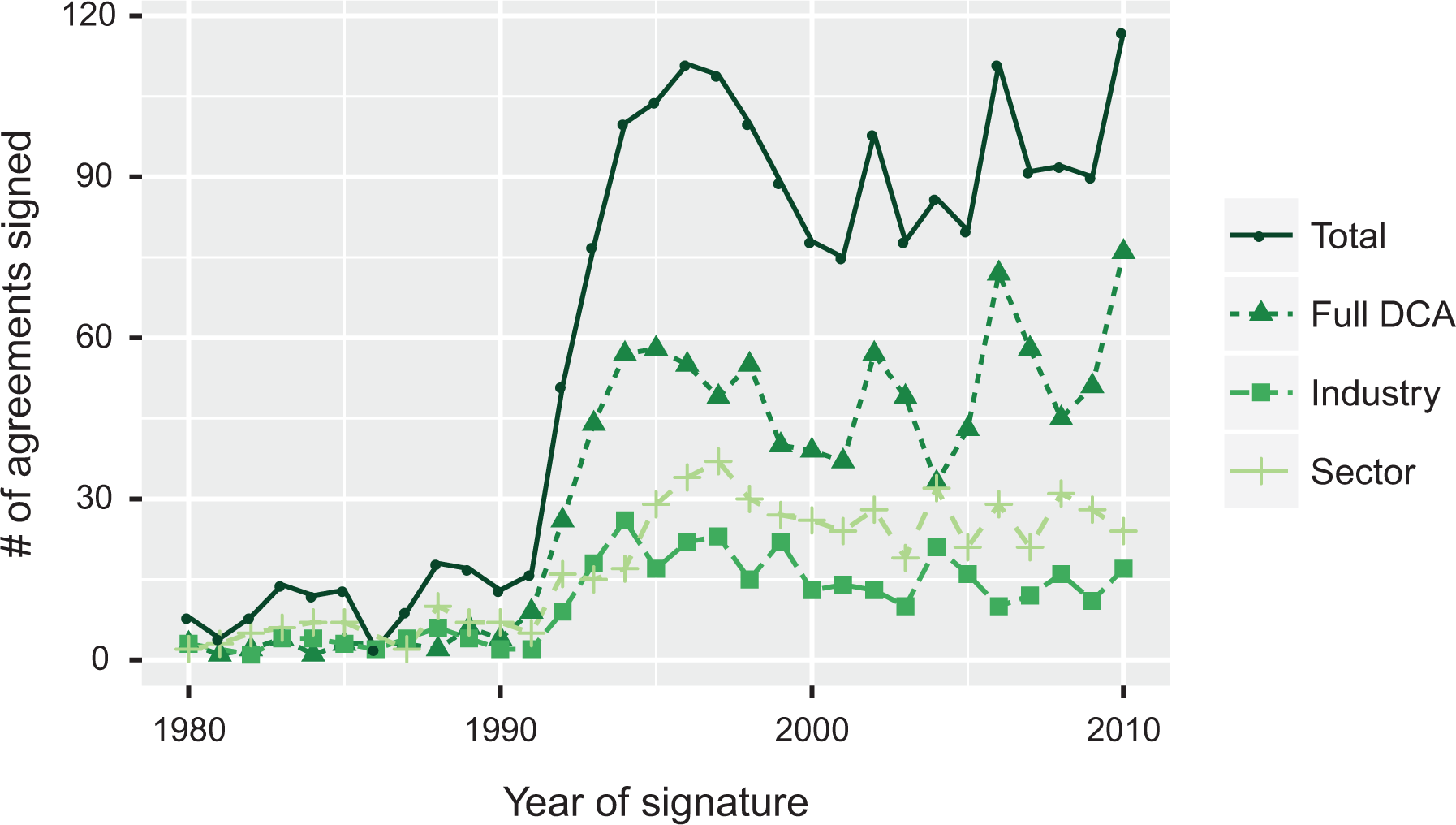
Defense cooperation agreement signature over time.
The categorization strategy necessitates a transparent assessment of coder confidence. Coders reported confidence in a number of ways. The main indicator of confidence, denoted categoryConf in DCAD, is a four-point nominal scoring system. A scoring of “high” typically corresponds to an agreement where the full text is available, either in English or translatable to English, and the text clearly and unequivocally identifies the issue areas covered by the agreement. A scoring of “medium” typically corresponds to an agreement where the full text is unavailable but the treaty is listed in treaty databases or official government records, and available sources—such as treaty archives, news sources, or other secondary sources—contain sufficient information to assign the DCA to a specific category with little ambiguity. A scoring of “low” typically corresponds to an agreement where full text is unavailable and secondary sources describe the agreement’s scope only in vague terms or not at all. Even a treaty that appears in an official government treaty record may be assigned low confidence if the full text of that treaty is unavailable and secondary sources provide little additional information. Coders also employed an “atypical” scoring, which corresponds to agreements that differ substantively from the archetypical category to which they’ve been assigned—for example, by including provisions common to other categories and/or incorporating high levels of asymmetry (see below). Due to the nonstandard nature of atypical agreements, the assigned category may be unreliable. When DCAs are the sole focus of an analyst’s attention, as when they are the dependent or independent variable of interest, only high and medium confidence agreements should be used.
Given the difficulty in coding agreements from newspaper and newswire sources, which nearly always lack full treaty texts, coders also assessed confidence specifically with regard to the Factiva data. The variable factivaConf is a five-point numeric scale that indicates the coder’s confidence that the following criteria are met: (1) a written international agreement was signed between two sovereign governments, with no ambiguity about the day, month, and year of signature; (2) the agreement covers issue areas that correspond to those typically covered by DCAs; (3) the agreement does not appear to be motivated solely by idiosyncratic events such as an ongoing war or activities of a specific terrorist organization; and (4) the agreement appears to correspond to the above-cited characteristics of DCAs, such as being long term and imposing relatively symmetric obligations. A five on this scale indicates maximum confidence, typically due to an abundance of highly detailed news reports on the given agreement. A one on this scale indicates minimal confidence and typically corresponds to agreements that are given only cursory mention in news sources and for which most of the details, including type and category, are not well known. A score of three indicates an agreement for which criteria #1 and #2 appear to be satisfied, but uncertainty remains about #3 and #4. If there is any ambiguity about an agreement’s legal status—that is, whether it is in fact a legal instrument or is instead a joint statement, declaration, protocol, addendum, or amendment—factivaConf is no higher than two. When DCAs are the focus of an analyst’s attention, only those agreements that score three or higher on the factivaConf scale should be used.
DCAD also includes an asymmetry indicator, which flags agreements that may involve asymmetric obligations. This variable is a three-point scale that equals one if the treaty text, news sources, and/or available secondary sources suggest that the agreement involves military aid from one signatory to the other, bases or other foreign deployment beyond reciprocal exchanges, explicit references to past colonial ties, or differing legal obligations in the agreement’s core areas. Because such asymmetries are difficult to establish definitively, we code this variable generously. The mere suspicion of asymmetry leads to a coding of one. Thus, asymmetry = 1 should be interpreted as indicating the possibility of asymmetry. The goal of this coding is to flag any potential cases of asymmetric obligations. In contrast, a coding of two indicates unequivocal evidence of (usually extensive) asymmetry. Given the nature of the coding, pooling agreements where asymmetry = 0 with those where asymmetry = 1 is acceptable. However, analysts should avoid pooling asymmetry = 2 agreements with the other types.
When available, DCAD includes information on agreements’ specified duration and renewal terms. This fine-grained information typically requires access to full treaty texts, though in some cases, online treaty databases and even news sources include such information. DCAD specifically includes measures of an agreement’s span in years, the conditions for renewal (denoted renewType), and the length of the renewal term in years (denoted renewYears). DCAD also includes a dummy variable indicating whether an agreement has terminated and an additional variable that lists, for terminated agreements, the full duration of the treaty in years. This information is particularly useful in constructing the dyad-year version of the data set as described below. Figure 3 summarizes DCAD’s key characteristics.
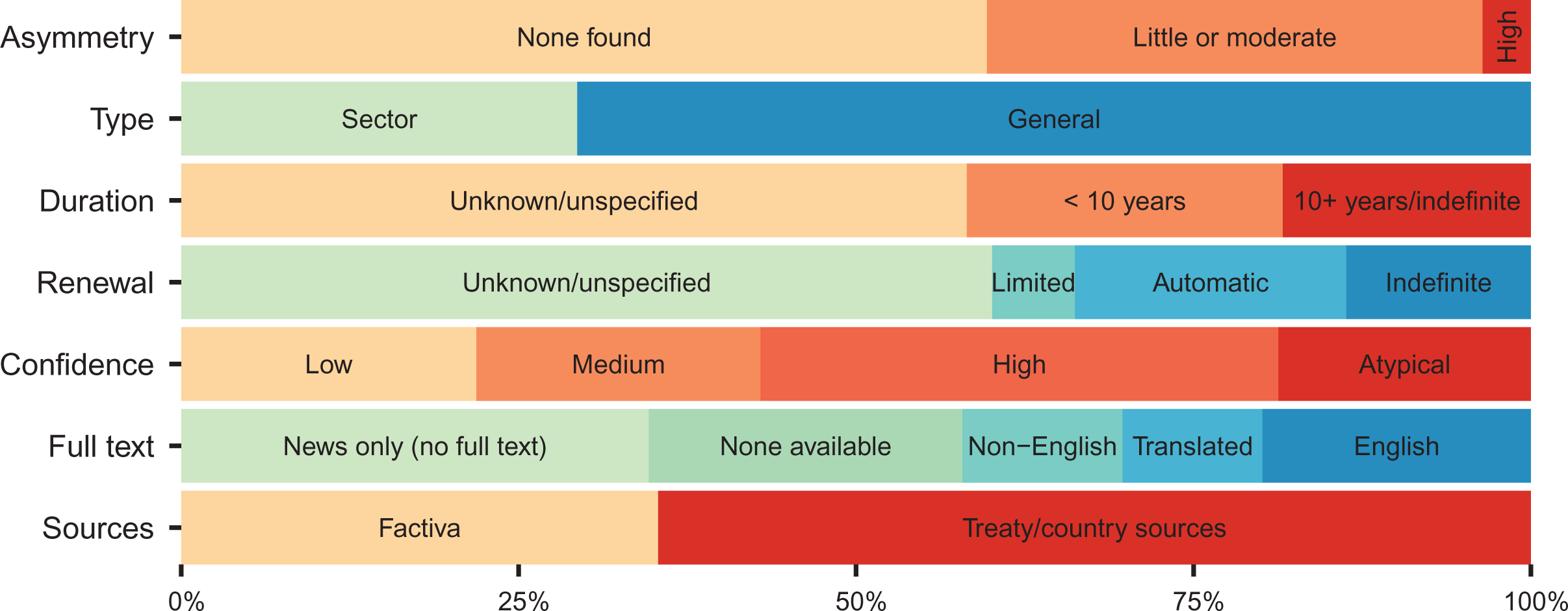
A graphical overview of Defense Cooperation Agreement Dataset. Horizontal bars indicate percentage of agreements that fall into each category.
Monadic versus Dyadic Versions
The main DCAD file contains agreement-year observations, where “year” is defined as the year of signature. The data set thus includes one record per agreement. This data structure is readily amenable to country-year or “monadic” analyses. However, scholars of international relations are often interested in bilateral, country-pair, or “dyadic” relations, where the unit of analysis is the dyad-year. At the same time, many studies of defense cooperation focus on the existence of formal agreements, not merely the creation of those agreements.
Generating a dyad-year data set of DCAs confronts two challenges. First, given that DCAs vary in issue scope (as well as in coder confidence), a researcher must make ex ante decisions about which agreements to include and which to exclude. Second, DCAD only includes information on duration for approximately half of agreements, typically because full treaty texts are not available or because the treaty itself is ambiguous about duration.
I address the first challenge by generating multiple versions of the dyad-year measure, focusing separately on general agreements, sector agreements, and all agreements in combination. Within each of these groupings, I further separate agreements with high- and medium-confidence codings from those with low or atypical codings. This approach yields six distinct dyad-year measures:
dcaGeneralV1: this coding includes only Full DCA and Industry agreements with category confidence ratings of high or medium.
dcaGeneralV2: includes Full DCA and Industry agreements regardless of category confidence.
dcaSectorV1: includes only category1 sector agreements—that is, Procurement, TrEx, Research, and Commission—with category confidence scores of high or medium.
dcaSectorV2: includes category1 sector agreements regardless of category confidence.
dcaAnyV1: includes both general and sector agreements with category confidence ratings of high or medium.
dcaAnyV2: includes general and sector agreements regardless of category confidence (i.e., all agreements).
To address the second challenge, regarding DCAs of unknown duration, I code an endYearEstimate variable according to the following rules. (1) If the agreement is known to have terminated, endYearEstimate equals the appropriate year of termination or the final year of the data set (2010), whichever is lower. (2) If a treaty is known to have not terminated at the time of data collection (e.g., the agreement is listed as active in a country’s treaty register), endYearEstimate equals the final year of the data set. (3) If a treaty’s stated duration is indefinite and there is no evidence of termination, endYearEstimate follows the same rule as in #2. (4) If a treaty renews indefinitely, without required consent from signatories, endYearEstimate follows the same rule as in #2. (5) If a treaty has a finite duration and explicitly states that it may not be renewed, endYearEstimate equals the year of signature plus the stated duration of the treaty. (6) If a treaty is of finite duration but permits limited renewal(s) with the consent of both parties, endYearEstimate equals the year of signature plus the stated duration of the treaty plus the renewal period. (7) If a treaty permits renewal but the duration and terms of renewal are not known, endYearEstimate follows the same rule as in #5. (8) For any remaining missing values, endYearEstimate equals the year of signature plus the median span, in years, for all observations in the data set where span is known. Given the time span of the data set, endYearEstimate can never exceed 2010. I use endYearEstimate to determine whether a tie exists within a given dyad in a given year.
Given these coding rules, analysts should be cautious in using the dyadic data. When DCAs are the dependent variable of interest, analysts should focus on the creation of DCAs rather than on the existence of DCAs. The versions utilizing treaty duration are more appropriate when DCAs act as independent variables, and the analyst can reasonably assume that agreements will exercise influence well past their year of signature. Most analysts will find dcaAnyV1 to be the most sensible variable to use, given that it includes all agreements for which there exists a reasonable level of confidence. 14
DCAs as a Global Network
DCAD is particularly valuable for the study of international networks. While many scholars now recognize that international relations are in fact network relations (Kinne 2013), IR data are not always amenable to network tools. For example, many studies operationalize military alliances as a traditional social network, where each network tie is separable from the others (e.g., Cranmer, Desmarais, and Menninga 2012; Cranmer, Desmarais, and Kirkland 2012; Maoz and Joyce 2016; Warren 2010, 2016). Yet, because many alliances are multilateral, they are better modeled as bipartite or “two-mode” networks, which require unique data structures and a distinct estimation approach (Borgatti and Everett 1997; Snijders, Lomi, and Torló 2013). Network scholars have also studied MIDs (e.g., Ward, Siverson, and Cao 2007); however, MIDs are transitory events rather than enduring social relations, which complicate the use of statistical tools designed for stable networks (Brandes, Lerner, and Snijders 2009).
To the best of my knowledge, DCAD is the first IR data set collected and assembled specifically with network implementations in mind. Because DCAs are bilateral, they readily approximate the dyadic relations that comprise traditional social networks. Figure 4 illustrates the DCA network in Asia in 2010 using a standard network graph, which helps identify central players (India, Philippines), peripheral players (Mongolia, Cambodia), relative prevalence of general versus sector agreements, and other structural features. Figure 5 uses hive plots to illustrate the changing topology of the global DCA network. The overall network was quite sparse until 1995, when a plethora of agreements emerged between governments in Europe, North America, Asia, and the Middle East—with relatively less activity between governments in Asia and Africa/Middle East. These trends have continued, with some regions showing much stronger DCA activity than others and the overall network gradually densifying through 2010.
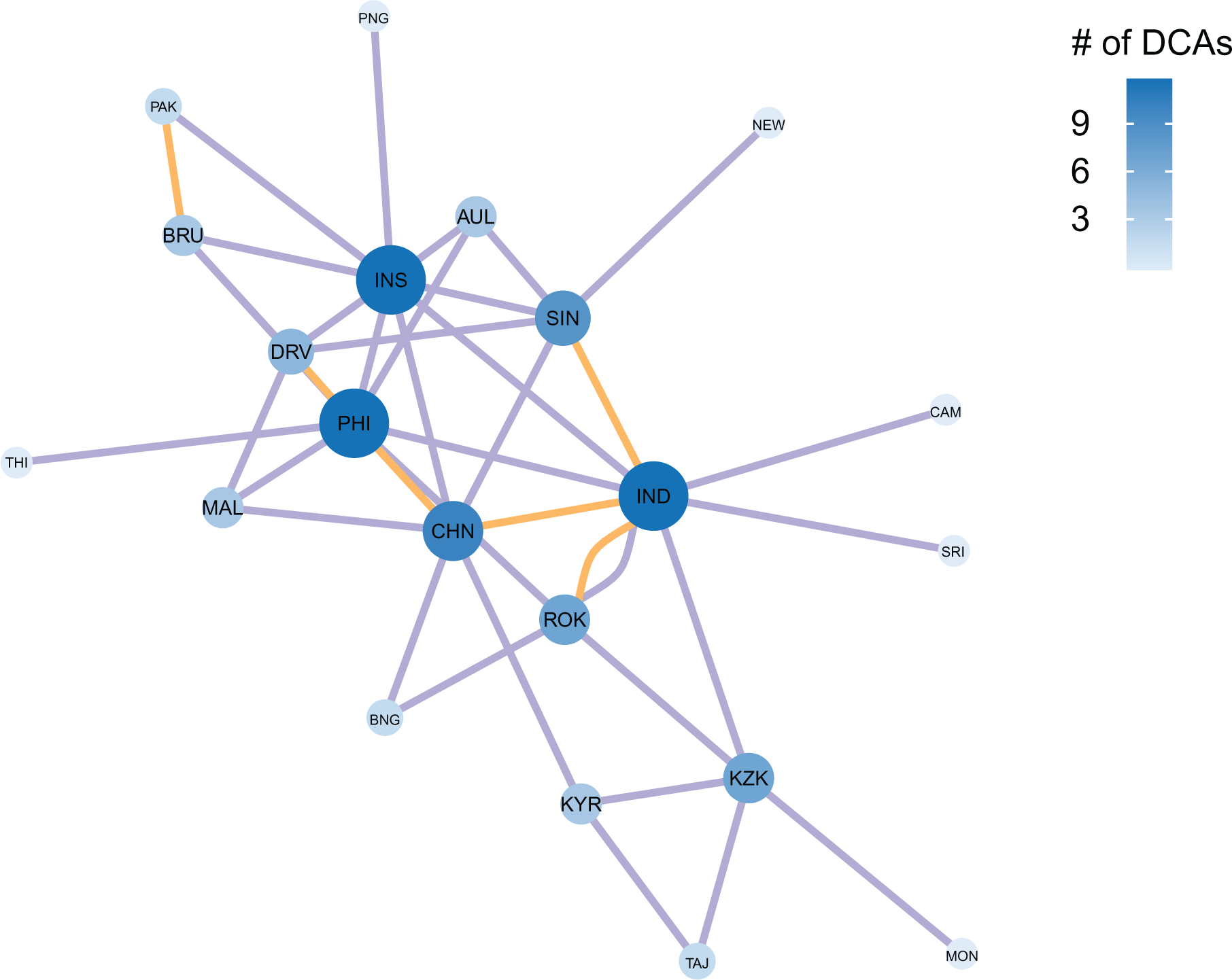
The defense cooperation agreement network in Asia in 2010. Figure uses dcaAnyV2 dyad-year version of Defense Cooperation Agreement Dataset. Nodes are countries. Purple edges are general agreements. Orange edges are sector agreements. Node size corresponds to number of ties.

Hive plot illustration of increasing density in the global defense cooperation agreement (DCA) network. Hive plot panels illustrate DCA network at five-year increments using dcaAnyV2 dyad-year measure. Nodes are countries. Node color and axis position are determined by number of ties. Red edges are sector DCAs. Orange edges are general DCAs.
The dyadic version of the data set allows analysts to define longitudinal networks of arbitrary length (i.e., within the 1980–2010 time period). Further, because DCAD includes day, month, and year of signature, networks can be constructed at the monthly, weekly, or even daily levels. This feature allows DCAD to integrate seamlessly with global event data, which are often available at high temporal resolutions. While inferential network models sometimes encounter difficulties in estimation (Schweinberger 2011), DCA data are highly amenable to network modeling. I have successfully estimated all mainstream inferential network models on DCAD, including exponential random graph models (Robins, Pattison, Kalish, and Lusher 2007), stochastic actor-oriented models (Snijders 1996), and social relations and latent space models (Dorff and Ward 2013; Hoff, Raftery, and Handcock 2002).
Future Releases
DCAD is currently limited to the 1980 to 2010 period. This thirty-one-year coverage ensures approximately a decade worth of data from each of three key epochs: Cold War, post–Cold War, and post-9/11. The 2010 end year reflects limitations both on data availability and on the labor-intensive process of collecting original treaty data. Many governments do not maintain up-to-date treaty databases, and global registries like the UNTS are woefully incomplete. Assembling a comprehensive data set therefore requires consultation with hundreds of unique, disparate sources. Online sources frequently go off-line or change URLs. Hard copy sources may only be available through overseas libraries, directly from government ministries, or via other difficult-to-navigate avenues. Many sources require translation to English.
At the same time, the data coding procedure is labor intensive. Coders must closely read treaty texts, which often run dozens of pages in length, in order to extract quantifiable information. Coding from news archives, such as the Factiva database, is uniquely time-consuming, as coders must query the database individually for every country in the world using narrow three- to twelve-month increments (totaling at least one hundred queries per country) and must then filter hundreds or thousands of results per query.
Given these constraints, I anticipate updating DCAD at five-year intervals using the basic framework discussed above. The project thus far has compiled an exhaustive collection of country-level data sources and has also made personal contacts in foreign ministries and streamlined the protocol for Factiva queries, all of which will substantially reduce the anticipated time, effort, and costs of updates.
Illustrative Analyses
To illustrate DCAD’s usefulness in tackling prominent research questions, I estimated simple regression models for two outcomes: MIDs and bilateral arms trade. The study of MIDs is well established. The study of arms trade attracts less attention but has recently blossomed into a thriving literature driven largely by high-quality data from the Stockholm International Peace Research Institution (Holtom, Bromley, Wezeman, and Wezeman 2013). These two outcomes represent distinct potential effects of DCAs. Arms-related issues often function prominently in DCAs, and a subset of DCAD consists solely of procurement and defense industrial frameworks. 15 By contrast, MIDs are related to DCAs only indirectly. While many defense partners express an interest in peace, DCAs themselves do not include mutual defense triggers. Insofar as DCAs affect conflict propensity, they most likely do so via their indirect effects on coordinated defense policies, alignment of interests, and agglomeration of nascent security communities (Beardsley, Liu, Mucha, Siegel, and Tellez 2018; Kinne Forthcoming).
I do not here develop causal explanations for why, how, and when DCAs affect MIDs and/or arms trade. Such questions are fodder for later research. The current analyses simply show that, using standard model specifications for both MIDs and arms trade, DCAs appear to be related to these important outcomes. Of course, many other outcomes warrant consideration. At the domestic level, the relationship between DCAs and defense spending, troop levels, modernization, or military capacity may deserve attention. Areas of inquiry at the international or bilateral level include the effect of DCAs on joint military exercises, contributions to peacekeeping missions or multilateral uses of force, or even such nonsecurity issue areas as trade and investment.
DCAs and MIDs
I specify a standard
I specify a logit model with dyadic fixed effects to account for the substantial unobserved heterogeneity that plagues cross-sectional time series IR data (Green, Kim, and Yoon 2001). I consider three different versions of the dyadic DCA variable. dcaAnyV1 records any DCA between i and j, whether general or sector, that meets a medium or high level of confidence. Model 1 in Table 1 lists the estimates. While the estimate for dcaAnyV1 is negative, it is not significant at conventional levels. In model 2, I swap this variable for dcaGeneralV1, which includes only general DCAs of high or medium confidence. Because these are the most ambitious and extensive DCAs, they may be the only agreements that matter for militarized conflict. Indeed, the estimate is negative and significant at the 1 percent level. The estimate also appears to be substantively meaningful; the odds ratio indicates that a general DCA reduces the probability of a MID by 70 percent, all else equal.
Effect of DCAs on Militarized Interstate Disputes, 1980 to 2010.

Note: Logit models with dyadic fixed effects. DCA = defense cooperation agreement; GDP = gross domestic product; AIC = akaike information criterion.
*p < .05.
**p < .01.
***p < .001.
In model 3, I replace dcaGeneralV1 with dcaSectorV1, which includes only sector-level agreements coded with at least “medium” confidence. The estimate for this variable is positive and significant at the 5 percent level. This result is unexpected and deserves consideration in future research. Quite possibly, the less ambitious sector agreements are more common among countries with a history of contentious relations. Model 4 drops the IGOs and power (low) control variables, thus extending the analysis to the full 1980 to 2010 period. The estimated effect of dcaGeneralV1 is larger and more precise, with the odds ratio showing a nearly 80 percent reduction in the probability of a MID.
Note that throughout the MID models, I obtain insignificant estimates for traditional military alliances. I explored alliances from many angles, including by considering only defense pacts, separating out NATO from other alliance types, and also considering NATO partnership-for-peace countries (cf. Kinne 2018). I consistently obtained a null estimate.
DCAs and Bilateral Arms Trade
I next consider arms trade. The dependent variable is defined as j’s arms imports from i in the current year as measured by SIPRI’s trend-in-value (TIV) indicators, log transformed. I control for some of the same variables used in the MIDs equation, including trade, alliance, democracy, power (low), and GDP (low). I also include a measure of i and j’s dissimilarity in voting patterns in the UN General Assembly, which captures dyadic foreign policy affinities. Because arms-trade patterns exhibit substantial inertia, I include a one-period lag of the dependent variable. I estimate a dynamic panel model with dyadic fixed effects.
Model 5 in Table 2 lists the results of the first estimation, which uses the dcaAnyV1 variable. The parameter estimate for DCA membership is positive and highly significant. The substantive effect of DCAs dwarfs other dummy variables, including democracy and alliances. In model 6, I employ the dcaGeneralV1 measure. While the estimate remains highly precise, it is smaller in magnitude than the more encompassing measure. Model 7 considers only sector-type agreements as measured by dcaSectorV1. The estimate is now much larger in magnitude. Given that numerous sector agreements focus specifically on procurement and acquisition, this result is perhaps not surprising. This variation in magnitude suggests that DCAs have wide-ranging but heterogeneous effects—an issue ripe for deeper exploration. Model 8 drops the IGO and capabilities measures in order to extend the temporal duration of the model, which slightly reduces the estimate for dcaGeneralV1. Consistent with Kinne (2016), DCAs appear to be strongly correlated with arms trade. As with the MIDs model, I obtain a null estimate for alliances.
Effect of DCAs on Bilateral Arms Trade, 1980 to 2010.
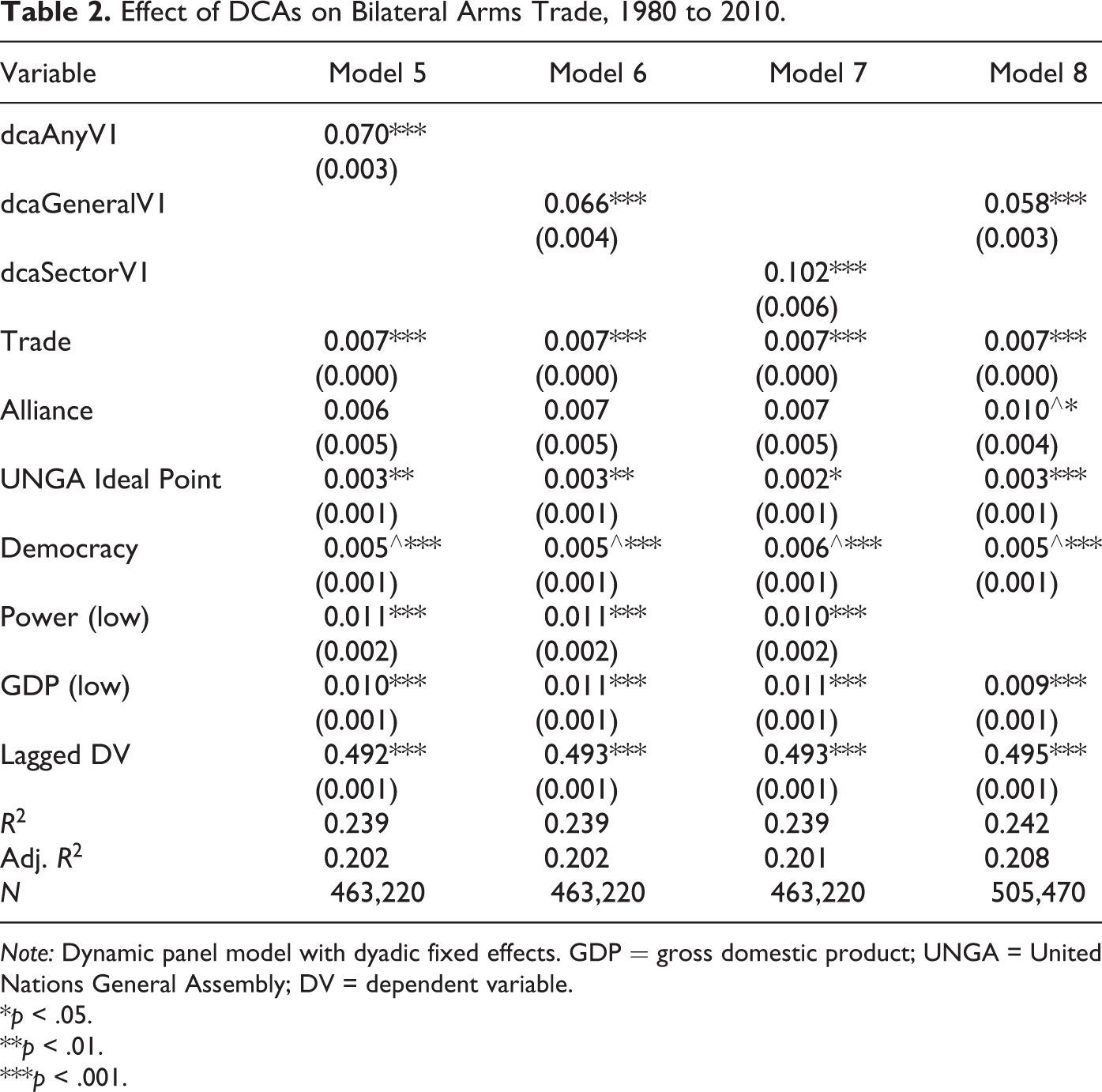
Note: Dynamic panel model with dyadic fixed effects. GDP = gross domestic product; UNGA = United Nations General Assembly; DV = dependent variable.
*p < .05.
**p < .01.
***p < .001.
Conclusion
International defense cooperation is a complex, heterogeneous phenomenon. While military alliances dominate the study of this topic, countries routinely engage in defense cooperation outside of alliances. This article draws attention particularly to DCAs, which are ambitious agreements that establish institutional frameworks—or legal umbrellas—for the entirety of their signatories’ cooperative defense activities. DCAs promote substantive, routine, day-to-day interactions between governments, militaries, defense industries, and other actors relevant to global security. Not only have DCAs exploded in number in recent decades but anecdotal evidence suggests that governments view DCAs as essential elements of their global security strategies. Preliminary statistical evidence further suggests that DCAs may have tangible effects on a wide range of activities, from arms trade to peacekeeping to bilateral lending and MIDs (cf. Kinne 2016, 2018; Kinne and Bunte 2018).
The DCAD provides scholars with an exhaustive compendium of all DCAs signed from 1980 through 2010. Not only does DCAD distinguish between different types of DCAs but it also provides institutional information on many DCAs, including details on entry into force, duration, and renewal terms. Carefully recorded confidence indicators allow analysts to filter out less reliably coded agreements and conduct sensitivity checks.
This resource should be highly useful for security scholars. While alliances are vitally important to international security, new alliances are rarely signed. Alliance variables exhibit little variation overtime, especially in the post–Cold War period. DCA activity allows researchers to observe ebbs and flows of security cooperation that are simply not visible in the alliance network. At the same time, there are inherently interesting questions worth exploring at the intersection of alliances and DCAs, such as whether alliances function more effectively when their members are also bound by DCAs or whether DCAs function as a more tractable form of security cooperation among governments that find alliance commitments difficult to maintain. These and many other questions remain to be explored.
Supplemental Material
Supplemental Material, Codebook1.0 - The Defense Cooperation Agreement Dataset (DCAD)
Supplemental Material, Codebook1.0 for The Defense Cooperation Agreement Dataset (DCAD) by Brandon J. Kinne in Journal of Conflict Resolution
Supplemental Material
Supplemental Material, KinneJCR - The Defense Cooperation Agreement Dataset (DCAD)
Supplemental Material, KinneJCR for The Defense Cooperation Agreement Dataset (DCAD) by Brandon J. Kinne in Journal of Conflict Resolution
Footnotes
Author’s Note
DCAD is available at https://www.brandonkinne.com/dcad and at http://www.correlatesofwar.org. Replication data for Tables 1 and 2 can be found at  . The opinions herein are my own and not those of the Department of Defense or Army Research Office.
Acknowledgment
I am indebted to Mayu Takeda, Calin Scoggins, Engin Kapti, Kuo-Chu Yang, Fiona Ogunkoya, Jasper Kaplan, Evan Sandlin, Jeffrey Seidl, Joseph Melkonian, and Rizwan Asghar for exceptional research assistance.
Declaration of Conflicting Interests
The author(s) declared no potential conflicts of interest with respect to the research, authorship, and/or publication of this article.
Funding
The author(s) disclosed receipt of the following financial support for the research and/or authorship of this article: This project was supported in part by Minerva Research Initiative grant # W911NF-15-1-0502.
Supplemental Material
Supplemental material for this article is available online.
Notes
References
Supplementary Material
Please find the following supplemental material available below.
For Open Access articles published under a Creative Commons License, all supplemental material carries the same license as the article it is associated with.
For non-Open Access articles published, all supplemental material carries a non-exclusive license, and permission requests for re-use of supplemental material or any part of supplemental material shall be sent directly to the copyright owner as specified in the copyright notice associated with the article.
