



Abstract
What is the legacy of war, violence, and displacement on altruism toward diverse populations suffering similar hardships today? Prior research suggests these hardships have the potential to increase empathy that can in turn motivate altruism across identity boundaries. We test this hypothesis using survey data collected in 2017 from over 2,000 Syrians living in rebel-held regions where many internally displaced persons (IDPs) sought refuge. We find that Syrians previously exposed to violence were more likely to host IDPs. Using a conjoint experiment to measure hosting preferences over different types of IDPs, we show that these individuals also preferred to host sick and vulnerable IDPs and outgroup IDPs from the Kurdish ethnic minority. However, they were less likely to host IDPs from the Christian minority, possibly due to their association with the government. These results suggest that empathy and politics both play an important role in shaping the relationship between violence, altruism, and intergroup behavior during conflict.
Introduction
According to the United Nations High Commissioner for Refugees (UNHCR), there are currently more refugees and internally displaced persons (IDPs) than at any time since the end of World War II. As the number of those displaced by violence grows, humanitarian agencies and host-country governments have increasingly call on ordinary citizens to welcome displaced people into their communities through resettlement and local integration programs (UNHCR 2013). However, little is known about what motivates hosts to incur the costs and risks of hosting refugees and IDPs.
This is especially true of host populations in poor and conflict-affected countries. Because it is often difficult to collect data in these settings, most research on why citizens of host-countries support migrants, asylum seekers, and refugees comes from wealthy countries in stable regions (e.g. Hainmueller and Hopkins 2014; Adida, Lo, and Platas 2018). While a small number of studies have addressed this topic using data from developing countries (Hartman and Morse 2020; Whitaker 2003), rigorous empirical evidence on the drivers of support for refugees and IDPs in countries experiencing civil conflict remains scarce. Yet this is precisely where the need for research on the drivers of support for IDPs and refugees is greatest, as the overwhelming majority of those forcibly displaced by violence flee within their own country or region, where levels of civil conflict, strife, and poverty are high (UNHCR 2016).
To address this gap, we collaborated with an international humanitarian aid organization conducting surveys in non-government controlled areas of Syria to inform their programming and aid policies. 1 Our collaboration centered around one such survey administered in 2017 to over 2,000 Syrians from seventy communities in northern and southern Syria. In addition to information on economic activity, medical needs, and food security, the survey collected information on past experiences with violence, whether respondents were currently hosting IDPs from other parts of Syria, and whether they would be willing to host additional IDPs should the need arise. The latter topic—willingness to offer assistance to IDPs—was elicited through a conjoint experiment in which respondents were presented vignettes of hypothetical IDP families whose attributes varied along several dimensions (e.g. ethnic and religious identity, gender of household head, level of need, and occupation) and asked to choose which family they would rather host, given their limited resources.
We use these data to assess how past exposure to violence associates with hosting behavior. We focus on the association of past violence with whether and for how long an individual decides to host IDPs, as well as past violence’s association with how much weight an individual assigns to indicators of need relative to ethnic and religious identity when deciding who to host. Our pre-registered hypotheses draw on theories of altruism born of suffering, which posit that victimization and suffering can lead to greater empathy, and that such empathy can in turn motivate altruistic behavior toward those in need regardless of their ethnic or religious identity. Recent research has found that this theory explains patterns of hosting behavior in regions beset by recurrent periods of cross-border violence and displacement (Hartman and Morse 2020), but the scope of this finding remains untested. If individuals previously exposed to violence are more responsive to indicators of need and less responsive to ethnic or religious identity when deciding which families to host, as compared to those with less prior exposure to violence, we argue that this is evidence is consistent of empathetic altruism, although we cannot rule out all alternative hypotheses.
In Syria, where Sunni Muslim Arabs are the majority, ethnic and religious minorities—including the Alawites, Druze, Christians, and Kurds—comprised 35 percent of the pre-war population (Balanche 2018). This diversity characterizes the setting in which we test how exposure to violence during civil war associates with altruistic behavior within and across ethnic and religious boundaries.
Our results are broadly consistent with our hypotheses. Whereas residents with below average exposure to violence and displacement discriminate against Kurdish families and families with sick children, residents with above average prior exposure exhibit no such discrimination and appear to prefer hosting families with sick children, consistent with the idea that violence precipitates an empathetic preference shift, making individuals more responsive to indicators of need and less responsive to identity when deciding who to host.
We also find a strong association between prior exposure to violence and actual hosting behavior. Substantively, a one standard deviation increase in violence associates with a five percentage point increase in the likelihood of hosting IDPs and an additional twelve person-months of hosting overall. We interpret this result as evidence that past experience with violence not only leads to more empathetic preferences, but also motivates greater helping behavior overall.
Lastly, we find that while violence appears to mitigate discrimination against ethnic Kurds, the same is not true for discrimination against minority Christians. Whereas individuals with low violence experience display a distinct preference for hosting Christians, this preference is much weaker among individuals with high violence exposure. Splitting our sample into subgroups for Sunni Muslims and Assyrian Christians, we find that past experience with violence associates with weaker support for Christian families among Sunni Muslim respondents but has no such association among the 15 percent of our sample who identify as Assyrian Christians.
We explore two potential explanations for this result, both of which are consistent with the idea the legacies of violence are heterogeneous and may depend on whether the outgroup falls along a hostile social cleavage: (1) self-interest: given the presence of Sunni extremist groups, hosting Christian IDPs may entail a heightened level of risk; individuals previously affected by violence may be especially concerned about these risks, reducing their motivation to host Christian IDPs; and (2) blame: because Christians have been associated with support for the Assad regime, both before and during the crisis, victims of violence may be especially resentful of Christians for their role in the conflict, reducing their willingness to host. In contrast to the rest of our results, the finding on hosting Christians is more consistent with theories of parochial altruism in the wake of violence (Choi and Bowles 2007; Beber, Roessler, and Scacco 2014).
Our study contributes to two related literatures. First, we contribute to the growing literature on the determinants of support for immigrants and refugees by explicitly testing an existing theory and associated set of findings in a new context. In so doing, we validate and strengthen existing evidence that altruism born of suffering can motivate hosting behavior in diverse settings, providing much needed replication in a field where this is all too often under-incentivized. At the same time, our results also caution that altruism born of suffering is unlikely to extend to all outgroups, especially those associated with rival parties in the conflict.
Second, our findings also contribute to the literature on the legacies of violence on individual and group-level behavior. Whereas previously this literature has tended to treat all outgroups the same, our findings suggests that the legacies of violence are not uniform across ethnic and religious outgroups and that they instead depend on sectarian politics—whereas altruism toward apolitical outgroups may increase in the aftermath of violence, altruism toward outgroups associated with rival parties in the conflict may decrease due to blame attribution, the heightened importance of self-interested security concerns, or other mechanisms associated with parochial altruism.
The project also has implications for providing humanitarian assistance to those forcibly displaced by violence. Our results suggests that under certain conditions, highlighting shared experiences as opposed to group differences may help increase generosity toward those in need. Further research on the potential for this type of public messaging to promote intergroup altruism during and after conflict is needed.
Conceptual Framework
Political scientists have long been interested in how conflict and violence affect intergroup relations. Some studies suggest that conflict can strengthen within group allegiance while building hostility toward outgroups, leading to parochial altruism (Bauer et al. 2014; Beber, Roessler, and Scacco 2014). This hypothesis is supported by the argument that in the context of intergroup competition, ingroup solidarity and outgroup hostility is advantageous for survival (Choi and Bowles 2007). There is evidence that under certain conditions violence can exacerbate parochial bias (Mironova and Whitt 2016), harden attitudes toward peace and compromise (Hirsch-Hoefler et al. 2016), and strengthen economic cooperation within groups at the expense of cooperation between groups (Hjort 2014).
In contrast to these findings, researchers have developed the theory of post-traumatic growth to explain the potential positive impacts of violence at the micro-level. Experience of violence has been shown to positively affect political participation (Bateson 2012; Blattman 2009), altruism (Voors et al. 2012), and community engagement (Bellows and Miguel 2009). A recent meta-analysis shows that that war violence indeed tends to increase pro-sociality across various countries and contexts (Bauer et al. 2016). Yet despite the growing post-traumatic growth literature, considerable uncertainty remains regarding the psychological mechanisms underlying pro-social behavioral shifts (Bauer et al. 2016). Indeed, the literature identifies a broad number of changes that could influence hosting behavior, including the re-orientation of life goals and priorities, a stronger sense of self, greater spirituality, and a more positive orientation toward life and other people (Tedeschi, Park, and Calhoun 1998; Tedeschi and Calhoun 2004). But it remains agnostic on which of these or other mechanisms may be at play. In this paper, we propose that empathy may be one specific mechanism underlying this phenomenon, though we do not preclude that other mechanisms may play a role.
Though growing quickly, the post-traumatic growth literature remains relatively small, and most evidence comes from studies measuring behavior within social groups rather than between, making it something of an open question whether observed prosocial shifts in behavior are parochial or general. Moreover, most evidence comes from data collected during the post-conflict period, long after the violence has stopped.
In this paper we advance the literature on both fronts, analyzing how experiences of violence shape behavior between social groups while violence is ongoing and social identities may be politicized or polarized. We do this in the context of the Syrian Civil war through an examination of the relationship between past experience with violence and hosting IDPs—as a potential altruistic and empathy-driven behavior in resource-constrained conflict environments.
Altruism Born of Suffering
To develop predictions about the relationship between violence and altruism toward ingroup and outgroup IDPs, we draw on the concept of altruism born of suffering (Vollhardt 2009; Staub and Vollhardt 2008; Hartman and Morse 2020). Altruism born of suffering proposes that recovering from trauma and hardship activates a sense of empathy and a belief in one’s responsibility for others’ welfare, making them more likely to behave altruistically, including toward those from different ethnic and religious groups.
The key mechanism in this theory is empathy, or the ability to share and understand the feelings of another. Empathy is a primary driver of altruistic, or “other-regarding” behavior (Batson and Powell 2003; De Waal 2008). Experiencing violence could increase empathy across identity boundaries through the following steps: (1) violence and displacement causes hardship and suffering; (2) surviving these hardships increases empathy for others, including for those who suffered in a similar way; (3) because empathy motivates helping behavior on the basis of need, identity boundaries become relatively less important when deciding who to assist. In this way, empathy cuts across identity boundaries, particularly when there is a shared experience, leading to altruistic behavior both within and between social groups (Hartman and Morse 2020).
The idea that empathy born of violence links violence to greater generosity across group boundaries is grounded in the work of Frans De Waal (2008), who identifies three processes that drive empathetic altruism. These include emotional contagion, when observing another being in need leads to personal distress. Personal distress can motivate an individual to help another for egotistical reasons—to relieve their own emotional distress. Second, sympathetic concern, or “an affective response that consists of feelings of sorrow or concern for a distressed need other” (Eisenberg 2000). A sympathetic response stands in contrast to other-regarding behavior motivated by self-interest (Batson and Powell 2003). Finally, perspective-taking is a process through which an individual accurately understands another person’s internal state. Perspective taking increases the power of both emotional contagion and sympathetic concern by increasing perceptions of another person’s distress.
When conflict leads to individual hardship, pain and distress, a person’s perspective-taking will be shaped by their own experience with a similar situation (Batson and Oleson 1991). As perspective-taking increases emotional contagion and sympathetic concern, empathetic altruism can motivate helping behavior toward others in times of distress. Empathetic altruism can be enhanced by perceptions of similarity between people (Staub and Vollhardt 2008), but hardship can increase sympathy independent of shared characteristics (Staub and Vollhardt 2008; Tedeschi and Calhoun 2004). As a result, experiences of hardship can create a cross-cutting identity that mitigates or supersedes other identities (Paluck and Green 2009).
Hypotheses
We present two sets of prespecified hypotheses. 2 First, leaving past experience of violence aside, we expect that respondents will be concerned about the well-being of internally displaced people, and will thus be more willing to accept people who are sick or in a female-headed household, two categories of household that tend to be more vulnerable than others, all else equal. Conversely, we also expect respondents to hold ingroup preferences, and thus to prefer co-ethnic and co-religious internally displaced people, all else equal.
Our main hypothesis is that those who previously experienced violence will be more responsive to indicators of IDP need or vulnerability (as proxied in our study by having a sick child or being a single, female-headed family) and correspondingly less responsive to IDPs’ religion or ethnicity, as compared to those who have not experienced violence and displacement. 3 We also expect those who previously experience violence to be more altruistic toward IDPs in general, and thus to host them in greater numbers, regardless of their ethnic or religious identity.
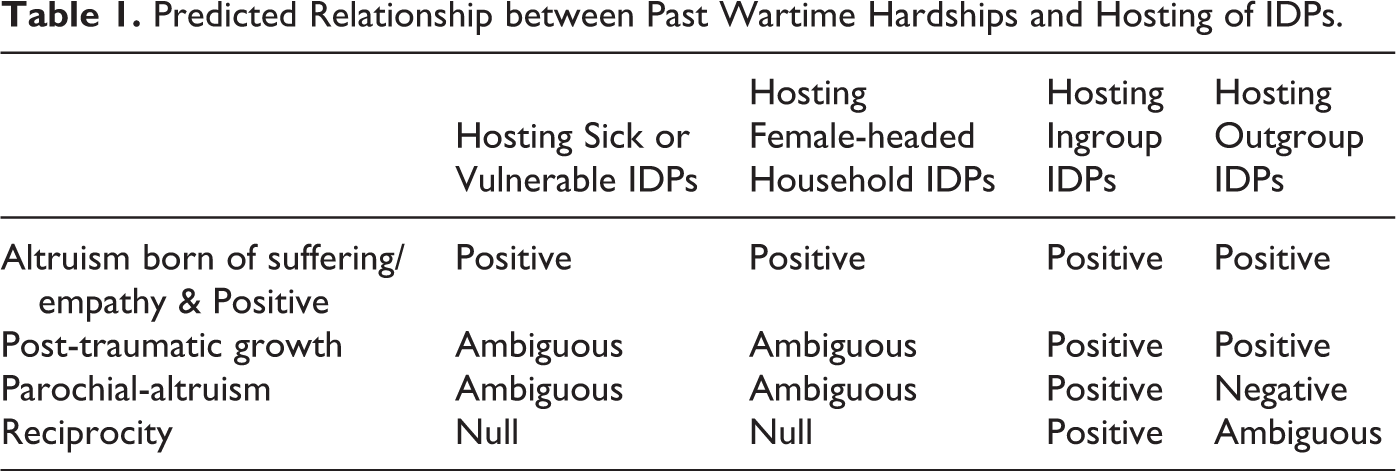
Greater empathy is by no means the only mechanism that may link past wartime hardship to altruism toward IDPs. Parochial altruism is another potential response. In our context, the theory of parochial altruism predicts greater hosting of ingroup IDPs and less hosting of outgroup IDPs. Because hosting decisions are driven primarily by these identity-based preferences, we expect indicators of need or vulnerability to be less influential, due to crowding out. 4 The theory of post-traumatic growth, by contrast, predicts greater hosting in general, toward both ingroups and outgroups. It does not provide predictions about the influence of need and vulnerability, though we might expect the influence of these factors to diminish when resources are limited. Theories of reciprocity, in which those who experienced hardship (and presumably relied on others to survive) feel intrinsically obligated to reciprocate (or instrumentally motivated to reciprocate in anticipation of needing help again in the future). Because reciprocity relies on repeated interaction overtime, it applies most strongly to dynamics within kinship groups. Hosting of outgroup families that one is less likely to have encountered previously and less likely to encounter again in the future, should either decline due to crowding out or increase to a much lesser degree than hosting ingroups due to the lower probability of re-encountering outgroup families again in the future. Hosting of the sick and vulnerable should either be unaffected or decline due to crowding out. Table 1 summarizes these predictions alongside those of the altruism born of suffering hypothesis.
Predicted Relationship between Past Wartime Hardships and Hosting of IDPs.
Scope Conditions
Recent research shows that empathy can drive support for IDPs and refugees (Hartman and Morse 2020; Adida, Lo, and Platas 2018; Simonovits, Kezdi, and Kardos 2018). However, these studies are relatively few in number, and come from very specific contexts. Hartman and Morse (2020), for instance, provide evidence suggesting that empathy motivates hosting behavior across group boundaries in the context of the Ivorian refugee crisis in Liberia; Adida, Lo, and Platas (2018) show that a perspective-taking exercise administered to U.S. citizens and designed to elicit empathy for refugees increased inclusionary behavior in the form of an anonymous letter to the US President; and Simonovits, Kezdi, and Kardos (2018) show that an online game designed to facilitate perspective-taking and engender empathy reduced antipathy toward refugees among citizens of Hungary.
Here, we test the empathy born of violence hypothesis in the context of ongoing civil war, circumstances which are altogether distinct from previous studies yet highly relevant to the well-being of the majority of those forcibly displaced. In considering whether this hypothesis will travel to our setting, several factors are important to keep in mind. First, high levels of civilian victimization as in the Syrian case mean that the salience of shared experience between host communities who have previously experienced violence and IDPs could increase the cross-cutting identity born of violence, increasing empathy. People in distress may be easily able to take a suffering person’s perspective and may find comfort in helping these individuals.
At the same time, the willingness to help displaced families might be low in the politicized and resource-constrained context of an ongoing civil war. In Syria, UN OCHA reported that 69 percent of the remaining population in 2017 lived in extreme poverty and that the coping capacities of many people in the most affected communities in Syria were exhausted, forcing them to cut back on food consumption, to spend savings and to accumulate debt (UN OCHA 2016). The acute priority of addressing one’s own needs may impede willingness to help others. The danger of being attacked by the various armed actors in Syria may also evoke self-preserving behavior and may restrain individuals’ support to those social groups that are targets of political violence in fear of increased attacks to one’s own home.
In addition, the highly politicized context of hosting IDPs while violence is ongoing might increase in- and outgroup dynamics consistent with parochial altruism. If individuals recently experienced violence by armed actors and associate this hardship with certain groups in an ongoing conflict, they may reject hosting “collaborators” of their tormentors. This blaming might mitigate the effects of empathy born of violence.
To summarize, we expect hosting IDPs in Syria to be a difficult test for the theory of empathy born of violence due to the politicization of identity groups, the imminent threat of violence, and the severity of resource constraints, all of which could be expected to further increase preferential treatment for social ingroups.
Syrian Conflict
The civil war in Syria began in 2011 when peaceful anti-government protests against President Bashar al-Assad were met with violent repression by the Syrian regime. In response, multiple rebel groups emerged and violence spread throughout the country. Since that time, the ongoing civil war has led more than 5.6 million people to seek refuge abroad and displaced another 6.1 million within the country itself, as of the end of 2017 (NRC/IDMC 2018). The following sections summarize the key dynamics of the crisis, with a particular focus on the sectarian dimension of the war. This perspective is central to an understanding of our experimental findings on ethno-religious hosting preferences. In the Online Appendix, we provide background information on sectarian divides in Syria prior to the crisis.
Sectarianism in the Popular Uprisings
In March 2011, Sunni-led groups in Southern Syria began to demonstrate against President Bashar al-Assad’s regime. Supported by a large part of the population, including both Arab and minority ethnic groups such as the Kurds, the demonstrations quickly gained momentum (Zisser 2017; Jenkins 2014). The Syrian regime responded to the growing opposition movement with violent repression and the strategic fueling of social, including religious and ethnic, divisions within the protesters (Baczko, Dorronsoro, and Quesnay 2018, 258). While the Assad regime formed political and economic alliances with minorities like Christians, Druze, and Alawites to marginalize Sunni protestors, the government simultaneously portrayed itself as the guarantor of national unity in light of Kurdish claims for self-determination (Balanche 2018, 13).
Over the course of the war, the rebellion splintered into various factions, often along religious and ethnic cleavages. Several factions are highlighted here. Syria’s Sunni Muslim majority loosely organized themselves as the Free Syrian Army (FSA) in opposition to the president’s Alawite-led regime. In addition, predominantly Sunni Muslim Jihadist groups, such as the Islamic State (IS) and Hayat Tahrir al-Sham (HTS), fought to control territory. Kurdish groups in the north-east of Syria, who initially fought alongside Sunni rebels, also shifted to fight for their own territorial autonomy. The Kurdish Democratic Union Party, for example, injected calls for Kurdish nationalism into their rallies and began to call for self-determination (ICG 2013). These claims alienated the Kurdish rebels from the broader Sunni movement against al-Assad whose constituents generally favor a unified Syria (Gunter 2015).
Other ethnic minorities, such as Christians and Druze, took different positions in the conflict. Government propaganda targeted these communities, stoking fears that a majority (Sunni Muslim) government would discriminate against minority groups (Balanche 2018; Berti and Paris 2014). The extremist ideology of IS and the specific targeting of non-Sunni Muslim minority groups may have also increased Christians’ fears about their future should the al-Assad government fall (Berti and Paris 2014). Hence, several Christian and Druze communities set up local defense militias and allied themselves with the Syrian regime (Baczko, Dorronsoro, and Quesnay 2018, 87).
By 2012, the growing ethnic and religious divisions in Syria were reflected in the emerging zones of control during the conflict. While the regime held multi-sectarian zones in the most populous areas, the largely Kurdish North East was controlled by the Kurdish-led Syrian Democratic Forces (SDF). The rebel-held areas in Aleppo and Idleb were predominantly Sunni Muslim zones until the fall of Aleppo in December 2016. Control in these areas was the most fragmented because of competing armed groups, including the presence of Islamist radicals, who until their defeat by Kurdish militias controlled territory in Raqqa and Deir-al-Zor. More recently, government forces were able to retake a slim majority of Syrian territory from rebel and jihadist groups. By the end of 2017, the IS was driven out of Raqqa, its de-facto capital in Syria, by a coalition of international forces and the Kurdish SDF.
Violence against Civilians during the Conflict
The Syrian civil war has been characterized by high levels of indiscriminate violence—including mass displacement, collective punishment, torture of civilians, bombings and sieges of entire villages and towns—perpetrated by all conflict parties. Unlawful weapons such as cluster munitions and chemical weapons have been used by different parties involved in the conflict. The Syrian Observatory for Human Rights, monitoring the conflict from abroad, estimated the death toll since the beginning of the war to be 511,000 as of March 2018.
The Syrian government has used indiscriminate shelling and barrel bombs to instill fear in Sunni districts and to make rebel-held areas unlivable. Aleppo, held by various fractions of Sunni rebel groups, was hit hardest by barrel bombs from regime forces (Fabbe, Hazlett, and Sinmazdemir 2017).
While the regime attacked Sunni majority areas, the insurgent-controlled territories became increasingly dangerous for minorities that were harassed and extorted by the various rebel fractions. Anti-government groups have looted Christian, Druze, Alawite, and Shia households, suspecting these groups to be regime collaborators (Baczko, Dorronsoro, and Quesnay 2018, 256-65). Assyrians in particular faced discrimination and violence at the hands of extremist Islamist groups. After the proclaimed creation of a “caliphate” in June 2014 and the group’s rapid territorial advances, the IS inflicted severe harm on the civilian population (ICG 2012). In their territories, the IS introduced strict sectarian hierarchies. Due to the ideological ambition to unite Sunnis across nationalities, other religious minorities were intensively persecuted, killed, and displaced. The IS and HTS looted churches, issued ultimatums to convert to Islam and suppressed the practice of Christian rites in their territories (Haider 2017). In Deir ez-Zor, as a stronghold of IS during the civil war, the Armenian Church was destroyed and the few Christians who chose to stay paid head taxes to ensure protection (Baczko, Dorronsoro, and Quesnay 2018, 259).
Accommodation of Syrian IDPs
Since the outbreak of armed conflict in 2011, more than half of the Syrian population has been displaced (UN OCHA 2016). By 2017, over 13.1 million people in Syria required humanitarian assistance to mitigate the vulnerabilities from displacement, exposure to hostilities, and limited access to basic goods (UN OCHA 2017). The enduring crisis also resulted in the mass destruction of housing infrastructure. With most neighborhoods being severely damaged, adequate shelter is insufficient and most IDPs struggle to meet basic needs. In 2016, only 5 percent of Syrian IDPs lived in collective shelters such as schools, mosques or churches (Shelter Sector Syria 2016). Instead, the majority of IDPs have settled in host communities, renting apartments, squatting in damaged buildings, or living with friends, families, and sometimes strangers (UN OCHA 2016, 19).
Empirical Strategy
We use two strategies to test how exposure to violence during war affects willingness to host IDPs, both of which rely on data collected during a face-to-face survey in four Syrian governorates in December 2017. First, we use data from a conjoint experiment designed to measure respondents’ preferences over IDPs’ characteristics when deciding who to host to assess whether prior exposure to violence and displacement associates with stronger preferences for vulnerable IDPs and weaker preferences for religious or ethnic ingroup IDPs, as our empathy born of violence argument would predict. Second, we test whether prior exposure to violence associates with greater actual hosting of IDPs, as would also be consistent with our empathy born of violence argument.
Access
We conducted our study in collaboration with a large international humanitarian organization involved in the provision of humanitarian aid to hard-hit regions of Syria. This organization conducts regular background surveys using local staff based in the communities where the surveys take place. 5 In our collaboration, the survey included questions on protection, access to information, possession of documentation, past experiences with violence, and current hosting of refugees or IDPs. We added our conjoint experiment to provide insights in to which types of IDPs were most or less likely to be supported and therefore would most benefit from assistance. The data were collected in December 2017 while fighting continued, and provide a unique opportunity to assess how generosity and altruism operate in the context of ongoing violence.
Given the sensitive nature of the data collected, we highlight some of the ethical concerns: First, research projects can place an undue burden on research participants. People inside of Syria struggle to meet their basic needs and participating in research that does not contribute toward this goal would be unethical. We managed this risk by adding only a limited number of questions to the existing survey and maintained an open dialogue with our partners so that the research would also be useful to their practical goals of providing assistance. Second, when asking questions of a sensitive nature about decision-making in times of crisis, we were wary of asking a questions that might unintentionally aggravate existing tensions between groups. To avoid this, we did not ask about the most sensitive inter-group cleavages (following the guidance of our local partners we did not ask about members of the Alwai sect) and framed our research in terms of a positive action (generosity to accommodate IDPs) as opposed to any negative behavior (burden that IDPs placed on local communities). Finally, we aimed to be reflexive about our own role during the design and set-up of the project, taking into consideration our role as foreign researchers and the role of our own countries in the conflict. Instead of conducting the survey ourselves, local researchers defined the boundaries of this research and collected the data as part of their ongoing work. 6 Hence, our partnerships were critical and this research would not have been possible without them.
Sample
Selection of respondents followed a three-stage sampling procedure. In the first stage, seventy communities were randomly selected from the governorates of Aleppo, Idlib, Daraa, and Qunietra using selection probabilities proportional to population size. Figure 1 displays sub-districts where the communities were sampled. In the second stage, enumerators randomly selected households using a random-walk procedure, with the total number of respondents selected per community proportional to their population. In the third stage, a single adult respondent was randomly selected within each household. If the respondent was not home at the time of the enumerator’s visit, an appointment was made for later that day or the following day. If the respondent was not available within forty-eight hours, the household was replaced. In total, the survey was administered to 2,350 respondents. 80.33 percent of the respondents identify as Arab (Sunni Muslims) while 15.50 percent identify as Assyrian (Christians). 7

Sample areas in the north and south of Syria.
Conjoint Experiment
Our conjoint experiment asks respondents to evaluate IDP families whose attributes randomly varied along five dimensions: ethnicity, religion, child health, profession, and the status of the household head, as depicted in Table 2. Respondents evaluated three pairs of families in succession, each time choosing which of two families they would prefer to host. The motivation for this “forced-choice” design was to mirror choices that host communities face when the number of refugees or IDPs exceeds capacity, as is often the case. Another advantage the conjoint design is that it has been shown to mitigate social desirability bias, by providing respondents multiple justifications for their selection and no clear “socially desirable” response (Horiuchi, Markovich, and Yamamoto 2018).
IDP Attributes.
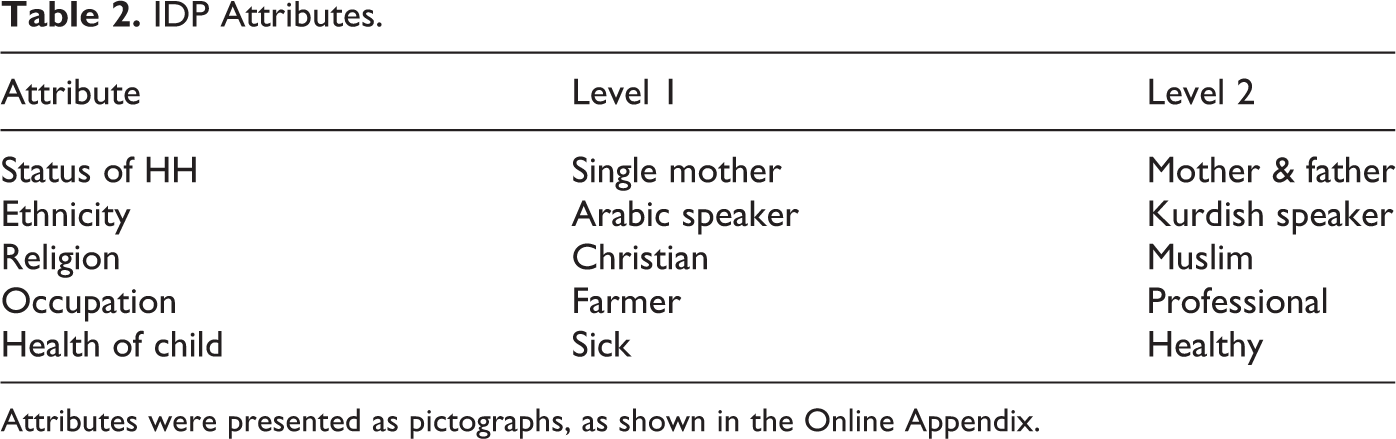
Attributes were presented as pictographs, as shown in the Online Appendix.
Each attribute corresponds to a specific hypothesized motivation for hosting IDPs. Recognizing that hosts may prefer to host ethnic or religious ingroups, we varied whether the IDP family was Muslim or Christian, and whether they were Arabic or Kurdish speaking. We report results for Arab and Assyrian respondents; and Kurds represent the ethnic outgroup for both ethnic groups. For Sunni Muslims (the majority of our Arab survey population), Assyrians are the relevant religious outgroup because of their adherence to Christianity. For the Assyrian in our sample, Muslims are the relevant outgroup. 8 Hypothesizing that empathy for would lead to greater sensitivity to IDPs in distress, we varied whether the IDP family had a sick child or a healthy child, and whether the household was headed by a single mother or by a mother and a father. And finally, in recognition of the role that class may play in motivating hosting behavior—and in particular, the IDP family’s ability to remunerate their hosts—we manipulated whether the household head was a farmer or a white collar worker.
Empirical Strategy for Estimating Hosting Preferences
Following Hainmueller, Hopkins, and Yamamoto (2013), we estimate the probability that a hypothetical IDP family is hosted via:

where i indicates the respondent, k indicates the round or “choice task”, and j indicates the depicted refugee family. In our experiment,
We also seek to test whether respondents with relatively high levels of exposure violence, displacement, and hardship have different preferences than those with more limited exposure to these experiences. To measure past exposure to violence, we average over four indicators:
9
Experience of displacement: we use a survey question about the number of times a household has been displaced during the Syrian civil war to construct a dichotomous variable equal to one if the household was displaced one or more times during the crisis, and zero otherwise. 57.8 percent of all respondents were displaced at least once. Experience of death in household: the survey asked whether the respondent’s household experienced the death of a family member during the conflict. We construct a dichotomous variable equal to one if a person in the household aged six to sixty has died in the last six years,
10
and zero otherwise. 17.4 percent of respondents experienced the death of a family member. Experience of residence destruction: we include a dichotomous variable for whether the household’s primary residence was destroyed during the conflict. 30.3 percent of all survey respondents’ residences were destroyed in the civil war. Experience of business destruction: the final dichotomous variable measures whether the respondent’s business was destroyed in the civil war. 27.1 percent of respondents’ businesses were destroyed.
We standardize the index of exposure to violence for ease of interpretation. We also create a second binary variable that takes the value of one for respondents with above mean levels of violence exposure and zero otherwise. We use the index for the observational regression analysis (see details below), and for ease of interpretation, we use the binary variable to identify heterogeneous preferences in the conjoint experiment. The estimation equation for heterogeneous preferences is as follows:

where
Observational Analysis
We also assess the relationship between past experience with violence and actual self-reported hosting behavior. Our hypothesis is that those with relatively high levels of past experience with violence will host greater numbers of refugees. We test this hypothesis using two survey-based outcome variables: Whether the respondent is currently hosting IDPs (1) or not (0) Total number of IDPs hosted by the respondent during the whole crisis × duration in months that IDPs were hosted (e.g. hosting of five IDPs over five months = 25)
Because we test this hypothesis with two variables, we use the procedure outlined in Benjamini and Hochberg (1995) to adjust our p-values and control the risk of false discovery to 5 percent.
On average, 44 percent of our respondents currently host an IDP. The average value for the continuous outcome variable is 23.25. We regress these outcomes on our continuous measures of past violence described above, controlling for gender, age, ethnicity, prewar education, 12 urban versus rural residence prior to the war, quality of prewar residence, 13 prewar occupation, 14 and prewar family ownership or residence. 15 We report OLS regressions with robust standard errors clustered at the community level. We also use mean imputation to address missingness in our predictor variables. 16 Summary statistics for our main outcome variables, independent variables, and descriptive (i.e. control) variables are reported in the Online Appendix.
We pursue two strategies to assess whether the observed relationship between these outcomes and past violence might be driven by unobserved confounding. First, we test empirically whether the covariates listed above vary by past experience with violence. The results, reported in Online Appendix A.5, suggest that victims of violence—specifically those with above median levels of prior violence exposure—are significantly more likely to have been agricultural workers prior to the war, more likely to have been a salaried or private sector (i.e. white collar) employee, more likely to live in a temporary structure (i.e. a tent), and more likely to by Assyrian, relative to those will with below median exposure to violence. Apart from these observed sources of selection, victims were broadly comparable to non-victims by gender, education, urban vs rural prewar residence, and prewar property ownership. As a whole, these results suggest that violence was not entirely indiscriminate, and that there are likely observed and unobserved sources of selection into violence.
The central question for purposes of this study, however, is not whether violence was or was not selective, but whether these sources of selection also predict hosting behavior. To the extent that they are weak predictors of hosting behavior, then they are unlikely to confound. We assess this through two strategies—first, we look for coefficient stability across our “naive” (i.e. bivariate) and controlled specifications, interpreting stability as evidence that observed covariates that are imbalanced across victimization status are non-confounding. Second, to estimate the degree of unobserved confounding, we pursue a sensitivity analysis following Oster (2019), assuming conservatively that the bias due to unobserved confounding is up to twice as influential as the biased eliminated by observed sources of confounding, following Oster’s recommended standard for robustness. As we show in the Online Appendix, the results of this sensitivity analysis suggest that unobserved confounders would have more than twice as strongly predictive of hosting behavior than our observed covariates to reduce the estimated association between violence and hosting behavior to zero, a possibility we believe is unlikely.
Notwithstanding these considerations and mitigating strategies, we recognize that because violence is unlikely to have been “as-if” randomly assigned, it is impossible to definitely rule out unobserved sources of confounding. For this reason, we interpret our results as associational and suggestive, using descriptive rather than causal language throughout the paper.
Results
Preferences for Hosting IDPs
Figure 2 displays the average effect of each attribute in the conjoint experiment on whether an IDP family was selected. 17 In line with the long history of division between Arabs and Kurds in Syria, we find strong evidence of discrimination against Kurdish IDPs, with these families roughly 5 percentage points less likely to be hosted. We also observe discrimination against families with sick children, who are 2 percentage points less likely to be hosted than families with healthy children. This small but significant bias may reflect the reluctance of would-be hosts to take on the burden of sick children given the lack of resources available in the Syrian setting, or it may reflect the fear that their illness may spread.
Against our expectations for a predominantly Muslim society, Figure 2 reveals favoritism toward Christian IDPs. One explanation is that this result may be driven by the substantial proportion of our sample (around 15 percent) that identify as Assyrian. Favoritism toward Christians is indeed much stronger among these respondents, as we report below, though the effect persists (albeit more weakly) even when restricting the sample to Muslim respondents. We return to this seemingly counterintuitive result below.
While respondents prefer to host Arab families who are Christian and have healthy children, they are otherwise more or less indifferent with regard to the gender and occupation of the household head.

Average effects of each conjoint attribute on the decision to host an IDP. OLS estimates with standard errors clustered at the individual level; horizontal bars represent 95 percent confidence intervals.
Prior exposure to violence and preferences for hosting IDPs
Figure 3 displays the effect of each attribute among those with above versus below mean prior exposure to violence. Disaggregating the results in this manner reveals stark differences in the preferences of those who experienced low versus high levels of violence, particularly in regards to their preferences over hosting ethnic and religious ingroups and families with sick children. Whereas respondents with low levels of prior exposure to violence discriminate against Kurdish families and families with sick children, those with relatively high levels of prior violence exposure exhibit no such discrimination. Compared to individuals with low exposure, survey respondents with high exposure to violence seem to no longer avoid the responsibility of hosting a family with sick children. The survey respondents with high prior exposure to violence are also indifferent to Kurdish IDPs while the group of respondents with lower prior exposure to violence prefers hosting Arab IDPs. These results are consistent with our hypothesis that prior exposure to violence activates empathy, motivating individuals to decide which families to host on the basis of their need and vulnerability, rather than their ethnic identity. 18
We also observe an important difference between those with low versus high prior exposure to violence in regards to their preferences for hosting Christian IDPs. In particular, we find that while those with low prior exposure have a weak preference for hosting Christian IDPs, those with high prior exposure do not show this preference. We interpret these findings in light of Syrian Christians’ association with support for Assad and the Syrian government (e.g. Dagher 2012; al Tamimi 2017). As discussed in third section, Assad rose to power in part by marshalling the support from a coalition of minority groups, including Alawites, Druze, and Assyrians who predominantly identify as Christian (Phillips 2015). During Assad’s reign and the subsequent civil war, many of Syria’s Christians continued to support his regime materially and through conscription in the Syrian armed forces (al Tamimi 2017). We surmise that exposure to violence during the conflict—most likely at the hands of Syrian government forces—has led to resentment among Sunni Muslims against Assyrian Christians for their support of Assad’s regime, reducing whatever preference they otherwise would have for hosting Christian IDPs and leading to hosting patterns more consistent with parochial altruism.

Hosting preferences by past experience with violence. OLS estimates with standard errors clustered at the individual level; horizontal bars represent 95 percent confidence intervals.
To explore this possibility further, we examine differences between those with high versus low exposure to violence among two subsets of our sample: Sunni Muslims and Assyrian Christians, who constitute 85 percent and 15 percent of our sample, respectively. If resentment of Assyrian Christians for their support for Assad explains the negative association between violence and willingness to host Christians, then we would expect this effect to be stronger among Sunni Muslims than for Assyrian Christians, whether because the latter is more likely to attribute blame elsewhere in defense of their religious identity, or because their experiences of victimization came from extremist Islamist groups or predominantly Sunni rebels groups rather than from the regime. The results, reported in Figure 4, are indeed consistent with this logic. Sunni Muslim respondents with high exposure to violence no longer prefer hosting Christian IDPs. In comparison to the overall sample and the Muslim subgroup that has experienced lower levels of violence, they have lost their preference to host Christians while this is not the case for Assyrian Christians that consistently favor their religious group. This provides associational evidence that they might attribute blame to Assyrian Christians for government violence.
To summarize our results, we find that among Sunni Muslims, violence associates with greater willingness to host Kurdish IDPs and IDPs with sick children and lower willingness to host Christian IDPs, relative to those with less exposure. While we cannot decisively identify the mechanisms behind these results, we believe the most likely explanation lies in a combination of i) greater empathy for vulnerable IDPs, which in turn motivates support for sick children regardless of their ethnic identity, and ii) resentment of Assyrian Christians for their support for Assad, which diminishes the preference Sunni’s otherwise would have for Christians. The end result is that Sunni Muslims who have experienced violence are essentially indifferent about the religious and ethnic identity of IDPs, as well as their occupation and gender of the household head, but exhibit a distinct preference for vulnerable families with sick children. By contrast, those with more limited exposure to violence are indifferent about the occupation and gender of the household head, favor hosting Christians over Muslims, and prefer not to host Kurdish families or families with sick children.
Among Assyrian Christians, a history of violence associates with slightly weaker preferences against hosting Kurdish IDPs or IDPs with sick children—consistent with our altruism born of empathy hypothesis—but there’s no significant change in willingness to host Christian IDPs from their religious ingroup.

Hosting preferences by past experience with violence, split by ethnic group. OLS estimates with standard errors clustered at the individual level; horizontal bars represent 95 per cent confidence intervals.
Observational Analysis
Our main hypothesis is that empathy born of violence will transcend identity boundaries, motivating altruistic behavior toward those in need regardless of their religious or ethnic identity. Using data on hypothetical hosting from the conjoint experiment, we have shown that this holds for ethnic identity but not religious identity in our setting. We return to these mixed results in the Discussion. Here, we use self-hypothesis reported data on actual hosting to test a corollary of our main hypothesis: that empathy born of violence will lead to greater hosting overall.
We focus on two measures of real-world support for IDPs: an indicator denoting whether the respondent is currently hosting IDPs, and a continuous variable constructed as the number of IDP-months the respondent has hosted over the course of the crisis (i.e. the size of the IDP family(ies) they have hosted
Table 3 presents our results. 19 Consistent with our empathy born of violence hypothesis, we find that exposure to violence associates positively with both measures of hosting. Substantively, a one standard deviation increase in violence exposure is associated with a five percentage point increase in the likelihood an individual is currently hosting and a roughly 15 month increase in number of IDP-months hosted over the course of the crisis. Notably, these associations become stronger when controlling for observed sources of confounding, suggesting that confounding due to unobserved factors may lead us to underestimate the true effect of violence on hosting behavior. In the Online Appendix, we test this intuition more formally, using the approach developed by Oster (2019) to assess the potential for unobserved confounding. Substantively, we find that for both of the outcomes reported in Table 3, omitted variables would have to be more than twice as confounding than the observed variables to reduce our effect estimates to zero. Because we have endeavored to measure and include the most influential determinants of hosting in our survey, including information on age, gender, ethnicity, and prewar education, occupation, and home ownership, we believe this scenario is unlikely. 20
Association of Past Experience with Violence and Hosting.
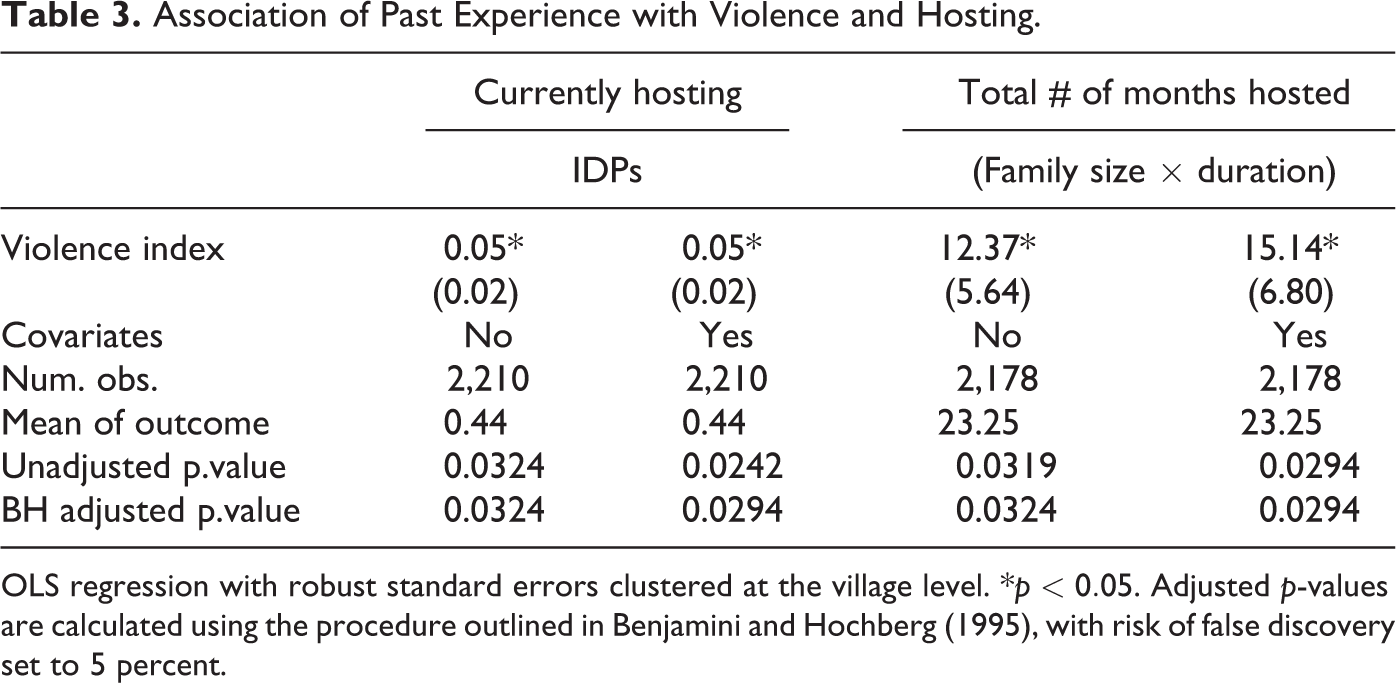
OLS regression with robust standard errors clustered at the village level. *
Consideration of Alternative Mechanisms
As with any study invoking an intrinsic explanation for observed behavior, it is impossible to decisively verify that our proposed mechanism, namely empathy born of violence, accounts for our results. Here, we consider the plausibility of three leading alternative mechanisms based on our review of the literature in second section and table of predictions across different theories (see Table 1). The first of these is post-traumatic growth theory, which posits a prosocial (re-)orientation of goals, priorities, and perspectives in the aftermath of traumatic events. In our setting this theory predicts that past violence associates with greater hosting of both ingroup and outgroup IDPs, which is consistent with our observational results and the lower bias against Kurdish IDPs in the conjoint experiment, but inconsistent with the stronger preference for sick and vulnerable IDPs. The second alternative mechanism is a norm of reciprocity, which would predict greater ingroup hosting, but would not explain greater hosting of Kurdish IDPs or sick and vulnerable IDPs—indeed, reciprocity norms are least likely to apply to relations with Kurdish IDPs, because past interactions with this outgroup are less likely, as are the prospects of future interactions. The final potential explanation that stands out in the literature would be a parochial altruistic response to violence, in which hosting of ingroups increases and hosting of outgroups decreases. This result is indeed consistent with the negative associate between violence and hosting Christians IDPs among Sunni members of our sample, as we have argued. But it cannot account for greater hosting of outgroup Kurdish IDPs, or greater sensitivity to sick and vulnerable IDPs.
Although our results are consistent with our pre-specified empathy born of violence hypothesis, we cannot decisively prove our hypothesis. Moreover, we did not include measures of empathy in our survey due to the limitations and challenges of conducting surveys in our setting. For this reason, we believe our results should be viewed as suggestive but by no means conclusive evidence in favor of the empathy born of violence hypothesis.
Limitations
Our study is not without limitations. For starters, though we have done our best to mitigate omitted variables bias by controlling for a large number of prewar covariates in the observational analysis, we cannot rule out unobserved confounding. Following Oster (2019), our sensitivity analysis suggests that unobserved confounding is unlikely to account for our results, though we cannot rule this out definitively. This is a problem that affects nearly all studies in the micro-effects of violence literature, and ours is no exception (Bauer et al. 2016).
A second and related limitation is there is no way of knowing how selective migration influences the association between violence and hosting behavior. It is possible, for instance, that the association of violence with hosting is negative among Syrians who fled Syrian altogether and do not enter into our sample. In short, we have no way of knowing whether the results we document in this paper generalize to Syrians displaced outside of Syria.
While this is a limitation, it is also important to bear in mind that our goal in this paper is not to assess the association of violence with hosting among all Syrians living in our study region at the outset of the war. Rather, we view residing within Syria as either an IDP or non-displaced resident as an important population in its own right and a key scope condition of our study; we focus on this population because it is particularly policy relevant given the important role it plays in hosting IDPs in war zones. How violence associates with hosting behavior among refugees living outside of Syrian is a separate question altogether, albeit one that is potentially less relevant from a humanitarian policy perspective given the availability of established camps and government services in these settings.
Lastly, as with all survey experiments, there are potentially important limitations to the external validity of our results. In our setting, one particular concern is that the preferences elicited in the conjoint experiment may not predict the actual decisions made in the real world in Syria or the resulting composition of IDPs hosted, as these outcomes clearly depend on factors well beyond the host population’s preferences, such as the composition of IDP flows, and of course, the host population’s constraints. In an extreme scenario in which potential hosts are themselves barely subsisting, they might not host anyone, even if they have a desire to do so and strong preferences over which types of IDPs they would host. Our goal in this study is much more narrow — to estimate preferences, and to assess how these preferences vary with prior exposure to violence.
Discussion
In this paper, we find that Syrians who previously experienced violence and displacement were more likely to host IDPs relative to those who experienced less violence. We also find that violence-affected Syrians were more likely to host outgroup Kurdish IDPs and sick IDPs in a conjoint experiment designed to measure hosting preferences over different categories of IDPs. These findings are consistent with our pre-specified altruism born of suffering hypothesis, in which wartime hardships lead to greater empathy, motivating greater altruism on the basis of need rather than identity. However, because we do not directly measure empathy and due to the inherent challenges of attributing observed behavior to psychological mechanisms, we view our results as suggestive but not conclusive.
We also find that the association between past violence and hosting outgroups is heterogeneous and appears to depend on whether the outgroup falls along a particular social cleavage. In particular, our data on Sunni respondents (who constitute 85 percent of our sample), shows that while violence associates positively with preferences for hosting Kurdish refugees, it associates negatively with hosting outgroup Christians. We speculate that this may be because of perceived Christian support for the Assad government, leading to animosity and blame. Conversely, violence-affected Sunnis may be more risk averse, and thus averse to hosting IDPs from a potentially hostile outgroup. Both of these explanations are more consistent with parochial altruism than our altruism born of suffering hypothesis.
Our finding that violence leads to altruism across identity boundaries even in the context of ongoing armed conflict complements and extends the literature on post-traumatic growth in the wake of violence, which hitherto has largely focused on post-conflict settings. Whereas studies conducted in post-conflict settings have shown that violence leads to greater levels of pro-sociality among Nepali communities (Gilligan, Pasquale, and Samii 2014), lower outgroup discrimination in post-conflict Bosnia (Whitt and Wilson 2007), and higher trust between groups in Burundi (Voors et al. 2012), we are among the first to provide empirical evidence that these pro-social effects may manifest even in the context of ongoing conflict.
Lastly, this study shows that violence does not always lead to parochial altruism. Instead, we show that in diverse settings violence can create the conditions for cross-cutting ties that transcend certain identity boundaries. This has several implication for policy going forward. First, it suggests that when members of groups with different political, religious and cultural characteristics share certain experiences, it can create the conditions for generosity. In humanitarian or migration crises where resources are severely constrained, interventions that activate this bridging identity may be critical to garnering support for people in need. Second, while it is an open question what sorts of projects activate this identity, ongoing work on the contact hypothesis and the power of integrated sports (Mousa 2020) and vocational training (Scacco and Warren 2018) may show a way forward for creating bonds between groups.
This study also suggests that some cleavages may be especially difficult to bridge, including those between competing groups in on-going conflict and when individuals have incentives to protect themselves against further violence. Further research is needed to more fully understand how experiences of violence create opportunities for bridging identities or reinforce divisions in society. This knowledge may be crucial when fighting stops to increase the chances of bringing people together for peace.
Supplemental Material
Supplemental Material, sj-pdf-1-jcr-10.1177_00220027211011523 - Violence, Displacement, and Support for Internally Displaced Persons: Evidence from Syria
Supplemental Material, sj-pdf-1-jcr-10.1177_00220027211011523 for Violence, Displacement, and Support for Internally Displaced Persons: Evidence from Syria by Alexandra C. Hartman, Benjamin S. Morse and Sigrid Weber in Journal of Conflict Resolution
Supplemental Material
Supplemental Material, sj-zip-1-jcr-10.1177_00220027211011523 - Violence, Displacement, and Support for Internally Displaced Persons: Evidence from Syria
Supplemental Material, sj-zip-1-jcr-10.1177_00220027211011523 for Violence, Displacement, and Support for Internally Displaced Persons: Evidence from Syria by Alexandra C. Hartman, Benjamin S. Morse and Sigrid Weber in Journal of Conflict Resolution
Footnotes
Authors’ Note
Benjamin S. Morse is now affiliated with Social Impact, Arlington, VA, USA.
Acknowledgments
The humanitarian partners who made this data collection possible wish not to be named due to the sensitivity of their operations inside Syria. Nevertheless, we wish to thank them for their courage and commitment to their work, without which this research would not have been possible.
Declaration of Conflicting Interests
The author(s) declared no potential conflicts of interest with respect to the research, authorship, and/or publication of this article.
Funding
The author(s) received no financial support for the research, authorship, and/or publication of this article.

Supplemental Material
Supplemental material for this article is available online.
Notes
References
Supplementary Material
Please find the following supplemental material available below.
For Open Access articles published under a Creative Commons License, all supplemental material carries the same license as the article it is associated with.
For non-Open Access articles published, all supplemental material carries a non-exclusive license, and permission requests for re-use of supplemental material or any part of supplemental material shall be sent directly to the copyright owner as specified in the copyright notice associated with the article.
