



Abstract
We examine the political consequence of exposure to widely available video content of terror violence. In a two-wave survey of Americans, we assess who is exposed to, and seeks out, terror-related video content in the first wave and then observe who decides to watch raw video footage of the Boston marathon terror attack in the second. We focus centrally on anxiety and anger as differing emotional reactions to the threat of terrorism and document their influence on exposure to terror violence. Anxiety generates avoidance of violent terror content whereas anger increases its consumption. Moreover, we find that anger increases exposure to violent terror content and in addition enhances support for punitive and retaliatory anti-terrorism policy. We discuss the implications of our findings for the broader dynamics of terrorist violence and the emotional basis of selective news exposure.
By design, the effects of terrorism extend well beyond its immediate victims and physical destruction to include a much broader target population (Crenshaw 1986; Perliger 2012; Wardlaw 1989). Acts of terrorism may have even greater influence now than in the past because the internet, mobile devices, and social media platforms allow for the rapid dissemination of highly arousing and potentially disturbing video content of events as they occur (Greenmeier 2017). This fact is not lost on the perpetrators of terrorism. Far-right attacks such as the 2019 Christchurch mosque massacre and the 2019 Halle synagogue shooting were live-streamed by the attacker (Cai and Landon 2019). Content recorded by a perpetrator has been quickly removed from online sites in these instances. But even if perpetrators do not live-stream an attack, witnesses visually record events, and this video footage is included in news segments that are often uploaded to online sites such as YouTube, as well as to social media platforms such as WhatsApp and Snapchat. This raw, graphic video content is readily accessible (sometimes accompanied by a gratuitous warning) and has the potential to arouse strong emotions among viewers, potentially amplifying public reactions to an act of terror.
There have been concerted international efforts to remove violent online video content. New Zealand Prime Minister Jacinda Ardern and French President Emmanuel Macron initiated the Christchurch call, a pledge to eliminate online terrorist and violent extremist content, following the 2019 Christchurch attack. To date, the pledge has been signed by 48 countries (Uberti 2019). The practical success of this effort remains unclear, however. YouTube currently hosts live footage from events surrounding the 2019 El Paso shooting, the 2016 Nice attack, the 2017 London Bridge attack, and many others. 1 Most are news segments depicting chaos at sites of attacks or the police killing or attacking the perpetrators. The footage typically omits real-time images of people being killed but does include images of medical and other first responders’ operations. Thus, the existing footage has the potential to trigger a strong emotional response in viewers which allows terrorists to enhance the psychological and symbolic impact of an attack by conveying to a broader audience the fear and panic experienced by victims.
In this research, we examine the political consequence of widely available video content of terror violence. First, we examine the degree to which members of the public are exposed to, and seek out, video content of terror events. In so doing, we contribute to a broader discussion on selective news exposure—the decision to watch some and avoid other types of news content. Cognitive goals, such as the decision to consume politically agreeable news, have been widely examined as the basis for news selection. But terrorism arouses strong emotions and activates emotional goals that also shape news exposure through the avoidance of negative emotion or the enhancement of positive states. In this study, we find that anxiety about terrorism generates avoidance of violent terror content whereas anger increases its consumption.
Second, we explore the political consequences of emotionally driven consumption or avoidance of terror violence. Terrorists’ actions are often designed to provoke a governmental reaction such as territorial concessions or political and policy reforms through acts of attrition or intimidation which exhaust the opposing government’s resolve or underscore its ineffectiveness (Kydd and Walters 2006). The arousal of public emotion plays a central role in terrorist strategy. By instilling anxiety in a target population, terrorists hope to increase public pressure on governments to negotiate and concede to their demands (Friedland and Merari 1985; Long 1990). Some terrorists may also aim to provoke anger within a population to goad an affected government into taking disproportionate action that will increase support for their cause and lead to further action (Piazza and Choi 2018). Selective news exposure in which anxiety and anger are further aroused or dampened by exposure to, or avoidance of, terror violence will thus have political consequences. We find in this research that anger increases exposure to violent terror content and enhances support for punitive and retaliatory anti-terrorism policy. Thus, the posting of violent terror content may play into the hands of terrorists by promoting support for severe counterterrorism policies.
Public Exposure to Real-time Accounts of Terrorist Violence
High speed internet access has made it increasingly possible to watch events as they unfold, including live footage of international terrorist attacks involving bombings and shooting. All told, over 200 people were killed and over a thousand injured in terrorist bombing and shooting attacks in the EU between 2015 and 2019 and many of these events were captured on video as they occurred. 2 In 2015, twelve people died and another 11 were injured in an attack on the Paris office of the satirical magazine, Charlie Hebdo. The perpetrators were captured on camera killing a police officer as they left the building. The 2015 Paris Bataclan nightclub and related attacks killed 130 people and injured 413 and much of that drama was captured on video including scenes of carnage from inside the nightclub and police firing at the perpetrators outside. In 2016, 86 people were killed by a truck plowing through crowds in Nice and live footage of that event is widely available online. In 2017, 22 people were killed and 512 injured in the 2017 Manchester stadium bombing and live footage of events inside the stadium are accessible online. In 2019, 22 were killed and 24 injured in the El Paso Walmart shootings and shoppers recorded the chaos as suspects were led out of the store.
Even more disturbing footage exists online of other violent terrorism-related content such as beheadings. Between 2014 and 2017, ISIS beheaded 296 people including nine westerners and released videos of the western hostages including American journalists James Foley and Steven Sotloff and British aid workers David Haines and Alan Henning. All four hostages were executed in 2014. In a November 2014 HuffPost-YouGov poll, 32 percent of Americans said they had seen at least some of the ISIS beheading videos, with fully 9 percent reporting that they had seen the actual beheading (Schwartz 2014). In data drawn from a nationally representative online panel interviewed some six to nine months after the most prominent American beheadings, Redmond and colleagues (2019) report that 25 percent of Americans had seen part or all of a beheading video.
News Exposure as a Form of Emotion Regulation
Selective Exposure Models
Who watches online terror violence and to what extent is that content chosen? We turn to research on selective news exposure to assess what is known about the decision to consume some and avoid other news content. In political communications, the term selective exposure typically refers to the ideological choice of agreeable and the avoidance of disagreeable news content (Mutz and Young 2011; Sears and Freedman 1967). But in communications research it has a broader meaning which includes the active avoidance or consumption of specific types of news content (Knobloch-Westerwick 2015). By broadening the definition of selective news exposure, we expand the motive for news selection beyond ideological agreement to include the management of emotional states. The choice to actively consume news for emotional reasons is politically important because news stories with strong emotional and moral tone are more likely than more emotionally pallid content to spread through social media (Berger and Milkman 2012; Brady et al. 2017; Heath, Bell, and Sternberg 2001).
Political science research provides supportive evidence on the emotional basis of news selection. In studies that focus variously on terrorism, immigration, and elections, anxiety consistently generates a search for information (Brader, Valentino, and Suhay 2008; Huddy et al. 2005; Marcus, Neuman, and MacKuen 2000; Redlawsk, Civettini, and Lau 2007; Valentino et al. 2008). Anxiety does not lead to an unbiased search for information, however. Rather, it motivates a search for threatening information consistent with a desire to estimate the nature and magnitude of the threat (Albertson and Gadarian 2015; Brader, Valentino, and Suhay 2008; Gadarian and Albertson 2014). Gadarian and Albertson research find clear support for an emotion-based approach to selective news exposure in their research on immigration.
Communication scholars have long acknowledged the importance of emotion in driving the consumption of entertainment programming. The earliest models built on uses and gratifications research (Katz, Blumler, and Gurevitch 1973) to develop a mood-management model in which programs were chosen to reverse bad and reinforce good moods (Zillmann 1988, 2000). Subsequent communications models were somewhat more complex to explain why people choose to watch entertainment such as horror movies that aroused negative moods (Knobloch 2003). Research on news consumption, however, has remained more squarely focused on cognitive explanations of selective exposure. The highly arousing nature of contemporary online news content, including acts of terrorism, makes a strong case for the inclusion of affective motives in the study of selective news exposure.
An enhanced understanding of the emotional impact of selective exposure is especially important in the context of terrorism. Many scholars intuitively assume a correlation between increased terrorist violence and a government’s tendency to escalate counterterrorism policies. Unlike a conventional military struggle, however, in which an escalation of violence on one side will lead to an escalation on the other, terrorism generates a different dynamic. Multiple studies confirm that a government’s response to terrorism is heavily influenced by the public’s emotional state and perception of threat (Katzenstein 2003; Omelicheva 2007; Perliger 2012). Hence, understanding the emotional origins and effect of selective exposure to violent terror content is crucial to deciphering a government’s policy response to terrorism.
The Regulation of Anger and Anxiety
To understand selective exposure to terror violence and its policy consequences, we focus on anger and anxiety as distinct negative emotional responses to terrorism (Albertson and Gadarian 2015; Gadarian 2010; Lerner et al. 2003; Skitka et al. 2006). We believe their regulation is a key motive for the willingness to consume or avoid emotionally arousing news coverage of terrorism.
Anxiety
Anxiety is commonly seen as a response to an external threat of unclear origins over which the threatened person has little control (Eysenck 2013). An act of terrorism can elicit anxiety because acts of terrorism are perceived as unpredictable, random, and difficult to counter or avoid. Once aroused, anxiety generates a search for information about the nature of threat, its possible causes, likelihood, and ways to minimize future risk (Lerner 2001; Lerner and Keltner 2000; MacLeod and Mathews 1988). This implies that someone who is anxious about terrorism may seek out highly arousing videos of a terror attack to gain information that might help them avoid future victimization.
On the other hand, anxiety is an inherently aversive state that arouses cognitions and behaviors designed to reduce or down regulate anxiety. Interest in the acquisition of information about the risk of terrorism is very different from the decision to watch highly arousing violent terror-related content. Situational selection is a key emotion regulation strategy designed to avoid situations that arouse an undesirable emotion (Gross 1998). We expect those anxious about terrorism to avoid exposure to highly arousing videos of a terror attack (Tamborni, Zillmann, and Bryant 1984). 3
Anger
When people report negative emotional states, anger and anxiety are invariably related. Yet they are very different emotions. Anger stems from harm to oneself or others or a frustrated personal goal caused by a known entity accompanied by a sense of certainty that retaliatory action is justified and will succeed (C. A. Smith and Ellsworth 1985). Anger motivates someone to act to “re-establish the situation that existed prior to the offense” (Lerner and Tiedens 2006). It is less likely than anxiety to generate a search for information and can reduce the amount of time and effort devoted to information seeking, limit the effect of information on political attitudes, and bolster defensive motivated reasoning (MacKuen et al. 2010; Redlawsk, Civettini, and Lau 2007; Suhay and Erisen 2018; Valentino et al. 2008; Weeks 2015).
On the other hand, an emotion regulation framework suggests that angry people may be more motivated than others to consume violent video content of a terror attack. Unlike anxiety, anger is not uniformly aversive and can generate positive feelings (e.g., Berkowitz and Harmon-Jones 2004; Blanchard and Blanchard 1984). Indeed, Chester and DeWall (2017) found that respondents who had experienced social rejection engaged in an aggressive act to help restore their positive mood (see also Chester 2017; Chester and DeWall 2016). Anger may also be actively maintained or enhanced to achieve instrumental goals (Tamir and Ford 2012; Tamir, Mitchell, and Gross 2008). When it comes to information exposure, there is evidence that angry people choose to watch entertainment programming that maintains their anger, especially if they anticipate taking future retaliatory action (O’Neal and Taylor 1989).
These findings are consistent with evidence that anger, unlike anxiety, is a positive, action-oriented emotion, propelling someone toward action by diminishing its perceived risks, increasing risk tolerance, and reducing the amount of cognitive effort devoted to a careful consideration of its potential pros and cons (Carver 2004). In past research, anger has been linked to active forms of political engagement, including information-seeking behavior and the posting of online comments (Groenendyk and Banks 2014; Hasell and Weeks 2016; Hoffner et al. 2009; Ryan 2012; Valentino et al. 2011; Weber 2013). From an emotion regulation perspective, anger could motivate a search for information that further intensifies anger in anticipation of future aggressive action. We thus expect angry people to be motivated to watch violent video content because it makes them feel good and/or readies them for future retaliatory action against terrorists including government action taken on their behalf.
Habitual emotional states
Anger and anxiety can be fleeing states, but they are also habitual tendencies. Within the study of emotion, enduring tendencies such as trait anxiety shape specific emotional reactions that result in state anxiety (Frijda 1986; Spielberger et al. 1999). Emotions felt in response to a specific stimulus can also be habitual even if the overall emotional reaction is not a stable trait emotion. As evidence, Halperin and Gross (2011) measured general anger toward Palestinians among Jewish-Israelis one year before the 2008 to 2009 Gaza War and then a week after the war’s outbreak. Anger measured a year earlier was the best predictor of anger toward Palestinians during the war, having far greater influence than immediate factors such as direct exposure to a missile attack.
Several studies also report lasting effects of emotional responses to immigrants. Schemer (2012) found that Swiss nationals who felt anxious, fearful, or angry about asylum seekers in July of 2006 were more likely to pay attention to negative ads concerning a referendum to place restrictions on asylum seekers some 4 to 6 weeks later. Valenzuela and Bachmann (2015) found that Swiss participants who felt pride in immigrants in April of 2008 were even more likely to argue with someone two months later in the context of a national anti-immigration campaign. Emotions have similar long-lasting effects on support for political candidates and parties (Ladd and Lenz 2008; Valenzeula and Bachmann 2015; Vasilopoulos, Marcus, and Foucault 2018).
The existence of habitual emotional reactions to a specific event or group is intertwined with the process of emotion regulation and selective news exposure. In order to engage in emotional regulation, someone needs to anticipate feeling anxious or angry in response to arousing images such as terror violence. A person who reports feeling anxious about terrorism is most likely to downregulate anxiety by avoiding exposure to such stimuli. Similarly, someone who feels habitually angry toward terror groups may upregulate anger by choosing to watch content that will maintain their vigilance and positive angry state. These reactions can become habitual, contributing to the stability over time of emotional reactions to terrorism.
Terrorism and National Security Attitudes
The decision to watch or avoid violent online terror content has important implications for public reactions to terrorism. In past research, anger at terrorists (and anger in general) reduced the perceived risk of military action and promoted support for military intervention, use of drones and pro-war political candidates (Fisk, Merolla, and Ramos 2019; Iyer et al. 2014; Lambert et al. 2010; Skitka et al. 2006). Anger in response to the 2015 Paris terror attacks increased support for the right-wing National Front / National Rally which promoted opposition to Muslim immigrants, a group linked to acts of terror (Marcus et al. 2019). Similarly, anger following the outbreak of a Palestinian suicide-attack campaign in the mid-1990s, led to the election of a hawkish right-wing government in Israel in 1996 (Peretz and Doron 1996). One possible consequence of ready access to online video content of terrorist violence is heightened support for an aggressive and retaliatory national security policy, such as support for torture or military intervention, among those who feel angry about terrorism and willingly consume anger-arousing content (Carlsmith and Sood 2009; Liberman 2013).
In contrast, anxiety has been associated with reduced support for risky anti-terrorism military action, increased support for negotiations with terrorists, and the enactment of self-protective behaviors designed to decrease the risk of personal victimization (Huddy et al. 2005; Iyer et al. 2014; Lambert et al. 2010; Skitka et al. 2006). In analyzing specific national security policies, anxiety has been shown to undercut support for potentially risky overseas military action and modestly increase support for less risky domestic policies such as increased surveillance (Huddy et al. 2005). Overall, the tendency of anxious people to avoid anxiety-arousing news means that violent online terror content will have less effect on them than on those angry at terrorists. Consequently, exposure to online terror violence is likely to boost national support for an aggressive and punitive national security policy because it is consumed by and amplifies the political reactions of those angry at terrorists.
Research Hypotheses
We examine the emotional underpinnings of selective exposure to terrorist violence to test the following two hypotheses:
We also examine the political effects of anger and anxiety to verify the likely political consequences of selective news exposure. In line with past research we test the following predictions:
Finally, we test the following prediction concerning the political effects of exposure to terror violence.
Method
Sample
Data are drawn from a two-wave online panel conducted by YouGov using a matched sample technique. 1,400 respondents were included in wave 1 and 1,050 were re-interviewed in wave 2 (75 percent re-interview rate; see the Online Appendix and Table A1 for details on the sample). Wave 1 occurred between May 2 and May 14, 2017 and wave 2 occurred between August 15 and August 25, 2017. The panel design allows us to test whether anger and anxiety affect individual behavior some three months later.
Measures
Emotions: Anger and anxiety
In Wave 1, respondents were asked about their reactions to a domestic terror attack in the US: feeling nervous and scared (anxiety) and feeling angry and hostile (anger). Measures of emotional adjustment, anxious attachment, and disgust sensitivity were included to assess the psychological determinants of anger and anxiety (see Table A2 in the Online Appendix for all item question wording and scale reliability). The latter scales assess psychological traits known to have a heritable component and are included to determine the degree to which anxiety is a function of stable underlying psychological traits (Brussoni et al. 2000; Loehlin et al. 1998; Sherlock et al. 2016). Unless otherwise stated, all scales are rescored to range from 0 to 1 for ease of interpretation.
Perceived terrorist threat
The perceived threat of a future terrorist attack in the US was assessed with three items tapping the likelihood of an attack on US soil (national), in one’s local area (personal), and the chance of personal victimization (personal). We created a combined perceived threat scale from all three items and a subscale for personal threat made up of two items.
Exposure to terror violence
In wave 1, respondents answered questions about their political attitudes and exposure to violent terrorist news content. In wave 2, they were asked to watch a news video of the Boston marathon bombing. We chose the 2013 Boston marathon bombing for several reasons. First, it occurred on domestic soil, increasing respondent’s emotional connection to the event. Second, footage from the event is comparable to footage of other terror events that typically show chaos, fearful victims, and bloodshed but do not typically provide a clear view of the most horrific violence. Third, the attack was clearly an instance of terrorism unlike other forms of domestic violence, such as right-wing extremist violence. Lastly, the event was perpetrated by two US residents who were not professional terrorists and is thus like other recent acts of terror.
National security policy
Torture
Respondents were asked two questions gauging their support for the US government’s use of torture against suspected terrorists that were combined into a single scale. 4
Military action
Respondents’ support for anti-terrorist military actions was assessed with four items Combined into a single scale. 5
Domestic surveillance
Support for government domestic surveillance was assessed with three items which were combined into a single scale. 6
Demographic and political controls
Analyses contain controls for partisanship and ideological self-identification. We also control for age, education, gender, religiosity, race and marital status. News consumption was assessed as the number of days on which someone consumed national news from any source. Respondents were also asked to identify their primary news source (TV, Internet, print, radio).
Results: Exposure to Terrorist Violence
Past Exposure, Wave 1
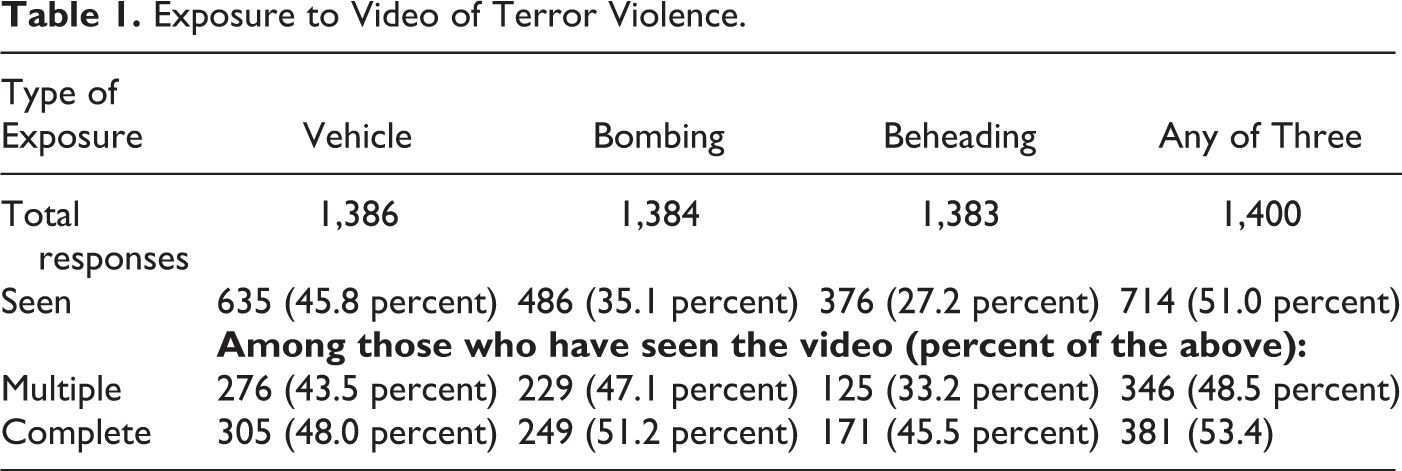
Respondents in wave 1 were asked whether they had “seen a video of a terrorist event such as a beheading or a terrorist attack (a vehicle running over civilians or shooting and bombings) showing the events as they occurred?” Fifty-one percent reported that they had. They were then asked several questions about three types of terrorist attacks. Forty-six percent had seen a video of a vehicle driving into a crowd, 35 percent had seen a video of a shooting or bombing, and 27 percent had seen a video of a beheading (Table 1). Those who had seen a specific type of attack were asked if they watched the video all the way through, and whether they had watched a video of an attack more than once. Of those who had seen a video, 53 percent had watched it all the way through and 49 percent had watched it more than once. These numbers did not differ dramatically across the different types of attacks, although somewhat fewer (33 percent) said they had watched a beheading video several times.
Exposure to Video of Terror Violence.
We analyze the determinants of exposure to any one of the three forms of attack to test the prediction that anger enhances exposure and anxiety increases avoidance (column 1, Table 2). Anger toward terrorism was somewhat more common than anxiety; 40 percent of respondents felt very angry at the thought of terrorism on US soil compared to roughly 20 percent who felt very nervous. Despite being positively correlated (r = .58) anger and anxiety have opposite effects on exposure as expected. Anxiety about terrorism reduces exposure to terrorist violence whereas anger increases it. 7 These effects are sizable as seen in Figure 1. As anger goes from its lowest to highest value, the probability of having watched at least one video clip of terrorist violence goes from .36 to .63, almost doubling the probability of exposure. As anxiety ranges from its lowest to highest score, the probability of having seen a video clip decreases from .61 to .46, a sizable decrease. 8
Determinants of Exposure to Terrorist Violence (Wave 1).

Note: Entries are unstandardized coefficients drawn from a logistic regression; standard errors in parentheses. All variables are scaled from 0 to 1. Labels indicate the high score for each variable. Internet news user are those who said they primarily get their news from the internet.
***p < 0.01, **p < 0.05, *p < 0.1.
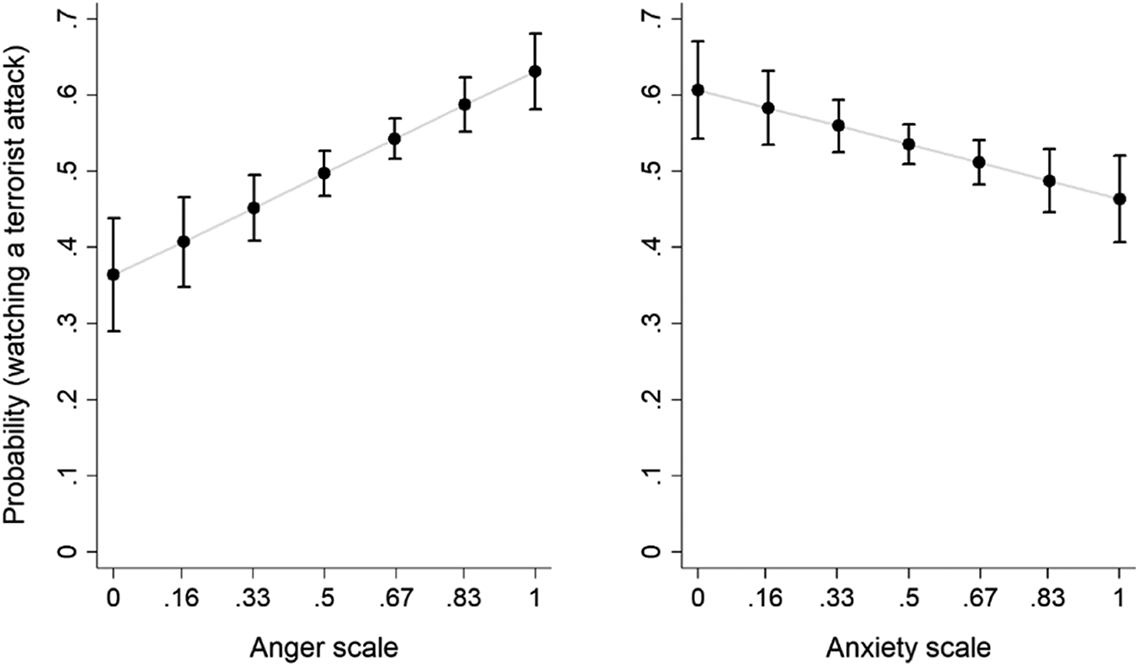
Effects of anxiety and anger on exposure to terrorist violence (wave 1). Note: Predicted values based on analyses in column 1 of Table 2 holding all other variables at their mean.
When we analyze exposure to specific types of terrorist violence, anger has a significant, positive association with exposure to all three kinds of attacks whereas anxiety is negatively related to exposure to vehicle attacks and has negative but non-significant effects on exposure to footage of bombing attacks and beheadings (columns 2–4, Table 2). These effects are depicted in Figure 2. Once again, the effects of anger are sizable. The probability of having seen a vehicle or bombing attack doubles across the range of anger and the increase is even larger for exposure to a beheading video. Anxiety is most likely to reduce exposure to a vehicle attach but that is because those low in anxiety are far more likely to have seen this content. As seen in Figure 2, anxiety reduces exposure to all three types of attacks and those highest in anxiety are equally unlikely to have seen any video content.

Effects of anxiety and anger on exposure to specific types of terrorist violence (wave 1). Note: Predicted values based on analyses shown in columns 2 to 4 in Table 2 holding all other variables at their mean.
In addition to increasing exposure to terrorist violence, anger is also linked to repeat exposure. In logit analyses, anger had a significant and positive association with having seen any type of video more than once. It was also linked to repeat watching of a vehicle, and bombing/shooting attack but not a beheading (see Table A4 in the Online Appendix for the determinants of repeat exposure to terrorist violence). The effects of anger are sizable as seen in Figure 3. The probability of having watched a video of a bombing or shooting attack more than once ranged from .2 for those at the lowest level of anger to a high of .63 among those scoring the maximum. Angry people were also more likely to watch a vehicle attack more than once. The chance of repeat watching went from .31 at the lowest level of anger to .50 at the highest. In contrast, anxiety had little effect on repeat watching of a vehicle attack or beheading but did decrease repeat exposure to a bombing or shooting attack. The probability of watching a bombing attack went from .56 at the highest level of anxiety to .40 at the lowest.

The effects of anger and anxiety on repeat exposure to terrorist violence (wave 1).
Several other factors were associated with the decision to watch a video more than once. Avid news consumers, the highly religious, men, and less well-educated respondents were more likely than others to have seen a video of a vehicle attack more than once. White respondents and those who relied on the internet for news were less likely to have seen a bombing video more than once. Men and the highly religious were more likely to have seen a beheading video more than once.
To ensure that we correctly estimate the effects of anger and anxiety on the decision to consume videos separately from the decision to watch them repeatedly, we created a scale that ranged from 0 (no exposure) to 1 (exposure to all three kinds of videos, watching a complete video segment for all three types of attacks, and watching a video of each type of attack more than once) and ran a hurdle analysis on the scale to distinguish between the decision to watch and the decision to watch repeatedly within the same model. We also ran these analyses for each type of attack.
There is a sizable percentage of respondents at 0 (non-exposure) on each scale, the barrier that needed to be passed before repeat exposure is analyzed in the hurdle model. These analyses (see Table A5 and Table A6 in the Online Appendix) replicate our major findings. In terms of overall exposure, anxiety has a significant negative and anger a significant positive effect on exposure to any type of terrorist video but only anger drives the decision to watch completely and repeatedly.
Selective Exposure to Boston Marathon Video: Wave 2
So far, reported findings have been cross-sectional in nature, raising questions about whether emotion drives exposure to terror violence or vice versa. To provide a stronger test of the relationship between emotion and news consumption, respondents in wave 2 were asked to watch a news report on the Boston marathon bombing. All respondents read a brief, graphic description of the Boston marathon attack (see Table A7 in the Online Appendix) from one of three different network or cable TV segments. The videos included news footage of street scenes taken during or right after the bombing, ranged from 115 to 186 seconds, and elicited similar levels of emotional reaction. Respondents were required to stay on the screen for at least thirty seconds before they could move forward in the survey. Anyone who watched the video for its full length minus five seconds and up to sixty seconds beyond the end of the video was coded as having watched it in full. 9 In total, 70 percent of respondents watched the complete video, 22 percent stopped early, and another 7 percent stayed on the screen for more than sixty seconds beyond the end of the video (see Table A8 in the Online Appendix).
We analyze determinants of the decision to watch the video in its entirety. In a replication of findings from wave 1, anxiety (wave 1) significantly decreased, and anger (wave 1) increased, the chance that someone watched the full video in wave 2. These results are large and robust to alternative model specifications (see Table A9 in the Online Appendix), providing stronger evidence that emotions drive the decision to watch a specific news segment. To ensure that anger and anxiety, and not an omitted third variable, was responsible for these findings we reran analyses with major correlates of each emotion (see Table A10 in the Online Appendix). The effects of anxiety and anger persisted even after controlling for psychological correlates of anxiety measured in wave 1 such as emotional adjustment, and political correlates of anger such as conservatism, nationalism, and authoritarianism.
The probability of watching the full video ranged from .57 to .77 for those lowest to highest in anger and from .78 to .62 for those lowest to highest in anxiety. These trends are depicted in Figure 4. Several additional factors also predict full exposure to the Boston marathon video. Non-diligent respondents who skipped more than 3 out of 62 survey questions were less likely than others to watch the entire video; older individuals and those who primarily get their news from the internet were more likely to watch.

The effects of anger and anxiety (wave 1) on full exposure to the Boston Marathon news clip (wave 2).
National Security Policy
National Security Policy Support, Wave 1
To assess the political effects of anxious avoidance and angry consumption of violent terror video content, we examine the link between anger and anxiety and support for various national security policies. The policy correlates of anger are of special interest because angry people voluntarily expose themselves to violent video content which may intensify their anger and enhance support for aggressive national security policies.
As seen in Table 3, anger is linked to greater support for torture, military action, and domestic surveillance in wave 1 as expected. For the most part, anxiety also has its expected effects. It is associated with stronger support for domestic surveillance, the kind of non-risky action favored by anxious individuals. It also promotes support for torture which can also be viewed as non-risky because it occurs in secret and is difficult to link to retaliatory action. In the extreme, torture may even be viewed by the public as providing useful information that further reduces risk.
Support for National Security Policy (Wave 1).
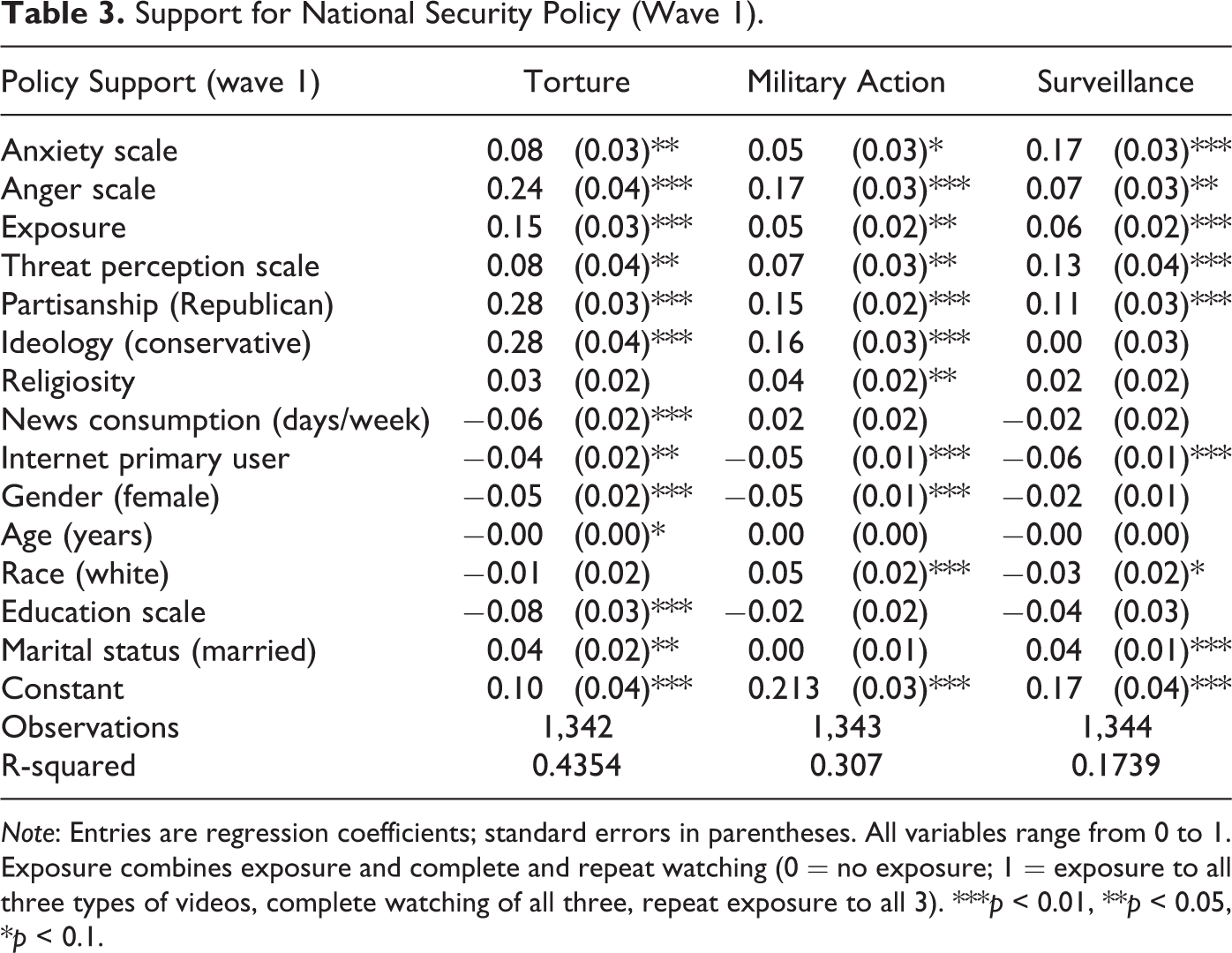
Note: Entries are regression coefficients; standard errors in parentheses. All variables range from 0 to 1. Exposure combines exposure and complete and repeat watching (0 = no exposure; 1 = exposure to all three types of videos, complete watching of all three, repeat exposure to all 3). ***p < 0.01, **p < 0.05, *p < 0.1.
Unexpectedly, anxiety is also modestly associated with support for overseas military action, a potentially risky policy. This is at odds with past research in which anxiety has reduced support for overseas military action (Huddy et al. 2005) and may arise because recent military action in Iraq and Syria has led to few US casualties. The link between anger, anxiety, and predicted levels of support for the three types of national security policy is depicted in Figure 5. This figure reveals the sizable association between anger and support for torture and military action, and the sizable association between anxiety and support for less risky domestic surveillance policies.

Effects of anger and anxiety on national security policy support (wave 1).
Exposure to terrorist violence also boosted support for all three forms of national security policies independently of anger and anxiety as seen in Table 3, underscoring the power of highly emotive video content to shape political attitudes. Those who have seen such content at the highest levels of exposure (having seen all three types of attacks and watched completely and repeatedly) are far more supportive of torture, an aggressive military response to terrorism, and enhanced domestic surveillance policies even after controlling for emotions, perceived terrorist threat, partisanship, and political ideology. Exposure has its largest effects on support for torture suggesting that watching terrorist violence heightens the desire for retribution regardless of one’s initial level of anger at terrorists.
National Security Policy Support, Wave 2
Study participants were asked the same questions about national security policy after watching the Boston marathon video as in wave 1. There was a significant albeit small increase in support for all three national security policies between the two waves among members of the panel. Support for torture increased from .49 in wave 1 to .50 in wave 2 (t = 2.24, df = 1,041), support for military action increased from .58 to .61 (t = 3.79, df = 1,043), and support for domestic surveillance increased from .34 to .39 (t = 7.54, df = 1,045). We cannot confirm that this increase in support is caused by reference to the marathon bombing but we have suggestive evidence to that effect.
We controlled for wave 1 support of a given national security policy and regressed wave 2 policy support on anger and anxiety, voting for Donald Trump in the 2016 election, news consumption, partisanship, ideology, and several demographic variables. We controlled for 2016 vote because President Trump continued to promote the use of torture in 2017 throughout the period covered by the panel. Findings are presented in Table 4.
Determinants of National Security Policy Support (Wave 2).

Note: Entries are regression coefficient; standard errors in parentheses. All variables range from 0 to 1.
*p < 0.1.
**p < 0.05.
***p < 0.01.
Analyses support the prediction that a reminder of terrorist violence enhanced the effects of anger on support for torture and military action. After being reminded of the Boston marathon bombings, those angry at terrorism in wave 1 were even more supportive of the use of torture and military action in wave 2 controlling for their support of each respective policy in wave 1. To ensure that the effects of anger were not due to an omitted variable, we controlled for its major correlates in a series of additional analyses. In these alternative model specifications, anger measured in wave 1 had a persistent effect on support for torture in wave 2 (see Table A11 in the Online Appendix). Anger had a less consistent effect on support for the use of military action in wave 2 (see Table A12 in the Online Appendix). The inclusion of patriotism, American identity, nationalism, and authoritarianism (all measured in wave 1) were more powerfully linked than anger to support for military action in wave 2. This suggests that a reminder of the Boston marathon may have boosted support for anti-terror military action because it aroused patriotism and nationalism which are related to anger concerning terrorism. In sum, a reminder of the Boston marathon attack clearly enhanced the effect of anger on support for torture but less clearly enhanced the effect of anger on support for military action.
Discussion and Conclusion
In this study, we demonstrate the differing effects of anger and anxiety on selective exposure to news of terrorist violence. Both emotions bias news consumption in ways consistent with an emotion regulation model. Those who felt angry at the prospect of anti-US terrorism were more likely to have seen video content of various recent terrorist events as they occurred and watched such content repeatedly. Moreover, individuals who were angry about terrorism in wave 1 were more likely than others to watch an entire news video of the Boston marathon bombing in wave 2, some three months later. In contrast, anxiety generates avoidance of news of terrorist violence. Individuals who felt anxious at the thought of terrorism were less likely to report that they had seen first-hand footage of a terrorist attack. They were also less likely to watch the entire video clip of the Boston marathon bombing months later.
Our findings reinforce prior evidence that anger is a far less aversive emotion than anxiety and is up regulated in the context of terrorism. Anger is one of the most common emotions reported in the aftermath of a terrorist attack, underscoring its political importance (T. W. Smith, Raskinski, and Toce 2001; Vasilopoulus, Marcus, and Foucault 2018). In this study, there is greater anger among those who see terrorism as an imminent threat to the nation or have a strongly nationalistic outlook that heightens their perception of external threat. Angry people may thus up regulate anger and expose themselves to terrorist violence to ready themselves for a counterattack. This supposition is consistent with findings from other research on anger and its regulation, linking heightened anger to an opportunity for retaliation that (Arpan and Nabi 2011; Mackie, Devos, and Smith 2000; Nabi 2003; O’Neal and Taylor 1989; Tamir, Mitchell, and Gross 2008). The strong link between anger and approval of torture and anti-terror military action provides suggestive support for this proposition.
The Political Consequences of Online Terror Violence
Our decision to study selective exposure to online terror violence is motivated by a deeper interest in how this content affects the politics of terrorism. Our most consequential findings concern the political effects of anger, which increases exposure to terrorist violence. Anger is also associated with greater support for the use of torture, military action, and heightened domestic surveillance. In addition, anger interacts with exposure to terrorist violence to additionally boost support for the use of torture. This is a potentially dangerous cycle which could benefit terrorist organizations. By inflaming a targeted population, terrorists can increase public support for punitive anti-terrorism policies. This could lead, in turn, to a disproportionate response to terrorist violence, arousing further violence. The Iraq War is a good example of this dynamic, in which the presence of US troops on Iraqi soil, strongly supported by Americans who were angry at terrorists, ultimately served as a recruitment tool for organizations such as al Qaeda (Huddy, Feldman, and Cassese 2007; Nesser 2006).
Our findings challenge past terrorism research which has devoted far more attention to the political effects of anxiety than anger. The existence of online terror violence is unlikely to enhance the political effects of anxiety because anxious individuals are less likely than others to be exposed to this content. Terrorists may engage in acts of violence to increase levels of anxiety in an affected population, but anxious individuals protect themselves against such influence by avoiding exposure to highly arousing violent content.
In conclusion, it is difficult to see news exposure motivated by anger as an unmitigated positive for democracy. News that is consumed because it stokes a desire for retribution can lead to support for ill-advised military adventurism and questionable punitive practices such as torture. Of course, anger can have positive normative effects when employed to promote social justice or right past wrongs (Halperin et al. 2011; Tagar, Federico, and Halperin 2011). Nonetheless, anger is unlikely to generate a balanced search for information, raising valid concerns about its democratic benefits. In the case of terrorism, pervasive anger and ready access to first-hand accounts of terrorist violence fuel the desire for retribution. The increasing availability of violent online content which is consumed at higher rates by angry people makes it difficult to see where and how this vicious cycle of anger, exposure to anger-arousing news content, and political retribution ends.
Supplemental Material
Supplemental Material, sj-do-1-jcr-10.1177_00220027211014937 - Anger, Anxiety, and Selective Exposure to Terrorist Violence
Supplemental Material, sj-do-1-jcr-10.1177_00220027211014937 for Anger, Anxiety, and Selective Exposure to Terrorist Violence by Leonie Huddy, Oleg Smirnov, Keren L. G. Snider and Arie Perliger in Journal of Conflict Resolution
Supplemental Material
Supplemental Material, sj-docx-1-jcr-10.1177_00220027211014937 - Anger, Anxiety, and Selective Exposure to Terrorist Violence
Supplemental Material, sj-docx-1-jcr-10.1177_00220027211014937 for Anger, Anxiety, and Selective Exposure to Terrorist Violence by Leonie Huddy, Oleg Smirnov, Keren L. G. Snider and Arie Perliger in Journal of Conflict Resolution
Supplemental Material
Supplemental Material, sj-docx-2-jcr-10.1177_00220027211014937 - Anger, Anxiety, and Selective Exposure to Terrorist Violence
Supplemental Material, sj-docx-2-jcr-10.1177_00220027211014937 for Anger, Anxiety, and Selective Exposure to Terrorist Violence by Leonie Huddy, Oleg Smirnov, Keren L. G. Snider and Arie Perliger in Journal of Conflict Resolution
Supplemental Material
Supplemental Material, sj-dta-1-jcr-10.1177_00220027211014937 - Anger, Anxiety, and Selective Exposure to Terrorist Violence
Supplemental Material, sj-dta-1-jcr-10.1177_00220027211014937 for Anger, Anxiety, and Selective Exposure to Terrorist Violence by Leonie Huddy, Oleg Smirnov, Keren L. G. Snider and Arie Perliger in Journal of Conflict Resolution
Supplemental Material
Supplemental Material, sj-dta-2-jcr-10.1177_00220027211014937 - Anger, Anxiety, and Selective Exposure to Terrorist Violence
Supplemental Material, sj-dta-2-jcr-10.1177_00220027211014937 for Anger, Anxiety, and Selective Exposure to Terrorist Violence by Leonie Huddy, Oleg Smirnov, Keren L. G. Snider and Arie Perliger in Journal of Conflict Resolution
Supplemental Material
Supplemental Material, sj-pdf-1-jcr-10.1177_00220027211014937 - Anger, Anxiety, and Selective Exposure to Terrorist Violence
Supplemental Material, sj-pdf-1-jcr-10.1177_00220027211014937 for Anger, Anxiety, and Selective Exposure to Terrorist Violence by Leonie Huddy, Oleg Smirnov, Keren L. G. Snider and Arie Perliger in Journal of Conflict Resolution
Supplemental Material
Supplemental Material, sj-xls-1-jcr-10.1177_00220027211014937 - Anger, Anxiety, and Selective Exposure to Terrorist Violence
Supplemental Material, sj-xls-1-jcr-10.1177_00220027211014937 for Anger, Anxiety, and Selective Exposure to Terrorist Violence by Leonie Huddy, Oleg Smirnov, Keren L. G. Snider and Arie Perliger in Journal of Conflict Resolution
Footnotes
Acknowledgments
We wish to thank Eric Groenendyk, George Marcus, Diana Mutz, Brendan Nyhan, Stuart Soroka, Matteo Vergani, and attendees of the Northwestern University Politics Workshop for their helpful comments.
Declaration of Conflicting Interests
The author(s) declared no potential conflicts of interest with respect to the research, authorship, and/or publication of this article.
Funding
The author(s) disclosed receipt of the following financial support for the research, authorship, and/or publication of this article: This research was funded by an award from the Combating Terrorism Center at the United States Military Academy at West Point.

Supplemental Material
Supplemental material for this article is available online.
Notes
References
Supplementary Material
Please find the following supplemental material available below.
For Open Access articles published under a Creative Commons License, all supplemental material carries the same license as the article it is associated with.
For non-Open Access articles published, all supplemental material carries a non-exclusive license, and permission requests for re-use of supplemental material or any part of supplemental material shall be sent directly to the copyright owner as specified in the copyright notice associated with the article.
