



Abstract
This year will mark the 10th anniversary of the commencement of the Corporate Manslaughter and Corporate Homicide Act 2007. The Act was significant in that it introduced a specific offence for corporate killing in the UK for the first time. Such reform was generally welcomed, yet many academics and practitioners were critical of what they perceived to be the Act’s unnecessary complexity and questioned how effective it would be. The Grenfell Tower fire has recently stimulated renewed debate about corporate manslaughter and the ability of the law to hold organisations and individuals to account. To engage meaningfully in this discourse, it is imperative to review the Act’s performance in practice over the last 10 years. The author offers an original contribution to knowledge in this area through (i) fresh analysis of whether the criticism 10 years ago has proved to be well founded; (ii) scrutiny of the extent to which the Act has been successful in meeting its stated aims; (iii) critique of the judicial precepts in this area; and (iv) new insights into the future of corporate manslaughter including how the Act could be more efficacious. The statutory corporate manslaughter offence affords a superior basis of liability to the unwieldy common law offence that preceded it; there have been more prosecutions, higher average fines and its reach encompasses more than just micro/small companies. Conversely, the Act is simultaneously a disappointing compromise; fewer prosecutions than predicted, unjustifiable inconsistency in sentencing, a continued lack of individual accountability and a prosecutory preoccupation with a limited range of defendant. The introduction of new sentencing guidelines and recent case law developments, including the first fine measured in the millions of pounds, signal progress and have gone some way to address these inadequacies. Despite this, it is questionable whether the Act can rise to the challenge of securing convictions in relation to Grenfell Tower and similar factually complex tragedies. In order to fully capture and prevent the wide range of deaths within the Act’s remit, it is clear that prosecutors need enhanced training and a willingness to embrace a holistic reconceptualisation of ‘offender’.
Keywords
Introduction
This year will mark the 10th anniversary of the commencement of the Corporate Manslaughter and Corporate Homicide Act 2007 (the ‘Act’). 1 The Act was significant in that it introduced a specific offence for corporate killing in the UK for the first time. 2 The Act was generally welcomed at its inception, 3 yet many experts were critical of what they perceived to be the Act’s unnecessary complexity. A significant body of academic literature was produced in this period which collectively subscribed to the view that the Act would be a failure, doomed by its own ‘layers of technicality’. 4 The Grenfell Tower fire has recently engrossed the public and stimulated renewed debate about corporate manslaughter and the ability of the law to hold organisations and individuals to account. 5 To engage meaningfully in this discourse, it is imperative to review the Act’s performance in practice over the last 10 years. During this period, a number of updating pieces have been published, although these have generally been short- or, at most, medium-length articles which have tended to focus on case law developments and sentencing. 6 These contributions to the debate have not referred back in detail to the initial criticisms of the Act in their analysis and the commentary has focused on the lack of convictions, and the absence of prosecutions of large companies. General critiques have provided a brief overview of the cases in this area, albeit there is scope for in-depth discussion. Recent developments warrant detailed critique: seven companies have now been sentenced under new sentencing guidelines, and in July 2017, the first fine in excess of £1 million was imposed in a corporate manslaughter case. In short, there is a need for a more pervasive deconstruction of this important area, providing a comprehensive analysis of the extant law. The majority of corporate manslaughter cases are unreported in the law reports and there is a requirement for a de novo reconceptualisation in this area. The author offers an original contribution to knowledge through (i) fresh analysis of whether the criticism 10 years ago has proved to be well founded; (ii) scrutiny of the extent to which the Act has been successful in meeting its stated aims; (iii) critique of the judicial precepts in this area; and (iv) new insights into the future of corporate manslaughter, including how the Act could be more efficacious. The article is divided into five main sections.
The first section considers how the common law developed in relation to corporate manslaughter in the years before the Act, something crucial to appreciate the context in which the new offence was introduced. The reasons why the common law offence of gross negligence manslaughter was considered ineffective are explored. The lack of prosecutions in this period is also discussed, as are the social impetuses that led to strong support for reform. The second section discusses the explicit aims of the Act by reference to the relevant regulatory impact assessment and the notes accompanying the Bill. The primary purpose of the new offence was to overcome the problems that had plagued common law corporate manslaughter prosecutions. It was hoped that this would increase the number of convictions for corporate manslaughter, in turn acting as a stronger deterrent to lax health and safety practices. The third section goes on to analyse the elements of the offence itself and the way in which it was, at least in theory, designed to overcome the problems encountered with the common law offence. The fourth section builds upon this enquiry by examining how radical the Act was, by reference to the debates which raged on its introduction. Crucially, consideration is also given to what extent, if at all, the criticism of the Act has proved to be well founded. The final section provides a de novo review of the cases to date by deconstructing their outcomes in terms of commonalities and identifiable trends. The conclusion draws together the threads of analysis running throughout the article and summarises the author’s conclusions in relation to points (i) to (iv) noted above. In precis, the main new insights are as follows.
Establishment of duty of care precepts and the senior management test have not operated as bulwarks against securing successful prosecutions. The inclusion of a senior management element to the offence is preferable to the identification doctrine, although it no doubt limits the number of prosecutions that are brought. The opaqueness of the senior management test has potentially been clarified by comments in the case of Maidstone and Tunbridge Wells NHS Trust, 7 statements which appear to have been largely overlooked, presumably because no conviction was ultimately secured in the case. The senior management test is a fudged compromise, the same is true of the Act more generally. It aimed to make it easier to secure convictions and create a level playing field for small, medium and large organisations. The Act has made advances in both respects, and while only one large company has been successfully prosecuted, a new insight is that there has at times been a misdirected focus on the importance of prosecuting large companies under the Act. Health and safety statistics suggest that large companies are responsible for relatively few fatalities and that it is reasonable to expect the majority of prosecutions should be of small or medium companies. It is now easier to secure prosecutions under the Act, higher average fines are imposed and a wider spectrum of liability has been established in terms of company size. The issue is that conviction rates consistently fall short of what was predicted, there has been beguiling obfuscation in corporate manslaughter sentencing, and a trend of continued individual liability avoidance. Disappointingly, a palpable nexus has been revealed between a defendant’s ability to pay and the level of fine in a case. Early indications suggest that the new sentencing guidelines will mark a significant step forward, reflecting apposite culpability and corporate blameworthiness. A trend of increased appetite for holding directors to account along with their companies can also be observed in recent cases. If the Act is to realise its full potential in capturing and preventing unlawful health and safety practices though, there needs to be a holistic reconceptualisation of offender beyond companies to the wide range of organisations which already fall within the Act’s remit. There is clearly a need for enhanced training of investigatory and prosecutor teams if prosecutions are to be pursued in all appropriate cases. Publicity orders should be routinely imposed in every case to ensure that reporting is balanced, factually accurate and not misleading in any way.
Preserving lives is as important today as it was 10 years ago. MP David Lammy has labelled the Grenfell Tower fire as ‘corporate manslaughter’ and called for arrests to be made. 8 In July 2017, the Scotland Yard investigation into the disaster said there were ‘reasonable grounds’ to suspect the Royal Borough of Kensington and Chelsea Council and Chelsea Tenant Management Organisation, the organisation that managed the tower block, of corporate manslaughter. 9 Individual charges were also announced as a possibility in September 2017. 10 Despite the Act being more effective than the common law which preceded it, there are significant potential barriers to any corporate manslaughter convictions being secured. Only a few months ago, Southwark Council was convicted of four breaches of fire safety regulations in relation to a fire in 2009 at another tower block in London, Lakanal House. 11 Despite six people dying in the blaze and a number of similarities to Grenfell, corporate manslaughter charges were not even pursued. 12 Grenfell is a disaster on an entirely different scale to Lakanal: up to 80 people died, the criminal investigation seized 31 million documents and identified 336 companies and organisations linked to the construction, refurbishment and management of the tower. 13 Despite the Act being introduced in part as a response to large-scale disasters exactly like this, it is not clear whether moral indignation will ultimately triumph over all the potential barriers to conviction. The Act represents progress but not perfection.
The Untenable Position Prior to the Act
Before the Act’s introduction, there was no specific corporate manslaughter offence. Individuals could be charged with the common law offence of gross negligence manslaughter, 14 and it was established in 1991 for the first time that a company could also be charged with that offence. 15 Securing successful prosecutions proved to be very difficult, and this was mainly attributed to issues with what is termed the ‘identification doctrine’. 16 A company, like a person, has a legal personality which means it is regarded in law as separate from the people who own it and it can do various things in its own right, for example, hold property, sue and be sued, and so on. This is convenient from a legal perspective, notwithstanding in practice companies can only act through human agents. In order to successfully convict a company of corporate manslaughter, the prosecution had to convince the court that the actions of a specific, culpable, individual within the company’s hierarchy should be ‘attributed’ to the company, i.e. that they could be ‘identified as the embodiment of the company itself’. 17 The court had to be satisfied that a person sufficiently senior in the company’s organisational structure was themselves guilty of gross negligence manslaughter and only then would the guilt of the individual in turn establish the guilt of the company. 18 This was particularly problematic in respect of large companies because the more complex a management structure was, the more difficult it was to identify a person with specific responsibility for health and safety matters. 19 The problem was exacerbated by the fact the courts refused to aggregate the actions of a number of individuals within a corporate structure in order to establish liability. 20
It was recognised that the application of the identification doctrine made prosecutions of large companies for manslaughter ‘almost impossible’. 21 As a result, charges were more commonly brought under health and safety legislation, where they were brought at all. 22 When the House of Commons Home Affairs and Work and Pensions Committees (the ‘Joint Committee’) scrutinised the Draft Corporate Manslaughter Bill in 2005, it noted that since 1992 there had only been seven work-related corporate manslaughter convictions all of which were of small organisations or sole traders. 23 For example, two of the cases commonly cited, Kite and others 24 and Jackson Transport (Ossett) Ltd, 25 involved one-person companies and, therefore, as Wells articulated, did not ‘provide the challenge that the large modern corporation brings to criminal law’. 26
Pressure for reform mounted in the late 1980s and 1990s. A lack of prosecutions in relation to a series of high-profile disasters left the public with the impression that the common law was not delivering justice. 27 Incidents like the Herald of Free Enterprise 28 and the Southall rail crash, 29 led to fatalities yet no corporate convictions were secured despite inquiries indicating corporate fault. 30 It was acknowledged that the UK generally had a strong health and safety track record albeit concern was expressed about the ‘unacceptably high’ 31 levels of workplace deaths, particularly in factories, and on building sites. 32 Such incidents had often been labelled as ‘accidents’, suggesting nobody was to blame when in fact many were attributable to health and safety failings. 33 The Health and Safety Executive (‘HSE’) was of the view that the majority of these deaths could have been prevented. 34
The idea of reform was first mooted in 1994, 35 and two years later the Law Commission outlined its proposals on ‘corporate killing’, and published a draft bill on involuntary manslaughter. 36 Progress was slow, and it was not until the year 2000 that the Home Office responded to the Law Commission’s proposals, acknowledging that the law relating to involuntary corporate killing was in need of ‘radical reform’. 37 Further delays ensued though, and it was 2005 before a specific corporate manslaughter Bill was published in draft (the ‘Bill’). 38 A further round of consultation followed the publication of the Bill, and amendments to the Bill were proposed and debated as it moved through Parliament. The Act finally received Royal Assent in 2007. Therefore, the Act is not a piece of legislation borne of haste, and hurriedly implemented. Rather, as Gobert notes, it was subject to a lengthy process of consultation and examination over a period of 13 years. 39 With such a long period in development, it is reasonable to have had high hopes for what the Act would achieve. In reality, the Act was a compromise, many of its aims were actually quite modest, and others, such as its deterrent effect, difficult to quantify.
The Aims of the Act
The principal aims of the Act were to replace the common law offence with a corporate manslaughter offence that was more effective in prosecuting companies and other organisations 40 and to act as a stronger deterrent against poor health and safety practices. 41 It was hoped that the new offence would overcome many of the issues that has previously been presented by the application of the identification doctrine, thus making it easier to prosecute large companies, and thereby creating a level playing field for small, medium and large enterprises. 42 The Regulatory Impact Assessment for the Act estimated that the new offence would lead to an additional 10 to 13 corporate manslaughter prosecutions per year. 43 It states ‘prosecutions’ as opposed to ‘convictions’ although it seems logical to infer that the government envisaged the substantial majority, if not all, of those additional prosecutions would result in a conviction. Before the Act, there were often years where no corporate manslaughter cases were prosecuted. In reality, the Regulatory Impact Assessment was suggesting the total number of cases each year would be in the region of 10 to 13. Given that there were 247 workplace deaths in 2006/2007, 44 and that the Act does not just apply to worker deaths, this prediction appears timid rather than tough. The Act is intended to complement rather than replace health and safety law, and companies can still be charged with health and safety offences in addition or alternatively to a charge of corporate manslaughter. 45 It was hoped that the threat of a corporate manslaughter charge, as opposed to ‘just’ a health and safety charge, would present ‘increased reputational risks’ for corporations and thereby act as a greater deterrent to lax health and safety practices. 46
The Act’s ambition was not only to achieve an increase in prosecutions for corporate manslaughter, it also sought to send a strong message about the value placed on preserving human life. Gobert, whilst highly critical of a number of aspects of the Act, argued that its ‘symbolic significance may ultimately transcend its methodological deficiencies’. 47 He noted that the Act would send a message that companies are not above the law and that corporate manslaughter is not just a technical regulatory offence, it is a ‘real’ crime. 48 Indeed commentators like Griffin have declared that family members of victims might feel justice had been better served if a specific charge of corporate manslaughter was brought against the organisation that caused their loved one’s death, rather than just a health and safety prosecution. 49 Health and safety offences are seen as technical rather than moral in nature, imposing liability for the exposure of persons to risk as opposed to imposing liability for any specific harm caused. 50 Almond is of the view that health and safety offences are not regarded as real crimes: ‘regulatory…law…is rarely, if ever, perceived as constituting a meaningful form of criminal law’. 51 Before the new offence came into force, companies that caused a person’s death could have faced an unlimited fine under health and safety legislation. Following the introduction of the Act, the primary sanction remains the same, an unlimited fine. Now, however, the corporate offender may be charged with the offence of corporate manslaughter, an offence which has graver connotations and is more ‘fairly labelled’ as Clarkson has iterated. 52
The Corporate Manslaughter Offence
The Act abolished the common law offence of gross negligence manslaughter in so far as it applies to corporations and other organisations falling within the scope of the Act 53 and created a new specific offence. 54 The offence does not apply to individuals (e.g. company directors or managers) and, quite controversially, an individual cannot be convicted of aiding, abetting, counselling or procuring the commission of the offence. 55 An ‘organisation’ is defined in the Act as a corporation (e.g. a company), 56 a police force, 57 certain government departments and Crown bodies listed in a schedule 58 and some unincorporated bodies (such as partnerships) where they are an employer. 59
Section 1(1) of the Act sets out the elements of the offence: An organisation to which this section applies is guilty of an offence if the way in which its activities are managed or organised (a) causes a person’s death, and (b) amounts to a gross breach of a relevant duty of care owed by the organisation to the deceased.
No new duties of care are created by the Act and whether a duty exists is a question of law for the judge. 61 Relevant existing duties under the law of negligence are listed and these include: a duty owed to employees or other workers; a duty owed as an occupier of premises; a duty owed in connection with construction or maintenance operations and a duty owed in connection with any other commercial activity. 62 The new offence was aimed at the most serious management failings deserving of criminal sanction, which is why it requires any breach to be gross. 63 In considering whether a gross breach occurred the jury must consider whether the evidence shows that the organisation failed to comply with any health and safety legislation that relates to the alleged breach, and if so how serious that failure was and how much of a risk of death it posed. 64 In addition, the jury may also consider the extent to which the evidence shows that there were attitudes, policies, systems or accepted practices within the organisation that were likely to have encouraged any such failure, or to have produced tolerance of it and have regard to any health and safety guidance that relates to the alleged breach. 65 Any other matters the jury believe are relevant may also be taken into account. 66 Jurisdiction wise, the Act applies where the harm causing death is sustained in the UK or other places where the jurisdiction of the UK extends. 67 It is only possible to bring a prosecution with the consent of the Director of Public Prosecutions (DPP; for either England and Wales or Northern Ireland as relevant). 68
In summary, to bring a successful prosecution: the prosecution must be brought against an ‘organisation’ which falls within the definition in the Act with the consent of the DPP; the organisation must have owed a duty of care to the deceased (this is a question of law for the judge); there must have been a gross breach of the duty of care as a result of the way the organisation’s activities were managed or organised (this is a question of fact for the jury
69
); the way in which the organisation’s activities were managed or organised by its senior management must have been a substantial element in the breach (also a question of fact for the jury
70
); this caused the deceased to die (the usual principles of causation in criminal law apply
71
); and the harm causing the death was sustained in the UK or some other place subject to the UK’s jurisdiction.
The offence is only triable on indictment and if an organisation is found guilty of the offence the main sanction has always been a fine. 72 Other, more extreme, remedies such as corporate ‘death sentences’ (i.e. orders for compulsory dissolution) were ultimately rejected. Sentencing guidelines for corporate manslaughter came into effect in 2010 (the ‘Original Sentencing Guidelines’), 73 later replaced by updated sentencing guidelines from 1 February 2016 (the ‘New Sentencing Guidelines’). 74 The New Sentencing Guidelines were formulated following criticism of the judicial approach to sentencing in corporate manslaughter cases and are discussed in detail below. In addition to a fine, a court can impose a remedial order requiring the organisation to take specified steps to remedy the breach which led to the death(s) 75 and/or a publicity order requiring it to publicise details of the conviction in a specified manner. 76 A conviction will also generally lead to a prosecution costs order being made against the organisation and such costs may be considerable, particularly where the defendant has pleaded not guilty and a trial has been held. 77
Radical Reform or Modest in Extent?
On the face of it, the introduction of a specific statutory offence for corporate manslaughter, and the abandonment of the troublesome identification doctrine, appears to have been a radical revision of the law. 78 If we analyse the Act in further detail the reform has arguably been more modest than it would first appear. 79 A range of criticisms were directed at the Act before and on its introduction, focusing on the offence’s ‘ambiguities’ and ‘undue complexities’. 80 When the Joint Committee scrutinised the Bill it condemned various aspects of the proposed offence including the emphasis placed on senior management, the requirement for a duty of care and the exclusion of individual liability. 81 Some of the Joint Committee’s recommendations were subsequently accepted by the government, many were simply rejected leading to a less radical reform than many had hoped for. 82 Each area of criticism levelled at the Act will be analysed sequentially to see if it has proved to be well founded.
The Slippery Concept of Senior Management
As noted above, an organisation’s senior management must play a substantial role in the breach of duty leading to death. The senior management ‘test’ as it has often been described became the most heavily criticised aspects of the Bill, and later the Act. 83 One of the intentions of the statutory offence was to overcome issues caused by the identification doctrine, nonetheless the inclusion of a senior management requirement was justified by the Home Office on the basis that the offence was intended to target strategic management failings rather than failings at relatively junior levels. 84 In terms of positives, the definition of senior management was generally accepted by academicians 85 to be wider than the limited scope of persons who would be classed as the embodiment of the company under the identification doctrine. The move away from the need to identify a specific individual who was themselves guilty of manslaughter was also welcomed. Gobert described this as a ‘major improvement’, noting that the definition of senior management referred to ‘persons’ rather than a single person suggesting an acceptance of ‘the concept of aggregation in limited form’. 86 Whilst the approach adopted in the Act has its advantages over the narrower identification doctrine, 87 for many the reform did not go far enough as the following discussion illustrates.
When the Bill was scrutinised by the Joint Committee, it was critical of the restriction of management failure to that of senior managers describing it as a ‘fundamental weakness’ which would ‘do little to address the problems that have plagued the…common law offence’. 88 Other critics agreed with this sentiment. Ormerod and Taylor argued that the test was ‘too restrictive’ and in that it would be necessary to identify specific individuals and the role they have within the organisation similar to when applying the identification doctrine. 89 A number of other commentators raised similar concerns. 90 Ireland noted corporate liability within the new offence was predicated on a finding of individual culpability in the senior management of the company as opposed to systemic failures alone. He concluded the senior management test was progressive, albeit not a profound reform: ‘the Corporate Manslaughter Bill represents a liberalisation of the existing common law identification doctrine rather than a radical departure in approach’. 91
Additionally, whilst ‘senior management’ is a defined term, many noted that otherwise the concept was ‘low on definitions’ 92 and ‘vague’. 93 , 94 Despite calls to clarify the terminology used, we are ultimately left without guidance in the Act as to the interpretation of key words such as ‘substantial’ and ‘significant’. The word ‘substantial’ is used three times and ‘significant’ once. Senior management must play a ‘substantial’ element in the breach and a person must play a ‘significant’ role in making decisions about, or manage, the whole or a ‘substantial part’ of the organisation’s activities to be classed as senior management. It was asserted that this lack of clarity would result in additional legal argument about which persons in an organisation’s structure would be regarded as senior managers. 95 The only advantage to be found in favour of leaving such terms open to interpretation is that it may allow the courts ‘maximum flexibility’ when considering the circumstances of corporations on a case by case basis. 96
Ten years after the offence was implemented, we are now in the position to review the cases to date and see if the senior management test has proved to be as problematic as predicted. As of September 2017, there have been 25 corporate manslaughter convictions and a handful of acquittals or cases where charges have ultimately not been pursued. The senior management test has not generally been a central issue in the cases; nonetheless, we should not infer from this that the senior management test is unquestionably the ideal way to attribute liability on organisations. Arguably, the reason that the senior management test has not been a central issue in the cases to date is twofold. Firstly, in the majority of cases, the defendant company has pleaded guilty meaning there was no requirement for analysis of which persons were the senior managers, and the meaning of terms like ‘substantial’ and ‘significant’. Secondly, the convictions have overwhelmingly been of micro-, small- or occasionally medium-sized organisations, the significant majority of which have lacked a complex management structure (discussed further below). Overall, the senior management test does appear to represent some improvement on the identification doctrine as there have already been 25 prosecutions under the Act, more than in total were prosecuted under the common law offence. It is very likely though that the inclusion of a senior management element to the offence deters prosecution of more complex cases.
The judge’s comments in the case of Maidstone and Tunbridge Wells NHS Trust mentioned above give us an indication of how the courts might apply the senior management test to organisations with complex organisational structures. Maidstone and Tunbridge Wells NHS Trust was charged with corporate manslaughter in relation to the death of a woman following a caesarean section. Gross negligence manslaughter charges were also brought against two anaesthetists who attended to the woman. The prosecution alleged that the treatment the deceased received was grossly negligent and questioned whether the Trust had employed unsuitably qualified anaesthetists. In order to come to a decision to dismiss the charge, the Honourable Mr Justice Coulson gave consideration as to who the senior management of the Trust was on the facts. He suggested that the prosecution did not necessarily have to name the relevant senior managers involved in the breach, rather it should be required to identify the ‘tier’ of management that it considers to be the lowest level of senior management within the organisation that is culpable for the offence. This would be contrary to the interpretation Ormerod and Taylor feared, whereby the prosecution would be required to identify and name specific individuals. The Honourable Mr Justice Coulson further noted that the prosecution would not be expected to ‘delve deep’ into labyrinthine management structures. The comments were made specifically in relation to a large NHS trust. It is advanced that there is no reason the same approach could not be applied to other types of organisation.
In conclusion, the senior management test does not appear to have been the overwhelming barrier to securing prosecutions that many experts feared. The high number of guilty pleas and predominance of prosecutions of small- or medium-sized enterprises (SMEs) have often meant that arguments about the senior management test are non-existent or not the crux of the case. The senior management test does appear to be an improvement on the identification doctrine. Although we have had limited guidance from the courts on its interpretation and application, the comments in Maidstone and Tunbridge Wells NHS Trust are encouraging and might go some way to allay the fears of Ormerod and Taylor regarding a perceived necessity to identify specific individuals within an organisation’s structure. Future judicial exploration of the concept is awaited with interest.
A Level Playing Field?
As noted above, one of the objectives of the act was to create a level playing field for small, medium and large organisations. A concern about the senior management requirement was that it would apply inequitably to small and large organisations, replicating one of the main problems with the identification doctrine. 97 As the Act’s primary purpose was to target company offending, let us consider the position vis-à-vis companies. Take, for example, a small company which has one main site of operation, the most senior people at the site will almost certainly be held to be senior managers who have responsibility for all or a substantial part of the company’s activities. At the other end of the spectrum, we might have a very large company with many factories, premises or sites of operation across the country. If a death occurs at any one of these sites, it is likely to be much harder to establish that the most senior persons at the relevant place were making decisions or managing a ‘substantial part’ of the organisation’s activities. The larger the company, the less ‘substantial’ any particular site of operations will be in the scheme of the organisation’s overall operations. 98
Commentators started to note the trend of prosecuting only small and medium companies around 2013/2014, and Field and Jones later went on to voice concern that the Act was ‘impotent’ against large companies. 99 This trend of prosecutions of small- to medium-sized companies has generally continued with the notable exception of the conviction of one large company, CAV Aerospace Ltd 100 (discussed below in further detail). In fact, some of the convictions have been of very small, sole-director companies which could have been convicted under the old common law offence. Academics have generally been very critical of the lack of prosecutions of large companies, criticism the author believes to be demonstrably unfair. Over 99 per cent of businesses in the UK are ‘SMEs’, of which 96 per cent are categorised as micro. 101 Large companies account for only around 1 per cent of all the UK businesses and are important in terms of the number of people they employ. However, SMEs still account for the majority of employment (60 per cent) and employ more people than large companies. 102 Further, the European Commission has estimated that 82 per cent of occupational injuries and 90 per cent of fatal accidents happen in SMEs. 103 According to a report produced for the HSE, SMEs are often unable to employ dedicated health and safety staff, are sometimes unaware of their legal obligations, and may inadvertently expose their workers to risk in an attempt to maintain competitive pricing. 104 When this information is taken into account, the fact that there has only been one prosecution of a large company is much less surprising. There are more SMEs than large companies, SMEs employ more people than large companies and fatalities are far more likely to be caused by SMEs than large companies. If only 10 per cent of fatal accidents are caused by large companies, we could only have expected approximately two of the 25 companies convicted to date have been of large companies. The figure is admittedly less than that, but only by one.
There have been some successful prosecutions of medium-sized companies and one large company. CAV Aerospace Ltd, the large company mentioned above, was a parent company which had a turnover of over £73 million and 460 employees. This prosecution involved a trial as opposed to a guilty plea, and exploration of collective management failings that led to the death of an employee who was crushed to death in a warehouse. CAV Aerospace Ltd was fined £600,000, at the time the record highest fine in a corporate manslaughter case. The fact that the Act can be utilised to prosecute a large company for corporate manslaughter is to be welcomed, although at present this case it is the only example. In the CAV Aerospace case, there was email evidence sent to senior management which clearly proved they had repeatedly ignored clear and unequivocal warnings that practices at its subsidiary company’s premises were dangerous. In a prosecution of a large company where there is no such correspondence sent directly to senior management it would likely be much harder for the prosecution to establish to the criminal standard of proof that the senior management played a substantial element in the gross breach.
Now we have had a conviction of a large company, accusations that the Act is impotent against large companies appear less tenable, particularly given that statistics suggest the majority of prosecutions should rightly be of SMEs. A better and undoubtedly valid criticism of the Act is that it has not created a level playing field for different types of organisation. It remains to be seen whether the basis of liability created by the Act can be employed to convict a public body, such as Royal Borough of Kensington and Chelsea Council, rather than a company.
Requirement to Establish a Duty of Care
The requirement for the organisation to owe a duty of care to the deceased was also controversial, and was not a requirement in earlier proposals for the offence. The earlier 1996 Draft Bill only required there to be management failure by the corporation which was the cause, or one of the causes, of death 105 and this approach was cogently described by Clarkson as the ‘superior’ one. 106 The Joint Committee was also critical of this aspect of the Bill. It described the inclusion of a civil law concept of duty care of care as ‘surplus to requirements’ and an ‘unnecessary legal complication’ 107 suggesting that the duty of care concept should be removed from the Bill altogether. 108 The difficulties of applying a civil law concept in criminal offences were also noted by a number of critics including Clarkson, 109 Trevelyan, 110 Ormerod and Taylor 111 and bodies such as the Law Society. 112 These concerns were ultimately rejected and the Act maintains the requirement to establish that the organisation owed a duty of care to the deceased. 113 Despite the compelling arguments for removing the duty of care requirement, the concept does not appear to have been a particular issue in any of the cases to date. This is probably because nearly all the cases have involved deaths of employees working for the relevant organisation. It is well established that an employer owes a duty of care to an employee. Further, a duty of care to employees is one of the duties explicitly stated in the Act. 114 The question of whether a duty of care exists is a question for the judge rather the jury, and judges are used to deciding question of law. We will, therefore, have to wait for a case involving a more factually complicated relationship between organisation and deceased to ascertain whether concerns about the duty of care requirement were in fact well founded.
Exclusion of Individual Liability and Plea Bargaining
Another key criticism of the Act is that it missed an opportunity to maximise its potential deterrent effect by failing to include any element of individual liability. No new criminal sanctions against individuals were imposed by the Act, and it was also decided to exclude secondary liability for persons who would otherwise be guilty of aiding, abetting, counselling or procuring the commission of the offence of corporate manslaughter. 115 This is contrary to the usual position in criminal law where individual liability for accessories and abettors is the norm and immunity from liability the exception. 116 In the report accompanying the draft Bill, the government stated that opinion had been strongly divided on the issue of individual liability. 117 Organisations representing workers and victims argued forcefully in favour, employers’ organisations had strongly opposed any form of individual liability. 118
In 2000, the Home Office had expressed concern that failing to provide punitive sanctions on company officers would not provide a meaningful level of deterrent, particularly in respect of large companies. 119 In a similar vein, when the draft Bill was scrutinised by the Joint Committee it recommended secondary liability. 120 Leading scholars like Wells had also advocated in the years preceding the Act that enforcement against companies is most effective when complemented by enforcement against senior managers. 121 This view was also shared by Clarkson who put it quite succinctly, ‘people are more amenable to deterrence than corporations’. 122
Ultimately, the government appears to have succumbed to industry pressure, justifying the exclusion of individual liability on the basis it was seeking to tackle the way the offence of manslaughter applies to organisations, not individuals.
123
The Home Office had changed its mind and argued that individual liability was already adequately provided for by the common law offence of gross negligence manslaughter.
124
Whilst it is true that directors and managers can be charged with the common law offence, convictions are rare and often difficult.
125
In 2005, Whyte reported that some senior lawyers were arguing that the new offence might actually discourage individual prosecutions, since the prosecuting authorities would be expected to bring a charge of corporate manslaughter instead.
126
This concern appears to have been unfounded as charges have regularly been brought simultaneously against company and individual(s). A gross negligence manslaughter charge has been brought in less than half the cases though and actual convictions are still very rare. The judge’s comments in the third case to be brought under the Act, Lion Steel Equipment Ltd,
127
may have deterred prosecutors from indicting directors. This case involved charges arising from the death of an employee who fell through the roof of an industrial unit whilst undertaking repair work. The company was charged with corporate manslaughter and two health and safety offences. The company pleaded guilty to the corporate manslaughter charge and received a fine of £480,000; the health and safety offences were left to lie on the file. Three of the company’s directors were also charged with gross negligence manslaughter and health and safety offences. All the individual charges were either dismissed or not pursued in light of the company’s guilty plea. In acquitting two of the directors of gross negligence manslaughter, the judge reiterated the high threshold required to secure a conviction for gross negligence manslaughter: prosecuting authorities in cases of gross negligence manslaughter alleged against individuals would be well advised to grapple with the height of the bar set by the House of Lords and the Court of Appeal; see R v Adomako [1995] 1 AC 171, R v Singh (Gurphal) [1999] CLR 582, Misra [2004] EWCA Crim 2375 and Yaqoob [2005] EWCA Crim 2169.
128
Individual liability was a thorny issue at the consultation stage of the corporate manslaughter legislation and the Act does not appear to have resolved the problem. Simultaneous conviction of individuals for gross negligence manslaughter has not been the norm under the new regime, and plea bargaining has allowed a number of individuals to escape liability entirely when some would argue they should not have. More recent case law suggests the courts approach to individual liability may be changing (discussed further below). In future cases, it may be more common to find individuals convicted along with a corporate offender.
Public Policy Exemptions
The offence applies to a wide range of organisations including Crown bodies, as noted above. Crown bodies were immune from prosecution for corporate manslaughter before the Act. The removal of crown immunity in the Act 133 was widely welcomed 134 and was consistent with the government’s recognition of the need for public bodies to be accountable for failings leading to death. 135 This is not the full picture though, as the Act includes a number of significant exceptions which will absolve public bodies of liability in a wide variety of circumstances. 136 For example, liability is excluded in relation to decisions involving: the allocation of public resources or the weighing of competing public interests 137 ; peacekeeping and terrorism operations 138 ; and certain ‘exclusively public functions’. 139 Clearly the inclusion of such exceptions was motivated by public policy and a recognition that such bodies are publicly funded, are intended to operate for the social good, and have competing pressures on their funds. The exceptions in the Act are not so extensive as to effectively retain Crown immunity in all circumstances, yet no Crown body or government department has ever been found guilty of corporate manslaughter. All charges to date have been brought against companies, save for the one prosecution against Maidstone and Tunbridge Wells NHS Trust in which the judge dismissed the charge (discussed in further detail below). Whilst detailed analysis of this aspect of the Act is outside the scope of this article, it seems very unlikely that no government department or public body has committed corporate manslaughter in the last 10 years. 140 If prosecutors wish to maximise the deterrent effect of the offence, they should consider casting their prosecutory net wider.
Requirement for Consent of the DPP
The consent of the DPP is required to bring a corporate manslaughter prosecution. 141 The requirement for consent applies to both public and private prosecutions. 142 This is contrary to the Law Commission’s initial proposals which suggested that there should be no such requirement in relation to private prosecutions. 143 The government argued that significant concern had been raised amongst respondents to the consultation that removal of the requirement for DPP consent would lead to spurious prosecutions which would fail and lead to an unfair burden on organisations. 144 This aspect of the draft Bill was also criticised by the Joint Committee although the restriction remains. 145 Gobert expressed concern that this requirement would lead to decisions becoming unacceptably caught up in politics and suggestions of withheld consent as a result of corporate lobbying of MPs: ‘those opposed to the decision may suspect that the DPP had been influenced by MPs who in turn had been influenced by corporate lobbyists…a shadow will have been cast over the integrity of the process’. 146 The author is not aware of any reports that this has been in the case. In fact, following the Grenfell fire, we have seen Tottenham MP David Lammy, calling for prosecutions to be brought. It is very likely that the number of prosecutions to date would have likely been higher without the requirement for DPP consent and any prosecution(s) in relation to Grenfell would of course have to overcome this potential restriction.
Limited in Scope to Fatalities Only/Type of Fatality
The Act focuses on cases of death only. Support for extending the draft Bill to cover serious injuries was mixed. 147 Clarkson advocated in favour of widening its scope to cover serious injuries as well as death. 148 However, the author believes that the Joint Committees’ view that amending the draft Bill in this way would have caused the legislation to have ‘lost its clear focus’ was a correct one. 149 Although Gobert was also of the view that focusing solely on fatalities had unduly restricted the scope of the Act, 150 the symbolic significance he speaks of would surely have been diluted if the offence had been widened to include anything other than deaths.
In the HSE reporting period 2015/2016, there were 144 workers who were fatally injured at work (0.46 deaths per 100,000 workers). 151 The number of deaths from occupational diseases is actually much higher than this, if more difficult to record with as much certainty. 152 Each year it is estimated that there are around 13,000 deaths from occupational lung disease and cancer which have been caused by past exposure to chemicals and dust at work. 153 The Act was intended to cover these types of occupational deaths as well as fatal injuries and the Joint Committee were satisfied that the Bill was sufficiently wider to cover such deaths. 154 All the cases to date have involved one-off incidents rather than cases of occupational disease. It has been highlighted that this can probably can be ascribed to other difficulties in bringing those types of cases, such as a lack of resources for gathering evidence. 155 The author contends that a strong deterrent from bringing these type of cases is the evidential problems they would raise. A death might happen after the Act’s commencement date albeit the exposure to harmful materials is likely to have occurred many years previously. As the Act is not retrospective, the judge in the Lion Steel Equipment case ruled that the Crown could not adduce evidence of activities which occurred before the Act’s commencement date save insofar as they were relevant to establishing a duty of care/gross breach of such duty after such commencement date. 156 If a person dies in 2017 of mesothelioma because of exposure to asbestos while working for a company in the 1990s, the prosecution would not be able to adduce evidence of the company’s practices in the 1990s and any prosecution would fail. 157 As time goes by, it may be possible for prosecutions to be brought relating to exposure to harmful materials/death which occurred after the date of the Act’s commencement. Of course given improved safety practices, it is hoped that we would see a reduction in these types of deaths in future years.
The Prosecutions to Date
If the government’s Regulatory Impact Assessment had proven correct, we should have had 100 to 130 corporate manslaughter prosecutions in the first 10 years of the Act’s life. As at September 2017, there have only been 25 convictions, and a handful of acquittals and dismissals (see Figure 1). Even allowing for an expected lag between the Act’s introduction and the first convictions, the Act has not lived up to (actually quite modest) expectations in terms of case numbers.
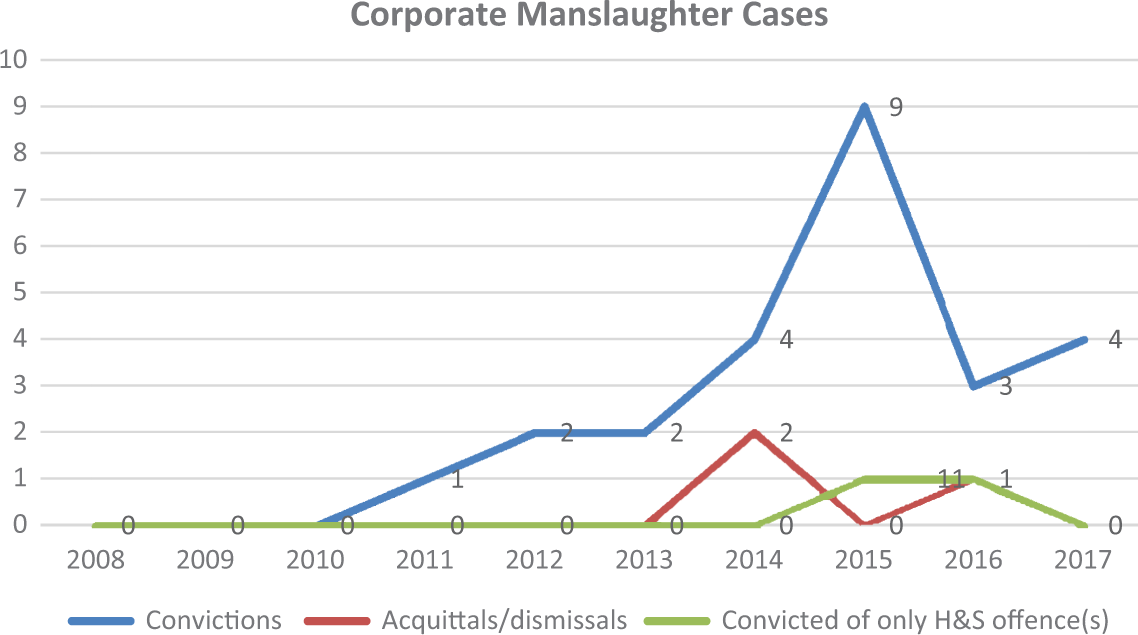
Corporate Manslaughter Case Numbers
Overview
There were no prosecutions in the first few years after the Act’s introduction, the first coming in 2011 with the successful prosecution of Cotswold Geotechnical Holdings Ltd. 158 Cotswold was a small company with only eight employees and a sole director, under the New Sentencing Guidelines discussed below is would be classed as a micro organisation. Cotswold was convicted in relation to the death of an employee who was killed when a pit collapsed on him and received a fine of £385,000. This first case was followed by two convictions in both 2012 and 2013. In 2014, there were four convictions and also the first acquittals under the Act. 159 A noticeable spike in prosecutions occurred in 2015 when nine companies were convicted. The trend of a year on year increase in cases ceased in 2016 though when there was only three convictions and there have been four convictions in 2017 to date (arising out of three cases). We have already had more prosecutions and convictions than ever occurred under the old common law offence though. In 2007, Griffin predicted that prosecutions would only be pursued in the most serious and obvious cases of gross negligence 160 and this appears to be have been borne out in practice.
To date there have been no Scottish cases and a higher number of Northern Irish cases than might have been expected given its relative population. 161 Almond has observed that there has been a complete absence of cases in some areas and a concentration of cases in others, attributing this to ‘clusters of local expertise’ in investigatory and prosecution teams which appears to be a valid assessment. 162 The majority of cases have involved workplace deaths and all the cases have involved one-off incidents as opposed to fatalities caused by industrial disease. Usually, there has only been one death involved (with a few exceptions). The cases illustrate that there tends to be a number of years between the fatality in question occurring and any prosecution and trial. This is to be expected given the requirement for various agencies (police, HSE and Crown Prosecution Service (CPS)) to work together, and the possibility of multiple charges being brought in respect of the same death as noted above. The acquittals in the cases have generally resulted from an inability to convince the court that a gross breach occurred which caused the deceased to die.
HSE statistics confirm that there has not been a significant decrease in the rate of worker deaths, the most often prosecuted type of case, so the question arises as to why there have not been more prosecutions, as predicted at the Act’s implementation.
163
Grimes, a criminal lawyer specialising in business crime, has opined that the primary reason is a lack of expertise in investigatory teams, and the unfamiliarity of the police with incidents of this type: the health and safety subject matter experts [the HSE] are not the ones who review the evidence with a view to considering whether there’s a case of corporate manslaughter. That’s a bit of a structural weakness.
164
Type and Size of Organisations Charged
At the time the new offence was proposed, the government envisaged that most prosecutions would be against companies 170 and this has proved to be the case with all other than one prosecution to date being of a company. A charge of corporate manslaughter was brought against Maidstone and Tunbridge Wells NHS Health Trust as noted above, but the judge held there was no case to answer. 171 Accepting that the deceased should not have died, the Honourable Mr Justice Coulson rejected the prosecution’s assertion that there were systematic failures at the Trust. He held that there was no evidence that any of the alleged breaches, even if they were gross, caused or contributed to the death of the deceased. Should the day eventually come when a public body is successfully prosecuted, it has been opined that fining an organisation which is taxpayer-funded is a somewhat pointless gesture. 172 Others may disagree though, arguing that the state does not operate as single unit and that, as the vast majority of public bodies will have a finite pre-determined budget, the threat of a fine can still be a powerful disincentive. Any potential impact on the provision of services is taken account of to a certain extent in the New Sentencing Guidelines. These provide that where the fine will fall on a public body, the fine should normally be substantially reduced if it would have a significant impact on its services. 173 As noted above, the vast majority of prosecutions have been of micro or small organisations.
Fines—The Highs and the Lows
Before the Act’s introduction, fines in corporate manslaughter cases under the old common law offence tended to be low, in the range of £4000 to £90,000. 174 The main sanction for corporate manslaughter under the Act has always been a fine with no upper limit. The majority of fines sentenced for the new offence have been above the pre-Act range. The average fine under the Original Sentencing Guidelines was £251,138. The average fine under the New Sentencing Guidelines is over double that amount, £528,571. 175 The Original Sentencing Guidelines for corporate manslaughter came into effect in 2010, and followed a period of consultation. The Original Sentencing Guidelines stated that a fine for corporate manslaughter should seldom be less than £500,000, and could be measured in the millions of pounds. 176 There was a 10-stage process for sentencing, which included consideration of aggravating and mitigating factors, and the financial resources of the defendant. The court had the power to impose remedial orders, and publicity orders, in addition to any fine.
In formulating the Original Sentencing Guidelines, the Sentencing Guidelines Council (predecessor body to the Sentencing Council) rejected a recommendation to link the amount of fine to an organisation’s turnover on the basis that the circumstances of defendant organisations, and the financial consequences of the fine would vary too much. 177 This was criticised at the time as a rejection of certainty in favour of judicial discretion, 178 and Slapper described the fine structure under the Original Sentencing Guidelines as ‘unnecessarily weak’. 179 Judicial discretion is all well and good, but the fines in the initial cases varied to such an extent it was impossible to discern a pattern. The majority were also below the recommended £500,000 level (see Figure 2, conviction numbers 1 to 18 relate to the period before the New Sentencing Guidelines were introduced). The lowest was in the case of Mobile Sweepers (Reading) Ltd in 2014. The company was charged with corporate manslaughter and two health and safety offences following the death of an employee who died from crush injuries while repairing a road-sweeping truck at a farm. The company pleaded guilty to the corporate manslaughter charge and the health and safety offences were left to lie on the file. The fine imposed on the company was arguably an insulting £8,000, albeit together with costs this amounted to all of the company’s assets. 180 Judge Boney commented that the fine would have been much great, closer to £1 million, if the company had a larger turnover.
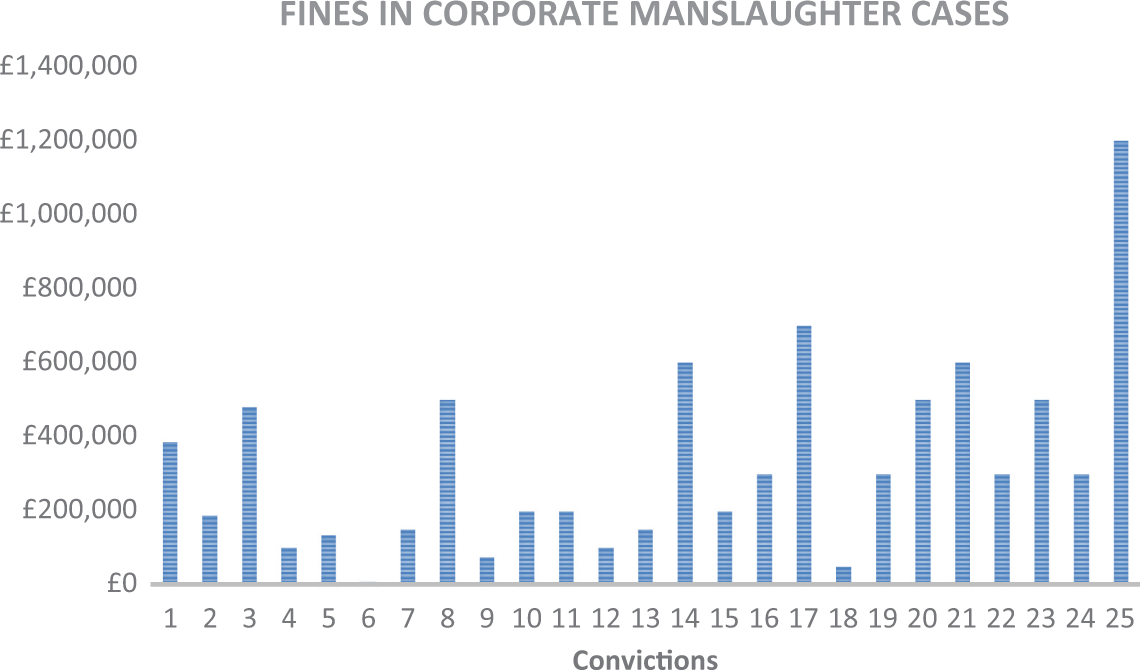
Fines in corporate manslaughter cases under the act 202
By 2014, the fines imposed under the Original Sentencing Guidelines were coming under attack from commentators such as Field and Jones, and Wells.
181
After the first 11 corporate manslaughter convictions, Field and Jones opined that the sentencing outcomes appeared to vary significantly, and that in a number of the cases the courts had been overly concerned with the financial health of the company rather than the interests of justice.
182
The first corporate manslaughter case, Cotswold Geotechnical Holdings Ltd, confirmed from the outset that a fine which had the effect of putting a company out of business might be an acceptable consequence of a conviction, and the company was indeed subsequently dissolved. Both versions of the sentencing guidelines also clearly state that in some cases insolvency is an acceptable consequence.
183
A number of companies have ceased trading or become insolvent following a fatality, both before and after conviction for corporate manslaughter. In general though, the courts often showed a reticence to push defendants into insolvency as Field and Jones note: in spite of the tough rhetoric and provision for ‘severe and punitive’ penalties, few fines could be said to conform to these criteria to date: the courts have tended to be more concerned with protecting the viability of the offending company.
184
In November 2014, the Sentencing Council issued a consultation paper on sentencing for corporate manslaughter. 187 The Sentencing Council noted that it was proposing to introduce an approach to sentencing for health and safety offences that would more closely link the means of the offender and the seriousness of the offence to the final sentence. 188 Given the close relationship between health and safety offences and corporate manslaughter, it was thought necessary to review and update both sentencing guidelines at the same time to ensure a consistent approach. 189 The Sentencing Council must have also been motivated by the widespread criticism that had been directed at the fines in the initial corporate manslaughter cases. Under the New Sentencing Guidelines, the multiple-step sentencing process is retained; the main change is that there is now a clearer link between the organisation’s turnover and the starting point for the fine. First, the court has to determine whether there was a higher or lower level of culpability taking into account things such as how far short of the appropriate standard the defendant fell and whether there was more than one death. 190 Where there is a higher level of culpability, the offence will be categorised as category A. Where there was a lower level of culpability, the offence will be categorised as category B. The court must then determine the size of the organisation (large, medium, small or micro) by reference to its turnover to work out the starting point for the fine and the fine range (see Table 1).
Sentencing Guidelines as to fines. 191
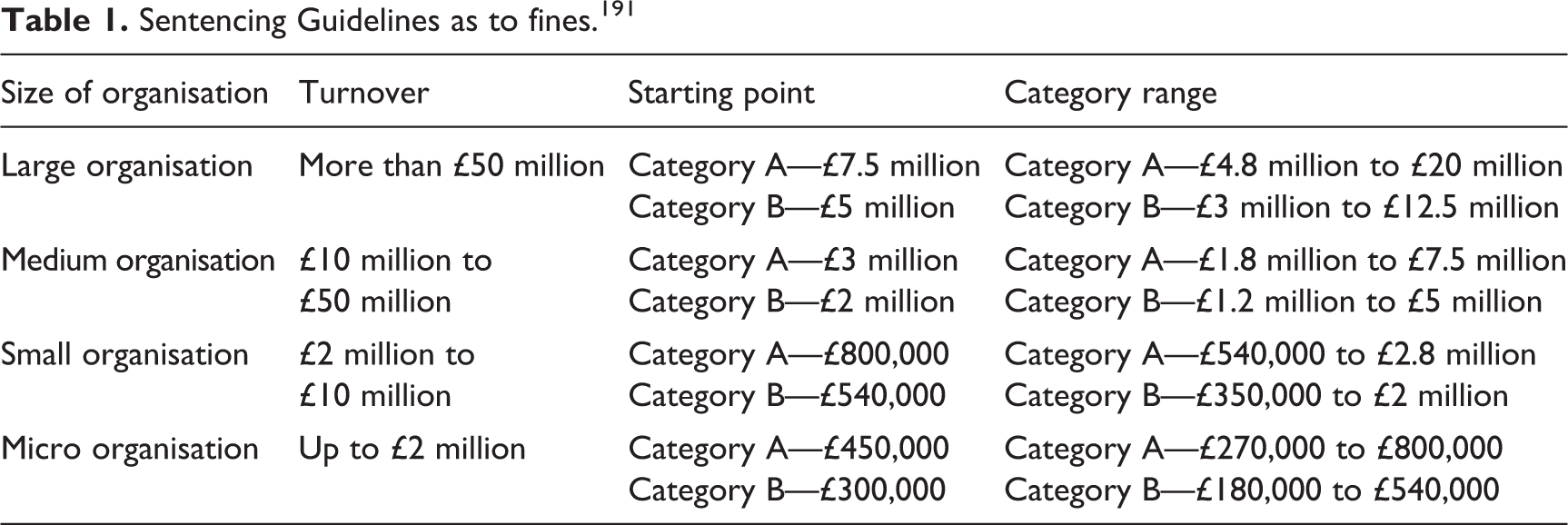
The suggested starting points and range of fines set the expectation that there would be a very significant increase in the levels of fines in corporate manslaughter cases. It is worth noting that the suggested starting point for fines for large and medium-sized organisations are both considerably in excess of £500,000, the benchmark under the Original Sentencing Guidelines. Even the starting point for a small organisation is significantly over £500,000 where the offence is category A. For example, if CAV Aerospace Ltd had been sentenced under the New Sentencing Guidelines we might have expected a fine in excess of £20 million rather than £600,000.
So what has happened since the New Sentencing Guidelines were introduced? Well the predictions of huge hikes in corporate manslaughter cases did not immediately come to pass. The first six sentences handed down under the New Sentencing Guidelines indicated that we could expect fines in future cases to be higher than they were before, but perhaps not as high as anticipated (see Figure 2, conviction numbers 19 to 24 relate to the first six sentences in the period after the New Sentencing Guidelines were introduced). The fine in all of these cases was within the range of fines imposed previously, although higher than the average fine imposed under the Original Sentencing Guidelines. Two defendants received a fine of £500,000, 192 one defendant received a fine of £600,000, 193 the other three defendants received fines of £300,000. 194 At first glance, fines of £300,000 seem disappointingly low. It should be noted though that the three companies concerned were micro organisations and the fines fell within the relevant category range (see Table 1). They also all pleaded guilty which will have led to a reduction in the level of the fine. 195 It has been observed that the £300,000 fine in the SR and RJ Brown case was high relative to the size of the offender and potentially indicative that the new guidelines may be resulting in larger fines than would previously have been the case. 196 This contention is correct, notwithstanding, the court could have still been more punitive. The facts of the case indicated a high level of culpability, the company had no proper risk assessment or method statement for the work and there was an absence of safeguards that would have prevented the deceased falling to his death. Although the judge categorised the offence as category A, the fine imposed (even discounting the 25 per cent reduction for the guilty plea) was still below the indicative starting point of £450,000 and well below the top of the category range (£800,000). The courts appeared to be prepared to be more punitive, just not as punitive as they possibly could, that is until a landmark sentence was passed. In July 2017, Martinisation (London) Ltd, a company with a turnover of £9.7 million was fined £1.2 million in relation to the deaths of two employees who fell from a first floor balcony as they tried to hoist a sofa up from the pavement. 197 This is the first time a fine measured in the millions of pounds has been imposed, the previous largest sanction was £700,000 against Baldwins Crane Hire Ltd, a medium-sized company with a turnover of £22 million. 198 Martinisation (London) Ltd was categorised as a small organisation (although it was only just below the turnover threshold to be classed as a medium organisation) and the judge viewed the level of culpability as high and therefore both corporate manslaughter offences were category A. The company had a poor health and safety track record, having received a number of enforcement notices from the HSE in the past, and had ignored advice to hire specialist equipment at a cost of £848 to lift the sofa. Despite the company already being in liquidation, the court was prepared to impose a fine significantly in excess of all preceding corporate manslaughter fines. The fine was well above the £800,000 starting point and within the fine range for a category A offence (£540,000 to £2.8 million). The court also imposed a publicity order and one of the company’s two directors was jailed for health and safety offences. The adherence of the court to the principles in the New Sentencing Guidelines and the imposition of a fine which is reflective of the gravity of the crimes committed in the Martinisation (London) Ltd case is to be commended. This case is the clearest indication since the introduction of the New Sentencing Guidelines of a paradigm shift in the sentencing of corporate manslaughter cases.
There were some concerns raised about the potential hike in fines for corporate manslaughter under the New Sentencing Guidelines. Forlin queried whether it might cause very large organisations to consider relocating out of the jurisdiction. 199 It is postulated that this is unlikely. The costs and inconvenience of relocating are always going to hugely outweigh the low risk of prosecution, something such companies would be aware of from their advisors. Other concerns raised by Forlin though, such as the spectre of more contested, lengthier and complex trials, may yet prove to be valid. 200 Early indications based on the recent cases suggest a significant proportion of defendants will continue to plead guilty. Field and Jones have also noted that there may be difficulties in ensuring the courts apply the New Sentencing Guidelines correctly. They argue that it will be a challenge for the courts to analyse detailed accounts and financial reports and to understand potentially complex group structures in order to categorise an organisation’s size. 201 Again, we will have to wait and see if this proves to be the case.
The New Sentencing Guidelines represent a significant step forward and should help to ensure greater uniformity in corporate manslaughter sentencing. Despite this, it is still difficult to predict with accuracy the level of fine that will be meted out in any particular case. The cases sentenced under the New Sentencing Guidelines thus far suggest we can expect significantly higher average fines in the future than we have seen in the past, sentences which better reflect the severity of the crime committed. Of course, if prosecutions continue to principally be brought against micro and small organisations we are unlikely to see million pound fines being routinely imposed. The New Sentencing Guidelines were not intended, and would have been the inappropriate vehicle, to address any perceived lack of prosecutions of large companies.
Remedial, Publicity and Compensation Orders
As noted above, the court has the power to make a remedial order in corporate manslaughter cases. This is in addition to the power of the HSE and local authorities already have to require improvements and such bodies are likely to intervene much quicker than a court could. 203 It was acknowledged by the Joint Committee that remedial orders would be rarely used in practice, 204 and to date no remedial order has been made in any of the cases.
The possibility of a publicity order is clearly designed to act as another deterrent to lax health and safety practices. A publicity order may potentially be more damaging than a fine as it has reputational implications and it has been articulated that it could also affect share prices and lead to higher insurance premiums. 205 Ormerod and Taylor contended that large organisations might be more concerned about adverse publicity than a fine. 206 Publicity orders have only been made against 8 207 of the 25 successfully prosecuted companies which have been sentenced despite both versions of the sentencing guidelines confirming that a publicity order should ordinarily be imposed. 208 Corporate manslaughter cases tend to attract significant media coverage and a publicity order may be viewed as achieving little where information has already been circulated in the public domain. This may be one of the reasons publicity orders have not been made routinely. It has been argued that a publicity order may present the facts in a more balanced way than the press might otherwise 209 and they may help to ensure accuracy of reporting. On a number of occasions, there has been inconsistent reporting of the level of fine imposed in a corporate manslaughter case. For example, most of the reporting on the recent Martinisation (London) Ltd case correctly stated that the fine payable was £1.2 million. However, other articles in the construction press gave the impression that the company was ordered to pay £2.4 million in respect of the two counts of corporate manslaughter and £650,000 for a health and safety breach, i.e. over £3 million in total. 210 The company was ordered to pay £1.2 million in total because the sentences were concurrent. In order to ensure that reporting is balanced, factually accurate and not misleading in any way, publicity orders should be routinely imposed in accordance with the provisions of the New Sentencing Guidelines.
The court also has the ability to consider making a compensation order. The New Sentencing Guidelines acknowledge that the assessment of compensation in cases involving death will usually be complex and will ordinarily be covered by insurance. 211 It is anticipated that in the majority of cases the court will conclude that compensation should be left to the civil courts. A compensation order has not been made in any of the cases to date.
Concurrent Health and Safety Proceedings Against the Organisation
As noted above, the Act is intended to complement rather than replace existing health and safety law. When a corporate manslaughter prosecution is pursued, a health and safety charge(s) is also usually brought in the majority of cases. In a significant number of the cases, health and safety charges have been left to lie on file though when a company has pleaded guilty to corporate manslaughter. This means that a defendant has been simultaneously convicted of both corporate manslaughter and a health and safety offence in less than half of the cases.
Concurrent Proceedings Against Individuals—Gross Negligence Manslaughter, Health and Safety and Director Disqualification
In the 25 instances where a company has been convicted of corporate manslaughter, it is notable that an individual has simultaneously been convicted of gross negligence manslaughter only twice. 212 This means should a company be convicted of corporate manslaughter there is less than a one in ten chance of any individual been convicted of gross negligence manslaughter. Although many more gross negligence charges have been brought in the cases, ultimately, the individuals have been acquitted or the prosecution has decided not to pursue the charge. 213 Individuals could, and still can, also be charged with health and safety offences 214 or be disqualified as a director (where relevant). 215 In corporate manslaughter cases under the Act, disqualifications have occurred in only 6 cases 216 and an individual has been convicted of a health and safety offence in 10 cases. 217
It is questionable whether the pre-existing law, particularly gross negligence manslaughter, was in fact adequate given how infrequently it is being successfully employed. Field and Jones have even gone as far as to suggest that individuals are less likely to be convicted with their companies under the Act than they were under the old common law: ‘the current picture would suggest that directors are in fact escaping prosecution, and thus being treated more leniently than was the case prior to the [Act]’. 218 Individual(s) have only received some form of personal sanction in 40 per cent of the cases to date. It should be noted that a significant proportion of cases where individuals have also been sanctioned have occurred after the introduction of the New Sentencing Guidelines. All except one case post February 2016 has involved simultaneous conviction of a director(s) for an offence. This may denote a tougher approach towards individuals in the future along with higher fines for organisations.
Conclusions
Creating a new statutory offence of corporate manslaughter was always going to be challenging. Various points of law were hotly debated in the long period of consultation before the Act was introduced, and respondents did not always agree about how the criminal law should be applied in corporate manslaughter cases. This article has investigated and brought fresh insight into this still evolving area of law through: analysis of the Act’s perceived weaknesses; scrutiny of the extent to which the Act has been successful in meeting its stated aims; exploration of the judicial precepts in this area; and consideration of what the future holds for corporate manslaughter.
Whether the Criticism of 10 Years Ago Has Proved to be Well Founded
The melding together of company law and criminal law in the Act, two usually distinct and complex areas of law in their own right, unsurprisingly provoked much debate and comment at the time. Later commentators have paid little regard to this useful body of literature so the author has used it to aid her critical interpretation of the Act’s performance in practice over the last 10 years. Surprisingly, questioned elements of the offence like the requirement to establish a duty of care and the senior management test have not proved to be central issues in the cases to date. It must be conceded that without the requirement for senior management involvement, it is very likely we would have seen a higher volume of cases prosecuted to date. However, in relation to the cases that have been prosecuted, the senior management test does not appear to have been the overwhelming barrier to securing prosecutions that many experts feared, and, whilst a flawed mechanism for attributing liability, it certainly represents an improvement on the identification doctrine. We await with interest a case that will further explore the relatively liberal interpretation of the senior management test posited in the recent case of Maidstone and Tunbridge Wells NHS Trust. The Act has outperformed its critics on certain issues. On the other hand, unease about other aspects of the offence, such as the requirement for DPP consent, wide-ranging public policy exemptions and the exclusion of individual liability do appear to have had a negative impact on the Act’s effectiveness as predicted. If the Act had provided for some form of individual liability (which was mooted and ultimately rejected) it would undoubtedly have a greater potential deterrent and have been more efficacious.
Has the Act Been Successful in Meeting Its Stated Aims?
The Act has not been the failure some experts predicted, but it occupies a statutory ‘middle ground’ in many respects. The government was seeking to balance the health and safety of workers and the public against the concerns of industry. This compromised approach has led to compromised results. We have seen an increase in the number of corporate manslaughter convictions and higher average fines being imposed. There have also been some convictions of medium companies and one large company, something that would have been almost unimaginable under the old law because of the restrictive identification doctrine. At times, the Act has been met with unwarranted criticism due to a perceived failure to prosecute enough large companies. Health and safety statistics suggest that large companies are responsible for relatively few fatalities and that it is in fact reasonable to expect the majority of prosecutions should be of SMEs. Bearing this in mind, the fact that there has only been one conviction of a large company does not mean that the Act has been unsuccessful in meeting its aim of creating a level playing field for organisations of different sizes, at least in respect of companies. Conversely, the reform was not as radical as many hoped.
The number of prosecutions each year has fallen short of what was projected and the Act has not yet realised its full potential in other ways as well. Only companies have been convicted of the new offence despite the wide spectrum of entities capable of committing the offence. The Act must rightly be accused of not creating an even playing field for different types of organisation: prosecutions have almost been entirely company centric. Neither have any of the cases to date concerned long-term fatal damage to health, and it remains to be seen whether the Act could be used to prosecute an organisation which has caused a multi-fatality disaster of the type the Act was intended to address. The Act did not attempt to impose individual liability, nonetheless it is impossible to entirely separate the issue of individual culpability from corporate liability. In order to secure corporate manslaughter convictions, prosecutors have often been willing to drop individual charges against directors and managers. We therefore have a position where, more often than not, directors and managers are not also held personally accountable. This has no doubt had an impact on the Act’s deterrent effect, although early indications are that that the courts may now be more willing to sanction individuals following the introduction of the New Sentencing Guidelines. The Act is neither a failure nor a resounding success, as it has only been partially capable of meeting its aims. As it is still a relatively new offence, it is possible that the Act may fulfil all its aspirations in due course. Clearly, much more proactivity in prosecution would be required for all the offence’s ambitions to come to fruition.
The Case Law—Commonalities and Identifiable Trends
A detailed review of the cases has confirmed that the Act is a more potent tool for prosecuting corporate manslaughter than the common law gross negligence manslaughter offence despite its flaws. There have been a small number of acquittals or dismissals, yet the majority of prosecutions have led to conviction. Approximately two-thirds of defendants have pleaded guilty which indicates a belief amongst defendants (or their advisors) that the Act has teeth and that they are more likely than not to be convicted on trial. Average fines under the new regime have generally been consistently higher than under the old regime. Consistency in sentencing has proved to be more problematic. Organisations cannot be incarcerated and, therefore, a fine is usually accepted as the most appropriate penalty for corporate offences. The problem is that whilst an individual who is convicted of as crime can be incarcerated regardless of whether they are rich or poor, an organisation’s ability to pay a fine is inextricably linked to its financial position. Bearing this in mind, judges have often found it hard to impose fines that reflect the seriousness of the offence and which are consistent with the fines imposed in other cases and the principles of sentencing. The New Sentencing Guidelines, which link the starting point for a fine with an organisation’s turnover, appear to have gone a significant way to answer these concerns. The recent cases sentenced pursuant to them give the impression that we can expect consistently higher average fines in future cases. If a company is charged with corporate manslaughter it is more likely than not that it will also be charged with a health and safety offence, albeit such charges are not always ultimately pursued. Publicity orders have only been made a small number of times and the court has never made a compensation order.
Plea bargaining has been a clear trend, especially in the earlier cases. It will be interesting to see if this is something which continues in the post New Sentencing Guidelines regime or if a tougher stance will be adopted along with potentially higher fines and a greater appetite for convicting individuals simultaneously. Convictions of individuals for gross negligence manslaughter are rare under the new regime, although the initial filing of charges is far more common. Disqualification as a director has occurred in only 20 per cent of the cases and individuals have been convicted of health and safety offences in only 40 per cent of the cases.
In summary, based on the prosecutions over the last 10 years, if an organisation is involved a fatality it is still statistically unlikely that it will be charged with corporate manslaughter, especially if it is not a limited company. The organisation is more likely to ‘just’ face a health and safety prosecution. If a defendant is charged with corporate manslaughter though, it will more likely than not be convicted. If a corporate manslaughter charge is brought, it is very likely health and safety charges will also be brought against the organisation, although there is only around a 50 per cent chance of the defendant being convicted of both corporate manslaughter and a health and safety offence. Following the introduction of the New Sentencing Guidelines, organisations can now expect higher fines than they could previously. It would still be quite difficult to predict with accuracy the level of fine that would be imposed in any particular case. A guilty plea on behalf of the company is likely to result in a reduction of the level of the fine and possibly other charges against the company and/or individuals being dropped, although the courts may not be as willing to do this in the future as they have been in the past. Whilst a possibility, it is unlikely that a publicity order will be imposed, in any event the incident is likely to attract adverse publicity in both the national and trade press. A compensation order and/or remedial order almost certainly will not be made.
If an organisation is charged with corporate manslaughter, it is quite likely that an individual, usually a director, will be charged with either breaching health and safety law or gross negligence manslaughter. There is a disconnect between charging and prosecution—the former being far more common than the latter. Gross negligence manslaughter convictions are still rare. Health and safety convictions are more frequent, but have still only occurred in less than half the cases. There is the possibility of director disqualification (where relevant), again fairly unlikely. In the past, it was more likely than not that no individual would be sanctioned at all. Analysis of cases post February 2016, when the New Sentencing Guidelines became effective, has revealed a new vigour for holdings individuals to account along with their companies. Future cases are awaited with interest to see if this trend continues.
The Future of Corporate Manslaughter
Revisions to the sentencing guidelines appear to have provoked a noticeable increase in the level of fines imposed for the offence and the courts have recently demonstrated an increased appetite to convict individuals alongside their companies. In isolation, these things are not enough to facilitate the Act to realise its full potential. The Act is being prosecuted, just not as effectively or fully as it could. The type of prosecutions being brought under the Act is fairly narrow in respect of the type of organisation, victim and injury. Given the very significant amount of time it took for the Act to be passed in the first place, and how much political time Brexit is likely to consume, it seems unlikely any government would have the appetite to embark on another round of consultation with a view to make substantive amendment to the Act itself. Prosecutor training is a more realistic option. Unless prosecutors are prepared to cast their net more widely in the future, we are likely to continue to see little variety in the type of organisations prosecuted, and the nature of the fatalities involved. The wider the prosecution net the more successful the Act will be in its aim discouraging negligent health and safety practices. Once an organisation is found guilty, judges should be prepared to set fines which are within the relevant guideline parameters and which reflect the sentencing objectives as the court did in the recent case of Martinisation (London) Ltd. Any fine imposed should meet the objective of punishment, encourage a reduction in offending, and reflect the seriousness of the offence even if this does sometimes mean the company will become insolvent. Publicity orders should be made in every case to avoid inconsistencies in reporting.
The Act and the cases prosecuted under it have attracted widespread publicity in the local, national and trade press. This has to be helpful in reminding organisations and their managers about the importance of good health and safety practices yet we still have a long way to go. Preventing unnecessary deaths is still as relevant today as it was when the Act was introduced. In 2015/2016, 144 people died at work in Great Britain 219 and the significant loss of life suffered in the Grenfell Tower fire is a tragic reminder that health and safety is not just a workplace issue. Incidents like this could and should be preventable. The chances of any organisation being convicted of corporate manslaughter in relation to any death is only very marginally higher than it was under the common law. Grenfell Tower will likely become the most significant test of the Act to date. In order to secure a conviction, a reconceptualisation of the meaning of offender, as argued above, may be required. Can the Act successfully prosecute an organisation which has caused a multi-fatality disaster of the type it was enacted to confront? Without enhanced training, will the multi-agency investigatory and prosecution team be able to build a cogent case from the overwhelming amount of complex evidence it is in the process of gathering? If no corporate manslaughter prosecution(s) are brought, the Act will be regarded as a failure; if prosecution(s) are brought and fail, the Act will be regarded as a failure. Ten years after the Act was introduced, we have come a long way, nevertheless there is still further to go. Arguably, the picture is one of progress, but we owe it to the many people who die unnecessarily each year, like those who died in the Grenfell blaze, to strive for nothing less than perfection.
Footnotes
Declaration of Conflicting Interests
The author(s) declared no potential conflicts of interest with respect to the research, authorship, and/or publication of this article.
Funding
The author(s) received no financial support for the research, authorship, and/or publication of this article.