



Abstract
Although socialization values have been consistently linked to sociocultural context, little is known about the question of to what extent societal change is reflected in socialization values. The present study’s aim was to address this research gap by comparing the short-term and long-term socialization values of mothers of adolescents from two different cultural groups (142 ethnic Estonian and 65 Russian-speaking mothers) living in a country of transition—Estonia—to those of 150 Swedish mothers residing in the relatively stable Sweden. The Child-Rearing Value Questionnaire consisted of two different tasks: (a) open-ended questions and (b) item ranking task. Answers to open-ended questions about valuable characteristics in the child in the present, in adulthood, and the mothers’ own characteristics they would like to pass to their children showed that the Swedish mothers’ short-term and long-term socialization values did not differ. The answers of Estonian and Russian Estonian mothers, in turn, appeared to reflect socialization value change in Estonia toward less emphasis on traditional values: The Estonian mothers mentioned conformity values and Russian Estonian mothers hard work less frequently when describing children in adulthood than when describing themselves. Both Estonian and Russian Estonian mothers stressed achievement when describing children in adulthood, whereas achievement and hard work were mentioned less frequently when describing children in the present. In the item-choosing task, the Swedish mothers were more likely than mothers living in Estonia to choose “belief in his/her abilities” among the three most important characteristics.
Keywords
Several developmental psychologists have been interested in cultural differences in parental socialization values because of their importance for understanding parental behavior and child outcomes in a wide variety of areas (see Hirsjärvi & Perälä-Littunen, 2001; Hoff, Laursen, & Tardif, 2002; Holden, 1995). Generally, great variability in dominant socialization values of parents from diverse cultural settings has been related mainly to differences in cultural value systems (e.g., individualism vs. collectivism) and the underlying cultural models of self, relationships, and family (Harkness & Super, 2006; Harwood, Handwerker, Schoelmerich, & Leyendecker, 2001; Keller, Borke, Yovsi, Lohaus, & Jensen, 2005; Leyendecker, Harwood, Lamb, & Schoelmerich, 2002). Most of the cross-cultural research on socialization values has occurred within an individualism-collectivism framework. Many researchers have identified two basic cultural pathways of development: socialization towards independence with an emphasis on individualistic values related to self-actualization, self-expression, and self-confidence, and socialization towards interdependence, which places importance on responsibility, honesty, politeness, respect for elders, conformity, and social obligations (see Greenfield, Keller, Fuligni, & Maynard, 2003).
Recent studies have increasingly shown the dynamic and complex interrelatedness of the sociocultural context and socialization values, as socialization value systems in all cultures—despite the specific cultural ideology or developmental model—include aspects of both independence and interdependence. Parents from cultures with dominantly individualistic orientation have been found to hold some socialization values typical of collectivistic orientation, and vice versa (Leyendecker et al., 2002; Wang & Phinney, 1998; Wang & Tamis-LeMonda, 2003). Cultural conceptions of independence and interdependence differ across cultures (Raeff, 2010). Moreover, cultures change historically.
Besides these prototypical independent and interdependent cultural orientations, a third—psychological interdependence—has been proposed in which emotional independence is combined with economical interdependence, and socialization values focus on autonomy as well as on integration into the family (Kagitçibaşi, 1996, 2005). Kagitçibaşi’s autonomous-relatedness model has found support in studies made in non-Western collectivistic societies undergoing urbanization and economic development that require better education than before or in immigrant families living in an independently oriented culture like the United States (see Kagitçibaşi, 2005). It is also likely that parents in societies that are restoring market economy and democracy represent an autonomy-relatedness model. For instance, studies carried out in Estonia, which was incorporated from 1940 to 1991 into the Soviet Union, show that parents of preschoolers seem to manifest the pattern of autonomous-relatedness (Tulviste & Ahtonen, 2007; Tulviste, Mizera, De Geer, & Tryggvason, 2007).
The change in socialization values over historical times has become a relevant research topic among psychologists during the last decade (Boehnke, 2001; Kagitçibaşi, 1996; Keller et al., 2005; Keller & Lamm, 2005; Suizzo, 2007). Yet little is known about the question of to what extent is cultural change reflected in socialization of children and child development (cf., Silbereisen, 2005). It has been shown that in Germany, changes in cultural values generally occur one generation (about 30 years) later than sociodemographic or socioeconomic changes (see Keller & Greenfield, 2000). It seems likely that different sociocultural contexts differ in respect of the amount of change in their value orientation as well as in the tempo of changes. In rapidly changing societies, value orientation can possibly change even quicker than over the course of successive generations (see Klages, 2005), because parents have to adapt their socialization values and practices to new environmental demands. This rapid change in developmental contexts may allow psychologists to better understand the relationships between socialization values and sociocultural factors. Moreover, value systems in such cultures are characterized by wide diversity and complexity: Besides emphasizing traditional values, parents in such societies have been shown to encourage achievement and independence—the characteristics that are desirable for meeting the demands of rapidly changing society (Lin & Fu, 1990; Tudge et al., 1999; Tulviste & Ahtonen, 2007; Tulviste et al., 2007; Wang & Tamis-LeMonda, 2003). One of the limitations of previous research lies in the fact that although it is known that socialization values change as a function of the transformation of society (Kagitçibaşi & Ataca, 2005; Lin & Fu, 1990), relatively few empirical comparative studies have been conducted on the issue.
Within-culture variability in socialization values has been related mainly to such sociocultural factors as parental educational level, income, neighborhood ecology, ethnicity, and the child’s gender (Hoff et al., 2002). The socialization values have also been demonstrated to vary between majority and minority groups (Citlak, Leyendecker, Schoelmerich, Driessen, & Harwood, 2008). Turkish mothers who are more integrated into German culture have been shown to value individualistic goals more than Turkish mothers who are separated from German culture (Durgel, Leyendecker, Yagmurlu, & Harwood, 2009). A study by Rosenthal and Roer-Strier (2001) found that Soviet-born mothers expected their children to be efficient, achievement-oriented, hard-working, and organized adults to succeed in life, while Israeli-born mothers prioritized the development of self-confidence in children. Another shortcoming of previous research lies in the fact that little attention has been paid to similarities and differences of socialization values held by members of different cultural groups (e.g., majority and minority families) in times of social change.
Most previous comparative studies about socialization values have been conducted in countries with markedly different sociocultural backgrounds (Harkness & Super, 2006). Estonia and Sweden, in contrast, are similar in many respects: Both are members of the European Union and have a low population density, Nordic mentality, and prevalently Protestant morale. The countries are similar by measures of individualism and power distance (Hofstede, 2001). At the same time, the countries differ by their historical past. The life standard in Estonia is still remarkably lower than in Sweden (GDP—per capita, 2009: $21,200 and $38,500, respectively). After regaining the independence from the Soviet Union in 1991, Estonia has experienced rapid economic growth and political, societal, and economic transformations.
Comparative studies about socialization values have found that Swedish mothers of preschoolers tend to stress rather the characteristics connected with self-direction as well as self-confidence and do not value the so-called traditional socialization values (Tulviste et al., 2007). Estonian parents, on the other hand, combine the modern Western values of self-direction and self-maximization with traditional socialization values such as respect of elders, politeness, obedience, and hard work.
Previous comparative studies on childrearing values have focused on Estonian parents, overlooking the Russian-speaking minority group. As a result of the Sovietization politics, Estonia now has two noticeably different communities: ethnic Estonians and nonethnic residents in Estonia. The majority of nonethnic Estonians (38.5%) belong to the Russian-speaking minority. Most of them are descendants of the people who settled in Estonia after the country was incorporated into the Soviet Union.
The main distinctions between the two communities are based on their legal status (Estonians are mostly Estonian citizens, whereas only one third of non-Estonians are Estonian citizens), language (Estonian is a Finno-Ugric language, whereas Russian is a Slavic language), and culture (Protestant Estonian culture vs. Russian Orthodox culture). There is surprisingly little contact between the ethnic Estonians and ethnic Russians living in Estonia (Korts, 2008). It has been noted that, like most ethnic minorities in Europe, the Russian-speaking population in Estonia seems to suffer from the so-called ethnic wage gap mostly explained by lower education and poor official language proficiency (Leping & Toomet, 2008). Estonia’s ethnic minorities have also been found to be characterized by significantly lower social capital with respect to the extent of the social network, participation in nongovernmental organizations, and trust (Masso, 2009). At the same time, compared to Estonians, the Russian-speaking minority has been demonstrated to be significantly more collectivistic in values and attitudes toward the family and society (Kants & Realo, 1999).
Vihalemm (2009) observes that “while Estonians have very clearly shown their preference for the new political order in all surveys since 1993, the local Russians have rated both the Soviet-era economic system and political regime more positively than the current ones in all surveys” (p. 88). It has also been noted that while “ethnic Estonians often identify with the residents of the Nordic countries, the Nordic dimension remains alien to the Estonian Russians” (Vihalemm & Kalmus, 2008a, p. 69). Thus, it seems likely that ethnic Estonians feel the need to shape their values according to the Nordic model, while Estonian Russians feel more secure with maintaining their traditional value system. Furthermore, in their analysis of data ranging from 1991 to 2005, Vihalemm and Kalmus (2008a, 2008b) found that while values centered around the individual (such as self-respect and -realization) had substantially increased among Estonians, values such as national security and freedom had gained more significance among the Russians living in Estonia. In respect of their values, Russian youth (15- to 24-year-olds) were found to differ from their parents to a greater extent than Estonian youth from their parents. Hence, the previously mentioned findings about socialization values in Estonia may not capture the views of Russian mothers residing in Estonia.
The third limitation of previous studies lies in the fact that empirical studies have been addressing either the short-term socialization values (e.g., what parents value in children in the present) or the long-term socialization values—what they expect to see in their children in adulthood. There are no empirical studies focusing on the comparison of short-term and long-term socialization values. At the same time, recent theoretical argumentation stresses that socialization values depend on the current sociocultural context, as well as on the context of the past and the context of the future (Cole, 1996; Valsiner, 2000). It has been argued that parents’ long-term values for their children’s futures might have an even greater impact on the children’s development than short-term socialization values (Suizzo & Cheng, 2007). Generally, parents have been found to like in children the characteristics that they have found to be important in order to achieve success in their own endeavors (Kohn, 1959). At the same time, every parent’s aim is to socialize his or her children to become “adaptive adults” with characteristics optimal for successful functioning in a given society (Roer-Strier, 2001; Rosenthal & Roer-Strier, 2006). It seems likely that in all societies parents socialize their children somewhat differently from themselves, in a way preparing children for the society of the present and future. Because of that there might be bigger differences between parents’ past, current, and future values in countries of transition than in stable countries. Moreover, majority and minority families might also differ in this respect.
The Present Study
The first aim of the study is to compare socialization values of mothers from two different cultural groups, ethnic Estonian and Russian-speaking minority groups living in a society in transition—Estonia—to those of Swedish mothers in a relatively stable society—Sweden—paying special attention to the so-called traditional childrearing values. In previous studies with parents of preschool-age children, socialization values held by Estonian mothers have been noted to differ from Finnish and Swedish parents mainly by more importance placed on the traditional values (Tulviste & Ahtonen, 2007; Tulviste et al., 2007). At the same time, no cultural differences have been found in valuing self-direction in children (e.g., independence and creativity), when comparing Estonian mothers with mothers from Russia, South Korea, and the United States (Tudge et al., 1999), or from Finland and Sweden (Tulviste & Ahtonen, 2007; Tulviste et al., 2007). Similarly, a recent study on childrearing values of Estonian mothers revealed within-society heterogeneity in respect to traditional socialization values in Estonia, which were typically stressed rather by the mid–socioeconomic status (SES) Estonian mothers and the mothers of sons than by the high-SES mothers and the mothers of daughters (Tulviste & Mizera, 2010).
The study focuses on the mothers’ socialization values, as in previous studies it has been found that in respect to socialization values fathers are similar to mothers (Tulviste & Ahtonen, 2007). Since most of the previous research has been conducted on the maternal socialization values, the focus on maternal values makes the results of the present study more comparable with other studies.
It is likely that parental socialization values depend on the child’s age (Chiu, 1987). Parents of adolescents were used in the present study because in previous comparative studies mainly parents of preschoolers have participated. We were interested to see how general the finding is that Estonian parents focus on a cultural model of autonomous-relatedness. Moreover, using mothers of adolescents decreases the likelihood that found differences in what they value in their children in the present and when they will be adults reflect rather differences between characteristics of small children and those of adults than differences between the current and future socialization values.
The present questionnaire consists of two different tasks: open-ended questions and item-choosing task. In open-ended questions, mothers are asked about desirable characteristics in children in the present, in the future when they are in adulthood, and mothers’ own valuable characteristics they would like to pass on to the child. Based on previous studies, we find it likely that significant cultural differences among similar cultures appear only in mothers’ spontaneous value judgments—in their answers to the open-ended questions (see Tamis-LeMonda, Wang, Koutsouvanou, & Albright, 2002). In addition, answers to the open-ended questions allow us to check whether childrearing values in the list of items used in the item ranking task correspond to those spontaneously named by mothers from three different cultural groups.
Previous comparative studies have found evidence of a decreasing emphasis on conformity values like politeness, obedience, and respect of elders with increasing levels of education (Hoff et al., 2002). However, it is plausible that socialization values vary also according to children’s and mothers’ age and education by ethnic group as the societal changes might be perceived differently. Hence, the previously mentioned findings may not capture the views of Russian mothers residing in Estonia, and the present study aims to fill this gap. Our Hypothesis 1 states the following: Cultural differences among mothers in Estonia (both Estonian and Russian Estonian mothers) and Sweden occur rather in the characteristics related to traditional values than in those of self-direction and self-maximization.
The second goal of the study is to find out how similar the short-term and long-term socialization values of mothers from two cultural groups in Estonia to those of mothers from Sweden are. To this aim, answers given to open-ended questions indicating what mothers value in their child (current values) are compared to those showing what the mothers would like their child to be in adulthood (future values) and which of their own values they would like to pass on to their child (past values). In previous studies, descriptions of desirable child characteristics have been put together with those of children in adulthood or mothers’ own characteristics (Leyendecker et al., 2002; Tulviste & Ahtonen, 2007; Tulviste et al., 2007). Our Hypothesis 2 states the following: There are bigger differences between the short-term and long-term socialization values of Estonian and Russian Estonian mothers than between the short-term and long-term socialization values of Swedish mothers.
Method
Participants
The samples consisted of a total of 357 mothers of adolescent children ranging in age from 27 to 56 years (M = 39.70, SD = 5.34). The adolescents ranged in age from 10 to 14 years (M = 12.12, SD = 1.01). Two hundred and seven mothers were from Estonia. One hundred and forty-two of them (57 had an adolescent son, and 85 an adolescent daughter) identified themselves as Estonians and spoke Estonian as their native language; 65 (36 had an adolescent son, 26 an adolescent daughter, 3 mothers had not indicated their child’s gender) belonged to the Russian minority born in Estonia and spoke Russian as their native language. One hundred and fifty mothers were from Sweden (71 had an adolescent son, and 79 an adolescent daughter). All identified themselves as Swedes and spoke Swedish as their native language.
Although the Eurostat Internet database (Eurostat Statistics, 2010) revealed an increase in the mean age of mothers giving birth in Estonia (28.36 in 2006), during recent years, they were still considerably younger than mothers from Sweden (30.53 in 2006). This tendency was reflected in the sample demographics of our study: Estonian (M = 37.94, SD = 5.30) and Estonian Russian (M = 36.88, SD = 4.81) mothers were on average significantly younger than Swedish mothers (M = 42.61, SD = 4.19). Their teenage children’s age ranged between 10 and 14 years (M = 12.12, SD = 1.01). Sixty-four percent of Swedish, 56.3% of Estonian, and 46.2% of Russian mothers had at least a college education.
Measures
The Child-Rearing Values Questionnaire (Tulviste & Mizera, 2010; Tulviste et al., 2007) used in the current study consisted of a demographic data sheet and two different questionnaire parts: open-ended questions and item-choosing task. The original version of the questionnaire was developed in Estonian and translated into Swedish and Finnish using back-translation procedures.
Open-ended questions
The participating mothers were asked (a) what characteristics they liked about their children, (b) to imagine their children as adults and to write what characteristics they would like to see in him/her, and (c) which of their own values they would like to pass on to their child. In all three cases, the mothers were asked to name the three most relevant characteristics. To enable comparison of cultural meanings of the characteristics, the mothers were asked to give an example of each characteristic.
Item-choosing task
The mothers were given a questionnaire consisting of a list of 23 items on parents’ socialization values (e.g., “I wish that my child would grow up to be hardworking”) and asked to choose three that they consider the most important. The questionnaire was developed on the basis of the findings of a previous comparative study (Tulviste & Kants, 2001) on mothers’ value priorities on the Schwartz Value Survey (Schwartz & Bilsky, 1987). According to the results of this study, the Estonian mothers living in Sweden scored higher in self-direction- and achievement-related values than the Estonian mothers living in Estonia. We also included items based on the domains of power, conformity, and tradition for these domains’ potential significance to family socialization.
Procedure
The mothers were recruited via schools in the capital of Estonia, Tallinn (two Estonian schools and two Russian schools), and in the capital of Sweden, Stockholm (two Swedish schools). The data were collected with the help of class teachers, who informed families about the study and asked the adolescents whose mothers agreed to participate to take the questionnaire home to their mothers. Mothers received the questionnaire in a sealed envelope, responded to the questionnaire described below, and returned them to school. The response rate for questionnaire return was 96% in the Estonian sample, 98% in the Russian Estonian sample, and 95% in the Swedish sample.
Coding the Open-Ended Questions
Content analysis was used to categorize the answers to the open-ended questions. Most mothers’ responses fell into 12 main categories of socialization values. The same categories were used in the study by Tulviste and Ahtonen (2007); one category—social—was added as it was frequently mentioned by Swedish mothers. Table 1 presents the definitions and examples of all value categories. Ten of them correspond to the types of universal values suggested by Schwartz (1992) that are typically measured in value surveys (e.g., achievement, benevolence, conformity, hedonism, and security). Two categories—hardworking and social—were added to the original 10 categories because hardworking was frequently mentioned by Estonian and Russian Estonian mothers and social by Swedish mothers. If mothers provided examples of what they meant by the mentioned characteristics, the examples were used while categorizing. For example, answers such as “Enjoys the nice things in life. Laughs a lot.” and “Happy. Sings a lot.” were categorized under hedonism and “Polite. Shakes hands and introduces himself to people.” and “Keeps promises, you can trust her.” under conformity. For further analysis, responses to all three questions were coded separately; the category which could be attributed to the particular response was coded as 1, while those not addressed were coded 0. For instance, if two out of three desired present characteristics fell into the achievement category and one into benevolence, the former category was coded as 2, the latter as 1, and all other categories as 0.
Definitions and Examples of Value Categories
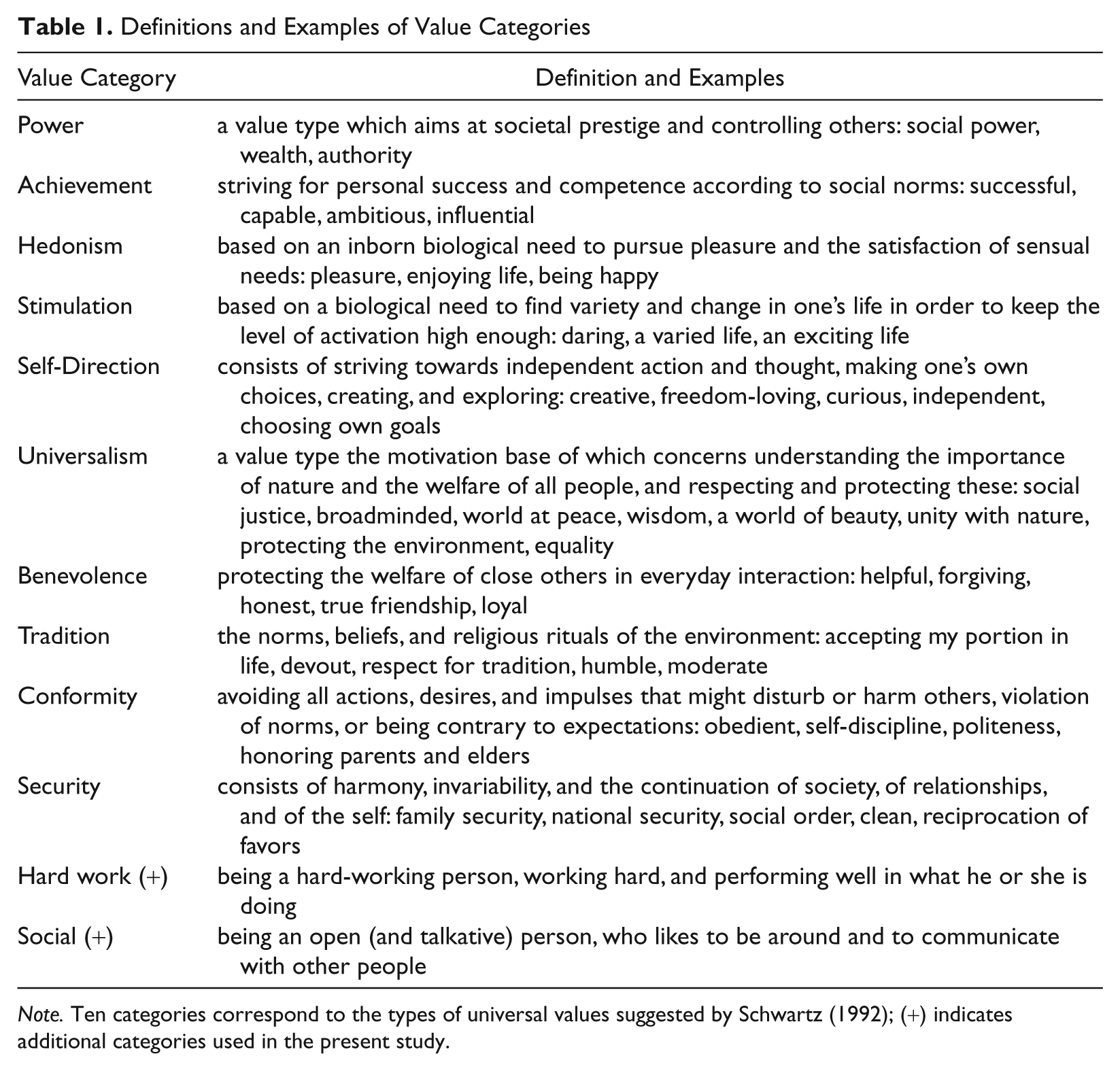
Note. Ten categories correspond to the types of universal values suggested by Schwartz (1992); (+) indicates additional categories used in the present study.
Interrater reliability of coding the characteristics was calculated for two researchers who coded simultaneously 20% of data. The Cohen’s kappa value was 0.85. Disagreements were resolved in discussion.
To correct for multiple testing, we used a conservative level of significance, dividing the conventional 5% level by the number of exploratory ANOVAs (35). Consequently, the significance level (alpha) was set at 0.001.
Results
Open-Ended Questions
Table 2 presents the mean numbers of Estonian, Russian Estonian, and Swedish mothers’ responses to each open-ended question corresponding to each value category. A series of general linear model (GLM) repeated measures ANOVAs, with context (child in the present, in the future, and mother’s own characteristics) as a repeated factor, three between-subject factors—sample, mother’s education and child’s gender—and mother’s and child’s age as covariates, was conducted. Mother’s education, mother’s age, and child’s gender did not have a statistically significant effect (p < .001) on mothers’ open-ended answers. The results of GLM repeated measures ANOVAs with context as a repeated factor and one between-subject factor, sample, are presented in Table 2. Figure 1 presents numbers of value categories mentioned most frequently by mothers when giving three answers to each open-ended question. As seen in Figure 1, in all samples, children in the present were described—first of all—by characteristics related to benevolence. Estonian and Russian Estonian mothers were similar when mentioning their own characteristics that they would like to pass on: benevolence, conformity, and hard work (see Figure 1). As to children when adults, Russian Estonian mothers stressed achievement as much as benevolence. As Table 2 demonstrates, Swedish mothers mentioned the characteristics related to hard work and conformity significantly less frequently than Estonian and Russian Estonian mothers. The first hypothesis according to which cultural differences occur rather in characteristics related to traditional values than in those of self-direction found support in respect to mothers’ answers to open-ended questions.
Numbers of Estonian, Estonian Russian, and Swedish Mothers’ Answers Corresponding to Each Value Category and the Results of Repeated-Measures ANOVAs
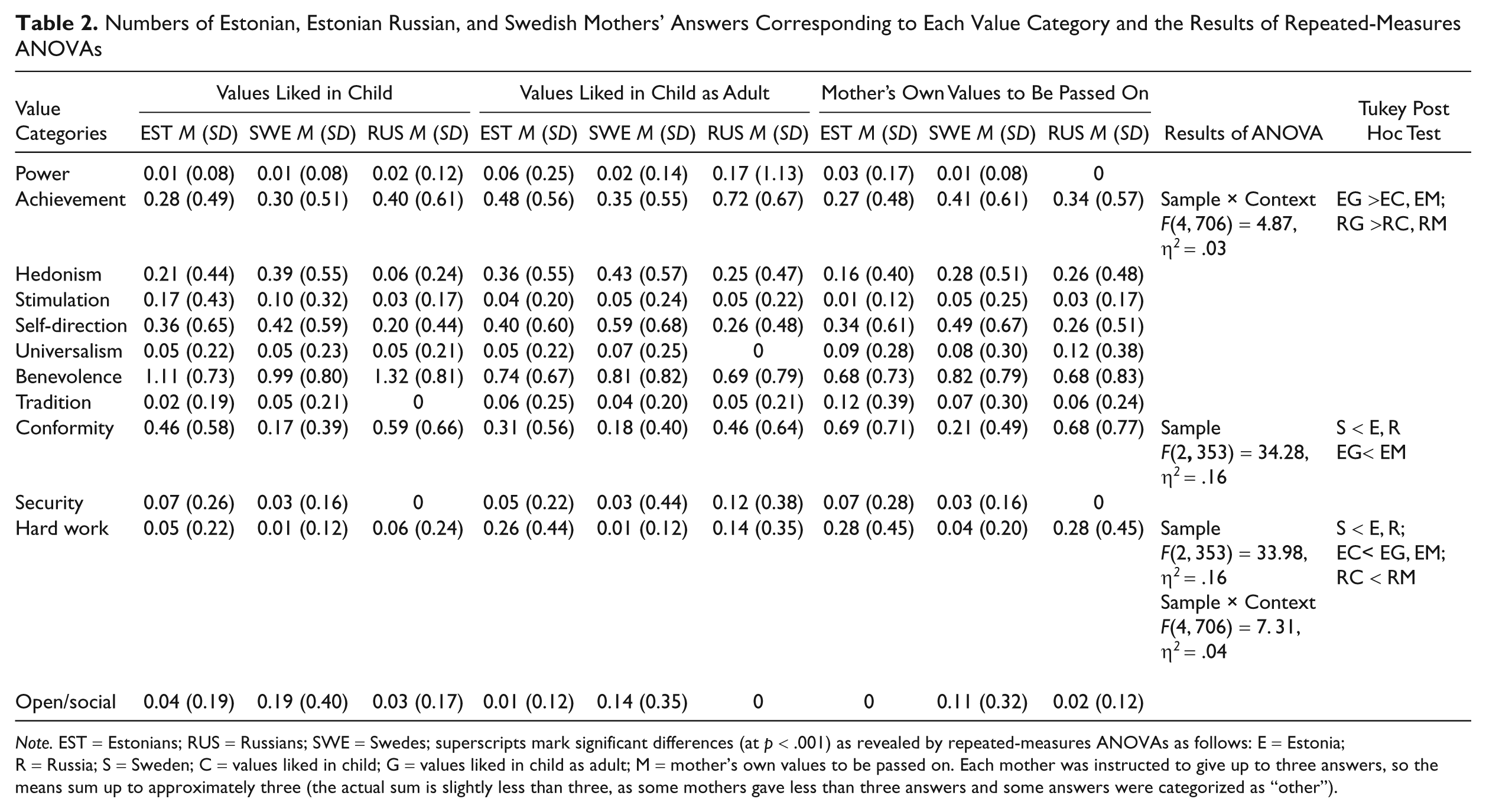
Note. EST = Estonians; RUS = Russians; SWE = Swedes; superscripts mark significant differences (at p < .001) as revealed by repeated-measures ANOVAs as follows: E = Estonia; R = Russia; S = Sweden; C = values liked in child; G = values liked in child as adult; M = mother’s own values to be passed on. Each mother was instructed to give up to three answers, so the means sum up to approximately three (the actual sum is slightly less than three, as some mothers gave less than three answers and some answers were categorized as “other”).
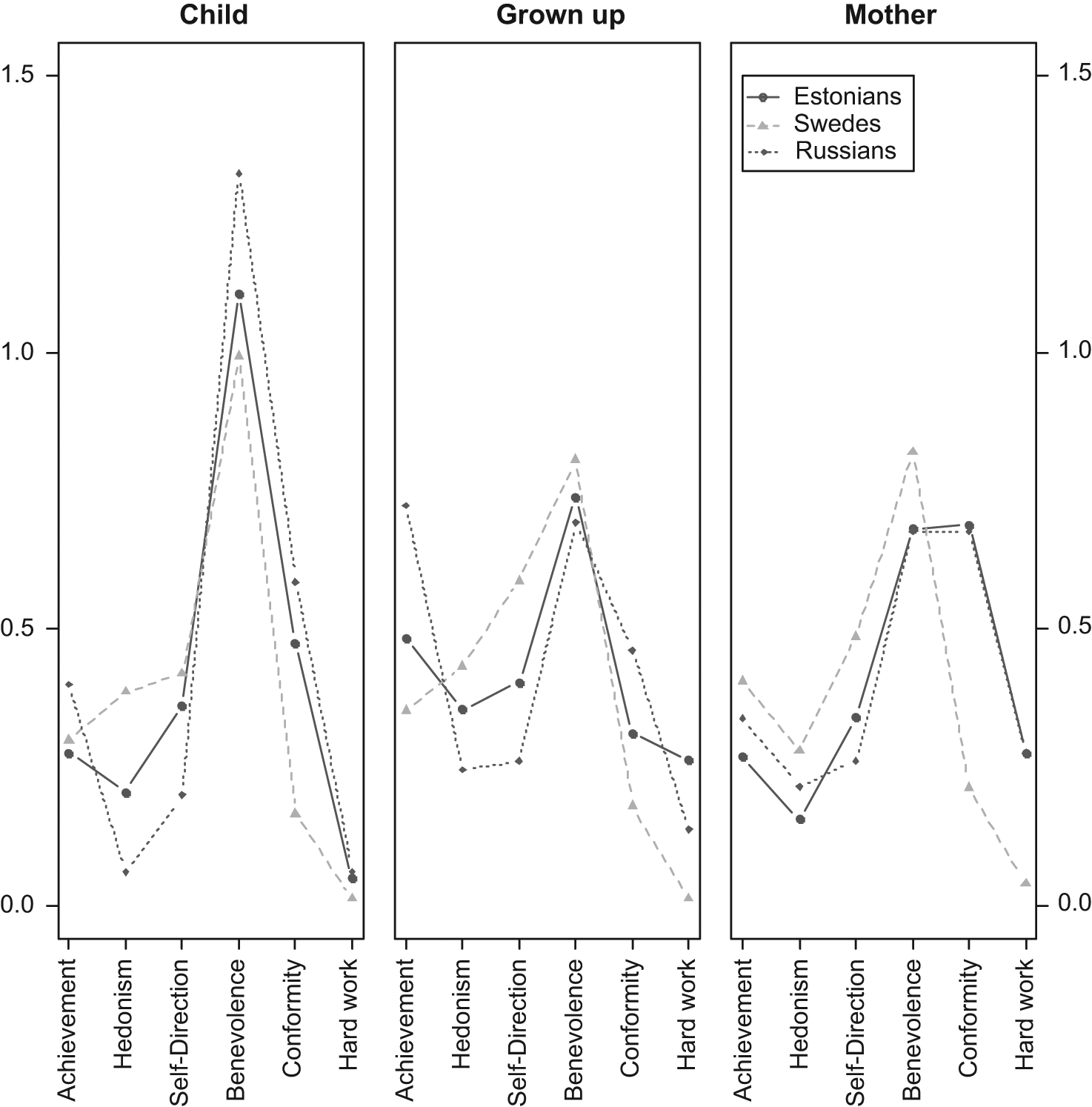
Numbers of Most Frequently Occurring Value Categories Across Samples
However, according to the second hypothesis, the answers given by Swedish mothers to three open-ended questions were expected not to differ to a great extent, whereas great differences were expected in the Estonian and Estonian Russian mothers’ answers. The hypothesis was supported by the results in three value domains—achievement, hard work, and conformity. Both Estonian and Russian Estonian mothers mentioned achievement more frequently when talking about children as adults than when talking about them in the present or about the mothers’ own characteristics. Estonian mothers mentioned hard work more frequently when talking about children as adults and about their own valuable characteristics than when talking about the child in the present. Estonian mothers mentioned conformity more frequently when talking about themselves than about the child as an adult. Russian Estonian mothers talked more about hard work when talking about themselves than when talking about the child in the present.
Item-Choosing Task
Figure 2 presents frequencies of choosing each of seven most frequently selected items among three most important ones across samples. As the figure illustrates, the child’s happiness was the most frequently chosen item of mothers across all samples. The Swedish mothers also put a considerable emphasis on the child’s belief in his/herself, while the Estonian mothers valued the child’s independence, being trustworthy, and hardworking, and the Russian Estonian mothers the child’s ability to fulfill his/her aims, trust in oneself, and being trustworthy the most. Table 3 presents the proportions of mothers across samples choosing each item among the three most important socialization goals, and the results of Sample × Child’s Gender × Mother’s Education ANCOVAs with child’s age and mother’s age as covariates. As seen in Table 3, Swedish mothers chose trustworthy, fulfill one’s aims, smart and intelligent, and hardworking less frequently and belief in one’s abilities more frequently than Estonian and Russian Estonian mothers. Russian Estonian mothers differed from all others by choosing fulfill one’s aims more frequently. Estonian mothers chose fulfill one’s aims less frequently than Russian Estonian mothers. The more educated mothers chose hardworking less frequently (M = 0.08, SD = 0.3) than the mothers with lower education (M = 0.22, SD = 0.4). The mothers of older children chose trustworthy more frequently than mothers of younger children (r = .24). The mothers of Swedish girls chose smart and intelligent significantly less frequently (M = 0.00) than the mothers of Estonian boys (M = 0.18, SD = 0.03) and Russian Estonian girls (M = 0.23, SD = 0.3).

Proportions of Most Frequently Chosen Socialization Value Items Across Samples
Proportions of Mothers Across Samples Choosing Each Item Among the Three Most Important Socialization Values
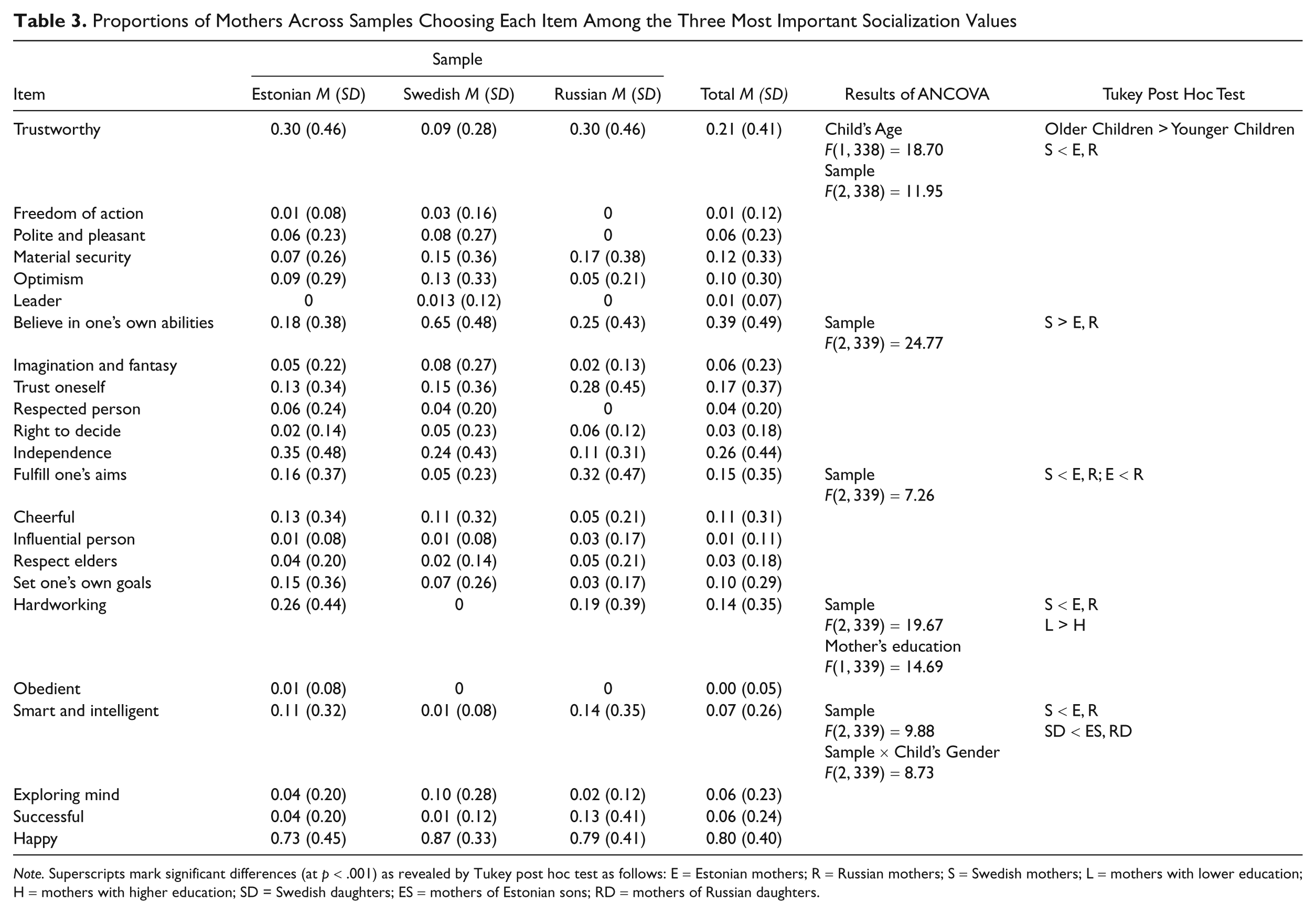
Note. Superscripts mark significant differences (at p < .001) as revealed by Tukey post hoc test as follows: E = Estonian mothers; R = Russian mothers; S = Swedish mothers; L = mothers with lower education; H = mothers with higher education; SD = Swedish daughters; ES = mothers of Estonian sons; RD = mothers of Russian daughters.
Discussion
The current study compared the socialization values of Estonian and Russian Estonian mothers living in a rapidly changing Estonian society, where socioeconomic transformations are an ongoing process, with those of the Swedish mothers living in a relatively stable and homogeneous Swedish society. Collective solutions have been called a “hallmark” of the Swedish society and politics (Daun, 1991, p. 165), while many societal core issues are still being discussed and negotiated in Estonia.
Comparative analyses of the mothers’ answers to open-ended questions revealed that the most valued characteristics in children in the present were those related to benevolence—being nice, friendly, helpful, and pleasant—regardless of the mothers’ sociocultural background. Descriptions of benevolence were used most frequently also when describing qualities valued in children as adults or the mothers’ own characteristics they would like to pass to their children. Benevolence seems to be valued universally, regardless of the mothers’ cultural background—in a recent comparative study on Taiwanese and American mothers’ long-term socialization values, it was also considered to be extremely important by all respondents (Suizzo & Cheng, 2007). In the same vein, in the item-choosing task, all mothers were similar in wanting their children most of all to be happy. Thus, we would like to underscore the fact that the socialization values of all mothers were more alike than different.
Cultural Differences
The first hypothesis, according to which cultural differences occur rather in characteristics related to traditional childrearing values than in those of self-direction, found support. In their spontaneous descriptions of valuable characteristics, both samples of mothers from Estonia (Estonians and Russian Estonians) put significantly more emphasis than the Swedish mothers on conformity (e.g., politeness, honoring parents and elders, obedience) and hard work. Estonian and Russian Estonian mothers’ priorities for desirable characteristics did not differ. In contrast, the Swedish mothers seldom used descriptions of conformity and hard work.
Cultural differences in the mothers’ socialization value preferences occurred in the item-choosing task both in respect to valuing characteristics related to self-direction as well as of those of traditional values. The Swedish mothers were more likely than the others to choose believe one’s own abilities among the three most important characteristics. The Estonian and Russian mothers residing in Estonia, in turn, chose trustworthy, hardworking, smart and intelligent, and fulfill one’s aims significantly more frequently than the Swedish mothers. This finding coincides with the results of the first part of the questionnaire. Swedish mothers seem to feel that the child’s self-confidence is most important and noteworthy, whereas Estonian and Russian Estonian mothers appear to think that serious efforts and hard work are the essential keys to a successful life. Similar results have been found in other studies on post-USSR parents’ childrearing values (Rosenthal & Roer-Strier, 2001). It was also noted by Wang and Tamis-LeMonda (2003) that in societies in transition parents tend to encourage achievement and independence in children—characteristics that are desirable for meeting the demands of a rapidly changing society. At the same time, already in an article dating back to 1998, an eminent Swedish ethnologist Åke Daun noted that “Swedes tend to attribute less weight to the work sphere, compared to family and leisure” (p. 12). The results of the current study are in concordance with the Special Eurobarometer 225 (2005): The Swedes valued hard work less than respondents from other European countries that were surveyed, at the same time standing out with the high proportion of respondents who considered it very important that children are encouraged to learn imagination and independence at home. Estonians, in turn, valued hard work highly (Special Eurobarometer 225, 2005). The current study added the knowledge that in Estonia not only the majority but also the Russian-speaking minority attach great importance to hard work.
Stability and Change in Socialization Values
As expected in the second hypothesis of the study, differences between answers concerning the child in the present, the child in adulthood, and the mother’s own characteristics were most pronounced in Estonia. Estonian and Russian Estonian mothers emphasized achievement in adulthood. When talking about children in adulthood, the Estonian mothers mentioned characteristics of conformity less frequently and hard work as frequently as they did when describing themselves. In describing children in the present, both Estonian and Russian Estonian mothers mentioned hard work and achievement less frequently than in other contexts. There were no differences in the frequencies of using single value categories in Swedish mothers’ answers to these questions. It is possible that the found differences between short-term and long-term socialization values reflect that a shift away from the valuation of obedience in children is taking place in current Estonia. Alternatively, this finding could be explained by larger differences between desirable characteristics of adolescents and adults in Estonia. However, answers given by Estonian and Russian Estonian mothers were similar, especially when listing their own valuable characteristics related to conformity, benevolence, and hard work.
Several researchers have suggested that some characteristics in children are valued in all cultures, whereas some others are specific to a particular culture (Harkness & Super, 2006; Kohn, 1977). The current study shows that this holds true also when comparing which characteristics are desirable in adulthood and the mothers’ own values they would like to pass on. The finding of previous studies that the value systems in countries of transition are characterized by complexity and diversity (Lin & Fu, 1990; Tudge et al., 1999; Tulviste & Ahtonen, 2007; Tulviste et al., 2007; Wang & Tamis-LeMonda, 2003) found support also in the current study. Both the Estonians and Russian Estonians were generally not focused on any specific value, whereas the Swedish mothers’ socialization value preferences appeared to be relatively homogeneous.
Open-Ended Questions Versus Item Rating Tasks
It has been argued before that significant cultural differences among similar cultures might appear only or mainly in the mothers’ spontaneous value judgments—in other words, in their answers to the open-ended questions (see Tamis-LeMonda et al., 2002). This was not observable in the current study. However, the two tasks yielded somewhat different results. In their spontaneous descriptions of desirable characteristics, the characteristics of hedonism (being happy, pleasure, enjoying life) were not dominating even among the Swedes who have been found in previous studies to name frequently happy when describing their children (Harkness & Super, 2006) or listing the most prominent characteristics of Swedes (see Daun, 1996, p. 184). At the same time, in the item ranking task, happy was the absolute favorite choice for most parents—regardless of their sociocultural background. One might argue that all parents wish their children to be happy, hence not mentioning such an obvious characteristic in their spontaneous answers.
Societal Change and Socialization Values
It is likely that the observed differences in how many mothers residing in Estonia value hard work, conformity, and achievement in themselves and how many of them consider them to be valuable characteristics in children in the present and in the future illustrate changes in socialization values over time as societies change. Previous research (e.g., Lauristin & Vihalemm, 1997) has reported changes in general cultural value systems in Estonia (e.g., increase in individualism). The present study adds the finding that, although the current socioeconomical situation in Estonia has become more stabile, the traditionally important values related to conformity (e.g., politeness and respecting elders) and hard work have not made way to hedonism and independence as values that are stressed in dynamic modern societies. The current study showed the co-existence of values related to self-direction with those of traditional values similarly to previous studies on socialization goals in Estonia after regaining the independence (Tulviste & Ahtonen, 2007; Tulviste et al., 2007).
The findings may also shed some light on the debate about cultural models of development. The Swedish mothers tended to stress the characteristics connected with self-direction as well as self-confidence but did not value those of conformity—a pattern that fosters the development of autonomous self. Despite the intensive transformation in Estonian society during the last two decades, the mothers’ socialization values focused on interdependence seem not to have been replaced by the independent orientation. Rather, there is a new integrative synthesis of socialization values that better responds to the changing lifestyle and includes both the characteristics related to self-direction and to conformity—a pattern that fosters the development of autonomous-relational self (Kagitçibaşi, 1996).
The data of the present study do not allow us to say whether mothers in Estonia restrict the traditional values to the family context and self-direction values to the activities outside the family, as proposed by Kagitçibaşi (1996), or whether it is not so context specific. Furthermore, it is difficult to say whether the changes in the socialization value system in Estonia have stabilized and a new synthesis of independent and interdependent cultural models has developed or the changes in the socialization value system continue until the current autonomous-related model will be replaced by an independent model.
The current study found that in respect to the socialization values of the Estonian mothers and Russian Estonian mothers, the results were strikingly similar. It is somewhat surprising because recent studies have shown that there is surprisingly little contact between the ethnic Estonians and ethnic Russians living in Estonia, ethnic Estonians feel rather the need to shape their values according to the Nordic model, and ethnic Estonians and Russian Estonians seem to have a different attitude towards the old political system and present societal changes (see above). The found similarity in socialization values of Estonian and Russian Estonian mothers in today’s Estonia might be explained by their shared Soviet past, their current life in a quickly changing society, or their views about what characteristics will be needed for a successful life in future Estonia. However, the present study does not allow us to answer these questions.
Although this study yielded evidence that both the majority and the minority in a changing society differ from a relatively stable neighboring country by still emphasizing highly traditional socialization values, there are several limitations. The sample size of the Russian Estonian minority was small compared to the Estonian and Swedish samples. A larger Russian Estonian sample would probably yield more reliable results. Also, it would be interesting to explore how different attitudes and expectations toward societal transitions might influence the changes in socialization values. A cross-generational comparison or a longitudinal research design is needed to address this question. A definite limitation of the study is that in Estonia, two ethnic groups—Estonians and Russian Estonians—participated, whereas in Sweden, only the ethnic Swedes participated. At the same time, it is known that Sweden is nowadays an increasingly multinational country. It is likely that the homogeneity of value system found in the current study characterizes only the ethnic Swedes.
The importance of the current, the past, and the future sociocultural contexts has been stressed in many socialization studies (e.g., Cole, 1996; Valsiner, 2000). The present study illustrated that the emphasis placed on hard work, conformity, and achievement was different when Estonian and Russian Estonian mothers talked about mothers’ own characteristics, about children’s characteristics in the present, and about children’s characteristics in adulthood in the changing Estonian society. In the light of our results, we may conclude that maternal socialization values are rather context-sensitive and that mothers are relatively fast and flexible in adjusting their socialization values according to the changing societal circumstances. Moreover, these changes seem to occur in cultures of transition during a shorter period than it has been reported in studies made in more stable societies such as Germany (see Keller & Greenfield, 2000).
Footnotes
The authors declared that they had no conflicts of interests with respect to their authorship or the publication of this article.
Reasearch for this article was supported by the Baltic Sea Foundation in Sweden (grant No. 3000903), and the Estonian Research Competency Council (grant No. SF0180025s08).