



Abstract
The majority of research on expressive suppression and health outcomes has been conducted in the United States, but little is known about how expressive suppression relates to the functioning of individuals living in other parts of the world. To address this gap, we conducted a cross-cultural study of Chinese Singaporean and European American college students, focusing on the relation between frequency of expressive suppression and self-reported depressive symptoms. Consistent with self-construal theory, the suppression-depression link depends on cultural background and the type of emotion involved. Expressive suppression involving positive socially disengaging emotions (e.g., pride) was associated with higher depressive symptoms for European Americans but not for Chinese Singaporeans. This cultural difference was mediated by independent self-construal. No cultural differences were found in the suppression-depression link when positive socially engaging emotions (e.g., respect) were involved. These findings underscore the importance of developing a more nuanced understanding of the relation between expressive suppression and psychological functioning to better inform theory and practice.
While decades of empirical research have demonstrated the benefits of emotional expression for health and well-being (Pennebaker, 1995; Pennebaker & Seagal, 1999), expressive suppression, defined by Gross (1998) as the inhibition of the outward expressive manifestation of emotional experiences, has generally been linked to adverse functioning of the body and mind, including coronary heart disease (Smith, 1992), compromised immune functioning (Petrie, Booth, & Davidson, 1995), and increased risk for depression and anxiety (Gross & John, 2003). However, most published research on expressive suppression has been based primarily on data collected in the United States, where the mainstream culture has been characterized as highly individualistic (Hofstede, 2001). The relation between expressive suppression and psychological functioning may take on a different form in more collectivistic cultural contexts. For example, individuals from Asian cultures tend to value moderation of emotions and their expressions more than European Americans (e.g., Kleinman, 1986; Matsumoto, 1993; Russell & Yik, 1996). Behaviors that might disrupt social harmony, including the expression of private emotions, are handled with greater discretion in collectivistic cultures compared to individualistic cultures (Markus & Kitayama, 1991). To the extent that emotional suppression serves positive interpersonal functions in collectivistic cultures, the previously observed link between emotion suppression and depression might be absent among individuals from this cultural context. The present research was designed to investigate potential cultural variations in how expressive suppression relates to depressive symptoms.
Cultural Background, Self-Construal, and Expressive Suppression
According to Markus and Kitayama (1991), European Americans from middle-class backgrounds are typically socialized to define and express who they are, to individuate from their families and social groups, and to achieve personal goals—all for the purpose of verifying and confirming their sense of self as autonomous, separate, and unique. This sense of self is reflected in what has been called an independent self-construal (Markus & Kitayama, 1991). Researchers have theorized that effective functioning in cultural contexts where the independent self-system is most prevalent requires self-assertion through emotional expression (e.g., Kitayama, Markus, & Kurokawa, 2000). In European American cultural contexts, for instance, open expression of emotions is considered a societal norm. American parents tend to encourage emotional expressivity in their children more than Chinese and Japanese parents (e.g., Miller, Fung, & Mintz, 1996; Zahn-Waxler, Friedman, Cole, Mizuta, & Hiruma, 1996), and the opportunity to express feelings has been associated with positive outcomes in European American children (e.g., Berenbaum & James, 1994; Halberstadt, Crisp, & Eaton, 1999).
Why is emotional expression so critical to individual adjustment in individualistic cultural contexts? First, emotional expression is regarded as a way of asserting individuality in mainstream European American culture (Markus & Kitayama, 1991; Wierzbicka, 1992). Second, expression of inner feelings fulfills a need that seems particularly important to people from individualistic cultures: the need for self-consistency. When emotional expressions are discouraged or suppressed, individuals from individualistic societies are likely to feel fake and dishonest (Rogers, 1951). The sense of incongruence between one’s inner experiences and outer expressions signals lack of self-consistency, which has been associated with more negative affect and less positive affect among predominantly European American college students (Sheldon, Ryan, Rawsthorne, & Ilardi, 1997). To the extent that the lack of self-consistency relates to positive and negative affect, the suppression of inner feelings, in particular emotions that signify independence (e.g., pride), might be positively correlated with symptoms of emotional distress among members of individualistic cultures.
By contrast, individuals from many East Asian cultures are typically socialized to define themselves according to their social roles, to maintain close ties to families and social groups, to foster interpersonal harmony, and to achieve group goals. This sense of self is reflected in what has been called an interdependent self-construal. The expression of one’s internal attributes, including one’s emotions, is accorded with less significance in cultures where the interdependent self-system is most prevalent (Kim & Sherman, 2007; Kitayama et al., 2000). Suh (2002), for example, found that, whereas consistency in self-perception predicts psychological well-being among European Americans, it is less predictive of psychological well-being among East Asians. Similarly, Butler, Lee, and Gross (2007) found that Asian cultural orientation reduces the negative social outcomes that have typically been associated with expressive suppression. More recently, a study focusing on the effects of anger suppression reported that Asian American status and interdependent self-construal attenuated the relation between suppression and depressive symptoms (Cheung & Park, 2010).
Cultural Influences on Depressive Symptoms and the Suppression-Depression Link
Cultural factors have been found to influence the connotative meanings and labels associated with depression (Kim, 2002; Tanaka-Matsumi & Marsella, 1976), as well as the expression of depression (Draguns & Tanaka-Matsumi, 2003). Recent cross-cultural analyses of depression underscore important differences in expressions of distress across cultural contexts. For example, some of these findings challenge the widely held assumption that Chinese have a greater tendency to express depression somatically compared to Westerners. Yen, Robins, and Lin (2000) found that somatic symptom presentation is not greater among nonpatient Chinese and Chinese American samples compared to a nonpatient European American sample, suggesting that greater somatization might be confined to Chinese who are clinically depressed. The other two cross-cultural studies to date (Parker, Cheah, & Roy, 2001; Ryder et al., 2008) have also found greater endorsement of somatic symptoms among Chinese, but more importantly, these studies revealed a much stronger tendency toward psychological symptom reporting among European Americans.
Rather than focusing on differences in the conceptualization and expression of depressive symptoms across broad cultural groups, several studies have examined individual differences in the link between culture and depression. Notably, independent and interdependent self-construals are generally found to be negatively and positively related, respectively, to depressive symptoms (e.g., Norasakkunkit & Kalick, 2002; Okazaki, 1997; Sato & McCann, 1998), a pattern that is consistent with the fact that social groups that have typically been characterized as being highly invested in relationships with others—such as women and individuals of Asian heritage—tend to report elevated depressive symptoms compared to groups described as autonomy-striving or individualistic (Jenkins, Kleinman, & Good, 1991; Kirsh & Kuiper, 2002; Okazaki, 1997; Uba, 1994). Various studies have also documented a positive relation between interdependent self-construal and sociotropy, an identified risk factor for depression (e.g., Fresno, Sampson, Craighead, & Koons, 2001; Mak, Law, & Teng, 2011).
Most pertinent to the current study is research on the cultural norm hypothesis (Chentsova-Dutton, Chu, Tsai, Rottenberg, Gross, & Gotlib, 2007; Chentsova-Dutton, Tsai, & Gotlib, 2010), which has documented significant cultural differences in the association between emotional expression and depression. The cultural norm hypothesis is predicated on the notion that culture shapes people’s ideal ways of experiencing and expressing emotions. Indeed, the work of Matsumoto et al. support the existence of cultural differences in rules that govern emotional expression according to nationality, individualism-collectivism, and other cultural dimensions (Matsumoto, 1990, 1991; Matsumoto, Takeuchi, Andayani, Kouznetsova, & Krupp, 1998). However, individuals who are depressed have difficulty regulating their emotions in ways that fit with cultural norms and ideals. As a result, patterns of emotional responding among depressed individuals tend to deviate from cultural norms regarding emotional experience and expression. For example, Chentsova-Dutton et al. (2007, 2010) found that in cultural contexts where emotional moderation and control is emphasized, depressed individuals show greater emotional reactivity compared to nondepressed individuals. By contrast, in cultures where open emotional expression is the norm, depressed individuals show diminished emotional reactivity compared to their nondepressed counterparts. Although the causal nature of the relation between depressive symptoms and emotional reactivity has yet to be determined, existing research on the cultural norm hypothesis suggests that culture, emotional expression, and depressive symptoms are inextricably linked.
The Social Orientation of Emotions
Whereas most of the expressive suppression literature has focused on generic positive and negative emotions, the social orientation of emotions may moderate the extent to which expressive suppression is associated with depression and other indicators of psychological distress. Markus and Kitayama (1991) drew an important distinction between emotions that focus on the separateness and independence of self from social relationships and emotions that focus on relational embeddedness and social interdependence. Emotions in the first category are called socially disengaging emotions. Because the experience of these emotions tends to emphasize one’s own personal attributes and to separate or disengage the self from social relationships, they tend to foster and reinforce the independent sense of self. Examples of socially disengaging emotions include anger, pride, and frustration. Emotions in the second category are called socially engaging emotions, because the experience of these emotions tends to promote an interdependent orientation and to assimilate or engage the self in social relationships. Examples of socially engaging emotions include empathy, feeling connected with someone, and shame. Kitayama et al. (Kitayama et al., 2000; Kitayama, Mesquita, & Karasawa, 2006) have examined how the experience of these two types of emotions relates to individuals’ subjective well-being. Together, their studies show that, among Japanese participants, well-being was more closely associated with how frequently positive socially engaging emotions are experienced, whereas for American participants, well-being was more closely associated with the frequency of experiencing positive socially disengaging emotions.
To date, cross-cultural research on socially engaging and socially disengaging emotions has focused almost exclusively on emotional experience rather than emotional expression. Applying Markus and Kitayama’s (1991) framework to research on culture and expressive suppression, one might expect to find different patterns of association between expressive suppression and psychological distress depending on cultural context and the type of emotion involved. Most of the existing research evidence suggests a weak association between expressive suppression and maladjustment for members of collectivistic cultures. Expressing internal attributes, including emotions, and maintaining consistency between inner experiences and outer expressions are less significant for effective functioning in the collectivistic cultural context. As such, for members of collectivistic cultures, suppression of emotions—whether socially engaging or socially disengaging—should be weakly related to depressive symptoms. For members of individualistic cultures, on the other hand, suppression of emotions that affirm the independent self-view (i.e., socially disengaging emotions) should be associated with more depressive symptoms, and the association between suppression and depressive symptoms should be weakened or absent when socially engaging emotions are involved.
The Present Study
To test these hypotheses, we conducted a cross-cultural study with European Americans and Chinese Singaporeans. The United States and Singapore were compared as these countries represent individualistic and collectivistic cultures, respectively (Hofstede, 2001; Schwartz & Bardi, 2001; Trompenaars, 1993). To alleviate concerns over the influence of ethnic minority status, we focused our comparisons on individuals representing the majority from each country, namely European Americans and Chinese Singaporeans. In addition to cross-cultural comparisons, we also examined whether individual differences in self-construal serve as an explanatory factor that might account for the cultural variations in the link between expressive suppression and depressive symptoms. 1 Because we predicted cultural differences to be found only with suppression of socially disengaging emotions, independent (rather than interdependent) self-construal was examined as a potential mediator of the proposed moderation.
Method
Samples and Procedure
The samples consisted of 172 European American (111 female and 61 male) undergraduates at a large public university in Midwestern United States and 151 Chinese Singaporean (88 female and 63 male) undergraduates at a large national university in Singapore. There was no significant group difference on gender distribution, χ2(1, 323) = 1.33, ns, but the Chinese Singaporean participants (mean age = 21.16 years, SE = .15, range = 19 to 26) were slightly older than the European American participants (mean age = 19.56 years, SE = .10, range = 18 to 24), t(321) = 9.07, p < .001. In terms of generation status, all of the participants were at least second generation—that is, they were all born in their respective countries. Follow-up test using standardized residual scores indicate that the proportion of third-generation Singaporeans (52%) was higher than the proportion of third-generation U.S. Americans (13%), whereas the proportion of U.S. Americans who were fourth generation or beyond (51%) was higher than the proportion of Singaporeans of the same generation status (16%), χ 2 (2, 323) = 67.20, p < .001.
Participants from both samples completed an online survey that included demographic information and measures of self-construal, depressive symptoms, and expressive suppression involving socially engaging and socially disengaging emotions. We administered all of the measures in English, as it is the primary medium of instruction and the de facto national language in both Singapore and the United States. All participants took part in the study for course credit.
Measures
Demographic information
Participants were asked to answer questions about their sex, age, race, ethnicity, and generation status.
Self-construal
Independent self-construal was measured using Singelis’s (1994) Self-Construal Scale. The SCS was composed of 24 items, half measuring levels of independence in self-construal and the other half measuring levels of interdependence. Each item was rated on a 7-point scale, ranging from 1 (strongly disagree) to 7 (strongly agree). According to Singelis (1994), the Independence subscale score has an internal reliability (Cronbach’s alpha) of .70. In the current samples, the Independent Self-Construal subscale score has an internal reliability (Cronbach’s alpha) of .73 for European Americans and.75 for Chinese Singaporeans. Construct and predictive validity of the SCS has been demonstrated in previous studies (Singelis, 1994; Singelis & Sharkey, 1995). Studies involving Chinese samples also help establish construct validity by showing that the two self-construal dimensions are related to ethnocultural group (e.g., Singelis, Bond, Sharkey, & Lai, 1999), as well as measures of communication (e.g., Hsu, 2004; Mortenson, 2002), self-esteem (e.g., Kwan, Bond, & Singelis, 1997), and differentiation-similarity (e.g., Aaker & Schmitt, 2001).
Depressive symptoms
The Center for Epidemiological Studies–Depression (CES-D; Radloff, 1977) was used to measure depressive symptoms. A total of 20 items, rated on a 4-point scale from 1 (rarely) to 4 (most of the time), assessed how frequently participants felt or behaved in certain ways during the past week that reflect either the presence or absence of symptoms associated with depression. In the original validation study, Radloff (1977) reported Cronbach’s alphas of .89 and .87 for a patient sample and a healthy comparison sample, respectively. Later studies have demonstrated adequate reliability with various Asian ethnic groups, including Chinese, Korean, Japanese, and Filipino Americans (e.g., Kuo, 1984; Okazaki, 1997; Ying, 1988). In the current samples, the CES-D scale score has an internal reliability (Cronbach’s alpha) of .90 and .89 for European Americans and Chinese Singaporeans, respectively. Moreover, the CES-D has been validated in studies involving Chinese (Cheung & Bagley, 1998; Lin, 1989; Zhang & Norvilitis, 2002) and Singaporeans (Stahl et al., 2008).
Expressive suppression
We assessed how frequently participants suppressed the expression of positive socially engaging and disengaging emotions. Specifically, participants were asked the following question: “When interacting with close friends, how frequently do you usually keep the following emotions inside when you feel them?” Using a 7-point Likert-type scale, ranging from 1 (never) to 7 (almost always), a response was given for three positive socially engaging (i.e., friendliness, closeness, respect) and three positive socially disengaging emotions (i.e., pride, superiority, feeling on top of the world). The location of these positive emotions on the dimension of social orientation (socially disengaging and socially engaging) has been supported by multidimensional scaling analysis (Kitayama et al., 2000).
In the current samples, the subscale scores for suppression of positive socially engaging emotions had internal reliabilities (Cronbach’s alpha) of .91 and .86 for European Americans and Chinese Singaporeans, respectively. The subscale used to measure suppression of positive socially disengaging emotions, however, had low internal reliabilities across both samples (Cronbach’s alpha = .36 and .50 for European Americans and Chinese Singaporeans, respectively). This low reliability was due in part to the fact that the item “feeling on top of the world” did not correlate with the other two items. Therefore, we recomputed the scale based on two of the three original items that were more highly correlated, namely pride and superiority (r = .27 and .62 for European Americans and Chinese Singaporeans, respectively). Despite the surprisingly low intercorrelation between the two items comprising the Suppression of Disengaging Emotions subscale for the European American sample, we decided to keep it in the present analysis for two reasons: (a) Previous research (Tracy & Robins, 2007) has found that the feeling of superiority is closely associated with one form of pride (i.e., hubristic pride), and (b) in the current study, significant relation were found between this subscale and depressive symptoms.
Results
Test of Moderator Effects
In Tables 1 and 2, we present the means, standard deviations, and interitem correlations of the primary scales for the Chinese Singaporean and the European American participants, respectively. Participants in these two cultural groups did not differ on the mean level of independent self-construal, t(321) = −1.41, p > .10. We used Aiken and West’s (1991) multiple regression analysis procedure for examining moderation effects to test the hypothesis that culture moderates the relation between expressive suppression and depressive symptoms when positive socially disengaging emotions are involved but not when positive socially engaging emotions are involved. Standardized independent variables were entered into the equation in three successive steps. The predictors (suppression of positive socially engaging emotions and suppression of positive socially disengaging emotions) and moderator (cultural membership, with Chinese Singaporean coded as −1 and European American coded as 1) were entered in Step 1, and the two-way interaction terms (cultural membership × suppression of positive engaging emotions, cultural membership × suppression of positive disengaging emotions) were introduced in Step 2. 2
Means, Standard Deviations, and Intercorrelations for Chinese Singaporeans
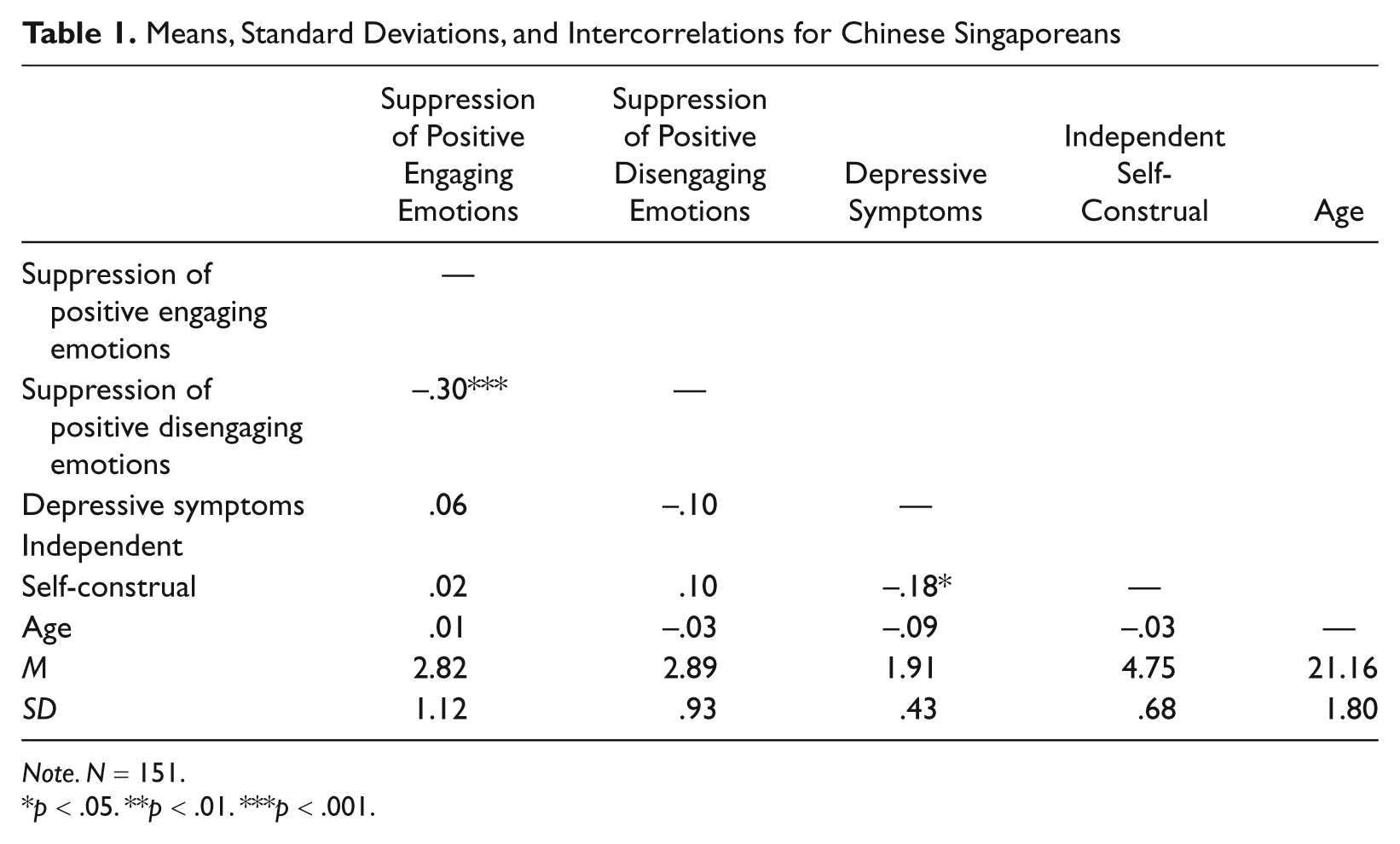
Note. N = 151.
p < .05. **p < .01. ***p < .001.
Means, Standard Deviations, Internal Reliability, and Intercorrelations for European Americans
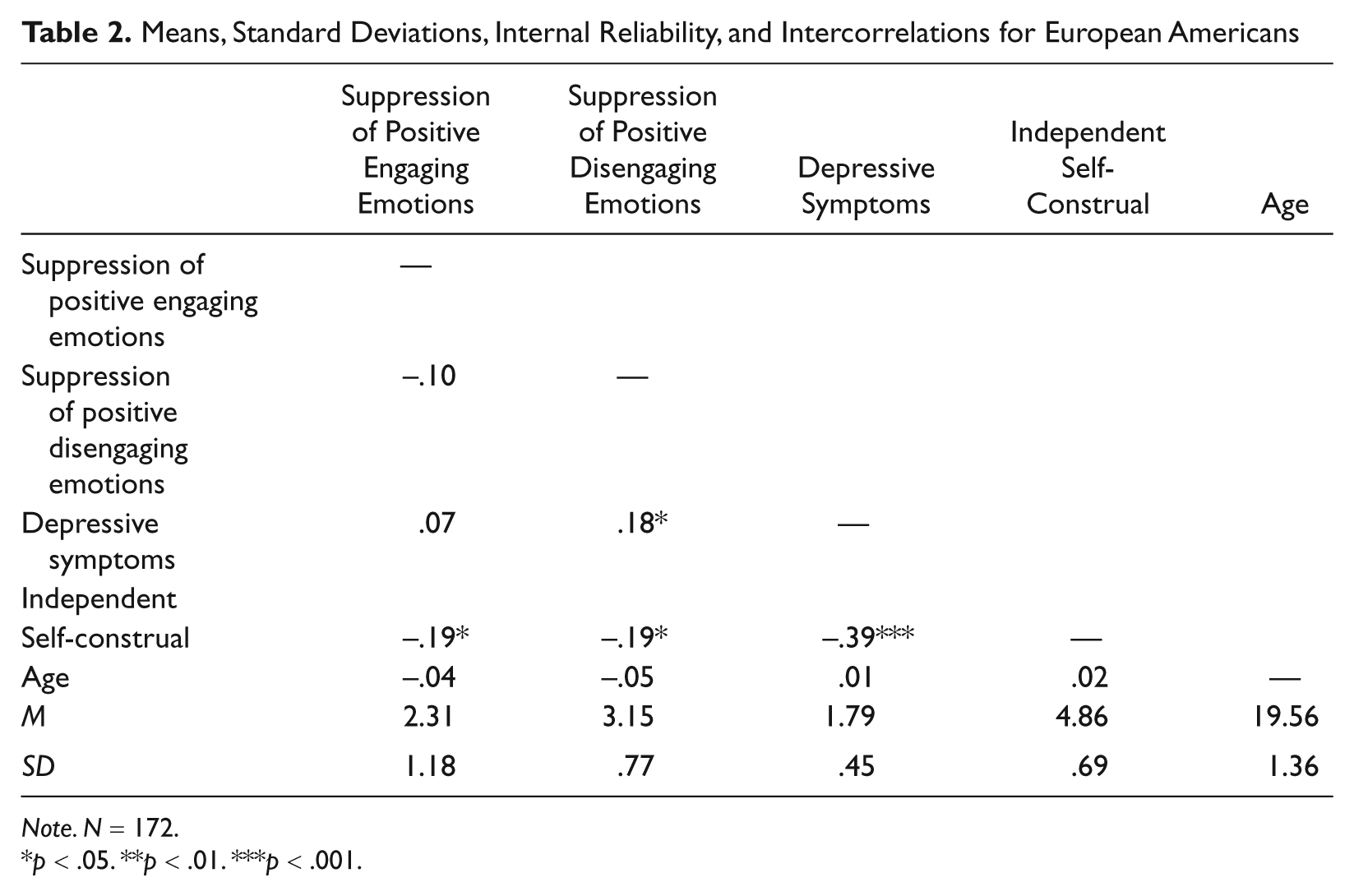
Note. N = 172.
p < .05. **p < .01. ***p < .001.
As predicted, we found cross-culturally divergent associations between frequency of expression suppression involving positive socially disengaging emotions and depressive symptoms (see Table 3). The regression step containing the two-way interaction terms (cultural membership × suppression of positive engaging emotions; cultural membership × suppression of positive disengaging emotions) was significant. Specifically, the interaction between cultural membership and expressive suppression involving positive socially disengaging emotions was statistically significant. The simple slopes were separately graphed for European Americans and Chinese Singaporeans (see Figure 1). Greater frequency of suppression involving positive socially disengaging emotions was related to greater depressive symptoms for European Americans (b = .11, se = .04), t(319) = 2.44, p < .05. For Chinese Singaporeans, the slope was negative but not statistically significant (b = –.05, se = .04), t(319) = −1.16, p > .10, suggesting that frequency of suppression involving positive socially disengaging emotions was unrelated to level of depressive symptoms.
Hierarchical Multiple Regression Analyses to Test Moderator Effects With Expressive Suppression of Positive Socially Engaging and Disengaging Emotions as Predictors, Cultural Group as Moderator, and Depressive Symptoms as Criterion

Note. N = 323. SPEE = suppression of positive engaging emotions; SPDE = suppression of positive disengaging emotions.
p < .05. **p < .01.
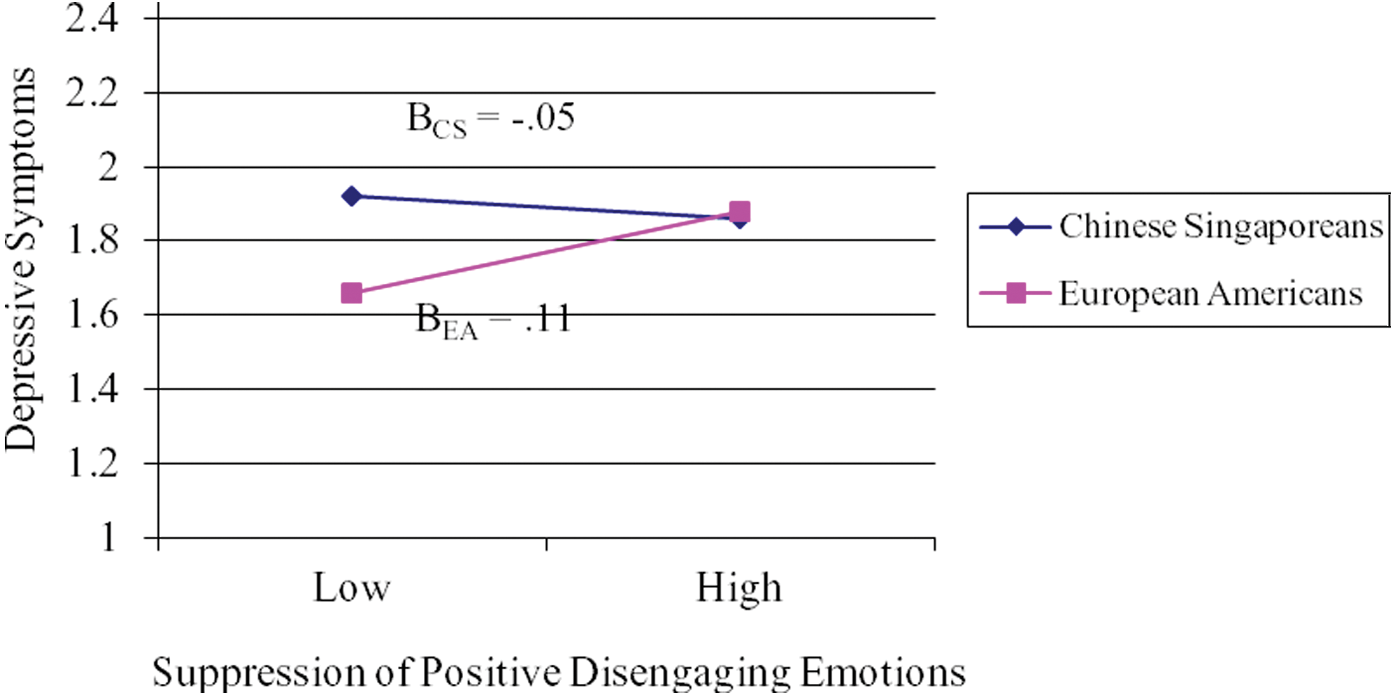
Interaction between cultural group and suppression of positive disengaging emotions predicting depressive symptoms.
Given the low intercorrelation between the two items comprising the Suppression of Disengaging Emotions subscale, we repeated the analyses using each item separately. The interaction between cultural membership and suppression involving feelings of superiority was statistically significant (b = .07, se = .03, p < .01), and the simple slopes again indicate that greater frequency of suppression involving feelings of superiority was related to greater depressive symptoms for European Americans (b = .06, se = .03), t(319) = 1.98, p < .05, but not for Chinese Singaporeans (b = –.04, se = .03), t(319) = −1.39, p > .10. The interaction between cultural membership and suppression involving pride, however, was not statistically significant (b = .04, se = .03, p > .10).
Test of Mediated Moderation
Baron and Kenny’s (1986) multiple regression analyses for testing mediation and the bootstrap analytic approach (Preacher & Hayes, 2008) were used to test the hypothesis that independent self-construal mediated the observed cultural differences in the relation between suppression and depressive symptoms. Because the model being tested is in the form of a mediated moderation, the predictor variable will be the interaction between cultural membership and expressive suppression.
A test of mediated-moderation using multiple regression revealed that the link between the key interaction term (cultural membership × suppression of positive disengaging emotions) and depressive symptoms was mediated by independent self-construal (Sobel test z = 2.25, p < .05). In other words, once independent self-construal was added to the regression analysis, the interaction between cultural membership and suppression of positive socially disengaging emotions was no longer significant (β = .04), t(319) = 1.76, p > .05 (see Figure 2). That is, the strength of independent self-construal explains the influence of cultural membership on the association between suppression of positive socially disengaging emotion and depressive symptoms. Results from bootstrapping using 5,000 resamples yielded a mean indirect effect of B= .02 (SE = .01) with a 95% confidence interval from .004 to .036, suggesting that the strength of independent self-construal explains the influence of cultural membership on the association between suppression of positive socially disengaging emotion and depressive symptoms.
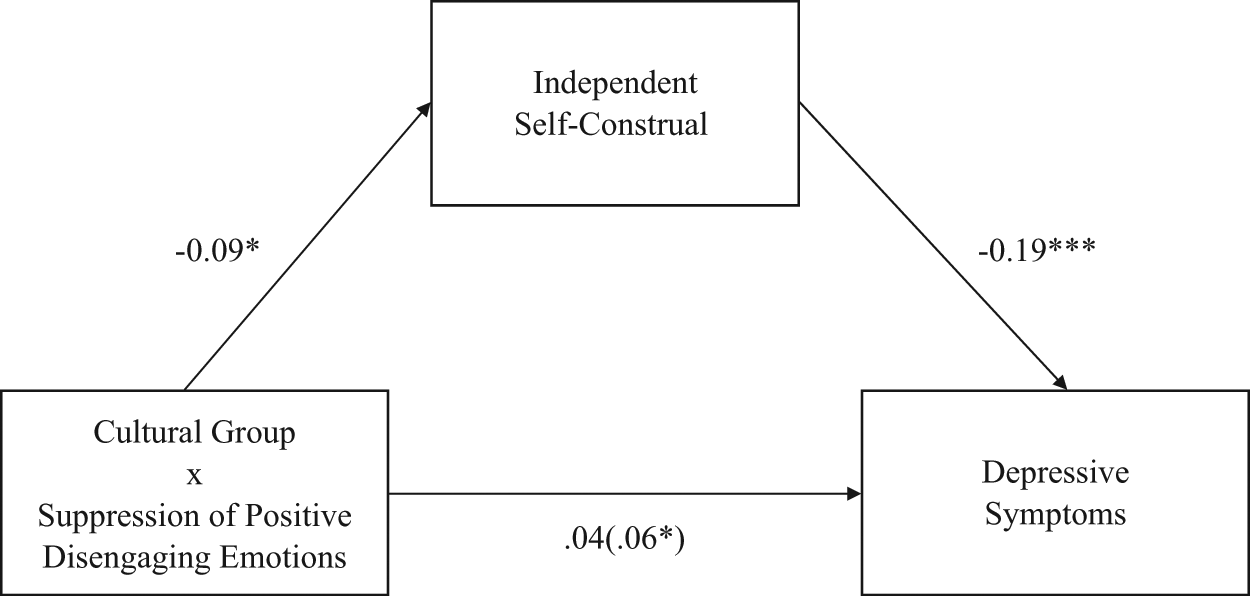
Independent self-construal mediates the effect of cultural group on the relation between suppression of positive disengaging emotions and depressive symptoms.
We also examined whether the moderated effect of culture on the link between suppression involving feelings of superiority and depressive symptoms was mediated by independent self-construal. After independent self-construal was added to the regression analysis, the interaction between cultural membership and suppression involving feelings of superiority reduced but remained statistically significant (β = .05), t(319) = 2.09, p < .05 (Sobel test z = 1.29, ns), indicating no mediation effect. Similar results were obtained from bootstrapping using 5,000 resamples (mean indirect effect of B= .01, SE = .01, with a 95% confidence interval from –.004 to .026).
Post Hoc Analyses on CES-D Factors
To examine whether the effects were confined to specific types of depressive symptoms, we reran the analyses separately for each of the four factors of depression identified by Radloff (1977) and others. These factors are typically described as depressed affect, positive affect, somatic symptoms, and interpersonal relations. The moderating effect of cultural membership was found only for one factor: positive affect (R 2 = .11, ΔR 2 = .02, f 2 = .02, p < .05). Greater frequency of suppression involving positive socially disengaging emotions was related to lower positive affect for European Americans (b = –.14, se = .06), t(319) = −2.09, p < .05, but not for Chinese Singaporeans (b = .08, se = .06), t(319) = 1.42, p > .10. Furthermore, independent self-construal explains the influence of cultural membership on the association between suppression of positive socially disengaging emotion and positive affect. Results from regression analyses indicate that the interaction between cultural membership and suppression of positive socially disengaging emotions (β = –.09, se = .04), t(319) = −2.41, p < .05, was no longer significant once independent self-construal was added to the regression analysis (β = –.06, se = .04), t(319) = −1.58, p > .10 (Sobel test z = −2.45, p < .05).
Discussion
The present study is the first to simultaneously consider the effects of cultural membership, independent self-construal, and social orientation of emotions (socially engaging vs. socially disengaging) on the link between expressive suppression and depressive symptoms. Our data revealed that expressive suppression had disparate effects on European American and Chinese Singaporean college students depending on the type of emotion being suppressed. As predicted, expressive suppression involving positive socially disengaging emotions, but not suppression involving positive socially engaging emotions, was associated with greater depressive symptoms among European American college students. Expressive suppression was unrelated to depressive symptoms for Chinese Singaporean college students whether the emotions were socially engaging or disengaging. Also consistent with our hypothesis, independent self-construal accounted for the effect of cultural membership on the relation between expressive suppression involving positive socially disengaging emotions and depressive symptoms.
The study’s main findings are consistent with emerging research challenging the dominant view of expressive suppression as a maladaptive emotion regulation strategy. Similar to previous studies with college samples (i.e., Butler et al., 2007; Cheung & Park, 2010), we found that cultural background attenuates the negative effects of expressive suppression. Nevertheless, the present study builds upon previous research on emotion regulation in two major ways. First, to our knowledge, this is the first investigation into how the social orientation of emotions may be associated with the manner in which expressive suppression relates to psychological functioning. Current theories on emotion regulation tend to assume that the effects of expressive suppression are more similar than different across emotions (Consedine, Magai, & Bonanno, 2002). Findings from the present research, however, suggest that the link between expressive suppression and psychological functioning could well vary depending on the characteristics of the emotion—in this case, its social orientation or referent of focus (i.e., socially engaging vs. socially disengaging). The emphasis on the social orientation of emotions goes beyond the dominant models of emotion (e.g., Larsen & Diener, 1992; Russell, 1980; Watson & Tellegen, 1985), most of which endorse a two-dimensional structure focused on valence and arousal. Second, the findings of the present study build upon the empirical knowledge base on how culture influences the relation between expressive suppression and psychological adjustment. By focusing on the interplay between self-construal and the social orientation of emotion, our results more clearly show that cultural influences on the suppression-adjustment link rely, in part, on the extent to which an individual’s sense of self is challenged by the act of suppression.
In addition to expanding upon our understanding of emotion regulation, the conceptual framework used in the present study has implications for a culturally informed model of depression. Previous research has found that cultural differences in models of the self play a critical role in emotional reactivity (Chentsova-Dutton & Tsai, 2010; Heine, 2001). Our findings extend this notion by suggesting that the social orientation of emotions is also key to understanding the pathway through which culture affects emotional reactivity and, subsequently, vulnerability to depression. More specifically, we found that suppression of socially disengaging emotions is associated with increased depression vulnerability among European Americans but not among Chinese Singaporeans. Moreover, this cultural difference in depression vulnerability may be due, in part, to variations in level of independent self-construal.
The findings of the present study need to be considered with several limitations in mind. One important limitation of the present study stems from the use of the correlational research design. We do not know whether more frequent suppression causes European Americans to experience greater depressive symptoms or vice versa. Second, we assumed that participants listed were consciously aware of and able to report how frequently they tend to suppress the emotions in the questionnaire. Future research can address this limitation by manipulating expressive suppression through explicit instructions given in the laboratory setting and examining its impact on psychological functioning. Third, the internal reliability of the measure we had chosen to assess suppression of positive socially disengaging emotions was less than optimal. Although cultural differences in the relation between expressive suppression involving socially disengaging emotions and depressive symptoms were found, the effects were primarily associated with suppression involving feelings of superiority. These results are not entirely surprising, given heterogeneity among distinct socially disengaging emotions. Fourth, the study was conducted in English. Past research has found that the values, beliefs, and perceptions of bilingual individuals can vary in accordance with the language they are using (e.g., Dinges & Hull, 1992; Matsumoto & Assar, 1992). We do not know whether the results would have been different if the Chinese Singaporean participants completed the survey in their mother tongue. Fifth, our sample characteristics raise the question of whether our results generalize to noncollege student populations and to countries other than Singapore and the United States.
The current research findings have important implications for theory, research, and clinical interventions. On the theoretical front, these findings generally support the cultural psychological view of emotion (Kitayama, 2002; Markus & Kitayama, 1991), which suggests that human emotional processes are shaped by cultural practices and meanings and, more generally, by what is most adaptive in particular sociocultural environments. In this study, we found that expressive suppression takes on different meanings and level of importance, depending on individuals’ cultural background and the emotions involved. Our conclusion challenges the view that expressive suppression is uniformly maladaptive and represents a step toward answering the question of why, when, and for whom suppression may have an impact on individual well-being (Consedine et al., 2002).
The present results also highlight the need for more research on the meaning and ramifications of different emotion regulation strategies outside of the North American cultural context. For example, under what circumstances might expressive suppression have a deleterious effect on individuals from collectivistic cultures? Might the adjustment of individuals from collectivistic cultures be more closely related to the suppression of emotional experiences compared to the suppression of emotional expression? What other types of emotion regulation strategies might have important effects on the outcomes of individuals from collectivistic cultures? By broadening and deepening our analysis of expressive suppression and other forms of emotion regulation across cultures, our understanding of the nature and impact of important emotional processes will become more complex and meaningful.
In terms of clinical implications, our research suggests that interventions need to go beyond simply encouraging expression and instead take a more culturally sensitive perspective toward the management of emotions. Specific knowledge about the effects of expressive suppression among diverse groups of individuals may enable mental health professionals to understand the vulnerabilities and resiliencies of specific groups, which in turn might allow them to make more well-informed and appropriate treatment accommodations. It can help define more precisely when the inhibition of emotional expression may serve as a risk factor for physical and behavioral problems. For instance, the present results suggest potential usefulness in helping individuals with a dominant independent self-construal limit occasions involving the expressive suppression of socially disengaging emotions. In other words, the focus of clinical interventions should include identifying cultural variables that are likely to have influences over the outcome of emotion regulation efforts and teaching individuals to regulate their emotions with greater sensitivity to these contextual constraints.
Footnotes
Acknowledgements
We are grateful to Zhaoli Song for his assistance in helping us collect data from the National University of Singapore. We also thank Mark Snyder, Jeff Simpson, and Alex Rothman for the valuable ideas and suggestions they have given and to Michele Spoont and Diana Burgess for their helpful comments on earlier drafts of this article.
Declaration of Conflicting Interests
The author(s) declared no potential conflicts of interest with respect to the research, authorship, and/or publication of this article.
Funding
The author(s) disclosed receipt of the following financial support for the research, authorship, and/or publication of this article: This study was funded in part by American Psychological Foundation/Council of Graduate Departments of Psychology Graduate Research Fellowship.