




Abstract
Previous research concludes that empowerment is ineffective with employees from societies high in power distance. The present study examines this conclusion across three types of empowerment: discretion empowerment, psychological empowerment, and leadership empowerment (or empowerment leadership behaviors). To assess the effects of power distance on these three types of empowerment, employee surveys were conducted in Canada (a society low in power distance) and in China (a society high in power distance). Results showed that the effect of discretion empowerment on employee satisfaction was less pronounced in China, just as previous literature had concluded about the dynamics of societies high in power distance. However, the effect of the leadership empowerment on employee satisfaction via the competence facet of psychological empowerment was found to be more pronounced in Canada, a society lower in power distance. These conclusions at the cultural level were also confirmed at the psychological level. We thus advocate that empowerment remains an advantageous strategy to organizations in both societies and individuals high and low in power distance, depending on the type of empowerment involved.
Over the last two decades, empowerment has emerged as a management intervention to ameliorate the satisfaction of frontline employees (Bowen & Lawler, 1992). Despite its popularity in Western societies, managers in Eastern societies are puzzled about the real meaning of empowerment and are uncertain about how to empower their subordinates (Tjosvold, Hui, & Law, 1998).
Furthermore, several studies in North America and Europe (e.g., Ahearne, Mathieu, & Rapp, 2005; Mathieu, Gilson, & Ruddy, 2006) have found that the concept of empowerment has been operationalized by previous researchers in two different ways. While some researchers (e.g., Chan & Lam, 2011; Kelley, Longfellow, & Malehorn, 1996) operationalize empowerment as a perceived discretionary authority at work (or discretion empowerment), a growing number of researchers (e.g., Conger & Kanungo, 1988; Spreitzer, 1995) propose that empowerment is more than job autonomy. These studies define empowerment as an intrinsic motivation, tapping the extent to which employees believe they are capable of discharging their job duties (or psychological empowerment).
Furthermore, some researchers in North America (e.g., Arnold, Arad, Rhoades, & Drasgow, 2000; Eylon & Au, 1999) have studied empowerment as leadership behaviors that facilitate employee performance by enabling and encouraging employees in their work roles (or leadership empowerment). In other words, in addition to discretion empowerment and psychological empowerment, there is a third operationalization of empowerment in the literature.
While these three types of empowerment have been individually investigated in past studies, prior research has yet to examine all three empowerment concepts together in a single study. The interrelations and combined effects of these three types of empowerment remain unknown even though these management practices have been popular in industry for more than two decades. To fill this void, the first objective of this article is to unveil the interrelations and joint effect of these three types of empowerment—here termed discretion empowerment, psychological empowerment, and leadership empowerment—on employees’ satisfaction at work.
Although many academics have promoted the benefits of empowerment (Bowen & Lawler, 1992; Liao, Toya, Lepak, & Hong, 2009), others have questioned its effectiveness in practice (Argyris, 1998). Their differing views entail a need to reexamine the impacts of empowerment and its boundary factors. Additionally, a number of researchers (e.g., Robert, Probst, Martocchio, Drasgow, & Lawler, 2000) have pointed out that empowerment as a form of management intervention is less compatible with the cultural values of societies high in power distance, where people are more receptive to and accepting of the unequal distribution of power across different levels of the organizational hierarchy.
In support of this position, and based on data collected from 42 nations, Hui, Au, and Fock (2004) empirically demonstrated that the effect of empowerment on employee satisfaction becomes less pronounced in high (versus low) power distance societies. However, the three studies in Hui et al.’s article operationalized empowerment largely as discretion empowerment. It is not known whether the same moderation effect of power distance will also apply to the other two types of empowerment: psychological empowerment and leadership empowerment. The second objective of this article, then, is to provide the first evidence on the varying effects of psychological empowerment and leadership empowerment as a function of power distance values.
The Three Types of Empowerment
Early empowerment studies in Western societies primarily focused on the structural design of organizational policy, which provides work discretion to powerless workers (e.g., Kelley et al., 1996). As conceptualized in these studies, empowerment involves “a formal horizontal decentralization of authority such that decisional power flows to the employee from the formal structure” (Mills & Ungson, 2003, p. 144). Various labels, such as “empowerment” (e.g., Hartline & Ferrell, 1996), “services empowerment” (e.g., Chan & Lam, 2011), or “structural empowerment” (e.g., Mills & Ungson, 2003), have been adopted by different researchers, but the construct has been commonly operationalized as a unidimensional construct capturing the extent to which employees are given discretionary authority in discharging their job duties (Chan & Lam, 2011). In the current study, we describe this type of empowerment as discretion empowerment to reflect the common nature of these labels.
Another school of researchers (e.g., Spreitzer, 1995; Thomas & Velthouse, 1990) has argued that the conceptualization of empowerment should capture the extent to which employees possess the required motivations and capabilities to discharge their job duties. They define the construct as “a process of enhancing feelings of self-efficacy among organizational members through the identification of conditions that foster powerlessness and through their removal by both formal organizational practices and informal techniques of providing efficacy information” (Conger & Kanungo, 1988, p. 474). They maintain that empowerment includes, but should be extended beyond, the dimension of perceived job autonomy at work. It is argued that when employees feel empowered, they would interpret their work as meaningful, feel free and competent to determine the course of their work, and envisage the successful impact of their contributions (Thomas & Velthouse, 1990). Hence, these researchers suggest that in addition to the sense of self-determination at work (job autonomy), meaning (perceived work value), competence (feeling of self-efficacy), and impact (ability to influence) are also constituent components of empowerment (Thomas & Velthouse, 1990). Since this conceptualization primarily covers the motivational aspect of employees, it is commonly known as psychological empowerment.
In addition to these two conceptualizations, our literature review also reveals a third type of empowerment that is distinct from the conventional conceptualizations of discretion empowerment and psychological empowerment. This type of empowerment is known in the literature as empowerment leadership behaviors, hereafter termed leadership empowerment, and focuses on supportive actions of leadership.
Previous researchers commonly agree that management support and trust given to employees are central to the effectiveness of empowerment (Erdogan & Bauer, 2009). Eylon and Au (1999) suggested that empowerment is manifested in the trust of a supervisor in an employee, because a supervisor will only entrust discretionary power to those he or she considers reliable and capable. In a similar vein, Arnold et al. (2000) further proposed that supportive management behaviors among supervisor-supervisee dyads, such as coaching, encouraging, and showing concern to subordinates, are integral components of leadership empowerment. Empirical results obtained from their interviews with supervisors and employees in various American industries provided evidence that leaders’ supportive behaviors facilitate employee performance by enabling and encouraging employees in their work roles and are widely regarded by employees as a manifestation of empowerment.
Effects of Empowerment on the Satisfaction of Employees
These three conceptualizations of empowerment are thus distinct in nature. The literature, however, indicates that they are associated in practice. Researchers have advocated that supportive leadership behaviors have causal links with discretion empowerment (e.g., Liden, Wayne, & Sparrowe, 2000; Peccei & Rosenthal, 2001) and psychological empowerment (e.g., Raub & Robert, 2010; Zhang & Bartol, 2010). Accordingly, we propose a theoretical model to portray the interrelations and effects of the three empowerment concepts on employee satisfaction (see Figure 1).

Diagrammatic Illustration of Hypothesized Paths of Leadership Empowerment
The participative management literature commonly shows that supportive supervisors who frequently encourage their employees to participate in decision-making processes would enhance employees’ sense of self-determination at work (Raub & Robert, 2010). In a similar vein, managers who express trust in their subordinates with a minimum level of supervision promote their employees’ belief that they are entrusted to decide how to carry out their own job (Zhang & Bartol, 2010). With the support of their supervisors, employees feel capable of coping with special tasks and do not worry about being blamed for any negative consequences resulting from their exercise of discretionary power (Leach, Wall, & Jackson, 2003). A high sense of discretion empowerment is therefore fostered among employees by leadership empowerment. When employees experience a high level of autonomy with discretion empowerment, they will be able to resolve role conflicts and ambiguities at work, and hence should feel more satisfied with their job (Bowen & Lawler, 1992).
Hypothesis 1: Leadership empowerment is positively associated with discretion empowerment (Hypothesis 1a), which in turn, positively affects employee satisfaction (Hypothesis 1b).
When a supervisor provides encouraging feedback and expresses trust and confidence in an employee’s work capability through his or her empowering leadership, the employee will feel that he or she is important and is making a distinctive contribution to his or her supervisor (Liden et al., 2000; Raub & Robert, 2010). This sense of self-importance in turn raises the employee’s self-confidence, self-efficacy, and expectancy for better work performance (Eden & Kinnar, 1991). Accordingly, leadership empowerment should positively associate with the psychological empowerment of the employee. Since psychologically empowered employees would interpret their work as meaningful, feel competent, and envisage desirable job outcomes, they would also feel more satisfied with their job (Erdogan & Bauer, 2009).
Hypothesis 2: Leadership empowerment is positively associated with psychological empowerment (Hypothesis 2a), which in turn positively affects employee satisfaction (Hypothesis 2b).
To summarize, although the three empowerment concepts in the extant literature are apparently dissimilar, they are practically associated and positively affect the satisfaction of employees via two corridors of influence (Hypothesis 1 and Hypothesis 2; see Figure 1).
Empowerment Types Across Cultures
Robert et al. (2000) hypothesized that the effective adoption of empowerment requires congruity with one’s cultural values. One major dimension of cultural values that shapes the superior-subordinate relationship is power distance. Power distance refers to the extent to which people expect and accept that power is distributed unequally among persons and across different levels of the organizational hierarchy (Hofstede, 1980). Whereas we agree with previous researchers that the influence of empowerment is contingent upon cultural power distance (e.g., Hui et al., 2004; Robert et al., 2000), we argue that the direction of the moderation effect of high power distance on the influence of empowerment is subject to the type of empowerment in question.
Hui et al. (2004) empirically showed that the effect of discretionary power on employee satisfaction is contingent on socialization into a low power distance culture. Their study revealed that employees from a culture high in power distance expect their supervisors to behave autocratically and may even feel uncomfortable if supervisors consult them. Therefore, power distance was shown to mitigate the relationship between discretion empowerment and employee satisfaction. In line with previous literature, then, we believe that the moderation effect of power distance on the relationship between discretion empowerment and employee satisfaction is negative.
Hypothesis 3: Power distance will mitigate the relationship between discretion empowerment and employee satisfaction.
In contrast, we argue that power distance will moderate the impact of leadership empowerment on employees, but the direction of the moderation should be opposite to that found in the discretion empowerment study of Hui et al. (2004). Specifically, in high power distance societies (e.g., China, Chile, and the Philippines), a senior holder of a more powerful position is obliged to assist and support those in relatively junior positions, while junior members are expected to be loyal and obey their supervisor (Hofstede & Bond, 1988). This social norm promotes the acceptance of leadership empowerment among employees and amplifies its effects as postulated in Hypothesis 1 and Hypothesis 2. In low power distance societies, employees prefer an independent working relationship with minimal personal influence from management (Hofstede, 1980). The more extensive care and concern that a supervisor may show to a subordinate in empowerment leadership behaviors could sometimes be seen as an intrusion or even informal control (Atuahene-Gima & Li, 2002), with the subordinate experiencing stress and discomfort. As a result, although leadership empowerment is generally welcomed by employees, its effect is relatively weaker in low power distance societies than in high power distance societies. We believe that the moderation effect of power distance on the impact of leadership empowerment on employees should thus be positive.
Hypothesis 4: Power distance will amplify the relationships between leadership empowerment and both discretion empowerment (Hypothesis 4a) and psychological empowerment (Hypothesis 4b).
Employees need work ability to craft meaningful outcomes in their job. Hence, a sense of self-efficacy is considered universally important to employees in cultures both high and low in power distance, because it is vital for any work task (Bandura, 2002). Therefore, the impact of psychological empowerment on employee satisfaction could be similar across cultures both high and low in power distance.
In summary, whereas previous research found that discretion empowerment is inapt for high power distance societies, we argue that this conclusion does not necessarily apply to psychological empowerment and leadership empowerment because these three types of empowerment are distinct concepts of the empowerment family. We contend that leadership empowerment is more congruent with the cultural values of high power distance societies even though employees in low power distance societies are also in favor of a supportive and caring leadership. All in all, the direction of moderation effect of cultural power distance values on empowerment should be dependent on the type of empowerment in question.
Method
Measuring the Three Types of Empowerment
Since previous researchers operationalized the concept of empowerment with different measurement scales, measurement items from any one study may well be correlated with items from another study. Therefore, prior to including the three types of empowerment in the current study, a measurement model which represents distinct properties of the three empowerment concepts must be established and validated. To this end, two pilot surveys were conducted in China (People’s Republic of China [PRC]) to provide data for exploratory analysis and confirmatory analysis. A third survey was then conducted in Canada to provide data for cross-validation in a Western cultural environment.
The First Survey
Respondents
A large-scale commercial research agent was commissioned to collect data from frontline service employees. A total of 274 frontline service employees in four national telecommunications retail chains in the PRC, out of 532 contacted, returned their questionnaires (usable response rate = 52%). Fifty-seven percent of the respondents fell into the 21- to 30-year-old age group, and 68% were female. Their average work experience was 5.3 years.
Measurements
Items from major empowerment studies were adopted for the questionnaire. These items included the psychological empowerment scale developed by Spreitzer (1995) and adapted items from Arnold et al. (2000), Eylon and Au (1999), and Spreitzer (1996) to capture the leadership aspect of empowerment.
Early studies of discretion empowerment commonly measure its extent from a management perspective (e.g., Hartline & Ferrell, 1996). Whereas this approach reflects the discretionary power given to employees, it does not represent the discretionary power that employees perceive receiving. We therefore adopted the recent measurement approach by Chan and Lam (2011), which captures the extent to which the employees perceive that they could exercise a certain degree of freedom and use their own judgment to perform tasks at work. Since the concept of discretion empowerment measured by this approach is parallel to the self-determination of employees in psychological empowerment, we expect that the extent of discretion empowerment would be reflected by three items of the Self-Determination subscale in the Spreitzer (1995) study. Sample items of this subscale include the following: “I can decide on my own how to go about doing my work” and “I have considerable opportunity for independence and freedom in how I do my job.”
Owing to the constraint from the length of our questionnaire, we were unable to include all 72 empowerment measurement items from the four key studies mentioned above (i.e., Arnold et al., 2000; Eylon & Au, 1999; Spreitzer, 1995, 1996). Moreover, we observed that a number of items were similar between Arnold et al. (2000) and Spreitzer (1996). Therefore, we follow the practice of previous empowerment researchers to adopt a subscale with representative items from the existing empowerment measures (e.g., Ahearne et al., 2005).
With reference to the item selection principles suggested by Spreitzer (1995, p. 1450), the following criteria were used to select and adopt appropriate items: (a) Items should not bridge two or more types of empowerment, (b) items should share a common format for ease of administration, and (c) items should reflect individual work experience or perceived relationship with supervisor rather than a description of the work environment. One of the co-authors of this article studied all 72 empowerment items from the four previous studies and removed items that duplicate similar ones from other studies. Two other co-authors independently reviewed the remaining items to ensure that the adopted measures were adequate to reflect the three types of empowerment. Thirty-three empowerment items were thereby selected for the present study.
For each item, respondents were asked to indicate their agreement on a set of Likert-type scales ranging from 1 (strongly disagree) to 7 (strongly agree). The original items in the measurement scales were written in English. To ensure linguistic equivalence between the English and Chinese versions of the instrument, the translation–back-translation procedure was used.
Exploratory factor analysis (EFA)
The empowerment measurement items were analyzed using exploratory factor analysis to examine the dimensionality of the construct. Since the empowerment measurement items adopted in our research come from different previous studies, some items from one study may be highly correlated to items in another study. We followed the recommendation of Hair, Anderson, Tatham, and Black (1998) and previous practice of Verhoef, Franses, and Hoekstra (2002) to remove cross-loading items that have significant loadings values (> .35) on two different factors (types of empowerment conceptualization). Following the practice of Hair et al. and Verhoef et al., we also deleted items with inadequate loadings (< .45) on their primary factor to assure that all items in our measurement model more strongly reflect the construct concerned.
This procedure resulted in a three-factor model with 16 items. The three factors had eigenvalues of 6.22, 1.83, and 1.42, altogether explaining 59.19% of the common variance. A close examination of the contents of these items found that they appropriately reflect the distinct properties of discretion empowerment, leadership empowerment, and the competence facet of psychological empowerment.
Item-total correlations
The initial three factors were examined for their item-total correlations. All items, except one belonging to Factor 3, were above the cutoff value (0.50). This weak item was deleted, and a total of 15 items remained for further analyses of their validity. Adequate reliability (α > 0.71) was found for all three factors.
The Second Survey
Since the outcome of EFA is exploratory by nature, a second set of survey data from bank employees was collected for follow-up confirmatory factor analyses (CFA) and validation of the three-factor measurement model.
Respondents
Another data set, collected from 187 frontline employees in nine major banks in Beijing, PRC, was used to verify the factor structure identified by the EFA (total of 228 frontline employees contacted; usable response rate = 82%; age 21 to 30 = 58%; female = 71%; average work experience = 5.2 years). The data collection methods were the same as those described for the first survey.
Confirmatory factor analysis (CFA)
The results, as shown in Table 1, indicate an acceptable fit of the three-factor model (χ2 = 135.81, df = 87, p < 0.001; CFI = 0.98; NNFI = 0.97; RMSEA = 0.055; all λs, p < 0.001). The variance extracted (AVE) was adequate (≥ .46) for all three factors, and their composite reliabilities (CR) were all above 0.70. These results confirmed that the items fell appropriately into the three empowerment conceptualization factors, demonstrating the convergent validity of the measures. The three-factor model also demonstrated discriminant validity by meeting the criterion that requires the square of the parameter estimate between two factors (φ2) to be less than the average variance extracted estimates of the two factors.
Confirmatory Factor Analysis
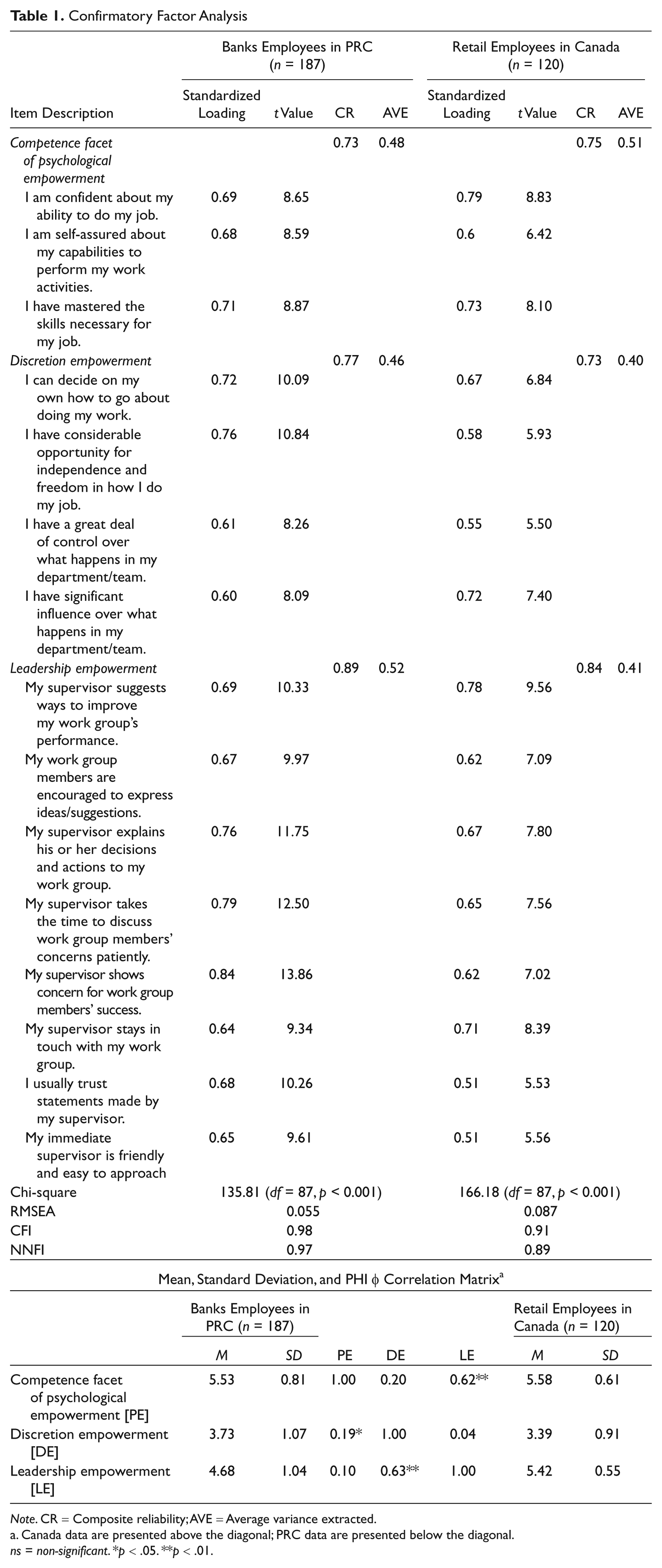
Note. CR = Composite reliability; AVE = Average variance extracted.
Canada data are presented above the diagonal; PRC data are presented below the diagonal.
ns = non-significant. *p < .05. **p < .01.
The Third Survey
Respondents of our first and second surveys were from China. To ensure that our findings can be generalized across cultures, we contacted 147 retail employees of a major communications company in Calgary, Canada, to validate the findings in a low power distance society. One hundred and twenty employees completed the questionnaires (usable response rate = 82%; age 21 to 30 = 63%; female = 46%; average work experience = 2.2 years). The results were consistent with the second survey and met the common criteria of a measurement model (χ2 = 166.18, df = 87, p < .001; CFI = 0.91; NNFI = 0.89; RMSEA = 0.087; all AVEs ≥ .40; all CRs > 0.70; all λs, p < 0.001; see Table 1). The internal consistency and convergent validity of our measurement in a different cultural setting were therefore assured. The squares of parameter estimate between factors (φ2) were all less than their average variance extracted estimates. Hence, the discriminant validity of the model was also confirmed. With the establishment of the measurement model, we were then able to test the three empowerment concepts in a single study.
The Main Study (The Fourth Survey)
Data collection and sample
To reveal the effects of the three types of empowerment in cultural environments high and low in power distance, data from part of a large-scale survey conducted in China and Canada were used. Questionnaires were distributed to 363 frontline hotel employees in the PRC. Two hundred questionnaires were returned with complete information (usable response rate = 55%; age 21 to 30 = 53%; female = 61%; average work experience = 4.4 years). In Canada, 264 hotel service employees were contacted, and 196 of them returned their questionnaires (usable response rate = 74%; age 21 to 30 = 70%; female = 59%; average work experience = 3.7 years).
Among the Canadian respondents, 61% had received tertiary education, whereas 68% of the PRC employees had only received secondary or vocational education. The Canadians were found to be different from their Chinese counterparts in age (χ2 = 21.05, df = 4, p < 0.01), gender (χ2 = 15.24, df = 1, p < 0.01), education (χ2 = 42.25, df = 3, p < 0.01), and industry experience (t value = 2.00, df = 389, p < 0.05). These demographic variables were included as covariates in the individual-level regression analyses reported below.
Measurements
Employee satisfaction was measured by two items adapted from Hartline and Ferrell (1996), which captured the employee’s attitude toward his or her job and the organization’s policies (α Canada = 0.70; α PRC = 0.71; α merged = 0.71). Power distance was assessed using an 11-item scale developed by Brockner et al. (2001) (α Canada = 0.80; α PRC = 0.73; α merged = 0.79) (see appendix). Other measures were the same as those used in previous pilot surveys.
Difference in power distance between Canada and China
An ANCOVA test of the effect of national culture on power distance values was conducted. As expected, results indicated that national identity had a significant effect (M PRC = 4.33 vs. M CAD = 3.76; F1, 384 = 31.52, p < 0.001), while all the demographic control variables were nonsignificant.
Confirmatory factor analysis (CFA) and measurement invariance
A key concern of cross-national studies is the issue of measurement invariance. The empowerment measurement is required to exhibit cross-national equivalence before the data collected from the two nations can be merged for theory testing (Steenkamp & Baumgartner, 1998). The data from each country were therefore first examined separately by CFA and then nested together for tests of configural invariance and factorial invariance (Cheung & Rensvold, 1999).
The configural invariance test results indicated that two items each from the scales tapping discretion empowerment and leadership empowerment had to be dropped to achieve measurement invariance across the two nations. Although a partial-invariance model is less ideal than a full-invariance model, we believe that the remaining items of our measurement should still reflect these empowerment types. The re-specified model shows an adequate statistical fit in both national samples (Canada: χ2 = 134.71, df = 62, p < 0.001; CFI = 0.95; NNFI = 0.94; RMSEA = 0.078; PRC: χ2 =168.94, df = 62, p < 0.001; CFI = 0.95; NNFI = 0.94; RMSEA = 0.093; all standardized loadings were significant and > 0.50; see Table 2) and nested analysis (χ2 = 303.65, df = 124, p < 0.001; CFI = 0.95; NNFI = 0.94; RMSEA = 0.086). The factorial invariance test was conducted with all pairs of factor loadings constrained (λijCanada = λijPRC). The results indicate that the two models were not significantly different across the two national groups (constrained model χ2 = 316.09, df =134; Δχ2 = 12.44; Δdf =10; p > 0.10). Therefore, the partial-invariance empowerment measures can be applied for further analyses and cross-national comparisons.
Confirmatory Factor Analysis
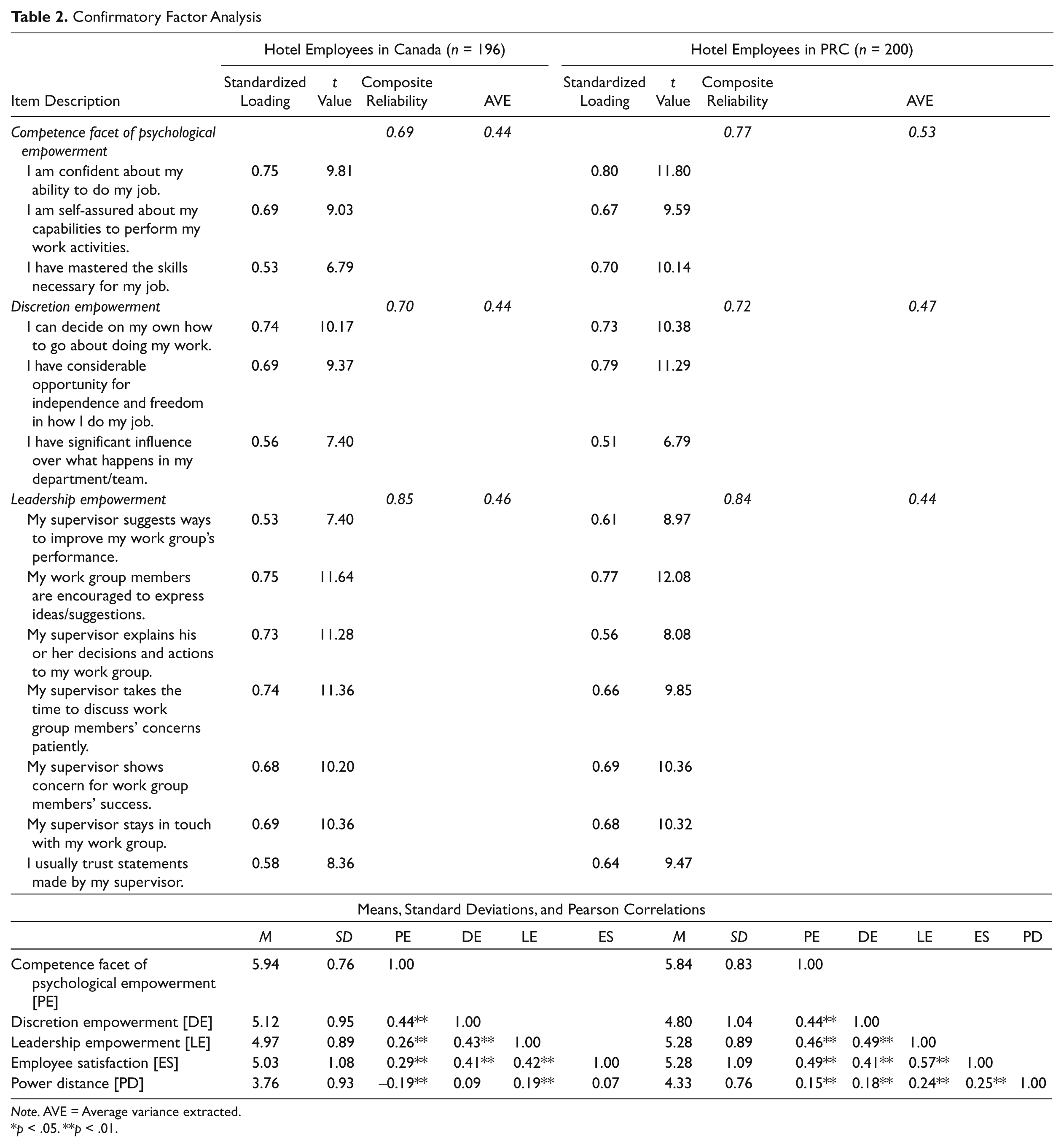
Note. AVE = Average variance extracted.
p < .05. **p < .01.
Path Analyses: Differences Across Nations
Data from the two nations were nested together in one model for path analyses to examine the interconstruct relationships across high and low power distance nations. All the paths in the nested model were constrained to be equivalent across the two nations and compared one-by-one using a conventional chi-square difference test.
The results provide initial evidence to support our hypotheses (see Figure 1). Specifically, the findings indicate that the effect of discretion empowerment on employee satisfaction showed significant difference between the high power distance, PRC group and the low power distance, Canadian group (unconstrained model: χ2 = 508.96, df = 183; constrained model: χ2 = 518.19, df = 184; Δχ2 = 9.23, Δdf =1, p < 0.01). Significant differences across the two samples were also found between leadership empowerment and discretion empowerment (constrained model: χ2 = 512.81, df = 184; Δχ2 = 3.85, Δdf =1, p < 0.05) and between leadership empowerment and psychological empowerment (constrained model: χ2 = 513.48, df = 184; Δχ2 = 4.52, Δdf =1, p < 0.05). Thus, Hypothesis 3 and Hypothesis 4 were supported. The relationship between psychological empowerment and employee satisfaction was not different between the two samples (constrained model: χ2 = 511.98, df = 184; Δχ2 = 3.02, Δdf =1, ns).
The nested model was re-specified according to the results of the chi-square difference tests. Statistics of the re-specified model reported in Figure 1 depict two corridors of empowerment influences on employees with different magnitudes. Specifically, the effect of leadership empowerment was shown to be positively associated with discretion empowerment in both nations (γCanada = 0.54, p < 0.001; γPRC = 0.76, p < 0.001). Discretion empowerment in turn positively affected employee satisfaction (γCanada = 0.50, p < 0.001; γPRC = 0.35, p < 0.001). Thus, Hypothesis 1 is fully supported. Concurrently, the effect of leadership empowerment was also found to be positively associated with psychological empowerment (γCanada = 0.37, p < 0.001; γPRC = 0.71, p < 0.001), which in turn increased the employee satisfaction in both nations similarly (γ = 0.40, p < 0.001). Hypothesis 2 is therefore confirmed.
The focus of our research, however, is upon the variation in empowerment influence across nations. The standardized coefficients together with the outcome of chi-square difference tests reported previously demonstrated that the effect of discretion empowerment in China, a high power distance nation, is significantly weaker than that in Canada, a low power distance nation (βPRC = 0.35 < βCanada = 0.50, p < 0.05). This finding is consistent with previous studies (e.g., Hui et al., 2004), and supports Hypothesis 3.
On the contrary, the effects of leadership empowerment on discretion empowerment and psychological empowerment were found to be significantly stronger in a high power society than in a low power society (Hypothesis 4a [LE to DE]: γPRC = 0.76 > γCanada = 0.54, p < 0.05; Hypothesis 4b [LE to PE]: γPRC = 0.71 > γCanada = 0.37, p < 0.01). These findings support Hypothesis 4.
Moderated Regression Analysis
Although the path analysis provided evidence to support our hypotheses, the differences detected at the national level may be attributed to other national variables (e.g., GDP) rather than national power distance. Therefore, a complementary regression analysis at the individual level was used to test the hypotheses. The items tapping each measure were averaged to form composites and were mean-centered prior to inclusion in the regression model. Demographic variables together with a proxy variable for common method variance were included as control variables. Results and descriptive statistics were reported in Table 3 and Table 4.
Results of Mean-Centered Regression Analyses
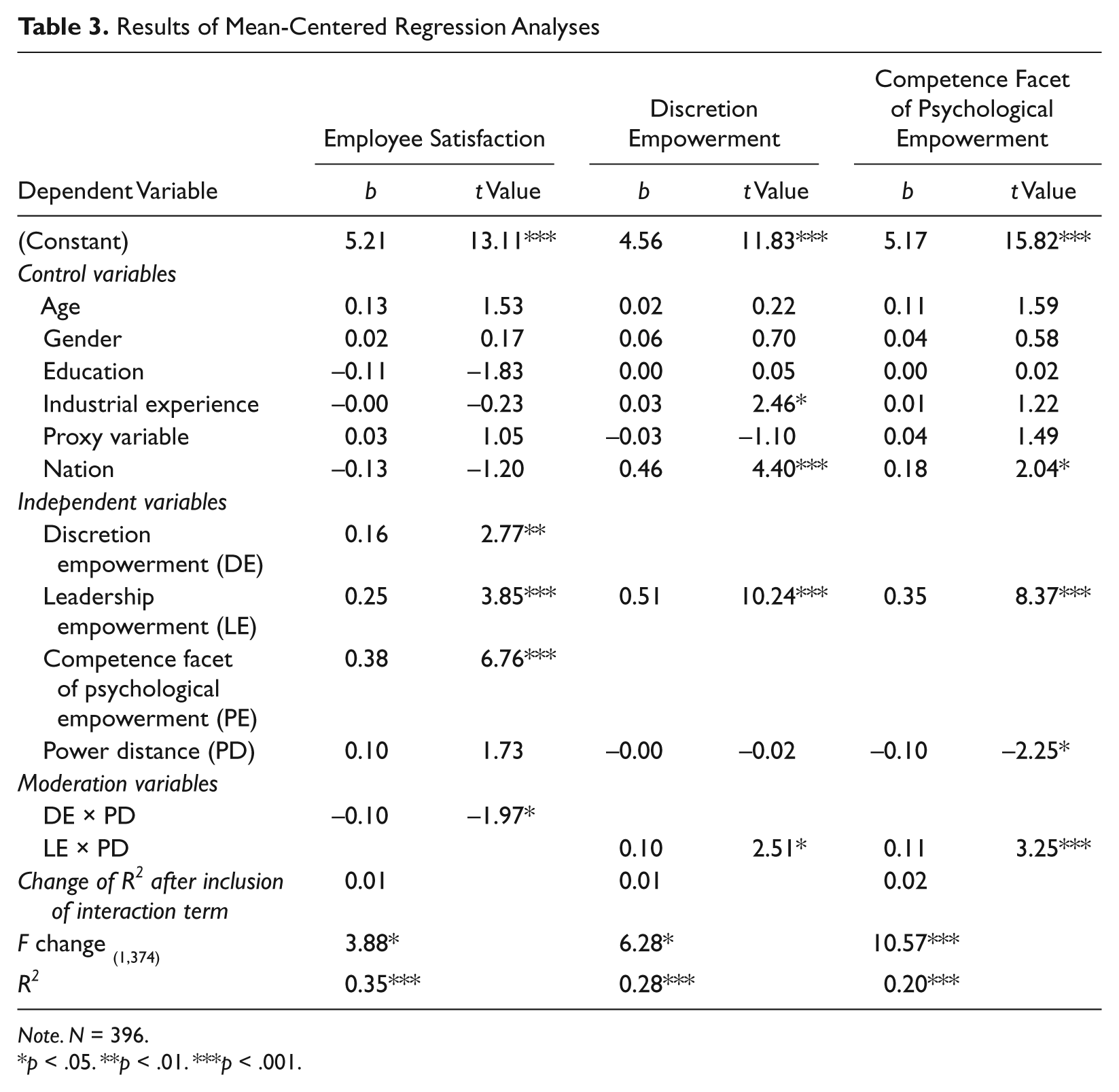
Note. N = 396.
p < .05. **p < .01. ***p < .001.
Descriptive Statistics, Reliabilities, and Pearson Correlations (Hotel Employees)
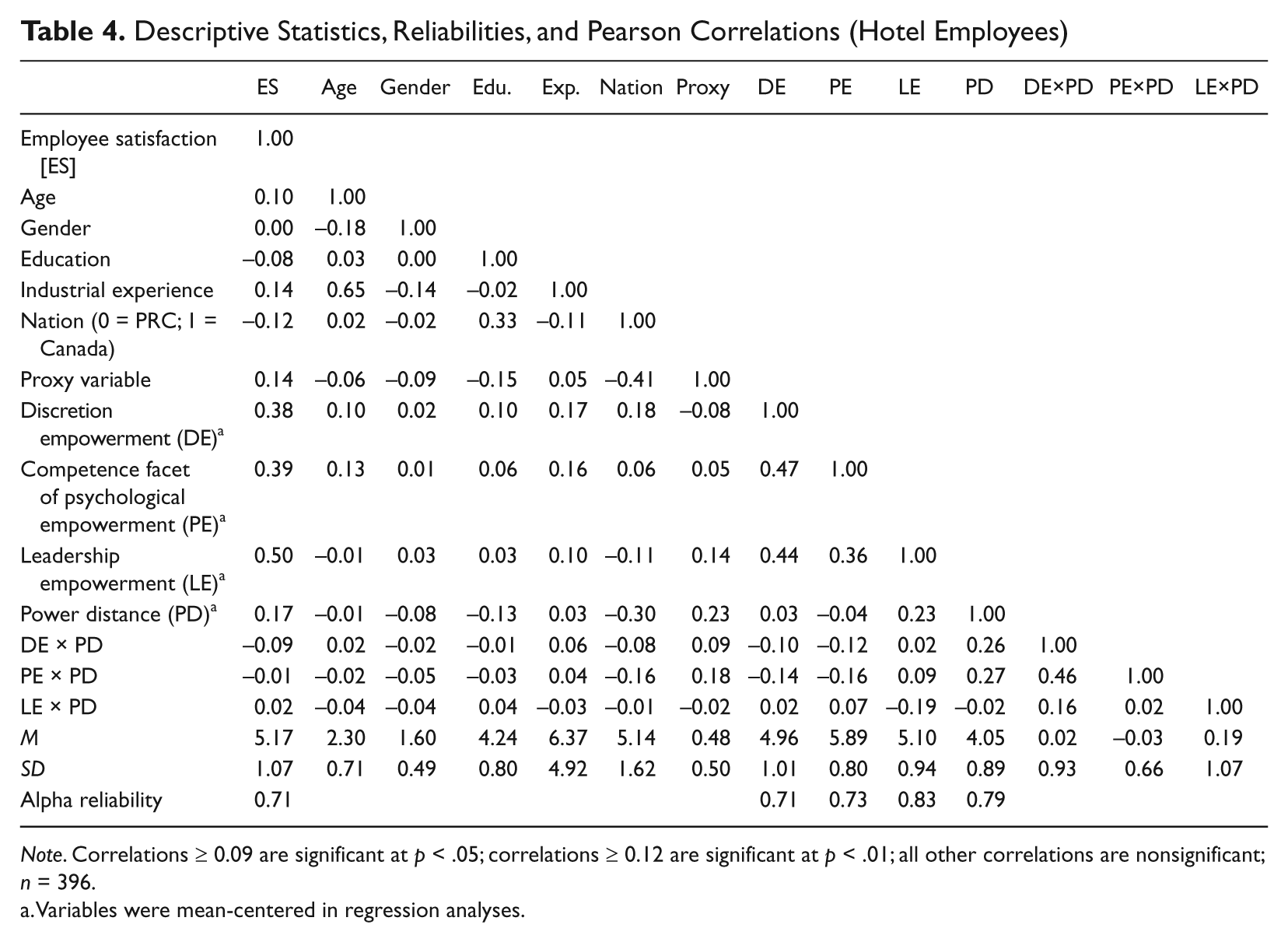
Note. Correlations ≥ 0.09 are significant at p < .05; correlations ≥ 0.12 are significant at p < .01; all other correlations are nonsignificant; n = 396.
Variables were mean-centered in regression analyses.
Results in Table 3 showed that the interaction between discretion empowerment and power distance (DE × PD) on employee satisfaction was significant and, as predicted by Hypothesis 3, in the negative direction (b = −0.10; t = −1.97; p < 0.05). Simple slope analysis (Aiken & West, 1991) revealed that the effect of discretion empowerment was contingent upon the individual’s holding low power distance values (sb = 0.24; t = 3.35; p < 0.001) and was ineffective among employees holding high power distance values (sb = 0.07; t = 0.95; ns).
The interaction between leadership empowerment and power distance (LE × PD) on discretion empowerment was positive and significant (b = 0.11; t = 2.43; p < 0.05), as predicted by Hypothesis 4a. Simple slope analysis showed that the magnitude of effect was stronger among high power distance employees (sb = 0.60; t = 10.04; p < 0.001) than among low power distance employees (sb = 0.41; t = 6.99; p < 0.001).
The interaction between leadership empowerment and power distance (LE × PD) on the competence facet of psychological empowerment was positive and significant (b = 0.11; t = 3.25; p < 0.001), as predicted by Hypothesis 4b. Simple slope analysis showed that the magnitude of effect was stronger among high power distance employees (sb = 0.45; t = 8.56; p < 0.001) than among low power distance employees (sb = 0.25; t = 4.78; p < 0.001). All hypotheses were therefore supported.
Taken together, our findings at both the national and individual levels not only verified the negative moderation effect of power distance on the impact of discretion empowerment as reported in previous literature, but more importantly, also revealed the positive moderation effect of power distance on the influence of leadership empowerment.
Discussion
The practice of empowerment has been popular in Western societies for more than two decades, but its meaning and conceptualization remain varied among researchers, in part because previous studies have operationalized the construct in varied ways. The present study investigated a model of three types of empowerment, namely discretion empowerment, psychological empowerment, and leadership empowerment, and explored their impact on employee satisfaction across two cultural groups differing in power distance values.
Contrary to the findings of prior research, which concluded that empowerment is inapplicable in high power distance societies (e.g., Hui et al., 2004; Robert et al., 2000), we have shown that this conclusion is subject to the type of empowerment in question. Based on convergent findings obtained from both national-level and individual-level analyses, the current study indicated that the effect of discretion empowerment on employee satisfaction is mitigated by higher power distance, in accordance with previous findings, but that the effect of leadership empowerment is heightened by high power distance. Furthermore, psychological empowerment is shown to be pertinent across both high and low power distance cultures and individuals. Hence, empowerment remains an effective employee management strategy to varying extents across cultures.
Empowerment matters, and power distance moderates its impact depending on the type of empowerment in question. An employee’s cultural background and endorsement of power values appears to change the logic surrounding leader-subordinate relationships. In higher power distance societies, leaders are expected to exercise stronger authority over a subordinate’s activities, but this heightened control is softened by the boss’s exercise of care and concern for his or her worker’s well-being across both workplace and nonworkplace domains (see Smith, Misumi, Tayeb, Peterson, & Bond, 1989). Although this reasoning initially emerged out of thinking about Chinese logic of leadership (King & Bond, 1985; Min Wu & Xu, in press), we believe that, given the present results at the individual level of power distance values, this logic concerning hierarchical relationships will apply anywhere.
Limitations and Future Research
Our measures were adopted from the various empowerment scales in the extant literature. To ensure adequate discriminate validity among the three types of empowerment, cross-loading items from these existing scales were removed from analyses, following the conventional research practice. Although our confirmatory factor analyses demonstrated that the retained items in our measures were effective reflective indicators for the three empowerment constructs, readers should consider the limitation of shortened empowerment scales in interpretation of our findings. Furthermore, previous literature has suggested a number of factors that are related to employee satisfaction (e.g., role ambiguity). As it was impossible to include all possible variables in our survey, we hope that future research can include more of these variables to assess their possible additive or moderating effects.
Footnotes
Appendix
Power Distance Values Measurement (Brockner et al., 2001)
Declaration of Conflicting Interests
The author(s) declared no potential conflicts of interest with respect to the research, authorship, and/or publication of this article.
Funding
The author(s) disclosed receipt of the following financial support for the research, authorship, and/or publication of this article: This study is supported by the Earmark Grant of the Hong Kong Research Grants Council (Project Ref. No. 2425/05H).