



Abstract
A bibliometric analysis of research articles published in the Journal of Cross-Cultural Psychology (JCCP) during the first 10 years (2001-2010) of the new millennium was provided. There were 457 original research articles, which were cited 6,187 times in 4,227 citing papers (January 25, 2012). Although the largest number of articles were authored by researchers from the United States (52.3%), Canada (12.0%), and People’s Republic of China (11.6%), the highest impact articles were written by Israeli (30.5 citations per article), Estonian (29.5), and Swiss (23.6) psychologists. The country self-citation rates or biases were highest in the United States (+22.9%), the Netherlands (+20.7%), and People’s Republic of China (+20.5%), showing that the small-world networks operate most strongly in these three countries. As revealed by a cross-journal citation pattern, JCCP had the strongest influence on personality and social psychology research and negligible on intelligence and cognitive research. The impact of the research articles published in JCCP on the core psychology journals remained at the same (modest) level, while the journal self-citation bias demonstrated a slight increase during the last 10 years.
Keywords
Unlike the representatives of many other disciplines, cross-cultural researchers seem to be relatively more reflective concerning their own activity. Several SWOT and bibliometric analyses of the Journal of Cross-Cultural Psychology (JCCP), the main platform of the cross-cultural research community, have been published during the last few decades (Allik, Massoudi, Realo, & Rossier, 2012; Best & Everett, 2010; Brouwers, Van Hemert, Breugelmans, & Van de Vijver, 2004; Lonner, 1980; Lonner, Smith, van de Vijver, & Murdock, 2010; van de Vijver, 2006; van de Vijver & Lonner, 1995). For instance, one of the most recent analyses found that besides more sophisticated methodologies and data analyses, a trend toward a predominance of social psychological topics had grown stronger along with an increase in studies based on self-reports (Brouwers et al., 2004). It was shown that the majority of empirical comparative studies were based on self-reports and have been done by researchers from the United States and other English-speaking countries (Best & Everett, 2010). An analysis also showed that the majority (52%) of empirical studies published in JCCP in 2009 involved a comparison of only two different ethnic, racial, or cultural groups. Most frequently, as could be predicted, American students were compared with their age mates in an East Asian country like China, Japan, or Korea. Bizarrely, in that year there were even 13 studies (22%) in which cross-cultural comparison was impossible since all participants were from the same culture (Allik et al., 2012).
It is expected that when it comes to a decision to cite or not to cite a previously published article, a preference is given to another member of the same research community whose research questions, methods used, and proposed theories are more understandable to the citing authors (Baldi, 1998). For this simple reason not only infectious diseases spread more easily in small-world networks (Allik, 2012; Watts & Strogatz, 1998) but also practices of mutual citation. Unlike many other countries, researchers from the United States demonstrate a strong country self-citation bias: They are more likely to cite articles that were written by their compatriots rather than non-U.S. authors (Allik, 2012; Jaffe, 2011). Thus, the citation practices may be indicative of the social network that exists in the research community.
One of the main goals of this bibliometric analysis is to compare JCCP in the first 10 years of the new millennium with bibliometric indicators of the nine principal personality journals—Journal of Personality and Social Psychology, Journal of Personality, Journal of Research in Personality, European Journal of Personality, Personality and Individual Differences, Personality and Social Psychology Bulletin, Personality and Social Psychology Review, Journal of Personality Assessment, and Journal of Personality Disorders—for the same period (Allik, 2012).
Methods
All searches were done in the Web of Science (WoS; Thomson Reuters) database on January 25, 2012. Altogether, there were 528 items published in JCCP during the period from 2001 to 2010. In all reported searches, the items that were classified as editorial materials, corrections, and book reviews were excluded. Four parts of the United Kingdom—England, Scotland, Wales, and North Ireland—are indexed separately in the WoS. Hong Kong, however, is not treated as a separate entity in WoS and is included in the records of the People’s Republic of China. All analyzed articles were classified as belonging to a specific country or territory if at least one of the authors has an address of this country or territory. A single article was assigned to all affiliations mentioned in the address section. The order of authors was ignored in all analyses.
Results
There were 457 original research articles published in JCCP during the period from 2001 to 2010. These articles were cited 6,187 times in 4,227 citing articles in journals (including JCCP) indexed by the WoS. Thus, the average citation rate was 13.5 citations per article, a figure comparable to the 10-year impact factors of such personality journals as Journal of Personality (17.2) or European Journal of Personality (12.6). This is slightly lower than the average citation rate (17.5) of the nine principal personality journals for the same period of time (Allik, 2012) but still more than two times higher than of Cross-Cultural Research (5.6 citations per article). In Table 1, a list of 20 countries is presented whose researchers (irrespective of their position in the list of authors) published the largest number of articles in JCCP during the period from 2001 to 2010. As expected, the United States was the most productive country with its researchers being co-authors of 52.3% of all articles. These articles also collected the largest number of citations (Cit = 3,230). The top 20 of the most productive countries contains many countries familiar from any other scientific productivity ranking (Schafer, 2012). However, Turkey, India, and Lebanon are countries whose particular strength seems to be in cross-cultural research. In these and especially smaller countries, few active researchers were typically behind the observed productivity. In total, the authors of these 457 research articles were from 96 countries or territories. In the spirit of the research topic, the geography of JCCP authors is more than two times broader than it is in any of the nine leading personality journals (Allik et al., 2012). From 53 articles produced by the People’s Republic of China, 34 (64%) were authored by researchers residing in Hong Kong.
Twenty Countries That Published the Largest Number of Articles in JCCP During the Period from 2001 to 2010
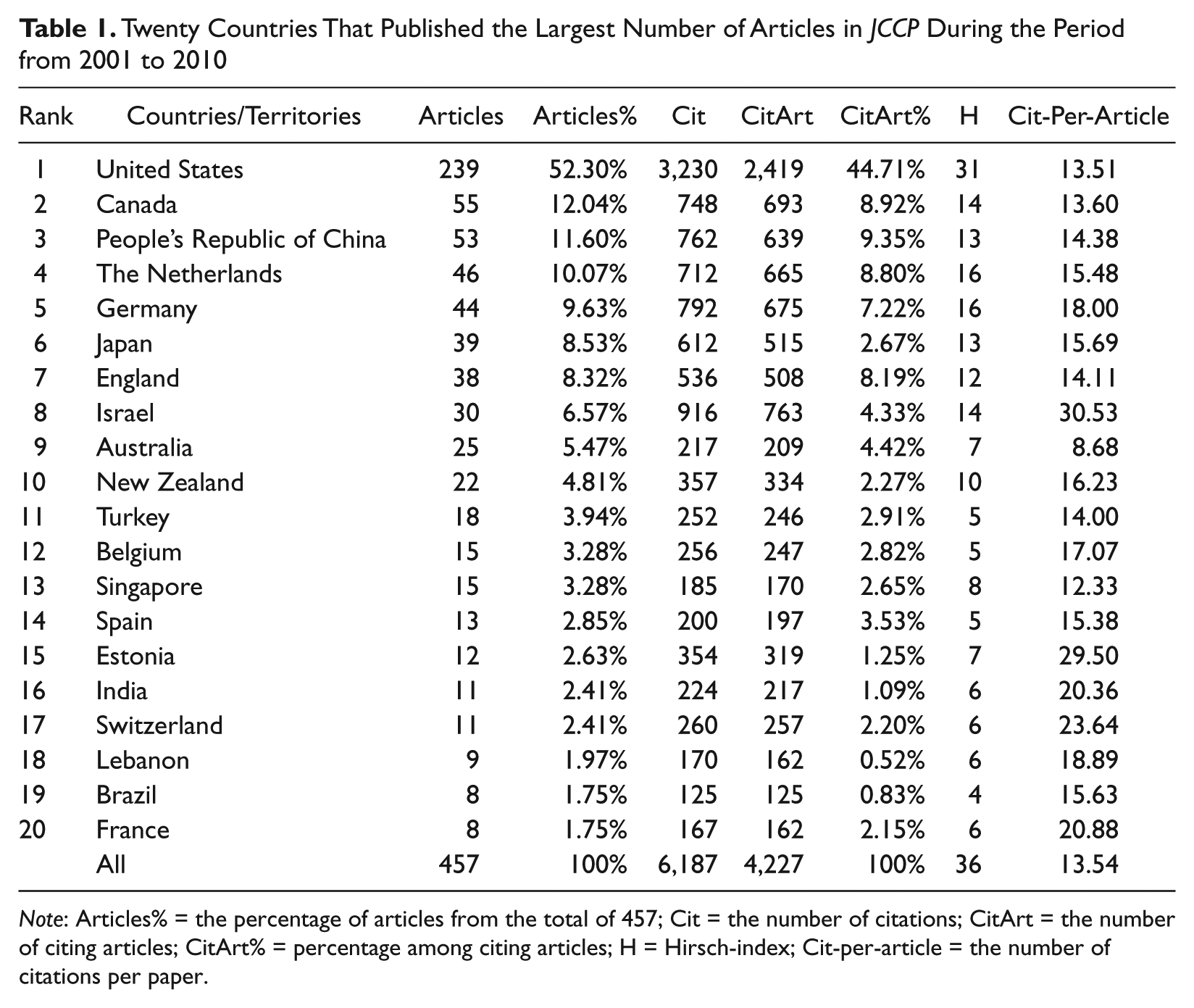
Note: Articles% = the percentage of articles from the total of 457; Cit = the number of citations; CitArt = the number of citing articles; CitArt% = percentage among citing articles; H = Hirsch-index; Cit-per-article = the number of citations per paper.
In general, the U.S. researchers are not only most productive in all scientific fields but also among the top three countries receiving the largest number of citations per article (Schafer, 2012). In JCCP, the most influential articles attracting the largest number of citations were authored by researchers from small countries such as Israel (30.5 citations per article), Estonia (29.5), and Switzerland (23.6). The average impact of articles authored by U.S. researchers was close to the average (13.5).
I also computed the percentage for each country of the total 4,227 articles citing at least one of which was published in JCCP during the period from 2001 to 2010. For example, 44.7% of these citing article were authored by the U.S. researchers. Thus, one can compute the publishing-citing balance, which was +7.6% (52.3−44.7) in favor of publishing for the U.S. researchers. A relatively high balance in favor of publishing was in Japan (+5.9%), Canada (+3.1%), and New Zealand (+2.5%). On the other end of the scale were researchers from Spain (−0.7%) and France (−0.4%), who were more frequently among those who cited articles published in JCCP rather among their authors.
It was recently observed that some countries such as China, the United States, and Iran demonstrate an abnormally high country self-citation rate: Researchers from these countries are disproportionably more likely to cite articles that were authored by their own countrymen rather than representative of any other nation (Allik, 2012; Jaffe, 2011). For example, 329 articles authored or co-authored by the U.S. researchers were cited in 2,419 article. From these citing articles, 56.0% had at least one author who was working in one U.S. academic institution. There were, however, 218 JCCP articles authored exclusively by non-U.S. researchers. These articles were cited by 2,345 articles, among which the percentage of the U.S. authors was only 33.0%. The difference of 22.9% is a measure of the country self-citation rate or self-citation bias. I also computed the country self-citation rate to several other productive countries. For instance, People’s Republic of China and the Netherlands were characterized by a relatively elevated level of self-citation bias of 20.5% and 20.7%, respectively. On the other hand, the country self-citation rate was rather moderate for Canada (10.6%) and Germany (11.2%).
In Table 2, the list of the most cited articles from 2001 to 2010 are shown. These 21 articles (there was a tie between two articles in 2009) had exactly 100 coauthors (about 4.8 coauthors per article) from 33 different countries. Shalom Schwartz of Hebrew University had three articles among the top citations. There were nine authors who were represented with two articles.
The Most Cited Articles Published in JCCP from 2001 to 2010

It is not very surprising that many authors who have written highly cited articles are also among the most productive authors. Table 3 demonstrates a list of the 22 most productive authors of JCCP who have published at least five articles in it during the last 10 years. Quite expectedly, Shalom Schwartz also leads the impact ranking. His five articles were cited on average 76.3 times each.
Authors Publishing Most Frequently in JCCP, 2001 to 2010
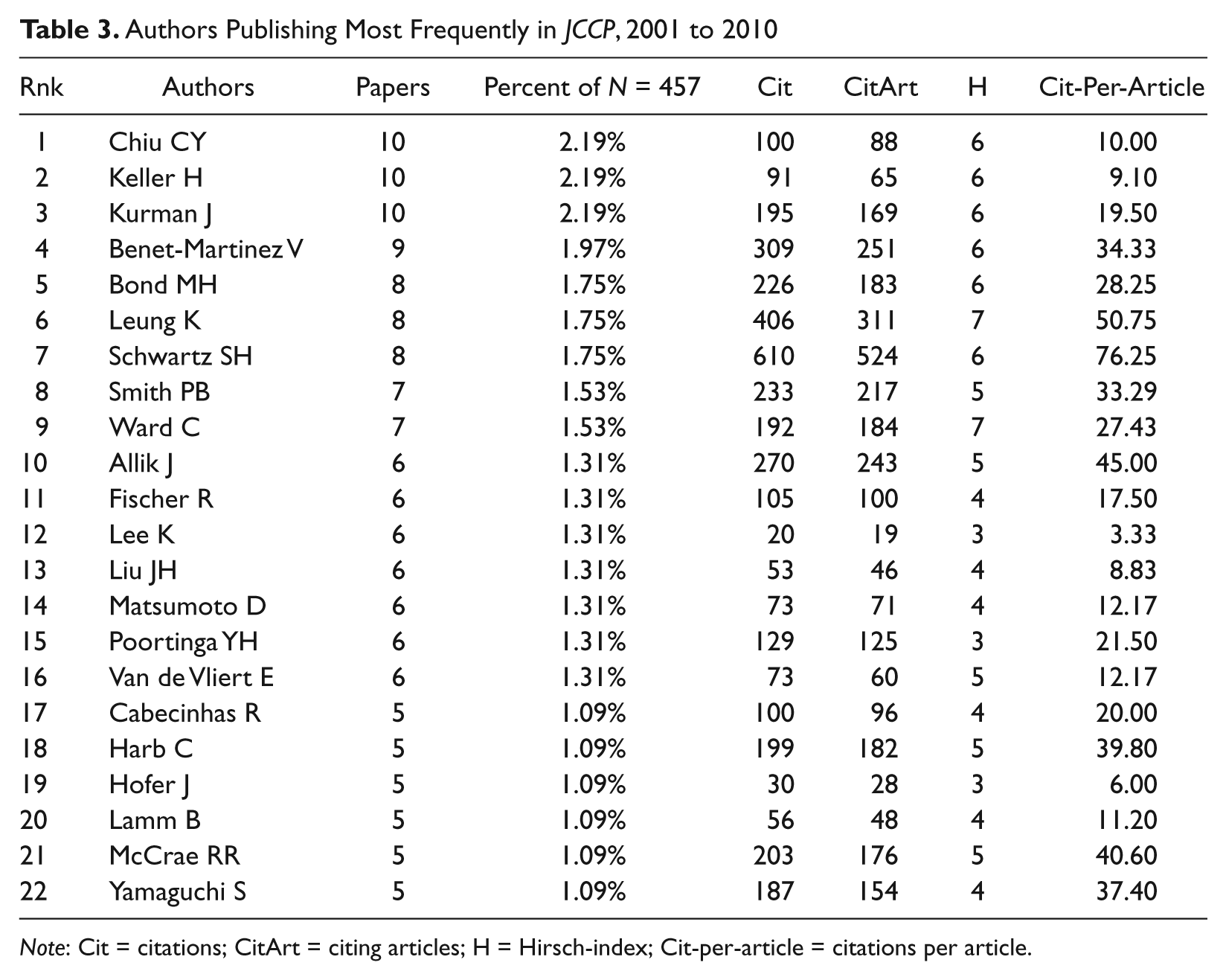
Note: Cit = citations; CitArt = citing articles; H = Hirsch-index; Cit-per-article = citations per article.
It was also interesting to see whose work relies most on articles published in JCCP. For that I analyzed the 4,227 citing articles to reveal the “best friends” who cited JCCP articles. Table 4 shows 21 authors who cited most frequently articles that were published in JCCP during the period from 2001 to 2010.
Authors of Articles Citing Most Frequently Articles That Were Published in JCCP During the Period From 2001 to 2010
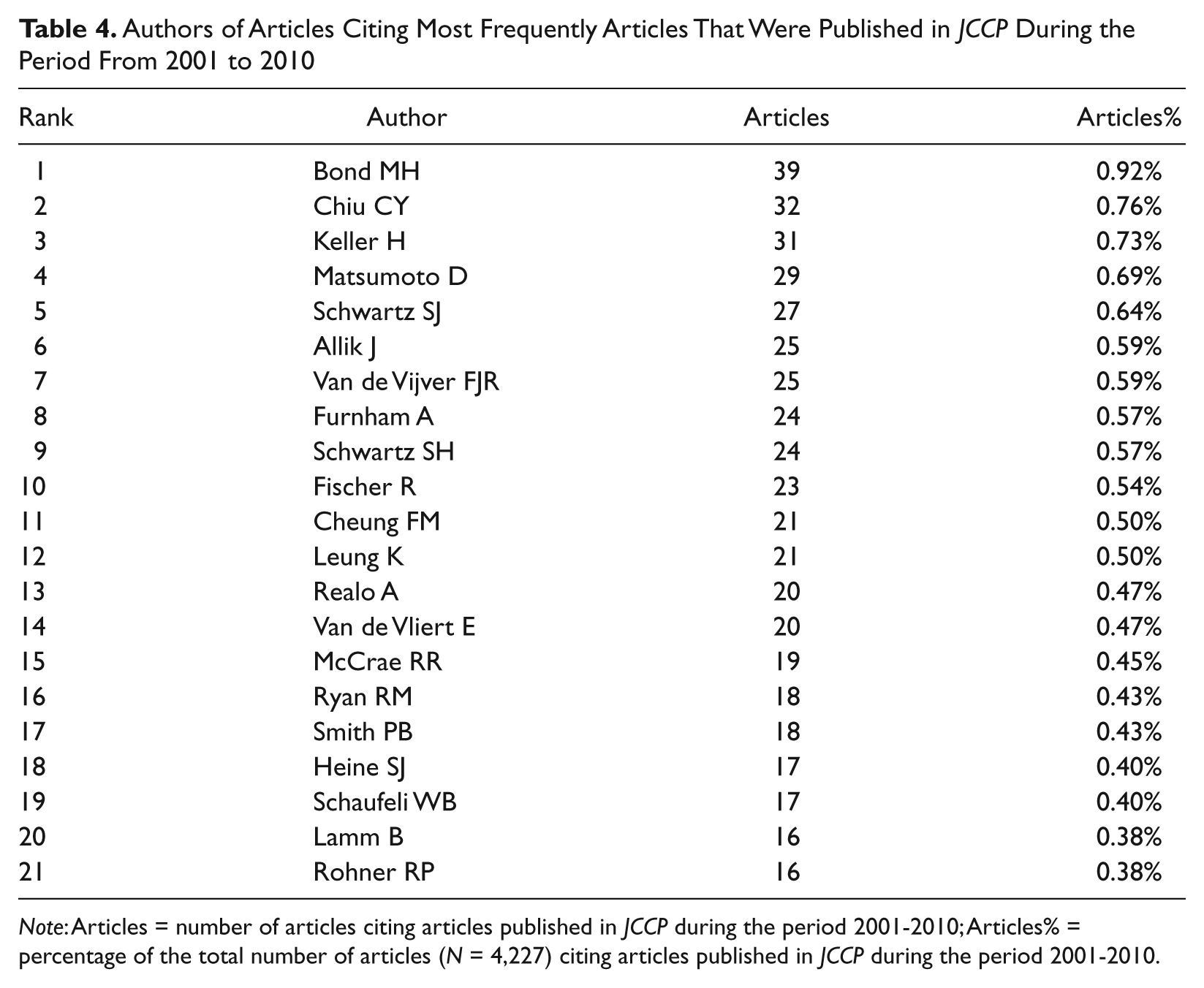
Note: Articles = number of articles citing articles published in JCCP during the period 2001-2010; Articles% = percentage of the total number of articles (N = 4,227) citing articles published in JCCP during the period 2001-2010.
Finally, I compiled a list of the top 20 journals most frequently citing articles that were published in JCCP during the period of 2001 to 2010 (see Table 5). Typical of most scientific journals, articles published in JCCP were most frequently cited by articles published in the same journal. Approximately 6.1% of all citing articles were published in JCCP. Understandably, this list overlaps with the similar table that was published for the period from 2000 to 2008 (Lonner et al., 2010, Table 2). Virtually all leading personality and social psychology journals were among these 20 most frequently citing journals. Besides cross-cultural research itself (Cross Cultural Research, Cultural Diversity and Ethnic Minority Psychology), the topics published in JCCP were also relevant to human development (International Journal of Behavioral Development), affective factors (Emotions), and management (Journal of International Business Studies, International Journal of Human Resource Management) science. The fact that journals devoted to the study of mental abilities (e.g., Intelligence) and cognitive functions (Cognition, Cognitive Psychology, Memory and Cognition, etc.) were not even in the top hundred seems not to be accidental.
Twenty Journals Most Often Citing Articles That Were Published in JCCP During the Period From 2001 to 2010
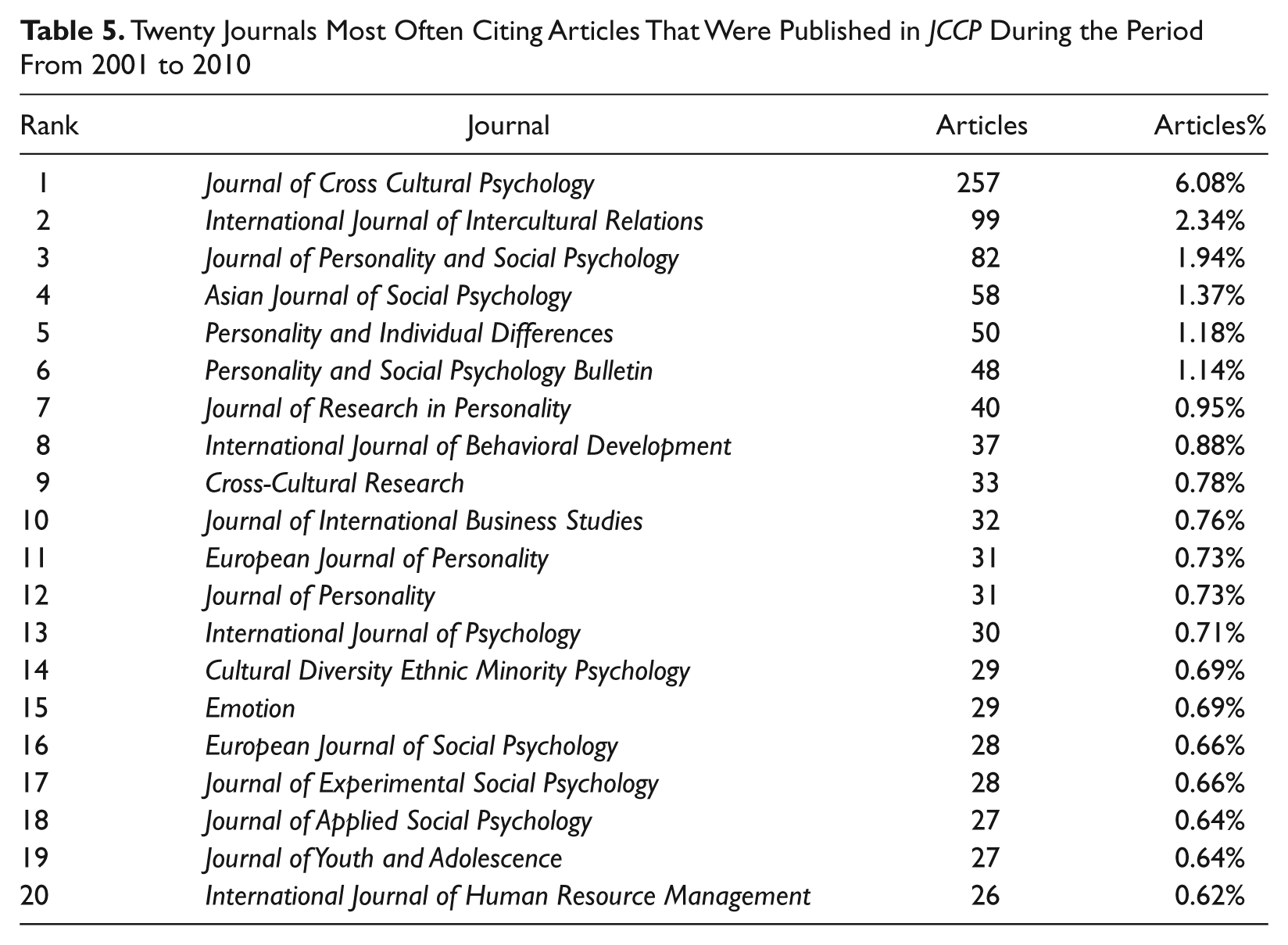
Figure 1 demonstrates the frequency of journal self-citation during the last 10 years. There was a slight increase of the percentage of the self-citations, r(10) = .65, p = .04. For a comparison, I compiled a list of the generalist psychology journals that included Annual Review of Psychology, Psychological Bulletin, Psychological Review, American Psychologist, European Psychologist, Psychological Science, Perspective of Psychological Science, and Behavioural and Brain Sciences. I also included three general science magazines: Nature, Science, and the Proceedings of the National Academy of Science of the United States. The percentage of the citing articles published in these eight core psychology journals and three general science magazines remained approximately on the same level, fluctuating around the 4.4% level.
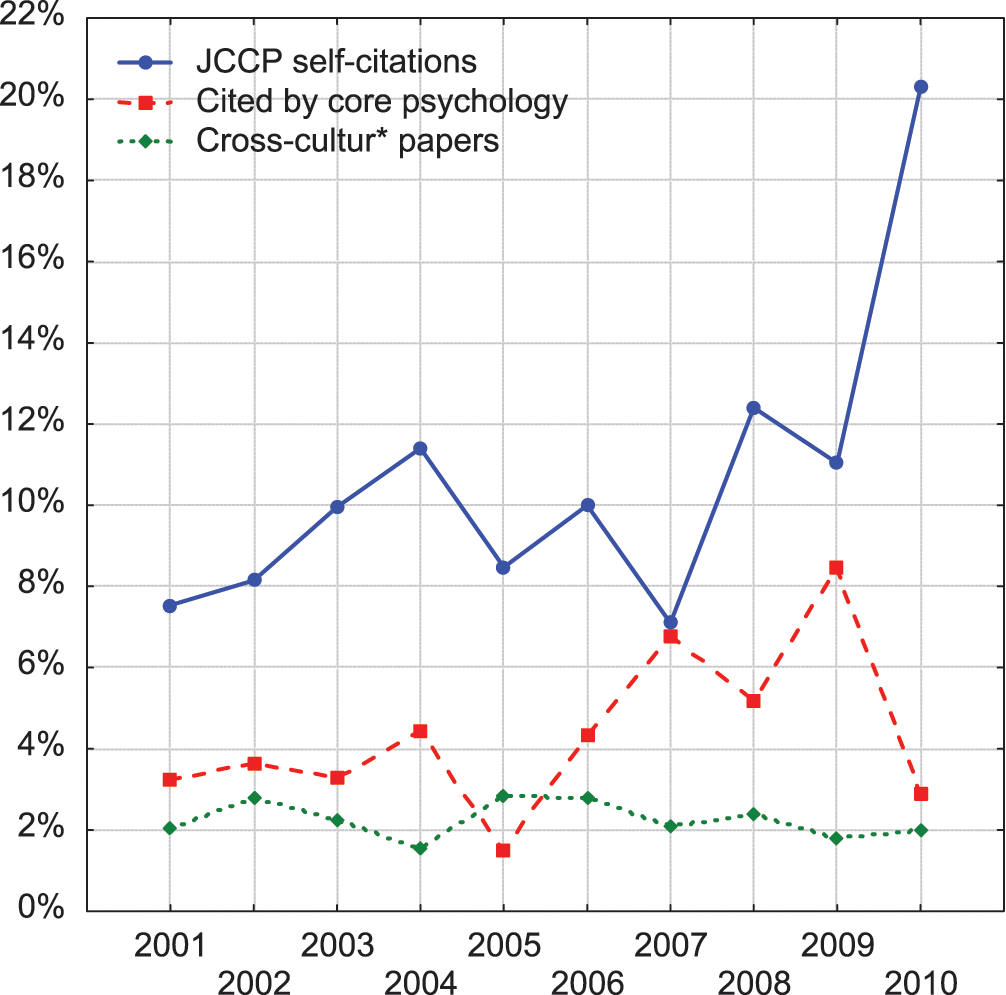
Percentage of JCCP Self-Citations, Citations of JCCP Articles by the Core Psychology Journals From All Citing Articles, and Prevalence of Cross-Culture Articles Among All Psychology Articles
During the past several decades there has been a steady increase in the number of cross-cultural articles that are being published not only in many other psychology journals but in journals that are only tangentially related to JCCP. A search of journals in such areas as nursing, speech and hearing disorders, and physical therapy (to name just a few) will show, as dedicated cross-cultural psychologists have often pointed out, that “everyone has discovered culture.” To analyze what could be called a healthy diffusion of cross-cultural research, I selected from generalist, personality, social and applied psychology, business, and health journals a representative sample of 46 journals that have more frequently than others published cross-cultural articles. 1 Figure 1 demonstrates the percentage of articles that explicitly used cross-culture, cross-cultural, or similar phrases in the title, abstract, or keywords relative to the total number of articles in these 46 journals. From a total of 46,587 articles, only 2.2% mentioned cross-culture in the title, abstract, or keywords. This number remained fairly constant during the period of observation.
Discussion
Time and again, psychologists become worried about their habitual practice of studying convenience samples of students attending introductory psychology courses. Recent highly publicized articles in Behavioral and Brain Sciences, Nature, and Science alarmed the research community with the well-known fact that in the top psychological journals 96% of all research participants were from Western industrialized countries (Henrich, Heine, & Norenzayan, 2010a, 2010b; Jones, 2010). In the community of cross-cultural researchers, it is common knowledge that psychology that is rooted predominantly in Western culture—sometimes called WASP (Western Academic Scientific Psychology)—cannot pretend to have automatic and meaningful relevance to the majority of the world (Berry, Poortinga, Segall, & Dasen, 2002), reflecting only a small minority of WEIRD (Western, Educated, Industrialized, Rich, and Democratic) people (Henrich et al., 2010a). Even though cross-cultural psychology has been aware of the danger of studying exclusively “weird” people, it is much easier to formulate than avoid this shallow propensity. As it was already mentioned in the introduction, even a majority of empirical studies published in JCCP involved a comparison of only two different ethnic, racial, or cultural groups, one of which usually belonged to the “weird” category (Allik et al., 2012).
Most fields of psychology are dominated by large numbers of U.S. psychologists. Usually they are not only the most productive, publishing from half to three thirds of all articles, but also the most influential, collecting the largest number of citations per each published article. Even compared with personality psychology, role of the U.S. scientist in JCCP is more modest. Although they still produced the largest number of articles in JCCP, their impact—the number of citations per article—ranked 18th in the list of the most influential countries. This relatively modest position was achieved despite a considerable country self-citation bias: The U.S. authors were 22.9% more likely to cite an article when it was written by U.S. rather than non-U.S. authors. This U.S. self citation-bias was even larger than in personality psychology, where at 14.5% it was still the largest among all other countries (Allik, 2012). Although the country self-citation bias can be influenced by a variety of reasons, one likely source is a strong cooperative “ingroup” network, which inclines researchers to ask the same research questions and to use similar methodology and theoretical interpretations, the result of which is a pattern of mutual citations. However, these local country networks are obviously overshadowed by a larger international network operating within JCCP. No other psychology journal has contributors from nearly 100 countries or territories. This analysis contributed to a previously reached conclusion that JCCP continues to be a truly international enterprise in which even small countries can influence the content of the journal.
Members of the cross-cultural research community, and especially those who are involved in some way with JCCP, have been promoting the idea of the cross-cultural diversity for more than four decades. That mission has been to contribute to psychological research, theory, and applications, as well as psychology education, in meaningful ways (Lonner, 1980, 2004; Lonner et al., 2010). When taking into consideration the entire history of psychology, the influence of culture-oriented psychologists shows that psychology has been enriched far beyond what it was decades ago when culture was hardly mentioned. However, an observation of bibliometric trends of JCCP during the last 10 years demonstrates that this mission is not yet accomplished. Among many things that need to be done is to lower the journal self-citation rate, which increased during the last decade. For a comparison, Journal of Personality and Social Psychology, which is the most cited psychology journal, receives only 4.1% of citations from articles that were published in the same journal. It seems that JCCP has had a sufficiently strong impact only on personality and social psychology journals. It is certainly telling that such journals as Intelligence or Cognitive Psychology had no good reason to cite articles published in JCCP. The reflection of the content published in JCCP during the last 10 years in the core psychological journals such as Annual Review of Psychology, Psychological Bulletin, or Psychological Review has also remained at a relatively modest level. There are no signs that the impact of JCCP on these generalist journals has considerably increased during the first decade of the new millennium. The same seems to be true concerning cross-cultural research in general. Only a small fraction (2.2%) of the mainstream psychology articles are reporting cross-cultural comparisons, and this fraction has not considerably increased during the last 10 years. In spite of warnings, the majority of psychological journals seem to continue an ill repute practice of accepting articles from participants from only one ethnic, racial, or professional group, even if it is absolutely clear that the results are not generalizable to the rest of the world.
Footnotes
Declaration of Conflicting Interests
The author declared no potential conflicts of interest with respect to the research, authorship, and/or publication of this article.
Funding
The author disclosed receipt of the following financial support for the research, authorship, and/or publication of this article: Writing of this article was supported by a grant from the Estonian Ministry of Science and Education (SF0180029s08) and by a Primus grant (3-8.2/60) from the European Social Fund to Anu Realo.