



Abstract
The authors propose that cross-cultural differences in sensitivity to social rejection, or the extent to which one is alert to potential rejection from significant others, can be understood as an adaptation to different social ecological contexts varying in the degrees of relational mobility. In societies low in relational mobility, such as East Asia, relationships and group memberships are stable and exclusive, and thus it is difficult for individuals to recover once rejected from current relationships or groups. In these contexts, one would expect people to be continuously paying attention to negative feedback from others to avoid potential rejection. In contrast, this type of anxiety will be less pronounced in societies high in relational mobility, such as North America, because there are a greater number of relationship alternatives available, even if individuals were to be excluded from a particular relationship. Results from two cross-national studies showed that, as expected, individuals’ perceptions of relational mobility partially mediated rejection sensitivity (Study 1) and Taijin Kyofusho, an allocentric subtype of social anxiety (Study 2).
As humans are fundamentally motivated to belong with others to survive and reproduce (Baumeister & Leary, 1995), avoiding social rejection or exclusion and becoming involved with beneficial relationships and groups is a crucial adaptive task. Therefore, people should be sensitive to cues of potential social rejection (Downey & Feldman, 1996), and thus need to monitor their behavior to avoid being rejected, for instance by offending and annoying others (Russell, 1989). However, recent studies have found that there are cross-cultural variations in sensitivity to social rejection. For example, East Asians, such as Japanese and Koreans, display greater sensitivity to rejection than Americans (Yamaguchi, Kulman, & Sugimori, 1995). Moreover, Japanese show higher amounts of concern or fear of offending or causing trouble to others through inappropriate behaviors and manners, a phenomenon known as Taijin Kyofusho (Norasakkunkit, Kitayama, & Uchida, 2012). The goal of this article is to explain why this cultural difference in sensitivity to social rejection exists, using a socio-ecological approach (Oishi & Graham, 2010) and specifically focusing on the role of relational mobility (Yuki et al., 2007), as an explanation.
Avoidance of social rejection, or of being excluded from the social relations of interpersonal relationships and groups, is a critical task for humans. This is due to the fact that social rejection brings individuals not only unpleasant experiences on both cognitive and physical levels (Eisenberger & Lieberman, 2004) but also can result in the concrete loss of emotional and material resources for living, which one could otherwise have received through lost relationships (Baumeister & Leary, 1995). Consequently, all humans are somewhat attentive to even subtle cues of social rejection. There are, however, individual differences in the degree of sensitivity to rejection. Sensitivity to social rejection is defined as the cognitive affective processing disposition to anxiously expect, readily perceive, and intensely react to rejection (Downey & Feldman, 1996).
Cross-Cultural Differences in Sensitivity to Social Rejection
While having moderate levels of sensitivity to rejection appears to be a universal phenomenon (Leary & Kowalski, 1995), a number of recent studies have revealed that there are cross-cultural variations in the level of sensitivity to social rejection. For instance, rejection sensitivity, defined as the anxious expectation of being rejected by people who are important to the self (Downey, Mougios, Ayduk, London, & Shoda, 2004), has been found to be higher for East Asians than for North Americans (Garris, Ohbuchi, Oikawa, & Harris, 2011; Yamaguchi et al., 1995). Likewise, Taijin Kyofusho, a subtype of social anxiety which is characterized by an excessive concern and fear of offending others by self-perceived inappropriate behaviors, such as one’s blushing, improper facial expressions, or inappropriate staring (Chang, 1997; Russell, 1989), tends to be more prevalent among East Asians than North Americans (Dinnel, Kleinknecht, & Tanaka-Matsumi, 2002; Norasakkunkit et al., 2012).
Traditionally, these cross-cultural differences in rejection sensitivity and Taijin Kyofusho have been explained by such cultural dimensions as individualism and collectivism (Hofstede, 1980; Triandis, 1995) and cultural self-construals (Markus & Kitayama, 1991, 2010). According to these perspectives, East Asian cultures, such as Japan and Korea, are characterized by high levels of collectivism, with the maintenance of good social relations and social harmony being the primary goal of people’s lives. This leads to a stronger sense of belongingness to social relationships among East Asians, thereby making them more afraid of damaging or jeopardizing relationships.
In contrast, North American culture emphasizes individuality, and the self is defined as an entity that is relatively distinct from others and situations. Thus, individuals in such cultures should be concerned about damaging their relationships to a lesser degree than in collectivistic cultures, such as East Asia (Kleinknecht, Dinnel, Kleinknecht, Hiruma, & Harada, 1997).
There is, however, a critical limitation to this “cultural” explanation. That is, it is unclear what kind of roles rejection sensitivity and Taijin Kyofusho play, especially within the social and practical realities of the given societies. Might high sensitivity to social rejection among East Asians help them to deal with problems that are prevalent in East Asian social contexts? On the other hand, might typical characteristics of North American societies present less need for individuals to possess high sensitivity to social rejection? Below, we will attempt to address this novel theoretical question, by using a socio-ecological approach.
Socio-Ecological Approach to Sensitivity to Rejection
Recently there has been a resurgence of interest in the effect of the ecological environment, especially social ecologies, on people’s psychological processes and behaviors (Nisbett & Cohen, 1996; Yamagishi, Hashimoto, & Schug, 2008; Yuki & Schug, 2012; see also Oishi & Graham, 2010, for an extensive review). Humans collectively create components of a social ecology, such as economic, political, and educational systems, as well as more intermediate social structures, such as small groups and interpersonal relationships. These social ecologies in turn create selection pressures that shape the behavioral patterns and psychological tendencies of individuals. Thus, according to this perspective, psychological and behavioral tendencies, which are more common in a particular society, are likely to have an adaptive function or ecological validity in the type of social contexts that are prevalent within a given society. We propose that sensitivity to social rejection should be no exception; the relative degree of usefulness and prevalence of higher sensitivity to social rejection should be affected by a socio-ecological factor called relational mobility.
Relational Mobility and Sensitivity to Social Rejection
Among a number of socio-ecological factors that have been proposed and dealt with to date, one that has recently received extensive focus is the level of interpersonal and intergroup mobility (Adams, 2005; Chen, Chiu, & Chan, 2009; Oishi, 2010; Yamagishi & Yamagishi, 1994). In this article, we particularly focus on relational mobility, 1 defined as the amount of opportunities people in a given society or social context have to select interactional partners or groups when necessary (Falk, Heine, Yuki, & Takemura, 2009; Schug, Yuki, Horikawa, & Takemura, 2009; Schug, Yuki, & Maddux, 2010a; Yuki, Sato, Takemura, & Oishi, 2013; Yuki & Schug, 2012).
We propose that greater levels of sensitivity to social rejection, such as rejection sensitivity and Taijin Kyofusho, will be higher in societies low in relational mobility in comparison with those high in relational mobility. In societies low in relational mobility, new interpersonal relationships and groups are relatively unavailable, because partners and members are bound to each other in obligatory social groups and networks (Yamagishi, Jin, & Miller, 1998). Interpersonal relationships and groups are not formed through personal choice, and thus it is difficult for individuals to acquire a replacement once they are excluded. This socio-ecological structure poses a strict constraint upon people, namely that they must minimize the possibility of being rejected and excluded from their current relationships and groups. To achieve this goal, people must be particularly sensitive to the possibility that their behaviors might be offensive to others (i.e., high Taijin Kyofusho), while overestimating the potential for being socially rejected (i.e., high rejection sensitivity). Such tendencies can then motivate the individual to adjust their behaviors to insure they are continuously accepted (see Yamagishi et al., 2008, for a related discussion).
In societies high in relational mobility, in contrast, there are a greater number of opportunities to form new relationships, and thus abundant alternative options when one is excluded from existing relationships. Therefore, being overly worried about the potential damage that their behavior might have on others and being sensitive to the subtle cues of potential rejection is not a primary task for individuals who reside in such societies (Yamagishi et al., 2008). Accordingly, sensitivity to social rejection should be lower in societies with high relational mobility than in societies with low relational mobility.
It would be good to note here that, while the above argument presupposes the causal direction that relational mobility in a social ecology affects the level of people’s sensitivity to social rejection, the reverse causation may also operate. That is, people with greater (vs. weaker) rejection sensitivity may be more likely to create social relations and groups that are lower (vs. higher) in relational mobility. While this remains a valid issue which needs to be addressed, the aim of the current research is not to disentangle the casual effects but rather to test the hypothesis that differential levels of relational mobility in social ecologies can predict cross-cultural differences in levels of people’s sensitivity to social rejection.
We conducted two cross-national studies to test the above hypothesis. Study 1 compared the sensitivity levels to rejection between Japanese and Americans, and Study 2 compared the levels of Taijin Kyofusho between Japanese and Canadians. We adopted a meditational analysis (Baron & Kenny, 1986) to test whether the cross-cultural differences in rejection sensitivity and Taijin Kyofusho levels would be mediated by the levels of relational mobility of the local social environment surrounding each participant. Although it is often challenging to identify what underlying factors actually bring about cultural differences in psychological tendencies, mediation analysis is one way to demonstrate a linkage between observed cultural differences and the contextual variables theoretically purported to contribute to the difference. If a significant mediation effect is obtained, then it is empirically justified to claim that that the specific cultural variable is linked to the differences observed (Matsumoto & Yoo, 2006). Previous studies have shown that the relational mobility scale successfully mediates cultural differences in self-enhancement (Falk et al., 2009), self-disclosure (Schug et al., 2010a), similarity between friends (Schug et al., 2009), general trust (Yuki et al., 2007), shame proneness (Sznycer et al., 2012), and the association between self-esteem and happiness (Yuki et al., 2013). In this study, we tested whether the level of perceived relational mobility in the micro socio-ecological context that surrounded each participant, as assessed by the relational mobility scale (Yuki et al., 2007), would mediate cross-cultural differences in rejection sensitivity and Taijin Kyofusho.
Study 1
Participants
One hundred sixteen Japanese university students at Hokkaido University and 73 American Caucasian students at the University of Virginia participated in the study. The Japanese participants received a monetary payment, while the American participants received partial course credits for their participation.
Procedure and Measurements
Both Japanese and American participants received a questionnaire packet in a lab setting. The 12-item relational mobility scale (Schug et al., 2010a; Yuki et al., 2007) was used to assess relational mobility of participants’ perceptions of immediate social surroundings. This scale asks participants to rate the degree of relational mobility in their immediate society, because the concept of relational mobility refers to the degree of new relational opportunities in the social ecology that surrounds individuals. The validity of this scale to measure relational mobility has been examined across states within the United States (Schug, Yuki, Sato, & Takemura, 2010b) by correlating perceived levels of relational mobility (i.e., relational mobility scale score) with the number of actual new acquaintances formed in the past week, rs(25) = .40, p < .05. Sample items were s follows: “They (i.e., people in your immediate society) have many chances to get to know other people” and “They can choose who they interact with.” Participants responded on a 6-point Likert-type scale ranging from 1 (strongly disagree) to 6 (strongly agree).
To measure rejection sensitivity, we used the rejection sensitivity questionnaire (RSQ; Downey & Feldman, 1996). The RSQ consists of 18 situations that render hypothetical interpersonal interactions in which rejection by a significant other is a possibility. Following Downey et al. (2004), within each of 18 situations, we calculated RSQ scores by first reversing the expected rejection likelihood index so that higher scores indicate expected acceptance, and then multiplying this with the degree of concern or anxiety, such that higher scores indicate high anxiety even when the likelihood of rejection is low. We then averaged the weighted scores across the 18 situations, and the result was used as an indication of the magnitude of a participant’s general rejection sensitivity. Consequently, the total score of RSQ ranges from 1 to 36 points. Examples of situations included, “You ask your friend to do you a big favor” and “You ask your boyfriend/girlfriend to move in with you.” Participants were asked their degree of concern or anxiety about the outcome, from 1 (very unconcerned) to 6 (very concerned), as well as the expected likelihood that the interaction partner(s) would respond by rejecting the respondent’s request, from 1 (very unlikely) to 6 (very likely), in the given situation. Both relational mobility and RSQ scales were checked for equivalency in both languages through back-translation (Brislin, 1970). In addition, all scenarios in RSQ were presented to undergraduate and postgraduate lab members and none of the 18 items were found to be unsuitable or difficult to understand in a Japanese cultural context.

The mediation effect of relational mobility on rejection sensitivity in two countries in Study 1.
Results and Discussion
All scales were highly reliable (Cronbach’s α: Relational mobility: United States = .83, Japan = .86; RSQ = United States = .93, Japan = .95). As expected and consistent with previous studies (e.g., Falk et al., 2009; Schug et al., 2010a), perceived levels of relational mobility were lower among Japanese (M = 3.83, SD = .59) than among Americans (M = 4.55, SD = .68), t(187) = −7.71, p < .0001, d = 1.16. Also as expected, the RSQ score was higher among Japanese (M = 13.40, SD = 3.29) than among Americans (M = 9.14, SD = 2.48), t(177) = 9.40, p < .0001, d = 1.43.
Next, we examined the correlations between both measures of relational mobility and RSQ. The relational mobility scale was negatively correlated with RSQ score for Americans (r = −.17, p = .099) and Japanese (r = −.28, p = .002).
We then examined whether the cultural differences in the level of RSQ could be explained by the cross-societal differences in relational mobility using a mediation analysis. First, we conducted a multiple regression analysis with country (United States = 1; Japan = 0) predicting RSQ. Consistent with the above finding, we found a significant effect of country, β(185) = −.57, p < .0001. When the effect of relational mobility was added to the equation as an additional independent variable, however, the effect of country decreased to β(185) = −.47, p < .0001, and the effect of relational mobility was significant, β(185) = −.21, p = .003. Sobel’s test showed that this mediation effect was significant (z = 2.84, p = .004; indirect effect = .10). To further investigate the effect of relational mobility as a mediator, bootstrap confidence intervals for this conditional indirect effect were obtained. We used a bootstrap procedure with 5,000 bootstrap samples (Shrout & Bolger, 2002), and the analysis yielded a bootstrap 95% bias-corrected interval of [−1.52, −0.26], suggesting relational mobility partially mediated the relationship between culture and RSQ. This indicates that, as hypothesized, the cross-cultural difference in RSQ between the United States and Japan is partially predicted by the societal difference in perceived levels of relational mobility.
Study 2
Participants
Eighty-three Japanese university students at Hokkaido University and 125 Canadian Caucasian university students at the University of Alberta participated. Japanese participants received monetary payments, while Canadian participants received partial course credits for their participation.
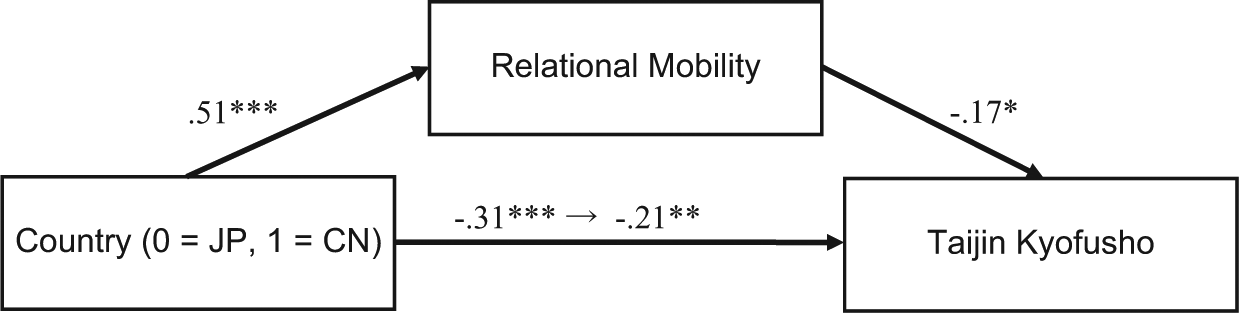
The mediation effect of relational mobility on rejection sensitivity in two countries in Study 2.
Procedure and Measurements
Participants completed the same relational mobility scale as in Study 1. As an alternative index of allocentric social anxiety, the Taijin Kyofusho Scale (TKS; Kleinknecht et al., 1997) was used. This scale consists of 31-items, which measure the allocentric component of social anxiety in which a person is anxious lest their shortcomings distress or even harm others. Sample items include, “I am afraid that I will blush in front of other people and as a result offend them” and “I am afraid that eye to eye contact with other people will offend them.” Participants were asked to rate the extent to which each statement applies to them on a 7-point scale ranging from 1 (totally false) to 7 (exactly true).
It should be noted that TKS was originally developed to capture a culturally bounded form of social anxiety, particular to Japan. However, subsequent research has revealed substantial evidence that similar symptoms exists in cultures other than Japan, including Korea (Choy, Schneier, Heimberg, Oh, & Liebowitz, 2008), China (Chang, 1997), Indonesia (Vriends, Pfaltz, Novianti, & Hadiyono, 2013), Switzerland (Vriends et al., 2013), Australia (Kim, Rapee, & Gaston, 2008), and even the United States (Choy et al., 2008; Dinnel et al., 2002; Norasakkunkit et al., 2012). Furthermore, TKS has successfully assessed Taijin Kyofusho tendencies in non-clinical samples (i.e., university students) in both United States and Japan (Dinnel et al., 2002; Norasakkunkit et al., 2012). Both measurements were checked for equivalency in both languages through back-translation.
Results and Discussion
All scales were highly reliable (Cronbach’s α: Relational mobility: United States = .84, Japan = .79; TKS = United States = .95, Japan = .95). Again as expected, relational mobility was lower among Japanese (M = 3.81, SD = .58) than among Canadians (M = 4.59, SD = .69), t(206) = −8.60, p < .0001, d = 1.21. Also as expected, TKS was higher among Japanese (M = 3.05, SD = .96) than among Canadians (M = 2.42, SD = .97), t(206) = 4.60, p < .0001, d = 0.66.
Next, we examined the correlations between both measures of relational mobility and TKS. The relational mobility scale was negatively correlated with TKS score for Japanese (r = −.30, p < .001) but not for Canadian participants (r = .09, p = .40).
We then examined the mediation effect. We conducted a multiple regression analysis with country (Canada = 1; Japan = 0) predicting TKS, and found a significant effect, β(207) = −.31, p < .0001. When the effect of relational mobility was added as an independent variable, the effect of country decreased to β(207) = −.21, p = .008, and the effect of relational mobility was significant, β(207) = −.17, p = .024. The mediation effect was also significant (z = 2.19, p = .028; indirect effect = .09). To further investigate the effect of relational mobility as a mediator, bootstrap confidence intervals for this conditional indirect effect were obtained. We used a bootstrap procedure with 5,000 bootstrap samples, and the analysis yielded a bootstrap 95% bias-corrected interval of [−0.37, −0.02], suggesting relational mobility, partially but significantly, mediated the relationship between culture and TKS. This finding supports our hypothesis that a factor behind the cross-cultural difference in TKS is the societal difference in perceived levels of relational mobility.
General Discussion
To the authors’ knowledge, the present research is the first to demonstrate that the characteristic of a social ecology is associated with the magnitude of sensitivity to social rejection that people who reside there exhibit, and that this partially predicts the cross-cultural differences in the levels of sensitivity to social rejection between North Americans and Japanese that previous research had found (Dinnel et al., 2002; Garris et al., 2011; Norasakkunkit et al., 2012; Yamaguchi et al., 1995). Across two studies, cross-national differences in sensitivity to social rejection (rejection sensitivity in Study 1 and Taijin Kyofusho in Study 2) between North Americans and Japanese were partially, but significantly, mediated by the level of relational mobility. The lower the perceived levels of relational mobility, the higher the levels of rejection sensitivity and Taijin Kyofusho that people exhibited.
These findings are consistent with our theory that sensitivity to social rejection, rejection sensitivity and Taijin Kyofusho, should be higher in social contexts low in relational mobility where people’s primary task is to maintain social harmony and avoid potential rejection from current relationships and groups. Japanese live in a social ecology where people tend to form relatively long-standing and exclusive interpersonal relationships and groups, and thus the number of alternative relationships and groups is small. If individuals were excluded from their relationships and group, they would be unable to find new relationship partners. Thus, it is useful for them to possess a relatively high sensitivity to social rejection or exclusion, because it helps them to avoid harmful social rejection. On the contrary, there is less need for such sensitivity or concern for North Americans who live in a socio-ecological context where there is a relative abundance of opportunities to form new relationships. In this sense, it can be argued that sensitivity to social rejection and concern for the potential to annoy or offend others represent “psychological tools” that are particularly useful in socio-ecological contexts that are low in relational mobility.
Limitations and Future Directions
This is the first empirical investigation of the relationship between relational mobility and sensitivity to social rejection, and thus there are inevitably limitations. First, aside from the effects of relational mobility, we will need to test whether cultural self-construal—especially self-construals measured at the intersubjective level in keeping with the level at which relational mobility is measured—mediates the cross-societal difference in sensitivity to rejection, especially since Dinnel and colleagues (2002) have found significant associations between Taijin Kyofusho and cultural self-construal scales (Singelis, 1994). It is important to note, however, that our socio-ecological viewpoint is not necessarily incompatible with the cultural self-construal theory. It is possible that a certain set of ideas of personhood, independent or interdependent self-construals, for instance, are more likely to emerge and be shared within a social ecology with, for instance, higher or lower relational mobility, and serves as proximate factor to bring about various “culture-specific” psychological tendencies among people who reside there (Yuki et al., 2013). There are, however, a number of criticisms leveled against the use of cultural self-construal scales due to low reliability (Matsumoto, 1999) and low construct validity (Kitayama, Park, Timur, Karasawa, & Uskul, 2009). Therefore, the development of a better index is still a pending concern, to enable a proper cross-cultural test of the mediation effects of cultural self-construals.
Second, while our theory generally predicts that the level of sensitivity to social rejection differs between high and low relational mobility contexts, we only included samples from Japan and two North American countries (i.e., United States and Canada). There are many other low mobility countries throughout the globe, other than the East Asian examples, particularly in Eastern and Southern Europe, the Middle East and Latin America. We will need to test whether the same results will be obtained if the same study is conducted with participants from those regions.
Third, future studies should test if situational changes and contextual differences in relational mobility are associated with differential outcomes in sensitivity to social rejection among people, which are often seen as “individual” differences (e.g., Sasagawa & Inoguchi, 2012). Indeed, relational mobility varies greatly even within a single country, depending on the specific social context and the kind of groups with which each individual interacts with (e.g., Bahns, Pickett, & Crandall, 2012; Sato, Yuki, & Takemura, 2011). However, a socio-ecological approach is particularly strong for addressing such variation as it can explain both cross-societal and cross-situational differences in psychological tendencies within the same general theoretical framework.
Fourth, there are other forms of social anxiety other than Taijin Kyofusho, such as social phobia as defined by Diagnostic and Statistical Manual of Mental Disorders (4th ed.; DSM-IV; American Psychiatric Association, 1994) or social interaction anxiety (Mattick & Clarke, 1998). Future studies should examine whether the connections found between TKS and relational mobility are replicated with other types of social anxiety.
Fifth, while the current results showed that the levels of relational mobility and sensitivity to social rejection were negatively associated, a correlational study cannot conclusively address the causal direction of the connection. Indeed, as noted earlier, the level of people’s sensitivity to social rejection could itself be an antecedent of peoples’ perception of relational mobility in their society. Future studies should use methods such as time-series analysis or experimental manipulations of relational mobility to test whether increasing or decreasing perceived levels of relational mobility can alter the level of sensitivity to social rejection.
Moreover, it should also be noted that even if our proposed causal direction (i.e., that low relational mobility results in high sensitivity to social rejection) is found to exist, the possibility of reverse causation still remains. That is, people who are highly sensitive to social rejection can make a society less relationally mobile because such an increased sensitivity or concern helps the actor’s relationships, particularly with surrounding others or ingroup members, to be more cooperative and harmonious. This could further strengthen mutual help between ingroup members, or bring about “bounded reciprocity” (Yamagishi, Jin, & Kiyonari, 1999) within a group, which in turn would generate an environment of low relational mobility. In contrast, people who have a low sensitivity to social rejection may create a relatively more relationally mobile social ecology because they do not care about maintaining current relationships as much as they care about forming and maintaining relationships of their own choosing. As a socio-ecological approach presumes bidirectional effects between social ecology and human psychological tendencies (Oishi & Graham, 2010), future research must examine whether and to what degree individuals’ sensitivity to social rejection tendencies can affect societal-level relational mobility.
Finally, an important remaining empirical question is whether having high levels of sensitivity to social rejection can be shown to provide individuals with an adaptive advantage, particularly in low relational mobility societies. On the one hand, excessive levels of such sensitivity must show maladaptive cognitions and behaviors in many societies because of the possible negative impact on relationships, such as perception of intentional rejection in their partner’s insensitive or ambiguous behaviors, feeling insecure and unhappy about their relationships, responding to perceived rejection or threats of rejection by their partner with hostility, diminished support, or jealousy (Downey, Freitas, Michaelis, & Khouri, 1998, see also Downey et al., 2004, for related argument), On the other hand, however, is it still possible, particularly in societies low in relational mobility, that individuals with somewhat higher levels of sensitivity to social rejection are more socially successful than those completely lacking this sensitivity? If so, what is the optimal level of sensitivity to rejection that is estimated from relational mobility in that society? Given recent arguments that some psychological symptoms, or even physical sicknesses, may be functional to human adaptation (e.g., Buss, 1990; Marks & Nesse, 1994), it will be both important and meaningful to investigate such a possibility.
Concluding Remarks
The current investigation has provided a novel insight into the relationship between a characteristic of a social ecology and the sensitivity to social rejection of individuals who reside there. Our results revealed that relational mobility levels across social environments were associated with levels of sensitivity to rejection and Taijin Kyofusho. The high theoretical generalizability of the socio-ecological approach leads us to suggest further that these findings may be applicable not only to explain between-culture but also within-culture variations of sensitivity to social rejection. For example, as discussed earlier, Choy and her colleagues (2008) reported that even American social anxiety patients displayed Taijin Kyofusho symptoms, which traditionally had been thought of as being specific to collectivist cultures. Given the existence of variability of relational mobility within each culture (e.g., Schug et al., 2010b), the attempt to map and match the level of sensitivity to social rejection and Taijin Kyofusho against characteristics of the social ecology surrounding the individual might be important in explaining within-culture variability in rejection sensitivity and Taijin Kyofusho. A socio-ecological perspective could enrich our understanding of the origins of cross-societal and cross-situational variations of not only social psychological but also clinical phenomena.
Footnotes
Acknowledgements
We thank Shigehiro Oishi, Takahiko Masuda, and Shohei Aizu for their help in data collection. Victoria Wai Lan Yeung, Joanna Schug, Christpher Kavanagh, and Robert Tohmson provided helpful comments on writing this article.
Declaration of Conflicting Interests
The author(s) declared no potential conflicts of interest with respect o the research, authorship, and/or publication of this article.
Funding
The author(s) disclosed receipt of the following financial support for the research, authorship, and/or publication of this article: This research was supported by Grant-in-aid for Japan Society for the Promotion of Science fellows, 09J02206 and research grant from the Konosuke Matsushita Memorial Foundation, 08-004 to Kosuke Sato.