




Abstract
Nation-level differences in individuals’ reports of helping strangers, donating money to charity, and volunteering time were analyzed, drawing on nationally representative survey data from 135 nations. Frequency of these three behaviors yielded a reliable index of pro-social behavior. All three behaviors were found to be more frequent in nations that score low on an index of in-group favoritism and score low on uncertainty avoidance. Helping a stranger was also more frequent in nations with greater income inequality. The use of a wide sample of nations provides a more valid understanding of what kinds of cultures favor pro-social actions and indicates that national wealth is a less important contributor to the differences that are found than is the case in other aspects of cultural difference.
This study focuses upon explanations of nation-level differences in pro-social behaviors by undertaking a secondary analysis of data drawn from a very broad range of nations. In this field, the work of Levine, Norenzayan, and Philbrick (2001) has long stood out as one of the few cross-cultural investigations, and as one in which overt behavioral measures were collected across a substantial number of nations. Frequency of helping strangers on a city street was sampled, using three different scenarios, each of which was staged in 23 countries. These scenarios comprised one in which an accomplice had dropped a pen, one in which the accomplice appeared to have hurt his leg, and a third in which the accomplice appeared blind. Very large variations between nations in helping responses were recorded, but the only factor that Levine et al. found to be associated with more frequent helping was low wealth. However, in a subsequent paper, Knafo, Schwartz, and Levine (2009) showed that the overall nation-level helping rates found in Levine et al.’s study could be accounted for not just by low wealth but also by low scores on embeddedness values, as sampled in previous studies using the Schwartz Value Survey (Schwartz, 1994). Although nation-level wealth and cultural embeddedness scores are negatively correlated with one another, Knafo et al. showed that their effects on helping were independent of one another and additive in their effects. This result suggests that there are at least two separate contributors to the frequency of helping strangers that characterize nations.
The range of nations sampled by Levine et al. was representative geographically, but included few less wealthy nations. Reported frequencies of helping strangers are now available from nationally representative surveys conducted in many nations by the Gallup Organization. The present article uses this much larger sample of nations to examine factors associated with helping strangers, as well as the frequencies of two other reported behaviors surveyed by Gallup, namely, donating money to charitable causes and volunteering one’s time to an organization. The Gallup survey is concerned only with the frequency of each of these behaviors, not with amounts of money or time contributed. The three behavior frequencies yield a reliable overall index of pro-social behavior at the national level, and so may be treated as a single index.
Each of these actions can be considered as meeting the generally accepted definition of pro-social behavior as “defined by society as behavior generally beneficial to other people and to the ongoing social system” (Piliavin, Dovidio, Gaertner, & Clark, 1981, p. 4). While donating money and working as a volunteer are not necessarily done with strangers, these behaviors would most often be directed toward out-groups rather than one’s immediate in-group. There is therefore some basis for expecting that the incidence of differing types of pro-social behaviors by nation may be positively correlated.
However, there is considerable cultural ambiguity in understandings of the nature of voluntarism. Handy, Cnaan, Brudney, Ascoli, and Maijs (2000) found variations both within the United States and between the United States, Canada, Netherlands, and India in the extent to which specific types of activities were considered to exemplify volunteering. A particular difficulty is posed by the practice of subbotnik (government-mandated volunteering of one’s unpaid time for community tasks), which was widespread in Soviet bloc nations during the communist period and which persists in some of the nations included in the present study. While the practice of subbotnik does fall within Piliavin et al.’s definition, its occurrence has a very large impact on scores for volunteering in the nations affected. To obtain a full understanding of volunteering frequencies, the data are analyzed with subbotnik nations excluded, as well as for the full sample.
Culture and Pro-Social Behavior
Wide variations in frequencies of different pro-social behaviors have been reported from pre-industrial societies (Henrich et al., 2005) and from industrialized societies (Van de Vliert, Huang, & Levine, 2004; Van de Vliert, Huang, & Parker, 2004). The studies by van de Vliert and his colleagues used data from the World Values Survey to examine cross-national variability in motives that they classified as egoistic or altruistic for undertaking volunteer work. The existence of various possible motives underlines the need not to assume that pro-social behaviors are always undertaken for the same reasons. However, at the nation level rather than the individual level, the frequency of different behaviors is less likely to be an aspect of personality and more likely to be related to environmental press, whether this be a matter of local norms (Gelfand et al., 2011), socialization procedures (Bond & Lun, 2014; Van de Vliert, van der Vegt, & Janssen, 2009), or ecological constraint (Van de Vliert, 2009). Eight possibly interwoven contributors to nation-level pro-social behaviors are considered here: wealth, trust, income equality, perceived corruption, uncertainty avoidance, cultural embeddedness, in-group favoritism, and religious norms. Some of these can be considered as distal factors that define aspects of culture in relatively general ways, while others may be considered proximal factors that define more precisely the determinants of specific actions. The interrelation of proximal and distal factors in the present context remains to be determined.
Wealth
Members of more wealthy cultures have a higher proportion of disposable income. This provides opportunities for pro-social actions, either through actual expenditure of money as donations or perhaps through enhanced ability to subsist in ways where income generation for personal consumption is not a prevailing priority. We are here concerned with the simple frequency of pro-social spending, not with the amount donated. In a 133-nation study drawing upon an earlier wave of the Gallup Organization’s annual global surveys than that used in the present study, Aknin et al. (2013) found that the proportion of persons in each nation having donated to charity during the past month correlated with nation-level wealth at r = .54. However, as noted earlier, Levine et al. (2001) found helping less frequent in the richer nations in their sample. The linkage of wealth with pro-social behavior is thus likely to be most strongly apparent through actions that involve actual financial expenditure, and least apparent through actions, such as those measured by Levine et al., that cost little time and no money but which involved simple benevolent acts toward strangers.
Trust and Income Equality
Pro-social actions are more likely to occur in settings where one can have confidence that one’s actions will have the intended consequences. Nations differ in the incidence of numerous causes of uncertainty that derive from climate, social instability, scarcity of resources, and the incidence of conflicts, war, and lawlessness. In consequence, they become characterized by systems of government that are more autocratic (Van de Vliert & Smith, 2004), wealth that is less equally distributed (Rothstein & Uslaner, 2005), and norms for which there are stronger incentives to conform (Gelfand et al., 2011). In contexts where a more equitable distribution of wealth is found, there is a lower frequency of a wide variety of social pathologies such as crime, violence, and corruption (Wilkinson & Pickett, 2009). In these circumstances, there will be less need to avoid uncertain circumstances and better reasons to trust others in general, thus providing enhanced opportunities for pro-social actions.
Across 43 nations, Rothstein and Uslaner (2005) found a correlation of .44 between a nation-level measure of generalized trust derived from the World Values Survey and the Gini index of nation-level income inequality. These authors also reported a significant link between perceived nation-level corruption and income inequality. Drawing on longitudinal data from within the United States, they concluded that there is a causal effect of increased inequality toward lower trust and higher corruption. However, Rothstein and Uslaner did not include a control for wealth in their analyses, so we cannot be sure whether the effects found are independent of those associated with wealth. Furthermore, the reported relationships are modest in size, and it is preferable to treat inequality, trust, and corruption as separate predictors of pro-social behaviors.
More specifically, pro-social behaviors can be targeted both toward those known and trusted individuals and groups with whom one is familiar and toward those who are strangers. Particularly in the case of strangers, pro-social behaviors are more likely if there is reason to believe that they will be trustworthy and not corrupt, whether it be in terms of using one’s donations for the purpose intended, or of finding one’s voluntary actions beneficial. We are thus here concerned with a generalized expectation of the trustworthiness of others, which can involve trusting both those whom one knows and those whom one does not know (Jing & Bond, 2015).
Yamagishi and Yamagishi (1994) have proposed a cultural theory highlighting the “emancipation” of trust. They argued that those with whom one is close provide assurance rather than trust. Within collectivistic societies, those outside one’s circle will be distrusted, whereas within individualistic societies, strangers are more likely to be trusted, because relations are governed in these societies more by the rule of law and its associated institutional protections, but less by in-group loyalties. However, there is no reason to expect that in nations characterized by “emancipated” trust, trust in one’s in-group would necessarily be any lower than elsewhere (Jing & Bond, 2015).
Allik and Realo (2004) showed that across 43 nations, a measure of generalized interpersonal trust derived from the World Values Survey was strongly correlated with nation-level individualism. However, this correlation was no longer significant when a measure of national wealth was partialed out. Realo, Allik, and Greenfield (2008) found a similar result, linking trust with measures of collectivism that they derived from the data of House et al. (2004). However, these studies included no control for individual-level variations in trust across nations. Across 23 European nations, Gheorghiu, Vignoles, and Smith (2009) showed that generalized trust in others was highest in individualistic nations, even after having controlled for individual-level variations in trust.
Thus, we have a basis for linking generalized trust with potential for pro-social behaviors, but it is unclear to what extent any such effects are separable from the effects of wealth, income inequality, or perceived corruption. However, in contrast to Hypothesis 1, there is no reason to expect that trust or income inequality would predict donation more strongly than helping or volunteering.
Uncertainty Avoidance
An alternative perspective on the circumstances favoring pro-social behaviors is that they are more likely to occur in circumstances where there are fewer reasons to be fearful. Much confusion has been created by the alternative conceptualizations of uncertainty avoidance propounded by Hofstede (2001) and House et al. (2004), which yield scores that are negatively correlated with one another. The focus here is upon Hofstede’s formulation, which emphasizes the shunning of ambiguity and the search for structure and continuity (Hofstede, 2001, p. 148). Nations scoring high on uncertainty avoidance score significantly higher on average levels of neuroticism (Allik & McCrae, 2004). In nations low on uncertainty avoidance, it may be less challenging to engage with others in pro-social actions, either because social structures are more flexible or because there are fewer reasons for events to be anxiety-inducing.
Embeddedness
Drawing upon Schwartz’s (2004) portrayal of nation-level variations in culture, Knafo et al. (2009) reasoned that in nations high on embeddedness values, members of families and other in-groups are preoccupied with the welfare of their own groups and less concerned with assisting strangers or other groups. If this analysis is correct, nations high on embeddedness values should also be characterized by behaviors that favor the in-group. Van de Vliert (2011) has provided a relevant nation-level index of in-group favoritism, providing evidence that it is higher in contexts where there are higher threats to survival. His index is based on favoritism toward fellow nationals, perceived nepotism, and endorsement of family collectivism. As the first of these components is a measure of preferred behavior and the last is derived from House et al.’s (2004) measure of perceived collectivistic behaviors, the overall index is based on an amalgam of values and perceived behaviors.
Religious Norms
The major religions of the world endorse and encourage most forms of pro-social behavior. Stavrova and Sieger (2014) tested the relationship between individuals’ religiosity and both pro- and antisocial behaviors in more than 70 nations. The strength of the individual-level relationships that were found varied, dependent on the extent of nation-level endorsement of an item included in the World Values Survey and the European Values Survey. The specific norm measured was endorsement of the view that “politicians who do not believe in God are unfit for public office.” In nations where this norm was strongly endorsed, a difference between the pro-social behaviors of believers and non-believers was not found. However, Stavrova and Sieger did not examine the nation-level relationship between endorsement of religious norms and pro-social behaviors. If religious norms are widely endorsed, we may expect that pro-social behaviors will occur more frequently.
Method
The dependent measures of pro-social behaviors were drawn from the World Giving Index 2014, a publicly available data source provided by the Charities Aid Foundation, based in the United Kingdom (www.cafonline.org/publications/2014-publications/world-giving-index-2014.aspx). These data are drawn from the 2013 wave of the surveys of nationally representative samples within up to 160 nations that are conducted annually by the Gallup Organization. The specific survey question of interest is, “During the past month have you done any of the following? Donated money to a charity? Volunteered your time to an organization? Helped a stranger or someone you didn’t know who needed help?” Respondents answer simply yes or no to each of these items. The single-item nature of these questions yields no further information as to the various possible types of donation, of volunteering, or of helping that respondents have in mind when answering. Nation-level Cronbach’s alpha for the three pro-social behavior measures was .70. A single pro-social behavior index based on standardized scores was therefore constructed.
To test validity of this index, correlations were computed between the index and measures with which a relationship would be expected. National percentages of respondents reporting active membership of charitable organizations are available from Waves 5 and 6 of the World Values Survey. These two measures were correlated at .39 (n = 69, p < .01). Percent of gross national income devoted to international aid in 2014 (www.oecd.org) correlated with the overall pro-social behavior index at .31, but with frequency of donating to charity at .48 (n = 36, p < .01). The present index of frequency of helping strangers correlated with the data from the experimental data of Levine et al. (2001) at −.28 (n = 21, ns), perhaps because Levine et al. focused on a specific type of helping within an urban environment, whereas the present data refer to national samples and a much broader range of types of helping. Test-retest reliability was obtained by comparison with the Gallup Survey data for 2013. Data for the 2 years correlated at .77 (Helping strangers), .91 (Volunteering), .92 (Donating), and .87 for the overall index. For added reliability, the score for each pro-social behavior was averaged across the 2 years data.
Target sample of the Gallup survey per nation is 1,000, with as few as 500 in a small number of countries and up to 2,000 in very large nations. Total sample size in 2013 was more than 130,000 in more than 140 nations. Telephone sampling is used in nations with greater than 80% telephone ownership, with personal interviews conducted in the remaining nations. Questions are translated into the major languages of each nation sampled. The percentage of affirmative responses to the relevant question is provided for 135 nations. Although each pro-social behavior is tapped by only one item, the sample size ensures that each data point is based on at least 500 responses.
Nine predictor indices are used to test the hypotheses. Wealth was measured as purchasing power parity for 2013 (World Development Report, 2014). Data were available for 149 nations. As wealth is not normally distributed between nations but is negatively skewed, a logarithmic transformation to base 10 was employed. Income equality was measured with the Gini Index for 2014 (wdi.worldbank.org). Data were available for 128 nations. The published scores were reversed so as to yield a high score for high equality. An index was also computed for the maximum rate of personal income tax in each nation (www.kpmg.com/Global/en/services/Tax/tax-tools-and-resources/Pages/individual-income-tax-rates-table.aspx). Perceived corruption scores for 2014 for 152 nations were taken from the Transparency International website (www.transparency.org/cpi2014). The published scores were reversed so as to yield a high score for low perceived corruption.
The measure for religious norms was that reported by Stavrova and Sieger (2014). Response categories were strongly disagree/strongly agree on a 5-point scale. Data were available for 72 nations. As a check on the properties of this measure, a correlation was computed with the nation-level percentage agreeing with the World Values Survey item, “Independently of whether you attend religious services or not, would you say you are a religious person?” Across 54 nations, the two measures correlated at .57 (p < .001).
Scores for uncertainty avoidance were taken from Hofstede (2001), with additional scores provided at www.geert-hofstede.com. A total of 96 scores were used, but the basis on which these scores were computed by Hofstede and his colleagues varies. Hypothesis tests are reported for the full range of scores and also for the original data set of 50 nations.
Scores for embeddedness versus autonomy were derived from Schwartz Values Survey data from 74 nations provided by Shalom Schwartz. These scores are based on pooling data from student respondents and teacher respondents. Knafo et al. (2009) used mean scores for embeddedness, whereas scores for embeddedness minus autonomy were preferred in the present study, to maximize the number of relevant items contributing to the mean score. The results reported below are very similar when only embeddedness items are used.
Two scores for generalized trust were used, both derived from the World Values Survey (www.worldvaluessurvey.org). The first (Trust1) comprised the national percentage of respondents agreeing with the statement, “Most people can be trusted” rather than, “You need to be careful in dealing with people.” Scores for each nation were taken from all waves of the World Values Survey, using the more recent score where more than one was available. Data were available for 106 nations. As Trust1 is based on a single item, it is not possible to assess its psychometric properties. However, nation-level scores for this item have shown test-retest reliability as high as .81 across succeeding waves of the World Values Survey (Rothstein & Uslaner, 2005). These authors have also reported high test-retest correlations for the Gini coefficient and for the index of perceived corruption.
To overcome the problem of a single-item measure of generalized trust, a second index (Trust6) was computed using six items designed by Welzel (2010), which have been included only in Waves 5 and 6 of the World Values Survey. On these six items, respondents are asked to rate on 4-point scales the extent to which they trust their family, people in their neighborhood, people they know personally, people they are meeting for the first time, people of another religion, and people of another nationality. Welzel intended the first three of these items to tap particularized trust, while the last three were seen as representing generalized trust. However, he provided no information on the extent to which these measures yield scores that differ from one another.
Using the same data as Welzel, Jing and Bond (2015) found that, at the individual level, respondents do distinguish between trust in in-group members and trust in out-group members. However, neither Welzel nor Jing and Bond examined the relationship between these items at the nation level. It remains possible that nations high on in-group trust are also high on out-group trust. Nation-level mean scores were computed using a procedure devised by Welzel. Nation-level averages for trust completely were weighted 100%, trust somewhat were weighted 66%, do not trust very much were weighted 33%, and do not trust at all were weighted 0%. Scores weighted in this way were summed to yield the Trust6 index. Data were available for 78 nations. Cronbach’s alpha was .84.
A score for in-group favoritism based on nepotism, compatriotism, and familism was taken from Van de Vliert (2011). Nepotism scores were derived from a World Values Survey item, with data for 117 nations. Compatriotism data for 79 nations came from a World Economic Forum survey and familism data for 60 societies were from House et al. (2004). Van de Vliert argued that these indices each tapped a latent variable for in-group favoritism, and his index for a given nation was based on whichever data were available for that nation. He also constructed estimates of in-group favoritism for an additional 58 nations on the basis of the climato-economic regression equation predicting in-group favoritism within his actual sample of nations. The present analysis includes 119 nations for which van de Vliert had data and 27 nations for which he made estimates.
Results
The overall averages of all nation-level means and variance for each type of pro-social behavior are shown in Table 1. Nation-level scores for the three pro-social behaviors, together with scores for the two predictors that will be reported below to have shown the strongest effects, are provided as supplementary material (http://jcc.sagepub.com/supplemental). Reported helping of strangers was most frequent in the United States (79%) and least frequent in Cambodia (22%). Reported working as a volunteer was most frequent in Turkmenistan (53%) and least frequent in Yemen (3%). Reported donation of money was most frequent in Myanmar (91%) and least frequent in Georgia and Yemen (both 4%). There was thus adequate variance between nations for the testing of the hypotheses.
Nation-Level Means for Pro-Social Behaviors.

The hypotheses require separate scores for the different pro-social behaviors. The hypotheses are therefore tested both with the overall mean for pro-social behavior and with separate scores. As the range of nations spanned by each predictor index varies, it is necessary to compute separate correlations for each predictor. Initial tests of all hypotheses are shown in Table 2.
Correlations Between Nation-Level Indicators.
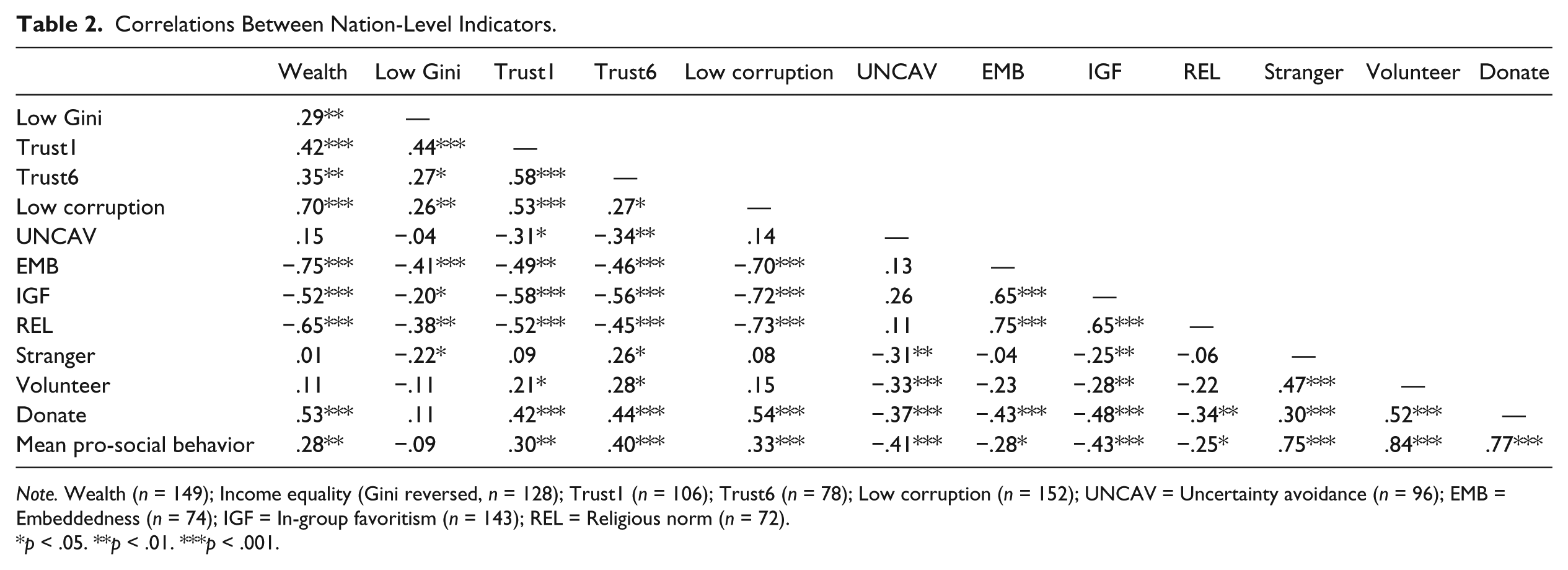
Note. Wealth (n = 149); Income equality (Gini reversed, n = 128); Trust1 (n = 106); Trust6 (n = 78); Low corruption (n = 152); UNCAV = Uncertainty avoidance (n = 96); EMB = Embeddedness (n = 74); IGF = In-group favoritism (n = 143); REL = Religious norm (n = 72).
p < .05. **p < .01. ***p < .001.
The table indicates substantial correlations between the indices of wealth, low corruption, low embeddedness, and weak religious norms. The two trust indices correlate with each other and with low in-group favoritism and low embeddedness. Incidence of the three pro-social behaviors is modestly but significantly correlated with one another.
Hypothesis 1 is supported, showing that wealth predicts donating behavior but not the other two pro-social behaviors. As low corruption is shown to be strongly correlated with high wealth, the sole significant linkage with donating is also to be expected. To further clarify the relation of wealth with donation, correlations were also computed between donating and the maximum personal tax rate in each nation. The correlation was positive (r = .32, n = 100, p < .001), indicating no support for the view that high tax rates may inhibit donation. It remains possible that high tax rates could affect the amounts donated.
Hypothesis 2 is supported in relation to Trust6, as all three pro-social behaviors are more frequent in nations with high generalized trust. However, Trust1 predicts only the frequency of donating, and the prediction for income equality is significantly reversed in relation to helping strangers. Hypothesis 3 is also supported, with all three pro-social behaviors more frequent in low uncertainty avoidance nations. As the provenance of recent Hofstede scores is not fully documented, correlations for uncertainty avoidance were recomputed using only the scores derived from the original IBM data set. The effects obtained (n = 52) were similar, but stronger (for helping, r = −.36, p < .01; for volunteering, r = −.37, p < .01; for donating, r = −.61, p < .001; for the overall index, r = −.54, p < .001).
The test of Hypothesis 4 is substantially supported by the association between low in-group favoritism and all three pro-social behaviors, but for embeddedness it is supported only in relation to donating. Given that the practice of subbotnik (unpaid community work on some Saturdays) in some former Soviet states appears to be mandated by the governments rather than being truly voluntary (e.g., http://www.eurasianet.org/node/66685), the correlations for volunteering in Table 2 were recomputed omitting the data from Azerbaijan, Belarus, Kazakhstan, Turkmenistan, and Uzbekistan. Volunteering now correlated more strongly with low in-group favoritism at r = .35 (p < .01) and now also correlated negatively with low corruption (r = −.24, p < .01) and Trust6 (r = .33, p < .01).
The results obtained using the index of in-group favoritism are partially dependent upon the nation-level estimates computed by Van de Vliert (2011). The results using this predictor were recomputed including only those 104 nations for which van de Vliert had direct information. The correlations with the three indices increased slightly from those reported in Table 2 (for helping, r = −.30, p < .001; for volunteering, r = −.32, p < .001; for donating, r = −.52, p < .001).
Hypothesis 5 is not supported, with a significant effect in the reverse direction, showing donation to be more frequent in less religious nations.
Additional analyses were conducted to test for alternative explanations of the results. Although survey items with a yes/no response are less likely to be vulnerable to acquiescent responding (Smith, 2004), there is a possibility that pro-social behaviors may be over-reported in some nations. To test for this, further correlations were computed using an index of acquiescence constructed from responses to 20 unrelated World Values Survey items by Smith (2011). Across 82 nations, acquiescence correlated at .03 (ns) with helping, −.25 (ns) with volunteering, and −.33 (p < .05) with donating. When acquiescence was partialed out of correlations between in-group favoritism and pro-social behaviors across 73 nations, stronger effects were found (for helping, r = −.39, p < .001; for volunteering, r = −.50, p < .001; for donating, r = −.54, p < .001).
National-level wealth has been found to correlate significantly with key dimensions of cultural difference such as individualism-collectivism (Hofstede, 2001). To assure the independence of the present results from such effects, the correlations in Table 2 were recomputed, partialing out wealth. The significant associations found between pro-social behaviors and the predictors in the table were sustained for in-group favoritism, uncertainty avoidance, Trust6, and income equality, but not for low corruption, Trust1, and embeddedness.
To better understand the relationship between the significant effects obtained, regressions for the nations for whom indices were available were computed using forward entry to identify the strongest predictors. The results shown in Table 3 confirm the view that the effects attributable to uncertainty avoidance and in-group favoritism are independent of one another and that these variables are the most significant predictors of all three pro-social behaviors. Interaction effects between these two predictors are not significant.
Regressions Predicting Pro-Social Behaviors by Nation.
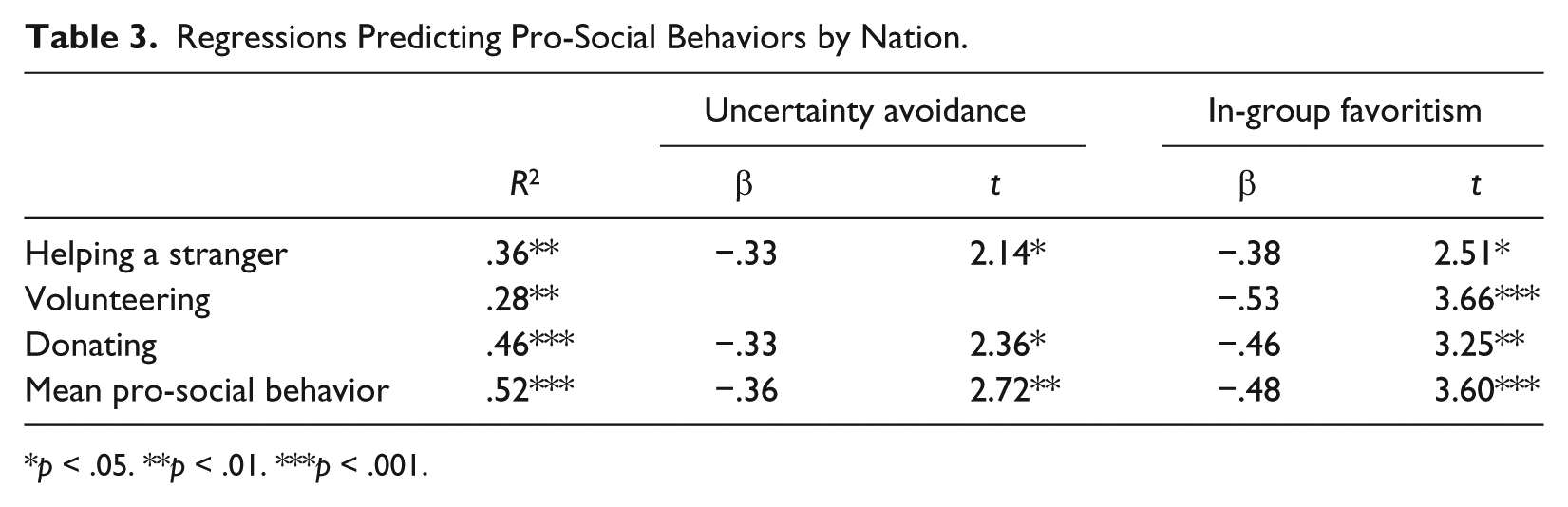
p < .05. **p < .01. ***p < .001.
Discussion
The point of departure for this study was a consideration of the behavioral measures of helping that were studied by Levine et al. (2001). Cross-cultural researchers have often warned that behaviors may have different meanings within different cultural contexts (e.g., Smith, Fischer, Vignoles, & Bond, 2013). As noted earlier, the three indices of pro-social behavior used here may all vary in the extent to which they have an unambiguous meaning. Helping a stranger in difficulty is likely to have a meaning that is relatively culture-general, although who is or is not considered to be a stranger could differ. The meaning of working as a volunteer can be affected by differing understandings of the nature of work and employment, and by the presence of coercive inducements. Likewise, donation of money can be influenced by the distribution of wealth in any society, and by variations in religious teachings. Donation of money was particularly high both in Buddhist societies and in Anglo cultures, but the intended recipients of the donated money will differ in ways that are culturally more specific. These variations in the meanings associated with different pro-social behaviors may contribute to the modest association found between the three indices. Pro-social behavior is multidimensional. There are also likely to be cultural variations in the ways in which respondents wish to present themselves. Acquiescent responding does not explain the present results, but modest or socially desirable responding remain as possibilities. Against these cautions, the extensive range of nations sampled provides some limitation of the effects of locally distinctive meanings or response styles.
The results for donation of money explained substantially more variance than did those for the other two pro-social behaviors. This could be because there is less variability across cultures in understandings of donation than of volunteering and helping. Table 1 also shows that there was greater variance in donating, which would enhance the possibility of detecting whatever effects are present.
The present results do not replicate the finding of Levine et al. (2001) that helping is more frequent in less wealthy nations. Neither do they replicate Knafo et al.’s (2009) finding that helping strangers is also lower in cultures characterized by embeddedness values. To test whether these non-replications were due to an increased sampling of nations, correlations between wealth, embeddedness, and helping were computed for those of the 23 nations originally sampled by Levine et al. (2001) for which current data were also available. For wealth, the relationship is now positive, both when using Levine’s 1994 wealth scores (r = .54, p <. 05) as predictor and when using the 2013 scores (r = .49, p <. 05), but not when using the logarithmic transformation of the 2013 scores (r = .20, ns). Thus, there is some suggestion that nations where helping was most frequent in Levine’s sample are now among the less helpful. However, the results using the logarithmic transformation suggest that both the positive and the negative effects found within this restricted sample of 23 nations are unreliable due to the effects of outliers. For embeddedness, the correlation with helping within the nations sampled by Levine et al. remained non-significant (r = −.22, ns).
These correlations indicate that while the non-replication of earlier conclusions may be partly attributable to increased sampling, there are additional possible reasons for the divergent results. Within the range of nations sampled by Levine et al., there is a negative sign for the relationship between Levine et al.’s measure of helping and the present measure for helping strangers (r = −.28, ns). It appears that helping strangers in big-city street emergencies may not be typical of other types of helping of strangers. While Levine et al. did collect data about actual behavioral responses, it is also possible (as they acknowledged) that their use of a different experimenter in each nation affected the frequencies of helping obtained. Although the present data are based on self-reports of helping, they are based on much larger samples both within and across nations, and they do show significant relations particularly with uncertainty avoidance and with in-group favoritism. These predictors may perform better because they are conceptualized in ways that carry behavioral implications across a broad range of settings.
The use of data from a much larger sample of nations has yielded a fuller picture of the factors associated with nation-level means for pro-social behaviors. Whereas the list of specific predictors is somewhat amended, it remains the case that there appear to be several independent factors involved. The most striking finding is the relatively consistent result for low in-group favoritism. As Table 2 showed, there is substantial association of low in-group favoritism with wealth, low corruption, and high trust, as well as low embeddedness. Each of these nation-level attributes are certainly elements within the general syndrome of individualism-collectivism. In the present context, the more proximally defined concept of in-group favoritism has proved most strongly predictive, and this does provide a partial picture of cultures high on pro-social behavior. However, an equally large proportion of variance was attributable to nation-level scores for uncertainty avoidance. While some recent analyses have provided evidence that uncertainty avoidance could be a precursor to the more proximally defined concept of generalized trust (Kong, 2012), the present data showed it to be a stronger predictor of pro-social behaviors than were either of the trust measures.
The hypotheses relating to income equality and religious norms were both significantly reversed. As Table 2 indicates, religious norms are strongest in nations scoring high on in-group favoritism, which could obscure any more direct linkage of religious norms and pro-social behavior. Clarification may require measures of more specific norms and more specific indices of religious affiliation. The modest relationship between income inequality and helping strangers requires replication and further investigation. The effect was present in both the 2013 data (r = .20) and the 2014 data (r = .22). When in-group favoritism is partialed out, the correlation between income equality and helping rises to .33 (n = 121, p < .001). If uncertainty avoidance is also partialed out, it rises further to .42 (n = 74, p < .001). It is plausible that there could be more instances of strangers requiring assistance in nations with high income inequality, and that such assistance would be more forthcoming where the in-group is not so strongly favored, and there are less reasons to be fearful.
This study has examined pro-social behaviors at a particular point in time. It would also be important to investigate the extent to which their reported frequencies change over time. Among the predictors that have been identified, it is not likely that nations’ in-group favoritism would change very rapidly. Uncertainty avoidance may also be deeply rooted. However, the incidence of events that are alarming, uncertain, or conducive to safety and security is much more variable, and these could prove to be of interest in considering increases or decreases over time.
While these results provide an indication of current pro-social behavior frequencies, they leave open the extent to which pro-social actions are directed toward similar targets in different cultural contexts. It is also important to determine cultural continuities or variability in the individual-level predictors of pro-social behaviors. Within World Values Survey data from 96 nations, Oishi, Diener, and Lucas (2007) found that volunteering is associated with high life satisfaction. However, they did not examine their sample for variations in the strength of this effect. In the study by Aknin et al. (2013) discussed earlier, there was a positive relation between individuals who reported donating to charity and higher subjective well-being in most of the 136 nations sampled by Gallup, but in only half of the nations was this relationship significant. The present study provides indicators of likely cultural moderators of this type of relationship between individual-level pro-social actions, their determinants, and their consequences. Multi-level analyses can help to identify key triggers to each type of pro-social action in specific cultural contexts.
Footnotes
Acknowledgements
I am grateful to the Charities Aid Foundation for granting access to the World Giving Index 2014, which is based on survey data provided by the Gallup Organization. My thanks also to Michael Harris Bond, Tom Farsides, Shalom Schwartz, and Evert van de Vliert for their helpful comments on an earlier draft.
Declaration of Conflicting Interests
The author(s) declared no potential conflicts of interest with respect to the research, authorship, and/or publication of this article.
Funding
The author(s) received no financial support for the research, authorship, and/or publication of this article.
References
Supplementary Material
Please find the following supplemental material available below.
For Open Access articles published under a Creative Commons License, all supplemental material carries the same license as the article it is associated with.
For non-Open Access articles published, all supplemental material carries a non-exclusive license, and permission requests for re-use of supplemental material or any part of supplemental material shall be sent directly to the copyright owner as specified in the copyright notice associated with the article.
