




Abstract
Previous findings in culture and attention reported mixed results. While some studies demonstrated systematic cultural variations in patterns of eye movement, other studies reported that the magnitude of the effects is minor. To further scrutinize when cultural variations in attention are attenuated or enhanced, we conducted a new series of visual flicker tasks while making changes in focal figures more salient than those in the background. European Canadian and Japanese participants searched for a change in a pair of quickly alternating still images. The task consisted of two parts: In the majority of trials, we set a change in part of either the focal object or the background (change trials), while in some trials, a pair of identical images was presented unbeknownst to participants (no-change trials), which resulted in forcing participants to search for a nonexistent change for 1 min. We then measured patterns of eye movement during each type of trial. The results of the change trials indicated that there were no cultural variations in change detection styles, nor were there cultural variations in eye movement patterns except for the total fixation duration, suggesting in general that both groups exhibited similar bottom-up patterns of attention. However, in the no-change trials, there were substantial cultural variations in eye movement patterns: European Canadians substantially attended to the focal figures longer and more frequently than to the backgrounds, whereas Japanese equally allocated their attention to both the focal figures and the backgrounds, suggesting that culturally unique top-down patterns were more evident.
For more than two decades, cultural psychologists have advocated the importance of culture in human psychological processes (Bruner, 1990; Miller, 1999; Shweder, 1990) and have demonstrated systematic cultural variations between people in Western societies and Eastern societies, even in fundamental psychological processes, notably attention (e.g., Nisbett & Masuda, 2003). By measuring eye movement, the current study further identifies a situation where cultural differences in people’s attention are attenuated or enhanced during the visual flicker task.
Culture, Attention, and Eye Movement
A plethora of empirical studies have demonstrated that cultural variations in modes of attention are observable when researchers use abstract stimuli (Duffy, Toriyama, Itakura, & Kitayama, 2009; Ji, Peng, & Nisbett, 2000; Kitayama, Duffy, Kawamura, & Larsen, 2003; Kitayama, Park, Savincer, Karasawa, & Uskul, 2009; Masuda, Akase, Radford, & Wang, 2008; Ueda & Komiya, 2012); when they use images of real objects such as wildlife, fish, and vehicles (Boland, Chua, & Nisbett, 2008; Chua, Boland, & Nisbett, 2005; Masuda & Nisbett, 2001, 2006; Senzaki, Masuda, & Ishii, 2014; Senzaki, Masuda, Takada, & Okada, 2016); when they use images of facial expressions (Ito, Masuda, & Hioki, 2012; Ito, Masuda, & Li, 2013; Masuda, Ellsworth, et al., 2008; Masuda, Wang, Ishii, & Ito, 2012); and when they use visual arts (Masuda, Gonzalez, Kwan, & Nisbett, 2008; Nand, Masuda, Senzaki, & Ishii, 2014; Senzaki, Masuda, & Nand, 2014; Wang, Masuda, Ito, & Rashid, 2012).
For example, Masuda and Nisbett (2001) presented European American and Japanese participants with animated vignettes of underwater scenes and then asked them to report the contents. The analyses of the participants’ description styles revealed that Japanese were more likely than European Americans to refer to information about the background (e.g., the water was green) and relationships between the focal objects and the background information (e.g., a big fish was swimming above the seaweed). The difference in the number of references to foreground and background information is much smaller for Japanese than for European American. The findings suggest that Japanese allocate their attention both to the foreground and the background, whereas Americans selectively put more importance on the foreground than the background. By measuring the patterns of eye movement, Senzaki, Masuda, and Ishii (2014) further demonstrated that participants’ description style corresponds to their pattern of eye movement. Similarly, Chua et al. (2005) measured patterns of eye movements of American and Chinese participants who viewed scenes containing an object against a realistic background. The results indicated that Americans looked at the focal object sooner and longer than did the Chinese participants. In contrast, the Chinese participants fixated on the background more than did the North American participants. These results suggest that cultural differences in eye movements may correspond to culturally unique patterns in ways of viewing things.
Various researchers have speculated on the origin of cultural variation in attention. Nisbett and colleagues maintained that Westerners such as Americans, Canadians, and Western Europeans have historically developed the worldview that things exist independently from each other, and that each thing can be understood in terms of its own essential qualities. Accordingly, Westerners developed the object-oriented mode of attention, selectively attending to the focal objects in a visual scene while paying little attention to the context or background. By contrast, Easterners such as Chinese, Japanese, and Koreans have historically developed the worldview that things are interrelated and believe that the relationships among things are important for understanding a phenomenon. As a result, they have developed the context-oriented mode of attention, equally allocating their attention to both focal objects and context, while paying attention to the relationships among them (Ishii, 2013; Nisbett, 2003; Nisbett & Masuda, 2003; Nisbett & Miyamoto, 2005; Nisbett, Peng, Choi, & Norenzayan, 2001; Norenzayan, Choi, & Peng, 2010).
Culture and Change Detection
Using change detection tasks in which participants search for a change or multiple changes in a pair of images or videos (Simons, 2000; Simons & Ambinder, 2005; Simons & Rensink, 2005), researchers have explored people’s ability to detect changes when searching for them. Researchers have also investigated the tendency to miss changes during active attention using the change blindness paradigm (e.g., Rensink, O’Regan, & Clark, 1997). The phenomenon of change blindness has also provided a context for examining the issue of culture and attention. For example, using the visual flicker task (Rensink et al., 1997), Masuda and Nisbett (2006) asked European Americans and Japanese to detect a single change from a pair of quickly alternating still images and found that European Americans could detect changes in the foreground (e.g., the color of an airplane’s logo) faster than changes in the background (e.g., the color of a lake), while such an attentional bias was not observed in the Japanese data.
However, several issues have not been completely resolved in this domain of research. First, although direct measurement of individuals’ eye movement using an eye tracker has been regarded as one of the most useful methodologies for research on culture and attention (Chua et al., 2005; Goh, Tan, & Park, 2009; Masuda, Ellsworth, et al., 2008; Masuda et al., 2012; Senzaki, Masuda, & Ishii, 2014), no eye movement research to date has been applied to people’s information searching strategy during a visual flicker task. Following the line of research on culture, attention, and eye movement, we maintain that analyzing eye movement allows us to further elucidate the characteristics of the object-oriented versus context-oriented mode of attention.
Second, researchers have long debated two possible ways of organizing attention, under the rubrics of endogenous versus exogenous, voluntary versus automatic, or top-down versus bottom-up processes (Chun & Wolfe, 2001; Jonides, 1981; Posner, 1980; Posner, Snyder, & Davidson, 1980; Yantis & Jonides, 1990). In addition to the research on attentional orientation, the issue has also been broadly discussed within the context of sociocultural versus biological effects on perception. Sociocultural experiences such as expectations, beliefs, values, and cultural worldviews influence perception (e.g., Bruner, 1957; Senzaki, Masuda, & Ishii, 2014) and the resulting top–down patterns of attention are generally assumed to vary cross-culturally. Biological processes are biologically furnished, fundamental ways of reacting to external stimuli; it is thus assumed that such data-driven, bottom-up patterns of attention are universal and independent of cultural experiences (e.g., Pylyshyn, 1999).
Some cross-cultural studies have demonstrated robust cultural variations in patterns of attention, suggesting the existence of top-down processes, and recent neural evidence has indeed given credence to these ideas (Goto, Ando, Huang, Yee, & Lewis, 2010; Goto, Yee, Lowenberg, & Lewis, 2013; Hedden, Ketay, Aron, Markus, & Gabrieli, 2008; Masuda, Russell, Chen, Hioki, & Caplan, 2014; Russell, Masuda, Hioki, & Singhal, 2015). Other researchers have reported that such cultural variations in attention are not observable, or are minimal at best (Evans, Rotello, Li, & Rayner, 2009; Rayner, Li, Williams, Cave, & Well, 2007), and these researchers use the results of cultural similarity in attention as evidence of universal, bottom-up processes.
We maintain that attention processes should not be discussed in an all-or-nothing manner. Bottom-up processes of attention indeed exist. For example, people’s attention is directed to abrupt movements of salient objects (Abrams & Christ, 2003; Jonides & Yantis, 1988; Simola, Kuisma, Öörni, Uusitalo, & Hyönä, 2011), suggesting that regardless of individuals’ experience, their attention will be directed according to how the stimuli are presented. However, some findings suggest that substantial top-down cultural biases in attention could co-exist even under such a data-driven, bottom-up external constraint (Goh et al., 2009; Senzaki, Masuda, & Ishii, 2014).
Many properties of objects could be sources of bottom-up attention processes, including color, movement, and the timing of stimulus onset versus offset. However, instead of comprehensively examining a variety of object properties, this article focuses on one of these properties: the size of the focal figure in relation to the background. We assumed that large-sized salient focal objects would direct people’s attention, and in turn would have the potential to efface cultural variations in attention. In fact, a careful examination of the sample stimuli used in previous studies revealed that studies reporting cultural variations in attention limited the size of the focal objects and showed a substantially large background area, and usually showed only one focal object per image; whereas studies that reported cultural similarities in attention tended to use large focal objects or multiple focal objects spread across an entire scene (Boland et al., 2008; Goh et al., 2009).
However, no cultural psychological research to date has clearly addressed this point. The first purpose of this article is to test the possibility that cultural variations in attention could be minimized due to the properties of stimuli (i.e., the salient foreground information). We then further attempted to examine a situation in which cultural variations in attention are still observable under such bottom-up external constraints.
The Current Study
In the present study, we measured European Canadian and Japanese participants’ eye movements and change detection performance during a visual flicker task. By referring to Masuda and Nisbett (2006), we devised a new set of stimuli in which a pair of slightly different images alternate at a regular pace, and the change occurs on either the focal figure (a sports athlete, for example, a volleyball player) or the background (a sports facility, for example, the volleyball court). Following previous works by cognitive scientists (e.g., Evans et al., 2009; Rayner et al., 2007), we intentionally made the focal object more salient than its background, which results in detection of focal changes being much easier than detection of background changes (change trials). To examine whether cultural variation in attention is completely effaced or minimized or still remains under the saliency of the focal information, we tested two competing hypotheses in these trials. First, similar to previous findings in cognitive psychology (e.g., Rayner et al., 2007), the pattern of eye movement in these trials would be the same across cultures; that is, both Japanese and Canadians would look at the focal object longer and more frequently than at the contextual background. Moreover, both groups would respond more accurately and more quickly to a focal change than to a background change. Second, similar to previous findings in cultural psychology (e.g., Chua et al., 2005), the pattern of behavioral responses and eye movement in change trials would vary across cultures.
Next, to further investigate the condition in which people show substantial cultural biases under data-driven, bottom-up constraints, we also prepared pairs of stimuli in which the same image alternates at a regular pace, and therefore, participants cannot find any changes (no-change trials). No-change trials were inserted without the participants’ knowledge, forcing them to laboriously search for a change that did not actually exist. A previous study (Wang et al., 2012) indicated that cultural variations in attention were minor when participants engaged in a task that participants complete relatively easily, but became intensified when they engaged in a task requiring more time, suggesting that when trying to solve problems, people would endorse their culturally dominant mode of attention, which is more familiar and easier to access in their daily cultural practices. Based on this logic, we assumed that when confronted with trials in which people cannot easily find the change (no-change trials), participants would tend to endorse their culturally familiar mode of attention: European Canadians, who hold the object-oriented mode of attention, would attend to the focal object longer and more frequently than to the backgrounds, whereas Japanese, who hold the context-oriented mode of attention, would attend to both the focal figure and the background almost equally. We also assumed that such culturally unique patterns of eye movement would still be evident even when we used stimuli that were created to minimize the cultural variations.
Method
Participants
Fifty-two Japanese undergraduates at Kobe University, Japan, (26 females and 26 males, M age = 19.5 years) and 49 European Canadian undergraduates at the University of Alberta, Canada, (24 females and 25 males, M age = 19.4 years) participated in the study. All Japanese participants were born and raised in mainland Japan, whereas the Canadian participants identified as European Canadians and reported that they were born in Canada. Japanese participants received 700 yen (about CAD$7) as an honorarium, while Canadian participants received a partial course credit for their participation. Participants were tested individually in an experimental cubicle. Data for five Canadian participants were excluded from the following analyses because their eye-tracking data were not recorded properly. The data from the remaining 96 participants are reported below. All the procedures and research designs had been previously approved by the Research Ethics Boards of the respective institutions.
Materials
Stimuli
Following previous studies (Masuda & Nisbett, 2006; Rensink et al., 1997), we selected 30 colored images that consisted of a sports athlete (a focal object) and the background. The size of the focal object (athlete) was about the same across all stimuli (around 35%-40% of the entire scene area), and the focal objects were situated in the middle area of the images, which made them very salient. This revision allowed participants to detect changes in the focal area (e.g., the number of stripes on a soccer player’s shorts) more easily than in the background area (e.g., the color of one of the legs of a picnic table). In both the focal changes and background changes, the size of the change area occupied 1% to 3% of the entire scene. Although it might take a while to detect a change, once the participants detected it, the change was clearly identifiable in all images. In total, 24 of the 30 images were used for the change trials (see the appendix). We modified each image in two ways—adding a change in the focal figure in one modification and a change in the background area in the other modification—and paired them with the first image. We created 48 pairs of images by combining the 24 original images with each of the two modified images, and split them into two sets of trials, with each set containing both foreground-modified and background-modified images. Participants were randomly assigned to engage in the task with either one of the sets (change trials). Six images were used for the no-change condition; unbeknownst to participants, these trials (no-change trials) were interspersed among the regular trials. Each participant engaged in 30 trials (24 change trials and 6 no-change trials). Each trial consisted of a fixation cross (1 s), followed by an alternation of experimental stimuli in the sequence of A, A′, A, A′ . . . with a gray-colored blank field presented for 80 ms between the two images. Each of the first and second images was presented for 560 ms.
Eye tracker
In both research sites, participants’ eye movements were recorded using a Tobii 1750 eye tracker with Tobii Studio™ 2.1 software. The image stimuli were presented using E-Prime 2.0 (Psychology Software Tools, Inc.). A Tobii Studio fixation filter was used to determine gaze fixations. The criteria for a gaze fixation were that the eye was stable within a circle of 20 pixels in diameter and the duration of the fixation was greater than 40 ms (visual angle 0.6°) in a 1,024 × 768 resolution computer screen (Duchowski, 2003; Salvucci & Goldberg, 2000).
Procedure
On arrival, participants were asked to fill in a consent form, then escorted to an experimental cubicle, where they sat in front of a monitor and adjusted their chair height and position to comfortably place their chin on a chin-rest placed 60 cm from the monitor.
After a calibration test, participants were instructed that their task was to detect the difference between the first and second images as accurately and quickly as possible, and we asked them to press a space bar when they detected the difference. At the beginning of the trial, a fixation cross appeared at the center of screen for 1 s, and subsequently, the alternation of images began. The alternation of images stopped when the participants pressed the space bar.
They were then presented with the same alternation of images and asked to verbally report the location of the change. By viewing the answer sheet, the experimenter judged whether the answer was correct or incorrect. There was a 10-s interval between each trial. If participants could not detect the difference within 60 s, the alternation ended, and the images disappeared; when they pressed the space bar once more, the program automatically moved to the next trial. In every five trials, unbeknownst to participants, a no-change trial was inserted. After completing 30 trials, participants filled out a demographic questionnaire and were fully debriefed and dismissed.
Results
We analyzed the results of the change and no-change trials separately. We categorized the areas of interest—the location of the gaze—into two areas: the focal area and the background area. We focused on the border around the sports athletes. Fixations falling inside of the border were categorized as being in the foreground area, and fixations falling outside of the border were categorized as being in the background area. Due to the intermediate quality of the eye tracker’s calibration accuracy, we applied relatively lenient criteria by adding about 10 to 15 pixels around the foreground border and also by smoothing the details of the figure outline.
Change Trials
As standard measures of the visual flicker task, we measured accuracy and response time for the change trials. We also measured the number of fixations, total fixation duration, and average fixation duration (= total fixation duration/number of fixations), as standard indicators of participants’ eye movement patterns. 1 We then examined whether (a) culturally similar data-driven, bottom-up or (b) culturally unique top-down patterns were observed, under the saliency of the focal figures.
Detection accuracy
A 2 (Culture: Canada vs. Japan) × 2 (Location of Change: focal vs. background) ANOVA was applied to the detection accuracy. The results indicated that there were significant main effects of culture, F(1, 94) = 6.45, p < .05,
Response time
A 2 (Culture: Canada vs. Japan) × 2 (Location of Change: focal vs. background) ANOVA showed significant main effects of culture, F(1, 94) = 6.11, p < .05,
Number of fixations
A 2 (Culture: Canada vs. Japan) × 2 (Location of Change: focal vs. background) × 2 (Area of Interest: focal vs. background) ANOVA showed significant main effects of the location of change, F(1, 94) = 59.81, p < .001,
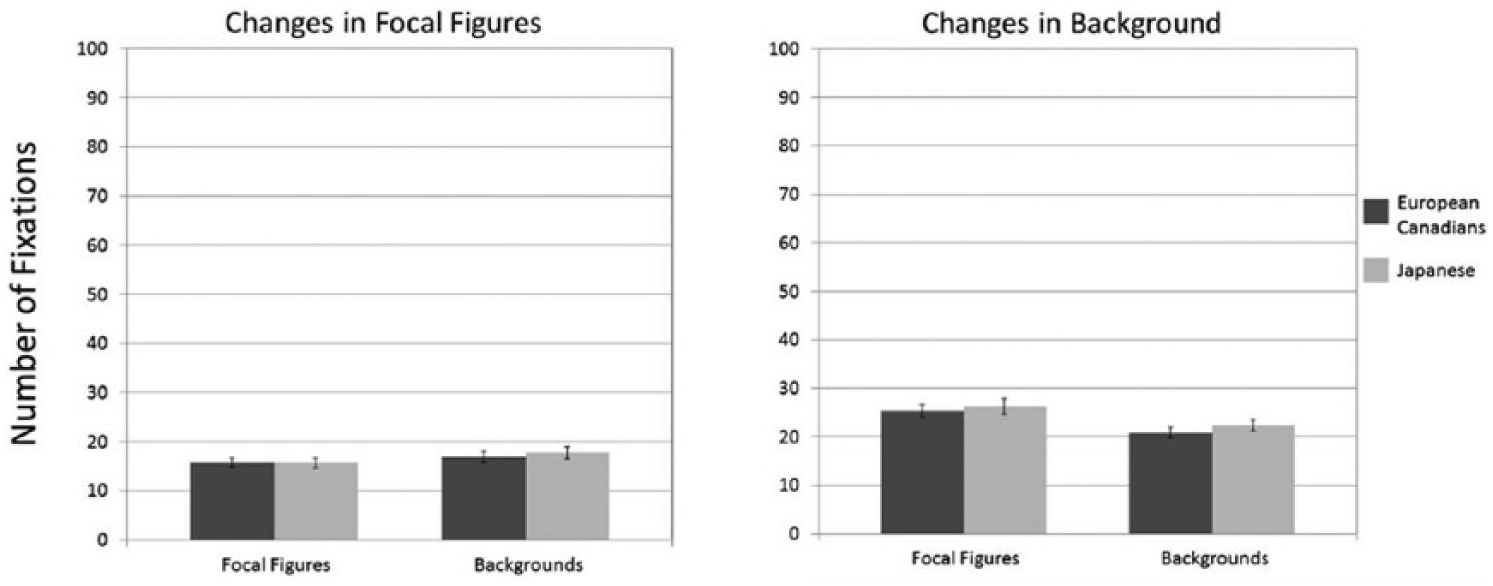
Number of fixations to focal figures and background areas in change trials across cultures.
Total fixation duration
A 2 (Culture: Canada vs. Japan) × 2 (Location of Change: focal vs. background) × 2 (Area of Interest: focal vs. background) ANOVA showed significant main effects of culture, F(1, 94) = 50.06, p < .001,
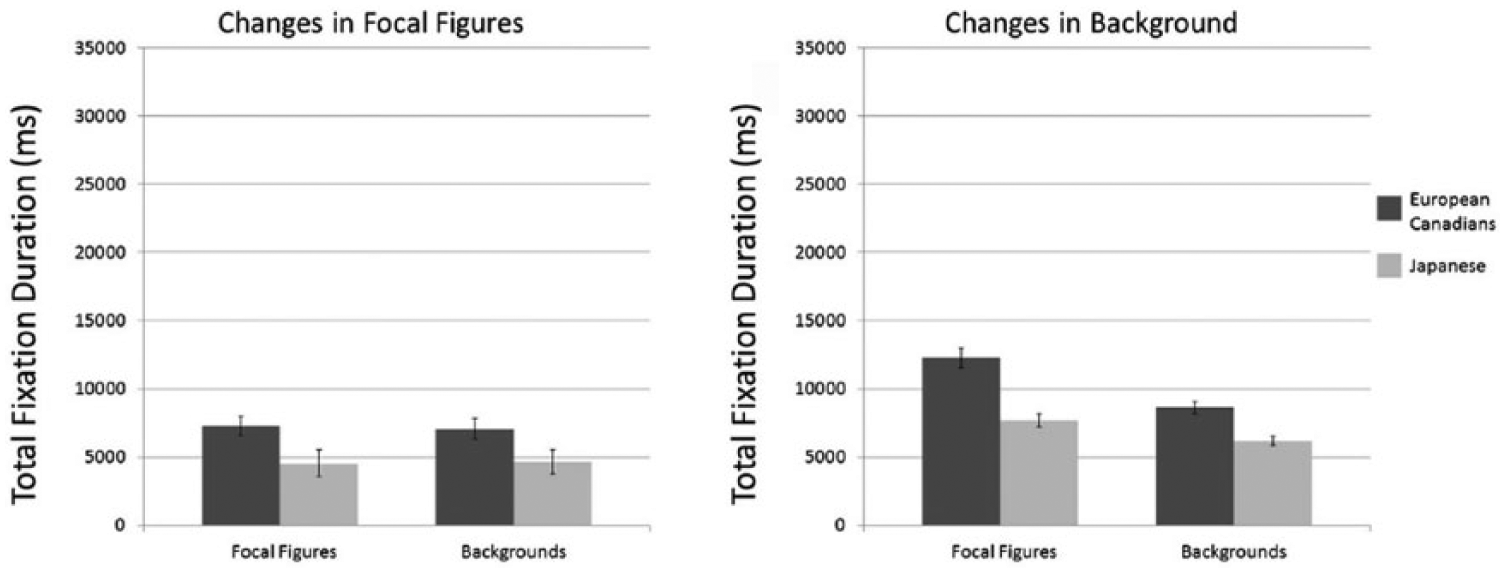
Total fixation duration (msec) to focal figures and background areas in change trials across cultures.
Average fixation duration
A 2 (Culture: Canada vs. Japan) × 2 (Location of Change: focal vs. background) × 2 (Area of Interest: focal vs. background) ANOVA showed significant main effects of culture, F(1, 94) = 89.61, p < .001,

Average fixation duration (ms) to focal figures and background areas in change trials across cultures.
In summary, the majority of data converged to indicate that under the saliency of focal figures, culturally similar patterns were dominant in this trial, supporting the existence of data-driven, bottom-up patterns of attention (e.g., Rayner et al., 2007). However, there is only one eye movement indicator—the total fixation duration—that indicated the possibility of cultural variations, implying that the effect of culture was minimized but not completely effaced even with these stimuli.
No-Change Trials
As aforementioned, participants were presented with the alternation of identical images, while not being informed that such trials had been inserted. The participants spent the full 60 s searching for the change, without detecting a change. Because of the nature of the trials, no accuracy data were collected for the no-change trials. However, by controlling the image presentation timing (60 s) for all participants, we analyzed the number of fixations, total duration of fixations, and average fixation duration as indicators of participants’ eye movement patterns during the no-change trials. With the findings that culturally variant patterns lingered in the pattern of one of indicators in the change trials, we assumed that such cultural variation in patterns of eye movement would emerge substantially in the no-change trials.
Number of fixations
A 2 (Culture: Canada vs. Japan) × 2 (Area of Interest: focal vs. background) ANOVA showed significant main effects of culture, F(1, 94) = 20.04, p < .001,
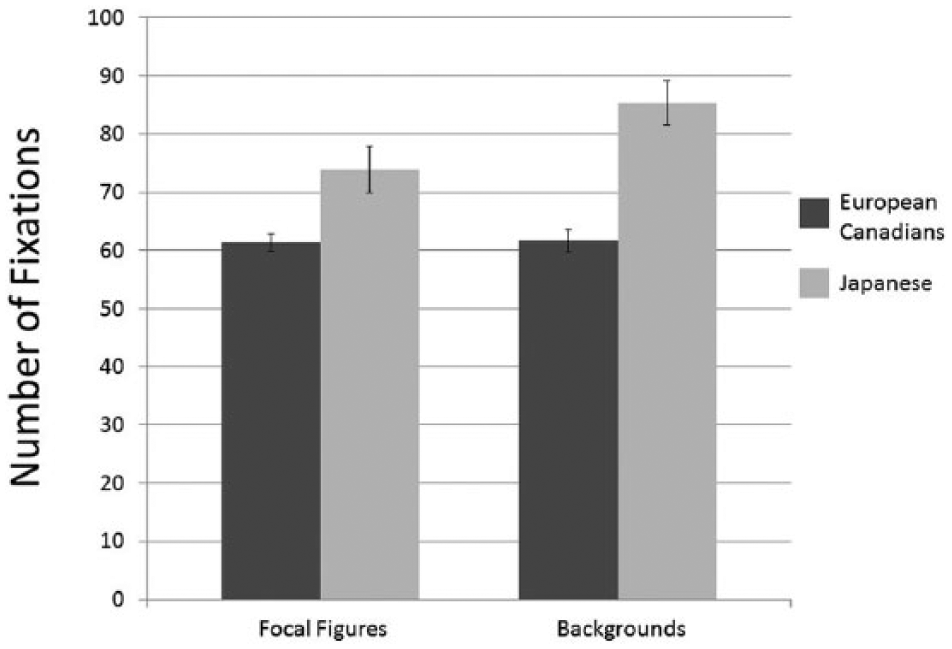
Number of fixations to focal figures and background areas in no-change trials across cultures.
Total fixation duration
A 2 (Culture: Japan vs. Canada) × 2 (Area of Interest: focal vs. background) ANOVA showed significant main effects of culture, F(1, 94) = 58.62, p < .001,

Total fixation duration (ms) to focal figures and background areas in no-change trials across cultures.
Average fixation duration
A 2 (Culture: Japan vs. Canada) × 2 (Area of Interest: focal vs. background) ANOVA showed significant main effects of culture, F(1, 94) = 144.45, p < .0001,
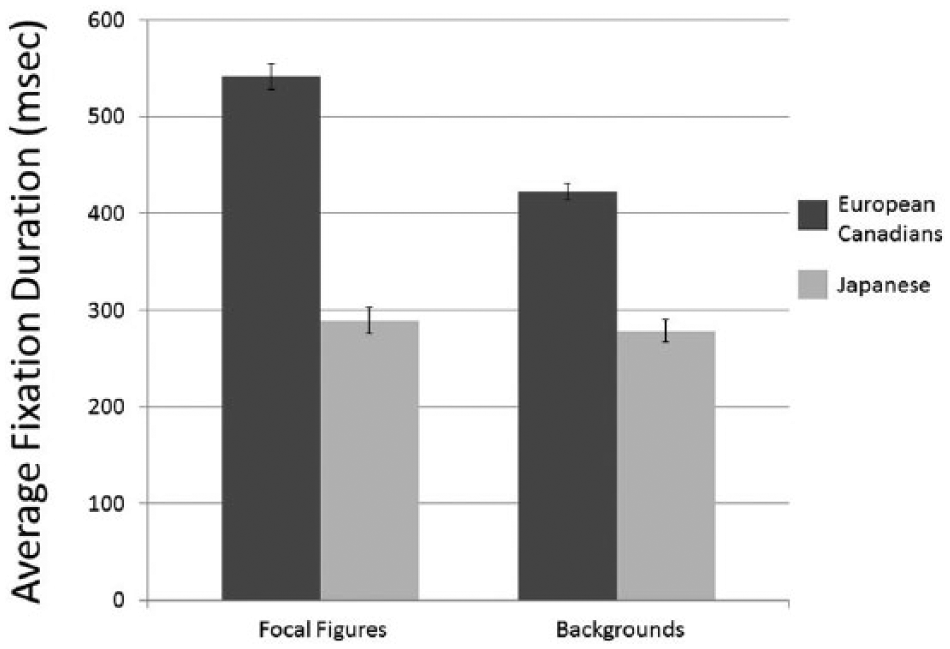
Average fixation duration (msec) to focal figures and background areas in no-change trials across cultures.
In sum, expected cultural variations were observed in all three indicators of eye movement patterns in no-change trials. In general, European Canadians held a tendency to search for changes in the focal area more than in the background area, whereas Japanese held a tendency to equally allocate their attention to both the focal and the background areas, and one indicator—the total fixation duration—showed that they had a substantial tendency to search for changes in the background area more than in the focal area.
Discussion
Summary and Implications
The present study examined cultural differences in patterns of eye movement between European Canadians and Japanese during the flicker paradigm (Masuda & Nisbett, 2006; Rensink et al., 1997). To the best of our knowledge, this cross-cultural study offers the first attempt to examine the characteristics of two different modes of attention—object-oriented versus context-oriented—during the visual flicker task and to identify the conditions where cultural variation in attention emerges (no-change trials) or is minimized (change trials). The effect size of the cultural differences is generally smaller than that of the task properties. Nonetheless, many studies have demonstrated that cultural variations in attention are substantial. To advance research on attention, it is important to report findings regarding both cultural similarities and differences.
First, in the change trials, we tested whether the saliency of the focal figure would influence participants’ pattern of attention equally across culture, thereby minimizing or completely effacing the culturally variant patterns of attention, or whether cultural variations in attention still linger under such stimulus constraints. The results of these trials indicated that, except for the interaction patterns of only one indicator, culturally specific modes of attention were minimized. In general, both Japanese and European Canadians equally fixated more on, and looked longer at, the focal area than the background area, and detected focal changes more accurately and quickly than background changes. Also, because the background changes were more difficult to find than focal changes, numbers of fixations were higher and average fixation durations were longer in the detection of background changes than in the detection of focal changes, and there were again no cultural variations in this pattern. Although there is a minor cultural difference in the magnitude of patterns, the results of average fixation durations indicated that both European Canadians and Japanese allocated their attention to the focal area more than to the background area when the change occurred in the background area.
These findings in general suggest that, under the stimulus constraints, there are substantial cultural similarities in human attentional patterns, in that people’s attention in general tends to be directed to the salient focal information. Such universal patterns have in fact been reported in other studies (e.g., Abrams & Christ, 2003; Simola et al., 2011). In addition, we empirically demonstrated that the effect of data-driven, bottom-up factors on visual perception is indeed substantial. This finding contributes to resolving contradictory findings reported in cultural psychological literature (e.g., Boland et al., 2008; Chua et al., 2005) and in cognitive psychological literature (e.g., Evans et al., 2009; Rayner et al., 2007) and suggests that there are limitations on the generalizability of findings reported by cultural psychologists (e.g., Masuda & Nisbett, 2006).
Second, while admitting the existence and similarity across cultures of data-driven, bottom-up information processing, we also assumed that cultural variation in attention would be observable when participants engaged in no-change trials. More specifically, we assumed that in these trials, both European Canadians and Japanese would spend a long time detecting a change in the scene and would apply the culturally familiar modes of attention they have chronically internalized. Consistent with our prediction, the findings suggest that there were indeed cultural variations in the mode of attention during the no-change trials in scene viewing. When the task required participants to spend time (60 s) to search for the change, European Canadians made longer eye fixations at the focal area than at the background area, whereas Japanese equally allocated their eye-fixation time to the focal and background areas, even showing tendency to allocate more attention to the background area than the focal area in one of the indicators. Furthermore, the number of fixations to the background area was larger than to the focal area for Japanese only, suggesting that Japanese indeed exhibited their context-oriented tendency.
The findings demonstrated that even though the experimental stimuli were designed to lead people to apply data-driven, bottom-up information processing, the top-down processes emerged when people were confronted with difficulty in solving the problem, suggesting that people’s modes of attention are substantially influenced by their cultural experiences. The findings give credence to the assertion by New Look psychologists that perception is modified through one’s expectations, values, and beliefs (Bruner, 1957; Kitayama et al., 2003).
Overall, these findings contribute to the long-lasting debates in cognitive and perceptual psychology regarding bottom-up versus top-down information processing on visual perception (e.g., Chun & Wolfe, 2001; Jonides, 1981; Jonides & Yantis, 1988; Posner, 1980; Posner et al., 1980; Yantis & Jonides, 1990). We maintain that the current study objectively tested whether both the culturally similar, data-driven, bottom-up factors and the culturally variable, top-down factors co-exist and articulated example situations where the culturally similar and culturally variant patterns of attention were mainly observed. To further advance the research on culture and attention, it is necessary for researchers to hold a balanced view—to objectively examine two competing assumptions (universality and cultural variability), articulate the conditions where each of the assumptions is proven, and report both types of results—which will help researchers to not blindly overgeneralize their findings (Imai, Kanero, & Masuda, 2016; Imai & Masuda, 2013). Recently, several researchers have taken the balanced view. For example, Senzaki, Masuda, and Ishii (2014) reported that cultural variations in attention were attenuated when people simply observed visual scenes, but were intensified when people verbally reported the visual scenes. Similarly, Goh et al. (2009) reported that while there were systematic cultural variations in object viewing patterns (i.e., North Americans were more likely than Singapore Chinese to allocate their attention to the focal object) there were also culturally universal constraints that applied to types of tasks, which led participants to apply data-driven, bottom-up visual processing. These examples suggest the co-existence of bottom-up and top-down information processing, giving credence to the current findings.
Limitations and Future Research
This study entails some limitations. First, although we successfully demonstrated two conditions where cultural variations in attention were attenuated and intensified, we did not comprehensively test the generalizability of the phenomenon, which would have made identifying the range of explanations possible. Future research should further articulate conditions and tasks where the cultural variations in attention are weakened and strengthened (e.g., Boland et al., 2008; Evans et al., 2009; Rayner et al., 2007; Ueda et al., 2016). Similarly, although we intentionally used agentic information (athletes) as the salient focal object, future cross-cultural studies should carefully examine whether changes in saliency (e.g., salient foreground vs. salient background), size (small object vs. large object), type (agentic vs. non-agentic object), and number of objects in the focal versus background area influence participants’ mode of attention.
Second, although we maintain that quick eye movement (e.g., short fixation duration with many fixation points, see also Note 1) and short saccades between fixation points can be seen as characteristic of the context-oriented mode of attention, some research suggests that holders of the context-oriented mode of attention have a wider visual field than those with the object-oriented mode of attention (e.g., Boduroğlu, Shah, & Nisbett, 2009; Goh et al., 2009). Future research should extensively examine whether such seemingly contradictory evidence sheds light on different aspects of the context-oriented mode of attention, through which the characteristics and underlying mechanisms of each mode of attention will be further elucidated.
Third, although we focused only on the ratio of foreground and background information as a stimulus property that leads to bottom-up processes, many other stimulus properties—such as the type, color, size, and image resolution of the stimuli—have the potential to enhance the bottom-up processes. Future research needs to test the generalizability of the current findings by devising stimuli that include all the combinations of these properties.
Fourth, the current study selectively examined participants’ performance in change trials and in no-change trials where the saliency of the focal objects is high. However, this does not mean that culturally variant top-down processes are observable only in the no-change trials. This time, no-change trials were used as extreme trials in which participants found it difficult to identify the change. If we were to use difficult trials, we assume that culturally variant top-down processes would be observed. Furthermore, if we were to use stimuli for which the saliency of the focal objects is low, we assume that culturally variant, top-down processes would be observed in all types of trials (e.g., easy, difficult, and no-change trials). Future research should comprehensively test these assumptions.
Finally, emergence of the culturally specific mode of attention in no-change trials may also be examined within the framework of a classic theory in social psychology. Under the rubric of “dominant response” (e.g., Michaels, Blommel, Brocato, Linkous, & Rowe, 1982; Zajonc, 1965; Zajonc, Heingartner, & Herman, 1969), researchers have posited that when people are emotionally aroused, they endorse the dominant patterns of behavior to which they are accustomed. In our study, the participants were not informed of the existence of no-change pairs but searched for the answer for 1 min, during which they experienced more difficulty than when they engaged in the change trials. This may have resulted in their being more emotionally aroused during the no-change trials than during the change trials, which in turn led them to endorse their dominant responses: the object-oriented mode of attention for European Canadians and the context-oriented mode of attention for Japanese. Of course, the current design did not control participants’ level of arousal; therefore, this issue is beyond the scope of our prediction. Future research should further examine this issue by overcoming the constraints of our experimental design. 4
Footnotes
Appendix
Change Trials.
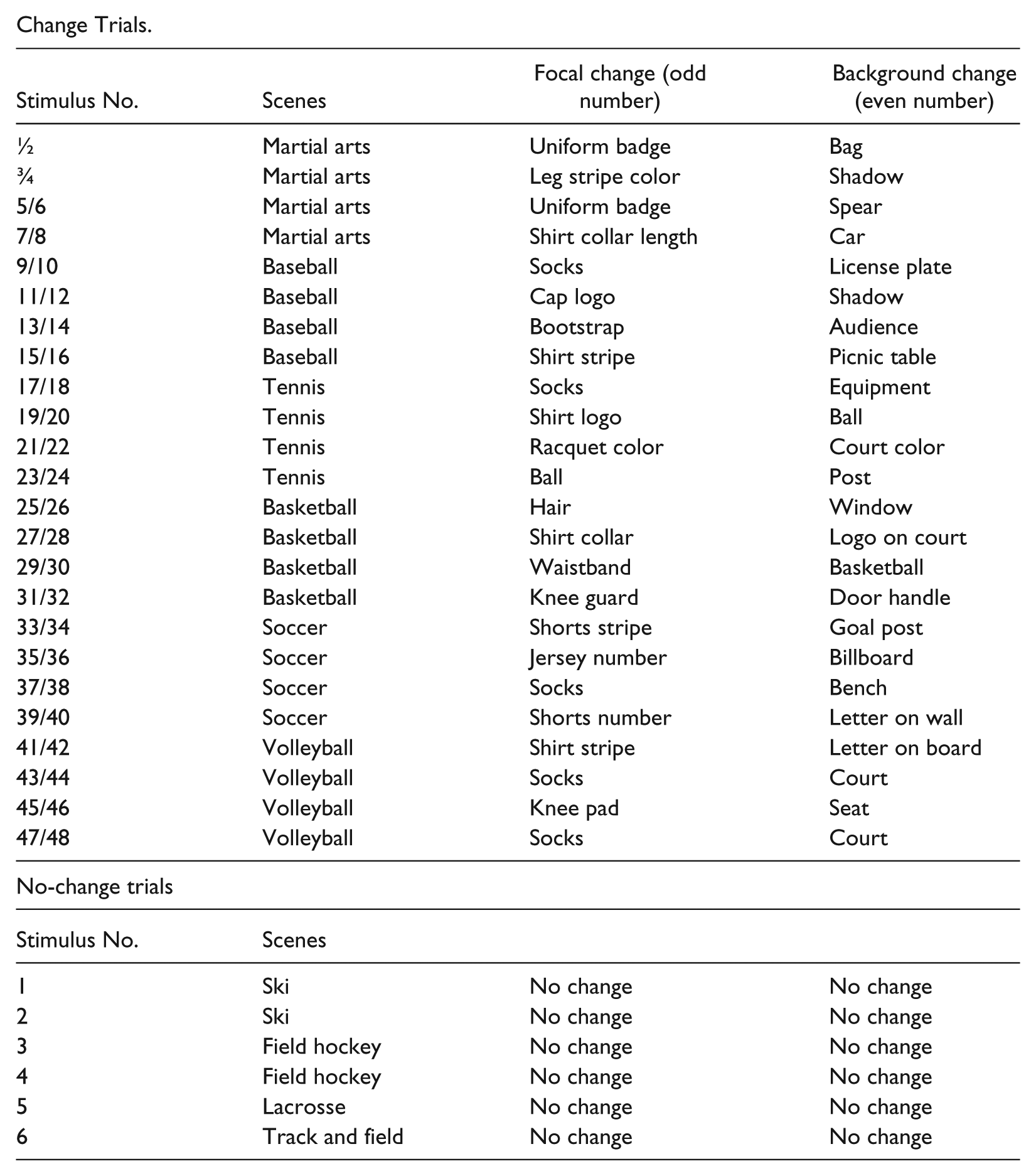
| Stimulus No. | Scenes | Focal change (odd number) | Background change (even number) |
|---|---|---|---|
| ½ | Martial arts | Uniform badge | Bag |
| ¾ | Martial arts | Leg stripe color | Shadow |
| 5/6 | Martial arts | Uniform badge | Spear |
| 7/8 | Martial arts | Shirt collar length | Car |
| 9/10 | Baseball | Socks | License plate |
| 11/12 | Baseball | Cap logo | Shadow |
| 13/14 | Baseball | Bootstrap | Audience |
| 15/16 | Baseball | Shirt stripe | Picnic table |
| 17/18 | Tennis | Socks | Equipment |
| 19/20 | Tennis | Shirt logo | Ball |
| 21/22 | Tennis | Racquet color | Court color |
| 23/24 | Tennis | Ball | Post |
| 25/26 | Basketball | Hair | Window |
| 27/28 | Basketball | Shirt collar | Logo on court |
| 29/30 | Basketball | Waistband | Basketball |
| 31/32 | Basketball | Knee guard | Door handle |
| 33/34 | Soccer | Shorts stripe | Goal post |
| 35/36 | Soccer | Jersey number | Billboard |
| 37/38 | Soccer | Socks | Bench |
| 39/40 | Soccer | Shorts number | Letter on wall |
| 41/42 | Volleyball | Shirt stripe | Letter on board |
| 43/44 | Volleyball | Socks | Court |
| 45/46 | Volleyball | Knee pad | Seat |
| 47/48 | Volleyball | Socks | Court |
| No-change trials | |||
| Stimulus No. | Scenes | ||
| 1 | Ski | No change | No change |
| 2 | Ski | No change | No change |
| 3 | Field hockey | No change | No change |
| 4 | Field hockey | No change | No change |
| 5 | Lacrosse | No change | No change |
| 6 | Track and field | No change | No change |
Acknowledgements
The authors thank the research assistants of the Culture and Cognition Laboratory at the University of Alberta and Cultural Psychology Laboratory at Kobe University for their help in carrying out this research as well as Laurie Rendon and Kacy Doucet for their helpful contributions in revising the manuscript.
Declaration of Conflicting Interests
The author(s) declared no potential conflicts of interest with respect to the research, authorship, and/or publication of this article.
Funding
The author(s) disclosed receipt of the following financial support for the research, authorship, and/or publication of this article: The authors thank the Social Sciences and Humanities Research Council of Canada (G124130642) for funding this research.