




Abstract
Participation in a new culture and identification with a new culture are important issues faced by millions of immigrants today. Literature describes three possible relations between participation and identification. First, some researchers postulate that they are part of the basic acculturation phenomenon and hence equivalent (Model 1). Others postulate that either identification with a new culture encourages participation in it (Model 2) or participation helps identification with a new culture (Model 3). The goal of the present article was to determine which model best describes the relation between participating in a new culture and identification with it. In Study 1, Latin American immigrants (N = 146) answered a questionnaire, and the fit of each of the three models was compared using path analyses. Results showed that the best fitting model was one where participation in the new culture positively predicted identification with it. These results were confirmed in Study 2, where semistructured interviews of 15 immigrants were analyzed. The two studies in the present article help us understand the relation between participation in the new culture and identification as well as the scope of the changes brought on by immigration.
Millions of individuals today no longer live in the country they were originally born in. For example, in Canada, first-generation immigrants accounted for roughly 21% of the Canadian population in 2011 (Statistics Canada, 2015). All immigrants experience many important changes in their lives, such as finding a new place to live and a new job. As they juggle with the practicalities of everyday life in a new country, immigrants must also deal with the pressing psychological changes they are experiencing.
One of the most important psychological changes experienced by the immigrant population is in their self-concept. For example, a Colombian immigrant who now lives in Canada is confronted with the ever pressing question “who am I?” but also “am I Canadian?” Research show that indeed contact with a new culture can trigger changes in a person’s identity (Carpentier & de la Sablonnière, 2013; de la Sablonnière et al., 2016; Fiske, 2015; Jensen, Arnett, & McKenzie, 2011), in the way the individual defines himself, and in how he constructs his self-definition. The changes in the self-concept can have significant implications for the individual’s personal (e.g., well-being, Benet-Martinez, Leu, Lee, & Morris, 2002) and social development (e.g., intergroup tolerance, Roccas & Brewer, 2002).
Another important change observed in individuals who have immigrated to a new country is changes in their behavior. More specifically, immigration gives individuals access to new cultural behaviors, traditions, and relationships that were not previously available. Immigrants can hence adopt the behaviors of the new cultural context and increasingly participate in the new culture. For instances, the Colombian immigrant can now participate in cultural traditions and social activities of the new culture as well as enjoy its entertainment industry. He now knows how to play hockey with his Canadian friends, a sport that was ignored when he lived in Colombia.
Briefly put, immigration gives individuals access to new identities and allows them to participate in the new cultures. As such, the new behaviors and identities often appear to occur simultaneously such that immigrants who identify more with their new culture also participate more in the new culture. But what exactly is the relationship between participation and identification? Does increased identification predict greater participation in the new culture? Or is it rather the participation in the new culture that helps identification? Or, instead, should they simply be considered part of the same overall phenomenon of acculturation? The goal of this article is to answer these questions.
Understanding the relationship between participating in the new culture and identification with it is essential for both individuals and countries, as both are invested in the adaption of the newcomers. At the individual level, psychologist, social workers, and nongovernmental organizations (NGOs) who directly intervene with immigrant populations are often expected to help immigrants feel part of the new culture, but how can they achieve such a goal? Should they focus on cognitive changes and directly promote identification with the new culture? Or should they instead focus their efforts on changing the behaviors of immigrants and help them actively participate in their new culture, with the expectation that participating in the new culture will develop their sense of belongingness? For countries with a high immigration rate such as Canada, helping immigrants adapt by either adopting new behaviors or an attachment to the new group means maximizing the social, cultural, and economic richness that these immigrants can bring to their new country.
Participating in a New Culture and Identification in Acculturation Literature
To understand the relation between participating in a new culture and identification with it, we first turn to the acculturation literature. The first definition of acculturation that was offered defined acculturation as being any change in the cultural patterns of people or groups that results from intercultural contact (Redfield, Linton, & Herskovits, 1936). More current definitions describe acculturation in the immigration context as the changes an immigrant experiences as a result of contact with a new culture (Berry, 1997; Graves, 1967; Sam & Berry, 2006). Under this large umbrella, research on acculturation has investigated the individual factors that help acculturation (e.g., personality, developmental factors, and cognitive frameworks) as well as how acculturation differs across countries. Overall, the general consensus is clear: Immigration results in acculturation changes, that is, changes related to the immigration process. What exactly constitutes acculturation changes, however, is not consensual in the literature.
Most studies on acculturation changes include increased participation in the new culture (e.g., language used and social relations, Phinney, 2003; see also Berry, 1997; Berry, Kim, Minde, & Mok, 1987; Gordon, 1964; Ryder, Alden, & Paulhus, 2000; Wong-Rieger & Quintanta, 1987). As such, participation in a culture is seen as an essential aspect of acculturation. An immigrant who increasingly participates in social activities with Canadians is believed to be acculturating.
However, the role of cultural identification (or the sense of attachment to a cultural group) in acculturation is unclear. Indeed, some researchers define acculturation as including identity changes (e.g., Berry, 1997; Cuéllar, Arnold, & González, 1995; Kosmitzki, 1996; Ryder et al., 2000; Snauwaert, Soenens, Vanbeselaere, & Boen, 2003). Berry (1997), for instances, defines the different acculturation strategies as a function of both identification with the culture of origin and participation in the new culture. As Berry’s acculturation model is the most dominant model in acculturation research, most studies conceptualize identification and participation as part of the same general concept of acculturation (see Model 1 in Table 1). Researchers that endorse this model use acculturation scales that include identification items (e.g., Acculturation Rating Scale for Mexican Americans–Revised; Cuéllar et al., 1995). Under the conception of Model 1, an immigrant in Canada who participates in Canadian culture also experiences changes in Canadian identification. Likewise, if the immigrant identifies with Canadians, he also participates in Canadian culture.
Models of Participation and Identification With the New Culture.
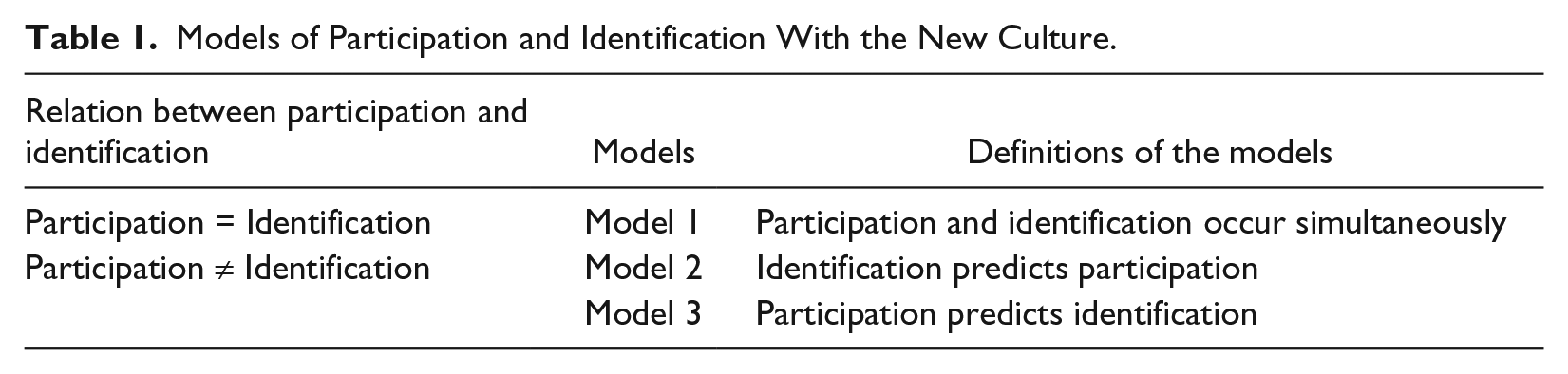
Other researchers see identification and acculturation changes (i.e., participation in the new culture) as two different yet related phenomenon (see Models 2 and 3 in Table 1). For instances, Ward, Bochner, and Furnham (2001) point out that successful immigrants will acquire the functional skills that enable them to succeed in the new environment and that this may be independent from any changes in their identity. In other words, participating in the new culture does not necessarily mean developing a sense of belonging in the new cultural group. Researchers who see identification and participation as separate concepts often position themselves either theoretically, by stating the difference between the two concepts, or empirically, by measuring identification and participation in the new culture separately from each other (e.g., Graves, 1967; Hutnik, 1986; Phinney, 2003; Phinney, Romero, Nava, & Huang, 2001; Rosenthal, Bell, Demetrious, & Efklides, 1989; Ward et al., 2001).
If identification with a new culture and participation in it are two different yet related phenomena and concepts, then two possible directional relations may exist between them. The first relation is that identifying with the new culture allows individuals to adopt the new culture’s behavior. In other words, the Colombian immigrant must first have a sense of belonging to the Canadian culture to participate in the new culture (see Model 2 in Table 1). Graves (1967), for example, hypothesized that identification with a new culture was necessary if an individual was to acculturate; according to him, believing that one belongs to a new culture is an antecedent and a requirement to changing the way one behaves. The second possible directional link between participation and identification in the new culture is that participation allows an immigrant to identify with the new cultural group. In other words, the Colombian immigrant must first participate in his new culture to develop a sense of Canadian identification (see Model 3). The three models are summarized in Table 1.
Previous research has examined the validity of Model 2, that is, whether identification patterns could predict participation in the new culture. Inspired by Berry’s (1997) four acculturation strategies, Hutnik (1986) proposed four identity strategies, categorizing individuals according to their level of identification with the new culture and with the culture of origin. The different identity strategies were then compared with their level of participation in the new culture and the culture of origin (defined in the study as social adaptation). Results showed that, in general, individual’s identity strategies did not necessarily predict participation in the new culture and culture of origin. A follow-up study (Snauwaert et al., 2003) showed that Hutnik’s identity strategies do not necessarily relate to Berry’s acculturation strategies either. In other words, a person’s level of identification with the new culture and the culture of origin does not predict their level of participation.
Research has also examined if participation could predict identification (i.e., Model 3), and of the three models, Model 3 has received the most empirical support. For instances, even though Wong-Rieger and Quintanta (1987) conceptualized participation and identification changes as being part of acculturation (hence Model 1), they measured behavioral changes apart from identity changes. Their results show that behavioral changes (e.g., working) were easier to integrate than cognitive (e.g., language) and self-identity (self-labelling; see also Rosenthal et al., 1989). Further studies have shown that immigrants to the United States who participated in American culture (i.e., interacted with Americans and were proficient in English) tended to have higher levels of American identity (Phinney, 2003). This pattern was replicated with the identity of origin and participation in the culture of origin (Phinney et al., 2001). The studies mentioned above not only support the theoretical and empirical difference between participating in a culture and identifying with it, they also offer support for Model 3, where participation leads to identification.
Research so far supports the distinction between participation and identification with a culture. Some studies also support a directional link where participation predicts identification. However, an important limitation of literature so far is that no study has tested the distinctions between participation and identification by examining the three competing models simultaneously. As such, it is not possible to know if similar results would be obtained by inversing the variables and allowing identification to predict participation in previous research; in addition, no study has tested whether people experience participation and identification as essentially the same phenomenon. Hence, no clear conclusion can be made about the relation between these concepts, leaving policy-makers and interveners in a void as to how to promote adaptation to the new country.
The two following studies tested the three different models simultaneously, establishing the relation, as well as the directionality, between participation in a new culture and identification with it. The first study used a quantitative correlational methodology. Latin-American immigrants answered a questionnaire containing self-report scales. The three different models were compared using path analyses to examine which one best fitted the data. In the second study, Latin American immigrants told their immigration story or narrative. The narratives were analyzed to understand how participation in a new culture and identification are experienced by participants. By using two different yet complementary methodologies, the present article hopes to illuminate the relation between two important variables that affect the long-term adaptation of immigrants, and enlighten interveners on how to proceed when targeting identity processes.
Study 1
The goal of Study 1 is to compare Model 1, Model 2, and Model 3 with the use of path analyses. Even though causality can only be established through an experimental device, path analysis can test the casual and directional relations among variables within a sample, implying a directional link in the observed data (Kline, 1998). In the present study, the fit of three path analyses (the three different theoretical models) are compared to see which one best fits the data.
Nevertheless, to use path analysis, exogenous variables are necessary. Exogenous variables are variables whose origin is independent from the other variables in the model. In the present study, exogenous variables are used to understand the relation between the variables of interest, participation, and identification. By setting external conditions to participation and identification, the path analyses will determine whether the exogenous variables are similarly related to participation and identification (supporting Model 1) or if they have different relations with each variable (supporting Model 2 or 3). Based on previous acculturation research, the present study makes use of two exogenous variables: coerciveness to immigrate and difference with the new culture (i.e., value incongruence).
Coerciveness to immigrate (or how much people felt forced to immigrate) is a unique variable in acculturation research (Berry, 1997; Berry et al., 1987; Ward et al., 2001) in that it illustrates both the sociopolitical situation of the country of origin and as well as the motivation behind immigration. Immigrants who felt forced to leave their country of origin will perceive a greater severity in the circumstances that caused migration than immigrants who immigrated after careful consideration (Richmond, 1993; see also Berry, 1997). In addition, those who feel forced to immigrate are more motivated by safety needs than by social mobility (Richmond, 1993; see also Berry, 1997).
Research shows that coerciveness to immigrate can affect the adaptation of immigrants by predicting high levels of acculturation stress (Berry et al., 1987) as well as by impeding on their cognitive processes (Everly & Lating, 2004), which are important for learning new behaviors during cross-cultural contact (Allen, Vaage, & Hauff, 2006). As such, people who felt forced to immigrate can have difficulty participating in the new country (see Colic-Peisker & Walker, 2003; Sayegh & Lasry, 1993). Even more, if identifying with a new cultural group requires cognitive processing skills as suggested by the cognitive developmental model of identity integration (Amiot, de la Sablonnière, Terry, & Smith, 2007), then coerciveness to immigrate can also impede on identification with the new culture (e.g., Colic-Peisker & Walker, 2003). Based on this, coerciveness to immigrate will be used as an exogenous variable.
A second variable that influences adaptation is the perception of difference between the new cultural group and oneself. Indeed, differences between a person’s culture of origin and the host culture in language, religion, and skin color, to name a few, affect individuals’ adaptation to the new country (Berry, 1997; Black, 1976; Ward et al., 2001). A value difference or incongruence can be particularly impactful in the immigration process, as values are considered the anchor of the personal identity (Hitlin & Piliavin, 2004). More specifically, values are beliefs about desirable transsituational goals, and they direct thoughts and behaviors of individuals (S. H. Schwartz, 1994). Because of their transsituational nature, values are the aspect of the self that remains constant across all situations, aiding people experience continuity across changes (Hitlin & Piliavin, 2004). Values are also important for cultural identity (Taylor, 1997), as they represent the shared priorities or goals of a cultural group and its members (Schwartz, 1999).
When an individual’s values are incongruent with the values of a group, his or her well-being suffers (see Stromberg & Boehnke, 2001). Value incongruence can also influence individual’s commitment to a group, predicting the likelihood to leave an organization (e.g., Amos & Weathington, 2008; Hyde & Weathington, 2006) and the desire to stay after major changes have been implemented (Meyer, Hecht, Gill, & Toplonytsky, 2010). In acculturation research, value incongruence negatively affects the adaptation of immigrants to the new country (Yijälä, Lönnqvist, Jasinskaja-Lahti, & Verkasalo, 2012). Considering their importance in the adaptation and acculturation process of immigrants, value incongruence and coerciveness to immigrate will be used as exogenous variables to test the relation between identification with a new culture and participation in it, helping distinguish which of the three models is most valid.
If participation and identification with the new culture are the same underlying construct of acculturation (Model 1), then the exogenous variables (feeling forced to immigrate and value incongruence) should directly and negatively affect both participation and identification. On the contrary, if participation and identification are two different yet related constructs, two possible relations are possible. The first relation is one where the exogenous variables (feeling forced to immigrate and value incongruence) affect identification with the new culture, which in turn influences participation in the new culture, supporting Model 2. The second relation is one where the exogenous variables (value incongruence and coerciveness to immigrate) influence participation in the new culture, which in turn predicts identification with the new culture, offering support to Model 3. These three models are hence tested.
Method
Participants
In total, 147 Latin American immigrants were recruited in French classes and in Hispanic churches in the province of Quebec, Canada. The age of participants ranged from 18 to 56 (M = 34). In the sample, 61% (n = 81) of participants were women. The majority of the participants were born in Colombia (45.9%), followed by Mexico (17.8 %) and Peru (13.7%). The remaining 22% came from other countries in Latin America. On average, participants had left their country of origin 53.71 months ago (SD = 70.33), and 80% were living their first immigration experience in Canada.
Most participants had the permanent resident immigration status (75%), while 13.9% had the Canadian citizenship. Few participants were refugees (6.3%), seeking the refugee status (2.1%), or students with a student visa (2.1%). In total, one person reported having finished elementary school (0.7%), 17.2% finished secondary school, and 18.6% did technical studies (e.g., to be a secretary). Most people had finished undergraduate studies (51.4%), while some reported having completed graduate studies (11.7%). Most participants (97.8%) reported Spanish as a mother tongue; three people did not answer this question and one person indicated Russian as his mother tongue. This person was removed from further analysis.
Procedure
Using a back-translation procedure (Brislin, 1970), the questionnaires were first translated from English to Spanish by a bilingual individual, and then translated back into English by a second individual. The translation was verified by the researcher. To verify that all the items were clear, five individuals not included in the following results answered the questionnaire, identifying any mistake or lack of clarity. Any confusion or discrepancy was resolved by the main researcher.
Measures
Coerciveness to immigrate
Participants were asked how much they felt forced to immigrate. The single-item scale was answered with a Likert-type scale that ranged from 1 (not at all forced) to 10 (very forced).
Value incongruence
Values were measured with the short version of Schwartz’s Portrait Value Questionnaire (PVQ; S. H. Schwartz, 2003). The 21 items of the PVQ describe 21 individuals who characterize one of Schwartz’s 10 theoretical values. Participants answered how much they personally resemble each description. An example of an item is, “She wants to have a lot of money and expensive things. It is important to her to be rich.” Individuals answered with a Likert-type scale from 1 (not at all like me) to 10 (very much like me). The more the individual reports resembling the description, the more he endorses the value. Subsequently, participants answered the same scale but for a typical Canadian/Quebecer (1 being “not at all like a typical Canadian/Quebecer,” and 10 being “very much like a typical Canadian/Quebecer”). The correlation and alphas of each value are presented in Table 2.
Study 1: Correlation Between Items of Each Value for Personal Values and for Canadian/Quebecer Values.
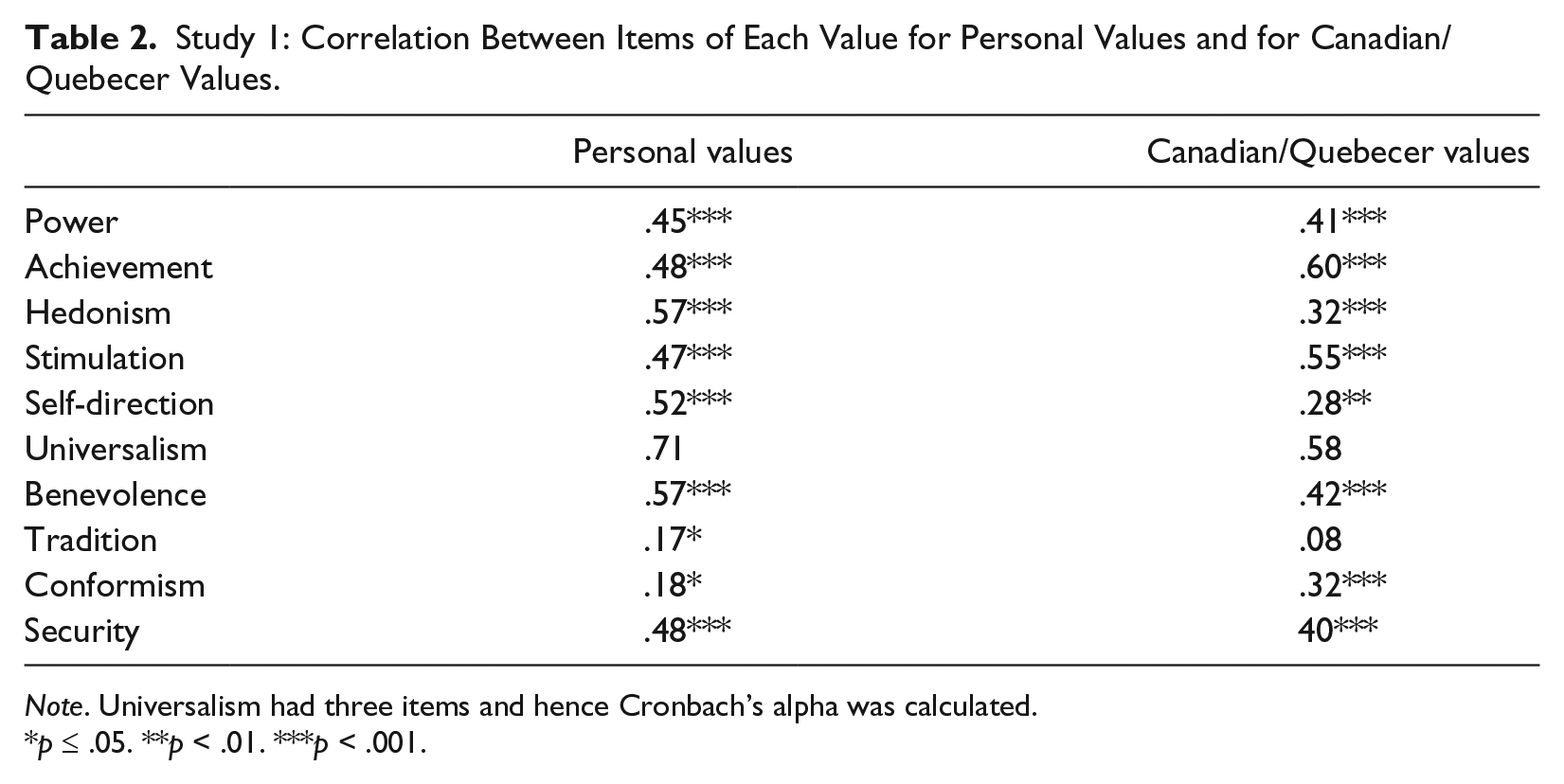
Note. Universalism had three items and hence Cronbach’s alpha was calculated.
p ≤ .05. **p < .01. ***p < .001.
The value incongruence score was created by calculating an absolute difference score. An individual’s value score (e.g., the power value) was subtracted from the Canadian/Quebecer value score (e.g., Canadian/Quebecer power value) to create a difference or incongruence score. The scores near zero represent values that are similar; positive numbers represent higher Canadian values than personal values, whereas negative numbers represent lower Canadian values than personal values. As the direction of the difference or value incongruence was not important in the present investigation, absolute scores of the difference were created, making all values positive and essentially targeting the difference or incongruence between value scores. This was done for each value, resulting in a total of 10 difference value scores. These 10 incongruences scores were then averaged to create a general incongruence score.
Participation in the new culture
A shortened version of the Vancouver Acculturation Index (Ryder et al., 2000) was used to measure participation in Canadian/Quebecer culture. This scale assesses the extent to which people participate in the new culture and the culture of origin. In the present study, only the scale for the new culture is presented (α = .79). Seven statements measuring individuals’ level of participation in Canadian/Quebecer culture were presented and participants answered with a Likert-type scale ranging from 1 (totally disagree) to 10 (totally agree). An example of an item is, I often participate in Quebec/Canada’s cultural traditions.
Identification with the new culture
Two different ways of conceptualizing and measuring identification with the new cultural group were employed. Ingroup identification refers to the cognitive awareness that one is connected or tied to the group (Jackson, 2002). Three items were used to assess participants’ identification with the new cultural group (α = .84), and individuals answered using a Likert-type scale ranging from 1 (totally disagree) to 10 (totally agree). An example of an item is, “I have a lot in common with members of the Canadian/Quebecer group.”
Identification was also evaluated by measuring identity integration, which is the process by which one comes to see a new identity as an important definition of who one is. This process allows new identities to become an essential aspect of one’s self-concept, at the same level as those identities already in the self (Amiot et al., 2007; Cheng et al., 2008). Identity integration was measured using an adapted version of the “Inclusion of the Other in the Self” Scale (Aron & McLaughlin-Volpe, 2001; see also Aron, Aron, & Smollan, 1992). The scale assessed the extent to which the Latin American and Canadian/Quebecer cultural identities were perceived as close or integrated. The scale consisted of seven pictures showing two circles (one representing the Latin American cultural identity and one representing the Quebecer/Canadian cultural identity) overlapping to differing degrees. Picture 1 represents circles that do not overlap at all while Picture 7 shows circles nearly occupying the same space. Participants were asked to select the picture that best illustrates the relationship between the two cultural identities. The higher the score, the more integrated the new identity is.
Results and Discussion
Preliminary analyses
The variables used in the main analyses were examined for accuracy of data entry, missing values, and fit between their distributions and the assumptions of multivariate analysis (Tabachnick & Fidell, 2012). All missing data (representing less than 5% of the total sample) was replaced using the simple linear trend imputation at point method. All scores had an acceptable range of skewness and kurtosis (Kline, 1998). No univariate or multivariate outliers were found.
Descriptive analyses
Table 3 presents the means and correlations for the main variables. An inspection of Table 3 shows that coerciveness to immigrate is negatively and significantly correlated to participation but not to the identification variables (identification and identity integration). A similar pattern is seen with value incongruence, as it negatively predicts participation in Canadian/Quebecer culture (marginally significant) but not identification.
Study 1: Means, Standard Deviations, and Correlations.

p < .10. *p ≤ .05. **p < .01. ***p < .001.
Main analyses
Factor analysis
To test whether the participation and identification items measured two different constructs, the seven items of the Vancouver Acculturation Index, the three items of cognitive identification, and the single-item identity integration scale were included in a principal components factor analysis (PC). The results from the PC show that the data are suitable for performing factor analysis: The Kaiser-Meyer-Olkin (KMO) value was of .84, and Bartlett’s test of sphericity was significant, χ2(66) = 532.51, p < .001). These two indices indicate that it is appropriate to use exploratory factor analyses with the data.
The PC analysis shows that the greatest drop in eigenvalue is from one factor (4.59) to two factors (1.38) and that these two factors explain 49.74% of the total variance. Considering that theoretically we expected two factors to emerge (Factor 1 being participation in the new culture and Factor 2 being identification with the new culture), we proceeded to principal axis factoring (or PAF) with a two-factor solution and a varimax rotation. As can be seen in Table 4, all items of the acculturation scale loaded on the first factor (Participation factor) whereas all items of identification and identity integration loaded in the second factor (Identification factor). Surprisingly, the item “I identify with other members of the Quebecer/Canadian group” loaded on both factors; however, it loaded stronger on the identification factor, and therefore that item was kept. The two factors explained 41.49% variance of the 49.74% variance that could be explained from the PC analysis.Overall, the results show the existence of two distinct constructs which match the theoretical constructs of Participation in the new culture and Identification with the new culture.
Study 1: Factor Loadings for the Items Measuring Participation in the New Culture, Identification With the New Culture and Identity Integration.
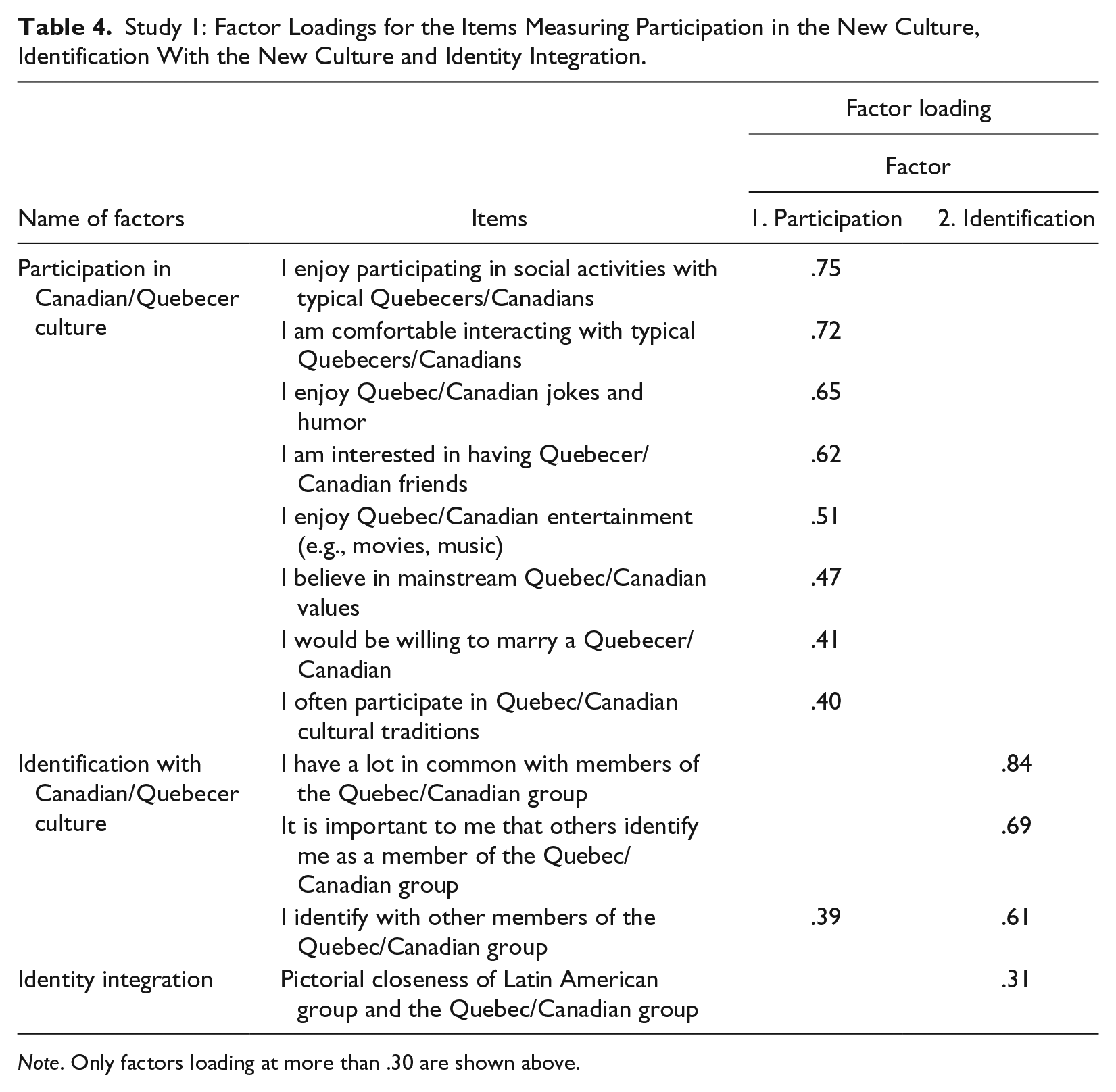
Note. Only factors loading at more than .30 are shown above.
Path analyses
To further test the distinction between these two constructs and the direction of their relation, path analyses were performed using Amos statistical package (Arbuckle, 2010). To test how well the models fit the data and as recommended by Kline (1998) and Byrne (2001), three indexes of fit were used: the chi-square (χ2), the comparative fit index (CFI), and the root mean square error of approximation (RMSEA). A model fits well the data if the significance of the χ2 value is larger than p ≤ .05, if the CFI is larger than .90, and if the value of RMSEA is smaller than .06, nonsignificant at p > .50 (Byrne, 2001). In addition, all the predictive links or estimates should be significant.
In addition, all the models presented below control for months since immigration as research shows that length of residence positively predicts adaptation, identification, and acculturation (Berry, Phinney, Sam, & Vedder, 2003). By controlling for length of residence, the models test whether the relations in the model hold above and beyond the effect of time.
Model 1: Participation = identification with the new culture
Figure 1 presents the model with the respective standardized coefficients. The path analysis performed to test this model suggests that it fits well the data, with acceptable indexes of fit, χ2(3, N = 146) = 1.05, p = .790; CFI = 1.00; RMSEA = .00, p = .864. However, only two predictive links were significant; more specifically, coerciveness to immigrate and value incongruence significantly predicted participation in the new culture, while value incongruence marginally predicted identity integration. No other link was significant, indicating that while the model fits well the data, it does not help us understand the relation between participation and changes in identification.
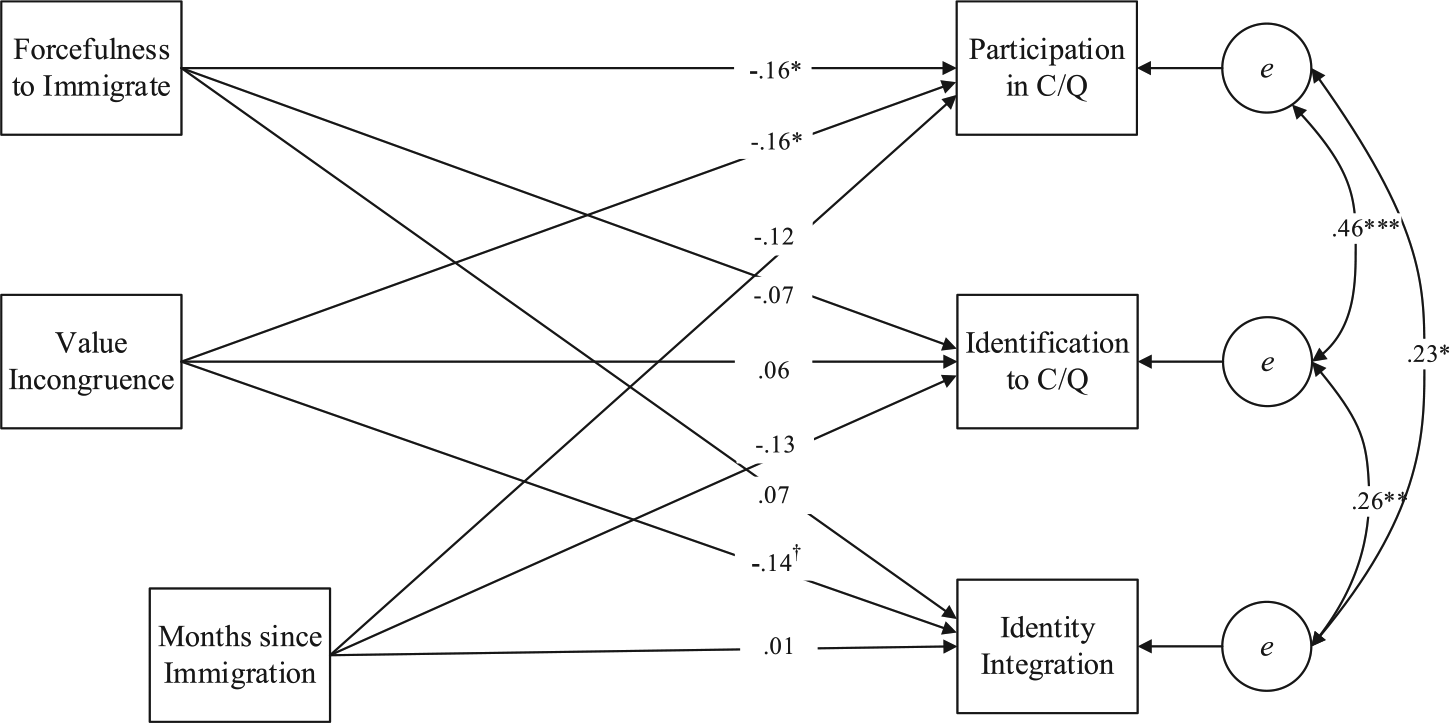
Model 1: Participation and identity processes are considered to be the same. Exogenous variables predict participation and identity processes.
Model 2: Participation ≠ identification with new culture, and identification predicting participation
Figure 2 shows the standardized links between variables. Some of the fit indexes for this model were acceptable, χ2(5, N = 146) = 7.57, p = .181, CFI = .95, but the RMSEA was not significant as it was lower than p = .50 (RMSEA = .06, p = .355). The only significant predictive link was between identification and participation in the new culture, while the link between value incongruence and identity integration was marginally significant. In addition, we tested whether the identity variables (identification and identity integration) mediated the relation between exogenous variables (forcefulness to immigrate and value incongruence) and participation in the new culture. Results show that both indirect effects were nonsignificant (standardized beta value incongruence = −.04, p = .378; standardized beta forcefulness to immigrate = −.02, p = .574), indicating that the exogenous variables did not affect participation by increasing identification and identity integration. Overall, this model only received partial support.
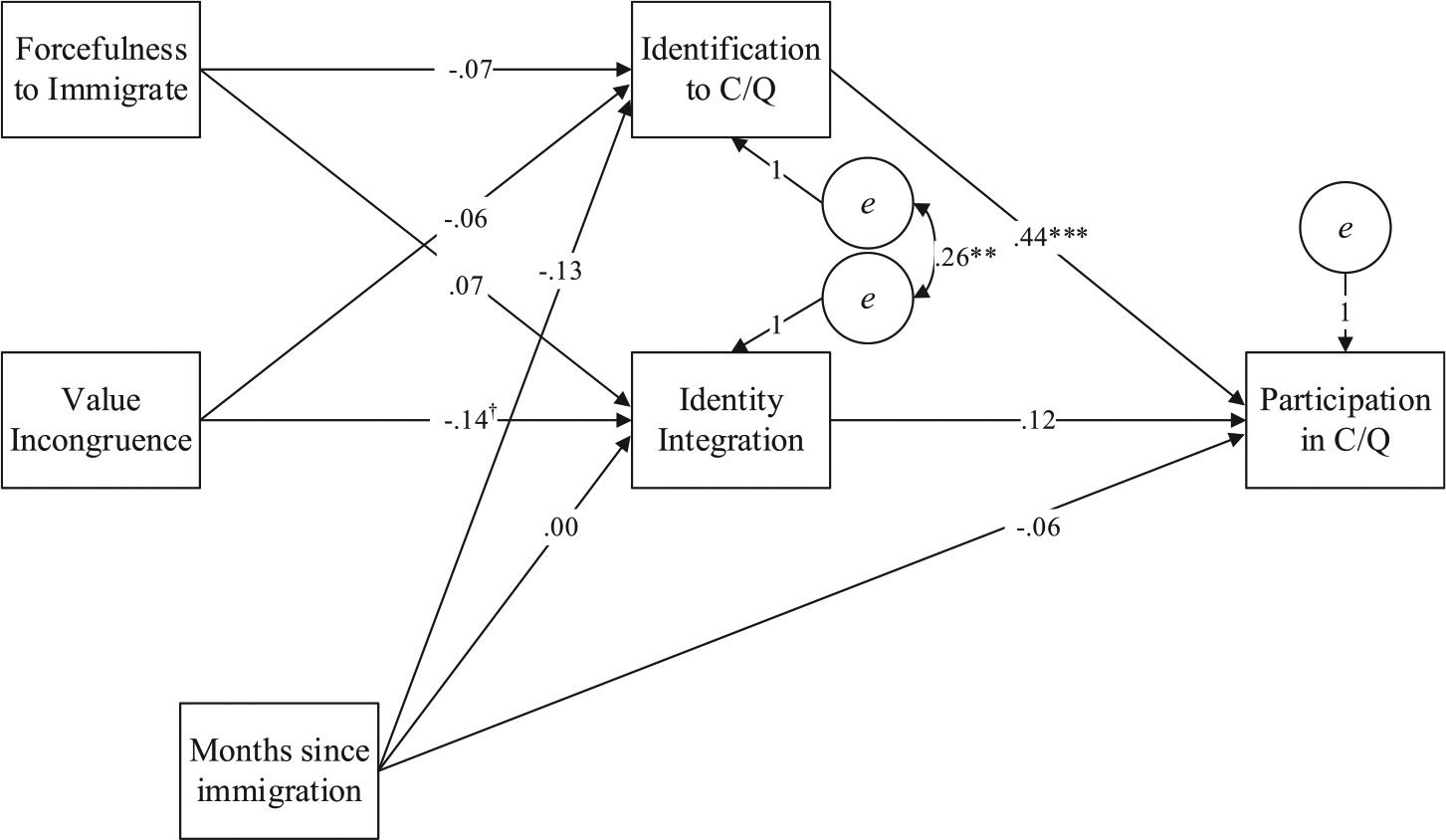
Model 2: Participation and identity processes are considered as different. Exogenous variables predict identity processes, which in turn predict participation.
Model 3: Participation ≠ identification with new culture, and participation predicting identification
Figure 3 shows the standardized links between the variables. All the fit indexes for this model were acceptable, χ2(7, N = 146) = 4.69, p = .698 (CFI = 1.00; RMSEA = .00, p = .851). All the predictive links of the main variables were significant and in the appropriate direction (see Figure 3). In addition, we tested whether participation in the new culture mediated the relation between exogenous variables (forcefulness to immigrate and value incongruence) and identity variables by performing 5,000 bootstraps (as recommended by Hayes, 2013) and using the bootstrap-corrected percentile intervals. Results show that the indirect paths of value incongruence (standardized beta = −.07; p = .037) and forcefulness to immigrate (standardized beta = −.07; p = .041) on identification, as mediated by participation, were both significant; a similar pattern was obtained for identity integration (standardized beta value incongruence = −.04, p = .033; standardized beta forcefulness to immigrate = −.04, p = .028). Of the three models, Model 3 received the strongest support from the path analyses, supporting the principle that participating in a new culture predicts identification. Furthermore, the analyses of the indirect paths illustrate that contextual immigration factors can affect identity by affecting participation in the new culture, giving further support to Model 3.
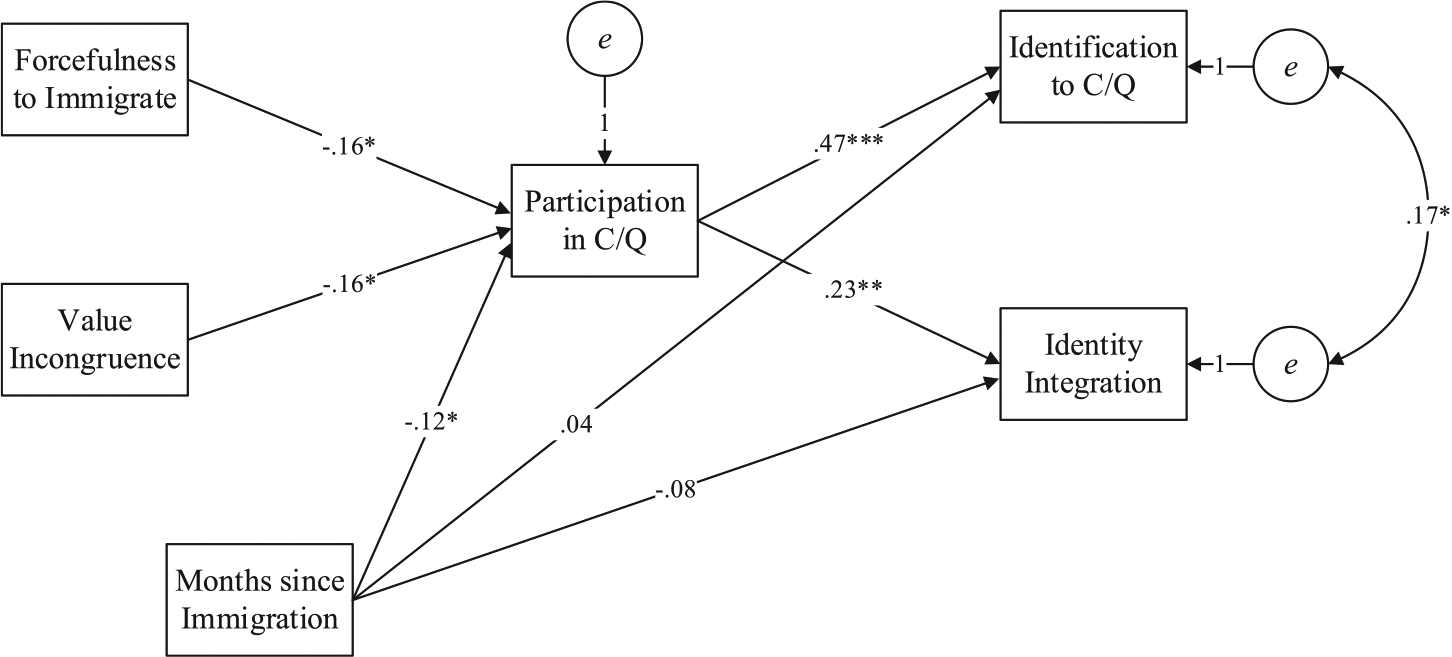
Model 3: Participation and identity processes are considered as different. Exogenous variables predict participation, which in turn predicts identity processes.
To verify the validity of the third model, an alternative model was tested. The directionality of the paths in the third model were reversed, such that identification and identity integration (as well as length of residency, the control variable) lead to participation, and participation to coerciveness to immigrate as well as value incongruence. The fit of the model was found to be not satisfactory, χ2(8, N = 146) = 15.98, p = .043 (CFI = .84; RMSEA = .08, p = .159), showing that the original third model is the most appropriate model.
Overall, the results from the present study show that the third model best fits the data, such that it better explains participants’ answers. These results advance two important conclusions. First, participation in a new culture should be conceptualized as differing from identification to a new culture. Second, the direction of this relationship seems to be one where participating in a culture facilitates a sense of belonging to it.
To replicate the present findings and confirm the pattern of results obtained in this study, a second study with a different methodology was performed. The goal of Study 2 is to verify whether individuals experience participation in a new culture as qualitatively different from identification with it, and if they reported participation as a requirement for identification. If a different study with a distinct methodology confirms results from Study 1, then the validity of Model 3 will receive further support.
Study 2
The study that follows investigates the content of participants’ narratives, highlighting the spontaneous expressions of participation and identification made by participants. This methodology allows us to grasp individuals’ insight on these variables, and the way they understand their relationship. In essence, Study 2 tests whether participants experience identification and participation in the new culture as essentially the same phenomenon (Model 1), or if they experience them as two different phenomena (Models 2 and 3). If, for instance, participants mention identification with the new culture helping them participate more in it, then Model 2 would be supported. If on the other hand, participants describe that participating in the new culture helps them identify with the new cultural group, then Model 3 receive further support.
Method
Participants
Twenty-two immigrants from the first study were selected to participate in the second study. To ensure that we had a varied sample of participants with different immigration experiences, we contacted individuals who had scored either very high or very low on the Coerciveness to immigrate measure (Allen et al., 2006). Of the 22 participants, 15 people accepted to participate in the second study. Seven of the 15 participants were among the most forced to immigrate while eight of them were among the least.
Of the 15 participants, nine were women. Their age ranged from 19 to 43 years, with an average age of 35 (SD = 7.99). In terms of education, one participant finished elementary school, one secondary school, two finished technical degrees, 10 finished undergraduate schooling, and one had a graduate degree. Thirteen participants reported that this was their first immigration experience and the average number of months since immigration was 46.73. Most of the participants came from South America (six Colombians, two Chileans, and two Peruvians) and five individuals came from Central America (four Mexicans and one Dominican). In terms of immigration status, most had the permanent residence (10 participants, 66.7%), two were refugees, one was applying to be a refugee, one had a student visa, and one already had the Canadian citizenship.
Procedure
A semistructured interview was employed, which gives participants freedom to express themselves, while still guiding them toward the research questions. Participants were given an outline of the interview based on McAdams life story narrative (McAdams et al., 2004; McAdams et al., 2006). In the present study, immigrants were asked to narrate their immigration story. They were asked to consider their immigration story as having five chapters: The first one was their life before immigration and the second one during the immigration process. The third and fourth chapters referred to their life in Canada. Participants related a significant event that marked their acculturation experience, and this significant event marked the end of Chapter 3 and the beginning of Chapter 4. The fifth chapter asked about their future perspectives (next 10 years). The instructions were intended as a guideline, to exemplify how their immigration story could be told in a linear fashion, but the structure was not forced on participants. As such, not all individuals made a distinction between Chapters 3 and 4, often telling a general story of how they experience life after immigration.
Each participant was met by a female, Spanish-speaking researcher at the place and time of their preference (usually the participant’s home or a quiet university room). The interviews took place in Spanish, which allowed participants to communicate unreservedly without the language barrier. Consent forms were explained and then read by the individuals. Interviews were recorded and transcribed word by word.
The coding scheme for the interviews was specified before reading the verbatim; however, they were adjusted in function of the themes expressed in the transcripts when required. The themes were coded as follows.
Participation in the new culture
Individuals who mentioned that they participated in Canadian/Quebecer culture and traditions, that they appreciated Canadian/Quebecer entertainment, and that they enjoyed the interpersonal relationships developed with Canadians/Quebecers were considered to be discussing participation in the new culture (based on the Vancouver Acculturation Index; Ryder et al., 2000). However, after reading the narratives, it was clear that for many participants, finding a job or studying for a career was an important aspect of participation in the new culture. Therefore, mentions of working or studying were considered as participating in the new culture.
Identification with the new culture
Whenever individuals mentioned that they “identify,” “integrate Canada/Quebec,” and “belong to Canada/Quebec,” they are considered to be describing the experience of identifying with the new cultural group.
Results
Participation in the new culture
All the participants mentioned participating in the new culture, even if they varied in their expression of acculturation. Eight participants spoke openly about the relationships they had with Canadians/Quebecer, and how satisfied or dissatisfied they felt with such relationships. For example, Participant 2 said, “ . . . I would like to open up to get to know the culture from here, to know the people from here,” conveying that even though she is not satisfied with her current participation in the culture, she desires to be more involved in it. Participant 127 mentioned how relationships with Canadians “allowed one to feel connected. To reconnect. And I am telling you, this is the most important part.” Other participants mentioned adapting to the new rules of social interactions. For example, Participant 50 said, . . . I had to adapt myself to the [fact that the] logic [or rules] of interaction were completely different. For example . . . to realize that in the context of university, people don’t say hi with a kiss when they arrive even if they are two classmates. I had to suppress a part of me, and in that aspect I missed the Latin American context.
This woman expressed the bittersweet realization that she missed the kind of interactions she would have in Latin America, but that she also adapted and adopted the relationship parameters of the new culture. Two participants mentioned the use and enjoyment of bikes, an important aspect of Montreal’s (Quebec) culture. For instances, Participant 40 said, “I am the number one fan of biking and biking routes.”
Last, participation was also manifested in terms of their desire to work or study in Canada. All the participants mentioned clearly that they wanted to pursue further studies (“I hope to have good grades to go to CEGEP,” Participant 148) or performing specific jobs (“[In 10 years] I imagine myself working in a library,” Participant 8). Participant 21 illustrates why finding a job (or being accepted in a university) is meaningful to immigrants: . . . when I began working where I am currently working . . . it was very [gratifying] because even though it is a job as a packer, as a peon, it is well paid, with good benefits, and from my point of view, it is thanks to this job that I could buy a house.
Participants feel that studying and getting a job is the first step toward establishing themselves and settling in Canada. Indeed, considering the high rate of unemployment among immigrants, the lower skilled occupations that they accept and the way they differ from their ideal job (Statistics Canada, 2005), finding work is an essential part of integrating to and participating in the new culture.
Interestingly, only one participant (Participant 72) mentioned participating in specific Canadian or Quebecer cultural traditions (picking up apples in the fall). This is interesting because several acculturation scales and measures ask the extent to which immigrants take part in these traditions; however, this aspect of participation in the new culture does not seem particularly important to this sample of Latin American immigrants.
Identification with the new culture
In terms of the spontaneous expression of identification, five out of 15 immigrants clearly verbalized a sense of belonging to Canada by using words such as “identifying,” “integrating Canada in me,” and “belonging in Canada.” Some of those who mentioned that they identified with Canada highlighted the similarities between Canadians/Quebecers and people from their culture of origin. Participant 7 said, We are in a capitalist society, consuming. “I want a computer, a television set, [I want many things]” But what for? So that your child may be well. But why do you want him to be well? So that he isn’t alone. Why don’t you want him to be alone? So that he feels loved. We always arrive to the same answer, [love], so whether here [in Canada] or there [in my country] it doesn’t matter; and I think that I do identify with the Quebecer culture . . . .
Participant 106, who had just mentioned wanting to identify to Canada, said, “At the end of the day, we are all human, we all have good and bad things.” Only after drawing on the similarities between cultures as well as their common humanity is identification a possibility. However, the similarities can only be seen after participating in the new culture. Indeed, as it will be seen further below, participants who mention identification also mention acculturation in the same paragraph.
The relation between participation in the new culture and identification with the new culture
Among participants who directly mentioned identification in their narratives, we see a clear pattern. When they mention identification, they have just described participation and wanting to get to know the new culture. Below are extracts from three participants that illustrate this point: When you start to take some of your time to do certain activities that you do here, then you feel more connected with the people from here, you start understanding the milieu, let’s say that only then you start feeling from here, you start having a certain sense of belonging. (Participant 72) I want to begin to know what is here, what is in this place that is so strange to me, to know it, to adapt myself, to have a relationship, to see the differences, to, see the differences and identify with the things that are new to me. (Participant 106)
Participant 138 was in a romantic relationship with a Canadian. When the interviewer asked why relationships were turning points in the immigration process, she said that “they change your identity, and they motivate you.”
The three participants describe the importance of getting to know the culture, participating in it, and connecting with people to have a sense of belongingness in the new culture. In other words, they underscore that only by participating can they come to identify with the new cultural group.
It is worth noting that even though the 15 immigrants mentioned participating in the culture, only five of them enunciated a sense of identification with Canada. That is, all those who mentioned identification also referred to participation; however, those who mentioned participation did not necessarily refer to identification. Considering that all participants discussed participation issues and yet only five acknowledged some level of identification, this difference implies two important conclusions that echo Study 1. First, participation in a new culture and identification with it are not experienced equally and as the same phenomenon. If they were, all the individuals who mentioned participating in the culture would have also mentioned identifying to it. Second, the present results also illustrate that participation in a new culture appears to be a necessary experience in order to experience identification, but that the opposite is not true. The results highlight the directionality of the relationship between the main concepts, where participation seems to help identification. Overall, the results from Study 2 confirm those of Study 1 from the experiential position of participants.
Discussion
The goal of the present article was to disentangle the relationship between two important concepts: participating in a new culture and identification with it. The relation between these variables in literature had not been established, as many researches in the acculturation literature considered the two variables to be simply part of acculturation and hence undifferentiated (Model 1). Others considered them to be different variables, with some positing that identification promoted participation (Model 2) and others postulating that participation affects identification (Model 3). Despite these differing conceptualizations, no empirical study had be undertaken to test whether these variables were one and the same or two different concepts, nor their directional relation.
To assess which of the three models better reflected the relation between participation and identification, two empirical studies with complementary methodologies were employed. The first study collected quantitative data from Latin American immigrants and used path analysis (Byrne, 2001) to compare which of the three models best fit the data. Of the three models, a model where participation predicted identification (Model 3) received the strongest empirical support, corroborating that their variables are different from each other.
The second study gave further support to results from Study 1 with a qualitative methodology. Immigrants narrated their immigration story, from their life before immigration to how they saw themselves 10 years from the present. The narratives suggested that immigrants subjectively experienced participation in the new culture and identification as two different yet related phenomenon. Furthermore, while participation in the new culture was often mentioned, identification was less often remarked. When participants acknowledged identifying with the new culture, it was after discussing their participation in the new culture. Overall, the results from both studies suggest that participation and identification with a new culture are indeed different concepts and that participation predicts identification (Model 3).
An important theoretical implication of these studies is that participating in a new culture appears easier or at least occurs at a higher rate than integrating a new identity, confirming results by Snauwaert et al. (2003). In other words, immigrants focus first on relating with people from the new culture and doing the activities from the new culture than developing a sense of belonging in the new cultural group. This is contrary to the initial theorizing of Graves (1967), one of the fathers of acculturation research who believed identification to be a precursor of participation, as well as of other theories that present participation and identification as occurring simultaneously in the acculturation process (Berry, 1997). The relative easiness of adopting new behaviors compared with adopting the new identity may be due to their nature. Participating in group, regardless of size, requires clear and concrete behaviors. Because they are clear and concrete, they are easier to engage in and mimic (see Cialdini, Reno, & Kallgren, 1990). Immigrants who wish to adapt to a new context may find it easier to adopt what they see around them, the clear and concrete behaviors, as opposed to the abstract values and identity of the new group. These changes in behavior in turn allow for an attitudinal change that promotes identification with the new culture.
A second theoretical implication derives from the results from Study 1, which provide evidence that participation in the new culture mediated the effect of value incongruence and coerciveness to immigrate on identity changes. This mediation not only further supports the distinction between participation and identification, it also illuminates the process by which contextual (i.e., coerciveness to immigrate) and individual (i.e., value incongruence) immigration factors affect identity. More specifically, they suggest that certain contextual and intraindividual variables imbedded in the immigration experience affect an immigrant’s capacity to participate in the new cultural group, that is, to engage in the new group by creating meaningful relations, participating in traditions and engaging in the general culture; in turn, this low participation results in lower attachment to the new cultural group and integration of the new identity. While further studies are necessary to replicate these results, they open the door for research wishing to understand the psychological process by which immigration affects identity through behavior.
A third theoretical implication refers to the use of the word acculturation in psychology. As was previously presented, acculturation has an extremely broad meaning that can be attributed to both behaviors and identities, along with attitudes and beliefs (Sam & Berry, 2006; Graves, 1967; Redfield et al., 1936). Because it is so broad, participation in a new culture and identification with it have been inscribed as part of acculturation. The present study however illustrates that these two are distinct and researchers should keep them distinct, both empirically and conceptually. To aid this distinction, we present clear and operational definitions of participation in the new culture and identification with the new culture. The definition of identification we present is based on previous literature and the results of this study: Identification to the new culture is the perception that one is tied, connected, or emotionally close to the new group. This is akin to ingroup ties (Cameron, 2004; Phinney, 1992). The definition of participation in the new culture is also based on previous literature and our own findings: Participation in the new culture is defined as engaging in behaviors that are typically observed in the new culture, such as engaging in cultural traditions, social/work/education activities, and relationships with members of new culture. Even though previous research has studied such behaviors, they have not been clearly defined as one of the many ways in which individuals can participate in the new culture. Our hope is that by clearly defining identification and participation with the new culture, researchers will continue to tease apart their components and understand their consequences for immigrant’s adaptation.
In terms of practical implications, if participation in the new culture helps create a sense of identification with the new culture, then field workers and governments could invest in programs and interventions that will favor participation in the new culture. Encouraging personal relations with members from the new culture, cultural traditions, and their education and employment are important steps toward developing in newcomers a sense of belonging. For example, organizations that pair immigrants with members of the group of origin to practice their language skills are not only helping immigrants participate in the new culture, they are also helping the development of identification with the new cultural group.
Future Research
The present article is the first to compare the three different ways of conceptualizing the relation between participation and identification with a new culture. Future research could focus on two important avenues. First, the causality of the direction in Model 3 remains to be determined. If we are to implement and promote programs and interventions that are effective, research must determine beyond any doubt that participation will have a positive effect on identification. This can be done through experimental designs, a rare finding in acculturation research. Longitudinal studies can also address the issue of causality by assessing changes in participation and identification across time (for an example of longitudinal studies in acculturation contexts, see Juang & Cookston, 2009). Even though most changes in participation and identification occur within the first few years of immigration, individuals are ever changing; longitudinal data would hence allow us to understand these natural variations in participation and identification within individuals from the strong initial changes to the more subtle late changes (e.g., S. J. Schwartz et al., 2016). Future studies should also vary the sample of participants, choosing a greater sample size as well as immigrants from other origins. A larger and more varied sample would test whether these findings can be generalized.
Second, future studies should investigate the conditions under which the relation between participation in a new culture and identification are both favored and hindered. For instances, discrimination is known to play an important role on the adaptation, integration, and well-being of immigrants (Sam & Berry, 2006). Recent studies suggest that open versus ambiguous discrimination may have different effects on how individuals protect their identities (Perozzo, de la Sablonnière, Auger, & Caron-Diotte, 2016). Will participation in the new culture predict identification when individuals feel open (as opposed to ambiguous) discrimination from their new country? If we are to understand the experience of immigrants, it is important to consider not only the relation between participation and identification but also the contextual and individual factors that could help immigrants to feel more at home.
Footnotes
Declaration of Conflicting Interests
The author(s) declared no potential conflicts of interest with respect to the research, authorship, and/or publication of this article.
Funding
The author(s) disclosed receipt of the following financial support for the research, authorship, and/or publication of this article: The present research was supported by a Fonds de recherche du Québec – société et culture (FRQSC) team grant entitled “Identity and social dysfunction” (2013-SE-164404) awarded to the second author.