




Abstract
The current study examines cultural value mediators of the relationship between culture and the relative weight placed on novelty versus usefulness when conceptualizing creativity. With a sample of Chinese and Caucasian Canadian undergraduate students, we found that uncertainty avoidance, but not power distance or individualism/collectivism, mediated the relationship between culture and preferences toward the novel versus useful dimensions of creativity. We replicated the effect of uncertainty avoidance in a second study with Chinese Canadians’ bicultural identity integration predicting focus on novelty versus usefulness in the predicted direction. We advance prior research by isolating a cultural value mechanism driving cultural variation in the conceptualization of creativity when considering novelty versus usefulness. We discuss theoretical contributions and implications for future research addressing additional creativity domains, situated cognition, and norm salience.
Keywords
While a universal desire to be creative is widely recognized, we find cultural variation in creative expression between the East (e.g., China) and the West (e.g., the United States) when it comes to the generation of revolutionary ideas (Sundararajan & Raina, 2015); the fluency, originality, and elaboration of creative ideas (Nouri et al., 2015); and the novelty of creative ideas (Mok & Morris, 2010; Morris & Leung, 2010). The Western academic definition of creativity specifies two domains: novelty and usefulness (Amabile, 1982, 1983, 1996; Hennessey & Amabile, 2010). Most creative endeavors necessitate a trade-off between a focus on novelty, which demands thinking outside of the box and corresponds to idea generation, and usefulness, which requires consideration of feasibility and practicality and typically occurs with idea selection or implementation (Goncalo & Staw, 2006; Liou & Lan, 2018). Because such trade-offs are commonplace in creative work, it is important to understand psychological and cultural predictors of a relative emphasis on novelty versus usefulness (Mueller, Melwani, & Goncalo, 2012).
In this research, we unpack and test cultural values as an explanatory mechanism for culture’s impact on the relative emphasis on novelty versus usefulness when conceptualizing creativity. It has been proposed that certain cultural values may stifle or stimulate the expression of novel ideas (Erez & Nouri, 2010; Goncalo & Staw, 2006). Other accounts suggest that social context may activate a particular set of creativity-related cultural values (Liou & Lan, 2018; Mok & Morris, 2010; Nouri et al., 2015) or cultural variation in information processing styles explains differences in creativity (de Dreu, 2010). Many existing accounts of cultural differences in creativity rest on the logic of variation in individualism/collectivism, but without empirical evidence of the cultural value mediator. As Erez and Nouri (2010) note, there are valid arguments for several different cultural value mechanisms, but we have little-to-no empirical evidence to support these predictions. In the context of recent advances in situated cognition and empirical research demonstrating the power of situational norms and norm salience to explain the effect of culture on creative expression and assessment, our research investigates and demonstrates the more basic and fundamental role of cultural values.
We focus on the general understanding of creativity as a construct, similar to Lowenstein and Mueller’s recent deep dive into implicit theories of creativity in China and the United States (2016). Through qualitative inductive analysis and cultural consensus modeling, the researchers identified 26 distinct domain general cues, the majority of which could be related to either novelty (e.g., paradigm shift or breakthrough) or usefulness (e.g., ease of use, functional). Complex culture-specific implicit theories help explain why the dominant Western lens of novel creativity cannot see the Chinese ability to imitate as creativity (see “Why China Can’t Innovate,” Abrami, Kirby, & McFarlan, 2014; and “China Makes Everything. Why Can’t It Create Anything,” Schuman & Jiang, 2013). Consider the case of 22 fake Apple stores uncovered in one Chinese city (Thornhill, 2011). The store owners had not only created replicas of Apple products such as iPhones and iPads, but they had also replicated the entire Apple shopping experience. They imitated the design and ambience of real Apple stores so well that their employees did not realize the stores were fake. Intellectual property considerations aside, to Westerners this seems anything but creative, corroborating Lowenstein and Mueller’s findings of a more narrow conceptualization of creativity in the West than in the East.
Others have noted that East Asian corporations tend to focus more on practical creative endeavors (Herbig & Palumbo, 1996). Morris and Leung (2010) note that Westerners describe Asian artistic accomplishments as imitative and reproductive, rather than novel or revolutionary. This emphasis on imitation and reproduction relates to the usefulness component of creative output. It also relates to an emphasis on incremental and safe business practices in today’s highly competitive and economically uncertain market. By looking into the minds of Chinese and Caucasian Canadians, we can examine what cultural values are behind these tendencies to prefer less novel and safer forms of creativity in the East.
Previously, scholars have proposed that values for uncertainty avoidance, power distance, and individualism all might explain why Westerners emphasize novelty and revolutionary creativity more than Easterners (Erez & Nouri, 2010; Morris & Leung, 2010; Westwood & Low, 2003). We simultaneously test these three psychological variables as mediators explaining how culture influences the understanding of creativity, arguing that uncertainty avoidance offers the most power to explain relative preferences for novelty versus usefulness.
Together, our study offers novel and useful contributions to the literature. We provide incremental advances to existing theory and empirical research by isolating the cultural mechanism of uncertainty avoidance in explaining the differential emphasis on novelty versus usefulness in the West versus the East. We also offer a novel measure of conceptualization, namely, a forced percentage allocation (maximum 100%) to novelty versus usefulness when thinking about the meaning of creativity. We discuss implications for both theorists and empiricists on the quest to understand the influence of culture on creativity.
The Universality and Culture Specificity of Creativity
The desire to create something new and useful is universal, as creativity helps meet basic human needs for exploration (Kashdan, Rose, & Fincham, 2004), variety (Kim & Drolet, 2003), and uniqueness (Brewer, 1991). Furthermore, creativity as a general concept is perceived positively across cultures (Paletz, Peng, & Li, 2011; Westwood & Low, 2003). However, while the concept of creativity may be universally valued, research has demonstrated cultural variation in how products and ideas embody creativity in the East versus the West. Research evidence supports higher levels of novel creative output in Western cultures than in Eastern cultures (Mok & Morris, 2010; Morris & Leung, 2010; Ng, 2001; Rudowicz & Ng, 2003). However, creativity is commonly defined in Western academic circles as the production of ideas that are both novel and useful (Amabile, 1982, 1983, 1996; Erez & Nouri, 2010), leading some to suggest that Easterners are less creative than Westerners (Rudowicz & Ng, 2003). We are beginning to understand that implicit theories of creativity are complex and multifaceted (Loewenstein & Mueller, 2016) and that Easterners and Westerners may vary more on their relative emphasis on novelty versus usefulness, rather than a straight preference for one versus the other (Mueller et al., 2012).
Clearly, national culture provides a social context and exerts influence on individuals’ motivations and cognition (Nisbett, Peng, Choi, & Norenzayan, 2001; Schwartz, 1992). Mok and Morris (2010) exposed Chinese-American bicultutrals to either Asian or Western cultural images to prime their Asian or Western mind-set, respectively, just before they completed a divergent thinking task. Integrated biculturals (those who identified with both Asian and American cultures and see them as compatible) exposed to American cultural cues generated more novel ideas than those exposed to Asian cultural cues. Cultural values are one place to look for mechanisms to explain these effects of culture on creativity, for example, values for conformity motivating an emphasis on usefulness in the East and values for individualism motivating an emphasis on novelty in the West (Ng, 2001; Zhou & Su, 2010).
Other researchers have proposed that cultural variation in social norms emphasizing novelty versus usefulness accounts for differences in creativity (Morris & Leung, 2010). Social norms evolve when behaviors become encoded as implicit standard operating procedures (Scott, 1998). Morris and Leung (2010) explain that when certain types of creative behavior and creative performance are informally endorsed and perpetuated in a culture, they reflect the shared conceptualization, understanding, and definition of creativity as a whole. The culture-in-context approach argues that a social context will activate a certain set of culture-based values or norms that guide behavior (Hong & Mallorie, 2004). For example, research reports lower levels of originality (similar to novelty) for Chinese working with a superior versus in a group or with peers (Nouri et al., 2015). Directive leadership is associated with decreased creativity in the West but increased creativity in the East (Zhou & Su, 2010). Cross-cultural differences in creative performance at different stages emerge when the task is conducted in a group setting, but not when individuals perform tasks in isolation (Liou & Lan, 2018; Nouri et al., 2015; Nouri, Erez, Rockstuhl, & Ang, 2008).
Others have suggested that cultural variation can be explained at a level more fundamental than social norms, values, or context. For example, it is proposed that the Chinese ideographic (vs. alphabetic) language and holistic (vs. analytic) educational instruction foster a distinct way of thinking leading to creative production that remains unnoticed by the Western “novel” creative lens (Hannas, 2003; Morris & Leung, 2010; Nisbett et al., 2001). In fact, empirical evidence supports different information processing styles, with flexible inferential processing leading to more novel solutions in the West and cautious persistent processing leading to more useful solutions in the East (Nijstad, de Dreu, Rietzschel, & Baas, 2010). This information processing account suggests that East Asians and Westerners understand “creativity” in fundamentally different ways, a perspective that is supported by additional research showing that instructions to “do your best” led to enhanced novelty in Dutch groups but enhanced usefulness in Korean groups (Bechtoldt, de Dreu, Nijstad, & Choi, 2010).
More recently, Loewenstein and Mueller (2016) conducted an in-depth cultural consensus analysis of how Chinese and Americans conceptualize creativity. Of the 26 domain-specific creativity cues identified by the authors, a small subset, representing a narrow view of creativity and including: “paradigm shift”, “breakthrough”, “potential”, “rare”, “updates tradition”, and “surprise”, was shared by most U.S. participants. Chinese implicit theories of creativity were more broad and included all 26 domains, three of which—ease of use, intuitive, and harmony—were considered unimportant in the narrow theory. Importantly, the authors agree with prior models (Chiu & Kwan, 2010) that a relative emphasis on usefulness in the East may be disadvantageous in the idea generation stages of knowledge work, whereas a relative emphasis on novelty in the West may be disadvantageous in the idea selection stage of knowledge work, an idea which is supported by the results comparing Taiwanese and American samples in an idea generation versus idea selection task (Liou & Lan, 2018).
This extensive literature review shows that we have made immense strides in understanding the relationship between culture and a broad set of creativity-related cues, as well as the role of information processing styles and situational cues in activating and eliciting certain kinds of creative performance and judgments. However, we still do not know what about culture explains these patterns.
Cultural Values Affecting Creativity
Cultural values are motivational forces guiding the way humans act, evaluate people and events, and explain their actions and evaluations (Schwartz, 1999). At a macro level, controlling for economic variables, national values for individualism and low power distance relate to national rates of innovation, which refers to the implementation of novel ideas (Shane, 1993). Westwood and Low (2003) explain that at the micro level, cultural values can explain individual cognitive and behavioral tendencies that are more likely to produce incremental versus revolutionary creativity.
Previously, researchers have proposed a relationship between cultural values and creativity (Erez & Nouri, 2010; Goncalo & Staw, 2006; Westwood & Low, 2003), but empirical evidence has been lacking. Erez and Nouri’s (2010) conceptual model specifies the role of cultural values as well as social and task contexts, and while their recent empirical work demonstrates the role of social context in activating Chinese levels of originality (a measure similar to novelty that was lower when working under a supervisor than alone) and U.S. levels of idea elaboration (an indirect measure of usefulness that was lower when working with peers than alone) in creative production, the authors did not include cultural values in their model (although they did use them as a sampling check; Nouri et al., 2015).
Research by Goncalo and colleagues has found that risk avoidance and uncertainty reduction (also individualism and conformity to group individualistic norms) explain the generation of novel ideas in work groups, but these studies do not test culture (Goncalo & Duguid, 2012; Mueller et al., 2012). For example, in a study of mixed-sex work groups, group norms for political correctness improved idea generation through reduced uncertainty (Goncalo, Chatman, Duguid, & Kennedy, 2015). Our work tests uncertainty avoidance, along with two other cultural values, as explanatory mechanisms for cultural variation in the conceptualization and perception of creativity in terms of novelty versus usefulness.
Individualism/collectivism
Individualism is a worldview that centralizes the self, from personal goals and uniqueness to personal control, while peripheralizing the social (Oyserman, Coon, & Kemmelmeier, 2002). The individualistic cultures of the West value autonomy and self-expression, which encourages expression of novel and original ideas that stand out from the rest of one’s group (Westwood & Low, 2003). Studies have found that self-direction, a value that correlates with individualism, positively relates to creativity (Dollinger, Burke, & Gump, 2007; Kasof, Chen, Himsel, & Greenberger, 2007). Collectivism is a value that emphasizes group membership as a central aspect of identity, and group harmony and group achievement as central goals (Markus & Kitayama, 1991; Oyserman, 1993; Triandis, 1995). Collectivists emphasize upholding group norms and maintaining group harmony, which discourage self-expression and the generation of unique ideas (Goncalo & Staw, 2006; Mok & Morris, 2010; Westwood & Low, 2003).
In direct support of these arguments with respect to idea generation and novelty, Goncalo and Staw (2006) showed that individualist groups generated and selected more novel ideas than collectivist groups when instructed to “be creative.” In addition, groups with strong individualist values tend to express more novel ideas, as do groups comprised of members with a strong independent self-construal who are in competition with other groups (Goncalo & Duguid, 2012; Goncalo & Kim, 2010; Goncalo & Krause, 2010). This body of research reveals the role of individualism as a group value in a group setting but does not address culture. Because collectivist cultures of the East emphasize conformity to existing rules, consensus, group norms, and interdependence, and they are likely to focus on elaboration and usefulness of ideas to gain the group’s acceptance, individualism and collectivism may mediate the effect of culture on creativity in a group setting. In the current study, we investigate how individuals conceptualize creativity, where individualism/collectivism is unlikely to be a strong culture predictor.
Power distance
Power distance indicates the equality of power distribution among members of a society (Hofstede, 1980; Schwartz & Bilsky, 1990). In cultures that exhibit high power distance, inequality in the social hierarchy is accepted, and it is important to comply with authority, which translates into following instructions and precedent rather than proposing novel approaches (de Dreu, 2010; Erez & Nouri, 2010; Morris & Leung, 2010; Nouri et al., 2015; Westwood & Low, 2003). Power distance is associated with both respect and suppression of deviant responses around superiors, which have a negative effect on overall creativity (Liu, 1986; Taras, Kirkman, & Steel, 2010). We propose that along with less emphasis on novelty, high levels of power distance should result in more emphasis on incremental, useful creativity. Previous research has found that East Asians tend to exhibit higher levels of power distance and Westerners lower levels of power distance (e.g., Hofstede, 1980), thus power distance may mediate the effect of culture on creative production or assessments especially in a leader–follower or workplace setting. However, when individually considering the meaning of creativity or rating creative products, power distance is unlikely to be a strong culture predictor.
Uncertainty avoidance
Uncertainty avoidance is defined as “the extent to which the members of a culture feel threatened by uncertain or unknown situations” (Hofstede, 1991, p. 113). It depicts level of comfort with unstructured or ambiguous situations such that if uncertainty avoidance is high, there will be stronger preferences for rigidity and rules (Hofstede, 1980). In low uncertainty avoidance cultures, ambiguous situations are not threatening and there is a greater chance that novelty will be accepted. This is because novelty requires exploration and openness (Erez & Nouri, 2010). Low uncertainty avoidance has been related to innovation at the national level (Shane, 1993). On the other hand, for individuals who cannot tolerate ambiguity, the novelty dimension of creativity will be avoided, replaced with an emphasis on usefulness. Previous research has found that East Asians tend to exhibit higher levels and Westerners lower levels of uncertainty avoidance (e.g., Hofstede, 1980).
Given the above review, we predict that when defining what constitutes creativity, the relationship between culture and relative emphasis on novelty versus usefulness will be mediated by cultural values for uncertainty avoidance, but not power distance or collectivism, such that high uncertainty avoidance will explain less emphasis on novelty (vs. usefulness) by Chinese versus Caucasian Canadians.
Study 1: Method
Procedure
Participants were undergraduate students enrolled in a large North American university. The recruitment advertisements invited Caucasian Canadian and ethnic Chinese students to participate in an online study examining common perceptions of creativity in exchange for bonus credit in courses. Participants completed a demographic questionnaire and were then asked how they define creativity. Participants then rated both the novelty and the usefulness of a creative idea (a running shoe with nanotechnology that adjusts fabric thickness to cool the foot and reduce blisters; Mueller et al., 2012).
Participants
The sample comprised 167 students, 84 of whom were Caucasian Canadian and 83 Chinese. There were 70 male and 97 female participants. We took measures to ensure that the Chinese participants were not acculturated to the Canadian culture by selecting participants who were born in China and identified with their native culture 6 or higher on a scale from 1 to 10 describing how much they identify with their native culture. We further examined our Chinese sample to ensure representativeness and found that when comparing Chinese participants who had lived in Canada 10 years or less with Chinese participants who had lived in Canada 11 years or more, there were no significant differences between these two groups in any of our measures (cultural values and dependent measures). Furthermore, the Chinese sample varied in the expected direction in values for both collectivism and uncertainty avoidance, as will be presented below.
The average age for Caucasian Canadian participants (50 females and 34 males) was 21 years old (SD = 4.90). The average age for Chinese participants (47 females and 36 males) was 21 years old (SD = 4.00).
Measures
Collectivism
We used Wagner’s (1995) 20-item scale to measure individualism/collectivism. Participants responded using a 5-point Likert-type scale (1 = strongly disagree; 5 = strongly agree; α = .86) to items such as “Only those who depend on themselves get ahead in life” and “In the long run the only person you can count on is yourself.” Item responses were reversed as needed so that high ratings indicated stronger collectivism.
Power distance
We used Earley and Erez’s (1997) 8-item scale to measure level of power distance. Participants responded using a 5-point Likert-type scale (1 = strongly disagree; 5 = strongly agree; α = .88) to items including “Employees should not express disagreements with their managers” and “A company’s rules should not be broken—not even when the employee thinks it is in the company’s best interest.” Higher scores indicated greater power distance.
Uncertainty avoidance
We used Jung’s (2002) 7-item scale, which is a modified version of Hofstede’s (1980) uncertainty avoidance scale. Participants responded using a 7-point Likert-type scale (1 = strongly disagree; 7 = strongly agree; α = .82) to questions such as “I would not take risks when an outcome cannot be predicted,” such that higher scores indicated stronger values for uncertainty avoidance.
Conceptualization of creativity
Participants were asked to rate the importance of the two dimensions of creativity by responding to the question: “Using a percentage, how much do you think each aspect below contributes to creativity? (Answers to both questions must total to 100%).”
Evaluating creative ideas
Participants evaluated the creativity of a running shoe and then rated which aspects of creativity they focused on the most when making their creativity assessment. Participants responded to three questions used in prior research that comprised our criterion measure (sample item: “I made my evaluation of the idea predominantly because of the idea’s ______,” α = .81). Response choices were as follows: 1 = novelty only, 2 = mostly novelty, some usefulness, 3 = balance of novelty and usefulness, 4 = mostly usefulness, some novelty, 5 = usefulness only (Mueller et al., 2012).
Data Analysis and Results
Table 1 presents the means, standard deviations, reliabilities, and correlations of the key variables. While Chinese participants were more uncertainty avoidant and collectivistic than Caucasian Canadian participants, there was no significant relationship between culture and power distance in our sample. The correlations between culture and our criterion measures (conceptualization and evaluation focus) were in the expected direction, with Chinese favoring usefulness. The moderate-sized significant correlation between percentages assigned to novelty and evaluation focus (r = .52) indicates that the two measures are related; however, they are not so highly correlated as to suggest construct overlap.
Study 1: Descriptive Statistics, Zero-Order Correlations, and Reliabilities.

Note. The numbers in bold on the diagonal are coefficient alphas. Caucasian Canadian coded as 0, Chinese coded as 1.
A lower score indicates more focus on novelty, and a higher score indicates more focus on usefulness.
p < .05. **p < .01.
One-way analysis of variance showed a main effect of culture on percentage weight assigned to novelty, F(1, 165) = 4.14, p = .024,
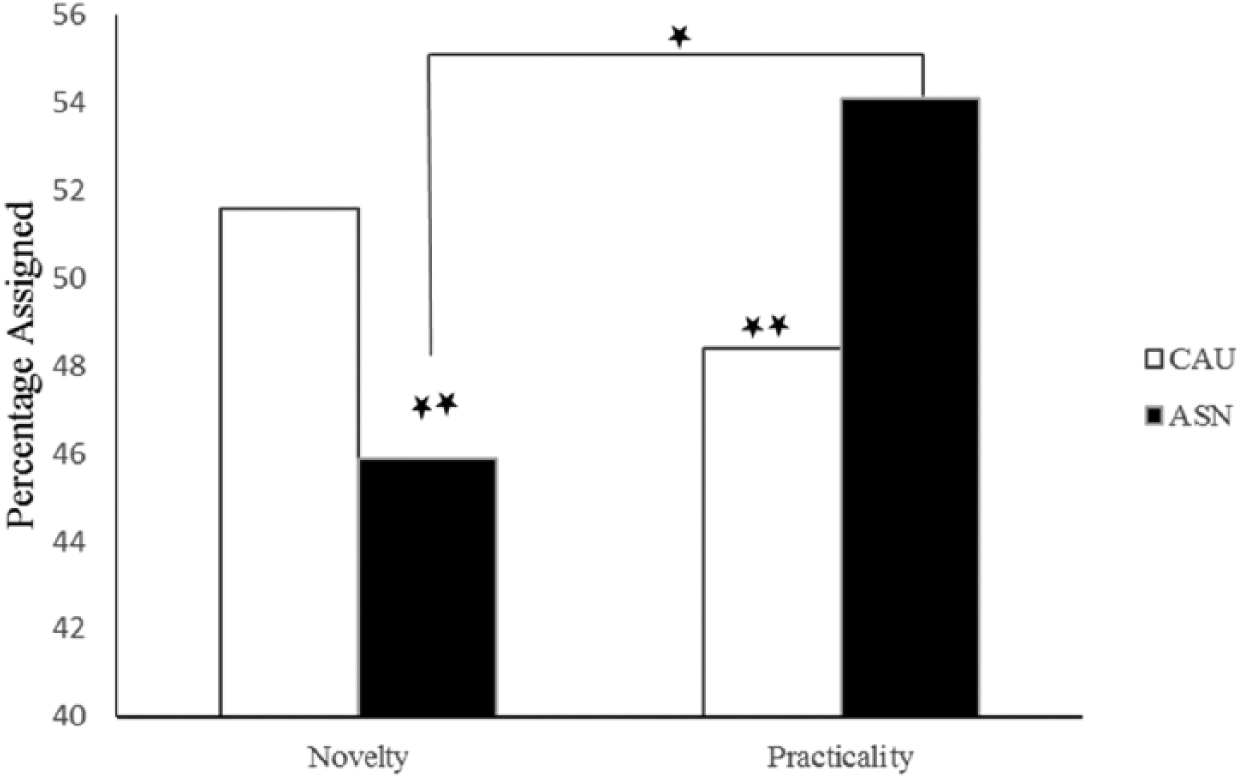
Comparison between Chinese and Caucasian Canadian participants’ distribution of usefulness and novelty toward creativity.
As a robustness check, we also examined our predictions using the Mueller et al. (2012) measure (recall that a lower score means more focus on novelty and a higher score means more focus on usefulness). Chinese participants reported paying significantly greater attention to idea usefulness when evaluating the creative idea (M = 3.25, SD = 0.80), while Caucasian participants reported paying significantly more attention to idea novelty (M = 2.95, SD = 0.80), F(1, 165) = 7.43, p = .007,
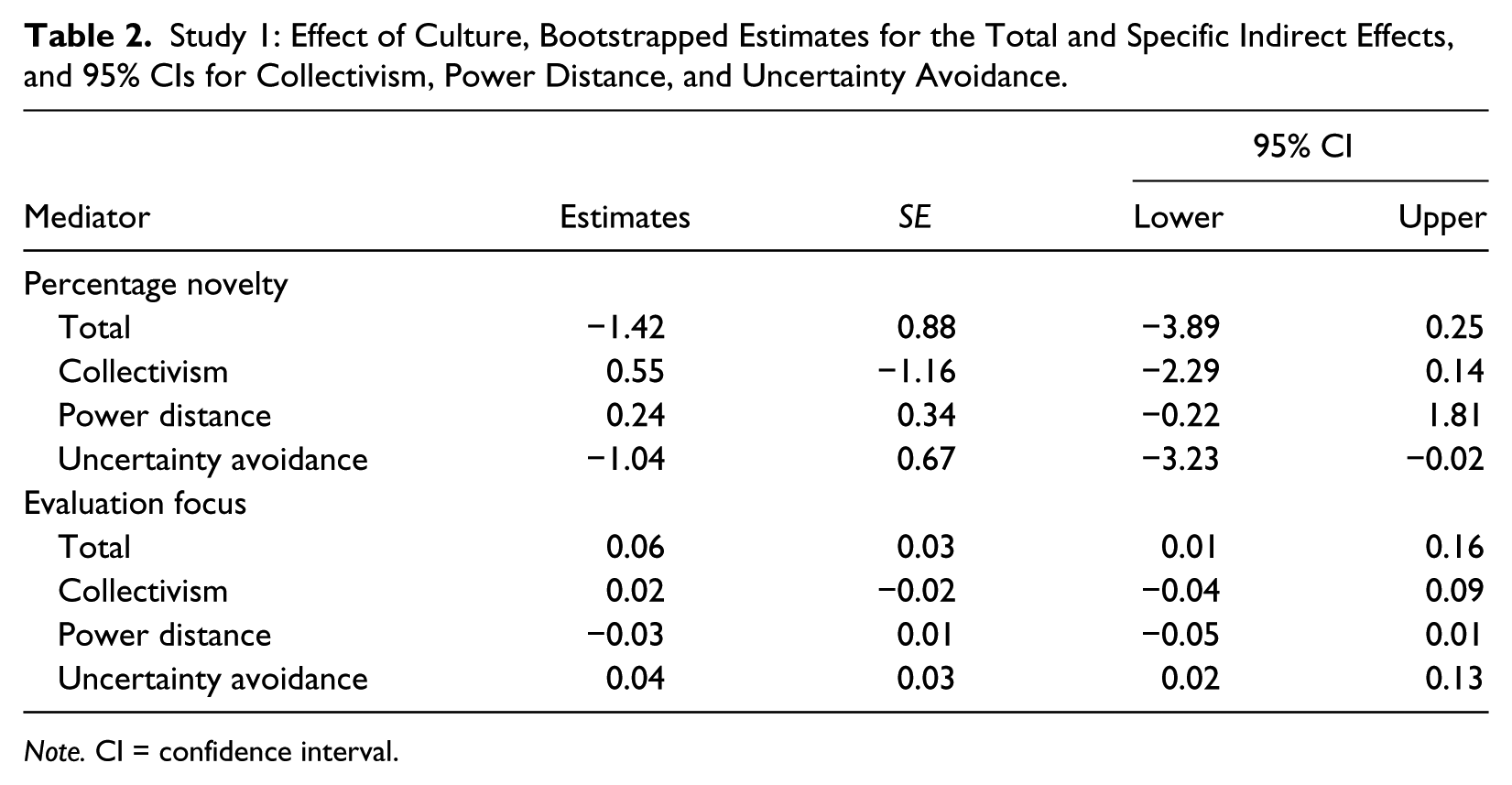
We proposed uncertainty avoidance, but not collectivism or power distance, would mediate the relationship between culture and emphasis on novelty versus usefulness in the conceptualization of creativity. We tested (a) the total indirect effect of culture on preference for novelty through collectivism, power distance, and uncertainty avoidance simultaneously; (b) the specific indirect effect of culture on preference for novelty through collectivism; (c) the specific indirect effect of culture on preference for novelty through power distance; and (d) the specific indirect effect of culture on preference for novelty through uncertainty avoidance. We tested the significance of indirect effects using the Preacher and Hayes (2008) bootstrapping procedure that computes unstandardized indirect effects for each of 5,000 bootstrapped samples, generating 95% confidence intervals.
Results indicate that the relationship between culture and percentage assigned to novelty was mediated by cultural values, with a significant bootstrapped unstandardized indirect effect of −1.04, 95% confidence interval (CI) = [−3.14, −.01]. Table 2 displays the bootstrapped estimates for the total and specific indirect effects and 95% confidence intervals, with coefficients and significance levels presented in the full model in Figure 2. The total direct effect of culture on percentage assigned to novelty was significant. As expected Chinese participants were more uncertainty avoidant than Caucasian Canadian participants (B = 0.29, p = .037), and a higher score on uncertainty avoidance was negatively related to percentage amount assigned to novelty (B = −3.589, p = .032; Figure 2). In addition, results indicate that the direct effects of culture on preference for novelty became nonsignificant (B = − 1.51, p = .128) when controlling for uncertainty avoidance, thus suggesting a full mediation. The specific indirect effects of culture on percentage assigned to novelty through collectivism and power distance were not statistically significant.
Study 1: Effect of Culture, Bootstrapped Estimates for the Total and Specific Indirect Effects, and 95% CIs for Collectivism, Power Distance, and Uncertainty Avoidance.
Note. CI = confidence interval.

Study 1: Estimated multiple mediation model.
We replicated the above findings with a measure of evaluation focus when assessing a creative idea. The specific indirect effect linking culture to evaluation focus on usefulness through uncertainty avoidance was statistically significant with a bootstrapped unstandardized indirect effect of .04, 95% CI = [0.00, 0.15]. As expected, Chinese participants were more uncertainty avoidant than Caucasian Canadian participants (B = .29, p = .037), and uncertainty avoidance was related to focus on usefulness (relative to novelty; B = .15, p = .033). In addition, results indicated that uncertainty avoidance partially mediated the direct effect of culture on evaluation focus (B = .23, p = .037) when controlling for collectivism and power distance. Power distance and collectivism were not significant mediators.
These data support predictions that the cultural value of uncertainty avoidance mediates the effect of culture on the relative weight assigned to novelty versus usefulness when conceptualizing creativity. To bolster evidence for this effect, we conducted a second study examining the effect of culture on percent assigned to novelty through uncertainty avoidance for bicultural Chinese Canadians.
Study 2
People who identify with two distinct cultures, biculturals, vary in the degree to which their identities are blended or separate (Benet-Martínez, Leu, Lee, & Morris, 2002). Bicultural identity integration (BII) measures whether biculturals’ identities are blended or separate (BII-distance) and harmonious or conflicting (BII-conflict). Prior research has found that when primed with either Asian or American cultural cues, East Asian Americans with high BII, meaning their two cultural identities are well-integrated, respond in a manner consistent with the culture prime. However, East Asian Americans with low BII, meaning their two cultural identities are in conflict, respond in a manner opposite to the culture prime (Mok & Morris, 2009). Thus, in a study of creativity, researchers found that East Asian Americans primed with American cues expressed more novel ideas, while those primed with Asian cues expressed fewer novel ideas (Mok & Morris, 2010). This chameleon effect, whereby high BIIs adapt to their cultural environment and low BIIs display contrastive responses, has proven quite stable.
In Study 2, we aim to replicate the effects of Study 1, predicting that Chinese Canadians with high BII will assign a greater percentage weight to novelty, acting in a culturally consistent manner with their surrounding cues: studying in a Canadian University, taking an online survey in English language for credit in an English language Psychology class. We expect Chinese Canadians with low BII to assign a lower percentage weight to novelty, acting in a manner more consistent with their Chinese culture, despite the surrounding Western and English language cues. Furthermore, we expect these effects will be explained through cultural values for uncertainty avoidance.
Method
Procedure
Participants were 72 ethnic Chinese undergraduate students in Canada who completed an online survey in exchange for bonus course credit. The online survey measured demographics, BII, uncertainty avoidance, and the same item used in Study 1 asking, “Using a percentage, how much do you think each aspect below contributes to creativity? (Answers to both questions must total to 100%).” Additional measures collected at the same time for a different study related to multicultural experience and cognitive style.
Participants
All participants self-identified as both Canadian and East Asian, 32% of participants were born in China and had lived in Canada for 10 years or less, 40% of participants were born in Canada and identified Chinese as their first language, and 28% were born in Canada and identified English as their first language. The sample was 56% male, and the average age was 21 (SD = 1.10).
Measures
We used the same measures as in Study 1 for uncertainty avoidance (Jung, 2002, α = .81) and percentage novelty as our criterion measure. We measured BII using Benet-Martinez and colleagues’ (2002) BIIS-1 scale. We computed scales for BII-distance (four items, sample item: “I keep Chinese and Canadian cultures separate”) and BII-conflict (four items, sample item: “I feel caught between the Chinese and Canadian cultures”). Scale items did not load reliably onto the distance subscale (α = .34), so we only used the conflict subscale (α = .86) in our analyses. High BII-conflict indicates low BII as the two cultures are not in harmony.
Analyses and Results
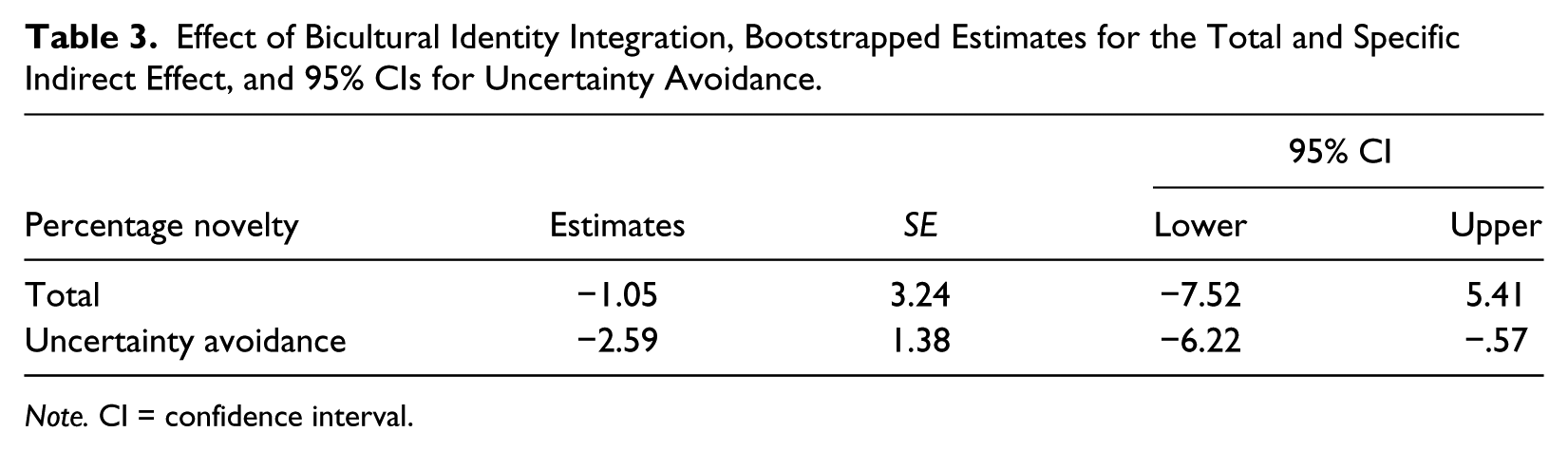
We used the same analytical technique as reported in Study 1. Table 3 displays the bootstrapped estimates for the total and specific indirect effect and 95% confidence intervals. The specific indirect effect of BII-conflict on relative percentage assigned to novelty through uncertainty avoidance was statistically significant with a bootstrapped unstandardized indirect effect of −2.59, 95% CI = [−6.21, −0.57]. As expected, BII-conflict was positively related to uncertainty avoidance (B = .40, p =.005), and uncertainty avoidance was negatively related to percentage assigned to novelty (B = −6.54, p = .021). In addition, results indicated that uncertainty avoidance fully mediated the direct effect of culture on percentage assigned to novelty (B = 1.53, p = .647).
Effect of Bicultural Identity Integration, Bootstrapped Estimates for the Total and Specific Indirect Effect, and 95% CIs for Uncertainty Avoidance.
Note. CI = confidence interval.
General Discussion
Because culture and creativity are both complex constructs, it is no surprise that culture influences creativity through multiple paths. We investigated uncertainty avoidance, a cultural value that tends to be endorsed more strongly in Eastern than Western cultures, as a mediator of the effect of culture on the relative emphasis placed on novelty versus usefulness when conceptualizing creativity and assessing a creative product. While previous research has proposed cultural values as possible explanatory mechanisms for cultural differences in creativity (Erez & Nouri, 2010; Westwood & Low, 2003), ours is the first culture study to empirically test cultural values as mediators.
We simultaneously tested uncertainty avoidance, power distance, and individualism/collectivism in multiple mediation analyses, allowing us to isolate the effect of uncertainty avoidance, which we then replicated in a second study. These findings are consistent with recent research that was not about culture but found that the motivation to reduce uncertainty predicted higher levels of implicit bias against novelty (relative to usefulness) and also interfered with the ability to recognize novel creative ideas (Mueller et al., 2012). Together, this body of research offers solid evidence of uncertainty avoidance as a mechanism explaining emphasis on novelty versus usefulness both as a cultural value and as an individual motivation.
We did not find significant mediation through individualism/collectivism or power distance. While these results may seem surprising at first, given existing evidence that individualism is linked to novel idea generation in studies that do not include culture as a variable (Goncalo & Krause, 2010; Goncalo & Staw, 2006), they can be explained by the role of situation. This past work was in a group setting and several studies have shown that situation can elicit culture-specific norms and activate certain cultural values (Liou & Lan, 2018; Nouri et al., 2015; Nouri et al., 2008). Because our research investigated how individuals conceptualize creativity, the individual nature of our tasks would not have elicited collectivism values, which tend to be activated in group settings, or power distance values, which tend to be activated in leader–follower situations.
By replicating our findings with BII as a predictor in a Chinese Canadian sample, we reinforce our argument that uncertainty avoidance is a mediator related to a cultural account of creativity. East Asians were less likely to emphasize novelty than Caucasian Canadians as were bicultural Chinese Canadians who have conflicted cultural identities versus those who have integrated and compatible cultural identities.
Importantly, our research addresses the conceptualization of creativity rather than creative production. Like Loewenstein and Mueller (2016), we were interested in how culture affects the understanding of creativity. Our research complements the richness and complexity of work on implicit theories of creativity by isolating a cultural value mechanism that may be related to other recently uncovered cues, for example, potential or easy to use, as well as creativity facets, for example, internal versus external creative pursuits (Paletz et al., 2011).
Furthermore, like Mueller et al. (2012), we forced a choice between novelty and usefulness to investigate how culture might affect views on creativity in different stages of creative production. Process models of creativity note the many stages involved in creative production, for example, processes, mechanisms, and structures (Westwood & Low, 2003). Our research suggests culture will likely influence all of these stages, from idea generation and endorsement to production, evaluation, and acceptance, by affecting how individuals conceptualize and perceive creativity throughout the creative process. Using Chiu and Kwan’s (2010) stage model of knowledge creation, low uncertainty avoidant Westerners’ conceptualization of creativity would benefit the authoring stage, while high uncertainty avoidant Easterners’ understanding of creativity is more suited to the selection, editing, marketing, and acceptance stages.
Limitations and Future Directions
The current research uncovered the mediating role of uncertainty avoidance underlying the relationship between culture and the conceptualization of creativity by Chinese and Caucasian Canadians. One limitation with the current study is that uncertainty avoidance was measured rather than manipulated. This limits our ability to infer causality of uncertainty avoidance on creativity. Previous studies have manipulated uncertainty avoidance by telling participants in a “certain” condition that they will receive a certain payment at the end of a study while those in an “uncertain” condition are told their name will be entered into a lottery to determine their payment (Mueller et al., 2012). However, for research examining the effect of culture, it would be best to develop an uncertainty avoidance manipulation based in the cultural value construct. For example, Schwartz’s (1992) individual level value of security includes items such as reciprocation of favors or family security that could be used to devise a psychological manipulation for uncertainty avoidance.
Another limitation is that we sampled undergraduate Chinese students living in Canada. Prior research sampling international Asian students in Canada suggests that due to the intense exposure to North American culture at university, international students’ responses fall somewhere in between those of Caucasian Canadians and mainland Asians (Heine & Hamamura, 2007), suggesting our sample offers a conservative test of our ideas. Nevertheless, we suggest future research should replicate with more representative culture samples (Henrich, Heine, & Norenzayan, 2010).
The present findings should be tempered by the recognition that both culture and creativity are multifaceted and complex constructs. Researchers should investigate the role of cultural values as well as situation in predicting the degree to which Easterners and Westerners access the distinct domain cues, both etic and emic, identified by Loewenstein and Mueller (2016). These authors note that most creativity cues in the narrow theory are related to novelty, with other cues possibly clustering around usefulness and collective benefits as organizing principles that could be investigated. They also note that among novelty-related cues, Americans emphasized “paradigm shift” and “rare” more than Chinese, who emphasized “potential” more than Americans, with still other cues like “breakthrough” and “repurposing” being equally emphasized across both cultures. Such findings may be explained through distinct cultural values. Furthermore, theorists have noted the importance of understanding creativity within a temporal, generational, and evolutionary context (Glăveanu, 2010), suggesting that how Chinese and North Americans understand creativity today in 2017 may be different from 50 years ago or 100 years in the future due to the changing social and economic contexts. If today’s economic climate partly explains Chinese entrepreneurs’ emphasis on usefulness and incremental advances, then we would surely expect different patterns to emerge over time.
Future research may examine cultural value mediators when culturally homogeneous and culturally heterogeneous groups work to conceptualize creativity, generate creative products, or assess creative products. As noted above, we would expect collectivism to be activated in a group setting for East Asians, but the effect of cultural collectivism is uncertain. Westwood and Low (2003) argue that commitment to harmony and group goals in collectivist cultures might temper possible negative effects of group conflict, a view supported by Liang, Adair, and Hideg’s (2014) research on conflict in East Asian versus Caucasian Canadian teams. In other words, if collectivist values promote cohesion and group safety that facilitate sharing revolutionary ideas, high collectivism values in East Asian teams could promote novelty through psychological safety, while in Western teams low collectivism values could promote novelty through greater comfort with individual self-expression and divergent thinking. Our findings also suggest potential synergies for multicultural Chinese and Caucasian Canadian creative teams in which members may be able to use their cultural diversity to reconcile the paradox of creative goals necessitating novel ideas and efficiency goals requiring useful ideas (Miron-Spektor, Gino, & Argote, 2011).
Previous scholars have argued that uncertainty spurs the search for and generation of creative ideas (Audia & Goncalo, 2007), while others have shown that a strong motivation to avoid uncertainty makes people less able to recognize creativity (Mueller et al., 2012). Given the role of both social context (Nouri et al., 2015) and individual creative ability (Goncalo & Duguid, 2012) as moderators of the relationship between culture and creativity, we expect that an uncertain context and values for uncertainty avoidance may also be significant moderators. Values for uncertainty avoidance may be associated with more rigid information processing styles, providing a culture mechanism in the information processing account of creativity (de Dreu, 2010). Research on multicultural experience suggests that it can facilitate novel creative production (Maddux & Galinsky, 2009) and also reduce need for cognitive closure (Tadmor, Hong, Chao, Wiruchnipawan, & Wang, 2012), which like uncertainty avoidance is related to resisting new ideas or experiences in favor of more certain outcomes (Webster & Kruglanski, 1997). Thus, future work should investigate whether multicultural experience promotes creativity through decreasing activation of uncertainty avoidance. Finally, we propose that future work experimentally examines factors that neutralize the influence of cultural values, allowing Caucasian Canadians to more readily recognize the usefulness of ideas and Chinese individuals to focus more on novelty.
Footnotes
Acknowledgements
We would like to acknowledge the invaluable contributions of Culture at Work Lab research assistants: Theresa Chu, Sam Daskaluk, Elizabeth Phillibert, Olivia Rodrigues, and Esmeralda Siddarta.
Declaration of Conflicting Interests
The author(s) declared no potential conflicts of interest with respect to the research, authorship, and/or publication of this article.
Funding
The author(s) disclosed receipt of the following financial support for the research, authorship, and/or publication of this article: This research was supported by funding from the Social Science and Humanities Research Council of Canada.