




Abstract
Many researchers have noted that bereavement is a major stress factor associated with the etiopathogeny of psychological disorders among immigrants, but until now, the grief reactions of these ethnic minorities have not been analyzed. This study aims to examine the impact of the migration trajectory (immigration status and duration) as well as the use of ritual support to cope with grief reactions in the context of migration. Fifty-four migrants and 20 refugees (N = 74) in France and Belgium were surveyed regarding their experience of mourning a family member. The results showed that complicated grief is associated with the status and duration of immigration. A majority of refugees reported a deterioration of their social life when the duration of their immigration exceeded 10 years. Feeling guilty, dazed or stunned, loneliness, bitterness, numbness, and emptiness made up the spectrum of severe and persistent guilt reactions. Those who took part in bereavement rituals suffered less from feelings of guilt and despondency. Eldest siblings presented a very high rate of complicated grief. These findings were discussed using a psycho-cultural approach; they demonstrated that in the context of migration, grief reactions develop around the principle of debt, based on the parent–child relationship inextricably associated with a feeling of belonging to the ethnic group and collective memory.
Keywords
Introduction
This article proposes to analyze complicated grief (CG) reactions in the context of migration. Bereavement after the death of a loved one is a difficult life event (Bonanno, 2004; Holmes & Rahe, 1967; Rando, 1993) that may often have a severe physical and psychosocial impact (Glass, 2005; Parkes, 2006; Prigerson et al., 2002). A growing body of research has documented the phenomenon of acute grief, known as “complicated grief” (Prigerson et al., 2002; Prigerson et al., 1995). More recently, the temporary inclusion of a new nosographic category, “Persistent Complex Bereavement Disorder,” in the Diagnostic and Statistical Manual of Mental Disorders (5th ed., DSM-5) published by the American Psychiatric Association (APA, 2013) testifies to the psycho-pathogenic burden of grief (Boelen & Prigerson, 2012). In the context of migration, bereavement is more likely to produce potentially traumatic effects. A considerable number of epidemiological or clinical studies indicated that grief is one of the factors associated with the etiopathogeny of psychological disorders among immigrants (e.g., Carta, Bernal, Hardoy, Haro-Abad, & the “Report on the Mental Health in Europe” working group, 2005; Fenta, Hyman, & Noh, 2004; Khawaja & Mason, 2008). However, although there is abundant literature on the subject of bereavement as well as on immigration, little specific research has been done on grief caused by the death of a loved one in the context of migration (Panagiotopoulosa, Walkera, & Luszczb, 2013; Rachédi, Le Gall, & et Leduc, 2010).
The present study targeted Togo immigrants in Europe (France and Belgium). Togo is a French-speaking country of West Africa, with a population of 6.8 million. Approximately one third of the population lives in the diaspora, the majority in Europe, the United States, and Canada. Historically, Togo has experienced three contexts of sociopolitical violence that gave rise to successive waves of exiles. The first exiles, spurred by interethnic and political persecution, took place in the aftermath of national independence in 1960. The second wave of exiles occurred in the early 1990s, under the influence of democratization movements. The most recent wave of exiles dates from 2005, following the presidential elections that were violently punctuated by a considerable loss of human life (Truth, Justice and Reconciliation Commission, 2012). It is reasonable to assume that the circumstances of immigration and whether it was undertaken by choice or necessity (notably in the case of exile) account for the specific experience of migration and grief. In particular, the trajectory of refugees appears to be more marked by the accumulation of violent losses and compounded traumatisms suffered in the context of their exile. With reference to the literature, the study by Craig, Sossou, Schnak, and Essex (2008) reported a prevalence of 66% for posttraumatic stress disorder and 54% for CG among Bosnian refugees after their resettlement in the United States. The authors discussed this higher prevalence of CG by pointing out the disruption of the extended family and peer networks that end up scattered around the world and the inability to express one’s grief in a cultural context. The findings of the study by Hinton et al. (2013b), which focused on complicated bereavement among Cambodian refugees, followed the same perspective. The refugees who have difficulties in the grief and mourning process deplored the lack of ritual practices to make sense of the loss of their beloveds. In the background, these studies imply that the migration experience sometimes profoundly alters relationships with cultural and religious traditions in the country of origin, the “space” that constitutes one’s social and cultural identity (Nathan, 1986). In this context of unraveling socioaffective and symbolic ties, the loss of a loved one “over there” or “here” in the host land undoubtedly has strong psychological resonance, which can a priori lead to acute and prolonged grief reactions. In addition, such grief for a parent or close family member may, by association, reactivate the memory traces of symbolic losses linked to the migration experience. 1 From this point of view, the study by Mazzucato, Kabki, and Smith (2006) is enlightening in a number of respects. In this sociological study of Ghanaian migrants in the Netherlands, these authors emphasized that bereavement following the loss of a parent who died in the person’s country of origin was felt to be a tragedy and experienced with apprehension and concern. These immigrants are often the first to be informed of the death due to the responsibilities that it places upon them. Those who cannot participate in the funeral ceremonies in their country of origin organize “makeshift rituals” in an effort to alleviate their grief. These renegotiated rituals include, in particular, a mini-wake without the body of the deceased parent, punctuated by prayers and religious songs for the rest of the deceased. However, for Africans, these wakes without the body of the deceased are not always sufficient to enable the necessary separation from the dead. The ritual practices demonstrate that the systems for the representation of death and what comes after death vary from one social or ethnic group to another (Bonanno & Kaltman, 2001; Eisenbruch, 1984a, 1984b; Lobar, Youngblut, & Brooten, 2006; Robben, 2004; Rosenblatt, 1993, 2008). The intercultural variations can be summed up in Thomas’s (1985) statement: “Biological death, which is a fact of nature, is constantly surpassed by the cultural fact of death” (p. 11). In France, studies have shown that in African communities, when a death occurs in the host country, a rite is performed to repatriate the body or the remains to the land of the ancestors, the Fatherland. Repatriating the body or the remains of the deceased and participating in bereavement rituals are imperative duties of fidelity to the collective memory and to assert one’s cultural identity (Aggoun, 2006; Chaïb, 2006; Thomas, 1985). In every instance, these practices convey the need to engage in bereavement rituals to symbolically mitigate the anguish of death and express a final farewell to the deceased. This is especially true among Africans, for whom the social and collective nature of bereavement is extremely important. Bereavement rituals are a complex, institutionalized device for the purpose of containing and regulating anxiety about death and the suffering of bereavement.
The presence of the children, grandchildren, widows, and close friends of the deceased is a duty of memory prescribed by tradition during funeral rituals. There is a saying in Togo: “It is the child who buries the parents.” Considerable family and social pressure is put on individuals to fulfill this duty of memory. Usually, the purchase of the coffin and the funeral procession for the deceased are ensured by the sons and grandsons, respectively, and both carry symbolic weight. Widows and widowers, sons and grandsons are the primary bereaved, supported next by the community, who prepare the journey of the deceased from the world of human beings to the world of the ancestors. These symbolic behaviors, coupled with blessings according to one’s beliefs, transcend family piety and express a social contract with the collective memory of the community; a breach of this contract can give rise to pathologies against a backdrop of cultural and identity conflict (Kokou-Kpolou, Moukouta, Mbassa, & Menick, 2016).
The above description raises a fundamental research question about grief for a loved one in the context of migration that has been skimmed over or seldom discussed in the literature (Rachédi et al., 2010). Furthermore, specific literature on this issue focused on African immigrants is less abundant. Thus, this study has a twofold objective. First, this study aims to describe CG reactions in the context of migration according to the migration trajectory (immigration status, duration of immigration). Logically, bereavement would, thus, be experienced differently depending on whether the individual is a migrant or a refugee. Second, the study aims to assess the effect of ritual support on CG reactions and the outcome of bereavement. This second aim seems particularly relevant, as we have just noted the need or tendency of immigrants from collectivist-oriented culture to engage in rituals to help alleviate their grief (Hinton, Peou, Joshi, Nickerson, & Simon, 2013; Petit, 2005). We should bear in mind that the question of the psychological benefits of bereavement rituals has been widely debated in the literature. The results of empirical studies carried out on this topic, especially in the 1970s and the 1990s, are divergent (e.g., Bolton & Camp, 1987; Euster, 1991; Thomas, 1985). The present study has the advantage of exploring this question in the context of the immigration of African participants who continue to value an attachment to rituals in modern Africa (De Rosny, 1996) or even among African Americans (Collins & Doolittle, 2006; Laurie & Neimeyer, 2008; Romanoff & Terenzio, 1998).
Method
Participants and Procedure
The period from July to November 2015 was devoted to distributing the questionnaires and collecting the data. In all, 82 questionnaires were filled out and collected. Of these, eight were excluded because of significant missing data. The study, therefore, included 74 immigrants (N = 74, 90.2%). Among the respondents, 62.2% were men and 37.8% were women, with a mean age of 37.12 years (SD = 11.03 years). The participants were recruited through three Togolese associations, two in France (n = 48) and one in Belgium (n = 26). The following selection criteria were applied. First, the death had to concern a parent or a close relative because it is this type of grief that mainly demands ritual involvement (Eisenbruch, 1984b). Then, the death had to predate the study by at least 6 months (Prigerson et al., 2002; Prigerson et al., 1995). 2 Next, the participants had to be born in Togo (first-generation immigrants). In addition, they had to have been residing in their new country for at least 12 months. Finally, informed consent was required to take part in the study.
Ethics
Prior to data collection, ethical approval for the study was obtained from the University of Picardie Jules Verne Social Sciences Human Research Ethics Committee. Following this, we sent a letter to the presidents of the three associations explaining the aim and interest of the study. Approvals were sought to distribute the questionnaire. The association members who volunteered and met the aforementioned selection criteria made up the sample of this study. The participants could withdraw their participation at any moment of discomfort. They could seek the authors’ advice through email if needed.
Measures
The participants filled out a questionnaire divided into four sections.
Sociodemographic Questionnaire
This section included the sex, age, position among the siblings in the family (the eldest sibling, from the second to the second-to-the-last sibling, the youngest sibling), religious affiliation, and matrimonial situation. The position within the family’s siblings carries special cultural significance in many African traditions. The role of burying the deceased parent and subsequently heading the family is incumbent upon the eldest son, whose position and assigned duties predispose him to psychopathological vulnerability described by the concept of “eldest-son syndrome” (Boucebci, 1994).
Information on immigration
The participants had to indicate their immigration status upon arrival, the primary motive for immigrating (study, family reunification, political refugee, war refugee), the length of immigration, and the host country.
Death and ritual information
First, participants were asked to indicate the nature of their kinship relationship with the deceased person (father, mother, grandfather, grandmother, aunt, uncle, brother, sister), type of death (2 = expected death, 1 = unexpected death), and the length of bereavement (they were requested to report the date that this loss occurred). Second, they were asked about funeral rites (place of death, place of funeral ceremonies, repatriation of the body or the remains of the deceased in the event the death occurred in the country of immigration, participation or nonparticipation in rituals, reasons for nonparticipation).
Inventory of Complicated Grief (ICG)–17 items
The ICG is an instrument developed by Prigerson and his colleagues to assess grief reactions and determine their complications. To date, there are several versions of this tool: The initial version made up of 19 items (Prigerson et al., 1995), a second version with 34 items, and a third version with 17 items. The latest version has been validated in France (Gana, Lesquoy, Pariset, de Tychey, & et Bacqué, 2004; K’Delant, 2010). This instrument measures a single construct underlying CG (Boelen & Hoijtink, 2009). The participants respond to each item on a Likert-type scale (0 = almost never to 4 = always, or 0 = no feeling of bitterness to 4 = an enormous feeling of bitterness, etc.). One item indicates the degree of disturbance of psychosocial functioning. In this study, this instrument yielded solid levels of internal consistency (Cronbach’s α = .84). The KMO index was .78, with a significant Bartlett test of Sphericity, χ2(df = 136) = 439.68, p < .0001, explaining 48.10% of the total variance. Furthermore, in addition to the items included in this inventory, we have included two questions whose relevance was revealed by the preliminary survey: The first one assesses the presence of guilt feelings relative to the context of the death on a Likert-type scale (0 = almost never to 4 = always); the second, which is open-ended, inquires about the reasons for possible guilt.
Data Analysis
The collected data were processed using the SPSS 21 software program. First, the descriptive statistics pertaining to sociodemographic and factual variables were obtained. How these variables influence CG was evaluated using ANOVA. Next, based on a comparison of the averages (t test) of the values obtained for each item, one-way ANOVA was used to determine how the CG reactions of immigrants differed from those of refugees. Moreover, ANCOVA was computed to examine the effect of the status and duration of immigration on the CG reactions. To presume the presence of CG, the total score on ICG-17 items must be higher than or equal to 31 and the grief reactions must persist for more than 6 months (Dassa, Soedje, Kokou-Kpolou, & et Gaba Dovi, 2012; K’Delant, 2010). The qualitative data obtained from the open-ended question regarding guilt feelings were subjected to content analysis using the Bardin (2003) logico-semantic method. Finally, we performed a hierarchical regression analysis to determine the predictors of CG.
Findings
Sample Characteristics
The mean age of the migrants and refugees was 33.87 years (SD = 10.01) and 45.9 years (SD = 8.73), respectively. According to the sibling’s position, 15 (20.3%) were eldest siblings, including 12 men. Upon their arrival in France or in Belgium, 73% had migrant status (students, family reunification) and 27% had refugee status (war refugee, political refugee). There are more refugee eldest siblings than migrant eldest siblings (n = 9/15, 60%). The mean duration of immigration was 11.47 years (SD = 7.82 years): 43.2% had been away from their country of origin for less than 10 years and 56.8% for more than 10 years. For migrants, the mean duration was 9.71 years (SD = 7.13), and for refugees, it was 16.75 years (SD = 7.26). With regard to the level of education, 45.9% were university graduates and 54.1% were high school graduates; 66.2% had a professional activity (full- or part-time) compared with 33.8% who did not. In terms of marital status, 58.1% were single and 41.9% were living in a couple (married or not). As for religious affiliation, 66.2% were Christians (55.4% were Catholics or Protestants vs. 10.2% new Christian denominations), 12.2% were Muslims, and 21.6% were followers of traditional religion.
CG Related to Sociodemographic Variables, Migratory Trajectory and Caracteristics of the Loss
The relationship between CG reactions and sociodemographic factors
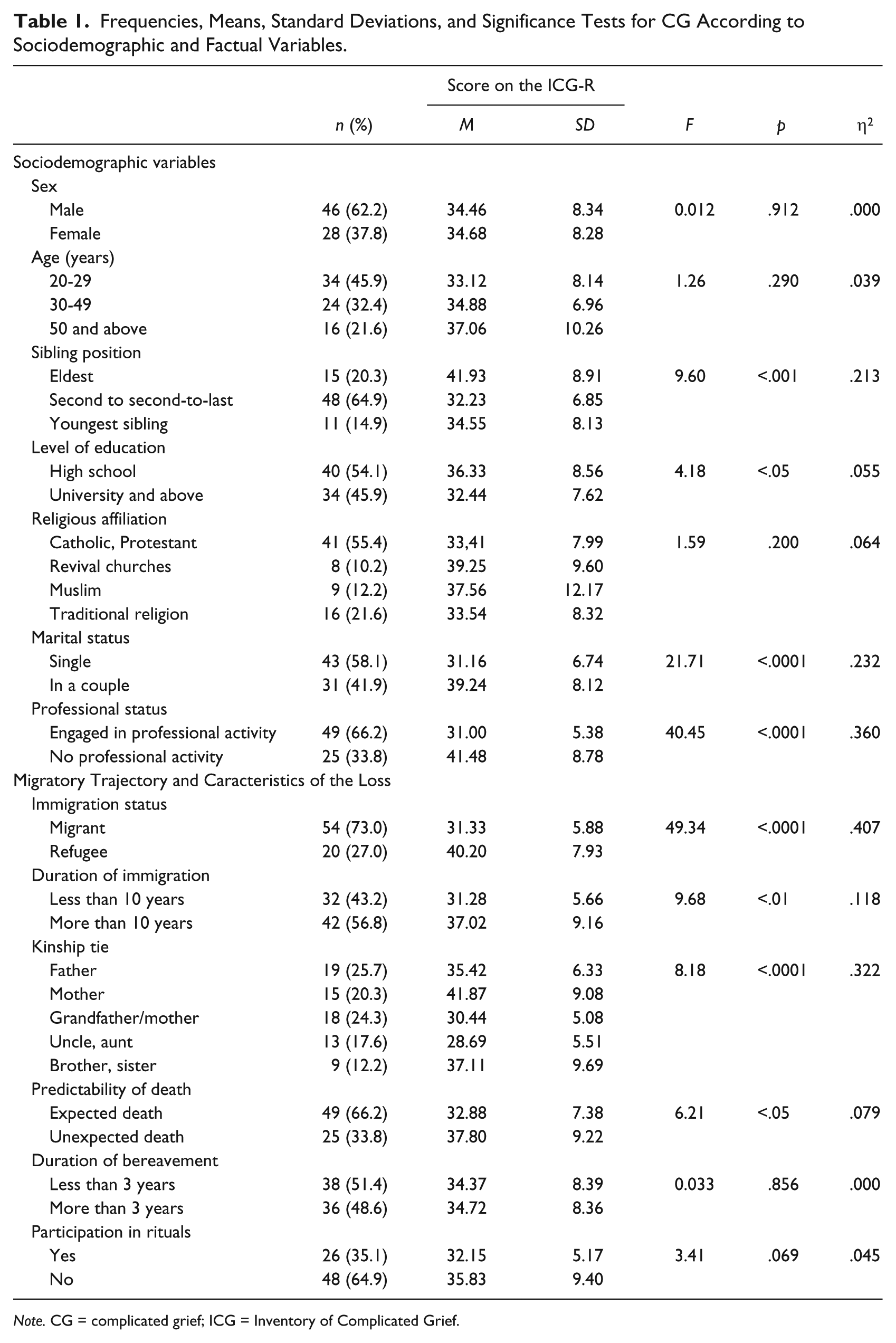
The findings highlighted in Table 1 show that CG was not significantly associated with the gender, age, or religious affiliation of the bereaved individual. However, it was significantly associated with sibling position. Indeed, the eldest siblings had a very high CG score, followed by the youngest siblings. CG was positively associated with the level of education: Immigrants who were university graduates presented less CG than those who were high school graduates. The connection between CG and employment status proved to be extremely positive, as well as that between CG and the individual’s marital situation. Immigrants living in a couple had higher ICG scores than those who were living alone.
Frequencies, Means, Standard Deviations, and Significance Tests for CG According to Sociodemographic and Factual Variables.
Note. CG = complicated grief; ICG = Inventory of Complicated Grief.
Impact of the migratory trajectory on CG reactions
The findings in Table 1 also show that CG is significantly associated with immigration status. For the most part, refugees had more grief complications than migrants. The duration of immigration was also significantly associated with CG: The longer the duration of immigration, the more intense were the grief reactions.
The simultaneous relationship of immigration status and duration to CG, computed using ANCOVA, was shown to be extremely positive (adjusted R2 = .45, F = 31.09, p < .0001, η2 = .46). Table 2 presents the results of the both effect of the status and then of the interaction effect of status and duration of immigration on bereavement reactions. The results reveal a highly significant relationship between both effect and feelings of bitterness, despondency, emptiness, cognitive avoidance, difficulty in accepting the death, deterioration of socioprofessional life, and persistent grief reactions for more than 6 months. The majority of refugees (60% vs. 12.9% of migrants) reported functional disorder or deterioration of their social life, above all when the duration of immigration was greater than 10 years.
Differentiation of CG Reactions Between Immigrants and Refugees, and According to the Duration of Immigration.

Note. CG = complicated grief; ICG = Inventory of Complicated Grief.
Item added without being included in the ICG-17 items.
p < .05. **p < .01. ***p < .001.
Impact of the kinship tie, the type of death, and involvement in rituals on CG reactions
CG was significantly associated with the immigrant’s kinship tie to the decreased CG. The loss of the mother caused more grief complications than that of the father, brothers or sisters or grandparents, aunts, and uncles. A significant relationship was also noted between the predictability of the death and CG. Deaths expected in old age or after a long illness or chronic disease caused fewer grief complications than those that were unexpected.
We observed that the relationship between participation in rituals and CG tended to be significant. Bereaved immigrants who took part in bereavement rituals had lower ICG scores than those who did not participate. After controlling the covariate effect of the duration of bereavement, it appears that taking part in rituals had a significant effect on three CG symptoms, namely, guilt feelings (adjusted R2 = .17, F = 8.43, p < .001, η2 = .19), emptiness (adjusted R2 = .07, F = 3.77, p < .05, η2 = .09), and despondency (adjusted R2 = .05, F = 3.15, p < .05, η2 = .08). In other words, the intensity of these symptoms more significantly decreased with the time among those who had participated in bereavement rituals.
Reasons for nonparticipation in bereavement and funeral rituals
Overall, 64.9% of bereaved immigrants versus 35.1% did not take part in bereavement rituals. It should be noted that in 59.5% of cases, the death occurred in the native country (Togo), and in 35.1% of cases, it occurred in the host country (France or Belgium). Two of the deaths occurred in the United States and two others in Ghana and the Ivory Coast. In the cases where the death occurred abroad (30 cases), 73.3% (n = 22) of the funeral rituals took place there. In such cases, 54.5% (n = 12/22) of the immigrants transferred the deceased’s remains to the country of origin. In eight cases, the body of the deceased was repatriated. With regard to the participation, only three eldest siblings of the 15 were able to take part in the funeral rituals for their parent. In cases where the death took place in the native country, administrative red tape and/or financial problems were the main reasons invoked to justify not participating in the bereavement rituals. These verbatim responses express the tenor of the comments: “Our financial situation was very precarious. My husband didn’t have a job. I didn’t either. So I couldn’t go back to my home country. I had to go into debt to pay for my mother’s coffin” (female, migrant, age 38); “I was an illegal immigrant, so I couldn’t leave the country” (male, refugee, age 53). We also noted that many refugees, especially political refugees, are haunted by feelings of insecurity about returning to their home countries: “My life will be in danger if I go back. They might try and arrest me” (male, political refugee, age 49); “As long as the same regime is in power, I cannot possibly go home. I would be risking my life” (female, political refugee, age 37).
Prevalence of CG
On average, the time since the loss was 47.01 months (SD = 34.76 months). At a cutoff score of ≥31, with the persistence of grief reactions for more than 6 months, 41.9% of the immigrants in our sample participants met the criteria for a diagnosis of CG. The mean score on the ICG was 34.58 (SD = 8.31). Unsurprisingly, Table 2 shows that there was a significant difference between the migrant group and the refugee group with regard to the feeling of emptiness, avoidance of reminders of the deceased, difficulty accepting the death of a parent, deterioration of socioprofessional life, a feeling of bitterness, and the continuation of these symptoms for a period of more than 6 months.
Regression Analysis
We performed a multiple hierarchical regression analysis to determine the variables that predict CG (Table 3). Three blocks of variables were created and introduced into the model. The first block included gender, age, sibling position (recoded 2= eldest, 1 = others), professional status, and marital status. The first block showed itself to be extremely significant (notably the contribution of socioprofessional status). The second block included immigration status and the duration of immigration and was also significant. This means that these two main variables of migratory trajectory are predictors of CG in the context of migration. The third block comprised kinship ties (grouped and ranked in decreasing order of grief severity according to the kinship tie—cf. Table 1; 2 = father, mother, brother, and sister; 1 = grandparent, uncle, and aunt), the type of death (2 = expected death, 1 = unexpected death), the duration of grief, and participation in rituals (dichotomized, 2 = did participate, 1 = did not participate). This last group was statistically significant. In particular, participation in rituals alleviates the grief reactions. The overall model was significantly associated with CG, predicting 67.6% of the CG variance in immigration.
Hierarchical Regression Analysis for Variables Predicting Complicated Grief in an Immigration Context.

Discussion
Bereavement is inseparably a psychological reaction and a process embedded in complex cultural representations. In migration situations, the lack of external adaptive resources such as social and ritual support can have a disruptive impact on bereaved immigrants. Thus, we adopted the cross-cultural approach in discussing the results yielded by the present study.
Severity of Bereavement and CG Reactions in the Context of Migration
The first aim of the current study was to describe CG reactions among Togolese immigrants in Europe according to their migratory trajectory (immigration status, duration of immigration). In this study, the prevalence of CG was 41.9%. It proved to be higher than the estimated rate among the general population, which varies between 10% and 20% (Prigerson et al., 2002; Shear, Zuckoff, & Frank, 2011) and 25.4% according to the study by Newson, Boelen, Hek, Hofman, and Tiemeier (2011). Logically, it is close to the figure of 54% found by Craig et al. (2008) in a sample of 126 Bosnian refugees suffering from posttraumatic stress disorder. In their study, the type of tie with the deceased person was not highlighted. In the present study, a parent–child relationship was selected as the criterion for participation in the study. Only “the death of a parent has immediate social consequences, since the bereaved must assume a set of social obligations as prescribed by his ethnic group” (Eisenbruch, 1984b, p. 325), which partly explains the severity of CG symptoms. Memories linked to the deceased are so invasive that the immigrants adopt a strategy of avoidance. From this analytic perspective, our findings are in line with the results of Hinton et al. (2013). In their study, grief among Cambodian refugees reached a worrying degree of intensity. During the last month prior to the survey, 76% of the patients had experienced a painful reminder related to the deceased. The severity of this painful memory of the dead was strongly associated with PTSD severity. The authors explain this result by the cultural perceptions that the bereaved had a “bad death” 3 and the consequences of failing to perform the proper bereavement rituals. We should note, however, that their study sample was made up exclusively of Cambodian patients who had experienced trauma linked to genocide. This is not exactly the case in our study in which the sample comprised more migrants than refugees.
The type of relationship to the deceased is a determining factor for understanding the reactions of identification with the deceased. In this study, grief reactions develop essentially around the kinship tie (and indirectly the parent–child relationship). According to attachment theory, the parent–child relationship is the primary major bond upon which our basic feelings of security are built (Bowlby, 1969, 1980, 1988). The sudden loss of the attachment figure through death could destroy an individual’s basic feelings and indirectly bring about acute grief reactions. From this perspective, the sudden or unexpected death of a parent will adversely affect the process of working through grief, which is likely to become complicated, contrary to expected deaths, which are often anticipated by immigrants. Moreover, a sudden or brutal death in Africa is embedded in the collective imagination as a “bad death,” associated with the idea of a curse, a punishment by the spirits of the ancestors, or the vengeance of the gods or wrathful spirits. In most cases, the death of a parent is a painful experience, so much so that approximately one third of our participants declared that their social life had deteriorated as a result. This finding suggests a backdrop of disturbed psychosocial adaptation, particularly among the refugees, when the duration of immigration exceeded 10 years. This finding concurs with one of the results of the Tousignant (1992) study. The author reports that, for immigrants, the 10th year marks the threshold for the period of recurrence of migration-related traumatisms that had been latent until then. A current major life event that proves difficult to integrate can trigger psychological decompensation, especially as the prospect of returning to the fold to be reconciled with the center of ancestrality is not within reach.
Our study showed that immigrants living in a couple suffer more frequently from CG. This result seems surprising, as CG within the bereaved population—apart from marital and perinatal bereavement—is less often associated with marital status (Fujisawa et al., 2010; Newson et al., 2011). In all likelihood, current parenthood reactivates the feeling of being indebted to one’s own parents. This is a cultural aspect that should be taken into consideration. Indeed, living in a couple implies a sense of responsibility associated with providing assistance to one’s parents and burying them in a dignified way. These roles are first and foremost incumbent upon the eldest son. Eldest sons are especially affected by bereavement because in collective representations, they are the potential successors called to take over in the event of the parents’ death. The weight of their hierarchy and their roles in the family saga and their existential and biographical trajectory constitute a high risk of psychopathological vulnerability (Boucebci, 1994). In Africa, according to Bougoul Badji (1986), the eldest son has a strange destiny, given the enormous expectations placed on him; either he becomes a man (by succeeding in fulfilling his destiny) or he goes mad (by failing to fulfill it). Indeed, the physical absence of eldest sons at funeral ceremonies (n = 12/15 of eldest sons did not take part in the rituals), even if they paid for all or part of the funeral organization, is often experienced by those siblings themselves as a failure and by their families as irresponsibility toward the clan. A recent study by Moukouta, Mbassa Menick, Masson, and Bernoussi (2016) supports this view. Using one of the two cases on which their study is based, the authors show how a “depressed” patient, the eldest sibling in his family and a political refugee in France, experienced his absence at his mother’s funeral in Congo as a failure of his responsibilities. In his mind, his absence was unforgiveable, both for his family and for his ancestors, because he had failed to live up to the group’s expectations. He felt guilty for not meeting his obligations as the eldest sibling and saw his illness as the consequence of a punishment inflicted by his ancestors and of symbolic exclusion from his ethnic group. In our study, nine of the 15 eldest siblings were refugees who fled political persecution in Togo in circumstances of insecurity and vital urgency. They left their country, sometimes without any farewell ritual as a blessing. Furthermore, refugees experience greater difficulty in achieving social and professional integration than migrants.
In the three models predictive of CG, professional status appears to be a highly significant factor. In migration, it is an extremely important indicator of social integration. From a psychosocial standpoint, professional activity is a factor that protects individuals against stress. It allows immigrants to provide material and financial support to parents in the country of origin. Immigrants who have trouble integrating in the host country for administrative reasons or a lack of financial resources and who cannot go back for the funeral of the deceased feel very intense grief (Mazzucato et al., 2006). These findings highlight the weight of socioeconomic conditions on grief reactions in a context of migration. When a parent dies in the country of origin, which happens most often, the reasons given for not participating in the funeral are socioeconomic or administrative (in the case of “undocumented immigrants”). The impossibility of returning exacerbates the feeling of despondency generated by the loss of a loved one. We would also note the prominence of feelings of loneliness and nostalgia, which seem to denote, by association, the consolidation of memory traces of the migration experience (Grinberg & Grinberg, 1984). Episodic memory, often linked to a painful migration experience, is surreptitiously trapped and reactivated by the death of one’s parent, when one is the heir in the full sense of the term through a parent–child relationship (blood ties).
The Roles of Rituals in the Bereavement Process
The study also aims to assess the effects of ritual support on CG reactions in the context of migration. In Africa, bereavement is first and foremost a matter of community and social ties. It is, therefore, social above all. Social mourning, characterized by rituals, is of paramount importance in the psychological economy of bereaved individuals. In the context of migration, due to the lack of ritual and social support, the bereavement process becomes frozen, marked by a shock that embeds the grief in a lasting way. The lack of available ritual support due to the prohibitions on many cultural practices creates difficulties in the mourning process. In the same way, the impossibility of returning home exacerbates feelings of bitterness and guilt rooted in a principle of debt to the community, a fee owed to one’s parents (Marie, 1997). According to Eisenbruch (1984b), the surge of guilt is linked to the inability or impossibility of fulfilling the expectations of the deceased, for example, providing enough financial assistance to one’s parent before his or her death. This guilt is sometimes followed by attempts at symbolic or real compensation: financial investment in the funeral (paying for the coffin, even if it means going into debt), conveying a posteriori the need to assert one’s ties to one’s ethnic group of belonging (Mazzucato et al., 2006). In short, grief reactions develop around the parent–child relationship, which is itself part of an underlying collective memory. In turn, bereavement rituals are, therefore, inscribed in this collective memory and draw their symbolic power from it. The use of rituals is a way of deflecting the threat to the feeling of intergenerational continuity, inasmuch as they tend, by their function, to ensure the social or ethnic group’s cohesion against any disruptive threat, such as the death of a member.
Our study has demonstrated statistically the psychological benefits of bereavement rituals on the process of adapting to the loss of a loved one. Following the work of Thomas (1985), our findings show that, from the standpoint of the imaginary, taking part in bereavement rituals is an act that fulfills a crucial function of absolution, expiating guilt feelings. In general, the use of the prescribed ritual and social support offered by the ethnic group relieves the grief, at least partially (Eisenbruch, 1984b; Thomas, 1985). By providing an outlet or a space to express and regulate emotions, bereavement rituals, along with the religious beliefs they set in motion, release the pain of loss (Becker et al., 2007). In this study, participation in rituals had an active effect on the cognitive and socioaffective processes related to bereavement. With regard to cognitive processes, taking part in rituals helped to defuse the traumatic burden of shock and promote the acceptance of the loss. Seeing the body of the deceased and saying one’s final farewell are ritual acts that relieve anguish and set in motion the symbolizing and mentalizing processes that are indispensable for the acceptance of loss. As for socioaffective processes, bereavement rituals form a transitional space for group catharsis ruled by feelings of despondency and ambivalence toward the deceased, which demands the medium of the body. Funerals in sub-Saharan Africa are mixed with celebration, asserting an eschatological belief in the rebirth of the deceased in another life cycle (Barrett & Heller, 2004). In addition, the rituals offer a place to renew and strengthen family and social ties through various forms of shared testimonies of support. There is ample literature on the crucial role played by social support in adapting to the loss of a loved one (e.g., Dowd, Poole, Davidhizar, & Giger, 1998; Li & Chen, 2016). It should be noted, however, that the sources of this social support vary according to the culture. Thus, Li and Chen (2016) have shown that, in the Chinese cultural context, apart from sacred books, family and friends are the main sources of social support. In the African context, the involvement of the family and the ethnic group in the bereavement process of one of its members has already been demonstrated (Boulware & Bui, 2016). The latter often intervene to protect the bereaved against the anguish of loneliness and isolation. In every way, bereavement rituals are defenses that protect, from a cognitive standpoint, against the discursive effects of loss (avoiding memories relating to the deceased, the impression that the future no longer has meaning). Their function of symbolic and praxis-oriented efficacy to “give meaning” and “cope” indeed seems to be borne out by immigrants who were able to take part in funerals. Thus, according to Thomas (1985), bereavement rituals provide “individual and collective therapy for the anguish of death” (p. 128). On this point, our findings are in line with research work indicating the countless therapeutic virtues of bereavement rituals (e.g., Imber-Black, 1991; Romanoff & Terenzio, 1998; Thomas, 1985, 2003).
What happens when migrants are unable to return to their country of origin for these rituals, or when the death occurs in the country of immigration? How are the rituals negotiated to mitigate grief? In our sample, it turns out that few immigrants repatriated the remains when the death took place in the country of immigration. Nevertheless, the present study has not explored in depth this choice of burial, although some elements in the literature offer possible answers. Indeed, the posthumous transfer of the body of the deceased is seen as extremely costly by immigrants, and it also engenders administrative worries (Mazzucato et al., 2006; Petit, 2005). At the same time, immigrants refuse the choice of cremation, which they consider incompatible with the principles of ancestralization. Consequently, they opt for rituals that reflect both cultures out of the desire to comply with the demands of the host country and the systems of representation and collective beliefs of the country of origin. Petit (2005) expressed our position masterfully when he says that burial in the host country helps the immigrant to put down roots in the territory of immigration, whereas the choice to transfer the remains of the deceased to continue the ancestralizing rites testifies to very strong symbolic ties to the country of origin. Beyond this identity-affirming function, the use of rituals—even when they are renegotiated—by bereaved African immigrants meets a need to mitigate their grief symbolically (Collins & Doolittle, 2006). As the study by Hinton et al. (2013) also noted, Cambodian refugees felt the need for rituals to begin and work through the grieving process. The lack of available or adequate sociocultural resources to channel grief is generally a source of anguish and depressive emotions characteristic of CG.
Limits and Implications of the Study
It is important to keep in mind that the present study is exploratory. In this regard, it has several limitations that can be improved with time. First, the size of our sample is too small (74 participants) and insufficiently representative (54 migrants vs. 20 refugees) to claim that our results have general validity. One interesting possibility would be to conduct a rigorous comparison between migrants and refugees based on a representative sample to evaluate the specific features of each status. Such an approach could also be used between immigrants and a native local population that would serve as a control group. Moreover, factors such as settlement conditions (Craig et al., 2008) and socioeconomic conditions (type of job, monthly income level, etc.) were not taken into account. Similarly, the circumstances and the announcement of the death of the parent in the country of origin, as well as earlier or accumulated losses, were not included in this study. From this standpoint, it is clear that a more comprehensive research protocol will have to be worked out to pinpoint simultaneous connections among several factors and their influence on grief reactions. It would also be relevant to include in such a protocol measuring instruments to objectify the quality of life or overall health of the immigrants (Craig et al., 2008). One might also look at the identity-affirming and acculturation strategies (Berry & Sam, 1997) used in negotiating the collective representations and beliefs of the country of origin in the face of demands linked to the context of migration. In practice, we should mention that such an enterprise would always be approximate because bereavement usually gives rise to a complex psychosocial, existential, and spiritual crisis, which, when added to an equally complex context of migration, cannot be reduced exclusively to quantitative studies. This demonstrates the importance of adopting a mixed methodology.
However, the results of this study present a fresh view of clinical research on migration. It refines the heuristic understanding of the effects of bereavement following the death of a parent or close relative according to the individual’s migration trajectory and the usefulness of ritual and social support to mitigate the anguish of death across time and space. As far as we know, this study is one of the first to be conducted in France and Belgium on bereavement in the context of migration, particularly among Togolese immigrants. In his recent book on immigrant African families in France, Bass (2014) lamented the slow progress of research concerning West African migrants and refugees. She also exposed the political and ideological discourse and stereotypes confusingly conveyed by the media concerning migrants and refugees from this region of Africa. Our findings indicate that the political, administrative, and economic constraints in the context of migration amplify the experience of bereavement. They also show that the specific feature of grief among immigrants is that it is culturally determined by a principle of community debt surrounding parent–child relationships and cultural ties that appear to be weakened and threatened by transcontinental distance.
Conclusion
Ultimately, the results of this study lay the foundations for further research on bereavement in the context of migration and open up avenues for clinical reflection on the role and scope of the parent–child relationship and cultural ties in providing support for migrants and refugees suffering from CG (Craig et al., 2008; McLellan, 2015). Whereas the “Persistent Complex Bereavement Disorder,” a new nosographic category in the DSM-5, requires additional research (APA, 2013; Shear et al., 2011), the psycho-cultural aspects of the grief reactions observed and discussed in this study modestly contribute to comprehensive heuristic analysis with the practical aim of preventing and treating them (Glass, 2005) in the context of migration.
Footnotes
Acknowledgements
We would like to thank the Laboraty Centre Universitaire de Recherches sur l’Action Publique et le Politique, Épistémologie et Sciences Sociales (CURAPP-ESS UMR-CNRS 7319) for having entirely supported the professional editing of this article.
Declaration of Conflicting Interests
The author(s) declared no potential conflicts of interest with respect to the research, authorship, and/or publication of this article.
Funding
The author(s) received no financial support for the research, authorship, and/or publication of this article.