




Abstract
This article explores links between cultural individualism and the age at which adult-role responsibilities are assumed (the speed of maturation to adulthood). Across 43 years (1973-2015) within the United States, yearly indicators of individualism were positively correlated with later onset of work and family responsibilities (a slow life strategy). The same pattern appeared cross-culturally: Across 53 nations, cultural individualism was significantly correlated with slower maturation to adulthood. These links remained over time and cross-culturally when unemployment rate, an indicator of economic strength, was included in the model. Analyses including GDP showed mixed results, suggesting a complex relationship between economic indicators, individualism, and maturation to adulthood. Across nations and time, more individualistic cultures are also those with slower maturation to adulthood (a slow life strategy).
Cultures vary in how quickly (vs. slowly) young adults take on adult roles such as employment, completing education, getting married, and having children (Bleidorn et al., 2013). One way to characterize developmental speed is life history theory, a broad theoretical model suggesting that there is often a trade-off between a fast life strategy with a high number of offspring produced quickly and a shorter life span, and a slow life strategy with fewer offspring born later and a longer life span. In humans, a slow life strategy focuses on individual development and delayed gratification with later reproduction, whereas a fast life strategy focuses on reproductive tasks and becoming independent of one’s parents sooner (e.g., Ellis, Del Giudice and Dishion et al., 2012; Figueredo, Vásquez and Brumbach et al., 2006; Mittal & Griskevicius, 2014). Which strategy is favored depends on the cultural context. Fast life strategies often appear in response to a challenging environment that emphasizes survival, often resulting in a large number of children per family in the hopes that some will survive. In contrast, slow life strategies are more likely to occur when environments are more stable and people have fewer children but nurture them more carefully and longer. These strategies are not necessarily a conscious choice, but an adaptation to a particular environment. Environments with more threats to life and health and fewer resources are more likely to lead to fast life strategies, and environments with fewer threats and more resources are more likely to lead to slow life strategies (Kaplan & Gangestad, 2005; Simpson, Griskevicius, Kun, Sung, & Collins, 2012).
Individualism and Maturation Into Adulthood
In the present research, we examine another possible environmental cause for a slower developmental speed: individualism. Individualism is a cultural system placing more emphasis on the self and less on others and social rules (e.g., Heine & Hamamura, 2007; Markus & Kitayama, 1991). Individualism is linked to lower birth rates as more women are employed outside the home and gender equality is promoted (Donnelly et al., 2016), individual freedom is emphasized over family roles, and as a result families become smaller (Fukuyama, 1999), a push toward slow life strategies. Individualism encourages more attention to the needs of each individual child, another characteristic of slow life strategies. Individualism may also influence the mating behavior of young adults. Individualism is about autonomous choice, and greater choice would plausibly delay entry into professions and marriage as these decisions, once made, constrain choice. Slower development allows the extension of adolescence, typically the most self-focused developmental stage. Recent language use in the United States even suggests that adulthood itself has become a choice. For example, the neologism “adulting” means engaging in adult tasks, often with a negative connotation (e.g., “I am going to be adulting this afternoon looking for jobs.”). These cultural shifts have come at a time when both young adults (Arnett, 2014) and adolescents (Twenge, 2017; Twenge & Park, 2018) take longer to achieve milestones of adulthood such as working, driving, dating, marriage, economic independence, and parenthood.
Thus, we predict that cultures higher in individualism will feature slower maturation into adult roles. This is not necessarily intuitive, given that individualism emphasizes the self and, at least in some characterizations, independence from others (Markus & Kitayama, 1991). Given the association of filial piety with collectivism rather than individualism (Schwartz et al., 2010), this independence could presumably include independence from parents. Given that, individualistic cultures would seemingly encourage adolescents to be more independent and young adults to strike out on their own sooner, becoming economically independent and forming their own families at younger ages.
We conceptualize individualism as including both more focus on the self and less focus on social rules. As documented in the research literature, individualism includes encouraging positive views of the self such as believing one is above average (Heine & Hamamura, 2007). Individualism is also linked to need for uniqueness, including favoring standing out rather than fitting in (Markus & Kitayama, 1991; Realo, Koido, Ceulemans, & Allik, 2002), especially in agentic areas (Sedikides, Gaertner, & Toguchi, 2003). Individualism is focused on independence/autonomy, as in a person doing what he or she wants (Realo et al., 2002). Along these same lines, individualism includes rejecting traditional social rules such as those against premarital and homosexual sex (Markham et al., 2010; Ven-hwei, So, & Guoliang, 2010), or leads to a decline in the normative significance of those rules.
The Case for Examining Economic Factors
Economic conditions and development have several empirical and theoretical links to individualism (e.g., Bianchi, 2014; Grossmann & Varnum, 2015). If individualistic countries are also rich countries, that suggests individualistic times and nations also have healthy and well-developed economies (Bianchi, 2016; Greenfield, 2009). In addition, economic development may be linked to life strategies, with less developed countries encouraging slower life strategies (Simpson et al., 2012). Thus life strategy effects that appear to be due to individualism might be partially or entirely due to economic conditions.
Several researchers have noted that economic wealth is related to individualism, with causal links going in both directions (Inglehart, 1997; Triandis, 1994). As Schimmack, Oishi, and Diener (2005) noted, affluence creates choices, a key element of individualism. Thus, economic factors are tied to individualism and may even be an inherent part of its definition (Schimmack et al., 2005). A less extreme position posits that economic changes can create and impact individualism, but that individualism and economic factors can still be separated in their influence. For example, the Great Recession of 2007-2009 predicted decreasing individualism on some measures, but these trends were not uniform (Park, Twenge, & Greenfield, 2014). Other measures, such as the uniqueness of children’s names, seemed to be affected primarily by individualism rather than by economic strength (Twenge, Dawson, & Campbell, 2016; cf. Bianchi, 2016). In sum, individualism and strong economies are intertwined in ways that are hard to untangle, with strong economies and psychological individualism positively, but not perfectly, correlated. Thus, we will include key economic markers in this research such as the Gross National Product (GDP), a measure of national wealth, and unemployment rate, a traditional measure of an economy’s health that has been linked to individualism. For example, Bianchi (2016) found that years with lower unemployment were also more likely to feature individualistic attitudes and behaviors such as giving unique names to children and aspiring to look different from others.
Another economic factor linked to individualism is the industrialization of societies over time, with work moving from agrarian manual labor to manufacturing to service and white-collar jobs that usually require more education and thus longer time to maturation in both work and family contexts, an economic system that also presents specific challenges for those seeking sufficient wages from lower skilled labor to support a family (e.g., Beck, 1992; Sum, Khatiwada, McLaughlin, & Palma, 2011). As Greenfield (2009) has argued, this type of modernization in societies is often accompanied by cultural individualism. For these reasons and more, industrialization and post-industrialization are likely to be intertwined with individualism in very basic ways—from the push in agricultural economies for large intact families, to the push in modern post-industrial economies for multiple jobs with maximum flexibility and no children or spouse to support. In sum, a strong case can be made that economic structure and strength should be linked to individualism and the length of time it takes to reach markers of adulthood. Indeed, fully teasing apart the potential unique roles of economics and cultural individualism on the speed of maturation is extremely difficult and, in some cases, impossible without a controlled experimental design. For these reasons and with these caveats, we will include economic indicators in our analyses.
The Present Research
In this article, we explore links between individualism and indicators of young people’s entry into adult work and family roles (Bleidorn et al., 2013) as indicators of a slow life strategy (i.e., slow maturation to adulthood). We approach this question in two ways: (a) over time in the United States, to explore cultural change, and (b) cross-culturally across nations to explore cultural differences. In both cases, these analyses are at the population level (year or nation) and not at the individual level.
We predict a positive correlation between increases in individualism over time and indicators of slow maturation to adulthood. Given that a growing body of research suggests that cultural change in the United States can be characterized by increasing individualism, including more individualistic written language (Greenfield, 2013; Twenge, Campbell, & Gentile, 2012b), more positive self-views (Twenge, Campbell, & Gentile, 2012a), and less interest in moral rules restricting individual behavior (Kesebir & Kesebir, 2012; Twenge, Campbell, & VanLandingham, 2017; Twenge, Sherman, & Wells, 2015), we expect a trend toward slower maturation to adulthood in the United States over time. To verify this pattern, we also examine the link between individualism and maturation speed cross-culturally with data from 53 nations around the world. We expect that across cultures, individualism and slow maturation into adulthood will be positively associated. In both analyses, we examine the role of economic indicators such as unemployment rate and Gross National Product (GDP) for the reasons noted above. We generally expect that slower maturation to adulthood will be associated with economic strength both over time in the United States and across cultures.
Method
For both the cross-time and cross-cultural analyses, we gathered indicators of cultural individualism and young adults’ entry into adult work-role and family-role responsibilities from existing sources.
Cross-Time Within the United States
To measure individualism, we relied on measures with data available over the longest span of time. To construct a comprehensive measure of individualism, we used four measures: (a) the percentage of male and female names chosen by parents that were not among the 50 most common in the Social Security Administration database, an indicator of need for uniqueness (Twenge et al., 2016); (b) the percentage of entering college students in the American Freshman Survey who described themselves as above average in leadership ability, drive to achieve, and intellectual self-confidence, the self-views judged as most agentic (Twenge et al., 2012a); (c) the percentage of Americans agreeing that sex between unmarried men and women is “not wrong at all”; and (d) the percentage agreeing that sex between two adults of the same sex is “not wrong at all,” both from the General Social Survey (e.g., Twenge et al., 2015). These four items showed satisfactory reliability (α = .96). All items were available from 1973 to 2015. All measures were Z-scored and then averaged, with higher numbers representing higher individualism.
For adult-role responsibilities, we used an index of statistics similar to Bleidorn et al.’s (2013) cross-national statistics for entry into adult roles, including both family roles and work roles. The family index consisted of (a) the age at first marriage for men and women (averaged) and (b) the teenage birthrate (annual live births per 1,000 women aged 15-19), reverse scored (α = .79). The work index included (a) the percentage of the U.S. population aged 25 or above with at least a college (bachelor’s) degree and (b) the employment ratio for males ages 15 to 24 (the percentage of people in that age group who are employed), reverse scored (α = .89). We gathered these for the United States from 1973 to 2015 from the U.S. Census (2016), the National Center for Education Statistics (2016), the Bureau of Labor Statistics (2016a), and the Centers for Disease Control and Prevention (2016). These were Z-scored and then added, with higher numbers representing later entry into adult roles.
To gauge economic conditions, we gathered yearly statistics on GDP per capita and the unemployment rate from the Bureau of Labor Statistics (2016b).
Cross-Cultural Study of Nations
For individualism across nations, we relied on Hofstede, Hofstede, and Minkov’s (2010; Hofstede, 1984) ratings of 53 of these countries on individualism based on surveys of employees and students in these nations. Hofstede et al. administered a measure of individualism-collectivism, corrected for response style differences, which further research validated (Schimmack et al., 2005).
For adult-role responsibilities across nations, we used the Z-scores of markers of adult roles in family and employment for the 62 nations in Table 1 of Bleidorn et al. (2013), who obtained their data from the United Nations Statistics Division and the UNESCO Institute for Statistics. Their family index included the percentage of (a) male and (b) female teenagers (aged 15-19) ever married, (c) teenage birth rates (annual live births per 1,000 women aged 15-19), and mean age at first marriage for (d) males and (e) females. The work index included (a) years of compulsory education and (b) the percentage of the population with a college degree or more. Both were Z-scored and averaged, with higher numbers representing later entry into adult roles. We examined the 53 nations that had data for both individualism and adult roles.
For economic strength, we obtained the GDP per capita in current U.S. dollars from the World Bank Data website and the most current unemployment rates from the CIA World Factbook for each nation.
Results
Cross-Time Within the United States
Across 43 years (1973-2015) within the United States, indicators of individualism were positively correlated with taking longer to assume adult-role responsibilities (a slow life strategy), in both work contexts, r(43) = .96, p < .001, and family contexts, r(43) = .97, p < .001 (see Figure 1). These correlations were still significant when the influence of year was controlled in partial correlations for work contexts, r(43) = .60, p < .001, and family contexts, r(43) = .59, p < .001. Thus, young people in more individualistic times were more likely to assume adult responsibilities later (a slow life strategy, with slower maturation to adulthood), and young people in less individualistic times were more likely to assume adult responsibilities earlier (a fast life strategy, with faster maturation to adulthood).

Later assumption of adult work and family responsibilities and individualism, the United States, 1973-2015.
Across years, GDP per capita was correlated with individualism and with year, r(34) = .98, r(34) = .996, ps < .001 (respectively), precluding the use of multiple regression due to multicollinearity. Thus, these factors are challenging to tease apart. As an alternative, we used the unemployment rate as an indicator of economic strength. Individualism was not significantly correlated with unemployment rate when matched by year, r(43) = –.05, p = .73. When individualism and unemployment were entered into a regression equation to predict later entry into work responsibilities, individualism was a stronger predictor, β(42) = .97, p < .001, than unemployment, β(42) = .25, p < .001. That was also true when year was included in the equation, β(42) = .49, p < .001, for individualism, and β(42) = .29, p < .001, for unemployment. For later entry into family responsibilities, individualism was a significant predictor, β(42) = .97, p < .001, while unemployment was not, β(42) = .03, p = .44. That was also true when year was included in the equation, β(42) = .84, p = .001, for individualism, and β(42) = .04, p = .34, for unemployment.
Cross-Cultural Study of Nations
Across 53 countries, individualism was positively correlated with taking longer to assume adult-role responsibilities (a slow life strategy) in both work contexts, r(53) = .66, p < .001 (see Figure 2), and family contexts (see Figure 3), r(53) = .70, p <.001. Thus, young people in more individualistic countries are more likely to assume adult responsibilities later, and young people in less individualistic countries are more likely to assume adult responsibilities earlier (a fast life strategy).
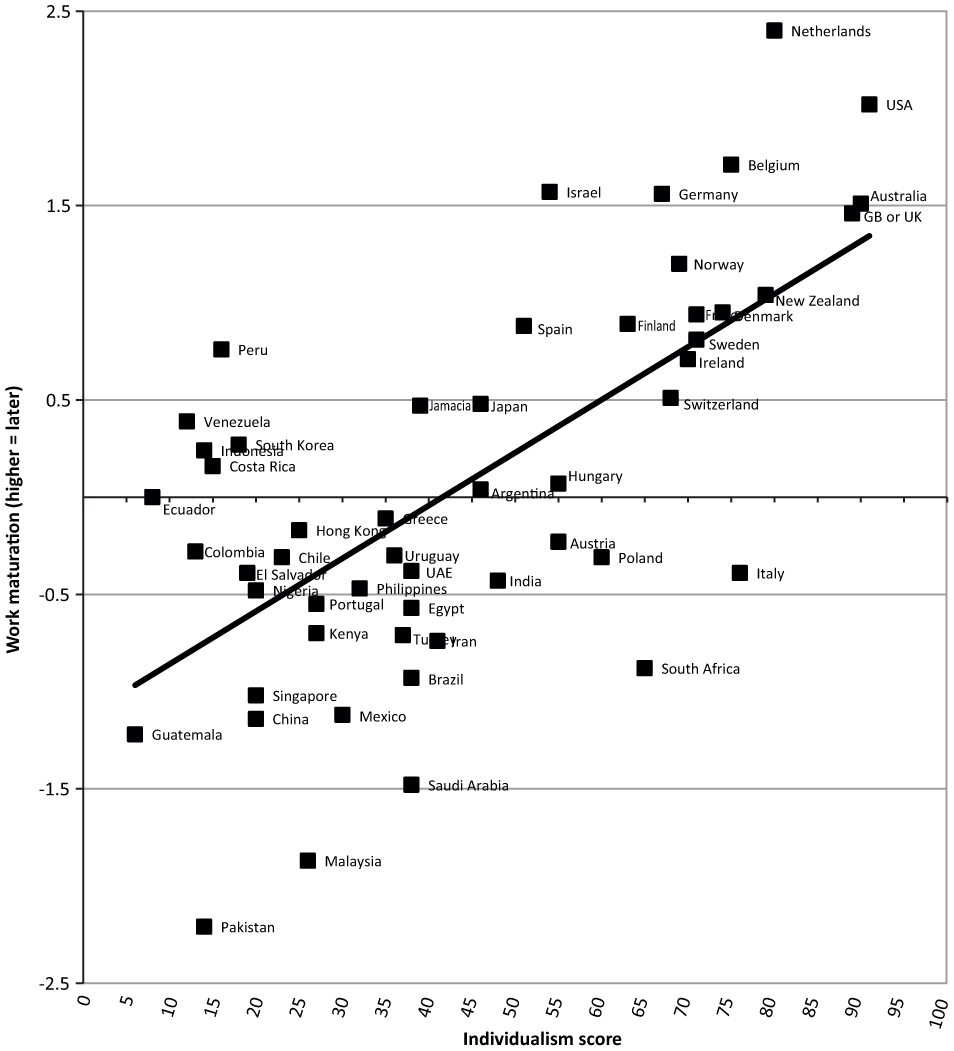
Later assumption of adult work responsibilities and individualism across 53 countries.

Later assumption of adult family responsibilities and individualism across 53 countries.
Among these 53 countries, individualism and GDP per capita were correlated r(53) = .70, p < .001, suggesting considerable overlap between individualism and economic resources. When individualism and GDP were entered into a regression equation to predict later entry into work responsibilities, individualism was a descriptively stronger predictor, β(52) = .45, p = .002, than GDP, β(52) = .30, p = .04. However, GDP was the stronger predictor of later entry into family responsibilities, β(52) = .56, p < .001, with individualism not significant once GDP was controlled, β(52) = .21, p = .14.
Next, we considered national unemployment rates, which were not significantly correlated with individualism, r(53) = –.08, p = .59. When individualism and unemployment rates were entered into a regression equation to predict later entry into work responsibilities, individualism was significantly correlated, β(52) = .65, p < .001, while unemployment was not, β(52) = –.13, p = .22. Later entry into family responsibilities was also predicted by individualism, β(52) = .58, p < .001, but not by unemployment rate, β(52) = –.15, p = .18.
Discussion
Both over time within the United States and cross-culturally across nations, slow maturation to adulthood in both work and family contexts was associated with higher individualism. When cultures are more individualistic, young adults cross the milestones of adulthood later, using a slow life strategy. In individualistic time periods and nations, the norm at the population level is for adolescents and young adults to be nurtured longer and to postpone entry into adult roles.
Given the relationship between economic strength and cultural individualism (Schimmack et al., 2005), we examined economic data in these analyses. In most cases, economic conditions did not eliminate the link between individualism and slower maturation to adulthood. In models including both individualism and unemployment rates, both over time and cross-culturally, unemployment was either not a significant predictor of slow maturation or was a weaker predictor of slow maturation than individualism. Thus, individualism seems to be a stronger predictor of slow maturation than unemployment, one indicator of economic strength. However, in cross-cultural analyses, GDP—another measure of economic strength—produced mixed results. For work roles, GDP was a weaker predictor of slow maturation than individualism, but for family roles, GDP not only was a stronger predictor but also eliminated the effect of individualism. Thus, the relationship between individualism, economic strength, and slow maturation to adulthood is complex. In short, individualism does seem to play a role in slow life strategies beyond economics, but given how intertwined these variables are, we want to be cautious in making any strong statement about a “test” between individualism versus economic factors. Clearly, these are both important variables and while our focus was on individualism, future research on this topic would benefit from including measures of economic strength.
These data are necessarily correlational, which precludes causal inference. Thus, it is difficult to tell whether individualism causes slower maturation or slower maturation causes individualism. In addition, an unidentified third variable or variables could cause both. In the over-time analyses, we were able to partially address this question by controlling for year, which helps guard against the possibility that both factors are simply rising in a linear way over time (Bianchi, 2016).
Implications and Limitations
One important implication of this research is for understanding individualism and adulthood: apparently, the former does not beget the latter. The finding that recent generations of Americans are both more individualistic (Grossman & Varnum, 2015) and more likely to take a slow path to adulthood (Arnett, 2014; Twenge & Park, 2018) is not contradictory. In fact, one predicts the other. The type (or “flavor”) of individualism now prevalent in the United States emphasizes positive self-views and focus on the needs of the self over others, the rejection of traditional social rules, and beliefs in equality (Greenfield, 2013; Twenge, 2014). However, this type of individualism does not necessarily mean engaging with society as a contributing and responsible adult; adulthood may instead be perceived as an impediment to individualism because adulthood often precludes choices and puts the needs of others (e.g., family, community) before the needs of the self. The delayed entry into adult roles has been so pronounced in contemporary Western societies that some have proposed that young adulthood is a new developmental stage, known as emerging adulthood and characterized by increased self-focus and individual exploration of choices (Arnett, 2014). Instead of taking on the responsibility for others inherent in family roles or the restriction of choice inherent in settling on an adult career, recent generations of young people have instead extended the uniquely individualistic developmental period of adolescence into adulthood. In this version of young adulthood, freedom and self-exploration are central. However, this freedom is facilitated by parents with more resources and fewer children (concomitant with a slow life strategy), allowing them to support their adult children as they explore their options. The big question—and one we could not answer with these data—is whether this represents a delay in adulthood or the loss of adulthood. The idea of emerging adulthood suggests that young people will eventually become adults, only a few years later than in the past. However, our data contain nothing, theoretically or empirically, suggesting that all young people will eventually enter adulthood. To the contrary, we speculate it is equally or more likely that a significant number of young adults will forgo the traditional markers of adulthood altogether, instead pursuing a more individualistic adolescent lifestyle and “adulting” as little as possible. Of course, we need more time and data to see how these trends manifest and whether this model of eschewing adulthood is economically feasible.
This research is limited by the variables available to be measured both across time and across nations. We are not aware of a dataset that has administered a standard measure of individualism/collectivism to a representative sample over time. Thus, we relied instead on correlates of individualism such as positive self-views, need for uniqueness, and rejection of traditional social rules around sexuality. This limitation is somewhat remedied in the international analysis, where we used Hofstede’s data on individualism. Similarly, we were limited to the variables available across time and nations for work and family maturation.
Conclusion
Individualism is linked to slower maturation into adult roles, both across time within the United States and cross-culturally across 53 nations. With one exception (GDP in the cross-cultural analysis of family-role maturation), the effects of individualism were still significant when controlled for indicators of economic strength. The relationships between individualism, economic growth, and maturation into adulthood are clearly complex. Overall, more individualistic cultures are also cultures in which young adults take longer to settle into adult work and family roles.
Footnotes
Declaration of Conflicting Interests
The author(s) declared no potential conflicts of interest with respect to the research, authorship, and/or publication of this article.
Funding
The author(s) received no financial support for the research, authorship, and/or publication of this article.
