



Abstract
The present study examined identity development and sociocultural adaptation (SCA) in the context of international mobility experiences. Specifically, we investigated changes and dynamic interactions of SCA and the Host and Home identity dimensions of commitment and reconsideration for adolescent sojourners. Therefore, we used data from 457 German high school exchange students (72.00% female; M age = 15.49 years, SD = 0.70 years) to study the longitudinal interplay of personality characteristics at two occasions over a period of 5 months. The first wave of data collection (T1) took place 8 weeks after the cultural transition. After 7 months abroad, the second measurement (T2) was taken. Longitudinal analyses revealed increases in Host reconsideration, Home commitment, and SCA, as well as a substantial decrease in Home reconsideration over the course of the study. In addition, initial identity levels predicted changes in SCA, whereas adaptation levels showed no predictive effect on later identity change. Indicators of subjective and objective sociocultural distance were tested as moderators for the effect of identity on changes in adaptation. However, results indicated that the impact identity had on adaptation was independent from influences of cultural distance, which further supported the robustness of identity effect patterns. The present research adds a longitudinal perspective on the association of identity and adaptation and contributes to the understanding of their dynamic interplay during cross-cultural transitions.
Keywords
Cultural transitions are life events that involve adaptive change (Zhou, Jindal-Snape, Topping, & Todman, 2008). For example, once individuals arrive in a new cultural environment, they find themselves confronted with the multifaceted task of adapting and reestablishing a sense of self. Currently, individuals and host countries are both challenged to adjust to a multicultural reality (Ward, Bochner, & Furnham, 2001). Although the social and personal consequences of international mobility experiences have been considered in recent literature (Greischel, Noack, & Neyer, 2016; Hutteman, Nestler, Wagner, Egloff, & Back, 2015; Zimmermann & Neyer, 2013), many questions regarding the intertwined dynamics of related developmental processes are still unanswered. Crossing cultures may, for example, influence adolescents’ cultural continuity and, therefore, their self-concept with regard to both the familiar home and the new host country. We use the term sojourners to address those who are required to navigate or even alternate between two worlds, simultaneously preserving home cultural values and acquiring new host values to facilitate their fit into the new environment. They are confronted with many opportunities to either succeed or fail to integrate into the host culture. In what way do cultural transitions affect adolescent identity development and sociocultural adaptation (SCA), and how do these two concepts interact during a sojourn year? In this study, we took a closer look at these effects.
Identity Development of Sojourners
Studies using a natural experiment design confirmed that mobility experiences elicit adolescent development in aspects of young indviduals’ personality (Greischel, Noack, & Neyer, 2018; Hutteman et al., 2015; Schubach, Zimmermann, Noack, & Neyer, 2016). We suggest that, once abroad, adolescents’ familiar home environments (e.g., social networks, school, and daily routines) are replaced by a novel kind of freedom from familial and cultural expectations, which may, in turn, change the way sojourners see themselves. That being said, research on interindividual differences in identity pathways during transitions is generally scarce. To meet this demand, we used Crocetti, Rubini, and Meeus’ (2008) process model to investigate identity change in adolescents who spent a year with host families abroad. The model by Crocetti and colleagues (2008), The Utrecht–Management of Identity Commitments Scale (U-MICS), was designed to represent the dynamics by which individuals form, evaluate, and revise their identity. The model particularly distinguishes two intertwined but distinct key dimensions of identity development: commitment and reconsideration. Commitment refers to a relatively firm choice between several alternatives concerning a life domain. Commitment processes are described as engaging in relevant activities toward the implementation of this choice and as deriving a certain sense of confidence from this choice. Reconsideration is defined as comparing present commitments with possible alternatives and is linked to negative life outcomes. This process occurs if individuals are dissatisfied with current commitments and is associated with the revision of identity choices or the avoidance of such choices (Crocetti et al., 2008).
The present research concentrated on commitment and reconsideration because these dimensions comprehensively reflect the certainty–uncertainty dynamic, which is a central characteristic of identity development during adolescence (Becht et al., 2016; Klimstra, Hale, Raaijmakers, Branje, & Meeus, 2010). Strong commitments reflect a more mature identity profile, which is associated with both a socially desirable personality (Crocetti, Jahromi, & Meeus, 2012; Klimstra et al., 2013) and psychological adjustment (Crocetti, Erentaite, & Zukauskiene, 2014), and which is negatively linked to anxiety and depression (Klimstra, Crocetti, Hale, Fermani, & Meeus, 2011; Schwartz, Zamboanga, Weisskirch, & Rodriguez, 2009). The model describes the development of identity domains as an ongoing iterative process in which commitment and reconsideration dynamically interact.
We used the U-MICS model as the underlying theoretical framework for several reasons. The model was specifically designed to measure and describe developmental trajectories of identity in adolescence and is, therefore, optimally suited for the aims of our investigation. Meeus and colleagues (Crocetti et al., 2008) provided a valid measure, which builds on their theoretical and empirical findings. Also, they have used the model to answer identity-related research questions on adolescent outcomes, making our findings more relatable to the relevant literature. Furthermore, the U-MICS model postulates a domain-specific as compared with a global approach to identity, which is recommended by leading researchers in the field (Goossens, 2001). Other identity theories, such as the narrative approach to identity, do not fully capture the size and direction of developmental shifts in identity processes. Consequently, in contrast to a narrative approach, the U-MICS model allows to examine developmental processes in a finer resolution (Klimstra et al., 2013).
Following Berry’s (2006) reasoning, we introduce Host and Home as distinct identity domains, and incorporate them into the established identity framework (Crocetti et al., 2008). Although earlier research on cultural identity put emphasis on either Host or Home identification (e.g., Berry & Sam, 1997), more recent studies appreciated the joint influence of both domains (e.g., Nguyen & Benet-Martinez, 2013). Consequently, we concentrated on both Home and Host identities to derive more comprehensive insights into adolescents’ cultural self-concepts. Although it is still an empirical question, one may suspect conceptual proximity between Home and Host identities and the acculturation strategies by Berry (2006). However, we explicitly distinguish between cognitive aspects of the self (i.e., Home and Host identities) and acculturation as a behavioral outcome. Furthermore, Home and Host are considered to be distinct domains—as compared with two end points of one continuum—and should, therefore, be examined as separate constructs within one study (Sussman, 2002). Acknowledging its wide-ranging implications, it is surprising that few studies on adolescent development have considered both domains’ dynamic interactions over time, yet.
Former studies used the term identification mostly in the sense of how similar participants rated their experiences and behaviors to those of individuals from their host or home cultures. In general, however, the term identification has been measured in varying forms and used to describe different phenomena impeding the generalization of findings. To overcome this limitation, we used an identity measure that was specifically designed to reflect identity constellations (U-MICS by Crocetti et al., 2008) based on theoretical and empirical assumptions developed by Erik Erikson (1968) and James E. Marcia (1966), respectively. The domain-specific approach (i.e., Home and Host identity) used in this study corresponds to the concept of identification with home and host (Ward & Kennedy, 1994). However, using the U-MICS, we focused on cognitive aspects of the adolescent self-concept rather than a global identification with home or host, which measures a person’s perspective on the similarity between the respective home and host cultures represented as dimensions of acculturation (Ward & Kennedy, 1994).
SCA of Sojourners
Ward and Kennedy (1999) considered SCA to be the acquisition of culturally appropriate knowledge, as well as the assembly of necessary tools to interact and solve everyday problems in a new cultural environment. This ability to fit in with the host culture is, thus, a pivotal outcome of the acculturation process and emphasizes the behavioral facet of cross-cultural adaptation (Zhang & Goodson, 2011). Host identification (Cemalcilar, Falbo, & Stapleton, 2005; Ward & Kennedy, 1994), personality (Leong, 2007), contact with host locals (Searle & Ward, 1990), and stress (Zhang & Goodson, 2011; Zhou et al., 2008), among other variables, were found to be predictive of SCA.
Spending extended periods of time outside of one’s home country has been described as being both positively challenging (Adler, 1975) and risky (Oberg, 1960). As to longitudinal pathways, although Ward and Kennedy (1994) described a fluctuating pattern of adaptation over time, they suggested that SCA paths reflect trajectories of a learning curve (Ward & Kennedy, 1996), that is, rapid improvement after the intercultural transition followed by gradual leveling off. In addition, Church (1982) concluded that most sojourners achieve reasonable cultural adaptation during their stay abroad. However, empirical investigations are still scarce and offered no conclusion about the chronological sequence of these adjustment patterns or longitudinal changes in SCA. We, therefore, aimed to investigate change patterns in SCA over the course of a high school exchange year, thereby analyzing time sequencing starting shortly after the transition abroad until almost the end of the exchange year.
Alongside migration experiences with their parents, international sojourn constitutes the most common mobility experience adolescents encounter. However, although most studies on cultural adaptation have concentrated on involuntary mobility, immigration, or adult sojourners (e.g., Berry & Sam, 1997; Ward et al., 2001), we focused on (a) voluntary and (b) temporarily limited mobility during adolescence to capture an understudied form of international mobility. For adolescent sojourners, the cultural obstacles during cultural transitions could hardly be higher, as these individuals simultaneously experience normative changes (e.g., puberty, renegotiation of parent–child relationships) and changes directly related to the cultural transition (Myers, 1999). Consequently, although SCA increases are expected, they may be less pronounced than for sojourners of other age groups.
Identity and SCA
Within the framework of traditional Eriksonian identity research, previous studies on adolescent development have emphasized the role of individuals’ social contexts, that is, social relationships, for identity change (e.g., Klimstra et al., 2013). However, they have often neglected the significance of cultural context and its influence on identity development (for an exception, see Greischel et al., 2018). That being said, acculturation research has a long tradition of studying the antecedents and outcomes of (Home and Host) cultural identity in the context of intercultural transitions (e.g., Phinney, 1989; Ward & Kennedy, 1993). For example, Ward et al. (2001) developed a model describing acculturation processes, which lead to adaptation outcomes and are influenced by various personal (e.g., cultural identity) and situational (e.g., cultural distance) characteristics. This general acculturation model and Berry’s (2006) acculturation strategies have provided the theoretical foundation for previous research on identity development in cross-cultural contexts.
From an empirical perspective, a large body of studies has investigated the role of cultural identity for SCA abroad (e.g., Eyou, Adair, & Dixon, 2000; Motti-Stefanidi, Pavlopoulos, Obradovic, & Masten, 2008; Ouarasse & van de Vijver, 2005; Ward & Kennedy, 1993, 1994). For example, several investigations emphasized that Home and Host identities are distinct constructs with specific predictive power (Hendrickson, Rosen, & Aune, 2011; Sussman, 2002). A recent study stressed the importance of a strong Home identity for adapting in a new context (Brisset, Safdar, Lewis, & Sabatier, 2010). Specifically, Home identity has been related to psychological aspects of adapting to a new environment (Cemalcilar et al., 2005; Motti-Stefanidi et al., 2008). In contrast, Ward and Rana-Deuba (1999) found that, above and beyond Home commitment, strong Host commitment was associated with greater adaptation success. However, Maydell-Stevens, Masggoret, and Ward (2007) suggested that migrants who indicated stronger commitments to their home and host country showed better adjustment (see also Berry, 2006). In addition, a recent meta-analysis by Nguyen and Benet-Martinez (2013) stressed the importance of biculturalism and supported Berry’s (2006) assumption that Home and Host dimensions play a role in adaptation processes. That is, those who simultaneously held strong commitments toward both cultures experienced less adjustment difficulties. That being said, Rudmin (2003) and Vivero and Jenkins (1999) raised concerns regarding the possible negative consequences of an integrative acculturation style, which could lead to identity confusion and stress.
Many available studies share a significant limitation: They relied on cross-sectional data and, therefore, fail to capture the longitudinal dynamics of identity–adaptation transactions, which constituted the focus of the present study. In sum, research has yet to find conclusive answers. However, common ground for most studies seems to be the assumption that high levels of Host and Home identities should be beneficial for SCA.
Sojourner adaptation unfolds on various levels (i.e., individual, family system, school, country) in an ecological context (Ward & Geeraert, 2016). We, therefore, integrated a contextual marker by including cultural distance as a moderating link of the identity–adaptation relationship. Previous research has shown that sociocultural distance (SCD) is an important predictor of SCA (Furnham & Bochner, 1982; Searle & Ward, 1990; Ward & Kennedy, 1993, 1994). For example, Redmond and Bunyi (1993) showed that, out of 644 international students studying at a U.S. American university, British, European, and South American students were best integrated, whereas Korean, Taiwanese, and Southeast Asian students were least adapted. However, both theoretical and empirical approaches have proposed a moderating role of SCD when considering identity effects on sojourner adaptation. For example, in her cultural identity model, Sussman (2002) suggests that the link between identity and adaptation is dependent on factors such as SCD. Also, Nguyen and Benet-Martinez’s (2013) meta-analysis of 83 studies (N = 23,197) confirmed the moderating role of cultural context for the relationship of identity-related characteristics and adaptation. Finally, a recent study on international students’ development found that personality effects on adaptation were moderated by psychological stress, which may be elicited by increased cultural differences (Brisset et al., 2010).
Still, little is known about the longitudinal influence of SCD indicators on SCA. Against this background, we investigated subjective sociocultural distance (sSCD) and objective sociocultural distance (oSCD) as a moderator for identity effects on SCA. To capture both the perceived and actual distance between one’s respective home and host country, we focused sSCD and oSCD.
The Present Study
In the present study, we investigated longitudinal dynamics of identity and adaptation processes, with the goal of disentangling directions of influence. We used data from the Personality, Identity, and Relationship Experiences in Adolescent Trajectories study (PIRATS) and measurements at 2 and 7 months into the sojourn experience. Thus, we investigated adolescents’ development across a 5-month period. We contend that at least a certain minimum of exposure to the new context is necessary to investigate adaptation effects. Hence, to examine developmental mechanisms, we observed construct levels relatively soon after a cultural transition took place (2 months abroad, T1) and again relatively far into the exchange year (7 months abroad, T2). We further inspected changes in commitment and reconsideration in individuals’ Home and Host identity domains, as well as changes in SCA over time (T1 – T2). Unlike most studies on intercultural adaptation, we studied sojourn in the context of multiple destinations.
Keeping in mind that many studies on SCA have been conducted on adult sojourners, and that the theoretical frameworks have been established mainly for immigrant groups, this study applied a fully dynamic perspective on adolescent sojourners. We examined (a) stability and change of identity and SCA, (b) initial correlations and correlated changes of identity and SCA, (c) longitudinal effects of identity dimensions on changes in SCA, (d) longitudinal effects of SCA on the development of identity dimensions, and (e) the moderating role of subjective and objective cultural distance for adaptation processes.
Apart from acculturation studies, identity development in the domains of Home and Host has only gained little attention in classical identity research thus far. Also, previous studies have not yielded conclusive results on longitudinal characteristics of SCA, especially regarding youth mobility. Previous longitudinal studies on cultural transitions investigated relatively small samples of adult sojourners, which possibly experience different sets of cultural difficulties (Ward, Okura, Kennedy, & Kojima, 1998). However, these longitudinal studies suggested an overall pattern of gradually increasing SCA during sojourners’ stay abroad. We, therefore, aimed at investigating mean-level changes and rank-order stabilities of the identity and adaptation construct. Based on theory and previous research, we expected increases in Host and Home commitment, decreases in reconsideration, and increased SCA, indicating enhanced adjustment to a new cultural environment (socialization hypothesis).
In addition, we investigated cross-sectional and longitudinal relations between identity and SCA. SCA should mainly and positively be associated with the Host domain, and less so with the Home domain. Also, changes over time regarding identity dimensions and adaptation should be positively linked (correlation hypotheses).
Domain-specific development would support Berry’s (2006) idea that Home and Host identification are distinct concepts, rather than two poles of one dimension. Ward et al. (2001) modeled identity as a predictive personal characteristic, whereas SCA constitutes an acculturation outcome. The present study examined longitudinal dynamics of both constructs; this was done to disentangle the direction of influence by predicting changes in either construct by initial levels in the other construct. Previous studies (e.g., Berry, 2003; Ward & Kennedy, 1994; Ward & Rana-Deuba, 1999) proposed that successful adaptation depends on the sojourner’s degree of identification with his or her host and home cultures. We, therefore, expected identity dimensions to predict changes in SCA. Initial adaptation levels, however, should not be predictive of identity development (cross-lagged hypotheses).
Finally, we tested indicators of sSCD and oSCD as possible moderators of the identity—adaptation relationship. We expected that the impact of identity on SCA would be associated with levels of SCD. Although our approach was rather exploratory, based on previous studies (e.g., Brisset et al., 2010), we expected that (a) SCA would be negatively and more strongly related to SCD than identity dimensions and (b) the positive link between a stronger identity and better adaptation abroad should be moderated by SCD such that less cultural differences between home and host country may facilitate how a strong sense of self affects sojourners’ adjustment (moderation hypothesis). On a different note, to test for possible domain-specific influences, we also explored the interaction of Host and Home identities on changes in SCA.
In one of the few longitudinal studies on identity development during cross-cultural transitions, adult sojourners were found to show increased Host identification and stable Home identification over time (e.g., Cemalcilar & Falbo, 2008). In contrast, we expect adolescent exchange students to make different experiences and to, consequently, reveal different change patterns for three reasons. First, adapting to the host culture may be a twofold challenge for adolescent sojourners as they need to adjust to the new environment as well as to deal with age-graded biological and psychological changes. Second, exchange students are the only migrating group that is situated within host families and, therefore, likely experiences different environmental cues than older sojourners or immigrants. We suggest that living in a family system will shape how adolescents adapt to the host country and form culture-related commitments. Third, moving to another country—be it voluntary or involuntary—usually goes along with increased stress levels, which may especially affect adolescents who likely travel on their own for the first time (Geeraert & Demoulin, 2013). Levitt and colleagues (2005) showed that immigrant adolescents indicated higher acculturation stress than their parents, and in a recent study, Motti-Stefanidi, Masten, and Asendorpf (2015) reported less academic success for adolescent immigrants.
We, consequently, expect identity and adaptation patterns to differ from adult sojourners and other migrating groups. Thus, although SCA gains are expected, they may be less pronounced for adolescent sojourners as adjustment to living abroad may reflect a more difficult task for this age group. We also predict that sojourners struggle with their commitment toward the host culture while maintaining or strengthening their Home commitment. These tendencies may be reflected in heightened Host reconsideration and decreases in Home reconsideration. These identity changes may also be expected based on studies suggesting increased homesickness in sojourning youth (Geeraert & Demoulin, 2013). Because most cross-cultural research concerns adaptive processes in adult immigrants and sojourners, this study aims at contributing a piece to the puzzle of how mobility affects personality development by investigating an understudied age range and mobility form.
Method
Participants and Procedure
We used data from the PIRATS (2013) project. This longitudinal study was specifically designed to trace the personal and social development of adolescent sojourners (i.e., German high school students who lived outside of their home country of Germany for an average period of 10 months). Exchange students were recruited via one of the largest German high school exchange organizations, AFS Interkulturelle Begegnungen e.V. Invitation emails were sent out to all students registered for the 2013-2014 high school exchange program. Data assessment was conducted using an individualized online platform (https://formr.org; Arslan, 2013).
Two months after their departure (T1), sojourners received an email containing a personalized link to the questionnaire. Wave 2 (T2) followed 7 months after the sojourners had left Germany (i.e., 3 months prior to their return). Both measurements were timed based on students’ individual dates of departure. Participation in the study was voluntary at all times and was incentivized by participation in a raffle for prizes such as tablet computers, as well as through the provision of individual feedback regarding participants’ personal development. Surveys had to be completed within 30 days of receiving the link.
The final sample comprised 457 sojourners. Participants were an average of 15.49 years old (SD = 0.70 years), ranging from age 14 to 17. Women made up 72% of the overall sample, reflecting a general trend among adolescent sojourners. Exchange students spent their year abroad in 43 different countries across the world. Destinations revealed four main groups, that is, 35.14% of sojourners went to North America, 31.13% to South America, 20.99% traveled within Europe, and 11.32% went to an Asian country. For more detailed information on the study sample, please also refer to Greischel et al. (2016). To answer our research questions, we used data taken at those two PIRATS measurements, both of which were taken while students lived abroad.
Measures
Identity measure
A translated version of the U-MICS (Crocetti, Schwartz, Fermani, & Meeus, 2010) was adapted to assess the identity dimensions of commitment and reconsideration within two newly introduced domains, that is, the Host and the Home domain. At both measurement occasions, items were rated on a 5-point Likert-type scale (1 = completely untrue, 5 = completely true). Sample items for identity dimensions included “I feel very connected to my host country/my home country of Germany” (Host or Home commitment, respectively) and “Regarding the future, I think about living in a different country than my host country/than my home country of Germany” (Host or Home reconsideration, respectively). As expected, commitment and reconsideration were negatively correlated at T1 (rHost = −.56, rHome = −.47), indicating that the dimensions are theoretically linked concepts representing intertwined processes. However, these dimensions are conceptually distinct (Luyckx, Soenens, & Goossens, 2006). Alpha coefficient reliabilities for commitment (T1: αHost = .60, αHome = .69; T2: αHost = .62, αHome = .70) and reconsideration (T1: αHost = .79, αHome = .76; T2: αHost = .81, αHome = .77), reflect adequate to high levels of internal consistency.
SCA measure
Ward and Kennedy’s (1999) Sociocultural Adaptation Scale (SCAS) was translated and adapted to measure SCA during the adolescents’ time abroad. The SCAS was developed, in particular, to capture the everyday life struggles of individuals living abroad. The scale is designed to be a flexible instrument that can be easily modified according to the characteristics of the sojourning sample. It requires respondents to indicate the degree of difficulty they experience in a number of areas, using a 5-point Likert-type scale (1 = no difficulty, 5 = extreme difficulty). A five-item short version of the instrument was tailored for the specific population in question. Sample items include “Please indicate the amount of difficulty you experience in your host country” with regard to a number of areas including daily routines, school, social life, food, and weather. We recoded all items before the analyses such that higher values indicate more successful SCA. Adequate internal consistency was reflected by the alpha coefficient reliability for SCA of α = .63 at T1 and α = .60 at T2.
Subjective sociocultural distance (sSCD)
To examine levels of sSCD, we adjusted Ward and Kennedy’s (1999) SCAS and used identical areas (e.g., daily routines, school) to generate the items for the sSCD scale. However, instead of the level of everyday difficulties, participants rated the extent to which they perceived their home country (here, Germany) as different from their respective host country regarding these areas. To do this, using a 5-point Likert-type scale (1 = countries are very similar, 5 = countries are very different), respondents indicated the amount of perceived home–host distance at both measurement occasions. Coefficient alpha reliability for the sSCD scale was α = .72 at T1 and α = .72 at T2.
Objective sociocultural distance (oSCD)
We identified levels of oSCD by applying Hofstede’s cultural dimensions of power distance index, individualism versus collectivism, masculinity versus femininity, uncertainty avoidance index, long-term orientation versus short-term normative orientation, and indulgence versus restraint. On his website (www.geert-hofstede.de), Hofstede provides scores for each dimension for a number of countries. Participants’ respective host countries were coded on each dimension. For example, of all of Hofstede’s (2001) dimensions, individualism has been the facet most frequently included in scientific research (cf. Oyserman, Coon, & Kemmelmeier, 2002). High levels of individualism indicate a society’s preference for a social framework in which individuals are expected to take care of only themselves and their immediate families, as compared with looking after relatives and other in-group members in exchange for absolute loyalty. We calculated the difference between participants’ respective Hofstede scores for Germany and the respective host country on all dimensions to derive six individual indicators for objective cultural distance between the two countries.
Analytical Strategy
All constructs included in these models were constrained to meet criteria for strong measurement invariance over time (Meredith, 1993). The chi-square test, the root mean square error of approximation (RMSEA), the comparative fit index (CFI), and the standardized root mean square residual (SRMR; see Hu & Bentler, 1999, for cutoff values) were used to investigate model fit. All latent models were controlled for age and gender. Mplus Software Version 7 (Muthén & Muthén, 1998-2012) was used to carry out all analyses. The built-in maximum likelihood estimator with robust standard errors allowed for deviation from multivariate normality and was, therefore, employed. We used the full information maximum likelihood procedure in Mplus to optimally deal with missing values.
Socialization effects
Five univariate latent change models were implemented to extract latent means of identity (Home and Host commitment and reconsideration), SCA at T1 and T2, and latent change scores (T1 – T2). All variables were modeled as latent factors to control for measurement error. We used univariate neighbor-change models in which time-specific latent factors (i.e., unaffected by measurement error) represent the construct at each wave and a latent change variable embodies the individual’s true change in the respective variable between measurement points (e.g., Steyer, Eid, & Schwenkmezger, 1997). Hence, a positive (negative) value for a latent difference score or change variable indicated an increase (decrease), respectively, in the variable’s mean level from T1 to T2. Using these models further allowed us to extract latent rank-order stabilities.
Initial correlations and correlated changes
In a second step, we combined and extended the univariate models and derived multivariate latent change models (see Figure 1, Panel I; McArdle, 2009), which allowed us to examine two particular correlation patterns, that is, initial correlations and correlated changes. We analyzed latent correlations of identity dimensions and SCA variables at T1 as well as latent correlations of changes in these constructs over the course of the study (T1–T2). In addition, correlations between SCD indicators and identity and SCA variables were calculated.
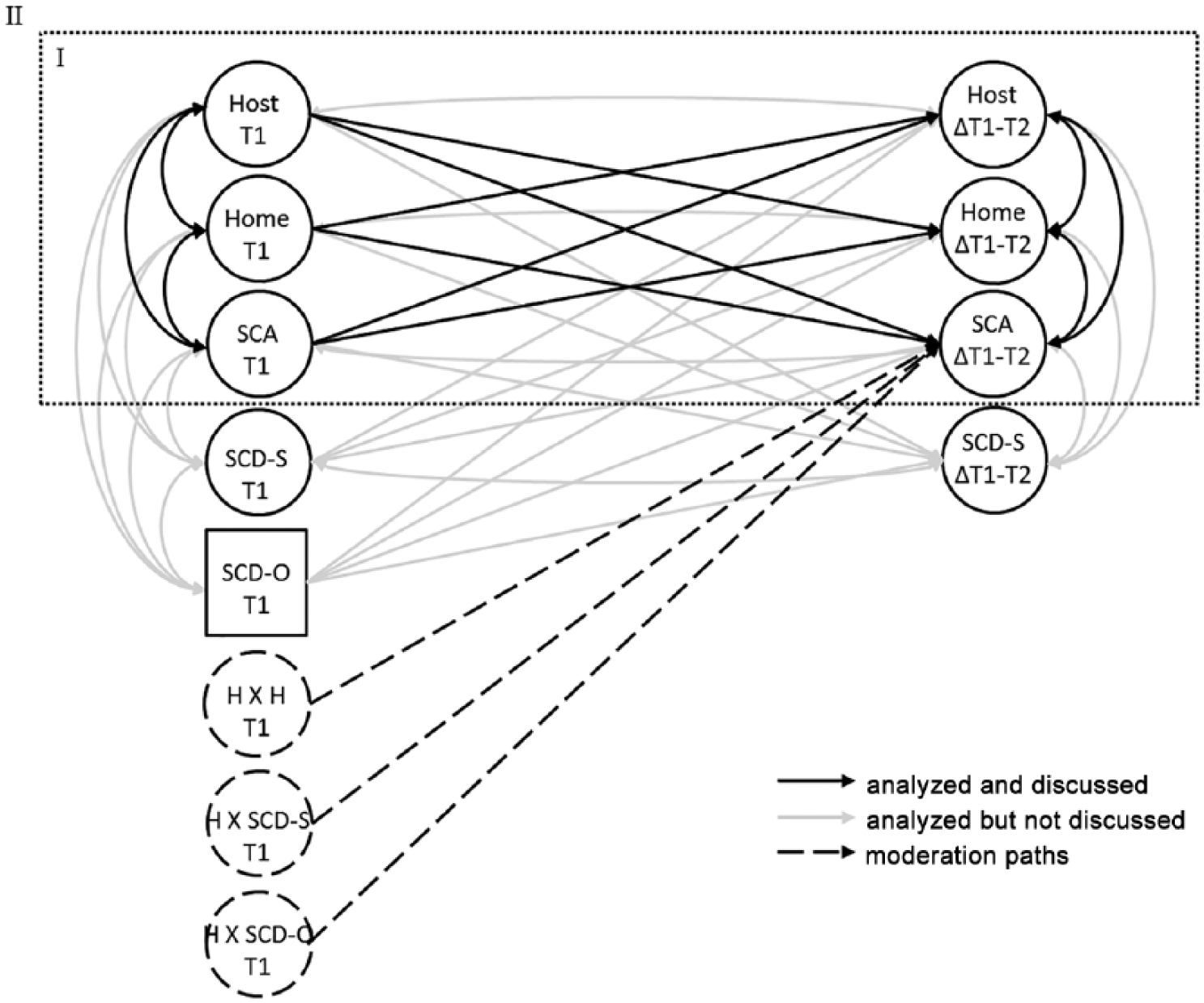
Conceptual model to assess identity and adaptation change during cultural transition.
Cross-lagged effects
In step 3, we further used these multivariate latent change models to investigate what we refer to as cross-lagged effects, that is, initial levels in one construct predict change in another construct. We were particularly interested in three groups of effects. First, identity effects were examined by analyzing effects of initial levels of Host or Home identity on changes in SCA. Second, we investigated how initial SCA levels influenced identity development, that is, adaptation effects. Finally, as a control analysis, we looked at domain effects, meaning the interaction between Host and Home identity dimensions. We, therefore, disentangled the effects of Host (Home) identity levels at T1 on changes in Home (Host) commitment and reconsideration. In sum, we implemented two models, one for commitment and one for reconsideration and simultaneously analyzed identity and adaptation variables.
Moderation effects
To account for possible moderating effects, we simultaneously incorporated interaction terms with SCD in the multivariate latent change models (see Figure 1, Panel II). Latent interaction terms were added to the model for Host × Home, as well as for Host × sSCD, Host × oSCD, Home × sSCD, and Home × oSCD respectively. As we were explicitly interested in moderation effects regarding the relationship between identity and adaptation, we analyzed only those moderation paths as indicated in the configural model (Figure 1, Panel II).
Results
Characteristics of Identity and Adaptation Variables
We expected increases in commitments and SCA, and decreases in Host and Home reconsideration across time. Five univariate latent change models (four identity models and one SCA model) were implemented to analyze latent means, standard deviations, Cohen’s d, and rank-order stabilities, all of which are displayed in Table 1. To derive overall mean levels for identity and adaptation variables, we used the effects coding method (Little, Slegers, & Card, 2006) to model a latent mean for each measurement occasion, which better reflects the mean of each indicator, rather than solely reflecting the mean of the respective first indicator (Geiser, 2012). The resulting models implied strong factorial invariance, that is, factor loadings and intercepts were constrained to be invariant across time. Model fit indices reflected good fit to the data, χ2/df = 1.491-5.112, χ2 = 13.419-69.550, df = 9 (37 for SCA), RMSEA = 0.035-0.102, CFI = 0.928-0.993, SRMR = 0.032-0.063. As expected, for the domain of Home, commitment increased and reconsideration decreased across the study period. Whereas Host reconsideration increased, Host commitment showed no significant change, and SCA tended to increase over time. Although overall rank-order stabilities were found to be in the medium range, Host dimensions appeared least stable over the 5-month period. All reported and subsequent analyses were controlled for age and gender.
Descriptive Statistics of Identity and Adaptation Variables.
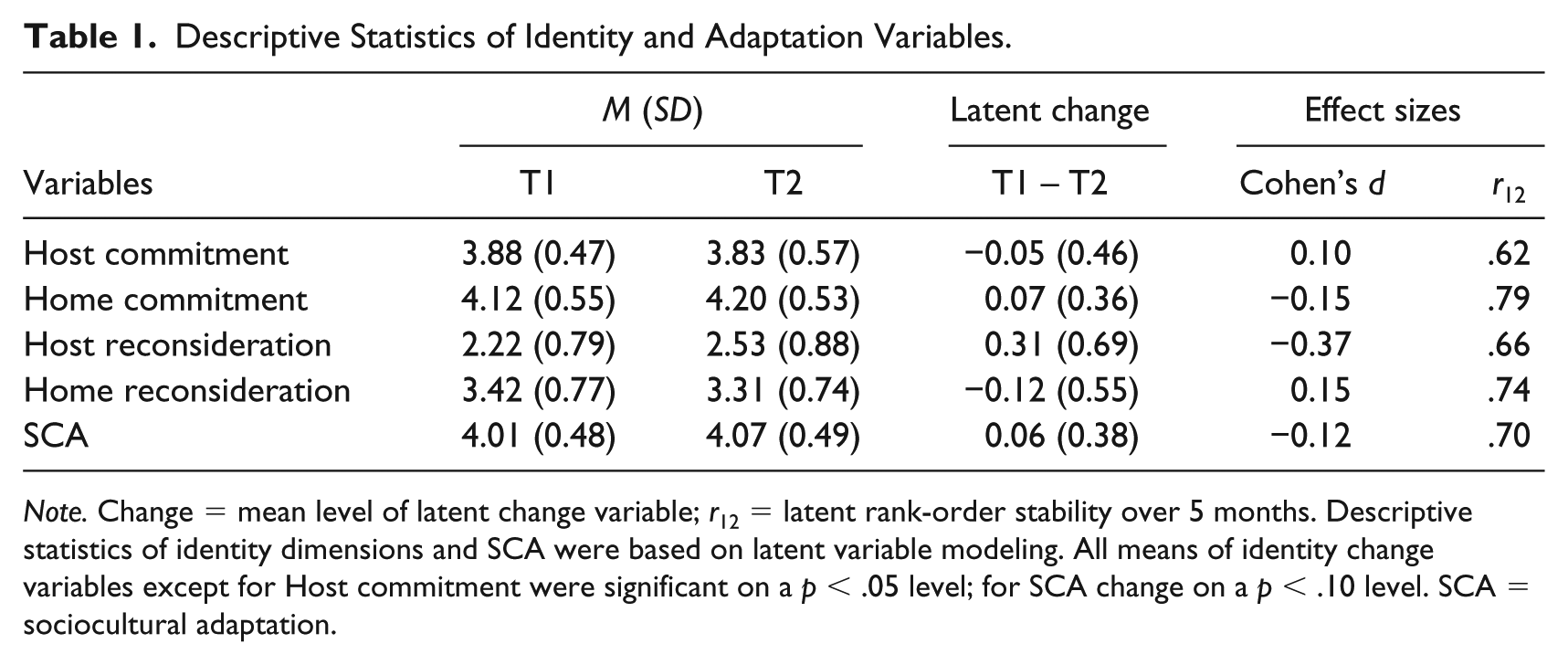
Note. Change = mean level of latent change variable; r12 = latent rank-order stability over 5 months. Descriptive statistics of identity dimensions and SCA were based on latent variable modeling. All means of identity change variables except for Host commitment were significant on a p < .05 level; for SCA change on a p < .10 level. SCA = sociocultural adaptation.
Dynamics of Identity and Adaptation Variables
We modeled two separate multivariate latent change models for commitment and reconsideration to extract initial correlations, correlated change, and cross-lagged effects (see Figure 1, Panel I). Strong factorial invariance was established, and was reflected by good fit for both models (model fit commitment and reconsideration, respectively: χ2/df = 1.748 and 1.371, χ2 = 403.789 and 316.608, df = 231, RMSEA = 0.043 and 0.031, CFI = 0.917 and 0.964, SRMR = 0.062 and 0.050).
Initial correlations and correlated change
SCA and Host commitment was—more than Home—expected to be positively linked. Initial correlations and correlated changes between identity dimensions and SCA variables are displayed in Table 2. Although Host and SCA appeared to be strongly related, initial correlations for Home and Host dimensions as well as Home and SCA were found to be negligible. Correlated-change coefficients indicated a strong positive association between Host commitment and SCA. Host and Home commitment and reconsideration were negatively associated, as were changes in Home commitment and SCA. Regarding reconsideration patterns, identity and SCA associations were found to have a different direction, but to be similar in size.
Initial Correlations and Correlated Changes.

Note. Correlations between latent intercepts for Host, Home, and SCA are displayed above the diagonal. Correlated changes, as estimated by the multivariate latent change model, are displayed below the diagonal. SCA = sociocultural adaptation; sSCD = subjective sociocultural distance; dimensions of objective sociocultural distance: PD = power distance; IN = individualism; M = masculinity; UA = uncertainty avoidance; LO = long-term orientation; ID = indulgence.
p < .05.
These results indicate that, first, Home and Host are indeed distinct domains. Second, increases in Host commitment or reconsideration were linked to decreases in Home commitment or reconsideration, respectively. Third, Host and SCA were not only initially associated—positively for commitment, negatively for reconsideration—but also changes in these variables were correlated as well: Increases or decreases in Host commitment or reconsideration, respectively, went along with increases in adaptation. Whereas Home and SCA were initially not linked, we found substantial negative and positive correlated changes for Home commitment and reconsideration, respectively. Hence, increases or decreases in Home commitment or reconsideration, respectively, were linked to decreases in SCA levels.
Identity effects on changes in adaptation
We expected identity to affect SCA but no reverse effects. All coefficients reflecting the relationship between initial identity levels and subsequent changes in adaptation were found to be significant (see Table 3). Whereas high initial levels of Host commitment predicted less increase in SCA, high initial Home commitment positively affected SCA increases (βHost = −.42, p < .001; βHome = .24, p = .012). In contrast, high initial levels of Host or Home reconsideration were predictive of stronger or weaker increases, respectively, in adaptation levels (βHost = .39, p < .001; βHome = −.18, p = .017). Overall, results indicated that those individuals who showed less Host commitment and Home reconsideration, as well as enhanced Host reconsideration and Home commitment at the beginning of their sojourn, showed greater increases in adaptation levels. In both models, the Host identity effect on SCA was significantly stronger than the effect of Home identity on adaptation, commitment: χ2(1, N = 398) = 21.54, p < .001; reconsideration: χ2(1, N = 398) = 19.31, p < .001.
Results of the Multivariate Latent Change Models.
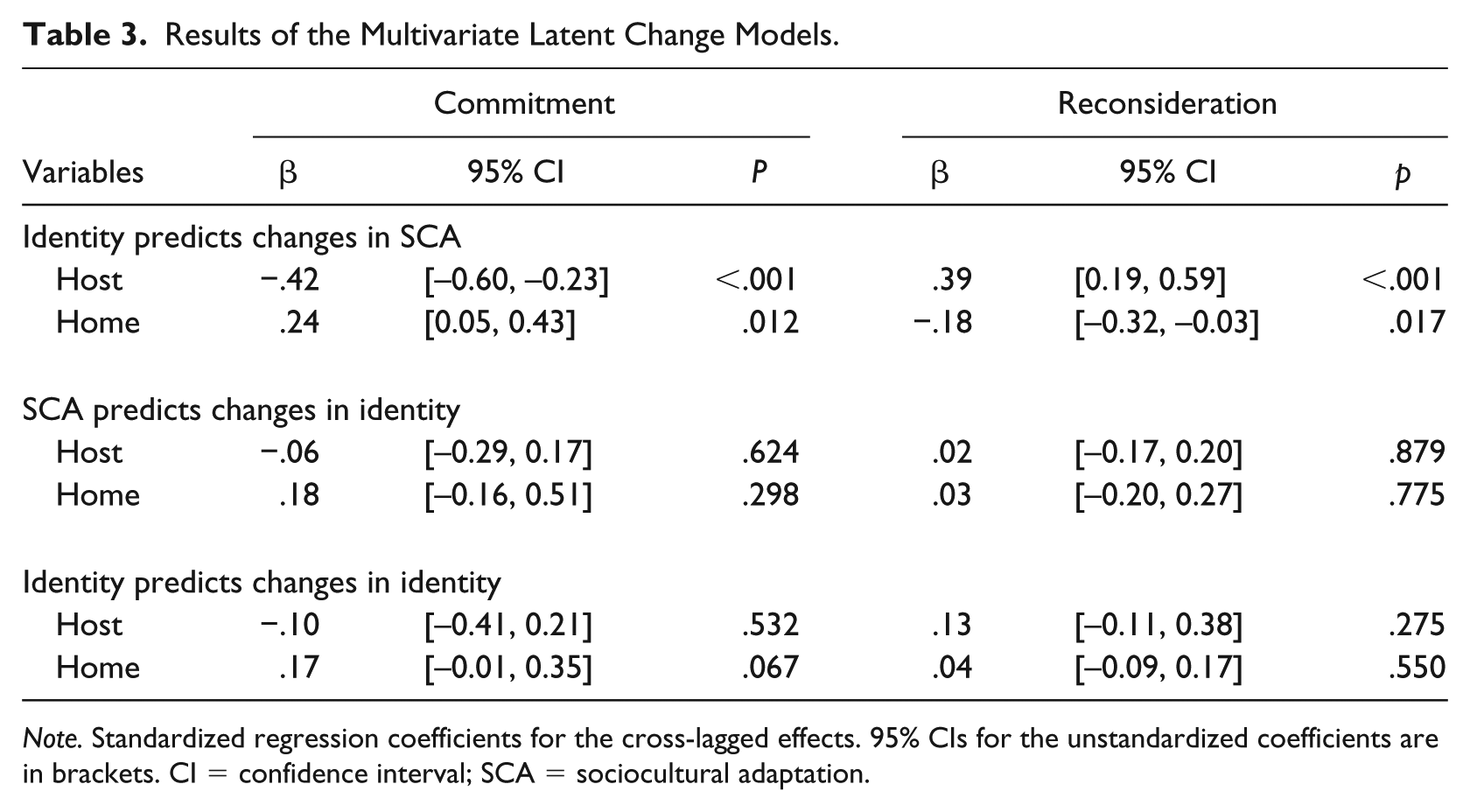
Note. Standardized regression coefficients for the cross-lagged effects. 95% CIs for the unstandardized coefficients are in brackets. CI = confidence interval; SCA = sociocultural adaptation.
Adaptation effects on changes in identity
We further analyzed the effects of SCA levels two months into the sojourn on subsequent identity development and found that initial SCA was not predictive of subsequent changes in identity dimensions.
Identity effects on changes in identity
The effects of Host and Home dimension levels at T1 were tested. No significant cross-lagged effects were found other than a tendency of initial levels of Home commitment to predict subsequent changes in Host commitment (β = .17, p = .067).
The Moderating Role of SCD
As expected, preliminary correlation patterns revealed weak associations between sSCD and oSCD indicators and identity (rs = −.15-.15), whereas SCD was more strongly linked to SCA (rs = −.42-.18; see Table 2).
Subjective and objective SCD, as well as the interaction between the Home and Host domains, were added to the multivariate latent change model (see Figure 1, Panel II) and were expected to moderate the sojourn effects on changes in all constructs. Because fit statistics are not available due to inclusion of latent interactions in Mplus (Marsh, Wen, & Hau, 2004), we used the multivariate latent change models, including SCD variables without interaction terms. Considering their complexity, the models fitted the data reasonably well (model fit for commitment and reconsideration, respectively: χ2/df = 1.791 and 1.583, χ2 = 881.219 and 778.991, df = 492, RMSEA = 0.045 and 0.038, CFI = 0.886 and 0.921, SRMR = 0.074 and 0.061). We extended the initial multivariate model by adding a univariate latent change model for sSCD, as well as manifest variables representing oSCD and all interactions simultaneously.
Subjective sociocultural difference affected SCA change (β = .23, p = .016) but had no effect on Host identity (commitment: β = −.06, p = .611; reconsideration: β = .15, p = .165) or on Home identity (commitment: β = .07, p = .560; reconsideration: β = .09, p = .559). With regard to objective measures of SCD, the six examined dimensions neither affected SCA (β = −.15-.14, p = .100-.898) nor identity (β = −.09-.07, p = .208-.998). We also included Host × Home as a moderator to control all moderation effects for possible influences of identity interactions. Of the 24 tested effects, moderation analyses revealed only one weak negative interaction effect on SCA between Host commitment and the oSCD dimension of indulgence versus restraint (β = −.01, p = .023). Thus, Host commitment negatively affected SCA change especially for sojourners residing in more restraint host countries. However, the overall result pattern revealed no meaningful interactions, indicating that the predictive effect of identity dimensions on adjustment was unaffected by levels of sSCD and oSCD.
Discussion
This study aimed at investigating stability and change of Home and Host identities and SCA during a year abroad. Thereby, a main focus of the study was to examine longitudinal associations between the constructs and to test moderating influences of oSCD and sSCD. To meet these objectives, we investigated German high school students to focus on an understudied mobility group that reflects both an often overlooked age group and a population that engages in genuinely different cross-cultural experiences than, for example, immigrants. On the one hand, sojourning high school students travel voluntarily unlike, for example, refugees. On the other hand, they live in host families and, therefore, make profoundly different experiences from refugees who may live in a shelter and even from college students living in dorms on campus. As expected, we found substantial cross-sectional and longitudinal associations between identity and SCA. Also, Host and Home identities were predictive of changes in adaptation, but not vice versa. This pattern of influence was independent from (a) oSCD and sSCD and (b) from specific influences of either Home or Host identity, supporting the generalizability of identity effects on adaptation. Thus, the degree of, for example, commitment toward one’s host, but also home country, influenced in how far a sojourner adapted to his or her life abroad.
How Do Identity Dimensions and Adaptation Develop Abroad?
We found domain-specific patterns for identity development. During their time abroad, sojourners’ Host commitment tended to decrease, whereas Host reconsideration tended to increase. In line with existing theory, the average exchange student increasingly reevaluated established choices with regard to his or her respective host country (e.g., Church, 1982). Sojourners enter a new world carrying different learned behaviors and values, and then find themselves confronted with a variety of host-related alternatives. In the host family and school setting, exchange students are continuously confronted with host culture norms and behaviors. Strong Host reconsideration may be bolstered as sojourners are faced with multiple uncertainties and must deal with ever-present daily hurdles. Increases in Host reconsideration may also be the reflection of a gradual decline in levels of well-being while maintaining good sociocultural adjustment (Geeraert & Demoulin, 2013).
From an alternative angle, it may also be possible that during the first 2 months after the transition abroad, Host commitment had already increased up to the point that it has already started to decrease again at T1 still indicating substantially high levels. Cemalcilar and Falbo (2008) found increased Host identification and stable Home identification in international student sojourners across 5 months starting at 2 months before the transition abroad. The present study may serve as an optimal follow-up as we measured Home and Host identities at 2 and 7 months after the cross-cultural transition. Thus, our findings may be interpreted in line with Cemalcilar and Falbo’s (2008) results.
Exchange students’ Home identity strengthened over time. One could speculate that elevated Home commitment or decreased Home reconsideration, respectively, toward the end of one’s sojourn constitutes a reorientation toward one’s own home culture in preparation for the upcoming return. Sussman (2002) found that reentry stress was negatively predicted by Home identification, suggesting that high levels of Home identity were preventive of stress levels when sojourners return home. This finding supports the speculation that an increase in Home identity toward the end of the sojourn mirrors an adaptive mechanism for sojourners, as it facilitates their reintegration back home.
The average Home identity changes may, in contrast, be an expression of the host-related disillusionment and feelings of homesickness that takes place when sojourners adapt to their new environment and start comparing life back Home with living conditions abroad (Geeraert & Demoulin, 2013). Similarly, having dealt with initial language barriers and unfamiliarity with cultural habits, exchange students may learn new appreciation for their home country and may wish to be back home in familiar spheres, leading to strengthened commitment. Cemalcilar and Falbo (2008) found increased levels of psychological difficulties during students’ sojourn, pointing toward growing homesickness being another explanation for Home change.
As reflected by the increasing trend in SCA levels, sojourners progressively adapted to living abroad and dealing with everyday problems in their new cultural environment. This result agrees with earlier studies, suggesting SCA development to follow a learning curve (Ward & Kennedy, 1994). The current study adds a longitudinal perspective: As increases in SCA approximate the theorized plateau, it may be speculated that, 2 months after the transition, the sociocultural learning curve has already peaked. Homesickness, prejudice, and communication difficulties are common companions of the sojourn experience (Ward & Kennedy, 2001), and may be responsible for a less than expected pronounced increase in SCA. However, changes in SCA point toward sojourners increasingly making sense out of their new environment and finding their way around.
How Are Identity and Adaptation Linked?
Previous research (e.g., Ward et al., 2001) has suggested a strong link between Host identification and SCA. However, a great number of these studies used data from either involuntarily traveling individuals (e.g., refugees) or adult immigrants, but less is known about adolescent development during a school year abroad. As we hypothesized, our results indicated a strong association between Host identity and adaptation in the beginning of the sojourn experience, providing further empirical evidence for the importance of an integrative acculturation style (e.g., Ward & Kennedy, 1994). In contrast, Home dimensions were only weakly linked to initial levels of SCA. This result bolsters evidence for stronger linkage between Home-related identity processes and psychological adaptation, as postulated by Ward and Kennedy (1993, 1994). Above and beyond initial associations, changes in Host commitment were positively associated with changes in adaptation, pointing toward an adjustment benefit for those who committed to their new environment. In contrast, the negative relations found between Host reconsideration and adaptation, and between Home commitment and adaptation, further support this interpretation. Students whose commitments shifted away from their host country and toward their home country appeared to simultaneously develop more problems dealing with everyday life abroad. In other words, fitting in may require a certain amount of commitment to the prevailing culture. Those who progressively adapted to living abroad were also increasingly committed toward their host country. In contrast to Berry’s (2006) assumptions, developing a strong Home identity over time did not coincide with better SCA.
We further investigated the dynamic interplay between identity and adaptation across time, meeting the long overdue call for longitudinal investigation of identity–adaptation interactions (Ward & Kennedy, 1994). Initial levels of identity were predictive of subsequent changes in adaptation. We, however, found no support for the reverse relationship. Thus, our results are in line with findings from Luyckx and colleagues (2006) who demonstrated that identity dimensions may be remarkably stable constructs as compared with other characteristic adaptations such as SCA. Those students with high initial levels of Host commitment showed less increase in adaptation over 5 months. This result not only illustrates the aforementioned disillusionment effect, but may also suggest that sojourners who started out with high Host commitment may have developed a more realistic view on their host country during their stay. Sojourners had known the host country for no longer than 2 months by the time of the first measurement: Being highly committed to the host culture from the very beginning of one’s stay may facilitate feeling disappointed, whereas having lower commitment may entail fewer expectations in the long run, thereby easing the adaptation process. In addition, as Host commitment and SCA are positively related, those who indicated strong Host commitment in the beginning of their stay may also be the ones advanced in adaptation processes. Along these lines, the link between high initial Host commitment and less positive changes in SCA could be alternatively interpreted as sojourners being already well adapted to the new environment.
In addition, it appeared that those who steadily reevaluate their host country may reap greater gains regarding adaptation (Hutteman et al., 2015), as students with high initial commitment toward their home country indicated enhanced increases in adaptation levels. These students may experience less adaption difficulty because they have fewer expectations regarding their life in the new culture, and, therefore, fewer disappointments. The prospect of returning to a safe haven may also facilitate exploration and adjustment in unfamiliar surroundings. Students who are high in Home reconsideration may have difficulty feeling at home, regardless of where they actually are, and this difficulty in familiarizing oneself with one’s surroundings could be reflected in reevaluation processes. The influence of Host identity on SCA was stronger than that of Home identity, suggesting that the extent to which sojourner adjust to their actual living environment is closely linked to their self-concept of this environment.
Taken together, these distinct patterns of linkages between identity and adaptation supported Berry’s (2006) notion that Home and Host identities are independent domains rather than two diametrical ends of a single dimension. However, longitudinal findings suggested support for Cemalcilar and Falbo (2008), who did not confirm Berry’s (2006) theory that integration is key. As most research on cultural adaptation relates identity to immigrant adjustment (Berry, 2006; Boekestijn, 1988; Moyerman & Forman, 1992) rather than to deliberately limited sojourn experiences—which explains these differences in results—further research is needed to study similar and divergent trajectories of mobile groups.
What Role Does SCD Play in the Adaptation Process?
In addition, we investigated whether sSCD and oSCD affected the impact identity had on adaptation processes. Moderation analyses revealed that, above and beyond the perceived magnitude of cultural distance and the measured factual distance, the extent to which sojourners adapted to their new environment was predicted by their initial level of Home and Host identities. We did not find consistent patterns of possible influences of SCD on SCA. Thus, neither the distance sojourners perceived between their home and the host country in the beginning of their stay nor the actual cultural distance affected how sojourners’ identity influenced adaptation to their new environment abroad. This finding is surprising because studies have repeatedly shown the predictive association between cultural distance with cultural identification and adjustment (e.g., Searle & Ward, 1990).
However, one may speculate that studies finding such effects often use cross-sectional data (e.g., Galchenko & van de Vijver, 2007) and may, therefore, overlook the complexity of these interrelations. As can be seen from the results, studying longitudinal interrelations between identity, adaptation, and SCD added a valuable perspective on how cultural differences may—or in this case may not—impact how sojourners’ self-concept affects adaptation abroad. Present cross-sectional correlation patterns pointed toward associations between SCD and SCA and supported Galchenko and van de Vijver’s (2007) results. However, our findings go beyond these cross-sectional associations, which have frequently been used in previously acculturation literature, and unraveled longitudinal links between identity, adaptation, and cultural distance.
In contrast to previous findings that cultural distance is associated with less adjustment (Searle & Ward, 1990; Ward & Kennedy, 1992), our results indicated that SCD did not play a meaningful role in mastering the difficulties of everyday life abroad. As can be seen from the worldwide distribution of host countries in our study, these results are not related to low variability of destinations. One could speculate that, for adolescent sojourners, actual and perceived distance may not be of crucial importance to their sojourn experience, as this experience likely constitutes—more importantly—a first encounter with living on their own. Also, we believe that this result may reflect that going abroad at such a young age is a highly influential change of context in itself, and the specificities about the environment abroad may not add to the effect sojourning has on adolescent development. Hence, whether exchange students lived 500 or 5,000 miles away from home did not make a difference supporting earlier findings from Geeraert and Demoulin (2013).
Adaptation is influenced by a number of social variables such as quantity and quality of contact with host nationals (Furnham & Bochner, 1982) and friendship networks (Bochner, McLeod, & Lin, 1977); the host family also plays an important role when it comes to psychological well-being and transmitting cultural values (Oppedal, 2006; Phinney, Horenczyk, Liebkind, & Vedder, 2001; Phinney & Ong, 2002). Social support may be a more meaningful moderator of the influence of identity on adaptation; further research is necessary to disentangle this relationship.
Limitations and Future Directions
The general applicability of our findings may be constrained for several reasons. First, there are obvious benefits to the use of data from sojourners with multinational backgrounds, which this study did not offer. However, this study did survey exchange students with multiple destinations, constituting a leap forward in the study of consequences of international mobility experiences. To combine the merits of multiple home countries and multiple destinations, future investigations should include students from different parts of the world going to various places (Ward & Geeraert, 2016). Second, although the present study provides novel and valuable insights into the processes of adaptation and identity development, including more than two data points in time generally adds to the generalizability of longitudinal results. Furthermore, although self-reports have been shown to be a reliable and valid source of information for studying certain phenomena in adolescents (Soto, John, Gosling, & Potter, 2008), future research could profit from using multiple informant ratings. Another limitation is that our approach may be conceived as acculturation strategy approach by Berry (2006). The present study, however, has a different conceptual focus, which lays on the adolescent development within a cross-cultural context. Future studies should examine questions of validity of these different approaches. Finally, in the present study, although we concentrated on the role of cultural distance as an influential factor, there may be other factors that influence the relationship between identity and adaptation (e.g., Furnham & Bochner, 1982; Ward & Searle, 1991). Future research should, therefore, take further psychological or social moderators into consideration. Specifically, future research should take into account variations of host family characteristics that may influence sojourners’ identity and adaptation processes during their stay abroad, such as religious beliefs, gender roles, and power distance between family members. A recent study found that family resources were associated with increased adaptation success in immigrant youth (Anagnostaki, Pavlopoulos, Obradović, Masten, & Motti-Stefanidi, 2016). Also, host families that volunteer to take in a German exchange student may systematically differ in these characteristics from other families and other host families, which should be taken into account in future studies.
Conclusion
The present research disentangled longitudinal identity processes and cross-cultural adaptation in an adolescent sojourn group. One main purpose of this study was to meet the call for an integration of context into classical identity research (e.g., Schachter, 2005), as intercultural experiences have become increasingly common for young people around the world. Be it as an international exchange student, an academic sojourner, or a member of the current migration wave, long-term mobility requires the traveler to balance and shift between two different worlds. We can only speculate regarding the extent to which our results might be generalizable to other adapting groups, such as immigrants. However, the study of international mobility experiences has become increasingly pivotal as the unyielding need to understand processes and outcomes of intercultural contact has never been more prominent than in the global era. More than 30 years ago, Bochner (1986) suggested that international education is one of the most powerful positive influences on world relations, with personal and global transformative potential. Therefore, research on how we adapt and develop a sense of self during international mobility experiences constitutes an investment in future cross-cultural perspectives.
Footnotes
Acknowledgements
We would like to thank Julia Zimmermann and Julia Dietrich for their valuable input, as well as Julia L. McMillan for stylistic improvements.
Declaration of Conflicting Interests
The author(s) declared no potential conflicts of interest with respect to the research, authorship, and/or publication of this article.
Funding
The author(s) disclosed receipt of the following financial support for the research, authorship, and/or publication of this article: The PIRATS (Personality, Identity, and Relationship Experiences in Adolescent Trajectories) study was funded by the German Research Foundation (Grant NE 633/9-1 awarded to Franz J. Neyer and Peter Noack).