




Abstract
The current study tests the application of Greenfield’s theory of social change and human development to an Arab Bedouin community transitioning from a nomadic to a sedentary way of life. We predicted that sociodemographic change across three generations away from a rural subsistence way of life (a Gemeinschaft ecology) toward an urban, educated, and technological way of life in a commercial economy (a Gesellschaft ecology) would correspond to generational differences in individualistic values related to gender, focusing on equality and chosen roles. We also examined the hypothesis that the pattern of intergenerational differences would suggest a more rapid pace of value change for women than for men. We presented 20 adolescent girls, their mothers, and their grandmothers, and 20 adolescent boys, their fathers, and their grandfathers with a series of vignettes to measure their values. Results showed increasing Gesellschaft-adapted values across generations of both women and men; however, the pattern of generational differences suggested that the most dramatic change for women was in the parent generation, whereas the most dramatic change for men was in the adolescent generation. This pattern suggested a more rapid pace of value change for women than for men. Mediation analyses showed that education, TV watching, and Internet use explained differences in values across the generations. Qualitative examples illustrate how beliefs about ideal gender behaviors and male–female relations shift across generations in correspondence with sociodemographic changes.
Our study examines whether the transition from a small-scale community-oriented (Gemeinschaft) ecology toward a large-scale society-oriented (Gesellschaft) ecology has produced value differences in pathways of development. Specifically, it examines whether there are value differences associated with sociodemographic change across three generations of Arab Bedouins in the south of Israel (in the region of the Negev Desert). The study tests predictions from Greenfield’s theory of social change and human development, which is based on Tönnies (1887/1957) distinction between Gemeinschaft and Gesellschaft social ecologies. The predictions are that change away from a rural, nomadic way of life in a homogeneous clan-based community with limited economic resources (Gemeinschaft) toward an urban, educated, and technological way of life in a heterogeneous social environment with a commercial economy and greater wealth (Gesellschaft) has produced changes in gender-related values. We expected that among individuals having less Gemeinschaft sociodemographic characteristics, there would be increases in horizontal individualism—gender equality, personal independence, and chosen gender roles—along with declines in vertical collectivism (Singelis, Triandis, Bhawuk, & Gelfand, 1995)—gender hierarchy, family interdependence, and ascribed (born into) gender roles (Greenfield, 2009, 2016; Manago, 2012, 2014, 2015; Manago & Greenfield, 2011; Manago, Greenfield, Kim, & Ward, 2014). The former values are adapted to a Gesellschaft ecology, whereas the latter are adapted to a Gemeinschaft ecology. Gemeinschaft adaptations also include marriages arranged by parents and large families; in contrast, the couple and partner choice are all-important in a Gesellschaft ecology, and small families are preferred (Kağıtçıbaşı & Ataca, 2005; Manago et al., 2014; Weinstock, Ganayiem, Igbariya, Manago, & Greenfield, 2015).
Mediating between values on the cultural level, as for example, manifest in cultural products such as books or television shows ( Greenfield, 2013; Uhls & Greenfield, 2011), and values on the individual level are learning environments. Learning environments are captured in influences such as formal education at school (Gesellschaft) versus informal education at home (Gemeinschaft), commerce-oriented activities (Gesellschaft) versus subsistence activities (Gemeinschaft), and advanced technologies (Gesellschaft) versus simple technologies (Gemeinschaft).
These proximal environments produce individuals who exemplify cultural values on the societal level. Indeed, empirical research in countries around the world has shown that individualistic values emerge and/or collectivistic values decrease with increasing affluence, urbanization, and higher levels of formal education (Freeman, 1997; Fuligni & Zhang, 2004; Greenfield & Quiroz, 2013; Greenfield, Quiroz, & Raeff, 2000; Keller & Lamm, 2005; Park, Coello, & Lau, 2014; Park, Joo, Quiroz, & Greenfield, 2015; Reykowski, 1994; Stephens, Fryberg, & Markus, 2012; Zhang & Fuligni, 2006).
However, Greenfield’s (2009) theory is not unidirectional. Although shifts are more unusual in the Gemeinschaft direction, they do have the predicted reverse effects on lower levels. For example, as a function of declining wealth in the Great Recession in the United States, adolescent values became more collectivistic (Park, Twenge, & Greenfield, 2014).
The central theoretical idea is that sociodemographic shifts on the societal or community level produce shifts on the levels of societal culture, learning environment, and individual values and behavior. It is a causal theory based on the concept of adaptation. For example, learning environments will be adapted to sociodemographic changes. With a move from a subsistence economy toward greater commerce, learning gendered subsistence skills at home might be replaced with formal mixed-sex schooling. The learning environment of school would lead to adaptive cognitive changes, such as the math skills needed to handle money and transactions. As an example in social development, the theory predicts that mixed-sex schooling in high school will lead to less differentiated, more egalitarian gender roles; this prediction was first tested and confirmed in a study in Chiapas, Mexico (Manago, 2014).
The theory also posits the equipotentiality of different sociodemographic factors. Therefore, a shift in any one factor in the Gesellschaft direction is predicted to lead to one and the same developmental shift; the particular sociodemographic element that is shifting most rapidly at a given time in a given place is predicted to be the one that links most strongly to the developmental change. For example, on the cognitive level, the theory posits that abstract thinking is an adaptation to Gesellschaft ecologies. A three-generation study in a Maya village in Chiapas, Mexico, tested and confirmed both tenets: Between Generations 1 and 2, when the major sociodemographic shift was from a subsistence economy to a commercial economy, increasing participation in commercial activities was linked to a shift toward more abstract cognition. In contrast, between Generations 2 and 3, when the major sociodemographic shift was an increase in formal education, amount of schooling was linked to more generalized development of abstract cognition.
At the same time, various sociodemographic factors are synergistic and interdependent. For example, in this Maya community, the introduction of a commercial economy created a need for basic schooling to develop math and literacy skills that would allow merchants to understand mathematical concepts like profit margins and to keep customer and transaction records. The commercial economy also created a need for cell phone technology to keep in touch with customers. Hence, sociodemographic changes were functionally linked with each other, but tended to develop sequentially.
Taking an empirical example that supports the theory and that is geographically close to the present study, we found in a previous study that, concordant with overall sociodemographic shifts of Arab communities in Israel in the Gesellschaft direction, Arab families near Haifa, Israel, showed the same sociodemographic shifts. At the same time, there were changes in learning environments such as more formal schooling and access to media content, and individual values shifted in the Gesellschaft direction (Weinstock et al., 2015). Just as we predict for the present study, the values of each new generation of Arab Israeli females became more independent, gender egalitarian, and open to choosing roles; the other side of the coin was that they also became more rejecting of complementary or interdependent gender roles, gender hierarchy, and roles ascribed by birth. Statistical modeling indicated that mobile technologies were the major driver of intergenerational value differences.
The current study adopts the same intergenerational research design: Three generations of each family are interviewed as a quasi-experimental design from which historical change can be inferred (Pinquart & Silbereisen, 2004). It has been argued that adolescence is a particularly sensitive period in the internalization of the cultural system, so that this generation will reflect changes in culture from previous generations (Minoura, 1992; Pinquart & Silbereisen, 2005). Thus, we expect in the current study that each generation will represent the different cultural ecologies in which they developed as adolescents. In addition, the present study extends, for the first time, the application of the theory to a group transitioning from a nomadic to a sedentary way of life.
Background: The Bedouin
Prior to 1858, the Negev Bedouin consisted of nomadic tribes who traversed the region of the Negev and the Sinai Peninsula. In 1858, the Ottoman Empire, which then ruled the region, established a policy of sedentarization to enforce their political control and control of land. Sedentarization continued under the British Mandate from 1920 so that by the time of the establishment of the state of Israel in 1948, the Bedouin could have been considered to be seminomadic, meaning increasing numbers had settled and were farming or working for the authorities. Both the Ottomans and the British tried to restrict migration to administrative boundaries (Frantzman & Kark, 2011; Goering, 1979). With the establishment of Israel, the policy of sedentarization accelerated, to establish political control and control of the land, and because crossing international borders was no longer possible. The area of migration was severely restricted, and the government extended compulsory education to include Bedouin children for 8 years (Goering, 1979). Starting in 1969, the government established multiclan, urban towns—traditionally Bedouin clans live separately. Currently there are seven such towns with the last being established in 1989 (I. Abu-Saad, 1991).
Half the Negev Bedouin were displaced from their land and located to these government-planned towns while the other half remain on traditional lands in makeshift villages that are not recognized by the state; our sample comes from one of the latter. Whereas the unrecognized villages are notably more agricultural, engaging in animal rearing, compared with the recognized towns, they have also undergone social and economic change away from a nomadic way of life. One of the means of encouraging settlement in the government-planned towns established between 1969 and 1989 was to restrict access and seasonal migration to grazing lands near unrecognized villages (I. Abu-Saad, 2008). These restrictions remain, along with other means of pushing resettlement from the unrecognized villages into the official towns, such as limiting infrastructure, basic services, the availability of high schools, and the quality of primary schools (I. Abu-Saad, 2003), along with the demolition of new dwellings. Thus, these unrecognized villages have few resources: poorer infrastructure, less access to education, and limited economic opportunity compared with the more Gesellschaft-oriented Jewish majority or even residents of recognized Bedouin towns.
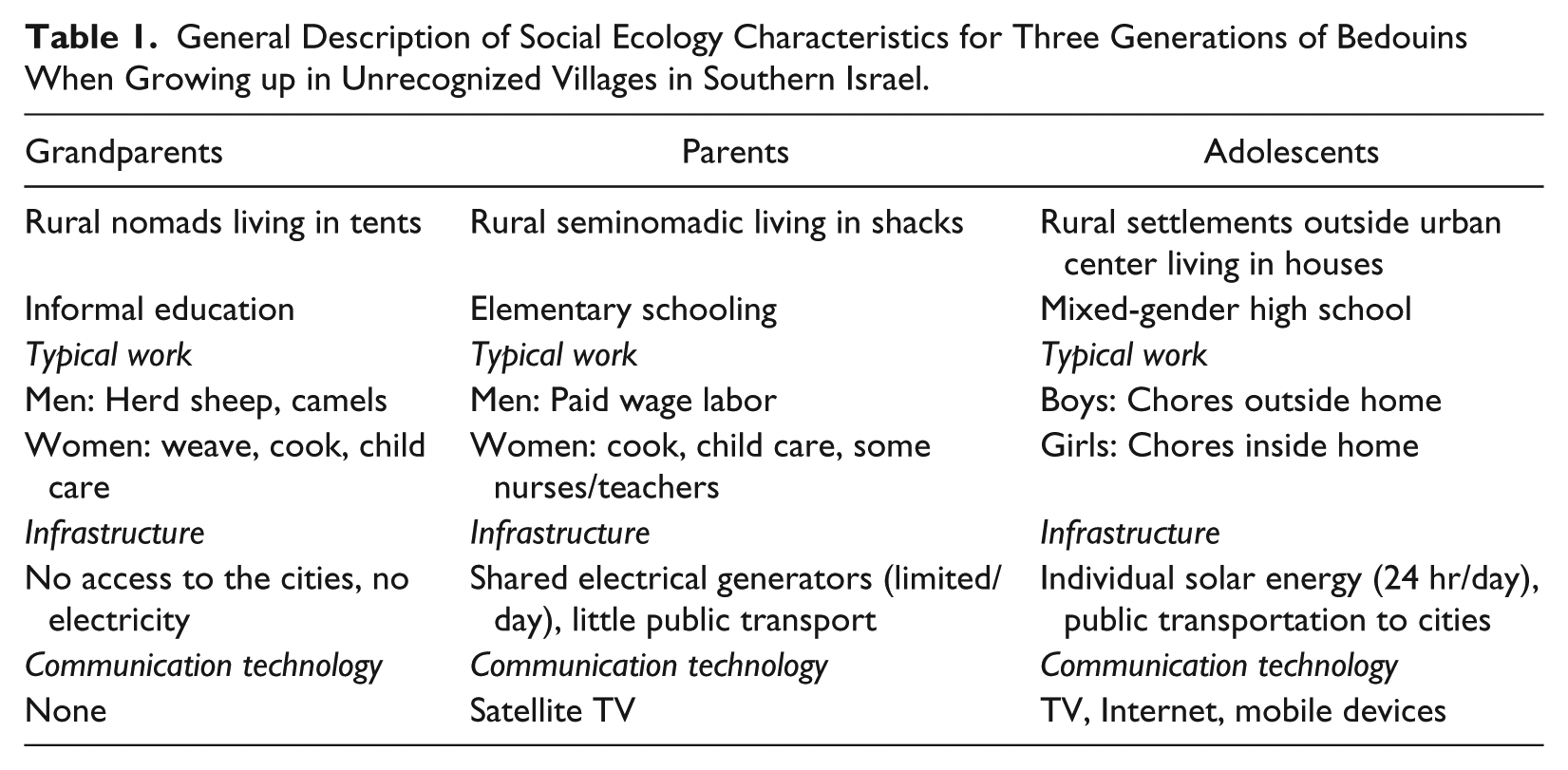
Bedouin society traditionally has been notably Gemeinschaft: Rural, homogeneous, clan-based, hierarchical, subsistence economy, low technology, and informal education at home. However, it has been moving toward Gesellschaft ecology: urbanization, participation in market and wage economy, formal education, greater contact with a diverse society. Table 1 portrays these changes as they affected the three generations in our sample.
General Description of Social Ecology Characteristics for Three Generations of Bedouins When Growing up in Unrecognized Villages in Southern Israel.
Bedouin society is traditionally a hierarchical, patriarchal, collective, tradition-oriented society (Dwairy, 1997). The central structural characteristic of the society is that the Bedouin live in tribes comprised of several extended families composed of nuclear families with many children. The relationship in the family is characterized by interdependence, expressed in economic and social support, in raising children and in household management (Barakat, 1993) with defined gender roles. Within Bedouin society, marriage serves as the basic framework, fulfilling an ideal of Islam, preserving the values of the community, and ensuring its stability and continuity over time. In this framework, the main role of the Bedouin woman is to manage the household and raise children (Abu-Rabia-Queder, 2006).
The traditional nomadic Bedouin culture in the Negev is characterized by ascribed and interdependent gender roles such that women had access to power only through their relationships with men and through their family roles of wife and mother (Dinero, 1997). Women were responsible for building and maintaining the tent home quarters and for a number of domestic activities including weaving clothes and tents, fetching water and wood, preparing food, caring for children, and milking goats (Abu-Rabia-Queder, 2006). Men were responsible for public domains of life, attended to land and flocks of sheep and camels, controlled resources, and made large decisions for the family. Although greater power was accorded to the male role, women had access to status through age, number of male children, as well as personal characteristics such as handicraft skills. In addition, women did have power, as they had knowledge and decision-making roles in domestic affairs, relations with neighbors, and marriage of their daughters. Men could have a number of wives, but women were expected to be indifferent to sex and demonstrate sexual purity through humble dress. Marriages were arranged based on family background and alliances, and women maximized their fertility to perpetuate the family and demonstrate service to Allah.
Some of the practices described here have changed somewhat as the Negev Bedouin moved from nomadic to seminomadic during the late Ottoman period and under the British mandate, and then more rapidly, with the advent of Israeli government policies beginning in the 1960s of settling the Bedouin toward sedentary lives (Goering, 1979). However, the general gender roles and patriarchal structure have persisted and more of the practices remain in the villages unrecognized by the state. (See Abu-Rabia-Queder, 2007, and K. Abu-Saad, Horowitz, and Abu-Saad, 2007, for descriptions of traditional gender roles and values, and changes in practices with settlement.)
When families began to settle into villages in the Negev, men began to rely less upon wives for meals and began to interact with other diverse Israelis; women, however, were still expected to maintain the domestic sphere and were even more cut off from public life than they were in nomadic times (Abu-Rabia-Queder, 2007). One of the goals of this study is to follow up with the most recent generation of Arab Bedouins to understand continuity and shifts in collectivistic values, gender roles, and cross-sex relations since the 1990s, when sociodemographic changes associated with integration into a sedentary Gesellschaft way of life occurred. More recent changes include greater accessibility of public transportation to urban centers, the increasing availability of high school as a public space in which girls can participate, and the greater ease of buying goods (such as clothes and prepared foods; Abu-Rabia-Queder, 2013).
Hypotheses
Because the scenarios used in the interviews were set up so that participants had to choose between a character espousing a Gemeinschaft perspective on a situation and participants espousing a Gesellschaft perspective on the same situation, increasing endorsement of the latter implies decreasing endorsement of the former.
In a previous study with Arab families near Haifa Israel, gender was controlled, in that all participants were female. In the present study, our sample includes participant families in which three generations of females are interviewed and participant families in which three generations of males are interviewed. How does gender relate to the effects of social change? Beginning to answer this question, Manago (2015) found that Zinacantec Maya high school boys in Chiapas, Mexico, were more resistant to gender role shifts in an egalitarian direction than were girls; she interprets this difference as an attempt by males to retain their higher position in a traditional gender hierarchy. With the advent of equal roles for both genders, males lose their advantageous position in the gender hierarchy, while females gain status in the same hierarchy. Female independence, particularly work outside the home, is perceived as detracting from the male provider role in an interdependent family system of complementary gender roles (Manago, 2015). However, she did not include males in the parent or grandparent generations of participants. Based on Manago’s findings, we developed two complementary hypotheses concerning gender differences in intergenerational comparisons:
Exploring Mechanisms
To this end, we explored differences between individuals in two types of sociodemographic characteristics: family characteristics (parental education, mother’s travel for work or other purposes, and age of marriage) and communication technologies (ownership and use of cell phone, computer, and television). In our prior research in an Arab village in Northern Israel, we found that mobile technologies were key to explaining intergenerational value differences. In the same study, we also found a significant rural–urban difference for Arab high school girls, with more Gesellschaft values in the urban group. In that case, there was no distinct mediating factor but mediation by complex of Gesellschaft factors prevalent in cities which together provided an explanatory mechanism for the rural–urban difference. Because multiple sociodemographic elements had undergone rapid change in this Bedouin community between the grandparents’ era growing up and the present-day adolescents, we explored the role of multiple factors.
Although there may be individual differences in some sociodemographic characteristics within ecologies, there are also the social changes common to all members of the community in a given generation that could be main drivers of value change; this would make it impossible to model the changes as individual differences. Many of the items in Table 1 are just such ecological features—characteristics of everyone’s environment in a given generation.
Method
Participants
Interviews were conducted with three generations of women and three generations of men in Bedouin families living in unrecognized villages (i.e., not the government established towns built to settle the Bedouin) surrounding the southern Israeli city of Be’er Sheva. The sample included 20 adolescent girls (Mage = 16.50; SD = 0.89), their mothers (Mage = 41.35; SD = 5.55), and grandmothers (Mage = 65.05; SD = 6.24) (total N = 60), and also 20 adolescent boys (Mage = 17.00, SD = 0.86), their fathers (Mage = 49.00, SD = 6.66), and grandfathers (Mage = 72.80, SD = 3.81) (total N = 60). There were significant differences in age between the grandmothers and grandfathers, t(38.403) = −4.74, p < .001, and between mothers and fathers, t(38) = −3.95, p < .001, but not between girls and boys, t(38) = −1.81, ns. The female and male generations were drawn from seven unrecognized villages to prevent the inclusion of overlapping family relations due to the practices within the villages of polygyny and intermarriage within clans.
Unrecognized villages have relatively small numbers of families, including many with cross-relations (as each village consists of a single clan), so we can assume that the participants are representative of their villages. We chose from a number of villages to maximize diversity (i.e., choosing from a number of clans). Because of our concern with overlapping families (given the practice of polygyny), it was in our interest to keep the sample size small in each village; this was one means to avoid choosing families with overlapping members. Given the homogeneity of the community and the small-scale size of the villages, we believe the sample is quite representative and likely contains a larger proportion of people from the population than a larger random sample in an urban area.
Materials
The interview instrument began with sociodemographic questions including age, highest level of formal schooling completed, work, age at marriage and number of children (adolescents provided ideal estimates of number of children), and possession of communication technology and use (i.e., mobile phones with or without data, computers with and without Internet and time on Internet, use of social media and television, and time watching television by languages).
To measure values, participants responded to a series of 10 vignettes that included a disagreement between two characters. One character in each vignette articulated Gemeinschaft-adapted values, arguing for the importance of family obligation, family unity, ascribed gender roles, interdependence, or gender hierarchy. Another character in each vignette articulated Gesellschaft-adapted values, arguing for the importance of individual achievement, the bond between a couple, individual choice, independence, or gender equality. For example, in one vignette a young woman travels by herself for work as a teacher and to run errands. One relative sees her and says that she should not be out without a male chaperone. Another male relative in the vignettes says he thinks that she is a free person and can go wherever she likes without a chaperone (gender hierarchy vs. independence). Participants are asked which character in the story they agree with more and why.
The stimulus stories were based on vignettes developed by Manago (2014) to study generational differences in a Maya community in Chiapas, Mexico, as the community shifted from a more Gemeinschaft to a more Gesellschaft ecology. The vignettes were revised and added to include culturally authentic issues regarding gender roles and cross-sex relations about which there are differences of opinion in the community. The first author, a Bedouin male, worked with two female Bedouin research assistants to develop realistic vignettes based on their experiences living in the community. They chose groups of people from a range of social ecologies and generations in the Bedouin community as pilot participants to test the vignettes to determine if they indeed represented points of tension and did evoke a range of responses. If proposed vignettes did not produce a range of responses or the issues were not well understood by these pilot participants, they were refined or discarded. All refined or new vignettes were tested with new participants. In addition, we received important feedback from a female Bedouin researcher who has researched Bedouin women and social changes from a sociological perspective; she was a member of the first author’s doctoral proposal committee and reviewed the vignettes as well as the sociodemographic questionnaire.
The vignettes dealt with the following 10 issues (labeled here with the Gemeinschaft perspective on the issue first): customs for men to walk in front of women versus next to each other, women traveling without a chaperone in the village versus freedom to walk around by themselves, women’s duty to make tea for men versus men making tea for themselves, arranged marriage versus personal choice in partnering, son staying near his family versus leaving the village for school in the city, professional woman should not or should be allowed to travel to city alone in the evening, girl spending time in the company of the family versus spending time on the Internet, boy working for the family versus deciding what to do with his leisure time, and accepting or rejecting polygyny.
Procedures
The first author (a Bedouin man from a recognized town in the Negev) recruited participants through schools, community centers, and contacts in villages where he worked as a teacher supervisor from the Ministry of Education. The first author’s insider cultural knowledge and that of the Bedouin research assistants indicated that snowball recruiting was a culturally appropriate method in a clan-based society; this method helped complete the sample. Snowball recruiting also helped ensure that families could be found that did not have overlapping relationships (like common fathers or grandparents), something that would not have been known by the researchers, had they recruited each family individually from the single-clan unrecognized villages. Through snowball sampling, we could set the criterion of recruiting families that were known not to have overlapping family members. Without this, we might have inadvertently recruited adolescents from different households with different mothers, but with the same father or the same grandparents. Given the quite homogeneous population of each unrecognized village, snowball sampling would not make the sample less representative. Indeed, given that it helped us find families with no overlapping members, it ensured greater diversity and representativeness in the sample.
All participants who were invited to participate agreed and all completed the interviews. This recruiting success also added to the representativeness of the sample. Consistent with cultural values, rather than as an incentive and precondition of participation, parents and grandparents received a gift of a grocery shopping card as an expression of appreciation following the completion of the interview. The adolescents received a flash drive, as it had an educational purpose. The first author conducted interviews along with Bedouin research assistants under his supervision. All of the interviews were conducted individually in spoken Arabic, and the exchange was audio recorded. To be respectful of cultural gender norms, the first author and a male research assistant interviewed the male participants; two female research assistants interviewed the female participants. As the Bedouin community is clan-based, a potential threat to anonymity and privacy would have occurred if the interviewer and a participant had been related. We insured that all participants were interviewed by an interviewer from a different clan. Participants were asked to listen to the stories and answer according to the way they view things. They were assured that their responses would be private and anonymous. Interviews lasted between 45 and 60 min. Recorded interviews were transcribed into spoken Arabic by the first author.
Coding and Scale Construction
Each response to the vignette was coded a “1” if the participant agreed with the Gemeinschaft character, a “3” if the participant agreed with the Gesellschaft character, and a “2” if the participant endorsed both sides or had some kind of mixed response. This scoring system was not meant to indicate that Gesellschaft-adapted responses were better than Gemeinschaft-adapted responses, but simply the dominant direction of globalized social change. The first author and a research assistant separately coded 21 interviews to test for interrater reliability. The interrater reliability was substantial in each of the 10 vignettes with Kappaweighted ranging from .79 to 1.00.
Scores for the 10 vignettes were added together to form a 20-point scale from 10 to 30. There was good internal reliability between the vignettes (α = .79) indicating consistency in individual responses to the vignettes. We also carried out a factor analysis; the scree plot indicated a likely one-factor solution. This same method of scale construction has been used in three prior articles using similarly structured vignettes: one in a Maya community in Mexico (Manago, 2014) and two in Arab communities in Israel (Weinstock, 2015; Weinstock et al., 2015). In addition, responses and reasons for responses were analyzed for themes that could potentially provide insights into any quantitative trends occurring across generations.
Statistical Analysis
To be clear, we are using intergenerational comparisons as an indication of social change (Pinquart & Silbereisen, 2004). To best represent intergenerational differences, the family unit (grandparent, parent, and adolescent) was the unit of analysis. Repeated measures general linear models were performed with generation as the within-subjects independent variable and mean vignette score as the dependent variable. This type of analysis allowed for testing contrasts in vignette scores across the generations within each family. The analyses were performed by gender, to assess generation differences within each gender, and by generation as a whole with gender included as a between-subjects factor to assess whether there were differences in the generational patterns by gender.
To shed light on potential mechanisms, we used a mediational analysis. For the mediation test, we used a bootstrapping analysis (Preacher & Hayes, 2008). That is, we tested whether an indirect effect of generation on vignette scores through the proposed mediation of various sociodemographic variables would be significant. The assumption of multivariate normality of the distribution of the total and specific indirect effects can be problematic in mediation tests without large samples (MacKinnon, Rose, Chassin, Presson, & Sherman, 2000; Preacher & Hayes, 2008). Thus, the bootstrapping method was used because, as a nonparametric test, it is suitable for the numbers of participants in our samples, and unlike parametric mediation, it can be used with multiple possible mediators to test for the indirect effect of each mediator variable while controlling for all other variables in the model; it also has generally been shown to be an improvement over parametric tests even with larger samples (Fritz & MacKinnon, 2007; Preacher & Hayes, 2004). With bootstrapping, the sampling distribution is approximated through extensive resampling. The results of this process are point estimates and percentile confidence intervals (CIs) for indirect and total effects. If the CI around the indirect effect does not include zero, the mediation is considered to be significant. In the present study, bootstrap percentile CIs were calculated with bias-correction and 5,000 bootstrap samples as recommended by Preacher and Hayes (2008). The analysis was performed using an SPSS macro for the PROCESS program (version 2.16) provided on Hayes’s (2014) website. The bootstrapping method used in the mediation analyses allows for small sample sizes as each of the thousands of reiterations uses variations in the membership of the groups and with this develops the CIs.
A Spearman’s nonparametric rank correlation was used to explore whether there was a pattern of significant relationships among the vignettes. As we expected the vignettes to be correlated in a single (positive) direction, we used a one-tailed test.
Results
Descriptive Statistics
Sociodemographic characteristics
Both female and male generations differed in sociodemographic characteristics that are representative of transitions from small-scale community to large-scale society (see Table 1 for general group description of sociodemographic characteristics by generation). Grandparents grew up living a nomadic life in tents; parents grew up in makeshift camps disconnected from the urban center of Be’er Sheva; and adolescents are growing up in environments with greater infrastructure like electricity, running water, Internet, paved roads, and more access to the urban center. Whereas only 15% of the grandmothers and grandfathers had any formal education at all (and all but one only elementary school), 55% of the fathers and 35% of the mothers had at least some high school education, and all 40 of the adolescent girls and boys were in high school in the closest Bedouin town (recognized by the government) or, in a few cases, in high schools opened recently in a few of the unrecognized villages.
Table 2 describes the demographics regarding education, work, and family in the grandparents’ and parents’ generations by gender. Adolescent girls reported 22.55 (SD = 3.30) years as the ideal age for marriage and desired 2.95 (SD = 1.00) children; adolescent boys reported 24.90 (SD = 2.71) as the ideal age for marriage and desired 5.20 (SD = 2.20) children. These goals contrast sharply with the 10 children born, on average, to the mothers and grandmothers in the sample. Smaller family sizes are one characteristic of the transition from a Gemeinschaft to a Gesellschaft social ecology (Weinstock et al., 2015). Moreover, the fact that adolescent boys desire more children than adolescent girls is the first indication that females have moved more quickly in the Gesellschaft direction than males. The list of all of the sociodemographic characteristics that were found correlated with generation and/or vignette score is found in Table 3.
Specific Description of Sociodemographic Statistics for Parents and Grandparents by Gender in This Study.
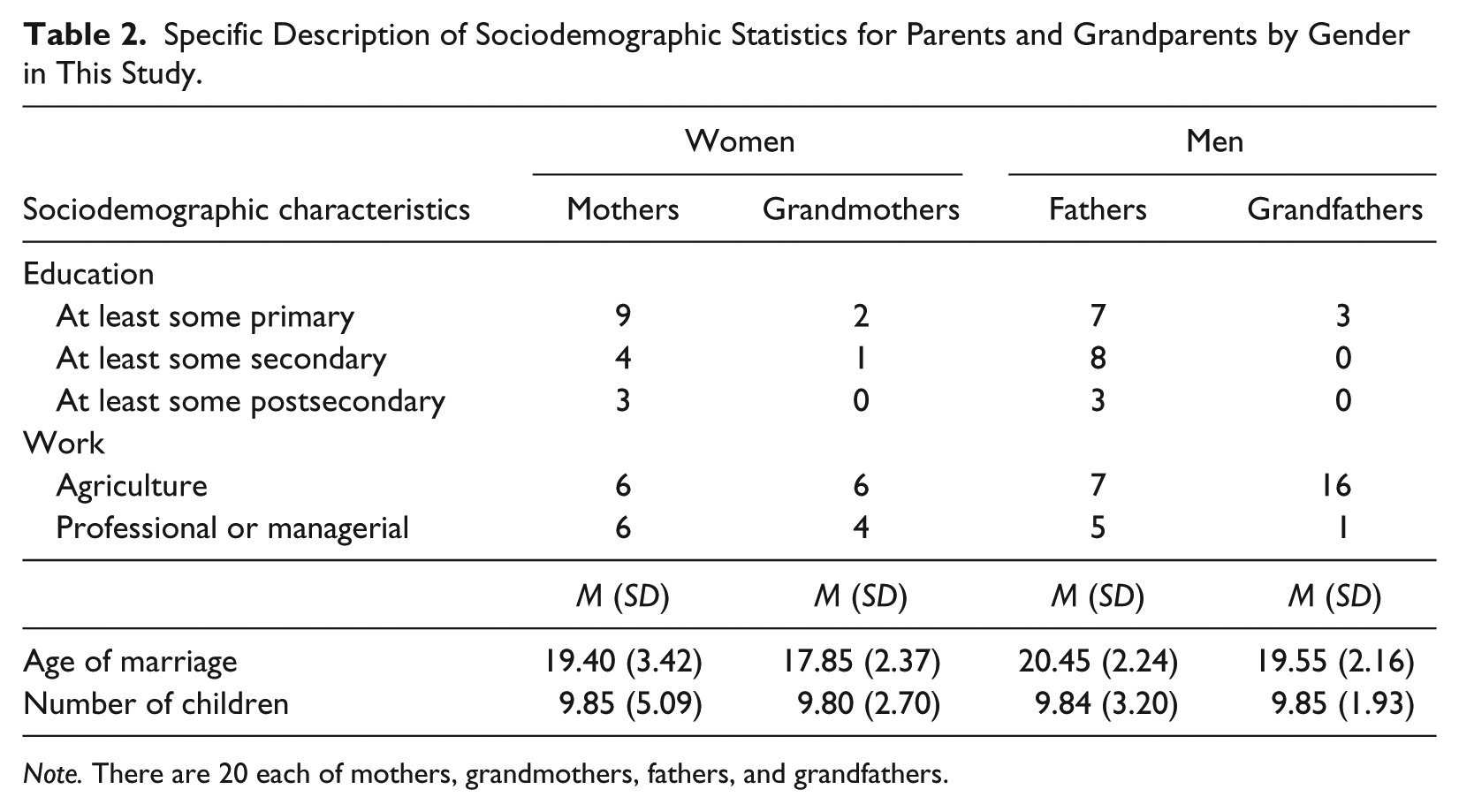
Note. There are 20 each of mothers, grandmothers, fathers, and grandfathers.
Sociodemographic Characteristics Found Correlated With Either Generation or Mean Vignette Scores.
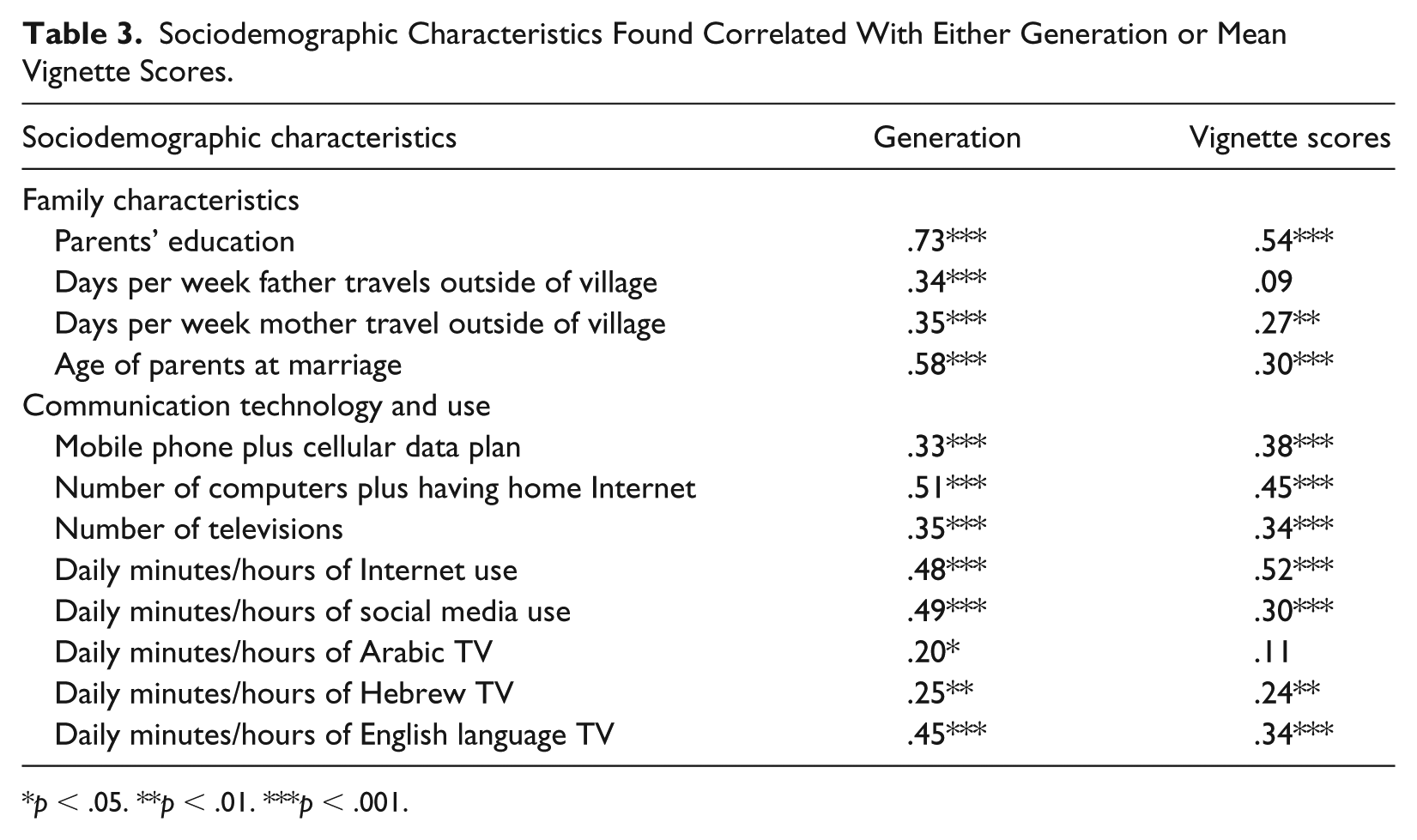
p < .05. **p < .01. ***p < .001.
Vignettes
Table 4 shows notable intercorrelations among the vignettes. Although there is not perfect correlation among the vignettes, every vignette is significantly correlated positively with between four and nine other vignettes. Thirty-two of the 45 correlations were significant with another four nearing significance. The two instances in which there were apparent negative correlations were not significant, and the correlations were near to 0. In sum, participants tended to be consistent in their views across vignettes. Because values can be situation-specific (Greenfield & Quiroz, 2013), we did not expect a complete set of strong correlations. Based on the general sense of direction indicated in this table showing relationships among the vignettes, and buttressed by the alphas, mean scores, used in subsequent analyses, were calculated representing the tendency across all of the vignettes.
Spearman Correlations Among the Vignettes.
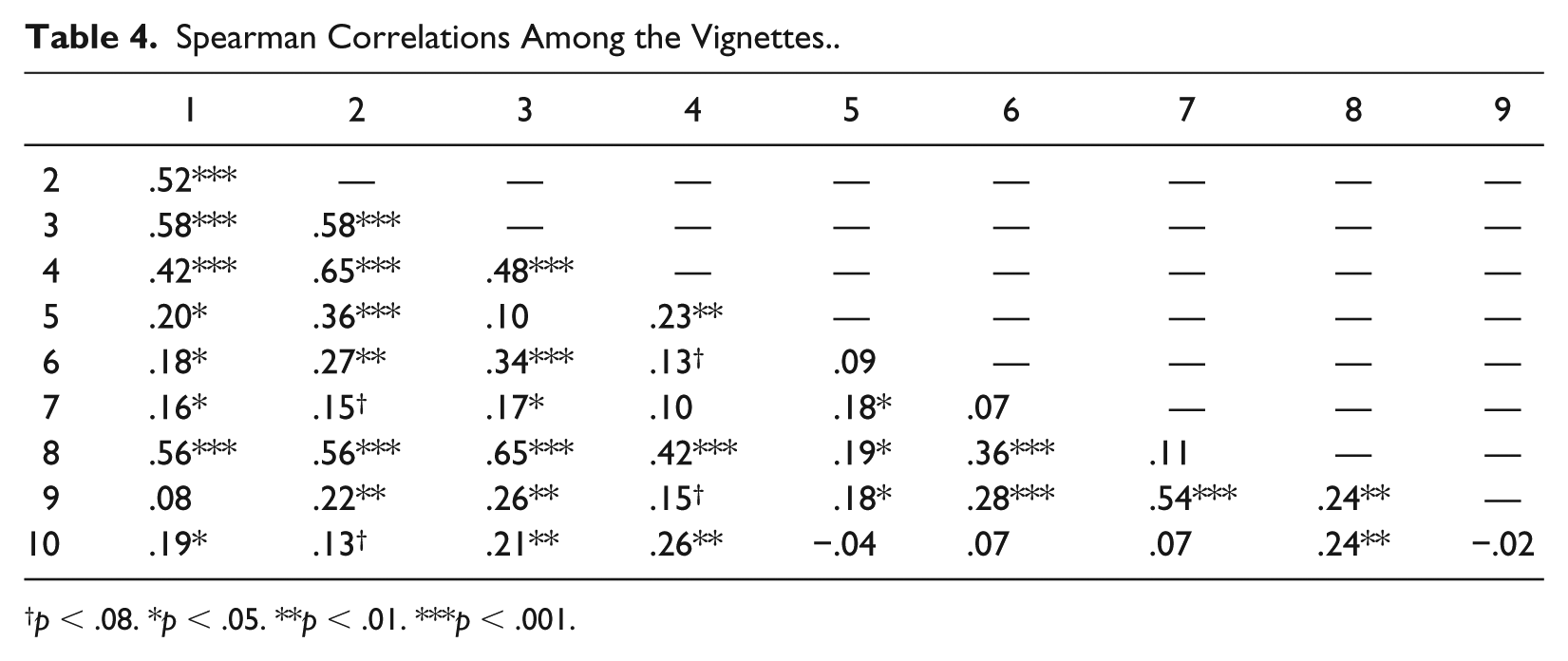
p < .08. *p < .05. **p < .01. ***p < .001.
Quantitative Findings
This hypothesis was confirmed. Sphericity could be assumed as Mauchly’s test was not significant, χ2(2) = 5.47, p = .07. The main effect of generational differences within families was found to be significant, F(2, 76) = 60.42, p < .001,
Means Values Vignette Scores by Generation Within Genders.

Repeated measures analyses were used to assess generational differences within families by gender. As the Mauchly’s test for sphericity was significant, χ2(2) = 6.27, p = .044, the lower bound correction of the within-subjects effects was used, and significant differences were found between the generations in the families among the females, F(1, 19) = 18.32, p < .001,
With the males, sphericity could be assumed as Mauchly’s test was not significant, χ2(2) = 2.58, p = .28. The within-subjects effects test showed significant differences between the generations of males, F(2, 28) = 52.65, p < .001,
To examine the possibility that Gesellschaft-adapted values are being added to, rather than replacing, Gemeinschaft-adapted values, we examined responses in which the participant endorsed both perspectives in responding to a vignette; these were coded as 2, per the coding system described in the “Method” section. Across three generations, these were very rare. Sixty percent of the participants had no 2s; no participant responded by expressing both cultural perspectives in response to more than one out of 10 vignettes. So by and large the two perspective were an either-or matter, and, consequently, the intergenerational differences were differences between a Gemeinschaft- and a Gesellschaft-adapted perspective, with almost no expression of both perspectives. However, there were a few cases where the middle generation exemplified an integration of or negotiation between both perspectives, and examples of this pattern of intergenerational differences are presented in the qualitative section of the Results.
In line with the overall prediction of gender differences, we found a main between-subjects effect of gender, F(1, 38) = 57.23, p < .001,
For each generation, the female family units have a significantly higher mean (i.e., more Gesellschaft) than the male family units (see Table 5). When controlling for age to account for significant age differences found between the genders in the grandparents’ and parents’ generations, grandmothers had higher mean vignette scores than grandfathers, F(1, 37) = 4.94, p < .05,
In line with this hypothesis, there was a significant interaction between generation and gender, F(2, 76) = 3.31, p = .042,
We tested two groups of sociodemographic variables as potential mediators—family characteristics and communication technology use. Among a number of possible sociodemographic variables, we tested those that were significantly correlated with generation and mean vignette score (see Table 3). Family characteristics included the number of times the mother travels outside the village each week, the age one’s parents were when they got married, and parental education (none, one, or both parents with formal education of elementary school or higher). The model of the indirect effect with these variables along with generation was found significant, F(5, 93) = 13.39, p < .001. As a whole, the group of family characteristics mediated the relationship between generation and vignette score (CI = [.018, .321]). However, the only variable that is statistically significant by itself is parental education (CI = [.031, .306]) Figure 1 highlights the unique role of parents’ education. This analysis indicates that participants’ parents’ level of education stands out from other family characteristics (the number of days each parent travels outside the village and the age one’s same-sex parent got married) as a potential motor of change toward Gesellschaft-adapted horizontal individualism concerning gender roles and cross-sex relations in the younger generations.
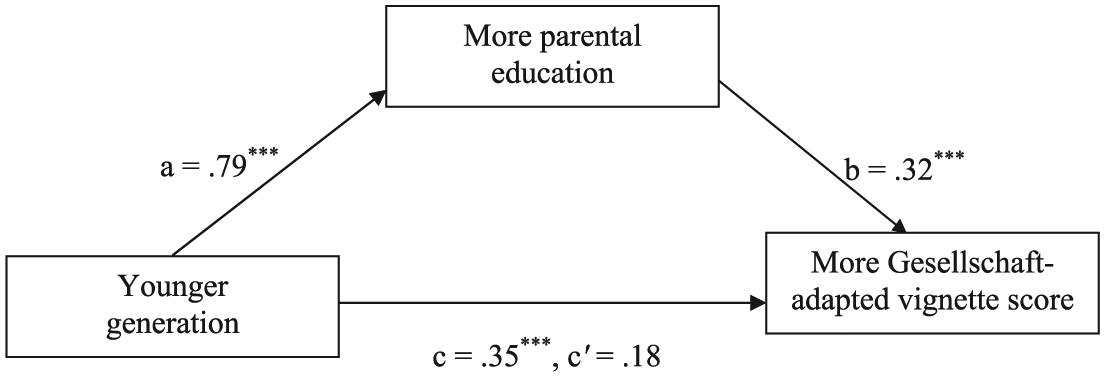
Mediation of relationship between generation and vignette score with significant family characteristic variables.
The sociodemographic variables regarding communication technology use were correlated with generation and, for the most part, mean vignette score (see Table 3). The technology variables included whether one had a cell phone, whether the phone had Internet capability, the number of computers in the house with or without Internet, and the number of televisions. The use variables included the number of minutes or hours spent daily on the Internet, using social media, and watching Arabic, Hebrew, and English language television. The model of the indirect effect which included these variables along with generation was significant, F(7, 106) = 14.84, p < .001. As a whole, this group of variables mediated the relationship between generation and vignette score (CI = [.063, .234]). However, the only variables that were statistically significant by themselves were hours of Internet use (CI = [.034, .138]) and hours of television watching across language types (CI = [.006, .137]) Figure 2 highlights the important role of Internet use and television viewing. This indicates analysis that particular technology uses, spending time on the Internet and watching television, stand out as potential motors of change toward Gesellschaft-adapted independent values.

Mediation of relationship between generation and vignette score with significant communication technology and use variables.
Qualitative Responses
The quantitative coding was based on the verbal responses to the vignettes. A selection of the reasons behind these responses can provide an illustration of the shifting values by generation. As shown in the quantitative results, there are significant differences within families that show grandparents tending toward Gemeinschaft-adapted responses, parents tending to be less Gemeinschaft and more Gesellschaft in their responses, and adolescents tending even more toward a Gesellschaft orientation, particularly girls. The illustrations provided are drawn from examples in single family units in each gender that match this pattern in a particular way, with grandparent expressing a Gemeinschaft-adapted response (coded as 1), the parent expressing a mixed response (coded as 2), and the adolescents expressing a Gesellschaft-adapted response (coded as 3).
The first author was responsible for the qualitative content presented here. He is a Bedouin doctoral student living in a Bedouin town in the region of the unrecognized villages. He was born in an unrecognized village and moved to the town 25 years ago. He has held many positions in the education system in the Bedouin community, and thus has extensive personal and professional knowledge regarding the characteristics of the villages, and has experienced the changes the community from which the sample was drawn has undergone. He worked with the other authors—one Israeli non-Bedouin living in the same region as the Bedouin communities, and two non-Bedouin Americans—to design the interviews, with his role being to ensure that they would be culturally appropriate for the community, while also being able to address the theoretical issues of interest to all the researchers. The purpose of the qualitative analysis is to provide a description at the personal level to test and provide insight into the lived experience suggested in the quantitative analysis at the group level. The first author analyzed the interviews and selected the excerpts reported.
In the vignette regarding whether or not it is okay for boys and girls to speak together outside of school, the grandmother in one family said, “She doesn’t need to speak with him at all. Girls don’t talk with boys.” This statement explicitly reflects the traditional belief that unmarried girls should not be speaking with unmarried boys. The mother in this family recognizes why this prohibition exists, but holds that there are circumstances when it might be okay for girls and boys to interact: “They can speak just about their studies but not beyond that. You never know what it could lead to.” Finally, the adolescent girl in this family unit takes a clearly Gesellschaft-adapted position, even explicitly referring to social change toward Gesellschaft-adapted values: “I think that there is no problem and they can talk. The world has changed a lot.”
A similar pattern appears in a male family unit regarding the vignette of whether it is okay for a woman to go to the school to talk with teachers about her son when this would traditionally be the man’s role to represent the family in the public domain. The grandfather states the Gemeinschaft-adapted value regarding gender roles saying, “The woman’s place is in the house. She does not need to go.” His son, the father in this family, acknowledges this value, and states it as a preference, but one that can make accommodations. “If he cannot go, she can go. But if he is at home, it is his job.” The adolescent boy in the family seems unconcerned with maintaining this value of ascribed gender roles when it comes to a child’s schooling. He says, “She needs to go to the school to ask about her children. This is okay and there is no problem.”
The interaction between gender and generation, in which the mothers appear less Gemeinschaft-oriented than the fathers, was also expressed in qualitative responses to the vignettes. For instance, the following examples are in response to the vignette of whether it is okay for a man to make food for the children if the mother is working late. Each example comes from families in which the grandparent and adolescent clearly state a Gemeinschaft- or a Gesellschaft-adapted value, respectively. Both the mother and the father express solutions that represent at least some accommodations between Gemeinschaft and Gesellschaft orientations. The father says, “She needs to change her job so that she comes home before he does and makes the food, or that she stays at home to make the food.” Although the father strongly expresses the need to maintain the gender hierarchy and corresponding gender roles—and in this reflects Gemeinschaft-adapted values—he does not reject the idea that a woman can work outside the home. In contrast, the mother’s solution represents possible accommodations recognizing the demands and affordances of Gesellschaft society, and the possibility of an egalitarian solution. “They need to arrange it that sometimes he makes it and sometimes she makes it, and they can heat it up in the microwave and sometimes they can buy it prepared.” Thus, this mother sees different avenues other than the mother’s ascribed role to fulfill the task of feeding the family. As a point of contrast, in what was coded as a clear expression of Gesellschaft-adapted gender egalitarianism, this mother’s daughter’s response was “Yes, he needs to prepare the food. Sarah is right that he needs to help at home.”
Discussion
Our major hypothesis (Hypothesis 1)—that increasingly Gesellschaft conditions across the three generations would relate to increasing endorsement of horizontal individualism in the domain of gender from the oldest to the youngest generation of Bedouin participants—was confirmed. Thus, the application of Greenfield’s theory of social change and human development was extended to a new ecology—a group transitioning from a nomadic way of life to life in Gesellschaft society. This extension of Greenfield’s theory demonstrates that sociodemographic factors characteristic of a more Gesellschaft society seem to increase ideals related to individual agency regardless of whether learning environments are shifting away from an agricultural or nomadic community. In both types of Gemeinschaft communities, whether stable or mobile, adult roles and learning environments are bifurcated by gender such that children and adolescents learn to become valued members of their community through tasks that emphasize their interdependence in a family unit. Sociodemographic factors associated with a Gesellschaft society modify this common characteristic of Gemeinschaft environments; instead, children engage with relatively more gender equivalent learning environments, tasks, and ideals, which may foster greater psychological salience of the self as an individual with independent choices rather than fulfilling ascribed, interdependent gender roles for the good of the family. The shifting nature of adult gender roles that comes alongside greater integration into a global market economy has already been identified as a powerful motor driving value change from tradition, survival, and security to secular-rational and self-expression values across the globe (Inglehart & Norris, 2003). Our study contributes to this body of knowledge by elaborating on various sociodemographic factors involved in this form of societal change that may impact socialization and development.
The hypothesis (Hypothesis 2a) that females will have more Gesellschaft-adapted values than males was confirmed. Results also suggested that females shift earlier than males toward gender equality and independence, confirming Hypothesis 2b. Thus, the design of our study allowed us to document an additional factor, beyond sociodemographics, that plays a role in societal and psychological change, namely, one’s own position of privilege in gender hierarchies. Whereas prior studies of intergenerational differences in the context of social change (Manago, 2014; Weinstock et al., 2015) have restricted their samples to female adolescents, mothers, and grandmothers, this study also included three generations of males and replicated the pattern of intergenerational differences. At the same time, we also found that males had less favorable attitudes toward Gesellschaft values, many of which were related to gender equality and female independence. Clearly, males, at the top in the traditional gender hierarchy, have more to lose in the shift, whereas females have more to gain. Manago (2015) found greater resistance from males than females to shifts toward independent gender roles in high school students in a Maya community in Chiapas; Dinero (1997) found the same pattern among the Bedouins of the Negev. In the present study, the pattern of greater male resistance is extended to three generations. Our speculation is that women (mothers and grandmothers) are thinking of the future of their granddaughters more than grandfathers when they endorse more Gesellschaft-adapted values and action. Despite male resistance, our data also show that younger males have more Gesellschaft-adapted values than their fathers and grandfathers.
A tenet of Greenfield’s theory of social change and human development is that the main driver of cultural and developmental change will be that ecological element that is changing most rapidly in the time period and place under consideration. In Bedouin communities, the main intergenerational differences were parental education and media use, and these factors mediated the observed intergenerational shift in values toward gender equality and female independence. These results confirmed Hypothesis 3, which stated that indicators of sociodemographic changes would mediate the hypothesized intergenerational differences in values.
In our study of social change and human development in Arab communities in Northern Israel, access to mobile technologies was the main variable explaining changing values. That was not the case in the Bedouin data; instead, daily minutes on Internet and daily minutes on TV had begun to shift from generation to generation among the Bedouins; unlike the Arabs, even grandparents had adopted cellular technology, so this was a constant between the generations and therefore could not explain intergenerational shift in gender values.
Despite these differences, both studies show support for the idea that greater engagement with communication technologies socializes the importance of individual choice. Whereas numerous studies have highlighted the role of formal schooling in cultural and psychological change (LeVine et al., 1991; Rogoff, Correa-Chávez, & Navichoc-Cotuc, 2005), researchers are just beginning to document how communication technologies are becoming another important mechanism by which learning environments and psychological values shift (Hansen, Postmes, Tovote, & Bos, 2014). In their experimental design with school children in Ethiopia, Hansen and colleagues found that those who received a laptop (with educational software, but without Internet connection) endorsed greater values for self-direction and gender equality 6 months later compared with a matched sample who did not receive a laptop. Ownership and use of communication technologies could increase independent and autonomous self-construal (Markus & Kitayama, 1991) by offering opportunities for choice and gratification of personal desires. When connected to the Internet, as was the case in the current study, these tools also provide a window into alternative horizons beyond the immediate surround, exposure to Western consumerist values, and opportunities to easily connect with people outside the community and family. Manago and Pacheco (2019) found that, among indigenous Maya youth, use of the Internet and Facebook led to more diverse social networks consisting of contacts outside the family, which in turn predicted greater endorsement of personal choice in matter of gender roles and relations. In our previous study with Arab adolescent girls in Northern Israel, using Facebook to talk to boys was also associated with more Gesellschaft-adapted individualistic values. Thus, communication technologies may be a driver of cultural and psychological value change if they lead to changes in the typical communication practices and compositions of social networks.
As the models show, not all intergenerational difference was explained. We attribute the remaining drivers of intergenerational differences to sociodemographic changes that cannot be separated out statistically because they affect the whole community. For example, important examples of lost subsistence skills on a community-wide level are agricultural work, shepherding, and weaving. These losses could reasonably be assumed to be drivers of change but have no point of comparison (such as between individuals in the community or to other similar communities without this infrastructure) that would enable one to test this assumption statistically.
Limitations
One limitation was that important sociodemographic variables that had changed over time were not part of the interview protocol, including access to public transportation and the number of hours of electricity available on average every day. This hindered our ability to account for greater variability in responses to the vignettes across generations. There may also be sources of stability in values over generation that we did not measure and that were not the focus of the current study. It is also important to point out that we used a cross-sectional rather than longitudinal design to test a theoretically driven causal hypothesis. Although research with larger sample sizes and with other nomadic communities could further strengthen the application of Greenfield’s theory to this new ecology, our sampling methods and locally derived value measurement tool constitute a valid representation of psychological change in correspondence with increasing Gesellschaft conditions in the south of Israel. The final limitation is that, although the theory predicts generalized effects of the most rapidly changing sociodemographic elements at a particular point in time, our data do not permit us to explore whether different sociodemographic factors are operative for particular value shifts.
Conclusion
Our study is one more testament to the fact that we cannot treat cultures or ethnic groups as static entities. Instead, we need to understand how and why cultures change—why the transmission of values from one generation to another—is imperfect. The present study shows once again that, to reach this understanding, we must incorporate sociodemographic shifts as a motor for changing cultural values across time.
Sociodemographic shifts are affecting Bedouin values, as they do in other parts of the world. The Bedouin are part of the worldwide movement toward individual achievement, choice, independence, and gender equality. These same movements can be fueled by national development or immigration (Greenfield, 2016). But in all cases, we need to keep in mind the corresponding losses: family interdependence, community permanence, and the security of complementary gender roles ascribed by birth.
Footnotes
Acknowledgements
The authors would like to thank Sara Vakili, Hayat Abu Kaf, Susman Abu Shakra, and Tasnin Elaasam, who helped with the development of the research instruments and assisted with the interviews. The authors would also like to thank all of the grandparents, parents, and teens who were generous with their time, effort, and thoughts in their participation in the research.
Declaration of Conflicting Interests
The author(s) declared no potential conflicts of interest with respect to the research, authorship, and/or publication of this article.
Funding
This research is supported by the United States–Israel Binational Science Foundation Grant 2011184 awarded to Michael Weinstock and Patricia M. Greenfield. The authors gratefully acknowledge this support.
